
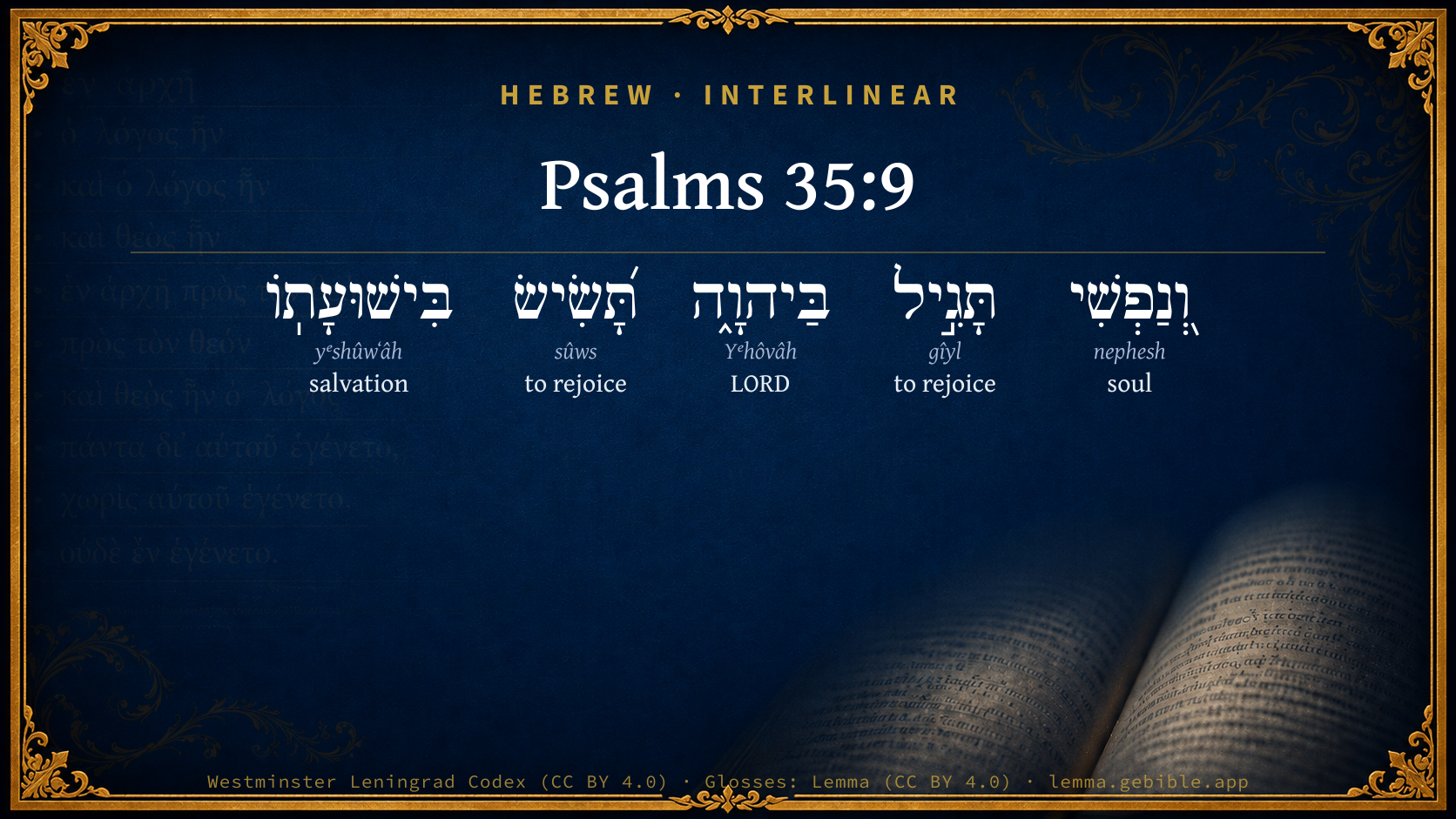
Psalms 35:9

Hebrew (Westminster Leningrad Codex) Psalms 35:9 appears in the Hebrew Old Testament. The text above is from the Westminster Leningrad Codex. Each word links to its Strong’s number, a concise gloss, and parsing drawn from the Open Scriptures Hebrew Bible morphology. Click any word for its full Brown-Driver-Briggs (BDB) entry.
Download image
Cite this verse

Psalms 35:9 (World English Bible). Public Domain. Lemma interlinear Bible study tool, https://lemma.gebible.app/v/psalms/35/9.

Show BibTeX & RIS
BibTeX
RIS
English Translation
My soul shall be joyful in Yahweh. It shall rejoice in his salvation.
World English Bible · Public Domain
Download a study sheet

One document with this verse’s original text, its word-by-word gloss line, the meaning frame, cross-references with their text, attributed commentary, and full source and license credits — printable, and it pastes into notes with its structure intact.

This verse Autodidact and up

Study sheet (.html) Plain text (.txt)

A passage Seminary Student

Up to 50 verses in one chapter. A passage sheet keeps up to 6 commentary sources and 12 cross-references per verse, in the order this page ranks them, and says so on the sheet whenever that leaves anything out. Ask for a single verse and you get the Autodidact verse sheet above.

Everything on this page stays free to read, with no account — the sheet is a download of what is already on screen, not access to it.

Want to remove ads? Support Godless Engineer
Compare translations 3

The same verse in 3 English versions, stacked beneath the original-language interlinear above. Click any original word for its lexicon entry.

Each is an independent rendering of the whole verse — the interlinear is not word-aligned to these translations.

Highlighted words mark where these versions differ — a whole-verse word diff, not a word-by-word alignment.

  • World English Bible Public Domain
    My soul shall be joyful in Yahweh. It shall rejoice in his salvation.
  • King James Version Public Domain
    And my soul shall be joyful in the LORD: it shall rejoice in his salvation.
  • unfoldingWord Literal Text CC BY-SA 4.0
    But my soul will be joyful in Yahweh; it will rejoice in his salvation.

unfoldingWord Literal Text — © unfoldingWord, licensed CC BY-SA 4.0. Word-aligned USFM3 via Door43 (git.door43.org/unfoldingWord/en_ult).

Versions to compare (up to 4)

3 of 4 selected

Show all 18 translations

Every available English version of this verse, each an independent rendering of the whole verse.

  • World English Bible Public Domain
    My soul shall be joyful in Yahweh. It shall rejoice in his salvation.
  • Berean Standard Bible Public Domain
    Then my soul will rejoice in the LORD and exult in His salvation.
  • Majority Standard Bible Public Domain
    Then my soul will rejoice in the LORD and exult in His salvation.
  • King James Version Public Domain
    And my soul shall be joyful in the LORD: it shall rejoice in his salvation.
  • American Standard Version (1901) Public Domain
    And my soul shall be joyful in Jehovah: It shall rejoice in his salvation.
  • Revised Version (1885) Public Domain
    And my soul shall be joyful in the LORD: it shall rejoice in his salvation.
  • Geneva Bible (1599) Public Domain
    Then my soule shalbe ioyfull in the Lord: it shall reioyce in his saluation.
  • Douay-Rheims (1899) Public Domain
    But my soul shall rejoice in the Lord; and shall be delighted in his salvation.
  • Young's Literal Translation Public Domain
    And my soul is joyful in Jehovah, It rejoiceth in His salvation.
  • Literal Standard Version CC BY-SA 4.0
    And my soul is joyful in YHWH, || It rejoices in His salvation.
  • Unlocked Literal Bible CC BY-SA 4.0
    But I will be joyful in Yahweh and rejoice in his salvation.
  • unfoldingWord Literal Text CC BY-SA 4.0
    But my soul will be joyful in Yahweh; it will rejoice in his salvation.
  • Darby Bible Public Domain
    And my soul shall be joyful in Jehovah; it shall rejoice in his salvation.
  • World Messianic Bible Public Domain
    My soul shall be joyful in the LORD. It shall rejoice in his salvation.
  • Webster's Bible Public Domain
    And my soul shall be joyful in the LORD: it shall rejoice in his salvation.
  • Free Bible Version CC BY-SA 4.0
    Then I will be glad in the Lord; I will be happy in his salvation.
  • Bible in Basic English Public Domain
    And my soul will have joy in the Lord; it will be glad in his salvation.
  • JPS Tanakh (1917) Public Domain
    And my soul shall be joyful in the LORD; it shall rejoice in His salvation.

Literal Standard Version (2020), Covenant Press — licensed CC BY-SA 4.0. Text via the HelloAO Bible API (eBible.org). Unlocked Literal Bible (unfoldingWord) — licensed CC BY-SA 4.0. Text via the HelloAO Bible API (eBible.org). unfoldingWord Literal Text — © unfoldingWord, licensed CC BY-SA 4.0. Word-aligned USFM3 via Door43 (git.door43.org/unfoldingWord/en_ult). Free Bible Version, Dr. Jonathan Gallagher — licensed CC BY-SA 4.0. Text via the HelloAO Bible API (eBible.org).

Word by word

More ways to search: Search by grammar → Find every occurrence → Compare this word →

Practice this passage: Drill this verse → Learn its vocabulary →

About this verse

These counts appear in no published source. They are computed here, from the morphology-tagged text and Lemma’s own curated glosses. What Lemma adds →

5
words
5
distinct lemmas
Wisdom
section

Shared distinctive vocabulary

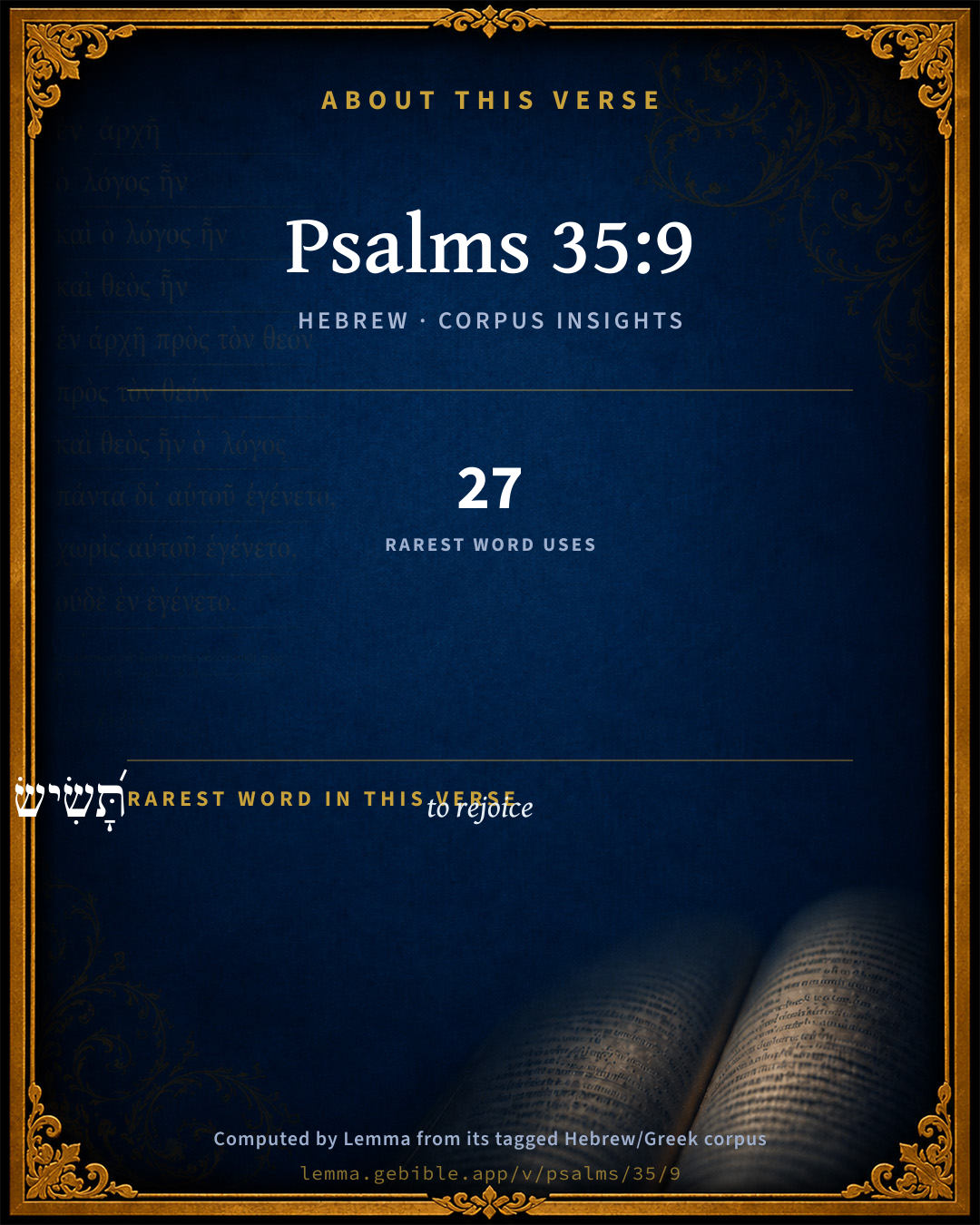
תָּ֝שִׂישׂ to rejoice H7797 occurs in 24 verses of the Hebrew Bible. Also found in:

Grammatical profile

  • 2 verbs
  • 3 nouns

Verb forms

  • תָּגִ֣יל Qal · Imperfect
  • תָּ֝שִׂישׂ Qal · Imperfect

Hebrew & Septuagint length

In English translation the verse runs 13 words from the Hebrew and 14 from the Septuagint (LXX English) — closely comparable.

A rough comparison of the two English renderings, which tokenize alike — not a word-level alignment.

Word counts can differ between the Hebrew and the Greek without any difference in meaning — e.g. the Hebrew direct-object marker אֵת has no separate Greek word, and Greek often adds the article ὁ.

Cross-references

13

Topical passages linked to Psalms 35:9 in the Treasury of Scripture Knowledge — connected by theme and wording, ordered by reader-vote popularity; previews shown in the World English Bible.

  • Isaiah 61:10 I will greatly rejoice in Yahweh, my soul shall be joyful in my God; for he has clothed me with the garments of salvation, he has covered me with the robe of righteousness, as a bridegroom decks himself with a garland, and as a bride adorns herself with her jewels.
  • Psalms 48:11 Let Mount Zion be glad! Let the daughters of Judah rejoice, Because of your judgments.
  • Psalms 58:10–11 The righteous shall rejoice when he sees the vengeance. He shall wash his feet in the blood of the wicked;
  • Luke 1:46–47 Mary said, "My soul magnifies the Lord.
  • 1 Samuel 2:1 Hannah prayed, and said: My heart exults in Yahweh; My horn is exalted in Yahweh; My mouth is enlarged over my enemies; Because I rejoice in your salvation.
  • Psalms 9:14 That I may show forth all your praise. In the gates of the daughter of Zion, I will rejoice in your salvation.
  • Psalms 13:5 But I trust in your loving kindness. My heart rejoices in your salvation.
  • Psalms 21:1 The king rejoices in your strength, Yahweh! How greatly he rejoices in your salvation!
  • Psalms 33:21 For our heart rejoices in him, Because we have trusted in his holy name.
  • Psalms 68:1–3 Let God arise! Let his enemies be scattered! Let them who hate him also flee before him.
  • Habakkuk 3:18 Yet I will rejoice in Yahweh. I will be joyful in the God of my salvation!
  • Galatians 5:22 But the fruit of the Spirit is love, joy, peace, patience, kindness, goodness, faithfulness,
  • Philippians 3:1–3 Finally, my brothers, rejoice in the Lord. To write the same things to you, to me indeed is not tiresome, but for you it is safe.

Cross-references courtesy of OpenBible.info (CC BY 4.0).

Hebrew and Greek witnesses Masoretic Hebrew ↔ Greek Septuagint

The same verse in the two great witnesses to the Old Testament, shown verse-for-verse.

You’re reading Greek Psalm 34 (Hebrew Psalm 35). The Septuagint counts the superscription, so verse numbers can differ from the Hebrew — chapter-level alignment, not verse-by-verse. Numbering follows Rahlfs.

These are two independent witnesses, not word-aligned to each other, and the Septuagint is shown in lemma (dictionary) form.

Hebrew Psalms 35:9 Masoretic · Westminster Leningrad Codex

וְ֭נַפְשִׁי תָּגִ֣יל בַּיהוָ֑ה תָּ֝שִׂישׂ בִּישׁוּעָתֽוֹ

My soul shall be joyful in Yahweh. It shall rejoice in his salvation.

World English Bible · Public Domain

Greek LXX Greek Psalm 34:9 Septuagint · lemma form

ὁ δέ ψυχή ἐγώ ἀγαλλιάομαι ἐπί ὁ κύριος τέρπω ἐπί ὁ σωτήριον αὐτός

But my soul shall exult in the Lord: it shall delight in his salvation.

LXX2012 (modern English Septuagint) · Public Domain

Hebrew: Westminster Leningrad Codex (CC BY 4.0). Greek: Septuagint (public domain); English from LXX2012 (modern English Septuagint) (Public Domain). How the Septuagint differs from the Hebrew →

Commentary

Notes on Psalms 35:9 from classic Christian and Jewish commentators (each source and its license shown beneath its notes). The classic Christian expositions comment on the surrounding passage and are grouped to its opening verse, so a note may address several verses; the Jewish commentaries on the Tanakh (Rashi and others) are per-verse, so they appear only where the commentator wrote on this verse.

Lemma curates 59 commentaries, every one of them public domain or Creative Commons licensed, each selected and text-cleaned for this edition rather than reprinted as found. About our sources →

Trapp's Complete Commentary

John Trapp

Psa 35:9 And my soul shall be joyful in the LORD: it shall rejoice in his salvation.

Ver. 9. And my soul shall be joyful in the Lord] This was what he aimed at in his foregoing imprecations, viz. the glory and praise of God, and not his own wreaking his spleen upon his enemies.

John Trapp, A Commentary or Exposition upon All the Books of the Old and New Testament (1647–1656) — public domain. Text from a community e-Sword module.

The Biblical Illustrator

Joseph S. Exell

Psa_35:9-10

My soul shall he joyful in the Lord.

Lifes joy

It is not often that we meet with a truly joyous face. We see many a brow curved with humour, and lips with their wreath of mirth, but the eyes seldom beam the glory of that quiet delight which is named in our text. Everybody has some joy; but in many cases it is spurious like a bad shilling, and unreliable like the grass which grows over the marsh on a moor. But real joy is wholesome, beneficent and abiding; and it is for all. It is seldom or never found in external things; it is an inward state of the soul. Joy may be likened to a seat under the shade of a tree to which you can go at once for rest, and it is as free as a street fountain with the cup hanging ready for the thirsty traveller to drink; anybody may take the cup and drink. True joy is not a fiction; to be expressed, it must be felt. As you cannot have a river without a spring or source, neither can you have true joy without its fountain which flows from the heart of God.

I. the secret cause of joy in the Christian is--

1. That he possesses all things. The great cry of the human heart is--I want this; O that I could have that! Our failing is discontentedness; the glory of Christianity is contentment, not empty and fleeting, but full, overflowing, and everlasting. Under the Atlantic ocean is a cable through which passes a wire connecting the coast of England with that of America, and though there are great storms and crashing icebergs on the ocean, the cable under the sea is undisturbed; the lightning message passes along the three thousand miles of wire silently and in the twinkling of an eye. Likewise, the soul of the Christian, no matter whether he may be in a dungeon, awaiting a martyrs death, or upon a throne, the object of the peoples praise, is serene because it is in communion with God.

2. That our sins are all forgiven.

3. The sense of salvation also inspires ones soul to be joyful in the Lord.

4. The promise of heaven. Some of you may say, What you have said is of no use to me, for I am not a Christian; I am not good; there is no chance for me. You think God must draw the line somewhere, that He cannot take you in; that He may receive other people, but He cannot admit you. Now the Bible says, Whosoever will. You cannot be too wicked for God to save; for He is able to save to the very uttermost all that pray unto Him. Therefore, come. (W. Birch:)

The Biblical Illustrator, edited by Joseph S. Exell (c. 1880s–1900s) — public domain. Text from a community e-Sword module.

J. A. Alexander on Psalms

Joseph Addison Alexander

9. (Psa 35:9)And my soul shall exult in Jehovah, shall joy in his salvation. Our idiom would require so or then at the beginning of the sentence, to make the connection of the verses clear.—In Jehovah, not merely on account of him, but in union with him and possession of him, as the parallel phrase, in his salvation, means in the experience and enjoyment of it. This is a kind of promise that the favour asked shall not be unrequited by thanks- giving, and the same idea is still further carried out in the next verse.

Joseph Addison Alexander, The Psalms Translated and Explained (1850) — public domain. Text from a community e-Sword module.

Adam Clarke's Commentary

Verse 9. My soul] My life, thus saved -

Shall be joyful in the Lord] I am so circumstanced at present as to be in the utmost danger of being destroyed by my foes; if I escape, it must be by the strong arm of the Lord; and to him shall the glory be given.

Adam Clarke's Commentary on the Bible (1810–1826) — public domain. Text from a community e-Sword/MySword module.

John Calvin's Commentaries

9. And my soul is joyful in Jehovah. Others read this in the optative mood, May my soul rejoice in Jehovah, and may it be glad in his salvation But instead of continuing to express his desires, David, in my opinion, rather promises in this verse that he will be grateful to God. This is still more evident from the following verse, in which extolling very highly the goodness of God, he says that he will celebrate the remembrance of it with every member of his body. While, therefore, some ascribe to fortune, and others to their own skill, the praise of their deliverance from danger, and few, if any, yield the whole praise of it to God, David here declares that he will not forget the favor which God had bestowed upon him. My soul, says he, shall rejoice, not in a deliverance of the author of which it is ignorant, but in the salvation of God. To place the matter in a still stronger light, he assigns to his very bones the office of declaring the divine glory. As if not content that his tongue should be employed in this, he applies all the members of his body to the work of setting forth the praises of God. The style of speaking which he employs is hyperbolical, but in this way he shows unfeignedly that his love to God was so strong that he desired to spend his sinews and bones in declaring the reality and truth of his devotion.

John Calvin's Commentaries (1540-1563) — public domain. Text from the Calvin Translation Society English edition (1840s-50s) via the Christian Classics Ethereal Library (ccel.org). Calvin's coverage is partial (roughly two-thirds of the Bible); uncommented books and verses are honest gaps, never fabricated. The 19th-century editor's footnotes and remarks are omitted so the notes are faithfully Calvin's own voice.

The Cambridge Bible for Schools and Colleges

gen. ed. J. J. S. Perowne

9, 10. Rejoicing for deliverance.

The Cambridge Bible for Schools and Colleges (gen. ed. J. J. S. Perowne; Cambridge University Press, 1878–1918) — public domain. Text from a community e-Sword module.

John Gill's Exposition

And my soul shall be joyful in the Lord,.... Not in the destruction of his enemies, but in the God of his salvation; the Targum is, "in the Word of the Lord"; the essential Word of God, the promised Messiah, Saviour, and Redeemer. Christ is the object of a believer's joy; he rejoices in his person, as he is the mighty God, able to save him, and to keep what he has committed to him, and to preserve him from falling; as he is God and man in one person, and so fit to be a Mediator between God and man; and as he is a Prophet to instruct him, a Priest to expiate his sin and make intercession for him, and as a King to rule over, protect, and defend him; and as he stands in the relations of a father, husband, brother, and friend: he rejoices in what he has done and is doing; in that this Word is made flesh, and has obtained eternal redemption, and now appears in the presence of God, as an advocate and intercessor: it follows,

it shall rejoice in his salvation; that which Jehovah the Father has determined upon, provided for, and has formed the scheme of; that which Jehovah the Son undertook to accomplish, and now has finished; and that which Jehovah the Spirit had made a discovery and application of unto the psalmist, in answer to his request in Psa 35:3. This filled him with so much joy, as it does every believer that has a view of interest in it; seeing hereby the law is fulfilled, justice is satisfied, sin is atoned for, the pardon of it is procured, an everlasting righteousness is brought in, and a solid foundation laid for hope of eternal glory and happiness.

John Gill's Exposition of the Whole Bible (1746–1763) — public domain (CC PDM 1.0). Text via the HelloAO Bible API.

Albert Barnes' Notes on the Bible

And my soul shall be joyful in the Lord - That is, I shall be joyful, or will rejoice. This is said in anticipation of the interposition of God in destroying his enemies, and in delivering him from danger. It is not joy in the destruction of others; it is joy that he himself would be delivered. Our own deliverance from the hand of our enemies may involve the necessity of their being cut off. What we rejoice in, in such a case, is not their ruin, but our own deliverance; and for this it can never be improper to give thanks. The psalmist says that he would rejoice “in the Lord.” It would not be in his own skill or valor, but in what God had done to save him. See the notes at Psa 34:2.

It shall rejoice in his salvation - For the salvation or deliverance that he brings to me.

Albert Barnes' Notes on the Bible (1834–1885) — public domain. Text from a community e-Sword/MySword module.

Matthew Poole's English Annotations

In the Lord; in and for his glory and service, which shall be advanced by this means, and for his favour to me, otherwise I am far from rejoicing in their calamities.

Matthew Poole's English Annotations on the Holy Bible (1683–1685) — public domain. Text from a community e-Sword/MySword module.

The Treasury of David

Charles H. Spurgeon

Ver. 9. And my soul shall be joyful in the Lord. Thus rescued, David ascribes all the honour to the Judge of the right; to his own valorous arm he offers no sacrifice of boasting. He turns away from his adversaries to his God, and finds a deep unbroken joy in Jehovah, and in that joy his spirit revels. It shall rejoice in his salvation. We do not triumph in the destruction of others, but in the salvation given to us of God. Prayer heard should always suggest praise. It were well if we were more demonstrative in our holy rejoicing. We rob God by suppressing grateful emotions.

Ver. 9. And my soul shall be joyful in the Lord, etc. While some ascribe to fortune, and others to their own skill, the praise of their deliverance from danger, and few, if any, yield the whole praise of it to God, David here, declares that he will not forget the favour which God had bestowed upon him. My soul, says he, shall rejoice, not in a deliverance of the author of which it is ignorant, but in the salvation of God. To place the matter in a still stronger light, he assigns to his very bones the office of declaring the divine glory. As if not content that his tongue should be employed in this, he applies all the members of his body to the work of setting forth the praises of God. The style if speaking which he employs is hyperbolical, but in this way he shows unfeignedly that his love to God was so strong that he desired to spend his sinews and bones in declaring the reality and truth of his devotion. John Calvin.

Ver. 9. Joy in God and in his salvation.

Psalms 35:10*

Charles H. Spurgeon's The Treasury of David (1869–1885) — public domain. Psalms only. Text from a community e-Sword/MySword module.

Whedon's Commentary on the Bible

Daniel D. Whedon

9, 10. These verses close the first strophe with promise of joy and praise at the deliverance asked and expected.

All my bones—The solid framework of my body shall, with my soul, show forth thy praise.

Daniel D. Whedon (gen. ed.), Commentary on the Old and New Testaments (1874–1909) — public domain. Text from a community e-Sword module.

The Pulpit Commentary

And my soul shall be joyful in the Lord. A sudden transition from imprecatory prayer to thanksgiving, or rather, to the promise of it soul shall be joyful;" i.e. it shall be so when my prayers have been granted. It shall rejoice in his salvation. "Salvation" here is, no doubt, especially, deliverance from the immediate danger, but, perhaps, even here, not only that (see the comment on ver. 3).

The Pulpit Commentary (1880–1919), ed. H.D.M. Spence-Jones & Joseph S. Exell — public domain. Text from a community e-Sword module.

Keil & Delitzsch

C. F. Keil & F. Delitzsch

This strophe, with which the first part of the song closes, contains the logical apodosis of those imprecatory jussives. The downfall of the power that is opposed to God will be followed by the joy of triumph. The bones of the body, which elsewhere are mentioned as sharing only in the anguish of the soul (Psa 6:3; Psa 31:11; Psa 32:3; Psa 51:10), are here made to share (as also in Psa 51:10) in the joy, into which the anxiety, that agitated even the marrow of the bones, is changed. The joy which he experiences in his soul shall throb through every member of his body and multiply itself, as it were, into a choir of praiseful voices. כּל with a conjunctive accent and without Makkeph, as also in Pro 19:7 (not כּל־, vid., the Masora in Baer's Psalterium p. 133), is to be read cāl (with קמץ רחב, opp. קמץ חטוף) according to Kimchi. According to Lonzano, however, it is to be read col, the conjunctive accent having an equal power with Makkeph; but this view is false, since an accent can never be placed against Kametz chatuph. The exclamation מי כמוך is taken from Exo 15:11, where, according to the Masora, it is to be pointed מי כמוך, as Ben Naphtali also points it in the passage before us. The Dagesh, which is found in the former passage and is wanting here, sharpens and hardens at the same time; it requires that the expression should be emphatically pronounced (without there being any danger in this instance of its being slurred over); it does not serve to denote the closer connection, but to give it especial prominence. חזק ממּנוּ, stronger than he, is equivalent to: strong, whereas the other is weak, just as in Jer 31:11, cf. Hab 1:13, צדּיק ממּנוּ, righteous, whereas he is ungodly. The repetition of ועני is meant to say: He rescues the עני, who is אביון (poor) enough already, from him who would take even the few goods that he possesses.

Keil & Delitzsch — Biblical Commentary on the Old Testament (1861–1891) — public domain (CC PDM 1.0). Text via the HelloAO Bible API. (Old Testament only.)

unfoldingWord translationNotes

Door43 World Missions Community

in his salvation

The abstract noun "salvation" can be stated as a verb. AT: "because you save me" (See: Abstract Nouns)

All my bones

Here "bones" refers to the deepest inner being of a person. AT: "My whole inner being" (See: Metonymy)

Yahweh, who is like you ... those who try to rob them?

The implicit answer to this question is that no one is like Yahweh. AT: "Yahweh, there is no one like you ... those who try to rob them." (See: Rhetorical Question)

the poor and needy

The words "poor" and "needy" mean basically the same thing and emphasize that Yahweh saves many who need his help. (See: Doublet)

translationWords

joy

Yahweh

joy

save

strength

oppress

unfoldingWord translationNotes — © Distant Shores Media and the Door43 World Missions Community, licensed CC BY-SA 4.0. Source: git.door43.org/Door43/en_tn.

Rashi

Rabbi Shlomo Yitzchaki (Rashi)

And my soul shall exult when I see their downfall.

Rashi on the Tanakh — English translations: “The Judaica Press complete Tanach with Rashi, translated by A. J. Rosenberg” (CC BY 4.0); “Pentateuch with Rashi's commentary by M. Rosenbaum and A.M. Silbermann, 1929-1934” (public domain); “The Metsudah Tanach series, Lakewood, N.J” (CC BY 4.0); and “The Book of Joshua, Metsudah Publications, 1997” (CC BY 4.0). Text via Sefaria.

Lesson kit

Teaching starters — assembled from the data on this page, not authored interpretation. Every prompt links to the verse data it draws on. Edit before teaching.

Psalms, in the Wisdom, opens this verse with 5 words (5 distinct Hebrew lemmas). Its most distinctive word is sûws (“to rejoice”). A historical commentator’s framing appears above. Read the whole chapter for the surrounding context.

Discussion questions

  1. The word sûws carries the sense “to rejoice.” How does it shape the verse?
  2. How does Deuteronomy 28:63, which shares the word «to rejoice», read alongside this verse?
  3. These translations render this verse differently. What is at stake in choosing one wording over another?
  4. «תָּגִ֣יל» is a Qal Imperfect verb. How does that grammatical form shape the action described?
  5. Compare how Trapp's Complete Commentary and The Biblical Illustrator read this verse. Where do they agree or differ?

Things to notice

Reading settings

Reading text

Shown beneath each verse's original-language words.

Old Testament
Old Testament edition

Read the OT as the Masoretic Hebrew (MT) or the Greek Septuagint (LXX).

English shown for the Greek Septuagint (in the Hebrew ↔ Greek comparison).

Comparing translations? Open the Compare panel on any verse page to stack up to four side by side.