Proverbs 7:23

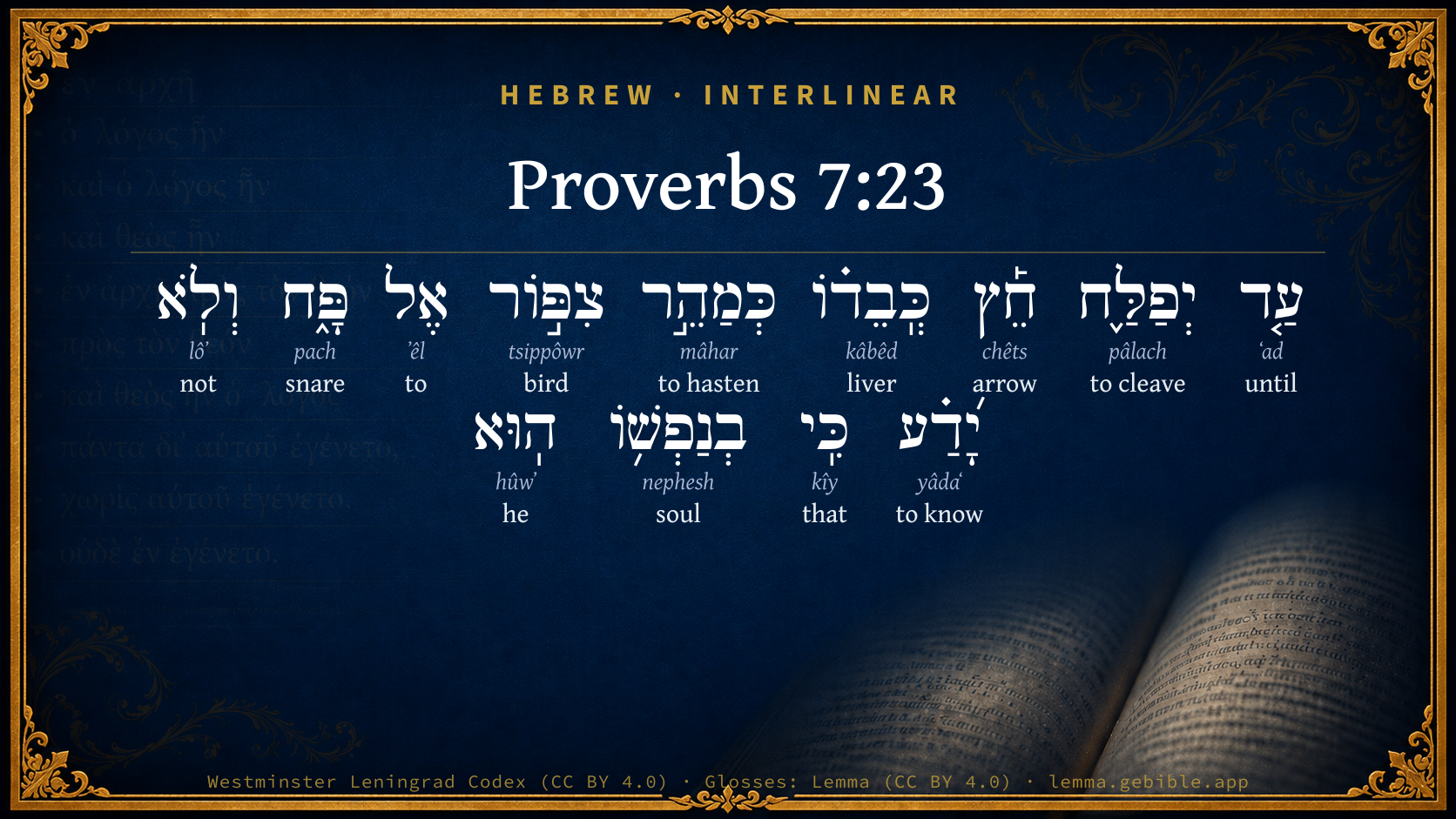
Hebrew (Westminster Leningrad Codex) Proverbs 7:23 appears in the Hebrew Old Testament. The text above is from the Westminster Leningrad Codex. Each word links to its Strong’s number, a concise gloss, and parsing drawn from the Open Scriptures Hebrew Bible morphology. Click any word for its full Brown-Driver-Briggs (BDB) entry.
Download image
Cite this verse

Proverbs 7:23 (World English Bible). Public Domain. Lemma interlinear Bible study tool, https://lemma.gebible.app/v/proverbs/7/23.

Show BibTeX & RIS
BibTeX
RIS
English Translation
Until an arrow strikes through his liver, As a bird hurries to the snare, And doesn't know that it will cost his life.
World English Bible · Public Domain
Download a study sheet

One document with this verse’s original text, its word-by-word gloss line, the meaning frame, cross-references with their text, attributed commentary, and full source and license credits — printable, and it pastes into notes with its structure intact.

This verse Autodidact and up

Study sheet (.html) Plain text (.txt)

A passage Seminary Student

Up to 50 verses in one chapter. A passage sheet keeps up to 6 commentary sources and 12 cross-references per verse, in the order this page ranks them, and says so on the sheet whenever that leaves anything out. Ask for a single verse and you get the Autodidact verse sheet above.

Everything on this page stays free to read, with no account — the sheet is a download of what is already on screen, not access to it.

Want to remove ads? Support Godless Engineer
Compare translations 3

The same verse in 3 English versions, stacked beneath the original-language interlinear above. Click any original word for its lexicon entry.

Each is an independent rendering of the whole verse — the interlinear is not word-aligned to these translations.

Highlighted words mark where these versions differ — a whole-verse word diff, not a word-by-word alignment.

  • World English Bible Public Domain
    Until an arrow strikes through his liver, As a bird hurries to the snare, And doesn't know that it will cost his life.
  • King James Version Public Domain
    Till a dart strike through his liver; as a bird hasteth to the snare, and knoweth not that it is for his life.
  • unfoldingWord Literal Text CC BY-SA 4.0
    until an arrow splits his liver; like a bird rushing into a trap, and he did not know that it for his life.

unfoldingWord Literal Text — © unfoldingWord, licensed CC BY-SA 4.0. Word-aligned USFM3 via Door43 (git.door43.org/unfoldingWord/en_ult).

Versions to compare (up to 4)

3 of 4 selected

Show all 18 translations

Every available English version of this verse, each an independent rendering of the whole verse.

  • World English Bible Public Domain
    Until an arrow strikes through his liver, As a bird hurries to the snare, And doesn't know that it will cost his life.
  • Berean Standard Bible Public Domain
    until an arrow pierces his liver, like a bird darting into a snare—not knowing it will cost him his life.
  • Majority Standard Bible Public Domain
    until an arrow pierces his liver, like a bird darting into a snare—not knowing it will cost him his life.
  • King James Version Public Domain
    Till a dart strike through his liver; as a bird hasteth to the snare, and knoweth not that it is for his life.
  • American Standard Version (1901) Public Domain
    Till an arrow strike through his liver; As a bird hasteth to the snare, And knoweth not that it is for his life.
  • Revised Version (1885) Public Domain
    Till an arrow strike through his liver; as a bird hasteth to the snare, and knoweth not that it is for his life.
  • Geneva Bible (1599) Public Domain
    Till a dart strike through his liuer, as a bird hasteth to the snare, not knowing that he is in danger.
  • Douay-Rheims (1899) Public Domain
    Till the arrow pierce his liver: as if a bird should make haste to the snare, and knoweth not that his life is in danger.
  • Young's Literal Translation Public Domain
    Till an arrow doth split his liver, As a bird hath hastened unto a snare, And hath not known that it `is' for its life.
  • Literal Standard Version CC BY-SA 4.0
    Until an arrow splits his liver, || As a bird has hurried to a snare, || And has not known that it [is] for its life.
  • Unlocked Literal Bible CC BY-SA 4.0
    until an arrow pierces through its liver. He was like a bird rushing into a snare. He did not know that it would cost his life.
  • unfoldingWord Literal Text CC BY-SA 4.0
    until an arrow splits his liver; like a bird rushing into a trap, and he did not know that it for his life.
  • Darby Bible Public Domain
    till an arrow strike through his liver: as a bird hasteth to the snare, and knoweth not that it is for its life.
  • World Messianic Bible Public Domain
    Until an arrow strikes through his liver, as a bird hurries to the snare, and doesn’t know that it will cost his life.
  • Webster's Bible Public Domain
    Till a dart striketh through his liver; as a bird hasteth to the snare, and knoweth not that it is for his life.
  • Free Bible Version CC BY-SA 4.0
    until an arrow pierces its liver, like a bird flying into a trap, he's unaware he will pay with his life.
  • Bible in Basic English Public Domain
    Like a bird falling into a net; with no thought that his life is in danger, till an arrow goes into his side.
  • JPS Tanakh (1917) Public Domain
    Till an arrow strike through his liver; as a bird hasteneth to the snare — and knoweth not that it is at the cost of his life.

Literal Standard Version (2020), Covenant Press — licensed CC BY-SA 4.0. Text via the HelloAO Bible API (eBible.org). Unlocked Literal Bible (unfoldingWord) — licensed CC BY-SA 4.0. Text via the HelloAO Bible API (eBible.org). unfoldingWord Literal Text — © unfoldingWord, licensed CC BY-SA 4.0. Word-aligned USFM3 via Door43 (git.door43.org/unfoldingWord/en_ult). Free Bible Version, Dr. Jonathan Gallagher — licensed CC BY-SA 4.0. Text via the HelloAO Bible API (eBible.org).

Word by word

More ways to search: Search by grammar → Find every occurrence → Compare this word →

Practice this passage: Drill this verse → Learn its vocabulary →

יְפַלַּ֪ח
pâlach
H6398
“to cleave”
Verb, Piel, Imperfect, 3rd Person, Masculine, Singular
Part of Speech
Verb
Stem
Piel
Form
Imperfect
Person
3rd Person
Gender
Masculine
Number
Singular
Full BDB Definition

Origin: a primitive root

TWOT: 1773

to cleave, slice - (Qal) to cleave, plow - (Piel) - to cleave open or through - to cause to cleave open - to slice, pierce
  1. עַ֤ד ʻad H5704 “until” Preposition
  2. חֵ֡ץ chêts H2671 “arrow” Noun, Common, Masculine, Singular, Absolute
  3. כְּֽבֵד֗וֹ kâbêd H3516 “liver · his” Noun, Common, Feminine, Singular, Construct + Suffix, Personal, 3rd Person, Masculine, Singular
  4. כְּמַהֵ֣ר mâhar H4116 “like/as · to hasten” Preposition + Verb, Piel, Infinitive Construct
  5. צִפּ֣וֹר tsippôwr H6833 “bird” Noun, Common, Both, Singular, Absolute
  6. אֶל ʼêl H413 “to” Preposition
  7. פָּ֑ח pach H6341 “snare” Noun, Common, Masculine, Singular, Absolute
  8. וְלֹֽא lôʼ H3808 “and · not” Conjunction + Particle, Negative
  9. יָ֝דַ֗ע yâdaʻ H3045 “to know” Verb, Qal, Perfect, 3rd Person, Masculine, Singular
  10. כִּֽי kîy H3588 “that” Conjunction
  11. בְנַפְשׁ֥וֹ nephesh H5315 “in/at · soul · his” Preposition + Noun, Common, Both, Singular, Construct + Suffix, Personal, 3rd Person, Masculine, Singular
  12. הֽוּא hûwʼ H1931 “he” Pronoun, Personal, 3rd Person, Masculine, Singular

About this verse

These counts appear in no published source. They are computed here, from the morphology-tagged text and Lemma’s own curated glosses. What Lemma adds →

13
words
13
distinct lemmas
Wisdom
section

Notable vocabulary

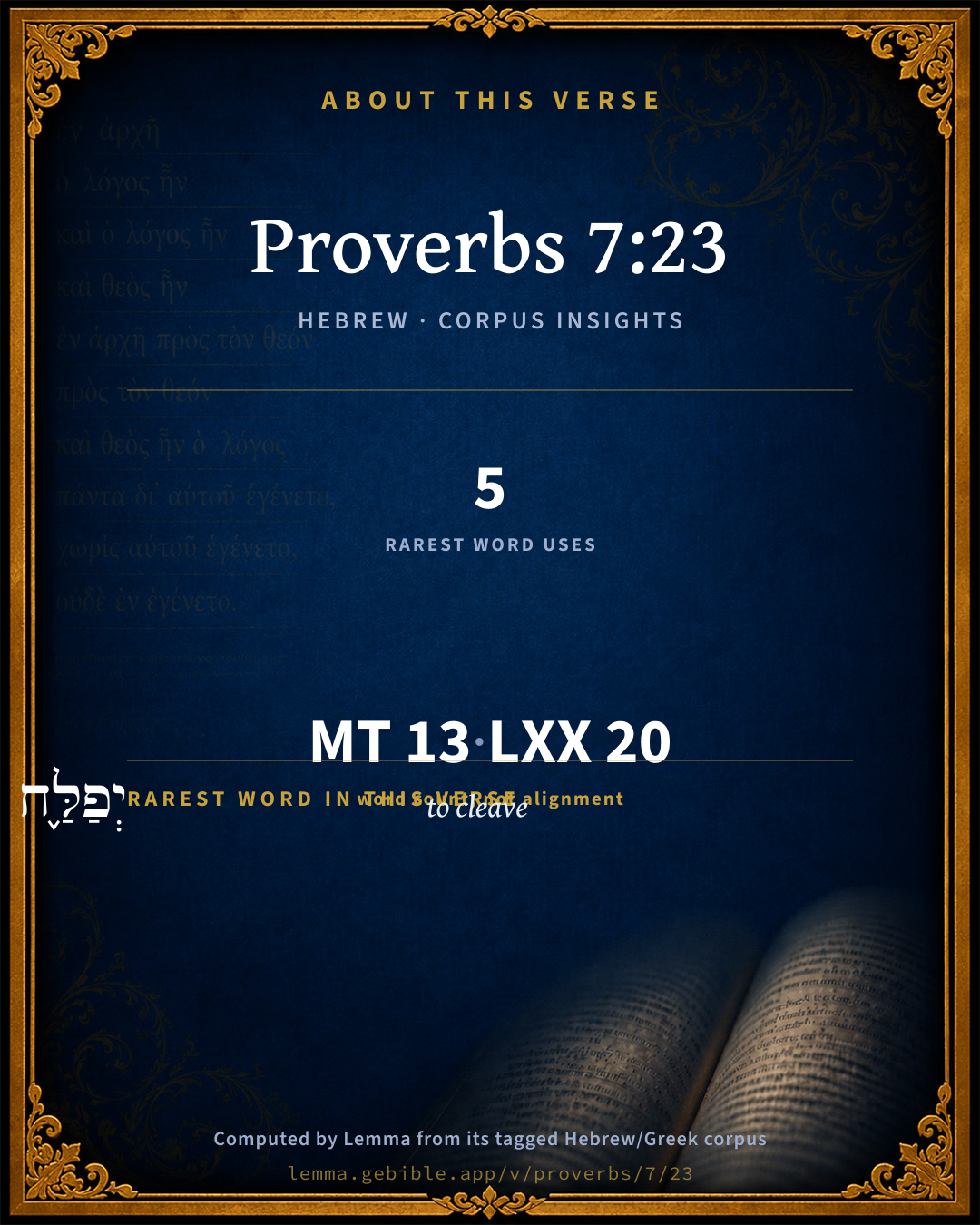
The rarest word here is יְפַלַּ֪ח to cleave H6398 — appearing just 5 times in the whole Hebrew Bible.

Shared distinctive vocabulary

יְפַלַּ֪ח to cleave H6398 occurs in 5 verses of the Hebrew Bible. Also found in:

Grammatical profile

  • 3 verbs
  • 5 nouns
  • 1 pronoun
  • 2 prepositions
  • 1 conjunction
  • 1 particle

Verb forms

  • יְפַלַּ֪ח Piel · Imperfect
  • כְּמַהֵ֣ר Piel · Infinitive Construct
  • יָ֝דַ֗ע Qal · Perfect

Hebrew & Septuagint length

In English translation the verse runs 23 words from the Hebrew and 18 from the Septuagint (LXX English) — closely comparable.

A rough comparison of the two English renderings, which tokenize alike — not a word-level alignment.

Word counts can differ between the Hebrew and the Greek without any difference in meaning — e.g. the Hebrew direct-object marker אֵת has no separate Greek word, and Greek often adds the article ὁ.

In the original languages it is 13 Hebrew tokens and 20 Greek tokens — but the two are counted differently (Hebrew bundles its prefixes and suffixes into one token; the Greek is in lemma form), so that isn’t a like-for-like length.

Cross-references

4

Topical passages linked to Proverbs 7:23 in the Treasury of Scripture Knowledge — connected by theme and wording, ordered by reader-vote popularity; previews shown in the World English Bible.

  • Ecclesiastes 9:12 For man also doesn't know his time. As the fish that are taken in an evil net, and as the birds that are caught in the snare, even so are the sons of men snared in an evil time, when it falls suddenly on them.
  • Proverbs 9:18 But he doesn't know that the dead are there, That her guests are in the depths of Sheol.
  • Numbers 25:8–9 and he went after the man of Israel into the pavilion, and thrust both of them through, the man of Israel, and the woman through her body. So the plague was stayed from the children of Israel.
  • Proverbs 1:17 For in vain is the net spread in the sight of any bird:

Cross-references courtesy of OpenBible.info (CC BY 4.0).

Hebrew and Greek witnesses Masoretic Hebrew ↔ Greek Septuagint

The same verse in the two great witnesses to the Old Testament, shown verse-for-verse.

These are two independent witnesses, not word-aligned to each other, and the Septuagint is shown in lemma (dictionary) form.

Hebrew Proverbs 7:23 Masoretic · Westminster Leningrad Codex

עַ֤ד יְפַלַּ֪ח חֵ֡ץ כְּֽבֵד֗וֹ כְּמַהֵ֣ר צִפּ֣וֹר אֶל פָּ֑ח וְלֹֽא יָ֝דַ֗ע כִּֽי בְנַפְשׁ֥וֹ הֽוּא

Until an arrow strikes through his liver, As a bird hurries to the snare, And doesn't know that it will cost his life.

World English Bible · Public Domain

Greek LXX Proverbs 7:23 Septuagint · lemma form

ἤ ὡς ἔλαφος τόξευμα πλήσσω εἰς ὁ ἧπαρ σπεύδω δέ ὥσπερ ὄρνεον εἰς παγίς οὐ οἶδα ὅτι περί ψυχή τρέχω

and he hastens as a bird into a snare, not knowing that he is running for his life.

LXX2012 (modern English Septuagint) · Public Domain

On this verse, The Cambridge Bible for Schools and Colleges discusses the Septuagint’s reading. Read the note in Commentary ↓

Hebrew: Westminster Leningrad Codex (CC BY 4.0). Greek: Septuagint (public domain); English from LXX2012 (modern English Septuagint) (Public Domain). How the Septuagint differs from the Hebrew →

Commentary

Notes on Proverbs 7:23 from classic Christian and Jewish commentators (each source and its license shown beneath its notes). The classic Christian expositions comment on the surrounding passage and are grouped to its opening verse, so a note may address several verses; the Jewish commentaries on the Tanakh (Rashi and others) are per-verse, so they appear only where the commentator wrote on this verse.

Lemma curates 59 commentaries, every one of them public domain or Creative Commons licensed, each selected and text-cleaned for this edition rather than reprinted as found. About our sources →

Trapp's Complete Commentary

John Trapp

Pro 7:23 Till a dart strike through his liver; as a bird hasteth to the snare, and knoweth not that it [is] for his life.

Ver. 23. Till a dart strike through his liver,] i.e, Filthy lust, that fiery dart of the devil, pointed and poisoned (as the Scythian darts are said to be) with the gall of asps and vipers. Philosophers {a} place lust in the liver. Mathematicians subject the liver to Venus; the poets {b} complain of cupid’s wounding them in that part.

“ Cor sapit, et pulmo loquitur, fel commovit iras:

Splen ridere facit, cogit amare iecor."

Or, as some sense it, Till the adulterer be, by the whore’s husband or friends, or by the hand of justice, deprived of life; perhaps in the very act, as Zimri and Cozbi were by Phinehas in the very flagrancy of their lust.

{a} Plato in hepate το επιθυμητικον ponit.

{b} Horat., Ode v. lib. iv., and Ode xxv. lib. v. Ovid. Trist.

John Trapp, A Commentary or Exposition upon All the Books of the Old and New Testament (1647–1656) — public domain. Text from a community e-Sword module.

The Biblical Illustrator

Joseph S. Exell

Pro_7:23

Till a dart strike through his liver.

The gospel of health

Solomon had noticed, either in vivisection or in post-mortem, what awful attacks sin and dissipation make upon the liver, until the fiat of Almighty God bids the soul and body separate. A javelin of retribution, not glancing off or making a slight wound, but piercing it from side to side till a dart strike through his liver. Galen and Hippocrates ascribe to the liver the most of the worlds moral depression, and the word melancholy means black bile. Let Christian people avoid the mistake that they are all wrong with God because they suffer from depression of spirits. Oftentimes the trouble is wholly due to physical conditions. The difference in physical conditions makes things look so differently. Another practical use of this subject is for the young. The theory is abroad that they must first sow their wild oats and then Michigan wheat. Let me break the delusion. Wild oats are generally sown in the liver, and they can never be pulled up. In after-life, after years of dissipation, you may have your heart changed, but religion does not change the liver. God forgives, but outraged physical law never. (T. De Witt Talmage.)

The Biblical Illustrator, edited by Joseph S. Exell (c. 1880s–1900s) — public domain. Text from a community e-Sword module.

Geneva Bible (1599)

Geneva Bible translators

Hebrew, It is for his life.

Geneva Bible (1599) marginal notes — public domain. Text via Bolls.life.

Jamieson, Fausset & Brown

Robert Jamieson, A. R. Fausset & David Brown

Till--He is now caught (Pro 6:26).

Jamieson, Fausset & Brown — Commentary Critical and Explanatory on the Whole Bible (1871) — public domain (CC PDM 1.0). Text via the HelloAO Bible API.

Ellicott's Commentary for English Readers

(23) Till a dart strike through his liver.—These words must be taken in a parenthesis.

That it is for his life.—i.e., at the cost of it, when “his flesh and body are consumed,” and remorse has seized upon him (Pro_5:11).

A Bible Commentary for English Readers, edited by Charles John Ellicott (1878–1897) — public domain. Text from a community e-Sword module.

The Cambridge Bible for Schools and Colleges

gen. ed. J. J. S. Perowne

23. dart] Rather, arrow, R.V.; sagitta, Vulg. The LXX. have ἢ ὡς ἔλαφος τοξεύματι πεπληγὼς εἰς τὸ ἧπαρ.

The Cambridge Bible for Schools and Colleges (gen. ed. J. J. S. Perowne; Cambridge University Press, 1878–1918) — public domain. Text from a community e-Sword module.

John Gill's Exposition

Hearken unto me now therefore, O ye children,.... The Septuagint, Vulgate Latin, and Arabic versions, read, in the singular number, "my son", in the same manner as the chapter begins; but it is in the plural number in the Hebrew text; and so read the Targum and Syriac version, "children", the children of Solomon; not only those of his own body, but all such that put themselves under his instruction, or were willing to take his advice: it may be extended to all the children of men, for all are interested herein; especially such who profess to be the children of God and of Christ, the followers of wisdom. This is the epilogue, or application of the above story. Since this is the case, that young men are in danger of being ensnared and brought to ruin by this harlot, therefore take the advice of the wisest of men, even of Wisdom herself;

and attend to the words of my mouth; the doctrines of Christ; the best preservative from the allurements of the whore of Rome.

John Gill's Exposition of the Whole Bible (1746–1763) — public domain (CC PDM 1.0). Text via the HelloAO Bible API.

Albert Barnes' Notes on the Bible

The first clause does not connect itself very clearly with the foregoing, and is probably affected by the corrupt text which makes it perplexing.

Albert Barnes' Notes on the Bible (1834–1885) — public domain. Text from a community e-Sword/MySword module.

Matthew Poole's English Annotations

His liver, i.e. his vital parts, whereof the liver is one. Till his life be lost, as it is explained in the next clause.

Knoweth not; which may be referred either to a foolish and inconsiderate young man; or to the silly bird to which he is compared, which comes to the same thing.

Matthew Poole's English Annotations on the Holy Bible (1683–1685) — public domain. Text from a community e-Sword/MySword module.

The Pulpit Commentary

Till a dart strike through his liver. This clause would be better taken with the preceding verse, as in the Septuagint, or else placed in a parenthesis; then the following clause introduces a new come parison. The youth follows the harlot till his liver, the seat of the passions, is thoroughly inflamed, or till fatal consequences ensue. Theocr., "Id," 11:15 Ecyiston ecwn upokardion elkov Kupriov ek megalav to oi hpati paxe belemnon . "Beneath his breast A hateful wound he bore by Cypris given, Who in his liver fixed the fatal dart.

Delitzsch would relegate the hemistich to the end of the verse, making it denote the final result of mad and illicit love. The sense thus gained is satisfactory, but the alteration is quite arbitrary, and unsupported by ancient authority. As a bird hasteth to the snare. This is another comparison. (see Pro_1:17, the first proverb in the book, and note there) And knoweth not that it is for his life; i.e. the infatuated youth does not consider that his life is at stake, that he is bringing upon himself, by his vicious rashness, temporal and spiritual ruin. (Pro_5:11)

The Pulpit Commentary (1880–1919), ed. H.D.M. Spence-Jones & Joseph S. Exell — public domain. Text from a community e-Sword module.

John Wesley's Explanatory Notes

His liver - His vital parts, 'till his life be lost.

John Wesley, Explanatory Notes Upon the Whole Bible (1754–1765) — public domain. Text via the GEBible commentary corpus.

Rashi

Rabbi Shlomo Yitzchaki (Rashi)

as a bird hastens to run to a snare, and it does not know that the snare was spread out there for the life of the bird.

Rashi on the Tanakh — English translations: “The Judaica Press complete Tanach with Rashi, translated by A. J. Rosenberg” (CC BY 4.0); “Pentateuch with Rashi's commentary by M. Rosenbaum and A.M. Silbermann, 1929-1934” (public domain); “The Metsudah Tanach series, Lakewood, N.J” (CC BY 4.0); and “The Book of Joshua, Metsudah Publications, 1997” (CC BY 4.0). Text via Sefaria.

Lesson kit

Teaching starters — assembled from the data on this page, not authored interpretation. Every prompt links to the verse data it draws on. Edit before teaching.

Proverbs, in the Wisdom, opens this verse with 13 words (13 distinct Hebrew lemmas). Its most distinctive word is pâlach (“to cleave”). A historical commentator’s framing appears above. Read the whole chapter for the surrounding context.

Discussion questions

  1. How does “to cleave” (pâlach) shape what this verse is saying?
  2. How does 2 Kings 4:39, which shares the word «to cleave», read alongside this verse?
  3. These translations render this verse differently; the difference is in the English rendering, not the original. What questions does that raise?
  4. «יְפַלַּ֪ח» is a Piel Imperfect verb. How does that grammatical form shape the action described?
  5. Compare how Trapp's Complete Commentary and The Biblical Illustrator read this verse. Where do they agree or differ?

Things to notice

Reading settings

Reading text

Shown beneath each verse's original-language words.

Old Testament
Old Testament edition

Read the OT as the Masoretic Hebrew (MT) or the Greek Septuagint (LXX).

English shown for the Greek Septuagint (in the Hebrew ↔ Greek comparison).

Comparing translations? Open the Compare panel on any verse page to stack up to four side by side.