Psalms 139:14

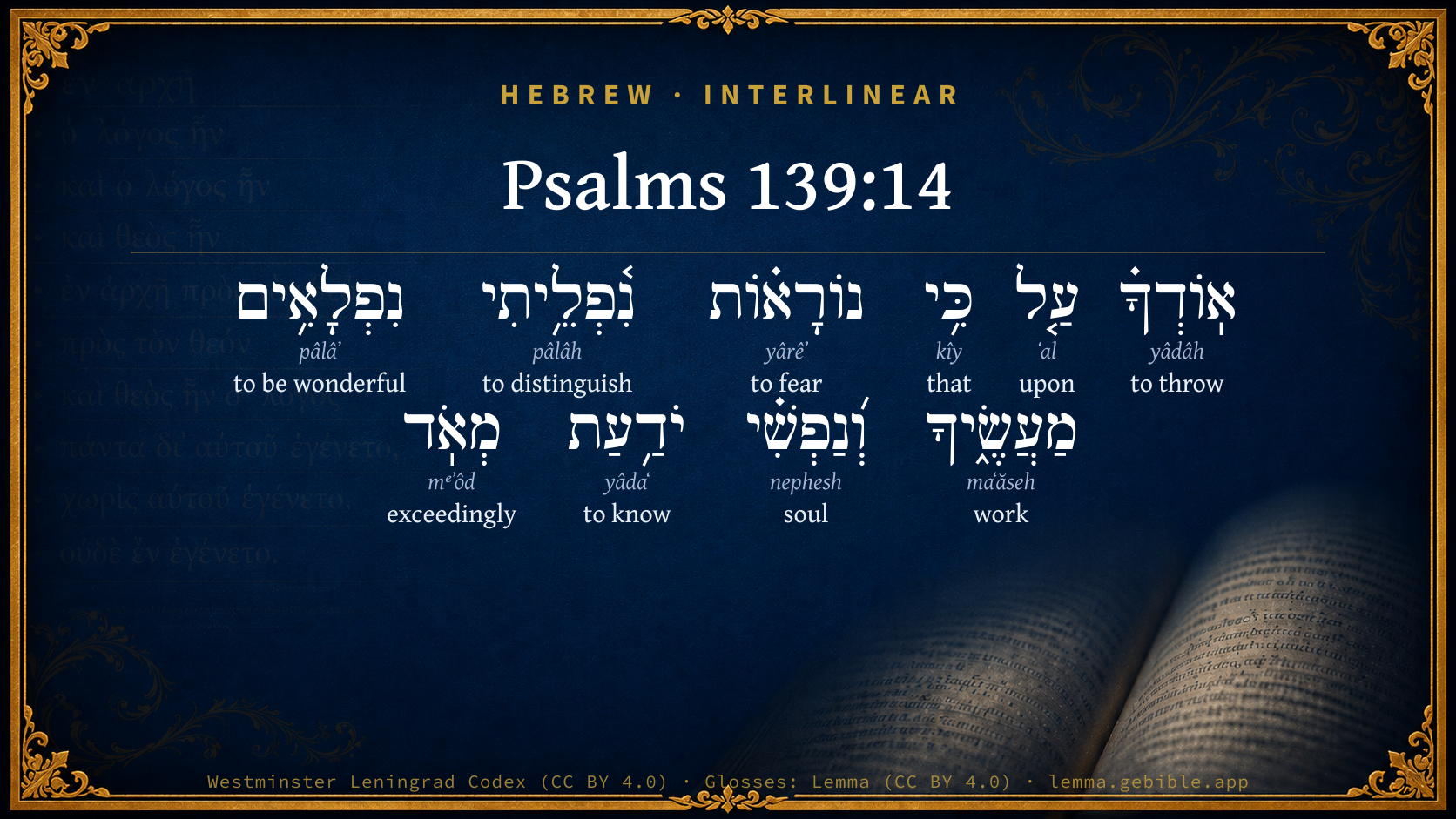
Hebrew (Westminster Leningrad Codex) Psalms 139:14 appears in the Hebrew Old Testament. The text above is from the Westminster Leningrad Codex. Each word links to its Strong’s number, a concise gloss, and parsing drawn from the Open Scriptures Hebrew Bible morphology. Click any word for its full Brown-Driver-Briggs (BDB) entry.
Download image
Cite this verse

Psalms 139:14 (World English Bible). Public Domain. Lemma interlinear Bible study tool, https://lemma.gebible.app/v/psalms/139/14.

Show BibTeX & RIS
BibTeX
RIS
English Translation
I will give thanks to you, For I am fearfully and wonderfully made. Your works are wonderful. My soul knows that very well.
World English Bible · Public Domain
Download a study sheet

One document with this verse’s original text, its word-by-word gloss line, the meaning frame, cross-references with their text, attributed commentary, and full source and license credits — printable, and it pastes into notes with its structure intact.

This verse Autodidact and up

Study sheet (.html) Plain text (.txt)

A passage Seminary Student

Up to 50 verses in one chapter. A passage sheet keeps up to 6 commentary sources and 12 cross-references per verse, in the order this page ranks them, and says so on the sheet whenever that leaves anything out. Ask for a single verse and you get the Autodidact verse sheet above.

Everything on this page stays free to read, with no account — the sheet is a download of what is already on screen, not access to it.

Want to remove ads? Support Godless Engineer
Compare translations 3

The same verse in 3 English versions, stacked beneath the original-language interlinear above. Click any original word for its lexicon entry.

Each is an independent rendering of the whole verse — the interlinear is not word-aligned to these translations.

Highlighted words mark where these versions differ — a whole-verse word diff, not a word-by-word alignment.

  • World English Bible Public Domain
    I will give thanks to you, For I am fearfully and wonderfully made. Your works are wonderful. My soul knows that very well.
  • King James Version Public Domain
    I will praise thee; for I am fearfully and wonderfully made: marvellous are thy works; and that my soul knoweth right well.
  • unfoldingWord Literal Text CC BY-SA 4.0
    I will thank you because fearsomely, I am wonderfully made. Wonderful your works, and my soul knows very well.

unfoldingWord Literal Text — © unfoldingWord, licensed CC BY-SA 4.0. Word-aligned USFM3 via Door43 (git.door43.org/unfoldingWord/en_ult).

Versions to compare (up to 4)

3 of 4 selected

Show all 17 translations

Every available English version of this verse, each an independent rendering of the whole verse.

  • World English Bible Public Domain
    I will give thanks to you, For I am fearfully and wonderfully made. Your works are wonderful. My soul knows that very well.
  • Berean Standard Bible Public Domain
    I praise You, for I am fearfully and wonderfully made. Marvelous are Your works, and I know this very well.
  • Majority Standard Bible Public Domain
    I praise You, for I am fearfully and wonderfully made. Marvelous are Your works, and I know this very well.
  • King James Version Public Domain
    I will praise thee; for I am fearfully and wonderfully made: marvellous are thy works; and that my soul knoweth right well.
  • American Standard Version (1901) Public Domain
    I will give thanks unto thee; for I am fearfully and wonderfully made: Wonderful are thy works; And that my soul knoweth right well.
  • Revised Version (1885) Public Domain
    I will give thanks unto thee; for I am fearfully and wonderfully made: wonderful are thy works; and that my soul knoweth right well.
  • Geneva Bible (1599) Public Domain
    I will praise thee, for I am fearefully and wonderously made: marueilous are thy workes, and my soule knoweth it well.
  • Young's Literal Translation Public Domain
    I confess Thee, because that `with' wonders I have been distinguished. Wonderful `are' Thy works, And my soul is knowing `it' well.
  • Literal Standard Version CC BY-SA 4.0
    I confess You, because I have been fearfully distinguished. Your works [are] wonderful, || And my soul is knowing [it] well.
  • Unlocked Literal Bible CC BY-SA 4.0
    I will praise you, for I am wonderfully made. My soul knows this very well.
  • unfoldingWord Literal Text CC BY-SA 4.0
    I will thank you because fearsomely, I am wonderfully made. Wonderful your works, and my soul knows very well.
  • Darby Bible Public Domain
    I will praise thee, for I am fearfully, wonderfully made. Marvellous are thy works; and [that] my soul knoweth right well.
  • World Messianic Bible Public Domain
    I will give thanks to you, for I am fearfully and wonderfully made. Your works are wonderful. My soul knows that very well.
  • Webster's Bible Public Domain
    I will praise thee: for I am fearfully and wonderfully made: wonderful are thy works; and that my soul well knoweth.
  • Free Bible Version CC BY-SA 4.0
    I praise you for making me in such an awesome and wonderful way. What you do is incredible—I realize this completely!
  • Bible in Basic English Public Domain
    I will give you praise, for I am strangely and delicately formed; your works are great wonders, and of this my soul is fully conscious.
  • JPS Tanakh (1917) Public Domain
    I will give thanks unto Thee, for I am fearfully and wonderfully made; wonderful are Thy works; and that my soul knoweth right well.

Literal Standard Version (2020), Covenant Press — licensed CC BY-SA 4.0. Text via the HelloAO Bible API (eBible.org). Unlocked Literal Bible (unfoldingWord) — licensed CC BY-SA 4.0. Text via the HelloAO Bible API (eBible.org). unfoldingWord Literal Text — © unfoldingWord, licensed CC BY-SA 4.0. Word-aligned USFM3 via Door43 (git.door43.org/unfoldingWord/en_ult). Free Bible Version, Dr. Jonathan Gallagher — licensed CC BY-SA 4.0. Text via the HelloAO Bible API (eBible.org).

Word by word

More ways to search: Search by grammar → Find every occurrence → Compare this word →

Practice this passage: Drill this verse → Learn its vocabulary →

נִ֫פְלֵ֥יתִי
pâlâh
H6395
“to distinguish”
Verb, Niphal, Perfect, 1st Person, Common, Singular
Part of Speech
Verb
Stem
Niphal
Form
Perfect
Person
1st Person
Gender
Common
Number
Singular
Full BDB Definition

Origin: a primitive root

TWOT: 1772

to be distinct, marked out, be separated, be distinguished - (Niphal) - to be distinct, be separated, be distinguished - to be wonderful - (Hiphil) to make separate, set apart
  1. אֽוֹדְךָ֗ yâdâh H3034 “to throw · you” Verb, Hiphil, Imperfect, 1st Person, Common, Singular + Suffix, Personal, 2nd Person, Masculine, Singular
  2. עַ֤ל ʻal H5921 “upon” Preposition
  3. כִּ֥י kîy H3588 “that” Conjunction
  4. נוֹרָא֗וֹת yârêʼ H3372 “fearing” Verb, Niphal, Participle Active, Feminine, Plural, Absolute
  5. נִפְלָאִ֥ים pâlâʼ H6381 “being wonderful” Verb, Niphal, Participle Active, Masculine, Plural, Absolute
  6. מַעֲשֶׂ֑יךָ maʻăseh H4639 “works · your” Noun, Common, Masculine, Plural, Construct + Suffix, Personal, 2nd Person, Masculine, Singular
  7. וְ֝נַפְשִׁ֗י nephesh H5315 “and · soul · my” Conjunction + Noun, Common, Both, Singular, Construct + Suffix, Personal, 1st Person, Common, Singular
  8. יֹדַ֥עַת yâdaʻ H3045 “knowing” Verb, Qal, Participle Active, Feminine, Singular, Absolute
  9. מְאֹֽד mᵉʼôd H3966 “exceedingly” Adverb

About this verse

These counts appear in no published source. They are computed here, from the morphology-tagged text and Lemma’s own curated glosses. What Lemma adds →

10
words
10
distinct lemmas
Wisdom
section

Notable vocabulary

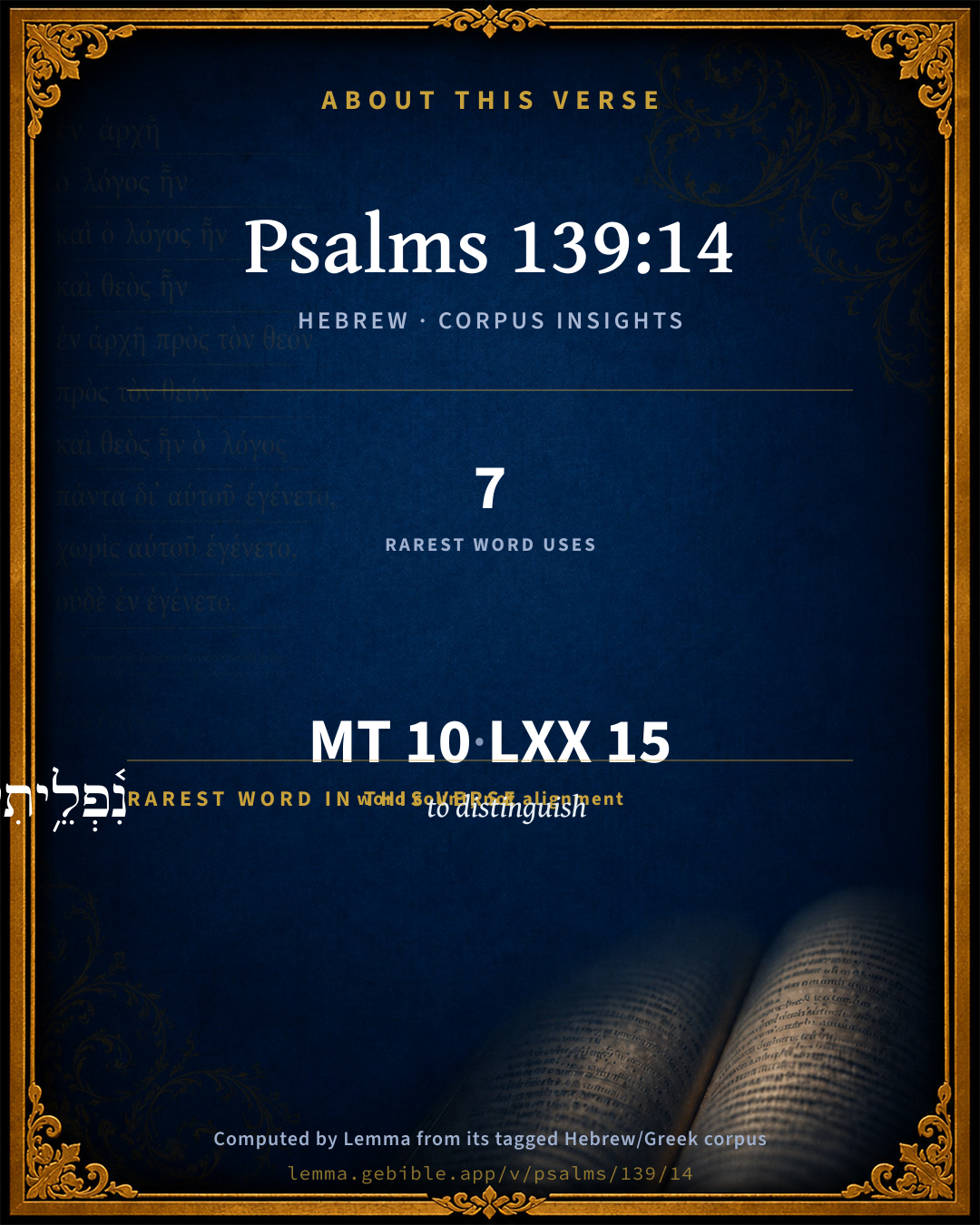
The rarest word here is נִ֫פְלֵ֥יתִי to distinguish H6395 — appearing just 7 times in the whole Hebrew Bible.

Shared distinctive vocabulary

נִ֫פְלֵ֥יתִי to distinguish H6395 occurs in 7 verses of the Hebrew Bible. Also found in:

Grammatical profile

  • 5 verbs
  • 2 nouns
  • 1 preposition
  • 1 conjunction
  • 1 adverb

Verb forms

  • אֽוֹדְךָ֗ Hiphil · Imperfect
  • נוֹרָא֗וֹת Niphal · Participle Active
  • נִ֫פְלֵ֥יתִי Niphal · Perfect
  • נִפְלָאִ֥ים Niphal · Participle Active
  • יֹדַ֥עַת Qal · Participle Active

Hebrew & Septuagint length

In English translation the verse runs 23 words from the Hebrew and 20 from the Septuagint (LXX English) — closely comparable.

A rough comparison of the two English renderings, which tokenize alike — not a word-level alignment.

Word counts can differ between the Hebrew and the Greek without any difference in meaning — e.g. the Hebrew direct-object marker אֵת has no separate Greek word, and Greek often adds the article ὁ.

In the original languages it is 10 Hebrew tokens and 15 Greek tokens — but the two are counted differently (Hebrew bundles its prefixes and suffixes into one token; the Greek is in lemma form), so that isn’t a like-for-like length.

Cross-references

7

Topical passages linked to Psalms 139:14 in the Treasury of Scripture Knowledge — connected by theme and wording, ordered by reader-vote popularity; previews shown in the World English Bible.

  • Genesis 1:26–27 God said, "Let us make man in our image, after our likeness: and let them have dominion over the fish of the sea, and over the birds of the sky, and over the cattle, and over all the earth, and over every creeping thing that creeps on the earth."
  • Psalms 111:2 Yahweh's works are great, Pondered by all those who delight in them.
  • Psalms 104:24 Yahweh, how many are your works! In wisdom have you made them all. The earth is full of your riches.
  • Psalms 92:4–5 For you, Yahweh, have made me glad through your work. I will triumph in the works of your hands.
  • Job 5:9 Who does great things that can't be fathomed, Marvelous things without number;
  • Psalms 40:5 Many, Yahweh, my God, are the wonderful works which you have done, And your thoughts which are toward us. They can't be set in order to you; If I would declare and speak of them, they are more than can be numbered.
  • Revelation 15:3 They sang the song of Moses, the servant of God, and the song of the Lamb, saying, "Great and marvelous are your works, Lord God, the Almighty; Righteous and true are your ways, you King of the nations.

Cross-references courtesy of OpenBible.info (CC BY 4.0).

Hebrew and Greek witnesses Masoretic Hebrew ↔ Greek Septuagint

The same verse in the two great witnesses to the Old Testament, shown verse-for-verse.

You’re reading Greek Psalm 138 (Hebrew Psalm 139). The Septuagint counts the superscription, so verse numbers can differ from the Hebrew — chapter-level alignment, not verse-by-verse. Numbering follows Rahlfs.

These are two independent witnesses, not word-aligned to each other, and the Septuagint is shown in lemma (dictionary) form.

Hebrew Psalms 139:14 Masoretic · Westminster Leningrad Codex

אֽוֹדְךָ֗ עַ֤ל כִּ֥י נוֹרָא֗וֹת נִ֫פְלֵ֥יתִי נִפְלָאִ֥ים מַעֲשֶׂ֑יךָ וְ֝נַפְשִׁ֗י יֹדַ֥עַת מְאֹֽד

I will give thanks to you, For I am fearfully and wonderfully made. Your works are wonderful. My soul knows that very well.

World English Bible · Public Domain

Greek LXX Greek Psalm 138:14 Septuagint · lemma form

ἐκὁμολογέω σύ ὅτι φοβερῶς θαυμαστόω θαυμάσιος ὁ ἔργον σύ καί ὁ ψυχή ἐγώ γιγνώσκω σφόδρα

I will give you thanks; for you are fearfully wondrous; wondrous are your works; and my soul knows it well.

LXX2012 (modern English Septuagint) · Public Domain

Hebrew: Westminster Leningrad Codex (CC BY 4.0). Greek: Septuagint (public domain); English from LXX2012 (modern English Septuagint) (Public Domain). How the Septuagint differs from the Hebrew →

Commentary

Notes on Psalms 139:14 from classic Christian and Jewish commentators (each source and its license shown beneath its notes). The classic Christian expositions comment on the surrounding passage and are grouped to its opening verse, so a note may address several verses; the Jewish commentaries on the Tanakh (Rashi and others) are per-verse, so they appear only where the commentator wrote on this verse.

Lemma curates 59 commentaries, every one of them public domain or Creative Commons licensed, each selected and text-cleaned for this edition rather than reprinted as found. About our sources →

Trapp's Complete Commentary

John Trapp

Psa 139:14 I will praise thee; for I am fearfully [and] wonderfully made: marvellous [are] thy works; and [that] my soul knoweth right well.

Ver. 14. I will praise thee; for I am fearfully and wonderfully made] Mirificatus sum mirabilibus operibus tuis, saith Montanus; neither can I wonder enough at thy workmanship. The greatest miracle in the world is man; in whose very body (how much more in his soul!) are miracles enough (between head and feet) to fill a volume. Austin complaineth that men much wonder at high mountains of the earth, huge waves of the sea, deep falls of rivers, the vastness of the ocean, the motions of the stars, et relinquunt seipsos nec mirantur, but wonder not at all at their wonderful selves. Galen, a profane physician, writing of the excellent parts of man’s body, and coming to speak of the double motion of the lungs, could not choose but sing a hymn to that God, whosoever he were, that was author of so excellent and admirable a piece of work, Fernel. de abdit, rerum causis.

And that my soul knoweth right well] That is, so well as to draw hearty praises from me to my Maker. But for any exact insight, hear Solomon: "As thou knowest not what is the way of the spirit, nor how the bones do grow in the womb of her that is with child; even so thou knowest not the works of God, who maketh all," Ecc 11:5. Some read the words thus, Thy works are wonderful, and so is my soul, which knoweth right well; q.d. my rational and intelligent soul is an admirable piece indeed. Nothing in the world, saith one, is so well worthy to be wondered at as man, nothing in man, as his soul.

John Trapp, A Commentary or Exposition upon All the Books of the Old and New Testament (1647–1656) — public domain. Text from a community e-Sword module.

The Biblical Illustrator

Joseph S. Exell

Psa_139:14

I will praise Thee, for I am fearfully and wonderfully made.

Man adoring his Maker

I. The expressive declaration--I am fearfully and wonderfully made.

1. The wonders and mysteries of the human frame are little thought of, or understood, by the children of men; yet surely we may say, The finger of God is here. Our body is a congeries of wonders from the crown of the head to the sole of the foot. The different parts are so finely, delicately, and exquisitely made that it seems as if the least thing must disjoint, disorder, or derange them. Our life is an affair of beauty, symmetry, utility, and of mystery. The configuration and the construction, the composition and the articulation, the perforations, the compressions, the expansions, the attrition, the compensation, the exhaustion, the restoration, the secretion, and the excretions of the body all prove it to be fearfully made. The mouth, the eye, the ear, the head, the brain, and the lungs, with the heart contracting four thousand times in an hour, and sending out with unerring accuracy at every contraction one ounce of blood, are all proof of the fact. The varied apparatus for breathing, for nourishing the system, for moving the limbs, for the reception of aliment, and for the ejection el waste, all demonstrate the truth of the text. The varied secretions of the system, and the gastric juice, all of them being different in consistency, in colour, in taste, in smell, and in their uses in the animal economy; some of them thick, others transparent, some bitter and others sweet, all adapted either to cleanse, to lubricate, to defend, to digest, or to nourish, are so many confirmations of the statement that we are fearfully made.

2. The language of the text also applies to the soul. Man is not only an animal, but also a spirit. That spirit is in the body, but not of it. So different from it, it yet influences it, and is influenced by it. It is lodged in it for an appointed time, and then to leave it, to be again reunited indissolubly to it, and there to abide for ever. This is the most wonderful part of man; it is mind, spirit, soul; the breath of God breathed into his nostrils, and man become a living soul. The first man, Adam, was made a living soul. Mentally, he is fearfully and wonderfully made. As a spirit he possesses the power to think, to learn, to know; he is capable of intermeddling with all wisdom, of receiving continuous supplies of wisdom and knowledge. What a power is this! It allies us to angels, to Deity! Do we value sufficiently our mental endowment? Are we careful to improve our power of reflection? Do we act as thinking beings--as creatures who must go wrong unless we exercise our minds in relation to the past, the present, and the future?

3. Socially; we are fearfully and wonderfully made. We are linked one to another, all the world round, and from generation to generation. We are ever being brought under the influence of others, and in our turn influence those around us. We may forget it, may doubt it, or deny it, and neglect it, yet it is so; all through our existence, in childhood, youth, manhood, or old age. This influence is being ever exerted, wherever we are, whatever we do, wherever we go--at home, abroad, in quiet or in active life. Oh! how it becomes us to be guarded, lest our being shall be a curse to any immortal spirit instead of a blessing; lest we lead them astray, and cause them suffering here and hereafter; or lest it be thus with ourselves! Let us indeed watch and pray, lest we lead or fall into temptation.

4. Morally, man is fearfully and wonderfully made. These natures of ours are distinguished by a moral sense, as well as by a mental power and a social influence. We are gifted with a sense of right and wrong, of which we can never be divested to all eternity. We can understand the difference; can choose the evil and reject the good; or we are at liberty to choose the good and repudiate the evil. The choice is our own act; the praise, the blame our own. We may be driven to choose between conflicting duties; never obliged to choose between criminal acts, or to act criminally at all. We may be virtuous or vicious; range ourselves on the side of heaven or hell; walk with the wise, or choose to be the companions of fools. Do we regard aright this fearful responsibility? Do we live as if thus distinguished from the rest of the terrene creation?

II. A becoming resolution. I will praise Thee. Let us not forget that we have much to praise God for. He is our Maker, He has blessed us with existence, and it will not be His fault if that blessing be turned into a curse. He it is that has so long held our souls in life. He has rightly framed us. He has endowed us with reason, He has favoured us with health, He has provided for our comfort, and supplied our ever-recurring necessities. We should praise Him for His marvellous wisdom, skill, power, and benevolence in thus building our house of clay; and endowing us with such mental powers, and for putting us into such social relations with each other, and in blessing us with such astounding spiritual possibilities for time and eternity; fully meeting and providing for the wants of our fallen spiritual natures as He has done also for the physical. We should praise Him for opening up to us through Jesus Christ His Son all the stores of Divine wisdom and knowledge, and giving us through Him free and constant access, the fulness of the Godhead, the unsearchable riches, the riches of His grace, the treasures of His love, and the immensity and eternity of His love. (Thomas Lord.)

The growth and perfection of the natural mans body and mind

I. The progress of mans natural and intellectual life from its first principles to maturity.

II. Practical lessons.

1. Here, then, you will find, if you have hearts to perceive, overwhelming proofs of the power, the providence, the wisdom, and the goodness of God.

2. If God has made these wonderful provisions for the formation and growth, the perfection and happiness of man; if He has endowed him with talents for comprehending the excellence of the work and the glory of its Maker, with a principle of self-action, deliberation, and choice of measures, man is bound to employ his parts and properties of body and mind with a special regard to Gods glory, as the main end and purpose of His own creation.

3. The formation, increase, and maturity of our bodily parts and intellectual faculties, the provisions that are made for their sustenance and development, and the wondrous processes by which they attain to their measure of perfection are strong presumptions of the truth of what the Scriptures teach us of the resurrection of the body: and may be considered as a pledge and assurance that this portion of Gods counsels and prophecies will be fulfilled. (Bishop Bethell.)

Man fearfully made

1. The expression imports the dignity of man in comparison with other creatures in this lower world. Man is so made that the sight of him impresses a terror on the beasts of the earth. Many of these are superior to man in strength and activity; and, were it not for this dread of man which is impressed on them, our life would be a state of anxiety and terror. Now, if God has given us dominion over the beasts of the earth, we ought to exercise it with justice and humanity. And if man is made superior to the beasts, he should conduct himself in a manner becoming his natural superiority. Reason is the dignity of man. Then only we maintain our dignity when we act as reasonable beings. If passion and appetite triumph over reason, we lose our superiority to the beast, and become as the horse or mule, which has no understanding.

2. We are fearfully made, as our frame demonstrates the power, wisdom, and presence of God. Such a wonderful composition as man could not be the effect of chance. It must be the work of an infinite, independent, all-wise Creator. And God demands, will ye not tremble at My presence? Ye have a revolting and a rebellious heart. But we need not go out of ourselves. Shall we not tremble at His presence, when we see Him around us, and feel Him within us? He is not far from every one of us. Shall not His excellency make us afraid? Let us fear, love, and obey Him. This is our whole duty.

3. We are fearfully made, as the Creator has impressed upon us evident marks of our immortality and accountableness. In the present state we find ourselves capable of progress and improvement: but we never rise to the perfection to which, in a longer space, we might attain. Must there not, then, be another state in which we may reach the perfection of which our nature is capable, but which is unattainable here?

4. In respect of our frailty. Such is the tenderness of our frame, that in this rough and dangerous world in which we live, we are always exposed to casualties and wounds, diseases and death. It may, therefore, with much propriety be said, we are fearfully made. Let religion possess our hearts, and peace will attend our path, and hope will brighten our prospect. We may take pleasure in infirmities, for the power of Christ will rest upon us. For us to live will be Christ, and to die will be gain. (J. Lathrop, D. D.)

The fabric of the human body

Wonderful as a piece of architecture, as Solomons Temple was, the fabric of the human body is far more wonderful and far more exquisite in its beauty. It is passing strange that while men can be passionate enthusiasts in the matter of being collectors and students of moths, of first editions of books, or even of postage stamps, such vast numbers of them are content to remain in ignorance of that cabinet of marvels which is nearer to them than anything else, which they carry about with them everywhere, and upon the well-being of which depends not only so much of their comfort, but also the highest effectiveness of their lives. (R. G. A. Bennets, B. A.)

The Biblical Illustrator, edited by Joseph S. Exell (c. 1880s–1900s) — public domain. Text from a community e-Sword module.

The Treasury of David

Charles H. Spurgeon

Ver. 14. I will praise thee: a good resolve, and one which he was even now carrying out. Those who are praising God are the very men who will praise him. Those who wish to praise have subjects for adoration ready to hand. We too seldom remember our creation, and all the skill and kindness bestowed upon our frame: but the sweet singer of Israel was better instructed, and therefore he prepares for the chief musician a song concerning our nativity and all the fashioning which precedes it. We cannot begin too soon to bless our Maker, who began so soon to bless us: even in the act of creation he created reasons for our praising his name,

For I am fearfully and wonderfully made. Who can gaze even upon a model of our anatomy without wonder and awe? Who could dissect a portion of the human frame without marvelling at its delicacy, and trembling at its frailty? The Psalmist had scarcely peered within the veil which hides the nerves, sinews, and blood vessels from common inspection; the science of anatomy was quite unknown to him; and yet he had seen enough to arouse his admiration of the work and his reverence for the Worker.

Marvellous are thy works. These parts of my frame are all thy works; and though they be home works, close under my own eye, yet are they wonderful to the last degree. They are works within my own self, yet are they beyond my understanding, and appear to me as so many miracles of skill and power. We need not go to the ends of the earth for marvels, nor even across our own threshold; they abound in our own bodies.

And that my soul knoweth right well. He was no agnostiche knew; he was no doubterhis soul knew; he was no dupehis soul knew right well. Those know indeed and of a truth who first know the Lord, and then know all things in him. He was made to know the marvellous nature of God's work with assurance and accuracy, for he had found by experience that the Lord is a master worker, performing inimitable wonders when accomplishing his kind designs. If we are marvellously wrought upon even before we are born, what shall we say of the Lord's dealings with us after we quit his secret workshop, and he directs our pathway through the pilgrimage of life? What shall we not say of that new birth which is even more mysterious than the first, and exhibits even more the love and wisdom of the Lord.

Ver. 14. I will praise thee, etc. All God's works are admirable, man wonderfully wonderful. "Marvellous are thy works; and that my soul knoweth right well." What infers he on all this? Therefore "I will praise thee." If we will not praise him that made us, will he not repent that he made us? Oh that we knew what the saints do in heaven, and how the sweetness of that doth swallow up all earthly pleasures! They sing honour and glory to the Lord. Why? Because he hath created all things: Re 4:11. When we behold an exquisite piece of work, we presently enquire after him that made it, purposely to commend his skill: and there is no greater disgrace to an artist, than having perfected a famous work, to find it neglected, no man minding it, or so much as casting an eye upon it. All the works of God are considerable, and man is bound to this contemplation. "When I consider the heavens", etc., I say, "What is man?." Ps 8:3-4. He admires the heavens, but his admiration reflects upon man. Quis homo? There is no workman but would have his instruments used, and used to that purpose for which they were made...Man is set like a little world in the midst of the great, to glorify God; this is the scope and end of his creation. Thomas Adams.

Ver. 14. I am fearfully and wonderfully made. The term "fearful" is sometimes to be taken subjectively, far our being possessed of fear. In this sense it signifies the same as timid. Thus the prophet was directed to say to them that were of a "fearful heart, be strong." At other times it is taken objectively, for that property in an object the contemplation of which excites fear in the beholder. Thus it is said of God that he is "fearful in praises", and that it is a "fearful thing to fall into the hands of the living God." In this sense it is manifestly to be understood in the passage now under consideration. The human frame is so admirably constructed, so delicately combined, and so much in danger of being dissolved by innumerable causes, that the more we think of it the more we tremble, and wonder at our own continued existence.

"How poor, how rich, how abject, how august,

How complicate, how wonderful is man!

How passing wonder he who made him such,

Who mingled in our make such strange extremes

Of different natures, marvellously mixed!

Helpless immortal, insect infinite,

A worm, a godI tremble at myself!"

To do justice to the subject, it would be necessary to be well acquainted with anatomy. I have no doubt that a thorough examination of that "substance which God hath curiously wrought" (Ps 139:15), would furnish abundant evidence of the justness of the Psalmist's words; but even those things which are manifest to common observation may be sufficient for this purpose. In general it is observable that the human frame abounds with avenues at which enter every thing conducive to preservation and comfort, and every thing that can excite alarm. Perhaps there is not one of these avenues but what may become an inlet to death, nor one of the blessings of life but what may be the means of accomplishing it. We live by inhalation, but we also die by it. Diseases and death in innumerable forms are conveyed by the very air we breathe. God hath given us a relish for divers aliments, and rendered them necessary to our subsistence: yet, from the abuse of them, what a train of disorders and premature deaths are found amongst men! And, when there is no abuse, a single delicious morsel may, by the evil design of another, or even by mere accident, convey poison through all our veins, and in one hour reduce the most athletic form to a corpse.

The elements of fire and water, without which we could not subsist, contain properties which in a few moments would be able to destroy us; nor can the utmost circumspection at all times preserve us from their destructive power. A single stroke on the head may divest us of reason or of life. A wound or a bruise of the spine may instantly deprive the lower extremities of all sensation. If the vital parts be injured, so as to suspend the performance of their mysterious functions, how soon is the constitution broken up! By means of the circulation of the blood, how easily and suddenly are deadly substances diffused throughout the frame! The putridity of a morbid subject has been imparted to the very hand stretched out to save it. The poisoned arrow, the envenomed fang, the hydrophobic saliva, derive from hence their fearful efficacy. Even the pores of the skin, necessary as they are to life, may be the means of death. Not only are poisonous substances hereby admitted, but, when obstructed by surrounding damps, the noxious humours of the body, instead of being emitted, are retained in the system, and become productive of numerous diseases, always afflictive, and often fatal to life.

Instead of wondering at the number of premature deaths that are constantly witnessed, there is far greater reason to wonder that there are no more, and that any of us survive to seventy or eighty years of age.

"Our life contains a thousand springs,

And dies if one be gone:

Strange that a harp of thousand strings

Should keep in tune so long."

Nor is this all. If we are "fearfully made" as to our animal frame, it will be found that we are much more so considered as moral and accountable beings. In what relates to our animal nature, we are in most instances constructed like other animals; but, in what relates to us as moral agents, we stand distinguished from all the lower creation. We are made for eternity. The present life is only the introductory part of our existence. It is that, however, which stamps a character on all that follows. How fearful is our situation! What innumerable influences is the mind exposed to from the temptations which surround us! Not more dangerous to the body is the pestilence that walketh in darkness than these are to the soul. Such is the construction of our nature that the very word of life, if heard without regard becomes a savour of death unto death. What consequences hang upon the small and apparently trifling beginnings of evil! A wicked thought may issue in a wicked purpose, this purpose in a wicked action, this action in a course of conduct, this course may draw into its vortex millions of our fellow creatures, and terminate in perdition, both to ourselves and them. The whole of this process was exemplified in the case of Jeroboam, the son of Nebat. When placed over the ten tribes, he first said in his heart, "If this people go up to sacrifice at Jerusalem, their hearts will turn to Rehoboam; and thus shall the kingdom return to the house of David." 1Ki 12:26-30. On this he took counsel, and made the calves of Dan and Bethel. This engaged him in a course of wickedness, from which no remonstrances could reclaim him. Nor was it confined to himself; for he "made all Israel to sin." The issue was, not only their destruction as a nation, but, to all appearance, the eternal ruin of himself and great numbers of Iris followers. Such were the fruits of an evil thought!

Oh, my soul, tremble at thyself! Tremble at the fearfulness of thy situation; and commit thine immortal all into his hands "who is able to keep thee from falling, and to present thee faultless before the presence of his glory with exceeding joy." Andrew Fuller.

Ver. 14. I am fearfully and wonderfully made. Never was so terse and expressive a description of the physical conformation of man given by any human being. So "fearfully" are we made, that there is not an action or gesture of our bodies, which does not, apparently, endanger some muscle, vein, or sinew, the rupture of which would destroy either life or health. We are so "wonderfully" made, that our organization infinitely surpasses, in skill, contrivance, design, and adaptation of means to ends, the most curious and complicated piece of mechanism, not only ever executed "by art and man's device", but ever conceived by human imagination. Richard Warner, 1828.

Ver. 14. I am wonderfully made. Take notice of the curious frame of the body. David saith, "I am wonderfully made"; acu pictus sum, so the Vulgate rendereth it, "painted as with a needle", like a garment of needlework, of divers colours, richly embroidered with nerves and veins. What shall I speak of the eye, wherein there is such curious workmanship, that many upon the first sight of it have been driven to acknowledge God? Of the hand, made to open and shut, and to serve the labours and ministries of nature without wasting and decay for many years? If they should be of marble or iron, with such constant use they would soon wear out; and yet now they are of flesh they last so long as life lasts. Of the head? fitly placed to be the seat of the senses, to command and direct the rest of the members. Of the lungs? a frail piece of flesh, yet, though in continual action, of a long use. It were easy to enlarge upon this occasion; but I am to preach a sermon, not to read an anatomy lecture. In short, therefore, every part is so placed and framed, as if God had employed his whole wisdom about it.

But as yet we have spoken but of the casket wherein the jewel lieth. The soul, that divine spark and blast, how quick, nimble, various, and indefatigable in its motions! how comprehensive in its capacities! how it animates the body, and is like God himself, all in every part! Who can trace the flights of reason? What a value hath God set upon the soul! He made it after his image, he redeemed it with Christ's blood. Thomas Manton.

Ver. 14. What is meant by saying that the soul is in the body, any more than saying that a thought or a hope is in a stone or a tree? How is it joined to the body? what keeps it one with the body? what keeps it in the body? what prevents it any moment from separating from the body? When two things which we see are united, they are united by some connection which we can understand. A chain or cable keeps a ship in its place; we lay the foundation of a building in the earth, and the building endures. But what is it which unites soul and body how do they touch how do they keep together? how is it we do not wander to the stars or the depths of the sea, or to and fro as chance may carry us, while our body remains where it was on earth? So far from its being wonderful that the body one day dies, how is it that it is made to live and move at all? how is it that it keeps from dying a single hour? Certainly it is as uncomprehensible as anything can be, how soul and body can make up one man; and, unless we had the instance before our eyes, we should seem in saying so to be using words without meaning. For instance, would it not be extravagant and idle to speak of time as deep or high, or of space as quick or slow? Not less idle, surely, it perhaps seems to some races of spirits to say that thought and mind have a body, which in the case of man they have, according to God's marvellous will. John Henry Newman, in Parochial Sermons, 1839.

Ver. 14. Moses describes the creation of man (Ge 2:7): "The Lord God formed man of the dust of the ground, and breathed into his nostrils the breath of life; and man became a living soul." Now what God did then immediately, he doth still by means. Do not think that God made man at first, and that ever since men have made one another. No (saith Job), "he that made me in the womb made him": Job 31:15. David will inform us: "I am fearfully and wonderfully made: marvellous are thy works", etc. As if he had said, Lord, I am wonderfully made, and thou hast made me. I am a part or parcel of thy marvellous works, yea, the breviate or compendium of them all. The frame of the body (much more the frame of the soul, most of all the frame of the new creature in the soul) is God's work, and it is a wonderful work of God. And therefore David could not satisfy himself in the bare affirmation of this, but enlargeth in the explication of it in Ps 139:15-16. David took no notice of father or mother but ascribed the whole efficiency of himself to God. And indeed David was as much made by God as Adam; and so is every son of Adam. Though we are begotten and born of our earthly parents, yet God is the chief parent and the only fashioner of us all. Thus graciously spake Jacob to his brother Esau, demanding, "Who are those with thee? And he said, The children which God hath graciously given thy servant": Ge 33:5. Therefore, as the Spirit of God warns, "Know ye that the Lord he is God: it is he that hath made us, and not we ourselves" (Ps 100:3); which as it is true especially of our spiritual making, so 'tis true also of our natural. Joseph Caryl.

Ver. 14. Those who were skilful in Anatomy among the ancients, concluded, from the outward and inward make of a human body, that it was the work of a Being transcendently wise and powerful. As the world grew more enlightened in this art, their discoveries gave them fresh opportunities of admiring the conduct of Providence in the formation of a human body. Galen was converted by his dissections, and could not but own a Supreme Being upon a survey of this his handiwork. There are, indeed, many parts, of which the old anatomists did not know the certain use; but as they saw that most of those which they examined were adapted with admirable art to their several functions, they did not question but those whose uses they could not determine, were contrived with the same wisdom for respective ends and purposes. Since the circulation of the blood has been found out, and many other great discoveries have been made by our modern anatomists, we see new wonders in the human frame, and discern several important uses for those parts, which uses the ancients knew nothing of. In short, the body of man is such a subject as stands the utmost test of examination. Though it appears formed with the nicest wisdom upon the most superficial survey of it, it still mends upon the search, and produces our surprise and amazement in proportion as we pry into it. The Spectator.

Ver. 14-16. The subject, from Ps 139:14 and Ps 139:16 inclusive, might have been much more particularly illustrated; but we are taught, by the peculiar delicacy of expression in the Sacred Writings, to avoid, as in this case, the entering too minutely into anatomical details. Adam Clarke.

Ver. 14. I am fearfully and wonderfully made. This is true of man in his fourfold state.

1. In his primitive integrity.

2. In his deplorable depravity.

3. In his regeneration.

4. In his fixed state in hell or heaven.

W.W.

Psalms 139:15*

Charles H. Spurgeon's The Treasury of David (1869–1885) — public domain. Psalms only. Text from a community e-Sword/MySword module.

Joseph Benson's Commentary

Psa 139:14. I am fearfully and wonderfully made — Thy infinite wisdom and power, manifested in the singular and curious structure of man’s body, fill me with wonder and astonishment, and with the dread of thy Majesty. Marvellous are thy works — Both in the lesser world, man, and in the greater; and that my soul knoweth right well — I am well assured, both by thy word, and by the contemplation and study of thy works, that they are wonderful, although I do not so accurately understand them in all their parts as I wish to do.

Joseph Benson's Commentary on the Old and New Testaments (1811–1818) — public domain. Text from a community e-Sword module.

J. A. Alexander on Psalms

Joseph Addison Alexander

14. (Psa 139:14) I thank thee, because fearfully I am distinguished; wonderful (are) thy works, and (that) my soul knoweth right (well). He makes it a subject of grateful acknowledgment, that God has distinguished him or made him to differ from inferior creatures, both in constitution and in destiny. Because is in Hebrew a compound particle like for that, forasmuch as. Fearfully, literally fearful (things), but used adverbially, as in Psa 65:5. It might here be rendered (by) fearful (things). The words corresponding to distinguished and wonderful are in Hebrew passive forms from cognate roots. The particular statement of the first clause is resolved by the last into the general one, of which it is a mere specification. The concluding words express a strong and, as it were, experimental conviction of the truth.

Joseph Addison Alexander, The Psalms Translated and Explained (1850) — public domain. Text from a community e-Sword module.

Geneva Bible (1599)

Geneva Bible translators

Considering thy wonderful work in forming me, I cannot but praise thee and fear thy mighty power.

Geneva Bible (1599) marginal notes — public domain. Text via Bolls.life.

Adam Clarke's Commentary

Verse 14. I am fearfully and wonderfully made] The texture of the human body is the most complicated and curious that can be conceived. It is, indeed, wonderfully made; and it is withal so exquisitely nice and delicate, that the slightest accident may impair or destroy in a moment some of those parts essentially necessary to the continuance of life; therefore, we are fearfully made. And God has done so to show us our frailty, that we should walk with death, keeping life in view; and feel the necessity of depending on the all-wise and continual superintending care and providence of God.

Adam Clarke's Commentary on the Bible (1810–1826) — public domain. Text from a community e-Sword/MySword module.

Ellicott's Commentary for English Readers

(14) For I am . . .—Literally, because I am fearfully separated or distinguished (see Note on Psa_26:7; Psa_40:5), which might mean separated from the womb, i.e., born. (Comp. Gal_1:15; Psa_22:10.) Or if the reference is national rather than individual, it would imply, as so frequently, the choice of Israel by Jehovah in distinction to other races.

A Bible Commentary for English Readers, edited by Charles John Ellicott (1878–1897) — public domain. Text from a community e-Sword module.

The Cambridge Bible for Schools and Colleges

gen. ed. J. J. S. Perowne

14. I will praise thee] I will give thanks unto thee.

I am fearfully and wonderfully made] The Ancient Versions represent the second person, thou art fearfully wondrous.

marvellous] Wonderful, the same word as in the preceding clause.

The Cambridge Bible for Schools and Colleges (gen. ed. J. J. S. Perowne; Cambridge University Press, 1878–1918) — public domain. Text from a community e-Sword module.

John Gill's Exposition

My substance was not hid from thee when I was made in secret,.... Or "my bone" (n); everyone of his bones, which are the substantial parts of the body, the strength of it; and so some render it "my strength" (o); those, though covered with skin and flesh yet, being done by the Lord himself, were not hid from him; nor the manner of their production and growth, which being done in secret is a secret to men; for they know not how the bones grow in the womb of her that is with child, Ecc 11:5; but God does;

and curiously wrought in the lowest parts of the earth; or formed in my mother's womb, as the Targum, and so Jarchi, like a curious piece of needlework or embroidery, as the word (p) signifies; and such is the contexture of the human body, and so nicely and curiously are all its parts put together, bones, muscles, arteries, veins, nerves, and fibres, as exceed the most curious piece of needlework, or the finest embroidery that ever was made by the hands of men; and all this done in the dark shop of nature, in the "ovarium", where there is no more light to work by than in the lowest parts of the earth. The same phrase is used of Christ's descent into this world, into the womb of the virgin, where his human nature was curiously wrought by the finger of the blessed Spirit, Eph 4:9.

(n) "os meum", V. L. Vatablus, Gejerus, "ossa mea", Piscator; "apparatio ossium meorum", Cocceius. (o) "Robur meum", Tigurine version; "vis mea", Junius & Tremellius. (p) "velut opere phrygio effingerer", Tigurine version; "velut acupictur sum", Grotius.

John Gill's Exposition of the Whole Bible (1746–1763) — public domain (CC PDM 1.0). Text via the HelloAO Bible API.

Albert Barnes' Notes on the Bible

I will praise thee - I will not merely admire what is so great and marvelous, but I will acknowledge thee in a public manner as wise, and holy, and good: as entitled to honor, love, and gratitude.

For I am fearfully and wonderfully made - The word rendered “fearfully” means properly “fearful things;” things suited to produce fear or reverence. The word rendered “wonderfully made” means properly to distinguish; to separate. The literal translation of this - as near as can be given - would be, “I am distinguished by fearful things;” that is, by things in my creation which are suited to inspire awe. I am distinguished among thy works by things which tend to exalt my ideas of God, and to fill my soul with reverent and devout feelings. The idea is, that he was “distinguished” among the works of creation, or so “separated” from other things in his endowments as to work in the mind a sense of awe. He was made different from inanimate objects, and from the brute creation; he was “so” made, in the entire structure of his frame, as to fill the mind with wonder. The more anyone contemplates his own bodily formation, and becomes acquainted with the anatomy of the human frame, and the more he understands of his mental organization, the more he will see the force and propriety of the language used by the psalmist.

Marvellous are thy works - Fitted are they to excite wonder and admiration. The particular reference here is to his own formation; but the same remark may be made of the works of God in general.

And that my soul knoweth right well - Margin, as in Hebrew, “greatly.” I am fully convinced of it. I am deeply impressed by it. We can see clearly that the works of God are “wonderful,” even if we can understand nothing else about them.

Albert Barnes' Notes on the Bible (1834–1885) — public domain. Text from a community e-Sword/MySword module.

Matthew Poole's English Annotations

I am fearfully and wonderfully made; thy infinite power and wisdom, manifested in the rare and curious structure of man’s body, doth fill me with wonder and astonishment, and with the dread of thy majesty.

Marvellous are thy works; both in the lesser world, man, and in the greater.

My soul knoweth right well; I am well assured, both by thy word, and by the contemplation and study of thy works, to which I have much addicted myself, that they are wonderful, although I do not so accurately understand all the particulars of them as I would do.

Matthew Poole's English Annotations on the Holy Bible (1683–1685) — public domain. Text from a community e-Sword/MySword module.

The Pulpit Commentary

I will praise thee. The note of praise, which has rung through the whole poem in an undertone, is here openly struck. Reflections upon God"s wonderful works must overflow into praise; and the phenomena of man"s creation and birth are, at least, as calculated to call forth praise and adoration as any other. For I am fearfully and wonderfully made. The wonderfulness of the human mechanism is so great that, if realized, it produces a sensation of fear. It has been said that, if we could see one-half of what is going on within us, we should not dare to move. Marvelous are thy works; i.e. thy doings generally. And that my soul knoweth right well. The extent of the marvelousness I may not be able to comprehend; but at least I know the fact that they are marvelous, That fact I know "right well.

The mystery of man"s being.

The psalm shows that the knowledge of God brings peace. It appeals to God"s omniscience, that which would confound him if he were not at peace with God. They who are not hide away from God, and dread the truth the psalm declares. But let us listen to the patriarch Job. (Job_22:21) The psalmist had done so, and hence he is able now to challenge even the all-searching eye and the absolute knowledge of God, to attest his sincerity and the integrity of his heart. No hypocrite or pretender to piety could possibly do this, or ever can. Our text tells how God had known man from the beginning of his life must know him, for he had created him. This leads to reflection on the mystery of man"s being. Note

I THE TRUTH OF THE PSALMIST"S ASSERTION. "I am fearfully and wonderfully made" Now, this is true:

1. As regards the body. This is what the psalmist had mainly in his thoughts. Now, our corporeal structure is wonderful, whether we regard it as a whole or in its separate parts. But it is "fearful" also; there is an awe and mystery about it, as his soul knew right well. That it should be subject to pain and disease; that it should be so often a clog to the spirit and a hindrance to our higher life rather than a help; and that it should be ever hastening deathwards, and be at last a prey to corruption. And yet God made it not man.

2. As regards the soul. It is marvelous, whether, as with the body, we consider it in its entirety or in its several parts intellect, imagination, affections, judgment, conscience, will. How wonderful it is! But how fearful also! That it should be born with a fatal bias and tendency towards evil; that thus it is in continual peril, and is often in bondage to sin; and it can perish, and, so far as we can see, it often does. And yet God formed the soul as he did the body. How true that we are fearfully and wonderfully made"!

II THE SPIRIT IN WHICH WE ARE TO REGARD THIS TRUTH. With praise. "I will praise thee." So speaks the psalmist.

1. Many wonder how he or any one could possibly do this. Some even dare to censure and blame the Creator that he has made man so; and they audaciously assert that the coming judgment will not be so much God calling us to account for what we have done, as man calling God to account for what he has done. Far enough are such from the spirit of this psalm.

2. But we cannot but askWhat was the ground of the psalmist"s praise? Now, it was not in spite of evil, defying and scorning it; nor ignoring it, for none were more sensible of it; nor by minimizing it in comparison with the superabundant good. And, in comparison with the good gifts of God, evil is as the small dust in the balance not worthy of account, though to us here and now it looms so large. But not for such reasons is this praise. But because by means of this strange and fearful mingling of evil in our constitution we come to know, as otherwise we could not, the highest good. God has caused that sin should be as a foil to make more manifest his grace. The devil meant only our harm. God turned it round to good. Thus we come to know evil and hate it; we come to know God in Christ, and to love him as we never else should have loved him; the unfallen angels cannot love him as we may and will and do. And we come to know good holiness, purity, truth, and to hunger for them, and to rejoice in them as else we had not done.

III THE LESSON TO BE LEARNT. If God turns the greatest ill into good, be sure he will all lesser ones. But it is only by the knowledge of God that evil is thus transformed. Praise him evermore! S.C.

The Pulpit Commentary (1880–1919), ed. H.D.M. Spence-Jones & Joseph S. Exell — public domain. Text from a community e-Sword module.

Lesson kit

Teaching starters — assembled from the data on this page, not authored interpretation. Every prompt links to the verse data it draws on. Edit before teaching.

Psalms, in the Wisdom, opens this verse with 10 words (10 distinct Hebrew lemmas). Its most distinctive word is pâlâh (“to distinguish”). A historical commentator’s framing appears above. Read the whole chapter for the surrounding context.

Discussion questions

  1. What does “to distinguish” (pâlâh) contribute to the verse as a whole?
  2. Exodus 8:22 shares the word «to distinguish» with this verse. How do the two illuminate each other?
  3. The translations on this page render this verse differently — a whole-verse word diff, not a word-by-word alignment. What might account for the different wordings?
  4. The verb «אֽוֹדְךָ֗» is Hiphil Imperfect. How does its form color the action?
  5. Reading how Trapp's Complete Commentary and The Biblical Illustrator read this verse, where do the two commentators agree and where do they part?

Things to notice

Reading settings

Reading text

Shown beneath each verse's original-language words.

Old Testament
Old Testament edition

Read the OT as the Masoretic Hebrew (MT) or the Greek Septuagint (LXX).

English shown for the Greek Septuagint (in the Hebrew ↔ Greek comparison).

Comparing translations? Open the Compare panel on any verse page to stack up to four side by side.