
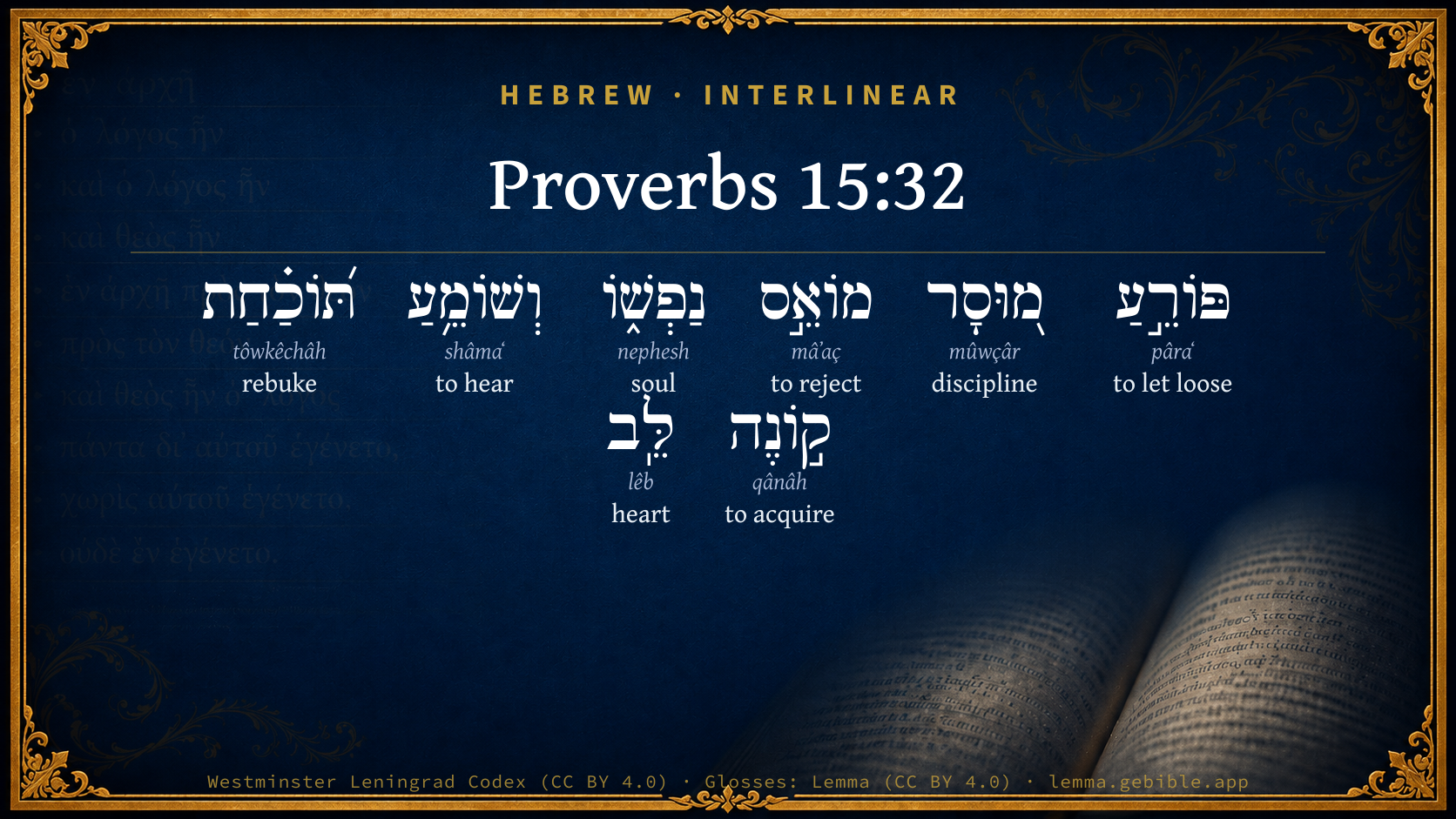
Proverbs 15:32

Hebrew (Westminster Leningrad Codex) Proverbs 15:32 appears in the Hebrew Old Testament. The text above is from the Westminster Leningrad Codex. Each word links to its Strong’s number, a concise gloss, and parsing drawn from the Open Scriptures Hebrew Bible morphology. Click any word for its full Brown-Driver-Briggs (BDB) entry.
Download image
Cite this verse

Proverbs 15:32 (World English Bible). Public Domain. Lemma interlinear Bible study tool, https://lemma.gebible.app/v/proverbs/15/32.

Show BibTeX & RIS
BibTeX
RIS
English Translation
He who refuses correction despises his own soul, But he who listens to reproof gets understanding.
World English Bible · Public Domain
Download a study sheet

One document with this verse’s original text, its word-by-word gloss line, the meaning frame, cross-references with their text, attributed commentary, and full source and license credits — printable, and it pastes into notes with its structure intact.

This verse Autodidact and up

Study sheet (.html) Plain text (.txt)

A passage Seminary Student

Up to 50 verses in one chapter. A passage sheet keeps up to 6 commentary sources and 12 cross-references per verse, in the order this page ranks them, and says so on the sheet whenever that leaves anything out. Ask for a single verse and you get the Autodidact verse sheet above.

Everything on this page stays free to read, with no account — the sheet is a download of what is already on screen, not access to it.

Want to remove ads? Support Godless Engineer
Compare translations 3

The same verse in 3 English versions, stacked beneath the original-language interlinear above. Click any original word for its lexicon entry.

Each is an independent rendering of the whole verse — the interlinear is not word-aligned to these translations.

Highlighted words mark where these versions differ — a whole-verse word diff, not a word-by-word alignment.

  • World English Bible Public Domain
    He who refuses correction despises his own soul, But he who listens to reproof gets understanding.
  • King James Version Public Domain
    He that refuseth instruction despiseth his own soul: but he that heareth reproof getteth understanding.
  • unfoldingWord Literal Text CC BY-SA 4.0
    One who avoids correction rejects his life, but one who hears rebuke acquires heart.

unfoldingWord Literal Text — © unfoldingWord, licensed CC BY-SA 4.0. Word-aligned USFM3 via Door43 (git.door43.org/unfoldingWord/en_ult).

Versions to compare (up to 4)

3 of 4 selected

Show all 18 translations

Every available English version of this verse, each an independent rendering of the whole verse.

  • World English Bible Public Domain
    He who refuses correction despises his own soul, But he who listens to reproof gets understanding.
  • Berean Standard Bible Public Domain
    He who ignores discipline despises himself, but whoever heeds correction gains understanding.
  • Majority Standard Bible Public Domain
    He who ignores discipline despises himself, but whoever heeds correction gains understanding.
  • King James Version Public Domain
    He that refuseth instruction despiseth his own soul: but he that heareth reproof getteth understanding.
  • American Standard Version (1901) Public Domain
    He that refuseth correction despiseth his own soul; But he that hearkeneth to reproof getteth understanding.
  • Revised Version (1885) Public Domain
    He that refuseth correction despiseth his own soul: but he that hearkeneth to reproof getteth understanding.
  • Geneva Bible (1599) Public Domain
    Hee that refuseth instruction, despiseth his owne soule: but he that obeyeth correction, getteth vnderstanding.
  • Douay-Rheims (1899) Public Domain
    He that rejecteth instruction, despiseth his own soul: but he that yieldeth to reproof possesseth understanding.
  • Young's Literal Translation Public Domain
    Whoso is refusing instruction is despising his soul, And whoso is hearing reproof Is getting understanding.
  • Literal Standard Version CC BY-SA 4.0
    Whoever is refusing instruction is despising his soul, || And whoever is hearing reproof || Is getting understanding.
  • Unlocked Literal Bible CC BY-SA 4.0
    The one who rejects discipline despises himself, but he who listens to correction gains understanding.
  • unfoldingWord Literal Text CC BY-SA 4.0
    One who avoids correction rejects his life, but one who hears rebuke acquires heart.
  • Darby Bible Public Domain
    He that refuseth instruction despiseth his own soul; but he that heareth reproof getteth sense.
  • World Messianic Bible Public Domain
    He who refuses correction despises his own soul, but he who listens to reproof gets understanding.
  • Webster's Bible Public Domain
    He that refuseth instruction despiseth his own soul: but he that heareth reproof getteth understanding.
  • Free Bible Version CC BY-SA 4.0
    If you ignore instruction you have no self-esteem, but if you listen to correction you gain understanding.
  • Bible in Basic English Public Domain
    He who will not be controlled by training has no respect for his soul, but he who gives ear to teaching will get wisdom.
  • JPS Tanakh (1917) Public Domain
    He that refuseth correction despiseth his own soul; but he that hearkeneth to reproof getteth understanding.

Literal Standard Version (2020), Covenant Press — licensed CC BY-SA 4.0. Text via the HelloAO Bible API (eBible.org). Unlocked Literal Bible (unfoldingWord) — licensed CC BY-SA 4.0. Text via the HelloAO Bible API (eBible.org). unfoldingWord Literal Text — © unfoldingWord, licensed CC BY-SA 4.0. Word-aligned USFM3 via Door43 (git.door43.org/unfoldingWord/en_ult). Free Bible Version, Dr. Jonathan Gallagher — licensed CC BY-SA 4.0. Text via the HelloAO Bible API (eBible.org).

Word by word

More ways to search: Search by grammar → Find every occurrence → Compare this word →

Practice this passage: Drill this verse → Learn its vocabulary →

פּוֹרֵ֣עַ
pâraʻ
H6544
“letting loose”
Verb, Qal, Participle Active, Masculine, Singular, Absolute
Part of Speech
Verb
Stem
Qal
Form
Participle Active
Gender
Masculine
Number
Singular
State
Absolute
Full BDB Definition

Origin: a primitive root

TWOT: 1822 , 1823 , 1824

to lead, act as leader - to let go, let loose, ignore, let alone - (Qal) - to let go, let loose - to let alone, avoid, neglect - to loosen - (Niphal) to be let loose, be loosened of restraint - (Hiphil) - to cause to refrain - to show lack of restraint - to let loose restraints
  1. מ֭וּסָר mûwçâr H4148 “discipline” Noun, Common, Masculine, Singular, Absolute
  2. מוֹאֵ֣ס mâʼaç H3988 “rejecting” Verb, Qal, Participle Active, Masculine, Singular, Absolute
  3. נַפְשׁ֑וֹ nephesh H5315 “soul · his” Noun, Common, Both, Singular, Construct + Suffix, Personal, 3rd Person, Masculine, Singular
  4. וְשׁוֹמֵ֥עַ shâmaʻ H8085 “and · hearing” Conjunction + Verb, Qal, Participle Active, Masculine, Singular, Absolute
  5. תּ֝וֹכַ֗חַת tôwkêchâh H8433 “rebuke” Noun, Common, Feminine, Singular, Absolute
  6. ק֣וֹנֶה qânâh H7069 “acquiring” Verb, Qal, Participle Active, Masculine, Singular, Absolute
  7. לֵּֽב lêb H3820 “heart” Noun, Common, Masculine, Singular, Absolute

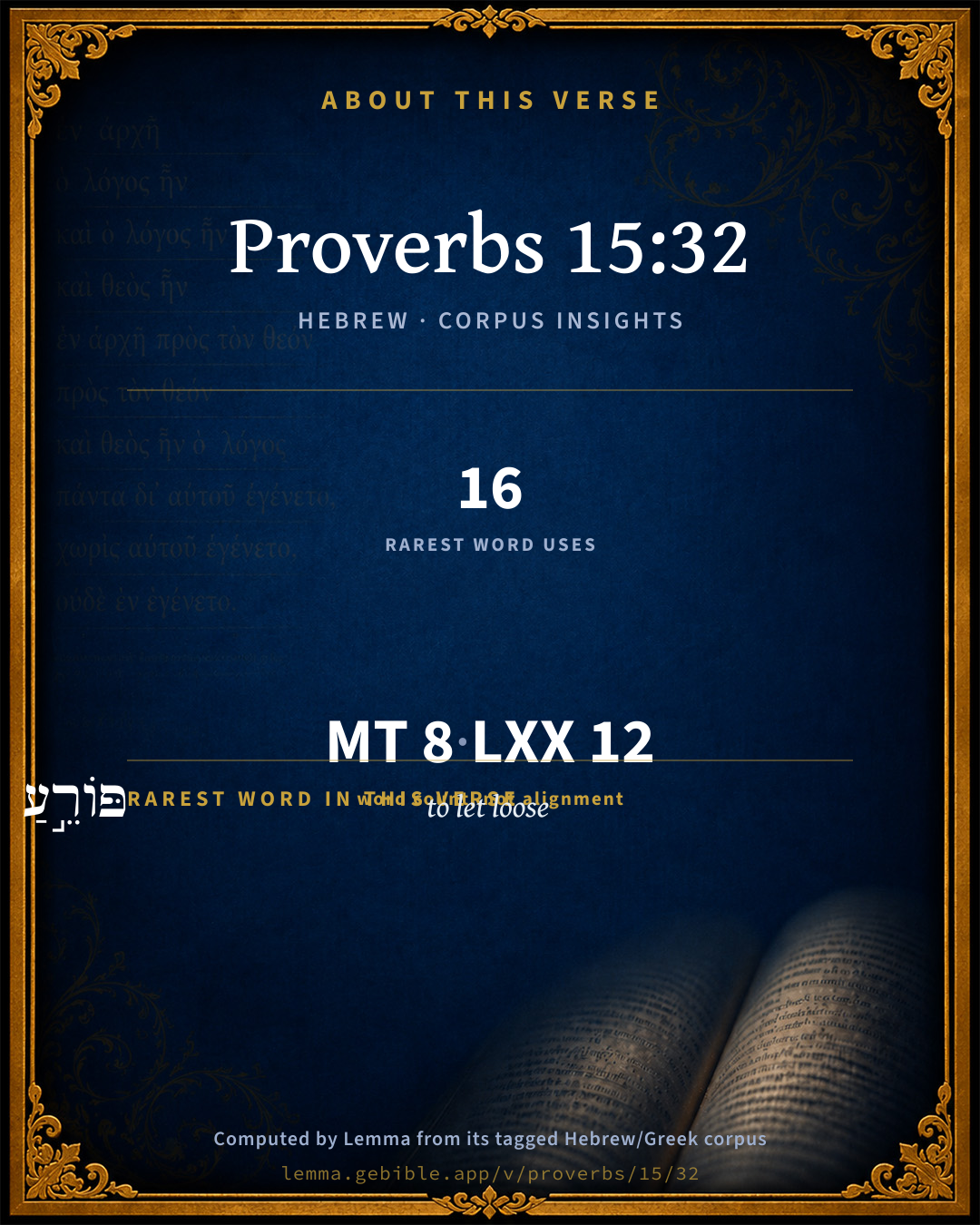
About this verse

These counts appear in no published source. They are computed here, from the morphology-tagged text and Lemma’s own curated glosses. What Lemma adds →

8
words
8
distinct lemmas
Wisdom
section

Notable vocabulary

The rarest word here is פּוֹרֵ֣עַ to let loose H6544 — appearing just 16 times in the whole Hebrew Bible.

Shared distinctive vocabulary

פּוֹרֵ֣עַ to let loose H6544 occurs in 15 verses of the Hebrew Bible. Also found in:

Grammatical profile

  • 4 verbs
  • 4 nouns

Verb forms

  • פּוֹרֵ֣עַ Qal · Participle Active
  • מוֹאֵ֣ס Qal · Participle Active
  • וְשׁוֹמֵ֥עַ Qal · Participle Active
  • ק֣וֹנֶה Qal · Participle Active

Hebrew & Septuagint length

In English translation the verse runs 16 words from the Hebrew and 14 from the Septuagint (LXX English) — closely comparable.

A rough comparison of the two English renderings, which tokenize alike — not a word-level alignment.

Word counts can differ between the Hebrew and the Greek without any difference in meaning — e.g. the Hebrew direct-object marker אֵת has no separate Greek word, and Greek often adds the article ὁ.

In the original languages it is 8 Hebrew tokens and 12 Greek tokens — but the two are counted differently (Hebrew bundles its prefixes and suffixes into one token; the Greek is in lemma form), so that isn’t a like-for-like length.

Cross-references

19

Topical passages linked to Proverbs 15:32 in the Treasury of Scripture Knowledge — connected by theme and wording, ordered by reader-vote popularity; previews shown in the World English Bible.

  • Proverbs 1:24–33 Because I have called, and you have refused; I have stretched out my hand, and no one has paid attention;
  • Revelation 3:19 As many as I love, I reprove and chasten. Be zealous therefore, and repent.
  • Proverbs 1:7 The fear of Yahweh is the beginning of knowledge; But the foolish despise wisdom and instruction.
  • Proverbs 8:33–36 Hear instruction, and be wise. Don't refuse it.
  • Proverbs 18:15 The heart of the discerning gets knowledge. The ear of the wise seeks knowledge.
  • Isaiah 1:5 Why should you be beaten more, That you revolt more and more? The whole head is sick, And the whole heart faint.
  • Jeremiah 5:3 O Yahweh, don't your eyes look on truth? you have stricken them, but they were not grieved; you have consumed them, but they have refused to receive correction: they have made their faces harder than a rock; they have refused to return.
  • Deuteronomy 21:18 If a man have a stubborn and rebellious son, who will not obey the voice of his father, or the voice of his mother, and, though they chasten him, will not listen to them;
  • Deuteronomy 21:20 and they shall tell the elders of his city, This our son is stubborn and rebellious, he will not obey our voice; he is a glutton, and a drunkard.
  • Psalms 50:17 Seeing you hate instruction, And throw my words behind you?
  • Proverbs 5:11–13 You will groan at your latter end, When your flesh and your body are consumed,
  • Proverbs 15:14 The heart of one who has understanding seeks knowledge, But the mouths of fools feed on folly.
  • Proverbs 15:21 Folly is joy to one who is void of wisdom, But a man of understanding keeps his way straight.
  • Proverbs 17:16 Why is there money in the hand of a fool to buy wisdom, Seeing he has no understanding?
  • Proverbs 29:1 He who is often rebuked and stiffens his neck Will be destroyed suddenly, with no remedy.
  • Matthew 7:24–27 "Everyone therefore who hears these words of mine, and does them, I will liken him to a wise man, who built his house on a rock.
  • James 1:22 But be doers of the word, and not only hearers, deluding your own selves.
  • Ezekiel 24:13–14 In your filthiness is lewdness: because I have cleansed you and you weren't cleansed, you shall not be cleansed from your filthiness any more, until I have caused my wrath toward you to rest.
  • Hebrews 12:15 looking carefully lest there be any man who falls short of the grace of God; lest any root of bitterness springing up trouble you, and thereby the many be defiled;

Cross-references courtesy of OpenBible.info (CC BY 4.0).

Hebrew and Greek witnesses Masoretic Hebrew ↔ Greek Septuagint

The same verse in the two great witnesses to the Old Testament, shown verse-for-verse.

These are two independent witnesses, not word-aligned to each other, and the Septuagint is shown in lemma (dictionary) form.

Hebrew Proverbs 15:32 Masoretic · Westminster Leningrad Codex

פּוֹרֵ֣עַ מ֭וּסָר מוֹאֵ֣ס נַפְשׁ֑וֹ וְשׁוֹמֵ֥עַ תּ֝וֹכַ֗חַת ק֣וֹנֶה לֵּֽב

He who refuses correction despises his own soul, But he who listens to reproof gets understanding.

World English Bible · Public Domain

Greek LXX Proverbs 15:32 Septuagint · lemma form

ὅς ἀποὠθέω παιδεία μισέω ἑαυτοῦ ὁ δέ τηρέω ἔλεγχος ἀγαπάω ψυχή αὐτός

He that rejects instruction hates himself; but he that mind reproofs loves his soul.

LXX2012 (modern English Septuagint) · Public Domain

On this verse, The Pulpit Commentary discusses the Septuagint’s reading. Read the note in Commentary ↓

Hebrew: Westminster Leningrad Codex (CC BY 4.0). Greek: Septuagint (public domain); English from LXX2012 (modern English Septuagint) (Public Domain). How the Septuagint differs from the Hebrew →

Commentary

Notes on Proverbs 15:32 from classic Christian and Jewish commentators (each source and its license shown beneath its notes). The classic Christian expositions comment on the surrounding passage and are grouped to its opening verse, so a note may address several verses; the Jewish commentaries on the Tanakh (Rashi and others) are per-verse, so they appear only where the commentator wrote on this verse.

Lemma curates 59 commentaries, every one of them public domain or Creative Commons licensed, each selected and text-cleaned for this edition rather than reprinted as found. About our sources →

Trapp's Complete Commentary

John Trapp

Pro 15:32 He that refuseth instruction despiseth his own soul: but he that heareth reproof getteth understanding.

Ver. 32. He that refuseth instruction, despiseth his own soul.] Is a sinner against his own soul, as Korah and his complices were, and sets as light by it as if it were not worth looking after. Oh! is it nothing to lose an immortal soul, to purchase an ever-living death? Wilt thou destroy that for which Christ died? {1Co 8:11} What shall a man give in exchange for his soul? There is no great matter in the earth but man, nothing great in man but his soul, said Faverinus. "Whose image and superscription is it" but God’s? "Give," therefore, "unto God the things that are God’s," by delivering it up to his discipline.

But he that heareth reproof, getteth understanding.] Heb., Possesseth his heart. This is like that sentence of our blessed Saviour, "In your patience possess ye your souls." {Luk 21:19} They have need of patience that must hear reproof; for man is a cross creature, and likes not to be controlled or contraried. "But suffer," saith that great apostle, "the words of exhortation"; suffer them in God’s name, sharp though they be, and set on with some more than ordinary earnestness. Better it is that the vine should bleed than die. Sinite virgam corripientem, ne sentitatis malleum conterentem. Certes, "when the Lord shall have done to you according to all the good that he hath spoken concerning you, and hath brought you to his kingdom, this shall be no grief unto you or offence of heart," as he said in a like case, {1Sa 25:30-31} that you have hearkened to instruction, and been bettered by reproof.

John Trapp, A Commentary or Exposition upon All the Books of the Old and New Testament (1647–1656) — public domain. Text from a community e-Sword module.

Matthew Henry's Commentary

See here, 1. The folly of those that will not be taught, that refuse instruction, that will not heed it, but turn their backs upon it, or will not hear it, but turn their hearts against it. They refuse correction (margin); they will not take it, no, not from God himself, but kick against the pricks. Those that do so despise their own souls; they show that they have a low and mean opinion of them, and are in little care and concern about them, considered as rational and immortal, instruction being designed to cultivate reason and prepare for the immortal state. The fundamental error of sinners is undervaluing their own souls; therefore they neglect to provide for them, abuse them, expose them, prefer the body before the soul, and wrong the soul to please the body. 2. The wisdom of those that are willing, not only to be taught, but to be reproved: He that hears reproof, and amends the faults he is reproved for, gets understanding, by which his soul is secured from bad ways and directed in good ways, and thereby he both evidences the value he has for his own soul and puts true honour upon it.

Matthew Henry's Commentary on the Whole Bible (1708–1710) — public domain (CC PDM 1.0). Text via the HelloAO Bible API.

Jamieson, Fausset & Brown

Robert Jamieson, A. R. Fausset & David Brown

refuseth--or, "neglects," "passes by" (Pro 1:25; Pro 4:15).

despiseth . . . soul--so acts as if esteeming its interests of no value.

Jamieson, Fausset & Brown — Commentary Critical and Explanatory on the Whole Bible (1871) — public domain (CC PDM 1.0). Text via the HelloAO Bible API.

Adam Clarke's Commentary

Verse 32. Despiseth his own soul] That is constructively; for if the instruction lead to the preservation of life and soul, he that neglects or despises it throws all as much in the way of danger as if he actually hated himself.

Adam Clarke's Commentary on the Bible (1810–1826) — public domain. Text from a community e-Sword/MySword module.

The Cambridge Bible for Schools and Colleges

gen. ed. J. J. S. Perowne

32. understanding] Lit. heart. Comp. void of wisdom (Lit. heart), Pro_15:21, above, and Pro_2:2, note.

The Cambridge Bible for Schools and Colleges (gen. ed. J. J. S. Perowne; Cambridge University Press, 1878–1918) — public domain. Text from a community e-Sword module.

John Gill's Exposition

He that refuseth instruction,.... The instruction of parents, masters, ministers, and of God himself; or "correction" (y), instruction either by the word or by the rod; he that withdraws himself from it, will not be in the way of it, that shuns, neglects, and despises it, or carelessly and contemptuously attends it:

despiseth his own soul; shows that he makes no account of it, has no regard for it or care about it, when it is so precious a jewel, and the loss of it irreparable; not that a man can strictly and properly despise his soul, but comparatively, having a greater regard for his body, and especially for his carnal lusts and pleasures, than for that; or as a man diseased and refuses proper medicines may be said to despise his health;

but he that heareth reproof getteth understanding; or "a heart" (z); he gets understanding by listening to reproof, and behaving according to it; he better understands himself and his case, what he should shun and avoid, what he should receive, embrace, and do; instead of losing his soul, as the man that refuses correction does, he finds the life of it, and possesses it, and with it a large share of experience and spiritual wisdom.

(y) "correctionem", Pagninus, Vatablus; "qui abstrahit se a castigatione", Piscator. (z) "cor", Pagninus, Piscator, Schultens, Michaelis.

John Gill's Exposition of the Whole Bible (1746–1763) — public domain (CC PDM 1.0). Text via the HelloAO Bible API.

Matthew Poole's English Annotations

Despiseth his own soul; which hereby he exposeth to the danger of utter destruction, whereby he shows his folly.

Getteth understanding; whereby he saveth his soul. Heb. possesseth an heart, which the Hebrews make the seat of wisdom.

Matthew Poole's English Annotations on the Holy Bible (1683–1685) — public domain. Text from a community e-Sword/MySword module.

Whedon's Commentary on the Bible

Daniel D. Whedon

32. Despiseth his own soul — Or, his life, or himself; meaning, acts as though he did, and does so in effect. Pro_8:36.

Getteth understanding — Hebrew, possesseth a heart; that is, intellect. As an illustration of the first clause, we give the following passage from Butler’s Analogy, chap. ii: “We may, by rashness, ungoverned passion, wilfulness, or even by negligence, make ourselves as miserable as we please. And many do make themselves extremely miserable; that is, they do what they know beforehand will render them so: they follow those ways, the fruit of which they know by instruction, example, and experience, will bring disgrace, poverty, sickness, and untimely death.” Comp. Pro_16:16; Pro_19:8.

Daniel D. Whedon (gen. ed.), Commentary on the Old and New Testaments (1874–1909) — public domain. Text from a community e-Sword module.

The Pulpit Commentary

This verse carries on and puts the climax to the lesson of the preceding. He that refuseth instruction despiseth his own soul; "hateth himself," Septuagint; commits moral suicide, because he does not follow the path of life. He is like a sick man who thrusts away (apwyeitai , Septuagint) the wholesome medicine which is his only hope of cure. He that heareth (listeneth to) reproof getteth understanding; literally, possesseth a heart, and therefore does not despise his soul, but "loves it", (Pro_19:8) as the LXX renders.

The Pulpit Commentary (1880–1919), ed. H.D.M. Spence-Jones & Joseph S. Exell — public domain. Text from a community e-Sword module.

Keil & Delitzsch

C. F. Keil & F. Delitzsch

Two proverbs with the catchword מוּסר:

32 He that refuseth correction lightly values his soul;

But he that heareth reproof getteth understanding.

Regarding פּורע מוּסר, vid., Pro 13:18, cf. Pro 1:25, and מואס נפשׁו, Pro 8:36. נפשׁו contains more than the later expression עצמו, self; it is equivalent to חיּיו (Job 9:21), for the נפשׁ is the bond of union between the intellectual and the corporeal life. The despising of the soul is then the neglecting, endangering, exposing of the life; in a word, it is suicide (10b). Pro 19:8 is a variation derived from this distich: "He who gains understanding loves his soul," according to which the lxx translate here ἀγαπᾷ ψυχὴν αὐτοῦ. לב the Midrash explains by חכמה שׁנתונה בלב; but the correct view is, that לב is not thought of as a formal power, but as operative and carried into effect in conformity with its destination.

Keil & Delitzsch — Biblical Commentary on the Old Testament (1861–1891) — public domain (CC PDM 1.0). Text via the HelloAO Bible API. (Old Testament only.)

Kretzmann's Popular Commentary

Paul E. Kretzmann

v. 32. He that refuseth instruction, trying to withdraw from correction, paying no heed to it, despiseth his own soul, valuing it but lightly, not knowing or caring that the true enjoyment of life depends upon his accepting reproof; but he that heareth reproof getteth understanding, and thereby shows that he regards his soul properly.

Paul E. Kretzmann, Popular Commentary of the Bible (1921–1924) — public domain. Text from a community e-Sword module.

Lesson kit

Teaching starters — assembled from the data on this page, not authored interpretation. Every prompt links to the verse data it draws on. Edit before teaching.

Proverbs, in the Wisdom, opens this verse with 8 words (8 distinct Hebrew lemmas). Its most distinctive word is pâraʻ (“to let loose”). A historical commentator’s framing appears above. Read the whole chapter for the surrounding context.

Discussion questions

  1. The word pâraʻ carries the sense “to let loose.” How does it shape the verse?
  2. Exodus 5:4 shares the word «to let loose» with this verse. How do the two illuminate each other?
  3. The translations on this page render this verse differently — a whole-verse word diff, not a word-by-word alignment. What might account for the different wordings?
  4. The verb «פּוֹרֵ֣עַ» is Qal Participle Active. How does its form color the action?
  5. Reading how Trapp's Complete Commentary and Matthew Henry's Commentary read this verse, where do the two commentators agree and where do they part?

Things to notice

Reading settings

Reading text

Shown beneath each verse's original-language words.

Old Testament
Old Testament edition

Read the OT as the Masoretic Hebrew (MT) or the Greek Septuagint (LXX).

English shown for the Greek Septuagint (in the Hebrew ↔ Greek comparison).

Comparing translations? Open the Compare panel on any verse page to stack up to four side by side.