Amos 2:14

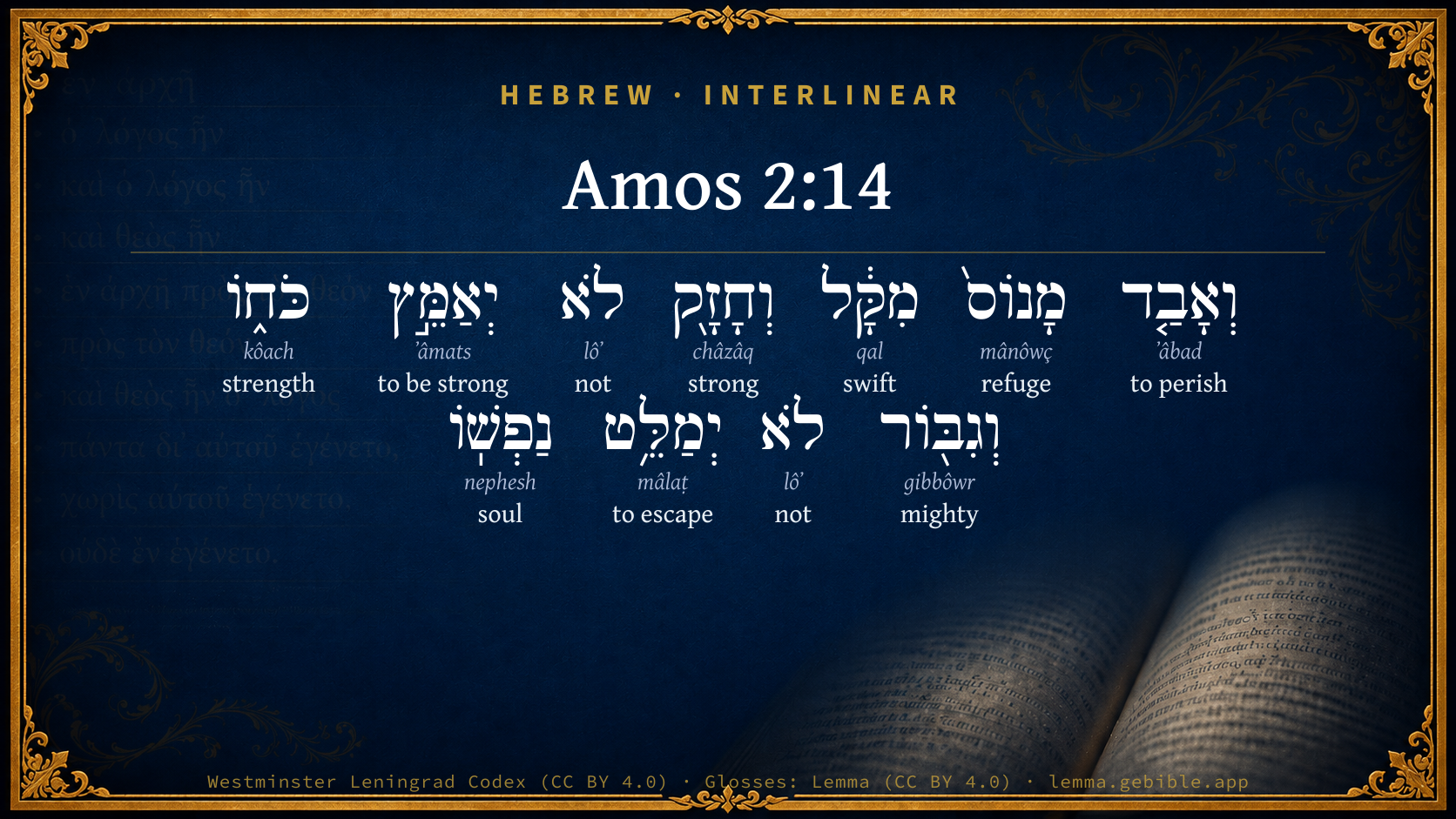
Hebrew (Westminster Leningrad Codex) Amos 2:14 appears in the Hebrew Old Testament. The text above is from the Westminster Leningrad Codex. Each word links to its Strong’s number, a concise gloss, and parsing drawn from the Open Scriptures Hebrew Bible morphology. Click any word for its full Brown-Driver-Briggs (BDB) entry.
Download image
Cite this verse

Amos 2:14 (World English Bible). Public Domain. Lemma interlinear Bible study tool, https://lemma.gebible.app/v/amos/2/14.

Show BibTeX & RIS
BibTeX
RIS
English Translation
Flight will perish from the swift; And the strong won't strengthen his force; Neither shall the mighty deliver himself;
World English Bible · Public Domain
Download a study sheet

One document with this verse’s original text, its word-by-word gloss line, the meaning frame, cross-references with their text, attributed commentary, and full source and license credits — printable, and it pastes into notes with its structure intact.

This verse Autodidact and up

Study sheet (.html) Plain text (.txt)

A passage Seminary Student

Up to 50 verses in one chapter. A passage sheet keeps up to 6 commentary sources and 12 cross-references per verse, in the order this page ranks them, and says so on the sheet whenever that leaves anything out. Ask for a single verse and you get the Autodidact verse sheet above.

Everything on this page stays free to read, with no account — the sheet is a download of what is already on screen, not access to it.

Want to remove ads? Support Godless Engineer
Compare translations 3

The same verse in 3 English versions, stacked beneath the original-language interlinear above. Click any original word for its lexicon entry.

Each is an independent rendering of the whole verse — the interlinear is not word-aligned to these translations.

Highlighted words mark where these versions differ — a whole-verse word diff, not a word-by-word alignment.

  • World English Bible Public Domain
    Flight will perish from the swift; And the strong won't strengthen his force; Neither shall the mighty deliver himself;
  • King James Version Public Domain
    Therefore the flight shall perish from the swift, and the strong shall not strengthen his force, neither shall the mighty deliver himself:
  • unfoldingWord Literal Text CC BY-SA 4.0
    A place of refuge will be lost by the swift; the strong will not add to his own strength; neither will the mighty save himself.

unfoldingWord Literal Text — © unfoldingWord, licensed CC BY-SA 4.0. Word-aligned USFM3 via Door43 (git.door43.org/unfoldingWord/en_ult).

Versions to compare (up to 4)

3 of 4 selected

Show all 18 translations

Every available English version of this verse, each an independent rendering of the whole verse.

  • World English Bible Public Domain
    Flight will perish from the swift; And the strong won't strengthen his force; Neither shall the mighty deliver himself;
  • Berean Standard Bible Public Domain
    Escape will fail the swift, the strong will not prevail by his strength, and the mighty will not save his life.
  • Majority Standard Bible Public Domain
    Escape will fail the swift, the strong will not prevail by his strength, and the mighty will not save his life.
  • King James Version Public Domain
    Therefore the flight shall perish from the swift, and the strong shall not strengthen his force, neither shall the mighty deliver himself:
  • American Standard Version (1901) Public Domain
    And flight shall perish from the swift; and the strong shall not strengthen his force; neither shall the mighty deliver himself;
  • Revised Version (1885) Public Domain
    And flight shall perish from the swift, and the strong shall not strengthen his force, neither shall the mighty deliver himself:
  • Geneva Bible (1599) Public Domain
    Therefore the flight shall perish from the swift, and the strong shall not strengthen his force, neither shall the mightie saue his life.
  • Douay-Rheims (1899) Public Domain
    And flight shall perish from the swift, and the valiant shall not possess his strength, neither shall the strong save his life.
  • Young's Literal Translation Public Domain
    And perished hath refuge from the swift, And the strong strengtheneth not his power, And the mighty delivereth not his soul.
  • Literal Standard Version CC BY-SA 4.0
    And refuge has perished from the swift, || And the strong does not strengthens his power, || And the mighty does not deliver his soul.
  • Unlocked Literal Bible CC BY-SA 4.0
    The swift will find no escape; the strong will not add to his own strength; neither will the mighty save himself.
  • unfoldingWord Literal Text CC BY-SA 4.0
    A place of refuge will be lost by the swift; the strong will not add to his own strength; neither will the mighty save himself.
  • Darby Bible Public Domain
    And flight shall perish from the swift, and the strong shall not strengthen his force, neither shall the mighty deliver his soul.
  • World Messianic Bible Public Domain
    Flight will perish from the swift. The strong won’t strengthen his force. The mighty won’t deliver himself.
  • Webster's Bible Public Domain
    Therefore the flight shall perish from the swift, and the strong shall not strengthen his force, neither shall the mighty deliver himself:
  • Free Bible Version CC BY-SA 4.0
    Not even your fastest runners will escape; strong men will lose their strength. Even the greatest warrior will not be able to save his life.
  • Bible in Basic English Public Domain
    And flight will be impossible for the quick-footed, and the force of the strong will become feeble, and the man of war will not get away safely:
  • JPS Tanakh (1917) Public Domain
    And flight shall fail the swift, and the strong shall not exert his strength, neither shall the mighty deliver himself;

Literal Standard Version (2020), Covenant Press — licensed CC BY-SA 4.0. Text via the HelloAO Bible API (eBible.org). Unlocked Literal Bible (unfoldingWord) — licensed CC BY-SA 4.0. Text via the HelloAO Bible API (eBible.org). unfoldingWord Literal Text — © unfoldingWord, licensed CC BY-SA 4.0. Word-aligned USFM3 via Door43 (git.door43.org/unfoldingWord/en_ult). Free Bible Version, Dr. Jonathan Gallagher — licensed CC BY-SA 4.0. Text via the HelloAO Bible API (eBible.org).

Word by word

More ways to search: Search by grammar → Find every occurrence → Compare this word →

Practice this passage: Drill this verse → Learn its vocabulary →

מָנוֹס֙
mânôwç
H4498
“refuge”
Noun, Common, Masculine, Singular, Absolute
Part of Speech
Noun
Type
Common
Gender
Masculine
Number
Singular
State
Absolute
Full BDB Definition

Origin: from H5127

TWOT: 1327a

flight, refuge, place of escape - flight - refuge, place of escape
  1. וְאָבַ֤ד ʼâbad H6 “and · to perish” Conjunction + Verb, Qal, Sequential Perfect, 3rd Person, Masculine, Singular
  2. מִקָּ֔ל qal H7031 “from · swift” Preposition + Adjective, Adjective, Masculine, Singular, Absolute
  3. וְחָזָ֖ק châzâq H2389 “and · strong” Conjunction + Adjective, Adjective, Masculine, Singular, Absolute
  4. לֹא lôʼ H3808 “not” Particle, Negative
  5. יְאַמֵּ֣ץ ʼâmats H553 “to be strong” Verb, Piel, Imperfect, 3rd Person, Masculine, Singular
  6. כֹּח֑וֹ kôach H3581 “strength · his” Noun, Common, Masculine, Singular, Construct + Suffix, Personal, 3rd Person, Masculine, Singular
  7. וְגִבּ֖וֹר gibbôwr H1368 “and · mighty” Conjunction + Adjective, Adjective, Masculine, Singular, Absolute
  8. לֹא lôʼ H3808 “not” Particle, Negative
  9. יְמַלֵּ֥ט mâlaṭ H4422 “to escape” Verb, Piel, Imperfect, 3rd Person, Masculine, Singular
  10. נַפְשֽׁוֹ nephesh H5315 “soul · his” Noun, Common, Both, Singular, Construct + Suffix, Personal, 3rd Person, Masculine, Singular

About this verse

These counts appear in no published source. They are computed here, from the morphology-tagged text and Lemma’s own curated glosses. What Lemma adds →

11
words
10
distinct lemmas
Prophets
section

Notable vocabulary

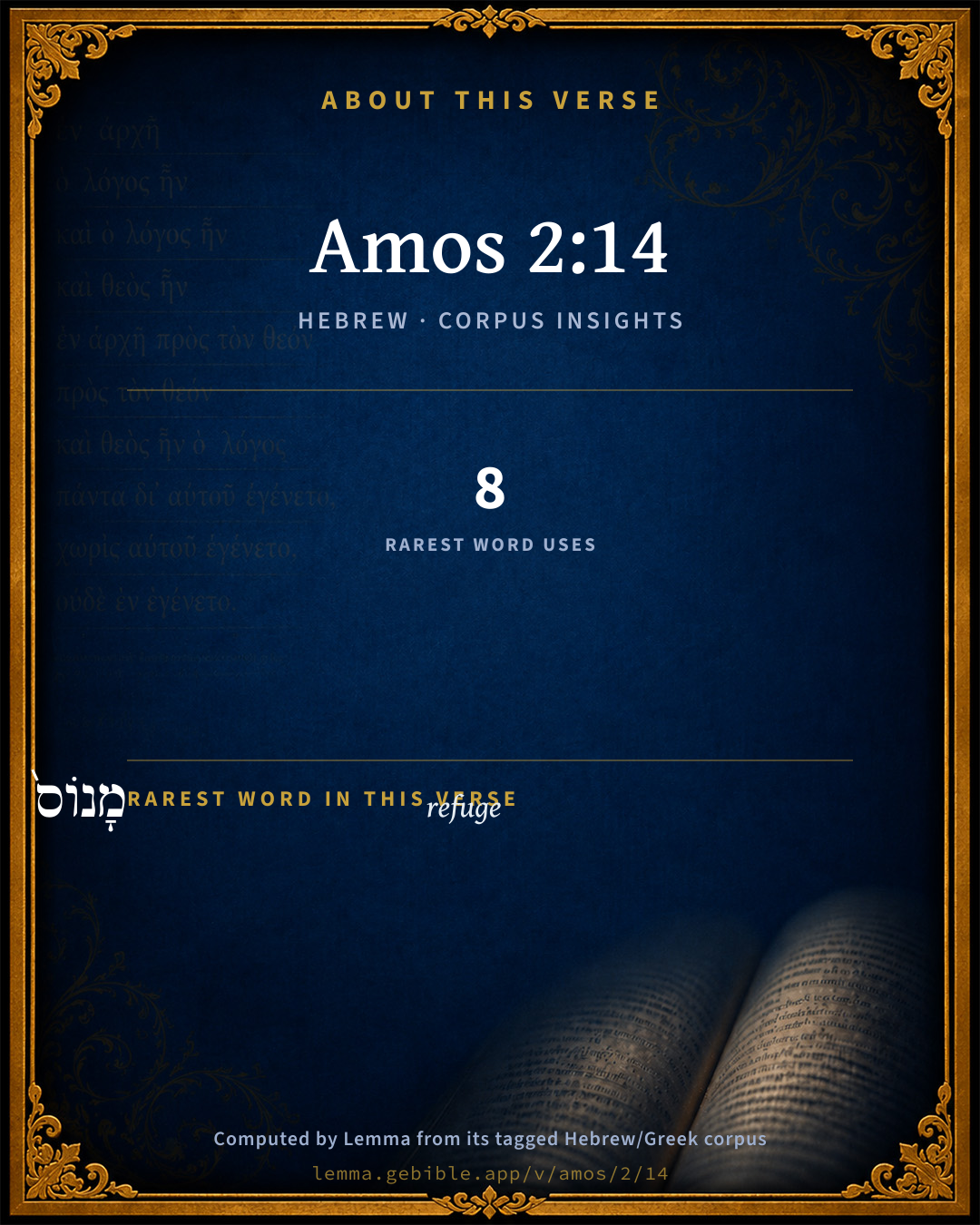
The rarest word here is מָנוֹס֙ refuge H4498 — appearing just 8 times in the whole Hebrew Bible.

Shared distinctive vocabulary

מָנוֹס֙ refuge H4498 occurs in 8 verses of the Hebrew Bible. Also found in:

Grammatical profile

  • 3 verbs
  • 3 nouns
  • 3 adjectives
  • 2 particles

Verb forms

  • וְאָבַ֤ד Qal · Sequential Perfect
  • יְאַמֵּ֣ץ Piel · Imperfect
  • יְמַלֵּ֥ט Piel · Imperfect

Repetition

A word recurs within this verse — often emphatic in Hebrew:

Hebrew & Septuagint length

In English translation the verse runs 19 words from the Hebrew and 24 from the Septuagint (LXX English) — closely comparable.

A rough comparison of the two English renderings, which tokenize alike — not a word-level alignment.

Word counts can differ between the Hebrew and the Greek without any difference in meaning — e.g. the Hebrew direct-object marker אֵת has no separate Greek word, and Greek often adds the article ὁ.

Cross-references

6

Topical passages linked to Amos 2:14 in the Treasury of Scripture Knowledge — connected by theme and wording, ordered by reader-vote popularity; previews shown in the World English Bible.

  • Jeremiah 9:23 Thus says Yahweh, Don't let the wise man glory in his wisdom, neither let the mighty man glory in his might, don't let the rich man glory in his riches;
  • Psalms 33:16 There is no king saved by the multitude of a host. A mighty man is not delivered by great strength.
  • Ecclesiastes 9:11 I returned, and saw under the sun, that the race is not to the swift, nor the battle to the strong, neither yet bread to the wise, nor yet riches to men of understanding, nor yet favor to men of skill; but time and chance happen to them all.
  • Amos 9:1–3 I saw the Lord standing beside the altar, and he said, "Strike the tops of the pillars, that the thresholds may shake; and break them in pieces on the head of all of them; and I will kill the last of them with the sword: there shall not one of them flee away, and there shall not one of them escape.
  • Job 11:20 But the eyes of the wicked shall fail, They shall have no way to flee; Their hope shall be the giving up of the spirit."
  • Isaiah 30:16–17 but you said, No, for we will flee on horses; therefore shall you flee: and, We will ride on the swift; therefore shall those who pursue you be swift.

Cross-references courtesy of OpenBible.info (CC BY 4.0).

Hebrew and Greek witnesses Masoretic Hebrew ↔ Greek Septuagint

The same verse in the two great witnesses to the Old Testament, shown verse-for-verse.

These are two independent witnesses, not word-aligned to each other, and the Septuagint is shown in lemma (dictionary) form.

Hebrew Amos 2:14 Masoretic · Westminster Leningrad Codex

וְאָבַ֤ד מָנוֹס֙ מִקָּ֔ל וְחָזָ֖ק לֹא יְאַמֵּ֣ץ כֹּח֑וֹ וְגִבּ֖וֹר לֹא יְמַלֵּ֥ט נַפְשֽׁוֹ

Flight will perish from the swift; And the strong won't strengthen his force; Neither shall the mighty deliver himself;

World English Bible · Public Domain

Greek LXX Amos 2:14 Septuagint · lemma form

καί ἀποὀλλύω φυγή ἐκ δρομεύς καί ὁ κραταιός οὐ μή κρατέω ὁ ἰσχύς αὐτός καί ὁ μαχητής οὐ μή σώζω ὁ ψυχή αὐτός

And flight shall perish from the runner, and the strong shall not hold fast his strength, and the warrior shall not save his life:

LXX2012 (modern English Septuagint) · Public Domain

On this verse, The Pulpit Commentary discusses the Septuagint’s reading. Read the note in Commentary ↓

Hebrew: Westminster Leningrad Codex (CC BY 4.0). Greek: Septuagint (public domain); English from LXX2012 (modern English Septuagint) (Public Domain). How the Septuagint differs from the Hebrew →

Targum (Aramaic paraphrase)

1

The Targum is the ancient Jewish Aramaic paraphrase of the Hebrew Scriptures — an interpretive translation, not the Hebrew text itself. Onkelos (literal) and Pseudo-Jonathan (expansive) render the Torah, and Jonathan the Prophets. Coverage is partial: where no permissively-licensed English translation exists for a verse, only the Aramaic is shown. This is verse-level text, not a word-by-word alignment to the Hebrew.

  1. Targum Jonathan Prophets (Joshua–Malachi)
    וְיֵבַד בֵּית עֵיקוּקֵי מִדְקַלִיל וּדְתַקִיף לָא יַחֲסִין חֵילֵיהּ וְגִבַּר לָא יְשֵׁיזֵיב נַפְשֵׁיהּ:

    (no public-domain English translation for this verse)

    Targum Jonathan — Aramaic: “Mikraot Gedolot” (public domain). English: “Sefaria Community Translation” (CC0 1.0 (public-domain dedication)); “London "Chaldee Paraphrase," 1871” (public domain). Text via Sefaria.

Commentary

Notes on Amos 2:14 from classic Christian and Jewish commentators (each source and its license shown beneath its notes). The classic Christian expositions comment on the surrounding passage and are grouped to its opening verse, so a note may address several verses; the Jewish commentaries on the Tanakh (Rashi and others) are per-verse, so they appear only where the commentator wrote on this verse.

Lemma curates 59 commentaries, every one of them public domain or Creative Commons licensed, each selected and text-cleaned for this edition rather than reprinted as found. About our sources →

Trapp's Complete Commentary

John Trapp

Amo 2:14 Therefore the flight shall perish from the swift, and the strong shall not strengthen his force, neither shall the mighty deliver himself:

Ver. 14. Therefore the flight shall perish from the swift] Men are apt to bless themselves when God curseth, Deu 29:19, and to bind upon impurity in a common calamity, to make fair weather, when such a tempest is up as shall never be blown over. Or, if worse come, then, as all creatures run to their refuges, Pro 30:25 Psa 104:18 Pro 18:11 Dan 4:12; Dan 4:14 Jdg 9:50-51 (the hunted hare runs to the form, to the bushes that she formerly haunted, but now these cannot save her), so men in misery bethink themselves of and betake themselves to creature comforts and refuges, either natural, or artificial, as here, but these all serve them as Absalom’s mule did her master, hanging between heaven and earth, but rejected of both. Let a man be as swift as Asahel, God can easily overtake him; his sin will find him out, and he shall but in running from his death run to it; as the historian speaketh of those Scots defeated by the English at Musselborough field, that they so strained themselves in running for their lives that they fell down breathless and dead. Surely as the coney that flees to the holes in the rocks doth easily avoid the dogs that pursue her, when the hare that trusts in the swiftness of her legs is at length overtaken and torn in pieces; so those that trust in God shall be secured, whereas those that confide in themselves or the creature shall be surprised, and come to an ill end. David ran to God in distress and was relieved; Saul goes to the witch, and from thence to the sword’s point; Judas to the Pharisees, and thence to the halter.

The strong shall not strengthen his force] But be made weak as water. "None of the men of might have found their hands," Psa 76:5; their hands are palsied, their sinews cracked and crippled. It is God that both strengtheneth and weakeneth the arms in the day of battle, Eze 30:24.

John Trapp, A Commentary or Exposition upon All the Books of the Old and New Testament (1647–1656) — public domain. Text from a community e-Sword module.

The Biblical Illustrator

Joseph S. Exell

Amo_2:14-16

Therefore the flight shall perish from the swift, and the strong shall not strengthen his force, neither shall the mighty deliver himself.

Effect of sin on the sinner

We have here the supplement to the former verse: the sin which wearies God reacts on those who walk in it.

I. A picture of the decay of national prowess. It is a painful remembrance of departed power, like some castle once the seat of a nations strength, now in ruins. The swift are there, but their swiftness is gone; the strong remain, but only as a wreck of their former selves, unable to gather up their strength. Danger found them, like Samson in the lap of Delilah, shorn of all their boasted power. He who handles the bow dare not stand to pour his shafts on the enemy; the fleet of foot, and even the mounted soldier, should fall into the hands of the enemy, and the mighty man, once full of courage, should be glad to escape, stripped of arms and clothing, in the day of visitation. Every sentence increases the effect of this picture. What they had been and what they were forms a terrible contrast.

II. The reason for such a decay of prowess. Sin had borne this deadly fruit. All their national valour sprang from confidence in God. They knew that the angel of the Lord encampeth round about them that fear Him, and delivereth them. What foe could stand before men who leaned on the arm of God? Lord Bacon says, that man, when he resteth and assureth himself upon Divine protection and favour, gathereth a force and faith which human nature in itself could not obtain. All their victories are proof of these words. Confidence in God had brought David off victorious in his conflict with Goliath (Deu_32:30). All was changed now. Sin had sapped their confidence in heaven, and the whole fabric of their national life was tottering to its foundations. They felt the truth of the old words, He that offends against heaven has none to whom he can pray. History presents many parallels to this declension. Injustice and sin have shorn great men of their strength, and left them weak in the hour of danger.

III. The effects of this decay of valour were soon evident. For them, as for us, peace depended on prowess; prowess was born of confidence in God. Foes, who were only held in check by fear, soon discovered their declension,--for such decay has many tokens,--and quickly overran their land. The floodgates were opened, and a tide of vengeance poured itself over their land. Three times Amos repeats,--the reiteration marking the certainty of their doom,--He shall not deliver himself. Application. Sin is ruin. He who would have victory must be loyal to heaven, then God will surely fulfil to him the great promise to Joshua (Jos_1:5). (J. Telford, B. A.)

Prosperity and ruin

It may sound strange to say that adversity is not half so dangerous to a man as prosperity run mad, but it is true. I have read somewhere that the south wall of Whitby Abbey is more dilapidated than the north wall, thus proving that the light of the sun has been more destructive than that angry tempest that swept in from the North Sea. And the bright sunshine of prosperity has often proved more ruinous to individuals and nations than the wintry tempests of adversity. (J. Ossian Davies.)

The Biblical Illustrator, edited by Joseph S. Exell (c. 1880s–1900s) — public domain. Text from a community e-Sword module.

Tyndale Open Study Notes

Tyndale Open Resources

2:14-16 The chapter concludes with a description of the battle in which Israel would be defeated and would flee (see Ps 33:16-17).

Tyndale Open Study Notes — © Tyndale Open Resources, licensed CC BY-SA 4.0. Text via the HelloAO Bible API.

Geneva Bible (1599)

Geneva Bible translators

None shall be delivered by any means.

Geneva Bible (1599) marginal notes — public domain. Text via Bolls.life.

Jamieson, Fausset & Brown

Robert Jamieson, A. R. Fausset & David Brown

flight shall perish from . . . swift--Even the swift shall not be able to escape.

strong shall not strengthen his force--that is, shall not be able to use his strength.

himself--literally, "his life."

Jamieson, Fausset & Brown — Commentary Critical and Explanatory on the Whole Bible (1871) — public domain (CC PDM 1.0). Text via the HelloAO Bible API.

Adam Clarke's Commentary

Verse 14. The flight shall perish from the swift] The swiftest shall not be able to save himself from a swifter destruction. None, by might, by counsel, or by fleetness, shall be able to escape from the impending ruin. In a word, God has so fully determined to avenge the quarrel of his broken covenant, that all attempts to escape from his judgments shall be useless.

Adam Clarke's Commentary on the Bible (1810–1826) — public domain. Text from a community e-Sword/MySword module.

John Calvin's Commentaries

I explained yesterday the verse, in which the Prophet says, in the name of God, that the people were like a grievous and heavy burden, as though they were a wagon laden with many sheaves. I stated that the Prophet’s words are differently explained by many interpreters, who give this view, — that God compares himself to a loaded wagon, under which the people were to be crushed. But no necessity constrains us to take the same verb in two senses, active and neuter, as they do; and then the comparison seems not quite suitable; and farther, it is better, as I have said, to say, that God complains, that he was loaded and pressed down under the people, than to render תחתיכם, tacheticm, “In your place;” for this is wholly a strained rendering. But most suitable is the Prophet’s meaning, when understood as the complaint of God, that it was a grievous thing to bear the burdens of the people, when he saw that they were men of levity, and, at the same time, burdensome.

Hence the Prophet now denounces vengeance such as they deserved; and he says first, Perish shall flight from the swift, etc., that is, no one will be so swift as to escape by fleeing; and the valiant shall do nothing by fighting; for it is to confirm strength when one resists an adversary and repels assaults. The valiant, therefore, shall fight with no advantage; and then, The strong shall not deliver his own life: he who holds the bow shall not stand; that is, he who is equipped with a bow, and repels his enemy at a distance, shall not be able to stand in his place. He who is swift on foot shall not be able to flee, nor he who mounts a horse; which means that whether footmen or horsemen, they shall not, by their celerity, be able to escape death. And, lastly, he who is stout and intrepid in heart among the valiant shall flee away naked, being content with life alone, and only anxious to provide for his own safety.

The Prophet intimates by all these words, that so grievous would be the slaughter of the people, that it would be a miracle if any should escape.

We now then see how severely the prophet at the very beginning handled this people. He no doubt observed their great obduracy: for he would not have assailed them so sharply at first, had they not been for a long time rebellious and had despised all warnings and threatening. Amos was not the first who addressed them; but the Israelites had hardened themselves against all threatenings before he came to them. It therefore behaved him sharply to reprove them, as God treats men according to their disposition. I come now to the third chapter.

John Calvin's Commentaries (1540-1563) — public domain. Text from the Calvin Translation Society English edition (1840s-50s) via the Christian Classics Ethereal Library (ccel.org). Calvin's coverage is partial (roughly two-thirds of the Bible); uncommented books and verses are honest gaps, never fabricated. The 19th-century editor's footnotes and remarks are omitted so the notes are faithfully Calvin's own voice.

Ellicott's Commentary for English Readers

(14) This doom Amos darkly foreshadows to be invasion and military overthrow, with all its attendant calamities.

A Bible Commentary for English Readers, edited by Charles John Ellicott (1878–1897) — public domain. Text from a community e-Sword module.

The Cambridge Bible for Schools and Colleges

gen. ed. J. J. S. Perowne

14–16. A disaster, in which neither the swiftest nor the best equipped warrior will be able to escape, brings the kingdom of Israel to its end.

Therefore] simply And (as R.V.).

the flight shall perish from the swift] rather place of flight, refuge; for perish from we should say fail (R.V. marg.). The idiom used occurs elsewhere, viz. Jer_25:35; Job_11:20 (see R.V. marg.); Psa_142:4 (A.V. “refuge failed me”).

the strong shall not strengthen his force] i.e. not collect his powers; he will be unmanned in presence of the foe.

the mighty] or the warrior. The word means specifically one mighty in war: see Isa_3:2; Jer_46:6; Jer_46:12; Isa_42:13; Nah_2:4 (noticing in each case the context): in the plural it is the term used to denote David’s select band of warriors, 2Sa_16:6; 2Sa_23:8, &c.

The Cambridge Bible for Schools and Colleges (gen. ed. J. J. S. Perowne; Cambridge University Press, 1878–1918) — public domain. Text from a community e-Sword module.

John Gill's Exposition

Therefore the flight shall perish from the swift,.... They should be so straitened and cooped up, and be so loaded with pressures, that those, as swift of foot as Asahel, should not be able to make their escape by fleeing:

and the strong shall not strengthen his force; should not increase it, or muster it up, and exert it to such a degree, as to be able to defend and secure himself from the enemy:

neither shall the mighty deliver himself; "his soul" or "life"; a soldier, a man of war, an expert and courageous officer at the head of his troop, or even the general of the army; see Psa 33:16.

John Gill's Exposition of the Whole Bible (1746–1763) — public domain (CC PDM 1.0). Text via the HelloAO Bible API.

Albert Barnes' Notes on the Bible

Israel relied, against God, on his own strength. “Have we not,” they said, “taken to us horns by our own strength?” Amo 6:13. Amos tells them then, that every means of strength, resistance, flight, swiftness of foot, of horse, place of refuge, should fail them. Three times he repeats, as a sort of dirge, “he shall not deliver himself.”

Therefore the flight shall perish - (Probably place of flight Job 11:20; Psa 142:5; Jer 25:35). They had despised God, as their “place of refuge” , so “the place of refuge, should perish from the swift,” as though it were not. He should flee amain, but there would be no “place to flee unto.” God alone “renews strength;” therefore “the strong” man should not “strengthen his force or might,” should not be able to gather or “collect his strength” as we say. Fear should disable him. “The handler of the bow” (as in Jer 46:9), and who by habit is a skilled archer, although himself out of the immediate reach of the enemy, and able, unharmed, to annoy him and protect the fugitives, “shall not stand” (as in Jer 46:21; Nah 2:8). Panic should overtake him. The “mighty” man, the “fleet of foot” should “not deliver,” yea, “the horseman” should not “deliver himself;” yea, he who, “among the mighty,” was “strongest of his heart,” firm-souled among those of mightiest prowess, “shall flee away naked,” that is, bared of all, armor or dress, which might encumber his flight “in that day” which the Lord made a day of terror His own day.

Saith the Lord - Probably literally, “the secret utterance of the Lord.” Amos, more than Hosea, uses this special authentication of his words , which is so common in Isaiah, Jeremiah, Ezekiel, and Zechariah. He claims a knowledge, which those around him had not, and ratifies it by the express appeal to the direct, though secret, revelation of God; what those who were not of God, would deny; what they who were of God, would believe.

Albert Barnes' Notes on the Bible (1834–1885) — public domain. Text from a community e-Sword/MySword module.

Haydock's Catholic Bible Commentary

Swift. Jeroboam I. Other kings are described afterwards. (St. Jerome) --- In the latter times all was in confusion. (Calmet)

George Leo Haydock (1774–1849), Haydock's Catholic Family Bible and Commentary, 1859 edition — public domain. Excludes Psalms (Douay-Rheims chapter numbering differs from Protestant) and Deuterocanonical books (Catholic canon only).

Matthew Poole's English Annotations

Therefore; because they first loaded God with their sins, and now he loads them with punishments, no way of escape shall be left.

The flight shall perish from the swift; not by swiftness of foot fleeing from the judgments, for their enemies shall be swifter than they, Isa 30:16.

The strong shall not strengthen his force; natural strength of body shall not deliver; such, though they might do more than weaker men, yet shall not save themselves, for they shall not know how to use their strength they shall want courage to do it.

The mighty, the valiant, and man of greatest courage, shall not be able to deliver himself, his courage shall fail.

Matthew Poole's English Annotations on the Holy Bible (1683–1685) — public domain. Text from a community e-Sword/MySword module.

Whedon's Commentary on the Bible

Daniel D. Whedon

14-16. The swiftest and best-equipped warriors cannot escape.

Therefore — R.V., better, “and.”

Flight — Rather the place of flight or of refuge.

Shall perish — Better, R.V. margin, “shall fail.”

Swift — He would be expected to be the first to reach a place of safety; but when the divine blow fails the qualities ordinarily of the greatest advantage will profit nothing.

Shall not strengthen his force — The strong man will be so terrified that he cannot collect his strength or make use of it.

Mighty — The warrior, whose bravery might be expected to save him, cannot save his life (margin).

Handleth the bow — The armed man.

Shall he stand — Stop in his flight (Nah_2:8). The swiftness of man (2Sa_1:23; 2Sa_2:18) or of horse shall avail nothing.

Courageous — Literally, the strong in his heart (Psa_27:14; Psa_31:24).

Naked — He will throw away everything that might hinder his flight — weapons, armor, and superfluous clothing.

In that day — The day of judgment.

Saith Jehovah — As in Amo_2:11.

The judgments announced in chapters 1, 2 are expected by the prophet to take the form of foreign invasions and war. In no case does he call the executioner by name; but it is beyond doubt that throughout he is thinking of the Assyrians, who, beginning with the reign of Ashur-nasir-pal (885-860 B.C.), became an ever-increasing menace to all the nations enumerated. Why Amos does not call them by name is not quite clear. It may be because in his days the Assyrian power was on the decline — it revived under Tiglath-pileser III (745-727 B.C.) — and therefore the mention of their name would have added no force to his message, but, on the contrary, might have weakened it. It is worthy of note, however, that neither Isaiah nor Jeremiah mention the national enemies by name in their earlier discourses. Wellhausen is undoubtedly right when he calls Amos “the leader of the prophetic choir of the Assyrian period.”

Daniel D. Whedon (gen. ed.), Commentary on the Old and New Testaments (1874–1909) — public domain. Text from a community e-Sword module.

The Pulpit Commentary

In this and the two following verses Amos individualizes the "pressure" that awaits them, when every means of resistance and escape shall fail. The flight shall perish from the swift. The swift of foot shall have no time or way to flee, (Jer_25:35 Jer_46:6) Ewald, Pusey, Gandell, for "flight" render "place of flight, refuge," as Job_11:20; Psa_142:5; Septuagint, fugh Vulgate, fuga. Shall not strengthen his force. The strong man shall not be able to collect or put forth his strength to any good purpose. (comp. Pro_24:5; Nah_2:1) Neither shall himself. Some of the Greek manuscripts omit this clause. Deliver himself occurs three times a kind of solemn refrain.

Vers. 14-16.

Judgment inevitable.

In the preceding verses there is observable an accumulation of human transgression and iniquity. And in these closing verses el the chapter the reader is equally struck with the rhetorical accumulation of figures intended to convey a deep impression of the inevitableness of retribution.

I A PICTURE OF HUMAN GREATNESS. Man has his own standard of greatness. The prophet piles up epithets to represent man"s power. In vivid colours and in rapid succession there rise before the imagination the figures of the "swift" runner who is wont to overtake his foe, the "strong" hero whose blow cleaves the helmet in twain, the "mighty" whose praise is upon all lips, the "bowman" whose arrow pierces the fugitive in the battlefield, the "swift on foot" who trusts for safety to his speed, the "horseman" whose charge has often broken the doughty ranks of the enemy, the "courageous," "the strong of his heart," whom no danger daunts.

II A VISION OF INEVITABLE RETRIBUTION AND OF THE DISCOMFITURE OF THE ENEMIES OF GOD. Even such as those who have been described shall be powerless in the day of the Lord. Exemption from the operation of righteous law is not to be obtained by any human craft or might. The swift shall be overtaken, and the arm of the warrior shall tall powerless by his side. Justice must be vindicated; the Lord of right will never abandon his sovereign throne. T.

The Pulpit Commentary (1880–1919), ed. H.D.M. Spence-Jones & Joseph S. Exell — public domain. Text from a community e-Sword module.

John Wesley's Explanatory Notes

The swift - For their enemies shall be swifter than they. The strong - Natural strength of body shall not deliver. The mighty - The valiant man, the man of the greatest courage.

John Wesley, Explanatory Notes Upon the Whole Bible (1754–1765) — public domain. Text via the GEBible commentary corpus.

Lesson kit

Teaching starters — assembled from the data on this page, not authored interpretation. Every prompt links to the verse data it draws on. Edit before teaching.

Amos, in the Prophets, opens this verse with 11 words (10 distinct Hebrew lemmas). Its most distinctive word is mânôwç (“refuge”). A historical commentator’s framing appears above. Read the whole chapter for the surrounding context.

Discussion questions

  1. How does “refuge” (mânôwç) shape what this verse is saying?
  2. How does 2 Samuel 22:3, which shares the word «refuge», read alongside this verse?
  3. What does the repetition of “not” (2× in this one verse) do in this verse?
  4. The translations on this page render this verse differently — a whole-verse word diff, not a word-by-word alignment. What might account for the different wordings?
  5. «וְאָבַ֤ד» is a Qal Sequential Perfect verb. How does that grammatical form shape the action described?
  6. Compare how Trapp's Complete Commentary and The Biblical Illustrator read this verse. Where do they agree or differ?

Things to notice

Reading settings

Reading text

Shown beneath each verse's original-language words.

Old Testament
Old Testament edition

Read the OT as the Masoretic Hebrew (MT) or the Greek Septuagint (LXX).

English shown for the Greek Septuagint (in the Hebrew ↔ Greek comparison).

Comparing translations? Open the Compare panel on any verse page to stack up to four side by side.