
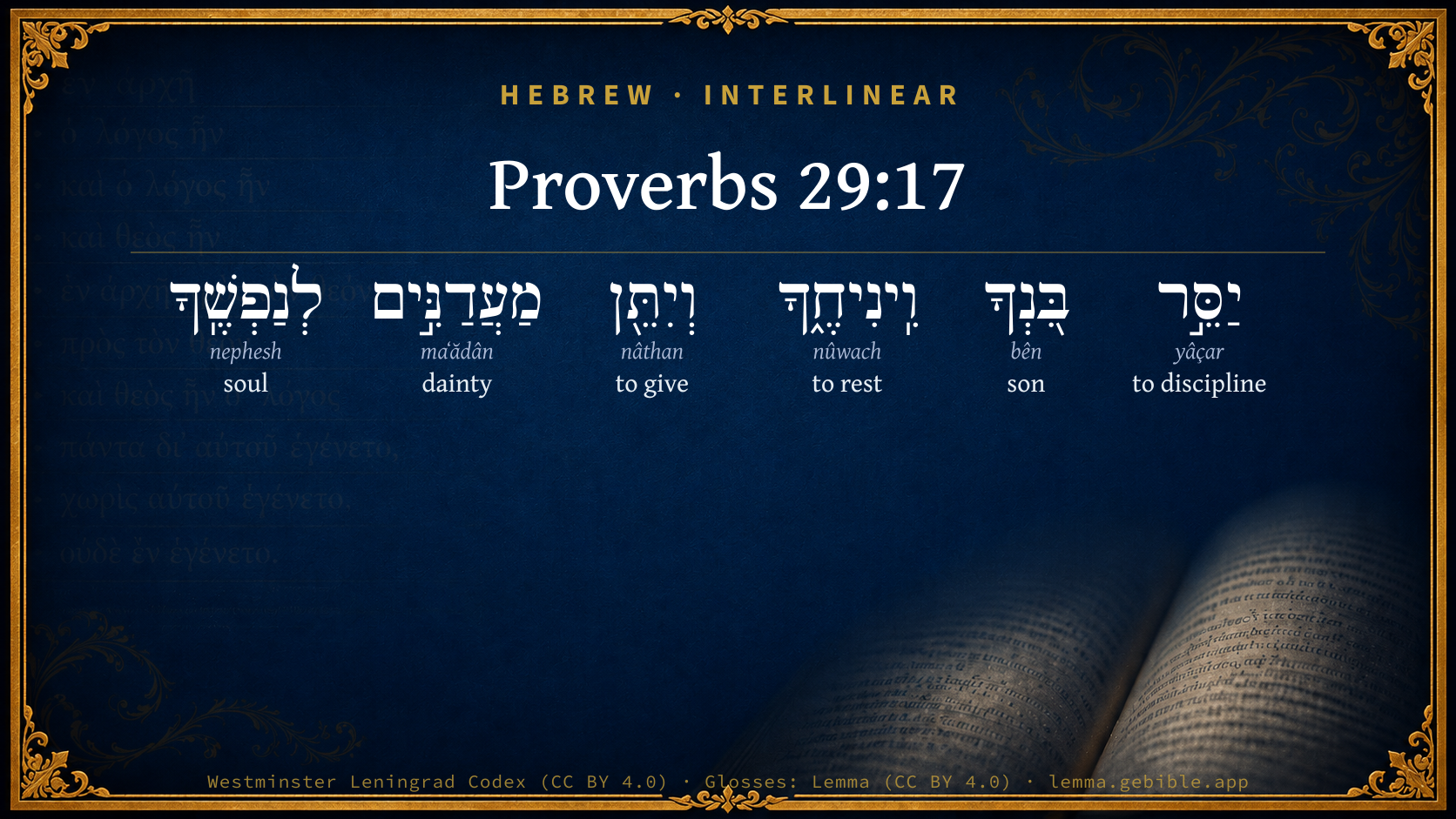
Proverbs 29:17

Hebrew (Westminster Leningrad Codex) Proverbs 29:17 appears in the Hebrew Old Testament. The text above is from the Westminster Leningrad Codex. Each word links to its Strong’s number, a concise gloss, and parsing drawn from the Open Scriptures Hebrew Bible morphology. Click any word for its full Brown-Driver-Briggs (BDB) entry.
Download image
Cite this verse

Proverbs 29:17 (World English Bible). Public Domain. Lemma interlinear Bible study tool, https://lemma.gebible.app/v/proverbs/29/17.

Show BibTeX & RIS
BibTeX
RIS
English Translation
Correct your son, and he will give you peace; Yes, he will bring delight to your soul.
World English Bible · Public Domain
Download a study sheet

One document with this verse’s original text, its word-by-word gloss line, the meaning frame, cross-references with their text, attributed commentary, and full source and license credits — printable, and it pastes into notes with its structure intact.

This verse Autodidact and up

Study sheet (.html) Plain text (.txt)

A passage Seminary Student

Up to 50 verses in one chapter. A passage sheet keeps up to 6 commentary sources and 12 cross-references per verse, in the order this page ranks them, and says so on the sheet whenever that leaves anything out. Ask for a single verse and you get the Autodidact verse sheet above.

Everything on this page stays free to read, with no account — the sheet is a download of what is already on screen, not access to it.

Want to remove ads? Support Godless Engineer
Compare translations 3

The same verse in 3 English versions, stacked beneath the original-language interlinear above. Click any original word for its lexicon entry.

Each is an independent rendering of the whole verse — the interlinear is not word-aligned to these translations.

Highlighted words mark where these versions differ — a whole-verse word diff, not a word-by-word alignment.

  • World English Bible Public Domain
    Correct your son, and he will give you peace; Yes, he will bring delight to your soul.
  • King James Version Public Domain
    Correct thy son, and he shall give thee rest; yea, he shall give delight unto thy soul.
  • unfoldingWord Literal Text CC BY-SA 4.0
    Discipline your son, and he will cause you to rest, and he will give delights to your soul.

unfoldingWord Literal Text — © unfoldingWord, licensed CC BY-SA 4.0. Word-aligned USFM3 via Door43 (git.door43.org/unfoldingWord/en_ult).

Versions to compare (up to 4)

3 of 4 selected

Show all 18 translations

Every available English version of this verse, each an independent rendering of the whole verse.

  • World English Bible Public Domain
    Correct your son, and he will give you peace; Yes, he will bring delight to your soul.
  • Berean Standard Bible Public Domain
    Discipline your son, and he will give you rest; he will bring delight to your soul.
  • Majority Standard Bible Public Domain
    Discipline your son, and he will give you rest; he will bring delight to your soul.
  • King James Version Public Domain
    Correct thy son, and he shall give thee rest; yea, he shall give delight unto thy soul.
  • American Standard Version (1901) Public Domain
    Correct thy son, and he will give thee rest; Yea, he will give delight unto thy soul.
  • Revised Version (1885) Public Domain
    Correct thy son, and he shall give thee rest; yea, he shall give delight unto thy soul.
  • Geneva Bible (1599) Public Domain
    Correct thy sonne and he will giue thee rest, and will giue pleasures to thy soule.
  • Douay-Rheims (1899) Public Domain
    Instruct thy son, and he shall refresh thee, and shall give delight to thy soul.
  • Young's Literal Translation Public Domain
    Chastise thy son, and he giveth thee comfort, Yea, he giveth delights to thy soul.
  • Literal Standard Version CC BY-SA 4.0
    Discipline your son, and he gives you comfort, || Indeed, he gives delights to your soul.
  • Unlocked Literal Bible CC BY-SA 4.0
    Discipline your son and he will give you rest; he will bring delights into your life.
  • unfoldingWord Literal Text CC BY-SA 4.0
    Discipline your son, and he will cause you to rest, and he will give delights to your soul.
  • Darby Bible Public Domain
    Chasten thy son, and he shall give thee rest, and shall give delight unto thy soul.
  • World Messianic Bible Public Domain
    Correct your son, and he will give you peace; yes, he will bring delight to your soul.
  • Webster's Bible Public Domain
    Correct thy son, and he shall give thee rest; yes, he shall give delight to thy soul.
  • Free Bible Version CC BY-SA 4.0
    Discipline your children and they won't give you any worries; they will make you very happy.
  • Bible in Basic English Public Domain
    Give your son training, and he will give you rest; he will give delight to your soul.
  • JPS Tanakh (1917) Public Domain
    Correct thy son, and he will give thee rest; yea, he will give delight unto thy soul.

Literal Standard Version (2020), Covenant Press — licensed CC BY-SA 4.0. Text via the HelloAO Bible API (eBible.org). Unlocked Literal Bible (unfoldingWord) — licensed CC BY-SA 4.0. Text via the HelloAO Bible API (eBible.org). unfoldingWord Literal Text — © unfoldingWord, licensed CC BY-SA 4.0. Word-aligned USFM3 via Door43 (git.door43.org/unfoldingWord/en_ult). Free Bible Version, Dr. Jonathan Gallagher — licensed CC BY-SA 4.0. Text via the HelloAO Bible API (eBible.org).

Word by word

More ways to search: Search by grammar → Find every occurrence → Compare this word →

Practice this passage: Drill this verse → Learn its vocabulary →

About this verse

These counts appear in no published source. They are computed here, from the morphology-tagged text and Lemma’s own curated glosses. What Lemma adds →

6
words
6
distinct lemmas
Wisdom
section

Notable vocabulary

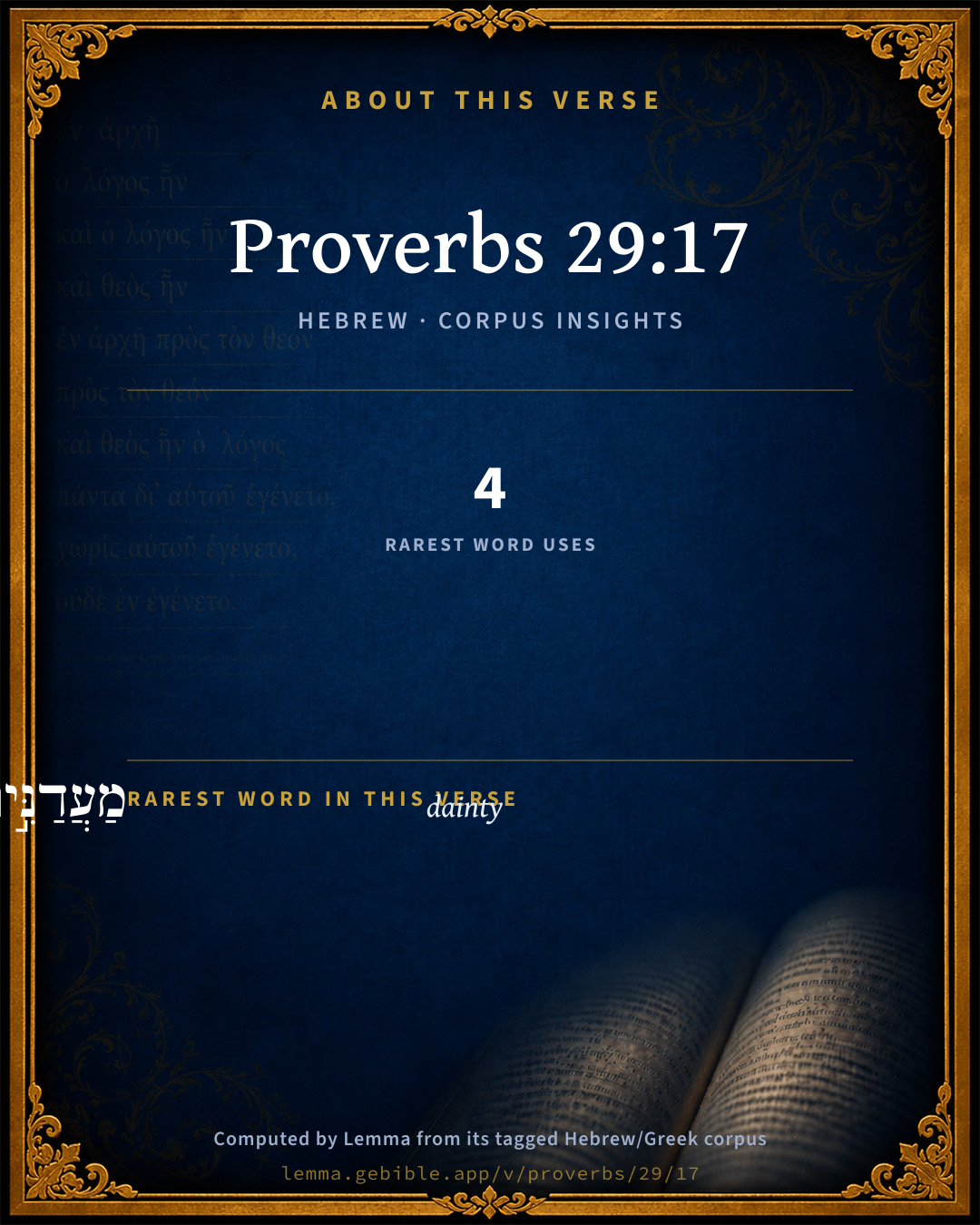
The rarest word here is מַעֲדַנִּ֣ים dainty H4574 — appearing just 4 times in the whole Hebrew Bible.

Shared distinctive vocabulary

מַעֲדַנִּ֣ים dainty H4574 occurs in 4 verses of the Hebrew Bible. Also found in:

Grammatical profile

  • 3 verbs
  • 3 nouns

Verb forms

  • יַסֵּ֣ר Piel · Imperative
  • וִֽינִיחֶ֑ךָ Hiphil · Imperfect
  • וְיִתֵּ֖ן Qal · Imperfect

Hebrew & Septuagint length

In English translation the verse runs 17 words from the Hebrew and 17 from the Septuagint (LXX English) — the same length.

A rough comparison of the two English renderings, which tokenize alike — not a word-level alignment.

Word counts can differ between the Hebrew and the Greek without any difference in meaning — e.g. the Hebrew direct-object marker אֵת has no separate Greek word, and Greek often adds the article ὁ.

Cross-references

6

Topical passages linked to Proverbs 29:17 in the Treasury of Scripture Knowledge — connected by theme and wording, ordered by reader-vote popularity; previews shown in the World English Bible.

  • Proverbs 10:1 The proverbs of Solomon. A wise son makes a glad father; But a foolish son brings grief to his mother.
  • Proverbs 29:15 The rod of correction gives wisdom, But a child left to himself causes shame to his mother.
  • Proverbs 13:24 One who spares the rod hates his son, But one who loves him is careful to discipline him.
  • Proverbs 23:13–14 Don't withhold correction from a child. If you punish him with the rod, he will not die.
  • Proverbs 19:18 Discipline your son, for there is hope; Don't be a willing party to his death.
  • Proverbs 22:15 Folly is bound up in the heart of a child: The rod of discipline drives it far from him.

Cross-references courtesy of OpenBible.info (CC BY 4.0).

Hebrew and Greek witnesses Masoretic Hebrew ↔ Greek Septuagint

The same verse in the two great witnesses to the Old Testament, shown verse-for-verse.

These are two independent witnesses, not word-aligned to each other, and the Septuagint is shown in lemma (dictionary) form.

Hebrew Proverbs 29:17 Masoretic · Westminster Leningrad Codex

יַסֵּ֣ר בִּ֭נְךָ וִֽינִיחֶ֑ךָ וְיִתֵּ֖ן מַעֲדַנִּ֣ים לְנַפְשֶֽׁךָ

Correct your son, and he will give you peace; Yes, he will bring delight to your soul.

World English Bible · Public Domain

Greek LXX Proverbs 29:17 Septuagint · lemma form

παιδεύω υἱός σύ καί ἀναπαύω σύ καί δίδωμι κόσμος ὁ ψυχή σύ

Chasten your son, and he shall give you rest; and he shall give honor to your soul.

LXX2012 (modern English Septuagint) · Public Domain

On this verse, Keil & Delitzsch discusses the Septuagint’s reading. Read the note in Commentary ↓

Hebrew: Westminster Leningrad Codex (CC BY 4.0). Greek: Septuagint (public domain); English from LXX2012 (modern English Septuagint) (Public Domain). How the Septuagint differs from the Hebrew →

Commentary

Notes on Proverbs 29:17 from classic Christian and Jewish commentators (each source and its license shown beneath its notes). The classic Christian expositions comment on the surrounding passage and are grouped to its opening verse, so a note may address several verses; the Jewish commentaries on the Tanakh (Rashi and others) are per-verse, so they appear only where the commentator wrote on this verse.

Lemma curates 59 commentaries, every one of them public domain or Creative Commons licensed, each selected and text-cleaned for this edition rather than reprinted as found. About our sources →

Trapp's Complete Commentary

John Trapp

Pro 29:17 Correct thy son, and he shall give thee rest; yea, he shall give delight unto thy soul.

Ver. 17. Correct thy son, and he shall give thee rest.] He will grow so towardly, that thou shalt with less ado rule him when grown up; or at least, thou shalt have peace within, in that thou hast used God’s means to mend him.

Yea, he shall give delight.] See Pro 10:1. The often urging this nurturing of children, shows that it is a most necessary, but much neglected duty.

John Trapp, A Commentary or Exposition upon All the Books of the Old and New Testament (1647–1656) — public domain. Text from a community e-Sword module.

Keil & Delitzsch

C. F. Keil & F. Delitzsch

17 Correct thy son, and he will give thee delight,

And afford pleasure to thy soul.

The lxx well translates ויניחך by καὶ ἀναπαύσει σε;

(Note: Their translation of Pro 29:17 and Pro 29:18 here is found, in a marred and mutilated form, after Pro 28:17. At that place the words are καὶ ἀγαπήσει σε.)

הניח denotes rest properly, a breathing again, ἀνάψυξις; and then, with an obliteration of the idea of restraint so far, generally (like the Arab. araḥ, compared by Fleischer) to afford pleasure or delight. The post.-bibl. language uses for this the words נחת רוּח, and says of the pious that he makes נחת רוח to his Creator, Berachoth 17a; and of God, that He grants the same to them that fear Him, Berach. 29b; in the morning prayer of the heavenly spirits, that they hallow their Creator בנחת רוח (with inward delight). Write with Codd. (also Jaman.) and older editions ויניחך, not ויניחךּ; for, except in verbs 'ה'ל, the suffix of this Hiphil form is not dageshed, e.g., אמיתך, Kg1 2:26; cf. also Kg1 22:16 and Psa 50:8. מעדנּים the lxx understands, after Sa2 1:24 (עם־עדנים, μετὰ κόσμου), also here, of ornament; but the word signifies dainty dishes - here, high spiritual enjoyment. As in Pro 29:15 and Pro 29:16 a transition was made from the house to the people, so there now follows the proverb of the discipline of children, a proverb of the education of the people:

Keil & Delitzsch — Biblical Commentary on the Old Testament (1861–1891) — public domain (CC PDM 1.0). Text via the HelloAO Bible API. (Old Testament only.)

Matthew Henry's Commentary

Note, 1. It is a very happy thing when children prove the comfort of their parents. Good children are so; they give them rest, make them easy, and free from the many cares they have had concerning them; yea, they give delight unto their souls. It is a pleasure to parents, which none know but those that are blessed with it, to see the happy fruit of the good education they have given their children, and to have a prospect of their well-doing for both worlds; it gives delight proportionable to the many thoughts of heart that have been concerning them. 2. In order to this, children must be trained up under a strict discipline, and not suffered to do what they will and to go without rebuke when they do amiss. The foolishness bound up in their hearts must by correction be driven out when they are young, or it will break out, to their own and their parents' shame, when they are grown up.

Matthew Henry's Commentary on the Whole Bible (1708–1710) — public domain (CC PDM 1.0). Text via the HelloAO Bible API.

Jamieson, Fausset & Brown

Robert Jamieson, A. R. Fausset & David Brown

(Compare Pro 29:3, Pro 29:15; Pro 19:18).

give thee rest--peace and quiet (compare Pro 29:9).

Jamieson, Fausset & Brown — Commentary Critical and Explanatory on the Whole Bible (1871) — public domain (CC PDM 1.0). Text via the HelloAO Bible API.

John Gill's Exposition

Correct thy son, and he shall give thee rest,.... Ease of mind, satisfaction and contentment, freedom from all anxious thoughts and cares; the correction being taken in good part, and succeeding according to wish and design;

yea, he shall give delight unto thy soul; by his tenderness to his parents, obedience to them, and respect for them; by his prudent behaviour among men; by his sobriety, diligence, and industry in his calling; by his fear of God, and walking in his ways; than which nothing can give a greater delight and pleasure to religious parents.

John Gill's Exposition of the Whole Bible (1746–1763) — public domain (CC PDM 1.0). Text via the HelloAO Bible API.

Matthew Poole's English Annotations

Rest; satisfaction to thy mind, and comfort in his amendment.

Matthew Poole's English Annotations on the Holy Bible (1683–1685) — public domain. Text from a community e-Sword/MySword module.

Whedon's Commentary on the Bible

Daniel D. Whedon

17. Delight unto thy soul — Literally, delights, מעדנים, (ma’hadhannim,) from the same root as Eden; גן עדן, (gan ‘hedhen,) the garden of delights. “It may seem more easy and comfortable to let a child have his own wilful way, and troublesome to correct him for his faults; but this is only purchasing present ease at the expense of great future distress; therefore, however painful the duty, correct him when he needs it.” “By joining the rod with the reproof, the moral is sometimes better enforced.” — Chalmers.

Daniel D. Whedon (gen. ed.), Commentary on the Old and New Testaments (1874–1909) — public domain. Text from a community e-Sword module.

The Pulpit Commentary

Correct thy son, and he shall give thee rest; (Pro_19:18) Septuagint, anapausei se . He will be no longer a source of care and disquiet to you. Delight (maadanim); properly, dainty dishes, and then any great and special pleasure (comp. Ecc 30:1-12). Septuagint, "He shall give ornament (kosmon ) to thy soul." This verse and the following are presented by the Greek version in a mutilated form after Pro_28:17 (where see note).

The Pulpit Commentary (1880–1919), ed. H.D.M. Spence-Jones & Joseph S. Exell — public domain. Text from a community e-Sword module.

Bridges on Proverbs

Charles Bridges

Once more the wise man returns to the subject of discipline. These repeated inculcations†1 strongly shew its importance. The command is positive — Correct thy son. How can an upright judgment evade or explain away a plain, literal rule? This book of Proverbs is not out of date. Like every other part of the Sacred Volume, it is the Book for every age; "given by inspiration of God; profitable for doctrine, and written for our learning."†2 To try therefore more self-pleasing rules, is to set up our will in opposition to God’s; reason or feeling in the stead of faith. It is making ourselves "wise above that which is written."

The measure and mode of correction indeed must depend upon the age, sex, temper of the child, the character, the aggravation, or the mitigated circumstances, of the fault. But let it be, like our gracious Father’s discipline, never more than can be borne.†3 Make due allowance for any marks of ingenuous confession. Yet with a wise application of the principle, there must be no exception to the rule. Different tempers, like different soils, require corresponding difference of treatment. But discipline there must be; not relaxed in fondness, not pushed on in harshness; but authority tempered with love.†4 If a gentle hand cannot control, a stronger hand must be applied.

We may take rest without correction; but such rest will bring trouble in the end. The true rest is that, which our child will give; and that he may give it, the rule is — Correct.†5 We may be assured, that God would not have so insisted upon it, if a blessing was not with it. If Eli was rejected, it was because in this matter he "honored his sons above God."†6 Those men "that honor him" above their sons "he will honor." Pain is the present exercise both to parent and child,†7 but the after blessing is secured. (Heb 12:11 .) Ground well tilled, trees carefully pruned, "bring forth more fruit."

Observe how the objection of parental weakness is anticipated. ’If I put my son to pain, will he not hate me?’ No — when "left to himself," he was a deep and anxious trouble. Now he shall give thee rest. Before — he "brought thee to shame." (Pro 29:15 .) Now he shall give delight to thy soul.†8 The momentary feelings of the child under correction will give way to the conviction of the parent’s wisdom and regard for his profit. (Heb 12:9 .)

Yet the rule against discouragement would not have been repeated, had there not been some parental evil to be corrected. "Provocation" revolts, transfers confidence to most unworthy associates, and brings into ruinous temptations. Children claim a considerate treatment. They must not be driven by brute force. Authority must be tempered with love. The grounds of extraordinary commands should be explained to them. What is good should be liberally commended. The best construction should be put upon defective efforts. The distinction should be carefully drawn between weakness and willfulness, between heedlessness and obstinacy. Home should be gladdened with the invigorating joy of spring, and replete with every wholesome indulgence. Every attempt should be made to gain confidence, so that the child, instead of a cold trembling reserve, should run into our arms. But in this glowing atmosphere, forget not God’s rule. The completeness of discipline is the father’s firmness combined with the mother’s tenderness; each infusing into the other the quality of each. A wise parent will put his seal to the testimony, that this well-disciplined education is the surest means of securing the children’s affection, gratitude, and reverence.

In fine — on this important subject so often enforced — we are not taught to believe without promises, or to obey without precepts. The Book of Proverbs exhibits cause and effect — the certain consequence of a given course of action, whether good or evil. It sets out promise and obligation — promise fulfilled in the way of obligation. The promised blessing to godly parental discipline is written in beams of living light. If the grace of the promise be lost, it is only by unbelief in the promise, or by a presumptuous confidence in it (separating the end from the means) such as brings shame in the issue. It is not that God is untrue, but that we are unfaithful. God has given the promise. Man either slights, rejects or abuses it. He attempts to put aside the Scripture by an appeal to experience, instead of proving the faithfulness of God by "the obedience of faith." The commands — the directions — the promises — the blessing — all are the Lord’s. Put his word to the test. The simplicity and perseverance of faith will be richly honored in his own best time and way.

Footnotes:

†1 Pro 29:15. Pro 13:24 ; Pro 19:18 ; Pro 22:15 ; Pro 23:13-14 .

†2 2Ti 3:16 . Rom 15:4 .

†3 Isa 27:8; Isa 57:16 . 1Co 10:13 .

†4 See Wis 6:17 .

†5 Compare Sir 30:2 .

†6 1Sa 2:29-30 . Contrast Gen 22:12 .

†7 Pro 15:10.

†8 Pro 23:13-16, Pro 23:24-25 .

Charles Bridges, An Exposition of the Book of Proverbs (1846) — public domain. Text from a community e-Sword module.

unfoldingWord translationNotes

Door43 World Missions Community

the one who keeps the law is blessed

This can be translated in active form. AT: "God will bless the one who keeps the law" (See: Active or Passive)

translationWords

discipline

rest

prophet

vision

law, laws

unfoldingWord translationNotes — © Distant Shores Media and the Door43 World Missions Community, licensed CC BY-SA 4.0. Source: git.door43.org/Door43/en_tn.

Lesson kit

Teaching starters — assembled from the data on this page, not authored interpretation. Every prompt links to the verse data it draws on. Edit before teaching.

Proverbs, in the Wisdom, opens this verse with 6 words (6 distinct Hebrew lemmas). Its most distinctive word is maʻădân (“dainty”). A historical commentator’s framing appears above. Read the whole chapter for the surrounding context.

Discussion questions

  1. What does “dainty” (maʻădân) contribute to the verse as a whole?
  2. Genesis 49:20 shares the word «dainty» with this verse. How do the two illuminate each other?
  3. These translations render this verse differently; the difference is in the English rendering, not the original. What questions does that raise?
  4. The verb «יַסֵּ֣ר» is Piel Imperative. How does its form color the action?
  5. Reading how Trapp's Complete Commentary and Keil & Delitzsch read this verse, where do the two commentators agree and where do they part?

Things to notice

Reading settings

Reading text

Shown beneath each verse's original-language words.

Old Testament
Old Testament edition

Read the OT as the Masoretic Hebrew (MT) or the Greek Septuagint (LXX).

English shown for the Greek Septuagint (in the Hebrew ↔ Greek comparison).

Comparing translations? Open the Compare panel on any verse page to stack up to four side by side.