Jeremiah 52:29

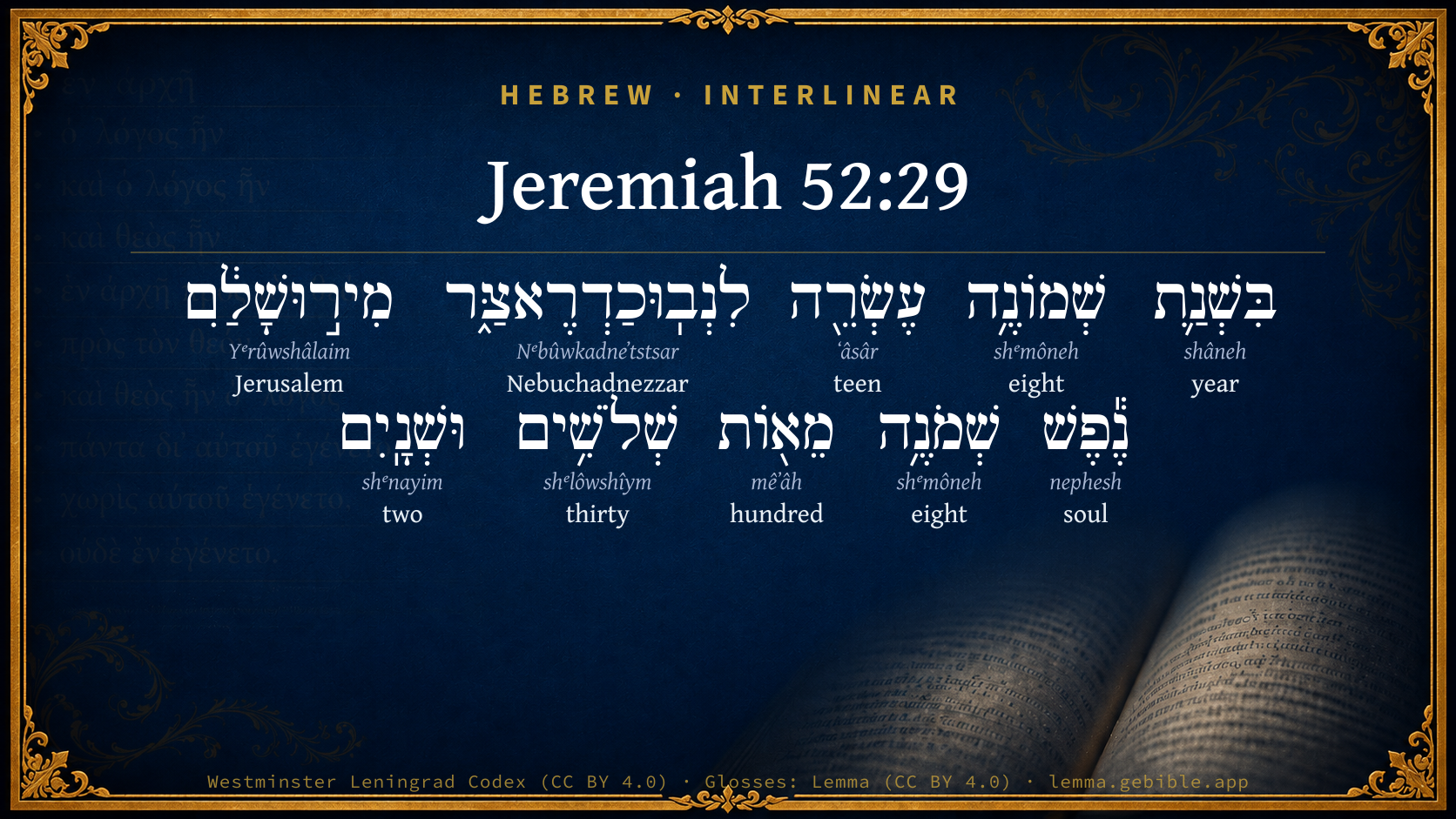
Hebrew (Westminster Leningrad Codex) Jeremiah 52:29 appears in the Hebrew Old Testament. The text above is from the Westminster Leningrad Codex. Each word links to its Strong’s number, a concise gloss, and parsing drawn from the Open Scriptures Hebrew Bible morphology. Click any word for its full Brown-Driver-Briggs (BDB) entry.
Download image
Cite this verse

Jeremiah 52:29 (World English Bible). Public Domain. Lemma interlinear Bible study tool, https://lemma.gebible.app/v/jeremiah/52/29.

Show BibTeX & RIS
BibTeX
RIS
English Translation
in the eighteenth year of Nebuchadrezzar he carried away captive from Jerusalem eight hundred thirty-two persons;
World English Bible · Public Domain
Download a study sheet

One document with this verse’s original text, its word-by-word gloss line, the meaning frame, cross-references with their text, attributed commentary, and full source and license credits — printable, and it pastes into notes with its structure intact.

This verse Autodidact and up

Study sheet (.html) Plain text (.txt)

A passage Seminary Student

Up to 50 verses in one chapter. A passage sheet keeps up to 6 commentary sources and 12 cross-references per verse, in the order this page ranks them, and says so on the sheet whenever that leaves anything out. Ask for a single verse and you get the Autodidact verse sheet above.

Everything on this page stays free to read, with no account — the sheet is a download of what is already on screen, not access to it.

Want to remove ads? Support Godless Engineer
Compare translations 3

The same verse in 3 English versions, stacked beneath the original-language interlinear above. Click any original word for its lexicon entry.

Each is an independent rendering of the whole verse — the interlinear is not word-aligned to these translations.

Highlighted words mark where these versions differ — a whole-verse word diff, not a word-by-word alignment.

  • World English Bible Public Domain
    in the eighteenth year of Nebuchadrezzar he carried away captive from Jerusalem eight hundred thirty-two persons;
  • King James Version Public Domain
    In the eighteenth year of Nebuchadrezzar he carried away captive from Jerusalem eight hundred thirty and two persons:
  • unfoldingWord Literal Text CC BY-SA 4.0
    In the eighteenth year of Nebuchadnezzar he took 832 people from Jerusalem.

unfoldingWord Literal Text — © unfoldingWord, licensed CC BY-SA 4.0. Word-aligned USFM3 via Door43 (git.door43.org/unfoldingWord/en_ult).

Versions to compare (up to 4)

3 of 4 selected

Show all 18 translations

Every available English version of this verse, each an independent rendering of the whole verse.

  • World English Bible Public Domain
    in the eighteenth year of Nebuchadrezzar he carried away captive from Jerusalem eight hundred thirty-two persons;
  • Berean Standard Bible Public Domain
    in Nebuchadnezzar’s eighteenth year, 832 people from Jerusalem;
  • Majority Standard Bible Public Domain
    in Nebuchadnezzar’s eighteenth year, 832 people from Jerusalem;
  • King James Version Public Domain
    In the eighteenth year of Nebuchadrezzar he carried away captive from Jerusalem eight hundred thirty and two persons:
  • American Standard Version (1901) Public Domain
    in the eighteenth year of Nebuchadrezzar he carried away captive from Jerusalem eight hundred thirty and two persons;
  • Revised Version (1885) Public Domain
    in the eighteenth year of Nebuchadrezzar he carried away captive from Jerusalem eight hundred thirty and two persons:
  • Geneva Bible (1599) Public Domain
    In the eightenth yere of Nebuchad-nezzar he caried away captiue from Ierusalem eight hundreth thirtie and two persons.
  • Douay-Rheims (1899) Public Domain
    In the eighteenth year of Nabuchodonosor, eight hundred and thirty-two souls from Jerusalem.
  • Young's Literal Translation Public Domain
    in the eighteenth year of Nebuchadrezzar -- from Jerusalem, souls, eight hundred thirty and two;
  • Literal Standard Version CC BY-SA 4.0
    in the eighteenth year of Nebuchadnezzar—from Jerusalem—eight hundred thirty-two souls;
  • Unlocked Literal Bible CC BY-SA 4.0
    In the eighteenth year of Nebuchadnezzar he took 832 people from Jerusalem.
  • unfoldingWord Literal Text CC BY-SA 4.0
    In the eighteenth year of Nebuchadnezzar he took 832 people from Jerusalem.
  • Darby Bible Public Domain
    in the eighteenth year of Nebuchadrezzar [he carried away captive] from Jerusalem eight hundred and thirty-two persons;
  • World Messianic Bible Public Domain
    in the eighteenth year of Nebuchadnezzar, he carried away captive from Jerusalem eight hundred thirty-two persons;
  • Webster's Bible Public Domain
    In the eighteenth year of Nebuchadrezzar he carried away captive from Jerusalem eight hundred thirty and two persons:
  • Free Bible Version CC BY-SA 4.0
    In his eighteenth year Nebuchadnezzar took another 832 from Jerusalem.
  • Bible in Basic English Public Domain
    And in the eighteenth year of Nebuchadrezzar he took away as prisoners from Jerusalem eight hundred and thirty-two persons:
  • JPS Tanakh (1917) Public Domain
    in the eighteenth year of Nebuchadrezzar, from Jerusalem, eight hundred thirty and two persons;

Literal Standard Version (2020), Covenant Press — licensed CC BY-SA 4.0. Text via the HelloAO Bible API (eBible.org). Unlocked Literal Bible (unfoldingWord) — licensed CC BY-SA 4.0. Text via the HelloAO Bible API (eBible.org). unfoldingWord Literal Text — © unfoldingWord, licensed CC BY-SA 4.0. Word-aligned USFM3 via Door43 (git.door43.org/unfoldingWord/en_ult). Free Bible Version, Dr. Jonathan Gallagher — licensed CC BY-SA 4.0. Text via the HelloAO Bible API (eBible.org).

Word by word

More ways to search: Search by grammar → Find every occurrence → Compare this word →

Practice this passage: Drill this verse → Learn its vocabulary →

לִנְבֽוּכַדְרֶאצַּ֑ר
Nᵉbûwkadneʼtstsar
H5019
“to/for · Nebuchadnezzar”
Preposition + Noun, Proper
Part of Speech
Preposition + Noun
Type
Proper
Full BDB Definition

Origin: of foreign derivation

TWOT: None

Nebuchadnezzar or Nebuchadrezzar = "may Nebo protect the crown" - the great king of Babylon who captured Jerusalem and carried Judah captive
  1. בִּשְׁנַ֛ת shâneh H8141 “in/at · year of” Preposition + Noun, Common, Feminine, Singular, Construct
  2. שְׁמוֹנֶ֥ה shᵉmôneh H8083 “eight” Adjective, Cardinal number, Feminine, Singular, Absolute
  3. עֶשְׂרֵ֖ה ʻâsâr H6240 “teen” Adjective, Cardinal number, Feminine, Singular, Absolute
  4. מִיר֣וּשָׁלִַ֔ם Yᵉrûwshâlaim H3389 “from · Jerusalem” Preposition + Noun, Proper
  5. נֶ֕פֶשׁ nephesh H5315 “soul” Noun, Common, Both, Singular, Absolute
  6. שְׁמֹנֶ֥ה shᵉmôneh H8083 “eight” Adjective, Cardinal number, Feminine, Singular, Absolute
  7. מֵא֖וֹת mêʼâh H3967 “hundred” Adjective, Cardinal number, Both, Plural, Absolute
  8. שְׁלֹשִׁ֥ים shᵉlôwshîym H7970 “thirty” Adjective, Cardinal number, Both, Plural, Absolute
  9. וּשְׁנָֽיִם shᵉnayim H8147 “and · two” Conjunction + Adjective, Cardinal number, Masculine, Dual, Absolute

About this verse

These counts appear in no published source. They are computed here, from the morphology-tagged text and Lemma’s own curated glosses. What Lemma adds →

10
words
9
distinct lemmas
Prophets
section

Shared distinctive vocabulary

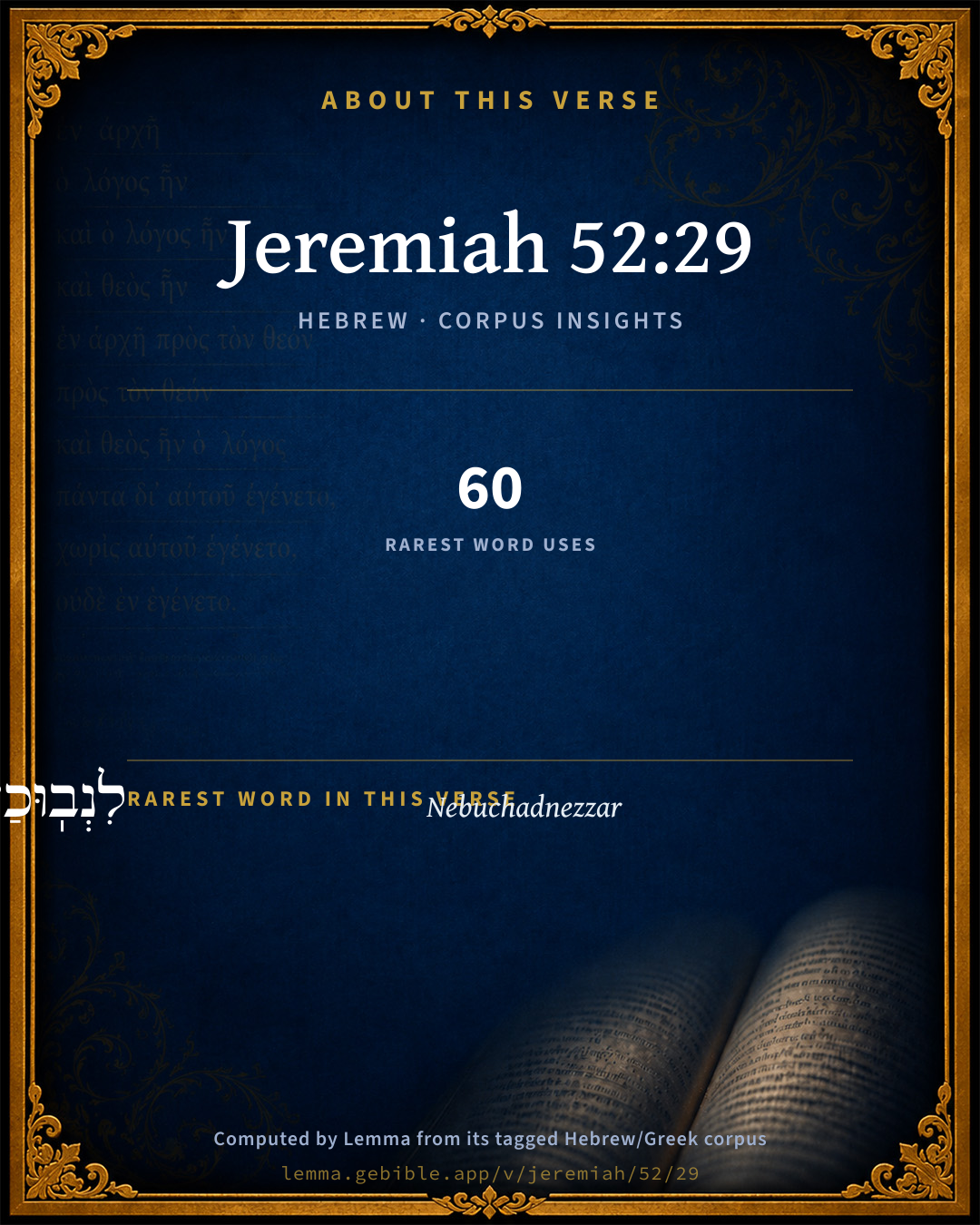
לִנְבֽוּכַדְרֶאצַּ֑ר Nebuchadnezzar H5019 occurs in 58 verses of the Hebrew Bible. Also found in:

Grammatical profile

  • 4 nouns
  • 6 adjectives

Repetition

A word recurs within this verse — often emphatic in Hebrew:

  • שְׁמוֹנֶ֥ה eight H8083 ×2

Cross-references

6

Topical passages linked to Jeremiah 52:29 in the Treasury of Scripture Knowledge — connected by theme and wording, ordered by reader-vote popularity; previews shown in the World English Bible.

  • Genesis 12:5 Abram took Sarai his wife, Lot his brother's son, all their substance that they had gathered, and the souls who they had gotten in Haran; and they went forth to go into the land of Canaan. Into the land of Canaan they came.
  • Jeremiah 52:12 Now in the fifth month, in the tenth day of the month, which was the nineteenth year of king Nebuchadrezzar, king of Babylon, came Nebuzaradan the captain of the guard, who stood before the king of Babylon, into Jerusalem:
  • Exodus 1:5 All the souls who came out of the Jacob's body were seventy souls, and Joseph was in Egypt already.
  • 2 Kings 25:11 The residue of the people who were left in the city, and those who fell away, who fell to the king of Babylon, and the residue of the multitude, did Nebuzaradan the captain of the guard carry away captive.
  • 2 Chronicles 36:20 Those who had escaped from the sword carried he away to Babylon; and they were servants to him and his sons until the reign of the kingdom of Persia:
  • Jeremiah 39:9 Then Nebuzaradan the captain of the guard carried away captive into Babylon the residue of the people who remained in the city, the deserters also who fell away to him, and the residue of the people who remained.

Cross-references courtesy of OpenBible.info (CC BY 4.0).

Hebrew and Greek witnesses Masoretic Hebrew ↔ Greek Septuagint

The same verse in the two great witnesses to the Old Testament, shown verse-for-verse.

These are two independent witnesses, not word-aligned to each other, and the Septuagint is shown in lemma (dictionary) form.

Hebrew Jeremiah 52:29 Masoretic · Westminster Leningrad Codex

בִּשְׁנַ֛ת שְׁמוֹנֶ֥ה עֶשְׂרֵ֖ה לִנְבֽוּכַדְרֶאצַּ֑ר מִיר֣וּשָׁלִַ֔ם נֶ֕פֶשׁ שְׁמֹנֶ֥ה מֵא֖וֹת שְׁלֹשִׁ֥ים וּשְׁנָֽיִם

in the eighteenth year of Nebuchadrezzar he carried away captive from Jerusalem eight hundred thirty-two persons;

World English Bible · Public Domain

Greek LXX Structure differs

In the Septuagint, Jeremiah is about an eighth shorter than the Hebrew and arranges its material differently — the Oracles Against the Nations (Hebrew chapters 46–51) appear in the middle of the Greek book, after 25:13. Because the chapter and verse boundaries do not line up, a verse-for-verse comparison with the Hebrew is not shown.

A verse-for-verse comparison isn’t shown here because the chapters and verses don’t line up. Switch to the LXX edition with the MT / LXX toggle above to read the Greek directly.

Hebrew: Westminster Leningrad Codex (CC BY 4.0). Greek: Septuagint (public domain); English from a public-domain English Septuagint. How the Septuagint differs from the Hebrew →

Targum (Aramaic paraphrase)

1

The Targum is the ancient Jewish Aramaic paraphrase of the Hebrew Scriptures — an interpretive translation, not the Hebrew text itself. Onkelos (literal) and Pseudo-Jonathan (expansive) render the Torah, and Jonathan the Prophets. Coverage is partial: where no permissively-licensed English translation exists for a verse, only the Aramaic is shown. This is verse-level text, not a word-by-word alignment to the Hebrew.

  1. Targum Jonathan Prophets (Joshua–Malachi)
    בִּשְׁנַת תַּמְנֵי עַסְרֵי לִנְבוּכַדְרֶאצַר מִירוּשְׁלֵם נַפְשָׁתָא תַּמְנֵי מְאָה וּתְלָתִין וְתַרְתֵּין:

    (no public-domain English translation for this verse)

    Targum Jonathan — Aramaic: “Mikraot Gedolot” (public domain). English: “Sefaria Community Translation” (CC0 1.0 (public-domain dedication)); “London "Chaldee Paraphrase," 1871” (public domain). Text via Sefaria.

Commentary

Notes on Jeremiah 52:29 from classic Christian and Jewish commentators (each source and its license shown beneath its notes). The classic Christian expositions comment on the surrounding passage and are grouped to its opening verse, so a note may address several verses; the Jewish commentaries on the Tanakh (Rashi and others) are per-verse, so they appear only where the commentator wrote on this verse.

Lemma curates 59 commentaries, every one of them public domain or Creative Commons licensed, each selected and text-cleaned for this edition rather than reprinted as found. About our sources →

Tyndale Open Study Notes

Tyndale Open Resources

52:29 Nebuchadnezzar’s eighteenth year was 586 BC, the year Jerusalem was destroyed.

Tyndale Open Study Notes — © Tyndale Open Resources, licensed CC BY-SA 4.0. Text via the HelloAO Bible API.

Geneva Bible (1599)

Geneva Bible translators

In the latter end also of that year, and the beginning of the nineteenth.

Hebrew, souls.

Geneva Bible (1599) marginal notes — public domain. Text via Bolls.life.

Jamieson, Fausset & Brown

Robert Jamieson, A. R. Fausset & David Brown

eighteenth year--when Jerusalem was taken. But in Jer 52:15, and Kg2 25:8, "the nineteenth year." Probably it was at the end of the eighteenth and the beginning of the nineteenth [LYRA].

eight hundred and thirty and two--The most illustrious persons are meant, who no doubt were carried away first, at the end of the eighteenth year.

Jamieson, Fausset & Brown — Commentary Critical and Explanatory on the Whole Bible (1871) — public domain (CC PDM 1.0). Text via the HelloAO Bible API.

Adam Clarke's Commentary

Verse 29. See Clarke on Jer 52:28.

Adam Clarke's Commentary on the Bible (1810–1826) — public domain. Text from a community e-Sword/MySword module.

Ellicott's Commentary for English Readers

(29) Eight hundred thirty and two persons.—The comparatively small number indicates the ravages of the sword, the pestilence, and the famine to which Jeremiah so often refers. The captives were probably the scanty remnant of the defenders of the city, and the deportation that by Nebuzar-adan narrated in Jer_52:15.

A Bible Commentary for English Readers, edited by Charles John Ellicott (1878–1897) — public domain. Text from a community e-Sword module.

John Gill's Exposition

In the three and twentieth year of Nebuchadnezzar,.... In this year of his reign, the Jews say (m), Tyre was delivered into his hands; and he carried off the Jews in Moab, Ammon, and the neighbouring nations, to the number after mentioned; though some think these were the poor people of the land he took from thence, after the murder of Gedaliah, and in revenge of that:

Nebuzaradan captain of the guard carried away captive of the Jews seven hundred forty and five persons; all which being put together make the following sum:

all the persons were four thousand and six hundred; this is the sum total of the three mentioned captivities.

(m) Seder Olam Rabba, c. 26. p. 77.

John Gill's Exposition of the Whole Bible (1746–1763) — public domain (CC PDM 1.0). Text via the HelloAO Bible API.

Matthew Poole's English Annotations

That was the year when the city was broken up.

Matthew Poole's English Annotations on the Holy Bible (1683–1685) — public domain. Text from a community e-Sword/MySword module.

Lesson kit

Teaching starters — assembled from the data on this page, not authored interpretation. Every prompt links to the verse data it draws on. Edit before teaching.

Jeremiah, in the Prophets, opens this verse with 10 words (9 distinct Hebrew lemmas). Its most distinctive word is Nᵉbûwkadneʼtstsar (“Nebuchadnezzar”). A historical commentator’s framing appears above. Read the whole chapter for the surrounding context.

Discussion questions

  1. What does “Nebuchadnezzar” (Nᵉbûwkadneʼtstsar) contribute to the verse as a whole?
  2. How does 2 Kings 24:1, which shares the word «Nebuchadnezzar», read alongside this verse?
  3. What does the repetition of “eight” (2× in this one verse) do in this verse?
  4. The translations on this page render this verse differently — a whole-verse word diff, not a word-by-word alignment. What might account for the different wordings?
  5. Compare how Tyndale Open Study Notes and Geneva Bible (1599) read this verse. Where do they agree or differ?

Things to notice

Reading settings

Reading text

Shown beneath each verse's original-language words.

Old Testament
Old Testament edition

Read the OT as the Masoretic Hebrew (MT) or the Greek Septuagint (LXX).

English shown for the Greek Septuagint (in the Hebrew ↔ Greek comparison).

Comparing translations? Open the Compare panel on any verse page to stack up to four side by side.