
Proverbs 31:6

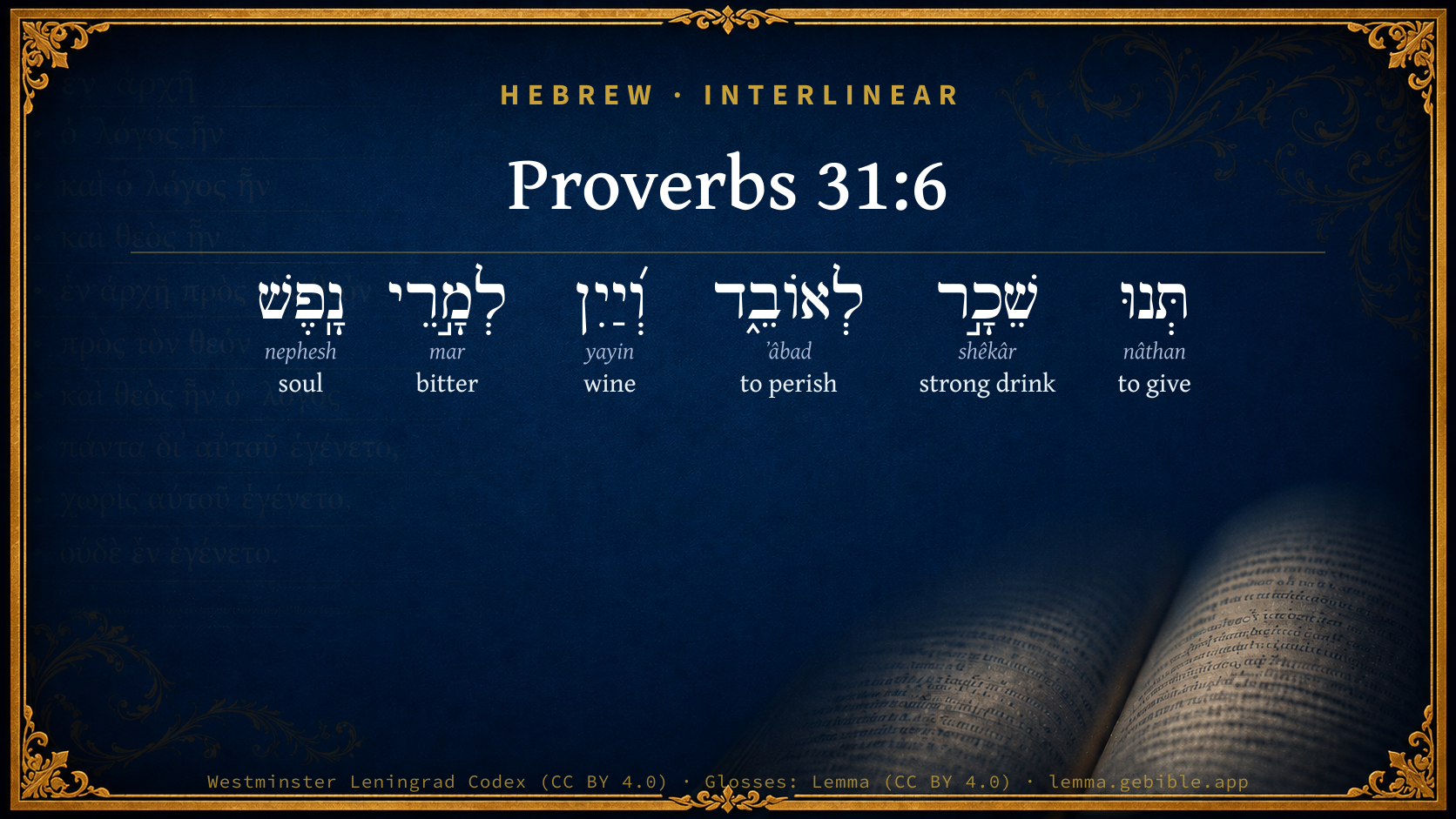
Hebrew (Westminster Leningrad Codex) Proverbs 31:6 appears in the Hebrew Old Testament. The text above is from the Westminster Leningrad Codex. Each word links to its Strong’s number, a concise gloss, and parsing drawn from the Open Scriptures Hebrew Bible morphology. Click any word for its full Brown-Driver-Briggs (BDB) entry.
Download image
Cite this verse

Proverbs 31:6 (World English Bible). Public Domain. Lemma interlinear Bible study tool, https://lemma.gebible.app/v/proverbs/31/6.

Show BibTeX & RIS
BibTeX
RIS
English Translation
Give strong drink to him who is ready to perish; And wine to the bitter in soul:
World English Bible · Public Domain
Download a study sheet

One document with this verse’s original text, its word-by-word gloss line, the meaning frame, cross-references with their text, attributed commentary, and full source and license credits — printable, and it pastes into notes with its structure intact.

This verse Autodidact and up

Study sheet (.html) Plain text (.txt)

A passage Seminary Student

Up to 50 verses in one chapter. A passage sheet keeps up to 6 commentary sources and 12 cross-references per verse, in the order this page ranks them, and says so on the sheet whenever that leaves anything out. Ask for a single verse and you get the Autodidact verse sheet above.

Everything on this page stays free to read, with no account — the sheet is a download of what is already on screen, not access to it.

Want to remove ads? Support Godless Engineer
Compare translations 3

The same verse in 3 English versions, stacked beneath the original-language interlinear above. Click any original word for its lexicon entry.

Each is an independent rendering of the whole verse — the interlinear is not word-aligned to these translations.

Highlighted words mark where these versions differ — a whole-verse word diff, not a word-by-word alignment.

  • World English Bible Public Domain
    Give strong drink to him who is ready to perish; And wine to the bitter in soul:
  • King James Version Public Domain
    Give strong drink unto him that is ready to perish, and wine unto those that be of heavy hearts.
  • unfoldingWord Literal Text CC BY-SA 4.0
    Give intoxicating drink to the perishing one and wine to those bitter of soul.

unfoldingWord Literal Text — © unfoldingWord, licensed CC BY-SA 4.0. Word-aligned USFM3 via Door43 (git.door43.org/unfoldingWord/en_ult).

Versions to compare (up to 4)

3 of 4 selected

Show all 18 translations

Every available English version of this verse, each an independent rendering of the whole verse.

  • World English Bible Public Domain
    Give strong drink to him who is ready to perish; And wine to the bitter in soul:
  • Berean Standard Bible Public Domain
    Give strong drink to one who is perishing, and wine to the bitter in soul.
  • Majority Standard Bible Public Domain
    Give strong drink to one who is perishing, and wine to the bitter in soul.
  • King James Version Public Domain
    Give strong drink unto him that is ready to perish, and wine unto those that be of heavy hearts.
  • American Standard Version (1901) Public Domain
    Give strong drink unto him that is ready to perish, And wine unto the bitter in soul:
  • Revised Version (1885) Public Domain
    Give strong drink unto him that is ready to perish, and wine unto the bitter in soul:
  • Geneva Bible (1599) Public Domain
    Giue ye strong drinke vnto him that is readie to perish, and wine vnto them that haue griefe of heart.
  • Douay-Rheims (1899) Public Domain
    Give strong drink to them that are sad: and wine to them that are grieved in mind:
  • Young's Literal Translation Public Domain
    Give strong drink to the perishing, And wine to the bitter in soul,
  • Literal Standard Version CC BY-SA 4.0
    Give strong drink to the perishing, || And wine to the bitter in soul,
  • Unlocked Literal Bible CC BY-SA 4.0
    Give strong drink to a person who is perishing and wine to those in bitter distress.
  • unfoldingWord Literal Text CC BY-SA 4.0
    Give intoxicating drink to the perishing one and wine to those bitter of soul.
  • Darby Bible Public Domain
    Give strong drink unto him that is ready to perish, and wine unto the bitter of soul:
  • World Messianic Bible Public Domain
    Give strong drink to him who is ready to perish, and wine to the bitter in soul.
  • Webster's Bible Public Domain
    Give strong drink to him that is ready to perish, and wine to those that are of heavy hearts.
  • Free Bible Version CC BY-SA 4.0
    Give alcohol to those who are dying, and wine to those who are in terrible distress.
  • Bible in Basic English Public Domain
    Give strong drink to him who is near to destruction, and wine to him whose soul is bitter:
  • JPS Tanakh (1917) Public Domain
    Give strong drink unto him that is ready to perish, and wine unto the bitter in soul;

Literal Standard Version (2020), Covenant Press — licensed CC BY-SA 4.0. Text via the HelloAO Bible API (eBible.org). Unlocked Literal Bible (unfoldingWord) — licensed CC BY-SA 4.0. Text via the HelloAO Bible API (eBible.org). unfoldingWord Literal Text — © unfoldingWord, licensed CC BY-SA 4.0. Word-aligned USFM3 via Door43 (git.door43.org/unfoldingWord/en_ult). Free Bible Version, Dr. Jonathan Gallagher — licensed CC BY-SA 4.0. Text via the HelloAO Bible API (eBible.org).

Word by word

More ways to search: Search by grammar → Find every occurrence → Compare this word →

Practice this passage: Drill this verse → Learn its vocabulary →

About this verse

These counts appear in no published source. They are computed here, from the morphology-tagged text and Lemma’s own curated glosses. What Lemma adds →

6
words
6
distinct lemmas
Wisdom
section

Notable vocabulary

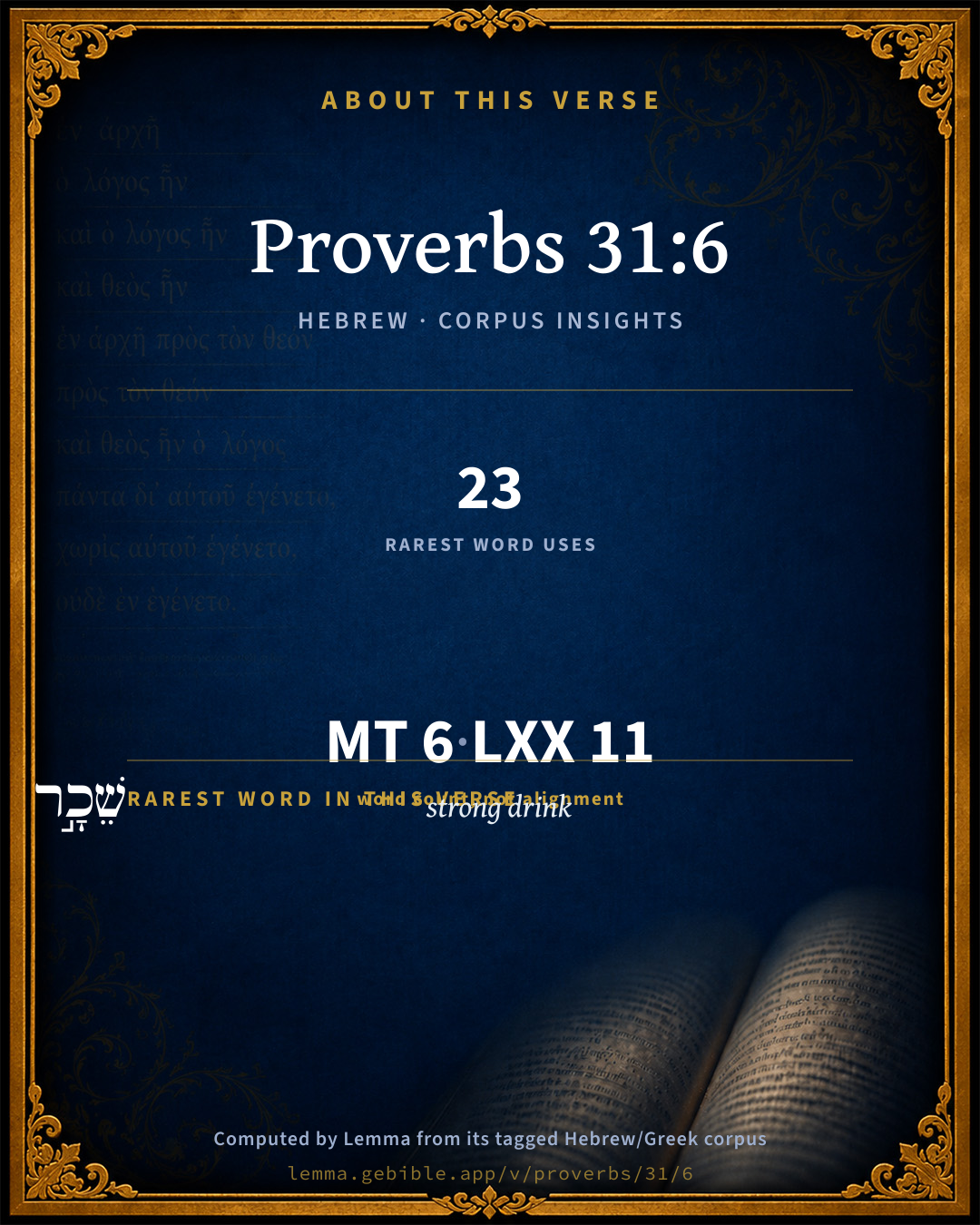
The rarest word here is שֵׁכָ֣ר strong drink H7941 — appearing just 23 times in the whole Hebrew Bible.

Shared distinctive vocabulary

שֵׁכָ֣ר strong drink H7941 occurs in 20 verses of the Hebrew Bible. Also found in:

Grammatical profile

  • 2 verbs
  • 3 nouns
  • 1 adjective

Verb forms

  • תְּנוּ Qal · Imperative
  • לְאוֹבֵ֑ד Qal · Participle Active

Hebrew & Septuagint length

In English translation the verse runs 17 words from the Hebrew and 18 from the Septuagint (LXX English) — closely comparable.

A rough comparison of the two English renderings, which tokenize alike — not a word-level alignment.

Word counts can differ between the Hebrew and the Greek without any difference in meaning — e.g. the Hebrew direct-object marker אֵת has no separate Greek word, and Greek often adds the article ὁ.

In the original languages it is 6 Hebrew tokens and 11 Greek tokens — but the two are counted differently (Hebrew bundles its prefixes and suffixes into one token; the Greek is in lemma form), so that isn’t a like-for-like length.

Cross-references

7

Topical passages linked to Proverbs 31:6 in the Treasury of Scripture Knowledge — connected by theme and wording, ordered by reader-vote popularity; previews shown in the World English Bible.

  • 1 Timothy 5:23 Be no longer a drinker of water only, but use a little wine for your stomach's sake and your frequent infirmities.
  • Psalms 104:15 Wine that makes glad the heart of man, Oil to make his face to shine, And bread that strengthens man's heart.
  • 1 Samuel 1:10 She was in bitterness of soul, and prayed to Yahweh, and wept sore.
  • 1 Samuel 30:6 David was greatly distressed; for the people spoke of stoning him, because the soul of all the people was grieved, every man for his sons and for his daughters: but David strengthened himself in Yahweh his God.
  • 2 Kings 4:27 When she came to the man of God to the hill, she caught hold of his feet. Gehazi came near to thrust her away; but the man of God said, Let her alone: for her soul is vexed within her; and Yahweh has hid it from me, and has not told me.
  • Job 3:20 "Why is light given to him who is in misery, Life to the bitter in soul,
  • Job 29:13 The blessing of him who was ready to perish came on me, And I caused the widow's heart to sing for joy.

Cross-references courtesy of OpenBible.info (CC BY 4.0).

Hebrew and Greek witnesses Masoretic Hebrew ↔ Greek Septuagint

The same verse in the two great witnesses to the Old Testament, shown verse-for-verse.

These are two independent witnesses, not word-aligned to each other, and the Septuagint is shown in lemma (dictionary) form.

Hebrew Proverbs 31:6 Masoretic · Westminster Leningrad Codex

תְּנוּ שֵׁכָ֣ר לְאוֹבֵ֑ד וְ֝יַיִן לְמָ֣רֵי נָֽפֶשׁ

Give strong drink to him who is ready to perish; And wine to the bitter in soul:

World English Bible · Public Domain

Greek LXX Proverbs 31:6 Septuagint · lemma form

δίδωμι μέθη ὁ ἐν λύπη καί οἶνος πίνω ὁ ἐν ὀδύνη

Give strong drink to those that are in sorrow, and the wine to drink to those in pain:

LXX2012 (modern English Septuagint) · Public Domain

On this verse, The Pulpit Commentary discusses the Septuagint’s reading. Read the note in Commentary ↓

Hebrew: Westminster Leningrad Codex (CC BY 4.0). Greek: Septuagint (public domain); English from LXX2012 (modern English Septuagint) (Public Domain). How the Septuagint differs from the Hebrew →

Commentary

Notes on Proverbs 31:6 from classic Christian and Jewish commentators (each source and its license shown beneath its notes). The classic Christian expositions comment on the surrounding passage and are grouped to its opening verse, so a note may address several verses; the Jewish commentaries on the Tanakh (Rashi and others) are per-verse, so they appear only where the commentator wrote on this verse.

Lemma curates 59 commentaries, every one of them public domain or Creative Commons licensed, each selected and text-cleaned for this edition rather than reprinted as found. About our sources →

Trapp's Complete Commentary

John Trapp

Pro 31:6 Give strong drink unto him that is ready to perish, and wine unto those that be of heavy hearts.

Ver. 6. Give strong drink to him, &c.] To those that stand at the bar, rather than to them that sit on the bench. Wine maketh glad the heart of man. {Jdg 9:13 Psa 104:15} Plato calls wine and music the μαλακτικα - mitigators of men’s miseries. Hence that laudable custom among the Jews at funerals to invite the friends of the deceased to a feast, and to give them the "cup of consolation." {Jer 16:7} And hence that not so laudable of giving wine, mingled with myrrh, to crucified malefactors, to make them die with less sense. {a} Christ did not like the custom so well, and therefore refused the potion. People should be most serious and sober when they are to die, since in death, as in war, non licet bis errare It is not permitted to error twice. - if a man miss at all, he misses for all and for ever. Vitellius therefore took a wrong course, who, looking for the messenger Death, made himself drunk to drown the fear of it. {b}

And wine unto those that be of heavy hearts.] Heb., Bitter of spirit, as was Naomi when she would needs be called "Marah"; {Rth 1:20} as was Hannah when she pleaded that she had neither drank wine nor strong drink (though at that time she had need enough of it), but was "a woman of a sorrowful spirit"; {1Sa 1:15} as was David when his heart was leavened and soured with the greatness of his grief, and he was "pricked in his reins." {Psa 73:21} This grief was right, because according to God - η κατα Yεον λυπα, {2Co 7:11} so was that bitter mourning, {Zec 10:12} and Peter’s weeping bitterly. These waters of Marah, that flow from the eyes of repentance, are turned into wine; they carry comfort in them; there is a clear shining after this rain. {2Sa 23:4} Such April showers bring on May flowers.

“Deiecit ut reveler, premit ut solatia praestet:

Enccat ut possit vivificare Deus.”

{a} Bacchus et afflictis requiem mortalibus affert. - Tibul.

{b} Vitellius trepidus, dein temulentus.

John Trapp, A Commentary or Exposition upon All the Books of the Old and New Testament (1647–1656) — public domain. Text from a community e-Sword module.

Keil & Delitzsch

C. F. Keil & F. Delitzsch

6 Give strong drink to him that is perishing,

And wine to those whose soul is in bitter woe;

7 Let him drink and forget his poverty,

And let him think of his misery no more.

The preparation of a potion for malefactors who were condemned to death was, on the ground of these words of the proverb, cared for by noble women in Jerusalem (נשׁים יקרות שׁבירושׁלים), Sanhedrin 43a; Jesus rejected it, because He wished, without becoming insensible to His sorrow, to pass away from the earthly life freely and in full consciousness, Mar 15:23. The transition from the plur. to the sing. of the subject is in Pro 31:7 less violent than in Pro 31:5, since in Pro 31:6 singular and plur. already interchange. We write תּנוּ־שׁכר with the counter-tone Metheg and Mercha. אובד designates, as at Job 29:13; Job 31:19, one who goes to meet destruction: it combines the present signification interiens, the fut. signif. interiturus, and the perf. perditus (hopelessly lost). מרי נפשׁ (those whose minds are filled with sorrow) is also supported from the Book of Job; Job 3:20, cf. Pro 21:25, the language and thought and mode of writing of which notably rests on the Proverbs of Agur and Lemuel (vid., Mhlau, pp. 64-66). The Venet. τοῖς πικροῖς (not ψυξροῖς) τὴν ψυχήν. רישׁ (poverty) is not, however, found there, but only in the Book of Proverbs, in which this word-stem is more at home than elsewhere. Wine rejoices the heart of man, Psa 104:15, and at the same time raises it for the time above oppression and want, and out of anxious sorrow, wherefore it is soonest granted to them, and in sympathizing love ought to be presented to them by whom this its beneficent influence is to be wished for. The ruined man forgets his poverty, the deeply perplexed his burden of sorrow; the king, on the contrary, is in danger from this cause of forgetting what the law required at his hands, viz., in relation to those who need help, to whom especially his duty as a ruler refers.

Keil & Delitzsch — Biblical Commentary on the Old Testament (1861–1891) — public domain (CC PDM 1.0). Text via the HelloAO Bible API. (Old Testament only.)

Jamieson, Fausset & Brown

Robert Jamieson, A. R. Fausset & David Brown

The proper use of such drinks is to restore tone to feeble bodies and depressed minds (compare Psa 104:15).

Jamieson, Fausset & Brown — Commentary Critical and Explanatory on the Whole Bible (1871) — public domain (CC PDM 1.0). Text via the HelloAO Bible API.

Adam Clarke's Commentary

Verse 6. Give strong drink unto him that is ready to perish] We have already seen, that inebriating drinks were mercifully given to condemned criminals, to render them less sensible of the torture they endured in dying. This is what was offered to our Lord; but he refused it. See Clarke on Ps 104:15.

Adam Clarke's Commentary on the Bible (1810–1826) — public domain. Text from a community e-Sword/MySword module.

Ellicott's Commentary for English Readers

(6) Give strong drink unto him that is ready to perish.—For this is not waste, but an advantageous use of God’s gift. (Comp. St. Paul’s advice, 1Ti_5:23.) It was out of a merciful remembrance of this passage that the pious ladies of Jerusalem used to provide a medicated drink for criminals condemned to be crucified, in order to deaden their pain. This was offered to our Lord (Mat_27:34), but He would not drink it, as He wished to keep His mind clear to the last, and was willing to drink to the dregs the “cup which His Father had given Him.”

A Bible Commentary for English Readers, edited by Charles John Ellicott (1878–1897) — public domain. Text from a community e-Sword module.

The Cambridge Bible for Schools and Colleges

gen. ed. J. J. S. Perowne

6. of heavy hearts] Better, with R.V. text and A.V. marg., bitter in soul. Comp. 1Sa_1:10, where the same Heb. expression is used.

The Cambridge Bible for Schools and Colleges (gen. ed. J. J. S. Perowne; Cambridge University Press, 1878–1918) — public domain. Text from a community e-Sword module.

John Gill's Exposition

Give strong drink unto him that is ready to perish,.... Thou, O Lemuel, and other kings and judges, rather than drink strong drink yourselves, least to excess; give it out of your great abundance and liberality to poor persons in starving circumstances, who must perish, unless relieved; it will do them good, moderately used; and should they drink too freely, which they ought not, yet it would not be attended with such bad consequences as if kings and princes should;

and wine to those that be of heavy heart; of melancholy dispositions, under gloomy apprehensions of things; pressed with the weight of their affliction and poverty: or, "bitter in soul" (i); such as God has dealt bitterly with, as Naomi says was her case, and therefore called her own name Marah, which signifies bitter; of such a sorrowful spirit, and one thus bitter in soul, was Hannah; and so Job, and others; persons in great affliction and distress, to whom life itself is bitter; see Rut 1:20; now wine to such is very exhilarating and cheering; see Jdg 9:13.

(i) "his qui amaro sunt animo", V. L. Pagninus, Tigurine version: "amaris animo", Montanus, Junius & Tremellius; "amaris animus", Vatablus, Piscator.

John Gill's Exposition of the Whole Bible (1746–1763) — public domain (CC PDM 1.0). Text via the HelloAO Bible API.

Albert Barnes' Notes on the Bible

The true purpose of the power of wine over man’s mind and body, as a restorative and remedial agent. Compare the margin reference. The same thought showed itself in the Jewish practice of giving a cup of wine to mourners, and (as in the history of the crucifixion) to criminals at their execution.

Albert Barnes' Notes on the Bible (1834–1885) — public domain. Text from a community e-Sword/MySword module.

Haydock's Catholic Bible Commentary

Drink. Hebrew shecar, particularly palm-wine. --- Are sad. Hebrew, "perish," being sentenced to die; (Mark xv. 23., and Amos ii. 8.) or, who grieve and mourn for one deceased. On such occasions no food was prepared in the house, but the friends supplied what was necessary, and went to eat and drink with the afflicted, Ecclesiastes vii. 3.

George Leo Haydock (1774–1849), Haydock's Catholic Family Bible and Commentary, 1859 edition — public domain. Excludes Psalms (Douay-Rheims chapter numbering differs from Protestant) and Deuterocanonical books (Catholic canon only).

Matthew Poole's English Annotations

Unto him; which is to be understood comparatively, to him rather than to kings, partly because he needs a liberal draught of it more than kings do; and principally because if it proceed to excess, in him it is only a private inconvenience, but in kings it is a public mischief and grievance.

Ready to perish; sorely afflicted and overwhelmed with sorrow, as it is explained in the following words; for such need a cordial.

Matthew Poole's English Annotations on the Holy Bible (1683–1685) — public domain. Text from a community e-Sword/MySword module.

Whedon's Commentary on the Bible

Daniel D. Whedon

6, 7. Give strong drink — That is, rather give it in suitable quantities to those who really need it, to support their fainting spirits under the influence of any trouble or calamity. The use prescribed here is a medicinal one.

Him… ready to perish — Or the perishing one — faint of body or of mind, or both. Such a one may need a stimulant.

Heavy hearts — Bitter of soul or life; those who are bowed down under the weight of grievous troubles. From this passage is said to have arisen the custom of administering stupifying potions — wine mingled with myrrh or gall — to criminals when going to execution, for the purpose of rendering them less sensitive to pain. Such was offered to our Lord, (Mat_27:34; Mar_15:23,) “but he received it not.” In accordance with this passage, it was a custom among the Jews to carry provisions to those who were mourning for the dead, especially alter the funeral. Jewish mournings were excessive and long continued. They sat on the ground, and sometimes refused to eat. They spoke not unless spoken to. Their friends, in due time, visited them to comfort them, and supply their wants with bread and wine. The bread was called the bread of bitterness, and the wine, the cup of consolation. Compare 2Sa_3:35; Psa_104:15; Jer_16:4; Jer_16:7; Hos_9:4; Eze_24:16-17; Joh_11:19.

Daniel D. Whedon (gen. ed.), Commentary on the Old and New Testaments (1874–1909) — public domain. Text from a community e-Sword module.

The Pulpit Commentary

There are cases where strong drink may be properly administered. Give strong drink unto him that is ready to perish. (Job_29:13 Job_31:19) As a restorative, a cordial, or a medicine, wine may he advantageously used; it has a place in the providential economy of God. "Use a little wine for thy stomach"s sake and thine often infirmities," was St. Paul"s advice to Timothy. (1Ti_5:23) It is supposed to have been in consideration of the injunction in the text that the ladies of Jerusalem provided for criminals on their way to the place of execution a drink of medicated wine, which might deaden the pain of suffering. This was the draught rejected by Christ, who willed to taste the full bitterness of death. (Mat_27:34 Mar_15:23) The Septuagint has, "to those that are in sorrow;" so the Vulgate, maerentibus, but this makes the two clauses tautological. Wine unto those that be of heavy hearts. (Job_3:20) "Wine," says the psalmist, "maketh glad the heart of man". (Psa_104:15) Says Homer, "Iliad," 6:261"Great is the strength Which generous wine imparts to wearied men.

"Wine," says St. Chrysostom ("Hom. in Ephes.," 19), "has been given us for cheerfulness, not for drunkenness. Wouldest thou know where wine is good? Hear what the Scripture saith, "Give wine to them, etc. And justly, because it can mitigate asperity and gloominess, and drive away clouds from the brow" (comp. Ecclus. 34 31:25, etc.).

The allowable as the exceptional.

It is often the case that that which is wrong as a rule is right as an exception; what it would be unwise, if not unlawful, to do under ordinary circumstances, it may be most wise and even obligatory to do in emergencies. This applies particularly, but not exclusively, to the subject of the text

I THE USE OF STIMULANTS. In a state of health and during the discharge of daily duties, shun the use of stimulants; depend upon that which nourishes and builds up. "Give strong drink unto him that is ready to perish;" to the man who, by exposure or by some suddenly inflicted wound, or by starvation, is brought down to the brink of death, administer the reviving cordial. What we should not depend upon for daily strength we do well to fall back upon in the time of extremity, or in the case of special need.

II THE EMPLOYMENT OF STRONG LANGUAGE OR VERY VIVID ILLUSTRATION. It is a great mistake to be always speaking in superlatives, or to be habitually indulging in expletives, or to be regularly resorting to highly coloured illustrations. It is a sign and also a source of weakness. These very soon lose their power by repetition, and then there is nothing in reserve. And the man who has no power in reserve is he who will find himself beaten in the battle. Temperate language, moderation in the use of imagery and the expression of disapproval, is the true and wise course. Strong language is for quite exceptional cases; it has its opportunity, but should be content to wait for it.

III RESORT TO VIOLENCE. There are occasions when physical force should he and must he employed. The magistrate is compelled to resort to it; so also is the schoolmaster, and even the parent. But the less the better. Bodily chastisement is always regrettable, and only to be resorted to when all other means have failed. Its constant exercise only hardens the object of it, and it is not unlikely to harden the hand that administers it. The wise teacher and the wise parent will do his best to reduce it to its very lowest point.

IV AFFECTIONATE DEMONSTRATIVENESS. This has its time and place, hut it is an exceptional rather than a constant one in the conduct of our life. When any one has lacked the tenderness and the affection which our heart craves, and is hungry for human love, when the free and full manifestation of heartfelt kindness will be like water to the parched lips, let it be freely and fully given. But the perpetual exhibition of endearment, whether in word or deed, is a mistake.

V THE APPEAL TO SELF-INTEREST ON THE PART OF THE MORALIST AND RELIGIOUS TEACHER. We should, as a rule, place moral obligations and religious duty on the ground of conviction; we should continually endeavour to impress men with the reeling that they ate sacredly bound to respect themselves, to regard the rights of their brethren, to respond to the claims of God, their Father and their Saviour. Religion is the response of the human soul to the boundless claim of Infinite Goodness and Love. But Christ has himself taught us that it is right and well sometimes to make our appeal to the sense of self-interest to say to men, "If not for Gods sake, who has a sovereign and supreme claim on your attention; is not for the sake of those who are related to you and dependent on you; yet for your own sake, because you love life and hate death, hearken and obey". C. (see Mar_8:36, 37)

The Pulpit Commentary (1880–1919), ed. H.D.M. Spence-Jones & Joseph S. Exell — public domain. Text from a community e-Sword module.

John Wesley's Explanatory Notes

To perish - To faint; for such need a cordial.

John Wesley, Explanatory Notes Upon the Whole Bible (1754–1765) — public domain. Text via the GEBible commentary corpus.

unfoldingWord translationNotes

Door43 World Missions Community

and wine

The ellipsis can be filled in. AT: "and give wine" (See: Ellipsis)

in bitter distress

"who's souls are bitter" or "who are in misery"

his poverty

The abstract noun "poverty" can be translated as an adjective. AT: "how poor he is" (See: Abstract Nouns)

his trouble

The abstract noun "trouble" can be translated as a clause. AT: "the bad things that are happening to him" (See: Abstract Nouns)

translationWords

strong drink

perish

wine

trouble

unfoldingWord translationNotes — © Distant Shores Media and the Door43 World Missions Community, licensed CC BY-SA 4.0. Source: git.door43.org/Door43/en_tn.

Rashi

Rabbi Shlomo Yitzchaki (Rashi)

to the one who is perishing To him who will ultimately perish—to the wicked.

to those of bitter soul Who suffer pain because of their poverty and their mourning. To give them pleasure in this world, so that they receive the reward for the precepts they kept, in this world, [leaving them with nothing in the hereafter.]

Rashi on the Tanakh — English translations: “The Judaica Press complete Tanach with Rashi, translated by A. J. Rosenberg” (CC BY 4.0); “Pentateuch with Rashi's commentary by M. Rosenbaum and A.M. Silbermann, 1929-1934” (public domain); “The Metsudah Tanach series, Lakewood, N.J” (CC BY 4.0); and “The Book of Joshua, Metsudah Publications, 1997” (CC BY 4.0). Text via Sefaria.

Lesson kit

Teaching starters — assembled from the data on this page, not authored interpretation. Every prompt links to the verse data it draws on. Edit before teaching.

Proverbs, in the Wisdom, opens this verse with 6 words (6 distinct Hebrew lemmas). Its most distinctive word is shêkâr (“strong drink”). A historical commentator’s framing appears above. Read the whole chapter for the surrounding context.

Discussion questions

  1. The word shêkâr carries the sense “strong drink.” How does it shape the verse?
  2. How does Leviticus 10:9, which shares the word «strong drink», read alongside this verse?
  3. These translations render this verse differently; the difference is in the English rendering, not the original. What questions does that raise?
  4. «תְּנוּ» is a Qal Imperative verb. How does that grammatical form shape the action described?
  5. Compare how Trapp's Complete Commentary and Keil & Delitzsch read this verse. Where do they agree or differ?

Things to notice

Reading settings

Reading text

Shown beneath each verse's original-language words.

Old Testament
Old Testament edition

Read the OT as the Masoretic Hebrew (MT) or the Greek Septuagint (LXX).

English shown for the Greek Septuagint (in the Hebrew ↔ Greek comparison).

Comparing translations? Open the Compare panel on any verse page to stack up to four side by side.