
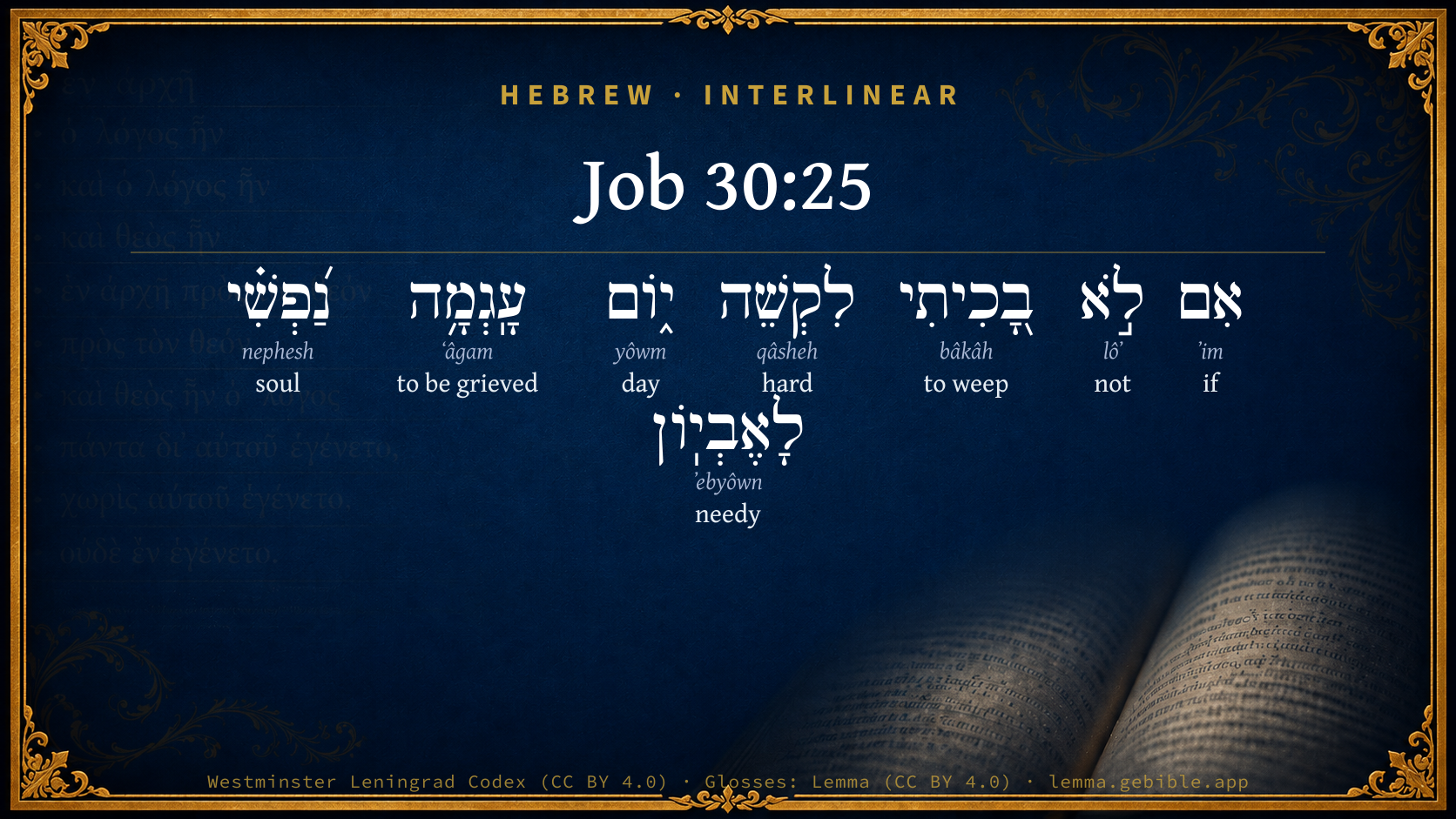
Job 30:25

Hebrew (Westminster Leningrad Codex) Job 30:25 appears in the Hebrew Old Testament. The text above is from the Westminster Leningrad Codex. Each word links to its Strong’s number, a concise gloss, and parsing drawn from the Open Scriptures Hebrew Bible morphology. Click any word for its full Brown-Driver-Briggs (BDB) entry.
Download image
Cite this verse

Job 30:25 (World English Bible). Public Domain. Lemma interlinear Bible study tool, https://lemma.gebible.app/v/job/30/25.

Show BibTeX & RIS
BibTeX
RIS
English Translation
Didn't I weep for him who was in trouble? Wasn't my soul grieved for the needy?
World English Bible · Public Domain
Highlights
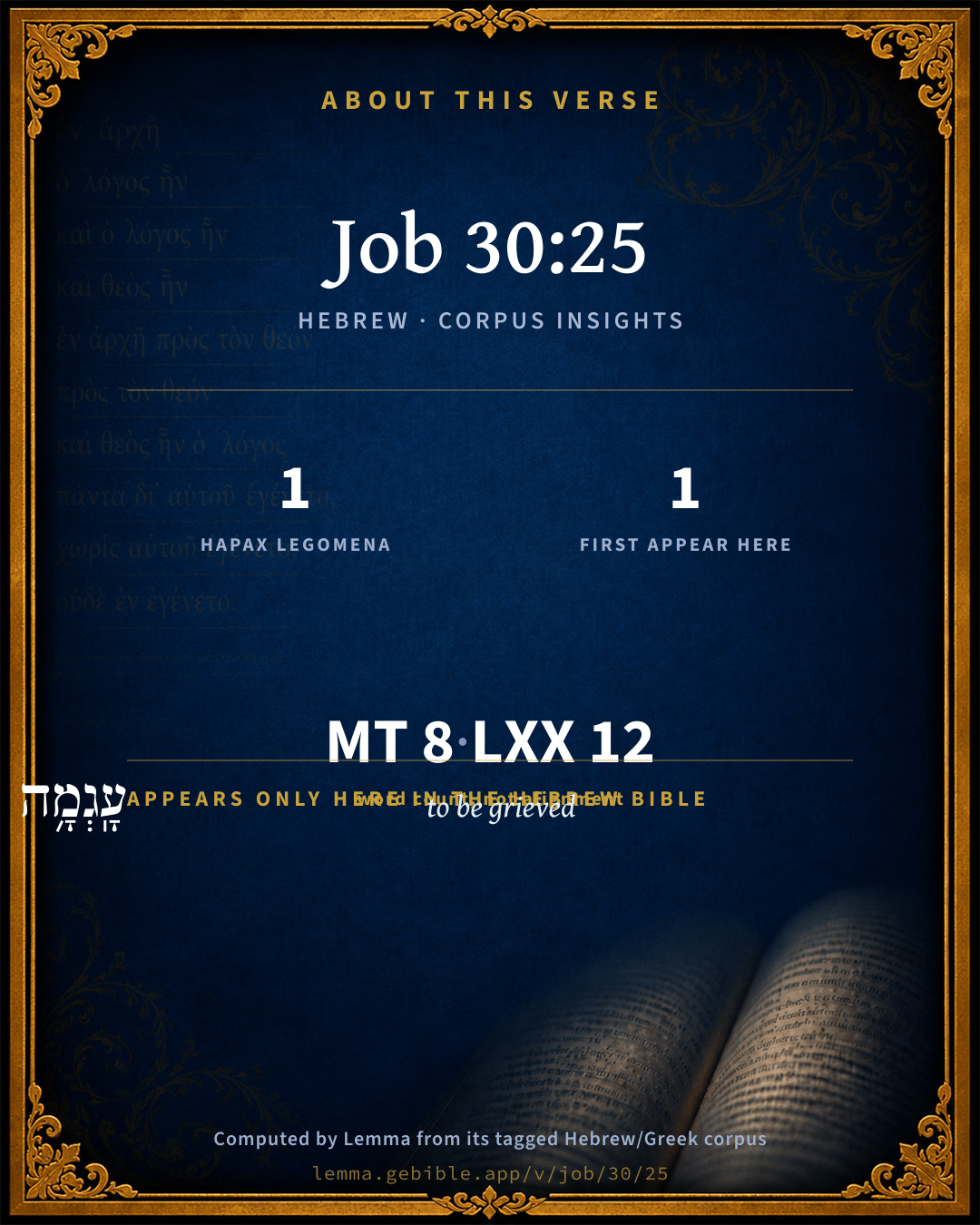
  • 1 hapax legomenon — only here in the Hebrew Bible
  • 1 first appearance in the Hebrew Bible
Full analysis ↓
Download a study sheet

One document with this verse’s original text, its word-by-word gloss line, the meaning frame, cross-references with their text, attributed commentary, and full source and license credits — printable, and it pastes into notes with its structure intact.

This verse Autodidact and up

Study sheet (.html) Plain text (.txt)

A passage Seminary Student

Up to 50 verses in one chapter. A passage sheet keeps up to 6 commentary sources and 12 cross-references per verse, in the order this page ranks them, and says so on the sheet whenever that leaves anything out. Ask for a single verse and you get the Autodidact verse sheet above.

Everything on this page stays free to read, with no account — the sheet is a download of what is already on screen, not access to it.

Want to remove ads? Support Godless Engineer
Compare translations 3

The same verse in 3 English versions, stacked beneath the original-language interlinear above. Click any original word for its lexicon entry.

Each is an independent rendering of the whole verse — the interlinear is not word-aligned to these translations.

Highlighted words mark where these versions differ — a whole-verse word diff, not a word-by-word alignment.

  • World English Bible Public Domain
    Didn't I weep for him who was in trouble? Wasn't my soul grieved for the needy?
  • King James Version Public Domain
    Did not I weep for him that was in trouble? was not my soul grieved for the poor?
  • unfoldingWord Literal Text CC BY-SA 4.0
    If I did not weep for the difficult of day? My soul grieved for the needy.

unfoldingWord Literal Text — © unfoldingWord, licensed CC BY-SA 4.0. Word-aligned USFM3 via Door43 (git.door43.org/unfoldingWord/en_ult).

Versions to compare (up to 4)

3 of 4 selected

Show all 18 translations

Every available English version of this verse, each an independent rendering of the whole verse.

  • World English Bible Public Domain
    Didn't I weep for him who was in trouble? Wasn't my soul grieved for the needy?
  • Berean Standard Bible Public Domain
    Have I not wept for those in trouble? Has my soul not grieved for the needy?
  • Majority Standard Bible Public Domain
    Have I not wept for those in trouble? Has my soul not grieved for the needy?
  • King James Version Public Domain
    Did not I weep for him that was in trouble? was not my soul grieved for the poor?
  • American Standard Version (1901) Public Domain
    Did not I weep for him that was in trouble? Was not my soul grieved for the needy?
  • Revised Version (1885) Public Domain
    Did not I weep for him that was in trouble? was not my soul grieved for the needy?
  • Geneva Bible (1599) Public Domain
    Did not I weepe with him that was in trouble? was not my soule in heauinesse for the poore?
  • Douay-Rheims (1899) Public Domain
    I wept heretofore for him that was afflicted, and my soul had compassion on the poor.
  • Young's Literal Translation Public Domain
    Did not I weep for him whose day is hard? Grieved hath my soul for the needy.
  • Literal Standard Version CC BY-SA 4.0
    Did I not weep for him whose day is hard? My soul has grieved for the needy.
  • Unlocked Literal Bible CC BY-SA 4.0
    Did not I weep for him who was in trouble? Did I not grieve for the needy man?
  • unfoldingWord Literal Text CC BY-SA 4.0
    If I did not weep for the difficult of day? My soul grieved for the needy.
  • Darby Bible Public Domain
    Did not I weep for him whose days were hard? was not my soul grieved for the needy?
  • World Messianic Bible Public Domain
    Didn’t I weep for him who was in trouble? Wasn’t my soul grieved for the needy?
  • Webster's Bible Public Domain
    Did not I weep for him that was in trouble? was not my soul grieved for the poor?
  • Free Bible Version CC BY-SA 4.0
    Didn't I weep for those having hard times? Didn't I grieve at what the poor suffered?
  • Bible in Basic English Public Domain
    Have I not been weeping for the crushed? and was not my soul sad for him who was in need?
  • JPS Tanakh (1917) Public Domain
    If I have not wept for him that was in trouble, and if my soul grieved not for the needy.

Literal Standard Version (2020), Covenant Press — licensed CC BY-SA 4.0. Text via the HelloAO Bible API (eBible.org). Unlocked Literal Bible (unfoldingWord) — licensed CC BY-SA 4.0. Text via the HelloAO Bible API (eBible.org). unfoldingWord Literal Text — © unfoldingWord, licensed CC BY-SA 4.0. Word-aligned USFM3 via Door43 (git.door43.org/unfoldingWord/en_ult). Free Bible Version, Dr. Jonathan Gallagher — licensed CC BY-SA 4.0. Text via the HelloAO Bible API (eBible.org).

Word by word

More ways to search: Search by grammar → Find every occurrence → Compare this word →

Practice this passage: Drill this verse → Learn its vocabulary →

About this verse

These counts appear in no published source. They are computed here, from the morphology-tagged text and Lemma’s own curated glosses. What Lemma adds →

8
words
8
distinct lemmas
Wisdom
section

Notable vocabulary

1 hapax legomenon — a word that appears only here in the entire Hebrew Bible:

  • עָֽגְמָ֥ה to be grieved H5701

First appearance in Scripture

This word makes its first canonical appearance in the Hebrew Bible here:

  • עָֽגְמָ֥ה to be grieved H5701

Shared distinctive vocabulary

לִקְשֵׁה hard H7186 occurs in 36 verses of the Hebrew Bible. Also found in:

Grammatical profile

  • 2 verbs
  • 2 nouns
  • 2 adjectives
  • 1 conjunction
  • 1 particle

Verb forms

  • בָ֭כִיתִי Qal · Perfect
  • עָֽגְמָ֥ה Qal · Perfect

Hebrew & Septuagint length

In English translation the verse runs 16 words from the Hebrew and 16 from the Septuagint (LXX English) — the same length.

A rough comparison of the two English renderings, which tokenize alike — not a word-level alignment.

Word counts can differ between the Hebrew and the Greek without any difference in meaning — e.g. the Hebrew direct-object marker אֵת has no separate Greek word, and Greek often adds the article ὁ.

In the original languages it is 8 Hebrew tokens and 12 Greek tokens — but the two are counted differently (Hebrew bundles its prefixes and suffixes into one token; the Greek is in lemma form), so that isn’t a like-for-like length.

Cross-references

17

Topical passages linked to Job 30:25 in the Treasury of Scripture Knowledge — connected by theme and wording, ordered by reader-vote popularity; previews shown in the World English Bible.

  • Romans 12:15 Rejoice with those who rejoice. Weep with those who weep.
  • Psalms 35:13–14 But as for me, when they were sick, my clothing was sackcloth. I afflicted my soul with fasting. My prayer returned into my own bosom.
  • Jeremiah 13:17 But if you will not hear it, my soul shall weep in secret for [your] pride; and my eye shall weep sore, and run down with tears, because Yahweh's flock is taken captive.
  • Job 24:4 They turn the needy out of the way. The poor of the earth all hide themselves.
  • Job 31:16–21 "If I have withheld the poor from their desire, Or have caused the eyes of the widow to fail,
  • Psalms 12:1 Help, Yahweh; for the godly man ceases. For the faithful fail from among the children of men.
  • Proverbs 14:21 He who despises his neighbor sins, But blessed is he who has pity on the poor.
  • Proverbs 14:31 He who oppresses the poor shows contempt for his Maker, But he who is kind to the needy honors him.
  • Proverbs 17:5 Whoever mocks the poor reproaches his Maker. He who is glad at calamity shall not be unpunished.
  • Proverbs 19:17 He who has pity on the poor lends to Yahweh; He will reward him.
  • Proverbs 28:8 He who increases his wealth by excessive interest Gathers it for one who has pity on the poor.
  • Isaiah 58:7–8 Isn't it to deal your bread to the hungry, and that you bring the poor who are cast out to your house? when you see the naked, that you cover him; and that you not hide yourself from your own flesh?
  • Jeremiah 18:20 Shall evil be recompensed for good? for they have dug a pit for my soul. Remember how I stood before you to speak good for them, to turn away your wrath from them.
  • Daniel 4:27 Therefore, O king, let my counsel be acceptable to you, and break off your sins by righteousness, and your iniquities by showing mercy to the poor; if there may be a lengthening of your tranquillity.
  • Luke 19:41 When he drew near, he saw the city and wept over it,
  • John 11:35 Jesus wept.
  • 2 Corinthians 9:9 As it is written, "He has scattered abroad, he has given to the poor. His righteousness remains forever."

Cross-references courtesy of OpenBible.info (CC BY 4.0).

Hebrew and Greek witnesses Masoretic Hebrew ↔ Greek Septuagint

The same verse in the two great witnesses to the Old Testament, shown verse-for-verse.

These are two independent witnesses, not word-aligned to each other, and the Septuagint is shown in lemma (dictionary) form.

Hebrew Job 30:25 Masoretic · Westminster Leningrad Codex

אִם לֹ֣א בָ֭כִיתִי לִקְשֵׁה י֑וֹם עָֽגְמָ֥ה נַ֝פְשִׁ֗י לָאֶבְיֽוֹן

Didn't I weep for him who was in trouble? Wasn't my soul grieved for the needy?

World English Bible · Public Domain

Greek LXX Job 30:25 Septuagint · lemma form

ἐγώ δέ ἐπί πᾶς ἀδύνατος κλαίω στενάζω δέ ὁράω ἀνήρ ἐν ἀνάγκη

Yet I wept over every helpless man; I groaned when I saw a man in distress.

LXX2012 (modern English Septuagint) · Public Domain

Hebrew: Westminster Leningrad Codex (CC BY 4.0). Greek: Septuagint (public domain); English from LXX2012 (modern English Septuagint) (Public Domain). How the Septuagint differs from the Hebrew →

Commentary

Notes on Job 30:25 from classic Christian and Jewish commentators (each source and its license shown beneath its notes). The classic Christian expositions comment on the surrounding passage and are grouped to its opening verse, so a note may address several verses; the Jewish commentaries on the Tanakh (Rashi and others) are per-verse, so they appear only where the commentator wrote on this verse.

Lemma curates 59 commentaries, every one of them public domain or Creative Commons licensed, each selected and text-cleaned for this edition rather than reprinted as found. About our sources →

Trapp's Complete Commentary

John Trapp

Job 30:25 Did not I weep for him that was in trouble? was [not] my soul grieved for the poor?

Ver. 25. Did I not weep for him that was in trouble?] Rursum, per pathos, excandescit (Mercer). Here Job wondereth and is much moved again at his unpitied condition, since he was so full of pity for the afflicted. He could safely say with Cyprian, Cum singulis pectus meum copulo, maeroris et funeris pondera luctuosa participo, cum plangentibus plango, cum deflentibus defico. He had tears ready for the afflicted, and wept with those that weep; not for a compliment, as the Brazilians, who

Ut flerent, oculos erudiere suos (Ovid),

nor out of tender heartedness, as Gordian the emperor, who would weep for the beating of a boy at school; but out of hearty compassion and commiseration, as good Nehemiah, Neh 2:2, and those Christian Hebrews, Heb 10:33-34. Now forasmuch as the merciful have the promises of mercy made unto them, Mat 5:7 Jas 2:13, and all men say, Ab alio expectes alteri quod feceris, Job marvelleth at others’ hard heartedness toward him, and expostulateth the unkindness.

Was not my soul grieved for the poor?] Into whose case good Job put himself, and so became mendicorum maximus, as Salvian saith of Christ, because he shareth with his saints in all their necessities; he drew out not only his sheaf, but his soul to the hungry, Isa 58:7; Isa 58:10, and satisfied the afflicted soul; this was right. Contrisrata est anima mea super egenum. Some render it, Restagnavit lachrymis anima mea, My soul stood with tears, like a standing pool. Others, ustulatur, πυρουται, My soul burneth: which is agreeable to that of the apostle, 2Co 11:29, "Who is weak, and I am not weak? Who is offended, and I burn not?"

John Trapp, A Commentary or Exposition upon All the Books of the Old and New Testament (1647–1656) — public domain. Text from a community e-Sword module.

The Biblical Illustrator

Joseph S. Exell

Job_30:25

Did I not weep for him that was in trouble.

Tears for the oppressed

By noticing the care with which Job throws back the insinuation of Eliphaz, how much he valued the character of charity, and how he esteemed it his bounden duty to contribute to the wants and necessities of others. Our text is a pathetic appeal, displaying the truly compassionate character of the patriarch. What are the tears which we may imagine fell from the eyes of Job, and which do fall from the eyes of every compassionate man that witnesses suffering and sorrow? They were tears of grief, of sincerity, of self-condemnation. But the compassionate man, like Job, may pour forth tears of indignation. For whom did compassionate Job thus weep? Lit. for him in a hard day. He that was suffering from privation. I now have to plead for such, for men who are suffering from over-toil and over-exertion. Special reference may be made to the late-hour system. (J. MConnell Hussey, B. A.)

Christian sympathy

In endeavouring to justify the ways of God, Jobs three friends came to the harsh conclusion that he would not have been so severely afflicted if he had not been a very great sinner. Among other accusations against the afflicted patriarch, Eliphaz the Temanite had the cruelty to lay this at his door, Thou hast not given water to the weary to drink, and thou hast withholden bread from the hungry. Richly did the three miserable comforters deserve the burning rebuke of their slandered friend, Ye are forgers of lies, ye are physicians of no value. O that ye would altogether hold your peace and it shall be your wisdom.

I. Human sympathy, its commendations.

1. We may say of it, first, that even nature dictateth that man should feel a sympathy for his kind. Humanity, had it remained in its unfallen estate, would have been one delightful household of brothers and sisters. Alas! for us, when Adam fell he not only violated his Makers laws, but in the fall he broke the unity of the race, and now we are isolated particles of manhood, instead of being what we should have been, members of one body, moved by one and the same spirit. Called with a nobler calling, let us exhibit as the result of our regenerate nature a loftier compassion for the suffering sons of men.

2. Further, we may remark that the absence of sympathy has always been esteemed, in all countries, and in all ages, one of the most abominable of vices. In old classic history who are the men held up to everlasting execration? Are they not those who had no mercy on the poor?

3. Sympathy is especially a Christians duty.

4. Remember the blessed example of our Lord and Saviour Jesus Christ. For ye know the grace of our Lord Jesus Christ, that, though He was rich, yet for our sakes He became poor, that we through His poverty might be rich.

5. Sympathy is essential to our usefulness.

6. Here I must supplement that thought with another; sympathy may often be the direct means of conversion.

7. And I shall say here, that this sympathy is sure to be a great blessing to yourselves. If you want joy--joy that you may think upon at nights, and live upon day after day, next to the joy of the Lord, which is our strength, is the joy of doing good. The selfish man thinks that he has the most enjoyment in laying out his wealth upon himself. Poor fool!

II. The hindrances to Christian sympathy.

1. One of the great impediments to Christian sympathy is our own intense selfishness. We are all selfish by nature, and it is a work of grace to break this thoroughly down, until we live to Christ, and not to self any longer. How often is the rich man tempted to think that his riches are his own.

2. Another hindrance lies in the customs of our country. We still have amongst us too much of caste and custom. The exclusiveness of rank is not readily overcome.

3. Much want of sympathy is produced by our ignorance of one another. We do not know the sufferings of our fellows.

4. No doubt the abounding deception which exists among those who seek our help has checked much liberality.

III. The fruits of Christian sympathy.

1. The fruit of Christian sympathy will be seen in a kindly association with all Christians: we shall not shun them nor pass them by.

2. It will be seen next, in a kindly encouragement of those who want aid, constantly being ready to give a word of good advice, and good cheer to the heart which is ready to faint.

3. Show it, also, whenever you hear the good name of any called into doubt. Stand up for your brethren. Tis an ill bird that fouls its own nest, but there are some such birds.

4. But still, there is no Christian sympathy in all this if it does not, when needed, prove itself by real gifts of our substance. Zealous words will not warm the cold; delicate words will not feed the hungry; the freest speech will not set free the captive, or visit him in prison. (C. H. Spurgeon.).

The Biblical Illustrator, edited by Joseph S. Exell (c. 1880s–1900s) — public domain. Text from a community e-Sword module.

Joseph Benson's Commentary

Job 30:25-26. Did not I weep for him that was in trouble — Have I now judgment without mercy, because I afforded no mercy or pity to others in misery? No; my conscience acquits me from this inhumanity: I did mourn over others in their misery. Was not my soul grieved for the poor? — The negative particle not, which is not in the Hebrew, seems to be here improperly supplied. The sense will be stronger and more emphatical to understand the second part of the verse as containing an answer to the first, and to render it, My soul was grieved for the poor; that is, I not only wept, but my very soul was grieved for them; yea, even for those who were so necessitous as to be incapable of requiting my kindness in case of their recovery from affliction. When I looked for good, then evil came — Yet trouble came upon myself when I expected it not.

Joseph Benson's Commentary on the Old and New Testaments (1811–1818) — public domain. Text from a community e-Sword module.

Jamieson, Fausset & Brown

Robert Jamieson, A. R. Fausset & David Brown

May I not be allowed to complain of my calamity, and beg relief, seeing that I myself sympathized with those "in trouble" (literally, "hard of day"; those who had a hard time of it).

Jamieson, Fausset & Brown — Commentary Critical and Explanatory on the Whole Bible (1871) — public domain (CC PDM 1.0). Text via the HelloAO Bible API.

Adam Clarke's Commentary

Verse 25. Did not I weep for him that was in trouble?] Mr. Good translates much nearer the sense of the original, לקשה יום liksheh yom. "Should I not then weep for the ruthless day?" May I not lament that my sufferings are only to terminate with my life? Or, Did I not mourn for those who suffered by times of calamity?

Was not my soul grieved for the poor? Did I not relieve the distressed according to my power; and did I not sympathize with the sufferer?

Adam Clarke's Commentary on the Bible (1810–1826) — public domain. Text from a community e-Sword/MySword module.

Ellicott's Commentary for English Readers

(25) Did not I weep for him?—Job declares that he has not withheld that sympathy with sorrow and suffering for which he himself has asked in vain.

A Bible Commentary for English Readers, edited by Charles John Ellicott (1878–1897) — public domain. Text from a community e-Sword module.

The Cambridge Bible for Schools and Colleges

gen. ed. J. J. S. Perowne

25. The compassion which Job seeks in his affliction it was his practice and nature to bestow.

The Cambridge Bible for Schools and Colleges (gen. ed. J. J. S. Perowne; Cambridge University Press, 1878–1918) — public domain. Text from a community e-Sword module.

John Gill's Exposition

Did not I weep for him that was in trouble?.... In outward trouble, whether personal in his own body, or in his family, or in his worldly affairs, or from wicked men, the men of the world; or in inward trouble, in soul trouble, on account of indwelling sin, the breakings forth of it, the lowness of grace, as to exercise, the hidings of God's face, and the temptations of Satan: or "for him that is hard of day" (l); with whom times are hard, the days are evil, with respect either to things temporal or spiritual; now Job had a sympathizing heart with such persons; he wept with them that wept; his bowels yearned towards them; he felt their sufferings and their sorrows, which is a Godlike frame of soul; for God, in all the afflictions of his people, is afflicted; a disposition of mind like that of the living Redeemer, who cannot but be touched with the feeling of the infirmities of saints, having been in all points tempted as they; and is a fruit of the Spirit of God, and very becoming the relation the saints stand in to one another, being members of the same body, and of each other; and therefore, when one member suffers, all the rest should sympathize with it, and, being brethren, should be loving, pitiful, and courteous to each other; and should consider that they also are in the body, and liable to the same distresses, whether outward or inward:

was not my soul grieved for the poor? in general, and especially for the Lord's poor, for such in all ages have been chosen and called by him; for these Job was grieved at heart, when he saw their distress through poverty; and he not only expressed his concern for them by tears and words, but by distributing liberally to their necessities, Job 31:17; and by which he showed his grief was real, hearty, and sincere, as here expressed; his soul was grieved, and he was sorry at his very heart for them: some render the words, "was not my soul like a pool of water?" (m) not only his head and his eyes, as Jeremiah's on another account, but his soul melted, and flowed like water with grief for them; and others, as Mr. Broughton, "did not my soul burn for the poor?" with sorrow for them, and an ardent desire to relieve them; see Co2 9:12; now this was the frame of Job's mind in the time of his prosperity, very different from that in Amo 6:4; and was certain and well known; he could appeal to all that knew him for the truth of it, it being what, none could deny that had any knowledge of him; yea, he could appeal to an omniscient God, he was now speaking to, for the truth of it; nay, it is delivered in the form of an oath, "if I did not weep", &c. (n), as in Job 31:16.

(l) "ob durum die", Montanus, Mercerus, Drusius; "cui dura crant tempora", Junius & Tremellius; "ei cui durus dies", Cocceius. (m) "restagnavit", some in Mercerus. (n) "si non deflevi", Tigurine version; "si non flevi", Piscator.

John Gill's Exposition of the Whole Bible (1746–1763) — public domain (CC PDM 1.0). Text via the HelloAO Bible API.

Albert Barnes' Notes on the Bible

Did not I weep ... - Job here appeals to his former life, and says that it had been a characteristic of his life to manifest compassion to the afflicted and the poor. His object in doing this is, evidently, to show how remarkable it was that he was so much afflicted. “Did I deserve,” the sense is, “such a hard lot? Has it been brought on me by my own fault, or as a punishment for a life where no compassion was shown to others?” So far from it, he says, that his whole life had been distinguished for tender compassion for those in distress and want.

In trouble - Margin, as in Hebrew, hard of day. So we say, “a man has a hard time of it,” or has a hard lot.

Albert Barnes' Notes on the Bible (1834–1885) — public domain. Text from a community e-Sword/MySword module.

Haydock's Catholic Bible Commentary

CHAPTER XXX.

George Leo Haydock (1774–1849), Haydock's Catholic Family Bible and Commentary, 1859 edition — public domain. Excludes Psalms (Douay-Rheims chapter numbering differs from Protestant) and Deuterocanonical books (Catholic canon only).

Matthew Poole's English Annotations

Whence is it that neither God nor man show any compassion to me, but both conspire to afflict me, and increase my torments? Doth God now mete out to me the same measure which I meted out to others? Have I now judgment without mercy, because I afforded no mercy nor pity to others in misery? No, my conscience acquits me from this inhumanity. I did not slightly resent, but bitterly mourn and weep over others in their miseries; and therefore I had reason to expect more compassion than I find.

Was not my soul grieved for the poor, even for him who was not capable of requiting my kindness in case of his recovery? which shows that my sympathy was real, and not reigned, as it is in some who pretend great sorrow for the rich in their troubles, hoping thereby to insinuate themselves into their favour and friendship, and thereby to procure some advantage to themselves.

Matthew Poole's English Annotations on the Holy Bible (1683–1685) — public domain. Text from a community e-Sword/MySword module.

Whedon's Commentary on the Bible

Daniel D. Whedon

25. Him that was in trouble — Literally, the hard of day. Job seems to intimate that the sympathizer with men has reason to expect divine sympathy. Psa_41:1-3. And yet the sympathy he has freely poured forth for others is withheld from him by God and man. Like Jeremiah and our Saviour. Job was pre-eminent in sympathy. The touching pathos of this appeal must commend itself to each heart.

Daniel D. Whedon (gen. ed.), Commentary on the Old and New Testaments (1874–1909) — public domain. Text from a community e-Sword module.

The Pulpit Commentary

Did not I weep for him that was in trouble? i.e. do I claim a sympathy which I do not deserve? When men wept and entreated me, did not I do my best to give them the aid which they requested? Did not I weep for them, and intercede with God for them? Was not my soul grieved for the poor? (comp. Job_29:12-17 Job_31:16-22)

The Pulpit Commentary (1880–1919), ed. H.D.M. Spence-Jones & Joseph S. Exell — public domain. Text from a community e-Sword module.

John Wesley's Explanatory Notes

Did not I - Have I now judgment without mercy, because I afforded no mercy to others in misery? No; my conscience acquits me from this inhumanity: I did mourn over others in their miseries.

John Wesley, Explanatory Notes Upon the Whole Bible (1754–1765) — public domain. Text via the GEBible commentary corpus.

Rashi

Rabbi Shlomo Yitzchaki (Rashi)

...whether I did not weep for one who had a difficult time [You] know and recognize whether I was not compassionate and [did not] weep for the poor, who had difficult times, and [whether] my soul [did not] grieve for the needy, that this befell me because of all these.

Rashi on the Tanakh — English translations: “The Judaica Press complete Tanach with Rashi, translated by A. J. Rosenberg” (CC BY 4.0); “Pentateuch with Rashi's commentary by M. Rosenbaum and A.M. Silbermann, 1929-1934” (public domain); “The Metsudah Tanach series, Lakewood, N.J” (CC BY 4.0); and “The Book of Joshua, Metsudah Publications, 1997” (CC BY 4.0). Text via Sefaria.

Lesson kit

Teaching starters — assembled from the data on this page, not authored interpretation. Every prompt links to the verse data it draws on. Edit before teaching.

Job, in the Wisdom, opens this verse with 8 words (8 distinct Hebrew lemmas). Its most distinctive word is ʻâgam (“to be grieved”). A historical commentator’s framing appears above. Read the whole chapter for the surrounding context.

Discussion questions

  1. What does “to be grieved” (ʻâgam) contribute to the verse as a whole?
  2. 1 word here appears nowhere else in the Hebrew Bible. Why might the author reach for such rare wording?
  3. This is the first place “to be grieved” appears in Scripture (first appears here). What does its debut here establish?
  4. How does Genesis 42:7, which shares the word «hard», read alongside this verse?
  5. These translations render this verse differently. What is at stake in choosing one wording over another?
  6. «בָ֭כִיתִי» is a Qal Perfect verb. How does that grammatical form shape the action described?
  7. Compare how Trapp's Complete Commentary and The Biblical Illustrator read this verse. Where do they agree or differ?

Things to notice

Reading settings

Reading text

Shown beneath each verse's original-language words.

Old Testament
Old Testament edition

Read the OT as the Masoretic Hebrew (MT) or the Greek Septuagint (LXX).

English shown for the Greek Septuagint (in the Hebrew ↔ Greek comparison).

Comparing translations? Open the Compare panel on any verse page to stack up to four side by side.