
Psalms 107:9

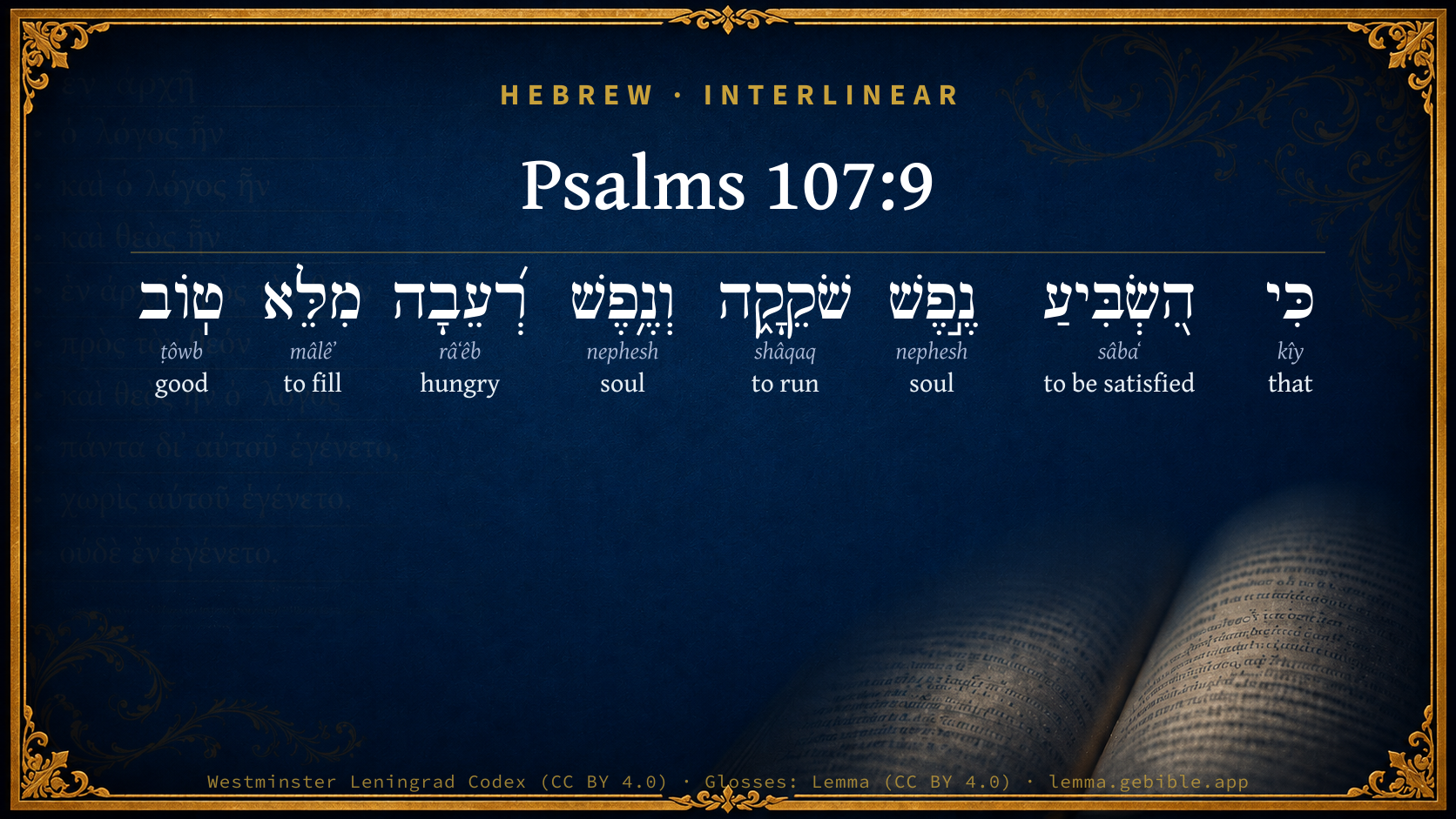
Hebrew (Westminster Leningrad Codex) Psalms 107:9 appears in the Hebrew Old Testament. The text above is from the Westminster Leningrad Codex. Each word links to its Strong’s number, a concise gloss, and parsing drawn from the Open Scriptures Hebrew Bible morphology. Click any word for its full Brown-Driver-Briggs (BDB) entry.
Download image
Cite this verse

Psalms 107:9 (World English Bible). Public Domain. Lemma interlinear Bible study tool, https://lemma.gebible.app/v/psalms/107/9.

Show BibTeX & RIS
BibTeX
RIS
English Translation
For he satisfies the longing soul. He fills the hungry soul with good.
World English Bible · Public Domain
Highlights
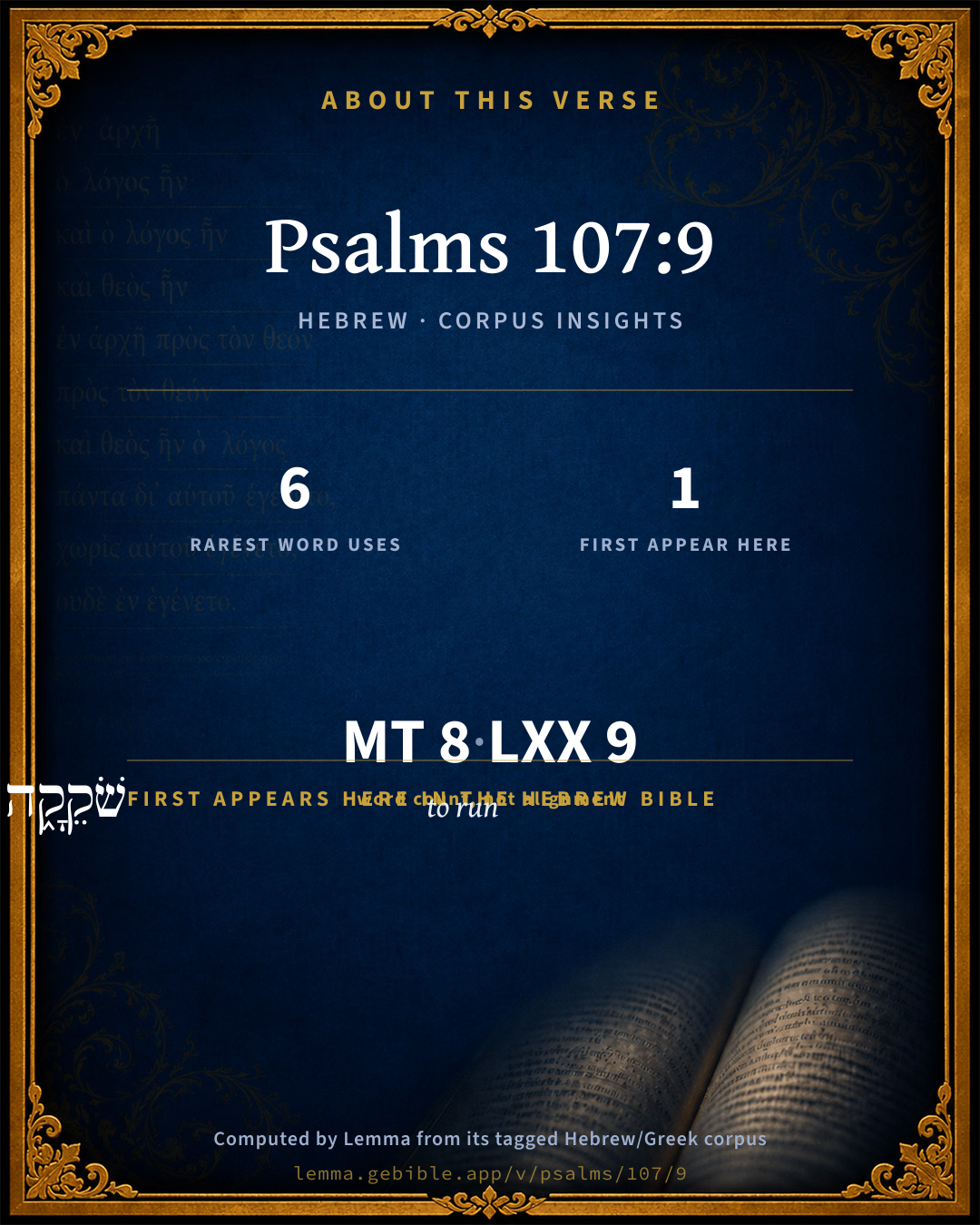
  • 1 first appearance in the Hebrew Bible
Full analysis ↓
Download a study sheet

One document with this verse’s original text, its word-by-word gloss line, the meaning frame, cross-references with their text, attributed commentary, and full source and license credits — printable, and it pastes into notes with its structure intact.

This verse Autodidact and up

Study sheet (.html) Plain text (.txt)

A passage Seminary Student

Up to 50 verses in one chapter. A passage sheet keeps up to 6 commentary sources and 12 cross-references per verse, in the order this page ranks them, and says so on the sheet whenever that leaves anything out. Ask for a single verse and you get the Autodidact verse sheet above.

Everything on this page stays free to read, with no account — the sheet is a download of what is already on screen, not access to it.

Want to remove ads? Support Godless Engineer
Compare translations 3

The same verse in 3 English versions, stacked beneath the original-language interlinear above. Click any original word for its lexicon entry.

Each is an independent rendering of the whole verse — the interlinear is not word-aligned to these translations.

Highlighted words mark where these versions differ — a whole-verse word diff, not a word-by-word alignment.

  • World English Bible Public Domain
    For he satisfies the longing soul. He fills the hungry soul with good.
  • King James Version Public Domain
    For he satisfieth the longing soul, and filleth the hungry soul with goodness.
  • unfoldingWord Literal Text CC BY-SA 4.0
    For he satisfies the thirsty soul, and the hungry soul he fills with good.

unfoldingWord Literal Text — © unfoldingWord, licensed CC BY-SA 4.0. Word-aligned USFM3 via Door43 (git.door43.org/unfoldingWord/en_ult).

Versions to compare (up to 4)

3 of 4 selected

Show all 18 translations

Every available English version of this verse, each an independent rendering of the whole verse.

  • World English Bible Public Domain
    For he satisfies the longing soul. He fills the hungry soul with good.
  • Berean Standard Bible Public Domain
    For He satisfies the thirsty and fills the hungry with good things.
  • Majority Standard Bible Public Domain
    For He satisfies the thirsty and fills the hungry with good things.
  • King James Version Public Domain
    For he satisfieth the longing soul, and filleth the hungry soul with goodness.
  • American Standard Version (1901) Public Domain
    For he satisfieth the longing soul, And the hungry soul he filleth with good.
  • Revised Version (1885) Public Domain
    For he satisfieth the longing soul, and the hungry soul he filleth with good.
  • Geneva Bible (1599) Public Domain
    For he satisfied the thirstie soule, and filled the hungrie soule with goodnesse.
  • Douay-Rheims (1899) Public Domain
    For he hath satisfied the empty soul, and hath filled the hungry soul with good things.
  • Young's Literal Translation Public Domain
    For He hath satisfied a longing soul, And a hungry soul hath filled `with' goodness.
  • Literal Standard Version CC BY-SA 4.0
    For He has satisfied a longing soul, || And has filled a hungry soul [with] goodness.
  • Unlocked Literal Bible CC BY-SA 4.0
    For he satisfies the longings of those who are thirsty, and the desires of those who are hungry he fills up with good things.
  • unfoldingWord Literal Text CC BY-SA 4.0
    For he satisfies the thirsty soul, and the hungry soul he fills with good.
  • Darby Bible Public Domain
    For he hath satisfied the longing soul and filled the hungry soul with good.
  • World Messianic Bible Public Domain
    For he satisfies the longing soul. He fills the hungry soul with good.
  • Webster's Bible Public Domain
    For he satisfieth the longing soul, and filleth the hungry soul with goodness.
  • Free Bible Version CC BY-SA 4.0
    For he gives drink to those who are thirsty, and food to those who are hungry.
  • Bible in Basic English Public Domain
    He gives its desire to the unresting soul, so that it is full of good things.
  • JPS Tanakh (1917) Public Domain
    For He hath satisfied the longing soul, and the hungry soul He hath filled with good.

Literal Standard Version (2020), Covenant Press — licensed CC BY-SA 4.0. Text via the HelloAO Bible API (eBible.org). Unlocked Literal Bible (unfoldingWord) — licensed CC BY-SA 4.0. Text via the HelloAO Bible API (eBible.org). unfoldingWord Literal Text — © unfoldingWord, licensed CC BY-SA 4.0. Word-aligned USFM3 via Door43 (git.door43.org/unfoldingWord/en_ult). Free Bible Version, Dr. Jonathan Gallagher — licensed CC BY-SA 4.0. Text via the HelloAO Bible API (eBible.org).

Word by word

More ways to search: Search by grammar → Find every occurrence → Compare this word →

Practice this passage: Drill this verse → Learn its vocabulary →

About this verse

These counts appear in no published source. They are computed here, from the morphology-tagged text and Lemma’s own curated glosses. What Lemma adds →

8
words
7
distinct lemmas
Wisdom
section

Notable vocabulary

The rarest word here is שֹׁקֵקָ֑ה to run H8264 — appearing just 6 times in the whole Hebrew Bible.

First appearance in Scripture

This word makes its first canonical appearance in the Hebrew Bible here:

  • שֹׁקֵקָ֑ה to run H8264

Shared distinctive vocabulary

שֹׁקֵקָ֑ה to run H8264 occurs in 6 verses of the Hebrew Bible. Also found in:

Grammatical profile

  • 3 verbs
  • 2 nouns
  • 2 adjectives
  • 1 conjunction

Verb forms

  • הִ֭שְׂבִּיעַ Hiphil · Perfect
  • שֹׁקֵקָ֑ה Qal · Participle Active
  • מִלֵּא Piel · Perfect

Repetition

A word recurs within this verse — often emphatic in Hebrew:

  • נֶ֣פֶשׁ soul H5315 ×2

Hebrew & Septuagint length

In English translation the verse runs 13 words from the Hebrew and 14 from the Septuagint (LXX English) — closely comparable.

A rough comparison of the two English renderings, which tokenize alike — not a word-level alignment.

Word counts can differ between the Hebrew and the Greek without any difference in meaning — e.g. the Hebrew direct-object marker אֵת has no separate Greek word, and Greek often adds the article ὁ.

In the original languages it is 8 Hebrew tokens and 9 Greek tokens — but the two are counted differently (Hebrew bundles its prefixes and suffixes into one token; the Greek is in lemma form), so that isn’t a like-for-like length.

Cross-references

10

Topical passages linked to Psalms 107:9 in the Treasury of Scripture Knowledge — connected by theme and wording, ordered by reader-vote popularity; previews shown in the World English Bible.

  • Matthew 5:6 Blessed are those who hunger and thirst after righteousness, For they shall be filled.
  • Jeremiah 31:25 For I have satiated the weary soul, and every sorrowful soul have I replenished.
  • Psalms 34:10 The young lions do lack, and suffer hunger, But those who seek Yahweh shall not lack any good thing.
  • Luke 1:53 He has filled the hungry with good things. He has sent the rich away empty.
  • Psalms 146:7 Who executes justice for the oppressed; Who gives food to the hungry. Yahweh frees the prisoners.
  • Psalms 22:26 The humble shall eat and be satisfied. They shall praise Yahweh who seek after him. Let your hearts live forever.
  • Isaiah 55:1–3 Ho, everyone who thirsts, come you to the waters, and he who has no money; come you, buy, and eat; yes, come, buy wine and milk without money and without price.
  • Revelation 7:16–17 They will never be hungry, neither thirsty any more; neither will the sun beat on them, nor any heat;
  • Psalms 132:15 I will abundantly bless her provision. I will satisfy her poor with bread.
  • Jeremiah 31:14 I will satiate the soul of the priests with fatness, and my people shall be satisfied with my goodness, says Yahweh.

Cross-references courtesy of OpenBible.info (CC BY 4.0).

Hebrew and Greek witnesses Masoretic Hebrew ↔ Greek Septuagint

The same verse in the two great witnesses to the Old Testament, shown verse-for-verse.

You’re reading Greek Psalm 106 (Hebrew Psalm 107). The Septuagint counts the superscription, so verse numbers can differ from the Hebrew — chapter-level alignment, not verse-by-verse. Numbering follows Rahlfs.

These are two independent witnesses, not word-aligned to each other, and the Septuagint is shown in lemma (dictionary) form.

Hebrew Psalms 107:9 Masoretic · Westminster Leningrad Codex

כִּי הִ֭שְׂבִּיעַ נֶ֣פֶשׁ שֹׁקֵקָ֑ה וְנֶ֥פֶשׁ רְ֝עֵבָה מִלֵּא טֽוֹב

For he satisfies the longing soul. He fills the hungry soul with good.

World English Bible · Public Domain

Greek LXX Greek Psalm 106:9 Septuagint · lemma form

ὅτι χορτάζω ψυχή κενός καί ψυχή πεινάω ἐνπίμπλημι ἀγαθός

For he satisfies the empty soul, and fills the hungry soul with good things,

LXX2012 (modern English Septuagint) · Public Domain

Hebrew: Westminster Leningrad Codex (CC BY 4.0). Greek: Septuagint (public domain); English from LXX2012 (modern English Septuagint) (Public Domain). How the Septuagint differs from the Hebrew →

Commentary

Notes on Psalms 107:9 from classic Christian and Jewish commentators (each source and its license shown beneath its notes). The classic Christian expositions comment on the surrounding passage and are grouped to its opening verse, so a note may address several verses; the Jewish commentaries on the Tanakh (Rashi and others) are per-verse, so they appear only where the commentator wrote on this verse.

Lemma curates 59 commentaries, every one of them public domain or Creative Commons licensed, each selected and text-cleaned for this edition rather than reprinted as found. About our sources →

Trapp's Complete Commentary

John Trapp

Psa 107:9 For he satisfieth the longing soul, and filleth the hungry soul with goodness.

Ver. 9. For he satisfieth the longing soul, &c.] This as a recapitulation of the first part, Psa 107:5-7, and setteth forth the reason why the redeemed should praise God out of the sweet experience they have had of his wonderful providence and goodness toward them.

And filleth the hungry soul with goodness] This flower the blessed Virgin picketh out of David’s garden (among many others out of other parts of Holy Scripture, wherein it appeareth she was singularly well versed), and puts it into her posy, Luk 1:53.

John Trapp, A Commentary or Exposition upon All the Books of the Old and New Testament (1647–1656) — public domain. Text from a community e-Sword module.

The Biblical Illustrator

Joseph S. Exell

Psa_107:9

For He satisfieth the longing soul, and filleth the hungry soul with goodness.

The longing soul satisfied

I. The source of true satisfaction is God.

1. The soul being made in His image has infinite yearnings which nothing finite can satisfy, and powers which can only find their due exercise in Divine worship and service.

2. The soul is fallen and therefore has need of restoration which nothing finite can accomplish.

II. The recipients of true satisfaction. Longing souls--men and women who realize their celestial origin. In time past, they may have turned to the world for satisfaction, they may have hewn them out cisterns, broken cisterns that can hold no water, but now they seek to slake their thirst from the fountain of living waters (Jer_2:13). They may in the past have been among the dissatisfied, saying, Who will show us any good? (Psa_4:6). Now they know that blessedness consists in having the light of the Divine countenance shining upon them.

III. The condition of true satisfaction. Obedience. The obedience which springs from filial trust and submission to the will of God. To those who hearkened to the Divine commandments the promise is (Isa_48:18). They shall be Gods people, and He shall be their God. God for them, and with them, and in them shall be a source of perfect and eternal satisfaction. (H. P. Wright, B. A.)

A longing soul satisfied

I. What is implied in a longing or hungry soul.

1. That it wants something which it has not got. Pardon, peace, purity, God.

2. That it wants something which it cannot provide for itself.

3. That the want of this something unsettles and makes it discontented.

II. What is the satisfaction which God gives to the longing or hungry soul. The gifts of God to the soul, of pardon, health, and life, are its coronation; its honour and glory; its satisfaction. Beyond this it cannot go on earth. This is being filled and satisfied with goodness. (Anon.)

The souls thirst and satisfaction

(with Psa_143:6):--Man has a threefold nature--physical, mental, and spiritual. The soul is the nobler part of man, and needs a nobler satisfaction than the body.

I. The souls thirst.

1. The soul comes from God, and its happiness is inseparably connected with obedience to the Divine will.

2. It is immortal.

3. It was made for God, in whom alone can it find true satisfaction.

4. It needs God, His smile, favour, and companionship.

5. How do men try to gratify this desire of the soul?

(1) Some force the body to do double work to make up for the lack of spiritual food. But the body resists excess. Man was made to be something nobler than a mere eating and drinking apparatus.

(2) Some with money--business. But the man who thought fifty pounds would give him complete satisfaction was unsatisfied with five hundred. Man should be better than a money-making machine, a slave to business.

(3) Some with worldly pleasure, drinking constantly at the wells of worldly bliss, which only increases their thirst. You may as well strive to catch the east wind as try to satisfy immortal hunger with sensual pleasures.

II. The souls satisfaction.

1. The world can stimulate and excite, but cannot give rest.

2. How may the soul be satisfied?

(1) In being at peace with God (Rom_5:11).

(2) In mutual sympathy, reciprocal affection.

(3) In regeneration, sanctification, moral likeness to God.

(4) In doing Gods will. To do the will of Jesus: this is rest.

(5) In constant communion with God. Through Christ we have access by the Spirit unto the Father. (C. Cross.)

The Biblical Illustrator, edited by Joseph S. Exell (c. 1880s–1900s) — public domain. Text from a community e-Sword module.

J. A. Alexander on Psalms

Joseph Addison Alexander

9. (Psa 107:9) For he has satisfied the craving soul, and the hungry soul has filled with good. This is merely the conclusion of the first scene or picture, with a change of figure but a very slight one, as the want of food is one of the most painful and familiar hardships of a journey through a desert, and as such would necessarily occur to every Israelite who knew the story of the error in the wilderness. The first verb has the same sense as in Psa 104:18; the last noun the same sense as in Psa 103:4; Psa 104:28. The unusual word translated craving is borrowed from Isa 29:8.

Joseph Addison Alexander, The Psalms Translated and Explained (1850) — public domain. Text from a community e-Sword module.

Adam Clarke's Commentary

Verse 9. For he satisfieth the longing soul] This is the reason which the psalmist gives for the duty of thankfulness which he prescribes. The longing soul, נפש שוקקה nephesh shokekah, the soul that pushes forward in eager desire after salvation.

Adam Clarke's Commentary on the Bible (1810–1826) — public domain. Text from a community e-Sword/MySword module.

Ellicott's Commentary for English Readers

(9) Longing soul.—Or, thirsty, as in Isa_29:8. (Comp. Psa_107:5.) The word originally applies to an animal running up and down in search of food or water. (See Joe_2:9; Pro_28:15.)

A Bible Commentary for English Readers, edited by Charles John Ellicott (1878–1897) — public domain. Text from a community e-Sword module.

The Cambridge Bible for Schools and Colleges

gen. ed. J. J. S. Perowne

9. Because he satisfied the longing soul,

And the hungry soul he filled with good.

The words refer to the particular case of those who were perishing with hunger and thirst, and do not, primarily at any rate, express a general truth, as the A.V. suggests. The language is derived from Jer_31:25; Isa_29:8 (A.V. ‘his soul hath appetite’); Psa_58:10-11; and Luk_1:53 is a reminiscence of this verse.

The Cambridge Bible for Schools and Colleges (gen. ed. J. J. S. Perowne; Cambridge University Press, 1878–1918) — public domain. Text from a community e-Sword module.

John Gill's Exposition

Such as sit in darkness, and in the shadow of death,.... This is the second instance of persons in distress calling on the name of the Lord; and who, being delivered, are under obligation to praise him, such as are captives and prisoners. The Targum applies it to the Israelites in the Babylonish captivity; but it is much better to interpret it of prisoners in common; whose prisons are generally dark cells or dungeons, and where they are alone, and deprived of the company of the living; and so are not only in darkness, but seem as if they were in the state of the dead; their condition is the shadow of it, and bears some resemblance to it. And it may be applied, in a spiritual sense, to the case and condition of the people of God in a state of unregeneracy, which is described in the same language, Isa 9:2, and which is a state of darkness and ignorance; they are darkness itself, and are ignorant of themselves and their case; of the nature of sin, and the evil of it; of the spirituality of the law; of God in Christ; of Christ, and the way of salvation by him; of the Spirit, and his work; of the Scriptures, and the doctrines of the Gospel contained in them; and, like persons in a dark prison, cannot behold the sun, nor see to read nor work; and are like those that are in the state of the dead; and indeed are dead in Adam, dead in law, dead in trespasses and sins; having no spiritual life, sense, nor motion. And here they sit, continue and remain, during the time of their ignorance, till it pleases the Lord to enlighten, quicken, and convert them. These phrases are used of the people of God after conversion, when in darkness and desertion, and under afflictive providences, Psa 23:4. Being bound in affliction and iron; that is, with fetters of iron, which is very afflicting; see Psa 105:18, and fitly describes the people of God in a state of nature, who are led captive by Satan, at his will; are held with the cords and fetters of their own sins, and are shut up under the law, as a ministering of condemnation and death: or, bound with affliction, as with iron; hence we read of fetters and cords of affliction, Job 36:8, with which good men may be held for their iniquities; or, however, are chastened with them for their good, Some refer all this to the state of the Christian church under the ten persecutions, Rev 2:10.

.

Psalms 107:11

psa 107:11

psa 107:11

psa 107:11Because they rebelled against the words of God,.... All afflictions, as captivity and imprisonment, are generally for sin; which is a rebellion against God, and a transgression of his laws. Adam rebelled against the words of God, not giving credit to them, but believing the words of the devil; and so brought himself and all his posterity into that state of darkness, captivity, and death, before described. Some understand this only of the light of nature, and the dictates of it, against which men rebel; but rather it designs any and every revelation of the will of God, either in the law or in the Gospel; disobedience to which is rebellion against the words of God, and is highly resented by him.

And contemned the counsel of the most High; the advice he gives in his law, and by his prophets, what to do, and what to avoid: and which he gives by the ministers of the word, in his Gospel and in his ordinances; which are both called his counsel, Luk 7:30, the contempt of which is very displeasing to him, Pro 1:25.

John Gill's Exposition of the Whole Bible (1746–1763) — public domain (CC PDM 1.0). Text via the HelloAO Bible API.

Albert Barnes' Notes on the Bible

For he satisfieth the longing soul - This does not mean - what is indeed true in itself - that God has made provision for the “soul” of man, and satisfies it when it longs or pants for its needed supply, but the reference is to the creatures of God - the living things that he has made; and the idea is, that he has made provision for their needs. He gives them food and drink, so that their needs are met. The “particular” reference here, however, in the word rendered “longing” is to “thirst,” as contradistinguished from the other member of the verse, where the reference is to “hunger.” So the word is used in Isa 29:8.

And filleth the hungry soul with goodness - Supplies the needs of the hungry with “good;” that is, with that which is “good” for it; which meets its needs, and imparts strength and happiness.

Albert Barnes' Notes on the Bible (1834–1885) — public domain. Text from a community e-Sword/MySword module.

Matthew Poole's English Annotations

The longing; either the thirsty, opposed to the hungry here following; or the hungry, as this general phrase is limited and expounded in the next clause.

With goodness; with the fruits of his goodness; with good things, Psa 103:5; with food and gladness, Act 14:17; with that good which they wanted and desired.

Matthew Poole's English Annotations on the Holy Bible (1683–1685) — public domain. Text from a community e-Sword/MySword module.

The Treasury of David

Charles H. Spurgeon

Ver. 9. For he satisfieth the longing soul. This is the summary of the lost traveller's experience. He who in a natural sense has been rescued from perishing in a howling wilderness ought to bless the Lord who brings hint again to eat bread among men. The spiritual sense is, however, the more rich in instruction. The Lord sets us longing and then completely satisfies us. That longing leads us into solitude, separation, thirst, faintness and self despair, and all these conduct us to prayer, faith, divine guidance, satisfying of the soul's thirst, and rest: the good hand of the Lord is to be seen in the whole process and in the divine result.

And filleth the hungry soul with goodness. As for thirst he gives satisfaction, so for hunger he supplies filling. In both cases the need is more than met, there is an abundance in the supply which is well worthy of notice: the Lord does nothing in a niggardly fashion; satisfying and filling are his peculiar modes of treating his guests; none who come under the Lord's providing ever complain of short commons. Nor does he fill the hungry with common fare, but with goodness itself. It is not so much good, as the essence of goodness which he bestows on needy suppliants. Shall man be thus royally supplied and return no praise for the largeness of love? It must not be so. We will even now give thanks with all the redeemed church, and pray for the time when the whole earth shall be filled with his glory.

Ver. 9. For he satisfieth the longing soul. This is the reason which the psalmist gives for the duty of thankfulness which he prescribes. "The longing soul", hqqs vpn, nephesh shokekah, the soul that pushes forward in eager desire after salvation. Adam Clarke.

Ver. 9. A great general fact. The condition, the benefactor, the blessing "goodness", the result"satisfieth." Then the further result of praise as seen in Ps 107:8.

Psalms 107:10*

Charles H. Spurgeon's The Treasury of David (1869–1885) — public domain. Psalms only. Text from a community e-Sword/MySword module.

The Pulpit Commentary

For he satisfieth the longing soul, and filleth the hungry soul with goodness. The "satisfaction" intended seems to be spiritual rather than material. (comp. Psa_34:10 Luk_1:53) God alone can satisfy the cravings of man"s spiritual nature.

The Pulpit Commentary (1880–1919), ed. H.D.M. Spence-Jones & Joseph S. Exell — public domain. Text from a community e-Sword module.

Lesson kit

Teaching starters — assembled from the data on this page, not authored interpretation. Every prompt links to the verse data it draws on. Edit before teaching.

Psalms, in the Wisdom, opens this verse with 8 words (7 distinct Hebrew lemmas). Its most distinctive word is shâqaq (“to run”). A historical commentator’s framing appears above. Read the whole chapter for the surrounding context.

Discussion questions

  1. How does “to run” (shâqaq) shape what this verse is saying?
  2. This is the first place “to run” appears in Scripture (first appears here). What does its debut here establish?
  3. How does Proverbs 28:15, which shares the word «to run», read alongside this verse?
  4. What does the repetition of “soul” (2× in this one verse) do in this verse?
  5. The translations on this page render this verse differently — a whole-verse word diff, not a word-by-word alignment. What might account for the different wordings?
  6. «הִ֭שְׂבִּיעַ» is a Hiphil Perfect verb. How does that grammatical form shape the action described?
  7. Compare how Trapp's Complete Commentary and The Biblical Illustrator read this verse. Where do they agree or differ?

Things to notice

Reading settings

Reading text

Shown beneath each verse's original-language words.

Old Testament
Old Testament edition

Read the OT as the Masoretic Hebrew (MT) or the Greek Septuagint (LXX).

English shown for the Greek Septuagint (in the Hebrew ↔ Greek comparison).

Comparing translations? Open the Compare panel on any verse page to stack up to four side by side.