

Proverbs 6:30

Hebrew (Westminster Leningrad Codex) Proverbs 6:30 appears in the Hebrew Old Testament. The text above is from the Westminster Leningrad Codex. Each word links to its Strong’s number, a concise gloss, and parsing drawn from the Open Scriptures Hebrew Bible morphology. Click any word for its full Brown-Driver-Briggs (BDB) entry.
Download image
Cite this verse

Proverbs 6:30 (World English Bible). Public Domain. Lemma interlinear Bible study tool, https://lemma.gebible.app/v/proverbs/6/30.

Show BibTeX & RIS
BibTeX
RIS
English Translation
Men don't despise a thief, If he steals to satisfy himself when he is hungry:
World English Bible · Public Domain
Download a study sheet

One document with this verse’s original text, its word-by-word gloss line, the meaning frame, cross-references with their text, attributed commentary, and full source and license credits — printable, and it pastes into notes with its structure intact.

This verse Autodidact and up

Study sheet (.html) Plain text (.txt)

A passage Seminary Student

Up to 50 verses in one chapter. A passage sheet keeps up to 6 commentary sources and 12 cross-references per verse, in the order this page ranks them, and says so on the sheet whenever that leaves anything out. Ask for a single verse and you get the Autodidact verse sheet above.

Everything on this page stays free to read, with no account — the sheet is a download of what is already on screen, not access to it.

Want to remove ads? Support Godless Engineer
Compare translations 3

The same verse in 3 English versions, stacked beneath the original-language interlinear above. Click any original word for its lexicon entry.

Each is an independent rendering of the whole verse — the interlinear is not word-aligned to these translations.

Highlighted words mark where these versions differ — a whole-verse word diff, not a word-by-word alignment.

  • World English Bible Public Domain
    Men don't despise a thief, If he steals to satisfy himself when he is hungry:
  • King James Version Public Domain
    Men do not despise a thief, if he steal to satisfy his soul when he is hungry;
  • unfoldingWord Literal Text CC BY-SA 4.0
    They do not despise the thief if he steals to satisfy his appetite when he is hungry;

unfoldingWord Literal Text — © unfoldingWord, licensed CC BY-SA 4.0. Word-aligned USFM3 via Door43 (git.door43.org/unfoldingWord/en_ult).

Versions to compare (up to 4)

3 of 4 selected

Show all 18 translations

Every available English version of this verse, each an independent rendering of the whole verse.

  • World English Bible Public Domain
    Men don't despise a thief, If he steals to satisfy himself when he is hungry:
  • Berean Standard Bible Public Domain
    Men do not despise the thief if he steals to satisfy his hunger.
  • Majority Standard Bible Public Domain
    Men do not despise the thief if he steals to satisfy his hunger.
  • King James Version Public Domain
    Men do not despise a thief, if he steal to satisfy his soul when he is hungry;
  • American Standard Version (1901) Public Domain
    Men do not despise a thief, if he steal To satisfy himself when he is hungry:
  • Revised Version (1885) Public Domain
    Men do not despise a thief, if he steal to satisfy his soul when he is hungry:
  • Geneva Bible (1599) Public Domain
    Men do not despise a thiefe, when he stealeth, to satisfie his soule, because he is hungrie.
  • Douay-Rheims (1899) Public Domain
    The fault is not so great when a man hath stolen: for he stealeth to fill his hungry soul:
  • Young's Literal Translation Public Domain
    They do not despise the thief, When he stealeth to fill his soul when he is hungry,
  • Literal Standard Version CC BY-SA 4.0
    They do not despise the thief, || When he steals to fill his soul when he is hungry,
  • Unlocked Literal Bible CC BY-SA 4.0
    People do not despise a thief if he steals to satisfy his need when he is hungry.
  • unfoldingWord Literal Text CC BY-SA 4.0
    They do not despise the thief if he steals to satisfy his appetite when he is hungry;
  • Darby Bible Public Domain
    They do not despise a thief, if he steal to satisfy his soul when he is hungry:
  • World Messianic Bible Public Domain
    Men don’t despise a thief if he steals to satisfy himself when he is hungry,
  • Webster's Bible Public Domain
    Men do not despise a thief, if he stealeth to satisfy his soul when he is hungry;
  • Free Bible Version CC BY-SA 4.0
    People don't condemn a thief if he steals to satisfy himself when he's hungry.
  • Bible in Basic English Public Domain
    Men do not have a low opinion of a thief who takes food when he is in need of it:
  • JPS Tanakh (1917) Public Domain
    Men do not despise a thief, if he steal to satisfy his soul when he is hungry;

Literal Standard Version (2020), Covenant Press — licensed CC BY-SA 4.0. Text via the HelloAO Bible API (eBible.org). Unlocked Literal Bible (unfoldingWord) — licensed CC BY-SA 4.0. Text via the HelloAO Bible API (eBible.org). unfoldingWord Literal Text — © unfoldingWord, licensed CC BY-SA 4.0. Word-aligned USFM3 via Door43 (git.door43.org/unfoldingWord/en_ult). Free Bible Version, Dr. Jonathan Gallagher — licensed CC BY-SA 4.0. Text via the HelloAO Bible API (eBible.org).

Word by word

More ways to search: Search by grammar → Find every occurrence → Compare this word →

Practice this passage: Drill this verse → Learn its vocabulary →

About this verse

These counts appear in no published source. They are computed here, from the morphology-tagged text and Lemma’s own curated glosses. What Lemma adds →

9
words
8
distinct lemmas
Wisdom
section

Notable vocabulary

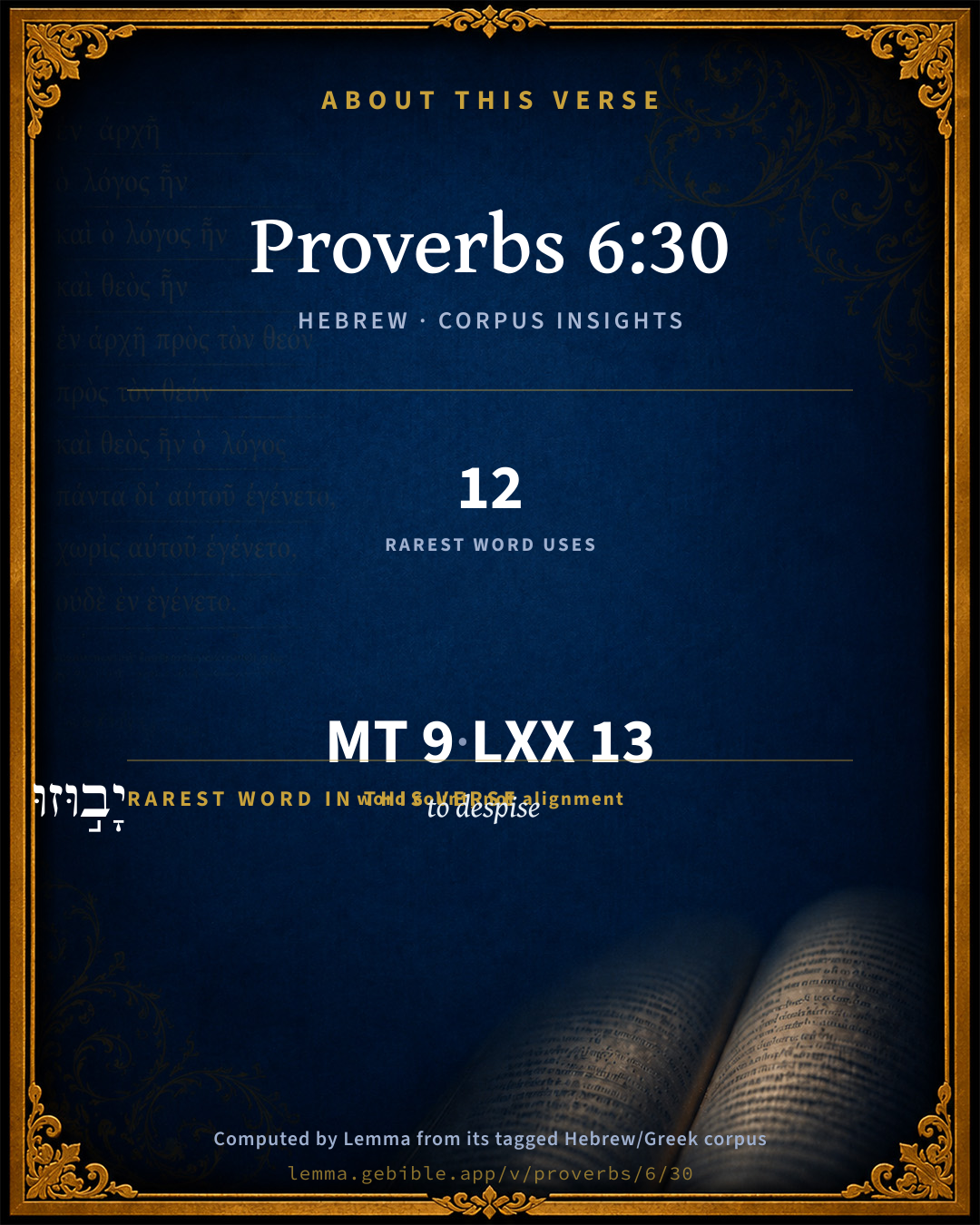
The rarest word here is יָב֣וּזוּ to despise H936 — appearing just 12 times in the whole Hebrew Bible.

Shared distinctive vocabulary

יָב֣וּזוּ to despise H936 occurs in 11 verses of the Hebrew Bible. Also found in:

Grammatical profile

  • 4 verbs
  • 2 nouns
  • 2 conjunctions
  • 1 particle

Verb forms

  • יָב֣וּזוּ Qal · Imperfect
  • יִגְנ֑וֹב Qal · Imperfect
  • לְמַלֵּ֥א Piel · Infinitive Construct
  • יִרְעָֽב Qal · Imperfect

Repetition

A word recurs within this verse — often emphatic in Hebrew:

  • כִּ֣י that H3588 ×2

Hebrew & Septuagint length

In English translation the verse runs 15 words from the Hebrew and 24 from the Septuagint (LXX English) — the Septuagint runs noticeably longer here. See the side-by-side →

A rough comparison of the two English renderings, which tokenize alike — not a word-level alignment.

Word counts can differ between the Hebrew and the Greek without any difference in meaning — e.g. the Hebrew direct-object marker אֵת has no separate Greek word, and Greek often adds the article ὁ.

In the original languages it is 9 Hebrew tokens and 13 Greek tokens — but the two are counted differently (Hebrew bundles its prefixes and suffixes into one token; the Greek is in lemma form), so that isn’t a like-for-like length.

Hebrew and Greek witnesses Masoretic Hebrew ↔ Greek Septuagint

The same verse in the two great witnesses to the Old Testament, shown verse-for-verse.

Here the Septuagint runs noticeably longer than the Hebrew — LXX2012 (modern English Septuagint) 24 words vs World English Bible 15. A rough length comparison of the two English translations, not a word-level alignment — read both below.

These are two independent witnesses, not word-aligned to each other, and the Septuagint is shown in lemma (dictionary) form.

Hebrew Proverbs 6:30 Masoretic · Westminster Leningrad Codex

לֹא יָב֣וּזוּ לַ֭גַּנָּב כִּ֣י יִגְנ֑וֹב לְמַלֵּ֥א נַ֝פְשׁ֗וֹ כִּ֣י יִרְעָֽב

Men don't despise a thief, If he steals to satisfy himself when he is hungry:

World English Bible · Public Domain

Greek LXX Proverbs 6:30 Septuagint · lemma form

οὐ θαυμαστός ἐάν ἁλίσκω τις κλέπτω κλέπτω γάρ ἵνα ἐνπίμπλημι ὁ ψυχή πείνη

It is not to be wondered at if one should be taken stealing, for he steals that when hungry he may satisfy his soul:

LXX2012 (modern English Septuagint) · Public Domain

On this verse, The Pulpit Commentary discusses the Septuagint’s reading. Read the note in Commentary ↓

Hebrew: Westminster Leningrad Codex (CC BY 4.0). Greek: Septuagint (public domain); English from LXX2012 (modern English Septuagint) (Public Domain). How the Septuagint differs from the Hebrew →

Commentary

Notes on Proverbs 6:30 from classic Christian and Jewish commentators (each source and its license shown beneath its notes). The classic Christian expositions comment on the surrounding passage and are grouped to its opening verse, so a note may address several verses; the Jewish commentaries on the Tanakh (Rashi and others) are per-verse, so they appear only where the commentator wrote on this verse.

Lemma curates 59 commentaries, every one of them public domain or Creative Commons licensed, each selected and text-cleaned for this edition rather than reprinted as found. About our sources →

Trapp's Complete Commentary

John Trapp

Pro 6:30 [Men] do not despise a thief, if he steal to satisfy his soul when he is hungry;

Ver. 30. Men do not despise a thief.] We used to say, A liar is worse than a thief; {a} and Siracides saith the same of a constant liar. (chap. 20) But that an adulterer is worse than a thief, the Holy Ghost here assureth us; and his reasons are unanswerable. For, first, his necessity pleads for him: {b} he must either steal or starve; and this doth somewhat excuse him, a tanto, as they say, but not a tote; for as a man should rather die than lie, so he should rather perish than purloin or pilfer. But what excuse hath the adulterer? - non ventris inediam patitur, sed cordis indigentiam, He wants not meat, but wit; he preserveth not his body, but destroyeth his soul.

{a} Potior est fur quam qui assidue mentitur.

{b} πεινωντι κλεπτειν, εστ αναγκοιως εχειν. - Suidas.

John Trapp, A Commentary or Exposition upon All the Books of the Old and New Testament (1647–1656) — public domain. Text from a community e-Sword module.

The Biblical Illustrator

Joseph S. Exell

Pro_6:30

If he steal to satisfy his soul when he is hungry.

Theft through necessity

The deceitful and perverting influence of sin requires careful consideration. While as yet it is only a principle in the mind, and not ripened into an external action, it draws into its service the various powers of imagination, invention, and even reason itself. By these powers the forbidden object is represented as a source of peculiar enjoyment, or it is invested with features of external attraction, or it is exhibited as fitted to gratify curiosity at least, and to extend the sphere of natural knowledge. Even after the principle is matured into action, and its fatal consequences begin to be felt, it employs the same powers to find excuses and apologies for the act. The sources from which apologies are drawn are exceedingly numerous. But this is the striking peculiarity of sin, that it seeks with greatest eagerness to draw them from the character, the providence, or the Word of God. The passage now before us seems to hold out an excuse for stealing, or at least to take off the odiousness and criminality of it.

I. The aspect of this act in the sight of men. The text implies that by men it is considered as venial or excusable. But it is the act under special limitations.

1. Limited exclusively to food. The thing stolen is not classed as property. It is that which is seldom coveted, and never for its own sake except under the influence of hunger. But this can never be drawn into an excuse for stealing in general. The food is supposed to be taken by the thief only when he is hungry. It is not inspired by covetousness, but by hunger. This is a very important limitation. Food may be stolen with as much criminality as any other thing, for it may be turned into money.

2. But the feeling of hunger itself is restricted by the text. The purpose for which it supposes food to be stolen is to satisfy. The thief must take no more even of it than is necessary to extinguish present hunger. He is not permitted to carry any away either to provide against future necessity, or to procure anything which he may be anxious to possess.

3. Food is supposed to be stolen merely to satisfy the soul--that is, to preserve the life. The thief must be at the point of extreme necessity, at which, if he did not commit the act under consideration, he would actually surrender his life.

II. The aspect of this act in the sight of God. The text does not state that God regards this thief with indulgence. The context implies that this individual has incurred the penalty of the law, and must be punished if he be found. Mercy, which sets aside the demands of the law, is only sin, and, if generally acted on, would be attended with the most ruinous consequences. The mercy of man is a very inadequate medium for contemplating the mercy of God. Though the act under consideration may seem perfectly innocent to man, it may appear highly criminal and dangerous in the sight of God. The justice of this estimate may be clearly perceived by attending to this case of necessity in two aspects.

1. If the thief has been involved in this necessitous condition by his own misconduct--by idleness, intemperance, or any other immoral habit--he is plainly guilty. The very necessity to which he has been reduced is s sinful necessity, since it has been occasioned by his own misconduct.

2. When he has been involved in it by the providence of God. Even in this view the act under consideration is decidedly sinful. It is a serious misimprovement and abuse of Gods providence. We may see that even the most extreme case of necessity will not warrant unbelief and the commission of sin. It is better to surrender even life itself than give way to an immoral and criminal act. A case can never occur in which one precept of the law may be set aside in order to avoid the violation of another. The case in which life is in danger is evidently the most extreme; it plainly comprehends every other. If the law is not to be broken in the superior, it is not to be broken in the inferior case; if it is not to be violated when life is at stake, it is much less to be violated when any inferior benefit is at stake. (George Hislop.)

Accused of theft

At one of the annual Waterloo banquets the Duke of Wellington after dinner handed round for inspection a very valuable presentation snuff-box set with diamonds. After a time it disappeared, and could nowhere be found. The Duke was much annoyed. The guests (there being no servants in the room at the time) were more so, and they all agreed to turn out their pockets. To this one old officer most vehemently objected, and on their pressing the point left the room, notwithstanding that the Duke begged that nothing more might be said about the matter. Of course suspicion fell on the old officer; nobody seemed to know much about him or where he lived. The next year the Duke at the annual banquet put his hand in the pocket of his coat, which he had not worn since the last dinner, and there was the missing snuff-box! The Duke was dreadfully distressed, found out the old officer, who was living in a wretched garret, and apologised. But why, said his Grace, did you not consent to what the other officers proposed, and thus have saved yourself from the terrible suspicion? Because, sir, my pockets were full of broken meat, which I had contrived to put there to save my wife and family, who were at that time literally dying of starvation. The Duke, it is said, sobbed like a child; and it need not be added that the old officer and his family suffered no more from want from that day.

The Biblical Illustrator, edited by Joseph S. Exell (c. 1880s–1900s) — public domain. Text from a community e-Sword module.

Joseph Benson's Commentary

Pro 6:30-35. Men do not despise a thief — That is, abhor or reproach him, but rather pity and pardon him, who is urged by mere necessity to these practices, but the adulterer is abhorred by all. If he — The thief; be found, he shall restore seven-fold — The law (Exo 22:1-4) did not oblige the thief to restore seven-fold, but only five oxen for one, or in another case double. Some persons think that the word seven-fold is only used as an indefinite number, meaning he shall restore the value of that which he hath taken, and much more. Others think that, as thefts were multiplied, so the punishment of them was increased in Solomon’s time; or, at least, that it was the practice of some nations to require this seven-fold restitution. Some again have thought (which seems most probable) that he speaks not of that restitution which the law required, but of that which either the wronged person might force the thief to make, or which the thief would willingly give rather than be exposed to public shame. But whoso committeth adultery lacketh understanding — Shows still greater folly; for, if he is found out, he is not punished in his estate only, but with loss of life; for if a theft, occasioned by hunger, is so punished, how much more severely shall the adulterer be punished, who robs a man of what is so much more valuable and dear to him than any part of his property, even of his wife, without any such necessity. He is indeed a brutish and silly man who madly rushes upon those filthy courses without any sense or consideration of the horrid shame and certain destruction which attend upon them. He that doeth it — That commits such a crime; destroyeth his own soul — Not only his life, but his soul: he is guilty, not only of self-murder, but of soul-murder. A wound and dishonour shall he get — Evil or corporeal punishment from the magistrate, or rather from the woman’s husband, as it follows. And his reproach shall not be wiped away — Although it should be forgiven by God, yet the reproach and scandal of it will remain. For jealousy is the rage of a man — It inflames a man with rage and fury against the adulterer. Therefore he will not spare in the day of vengeance — When he has an opportunity to avenge himself upon the delinquent. He will not regard any ransom — Though the adulterer may be willing to expiate his crime, and redeem his life at any rate, it will not be accepted: the largest gifts will be refused, and nothing will satisfy the injured husband but the death of the person who hath injured him so deeply.

Joseph Benson's Commentary on the Old and New Testaments (1811–1818) — public domain. Text from a community e-Sword module.

Keil & Delitzsch

C. F. Keil & F. Delitzsch

The thief and the adulterer are now placed in comparison with one another, in such a way that adultery is supposed to be a yet greater crime.

30 One does not treat the thief scornfully if he steals

To satisfy his craving when he is hungry;

31 Being seized, he may restore sevenfold,

Give up the whole wealth of his house.

For the most part 30a is explained: even when this is the case, one does not pass it over in the thief as a bagatelle. Ewald remarks: בּוּז ל stands here in its nearest signification of overlooking, whence first follows that of contemning. But this "nearest" signification is devised wholly in favour of this passage; - the interpretation, "they do not thus let the thief pass," is set aside by Sol 8:1, Sol 8:7; for by 31b, cf. Sol 8:7, and 34a, cf. Sol 8:6, it is proved that from Pro 6:30 on, reminiscences from the Canticles, which belong to the literature of the Chokma, find their way into the Mashal language of the author. Hitzig's correct supposition, that בּוּז ל always signifies positive contemning, does not necessitate the interrogative interpretation: "Does not one despise the thief if...?" Thus to be understood, the author ought to have written אף כי or גם כי. Michaelis rightly: furtum licet merito pro infami in republica habetur, tamen si cum adulterio comparatur, minus probrosum est. Regarding נפשׁ in the sense of appetite, and even throat and stomach, vid., Psychologie, p. 204. A second is, that the thief, if he is seized (but we regard ונמצא not as the hypoth. perf., but as the part. deprehensus), may make compensation for this crime. The fut. ישׁלּם thus to be understood as the potential lies near from this, that a sevenfold compensation of the thing stolen is unheard of in the Israelitish law; it knows only of a twofold, fourfold, fivefold restoration, Ex. 21:37; Exo 22:1-3, Exo 22:8 (cf. Saalschtz, Mos. Recht, p. 554ff.). This excess over that which the law rendered necessary leads into the region of free-will: he (the thief, by which we are now only to think of him whom bitter necessity has made such) may make compensation sevenfold, i.e., superabundantly; he may give up the whole possessions (vid., on הון at Pro 1:13) of his house, so as not merely to satisfy the law, but to appease him against whom he has done wrong, and again to gain for himself an honoured name. What is said in Pro 6:30 and Pro 6:31 is perfectly just. One does not contemn a man who is a thief through poverty, he is pitied; while the adulterer goes to ruin under all circumstances of contempt and scorn. And: theft may be made good, and that abundantly; but adultery and its consequences are irreparable.

Keil & Delitzsch — Biblical Commentary on the Old Testament (1861–1891) — public domain (CC PDM 1.0). Text via the HelloAO Bible API. (Old Testament only.)

Tyndale Open Study Notes

Tyndale Open Resources

6:30-31 Seven times is probably a way of saying a great amount since the law never stipulated such high repayment (see Exod 22:1, 4, 9).

Tyndale Open Study Notes — © Tyndale Open Resources, licensed CC BY-SA 4.0. Text via the HelloAO Bible API.

Geneva Bible (1599)

Geneva Bible translators

He reproveth not theft, but showeth that it is not so abominable as whoredom, forasmuch as theft might be redeemed: but adultery was a perpetual infamy, and death by the law of God.

Meaning, for very necessity.

Geneva Bible (1599) marginal notes — public domain. Text via Bolls.life.

Jamieson, Fausset & Brown

Robert Jamieson, A. R. Fausset & David Brown

Such a thief is pitied, though heavily punished.

Jamieson, Fausset & Brown — Commentary Critical and Explanatory on the Whole Bible (1871) — public domain (CC PDM 1.0). Text via the HelloAO Bible API.

Adam Clarke's Commentary

Verse 30. Men do not despise a thief if he steal] Every man pities the poor culprit who was perishing for lack of food, and stole to satisfy his hunger; yet no law clears him: he is bound to make restitution; in some cases double, in others quadruple and quintuple; and if he have not property enough to make restitution, to be sold for a bondsman; Ex 22:1-4; Le 25:39.

Adam Clarke's Commentary on the Bible (1810–1826) — public domain. Text from a community e-Sword/MySword module.

Ellicott's Commentary for English Readers

(30) Men do not despise a thief . . .—A man who is driven to theft by poverty is more worthy of pity than disdain; not so the adulterer. Again, the thief can make retribution, while the adulterer can have none to offer.

A Bible Commentary for English Readers, edited by Charles John Ellicott (1878–1897) — public domain. Text from a community e-Sword module.

The Cambridge Bible for Schools and Colleges

gen. ed. J. J. S. Perowne

30. despise] Some render, make light of, let go unpunished (“non impunis dimittitur fur,” Maur.). But the proper meaning of the Heb. word is to be retained with A.V. and R.V.

“The argument appears to be this: The thief, driven by hunger to steal, is regarded with pity rather than contempt, and yet is punished for the protection of society; how much more then shall the adulterer be despised as one who ‘lacketh understanding,’ and visited with a punishment for which there is no redemption.” Rel. Tr. Soc. Comm.

The Cambridge Bible for Schools and Colleges (gen. ed. J. J. S. Perowne; Cambridge University Press, 1878–1918) — public domain. Text from a community e-Sword module.

John Gill's Exposition

But if he be found, he shall restore sevenfold,.... According to the law in Exo 22:1; in case of theft double was to be restored, if the theft was found alive in his hand; and in some cases fourfold and fivefold. Aben Ezra observing that double and fivefold being near together in the law, joins them, and so makes sevenfold. Some think Solomon has reference to a law in other nations, which obliged to a sevenfold restoration; or that the penalty was increased in his time, but neither appears; rather the meaning is, that a thief should make restoration according to law as often as he is found guilty, be it seven times, or seventy times seven, Mat 18:21; or the sense is, that be should make perfect restoration, full restitution as the law requires: but then this finding: him is not to be understood of finding him in the fact, stealing to satisfy hunger, for then to insist upon a legal restitution, as it is incompatible with such a man's circumstances, so would contradict what is before said, that such an one is not usually reproached and found fault with; but the sense is, if it should be found otherwise, or it should be found that he has food to satisfy his soul, as Gersom observes, and has no need to steal; or if he is found in a man's house, then he shall make restitution as the law directs, even a full one, Exo 22:2;

he shall give all the substance of his house: to pay the sevenfold, or to make full restitution; nay, if necessary, he himself may be sold, as the above law requires.

John Gill's Exposition of the Whole Bible (1746–1763) — public domain (CC PDM 1.0). Text via the HelloAO Bible API.

Haydock's Catholic Bible Commentary

The fault is not so great, &c. The sin of theft is not so great, as to be compared with adultery: especially when a person pressed with hunger (which is the case here spoken of) steals to satisfy nature. Moreover the damage done by theft may much more easily be repaired, then the wrong done by adultery. But this does not hinder but that theft also is a mortal sin, forbidden by one of the ten commandments. (Challoner) --- Hebrew, "they will not despise a thief, when he hath stolen to fill his soul, when he is hunger." (Mont.[Montanus?]) (Haydock) --- This was commonly supposed to be his motive, and he was only condemned to make restitution, without any further disgrace, chap. xix. 24., and Exodus xxii. 1. But what necessity could the adulterer plead? Both he and the woman must suffer death, Leviticus xx. 10.

George Leo Haydock (1774–1849), Haydock's Catholic Family Bible and Commentary, 1859 edition — public domain. Excludes Psalms (Douay-Rheims chapter numbering differs from Protestant) and Deuterocanonical books (Catholic canon only).

Matthew Poole's English Annotations

Despise, i.e. abhor or reproach him, but rather pity and pardon him, who is urged by mere necessity to these practices.

Matthew Poole's English Annotations on the Holy Bible (1683–1685) — public domain. Text from a community e-Sword/MySword module.

Whedon's Commentary on the Bible

Daniel D. Whedon

30, 31. Do not despise, etc. — That is, Do not despise his crime, as if it was venial; others say, Do not wonder at it. Though men pity the poor thief who steals merely to supply a pressing necessity, yet the law will not acquit him. He must suffer the penalty. This varied: sometimes stripes, sometimes restitution, or both. And the amount of restitution varied: in some cases double, in others fourfold, in others five or sevenfold; and if he had not property enough he might be sold for a bondman. See Exo_22:1-4; Lev_25:37. The old law did not require more than fourfold. Sevenfold is, perhaps, to be taken in its frequent Hebrew meaning of ample, sufficient.

Daniel D. Whedon (gen. ed.), Commentary on the Old and New Testaments (1874–1909) — public domain. Text from a community e-Sword module.

The Pulpit Commentary

The teacher continues his argument with another illustration, still keeping in view his object, which is to show that the punishment of the adulterer is a surely impending one and severe in its character. The argument in vers. 30-33 is one a fortiori. If men do not overlook but severely punish a crime which has been committed under extenuating circumstances, much less will they do so where the crime is of a much graver character and has nothing to excuse it. Theft and adultery are brought into comparison. Theft under all circumstances is a lesser crime than adultery, but here it is minimized to the lowest degree. The ease of a man is taken who steals to satisfy his hunger; the extent of the theft cannot be large, but yet he is punished, and called upon to make the amplest restitution. Much more, does the teacher infer, will be the punishment, and equally certain, where adultery is in question, and the crime is of the most heinous character affecting the most precious interests, and indulged in from the lowest of motives. Men do not despise a thief, etc.; i.e. they do not condemn him under the circumstances, non grandis est culpa (Vulgate), "the fault is not a great one;" but they do despise an adulterer him they hold in contempt as one "who lacketh understanding" and destroyeth his own soul (ver. 32). The verb buz has, however, been otherwise rendered as "to overlook." Zockler and Holden explain, "men do not overlook," though the former gives the literal sense as "men do not despise." Gesenius renders "despise," but explains, i.e. they do not let him go unpunished." Vatablus, the Versions, Ariae, Montani, and Munsteri, Hitzig, Delitzsch, and Gesenius, Stuart, Muenscher, and Wordsworth, all agree m regarding the proper meaning of the verb to be "to despise" or "to treat scornfully." The verb buz, moreover, occurs in this sense in Pro_1:7 Pro_11:12 Pro_13:13 Pro_14:21 Pro_23:9; and Son_8:1, Son_8:7. Michaelis"s explanation is as follows: "although a theft is deservedly regarded as infamous in the commonwealth, nevertheless, if it be compared with adultery, it is less wicked." The rendering of the LXX, ou yaumaston alw tiv kleptwn , i.e. "it is not a wonder if any thief be taken," it is difficult to reconcile with the text in the original, though it may be explained as expressing the certainty of arrest which follows theft, and thus gives colour to the secondary meaning attached to the verb, i.e. that of overlooking. The Syriac and Arabic Versions follow the LXX while the Chaldee Paraphrase renders, "It is not a matter of surprise if a thief steals," etc. His soul; Hebrew, naph"sko. Nephesh is used here for desire, craving, or appetite, as in Ecc_6:2, 7 Eze_7:19. "To satisfy his soul" is "to sustain his life." Anima, Vulgate; quch , LXX

Vers. 30, 31. Motive and responsibility.

I GUILT IS TO BE MEASURED BY MOTIVE. The starving pickpocket is not so wicked as the well-to-do house breaker. Even in the low depths of crime moral distinctions need to be observed, lest we do grievous injustice to our most unhappy fellow men. The principle that guilt is commensurate with motive rests on the Christian conception of it as an inward fact. This makes it always difficult to form a correct judgment of other people. The rough external standard of the law must be applied by the administrators of civil justice, because no other standard is within their power. But it still remains true that the judge who pronounces sentence may be a much worse man than the prisoner whom he sends to the hulks.

II PRIMARY NECESSARIES ARE PRIOR TO CONVENTIONAL LAWS. It is an instinct of the most elementary character that prompts the hungry man to take food. Of course, it is still possible for moral laws to interfere with the pursuit of the object of that instinct, and we must always recognize that moral laws are higher than natural instincts. But in our complicated modern civilization we are not dealing with the direct and simple impact of those lofty and inflexible laws. We are brought into contact with very curious social arrangements, and the laws of right and justice are only allowed to work themselves out by means of an extraordinary social machinery. Under such circumstances there may be room for a protest of instinct against convention, though there can never be an excuse for the enjoyment of any personal desire when that is contradicted by absolute morality. The hero of Victor Hugo"s story, "Les Miserables," is not regarded as a vulgar thief when he steals the loaf from the baker"s shop to feed his starving family. He appears as a revolutionist protesting against what he feels to be an unjust distribution of property. A healthy Christian conscience must condemn his action; but in such a case every human heart will give great weight to "extenuating circumstances.

III RESPONSIBILITY CANNOT BE MEASURED BY MOTIVE. Here a new element is introduced one which cannot be lightly set aside. A man must reap the consequences of his deeds, no matter what motives prompted them. If he acts foolishly from the best of motives, he must suffer for his folly; if he offends against social law, no plea of primary necessity will exonerate him from the penalty. In a world of law and order we must look to the results of our conduct as well as to its inward urging principle.

Moreover, if we injure any one without the least malice, but only through what we regard as sheer necessity, the fact of the injury does not vanish, and we are under an obligation to take the first opportunity to make ample amends. Further, it is the duty of society to see that external right is done, even though those who resist it may be acting with the best of excuses. The thief must be punished, though his starving condition rouses our pity. But surely these painful points of casuistry should never arise. It is the duty of Christians to work for a better social order, wherein no injustice can give the semblance of an excuse to crime.

The Pulpit Commentary (1880–1919), ed. H.D.M. Spence-Jones & Joseph S. Exell — public domain. Text from a community e-Sword module.

John Wesley's Explanatory Notes

Despise - Abhor, but rather pity him.

John Wesley, Explanatory Notes Upon the Whole Bible (1754–1765) — public domain. Text via the GEBible commentary corpus.

Bridges on Proverbs

Charles Bridges

Here is no excuse or impunity for the thief. The full restitution that he is compelled to make†1 — perhaps sweeping away all his little substance — proves that no extremity can excuse "the transgression of the law." (Compare 1Co 6:10, with 1Jn 3:4 .) Let him earn his bread by honest industry. If the fruits of industry fail, let him, trusting in God, seek the help of his fellow-creatures. If he have faith to trust, he will never be forced to steal. (See Mat 6:25-33 .) Yet his extreme temptation renders him an object rather of pity than of scorn — Men do not despise him.

But the sin of the adulterer claims no sympathy. His plea is not the cry of hunger, but of lust; not want, but wantonness; not the lack of bread, but of understanding. (Compare Ecc 7:25-26 ; Jer 5:8, Jer 5:21 .) He is willfully given up to his sin. He destroyeth his own soul. (Lev 20:10 . Pro 2:18-19 ; Pro 5:22-23 ; Pro 7:22-23 . Eph 5:5 .) He gets a wound — not like the soldier or the martyr for Christ — full of honour; but rankling on his conscience (Psa 32:3-4 ), and bringing dishonour and indelible reproach upon his name.†2 The tremendous passions of jealousy and rage shut out all forgiveness.†3 The face of no one who offered a ransom would be accepted. No compensation (Gen 39:19-20 . Jdg 19:29-30 ), however costly, will content.

Such are the many sins (2Sa 11:6-24 ), the awfully destructive miseries,†4 flowing from the breach of God’s holy commandment. ’Oh! how great iniquity’ — exclaimed the godly Augustine — ’is this adultery! How great a perverseness! The soul, redeemed by the precious blood of Christ, is thus for the pleasures of an hour given to the devil; a thing much to be lamented and bewailed; when that which delighteth is soon gone, that which tormenteth remaineth without end.’†5

And shall not this fearful picture of sin and its consequences (which Solomon, alas! was too well fitted to draw) teach us to avoid everything that may be temptation; to be sensitive to the first intimations of its becoming so; to close every avenue of sense to the entrance of this seductive poison; to shun all communications that taint the purity of taste, that familiarize the mind with impurity, that give a vivid interest to associations from which a chaste imagination recoils with disgust? Let us learn to seek Divine strength to "watch and pray" continually; and, while we "think we stand, to take heed lest we fall." (1Co 10:12 .)

Footnotes:

†1 Exo 22:1-4. Seven-fold — not literally. Four or five-fold was the extent of the Divine requirement. Compare Luk 19:8 . It means full (Exo 22:3 ) and satisfactory — and indefinite number. Compare Gen 4:15, Gen 4:24 ; Psa 79:12, and alia passim. Compare Job 20:18 .

†2 Pro 5:9. Gen 38:23 ; Gen 49:4 . 2Sa 3:13 ; 2Sa 13:13 . 1Ki 15:5, with Mat 1:6 . Neh 13:26 . Compare Deu 23:2 .

†3 Gen 34:7; Gen 49:5-7 . Num 5:14 . Est 7:7-10 . Eze 16:38 . Schultens remarks that no version fully expresses the strength of the original. Rage, ’Ignitio.’ In loco

†4 The quaint lines of an old Chronicler give an awful picture —

’Corpus, opes, animum, famam, vim, lumina, scortum

Debilitat, perdit, necat, aufert, eripit, orbat.’

Quoted by Trapp on verse 26.

†5 Lib. de Honest. Mulier quoted by Lavater on Pro 6:26 .

Charles Bridges, An Exposition of the Book of Proverbs (1846) — public domain. Text from a community e-Sword module.

unfoldingWord translationNotes

Door43 World Missions Community

despise a thief

"do not regard a thief with contempt" or "do not think a thief is evil"

if he is caught

This can be stated in active form. AT: "if someone catches him" (See: Active or Passive)

in his house

This figure of speech is saying that everything in his house is all that he owns. AT: "that he owns" (See: Idiom)

translationWords

thief

unfoldingWord translationNotes — © Distant Shores Media and the Door43 World Missions Community, licensed CC BY-SA 4.0. Source: git.door43.org/Door43/en_tn.

Rashi

Rabbi Shlomo Yitzchaki (Rashi)

They will not despise a thief, etc. And if he is found, he will pay sevenfold, etc. One who commits adultery with a woman The three of them are combined in one statement. If a thief commits a theft, he should not be despised as much as the adulterer. Why? Because he steals in order to sate his hunger, and perhaps he has nothing to eat. And, when he is found, he can rectify his sin with payment; at the most, he will pay sevenfold i.e., many times the double payment and even fifty times for one. Some explain “sevenfold” as referring to one who steals an ox and his trappings and slaughters it, who pays five cattle and double payment of the trappings (totalling seven). he must give all he owns lit. he must give all the property of his house. And, even if he must sell all he owns because of this, he can nevertheless rectify it, and from the beginning he did it because of hunger. But...

Rashi on the Tanakh — English translations: “The Judaica Press complete Tanach with Rashi, translated by A. J. Rosenberg” (CC BY 4.0); “Pentateuch with Rashi's commentary by M. Rosenbaum and A.M. Silbermann, 1929-1934” (public domain); “The Metsudah Tanach series, Lakewood, N.J” (CC BY 4.0); and “The Book of Joshua, Metsudah Publications, 1997” (CC BY 4.0). Text via Sefaria.

Lesson kit

Teaching starters — assembled from the data on this page, not authored interpretation. Every prompt links to the verse data it draws on. Edit before teaching.

Proverbs, in the Wisdom, opens this verse with 9 words (8 distinct Hebrew lemmas). Its most distinctive word is bûwz (“to despise”). The Greek Septuagint runs longer here. A historical commentator’s framing appears above. Read the whole chapter for the surrounding context.

Discussion questions

  1. How does “to despise” (bûwz) shape what this verse is saying?
  2. Proverbs 1:7 shares the word «to despise» with this verse. How do the two illuminate each other?
  3. “that” occurs 2× in this one verse. What is the effect of the repetition?
  4. Compared with the Hebrew, the Septuagint runs longer here. What questions does that raise?
  5. These translations render this verse differently; the difference is in the English rendering, not the original. What questions does that raise?
  6. The verb «יָב֣וּזוּ» is Qal Imperfect. How does its form color the action?
  7. Reading how Trapp's Complete Commentary and The Biblical Illustrator read this verse, where do the two commentators agree and where do they part?

Things to notice

Reading settings

Reading text

Shown beneath each verse's original-language words.

Old Testament
Old Testament edition

Read the OT as the Masoretic Hebrew (MT) or the Greek Septuagint (LXX).

English shown for the Greek Septuagint (in the Hebrew ↔ Greek comparison).

Comparing translations? Open the Compare panel on any verse page to stack up to four side by side.