Jeremiah 6:8

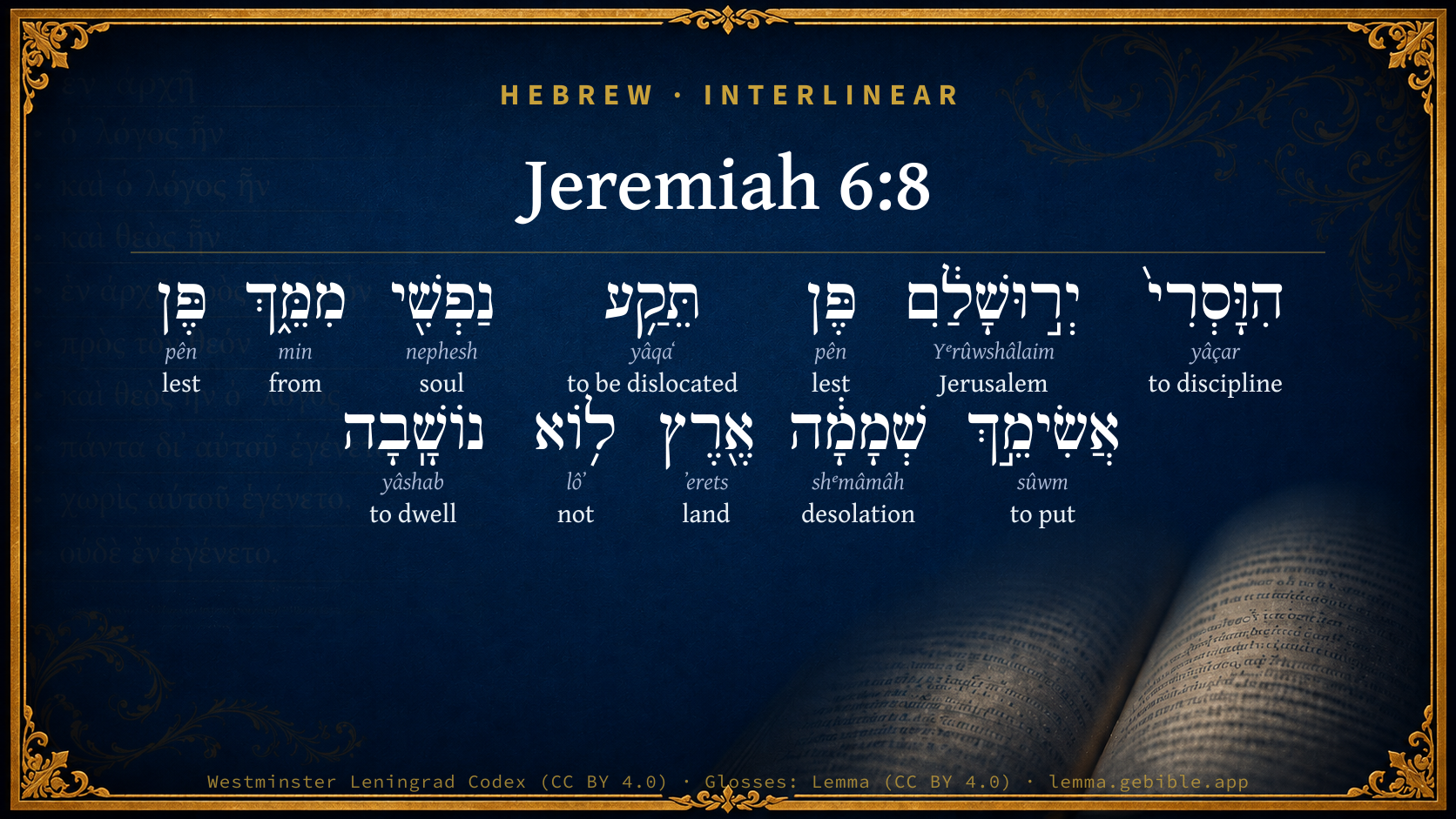
Hebrew (Westminster Leningrad Codex) Jeremiah 6:8 appears in the Hebrew Old Testament. The text above is from the Westminster Leningrad Codex. Each word links to its Strong’s number, a concise gloss, and parsing drawn from the Open Scriptures Hebrew Bible morphology. Click any word for its full Brown-Driver-Briggs (BDB) entry.
Download image
Cite this verse

Jeremiah 6:8 (World English Bible). Public Domain. Lemma interlinear Bible study tool, https://lemma.gebible.app/v/jeremiah/6/8.

Show BibTeX & RIS
BibTeX
RIS
English Translation
Be instructed, Jerusalem, lest my soul be alienated from you; lest I make you a desolation, a land not inhabited.
World English Bible · Public Domain
Download a study sheet

One document with this verse’s original text, its word-by-word gloss line, the meaning frame, cross-references with their text, attributed commentary, and full source and license credits — printable, and it pastes into notes with its structure intact.

This verse Autodidact and up

Study sheet (.html) Plain text (.txt)

A passage Seminary Student

Up to 50 verses in one chapter. A passage sheet keeps up to 6 commentary sources and 12 cross-references per verse, in the order this page ranks them, and says so on the sheet whenever that leaves anything out. Ask for a single verse and you get the Autodidact verse sheet above.

Everything on this page stays free to read, with no account — the sheet is a download of what is already on screen, not access to it.

Want to remove ads? Support Godless Engineer
Compare translations 3

The same verse in 3 English versions, stacked beneath the original-language interlinear above. Click any original word for its lexicon entry.

Each is an independent rendering of the whole verse — the interlinear is not word-aligned to these translations.

Highlighted words mark where these versions differ — a whole-verse word diff, not a word-by-word alignment.

  • World English Bible Public Domain
    Be instructed, Jerusalem, lest my soul be alienated from you; lest I make you a desolation, a land not inhabited.
  • King James Version Public Domain
    Be thou instructed, O Jerusalem, lest my soul depart from thee; lest I make thee desolate, a land not inhabited.
  • unfoldingWord Literal Text CC BY-SA 4.0
    Let yourself be instructed, Jerusalem, lest my soul turns away in disgust from you, lest I make you a wasteland, a land not inhabited.’”

unfoldingWord Literal Text — © unfoldingWord, licensed CC BY-SA 4.0. Word-aligned USFM3 via Door43 (git.door43.org/unfoldingWord/en_ult).

Versions to compare (up to 4)

3 of 4 selected

Show all 18 translations

Every available English version of this verse, each an independent rendering of the whole verse.

  • World English Bible Public Domain
    Be instructed, Jerusalem, lest my soul be alienated from you; lest I make you a desolation, a land not inhabited.
  • Berean Standard Bible Public Domain
    Be forewarned, O Jerusalem, or I will turn away from you; I will make you a desolation, a land without inhabitant.”
  • Majority Standard Bible Public Domain
    Be forewarned, O Jerusalem, or I will turn away from you; I will make you a desolation, a land without inhabitant.”
  • King James Version Public Domain
    Be thou instructed, O Jerusalem, lest my soul depart from thee; lest I make thee desolate, a land not inhabited.
  • American Standard Version (1901) Public Domain
    Be thou instructed, O Jerusalem, lest my soul be alienated from thee; lest I make thee a desolation, a land not inhabited.
  • Revised Version (1885) Public Domain
    Be thou instructed, O Jerusalem, lest my soul be alienated from thee; lest I make thee a desolation, a land not inhabited.
  • Geneva Bible (1599) Public Domain
    Be thou instructed, O Ierusalem, lest my soule depart from thee, lest I make thee desolate as a land, that none inhabiteth.
  • Douay-Rheims (1899) Public Domain
    Be thou instructed, O Jerusalem, lest my soul depart from thee, lest I make thee desolate, a land uninhabited.
  • Young's Literal Translation Public Domain
    Be instructed, O Jerusalem, Lest My soul be alienated from thee, Lest I make thee a desolation, a land not inhabited.
  • Literal Standard Version CC BY-SA 4.0
    Be instructed, O Jerusalem, || Lest My soul be alienated from you, || Lest I make you a desolation, || A land [that is] not inhabited.”
  • Unlocked Literal Bible CC BY-SA 4.0
    Accept discipline, Jerusalem, or I will turn away from you and make you into a ruin, an uninhabited land.'”
  • unfoldingWord Literal Text CC BY-SA 4.0
    Let yourself be instructed, Jerusalem, lest my soul turns away in disgust from you, lest I make you a wasteland, a land not inhabited.’”
  • Darby Bible Public Domain
    Be thou instructed, Jerusalem, lest my soul be alienated from thee; lest I make thee a desolation, a land not inhabited.
  • World Messianic Bible Public Domain
    Be instructed, Jerusalem, lest my soul be alienated from you, lest I make you a desolation, an uninhabited land.”
  • Webster's Bible Public Domain
    Be thou instructed, O Jerusalem, lest my soul depart from thee; lest I make thee desolate, a land not inhabited.
  • Free Bible Version CC BY-SA 4.0
    I'm warning you, people of Jerusalem, I'm going to give up on you in disgust. I will destroy you and leave your country uninhabited.
  • Bible in Basic English Public Domain
    Undergo teaching, O Jerusalem, or my soul will be turned away from you, and I will make you a waste, an unpeopled land.
  • JPS Tanakh (1917) Public Domain
    Be thou corrected, O Jerusalem, lest My soul be alienated from thee, lest I make thee desolate, a land not inhabited.

Literal Standard Version (2020), Covenant Press — licensed CC BY-SA 4.0. Text via the HelloAO Bible API (eBible.org). Unlocked Literal Bible (unfoldingWord) — licensed CC BY-SA 4.0. Text via the HelloAO Bible API (eBible.org). unfoldingWord Literal Text — © unfoldingWord, licensed CC BY-SA 4.0. Word-aligned USFM3 via Door43 (git.door43.org/unfoldingWord/en_ult). Free Bible Version, Dr. Jonathan Gallagher — licensed CC BY-SA 4.0. Text via the HelloAO Bible API (eBible.org).

Word by word

More ways to search: Search by grammar → Find every occurrence → Compare this word →

Practice this passage: Drill this verse → Learn its vocabulary →

תֵּקַ֥ע
yâqaʻ
H3363
“to be dislocated”
Verb, Qal, Imperfect, 3rd Person, Feminine, Singular
Part of Speech
Verb
Stem
Qal
Form
Imperfect
Person
3rd Person
Gender
Feminine
Number
Singular
Full BDB Definition

Origin: a primitive root

TWOT: 903

to be dislocated, be alienated - (Qal) to be dislocated, be torn away, be alienated - (Hiphil) - to execute slowly (by exposure or impalation) - to hang - (Hophal) to be executed
  1. הִוָּסְרִי֙ yâçar H3256 “discipline” Verb, Niphal, Imperative, 2nd Person, Feminine, Singular
  2. יְר֣וּשָׁלִַ֔ם Yᵉrûwshâlaim H3389 “Jerusalem” Noun, Proper
  3. פֶּן pên H6435 “lest” Conjunction
  4. נַפְשִׁ֖י nephesh H5315 “soul · my” Noun, Common, Both, Singular, Construct + Suffix, Personal, 1st Person, Common, Singular
  5. מִמֵּ֑ךְ min H4480 “from · you” Preposition + Suffix, Personal, 2nd Person, Feminine, Singular
  6. פֶּן pên H6435 “lest” Conjunction
  7. אֲשִׂימֵ֣ךְ sûwm H7760 “to put · you” Verb, Qal, Imperfect, 1st Person, Common, Singular + Suffix, Personal, 2nd Person, Feminine, Singular
  8. שְׁמָמָ֔ה shᵉmâmâh H8077 “desolation” Noun, Common, Feminine, Singular, Absolute
  9. אֶ֖רֶץ ʼerets H776 “land” Noun, Common, Both, Singular, Absolute
  10. ל֥וֹא lôʼ H3808 “not” Particle, Negative
  11. נוֹשָֽׁבָה yâshab H3427 “to dwell” Verb, Niphal, Perfect, 3rd Person, Feminine, Singular

About this verse

These counts appear in no published source. They are computed here, from the morphology-tagged text and Lemma’s own curated glosses. What Lemma adds →

12
words
11
distinct lemmas
Prophets
section

Notable vocabulary

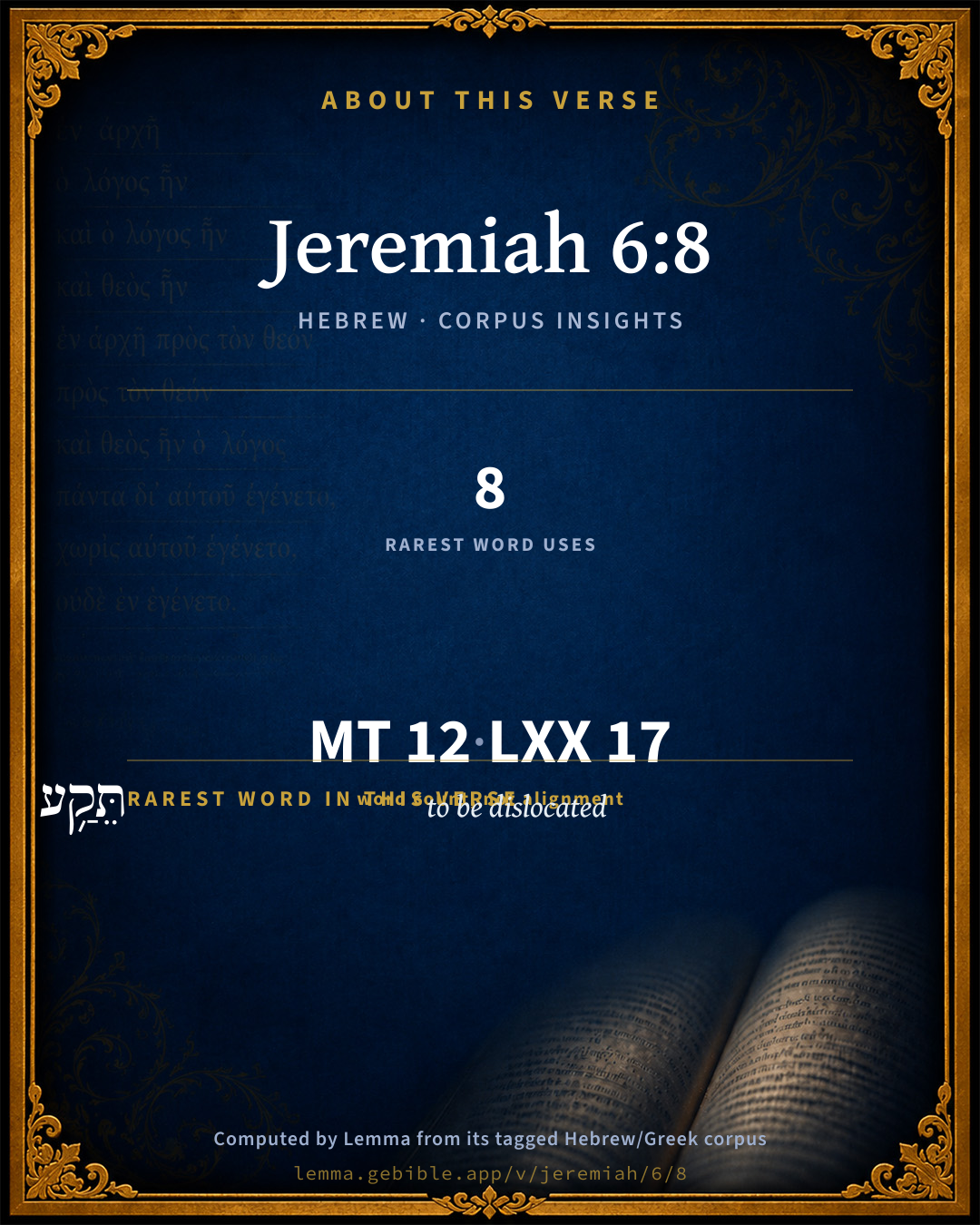
The rarest word here is תֵּקַ֥ע to be dislocated H3363 — appearing just 8 times in the whole Hebrew Bible.

Shared distinctive vocabulary

תֵּקַ֥ע to be dislocated H3363 occurs in 8 verses of the Hebrew Bible. Also found in:

Grammatical profile

  • 4 verbs
  • 4 nouns
  • 1 preposition
  • 2 conjunctions
  • 1 particle

Verb forms

  • הִוָּסְרִי֙ Niphal · Imperative
  • תֵּקַ֥ע Qal · Imperfect
  • אֲשִׂימֵ֣ךְ Qal · Imperfect
  • נוֹשָֽׁבָה Niphal · Perfect

Repetition

A word recurs within this verse — often emphatic in Hebrew:

  • פֶּן lest H6435 ×2

Hebrew & Septuagint length

In the original languages it is 12 Hebrew tokens and 17 Greek tokens — but the two are counted differently (Hebrew bundles its prefixes and suffixes into one token; the Greek is in lemma form), so that isn’t a like-for-like length.

Cross-references

20

Topical passages linked to Jeremiah 6:8 in the Treasury of Scripture Knowledge — connected by theme and wording, ordered by reader-vote popularity; previews shown in the World English Bible.

  • Ezekiel 23:18 So she uncovered her prostitution, and uncovered her nakedness: then my soul was alienated from her, like as my soul was alienated from her sister.
  • Hosea 9:12 Though they bring up their children, Yet I will bereave them, so that not a man shall be left. Indeed, woe also to them when I depart from them!
  • Jeremiah 17:23 But they didn't listen, neither turn their ear, but made their neck stiff, that they might not hear, and might not receive instruction.
  • Psalms 50:17 Seeing you hate instruction, And throw my words behind you?
  • Jeremiah 32:33 They have turned to me the back, and not the face: and though I taught them, rising up early and teaching them, yet they have not listened to receive instruction.
  • Jeremiah 35:13–15 Thus says Yahweh of Hosts, the God of Israel: Go, and tell the men of Judah and the inhabitants of Jerusalem, Will you not receive instruction to listen to my words? says Yahweh.
  • Zephaniah 3:7 I said, "Just fear me. Receive correction, so that her dwelling won't be cut off, according to all that I have appointed concerning her." But they rose early and corrupted all their doings.
  • Leviticus 26:34 Then the land will enjoy its sabbaths as long as it lies desolate and you are in your enemies' land. Even then the land will rest and enjoy its sabbaths.
  • Deuteronomy 32:29 Oh that they were wise, that they understood this, That they would consider their latter end!
  • Psalms 2:10 Now therefore be wise, you kings. Be instructed, you judges of the earth.
  • Psalms 94:12 Blessed is the man whom you discipline, Yah, And teach out of your law;
  • Proverbs 4:13 Take firm hold of instruction. Don't let her go. Keep her, for she is your life.
  • Jeremiah 2:15 The young lions have roared on him, and yelled; and they have made his land waste: his cities are burned up, without inhabitant.
  • Jeremiah 4:14 Jerusalem, wash your heart from wickedness, that you may be saved. How long shall your evil thoughts lodge within you?
  • Jeremiah 7:3–7 Thus says Yahweh of Hosts, the God of Israel, Amend your ways and your doings, and I will cause you to dwell in this place.
  • Jeremiah 7:20 Therefore thus says the Lord Yahweh: Behold, my anger and my wrath shall be poured out on this place, on man, and on animal, and on the trees of the field, and on the fruit of the ground; and it shall burn, and shall not be quenched.
  • Jeremiah 7:34 Then will I cause to cease from the cities of Judah, and from the streets of Jerusalem, the voice of mirth and the voice of gladness, the voice of the bridegroom and the voice of the bride; for the land shall become a waste.
  • Jeremiah 9:11 I will make Jerusalem heaps, a dwelling-place of jackals; and I will make the cities of Judah a desolation, without inhabitant.
  • Jeremiah 31:19 Surely after that I was turned, I repented; and after that I was instructed, I struck on my thigh: I was ashamed, yes, even confounded, because I did bear the reproach of my youth.
  • Zechariah 11:8–9 I cut off the three shepherds in one month; for my soul was weary of them, and their soul also loathed me.

Cross-references courtesy of OpenBible.info (CC BY 4.0).

Hebrew and Greek witnesses Masoretic Hebrew ↔ Greek Septuagint

The same verse in the two great witnesses to the Old Testament, shown verse-for-verse.

These are two independent witnesses, not word-aligned to each other, and the Septuagint is shown in lemma (dictionary) form.

Hebrew Jeremiah 6:8 Masoretic · Westminster Leningrad Codex

הִוָּסְרִי֙ יְר֣וּשָׁלִַ֔ם פֶּן תֵּקַ֥ע נַפְשִׁ֖י מִמֵּ֑ךְ פֶּן אֲשִׂימֵ֣ךְ שְׁמָמָ֔ה אֶ֖רֶץ ל֥וֹא נוֹשָֽׁבָה

Be instructed, Jerusalem, lest my soul be alienated from you; lest I make you a desolation, a land not inhabited.

World English Bible · Public Domain

Greek LXX Structure differs

In the Septuagint, Jeremiah is about an eighth shorter than the Hebrew and arranges its material differently — the Oracles Against the Nations (Hebrew chapters 46–51) appear in the middle of the Greek book, after 25:13. Because the chapter and verse boundaries do not line up, a verse-for-verse comparison with the Hebrew is not shown.

A verse-for-verse comparison isn’t shown here because the chapters and verses don’t line up. Switch to the LXX edition with the MT / LXX toggle above to read the Greek directly.

Hebrew: Westminster Leningrad Codex (CC BY 4.0). Greek: Septuagint (public domain); English from a public-domain English Septuagint. How the Septuagint differs from the Hebrew →

Targum (Aramaic paraphrase)

1

The Targum is the ancient Jewish Aramaic paraphrase of the Hebrew Scriptures — an interpretive translation, not the Hebrew text itself. Onkelos (literal) and Pseudo-Jonathan (expansive) render the Torah, and Jonathan the Prophets. Coverage is partial: where no permissively-licensed English translation exists for a verse, only the Aramaic is shown. This is verse-level text, not a word-by-word alignment to the Hebrew.

  1. Targum Jonathan Prophets (Joshua–Malachi)
    אִיתְרְדָא יְרוּשְׁלֵם דִלְמָא יְרָחַק מֵימְרִי יָתָךְ דִלְמָא אֲשַׁוִינָךְ צַדְיָא כַּאֲרַע סְדוֹם דְלָא אִתּוֹתָבַת:

    (no public-domain English translation for this verse)

    Targum Jonathan — Aramaic: “Mikraot Gedolot” (public domain). English: “Sefaria Community Translation” (CC0 1.0 (public-domain dedication)); “London "Chaldee Paraphrase," 1871” (public domain). Text via Sefaria.

Commentary

Notes on Jeremiah 6:8 from classic Christian and Jewish commentators (each source and its license shown beneath its notes). The classic Christian expositions comment on the surrounding passage and are grouped to its opening verse, so a note may address several verses; the Jewish commentaries on the Tanakh (Rashi and others) are per-verse, so they appear only where the commentator wrote on this verse.

Lemma curates 59 commentaries, every one of them public domain or Creative Commons licensed, each selected and text-cleaned for this edition rather than reprinted as found. About our sources →

Trapp's Complete Commentary

John Trapp

Jer 6:8 Be thou instructed, O Jerusalem, lest my soul depart from thee; lest I make thee desolate, a land not inhabited.

Ver. 8. Be thou instructed.] Affliction is a schoolmaster, {a} or rather an usher to the law, which the apostle calleth a schoolmaster to Christ. Affliction bringeth men to the law, and the law to Christ. Affliction is a preacher, saith one; "Blow the trumpet in Tekoah"; what saith the trumpet? "Be instructed, O Jerusalem."

Lest my soul depart from thee.] Heb., Be loosed or disjointed; lest I loathe thee more than ever I loved thee, and so thy ruin come rushing in, as by a sluice.

{a} Maturant aspera mentem.

John Trapp, A Commentary or Exposition upon All the Books of the Old and New Testament (1647–1656) — public domain. Text from a community e-Sword module.

The Biblical Illustrator

Joseph S. Exell

Jer_6:8

Be thou instructed, O Jerusalem, lest My soul depart from thee.

The way to prevent the ruin of a sinful people

I. The infinite goodness and patience of God towards a sinful people and His great unwillingness to bring ruin and destruction upon them. How loath is He that things should come to this extremity?

II. The only proper and effectual means to prevent the misery and ruin of a sinful people. If they will be instructed, and take warning by the threatenings of God, and will become wiser and better, then His soul will not depart from them, He will not bring upon them the desolation which He hath threatened.

III. The miserable case and condition of a people, when God takes off His affection from them and gives over all further care and concernment for them. Woe unto them, when His soul departs from them! For when God once leaves them, then all sorts of evil and calamities will break in upon them. (Archbishop Tillotson.)

A warning to the nation

I. The caution.

1. Whereby are we to be instructed? By the state of affairs, and by the reason of things, or the right of cases.

(1) God is a being of all perfection, of infinitely vast comprehension and understanding and power: and therefore He is able to attain those effects, and to teach men by all things that fall under His government.

(2) Things managed by Divine wisdom are intensely expressive of notions, because they do partake of the excellency and sufficiency of their cause.

(3) God doth nothing in vain, nor to fewer or lesser purposes than the things are capable to promote, or be subservient unto.

(4) Because the affairs of mankind are the choice piece of the administration of providence: And God doth in a special manner charge Himself with teaching the mind of man knowledge.

2. Wherein are we to be instructed?

(1) In matters of Gods offence. For we are highly concerned in Gods favour or displeasure.

(2) In instances of our own duty: if we have departed from it, to return to it; if we have done the contrary, to revoke it with self-condemnation and humble deprecation.

3. What is it to be instructed?

(1) To search and examine.

(2) To weigh and consider.

(3) To understand and discern.

(4) To do and perform.

II. the enforcement.

1. An argument of love and goodwill, lest My soul depart from thee.

2. An argument from fear, lest I make thee desolate, A double argument is as a double testimony, by which every word is established (2Co_13:1).

3. This double argument shows us two things.

(1) The stupidity and senselessness of those, who are made to the perfection of reason and understanding, and yet act contrary to it.

(2) The impiety and unrighteousness of sinners, who are a real offence to God, cause His displeasure, and bring upon persons and places, ruin and destruction. Sin is a variation from the law and rule of Gods creation: it is contrary to the order of reason: and when I say this, I say as bad as can be spoken. In sin there is open and manifest neglect of God, to whom all reverence and regard is most due. By sin there is a disturbance in Gods family: it is an interruption of that intercourse and communication there ought to be amongst creatures; for every sinner destroys much good. By the practice of iniquity we mar our spirits, spoil our tempers, and acquire unnatural principles and dispositions. (B. Whichcote, D. D.)

The Biblical Illustrator, edited by Joseph S. Exell (c. 1880s–1900s) — public domain. Text from a community e-Sword module.

Joseph Benson's Commentary

Jer 6:8. Be thou instructed, O Jerusalem, &c. — Take warning by the many threatenings and judgments I have denounced against thee; amend thy ways and doings, lest, if thou persist in thy wickedness, I be utterly alienated from thee; and I cast off all bowels of compassion toward thee, and give thee up to ruin and desolation. This threatening God fulfilled afterward, when he suffered the city and nation to be utterly ruined and destroyed by Nebuchadnezzar: but it still received a further completion, in that final desolation brought upon them by the Romans, under Titus Vespasian.

Joseph Benson's Commentary on the Old and New Testaments (1811–1818) — public domain. Text from a community e-Sword module.

Tyndale Open Study Notes

Tyndale Open Resources

6:8 Even at this late hour, the purpose of the Lord’s accusations was to make the people listen and turn back to him.

Tyndale Open Study Notes — © Tyndale Open Resources, licensed CC BY-SA 4.0. Text via the HelloAO Bible API.

Geneva Bible (1599)

Geneva Bible translators

He warneth them to amend by his correction, and turn to him by repentance.

Geneva Bible (1599) marginal notes — public domain. Text via Bolls.life.

Jamieson, Fausset & Brown

Robert Jamieson, A. R. Fausset & David Brown

Tender appeal in the midst of threats.

depart--Hebrew, "be torn away"; Jehovah's affection making Him unwilling to depart; His attachment to Jerusalem was such that an effort was needed to tear Himself from it (Eze 23:18; Hos 9:12; Hos 11:8).

Jamieson, Fausset & Brown — Commentary Critical and Explanatory on the Whole Bible (1871) — public domain (CC PDM 1.0). Text via the HelloAO Bible API.

Adam Clarke's Commentary

Verse 8. Be thou instructed] Still there is respite: if they would even now return unto the Lord with all their heart, the advancing Chaldeans would be arrested on their march and turned back.

Adam Clarke's Commentary on the Bible (1810–1826) — public domain. Text from a community e-Sword/MySword module.

John Calvin's Commentaries

Though the Prophet had spoken as though there was no remedy for the evils of Jerusalem, he yet exhorts it to seek peace with God, and addresses men past remedy in his name. It is then the same as though God was stopping in the middle course of his wrath, and saying, “What is to be done? Shall I destroy the city which I have chosen?” He then attributes here to God a paternal feeling, as we also find in several other places: God appeared as unwilling to proceed to extreme rigor in punishing his people.

“Alas! I will now take vengeance on mine enemies,” he says by Isaiah. (Isaiah 1:24)

He called them enemies, and justly too; for as it was said before, they ceased not to carry on war against him; but he spoke with grief: “Alas! must I take vengeance on mine enemies; I would, however, willingly spare them, were it possible.” God is not indeed subject to grief or to repentance; but his ineffable goodness cannot be otherwise expressed to us but by such mode of speaking. So also, in this place, we see that God as it were restrains himself; for he had previously commanded the enemies to ascend quickly the walls, to overturn the towers, and to destroy the whole city; but now, as though he had repented, he says, Be instructed, Jerusalem; that is, “Can we not yet be reconciled?” It is like the conduct of an offended father, who intends to punish his son, and yet desires to moderate his displeasure, and to blend some indulgence with rigor. Be then instructed; that is, “There is yet room for reconciliation, if thou wishest; provided thou shewest thyself willing to relinquish that perverseness by which thou hast hitherto provoked me, I will in return prove myself to be a father.”

There is no doubt but the object of the threatenings of the prophets was to lead the people to know their sins, and suppliantly to seek pardon; for why were the unbelieving threatened, except that God thereby proved whether they were healable? It is indeed true that the reprobate are known by God, and that God does not try or seek to find what is in their hearts, as though he did not know their obstinacy; but as I have already said, God speaks here after the manner of men: and he also shews what is the end of teaching, which is to lead men to repentance; and this cannot be done without giving them the hope of pardon and reconciliation. The Prophet thus briefly shews here for what purpose he had hitherto so dreadfully threatened the Jews, even to lead them at length to repentance.

Lest torn shall be my soul from thee Here God more clearly shews that he was as yet restrained by love. He alludes no doubt to a similitude which we have observed in another place; for God sustains the character of a spouse to his Church; and hence he shews, that he had not yet divested himself of that love which a husband has towards his wife. For a husband, when grievously offended at his wife, cannot immediately throw aside his conjugal affection; some feeling of this kind will ever remain. And we have seen in the fourth chapter, that God surpasses all husbands in kindness; for he says there, “When a repudiated wife has found another husband, will the former receive her again? Return to me, thou harlot, return to me, thou strumpet and adulteress, and I am ready to pardon thee.” It is the same course that God pursues here, “Be instructed, Jerusalem, lest my soul wholly depart from thee;” as though he had said, “Even though I am now angry, and have resolved severely to punish thy perfidy and rebellion, I shall yet be reconciled to thee, provided thou returnest.” And it is added, Lest I make thee a desolate land, a land uninhabited

The Prophet in short shews in this verse, that however grievously offended God was with his people, there was yet a hope of pardon; for he would be propitious to the people, if they turned and humbly confessed their sins, and sought to return into favor with him. It follows —

John Calvin's Commentaries (1540-1563) — public domain. Text from the Calvin Translation Society English edition (1840s-50s) via the Christian Classics Ethereal Library (ccel.org). Calvin's coverage is partial (roughly two-thirds of the Bible); uncommented books and verses are honest gaps, never fabricated. The 19th-century editor's footnotes and remarks are omitted so the notes are faithfully Calvin's own voice.

Ellicott's Commentary for English Readers

(8) Be thou instructed.—Better, Be thou corrected, or, chastened. Comp. Psa_2:10; Lev_26:23 (where we have “reformed”); and Pro_29:19.

Lest my soul.—As in Jer_4:19, the Hebrew formula for emphasised personality. The word for “depart” may be better rendered tear itself away.

A Bible Commentary for English Readers, edited by Charles John Ellicott (1878–1897) — public domain. Text from a community e-Sword module.

The Cambridge Bible for Schools and Colleges

gen. ed. J. J. S. Perowne

8. instructed] rather, disciplined, corrected. Cp. Jer_2:30, Jer_5:3.

lest my soul be alienated] The verb in the original is much stronger, be wrenched. In Gen_32:25 (Heb. 26) the same verb is rendered “was strained.”

The Cambridge Bible for Schools and Colleges (gen. ed. J. J. S. Perowne; Cambridge University Press, 1878–1918) — public domain. Text from a community e-Sword module.

John Gill's Exposition

And be thou instructed, O Jerusalem,.... Or "corrected" (s); receive discipline or instructions by chastisements and corrections, return by repentance, that the evils threatened may not come: this shows the affection of the Lord to his people, notwithstanding all their sins; that their amendment, and not their destruction, were pleasing to him; that it was with reluctance he was about to visit them in the manner threatened; and that even now it was not too late, provided they were instructed and reformed; but, if not, they must expect what follows:

lest my soul depart from thee; his Shechinah, or divine Presence, and all the tokens of his love, favour, and good will. The Targum interprets it of the Word of the Lord,

"lest my Word cast thee off;''

see Rom 11:1, or, "lest my soul pluck itself from thee"; or "be plucked" (t), and separated from thee: the phrase denotes an utter separation, a forcible one, joined with the utmost abhorrence and detestation. In Eze 23:18, it is rendered, "my mind was alienated"; it denotes disunion and disaffection.

Lest I make thee desolate, a land not inhabited; the Targum adds, by way of illustration,

"as the land of Sodom;''

so that not a man should dwell in it; see Jer 4:25.

(s) "cape disciplinam", Vatablus; "admitte disciplinam", Cocceius; "castigationem", Schmidt. (t) "ut non luxetur, vel avellatur anima mea a te", Vatablus, Junius & Tremellius, Schmidt.

John Gill's Exposition of the Whole Bible (1746–1763) — public domain (CC PDM 1.0). Text via the HelloAO Bible API.

Albert Barnes' Notes on the Bible

Be thou instructed - Be thou chastised: learn the lesson which chastisement is intended to teach thee.

Lest my soul - Lest I Myself - not “depart from thee,” God does not willingly leave His people, but - “be torn from thee.”

Albert Barnes' Notes on the Bible (1834–1885) — public domain. Text from a community e-Sword/MySword module.

Haydock's Catholic Bible Commentary

Instructed, by afflictions and prosperity, by public and internal admonitions. Willful ignorance is criminal, and drives God away, chap. li. 9., and Psalm lxxx. 12.

George Leo Haydock (1774–1849), Haydock's Catholic Family Bible and Commentary, 1859 edition — public domain. Excludes Psalms (Douay-Rheims chapter numbering differs from Protestant) and Deuterocanonical books (Catholic canon only).

Matthew Poole's English Annotations

Be thou instructed, Heb. corrected: q.d. By the correction thou hast felt, and what is threatened, be persuaded to repentance before it be too late, Pro 29:15. God doth here

in the midst of judgment remember mercy, as it were suddenly putting a stop to his fury, seeking if by any means it may yet be prevented by their repentance: q.d. I would yet willingly spare them, if it might be.

Lest my soul depart from thee, Heb. be disjointed; a most emphatical metaphor, whereby God would express how great grief it is to him to withdraw himself from them, could it possibly be avoided, (his great affection to them being here expressed by soul, which is the seat of it, Psa 42:1,2) even like the separating one limb from another: hereby is intimated the near communion that God hath with the faithful, and how ready he is to return, if they will return.

Lest I make thee desolate, a land not inhabited; lest he make them not a people.

Matthew Poole's English Annotations on the Holy Bible (1683–1685) — public domain. Text from a community e-Sword/MySword module.

Whedon's Commentary on the Bible

Daniel D. Whedon

8. Be thou instructed — Rather, more strongly, chastised.

Daniel D. Whedon (gen. ed.), Commentary on the Old and New Testaments (1874–1909) — public domain. Text from a community e-Sword module.

The Pulpit Commentary

Be thou instructed; rather, Let thyself be corrected (Authorized Version misses the sense, a very important one, of the conjugation, which is Nifal tolerativum. (comp. Psa_2:10 Isa_53:12) The phrase equivalent to "receive correction", (Jer_2:30 Jer_5:3) and means to accept the warning conveyed in the Divine chastisement. Lest my soul, etc.; rather, lest my soul be rent from thee. (Authorized Version renders the same verb in Eze_23:17, "be alienated

The worst woe of the wicked. "Be thou instructed, O Jerusalem, lest my soul depart from thee.

I THERE ARE MANY WOES WHICH ACCOMPANY SIN. "Many sorrows shall be to the wicked." All observation attests the truth of this word.

II BUT THERE IS ONE WHICH MAY FITLY BE SPOKEN OF AS THE WORST OF ALL. It is this God"s soul departing from the sinner. This indeed is terrible. It is so amongst men. We hear at times of those who have worn out the love even of those who loved them most tenderly. They have made the soul of those who loved them to depart from them. Sons have done this for fathers and mothers, friends for friends, husbands for wives and wives for husbands; and to have thus driven away a deep and earnest love is a depth of ruin than which none in this world can be more terrible. But to have worn out the love of God to have made his soul to depart from us, what woe can compare to that? His providential favor may depart from us, and that is sad. Our realization of his love in our hearts may depart from us, and that is sadder still. But for his love itself to depart, that is the worst of all.

III WHAT, THEN, CAN CAUSE SO GREAT A CALAMITY TO COME UPON A MAN? It is his refusing instruction (cf. Proverbs 1, "Seeing thou hatest knowledge," etc.). This Judah and Jerusalem were doing; this all too many are doing now.

IV BUT THIS GOD DEPRECATES GREATLY, AND IMPLORES US NOT TO BE GUILTY OF. "Be thou instructed, O Jerusalem" (cf. our Savior"s tears over Jerusalem). Appeal. C.

The Pulpit Commentary (1880–1919), ed. H.D.M. Spence-Jones & Joseph S. Exell — public domain. Text from a community e-Sword module.

John Wesley's Explanatory Notes

Be thou instructed - I would yet willingly spare them if it might be. Depart - Hebrew. be disjointed, a most emphatical metaphor, whereby God would express how great grief it is to him to withdraw himself from them, even like the separating one limb from another.

John Wesley, Explanatory Notes Upon the Whole Bible (1754–1765) — public domain. Text via the GEBible commentary corpus.

Rashi

Rabbi Shlomo Yitzchaki (Rashi)

Be corrected Heb. הוסרי. Accept correction.

lest...be alienated Heb. תקע, lest it be pulled away. יקע is an expression of joining. Comp. “and hang them up (והוקע)” (Num. 25:4), and it is sometimes an expression of detaching. There are many words that are used in such a manner.

Rashi on the Tanakh — English translations: “The Judaica Press complete Tanach with Rashi, translated by A. J. Rosenberg” (CC BY 4.0); “Pentateuch with Rashi's commentary by M. Rosenbaum and A.M. Silbermann, 1929-1934” (public domain); “The Metsudah Tanach series, Lakewood, N.J” (CC BY 4.0); and “The Book of Joshua, Metsudah Publications, 1997” (CC BY 4.0). Text via Sefaria.

Lesson kit

Teaching starters — assembled from the data on this page, not authored interpretation. Every prompt links to the verse data it draws on. Edit before teaching.

Jeremiah, in the Prophets, opens this verse with 12 words (11 distinct Hebrew lemmas). Its most distinctive word is yâqaʻ (“to be dislocated”). A historical commentator’s framing appears above. Read the whole chapter for the surrounding context.

Discussion questions

  1. The word yâqaʻ carries the sense “to be dislocated.” How does it shape the verse?
  2. How does Genesis 32:25, which shares the word «to be dislocated», read alongside this verse?
  3. What does the repetition of “lest” (2× in this one verse) do in this verse?
  4. The translations on this page render this verse differently — a whole-verse word diff, not a word-by-word alignment. What might account for the different wordings?
  5. «הִוָּסְרִי֙» is a Niphal Imperative verb. How does that grammatical form shape the action described?
  6. Compare how Trapp's Complete Commentary and The Biblical Illustrator read this verse. Where do they agree or differ?

Things to notice

Reading settings

Reading text

Shown beneath each verse's original-language words.

Old Testament
Old Testament edition

Read the OT as the Masoretic Hebrew (MT) or the Greek Septuagint (LXX).

English shown for the Greek Septuagint (in the Hebrew ↔ Greek comparison).

Comparing translations? Open the Compare panel on any verse page to stack up to four side by side.