
Proverbs 13:4

Hebrew (Westminster Leningrad Codex) Proverbs 13:4 appears in the Hebrew Old Testament. The text above is from the Westminster Leningrad Codex. Each word links to its Strong’s number, a concise gloss, and parsing drawn from the Open Scriptures Hebrew Bible morphology. Click any word for its full Brown-Driver-Briggs (BDB) entry.
Download image
Cite this verse

Proverbs 13:4 (World English Bible). Public Domain. Lemma interlinear Bible study tool, https://lemma.gebible.app/v/proverbs/13/4.

Show BibTeX & RIS
BibTeX
RIS
English Translation
The soul of the sluggard desires, and has nothing, But the desire of the diligent shall be fully satisfied.
World English Bible · Public Domain
Download a study sheet

One document with this verse’s original text, its word-by-word gloss line, the meaning frame, cross-references with their text, attributed commentary, and full source and license credits — printable, and it pastes into notes with its structure intact.

This verse Autodidact and up

Study sheet (.html) Plain text (.txt)

A passage Seminary Student

Up to 50 verses in one chapter. A passage sheet keeps up to 6 commentary sources and 12 cross-references per verse, in the order this page ranks them, and says so on the sheet whenever that leaves anything out. Ask for a single verse and you get the Autodidact verse sheet above.

Everything on this page stays free to read, with no account — the sheet is a download of what is already on screen, not access to it.

Want to remove ads? Support Godless Engineer
Compare translations 3

The same verse in 3 English versions, stacked beneath the original-language interlinear above. Click any original word for its lexicon entry.

Each is an independent rendering of the whole verse — the interlinear is not word-aligned to these translations.

Highlighted words mark where these versions differ — a whole-verse word diff, not a word-by-word alignment.

  • World English Bible Public Domain
    The soul of the sluggard desires, and has nothing, But the desire of the diligent shall be fully satisfied.
  • King James Version Public Domain
    The soul of the sluggard desireth, and hath nothing: but the soul of the diligent shall be made fat.
  • unfoldingWord Literal Text CC BY-SA 4.0
    A lazy one, his appetite is craving and there is nothing, but the appetite of the diligent will be fattened.

unfoldingWord Literal Text — © unfoldingWord, licensed CC BY-SA 4.0. Word-aligned USFM3 via Door43 (git.door43.org/unfoldingWord/en_ult).

Versions to compare (up to 4)

3 of 4 selected

Show all 18 translations

Every available English version of this verse, each an independent rendering of the whole verse.

  • World English Bible Public Domain
    The soul of the sluggard desires, and has nothing, But the desire of the diligent shall be fully satisfied.
  • Berean Standard Bible Public Domain
    The slacker craves yet has nothing, but the soul of the diligent is fully satisfied.
  • Majority Standard Bible Public Domain
    The slacker craves yet has nothing, but the soul of the diligent is fully satisfied.
  • King James Version Public Domain
    The soul of the sluggard desireth, and hath nothing: but the soul of the diligent shall be made fat.
  • American Standard Version (1901) Public Domain
    The soul of the sluggard desireth, and hath nothing; But the soul of the diligent shall be made fat.
  • Revised Version (1885) Public Domain
    The soul of the sluggard desireth, and hath nothing: but the soul of the diligent shall be made fat.
  • Geneva Bible (1599) Public Domain
    The sluggard lusteth, but his soule hath nought: but the soule of the diligent shall haue plentie.
  • Douay-Rheims (1899) Public Domain
    The sluggard willeth and willeth not: but the soul of them that work, shall be made fat.
  • Young's Literal Translation Public Domain
    The soul of the slothful is desiring, and hath not. And the soul of the diligent is made fat.
  • Literal Standard Version CC BY-SA 4.0
    The soul of the slothful is desiring, and does not have. And the soul of the diligent is made fat.
  • Unlocked Literal Bible CC BY-SA 4.0
    The appetite of lazy people craves but gets nothing, but the appetite of diligent people will be richly satisfied.
  • unfoldingWord Literal Text CC BY-SA 4.0
    A lazy one, his appetite is craving and there is nothing, but the appetite of the diligent will be fattened.
  • Darby Bible Public Domain
    A sluggard's soul desireth and hath nothing; but the soul of the diligent shall be made fat.
  • World Messianic Bible Public Domain
    The soul of the sluggard desires, and has nothing, but the desire of the diligent shall be fully satisfied.
  • Webster's Bible Public Domain
    The soul of the sluggard desireth, and hath nothing: but the soul of the diligent shall be made fat.
  • Free Bible Version CC BY-SA 4.0
    Lazy people want a lot, but get nothing; if you work hard you'll be well rewarded.
  • Bible in Basic English Public Domain
    The hater of work does not get his desires, but the soul of the hard workers will be made fat.
  • JPS Tanakh (1917) Public Domain
    The soul of the sluggard desireth, and hath nothing; but the soul of the diligent shall be abundantly gratified.

Literal Standard Version (2020), Covenant Press — licensed CC BY-SA 4.0. Text via the HelloAO Bible API (eBible.org). Unlocked Literal Bible (unfoldingWord) — licensed CC BY-SA 4.0. Text via the HelloAO Bible API (eBible.org). unfoldingWord Literal Text — © unfoldingWord, licensed CC BY-SA 4.0. Word-aligned USFM3 via Door43 (git.door43.org/unfoldingWord/en_ult). Free Bible Version, Dr. Jonathan Gallagher — licensed CC BY-SA 4.0. Text via the HelloAO Bible API (eBible.org).

Word by word

More ways to search: Search by grammar → Find every occurrence → Compare this word →

Practice this passage: Drill this verse → Learn its vocabulary →

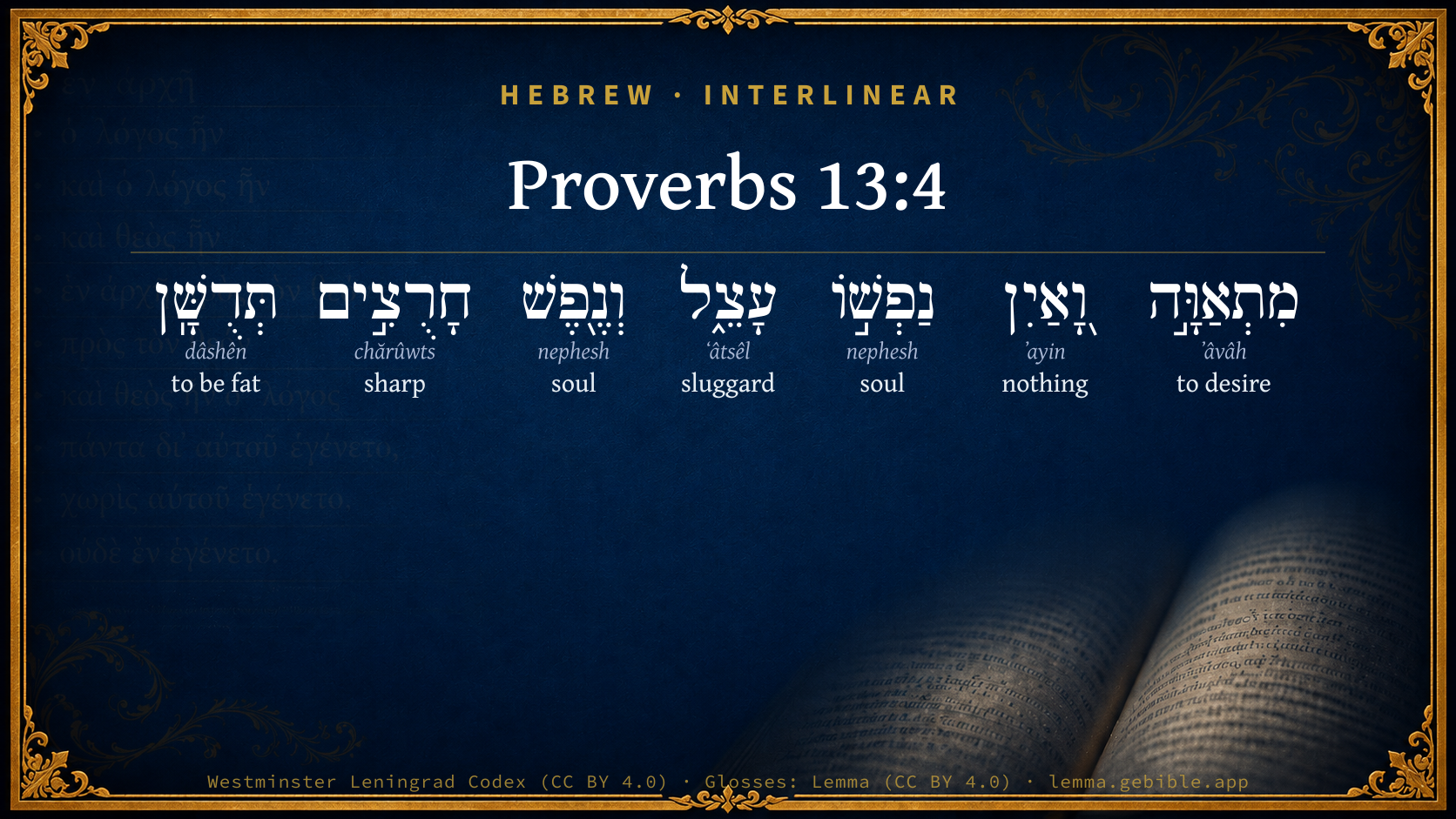
תְּדֻשָּֽׁן
dâshên
H1878
“to be fat”
Verb, Pual, Imperfect, 3rd Person, Feminine, Singular
Part of Speech
Verb
Stem
Pual
Form
Imperfect
Person
3rd Person
Gender
Feminine
Number
Singular
Full BDB Definition

Origin: a primitive root

TWOT: 457

to be fat, grow fat, become fat, become prosperous, anoint - (Qal) of prosperity (figuratively) - (Piel) - to make fat, anoint - to find fat (of offering - acceptable) - to take away ashes (from altar) - (Pual) to be made fat - (Hothpael) to fatten oneself (of Jehovah's sword)
  1. מִתְאַוָּ֣ה ʼâvâh H183 “desiring” Verb, Hithpael, Participle Active, Feminine, Singular, Absolute
  2. וָ֭אַיִן ʼayin H369 “and · nothing” Conjunction + Particle, Negative
  3. נַפְשׁ֣וֹ nephesh H5315 “soul · his” Noun, Common, Both, Singular, Construct + Suffix, Personal, 3rd Person, Masculine, Singular
  4. עָצֵ֑ל ʻâtsêl H6102 “sluggard” Adjective, Adjective, Masculine, Singular, Absolute
  5. וְנֶ֖פֶשׁ nephesh H5315 “and · soul of” Conjunction + Noun, Common, Both, Singular, Construct
  6. חָרֻצִ֣ים chărûwts H2742 “sharp” Adjective, Adjective, Masculine, Plural, Absolute

About this verse

These counts appear in no published source. They are computed here, from the morphology-tagged text and Lemma’s own curated glosses. What Lemma adds →

7
words
6
distinct lemmas
Wisdom
section

Notable vocabulary

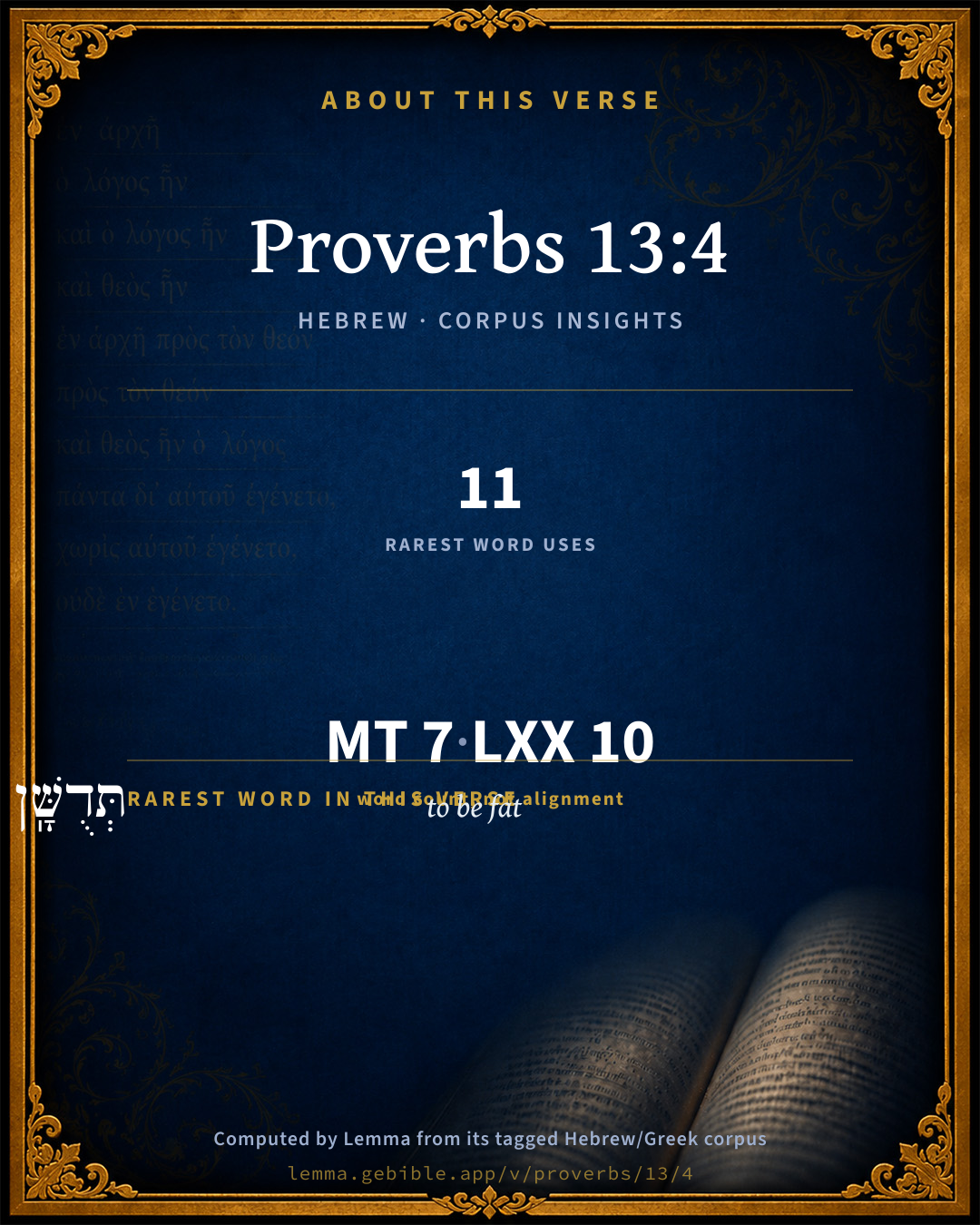
The rarest word here is תְּדֻשָּֽׁן to be fat H1878 — appearing just 11 times in the whole Hebrew Bible.

Shared distinctive vocabulary

תְּדֻשָּֽׁן to be fat H1878 occurs in 11 verses of the Hebrew Bible. Also found in:

Grammatical profile

  • 2 verbs
  • 2 nouns
  • 2 adjectives
  • 1 particle

Verb forms

  • מִתְאַוָּ֣ה Hithpael · Participle Active
  • תְּדֻשָּֽׁן Pual · Imperfect

Repetition

A word recurs within this verse — often emphatic in Hebrew:

  • נַפְשׁ֣וֹ soul H5315 ×2

Hebrew & Septuagint length

In English translation the verse runs 19 words from the Hebrew and 12 from the Septuagint (LXX English) — the Septuagint runs noticeably shorter here. See the side-by-side →

A rough comparison of the two English renderings, which tokenize alike — not a word-level alignment.

Word counts can differ between the Hebrew and the Greek without any difference in meaning — e.g. the Hebrew direct-object marker אֵת has no separate Greek word, and Greek often adds the article ὁ.

In the original languages it is 7 Hebrew tokens and 10 Greek tokens — but the two are counted differently (Hebrew bundles its prefixes and suffixes into one token; the Greek is in lemma form), so that isn’t a like-for-like length.

Cross-references

14

Topical passages linked to Proverbs 13:4 in the Treasury of Scripture Knowledge — connected by theme and wording, ordered by reader-vote popularity; previews shown in the World English Bible.

  • Proverbs 12:24 The hands of the diligent ones shall rule, But laziness ends in slave labor.
  • Proverbs 12:11 He who tills his land shall have plenty of bread, But he who chases fantasies is void of understanding.
  • 2 Peter 1:5–11 Yes, and for this very cause adding on your part all diligence, in your faith supply moral excellence; and in moral excellence, knowledge;
  • Proverbs 2:2–9 So as to turn your ear to wisdom, And apply your heart to understanding;
  • Proverbs 10:4 He becomes poor who works with a lazy hand, But the hand of the diligent brings wealth.
  • Proverbs 11:25 The liberal soul shall be made fat. He who waters shall be watered also himself.
  • Proverbs 28:25 One who is greedy stirs up strife; But one who trusts in Yahweh will prosper.
  • John 6:27 Don't work for the food which perishes, but for the food which remains to eternal life, which the Son of Man will give to you. For God the Father has sealed him."
  • Hebrews 6:11 We desire that each one of you may show the same diligence to the fullness of hope even to the end,
  • Proverbs 8:34 Blessed is the man who hears me, Watching daily at my gates, Waiting at my door posts.
  • Proverbs 26:13 The sluggard says, "There is a lion in the road! A fierce lion roams the streets!"
  • Isaiah 58:11 and Yahweh will guide you continually, and satisfy your soul in dry places, and make strong your bones; and you shall be like a watered garden, and like a spring of water, whose waters don't fail.
  • Numbers 23:10 Who can count the dust of Jacob, Or number the fourth part of Israel? Let me die the death of the righteous, Let my last end be like his!
  • Psalms 92:14 They will still bring forth fruit in old age. They will be full of sap and green,

Cross-references courtesy of OpenBible.info (CC BY 4.0).

Hebrew and Greek witnesses Masoretic Hebrew ↔ Greek Septuagint

The same verse in the two great witnesses to the Old Testament, shown verse-for-verse.

Here the Septuagint runs noticeably shorter than the Hebrew — LXX2012 (modern English Septuagint) 12 words vs World English Bible 19. A rough length comparison of the two English translations, not a word-level alignment — read both below.

These are two independent witnesses, not word-aligned to each other, and the Septuagint is shown in lemma (dictionary) form.

Hebrew Proverbs 13:4 Masoretic · Westminster Leningrad Codex

מִתְאַוָּ֣ה וָ֭אַיִן נַפְשׁ֣וֹ עָצֵ֑ל וְנֶ֖פֶשׁ חָרֻצִ֣ים תְּדֻשָּֽׁן

The soul of the sluggard desires, and has nothing, But the desire of the diligent shall be fully satisfied.

World English Bible · Public Domain

Greek LXX Proverbs 13:4 Septuagint · lemma form

ἐν ἐπιθυμία εἰμί πᾶς ἀεργός χείρ δέ ἀνδρεῖος ἐν ἐπιμέλεια

Every slothful man desires, but the hands of the active are diligent.

LXX2012 (modern English Septuagint) · Public Domain

On this verse, Whedon's Commentary on the Bible discusses the Septuagint’s reading. Read the note in Commentary ↓

Hebrew: Westminster Leningrad Codex (CC BY 4.0). Greek: Septuagint (public domain); English from LXX2012 (modern English Septuagint) (Public Domain). How the Septuagint differs from the Hebrew →

Commentary

Notes on Proverbs 13:4 from classic Christian and Jewish commentators (each source and its license shown beneath its notes). The classic Christian expositions comment on the surrounding passage and are grouped to its opening verse, so a note may address several verses; the Jewish commentaries on the Tanakh (Rashi and others) are per-verse, so they appear only where the commentator wrote on this verse.

Lemma curates 59 commentaries, every one of them public domain or Creative Commons licensed, each selected and text-cleaned for this edition rather than reprinted as found. About our sources →

Trapp's Complete Commentary

John Trapp

Pro 13:4 The soul of the sluggard desireth, and [hath] nothing: but the soul of the diligent shall be made fat.

Ver. 4. The soul of the sluggard desireth, &c.] Vult, et non vult piger - so the Vulgate reads it. The sluggard would, and he would not; he would have the end, but he would not use the means; he would "sit at Christ’s right hand," but he would not "drink of his cup, or be baptized with his baptism." Lyra compares these men to cats that would fain have fish, but are loath to wet their feet. (This is an English proverb; for Lyra was a famous English Jew, and flourished in the year of grace 1320.) Affection without endeavour is like Rachel - beautiful, but barren.

But the soul of the diligent shall be made fat,] i.e., Those that work as well as wish, that add endeavours to their desires, as 2Co 8:11. David, ravished with the meditation of the good man’s blessedness, presently conceives this desire and pursues it; not, Oh that I had this happiness! but, Oh that I could use the means! "Oh that my ways were so directed." {Psa 119:4-5}

John Trapp, A Commentary or Exposition upon All the Books of the Old and New Testament (1647–1656) — public domain. Text from a community e-Sword module.

The Biblical Illustrator

Joseph S. Exell

Pro_13:4

The soul of the sluggard desireth, and hath nothing: but the soul of the diligent shall be made fat.

The nature and consequences of idleness and of industry

This text is true both in a temporal and spiritual sense.

I. The nature and effects of sloth. The slothful man wants to attain the end without the use of the proper means. He would be rich without labour, learned without study, and respected without doing anything to deserve respect. This desire of the slothful killeth him; for his hands refuse to labour. Such persons waste their days in forming idle schemes and vain wishes. The consequences are often very terrible. They become a plague and a burden to all who are connected with them. They frequently injure their best friends, prey upon the property of others, and bring disgrace and ruin upon their dearest earthly connections. Our land, all our lands, abound with such drones. Slothfulness also gives birth to envy, discontent, fraud, lying, and almost every other evil work. In whatever situation of life a slothful person is fixed, he will, from this disposition, fall into some destructive vice, and become miserable in himself and mischievous to others. A sluggard, whatever he may profess, cannot be a truly religious person, or possessed of those graces which form the character of a member of Christ and a child of God. The sluggard may desire the good things of religion, but as he will not use the means for attaining them, he desires, and has nothing. God will be found only of them who diligently seek Him. A slothful disposition is so pernicious in its nature and effects that wherever it reigns and has the dominion, it must debase a persons character and pervert the end for which he was sent into the world.

II. The nature and effects of industry. Plenty and comfort are, in general, the consequences of diligence, both in our temporal and spiritual calling. Whatever may be a persons rank or circumstances, the providence of God has given him something to do. The sober and industrious are the glory and strength of every nation. And the industrious disposition is a great preservative against vice. Those who are trained up to honest labour and habits of industry seldom fall into those criminal excesses to which the slothful are prone. The most salutary effects of diligence are seen in religion. The diligent use of all appointed means of grace is crowned with the Divine blessing. These are the persons who have always done the most good in the world, and whom God and men have delighted to honour. There may, of course, be exceptions to the general rule. Would you, then, provide things honest in the sight of all men, pursue your profession with success, maintain yourselves and your families, and become easy in your circumstances, you must be sober and industrious, diligent and laborious. And so you must be if you would enjoy the peace and blessing of God. Some may from this learn the true reason of their embarrassments. They have spent themselves in wishing, not in working. (W. Richardson.)

Idleness

Work is the grand, all-pervading feature in the government of the world. God works. The universe, considered as an inert mass, moves. Stagnation is the sign of death. How early in life the human being should begin regular employment is a question in which both the moralist and the political economist are interested. The burden, the obligation, the duty of one man differs from that of another. In one sense, the duty of labour is laid upon all. Idleness is to be avoided by all, irrespective of the pressure, or the absence of the pressure, of poverty or any personal needs. It is curious to notice that, in the estimation of many, no persons are thought to be engaged in labour save those who are engaged in some handicraft for their livelihood. But idleness, like labour, is a relative term. Idleness is a sin against the ordinance of God. Man has manifold needs, desires, possibilities. Were there no hunger, there would be no crops, no bread. Were there no need of shelter, there would be no huts, houses, palaces. Were there no sense of ignorance, there would be no desire to learn anything. Were there no religious feeling, there would be no temples, nor desire to know anything of what the apostle calls the invisible things of God. The refusal of work, whether demanded of us, or opened to us in the way of providential opportunity, this is idleness. By this refusal one places ones self outside the life of the community. It is a sin--a sin of omission; the sin of neglect, and of lost opportunity. The life is barren, sterile, nothing. Only an idler, it may be said; not as bad as if he gave way to stormy, passionate excesses. And yet there will be in the brain of that idler an indistinguishable brood of vipers, all possible evil and corruption. God requires the use of our gifts and faculties for our development, and that we may do our share in the State, fill the position and, in a word, accomplish the purposes of our existence. The proofs of the sinfulness of idleness are to be found in its effects. It destroys our power of usefulness in the world. All real devotion to a cause implies work. We cannot set ourselves in opposition to Gods ordinances, and at the same time entertain any belief seriously that we shall succeed by circumventing Him. If any of you, who are in your years of work, when the duty of work is specially your duty, are refusing everything of the kind, and are bent upon trifles or mere amusement, it requires no large insight to perceive that your minds and characters are becoming weakened; the thews and sinews are soft; the gristle does not harden into bone. Let this state of things last, and it is certain that you will be left behind in the rear. Wholesome, not morbid, activity is what is needed for many whose hands hang idly, not through the fault of an idle disposition. Work will heal many a human woe when all else will seem to fail. (Edwin Harwood, D.D.)

Christian diligence, with the blessings that attend it

The son of diligence, considered either as a man or a Christian, is in a fair way to obtain the good things he seeks. The slothful wretch shall be poor indeed.

I. What are the several things which are implied in true Diligence?

1. Diligence includes the employment of every part of our time in proper business. This is opposed to sauntering life away; to trifling, or doing what is to no purpose; and to mistiming the businesses which are to be done.

2. Diligence includes earliness--in opposition to delay. The early man shows that his heart is in his work. If we begin betimes the service of the day, we happily provide against hindrances, and we are not in danger of being thrown into a hurry by accidental avocations.

3. Diligence implies activity and vigour. Lazy wishes will neither perform work nor obtain a blessing. What poor work doth a Christian make who is cold, indifferent, slothful in the things which concern his soul and salvation!

4. Diligence implies watchfulness--in opposition to a drowsy, heedless temper, a thoughtless security of soul. We must be awake to seize all advantages for our work, as well as to guard against surprises and dangers.

5. Diligence implies a constancy in our work--in opposition to looking back, and perpetual avocation by diversions and pleasures.

6. Another thing implied in true diligence is, firmness and resolution in our labour--in opposition to all the difficulties which attend our work. If we are frighted at every shadow of difficulty, we shall never fulfil our service, nor perfect our design.

7. There is also implied perseverance--in opposition to fainting and weariness. It is the end that crowns all.

II. The blessings which attend diligence in a course of virtue and goodness.

1. Diligence hath a natural tendency to success and to obtain the good things we seek.

2. Diligence hath the rich and special promises of a faithful God to encourage its hope.

3. Diligence and industry are a happy guard against snares and temptations of every kind. When the devil finds you idle, he hath a proper moment to assault you with some powerful temptation.

4. Diligence is always making a progress towards its designed end, but the slothful man is in great danger of going backward. The gardener who neglects his daily work will soon find the ground overrun with weeds.

5. The diligent Christian is a most useful person in the world. He does the most good himself, and becomes an excellent example to all that are round about him.

6. The diligent Christian finishes his work with peace, hope, and joy. He will review his conduct and his labours with an inward satisfaction and a sacred pleasure of soul. Let us dread the curse of the wicked and slothful servant. (Isaac Watts, D.D.)

Soul-craving

I. Soul-craving is common to all. Souls have a hunger as well as bodies, and the hunger of the soul is a much more serious thing. What is the ennui that makes miserable the rich but the unsatisfied hunger of the soul?

1. The hunger of the soul, as well as the hunger of the body, implies the existence of food somewhere.

2. The unsatisfied hunger of the soul as well as the body is painful and ruinous.

II. Soul-craving can be allayed only by labour. (Homilist.)

Diligence

A friend of mine, says Mr. Gurney, one day inquired of the then Lord Chancellor, how he managed to get through so much business? Oh, said his lordship, I have three rules; the first is, I am a whole man to one thing at a time; the second is, I never lose a passing opportunity of doing anything that can be done; and the third is, I never entrust to other people what I ought to do myself.

The Biblical Illustrator, edited by Joseph S. Exell (c. 1880s–1900s) — public domain. Text from a community e-Sword module.

Joseph Benson's Commentary

Pro 13:4. The sluggard desireth and hath nothing — Because he contents himself with lazy desires, without diligent endeavours; but the soul of the diligent shall be made fat — He shall be enriched with the fruit of his own labours.

Joseph Benson's Commentary on the Old and New Testaments (1811–1818) — public domain. Text from a community e-Sword module.

The Preacher's Complete Homiletical Commentary

Joseph S. Exell (gen. ed.)

CRITICAL NOTES.—

Pro_13:4. Fat, i.e., abundantly satisfied.

MAIN HOMILETICS OF Pro_13:4

THE DISAPPOINTMENT OF THE SLUGGARD’S DESIRES

I, The desires of the sluggard cannot be satisfied—

1. Because they are contrary to the ordination of God. The Divine ordination is, “In the sweat of thy face shalt thou eat bread” (Gen_3:19), in other words, that reward shall be the result of labour. If a man is to have that which he desires, he must frame his desires in harmony with the law of the universe, or he must be disappointed. If men desire to bring about any material result they take care to work in harmony with physical law. He would be looked upon as a madman who expected to achieve anything by setting at nought the law of gravitation, for instance. It is quite as useless for men to desire to set aside God’s moral laws.

2. Because they are contrary to the practice of God. God, as we saw in homiletics on chap. Pro_12:24; Pro_12:27, is a great worker. He desired to save man, but He used means to accomplish His desires, even means which involved the highest self-sacrifice. Shall man expect to realise his wishes without effort, when God “spared not His own Son” (Rom_8:32) to bring about the salvation of the world, when Christ “endured the cross” to attain “the joy set before Him?” (Heb_12:2).

3. Because they are unfair to his fellow-creatures. He desires to consume, but not to contribute to the general good; he wants to have the reward of the diligent without his toil. It would be unjust to the industrious to give to him for desiring what others gain by working. Therefore,

II. He wearies himself far more by his laziness than he would do by honest labour. If a man is constantly desiring and never having his desires fulfilled, his life must become a weariness to him. Fulfilled desires become an incentive to renewed activity—he who has reaped one harvest as a result of his labour is quickened to new energy to sow for another crop. The sluggard knows not the enjoyment which comes to the man who has worked hard for the reward which he now enjoys; he knows not what it is to enjoy rest and recreation, because true diligence only can give them any true relish. (See also Homiletics on chap. Pro_6:6-11 and Pro_12:24.)

OUTLINES AND SUGGESTIVE COMMENTS

The sluggard in religion desires to overcome his bad habits, to enjoy the happiness of God’s people. So far, well. Desires are a part of religion, There can be no attainment without them. Many have not even the desire, yet the sluggard hath nothing, because it is desire without effort. “Hell,” says an old writer, “is paved with such desires.”—Bridges.

Wishes and woulders are never good householders.—Muffet.

Doddridge says most people perish by laziness. Laziness is the attribute of a man who desires an object, but will not work for it. The impenitent desires heaven—nay longs for it—yea, confidently expects it (just as many a sluggard expects wealth), but religion never “turns up,” it never comes like game taken in the chase (chap. Pro_12:27), it is a solid product: we must stir up ourselves to take hold on God (Isa_64:7). With no exceptions, such as are on “change,” it is the “diligent soul” that “shall be made fat” and the yearning sluggard, at the very last, “has nothing.”—Miller.

The slothful man has one mighty objection against heaven, that he cannot make sure of it in a morning dream.—Lawson.

Labour is the original law of man’s nature. The fatigue and distress of labour, are, no doubt, the result of sin. Even in the garden of primeval innocence, it was by his “dressing” and “keeping” that everything was to thrive.—Wardlaw.

The sluggard would and he would not, he would have the end, but would not use the means; he would “sit at Christ’s right hand,” but he would not “drink of His cup,” or “be baptized with his baptism. Affection without endeavour is like Rachel, beautiful, but barren.… David, ravished with the meditation of the good man’s blessedness, presently conceives this desire and pursues it; not “Oh that I had this happiness,” but “Oh that I could use the means!” “Oh that my ways were directed to keep thy statutes” (Psa_119:4-5).—Trapp.

The Preacher's Complete Homiletical Commentary (gen. ed. Joseph S. Exell; Funk & Wagnalls, c. 1892) — public domain (pre-1929). A full-Bible homiletical/sermon-outline anthology covering 65 of 66 books (2 John is absent from the source module). Text from a community e-Sword module.

Geneva Bible (1599)

Geneva Bible translators

He ever desireth, but taketh no pains to get anything.

Geneva Bible (1599) marginal notes — public domain. Text via Bolls.life.

Matthew Henry's Commentary

Here is, 1. The misery and shame of the slothful. See how foolish and absurd they are; they desire the gains which the diligent get, but they hate the pains which the diligent take; they covet every thing that is to be coveted, but will do nothing that is to be done; and therefore it follows, They have nothing; for he that will not labour let him hunger, and let him not eat, Th2 3:10. The desire of the slothful, which should be his excitement, is his torment, which should make him busy, makes him always uneasy, and is really a greater toil to him than labour would be. 2. The happiness and honour of the diligent: Their soul shall be made fat; they shall have abundance, and shall have the comfortable enjoyment of it, and the more for its being the fruit of their diligence. This is especially true in spiritual affairs. Those that rest in idle wishes know not what the advantages of religion are; whereas those that take pains in the service of God find both the pleasure and profit of it.

Matthew Henry's Commentary on the Whole Bible (1708–1710) — public domain (CC PDM 1.0). Text via the HelloAO Bible API.

Jamieson, Fausset & Brown

Robert Jamieson, A. R. Fausset & David Brown

(Compare Pro 12:11, Pro 12:27).

Jamieson, Fausset & Brown — Commentary Critical and Explanatory on the Whole Bible (1871) — public domain (CC PDM 1.0). Text via the HelloAO Bible API.

Adam Clarke's Commentary

Verse 4. The soul of the sluggard desireth, and hath nothing] We often hear many religious people expressing a desire to have more of the Divine life, and yet never get forward in it. How is this? The reason is, they desire, but do not stir themselves up to lay hold upon the Lord. They are always learning, but never able to come to the knowledge of the truth. They seek to enter in at the strait gate, but are not able, because they do not strive.

Adam Clarke's Commentary on the Bible (1810–1826) — public domain. Text from a community e-Sword/MySword module.

John Gill's Exposition

The soul of the sluggard desireth, and hath nothing,.... He desires knowledge, but does not care to be at any pains to get it, and so has it not; he desires riches, but chooses not to make use of the means, to be diligent and industrious, and so he is without them; he desires to wear good clothes and rich raiment, but is unwilling to labour for them, and therefore is clothed with rags; he desires food, and plenty of it, but refuses to work for it; and he that will not work should not eat, and therefore he has it not, but starves and famishes: and, in spiritual things, the sluggard desires heaven and happiness, but does not care to do the duties of religion; he would die the death of the righteous, but is unwilling to live his life; to abstain from sin, and live soberly and righteously, is too hard service for him; he does not choose to do or suffer anything for the cause of Christ and true religion. Jarchi's note is, that

"in the future state he shall see the glory of the wise man, and desire it; but shall not attain to it;''

but the soul of the diligent shall be made fat; become rich; increase in temporal things, and have great plenty and prosperity; and so, in spiritual matters, such who are diligent in the use of means, constantly attend on the word and ordinances, and labour for the meat which endures to everlasting life; such are filled and satisfied, as with marrow and fatness; and become fat and flourishing, and fruitful in every good word and work; and shall at last arrive to that state where there will be no more hunger and thirst.

John Gill's Exposition of the Whole Bible (1746–1763) — public domain (CC PDM 1.0). Text via the HelloAO Bible API.

Haydock's Catholic Bible Commentary

Willeth not. Hebrew, "hath not." He only desires riches, or to be converted, and will not labour, chap. xxi. 25., and Ecclesiasticus v. 8.

George Leo Haydock (1774–1849), Haydock's Catholic Family Bible and Commentary, 1859 edition — public domain. Excludes Psalms (Douay-Rheims chapter numbering differs from Protestant) and Deuterocanonical books (Catholic canon only).

Matthew Poole's English Annotations

Hath nothing, because he contenteth himself with lazy desires without diligent endeavours.

Shall be made fat; he shall be enriched with the fruit of his own labours.

Matthew Poole's English Annotations on the Holy Bible (1683–1685) — public domain. Text from a community e-Sword/MySword module.

Whedon's Commentary on the Bible

Daniel D. Whedon

4. Sluggard desireth — The sentiment of this verse is, the lazy man has a great appetite, with nothing to satisfy it; but the diligent (active) shall be fed abundantly. The Septuagint has: “Every slothful man desires, but the hands of the active are diligent.” On first clause, compare Pro_11:25; on second, Pro_10:4.

Daniel D. Whedon (gen. ed.), Commentary on the Old and New Testaments (1874–1909) — public domain. Text from a community e-Sword module.

The Pulpit Commentary

Comp. Pro_10:4. The soul of the sluggard desireth, and hath nothing; literally, and nothing is there he gains nothing. (Pro_14:6 Pro_20:4) He has the wish, but not the will, and the empty wish without corresponding exertion is useless. (Pro_21:25, etc.) Vulgate, "The indolent wishers, and wishes not;" he wishes for something, but he wishes not for the labour of getting it; he would like the result, but he hates the process by which the result is to be obtained. Septuagint, "In desires every idle man is occupied;" his mind is fixed wholly on aimless wishes, not on action. Shall be made fat; (Pro_11:25) Septuagint, "The hands of the valiant are fully occupied (en epimeleia ).

Vers. 4, 7, 8, 11. The value and use of property.

I THE WORTH OF THIS WORLD"S GOODS IS ASSUMED. It is needless to show that property is a necessary institution of life under present conditions. All the strong things said in the gospel about riches do not dispute their value; it is in the relation of the spirit to them that evil arises. Their value as a means to the ends of the spirit is unquestioned, and everywhere assumed.

II THE VANITY OF RICHES WITHOUT CORRESPONDING ACTION. Wishes are a great force in our nature (compare Mozley"s sermon on the "Power of Wishes"). Still, they have no practical effect unless they are transformed into will and into exertion of means to an end. It is the very characteristic of the fool that his mind evaporates in wishes; he is always desiring, but never at the pains to get anything. He is always idly expecting something to "turn up." This is a sheer superstition, a sort of clinging to the magical belief that the course of nature can be altered for one"s private benefit. The lesson is, of course, equally applicable to higher things. "He would lain go to heaven if a morning dream would carry him there." He wishes to be good, to die the death of the righteous, but, at the same time, to continue in a way of life that can lead neither to the one nor to the other. Hell is paved with good intentions.

III THE SECRET OF PROSPERITY IS DILIGENCE. Here desire is united with exertion, and it is an almost irresistible combination, as the careers of men who have risen constantly show. To conceive a good thing with such is to desire it; to desire it is to begin at once to work for it. This course must bring "rich satisfaction the satisfaction, by no means the least, of the pursuit, and the satisfaction in the end of entire or partial fruition. And so in moral and spiritual progress. We cannot overcome our weaknesses and sins by direct resistance, but we may react upon them by filling the mind with profitable matter of thought. The rich satisfaction depends in every case upon the same law; the personal energies must be aroused, and an object must be aimed at. Satisfaction is the complete joy of the mind in closing with and possessing a worthy and desirable object.

IV THE CONCEIT OF RICHES IS NOT REAL RICHES. (Ver. 7; comp. Pro_12:9) The saying may he directed against the foolish pride of birth and ostentation without anything real to back it up. It strikes a common vice of modern times the aim to keep up appearances, and to pass for something greater in position than one really is. The contrasted example teaches the lesson of preferring the substance to the show, of being willing to appear much less than one is. And so in higher matters; take care to be what is sound and good in principle, and the seeming may be left for the most part to take care of itself. No appearances deceive God, and nothing that is real escapes him.

V THE PRACTICAL SERVICE OF RICHES. (Ver. 8) They may provide a ransom from captivity, from penal judgment, from the hand of robbers. Their power to procure deliverances from the evils of life is much wider in the present day. The poor man, on the contrary, "listens to no rebuke," i.e. no threats can extort from him what he has not got. He is helpless for want of means. A lesson not often taught from the pulpit, and perhaps not needed for the majority prudent regard to the possible advantages of money, stimulating to industry in the quest for it. Still, some do need the lesson. And the Bible has no affectation of a false contempt for the means of living. Business men should be encouraged in their pursuit of wealth, and guided in their application of it.

VI WEALTH ONLY PERMANENT WHEN WELL-GOTTEN. (Ver. 11) Perhaps the, translation to be preferred is, "Swindled wealth becomes small." Hastily gotten generally means hastily spent. And dishonest gain burns the fingers. How often do we see a feverish passion for spending going hand in hand with unlawful or unhealthy getting! A healthy acquisition of wealth is gradual, and the result of steady industry. Rapid fortune making, or sudden "strokes of luck," are certainly not to be envied in view of the good of the soul.

LESSONS.

1. Wealth is a good in itself. When we speak of it as an evil, we are using a certain figure of speech; for the evil is in the false relation of the soul to this as to other earthly objects.

2. In the desires that relate to wealth, their proper control and direction, the moral discipline probably of the majority must ever lie.

3. Safety is to be found in the religious habit, which sees in earthly objects good only as they can be connected with that which is beyond themselves, and is Divine and eternal. J.

See homily on Pro_27:23. C.

The Pulpit Commentary (1880–1919), ed. H.D.M. Spence-Jones & Joseph S. Exell — public domain. Text from a community e-Sword module.

Keil & Delitzsch

C. F. Keil & F. Delitzsch

The three proverbs (Pro 13:1-3) which refer to hearing and speaking are now following by a fourth which, like Pro 13:2 and Pro 13:3, speaks of the נפשׁ.

The soul of the sluggard desires, yet has not;

But the soul of the industrious is richly satisfied.

The view that the o in נפשׁו עצל is the cholem compaginis, Bttcher, 835, meets with the right answer that this would be the only example of a vocal casus in the whole of gnomic poetry; but when on his own part (Neue Aehrenlese, 1305) he regards נפשׁו as the accus. of the nearer definition (= בּנפשׁו), he proceeds inadvertently on the view that the first word of the proverb is מתאוּה, while we read מתאוּה, and נפשׁו is thus the nom. of the subject. נפשׁו עצל means "his (the sluggard's) soul" (for עצל occurs as explanatory permutative briefly for נפשׁ עצל), as סעיפיה פּריּה means "its branches (i.e., of the fruitful tree)," Isa 17:6. One might, it is true, add ה to the following word here, as at Pro 14:13; but the similar expression appertaining to the syntax ornata occurs also Sa2 22:33; Psa 71:7, and elsewhere, where this is impracticable. Meri appropriately compares the scheme Exo 2:6, she saw him, viz., the boy. With reference to the ואין here violently (cf. Pro 28:1) introduced, Bttcher rightly remarks, that it is an adverb altogether like necquidquam, Pro 14:6; Pro 20:4, Psa 68:21, etc., thus: appetit necquidquam anima ejus, scilicet pigri. 4b shows the meaning of the desire that has not, for there תדשּׁן occurs, a favourite strong Mishle word (Pro 11:25; Pro 28:25, etc.) for abundant satisfaction (the lxx here, as at 28:25, ἐν ἐπιμελείᾳ, sc. ἔσονται, instead of which, Montfaucon supposed πιμελείᾳ, which is, however, a word not authenticated). The slothful wishes and dreams of prosperity and abundance (cf. Pro 21:25., a parallel which the Syr. has here in view), but his desire remains unsatisfied, since the object is not gained but only lost by doing nothing; the industrious gain, and that richly, what the slothful wishes for, but in vain.

Keil & Delitzsch — Biblical Commentary on the Old Testament (1861–1891) — public domain (CC PDM 1.0). Text via the HelloAO Bible API. (Old Testament only.)

Bridges on Proverbs

Charles Bridges

Another vivid contrast of the sluggard with the diligent! (Pro 10:4 ; Pro 12:24 .) The sluggard desires the gain of diligence, without the diligence that gains. He would be wise without study, and rich without labour. His religion is of the same heartless character. He desires to overcome his bad habits, to enjoy the happiness of God’s people. So far well. Desires are a part of religion. There can be no attainment without them. Many have not even the desire. They ridicule it as enthusiasm. Yet the sluggard hath nothing, because it is desire without effort. ’He ever desireth; but he taketh no pains to get any thing.’†1 He would fain go to heaven, if a morning dream would carry him there. And many a wish (alas! — of prayer he knows nothing) he sighs for "the death of the righteous." (Num 23:10 .) He would gladly be a Christian, if it cost him no trouble. His duties are a force upon him; and when they are over, he feels as if relieved from a heavy weight. This is no rare case. Often do we hear the cry — and that year after year — ’I desire to be a child of God.’ And yet the soul continues at the same point; or rather settles down more resolutely in a lifeless profession. ’Hell’ — says an old writer — ’is paved with such desires.’

Oh! be industrious — if anywhere — in religion. Eternity is at stake. Hours, days are lost. Soon they come to years; and for want of energy, all is lost. Heartless wishes will not give life. The halting step will not bring us to God. A few minutes’ cold prayers will not seize the prize. To expect the blessing without diligence is delusion.

Diligence brings its own reward in the world. (Pro 22:29 ); much more in religion. It will not be content with desiring, without the reality of possession. The "exercise of godliness" tends to health and profit. (1Ti 4:8 .) Useful habits are formed; dormant energy is excited. The conflict of faith, and the violence of prayer, ensure success. (Mat 11:12 .) God honours the trading of talents, where he has the full revenue of his own gifts. (Mat 25:14-29 .) He gives, not the wisdom only, but "the manifestation;" not for selfish indulgence, but "to profit withal." (1Co 12:7 .) The "talent must not be hid in a napkin" (Luk 19:20 ), or "the light under the bushel." (Mat 5:15 .) False humility — a cover for indolence — must not hinder the faithful discharge of our trust.

Child of God! shake off the dust of sloth. Take care that the bed of ease doth not pall thine appetite, and hinder thee from seeking food for thy soul; or from active exercise for God. Let thy graces be vigorous and radiant. Let thy profession be always progressing, deepening, expanding. If thou be in Christ, seek to be "rooted and grounded in him" (Col 2:7 .) Let there be "life more abundantly." (Joh 10:10 .) "Be strong in the grace that is in Christ Jesus." (2Ti 2:1 .) Let "the joy of the LORD be thy strength." (Neh 8:10 .) Then thy soul shall be made fat, healthful, vigorous in all fruit and grace. (Psa 92:12-14 .)

Footnotes:

†1 Reformers’ Notes.

Charles Bridges, An Exposition of the Book of Proverbs (1846) — public domain. Text from a community e-Sword module.

Kretzmann's Popular Commentary

Paul E. Kretzmann

v. 4. The soul of the sluggard desireth, he is always ready to discourse on what he wants and ought to have, and hath nothing, he has no success, because he is too lazy to work for it; but the soul of the diligent shall be made fat, as a result of their industry they possess in abundance what they need.

Paul E. Kretzmann, Popular Commentary of the Bible (1921–1924) — public domain. Text from a community e-Sword module.

Rashi

Rabbi Shlomo Yitzchaki (Rashi)

The soul of the lazy man desires but has nothing His soul desires all good, but has nothing.

but the soul of the diligent shall be sated The upright who eat from the toil of their hands. This is its meaning according to its simple interpretation. According to its allegorical meaning, in the future he will see the glory of the Torah scholar and long for it, but he will not achieve it.

Rashi on the Tanakh — English translations: “The Judaica Press complete Tanach with Rashi, translated by A. J. Rosenberg” (CC BY 4.0); “Pentateuch with Rashi's commentary by M. Rosenbaum and A.M. Silbermann, 1929-1934” (public domain); “The Metsudah Tanach series, Lakewood, N.J” (CC BY 4.0); and “The Book of Joshua, Metsudah Publications, 1997” (CC BY 4.0). Text via Sefaria.

Lesson kit

Teaching starters — assembled from the data on this page, not authored interpretation. Every prompt links to the verse data it draws on. Edit before teaching.

Proverbs, in the Wisdom, opens this verse with 7 words (6 distinct Hebrew lemmas). Its most distinctive word is dâshên (“to be fat”). The Greek Septuagint runs shorter here. A historical commentator’s framing appears above. Read the whole chapter for the surrounding context.

Discussion questions

  1. How does “to be fat” (dâshên) shape what this verse is saying?
  2. How does Exodus 27:3, which shares the word «to be fat», read alongside this verse?
  3. What does the repetition of “soul” (2× in this one verse) do in this verse?
  4. The Septuagint runs shorter here than the Hebrew. What might account for the difference?
  5. These translations render this verse differently. What is at stake in choosing one wording over another?
  6. «מִתְאַוָּ֣ה» is a Hithpael Participle Active verb. How does that grammatical form shape the action described?
  7. Compare how Trapp's Complete Commentary and The Biblical Illustrator read this verse. Where do they agree or differ?

Things to notice

Reading settings

Reading text

Shown beneath each verse's original-language words.

Old Testament
Old Testament edition

Read the OT as the Masoretic Hebrew (MT) or the Greek Septuagint (LXX).

English shown for the Greek Septuagint (in the Hebrew ↔ Greek comparison).

Comparing translations? Open the Compare panel on any verse page to stack up to four side by side.