
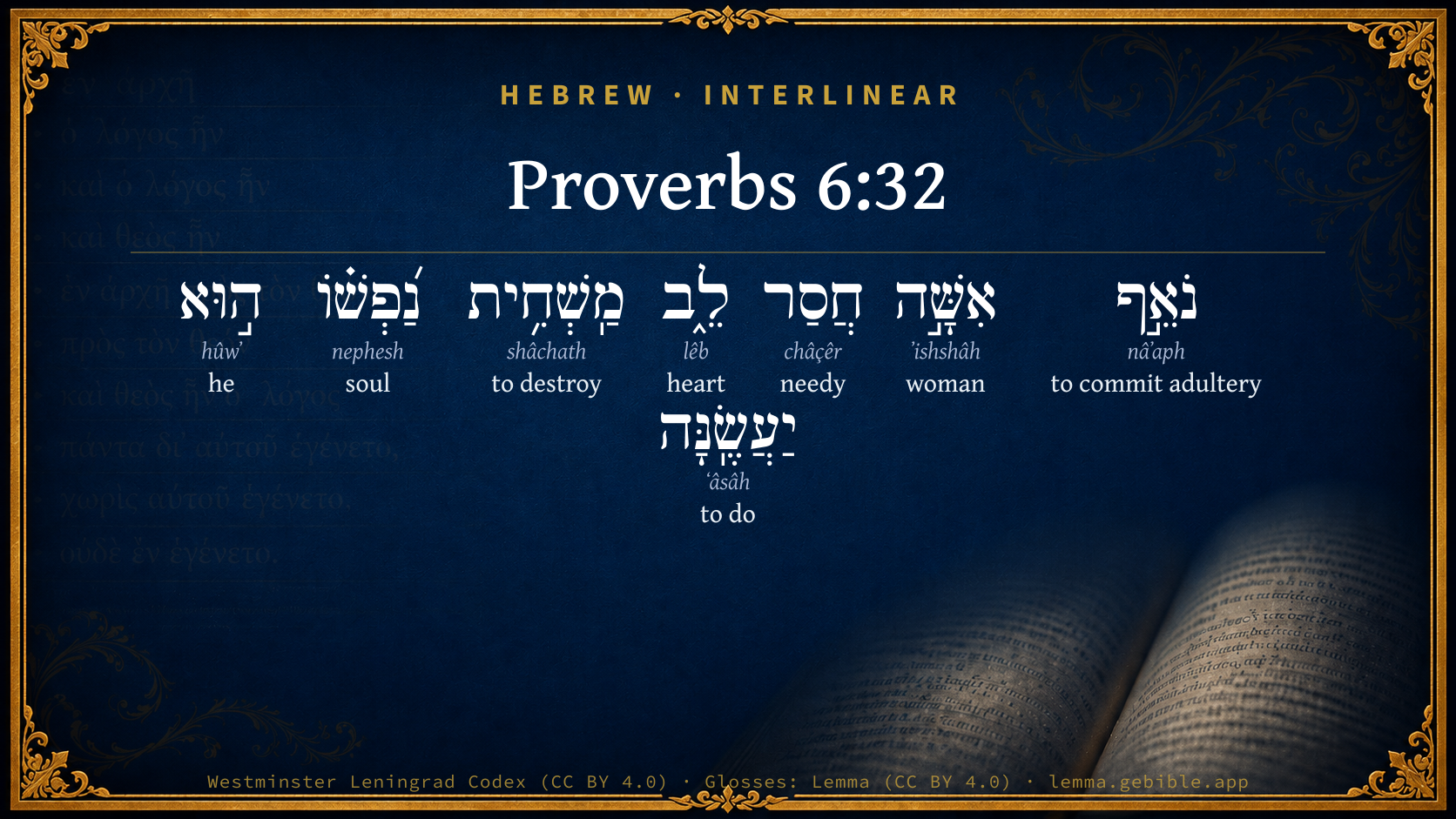
Proverbs 6:32

Hebrew (Westminster Leningrad Codex) Proverbs 6:32 appears in the Hebrew Old Testament. The text above is from the Westminster Leningrad Codex. Each word links to its Strong’s number, a concise gloss, and parsing drawn from the Open Scriptures Hebrew Bible morphology. Click any word for its full Brown-Driver-Briggs (BDB) entry.
Download image
Cite this verse

Proverbs 6:32 (World English Bible). Public Domain. Lemma interlinear Bible study tool, https://lemma.gebible.app/v/proverbs/6/32.

Show BibTeX & RIS
BibTeX
RIS
English Translation
He who commits adultery with a woman is void of understanding. He who does it destroys his own soul.
World English Bible · Public Domain
Download a study sheet

One document with this verse’s original text, its word-by-word gloss line, the meaning frame, cross-references with their text, attributed commentary, and full source and license credits — printable, and it pastes into notes with its structure intact.

This verse Autodidact and up

Study sheet (.html) Plain text (.txt)

A passage Seminary Student

Up to 50 verses in one chapter. A passage sheet keeps up to 6 commentary sources and 12 cross-references per verse, in the order this page ranks them, and says so on the sheet whenever that leaves anything out. Ask for a single verse and you get the Autodidact verse sheet above.

Everything on this page stays free to read, with no account — the sheet is a download of what is already on screen, not access to it.

Want to remove ads? Support Godless Engineer
Compare translations 3

The same verse in 3 English versions, stacked beneath the original-language interlinear above. Click any original word for its lexicon entry.

Each is an independent rendering of the whole verse — the interlinear is not word-aligned to these translations.

Highlighted words mark where these versions differ — a whole-verse word diff, not a word-by-word alignment.

  • World English Bible Public Domain
    He who commits adultery with a woman is void of understanding. He who does it destroys his own soul.
  • King James Version Public Domain
    But whoso committeth adultery with a woman lacketh understanding: he that doeth it destroyeth his own soul.
  • unfoldingWord Literal Text CC BY-SA 4.0
    One who commits adultery a woman lacking of heart; destroying his life, he does it.

unfoldingWord Literal Text — © unfoldingWord, licensed CC BY-SA 4.0. Word-aligned USFM3 via Door43 (git.door43.org/unfoldingWord/en_ult).

Versions to compare (up to 4)

3 of 4 selected

Show all 18 translations

Every available English version of this verse, each an independent rendering of the whole verse.

  • World English Bible Public Domain
    He who commits adultery with a woman is void of understanding. He who does it destroys his own soul.
  • Berean Standard Bible Public Domain
    He who commits adultery lacks judgment; whoever does so destroys himself.
  • Majority Standard Bible Public Domain
    He who commits adultery lacks judgment; whoever does so destroys himself.
  • King James Version Public Domain
    But whoso committeth adultery with a woman lacketh understanding: he that doeth it destroyeth his own soul.
  • American Standard Version (1901) Public Domain
    He that committeth adultery with a woman is void of understanding: He doeth it who would destroy his own soul.
  • Revised Version (1885) Public Domain
    He that committeth adultery with a woman is void of understanding: he doeth it that would destroy his own soul.
  • Geneva Bible (1599) Public Domain
    But he that committeth adulterie with a woman, he is destitute of vnderstanding: he that doeth it, destroyeth his owne soule.
  • Douay-Rheims (1899) Public Domain
    But he that is an adulterer, for the folly of his heart shall destroy his own soul:
  • Young's Literal Translation Public Domain
    He who committeth adultery `with' a woman lacketh heart, He is destroying his soul who doth it.
  • Literal Standard Version CC BY-SA 4.0
    He who commits adultery [with] a woman lacks heart, || He who does it is destroying his soul.
  • Unlocked Literal Bible CC BY-SA 4.0
    The one who commits adultery has no sense; the one who does it destroys himself.
  • unfoldingWord Literal Text CC BY-SA 4.0
    One who commits adultery a woman lacking of heart; destroying his life, he does it.
  • Darby Bible Public Domain
    Whoso committeth adultery with a woman is void of understanding: he that doeth it destroyeth his own soul.
  • World Messianic Bible Public Domain
    He who commits adultery with a woman is void of understanding. He who does it destroys his own soul.
  • Webster's Bible Public Domain
    But whoever committeth adultery with a woman lacketh understanding: he that doeth it destroyeth his own soul.
  • Free Bible Version CC BY-SA 4.0
    Any man who commits adultery with a woman has no sense; he who does so destroys himself.
  • Bible in Basic English Public Domain
    He who takes another man's wife is without all sense: he who does it is the cause of destruction to his soul.
  • JPS Tanakh (1917) Public Domain
    He that committeth adultery with a woman lacketh understanding; he doeth it that would destroy his own soul.

Literal Standard Version (2020), Covenant Press — licensed CC BY-SA 4.0. Text via the HelloAO Bible API (eBible.org). Unlocked Literal Bible (unfoldingWord) — licensed CC BY-SA 4.0. Text via the HelloAO Bible API (eBible.org). unfoldingWord Literal Text — © unfoldingWord, licensed CC BY-SA 4.0. Word-aligned USFM3 via Door43 (git.door43.org/unfoldingWord/en_ult). Free Bible Version, Dr. Jonathan Gallagher — licensed CC BY-SA 4.0. Text via the HelloAO Bible API (eBible.org).

Word by word

More ways to search: Search by grammar → Find every occurrence → Compare this word →

Practice this passage: Drill this verse → Learn its vocabulary →

About this verse

These counts appear in no published source. They are computed here, from the morphology-tagged text and Lemma’s own curated glosses. What Lemma adds →

8
words
8
distinct lemmas
Wisdom
section

Notable vocabulary

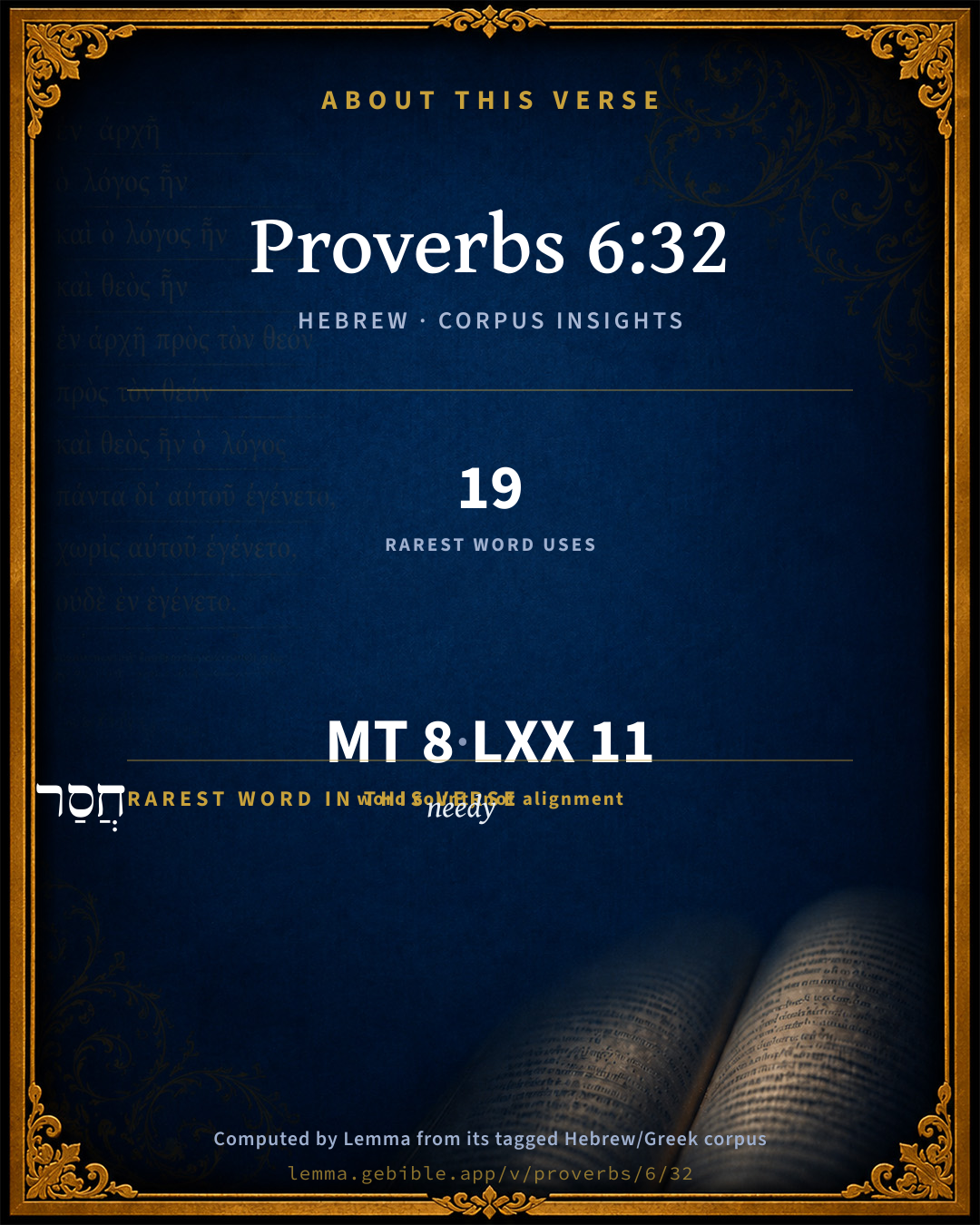
The rarest word here is חֲסַר needy H2638 — appearing just 19 times in the whole Hebrew Bible.

Shared distinctive vocabulary

חֲסַר needy H2638 occurs in 19 verses of the Hebrew Bible. Also found in:

Grammatical profile

  • 3 verbs
  • 3 nouns
  • 1 adjective
  • 1 pronoun

Verb forms

  • נֹאֵ֣ף Qal · Participle Active
  • מַֽשְׁחִ֥ית Hiphil · Participle Active
  • יַעֲשֶֽׂנָּה Qal · Imperfect

Hebrew & Septuagint length

In English translation the verse runs 19 words from the Hebrew and 12 from the Septuagint (LXX English) — the Septuagint runs noticeably shorter here. See the side-by-side →

A rough comparison of the two English renderings, which tokenize alike — not a word-level alignment.

Word counts can differ between the Hebrew and the Greek without any difference in meaning — e.g. the Hebrew direct-object marker אֵת has no separate Greek word, and Greek often adds the article ὁ.

In the original languages it is 8 Hebrew tokens and 11 Greek tokens — but the two are counted differently (Hebrew bundles its prefixes and suffixes into one token; the Greek is in lemma form), so that isn’t a like-for-like length.

Cross-references

18

Topical passages linked to Proverbs 6:32 in the Treasury of Scripture Knowledge — connected by theme and wording, ordered by reader-vote popularity; previews shown in the World English Bible.

  • Proverbs 7:7 I saw among the simple ones. I discerned among the youths a young man void of understanding,
  • Proverbs 7:22–23 He followed her immediately, As an ox goes to the slaughter, As a fool stepping into a noose.
  • Hebrews 13:4 Let marriage be held in honor among all, and let the bed be undefiled: but God will judge the sexually immoral and adulterers.
  • Romans 1:22–24 Professing themselves to be wise, they became fools,
  • Proverbs 2:18–19 For her house leads down to death, Her paths to the dead.
  • Ecclesiastes 7:25–26 I turned around, and my heart sought to know and to search out, and to seek wisdom and the scheme of things, and to know that wickedness is stupidity, and that foolishness is madness.
  • Genesis 39:9–10 He isn't greater in this house than I, neither has he kept back anything from me but you, because you are his wife. How then can I do this great wickedness, and sin against God?"
  • Genesis 41:39 Pharaoh said to Joseph, "Because God has shown you all of this, there is none so discreet and wise as you.
  • Exodus 20:14 "You shall not commit adultery.
  • Proverbs 5:22–23 The evil deeds of the wicked ensnare him. The cords of his sin hold him firmly.
  • Proverbs 8:36 But he who sins against me wrongs his own soul. All those who hate me love death."
  • Proverbs 9:4 "Whoever is simple, let him turn in here!" As for him who is void of understanding, she says to him,
  • Proverbs 9:16–18 "Whoever is simple, let him turn in here." As for him who is void of understanding, she says to him,
  • Jeremiah 5:8 They were as fed horses roaming at large; everyone neighed after his neighbor's wife.
  • Jeremiah 5:21 Hear now this, foolish people, and without understanding; who have eyes, and don't see; who have ears, and don't hear:
  • Ezekiel 18:31 Cast away from you all your transgressions, in which you have transgressed; and make you a new heart and a new spirit: for why will you die, house of Israel?
  • Hosea 4:11–12 Prostitution, wine, and new wine take away understanding.
  • Hosea 13:9 You are destroyed, Israel, because you are against me, Against your help.

Cross-references courtesy of OpenBible.info (CC BY 4.0).

Hebrew and Greek witnesses Masoretic Hebrew ↔ Greek Septuagint

The same verse in the two great witnesses to the Old Testament, shown verse-for-verse.

Here the Septuagint runs noticeably shorter than the Hebrew — LXX2012 (modern English Septuagint) 12 words vs World English Bible 19. A rough length comparison of the two English translations, not a word-level alignment — read both below.

These are two independent witnesses, not word-aligned to each other, and the Septuagint is shown in lemma (dictionary) form.

Hebrew Proverbs 6:32 Masoretic · Westminster Leningrad Codex

נֹאֵ֣ף אִשָּׁ֣ה חֲסַר לֵ֑ב מַֽשְׁחִ֥ית נַ֝פְשׁ֗וֹ ה֣וּא יַעֲשֶֽׂנָּה

He who commits adultery with a woman is void of understanding. He who does it destroys his own soul.

World English Bible · Public Domain

Greek LXX Proverbs 6:32 Septuagint · lemma form

ὁ δέ μοιχός διά ἔνδεια φρήν ἀπώλεια ὁ ψυχή αὐτός περιποιέω

But the adulterer through lack of sense procures destruction to his soul.

LXX2012 (modern English Septuagint) · Public Domain

On this verse, The Pulpit Commentary discusses the Septuagint’s reading. Read the note in Commentary ↓

Hebrew: Westminster Leningrad Codex (CC BY 4.0). Greek: Septuagint (public domain); English from LXX2012 (modern English Septuagint) (Public Domain). How the Septuagint differs from the Hebrew →

Commentary

Notes on Proverbs 6:32 from classic Christian and Jewish commentators (each source and its license shown beneath its notes). The classic Christian expositions comment on the surrounding passage and are grouped to its opening verse, so a note may address several verses; the Jewish commentaries on the Tanakh (Rashi and others) are per-verse, so they appear only where the commentator wrote on this verse.

Lemma curates 59 commentaries, every one of them public domain or Creative Commons licensed, each selected and text-cleaned for this edition rather than reprinted as found. About our sources →

Trapp's Complete Commentary

John Trapp

Pro 6:32 [But] whoso committeth adultery with a woman lacketh understanding: he [that] doeth it destroyeth his own soul.

Ver. 32. Lacketh understanding.] Being wholly carried by sensual appetite, against the dictates both of religion and of reason. Beetles love dunghills better than ointments, and swine love mud better than a garden. Luther tells of a certain noble in his country so besotted with the sin of whoredom, he was not ashamed to say, that if he might ever live here, and be carried from one whore house to another, there to satisfy his lusts, he would never desire any other heaven. This filthy man did afterwards breathe out his wretched soul between two notorious harlots.

Destroyeth his own soul.] It is not therefore leve peccatum, a small sin, as the pope’s canonists call it. {a} Divine justice doth not use to kill flies with beetles.

{a} Loniceri Theat. Histor., p. 568.

John Trapp, A Commentary or Exposition upon All the Books of the Old and New Testament (1647–1656) — public domain. Text from a community e-Sword module.

The Biblical Illustrator

Joseph S. Exell

Pro_6:32

He that doeth it destroyeth his own soul.

The suicide of the soul

Lovely as maiden purity is, and crowned with benedictions though it is by Christ, we have here to learn its excellence and fear its loss, by the sad, stern picture of impurity and shameless sin. In these sad proverbs of purity the wise man pictures to us in fearful personification wisdoms rival standing in the same great thoroughfares of earth and bidding to her shameful pleasures the simple youth who throng the broad and crowded way. This is no fancy picture allegorising the dangers of youth. It is drawn from reality, from every-day life. There is no mistake in the outline, no exaggeration in the colouring. The power of sin lies in its pleasure. They are mistaken who assert that there are no gratifications in the enjoyments of sense. Were there none, they would not be so diligently sought. Sin, which brings death to the soul, is yet sweet to the taste. The more we sin the more perverted becomes our taste, the more clamorous for further indulgence. But these stolen waters of sinful pleasure are not always sweet. Pleasant though they may be at the first, they will yet become bitter indeed. Much of the sinners peril grows out of his simple ignorance. Sin naturally brings with it temporal and physical suffering. But the pleasures of the sensualist are the preludes to a misery words refuse to paint. The sentence that to the defiled and unbelieving nothing is pure is fulfilled to the letter. Even the innocent pleasures of conversation become to the sensualist defiling, for he turns them into the foul channel of his own base thought. The mind and conscience of the impure are defiled. The mental faculties of the depraved and sensual lose at once and for ever the power of discerning and appreciating that which is excellent, lovely, and true. The deep things of God are no subjects for the lover of sensual sin to dwell upon. Sensuality not only prevents us from exercising our mental powers with freedom and profit, but it also wastes and enfeebles those powers themselves. Long since has this enfeebling of the intellectual man been noticed as the result of impurity of life. The sensualist must make his choice between intellect and mental imbecility. If any man defile the temple of God, which is our body, him will God destroy. This avenging work of destruction is well-nigh accomplished here on earth. Body, spirit, and soul--all is impure. But to the pure all things are pure. Unheeding the solicitations of the wanton, they go straight on their way. And this purity may be ours. Not indeed gained by our own strength, nor by any strength save that which is found at the foot of the Cross. Why may we not thus purify ourselves? To the life of purity we are called throughout the Book of Proverbs, and the cry of heavenly Wisdom is, Seek early, for the early seekers shall find. (Bp. William Stevens Perry.)

.

The Biblical Illustrator, edited by Joseph S. Exell (c. 1880s–1900s) — public domain. Text from a community e-Sword module.

Keil & Delitzsch

C. F. Keil & F. Delitzsch

Here there is a contrast stated to Pro 6:30 :

32 He who commits adultery (adulterans mulierem) is beside himself,

A self-destroyer-who does this.

33 He gains stripes and disgrace,

And his reproach is never quenched.

נאף, which primarily seems to mean excedere, to indulge in excess, is, as also in the Decalogue, cf. Lev 20:10, transitive: ὁ μοιχεύων γυναῖκα. Regarding being mad (herzlos = heartless) = amens (excors, vecors), vid., Psychologie, p. 254. משׁחית נפשׁו is he who goes to ruin with wilful perversity. A self-murderer - i.e., he intends to ruin his position and his prosperity in life - who does it, viz., this, that he touches the wife of another. It is the worst and most inextinguishable dishonouring of oneself. Singularly Behaji: who annihilates it (his soul), with reference to Deu 21:12. Eccl. 4:17, where עשׂה would be equivalent to בּטּל, καταργεῖν, which is untrue and impossible.

(Note: Behaji ought rather to have referred to Zep 3:19; Eze 7:27; Eze 22:14; but there עשׂה את means agere cum aliquo, as we say: mit jemandem abrechnen (to settle accounts with any one).)

נגע refers to the corporal punishment inflicted on the adulterer by the husband (Deu 17:8; Deu 21:5); Hitzig, who rejects Pro 6:32, refers it to the stripes which were given to the thief according to the law, but these would be called מכּה (מכּות). The punctuation נגע־וקלון is to be exchanged for קלונו נגע (Lwenstein and other good editors). מצא has a more active signification than our "finden" (to find): consequitur, τυγχάνει.

Keil & Delitzsch — Biblical Commentary on the Old Testament (1861–1891) — public domain (CC PDM 1.0). Text via the HelloAO Bible API. (Old Testament only.)

Tyndale Open Study Notes

Tyndale Open Resources

6:32-35 A thief might be punished severely even if he had a reason for his actions, but his punishment is nothing compared to an adulterer’s, who has no excuse for his crime. A jealous husband will seek the full punishment provided by law, which is death (Deut 22:22).

Tyndale Open Study Notes — © Tyndale Open Resources, licensed CC BY-SA 4.0. Text via the HelloAO Bible API.

Geneva Bible (1599)

Geneva Bible translators

Hebrew, faileth in heart.

Geneva Bible (1599) marginal notes — public domain. Text via Bolls.life.

Jamieson, Fausset & Brown

Robert Jamieson, A. R. Fausset & David Brown

lacketh understanding--or, "heart"; destitute of moral principle and prudence.

Jamieson, Fausset & Brown — Commentary Critical and Explanatory on the Whole Bible (1871) — public domain (CC PDM 1.0). Text via the HelloAO Bible API.

Adam Clarke's Commentary

Verse 32. But whoso committeth adultery] The case understood is that of a married man: he has a wife; and therefore is not in the circumstances of the poor thief, who stole to appease his hunger, having nothing to eat. In this alone the opposition between the two cases is found: the thief had no food, and he stole some; the married man had a wife, and yet went in to the wife of his neighbour.

Destroyeth his own soul.] Sins against his life, for, under the law of Moses, adultery was punished with death; Le 20:10; De 22:22.

Adam Clarke's Commentary on the Bible (1810–1826) — public domain. Text from a community e-Sword/MySword module.

The Cambridge Bible for Schools and Colleges

gen. ed. J. J. S. Perowne

32. understanding] Lit. heart. See Pro_2:2, note.

he that doeth it destroyeth] Rather, he doeth it that would destroy.

The Cambridge Bible for Schools and Colleges (gen. ed. J. J. S. Perowne; Cambridge University Press, 1878–1918) — public domain. Text from a community e-Sword module.

John Gill's Exposition

A wound and dishonour shall he get,.... A wound, stroke, or blow, either from the husband of the strumpet, as was often the case (x) in later times; or from the civil magistrate, being ordered by him to be beaten (y) or stoned; or from God himself inflicting diseases on him; see Gen 12:17; where the same word is used as here: and "dishonour" from men; for though they do not despise a thief in circumstances before related, yet they will despise an adulterer, and speak reproachfully of him, whenever they have occasion to make mention of him;

and his reproach shall not be wiped away; as long as he lives, though his life may be spared; yea, it shall even continue after death; and though he may repent of his sin and reform, as in the case of David.

(x) "Secat ille cruentis verberibus", Juvenal. Satyr. 10. v. 316. Vid. A. Gell. Noct. Attic. l. 17. c. 18. Horat. Satyr. l. 1. Sat. 2. v. 41, 42. (y) Valer. Maximus, l. 6. c. 1. s. 13.

John Gill's Exposition of the Whole Bible (1746–1763) — public domain (CC PDM 1.0). Text via the HelloAO Bible API.

Haydock's Catholic Bible Commentary

Folly. Literally, "want," inopiam. Hebrew, "is faint-hearted, corrupting his own soul, he will do that." (Haydock)

George Leo Haydock (1774–1849), Haydock's Catholic Family Bible and Commentary, 1859 edition — public domain. Excludes Psalms (Douay-Rheims chapter numbering differs from Protestant) and Deuterocanonical books (Catholic canon only).

Matthew Poole's English Annotations

Lacketh understanding; is a brutish and silly man, who madly rusheth upon these filthy courses, without any sense or consideration of the horrid shame and certain destruction which attends upon them.

Destroyeth his own soul, or life; is guilty of self-murder and of soul-murder.

Matthew Poole's English Annotations on the Holy Bible (1683–1685) — public domain. Text from a community e-Sword/MySword module.

Whedon's Commentary on the Bible

Daniel D. Whedon

32. Whose committeth adultery, taking all the circumstances and consequences into the account, acts like a madman or simpleton — like one who seeks to destroy his own life. Unlike the thief who steals to satisfy his hunger, he unnecessarily robs a man of his wife, and when discovered will not merely lose his property, but forfeit his life. See Lev_20:10; Deu_22:22. The argument here is a fortiori, from the less to the greater. If a thief is punished for stealing to satisfy his hunger, how much more the adulterer!

Daniel D. Whedon (gen. ed.), Commentary on the Old and New Testaments (1874–1909) — public domain. Text from a community e-Sword module.

The Pulpit Commentary

But whoso committeth adultery with a woman lacketh understanding. The adversative "but" is wanting in the original, but is clearly demanded by the contrast which is instituted. The man who steals from hunger has a motive for so doing, but the adulterer has no such excuse for his crime, which is an unwarrantable invasion of his neighbour"s rights. Because there are honest ways for satisfying his desires, he therefore "lacketh understanding." Committeth adultery with a woman; Hebrew, noeph ishshah; LXX, o moicov ; Vulgate, qui adulter est; i.e. an adulterer. The Hebrew naaph, "to commit adultery," is here followed by an accusative, as in Lev_20:10 and Jer_29:23. Lacketh understanding; Hebrew, khasar-lev; deficit corde. The verb khaser is "to be devoid of anything," "to lack." The expression, which occurs again in Pro_7:7 and Pro_9:4, refers to the brutish and stupid condition to which lust has reduced him. Lust has displaced right reason. He is expers judicii (Syriac), devoid of judgment, without intelligence, senseless and stupid. In modern phraseology, he has taken leave of his senses. Both the LXX and Vulgate have combined the two branches of this verse, the former rendering, "But the adulterer, on account of want of intelligence, compasses the loss of his life," and the latter, "But the adulterer, on account of want of intelligence, loses his life." He that doeth it destroyeth his own soul; or literally, whoso will destroy his life he will do this, i.e. adultery. So Ariae Montani, Munsterus, Chaldee Targum. The man who commits adultery is a self-murderer. The phrase, mashkith naph"sho, corrumpens animam suam, may be resolved into the concrete "a self-destroyer," as Delitzsch. The following verses seem to indicate that it is the temporal life which is referred to in nephesh, but the meaning of the term may be extended to embrace not only physical loss of life, but also moral and spiritual loss. By the Levitical Law adultery was punished by death: "The man that committeth adultery with another man"s wife ... the adulterer and adulteress shall surely be put to death". (Lev_20:10; cf. Deu_22:22Jo Deu_8:4, Deu_8:5; see also 1Th_4:6)

The Pulpit Commentary (1880–1919), ed. H.D.M. Spence-Jones & Joseph S. Exell — public domain. Text from a community e-Sword module.

unfoldingWord translationNotes

Door43 World Missions Community

The one

"The person" or "The man"

what he deserves

"the appropriate punishment for what he has done"

his disgrace

This figure of speech is using the term "disgrace" to refer to the feeling of him acting shamefully. AT: "the memory of his shameful act" (See: Metonymy)

will not be wiped away

This figure of speech is using the negative "will not be wiped away" to refer to it always being there. AT: "will always remain" (See: Litotes)

translationWords

adultery

shame

unfoldingWord translationNotes — © Distant Shores Media and the Door43 World Missions Community, licensed CC BY-SA 4.0. Source: git.door43.org/Door43/en_tn.

Rashi

Rabbi Shlomo Yitzchaki (Rashi)

One who commits adultery with a woman is devoid of sense since he does not do it because of hunger.

one who would destroy his soul—he will do it The lewd act.

Rashi on the Tanakh — English translations: “The Judaica Press complete Tanach with Rashi, translated by A. J. Rosenberg” (CC BY 4.0); “Pentateuch with Rashi's commentary by M. Rosenbaum and A.M. Silbermann, 1929-1934” (public domain); “The Metsudah Tanach series, Lakewood, N.J” (CC BY 4.0); and “The Book of Joshua, Metsudah Publications, 1997” (CC BY 4.0). Text via Sefaria.

Lesson kit

Teaching starters — assembled from the data on this page, not authored interpretation. Every prompt links to the verse data it draws on. Edit before teaching.

Proverbs, in the Wisdom, opens this verse with 8 words (8 distinct Hebrew lemmas). Its most distinctive word is châçêr (“needy”). The Greek Septuagint runs shorter here. A historical commentator’s framing appears above. Read the whole chapter for the surrounding context.

Discussion questions

  1. How does “needy” (châçêr) shape what this verse is saying?
  2. 1 Samuel 21:15 shares the word «needy» with this verse. How do the two illuminate each other?
  3. Compared with the Hebrew, the Septuagint runs shorter here. What questions does that raise?
  4. These translations render this verse differently. What is at stake in choosing one wording over another?
  5. The verb «נֹאֵ֣ף» is Qal Participle Active. How does its form color the action?
  6. Reading how Trapp's Complete Commentary and The Biblical Illustrator read this verse, where do the two commentators agree and where do they part?

Things to notice

Reading settings

Reading text

Shown beneath each verse's original-language words.

Old Testament
Old Testament edition

Read the OT as the Masoretic Hebrew (MT) or the Greek Septuagint (LXX).

English shown for the Greek Septuagint (in the Hebrew ↔ Greek comparison).

Comparing translations? Open the Compare panel on any verse page to stack up to four side by side.