
Job 33:18

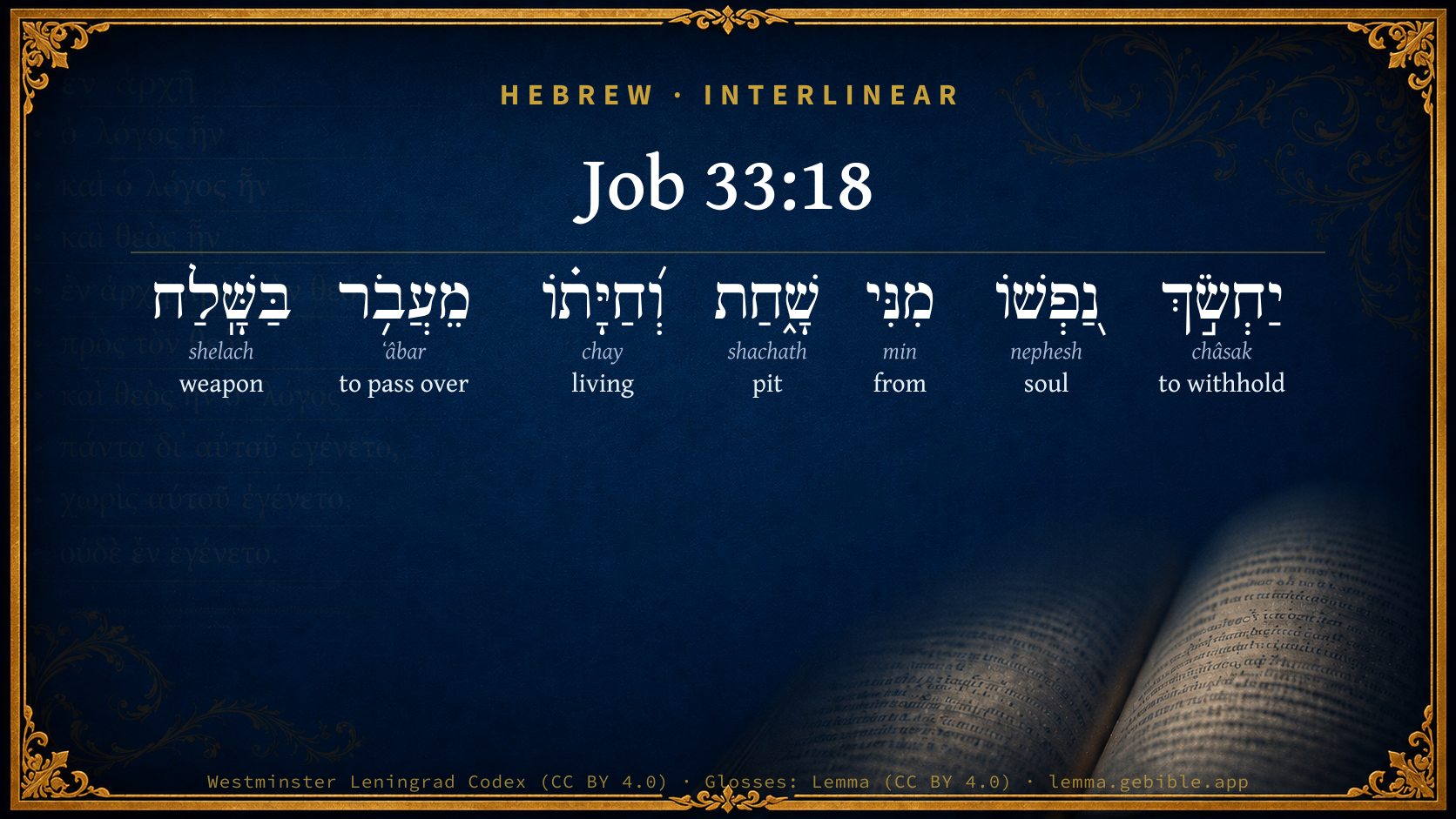
Hebrew (Westminster Leningrad Codex) Job 33:18 appears in the Hebrew Old Testament. The text above is from the Westminster Leningrad Codex. Each word links to its Strong’s number, a concise gloss, and parsing drawn from the Open Scriptures Hebrew Bible morphology. Click any word for its full Brown-Driver-Briggs (BDB) entry.
Download image
Cite this verse

Job 33:18 (World English Bible). Public Domain. Lemma interlinear Bible study tool, https://lemma.gebible.app/v/job/33/18.

Show BibTeX & RIS
BibTeX
RIS
English Translation
He keeps back his soul from the pit, And his life from perishing by the sword.
World English Bible · Public Domain
Download a study sheet

One document with this verse’s original text, its word-by-word gloss line, the meaning frame, cross-references with their text, attributed commentary, and full source and license credits — printable, and it pastes into notes with its structure intact.

This verse Autodidact and up

Study sheet (.html) Plain text (.txt)

A passage Seminary Student

Up to 50 verses in one chapter. A passage sheet keeps up to 6 commentary sources and 12 cross-references per verse, in the order this page ranks them, and says so on the sheet whenever that leaves anything out. Ask for a single verse and you get the Autodidact verse sheet above.

Everything on this page stays free to read, with no account — the sheet is a download of what is already on screen, not access to it.

Want to remove ads? Support Godless Engineer
Compare translations 3

The same verse in 3 English versions, stacked beneath the original-language interlinear above. Click any original word for its lexicon entry.

Each is an independent rendering of the whole verse — the interlinear is not word-aligned to these translations.

Highlighted words mark where these versions differ — a whole-verse word diff, not a word-by-word alignment.

  • World English Bible Public Domain
    He keeps back his soul from the pit, And his life from perishing by the sword.
  • King James Version Public Domain
    He keepeth back his soul from the pit, and his life from perishing by the sword.
  • unfoldingWord Literal Text CC BY-SA 4.0
    He spares his soul from the pit and his life from crossing over by a weapon.

unfoldingWord Literal Text — © unfoldingWord, licensed CC BY-SA 4.0. Word-aligned USFM3 via Door43 (git.door43.org/unfoldingWord/en_ult).

Versions to compare (up to 4)

3 of 4 selected

Show all 18 translations

Every available English version of this verse, each an independent rendering of the whole verse.

  • World English Bible Public Domain
    He keeps back his soul from the pit, And his life from perishing by the sword.
  • Berean Standard Bible Public Domain
    to preserve his soul from the Pit and his life from perishing by the sword.
  • Majority Standard Bible Public Domain
    to preserve his soul from the Pit and his life from perishing by the sword.
  • King James Version Public Domain
    He keepeth back his soul from the pit, and his life from perishing by the sword.
  • American Standard Version (1901) Public Domain
    He keepeth back his soul from the pit, And his life from perishing by the sword.
  • Revised Version (1885) Public Domain
    He keepeth back his soul from the pit, and his life from perishing by the sword.
  • Geneva Bible (1599) Public Domain
    And keepe backe his soule from the pit, and that his life should not passe by the sword.
  • Douay-Rheims (1899) Public Domain
    Rescuing his soul from corruption: and his life from passing to the sword.
  • Young's Literal Translation Public Domain
    He keepeth back his soul from corruption, And his life from passing away by a dart.
  • Literal Standard Version CC BY-SA 4.0
    He keeps back his soul from corruption, || And his life from passing away by a dart.
  • Unlocked Literal Bible CC BY-SA 4.0
    God keeps man's life back from the pit, his life from crossing over to death.
  • unfoldingWord Literal Text CC BY-SA 4.0
    He spares his soul from the pit and his life from crossing over by a weapon.
  • Darby Bible Public Domain
    He keepeth back his soul from the pit, and his life from passing away by the sword.
  • World Messianic Bible Public Domain
    He keeps back his soul from the pit, and his life from perishing by the sword.
  • Webster's Bible Public Domain
    He keepeth back his soul from the pit, and his life from perishing by the sword.
  • Free Bible Version CC BY-SA 4.0
    He saves them from the grave and spares them from violent death.
  • Bible in Basic English Public Domain
    To keep back his soul from the underworld, and his life from destruction.
  • JPS Tanakh (1917) Public Domain
    That He may keep back his soul from the pit, and his life from perishing by the sword.

Literal Standard Version (2020), Covenant Press — licensed CC BY-SA 4.0. Text via the HelloAO Bible API (eBible.org). Unlocked Literal Bible (unfoldingWord) — licensed CC BY-SA 4.0. Text via the HelloAO Bible API (eBible.org). unfoldingWord Literal Text — © unfoldingWord, licensed CC BY-SA 4.0. Word-aligned USFM3 via Door43 (git.door43.org/unfoldingWord/en_ult). Free Bible Version, Dr. Jonathan Gallagher — licensed CC BY-SA 4.0. Text via the HelloAO Bible API (eBible.org).

Word by word

More ways to search: Search by grammar → Find every occurrence → Compare this word →

Practice this passage: Drill this verse → Learn its vocabulary →

About this verse

These counts appear in no published source. They are computed here, from the morphology-tagged text and Lemma’s own curated glosses. What Lemma adds →

7
words
7
distinct lemmas
Wisdom
section

Notable vocabulary

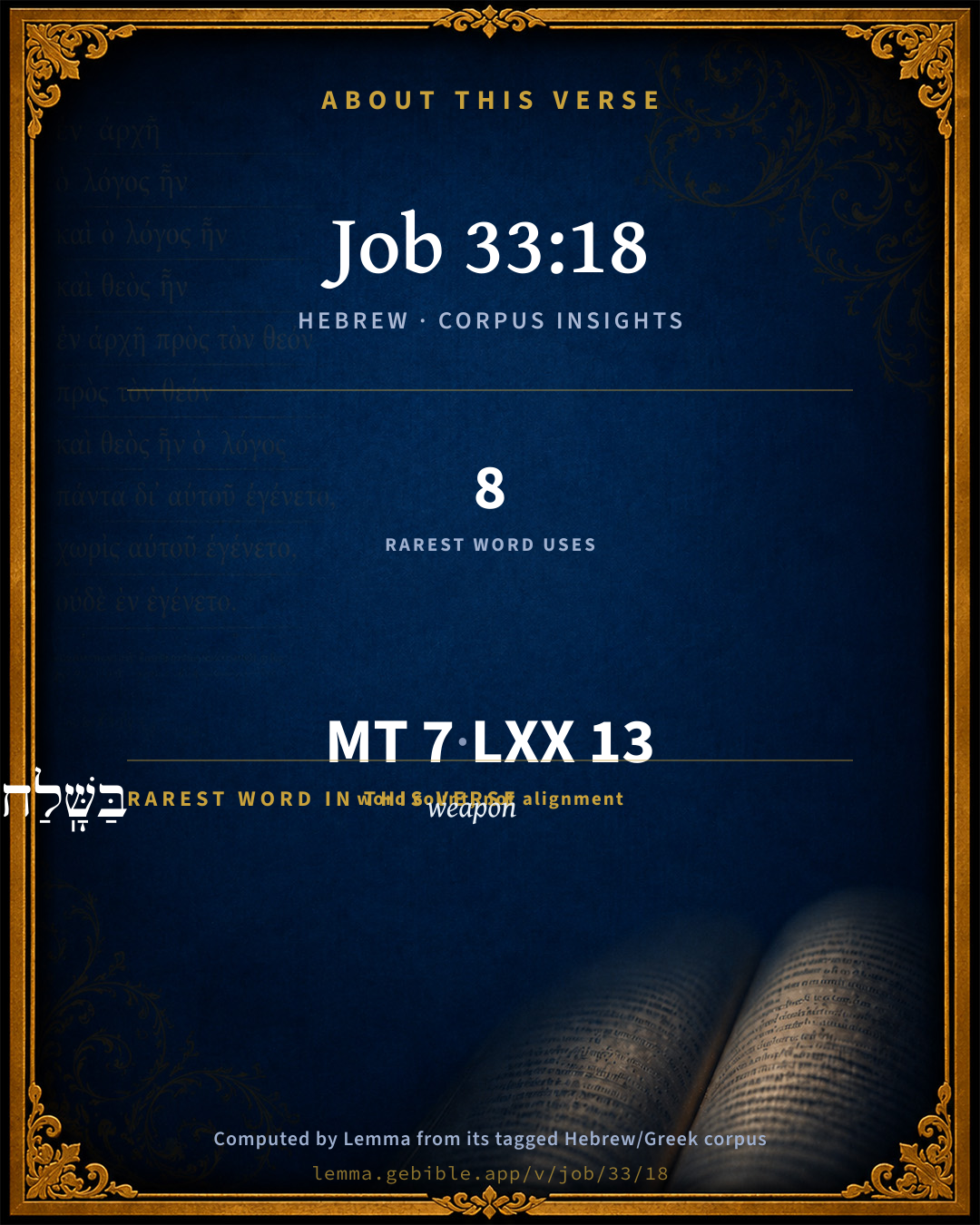
The rarest word here is בַּשָּֽׁלַח weapon H7973 — appearing just 8 times in the whole Hebrew Bible.

Shared distinctive vocabulary

בַּשָּֽׁלַח weapon H7973 occurs in 8 verses of the Hebrew Bible. Also found in:

Grammatical profile

  • 2 verbs
  • 4 nouns
  • 1 preposition

Verb forms

  • יַחְשֹׂ֣ךְ Qal · Imperfect
  • מֵעֲבֹ֥ר Qal · Infinitive Construct

Hebrew & Septuagint length

In English translation the verse runs 16 words from the Hebrew and 15 from the Septuagint (LXX English) — closely comparable.

A rough comparison of the two English renderings, which tokenize alike — not a word-level alignment.

Word counts can differ between the Hebrew and the Greek without any difference in meaning — e.g. the Hebrew direct-object marker אֵת has no separate Greek word, and Greek often adds the article ὁ.

In the original languages it is 7 Hebrew tokens and 13 Greek tokens — but the two are counted differently (Hebrew bundles its prefixes and suffixes into one token; the Greek is in lemma form), so that isn’t a like-for-like length.

Cross-references

9

Topical passages linked to Job 33:18 in the Treasury of Scripture Knowledge — connected by theme and wording, ordered by reader-vote popularity; previews shown in the World English Bible.

  • Job 33:28 He has redeemed my soul from going into the pit, My life shall see the light.'
  • Job 33:30 To bring back his soul from the pit, That he may be enlightened with the light of the living.
  • Romans 2:4 Or do you despise the riches of his goodness, forbearance, and patience, not knowing that the goodness of God leads you to repentance?
  • 2 Peter 3:9 The Lord is not slow concerning his promise, as some count slowness; but is patient with us, not wishing that any should perish, but that all should come to repentance.
  • Job 15:22 He doesn't believe that he shall return out of darkness, He is waited for by the sword.
  • Job 33:22 Yes, his soul draws near to the pit, And his life to the destroyers.
  • Job 33:24 Then God is gracious to him, and says, 'Deliver him from going down to the pit, I have found a ransom.'
  • Acts 16:27–33 The jailer, being roused out of sleep and seeing the prison doors open, drew his sword and was about to kill himself, supposing that the prisoners had escaped.
  • 2 Peter 3:15 Regard the patience of our Lord as salvation; even as our beloved brother Paul also, according to the wisdom given to him, wrote to you;

Cross-references courtesy of OpenBible.info (CC BY 4.0).

Hebrew and Greek witnesses Masoretic Hebrew ↔ Greek Septuagint

The same verse in the two great witnesses to the Old Testament, shown verse-for-verse.

These are two independent witnesses, not word-aligned to each other, and the Septuagint is shown in lemma (dictionary) form.

Hebrew Job 33:18 Masoretic · Westminster Leningrad Codex

יַחְשֹׂ֣ךְ נַ֭פְשׁוֹ מִנִּי שָׁ֑חַת וְ֝חַיָּת֗וֹ מֵעֲבֹ֥ר בַּשָּֽׁלַח

He keeps back his soul from the pit, And his life from perishing by the sword.

World English Bible · Public Domain

Greek LXX Job 33:18 Septuagint · lemma form

φείδομαι δέ ὁ ψυχή αὐτός ἀπό θάνατος καί μή πίπτω αὐτός ἐν πόλεμος

He spares also his soul from death, and suffers him not to fall in war.

LXX2012 (modern English Septuagint) · Public Domain

Hebrew: Westminster Leningrad Codex (CC BY 4.0). Greek: Septuagint (public domain); English from LXX2012 (modern English Septuagint) (Public Domain). How the Septuagint differs from the Hebrew →

Commentary

Notes on Job 33:18 from classic Christian and Jewish commentators (each source and its license shown beneath its notes). The classic Christian expositions comment on the surrounding passage and are grouped to its opening verse, so a note may address several verses; the Jewish commentaries on the Tanakh (Rashi and others) are per-verse, so they appear only where the commentator wrote on this verse.

Lemma curates 59 commentaries, every one of them public domain or Creative Commons licensed, each selected and text-cleaned for this edition rather than reprinted as found. About our sources →

Trapp's Complete Commentary

John Trapp

Job 33:18 He keepeth back his soul from the pit, and his life from perishing by the sword.

Ver. 18. He keepeth back his soul from the pit] Or, That he may keep back his soul, that is, his body, as Psa 16:10 Lev 21:1, from the pit; i.e. from the grave, or from the pit falls made for him by his enemies. A penitent person redeemeth his own sorrows, and provideth for his own safety, Psa 91:1-16, and accordingly some read it, He shall keep back his own soul, &c.

And his life from perishing by the sword] Whether by the sword of God or man, he shall be extra iactum, out of the gunshot or danger of any death, whether corporal or eternal. The universal antidote for all the judgments of God is our humble repentance. Aaron escaped by it, when Miriam was smitten with leprosy.

Per miserere met, tollitur ira Dei.

This is the rainbow, which if God see shining in our hearts, he will never drown our souls. Jehoshaphat by this escaped the edge of the sword; David and his poor sheep the stroke of the punishing angel; all the crowned saints now in heaven the damnation of hell, &c.

John Trapp, A Commentary or Exposition upon All the Books of the Old and New Testament (1647–1656) — public domain. Text from a community e-Sword module.

Joseph Benson's Commentary

Job 33:18-22. He keepeth back his soul from the pit — By these gracious admonitions, whereby God leads men to humiliation of soul before him, and to repentance, he preserves their lives from death and the grave, and their souls from eternal destruction. From perishing by the sword — By some dreadful judgment which was ready to fall upon them. He is chastened also with pain — With some painful and dangerous disease, which is the second way whereby God instructs men and excites them to repentance, which also was Job’s case. So that his life abhorreth bread —

In which languishing condition he loathes his food, yea, nauseates that very meat which formerly was his greatest delight. His flesh is consumed away — Through pain and pining sickness. That it cannot be seen — Because there is little or none left to be seen, but he who before was fat and flourishing is now become a mere skeleton. His soul draweth near unto the grave — He seems to himself and others to be past all hopes of recovery: which he adds for Job’s comfort in his desperate condition. And his life to the destroyers — To the instruments of death and destruction, namely, diseases, which, by God’s appointment, are ready to give the fatal blow.

Joseph Benson's Commentary on the Old and New Testaments (1811–1818) — public domain. Text from a community e-Sword module.

Tyndale Open Study Notes

Tyndale Open Resources

33:18 from crossing over the river of death: This phrase may also be translated from passing [i.e., dying] by the sword. Both translations fit the context (cp. 36:12).

Tyndale Open Study Notes — © Tyndale Open Resources, licensed CC BY-SA 4.0. Text via the HelloAO Bible API.

Jamieson, Fausset & Brown

Robert Jamieson, A. R. Fausset & David Brown

his soul--his life.

the pit--the grave; a symbol of hell.

perishing by the sword--that is, a violent death; in the Old Testament a symbol of the future punishment of the ungodly.

Jamieson, Fausset & Brown — Commentary Critical and Explanatory on the Whole Bible (1871) — public domain (CC PDM 1.0). Text via the HelloAO Bible API.

Adam Clarke's Commentary

Verse 18. He keepeth back his soul from the pit] By the above means, how many have been snatched from an untimely death! By taking the warning thus given, some have been prevented from perishing by the pit - some sudden accident; and others from the sword of the assassin or nocturnal murderer. It would be easy to give examples, in all these kinds; but the knowledge of the reader may save this trouble to the commentator.

Adam Clarke's Commentary on the Bible (1810–1826) — public domain. Text from a community e-Sword/MySword module.

John Gill's Exposition

He keepeth back his soul from the pit,.... Or, "that he may keep back" (n); for this is another end and use of God's speaking unto men; it is to preserve them for the present from going down to the grave, the pit of corruption and destruction; so called because the bodies of men, being there laid, corrupt, and are entirely destroyed by worms, and turn to rottenness and dust; and to preserve them from the bottomless pit of everlasting ruin and destruction; for the Lord's people are reproved by him, that they may not be condemned with the world, Co1 11:32;

and his life from perishing by the sword; by the sword of men, which is one of God's sore judgments; or by the sword of the civil magistrate, the man spoken to being warned of God of committing these sins, which would bring him into the hands of such; or by the sword of divine justice; Jarchi interprets it of the sword of the angel of death; the word signifies a missive weapon, as a dart; so Mr. Broughton renders the words, "and his life from going on the dart": or, as another version has it, "lest it should go on under the cast of darts" (o); the darts of an enemy in war, or the fiery darts of Satan, Eph 6:16.

(n) "ut prohibeat", Mercerus, Piscator. (o) Tigurine version.

John Gill's Exposition of the Whole Bible (1746–1763) — public domain (CC PDM 1.0). Text via the HelloAO Bible API.

Albert Barnes' Notes on the Bible

He keepeth back his soul from the pit - The word soul in the Hebrew is often equivalent to self, and the idea is, that he keeps the man from the pit in this manner. The object of these warnings is to keep him from rushing on to his own destruction. The word rendered “pit” - שׁחת shachath, properly means a pit, or pitfall, in which traps are laid for wild animals; Psa 7:15; Psa 9:15; then a cistern that is miry; Job 9:31; a prison, Isa 51:14; then the grave, or sepulchre, as being often a cavern; Job 17:13; Psa 30:9; see Job 33:28, Job 33:30. It evidently means here the grave, and the sense is, that God thus warns people against pursuing a course of conduct which would lead them to destruction, or would speedily terminate their lives.

And his life from perishing by the sword - Margin, “passing by.” The meaning of the Hebrew may be, “to keep his life from passing away by the sword;” as if the sword were the means by which the life or soul passed from the body. The word rendered sword here - שׁלח shelach is from שׁלח shâlach - to send, cast, hurl, and the reference is rather to something sent, as of an arrow, dart, javelin, than to a sword. The sense is not materially varied, and the idea referred to is that of a violent death. The meaning is, that God by these warnings would keep a man from such a course of life as would lead to a death by violence - either by punishment for his crime, or by being cut off in war.

Albert Barnes' Notes on the Bible (1834–1885) — public domain. Text from a community e-Sword/MySword module.

Matthew Poole's English Annotations

He keepeth back, to wit, by these gracious admonitions, whereby he leads them to repentance,

his soul; either the man, who is oft expressed by this part; or

his life, as the next branch explains it.

From the pit, i.e. from the grave, from death or destruction.

From perishing by the sword, i.e. by some dreadful judgment of God which was ready to fall upon him.

Matthew Poole's English Annotations on the Holy Bible (1683–1685) — public domain. Text from a community e-Sword/MySword module.

Whedon's Commentary on the Bible

Daniel D. Whedon

18. Pit — Shuhhath. In some countries, as in Athens, criminals were cast down into a deep pit. They were left in the darkness, hopelessly to die of starvation. The pit is evidently used here in the sense of destruction, and as the penalty of evildoing. The oldest of the sacred Books of the Brahmans (Rig-Veda, 9:73-78) speaks of a pit into which the lawless are hurled down, and into which Indra casts those who offer no sacrifices. (See MULLER’S Chips, 1:47.)

Daniel D. Whedon (gen. ed.), Commentary on the Old and New Testaments (1874–1909) — public domain. Text from a community e-Sword module.

The Pulpit Commentary

He keepeth back his soul from the pit, and his life from perishing by the sword. By these interpositions God may even save a man from utter ruin, when, but for them, he would have rushed upon it. He may cause a person to give up designs or enterprises which would have brought him into danger, and perhaps led to his being slain with the sword.

The Pulpit Commentary (1880–1919), ed. H.D.M. Spence-Jones & Joseph S. Exell — public domain. Text from a community e-Sword module.

John Wesley's Explanatory Notes

Keepeth - By his gracious admonitions whereby he leads him to repentance.

John Wesley, Explanatory Notes Upon the Whole Bible (1754–1765) — public domain. Text via the GEBible commentary corpus.

Rashi

Rabbi Shlomo Yitzchaki (Rashi)

and his life from perishing by the sword by the weapon and the sword of the Angel of Death; that is to say, He brought suffering upon you for your good.

by the sword Heb. בשלח, a weapon, and so in Ezra (Neh. 4:11): “and one was holding the weapon (השלח).”

Rashi on the Tanakh — English translations: “The Judaica Press complete Tanach with Rashi, translated by A. J. Rosenberg” (CC BY 4.0); “Pentateuch with Rashi's commentary by M. Rosenbaum and A.M. Silbermann, 1929-1934” (public domain); “The Metsudah Tanach series, Lakewood, N.J” (CC BY 4.0); and “The Book of Joshua, Metsudah Publications, 1997” (CC BY 4.0). Text via Sefaria.

Lesson kit

Teaching starters — assembled from the data on this page, not authored interpretation. Every prompt links to the verse data it draws on. Edit before teaching.

Job, in the Wisdom, opens this verse with 7 words (7 distinct Hebrew lemmas). Its most distinctive word is shelach (“weapon”). A historical commentator’s framing appears above. Read the whole chapter for the surrounding context.

Discussion questions

  1. What does “weapon” (shelach) contribute to the verse as a whole?
  2. 2 Chronicles 23:10 shares the word «weapon» with this verse. How do the two illuminate each other?
  3. These translations render this verse differently; the difference is in the English rendering, not the original. What questions does that raise?
  4. The verb «יַחְשֹׂ֣ךְ» is Qal Imperfect. How does its form color the action?
  5. Reading how Trapp's Complete Commentary and Joseph Benson's Commentary read this verse, where do the two commentators agree and where do they part?

Things to notice

Reading settings

Reading text

Shown beneath each verse's original-language words.

Old Testament
Old Testament edition

Read the OT as the Masoretic Hebrew (MT) or the Greek Septuagint (LXX).

English shown for the Greek Septuagint (in the Hebrew ↔ Greek comparison).

Comparing translations? Open the Compare panel on any verse page to stack up to four side by side.