
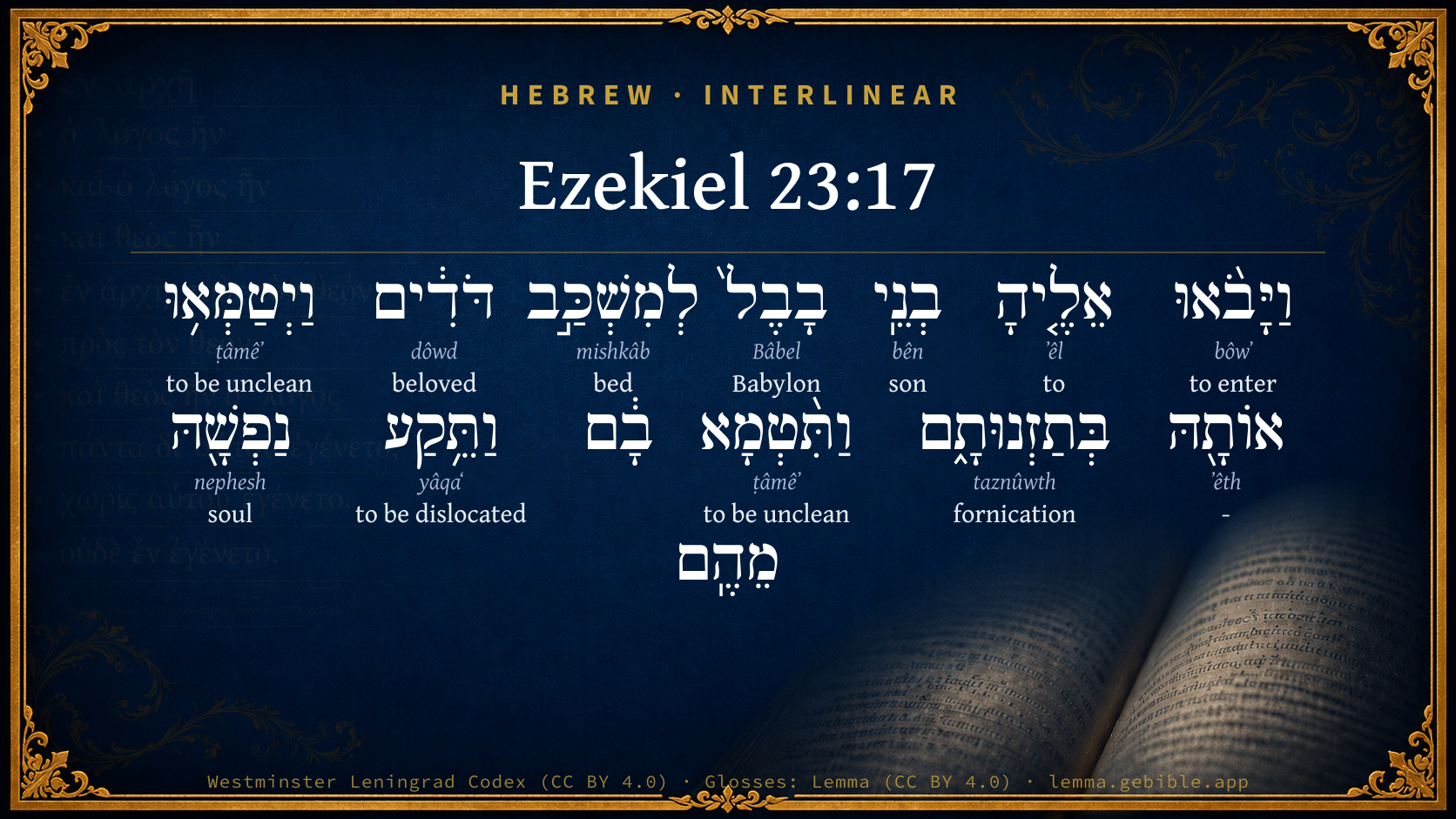
Ezekiel 23:17

Hebrew (Westminster Leningrad Codex) Ezekiel 23:17 appears in the Hebrew Old Testament. The text above is from the Westminster Leningrad Codex. Each word links to its Strong’s number, a concise gloss, and parsing drawn from the Open Scriptures Hebrew Bible morphology. Click any word for its full Brown-Driver-Briggs (BDB) entry.
Download image
Cite this verse

Ezekiel 23:17 (World English Bible). Public Domain. Lemma interlinear Bible study tool, https://lemma.gebible.app/v/ezekiel/23/17.

Show BibTeX & RIS
BibTeX
RIS
English Translation
The Babylonians came to her into the bed of love, and they defiled her with their prostitution, and she was polluted with them, and her soul was alienated from them.
World English Bible · Public Domain
Download a study sheet

One document with this verse’s original text, its word-by-word gloss line, the meaning frame, cross-references with their text, attributed commentary, and full source and license credits — printable, and it pastes into notes with its structure intact.

This verse Autodidact and up

Study sheet (.html) Plain text (.txt)

A passage Seminary Student

Up to 50 verses in one chapter. A passage sheet keeps up to 6 commentary sources and 12 cross-references per verse, in the order this page ranks them, and says so on the sheet whenever that leaves anything out. Ask for a single verse and you get the Autodidact verse sheet above.

Everything on this page stays free to read, with no account — the sheet is a download of what is already on screen, not access to it.

Want to remove ads? Support Godless Engineer
Compare translations 3

The same verse in 3 English versions, stacked beneath the original-language interlinear above. Click any original word for its lexicon entry.

Each is an independent rendering of the whole verse — the interlinear is not word-aligned to these translations.

Highlighted words mark where these versions differ — a whole-verse word diff, not a word-by-word alignment.

  • World English Bible Public Domain
    The Babylonians came to her into the bed of love, and they defiled her with their prostitution, and she was polluted with them, and her soul was alienated from them.
  • King James Version Public Domain
    And the Babylonians came to her into the bed of love, and they defiled her with their whoredom, and she was polluted with them, and her mind was alienated from them.
  • unfoldingWord Literal Text CC BY-SA 4.0
    Then the Babylonians came to her and to her bed of lust, and they made her unclean with their promiscuousness. By what she had done she was made unclean, so she turned herself away from them in disgust.

unfoldingWord Literal Text — © unfoldingWord, licensed CC BY-SA 4.0. Word-aligned USFM3 via Door43 (git.door43.org/unfoldingWord/en_ult).

Versions to compare (up to 4)

3 of 4 selected

Show all 18 translations

Every available English version of this verse, each an independent rendering of the whole verse.

  • World English Bible Public Domain
    The Babylonians came to her into the bed of love, and they defiled her with their prostitution, and she was polluted with them, and her soul was alienated from them.
  • Berean Standard Bible Public Domain
    Then the Babylonians came to her, to the bed of love, and in their lust they defiled her. But after she had been defiled by them, she turned away in disgust.
  • Majority Standard Bible Public Domain
    Then the Babylonians came to her, to the bed of love, and in their lust they defiled her. But after she had been defiled by them, she turned away in disgust.
  • King James Version Public Domain
    And the Babylonians came to her into the bed of love, and they defiled her with their whoredom, and she was polluted with them, and her mind was alienated from them.
  • American Standard Version (1901) Public Domain
    And the Babylonians came to her into the bed of love, and they defiled her with their whoredom, and she was polluted with them, and her soul was alienated from them.
  • Revised Version (1885) Public Domain
    And the Babylonians came to her into the bed of love; and they defiled her with their whoredom, and she was polluted with them, and her soul was alienated from them.
  • Geneva Bible (1599) Public Domain
    Nowe when the Babylonians came to her into the bed of loue, they defiled her with their fornication, and she was polluted with them, and her lust departed from them.
  • Douay-Rheims (1899) Public Domain
    And when the sons of Babylon were come to her to the bed of love, they defiled her with their fornications, and she was polluted by them, and her soul was glutted with them.
  • Young's Literal Translation Public Domain
    And come in unto her do sons of Babylon, To the bed of loves, And they defile her with their whoredoms, And she is defiled with them, And her soul is alienated from them.
  • Literal Standard Version CC BY-SA 4.0
    And sons of Babylon come in to her, || To the bed of loves, || And they defile her with their whoredoms, || And she is defiled with them, || And her soul is alienated from them.
  • Unlocked Literal Bible CC BY-SA 4.0
    Then the Babylonians came to her and to her bed of lust, and they made her unclean with their promiscuousness. By what she had done she was made unclean, so she turned herself away from them in disgust.
  • unfoldingWord Literal Text CC BY-SA 4.0
    Then the Babylonians came to her and to her bed of lust, and they made her unclean with their promiscuousness. By what she had done she was made unclean, so she turned herself away from them in disgust.
  • Darby Bible Public Domain
    And the children of Babylon came to her into the bed of love, and they defiled her with their fornication; she too defiled herself with them, and her soul was alienated from them.
  • World Messianic Bible Public Domain
    The Babylonians came to her into the bed of love, and they defiled her with their prostitution. She was polluted with them, and her soul was alienated from them.
  • Webster's Bible Public Domain
    And the Babylonians came to her into the bed of love, and they defiled her with their lewdness, and she was polluted with them, and her mind was alienated from them.
  • Free Bible Version CC BY-SA 4.0
    The Babylonians came to her and her love bed, and made her unclean with their sexual desire. However, after she had been dishonored by them, she rejected them in disgust.
  • Bible in Basic English Public Domain
    And the Babylonians came to her, into the bed of love, and made her unclean with their loose desire, and she became unclean with them, and her soul was turned from them.
  • JPS Tanakh (1917) Public Domain
    And the Babylonians came to her into the bed of love, and they defiled her with their lust; and she was polluted with them, and her soul was alienated from them.

Literal Standard Version (2020), Covenant Press — licensed CC BY-SA 4.0. Text via the HelloAO Bible API (eBible.org). Unlocked Literal Bible (unfoldingWord) — licensed CC BY-SA 4.0. Text via the HelloAO Bible API (eBible.org). unfoldingWord Literal Text — © unfoldingWord, licensed CC BY-SA 4.0. Word-aligned USFM3 via Door43 (git.door43.org/unfoldingWord/en_ult). Free Bible Version, Dr. Jonathan Gallagher — licensed CC BY-SA 4.0. Text via the HelloAO Bible API (eBible.org).

Word by word

More ways to search: Search by grammar → Find every occurrence → Compare this word →

Practice this passage: Drill this verse → Learn its vocabulary →

וַתֵּ֥קַע
yâqaʻ
H3363
“and · to be dislocated”
Conjunction + Verb, Qal, Sequential Imperfect, 3rd Person, Feminine, Singular
Part of Speech
Conjunction + Verb
Stem
Qal
Form
Sequential Imperfect
Person
3rd Person
Gender
Feminine
Number
Singular
Full BDB Definition

Origin: a primitive root

TWOT: 903

to be dislocated, be alienated - (Qal) to be dislocated, be torn away, be alienated - (Hiphil) - to execute slowly (by exposure or impalation) - to hang - (Hophal) to be executed
  1. וַיָּבֹ֨אוּ bôwʼ H935 “and · to enter” Conjunction + Verb, Qal, Sequential Imperfect, 3rd Person, Masculine, Plural
  2. אֵלֶ֤יהָ ʼêl H413 “to · her” Preposition + Suffix, Personal, 3rd Person, Feminine, Singular
  3. בְנֵֽי bên H1121 “sons of” Noun, Common, Masculine, Plural, Construct
  4. בָבֶל֙ Bâbel H894 “Babylon” Noun, Proper
  5. לְמִשְׁכַּ֣ב mishkâb H4904 “to/for · bed of” Preposition + Noun, Common, Masculine, Singular, Construct
  6. דֹּדִ֔ים dôwd H1730 “love” Noun, Common, Masculine, Plural, Absolute
  7. וַיְטַמְּא֥וּ ṭâmêʼ H2930 “and · to be unclean” Conjunction + Verb, Piel, Sequential Imperfect, 3rd Person, Masculine, Plural
  8. אוֹתָ֖הּ ʼêth H853 “- · her” Particle, Direct Object + Suffix, Personal, 3rd Person, Feminine, Singular
  9. בְּתַזְנוּתָ֑ם taznûwth H8457 “in/at · fornication · their” Preposition + Noun, Common, Feminine, Singular, Construct + Suffix, Personal, 3rd Person, Masculine, Plural
  10. וַתִּ֨טְמָא ṭâmêʼ H2930 “and · to be unclean” Conjunction + Verb, Qal, Sequential Imperfect, 3rd Person, Feminine, Singular
  11. נַפְשָׁ֖הּ nephesh H5315 “soul · her” Noun, Common, Both, Singular, Construct + Suffix, Personal, 3rd Person, Feminine, Singular

About this verse

These counts appear in no published source. They are computed here, from the morphology-tagged text and Lemma’s own curated glosses. What Lemma adds →

14
words
11
distinct lemmas
Prophets
section

Notable vocabulary

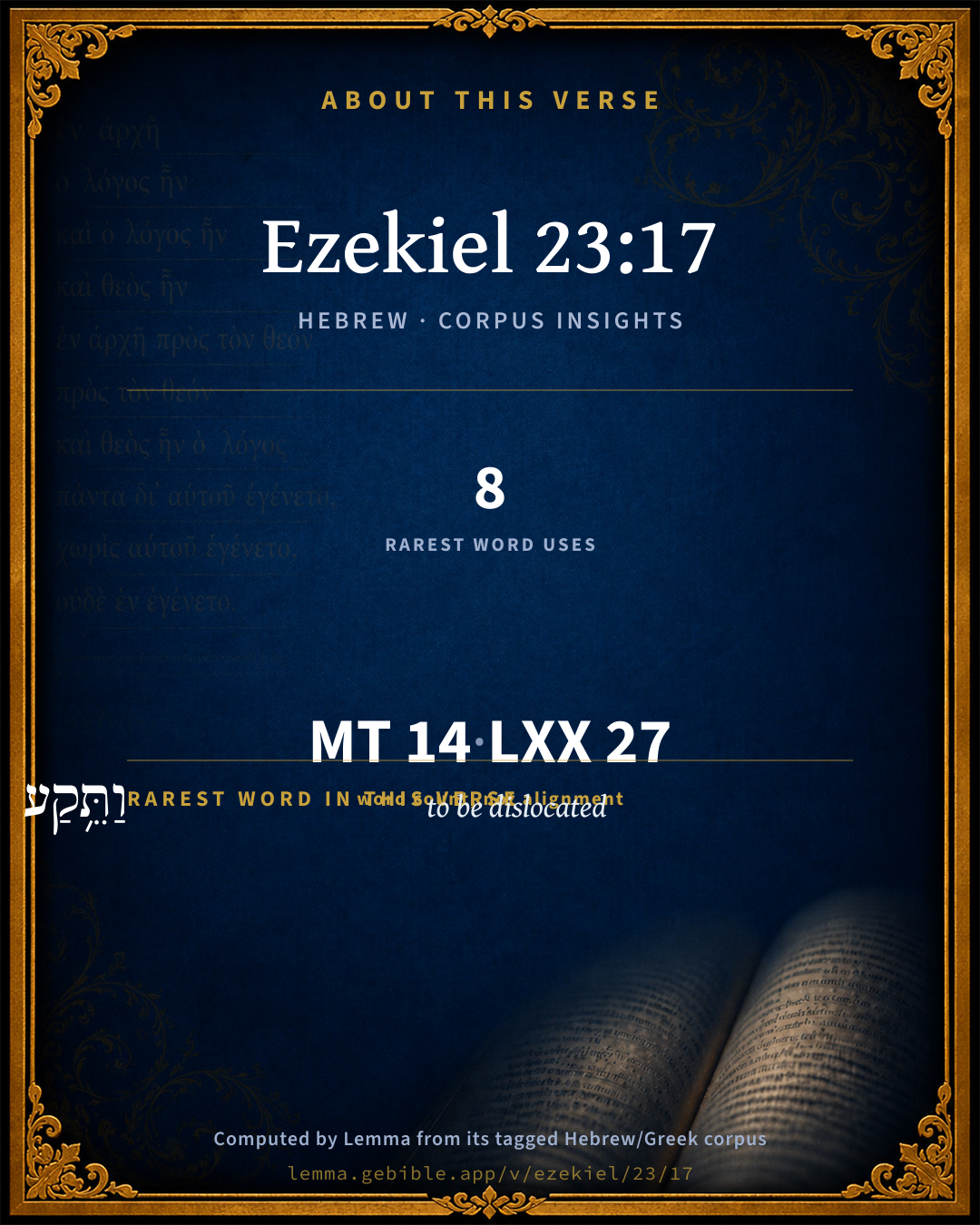
The rarest word here is וַתֵּ֥קַע to be dislocated H3363 — appearing just 8 times in the whole Hebrew Bible.

Shared distinctive vocabulary

וַתֵּ֥קַע to be dislocated H3363 occurs in 8 verses of the Hebrew Bible. Also found in:

Grammatical profile

  • 4 verbs
  • 6 nouns
  • 3 prepositions
  • 1 particle

Verb forms

  • וַיָּבֹ֨אוּ Qal · Sequential Imperfect
  • וַיְטַמְּא֥וּ Piel · Sequential Imperfect
  • וַתִּ֨טְמָא Qal · Sequential Imperfect
  • וַתֵּ֥קַע Qal · Sequential Imperfect

Repetition

A word recurs within this verse — often emphatic in Hebrew:

  • וַיְטַמְּא֥וּ to be unclean H2930 ×2

Hebrew & Septuagint length

In English translation the verse runs 30 words from the Hebrew and 33 from the Septuagint (LXX English) — closely comparable.

A rough comparison of the two English renderings, which tokenize alike — not a word-level alignment.

Word counts can differ between the Hebrew and the Greek without any difference in meaning — e.g. the Hebrew direct-object marker אֵת has no separate Greek word, and Greek often adds the article ὁ.

In the original languages it is 14 Hebrew tokens and 27 Greek tokens — but the two are counted differently (Hebrew bundles its prefixes and suffixes into one token; the Greek is in lemma form), so that isn’t a like-for-like length.

Cross-references

6

Topical passages linked to Ezekiel 23:17 in the Treasury of Scripture Knowledge — connected by theme and wording, ordered by reader-vote popularity; previews shown in the World English Bible.

  • Ezekiel 23:22 Therefore, Oholibah, thus says the Lord Yahweh: Behold, I will raise up your lovers against you, from whom your soul is alienated, and I will bring them against you on every side:
  • Ezekiel 23:28 For thus says the Lord Yahweh: Behold, I will deliver you into the hand of them whom you hate, into the hand of them from whom your soul is alienated;
  • Genesis 10:10 The beginning of his kingdom was Babel, Erech, Accad, and Calneh, in the land of Shinar.
  • Genesis 11:9 Therefore the name of it was called Babel, because Yahweh confused the language of all the earth, there. From there, Yahweh scattered them abroad on the surface of all the earth.
  • 2 Samuel 13:15 Then Amnon hated her with exceeding great hatred; for the hatred with which he hated her was greater than the love with which he had loved her. Amnon said to her, Arise, be gone.
  • Ezekiel 16:37 therefore see, I will gather all your lovers, with whom you have taken pleasure, and all those who you have loved, with all those who you have hated; I will even gather them against you on every side, and will uncover your nakedness to them, that they may see all your nakedness.

Cross-references courtesy of OpenBible.info (CC BY 4.0).

Hebrew and Greek witnesses Masoretic Hebrew ↔ Greek Septuagint

The same verse in the two great witnesses to the Old Testament, shown verse-for-verse.

These are two independent witnesses, not word-aligned to each other, and the Septuagint is shown in lemma (dictionary) form.

Hebrew Ezekiel 23:17 Masoretic · Westminster Leningrad Codex

וַיָּבֹ֨אוּ אֵלֶ֤יהָ בְנֵֽי בָבֶל֙ לְמִשְׁכַּ֣ב דֹּדִ֔ים וַיְטַמְּא֥וּ אוֹתָ֖הּ בְּתַזְנוּתָ֑ם וַתִּ֨טְמָא בָ֔ם וַתֵּ֥קַע נַפְשָׁ֖הּ מֵהֶֽם

The Babylonians came to her into the bed of love, and they defiled her with their prostitution, and she was polluted with them, and her soul was alienated from them.

World English Bible · Public Domain

Greek LXX Ezekiel 23:17 Septuagint · lemma form

καί ἔρχομαι πρός αὐτός υἱός βαβυλών εἰς κοίτη καταλύω καί μιαίνω αὐτός ἐν ὁ πορνεία αὐτός καί μιαίνω ἐν αὐτός καί ἀποἵστημι ὁ ψυχή αὐτός ἀπό αὐτός

And the sons of Babylon came to her, into the bed of rest, and they defiled her in her fornication, and she was defiled by them, and her soul was alienated from them.

LXX2012 (modern English Septuagint) · Public Domain

Hebrew: Westminster Leningrad Codex (CC BY 4.0). Greek: Septuagint (public domain); English from LXX2012 (modern English Septuagint) (Public Domain). How the Septuagint differs from the Hebrew →

Targum (Aramaic paraphrase)

1

The Targum is the ancient Jewish Aramaic paraphrase of the Hebrew Scriptures — an interpretive translation, not the Hebrew text itself. Onkelos (literal) and Pseudo-Jonathan (expansive) render the Torah, and Jonathan the Prophets. Coverage is partial: where no permissively-licensed English translation exists for a verse, only the Aramaic is shown. This is verse-level text, not a word-by-word alignment to the Hebrew.

  1. Targum Jonathan Prophets (Joshua–Malachi)
    וַאֲתוֹ לְוָתָהּ בְּנֵי בָבֶל לְמֶעְבַּד רַחֲמוּ וְסָאִיבוּ יָתָהּ בְּטַעֲוָתְהוֹן וְאִסְתַּאֲבַת בְּהוֹן עַד דְקָצַת נַפְשָׁהּ בְּהוֹן:

    (no public-domain English translation for this verse)

    Targum Jonathan — Aramaic: “Mikraot Gedolot” (public domain). English: “Sefaria Community Translation” (CC0 1.0 (public-domain dedication)); “London "Chaldee Paraphrase," 1871” (public domain). Text via Sefaria.

Commentary

Notes on Ezekiel 23:17 from classic Christian and Jewish commentators (each source and its license shown beneath its notes). The classic Christian expositions comment on the surrounding passage and are grouped to its opening verse, so a note may address several verses; the Jewish commentaries on the Tanakh (Rashi and others) are per-verse, so they appear only where the commentator wrote on this verse.

Lemma curates 59 commentaries, every one of them public domain or Creative Commons licensed, each selected and text-cleaned for this edition rather than reprinted as found. About our sources →

Ellicott's Commentary for English Readers

(17) Her mind was alienated.—The original implies the disgust of satiety. Josiah had been the devoted friend of Babylon, and perished in his zeal on its behalf. Judah was then made a dependency of Egypt, and turned for aid to Babylon. Then receiving in turn the yoke of Babylon, she became impatient, and sought the aid of Egypt. This vacillating policy is described in Eze_23:17-19, and at either, turn was so entirely wanting in sole reliance upon God as to produce the effect of Eze_23:18 : “My mind was alienated from her.”

A Bible Commentary for English Readers, edited by Charles John Ellicott (1878–1897) — public domain. Text from a community e-Sword module.

Trapp's Complete Commentary

John Trapp

Eze 23:17 And the Babylonians came to her into the bed of love, and they defiled her with their whoredom, and she was polluted with them, and her mind was alienated from them.

Ver. 17. Into the bed of love.] Or, Of breasts, which are the symbols of love and seats of delight, as naturalists note. See Pro 6:19; Pro 7:18.

And her mind was alienated from them.] Heb., Loosed or disjointed, to dote another while upon the Egyptians. Etiam vota post usum fastidia sunt.

John Trapp, A Commentary or Exposition upon All the Books of the Old and New Testament (1647–1656) — public domain. Text from a community e-Sword module.

Joseph Benson's Commentary

Eze 23:17-20. And the Babylonians came to her, &c. — The metaphor of representing idolatry by the inordinate lust of adultery is still carried on. And her mind was alienated from them — She quickly grew weary of these also, as lewd women are of their former gallants, and look out for new ones. She broke her league and covenant with them, as St. Jerome very well expresses the sense; meaning that covenant which Jehoiakim made with Nebuchadnezzar to be his tributary, and which was afterward renewed by Zedekiah. So she discovered, or, after she discovered, her whoredoms — The sense being still continued with the foregoing verse. The meaning is, She was open and notorious in her lewd practices, and in the highest degree shameless. Then my mind was alienated from her — As she, by her idolatries, had broken all the bonds of duty and allegiance whereby she was engaged to me, a sin often compared to a wife’s disloyalty toward her husband, so I withdrew my love and affection from her, and resolved to give her a bill of divorce, as the Prophet Jeremiah expresses it, and not own her any more as mine, as I had cast off her sister Samaria. Yet she multiplied, &c. — Though she was fond of new idolatries, she did not forget her old ones, even those which she had learned in Egypt. For she doted upon their paramours — Upon the idols of Egypt, and the impure rites which accompanied their idolatrous worship. This may relate to the time when Zedekiah entered into a new confederacy with Egypt, which made the people fond of admitting the Egyptian idolatries. Whose flesh, &c. — These expressions seem to be made use of, to signify the excess of the Egyptian idolatry. They may likewise metaphorically express the great power and riches of the Egyptians, which made the Jewish people fond of courting their friendship and alliance.

Joseph Benson's Commentary on the Old and New Testaments (1811–1818) — public domain. Text from a community e-Sword module.

Jamieson, Fausset & Brown

Robert Jamieson, A. R. Fausset & David Brown

alienated from them--namely, from the Chaldeans: turning again to the Egyptians (Eze 23:19), trying by their help to throw off her solemn engagements to Babylon (compare Jer 37:5, Jer 37:7; Kg2 24:7).

Jamieson, Fausset & Brown — Commentary Critical and Explanatory on the Whole Bible (1871) — public domain (CC PDM 1.0). Text via the HelloAO Bible API.

The Cambridge Bible for Schools and Colleges

gen. ed. J. J. S. Perowne

17. alienated from them] The figure lies in the revulsion of sated passion; the thing in the weariness of the Babylonian alliance and yoke, cf. ch. 17.

The Cambridge Bible for Schools and Colleges (gen. ed. J. J. S. Perowne; Cambridge University Press, 1878–1918) — public domain. Text from a community e-Sword module.

John Gill's Exposition

And the Babylonians came to her in the bed of love,.... Entered into alliance with the Jews, and worshipped together in the same idols' temple. Jarchi thinks this refers to the messengers of the king of Babylon to Hezekiah; who were gladly received by him, and to whom he showed all the treasures of his house:

and they defiled her with their whoredom; or with their idols, as the Targum; they drew them into their idolatrous practices; which were defiling them, and by which they were corrupted from the simplicity of the true worship of God:

and she was polluted with them, and her mind was alienated from them: or "plucked", or "disjoined from them" (y); the Chaldeans, broke league and covenant with them, hating them as much as before they doted upon them; this was done in the times of Jehoiakim and Zedekiah, who rebelled against the king of Babylon, Kg2 24:1 as it often is the case with lewd women, when they have satisfied their lust with their gallants, loath and despise them, and cast them off.

(y) "avulsa est", Munster; "et luxata est anima ipsius ab eis", Junius & Tremellius, Polanus.

John Gill's Exposition of the Whole Bible (1746–1763) — public domain (CC PDM 1.0). Text via the HelloAO Bible API.

Albert Barnes' Notes on the Bible

After Josiah’s death and the usurpation of dominion by the Egyptians, the Babylonians were no doubt welcomed as friends 2Ki 24:1. But the Jews were soon tired of their alliance and disgusted with their friends, and this led to the rebellion of Jehoiakim and the first captivity.

Albert Barnes' Notes on the Bible (1834–1885) — public domain. Text from a community e-Sword/MySword module.

Haydock's Catholic Bible Commentary

Love. Literally, "of breasts," as Hebrew also signifies. Here it denotes the temples. (Haydock)

George Leo Haydock (1774–1849), Haydock's Catholic Family Bible and Commentary, 1859 edition — public domain. Excludes Psalms (Douay-Rheims chapter numbering differs from Protestant) and Deuterocanonical books (Catholic canon only).

Matthew Poole's English Annotations

The Babylonians came: the prophet prosecuteth the allegory; the adulteress sent, and invited, and here the Chaldeans comply with it, they came, ambassadors no doubt first to make a confederacy, and then free intercourse in trade, and religion too.

The bed of love; so the impudently lascivious call the polluted, forbidden bed, as the harlot, Pro 7:18. It is like with this commerce and confederacy the lustful Babylonians did spread that disease, the Jewish nation were too much inclined to corporal adulteries and fornications; but metaphorically it is a delightful communicating with them in their idolatry in their idol temples and feasts.

Defiled her; made her unclean and loathsome.

Whoredom; spiritual and corporal.

Polluted; greatly defiled, as the doubling the expression imports. Her mind was alienated from them; like an arrant adulteress, wearied, but not satisfied with her adulterers, she changeth mind and friendships, and seeks new ones. So did this people, weary of the Chaldeans, seek new confederates.

Matthew Poole's English Annotations on the Holy Bible (1683–1685) — public domain. Text from a community e-Sword/MySword module.

Whedon's Commentary on the Bible

Daniel D. Whedon

17. Her mind was alienated from them — This occurred after her passion was satisfied (compare 2Sa_13:15), and she began to feel the weight of the heavy hand of her Babylonian lovers and to long for release; but it was too late to return without bitter repentance to her true husband, for his mind had also become alienated from her (Eze_23:18).

Daniel D. Whedon (gen. ed.), Commentary on the Old and New Testaments (1874–1909) — public domain. Text from a community e-Sword module.

The Pulpit Commentary

The words paint the intimate alliance, the political prostitution, as it were, involved in the alliance with Babylon. Her mind was alienated from them. Interpreted by the history, the words point to the fact that Judah soon found out how hollow was the help gained by the alliance with Babylon, and turned, after Josiah"s death, to Egypt as a counterpoise. As in the history of Amnon, (2Sa_13:15) lust, when it had wrought its will, passed into loathing and disgust. Jehoiakim and Zedekiah were examples of what we may well call this distracted policy. But, as it was, this alienation did but increase her guilt. As things were, it would have been better, as Jeremiah all along counseled, to accept the rule of the Chaldeans. The mind of Jehovah was alienated from Jerusalem as hers had been from the Chaldeans.

The Pulpit Commentary (1880–1919), ed. H.D.M. Spence-Jones & Joseph S. Exell — public domain. Text from a community e-Sword module.

John Wesley's Explanatory Notes

Alienated - She grew weary of the Chaldeans.

John Wesley, Explanatory Notes Upon the Whole Bible (1754–1765) — public domain. Text via the GEBible commentary corpus.

Rashi

Rabbi Shlomo Yitzchaki (Rashi)

And the children of Babylon came to her for a bed of love They made a covenant together, and I say that this is said concerning Hezekiah, who rejoiced about the emissaries of Merodach-baladan (Isa. 39, II Kings 20), and he fed them at his table and showed them his entire treasure house. This resembles the prophet’s statement (verse 14), “men engraved on the wall,” because they came from a distant land, and the Chaldeans were not frequent visitors to them, as it is said (Isa. 39:3): “They have come to me from a distant country,” and from seeing their faces once, they became endeared to him. And the Holy One, blessed be He, became wroth with him because of this matter, as it is written (Isa. 36:6, II Kings 20:17): “Behold a time will come when everything in your palace...will be carried off, etc.,” and in (II) Chronicles (32:25): “But Hezekiah did not pay back according to the benefit they had done for him, but his heart became haughty; therefore, wrath came upon him and upon Judah, etc.”

her soul was disgusted with them [Heb. וַתֵּקַע.] That Jehoiakim and Zedekiah rebelled against them. וַתֵּקַע is esloched in Old French, dislocated. וַתֵּקַע is like (Gen. 32: 26): “and the upper joint of Jacob’s thigh was dislocated (וַתֵּקַע).” הוֹקָעָה is an expression of joining and inserting a pole into the earth, and also when it is withdrawn from the earth, is the expression קְעִיָה appropriate for it, just as you say (Ps. 80:10): “it took root (וַתַשְׁרֵשׁ),” as an expression of taking root, and (Job 31:12), “and it uproots (תְּשָׁרֵשׁ) all my grain,” as an expression of uprooting. Similarly (Isa. 17:6): “on its branches (בִּסְעִפֶיהָ) when it produces fruit,” is an expression of branches, and (ibid. 10:33), “lops off (מְסָעֵף) the branches,” is an expression of cutting off the branches of the tree and its boughs.

Rashi on the Tanakh — English translations: “The Judaica Press complete Tanach with Rashi, translated by A. J. Rosenberg” (CC BY 4.0); “Pentateuch with Rashi's commentary by M. Rosenbaum and A.M. Silbermann, 1929-1934” (public domain); “The Metsudah Tanach series, Lakewood, N.J” (CC BY 4.0); and “The Book of Joshua, Metsudah Publications, 1997” (CC BY 4.0). Text via Sefaria.

Lesson kit

Teaching starters — assembled from the data on this page, not authored interpretation. Every prompt links to the verse data it draws on. Edit before teaching.

Ezekiel, in the Prophets, opens this verse with 14 words (11 distinct Hebrew lemmas). Its most distinctive word is yâqaʻ (“to be dislocated”). A historical commentator’s framing appears above. Read the whole chapter for the surrounding context.

Discussion questions

  1. How does “to be dislocated” (yâqaʻ) shape what this verse is saying?
  2. Genesis 32:25 shares the word «to be dislocated» with this verse. How do the two illuminate each other?
  3. “to be unclean” occurs 2× in this one verse. What is the effect of the repetition?
  4. The translations on this page render this verse differently — a whole-verse word diff, not a word-by-word alignment. What might account for the different wordings?
  5. The verb «וַיָּבֹ֨אוּ» is Qal Sequential Imperfect. How does its form color the action?
  6. Reading how Ellicott's Commentary for English Readers and Trapp's Complete Commentary read this verse, where do the two commentators agree and where do they part?

Things to notice

Reading settings

Reading text

Shown beneath each verse's original-language words.

Old Testament
Old Testament edition

Read the OT as the Masoretic Hebrew (MT) or the Greek Septuagint (LXX).

English shown for the Greek Septuagint (in the Hebrew ↔ Greek comparison).

Comparing translations? Open the Compare panel on any verse page to stack up to four side by side.