Exodus 23:9

Hebrew (Westminster Leningrad Codex) Exodus 23:9 appears in the Hebrew Old Testament. The text above is from the Westminster Leningrad Codex. Each word links to its Strong’s number, a concise gloss, and parsing drawn from the Open Scriptures Hebrew Bible morphology. Click any word for its full Brown-Driver-Briggs (BDB) entry.
Download image
Cite this verse

Exodus 23:9 (World English Bible). Public Domain. Lemma interlinear Bible study tool, https://lemma.gebible.app/v/exodus/23/9.

Show BibTeX & RIS
BibTeX
RIS
English Translation
"You shall not oppress an alien, for you know the heart of an alien, seeing you were aliens in the land of Egypt.
World English Bible · Public Domain
Download a study sheet

One document with this verse’s original text, its word-by-word gloss line, the meaning frame, cross-references with their text, attributed commentary, and full source and license credits — printable, and it pastes into notes with its structure intact.

This verse Autodidact and up

Study sheet (.html) Plain text (.txt)

A passage Seminary Student

Up to 50 verses in one chapter. A passage sheet keeps up to 6 commentary sources and 12 cross-references per verse, in the order this page ranks them, and says so on the sheet whenever that leaves anything out. Ask for a single verse and you get the Autodidact verse sheet above.

Everything on this page stays free to read, with no account — the sheet is a download of what is already on screen, not access to it.

Want to remove ads? Support Godless Engineer
Compare translations 3

The same verse in 3 English versions, stacked beneath the original-language interlinear above. Click any original word for its lexicon entry.

Each is an independent rendering of the whole verse — the interlinear is not word-aligned to these translations.

Highlighted words mark where these versions differ — a whole-verse word diff, not a word-by-word alignment.

  • World English Bible Public Domain
    "You shall not oppress an alien, for you know the heart of an alien, seeing you were aliens in the land of Egypt.
  • King James Version Public Domain
    Also thou shalt not oppress a stranger: for ye know the heart of a stranger, seeing ye were strangers in the land of Egypt.
  • unfoldingWord Literal Text CC BY-SA 4.0
    And you shall not oppress a foreigner, since you yourself know the soul of the foreigner, for you were foreigners in the land of Egypt.

unfoldingWord Literal Text — © unfoldingWord, licensed CC BY-SA 4.0. Word-aligned USFM3 via Door43 (git.door43.org/unfoldingWord/en_ult).

Versions to compare (up to 4)

3 of 4 selected

Show all 18 translations

Every available English version of this verse, each an independent rendering of the whole verse.

  • World English Bible Public Domain
    "You shall not oppress an alien, for you know the heart of an alien, seeing you were aliens in the land of Egypt.
  • Berean Standard Bible Public Domain
    Do not oppress a foreign resident, since you yourselves know how it feels to be foreigners; for you were foreigners in the land of Egypt.
  • Majority Standard Bible Public Domain
    Do not oppress a foreign resident, since you yourselves know how it feels to be foreigners; for you were foreigners in the land of Egypt.
  • King James Version Public Domain
    Also thou shalt not oppress a stranger: for ye know the heart of a stranger, seeing ye were strangers in the land of Egypt.
  • American Standard Version (1901) Public Domain
    And a sojourner shalt thou not oppress: for ye know the heart of a sojourner, seeing ye were sojourners in the land of Egypt.
  • Revised Version (1885) Public Domain
    And a stranger shalt thou not oppress: for ye know the heart of a stranger, seeing ye were strangers in the land of Egypt.
  • Geneva Bible (1599) Public Domain
    Thou shalt not oppresse a stranger: for ye knowe the heart of a stranger, seeing yee were strangers in the land of Egypt.
  • Douay-Rheims (1899) Public Domain
    Thou shalt not molest a stranger, for you know the hearts of strangers: for you also were strangers in the land of Egypt.
  • Young's Literal Translation Public Domain
    `And a sojourner thou dost not oppress, and ye -- ye have known the soul of the sojourner, for sojourners ye have been in the land of Egypt.
  • Literal Standard Version CC BY-SA 4.0
    And you do not oppress a sojourner, since you have known the soul of the sojourner, for you have been sojourners in the land of Egypt.
  • Unlocked Literal Bible CC BY-SA 4.0
    You must not oppress a foreigner, since you know the life of a foreigner, for you were foreigners in the land of Egypt.
  • unfoldingWord Literal Text CC BY-SA 4.0
    And you shall not oppress a foreigner, since you yourself know the soul of the foreigner, for you were foreigners in the land of Egypt.
  • Darby Bible Public Domain
    And the stranger thou shalt not oppress; for ye know the spirit of the stranger, for ye have been strangers in the land of Egypt.
  • World Messianic Bible Public Domain
    “You shall not oppress an alien, for you know the heart of an alien, since you were aliens in the land of Egypt.
  • Webster's Bible Public Domain
    Also thou shalt not oppress a stranger; for ye know the heart of a stranger, seeing ye were strangers in the land of Egypt.
  • Free Bible Version CC BY-SA 4.0
    Don't abuse foreigners living among you, since you know very well what it's like to be foreigners, for you were once foreigners in Egypt.
  • Bible in Basic English Public Domain
    Do not be hard on the man from a strange country who is living among you; for you have had experience of the feelings of one who is far from the land of his birth, because you yourselves were living in Egypt, in a strange land.
  • JPS Tanakh (1917) Public Domain
    And a stranger shalt thou not oppress; for ye know the heart of a stranger, seeing ye were strangers in the land of Egypt.

Literal Standard Version (2020), Covenant Press — licensed CC BY-SA 4.0. Text via the HelloAO Bible API (eBible.org). Unlocked Literal Bible (unfoldingWord) — licensed CC BY-SA 4.0. Text via the HelloAO Bible API (eBible.org). unfoldingWord Literal Text — © unfoldingWord, licensed CC BY-SA 4.0. Word-aligned USFM3 via Door43 (git.door43.org/unfoldingWord/en_ult). Free Bible Version, Dr. Jonathan Gallagher — licensed CC BY-SA 4.0. Text via the HelloAO Bible API (eBible.org).

Word by word

More ways to search: Search by grammar → Find every occurrence → Compare this word →

Practice this passage: Drill this verse → Learn its vocabulary →

תִלְחָ֑ץ
lâchats
H3905
“to oppress”
Verb, Qal, Imperfect, 2nd Person, Masculine, Singular
Part of Speech
Verb
Stem
Qal
Form
Imperfect
Person
2nd Person
Gender
Masculine
Number
Singular
Full BDB Definition

Origin: a primitive root

TWOT: 1106

to squeeze, press, oppress - (Qal) - to squeeze, press - to oppress - (Niphal) to squeeze oneself
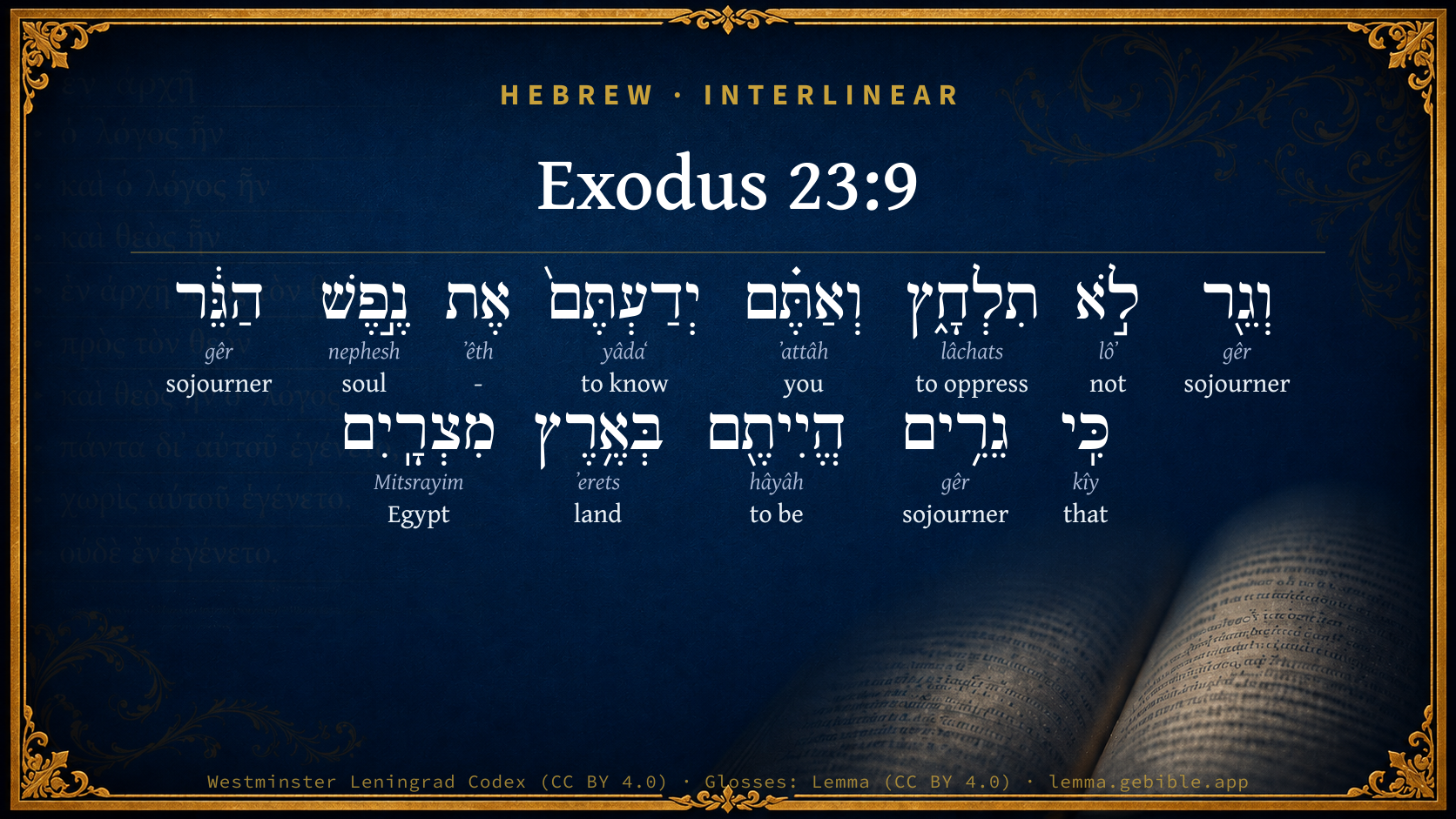
  1. וְגֵ֖ר gêr H1616 “and · sojourner” Conjunction + Noun, Common, Masculine, Singular, Absolute
  2. לֹ֣א lôʼ H3808 “not” Particle, Negative
  3. וְאַתֶּ֗ם ʼattâh H859 “and · you” Conjunction + Pronoun, Personal, 2nd Person, Masculine, Plural
  4. יְדַעְתֶּם֙ yâdaʻ H3045 “to know” Verb, Qal, Perfect, 2nd Person, Masculine, Plural
  5. אֶת ʼêth H853 “-” Particle, Direct Object
  6. נֶ֣פֶשׁ nephesh H5315 “soul of” Noun, Common, Both, Singular, Construct
  7. הַגֵּ֔ר gêr H1616 “the · sojourner” Particle, Definite Article + Noun, Common, Masculine, Singular, Absolute
  8. כִּֽי kîy H3588 “that” Conjunction
  9. גֵרִ֥ים gêr H1616 “sojourners” Noun, Common, Masculine, Plural, Absolute
  10. הֱיִיתֶ֖ם hâyâh H1961 “to be” Verb, Qal, Perfect, 2nd Person, Masculine, Plural
  11. בְּאֶ֥רֶץ ʼerets H776 “in/at · land of” Preposition + Noun, Common, Both, Singular, Construct
  12. מִצְרָֽיִם Mitsrayim H4714 “Egypt” Noun, Proper

About this verse

These counts appear in no published source. They are computed here, from the morphology-tagged text and Lemma’s own curated glosses. What Lemma adds →

13
words
11
distinct lemmas
Pentateuch
section

Notable vocabulary

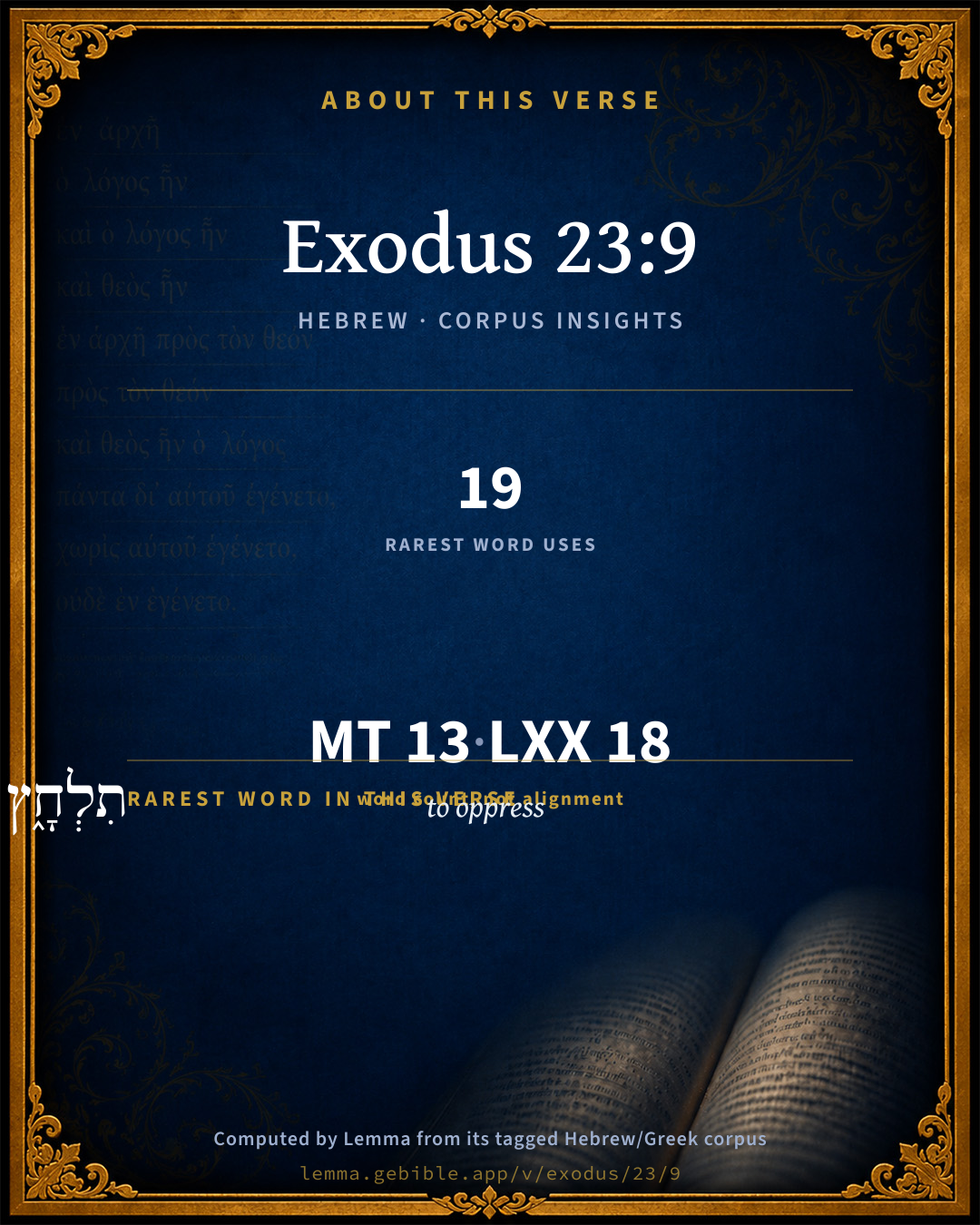
The rarest word here is תִלְחָ֑ץ to oppress H3905 — appearing just 19 times in the whole Hebrew Bible.

Shared distinctive vocabulary

תִלְחָ֑ץ to oppress H3905 occurs in 18 verses of the Hebrew Bible. Also found in:

Grammatical profile

  • 3 verbs
  • 6 nouns
  • 1 pronoun
  • 1 conjunction
  • 2 particles

Verb forms

  • תִלְחָ֑ץ Qal · Imperfect
  • יְדַעְתֶּם֙ Qal · Perfect
  • הֱיִיתֶ֖ם Qal · Perfect

Repetition

A word recurs within this verse — often emphatic in Hebrew:

  • וְגֵ֖ר sojourner H1616 ×3

Hebrew & Septuagint length

In English translation the verse runs 23 words from the Hebrew and 25 from the Septuagint (LXX English) — closely comparable.

A rough comparison of the two English renderings, which tokenize alike — not a word-level alignment.

Word counts can differ between the Hebrew and the Greek without any difference in meaning — e.g. the Hebrew direct-object marker אֵת has no separate Greek word, and Greek often adds the article ὁ.

In the original languages it is 13 Hebrew tokens and 18 Greek tokens — but the two are counted differently (Hebrew bundles its prefixes and suffixes into one token; the Greek is in lemma form), so that isn’t a like-for-like length.

Cross-references

9

Topical passages linked to Exodus 23:9 in the Treasury of Scripture Knowledge — connected by theme and wording, ordered by reader-vote popularity; previews shown in the World English Bible.

  • Exodus 22:21 "You shall not wrong an alien, neither shall you oppress him, for you were aliens in the land of Egypt.
  • Deuteronomy 27:19 Cursed be he who wrests the justice [due] to the foreigner, fatherless, and widow. All the people shall say, Amen.
  • Deuteronomy 24:14–18 You shall not oppress a hired servant who is poor and needy, whether he be of your brothers, or of your foreigners who are in your land within your gates:
  • Matthew 18:33 Shouldn't you also have had mercy on your fellow servant, even as I had mercy on you?'
  • Exodus 21:21 Notwithstanding, if he gets up after a day or two, he shall not be punished, for he is his property.
  • Deuteronomy 10:19 Therefore love the foreigner; for you were foreigners in the land of Egypt.
  • Psalms 94:6 They kill the widow and the alien, And murder the fatherless.
  • Ezekiel 22:7 In you have they set light by father and mother; in the midst of you have they dealt by oppression with the foreigner; in you have they wronged the fatherless and the widow.
  • Hebrews 2:17–18 Therefore he was obligated in all things to be made like his brothers, that he might become a merciful and faithful high priest in things pertaining to God, to make atonement for the sins of the people.

Cross-references courtesy of OpenBible.info (CC BY 4.0).

Hebrew and Greek witnesses Masoretic Hebrew ↔ Greek Septuagint

The same verse in the two great witnesses to the Old Testament, shown verse-for-verse.

These are two independent witnesses, not word-aligned to each other, and the Septuagint is shown in lemma (dictionary) form.

Hebrew Exodus 23:9 Masoretic · Westminster Leningrad Codex

וְגֵ֖ר לֹ֣א תִלְחָ֑ץ וְאַתֶּ֗ם יְדַעְתֶּם֙ אֶת נֶ֣פֶשׁ הַגֵּ֔ר כִּֽי גֵרִ֥ים הֱיִיתֶ֖ם בְּאֶ֥רֶץ מִצְרָֽיִם

"You shall not oppress an alien, for you know the heart of an alien, seeing you were aliens in the land of Egypt.

World English Bible · Public Domain

Greek LXX Exodus 23:9 Septuagint · lemma form

καί προσήλυτος οὐ θλίβω σύ γάρ οἶδα ὁ ψυχή ὁ προσήλυτος αὐτός γάρ προσήλυτος εἰμί ἐν γῆ αἴγυπτος

And you⌃ shall not afflict a stranger, for you⌃ know the heart of a stranger; for you⌃ were yourselves strangers in the land of Egypt.

LXX2012 (modern English Septuagint) · Public Domain

Hebrew: Westminster Leningrad Codex (CC BY 4.0). Greek: Septuagint (public domain); English from LXX2012 (modern English Septuagint) (Public Domain). How the Septuagint differs from the Hebrew →

Targum (Aramaic paraphrase)

2

The Targum is the ancient Jewish Aramaic paraphrase of the Hebrew Scriptures — an interpretive translation, not the Hebrew text itself. Onkelos (literal) and Pseudo-Jonathan (expansive) render the Torah, and Jonathan the Prophets. Coverage is partial: where no permissively-licensed English translation exists for a verse, only the Aramaic is shown. This is verse-level text, not a word-by-word alignment to the Hebrew.

  1. Targum Onkelos Torah (Genesis–Deuteronomy)
    וְגִיוֹרָא לָא תְעִיקוּן וְאַתּוּן יְדַעְתּוּן יָת נַפְשָׁא דְגִיוֹרָא אֲרֵי דַיָרִין הֲוֵיתוּן בְּאַרְעָא דְמִצְרָיִם:

    (no public-domain English translation for this verse)

    Targum Onkelos — Aramaic: “Onkelos Genesis” (public domain); “Onkelos Exodus” (public domain); “Onkelos Leviticus” (public domain); “Onkelos Numbers” (public domain); “Onkelos Deuteronomy” (public domain). English: “Sefaria Community Translation” (CC0 1.0 (public-domain dedication)); “J.W. Etheridge. The Targums of Onkelos and Jonathan Ben Uzziel on the Pentateuch. London: Longmans, Green, 1862” (public domain). Text via Sefaria.

  2. Targum Pseudo-Jonathan Torah (Genesis–Deuteronomy)
    וּלְגִיּוּרָא לָא תְעִיקוּן וְאַתּוּן חַכִּימְתּוּן יַת אֲנִיק נְפַשׁ גִּיּוֹרָא אֲרוּם דַּיְירִין הֲוֵיתוּן בְּאַרְעָא דְמִצְרָיִם

    Thou shalt not oppress the stranger; for ye know the sigh of a stranger's soul; because ye were sojourners in the land of Mizraim.

    Targum Pseudo-Jonathan — Aramaic: “Targum Jonathan on Genesis” (public domain); “Targum Jonathan on Exodus” (public domain); “Targum Jonathan on Leviticus” (public domain); “Targum Jonathan on Numbers” (public domain); “Targum Jonathan on Deuteronomy” (public domain). English: “The Targum of Jonathan ben Uzziel, trans. J. W. Etheridge, London, 1862” (public domain). Text via Sefaria.

Commentary

Notes on Exodus 23:9 from classic Christian and Jewish commentators (each source and its license shown beneath its notes). The classic Christian expositions comment on the surrounding passage and are grouped to its opening verse, so a note may address several verses; the Jewish commentaries on the Tanakh (Rashi and others) are per-verse, so they appear only where the commentator wrote on this verse.

Lemma curates 59 commentaries, every one of them public domain or Creative Commons licensed, each selected and text-cleaned for this edition rather than reprinted as found. About our sources →

Trapp's Complete Commentary

John Trapp

Exo 23:9 Also thou shalt not oppress a stranger: for ye know the heart of a stranger, seeing ye were strangers in the land of Egypt.

Ver. 9. Thou shalt not oppress, &c.] {See Trapp on "Exo 22:21"}

John Trapp, A Commentary or Exposition upon All the Books of the Old and New Testament (1647–1656) — public domain. Text from a community e-Sword module.

The Biblical Illustrator

Joseph S. Exell

Exo_23:9

Thou shalt not oppress a stranger, for ye knew the heart of a stranger.

The logic of law

The argument is that our conduct is to spring out of our experience; we are to go back upon our own history and consciousness for the law that shall guide us in the treatment of our fellow-men. Why, could we do so, no more should we hear the rasping voice of rancour, hostile criticism, mean remark, or severe demand.

1. Thou shalt not oppress the struggling man, for thou thyself hast had thy struggle. Do not be hard upon those who are going up-hill.

2. Thou shall not oppress a doubting man, for thou thyself hast had thy doubts, if thou art more than half a man.

3. The text has a meaning in reference to ourselves, as well as to others. Thou shalt not renew old fears, for all thy fears have been round, black, blatant liars. Six fears have been with you, have lied to you, have made you play the fool in all the higher relations and issues of life, and yet I detect you this morning talking in the corner to a member of the same false family! Why do you not throw it from you, or order it behind you, or mock it with the jibing of perfect rest in God!

4. Thou shalt not--, because--. That is the logic of the text. Now, what must He be who gave such laws? In the character of the laws, find the character of the legislator. God must be tender; He takes care of strangers. Not only so; He must be aware of human history in all its changes and processes. He knows about the strangers who were in the land of Egypt; He knows about their deliverance; He knows that strangers are a tribe that must be on the earth from age to age; He knows us altogether. He speaks a word for the stranger. Oh, man, friendless, lonely man, you should love God. Oh, woman, mother, sister, sinning woman, you should love Christ. Oh, little children, frail flowers that may wither in a moment, you should put out your little hands, if in but dumb prayer, and long to touch the Son of God. Oh, working man, led away by the demagogue, made to scoff where you ought to pray, the Bible has done more for you than any other book ever attempted to do; this is a human book, a book for the nursery, the family, the market-place, the parliament, the universe! (J. Parker, D. D.)

Kindly qualities developed by adversity

I suppose it is adversity that develops the kindly qualities of our nature. I believe the sense of common degradation has a tendency to make the degraded amiable--at least among themselves. I am told it is found so in the plantations in slave-gangs. (Lord Beaconsfield.)

The Biblical Illustrator, edited by Joseph S. Exell (c. 1880s–1900s) — public domain. Text from a community e-Sword module.

Joseph Benson's Commentary

Exo 23:9. Thou shalt not oppress the stranger — Though aliens might not inherit lands among them; yet, they must have justice done them. It is an instance of the equity of our law, that if an alien be tried for any crime, except treason, the one half of his jury, if he desire it, shall be foreigners; a kind provision that strangers may not be oppressed. For ye know the heart of a stranger — That is, ye know by experience what a distressed, friendless condition that of a stranger is. The disposition, dejection, and distress of his heart, make him an object of pity, not of malice or injustice. Ye know his heart is easily depressed, and very unable to bear repulses. There is a great beauty in the expression.

Joseph Benson's Commentary on the Old and New Testaments (1811–1818) — public domain. Text from a community e-Sword module.

Geneva Bible (1599)

Geneva Bible translators

For in that that he is a stranger, his heart is sorrowful enough.

Geneva Bible (1599) marginal notes — public domain. Text via Bolls.life.

Adam Clarke's Commentary

Verse 9. Ye know the heart of a stranger] Having been strangers yourselves, under severe, long continued, and cruel oppression, ye know the fears, cares, anxieties, and dismal forebodings which the heart of a stranger feels. What a forcible appeal to humanity and compassion!

Adam Clarke's Commentary on the Bible (1810–1826) — public domain. Text from a community e-Sword/MySword module.

Ellicott's Commentary for English Readers

(9) Thou shalt not oppress a stranger.—See Note on Exo_22:21. The repetition of the law indicates the strong inclination of the Hebrew people to ill-use strangers, and the anxiety of the legislator to check their inclination.

A Bible Commentary for English Readers, edited by Charles John Ellicott (1878–1897) — public domain. Text from a community e-Sword module.

The Cambridge Bible for Schools and Colleges

gen. ed. J. J. S. Perowne

9. The gêr, or foreigner ‘sojourning’ in Israel, not to be ‘crushed.’ Identical, in great measure verbally, with Exo_22:21 : here, no doubt, directed specially against unfair judgement (cf. Deu_24:17 ‘Thou shalt not wrest the judgement of the sojourner,’ Exo_27:19, Mal_3:5).

stranger (each time)] sojourner: see on Exo_22:11.

for ye (emph.) know …, seeing ye were sojourners, &c.] see on Exo_22:21.

the heart] lit. the soul, i.e. the feelings.

The Cambridge Bible for Schools and Colleges (gen. ed. J. J. S. Perowne; Cambridge University Press, 1878–1918) — public domain. Text from a community e-Sword module.

John Gill's Exposition

And six years thou shall sow thy land, The land of Canaan, given to their ancestors and to them, and which they were now going to inherit; and when they came into it they were to plant it with vines and olives; or rather, these being ready planted, they were to prune and dress them; and they were to till their land, and plough it, and sow it with various sorts of grain, for six years running, from the time of their possession of it:

and shall gather in the fruits thereof; corn and wine, and oil, into their own garners, treasuries, and cellars, as their own property, to dispose of as they pleased for their own use and profit.

John Gill's Exposition of the Whole Bible (1746–1763) — public domain (CC PDM 1.0). Text via the HelloAO Bible API.

Haydock's Catholic Bible Commentary

The hearts. You have experienced what sorrow and misery they feel. (Menochius)

George Leo Haydock (1774–1849), Haydock's Catholic Family Bible and Commentary, 1859 edition — public domain. Excludes Psalms (Douay-Rheims chapter numbering differs from Protestant) and Deuterocanonical books (Catholic canon only).

Matthew Poole's English Annotations

The heart of a stranger, i.e. the disposition, dejection, and distress of his heart, which makes him an object of pity, not of malice or mischief.

Matthew Poole's English Annotations on the Holy Bible (1683–1685) — public domain. Text from a community e-Sword/MySword module.

Whedon's Commentary on the Bible

Daniel D. Whedon

9. Not oppress a stranger — This command is repeated from Exo_22:21, with some addition, and shows that the foreigner was entitled to protection from judicial wrongs as well as other forms of oppression. Israel should not forget how the heart of a stranger feels.

Daniel D. Whedon (gen. ed.), Commentary on the Old and New Testaments (1874–1909) — public domain. Text from a community e-Sword module.

The Pulpit Commentary

Thou shalt not oppress a stranger. This is a repetition of Exo_22:21, with perhaps a special reference to oppression through courts of justice. For thou knowest the heart of a stranger. Literally, "the mind of a stranger," or, in other words, his thoughts and feelings. Thou shouldest therefore be able to sympathise with him.

The Pulpit Commentary (1880–1919), ed. H.D.M. Spence-Jones & Joseph S. Exell — public domain. Text from a community e-Sword module.

John Wesley's Explanatory Notes

Thou shalt not oppress the stranger - Though aliens might not inherit lands among them; yet they must have justice done them. It was an instance of the equity of our law, that if an alien be tried for any crime except treason, the one half of his jury, if he desire it, shall be foreigners; a kind provision that strangers may not be oppressed. For ye know the heart of a stranger - You know something of the griefs and fears of a stranger by sad experience.

John Wesley, Explanatory Notes Upon the Whole Bible (1754–1765) — public domain. Text via the GEBible commentary corpus.

Rashi

Rabbi Shlomo Yitzchaki (Rashi)

וגר לא תלחץ AND THOU SHALT NOT OPPRESS THE STRANGER — In numerous passages (36 in number) does the Torah offer a caution about the ill-treatment of the stranger, because his original character is bad (Bava Metzia 59b).

אח נפש הגר [FOR YE KNOW] THE SOUL OF A STRANGER — how hard it is for him when people oppress him.

Rashi on the Tanakh — English translations: “The Judaica Press complete Tanach with Rashi, translated by A. J. Rosenberg” (CC BY 4.0); “Pentateuch with Rashi's commentary by M. Rosenbaum and A.M. Silbermann, 1929-1934” (public domain); “The Metsudah Tanach series, Lakewood, N.J” (CC BY 4.0); and “The Book of Joshua, Metsudah Publications, 1997” (CC BY 4.0). Text via Sefaria.

Lesson kit

Teaching starters — assembled from the data on this page, not authored interpretation. Every prompt links to the verse data it draws on. Edit before teaching.

Exodus, in the Pentateuch, opens this verse with 13 words (11 distinct Hebrew lemmas). Its most distinctive word is lâchats (“to oppress”). A historical commentator’s framing appears above. Read the whole chapter for the surrounding context.

Discussion questions

  1. How does “to oppress” (lâchats) shape what this verse is saying?
  2. Exodus 3:9 shares the word «to oppress» with this verse. How do the two illuminate each other?
  3. “sojourner” occurs 3× in this one verse. What is the effect of the repetition?
  4. These translations render this verse differently; the difference is in the English rendering, not the original. What questions does that raise?
  5. The verb «תִלְחָ֑ץ» is Qal Imperfect. How does its form color the action?
  6. Reading how Trapp's Complete Commentary and The Biblical Illustrator read this verse, where do the two commentators agree and where do they part?

Things to notice

Reading settings

Reading text

Shown beneath each verse's original-language words.

Old Testament
Old Testament edition

Read the OT as the Masoretic Hebrew (MT) or the Greek Septuagint (LXX).

English shown for the Greek Septuagint (in the Hebrew ↔ Greek comparison).

Comparing translations? Open the Compare panel on any verse page to stack up to four side by side.