
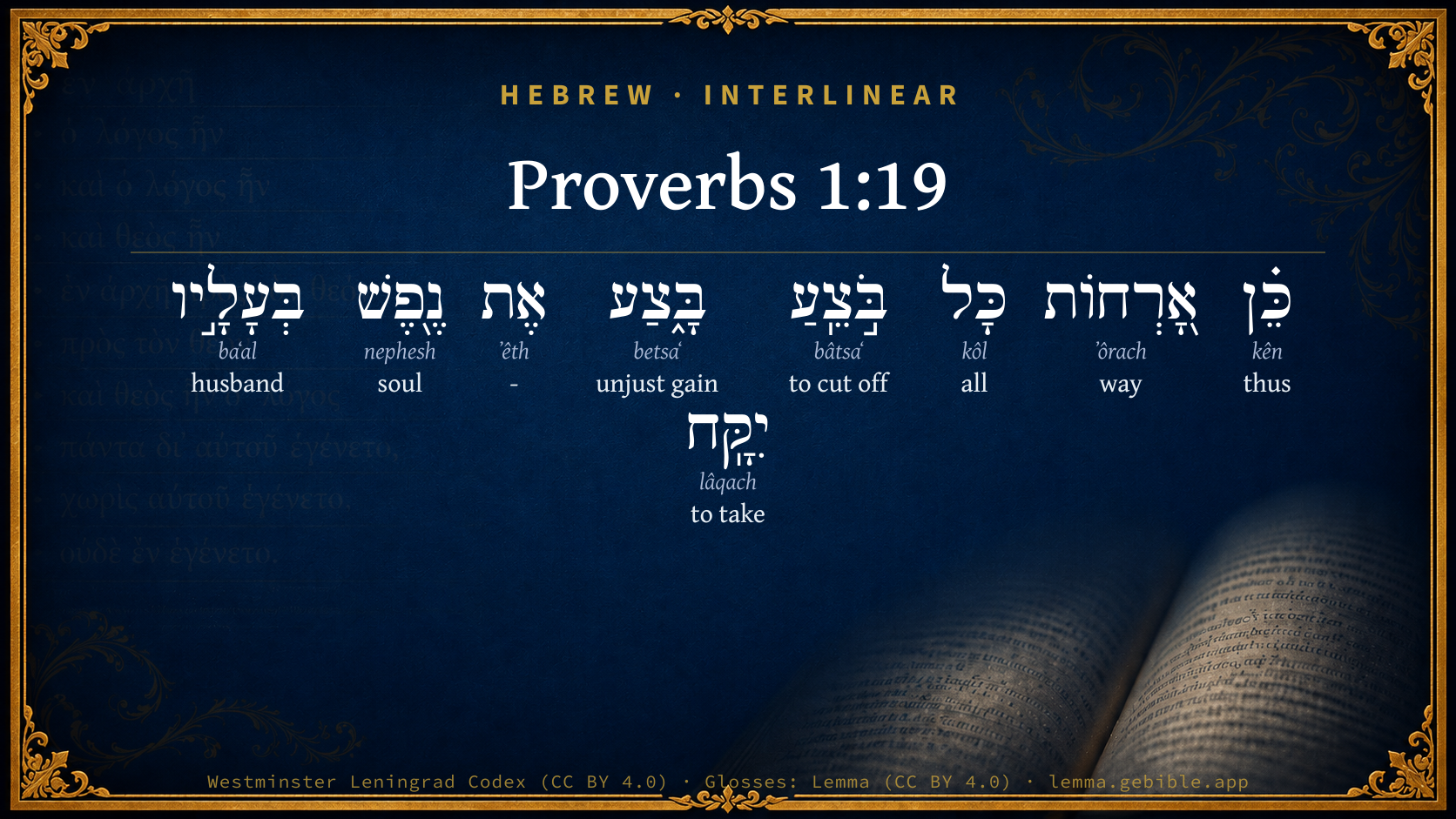
Proverbs 1:19

Hebrew (Westminster Leningrad Codex) Proverbs 1:19 appears in the Hebrew Old Testament. The text above is from the Westminster Leningrad Codex. Each word links to its Strong’s number, a concise gloss, and parsing drawn from the Open Scriptures Hebrew Bible morphology. Click any word for its full Brown-Driver-Briggs (BDB) entry.
Download image
Cite this verse

Proverbs 1:19 (World English Bible). Public Domain. Lemma interlinear Bible study tool, https://lemma.gebible.app/v/proverbs/1/19.

Show BibTeX & RIS
BibTeX
RIS
English Translation
So are the ways of everyone who is greedy for gain. It takes away the life of its owners.
World English Bible · Public Domain
Download a study sheet

One document with this verse’s original text, its word-by-word gloss line, the meaning frame, cross-references with their text, attributed commentary, and full source and license credits — printable, and it pastes into notes with its structure intact.

This verse Autodidact and up

Study sheet (.html) Plain text (.txt)

A passage Seminary Student

Up to 50 verses in one chapter. A passage sheet keeps up to 6 commentary sources and 12 cross-references per verse, in the order this page ranks them, and says so on the sheet whenever that leaves anything out. Ask for a single verse and you get the Autodidact verse sheet above.

Everything on this page stays free to read, with no account — the sheet is a download of what is already on screen, not access to it.

Want to remove ads? Support Godless Engineer
Compare translations 3

The same verse in 3 English versions, stacked beneath the original-language interlinear above. Click any original word for its lexicon entry.

Each is an independent rendering of the whole verse — the interlinear is not word-aligned to these translations.

Highlighted words mark where these versions differ — a whole-verse word diff, not a word-by-word alignment.

  • World English Bible Public Domain
    So are the ways of everyone who is greedy for gain. It takes away the life of its owners.
  • King James Version Public Domain
    So are the ways of every one that is greedy of gain; which taketh away the life of the owners thereof.
  • unfoldingWord Literal Text CC BY-SA 4.0
    So the paths of all who unjustly gain unjust gain; it takes the life of its owner.

unfoldingWord Literal Text — © unfoldingWord, licensed CC BY-SA 4.0. Word-aligned USFM3 via Door43 (git.door43.org/unfoldingWord/en_ult).

Versions to compare (up to 4)

3 of 4 selected

Show all 18 translations

Every available English version of this verse, each an independent rendering of the whole verse.

  • World English Bible Public Domain
    So are the ways of everyone who is greedy for gain. It takes away the life of its owners.
  • Berean Standard Bible Public Domain
    Such is the fate of all who are greedy, whose unjust gain takes the lives of its possessors.
  • Majority Standard Bible Public Domain
    Such is the fate of all who are greedy, whose unjust gain takes the lives of its possessors.
  • King James Version Public Domain
    So are the ways of every one that is greedy of gain; which taketh away the life of the owners thereof.
  • American Standard Version (1901) Public Domain
    So are the ways of every one that is greedy of gain; It taketh away the life of the owners thereof.
  • Revised Version (1885) Public Domain
    So are the ways of every one that is greedy of gain; it taketh away the life of the owners thereof.
  • Geneva Bible (1599) Public Domain
    Such are the wayes of euery one that is greedy of gaine: he would take away the life of the owners thereof.
  • Douay-Rheims (1899) Public Domain
    So the wage of every covetous man destroy the souls of the possessors.
  • Young's Literal Translation Public Domain
    So `are' the paths of every gainer of dishonest gain, The life of its owners it taketh.
  • Literal Standard Version CC BY-SA 4.0
    So [are] the paths of every gainer of dishonest gain, || It takes the life of its owners.
  • Unlocked Literal Bible CC BY-SA 4.0
    So are the ways of everyone who gains riches by injustice; unjust gain takes away the lives of those who hold on to it.
  • unfoldingWord Literal Text CC BY-SA 4.0
    So the paths of all who unjustly gain unjust gain; it takes the life of its owner.
  • Darby Bible Public Domain
    So are the paths of every one that is greedy of gain: it taketh away the life of its possessors.
  • World Messianic Bible Public Domain
    So are the ways of everyone who is greedy for gain. It takes away the life of its owners.
  • Webster's Bible Public Domain
    So are the ways of every one that is greedy of gain; who taketh away the life of its owners.
  • Free Bible Version CC BY-SA 4.0
    This is what happens to you if you try to become rich through crime—it kills you!
  • Bible in Basic English Public Domain
    Such is the fate of everyone who goes in search of profit; it takes away the life of its owners.
  • JPS Tanakh (1917) Public Domain
    So are the ways of every one that is greedy of gain; it taketh away the life of the owners thereof.

Literal Standard Version (2020), Covenant Press — licensed CC BY-SA 4.0. Text via the HelloAO Bible API (eBible.org). Unlocked Literal Bible (unfoldingWord) — licensed CC BY-SA 4.0. Text via the HelloAO Bible API (eBible.org). unfoldingWord Literal Text — © unfoldingWord, licensed CC BY-SA 4.0. Word-aligned USFM3 via Door43 (git.door43.org/unfoldingWord/en_ult). Free Bible Version, Dr. Jonathan Gallagher — licensed CC BY-SA 4.0. Text via the HelloAO Bible API (eBible.org).

Word by word

More ways to search: Search by grammar → Find every occurrence → Compare this word →

Practice this passage: Drill this verse → Learn its vocabulary →

בֹּ֣צֵֽעַ
bâtsaʻ
H1214
“cutting off”
Verb, Qal, Participle Active, Masculine, Singular, Absolute
Part of Speech
Verb
Stem
Qal
Form
Participle Active
Gender
Masculine
Number
Singular
State
Absolute
Full BDB Definition

Origin: a primitive root

TWOT: 267

to cut off, break off, gain by unrighteous violence, get, finish, be covetous, be greedy - (Qal) - to cut off - to stop - to gain wrongfully or by violence - (Piel) - to cut off, sever - to finish, complete, accomplish - to violently make gain of
  1. כֵּ֗ן kên H3651 “thus” Particle, Demonstrative
  2. אָ֭רְחוֹת ʼôrach H734 “ways of” Noun, Common, Both, Plural, Construct
  3. כָּל kôl H3605 “all of” Noun, Common, Masculine, Singular, Construct
  4. בָּ֑צַע betsaʻ H1215 “unjust gain” Noun, Common, Masculine, Singular, Absolute
  5. אֶת ʼêth H853 “-” Particle, Direct Object
  6. נֶ֖פֶשׁ nephesh H5315 “soul of” Noun, Common, Both, Singular, Construct
  7. בְּעָלָ֣יו baʻal H1167 “husbands · his” Noun, Common, Masculine, Plural, Construct + Suffix, Personal, 3rd Person, Masculine, Singular
  8. יִקָּֽח lâqach H3947 “to take” Verb, Qal, Imperfect, 3rd Person, Masculine, Singular

About this verse

These counts appear in no published source. They are computed here, from the morphology-tagged text and Lemma’s own curated glosses. What Lemma adds →

9
words
9
distinct lemmas
Wisdom
section

Notable vocabulary

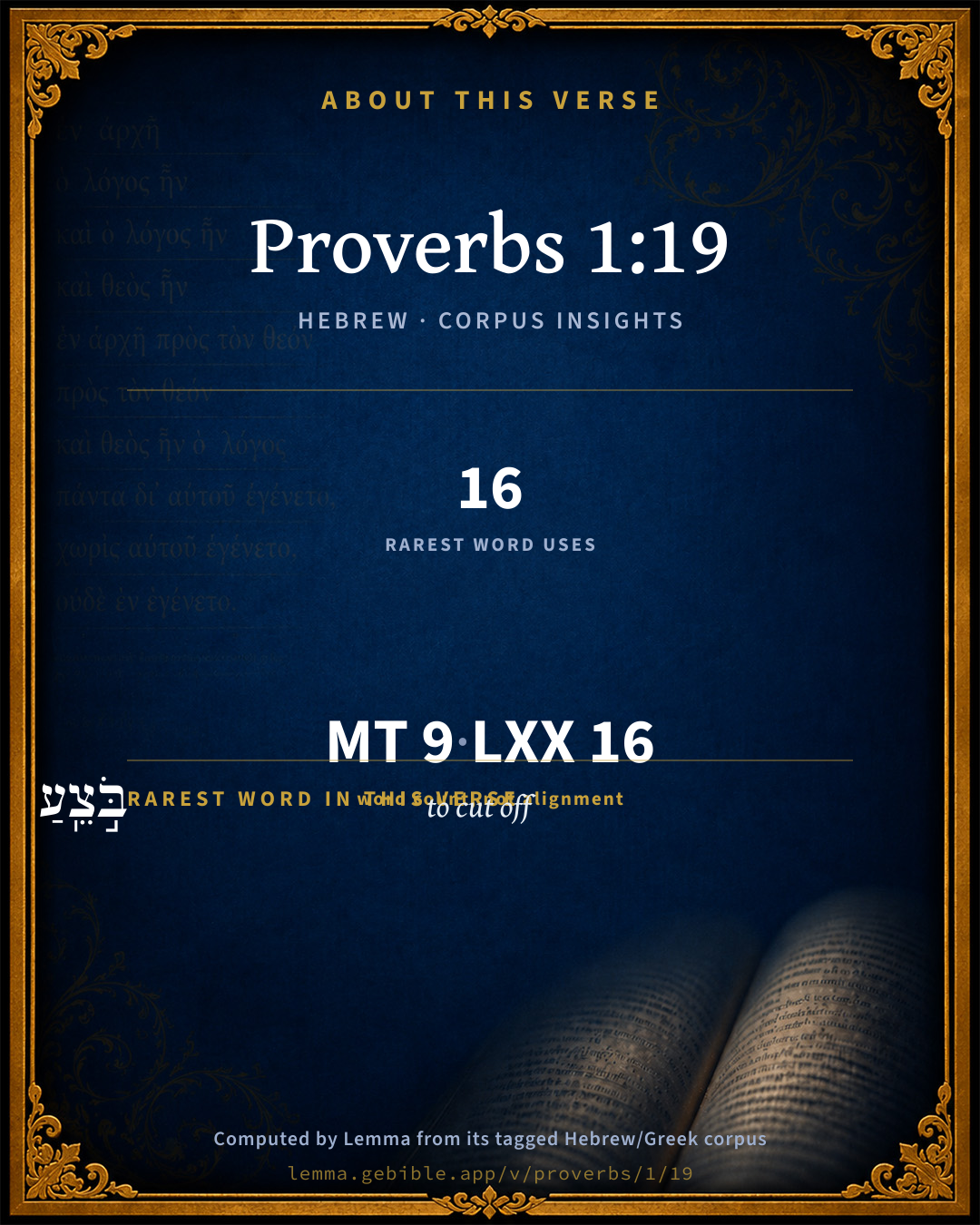
The rarest word here is בֹּ֣צֵֽעַ to cut off H1214 — appearing just 16 times in the whole Hebrew Bible.

Shared distinctive vocabulary

בֹּ֣צֵֽעַ to cut off H1214 occurs in 16 verses of the Hebrew Bible. Also found in:

Grammatical profile

  • 2 verbs
  • 5 nouns
  • 2 particles

Verb forms

  • בֹּ֣צֵֽעַ Qal · Participle Active
  • יִקָּֽח Qal · Imperfect

Hebrew & Septuagint length

In English translation the verse runs 19 words from the Hebrew and 18 from the Septuagint (LXX English) — closely comparable.

A rough comparison of the two English renderings, which tokenize alike — not a word-level alignment.

Word counts can differ between the Hebrew and the Greek without any difference in meaning — e.g. the Hebrew direct-object marker אֵת has no separate Greek word, and Greek often adds the article ὁ.

In the original languages it is 9 Hebrew tokens and 16 Greek tokens — but the two are counted differently (Hebrew bundles its prefixes and suffixes into one token; the Greek is in lemma form), so that isn’t a like-for-like length.

Cross-references

16

Topical passages linked to Proverbs 1:19 in the Treasury of Scripture Knowledge — connected by theme and wording, ordered by reader-vote popularity; previews shown in the World English Bible.

  • Proverbs 15:27 He who is greedy for gain troubles his own house, But he who hates bribes will live.
  • 2 Peter 2:3 In covetousness they will exploit you with deceptive words: whose sentence now from of old doesn't linger, and their destruction will not slumber.
  • Proverbs 23:3–4 Don't be desirous of his dainties, Seeing they are deceitful food.
  • Jeremiah 22:17–19 But your eyes and your heart are not but for your covetousness, and for shedding innocent blood, and for oppression, and for violence, to do it.
  • Micah 2:1–3 Woe to those who devise iniquity And work evil on their beds! When the morning is light, they practice it, Because it is in the power of their hand.
  • Habakkuk 2:9 Woe to him who gets an evil gain for his house, that he may set his nest on high, that he may be delivered from the hand of evil!
  • James 5:1–4 Come now, you rich, weep and howl for your miseries that are coming on you.
  • 2 Kings 5:20–27 But Gehazi the servant of Elisha the man of God, said, Behold, my master has spared this Naaman the Syrian, in not receiving at his hands that which he brought: as Yahweh lives, I will run after him, and take somewhat of him.
  • Ecclesiastes 5:13 There is a grievous evil which I have seen under the sun: wealth kept by its owner to his harm.
  • Micah 3:10–12 They build up Zion with blood, And Jerusalem with iniquity.
  • Acts 8:19–20 saying, "Give me also this power, that whoever I lay my hands on may receive the Holy Spirit."
  • 1 Timothy 3:3 not a drinker, not violent, not greedy for money, but gentle, not quarrelsome, not covetous;
  • 2 Samuel 18:11–13 Joab said to the man who told him, Behold, you saw it, and why didn't you strike him there to the ground? and I would have given you ten [pieces of] silver, and a sash.
  • Job 31:39 If I have eaten the fruits of it without money, Or have caused the owners of it to lose their life:
  • 1 Timothy 6:9–10 But those who are determined to be rich fall into a temptation and a snare and many foolish and harmful lusts, such as drown men in ruin and destruction.
  • 2 Peter 2:14–16 having eyes full of adultery, and who can't cease from sin; enticing unsettled souls; having a heart trained in greed; children of cursing;

Cross-references courtesy of OpenBible.info (CC BY 4.0).

Hebrew and Greek witnesses Masoretic Hebrew ↔ Greek Septuagint

The same verse in the two great witnesses to the Old Testament, shown verse-for-verse.

These are two independent witnesses, not word-aligned to each other, and the Septuagint is shown in lemma (dictionary) form.

Hebrew Proverbs 1:19 Masoretic · Westminster Leningrad Codex

כֵּ֗ן אָ֭רְחוֹת כָּל בֹּ֣צֵֽעַ בָּ֑צַע אֶת נֶ֖פֶשׁ בְּעָלָ֣יו יִקָּֽח

So are the ways of everyone who is greedy for gain. It takes away the life of its owners.

World English Bible · Public Domain

Greek LXX Proverbs 1:19 Septuagint · lemma form

ἑαυτοῦ ὁ ὁδός εἰμί πᾶς ὁ συντελέω ὁ ἄνομος ὁ γάρ ἀσέβεια ὁ ἑαυτοῦ ψυχή ἀποαἱρέω

These are the ways of all that perform lawless deeds; for by ungodliness they destroy their own life.

LXX2012 (modern English Septuagint) · Public Domain

Hebrew: Westminster Leningrad Codex (CC BY 4.0). Greek: Septuagint (public domain); English from LXX2012 (modern English Septuagint) (Public Domain). How the Septuagint differs from the Hebrew →

Commentary

Notes on Proverbs 1:19 from classic Christian and Jewish commentators (each source and its license shown beneath its notes). The classic Christian expositions comment on the surrounding passage and are grouped to its opening verse, so a note may address several verses; the Jewish commentaries on the Tanakh (Rashi and others) are per-verse, so they appear only where the commentator wrote on this verse.

Lemma curates 59 commentaries, every one of them public domain or Creative Commons licensed, each selected and text-cleaned for this edition rather than reprinted as found. About our sources →

Trapp's Complete Commentary

John Trapp

Pro 1:19 So [are] the ways of every one that is greedy of gain; [which] taketh away the life of the owners thereof.

Ver. 19. Which taketh away the life.] The greater wealth, the greater spoil awaits a man: as a tree with thick and large boughs, every man desires to lop him. Trithemius writeth that the Templars, at the request of Philip, King of France, were put down and extinct, upon the pretext of heresy; but indeed, because they were rich, and Philip sore longed after their possessions. Cyprus for its great wealth became a spoil to the Roman’s auri sacra fames, &c. Dεινος και παντολμος της φιλοχρηματιας ερως. {a} Covetousness is daring and desperate: it rides without reins, as Balaam did after the wages of wickedness, "the mammon of iniquity." {Luk 16:9}

{a} Sixtus Rufus, Virgil, Isidor.

John Trapp, A Commentary or Exposition upon All the Books of the Old and New Testament (1647–1656) — public domain. Text from a community e-Sword module.

Geneva Bible (1599)

Geneva Bible translators

Whereby he concludeth, that the covetous man is a murderer.

Geneva Bible (1599) marginal notes — public domain. Text via Bolls.life.

Adam Clarke's Commentary

Verse 19. Which taketh away the life] A covetous man is in effect, and in the sight of God, a murderer; he wishes to get all the gain that can accrue to any or all who are in the same business that he follows-no matter to him how many families starve in consequence. This is the very case with him who sets up shop after shop in different parts of the same town or neighbourhood, in which he carries on the same business, and endeavours to undersell others in the same trade, that he may get all into his own hand.

Adam Clarke's Commentary on the Bible (1810–1826) — public domain. Text from a community e-Sword/MySword module.

Ellicott's Commentary for English Readers

(19) So are the ways . . .—The conclusion of the discourse. The same phrase occurs in Job_8:13.

Which taketh away . . .—That is, covetousness takes away the life of him who has this vice in his heart, who is, according to the Hebrew idiom, the “owner” of it. (Comp. similar expressions in Pro_22:24; Pro_23:2, where an “angry” man and a man “given to appetite” are literally an owner of anger and appetite.)

A Bible Commentary for English Readers, edited by Charles John Ellicott (1878–1897) — public domain. Text from a community e-Sword module.

The Cambridge Bible for Schools and Colleges

gen. ed. J. J. S. Perowne

19. which taketh away] Rather, It (greed of gain) taketh away the life of them that have it. It is the destruction of those who are possessed by it. The same Heb. phrase, owner or lord of, is rendered him that hath it, in Pro_16:22, Comp. Pro_22:24, an angry man, A.V.; him that is given to anger, R.V. lit. a lord, or owner, of anger, and Pro_23:2, a man given to appetite, lit. an owner of appetite.

The Cambridge Bible for Schools and Colleges (gen. ed. J. J. S. Perowne; Cambridge University Press, 1878–1918) — public domain. Text from a community e-Sword module.

John Gill's Exposition

So are the ways of everyone that is greedy of gain,.... That is set upon getting riches in an unlawful way, by robberies and murder; his ways will end in the loss of his own blood and life, and in the loss of his immortal soul; this will be what his wicked ways and course of life will bring him to, and what will his gain profit him then? it would be of no use and service to him could he have gained the whole world;

which taketh away the life of the owners thereof: or who, even every one of those that are greedy of gain, and will be rich at any rate; such stick not to take away the life of the proper owners of that gain, or money they are greedy of, in order to get it into their own possession; and such wicked practices cannot fail of meeting with a just recompence of reward: or "which" covetous gain, or gain gotten in such a wicked manner, will be the cause of the life of the injurious masters and wrong possessors of it being taken away from them, either by the hand of the civil magistrate, or by God himself. These sins of robbery and murder are particularly instanced in, not only because other sins lead unto them, as sabbath breaking, drunkenness, and lewdness, and issue in temporal and eternal ruin; but because they were very common among the Jews at the time that Wisdom, or Christ, was here on earth: to which time the whole passage refers, as appears from the following verses; and that those sins were frequent then is manifest both from Scripture; see Mat 27:38; and from the confessions of the Jews, who say (z) that forty years before the destruction of the temple the sanhedrim were obliged to remove from place to place, because that murderers increased, and they could not judge and condemn them, for fear of being murdered themselves; and it was because of this great increase they were obliged to stop the beheading of the red heifer (a).

(z) T. Bab. Avodah Zarah, fol. 8. 2. (a) Misnah Sotah, c. 9. s. 9.

John Gill's Exposition of the Whole Bible (1746–1763) — public domain (CC PDM 1.0). Text via the HelloAO Bible API.

Albert Barnes' Notes on the Bible

Not robbery only, but all forms of covetousness are destructive of true life.

Albert Barnes' Notes on the Bible (1834–1885) — public domain. Text from a community e-Sword/MySword module.

Haydock's Catholic Bible Commentary

Possessors. Of money. (Calmet) --- While they attempt to invade another’s property, they ruin themselves, and come to the gallows. (Haydock)

George Leo Haydock (1774–1849), Haydock's Catholic Family Bible and Commentary, 1859 edition — public domain. Excludes Psalms (Douay-Rheims chapter numbering differs from Protestant) and Deuterocanonical books (Catholic canon only).

Matthew Poole's English Annotations

So, as is expressed both in the foregoing and following words,

are the ways; the actions and courses, which are so in the tendency and event of them.

That is greedy of pain; that seeks gain by unrighteous and wicked practices. Which; either which greediness; or rather, which gain, by comparing the last words.

Taketh away the lives of the owners thereof; brings sudden and violent death upon those who had made themselves masters and possessors of such gain.

Matthew Poole's English Annotations on the Holy Bible (1683–1685) — public domain. Text from a community e-Sword/MySword module.

Whedon's Commentary on the Bible

Daniel D. Whedon

19. So are the ways — Such is the natural course and end of every one that is greedy of gain — Literally, a plunderer of plunder, (comp. Pro_15:29,) or rapacious plunderers of property, that do not hesitate to take the life of the owner of it. So the passage is commonly understood; but others, with some plausibility, render, It (that is, the unjust gain) takes away the life of its master or possessor. 1Ti_6:9-10.

Daniel D. Whedon (gen. ed.), Commentary on the Old and New Testaments (1874–1909) — public domain. Text from a community e-Sword module.

The Pulpit Commentary

So am the ways of every one that is greedy of gain. The epiphonema or moral of the preceding address. So are the ways, or such is the lot (as Delitzsch), or such are the paths (as Zockler), i.e. so deceitful, so ruinous, are the ways. Ke (chen,) is here used as a qualitative adverb.

Ways; twOjra (ar"khoth), the plural of jraO (orakh), a poet. word, equivalent in the first instance to "way," i.q. (derekh), and metaphorically applied to any one"s ways, his manner of life and its result, and hence lot, as in Job_8:12, and hence the expression coven the three preceding verses. That is greedy of gain (xB xebo, botsea batsa); literally, concupiscentis concupiscentium lucri; i.e. eagerly longing after gain; he who greedily desires riches (avari, Vulgate). Gain; batsa in pause, from xB. (betsa), which takes its meaning from the verb xB (batsa), "to out in pieces, to break," and hence means properly that which is cut or broken off and taken by any one for himself, and so unjust gain anything whatever fraudulently acquired, as in Pro_28:16, where it is translated "covetousness" (Authorized Version); cf. Isa_33:15 Pro_15:27. The idea of greed and covetousness enters largely into the word. Which taketh away the life of the owners thereof. The pronoun "which" does not occur in the original. The nominative to "taketh away" (tQyi, yikkath) is "gain;" the "unjust gain." (betsa) takes away the life of its owners, i.e. of those who are under its power. Owners thereof (wOylB, b"alayo) does not necessarily imply that they are in actual possession of the unjust gain, but rather refers to the influence which the lust for gain exercises over them. The expression in this second hemistich does not mean that the rapacious take the life of their comrades who possess the gain, as Rabbi Salomon; nor as the Vulgate, "the ways of the avaricious man take away the lives of those who possess them." For the phrase, "taketh away the life," as importing a violent taking away, cf. Psa_31:13 1Ki_19:10. The sentiment of the verse is well expressed in 1Ti_6:10, "For the love of money is the root of all evil; which while some coveted after, they have erred from the faith, and pierced themselves through with many sorrows."

The Pulpit Commentary (1880–1919), ed. H.D.M. Spence-Jones & Joseph S. Exell — public domain. Text from a community e-Sword module.

John Wesley's Explanatory Notes

Greedy - That seeks gain by wicked practices.

John Wesley, Explanatory Notes Upon the Whole Bible (1754–1765) — public domain. Text via the GEBible commentary corpus.

Keil & Delitzsch

C. F. Keil & F. Delitzsch

An epiphonema:

Such is the lot of all who indulge in covetousness;

It takes away the life of its owner.

This language is formed after Job 8:13. Here, as there, in the word ארחות, the ideas of action and issue, manner of life and its result, are all combined. בּצע signifies properly that which is cut off, a piece, fragment broken off, then that which one breaks off and takes to himself - booty, gain, particularly unjust gain (Pro 28:16). בּצע בּצע is he who is greedy or covetous. The subject to יקּח is בּצע, covetousness, πλεονεξία (see Isa 57:17). As Hoses, Job 4:11, says of three other things that they taken away לב, the understanding (νοῦς), so here we are taught regarding unjust gain or covetousness, that it takes away נפשׁ, the life (ψυχή) (לקח נפשׁ, to take away the life, Kg1 19:10; Psa 31:14). בּעליו denotes not the possessor of unjust gain, but as an inward conception, like בעל אף, Pro 22:24, cf. Pro 23:2; Pro 24:8; Ecc 10:11, him of whom covetousness is the property. The sing. נפשׁ does not show that בּעליו is thought of as sing.; cf. Pro 22:23, Ps. 34:23; but according to Pro 3:27; Pro 16:22; Ecc 8:8, this is nevertheless probable, although the usage without the suffix is always בּעל בּצע, and not בּעלי (of plur. intens. בּעלים).

Keil & Delitzsch — Biblical Commentary on the Old Testament (1861–1891) — public domain (CC PDM 1.0). Text via the HelloAO Bible API. (Old Testament only.)

Rashi

Rabbi Shlomo Yitzchaki (Rashi)

So are the ways of everyone who commits robbery Heb. בצע בצע, who commits robbery. It is beautiful and precious to him, and it is free to him. But his end will be that... it will take away the life of its owner His own life, for he has now become the owner of the money that he stole from his neighbor.

Rashi on the Tanakh — English translations: “The Judaica Press complete Tanach with Rashi, translated by A. J. Rosenberg” (CC BY 4.0); “Pentateuch with Rashi's commentary by M. Rosenbaum and A.M. Silbermann, 1929-1934” (public domain); “The Metsudah Tanach series, Lakewood, N.J” (CC BY 4.0); and “The Book of Joshua, Metsudah Publications, 1997” (CC BY 4.0). Text via Sefaria.

Lesson kit

Teaching starters — assembled from the data on this page, not authored interpretation. Every prompt links to the verse data it draws on. Edit before teaching.

Proverbs, in the Wisdom, opens this verse with 9 words (9 distinct Hebrew lemmas). Its most distinctive word is bâtsaʻ (“to cut off”). A historical commentator’s framing appears above. Read the whole chapter for the surrounding context.

Discussion questions

  1. How does “to cut off” (bâtsaʻ) shape what this verse is saying?
  2. Job 6:9 shares the word «to cut off» with this verse. How do the two illuminate each other?
  3. These translations render this verse differently; the difference is in the English rendering, not the original. What questions does that raise?
  4. The verb «בֹּ֣צֵֽעַ» is Qal Participle Active. How does its form color the action?
  5. Reading how Trapp's Complete Commentary and Geneva Bible (1599) read this verse, where do the two commentators agree and where do they part?

Things to notice

Reading settings

Reading text

Shown beneath each verse's original-language words.

Old Testament
Old Testament edition

Read the OT as the Masoretic Hebrew (MT) or the Greek Septuagint (LXX).

English shown for the Greek Septuagint (in the Hebrew ↔ Greek comparison).

Comparing translations? Open the Compare panel on any verse page to stack up to four side by side.