Numbers 30:3

Hebrew (Westminster Leningrad Codex) Numbers 30:3 appears in the Hebrew Old Testament. The text above is from the Westminster Leningrad Codex. Each word links to its Strong’s number, a concise gloss, and parsing drawn from the Open Scriptures Hebrew Bible morphology. Click any word for its full Brown-Driver-Briggs (BDB) entry.
Download image
Cite this verse

Numbers 30:3 (World English Bible). Public Domain. Lemma interlinear Bible study tool, https://lemma.gebible.app/v/numbers/30/3.

Show BibTeX & RIS
BibTeX
RIS
English Translation
Also when a woman vows a vow to Yahweh, and binds herself by a bond, being in her father's house, in her youth,
World English Bible · Public Domain
Download a study sheet

One document with this verse’s original text, its word-by-word gloss line, the meaning frame, cross-references with their text, attributed commentary, and full source and license credits — printable, and it pastes into notes with its structure intact.

This verse Autodidact and up

Study sheet (.html) Plain text (.txt)

A passage Seminary Student

Up to 50 verses in one chapter. A passage sheet keeps up to 6 commentary sources and 12 cross-references per verse, in the order this page ranks them, and says so on the sheet whenever that leaves anything out. Ask for a single verse and you get the Autodidact verse sheet above.

Everything on this page stays free to read, with no account — the sheet is a download of what is already on screen, not access to it.

Want to remove ads? Support Godless Engineer
Compare translations 3

The same verse in 3 English versions, stacked beneath the original-language interlinear above. Click any original word for its lexicon entry.

Each is an independent rendering of the whole verse — the interlinear is not word-aligned to these translations.

Highlighted words mark where these versions differ — a whole-verse word diff, not a word-by-word alignment.

  • World English Bible Public Domain
    Also when a woman vows a vow to Yahweh, and binds herself by a bond, being in her father's house, in her youth,
  • King James Version Public Domain
    If a woman also vow a vow unto the LORD, and bind herself by a bond, being in her father's house in her youth;
  • unfoldingWord Literal Text CC BY-SA 4.0
    And if a woman vows a vow to Yahweh and binds a binding vow in the house of her father, in her youth,

unfoldingWord Literal Text — © unfoldingWord, licensed CC BY-SA 4.0. Word-aligned USFM3 via Door43 (git.door43.org/unfoldingWord/en_ult).

Versions to compare (up to 4)

3 of 4 selected

Show all 18 translations

Every available English version of this verse, each an independent rendering of the whole verse.

  • World English Bible Public Domain
    Also when a woman vows a vow to Yahweh, and binds herself by a bond, being in her father's house, in her youth,
  • Berean Standard Bible Public Domain
    And if a woman in her father’s house during her youth makes a vow to the LORD or obligates herself by a pledge,
  • Majority Standard Bible Public Domain
    And if a woman in her father’s house during her youth makes a vow to the LORD or obligates herself by a pledge,
  • King James Version Public Domain
    If a woman also vow a vow unto the LORD, and bind herself by a bond, being in her father's house in her youth;
  • American Standard Version (1901) Public Domain
    Also when a woman voweth a vow unto Jehovah, and bindeth herself by a bond, being in her father's house, in her youth,
  • Revised Version (1885) Public Domain
    Also when a woman voweth a vow unto the LORD, and bindeth herself by a bond, being in her father’s house, in her youth;
  • Geneva Bible (1599) Public Domain
    Whosoeuer voweth a vow vnto the Lord, or sweareth an othe to binde him selfe by a bonde, he shall not breake his promise, but shall do according to al that proceedeth out of his mouth.
  • Douay-Rheims (1899) Public Domain
    If any man make a vow to the Lord, or bind himself by an oath: he shall not make his word void but shall fulfil all that he promised.
  • Young's Literal Translation Public Domain
    `And when a woman voweth a vow to Jehovah, and hath bound a bond in the house of her father in her youth,
  • Literal Standard Version CC BY-SA 4.0
    And when a woman vows a vow to YHWH, and has bound a bond in the house of her father in her youth,
  • Unlocked Literal Bible CC BY-SA 4.0
    When a young woman living in her father's house makes a vow to Yahweh and binds herself with a promise,
  • unfoldingWord Literal Text CC BY-SA 4.0
    And if a woman vows a vow to Yahweh and binds a binding vow in the house of her father, in her youth,
  • Darby Bible Public Domain
    If a woman also vow a vow to Jehovah, and bind herself by a bond, in her father's house in her youth,
  • World Messianic Bible Public Domain
    “Also, when a woman vows a vow to the LORD and binds herself by a pledge, being in her father’s house, in her youth,
  • Webster's Bible Public Domain
    \\30:2\\If a man shall vow a vow to the LORD, or swear an oath to bind his soul with a bond; he shall not break his word; he shall do according to all that proceedeth out of his mouth.
  • Free Bible Version CC BY-SA 4.0
    If a woman who's young and still living in her father's house makes a solemn promise to the Lord or pledges to do something by swearing an oath
  • Bible in Basic English Public Domain
    When a man takes an oath to the Lord, or gives an undertaking having the force of an oath, let him not go back from his word, but let him do whatever he has said he will do.
  • JPS Tanakh (1917) Public Domain
    (30-4) Also when a woman voweth a vow unto the LORD, and bindeth herself by a bond, being in her father's house, in her youth,

Literal Standard Version (2020), Covenant Press — licensed CC BY-SA 4.0. Text via the HelloAO Bible API (eBible.org). Unlocked Literal Bible (unfoldingWord) — licensed CC BY-SA 4.0. Text via the HelloAO Bible API (eBible.org). unfoldingWord Literal Text — © unfoldingWord, licensed CC BY-SA 4.0. Word-aligned USFM3 via Door43 (git.door43.org/unfoldingWord/en_ult). Free Bible Version, Dr. Jonathan Gallagher — licensed CC BY-SA 4.0. Text via the HelloAO Bible API (eBible.org).

Word by word

More ways to search: Search by grammar → Find every occurrence → Compare this word →

Practice this passage: Drill this verse → Learn its vocabulary →

אִסָּ֛ר
ʼĕçâr
H632
“bond”
Noun, Common, Masculine, Singular, Absolute
Part of Speech
Noun
Type
Common
Gender
Masculine
Number
Singular
State
Absolute
Full BDB Definition

Origin: from H631

TWOT: 141d

bond, binding obligation, obligation
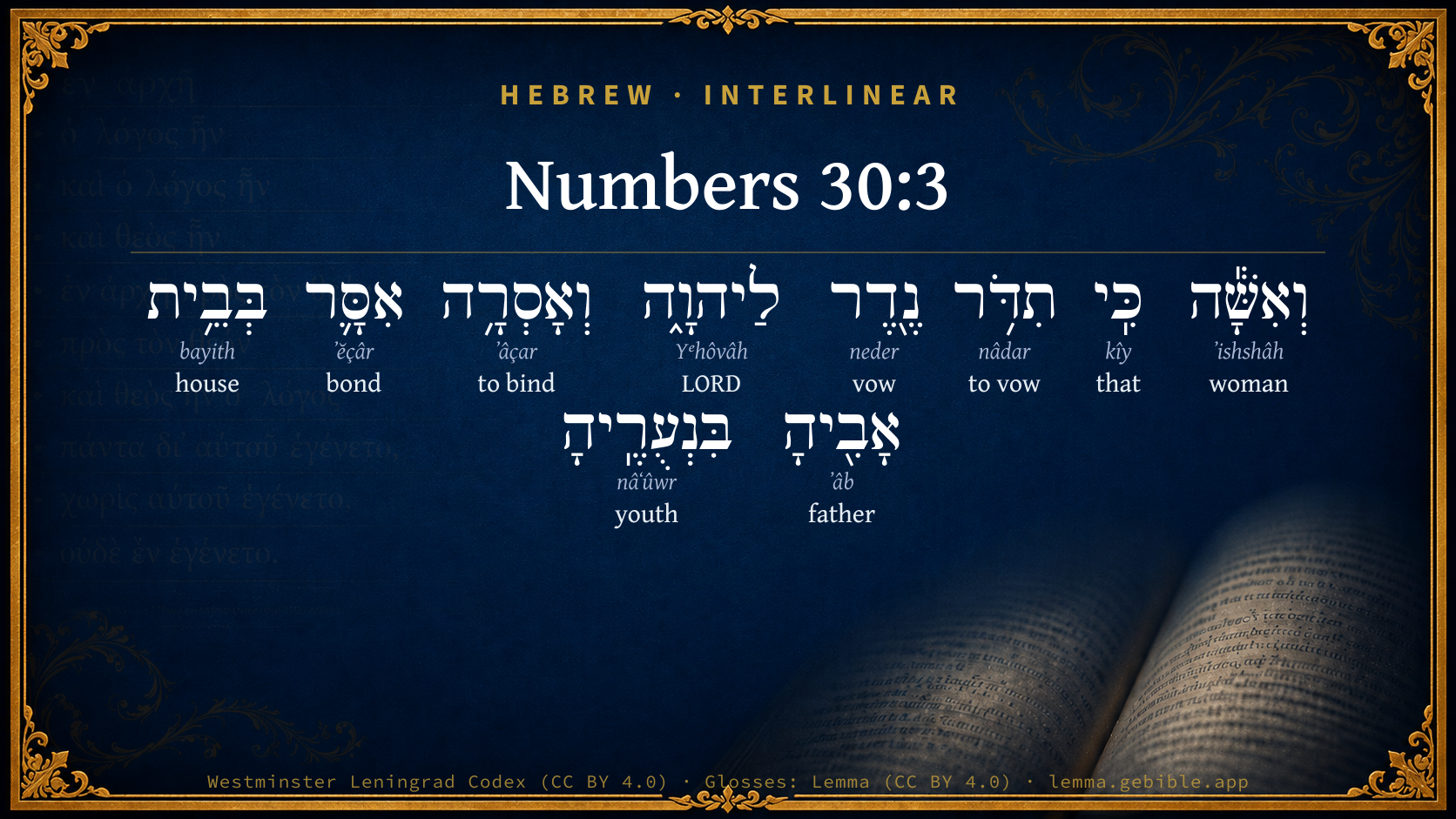
  1. וְאִשָּׁ֕ה ʼishshâh H802 “and · woman” Conjunction + Noun, Common, Feminine, Singular, Absolute
  2. כִּֽי kîy H3588 “that” Conjunction
  3. תִדֹּ֥ר nâdar H5087 “to vow” Verb, Qal, Imperfect, 3rd Person, Feminine, Singular
  4. נֶ֖דֶר neder H5088 “vow” Noun, Common, Masculine, Singular, Absolute
  5. לַיהוָ֑ה Yᵉhôvâh H3068 “to/for · LORD” Preposition + Noun, Proper
  6. וְאָסְרָ֥ה ʼâçar H631 “and · to bind” Conjunction + Verb, Qal, Sequential Perfect, 3rd Person, Feminine, Singular
  7. בְּבֵ֥ית bayith H1004 “in/at · house of” Preposition + Noun, Common, Masculine, Singular, Construct
  8. אָבִ֖יהָ ʼâb H1 “father · her” Noun, Common, Masculine, Singular, Construct + Suffix, Personal, 3rd Person, Feminine, Singular
  9. בִּנְעֻרֶֽיהָ nâʻûwr H5271 “in/at · youth · her” Preposition + Noun, Common, Both, Plural, Construct + Suffix, Personal, 3rd Person, Feminine, Singular

About this verse

These counts appear in no published source. They are computed here, from the morphology-tagged text and Lemma’s own curated glosses. What Lemma adds →

10
words
10
distinct lemmas
Pentateuch
section

Notable vocabulary

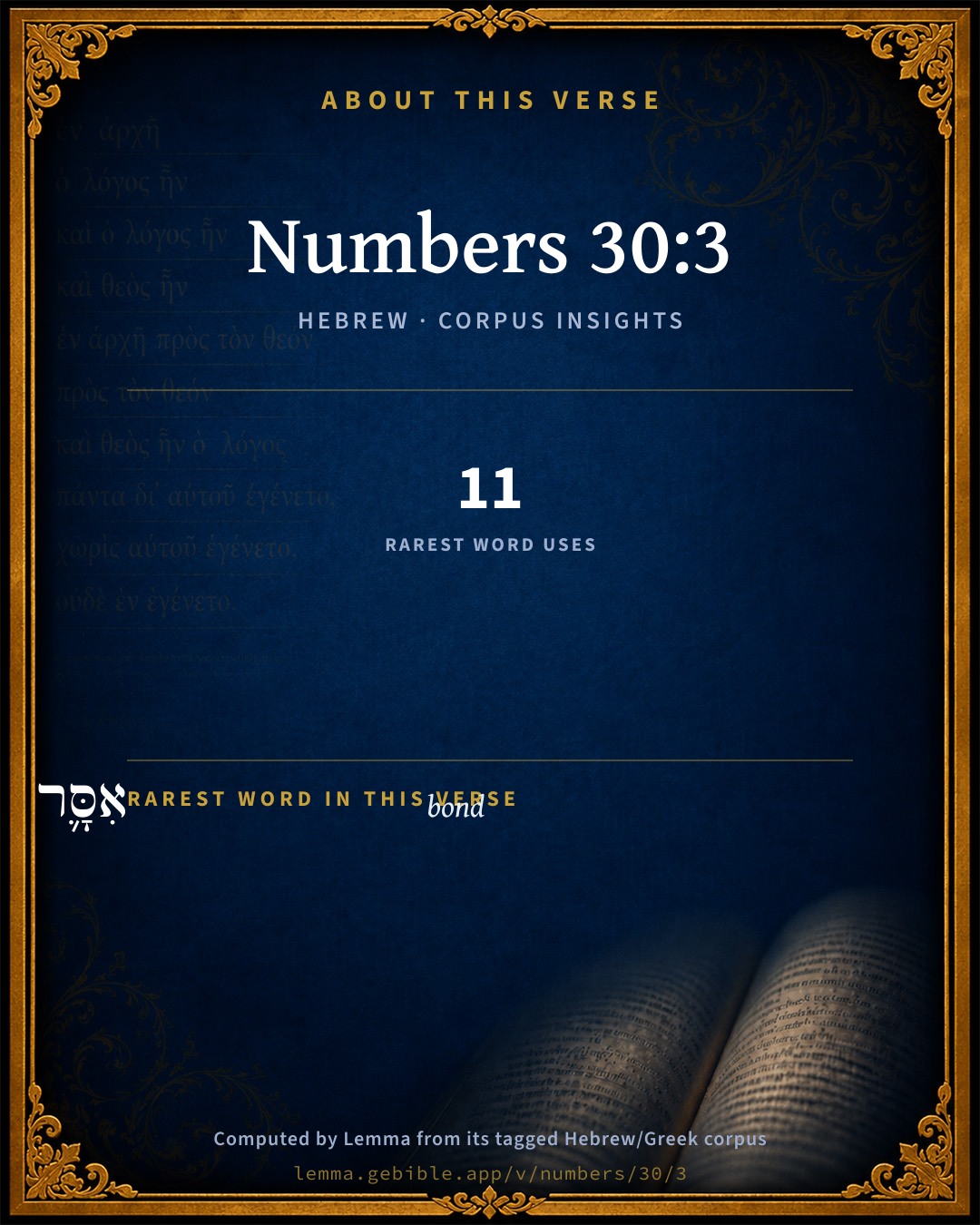
The rarest word here is אִסָּ֛ר bond H632 — appearing just 11 times in the whole Hebrew Bible.

Shared distinctive vocabulary

אִסָּ֛ר bond H632 occurs in 10 verses of the Hebrew Bible. Also found in:

Grammatical profile

  • 2 verbs
  • 7 nouns
  • 1 conjunction

Verb forms

  • תִדֹּ֥ר Qal · Imperfect
  • וְאָסְרָ֥ה Qal · Sequential Perfect

Hebrew & Septuagint length

In English translation the verse runs 23 words from the Hebrew and 39 from the Septuagint (LXX English) — the Septuagint runs noticeably longer here. See the side-by-side →

A rough comparison of the two English renderings, which tokenize alike — not a word-level alignment.

Word counts can differ between the Hebrew and the Greek without any difference in meaning — e.g. the Hebrew direct-object marker אֵת has no separate Greek word, and Greek often adds the article ὁ.

Hebrew and Greek witnesses Masoretic Hebrew ↔ Greek Septuagint

The same verse in the two great witnesses to the Old Testament, shown verse-for-verse.

Here the Septuagint runs noticeably longer than the Hebrew — LXX2012 (modern English Septuagint) 39 words vs World English Bible 23. A rough length comparison of the two English translations, not a word-level alignment — read both below.

These are two independent witnesses, not word-aligned to each other, and the Septuagint is shown in lemma (dictionary) form.

Hebrew Numbers 30:3 Masoretic · Westminster Leningrad Codex

וְאִשָּׁ֕ה כִּֽי תִדֹּ֥ר נֶ֖דֶר לַיהוָ֑ה וְאָסְרָ֥ה אִסָּ֛ר בְּבֵ֥ית אָבִ֖יהָ בִּנְעֻרֶֽיהָ

Also when a woman vows a vow to Yahweh, and binds herself by a bond, being in her father's house, in her youth,

World English Bible · Public Domain

Greek LXX Numbers 30:3 Septuagint · lemma form

ἄνθρωπος ἄνθρωπος ὅς ἄν εὔχομαι εὐχή κύριος ἤ ὄμνυμι ὅρκος ἤ ὁρίζω ὁρισμός περί ὁ ψυχή αὐτός οὐ βεβηλόω ὁ ῥῆμα αὐτός πᾶς ὅσος ἐάν ἐκἔρχομαι ἐκ ὁ στόμα αὐτός ποιέω

Whatsoever man shall vow a vow to the Lord, or swear an oath, or bind himself with an obligation upon his soul, he shall not break his word; all that shall come out of his mouth he shall do.

LXX2012 (modern English Septuagint) · Public Domain

Hebrew: Westminster Leningrad Codex (CC BY 4.0). Greek: Septuagint (public domain); English from LXX2012 (modern English Septuagint) (Public Domain). How the Septuagint differs from the Hebrew →

Targum (Aramaic paraphrase)

2

The Targum is the ancient Jewish Aramaic paraphrase of the Hebrew Scriptures — an interpretive translation, not the Hebrew text itself. Onkelos (literal) and Pseudo-Jonathan (expansive) render the Torah, and Jonathan the Prophets. Coverage is partial: where no permissively-licensed English translation exists for a verse, only the Aramaic is shown. This is verse-level text, not a word-by-word alignment to the Hebrew.

  1. Targum Onkelos Torah (Genesis–Deuteronomy)
    גְבַר אֲרֵי יִדַר נְדַר קֳדָם יְיָ אוֹ יְקַיֵים קְיַם לְמֵיסַר אִסַר עַל נַפְשֵׁיהּ לָא יְבַטֵל פִּתְגָמֵיהּ כְּכָל דִי יִפּוֹק מִפּוּמֵיה יַעֲבֵּד

    Any man who vows a vow before God, or oaths an oath to prohibit a prohibition on himself, he cannot void his word; anything that his mouth utters he shall do.

    Targum Onkelos — Aramaic: “Onkelos Genesis” (public domain); “Onkelos Exodus” (public domain); “Onkelos Leviticus” (public domain); “Onkelos Numbers” (public domain); “Onkelos Deuteronomy” (public domain). English: “Sefaria Community Translation” (CC0 1.0 (public-domain dedication)); “J.W. Etheridge. The Targums of Onkelos and Jonathan Ben Uzziel on the Pentateuch. London: Longmans, Green, 1862” (public domain). Text via Sefaria.

  2. Targum Pseudo-Jonathan Torah (Genesis–Deuteronomy)
    גְבַר בַּר תְּלֵיסַר שְׁנִין אֲרוּם יִדַר נִדְרָא קֳדָם יְיָ אוֹ יְקַיֵים קְיַים לְמֵיסַר אִיסַר מִמַדַעַם דְהֶתֵּירָא עַל נַפְשֵׁיהּ לָא יָפִיס פִּתְגָמֵיהּ בְּרַם בֵּית דִינָא שָׁרַן לֵיהּ וְאִין לָא שָׁרוּ לֵיהּ כְּכָל מַה דְיִפּוֹק מִפּוּמֵיהּ יַעֲבֵיד

    A man, a son of thirteen when he shall have vowed a vow before the Lord, or have sworn an oath, saying, I will withhold from such a thing which is permitted to me, shall not be allowed to relax his word (at his own will): nevertheless, the house of judgment (beth dina) can absolve him; but if they absolve him not, whatsoever hath gone out of his mouth he shall perform.

    Targum Pseudo-Jonathan — Aramaic: “Targum Jonathan on Genesis” (public domain); “Targum Jonathan on Exodus” (public domain); “Targum Jonathan on Leviticus” (public domain); “Targum Jonathan on Numbers” (public domain); “Targum Jonathan on Deuteronomy” (public domain). English: “The Targum of Jonathan ben Uzziel, trans. J. W. Etheridge, London, 1862” (public domain). Text via Sefaria.

Commentary

Notes on Numbers 30:3 from classic Christian and Jewish commentators (each source and its license shown beneath its notes). The classic Christian expositions comment on the surrounding passage and are grouped to its opening verse, so a note may address several verses; the Jewish commentaries on the Tanakh (Rashi and others) are per-verse, so they appear only where the commentator wrote on this verse.

Lemma curates 59 commentaries, every one of them public domain or Creative Commons licensed, each selected and text-cleaned for this edition rather than reprinted as found. About our sources →

Whedon's Commentary on the Bible

Daniel D. Whedon

THE MAID’S VOW, Num_30:3-5.

3. If a woman vow — Both Judaism and Christianity recognise the religious nature and rights of woman, in marked contrast to the denial of those rights by paganism. Even girls in their minority are here recognised as capable of assuming religious obligations.

In her youth — Not in her childhood. The Hebrew canons thus define youth: “A young man, the son of twelve years and one day, and a young woman, the daughter of eleven years and one day, who vow either vows of abstinence or of consecration, they examine and question. If they know to whose name they have vowed, then their vows are established; but if they know not, then there is nothing in their vows or words.” This examination they are subject to during one year; afterward their vows are binding without examination, except that the daughter’s may be annulled by the father in accordance with the law.

Daniel D. Whedon (gen. ed.), Commentary on the Old and New Testaments (1874–1909) — public domain. Text from a community e-Sword module.

Keil & Delitzsch

C. F. Keil & F. Delitzsch

Num 30:3-15 contain the rules relating to positive and negative vows made by a woman, and four different examples are given. The first case (Num 30:3-5) is that of a woman in her youth, while still unmarried, and living in her father's house. If she made a vow of performance or abstinence, and her father heard of it and remained silent, it was to stand, i.e., to remain in force. But if her father held her back when he heard of it, i.e., forbade her fulfilling it, it was not to stand or remain in force, and Jehovah would forgive her because of her father's refusal. Obedience to a father stood higher than a self-imposed religious service. - The second case (Num 30:6-8) was that of a vow of performance or abstinence, made by a woman before her marriage, and brought along with her (עליה, "upon herself") into her marriage. In such a case the husband had to decide as to its validity, in the same way as the father before her marriage. In the day when he heard of it he could hold back his wife, i.e., dissolve her vow; but if he did not do this at once, he could not hinder its fulfilment afterwards. שׂפתיה מבטא, gossip of her lips, that which is uttered thoughtlessly or without reflection (cf. Lev 5:4). This expression implies that vows of abstinence were often made by unmarried women without thought or reflection. - The third case (Num 30:9) was that of a vow made by a widow or divorced woman. Such a vow had full force, because the woman was not dependent upon a husband. - The fourth case (Num 30:10-12) was that of a vow made by a wife in her married state. Such a vow was to remain in force if her husband remained silent when he heard of it, and did not restrain her. On the other hand, it was to have no force if her husband dissolved it at once. After this there follows the general statement (Num 30:13-16), that a husband could establish or dissolve every vow of performance or abstinence made by his wife. If, however, he remained silent "from day to day," he confirmed it by his silence; and if afterwards he should declare it void, he was to bear his wife's iniquity. עונה, the sin which the wife would have had to bear if she had broken the vow of her own accord. This consisted either in a sin-offering to expiate her sin (Lev 5:4.); or if this was omitted, in the punishment which God suspended over the sin (Lev 5:1).

Keil & Delitzsch — Biblical Commentary on the Old Testament (1861–1891) — public domain (CC PDM 1.0). Text via the HelloAO Bible API. (Old Testament only.)

Tyndale Open Study Notes

Tyndale Open Resources

30:3-5 A young woman was under the authority of her father, who was responsible for her actions and her financial obligations.

Tyndale Open Study Notes — © Tyndale Open Resources, licensed CC BY-SA 4.0. Text via the HelloAO Bible API.

Geneva Bible (1599)

Geneva Bible translators

Hebrew, violate his word.

Hebrew, his soul.

Geneva Bible (1599) marginal notes — public domain. Text via Bolls.life.

Matthew Henry's Commentary

It is here taken for granted that all such persons as are sui juris - at their own disposal, and are likewise of sound understanding and memory, are bound to perform whatever they vow that is lawful and possible; but, if the person vowing be under the dominion and at the disposal of another, the case is different. Two cases much alike are here put and determined: -

I. The case of a daughter in her father's house: and some think, probably enough, that it extends to a son likewise, while he is at home with his father, and under tutors and governors. Whether the exception may thus be stretched I cannot say. Non est distinguendum, ubi lex non distinguit - We are not allowed to make distinctions which the law does not. The rule is general, If a man vow, he must pay. But for a daughter it is express: her vow is nugatory or in suspense till her father knows it, and (it is supposed) knows it from her; for, when it comes to his knowledge, it is in his power either to ratify or nullify it. But in favour of the vow, 1. Even his silence shall suffice to ratify it: If he hold his peace, her vows shall stand, Num 30:4. Qui tacet, consentire videtur - Silence gives consent. Hereby he allows his daughter the liberty she has assumed, and, as long as he says nothing against her vow, she shall be bound by it. But, 2. His protestation against it shall perfectly disannul it, because it is possible that such vow may by prejudicial to the affairs of the family, break the father's measures, perplex the provision made for his table if the vow related to meats, or lessen the provision made for his children if the vow would be more expensive than his estate would bear; however, it was certain that it was an infringement of his authority over his child, and therefore, if he disallow it, she is discharged, and the Lord shall forgive her, that is, she shall not be charged with the guilt of violating her vow; she showed her good-will in making the vow, and, if her intentions therein were sincere, she shall be accounted better than sacrifice. This shows how great a deference children owe to their parents, and how much they ought to honour them and be obedient to them. It is for the interest of the public that the paternal authority be supported; for, when children are countenanced in their disobedience to their parents (as they were by the tradition of the elders, Mat 15:5, Mat 15:6), they soon become in other things children of Belial. If this law be not to be extended to children's marrying without their parents' consent so far as to put it in parents' power to annul the marriage and dissolve the obligation (as some have thought it does), yet certainly it proves the sinfulness of it, and obliges the children that have thus done foolishly to repent and humble themselves before God and their parents.

II. The case of a wife is much the same. As for a woman that is a widow or divorced, she has neither father nor husband to control her, so that, whatever vows she binds her soul with, they shall stand against her (Num 30:9), it is at her peril if she run back; but a wife, who has nothing that she can strictly call her own, but with her husband's allowance, cannot, without that, make any such vow. 1. The law is plain in case of a wife that continues so long after the vow. If her husband allow her vow, though only by silence, it must stand, Num 30:6, Num 30:7. If he disallow it, since her obligation to that which she had vowed arose purely from her own act, and not from any prior command of God, her obligation to her husband shall take place of it, for to him she ought to be in subjection as unto the Lord; and now it is so far from being her duty to fulfil her vow that it would be her sin to disobey her husband, whose consent perhaps she ought to have asked before she made the vow; therefore she needs forgiveness, Num 30:8. 2. The law is the same in case of a wife that soon after becomes a widow, or is put away. Though, if she return to her father's house, she does not therefore so come again under his authority as that he has power to disannul hew vows (Num 30:9), yet if the vow was made while she was in the house of her husband, and her husband disallowed it, it was made void and of no effect for ever, and she does not return under the law of her vow when she is loosed from the law of her husband. This seems to be the distinct meaning of Num 30:10-14, which otherwise would be but a repetition of Num 30:6-8. But it is added (Num 30:15) that, if the husband make void the vows of his wife, he shall bear her iniquity; that is, if the thing she had vowed was really good, for the honour of God and the prosperity of her own soul, and the husband disallowed it out of covetousness, or humour, or to show his authority, though she be discharged from the obligation of her vow, yet he will have a great deal to answer for. Now here it is very observable how carefully the divine law consults the good order of families, and preserves the power of superior relations, and the duty and reverence of inferiors. It is fit that every man should bear rule in his own house, and have his wife and children in subjection with all gravity; and rather than this great rule should be broken, or any encouragement given to inferior relations to break those bonds asunder, God himself would quit his right, and release the obligations even of a solemn vow; so much does religion strengthen the ties of all relations, and secure the welfare of all societiesd, that in it the families of the earth are blessed.

Matthew Henry's Commentary on the Whole Bible (1708–1710) — public domain (CC PDM 1.0). Text via the HelloAO Bible API.

Jamieson, Fausset & Brown

Robert Jamieson, A. R. Fausset & David Brown

If a woman also vow a vow unto the Lord, and bind herself by a bond, being in her father's house in her youth--Girls only are specified; but minors of the other sex, who resided under the parental roof, were included, according to Jewish writers, who also consider the name "father" as comprehending all guardians of youth. We are also told that the age at which young people were deemed capable of vowing was thirteen for boys and twelve for girls. The judgment of a father or guardian on the vow of any under his charge might be given either by an expressed approval or by silence, which was to be construed as approval. But in the case of a husband who, after silence from day to day, should ultimately disapprove or hinder his wife's vow, the sin of non-performance was to be imputed to him and not to her [Num 30:15].

Jamieson, Fausset & Brown — Commentary Critical and Explanatory on the Whole Bible (1871) — public domain (CC PDM 1.0). Text via the HelloAO Bible API.

Adam Clarke's Commentary

Verse 3. In her youth] That is, say the rabbins, under twelve years of age; and under thirteen in case of a young man. Young persons of this age were considered to be under the authority of their parents, and had consequently no power to vow away the property of another. A married woman was in the same circumstances, because she was under the authority of her husband. If however the parents or the husband heard of the vow, and objected to it in the same day in which they heard of it, (Nu 30:5), then the vow was annulled; or, if having heard of it, they held their peace, this was considered a ratification of the vow.

A rash vow was never to be kept; "for," says Philo, and common sense and justice say the same, "he who commits an unjust action because of his vow adds one crime to another,

1. By making an unlawful vow;

2. By doing an unlawful action."

Adam Clarke's Commentary on the Bible (1810–1826) — public domain. Text from a community e-Sword/MySword module.

Ellicott's Commentary for English Readers

(3) If a woman also . . . —Four distinct cases are contemplated in the following verses in regard to vows taken by women:—(1) that of an unmarried woman, living, in her youth, in the house of her father; (2) that of a woman who is unmarried at the time of making a vow, but enters into the state of marriage before the vow is fulfilled; (3) that of a widow, or of a divorced woman; and (4) that of a married woman. The sanctity and obligations of the fifth commandment are distinctly recognised and enforced in these verses. (See Mat_15:4-5.) Whenever the vow which the young daughter had made should come to the ears of her father, he had the power either to ratify or to disannul it. If he remained silent the vow was ratified; if he disallowed the vow, the obligation to fulfil it no longer remained in force.

A Bible Commentary for English Readers, edited by Charles John Ellicott (1878–1897) — public domain. Text from a community e-Sword module.

The Cambridge Bible for Schools and Colleges

gen. ed. J. J. S. Perowne

3. in her youth] Old unmarried women are not mentioned. But since marriage was, in the eyes of a Jew, a religious duty, this class of women must have been very small, and would probably be subject to the same rule as widows.

The Cambridge Bible for Schools and Colleges (gen. ed. J. J. S. Perowne; Cambridge University Press, 1878–1918) — public domain. Text from a community e-Sword module.

John Gill's Exposition

If a woman also vow a vow unto the Lord,.... Who has not passed thirteen years, as the Targum of Jonathan:

and bind herself by a bond; lay herself under obligation to perform her vow by an oath: being in her father's house; unto the twelfth year, as the same Targum; that is, that is under his care, tuition, and jurisdiction, whether she literally, or properly speaking, is in the house or no at the time she vows; so Jarchi interprets it of her being in the power of her father, though not in his house, she being not at age to be at her own disposal, but at his: wherefore it is added:

in her youth; which, as the same writer explains it, signifies that she is"neither a little one, nor at age; for a little one's vow is no vow, and one at age is not in the power of her father to make void her vow: who is a little one? our Rabbins say, one of eleven years of age and one day, her vows are examined, whether she knows on whose account she vows and consecrates, or devotes anything; one vows a vow that is twelve years and one day old, there is no need to examine them.''He seems to refer to a passage in the Misnah (t),"a daughter of eleven years and one day, her vows are examined; a daughter of twelve years and one day, her vows are firm, but they are to be examined through the whole twelfth year.''

(t) Niddah, c. 5. sect. 6.

John Gill's Exposition of the Whole Bible (1746–1763) — public domain (CC PDM 1.0). Text via the HelloAO Bible API.

Albert Barnes' Notes on the Bible

Being in her father’s house in her youth - It was not ordinarily until her betrothal or marriage, that the female passed (some suppose by purchase) from the power of her father to that of her husband.

Albert Barnes' Notes on the Bible (1834–1885) — public domain. Text from a community e-Sword/MySword module.

Haydock's Catholic Bible Commentary

Oath, to do something commendable, shall observe his promise, whether any body has heard him or not. The Rabbins pretend, that if the vow be not expressed in words, it is not obligatory. But this is only true before men, who cannot subject their fellow creatures to punishment for internal faults. (Haydock) --- The obligation of a vow or oath is founded upon common honesty, which requires that we should comply with our lawful promises; and, though all properly belong to God, yet, as he does not strictly require us to do every good work which may be in our power, we may, by vow, testify our desire to please and honour him the more. Some of the Rabbins have very loose sentiments with respect to vows, which they look upon as no better than building an altar, or immolating a victim upon the high places. It is sufficient, they say, to observe the law, apud Fagium. (Calmet) --- Luther was desirous of introducing the same loose morality among Christians. But we need not ask, what the Rabbins said, or Luther, &c. But what does God and his Church assert? The Scripture repeatedly commends prudent vows; and those who can persuade themselves that they can infringe such solemn promises without offence, will be little solicitous about keeping their word to a fellow creature, unless when interest, or fear of shame, force them to do it. (Haydock) --- He who makes a vow to abstain from any thing lawful, would be guilty of sin if he should observe it afterwards. (St. Augustine, q. 56.) (Worthington)

George Leo Haydock (1774–1849), Haydock's Catholic Family Bible and Commentary, 1859 edition — public domain. Excludes Psalms (Douay-Rheims chapter numbering differs from Protestant) and Deuterocanonical books (Catholic canon only).

Matthew Poole's English Annotations

If a woman, or a man in the same circumstances, a son or a servant, as plainly appears from hence, because the reason of this law is perfectly the same in both sexes, which is, that such persons have given away what was not their own, but another’s, even their superior’s right, which is against the rule and law of natural reason, and against the word of God, which binds all persons to give to every one their due. He instanceth only in the woman, because that sex is both by creation and sin put into a state of subjection, but under the chief and most unquestionable kind all other subjects in like circumstances are comprehended, as is very usual.

Being in her father’s house, i.e. under his care, power, and government, which she is whilst she continues in her father’s house, being a virgin, as appears by the opposition of a married woman, Num 30:6, and of a widow, and divorced woman, Num 30:9, and by this phrase of being in her father’s house, for when she marries, she is removed into her husband’s house, Rth 1:9. Or, being in, or of her father’s family, the word house being commonly used for family; for when she marries, she is translated and removed into another family.

In her youth; when not only her sex, but her age, disenables her for vowing; and this clause is added not by way of restriction, as if’ virgins in their riper years were freed from their parents’ jurisdiction, and at their own disposal, (which undoubtedly they are not,) but by way of addition, or amplification, q.d. especially (which particle is here to be understood, such defects of particles being frequent in the Hebrew tongue) in her youth, which is commonly reckoned about her twelfth or thirteenth year.

Matthew Poole's English Annotations on the Holy Bible (1683–1685) — public domain. Text from a community e-Sword/MySword module.

The Pulpit Commentary

If a woman vow a vow. The fragmentary nature of this section appears from the fact that, after laying down the general principle of the sacredness of vows, it proceeds to qualify it in three special cases only of vows made by women under authority. That vows made by boys were irreversible is exceedingly unlikely; and indeed it is obvious that many cases must have occurred, neither mentioned here nor in Le 27, in which the obligation could not stand absolute. In her father"s house in her youth. Case first, of a girl in her father"s house, who had no property of her own, and whose personal services were due to her father.

Vers. 3-16. The head of the household honoured and cautioned.

The command contained in this section of the chapter secures a double result.

1. By specifying certain exceptions to the validity of the vow, it makes that validity all the more manifest where the exceptions do not obtain. Stating exceptions to a rule is only another way of stating the rule itself.

2. These exceptions relate to the interests of the household, to the preservation of its integrity, and, to this end, of the rights and authority of the person whom God has placed at its head. Moreover, that which secures the right of the father and the husband equally secures the interests of the daughter and the wife. Consider

I WHAT THIS COMMAND IMPLIED WITH RESPECT TO THE HEAD OF THE HOUSEHOLD. Let us take the relation of the father and daughter, similar things being true, mutatis mutandis, with respect to the husband and wife.

1. This command honoured parental authority. God had laid a solemn injunction on children to honour father and mother, and we see here how careful he was to honour the parental relation himself. He puts everything in the shape of a vow, everything which the daughter was otherwise free to choose, under the father"s control He requires no reason to be given; the simple veto is enough, if only it be uttered at the appointed time. The father had a responsibility which the daughter had not, and it was fitting that God should give the father all possible help in meeting that responsibility.

2. This command required much watchfulness on the part of the father. To act rightly here demanded the whole compass of paternal duty. The father was not allowed to say that his daughter"s vow was no business of his. He himself might not be a vowing sort of person, and therefore under no temptation to neglect a vow he was not likely to make. But even if indifferent to vows himself, he was bound to be interested in his daughter"s welfare, and do his best to keep her from future difficulties. Her limited life hid many difficulties from her eyes. It was not for a father to expose himself in later days to reproach from the lips of his own daughter. It was not for him to run the risk of hearing her say, "Why did not your larger knowledge and experience shelter me from difficulties which my inexperience could not possibly anticipate?

3. This command required much consideration on the part of the father. He must not let the vow pass without notice, and when he noticed it must be with proper consideration. While it was within his right to stop the vow, he might in stopping it be doing a very unfatherly thing, a thing very hurtful to the religious life of his daughter. As God had honoured him and undertaken to help him in his fatherly relation, he must honour that relation himself. That relation from which God expects so much must be prepared to yield much in the way of care and consideration. The father may think too much of his own wishes, too little of his daughter"s needs, and too little of the will of God. The vow of the daughter might be a rightful, helpful, and exemplary one, a vow of the Nazarite indeed. (Num_6:2) It was not enough, therefore, for the father to fall back on the mere assertion of authority. It is a serious thing to offend one of the little ones a serious thing for any one to do; but how unspeakably serious when the hand which casts down the stumbling-block is that of a father!

4. This command required, in order to be fully complied with, sympathy with the voluntary spirit in religion. A father who felt that the services of religion consisted chiefly in exact external conformity with certain rules for worship and conduct would be very likely to stop his daughter"s vow as mere whimsicality. But religion must go beyond obedience to verbal commands; it must aim at something more than can be put into even the most exact and expressive of them. Commands are nothing more than finger-posts; and the joys of hope and preparation during the journey are directed towards something lying beyond the last of the finger-posts, The father who would act rightly by all possible wishes of his children must be one who comprehends that experience of John: "We love him because he first loved us". (1Jn_4:19) He must be one who feels that love can never be satisfied with mere beaten tracks and conventional grooves. He must be such a one as appreciates the act of the woman who poured the precious ointment on the head of Jesus. If he be a man of the Judas spirit, grudging what he reckons waste, he is sure to go wrong. He will check his children when he ought to encourage them, and encourage when he ought to check. If God opens their eyes he will do his best to close them again, so that the blind father may go on leading the blind children, till at last both fall into the pit.

II WHAT THIS COMMAND IMPLIED WITH RESPECT TO THE DAUGHTER AND THE WIFE.

1. Their right to make a vow was itself secured. The command did not say that daughter and wife were to make no vow at all. They were as free to make a vow at any man in all Israel; and if it had not been for more important considerations connected with the household, they would also have been free to keep the vow. God would have us to understand that inferior and mutilated duties or privileges are no necessary consequence of a subordinate position.

2. A gentle and patient submission was recommended on the part of the daughter and the wife. The right to propose the vow being secured to every woman, it was no fault of hers, and would be counted no blame, if the father or husband cancelled it. The Nazarite vow might be thwarted in the very freshness of it, but the spirit of zeal which produced it needed not to grow languid. We cannot be hindered in the attainment of any good, save by our own negligence. God will meet us amid all restraints which untoward circumstances may impose upon us. The claims rising out of natural relations and the present needs of human society are imperative while they last, and must be respected. But they will not last for ever. "In the resurrection they neither marry nor are given in marriage". Y. (Mat_22:30)

The Pulpit Commentary (1880–1919), ed. H.D.M. Spence-Jones & Joseph S. Exell — public domain. Text from a community e-Sword module.

Kretzmann's Popular Commentary

Paul E. Kretzmann

Regarding Vows of Persons in Dependent Positions

v. 3. If a woman also vow a vow unto the Lord and hind herself by a bond, being in her father’s house in her youth, and thus bound under the Fourth Commandment in its full range and compass,

v. 4. and her father hear her vow and her bond wherewith she hath bound her soul, and her father shall hold his peace at her, not object or interfere, then all her vows shall stand, and every bond wherewith she hath bound her soul shall stand, for her father’s silence would be construed as equivalent to consent.

v. 5. But if her father disallow her, prohibit the keeping of the vow, in the day that he heareth, not any of her vows or of her bonds Wherewith she hath bound her soul, whether they included the performance of, or the abstinence from, anything, shall stand; and the Lord shall forgive her because her father disallowed her. Obedience to her father was to be placed higher than any self-imagined act of worship.

v. 6. And if she had (at all) an husband when she vowed, or uttered aught out of her lips, wherewith she bound her soul,

v. 7. and her husband, toward whom she was in a state of dependence, since he, from the time of betrothal, was the head of the family or house, heard it, and held his peace at her in the day that he heard it, then her vows shall stand, and her bonds wherewith she bound her soul shall stand.

v. 8. But if her husband disallowed her, if he vetoed the promise which she brought along with her into marriage, on the day that he heard it, then he shall make her vow which she vowed, and that which she uttered with her lips, wherewith she bound her soul, of none effect; and the Lord shall forgive her. In this case the jurisdiction of the husband was equal to that of the father before the woman’s marriage.

v. 9. But every vow of a widow and of her that is divorced, forsaken or rejected by her husband, wherewith they have bound their souls, shall stand against her; in either case the woman was not restricted by any male authority or household government.

v. 10. And if she vowed in her husband’s house or bound her soul by a bond with an oath,

v. 11. and her husband heard it and held his peace at her and disallowed her not, then all her vows shall stand, and every bond wherewith she hound her soul shall stand.

v. 12. But it her husband hath utterly made them void, frustrated them, made them of none effect, on the day he heard them, namely, by his refusal to sanction them, then whatsoever proceeded out of her lips concerning her vows or concerning the bond of her soul, no matter what promise it may have been, shall not stand; her husband hath made them void; and the Lord shall forgive her.

v. 13. Every vow and every binding oath to afflict the soul, to burden the soul with the obligation of fulfilling the provisions of the promise, her husband may establish it, by his consent, or her husband may make it void, by his disapproval.

v. 14. But if her husband altogether hold his peace at her from day to day, although he knows of the vow, then he establisheth all her vows or all her bonds which are upon her; he conflrmeth them, because he held his peace at her in the day that he heard them, for his silence is equivalent to consent.

v. 15. But if he shall anyways make them void after that he hath heard them, tries to nullify them after a period of silent consent, then he shall bear her iniquity, namely, the guilt which his wife would have loaded upon herself, had she frivolously broken her vow.

v. 16. These are the statutes which the Lord commanded Moses, concerning the relations between a man and his wife, between the father and his daughter, being yet in her youth in her father’s house. "How carefully the divine law consults the good order of families, and preserves the power of superior relations and the duty and reverence of inferiors! Rather than break these bonds. God Himself would quit His right and release the obligation of a solemn vow. " (Henry. )

Paul E. Kretzmann, Popular Commentary of the Bible (1921–1924) — public domain. Text from a community e-Sword module.

unfoldingWord translationNotes

Door43 World Missions Community

binds herself with a promise

Here Moses speaks of a woman promising to do something as if her promise were a physical object that she ties to herself. AT: "commits herself to fulfilling a promise" or "promises to do something" (See: Metaphor)

the vow and the promise

These two phrases have very similar meanings. They emphasize what she has promised to do. AT: "the vow" (See: Doublet)

by which she has bound herself

Here Moses speaks of how a woman has committed herself to fulfilling a promise as if her promise were a physical object that she had bound to her body. AT: "which she has committed herself to fulfill" (See: Metaphor)

to reverse her

"to cancel what she has said"

then all her vows will remain in force. Every promise ... will remain in force

These two statements say basically the same thing and emphasize that she must keep all of her vows. (See: Parallelism)

will remain in force

This is an idiom. It means that her vows will remain in effect and that she will be required to fulfill them. AT: "she will be obligated to fulfill" (See: Idiom)

translationWords

life

unfoldingWord translationNotes — © Distant Shores Media and the Door43 World Missions Community, licensed CC BY-SA 4.0. Source: git.door43.org/Door43/en_tn.

Rashi

Rabbi Shlomo Yitzchaki (Rashi)

נדר A VOW — This is when one says, Behold, I take upon myself an obligation which is as sacred to me as an offering, that I will not eat, or that I will not do such-and-such a thing. — One might think that if he swears that he will eat the flesh of an animal which has not been slaughtered properly according to the rite that I may apply to him the text, “He shall do according to all that goeth forth from his mouth”! It, however, says, “[If he takes an oath] to forbid something to himself”, i.e., to forbid for himself something which is permissible to him — and not to make permissible that which is forbidden to him (Sifrei Bamidbar 153:4).

לא יחל דברו This is the same as לא יחלל דברו (the root of יחל being חלל): He shall not make his own word to bear a secular character (חולין) (Sifrei Bamidbar 153:4; see also Rashi on Leviticus 21:4).

Rashi on the Tanakh — English translations: “The Judaica Press complete Tanach with Rashi, translated by A. J. Rosenberg” (CC BY 4.0); “Pentateuch with Rashi's commentary by M. Rosenbaum and A.M. Silbermann, 1929-1934” (public domain); “The Metsudah Tanach series, Lakewood, N.J” (CC BY 4.0); and “The Book of Joshua, Metsudah Publications, 1997” (CC BY 4.0). Text via Sefaria.

Ramban (Nachmanides)

Rabbi Moshe ben Nachman (Ramban / Nachmanides)

IF A MAN ‘YIDOR NEDER’ (VOWETH A VOW). “[This means if] a person says: ‘May there be konam is a substitute for korban (offering), and is used for a vow of abstinence, meaning, “May this object be forbidden to me in the same way as it is forbidden to have any benefit from a holy offering.” upon me that I shall not eat, or that I shall not do such-and-such a thing.’ I might think that even [if he vowed] that he would eat n’veilah is an animal that has died a natural death, or was not properly slaughtered. Treifah is an animal suffering from a certain serious organic disease, even if it is properly slaughtered. Both are forbidden to be eaten by law of the Torah. See Vol. III, p. 343, Note 96. [which is forbidden by the Torah to be eaten] I apply to him [the verse], he shall do according to all that proceedeth out of his mouth. Scripture therefore says, to bind his soul with a bond, which means [that he has the power] to forbid [upon himself] that which was [hitherto] permitted to him, but not to allow himself to do that which is forbidden [by means of vowing to do it].” This is Rashi’s language. But the text of the Sifre 153. is not so. Instead the Rabbis taught there [the following explanation] of [the expression] to bind his soul with a bond: “I might think that even if ‘he swore’ to eat n’veiloth and treifoth, is an animal that has died a natural death, or was not properly slaughtered. Treifah is an animal suffering from a certain serious organic disease, even if it is properly slaughtered. Both are forbidden to be eaten by law of the Torah. See Vol. III, p. 343, Note 96. abominable things and reptiles, I apply to him [the verse], he shall do according to all that proceedeth out of his mouth. Scripture therefore says, to bind his soul with a bond, which means [that he has the power] to forbid [upon himself] that which was [hitherto] permitted to him, but not to bind himself to do that which is forbidden [by means of vowing to do that which is prohibited by the Torah].” Thus the Rabbis [in the Sifre] mentioned this matter in connection with shevuoth (oaths), and the Rabbi [Rashi] changed it to apply to nedarim (vows).. Ramban’s intent is to point out that Rashi, who made his comment on the phrase if a man voweth a vow, and speaks of konam [a term used only in vows], is diverging from the Sifre who gives this explanation on the phrase or sweareth an oath. Since, as will be explained further on, there are important legal differences between vows and oaths, Rashi’s application of the Sifre to the case of a vow [instead of to an oath] is thus incorrect. And in my opinion he was not mindful [about this], for the Rabbis have said that in the case of vows one makes the [actual] object [referred to in the vow] forbidden to oneself [as when one says: “May this bread be konam is a substitute for korban (offering), and is used for a vow of abstinence, meaning, “May this object be forbidden to me in the same way as it is forbidden to have any benefit from a holy offering.” upon me”], and therefore [vows] do not take effect upon non-tangible matters, 13b. such as when one says, “A vow be upon me that I shall not speak to you, or that I shall not walk, or that I shall not sleep,” and similar expressions [affecting non-tangible matters]. Now this being so, it would appear that even in the case of a permitted object, if one said: “A vow be upon me that I shall eat today,” or “that I shall eat this loaf,” it is not a [valid] vow since this vow does not have any object at all on which to take effect, but [was expressed in such a way as to impose] a duty upon him [personally] to do it. [which is forbidden] that it is invalid, but even if he “vowed” to eat a permissible thing it is also invalid, since we do not find anywhere in the Gemara vows about matters which require one “to get up and do,” but only matters which require one to abstain from certain things. On the other hand, in the case of an “oath,” as where one says “I swear to eat this loaf,” the oath would indeed be valid. Since Rashi applied it to “vows,” it is therefore incorrect, as explained above. — The reason for this distinction between oaths and vows is as follows: An oath takes effect upon the person himself. Hence if he says, “I swear to eat the loaf,” he is obliged to do so. But a vow takes effect upon the object. Hence if he says, “This bread is ‘konam’ to me,” it is a valid vow and he may not eat it. But if he were to say, “A vow be upon me that I shall eat this loaf,” it would be invalid, since it is a contradiction in terms [the statement begins with a reference to a vow, but concludes with — “I shall eat …” — which is appropriate only for an oath]. And we do not find mentioned anywhere in the Gemara vows about [matters which require one] to “get up and do” [a particular action, but only about matters which require one to abstain from certain things, such as when he says, “May this loaf be konam upon me,” in which case he must fulfill the vow by not eating it]. And although we find in the case of vows [to G-d Who is] on high [that they are valid if uttered in the following manner]: “I undertake upon myself [to bring] a burnt-offering,” or “I undertake upon myself [to bring] a peace-offering” [which would seem to indicate that vows do take effect when expressed as an obligation resting upon a person, and not, as explained above, that they only take effect upon a specific object which itself becomes forbidden], this [vow is valid] because [there is a general principle that] dedicating something [verbally] to the Sanctuary creates an obligation on one’s property exactly as if it had been handed over to an ordinary person. Or [it may be that] this is a stringency of the object, we may yet explain the reason why vows to the Sanctuary are valid, because of a stringency ordained by the Rabbis based on the fact that since ultimately he will set aside a specific animal for his offering, therefore the effect of the vow takes place immediately upon his utterance thereof, and all his property becomes mortgaged to the fulfillment of the vow. applicable [only] to vows to the Sanctuary, because they [such vows] involve an object which becomes forbidden to an ordinary person and invested [with sanctity] for the Sanctuary when [the object is actually] set aside [as an offering]; therefore right from the start [when he merely bound himself verbally to separate an animal as an offering at some future date], the obligation created by the vow takes effect upon his property. But the case of [ordinary] vows of utterance [about a secular matter] we have no such rule, because there is no [tangible] object existing at all, neither at the beginning [i.e., at the time of uttering the vow], nor at the end [i.e., at the time that the vow is to be fulfilled]. Similarly, [the expression of the Sifre mentioned by Rashi that] he can “forbid [upon himself] that which was [hitherto] permitted to him, but cannot allow himself to do that which is forbidden [by vowing to do that which is prohibited by the Torah]” is a statement which is not correct to make in connection with vows [as Rashi did], because they do take effect on matters of [religious] commandments, just as they do on secular matters [i.e., on matters which do not come within the scope of the commandments]. Thus someone who says in the form of a vow “I will not make a Booth [for the Festival of Tabernacles]” or “I will not put on phylacteries” is indeed forbidden [to make the Booth, or to put on the phylacteries] although he thereby violates a positive commandment. Similarly a man who vowed not to have [sexual] intercourse with his wife is forbidden [to have such intercourse with her] although he thereby violates a negative commandment.. See Vol. II, pp. 356-357, where Ramban discusses at length the nature of this prohibition. Similarly, vows take effect to oblige one to observe a negative commandment [although, of course, he already is bound not to transgress it], such as if he vowed not to eat n’veilah is an animal that has died a natural death, or was not properly slaughtered. Treifah is an animal suffering from a certain serious organic disease, even if it is properly slaughtered. Both are forbidden to be eaten by law of the Torah. See Vol. III, p. 343, Note 96. — [so that if he does it he violates two prohibitions: against eating n’veilah, and against breaking his vow, this principle being deduced] from the words of the Mishnah: is prohibited to a person for some reason, such as n’veilah or treifah (see Note 14 above), or indeed any other prohibition, another vow — not to eat it — can still take effect upon that object doubly prohibiting the person from eating it, so that if he does eat it, he violates two prohibitions: one for having eaten n’veilah, and one for having violated his vow. “A vow may take effect upon a vow etc.”Thus a vow takes effect to forbid [not only that which was previously permitted, but also to forbid] that which was [already] forbidden [such as when he vows not to eat n’veilah] is an animal that has died a natural death, or was not properly slaughtered. Treifah is an animal suffering from a certain serious organic disease, even if it is properly slaughtered. Both are forbidden to be eaten by law of the Torah. See Vol. III, p. 343, Note 96., and [a vow takes effect] not to do [something] which he is [commanded to do and] forbidden to transgress [such as the duty to have sexual intercourse with his wife,. See Vol. II, pp. 356-357, where Ramban discusses at length the nature of this prohibition. as mentioned above], except that vows do not take effect to allow him to actively transgress a negative commandment. the flesh of n’veilah which is prohibited by a negative commandment, the vow takes no effect whatever, so that if he does not eat it he is not punishable for having violated his word. But oaths are only able to render forbidden that which was [hitherto] permitted, and they do not apply at all to matters involving commandments, neither to transgress [the prohibition of] a negative commandment [even passively, such as by swearing not to have intercourse with his wife], nor to strengthen its observance [such as by swearing not to eat n’veilah], is an animal that has died a natural death, or was not properly slaughtered. Treifah is an animal suffering from a certain serious organic disease, even if it is properly slaughtered. Both are forbidden to be eaten by law of the Torah. See Vol. III, p. 343, Note 96. nor to neglect [the performance of] a positive commandment, such as [by saying]: “I swear that I will not make a Booth,” or “[I swear] that I will not put on phylacteries.” Even to strengthen the performance of a positive commandment [an oath] cannot take effect, so that if a person swears to fulfill a commandment and does not fulfill it, he is not liable for [breaking his] oath either to [the punishment of] stripes [if he deliberately neglects it] or to [bring] an offering [if he neglects it accidentally]. fulfill the commandment, he is responsible for neglect of a positive commandment, but is not subject to stripes or an offering for failure of fulfilling the additional oath, since his oath never took effect. But it is permitted for a person to encourage himself [to fulfill a commandment by swearing to do so], for it is written, I have sworn, and have confirmed it, to observe Thy righteous ordinances. Therefore it is only with reference to swearing [and not, as implied by Rashi, to vows] that one can interpret [the expression] to bind his soul with a bond [as the Sifre does, that he may forbid upon himself that which was hitherto permitted to him, but may not allow himself to do that which is forbidden, by means of swearing to do it]. These are great [i.e., complex and important] laws, and the scholar will find them [explained in the Talmud] in their [proper] places.

YIDOR NEDER LA’SHEM (VOWETH A VOW ‘UNTO’ THE ETERNAL). The meaning of [the expression] ‘yidor neder la’shem’ is not like that of ‘asher nishba la’shem (how he — David — swore ‘unto’ the Eternal), 132:2. for that [expression mentioned by David] is like ‘vayishava lo’ (and he swore ‘to him’) [‘lo’] is its literal meaning — “unto him,” and the intention is to say that the oath was “for his benefit.” Likewise the prepositional lamed [in the word la’shem] used by David has its literal meaning — “for ‘the benefit’ [so to say] and glory of G-d,” since the oath concerned his determination to build the House of G-d. which means that he swore to him for his [the recipient’s] benefit. But [the use of the prepositional lamed in the case of vows is equivalent to the use of the preposition beth (“by”) in the case of oaths [in the examples cited above] has the meaning of “to” — to the benefit of the recipient, as is the case of Eliezer where the oath was for the benefit of Abraham. This principle, however, cannot be made to apply to vows, since in our verse it says if a man vows a vow ‘la’shem,’ and the verse is not speaking exclusively about vows to the benefit of the Sanctuary but refers to vows of all sorts, even of secular matters. Hence we must say that the prepositional lamed in vows has the same meaning as the beth [not the lamed] in oaths, which in both cases means “by” — by G-d. In other words, the prepositional lamed in vows and the beth in oaths are identical in meaning. Finally, Ramban will conclude that the Cabala does offer an explanation why a different preposition is used in each case. Thus it is shown that the mystic character of the Sacred Language is deeply embedded in the text of the Torah. in the case of oaths, for] in the case of oaths Scripture says: ‘u’vishmo’ (and ‘by’ His Name) shalt thou swear; v’ashbiacha ‘ba’shem’ (and I will make thee swear ‘by’ the Eternal); as I swore ‘lecha’ (unto thee) ‘ba’shem’ (‘by’ the Eternal), the G-d of Israel, saying: Assuredly Solomon thy son shall reign after me; swear ‘li’ (unto me) here ‘bei’Elokim’ (‘by’ G-d). But in the case of a vow Scripture does not say: “he vows ‘ba’shem’ (‘by’ G-d)” but la’shem (‘to’ G-d). The Sages in the Sifre have already alluded to the reason for this matter [the different terminology], saying: 153. See Vol. I, p. 66, where Ramban quotes this Sifre. “What is the difference between vows and oaths? Vows are like vowing ‘by the life of the King;’ oaths are like swearing ‘by the King Himself.’ Although there is no [clear] proof for this explanation [in Scripture], there is an allusion to it: By the living G-d, and by the life of your soul. I will not leave thee.” And the secret thereof is that the shevuah (oath) is derived from the word shivah [“seven” — alluding to the seven Emanations], for she [wisdom] hath builded her house, she hath hewn out her seven pillars, whereas the vow is on [the level of] understanding, the beginning of His way, the first of His works of old., 8:22. Thus you find that vows take precedence over the Torah, and therefore they apply to commandments just as to optional matters [as explained above]. Thus all vows are la’shem (“to” the Eternal), whereas all who swear [do so] “by” Him.

Ramban (Nachmanides) on the Tanakh — English translation: “Commentary on the Torah by Ramban (Nachmanides). Translated and annotated by Charles B. Chavel. New York, Shilo Pub. House, 1971-1976” (CC BY 4.0). Text via Sefaria.

Lesson kit

Teaching starters — assembled from the data on this page, not authored interpretation. Every prompt links to the verse data it draws on. Edit before teaching.

Numbers, in the Pentateuch, opens this verse with 10 words (10 distinct Hebrew lemmas). Its most distinctive word is ʼĕçâr (“bond”). The Greek Septuagint runs longer here. A historical commentator’s framing appears above. Read the whole chapter for the surrounding context.

Discussion questions

  1. The word ʼĕçâr carries the sense “bond.” How does it shape the verse?
  2. Numbers 30:2 shares the word «bond» with this verse. How do the two illuminate each other?
  3. Compared with the Hebrew, the Septuagint runs longer here. What questions does that raise?
  4. These translations render this verse differently; the difference is in the English rendering, not the original. What questions does that raise?
  5. The verb «תִדֹּ֥ר» is Qal Imperfect. How does its form color the action?
  6. Reading how Whedon's Commentary on the Bible and Keil & Delitzsch read this verse, where do the two commentators agree and where do they part?

Things to notice

Reading settings

Reading text

Shown beneath each verse's original-language words.

Old Testament
Old Testament edition

Read the OT as the Masoretic Hebrew (MT) or the Greek Septuagint (LXX).

English shown for the Greek Septuagint (in the Hebrew ↔ Greek comparison).

Comparing translations? Open the Compare panel on any verse page to stack up to four side by side.