
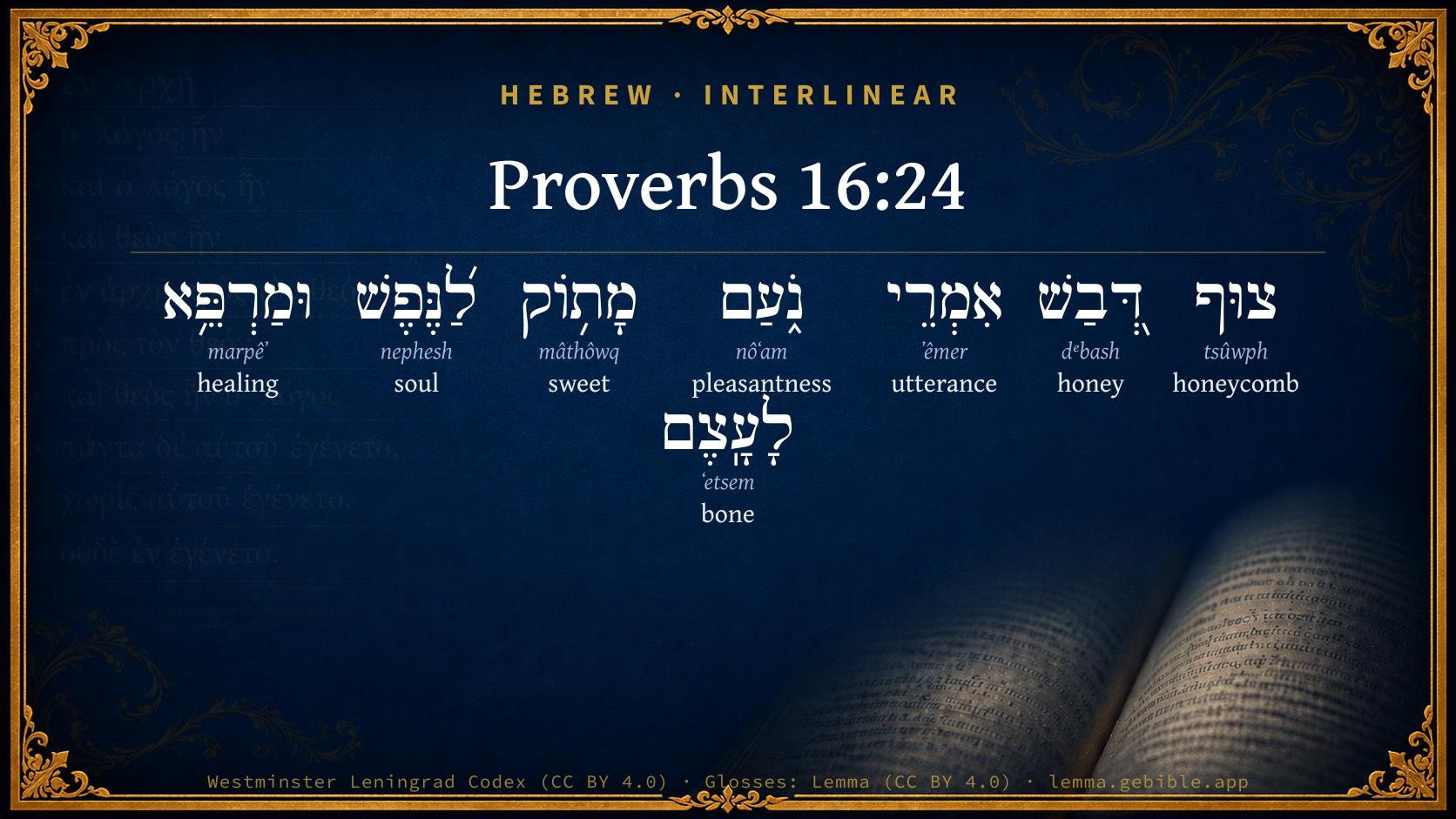
Proverbs 16:24

Hebrew (Westminster Leningrad Codex) Proverbs 16:24 appears in the Hebrew Old Testament. The text above is from the Westminster Leningrad Codex. Each word links to its Strong’s number, a concise gloss, and parsing drawn from the Open Scriptures Hebrew Bible morphology. Click any word for its full Brown-Driver-Briggs (BDB) entry.
Download image
Cite this verse

Proverbs 16:24 (World English Bible). Public Domain. Lemma interlinear Bible study tool, https://lemma.gebible.app/v/proverbs/16/24.

Show BibTeX & RIS
BibTeX
RIS
English Translation
Pleasant words are a honeycomb, Sweet to the soul, and health to the bones.
World English Bible · Public Domain
Download a study sheet

One document with this verse’s original text, its word-by-word gloss line, the meaning frame, cross-references with their text, attributed commentary, and full source and license credits — printable, and it pastes into notes with its structure intact.

This verse Autodidact and up

Study sheet (.html) Plain text (.txt)

A passage Seminary Student

Up to 50 verses in one chapter. A passage sheet keeps up to 6 commentary sources and 12 cross-references per verse, in the order this page ranks them, and says so on the sheet whenever that leaves anything out. Ask for a single verse and you get the Autodidact verse sheet above.

Everything on this page stays free to read, with no account — the sheet is a download of what is already on screen, not access to it.

Want to remove ads? Support Godless Engineer
Compare translations 3

The same verse in 3 English versions, stacked beneath the original-language interlinear above. Click any original word for its lexicon entry.

Each is an independent rendering of the whole verse — the interlinear is not word-aligned to these translations.

Highlighted words mark where these versions differ — a whole-verse word diff, not a word-by-word alignment.

  • World English Bible Public Domain
    Pleasant words are a honeycomb, Sweet to the soul, and health to the bones.
  • King James Version Public Domain
    Pleasant words are as an honeycomb, sweet to the soul, and health to the bones.
  • unfoldingWord Literal Text CC BY-SA 4.0
    Words of pleasantness a honeycomb of honey, sweet to the soul and healing to the bone.

unfoldingWord Literal Text — © unfoldingWord, licensed CC BY-SA 4.0. Word-aligned USFM3 via Door43 (git.door43.org/unfoldingWord/en_ult).

Versions to compare (up to 4)

3 of 4 selected

Show all 18 translations

Every available English version of this verse, each an independent rendering of the whole verse.

  • World English Bible Public Domain
    Pleasant words are a honeycomb, Sweet to the soul, and health to the bones.
  • Berean Standard Bible Public Domain
    Pleasant words are a honeycomb, sweet to the soul and healing to the bones.
  • Majority Standard Bible Public Domain
    Pleasant words are a honeycomb, sweet to the soul and healing to the bones.
  • King James Version Public Domain
    Pleasant words are as an honeycomb, sweet to the soul, and health to the bones.
  • American Standard Version (1901) Public Domain
    Pleasant words are `as' a honeycomb, Sweet to the soul, and health to the bones.
  • Revised Version (1885) Public Domain
    Pleasant words are as an honeycomb, sweet to the soul, and health to the bones.
  • Geneva Bible (1599) Public Domain
    Faire wordes are as an hony combe, sweetenesse to the soule, and health to the bones.
  • Douay-Rheims (1899) Public Domain
    Well ordered words are as a honeycomb: sweet to the soul, and health to the bones.
  • Young's Literal Translation Public Domain
    Sayings of pleasantness `are' a honeycomb, Sweet to the soul, and healing to the bone.
  • Literal Standard Version CC BY-SA 4.0
    Sayings of pleasantness [are] a honeycomb, || Sweet to the soul, and healing to the bone.
  • Unlocked Literal Bible CC BY-SA 4.0
    Pleasant words are a honeycomb— sweet to the soul and healing to the bones.
  • unfoldingWord Literal Text CC BY-SA 4.0
    Words of pleasantness a honeycomb of honey, sweet to the soul and healing to the bone.
  • Darby Bible Public Domain
    Pleasant words are [as] a honeycomb, sweet to the soul, and health for the bones.
  • World Messianic Bible Public Domain
    Pleasant words are a honeycomb, sweet to the soul, and health to the bones.
  • Webster's Bible Public Domain
    Pleasant words are as a honey-comb, sweet to the soul, and health to the bones.
  • Free Bible Version CC BY-SA 4.0
    Kind words are like a honeycomb—they taste sweet and are healthy for the body.
  • Bible in Basic English Public Domain
    Pleasing words are like honey, sweet to the soul and new life to the bones.
  • JPS Tanakh (1917) Public Domain
    Pleasant words are as a honeycomb, sweet to the soul, and health to the bones.

Literal Standard Version (2020), Covenant Press — licensed CC BY-SA 4.0. Text via the HelloAO Bible API (eBible.org). Unlocked Literal Bible (unfoldingWord) — licensed CC BY-SA 4.0. Text via the HelloAO Bible API (eBible.org). unfoldingWord Literal Text — © unfoldingWord, licensed CC BY-SA 4.0. Word-aligned USFM3 via Door43 (git.door43.org/unfoldingWord/en_ult). Free Bible Version, Dr. Jonathan Gallagher — licensed CC BY-SA 4.0. Text via the HelloAO Bible API (eBible.org).

Word by word

More ways to search: Search by grammar → Find every occurrence → Compare this word →

Practice this passage: Drill this verse → Learn its vocabulary →

About this verse

These counts appear in no published source. They are computed here, from the morphology-tagged text and Lemma’s own curated glosses. What Lemma adds →

8
words
8
distinct lemmas
Wisdom
section

Notable vocabulary

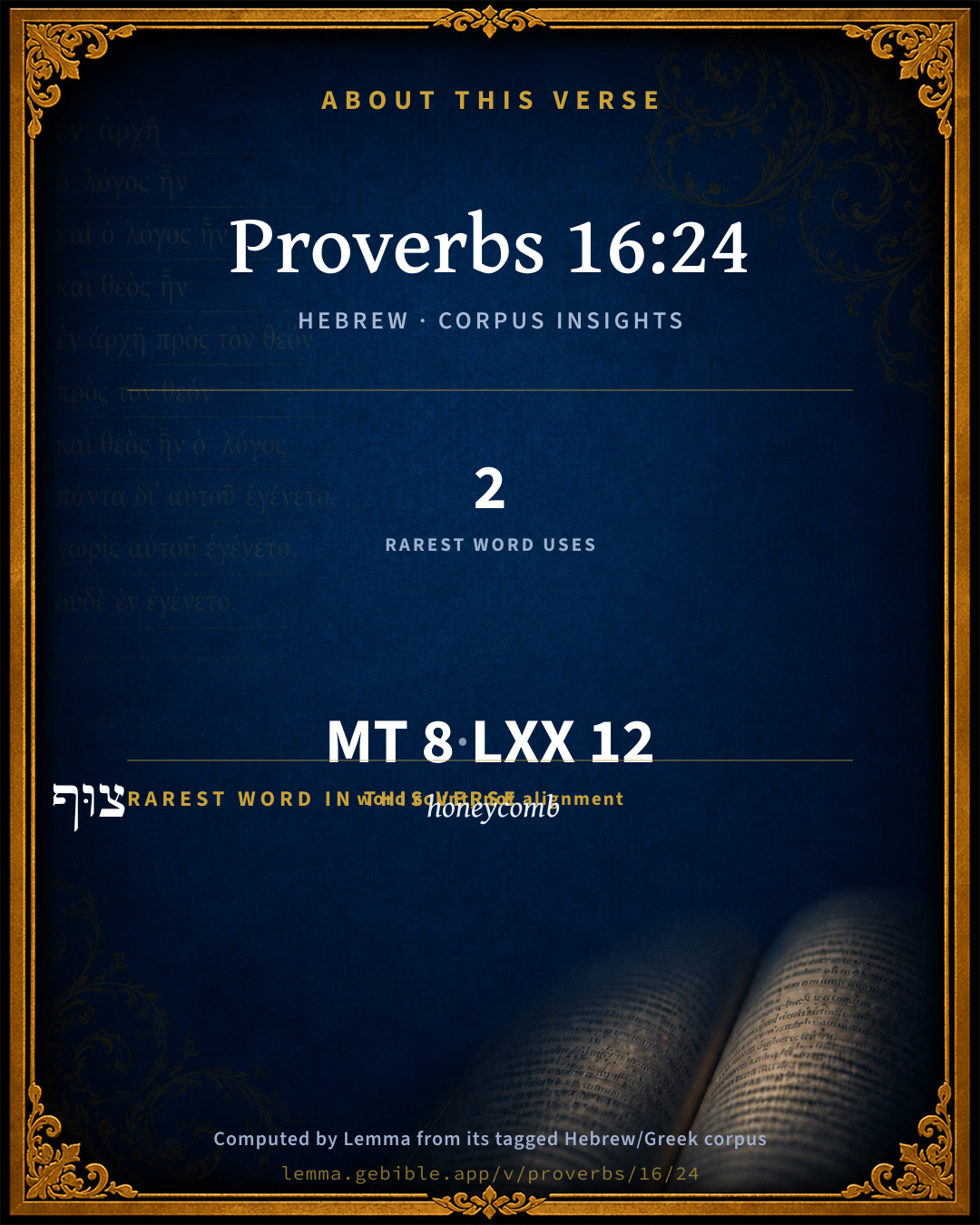
The rarest word here is צוּף honeycomb H6688 — appearing just 2 times in the whole Hebrew Bible.

Shared distinctive vocabulary

צוּף honeycomb H6688 occurs in 2 verses of the Hebrew Bible. Also found in:

Grammatical profile

  • 7 nouns
  • 1 adjective

Hebrew & Septuagint length

In English translation the verse runs 14 words from the Hebrew and 14 from the Septuagint (LXX English) — the same length.

A rough comparison of the two English renderings, which tokenize alike — not a word-level alignment.

Word counts can differ between the Hebrew and the Greek without any difference in meaning — e.g. the Hebrew direct-object marker אֵת has no separate Greek word, and Greek often adds the article ὁ.

In the original languages it is 8 Hebrew tokens and 12 Greek tokens — but the two are counted differently (Hebrew bundles its prefixes and suffixes into one token; the Greek is in lemma form), so that isn’t a like-for-like length.

Cross-references

15

Topical passages linked to Proverbs 16:24 in the Treasury of Scripture Knowledge — connected by theme and wording, ordered by reader-vote popularity; previews shown in the World English Bible.

  • Proverbs 12:18 There is one who speaks rashly like the piercing of a sword, But the tongue of the wise heals.
  • Proverbs 24:13–14 My son, eat honey, for it is good; The droppings of the honeycomb, which are sweet to your taste:
  • Proverbs 4:22 For they are life to those who find them, And health to their whole body.
  • Proverbs 25:11–12 A word fitly spoken Is like apples of gold in settings of silver.
  • Proverbs 23:16 Yes, my heart will rejoice, When your lips speak what is right.
  • Psalms 119:103 How sweet are your promises to my taste, More than honey to my mouth!
  • Proverbs 3:8 It will be health to your body, And nourishment to your bones.
  • Proverbs 27:9 Perfume and incense bring joy to the heart; So does earnest counsel from a man's friend.
  • Psalms 19:10 More to be desired are they than gold, yes, than much fine gold; Sweeter also than honey and the extract of the honeycomb.
  • Proverbs 15:26 Yahweh detests the thoughts of the wicked, But the thoughts of the pure are pleasing.
  • Jeremiah 15:16 Your words were found, and I ate them; and your words were to me a joy and the rejoicing of my heart: for I am called by your name, Yahweh, God of hosts.
  • Deuteronomy 32:2 My doctrine shall drop as the rain; My speech shall condense as the dew, As the small rain on the tender grass, As the showers on the herb.
  • Proverbs 15:23 Joy comes to a man with the reply of his mouth. How good is a word at the right time!
  • John 20:19–21 When therefore it was evening, on that day, the first day of the week, and when the doors were locked where the disciples were assembled, for fear of the Jews, Jesus came and stood in the midst, and said to them, "Peace be to you."
  • Song of Solomon 4:11 Your lips, my bride, drip like the honeycomb. Honey and milk are under your tongue. The smell of your garments is like the smell of Lebanon.

Cross-references courtesy of OpenBible.info (CC BY 4.0).

Hebrew and Greek witnesses Masoretic Hebrew ↔ Greek Septuagint

The same verse in the two great witnesses to the Old Testament, shown verse-for-verse.

These are two independent witnesses, not word-aligned to each other, and the Septuagint is shown in lemma (dictionary) form.

Hebrew Proverbs 16:24 Masoretic · Westminster Leningrad Codex

צוּף דְּ֭בַשׁ אִמְרֵי נֹ֑עַם מָת֥וֹק לַ֝נֶּפֶשׁ וּמַרְפֵּ֥א לָעָֽצֶם

Pleasant words are a honeycomb, Sweet to the soul, and health to the bones.

World English Bible · Public Domain

Greek LXX Proverbs 16:24 Septuagint · lemma form

ἀνήρ σκολιός διαπέμπω κακός καί λαμπτήρ δόλος πυρσεύω κακός καί διαχωρίζω φίλος

Good words are honeycombs, and the sweetness thereof is a healing of the soul.

LXX2012 (modern English Septuagint) · Public Domain

On this verse, The Pulpit Commentary discusses the Septuagint’s reading. Read the note in Commentary ↓

Hebrew: Westminster Leningrad Codex (CC BY 4.0). Greek: Septuagint (public domain); English from LXX2012 (modern English Septuagint) (Public Domain). How the Septuagint differs from the Hebrew →

Commentary

Notes on Proverbs 16:24 from classic Christian and Jewish commentators (each source and its license shown beneath its notes). The classic Christian expositions comment on the surrounding passage and are grouped to its opening verse, so a note may address several verses; the Jewish commentaries on the Tanakh (Rashi and others) are per-verse, so they appear only where the commentator wrote on this verse.

Lemma curates 59 commentaries, every one of them public domain or Creative Commons licensed, each selected and text-cleaned for this edition rather than reprinted as found. About our sources →

Trapp's Complete Commentary

John Trapp

Pro 16:24 Pleasant words [are as] an honeycomb, sweet to the soul, and health to the bones.

Ver. 24. Pleasant words are as a honeycomb.] Dainty and delicious, such as "the preacher set himself to search out"; {Ecc 12:10} such as his father David found God’s words to be; {Psa 119:103} "wells of salvation." {Isa 12:3} "Breasts of consolation"; {Isa 66:11} the honey drops of Christ’s mouth. {Son 5:16} Oh, hang upon his holy lips, as they did! {Luk 19:48} Hast thou found honey with Samson? Eat it as he did. {Pro 25:16} Eat God’s book as John did; {Rev 10:9} find fatness and sweetness in it. {Psa 63:5} Get "joy and gladness" out of it. {Psa 51:8} And if at any time the word, in searching our wounds, put us to pain, as honey will cause pain to exulcerate parts, let us bear it, and not be like children, who, though they like honey well, yet will they not endure to have it come near their lips when they have sore mouths.

Sweet to the soul, health to the bones,] i.e., Satisfactory to the mind and medicinal also to the body, which many times follows the temperament of the mind. Alphonsus, King of Sicily, is said to have recovered from a dangerous disease by the pleasure that he took in reading Quintus Curtius, and some others in like sort by reading Livy, Aventine, &c. But these were "physicians of no value" to that of David. "Unless thy law had been my delight, I should then have perished in mine affliction." {Psa 119:92} Look how those that are fallen into a swoon may be fetched again with cold water sprinkled on their faces, or with hot water poured down their throats. So those that are troubled in mind may by patience and comfort of the Scriptures recover hope.

John Trapp, A Commentary or Exposition upon All the Books of the Old and New Testament (1647–1656) — public domain. Text from a community e-Sword module.

Matthew Henry's Commentary

The pleasant words here commended must be those which the heart of the wise teaches, and adds learning to (Pro 16:23), words of seasonable advice, instruction, and comfort, words taken from God's word, for that is it which Solomon had learned from his father to account sweeter than honey and the honey-comb, Psa 19:10. These words, to those that know how to relish them, 1. Are pleasant. They are like the honey-comb, sweet to the soul, which tastes in them that the Lord is gracious; nothing more grateful and agreeable to the new man than the word of God, and those words which are borrowed from it, Psa 119:103. 2. They are wholesome. Many things are pleasant that are not profitable, but these pleasant words are health to the bones, to the inward man, as well as sweet to the soul. They make the bones, which sin has broken and put out of joint, to rejoice. The bones are the strength of the body; and the good word of God is a means of spiritual strength, curing the diseases that weaken us.

Matthew Henry's Commentary on the Whole Bible (1708–1710) — public domain (CC PDM 1.0). Text via the HelloAO Bible API.

Jamieson, Fausset & Brown

Robert Jamieson, A. R. Fausset & David Brown

(Compare Pro 15:26). Gentle, kind words, by soothing the mind, give the body health.

Jamieson, Fausset & Brown — Commentary Critical and Explanatory on the Whole Bible (1871) — public domain (CC PDM 1.0). Text via the HelloAO Bible API.

Adam Clarke's Commentary

Verse 24. Pleasant words are as a honey-comb] The honey of which is sweeter than that which has been expressed from it, and has a much finer flavour before it has come in contact with the atmospheric air.

Adam Clarke's Commentary on the Bible (1810–1826) — public domain. Text from a community e-Sword/MySword module.

Ellicott's Commentary for English Readers

(24) Pleasant words.—Comp. Pro_15:26.

Health to the bones.—Comp. 1Sa_14:27.

A Bible Commentary for English Readers, edited by Charles John Ellicott (1878–1897) — public domain. Text from a community e-Sword module.

The Cambridge Bible for Schools and Colleges

gen. ed. J. J. S. Perowne

24. health] i.e. healthy or wholesome. There is no necessary reference to any medicinal properties in honey. Comp. Pro_4:22, Pro_12:18, Pro_13:17; and Jonathan’s experience, when he was exhausted with pursuing the enemy: “See, I pray you, how mine eyes have been enlightened, because I tasted a little of this honey,” 1Sa_14:29.

The Cambridge Bible for Schools and Colleges (gen. ed. J. J. S. Perowne; Cambridge University Press, 1878–1918) — public domain. Text from a community e-Sword module.

John Gill's Exposition

Pleasant words are as an honeycomb,.... Jarchi interprets it of the words of the law; but it may be much better understood of the doctrines of the Gospel; such as the doctrines of God's everlasting love, eternal election, the covenant of grace, the person of Christ as God-man; of peace and reconciliation by his blood; of remission of sins through his atoning sacrifice; of justification by his righteousness; of life and salvation by his obedience, sufferings, and death; all the doctrines of grace, which show that salvation in all its parts is owing entirely to the free grace of God; these are all pleasant to the ear of him that knows the joyful sound, and to the taste of everyone that has tasted that the Lord is gracious. The precious promises of the Gospel may be meant; which are free and unconditional, irrevocable, and immutable, never fail of accomplishment; are yea and amen in Christ, and are suited to the various cases of God's people; these are very pleasant and delightful, when they are fitly spoken, and seasonably applied. Moreover, the speech of such as are wise in heart, true believers in Christ; their words, whether expressed in prayer or in praise, are pleasant to the Lord, and very grateful and acceptable to him: so their speech one to another, when about spiritual things; when it is with grace, then it ministers grace, and is very pleasant. Now all these, and especially the doctrines of the Gospel, are as "an honeycomb"; they are like unto it for the manner of its production; it is wrought and filled by the laborious bee, which goes from flower to flower, and gathers honey, and brings it into the hive, and there disposes of it: so laborious ministers of the Gospel gather their doctrines from the sacred Scriptures, which they diligently search, and go from one to another, and gather something from each; and, being richly laden with the fulness of the blessing Of the Gospel of Christ, bring it into the hive of the church, and there feed men with knowledge and understanding: and the doctrines of the Gospel are like unto the honeycomb for the manner of its communication, by dropping freely, gradually, and constantly; so Gospel ministers drop the pleasant words of the Gospel freely, and without pressing, having no other constraint but love to Christ and the souls of men; they do it gradually, as men are able to bear; and constantly preach the word, in season and out of season: and as the honey which drops from the honeycomb is the choicest honey, called "life honey"; such are the truths of the Gospel, they are excellent things, the most excellent. Likewise these are as the honeycomb for the honey in it; they are like the honey out of the rock the Israelites ate of; and like that out of the lion Samson fed upon; and like that which Jonathan tasted, that enlightened his eyes. The Gospel flows from Christ, the Rock; and is to be found in him, the Lion of the tribe of Judah, and as slain, and has an enlightening virtue in it; and particularly these pleasant words are said to be as the honeycomb for its sweetness and healthfulness, as follows:

sweet to the soul, and health to the bones; they are "sweet" to the "soul" of him that understands them, and that has a spiritual taste of them; not to a natural and unregenerate man, whose natural taste remains in him, and is not changed; who calls evil good, and good evil; puts bitter for sweet, and sweet for bitter; to him the doctrines of the Gospel are insipid, tasteless, and disagreeable things: nor are they sweet to a carnal professor; who, though he may express some value for them, has no spiritual gust and relish of them; but to them that believe, to whom Christ is precious, who have tasted that he is gracious; to these they are sweet, even sweeter than the honey or the honeycomb, Psa 19:10. And they are "health to the bones"; they are the wholesome words of our Lord Jesus; they are the means of curing the diseases of the mind; of healing wounded spirits, and broken hearts, and broken bones; they make the bones which were broken to rejoice; what heals the bones strengthens the whole man, a man's strength lying much in his bones; these strengthen the inward man, cause believers to go from strength to strength, and to hold on and persevere to the end.

John Gill's Exposition of the Whole Bible (1746–1763) — public domain (CC PDM 1.0). Text via the HelloAO Bible API.

Albert Barnes' Notes on the Bible

Honey took its place not only among the luxuries, but among the medicines of the Israelites. This two-fold use made it all the more suitable to be an emblem both of the true Wisdom which is also true obedience, and of the “pleasant words” in which that Wisdom speaks.

Albert Barnes' Notes on the Bible (1834–1885) — public domain. Text from a community e-Sword/MySword module.

Matthew Poole's English Annotations

Pleasant words; the discourses of the wise last mentioned, Pro 16:23, which yield both profit and delight; their wholesome counsels and refreshing comforts.

To the bones; to the body, synecdochically expressed by the bones, the strongest and greatest parts of it, and the supporters of the rest.

Matthew Poole's English Annotations on the Holy Bible (1683–1685) — public domain. Text from a community e-Sword/MySword module.

Whedon's Commentary on the Bible

Daniel D. Whedon

24. Pleasant words — Or, words of kindness. Comp. Pro_15:26. Honey-comb — Comp. Psa_19:10.

Bones — The word “bones” stands for the whole body or person. It often happens that a few kind words do a man’s body good as well as his soul. In certain forms of disease they are better than any medicine.

Daniel D. Whedon (gen. ed.), Commentary on the Old and New Testaments (1874–1909) — public domain. Text from a community e-Sword module.

The Pulpit Commentary

Pleasant words are as a honeycomb. "Pleasant words" are words of comforting, soothing tendency, as in Pro_15:26 Psa_19:10. The writer continues his praise of apt speech. The comparison with honey is common in all languages and at all times. Thus Homer sings of Nestor ("Iliad," 1:248, etc.)"The smooth-tongued chief, from whose persuasive lips Sweeter than honey flowed the stream of speech. (Derby.)

So the story goes that on the lips of St. Ambrose, while still a boy, a swarm of bees settled, portending his future persuasive eloquence. Sweet to the soul, and health to the bones. (Pro_15:30) The verse forms one sentence. The happy results of pleasant words are felt in body and soul. Honey in Palestine is a staple article of food, and is also used as a medicinal remedy. Of its reviving effects we read in the ease of Jonathan, who from a little portion hurriedly taken as he marched on had "his eyes enlightened". (1Sa_14:27) Septuagint, "Their sweetness is the healing of the soul." Iatrogov tou kata quchyouv . "Speech the physician of the soul"s annoy.

Pleasant words.

I PLEASANT WORDS ARE GOOD IN SOCIAL INTERCOURSE. They are said to cost little, while they are worth much. But often they are not to be had without trouble.

1. Sympathy. We must put ourselves to the trouble of entering into our brother"s feelings if we would speak with real kindness to him.

2. Self-suppression. Angry words may be the first to rise to our lips; bitter words of scorn or melancholy words springing from the gloom of our own minds may come more readily than the pleasant words that are due to our neighbours.

3. Thought. Words of honey soon cloy if no satisfying thoughts lie behind them. Pleasant words should be more than words they should be messengers of healing, suggestions of helpfulness. Now, as some trouble is required for the production of this kind of speech in daily intercourse, it is well to consider how valuable it is. It draws hearts together. It lightens the load of life and oils its wheels. There are enough of clouds about the souls of most men to make it desirable that we should shed all the sunshine that we possibly can. It would, be like a migration from Northern gloom to Southern sunshine for all speech to be seasoned with truly pleasant words.

II PLEASANT WORDS ARE NEEDED IN CHRISTIAN TEACHING. The preacher is not to be a false prophet of smooth sayings, whispering," Peace, peace," when there is no peace. There are times when hard words must be spoken and most unpleasant truths do need to be driven home to unwilling hearers. But it will be only the pressing necessity of the subject that will force men of tender hearts to utter painful words. When the topic is not of this character, the most winning words should be chosen.

1. In teaching the young. The gloom of some good people has repelled the young. Children ought to see the sunny side of religion. All who are themselves bright and happy should know that there is a greater gladness for them in Christ. The preacher of the gospel belies his rue sage when he proclaims it like a funeral dirge.

2. In interesting the careless. We cannot frown men into the Church. if we show the attractiveness of the gospel by cheerful manners, we help to commend it to the world.

3. In comforting the sorrowful. It is not necessary to speak sad words to the sad in order to prove our sympathy. It should be our aim to lighten the load of their sorrow.

III PLEASANT WORDS ARE FOUND IN THE GOSPEL OF CHRIST. Christ preached so that "the common people heard him gladly." Men wondered at the "gracious wonts" that fell from his lips. Christianity is a religion of Divine grace. Surely there must be found many pleasant words in the description of it. The words of the gospel are pleasant, in particular, on several accounts.

1. They tell of God"s love.

2. They portray Christ.

3. They invite men to salvation.

4. They reveal the blessedness of the kingdom of heaven.

The Pulpit Commentary (1880–1919), ed. H.D.M. Spence-Jones & Joseph S. Exell — public domain. Text from a community e-Sword module.

Keil & Delitzsch

C. F. Keil & F. Delitzsch

24 A honeycomb are pleasant words,

Sweet to the soul, and healing to the bones.

Honeycomb, i.e., honey flowing from the צוּף, the comb or cell (favus), is otherwise designated, Psa 19:11. מתוק, with מרפּא, is neut. אמרי־נעם are, according to Pro 15:26, words which love suggests, and which breathe love. Such words are sweet to the soul of the hearer, and bring strength and healing to his bones (Pro 15:30); for מרפא is not only that which restores soundness, but also that which preserves and advances it (cf. θεραπεία, Rev 22:2).

Keil & Delitzsch — Biblical Commentary on the Old Testament (1861–1891) — public domain (CC PDM 1.0). Text via the HelloAO Bible API. (Old Testament only.)

Bridges on Proverbs

Charles Bridges

The sweets of pleasure are not always health. (Pro 5:3-5 .) The honeycomb combines both. Description may give a fancied notion of it. But the taste affords the only true apprehension. Such is the mysterious delight and refreshment conveyed to us in pleasant words. When they are words of counsel, sympathy, or encouragement, they are medicinal also; not only sweet to the soul, but health to the bones. Much more are the pleasant words of God both sweet and wholesome. The professor may enjoy a passing sweetness in them.†1 But it is only "the drinking in of them," that realizes their solid pleasure,†2 "sweeter than honey or the honeycomb."†3 We go on our way, like Samson, eating our honeycomb;†4 like Jonathan, revived.†5 We take the Lord’s words to the throne of grace; and, pleading them humbly and thankfully, most pleasant are they to our taste. Yea, so overwhelming often is their richness, that we can only ask, as concerning the manna — "What is it?"†6 Not less healthful are they than pleasant; invigorating to our inner principles, the strength — the bones — so to speak — of our spiritual system. (Pro 3:8 ; Pro 4:22 .)

The like pleasure and health flow from the words of man in the things of God.†7 How did "David and Jonathan in the wood strengthen each other’s hands in God!"†8 How was the Eunuch cheered by Philip’s exposition of the precious Scripture!†9 What health did Paul’s most pleasant words pour into the heart of the desponding jailor!†10 And how was his own spirit revived by the meeting at Appii Forum;†11 as the disciples had been refreshed by the converse of their Divine Master on the walk to Emmaus!†12 When he is the subject, and his Spirit the teacher, pleasant indeed will be the words of Christian communion beyond any earthly enjoyment.

Footnotes:

†1 Eze 33:32. Mat 13:20 . Heb 6:4-5 .

†2 Heb 6:7.

†3 Psa 19:10. Compare Psa 119:103 .

†4 Jdg 14:8-9.

†5 1Sa 14:27 .

†6 Exo 16:15, marg.

†7 Pro 16:21, Pro 16:23 ; Pro 15:23 ; Pro 27:9

†8 1Sa 23:16 .

†9 Act 8:35-39.

†10 Act 16:27, Act 16:34 .

†11 Act 28:15.

†12 Luk 24:32.

Charles Bridges, An Exposition of the Book of Proverbs (1846) — public domain. Text from a community e-Sword module.

Kretzmann's Popular Commentary

Paul E. Kretzmann

v. 24. Pleasant words are as an honeycomb, sweet to the soul and health to the bones; for the spirit of friendliness inspired by love is evident in them, to strengthen the hearer.

Paul E. Kretzmann, Popular Commentary of the Bible (1921–1924) — public domain. Text from a community e-Sword module.

Rashi

Rabbi Shlomo Yitzchaki (Rashi)

a honeycomb Heb. צוף דבש, sweet as honey (bresche in O.F.).

Pleasant words Words of Torah.

Rashi on the Tanakh — English translations: “The Judaica Press complete Tanach with Rashi, translated by A. J. Rosenberg” (CC BY 4.0); “Pentateuch with Rashi's commentary by M. Rosenbaum and A.M. Silbermann, 1929-1934” (public domain); “The Metsudah Tanach series, Lakewood, N.J” (CC BY 4.0); and “The Book of Joshua, Metsudah Publications, 1997” (CC BY 4.0). Text via Sefaria.

Lesson kit

Teaching starters — assembled from the data on this page, not authored interpretation. Every prompt links to the verse data it draws on. Edit before teaching.

Proverbs, in the Wisdom, opens this verse with 8 words (8 distinct Hebrew lemmas). Its most distinctive word is tsûwph (“honeycomb”). A historical commentator’s framing appears above. Read the whole chapter for the surrounding context.

Discussion questions

  1. The word tsûwph carries the sense “honeycomb.” How does it shape the verse?
  2. Psalms 19:10 shares the word «honeycomb» with this verse. How do the two illuminate each other?
  3. These translations render this verse differently; the difference is in the English rendering, not the original. What questions does that raise?
  4. Reading how Trapp's Complete Commentary and Matthew Henry's Commentary read this verse, where do the two commentators agree and where do they part?

Things to notice

Reading settings

Reading text

Shown beneath each verse's original-language words.

Old Testament
Old Testament edition

Read the OT as the Masoretic Hebrew (MT) or the Greek Septuagint (LXX).

English shown for the Greek Septuagint (in the Hebrew ↔ Greek comparison).

Comparing translations? Open the Compare panel on any verse page to stack up to four side by side.