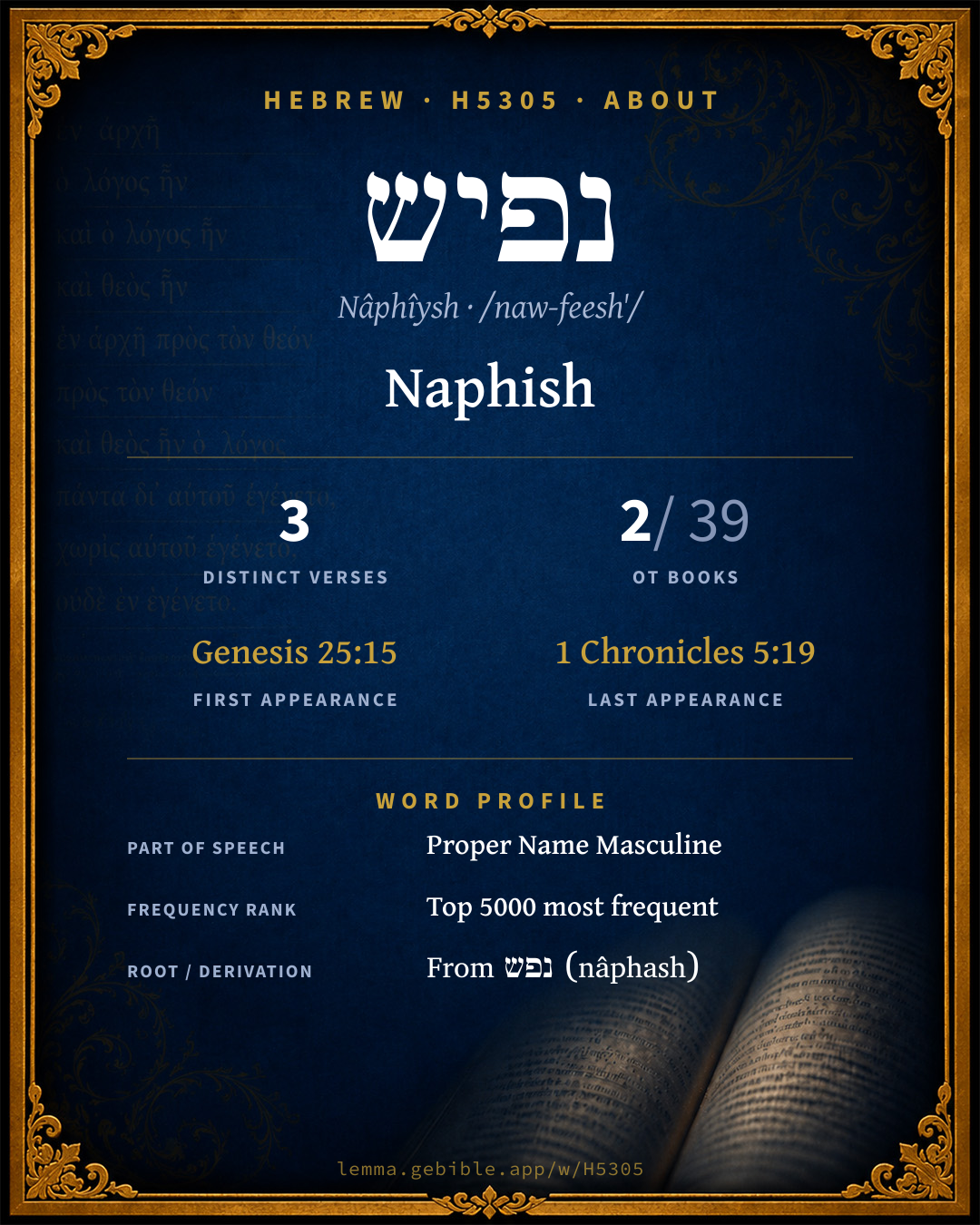
נָפִישׁ
Naphish
BDB lists 3 entries for ‘Naphish’ fuller range ↓
Full lexicon entry — Brown-Driver-Briggs (BDB)
From Brown-Driver-Briggs (BDB)
Where this word appears
Grammar key — what these labels mean
Part of speech
- Noun
- A naming word — a person, place, thing, or idea.
Noun type
- Proper
- A name of a specific person, place, or people (e.g. Abraham, Zion, Israel).
Every verse where H5305 appears — 3 distinct verses across 2 books. Click any verse to open its interlinear word-by-word view. Verse text shown in the World English Bible for context — . Each verse’s Hebrew form is shown with its reference; the English is not keyword-highlighted, since the data carries no word-level English alignment. Use “Compare translations” on any verse to read it across multiple English versions. This concordance covers the Hebrew Bible; Septuagint (Greek Old Testament) occurrences are not indexed here.
Genesis 1 verse
1 Chronicles 2 verses
About this entry
At a glance — auto-summarized from this page’s data, not written by a person. Every figure links to its source below. This summary describes the numbers; it doesn’t interpret them.
At its core, נפיש (Nâphîysh) means “Naphish.” It is rare — just 3 verses in the entire Hebrew Bible. The word gravitates to 1 Chronicles (67%), then Genesis. Scripture first uses it in Genesis 25:15. Dig into 3-verse concordance and the renderings breakdown below.
Gloss history
Strong's 1890 vs modern scholarship
About this word
Strong's H5305 catalogs a Hebrew word from the Hebrew Old Testament.
These counts are not copied from any lexicon or concordance. They are computed here, from the morphology-tagged Hebrew Old Testament. What Lemma adds →
- 3
- distinct verses
- The word appears in 3 distinct verses.
- 2 / 39
- OT books
- The word appears in 2 of 39 Old Testament books.
- #4,179
- by frequency
- Top 5000 most frequent Hebrew words (rank 4,179 of 8,640 Hebrew words by occurrence).
View all 3 occurrences in the concordance →
Most concentrated in
- 1 Chronicles 2 verses 67%
- Genesis 1 verse 33%
By section of the Old Testament
By traditional corpus
Conventional, traditional groupings — biblical authorship is debated, so this is a traditional corpus grouping, not an authorship claim. Each share is this word’s portion of its verses in that division of the Hebrew canon. Each figure is a share of the word’s 3 distinct verses.
- Writings (Ketuvim) 2 verses · 67%
- Torah (Pentateuch) 1 verse · 33%
How translations render this word
Counts come from each version’s own published word-to-Strong’s tagging or interlinear alignment — an approximate guide to how each version renders this word, not a word-level alignment the data otherwise carries. Because each total is that version’s own tagged count, the per-version totals vary from one another and need not match the appearance or distinct-verse counts above. These counts may also differ from a printed concordance because Lemma counts each distinctly tagged rendering and does not collapse phrase taggings into a single head-word total. This is a fixed set of word-tagged versions (KJV, ASV, BSB, ULT) and does not change with the reading translation you choose elsewhere. Each version’s license is shown beside its name below (and on Sources).
- King James Version: Naphish 2×
- American Standard Version: Naphish 3×
- Berean Standard Bible: Naphish 3×
- unfoldingWord Literal Text: Naphish 3×
King James Version Public Domain
Renders H5305 across 3 tagged occurrences — most commonly:
Plus 1 rendering that appears only once — usually multi-word phrases or single function words the recovered tagging swept in, not distinct renderings.
American Standard Version Public Domain
Renders H5305 across 3 tagged occurrences — most commonly:
Berean Standard Bible Public Domain
Renders H5305 across 3 tagged occurrences — most commonly:
unfoldingWord Literal Text CC BY-SA 4.0
Renders H5305 across 3 tagged occurrences — most commonly:
Senses in BDB
The 3 senses BDB distinguishes for this word, in lexicon order (not ranked by frequency or importance). The full entry — with sub-senses — is in the Lexicon Entry tab.
- Naphish = "refreshment"
- the next to last son of Ishmael
- an Arabian tribe
Word origin
n.pr.m. son of Ishmael, according to Gn 25:15 (P), = 1 Ch 1:31 (𝔊 Ναφες, 𝔊L Ναφεις); = (Arab) tribe 5:19 (𝔊 Ναφεισαδαιων, A 𝔊L Ναφισαιων).
— Brown-Driver-Briggs (Oxford 1906, public domain), digitized via Sefaria, supplemented by the OpenScriptures HebrewLexicon (CC BY 4.0). See Sources.
Derived from נפש (nâphash) (H5314) — to refresh.
Jastrow Dictionary
A second Hebrew/Aramaic lexicon for comparison, covering Aramaic and post-biblical (Talmudic, Targumic, Midrashic) usage that the biblical-Hebrew BDB does not. Matched by lemma rather than by Strong’s number, so a lemma may carry more than one Jastrow headword (shown separately below), and the entries cover usage well beyond the Bible.
נְפֵישׁ
- (interch. with פּוּשׁ a. פְּשֵׁי, q. v.)
- 1. [to be blown up,] to be large; to increase. Targ. Ex. I, 7; a. e. Imper. פּוּשׁ. Targ. Gen. I, 28; a. e.—
- *2. [to be blown away,] to be gone. B. Bath. 121ᵃ; Ned. 78ᵃ אתא לנהרדעא … נ׳ Ar. (ed. ולא אשכחיה) he came to N. to see R. S.; he was gone.
- (interch. with אָפֵישׁ, a. אַפְשֵׁי) to extend, enlarge. Targ. Gen. XLVIII, 4 (some ed. מַפְשִׁי׳). Targ. Y. Num. XIX, 6 אַפּוּשֵׁי; a. fr.—Men. 23ᵇ דא׳ לה תבלין טפי וכ׳ when he made the quantity of spices larger than &c. Bets. 7ᵃ אַפּוּשֵׁי … לא מַפְּשִׁינָן (or אֲפוּשֵׁי … מַפְשִׁי׳) we must not extend the range of unclean things by rabbinical enactments. Sot. 26ᵃ אפושי … לא לִיפַּשׁ we ought not to increase the number of illegitimate births (by allowing intermarriage between bastards). B. Bath. 12ᵇ בעינא דא׳ אריסי (Rashi ניחא לי לאפושי) I desire (it is an advantage to me) to have a large number of tenants around me (whom my neighbor must employ). Ib. אפושי לאו מילתא היא this plea about a large number &c., is no plea; a. e.—Y. Kil. IX, 32ᶜ top; Y. Keth. XII, 35ᵇ top נַפֵּישׁ לר׳ וכ׳ let us make room for R. H.
נְפִישׁ
- c. (preced.) [blown up,] large, numerous (cmp. אֲוַשׁ). Targ. Y. Deut. XXV, 9.—B. Bath. 73ᵇ כמה נ׳ חיליה וכ׳ how great is the strength of the tree. Keth. 66ᵇ דנ׳ זיונא the management of which is a large concern, v. זִיּוּנָא III.; a. fr.—Pl. נְפִישִׁין, נְפִישֵׁי; נְפִישָׁן. Targ. II Esth. VI, 10; a. e.—Snh. 52ᵃ, v. הוֹגָנָא. Yeb. 74ᵇ הנך נ׳ those (laws relating to dedicated objects) are extensive. B. Bath. l. c. משום דנ׳ מיא because the water is deep; a. fr.
נָפֵישׁ
- , pl. נְפֵישִׁים, v. נָפֵשׁ.
A Dictionary of the Targumim, the Talmud Babli and Yerushalmi, and the Midrashic Literature (Marcus Jastrow; London, Luzac, 1903) — Public Domain. Digitized via Sefaria. Digitized via Sefaria. Full attribution on Sources.
Forms in the corpus
The 2 distinct written forms H5305 takes in the Hebrew Bible, most frequent first — each parse links to that state’s occurrences in the concordance. Hebrew forms include their vowel points and cantillation, so a single lemma takes many written forms.
| Form | Parsing | Example | Uses |
|---|---|---|---|
| נָפִ֖ישׁ | Noun, Proper | Genesis 25:15 | 2 |
| וְ/נָפִ֖ישׁ | Noun, Proper | 1 Chronicles 5:19 | 1 |
Same root — word family
Other BDB entries built from the same root as H5305, grouped by Strong’s listed origin. These share a root / origin per the lexicon — not necessarily a shared meaning. Each links to that word’s own entry.
Derives from
Shares the same root
Compare all same-root words → They share a root, not necessarily a meaning.
Bible dictionary
Public-domain dictionary articles matched to this entry by name (Naphish). A biblical name can be shared by more than one person or place, so an article may treat several.
Easton's Bible Dictionary · M. G. Easton, 1897
Refresher, one of the sons of Ishmael (Gen. 25:15; 1 Chr. 1:31). He was the father of an Arab tribe.
Smith's Bible Dictionary · William Smith, 1863
(refreshment), the last but one of the sons of Ishmael. (Genesis 25:15; 1 Chronicles 1:31)
Hitchcock's Bible Names Dictionary · Roswell D. Hitchcock, 1869
the soul; he that rests, refreshes himself, or respires
Classic public-domain reference works; full attribution on Sources.
Septuagint verse parallels
This word appears in 3 verses that also exist in the Greek Old Testament (Septuagint), out of the 3 Hebrew verses it occurs in. You can read those verses in Greek by switching the Old Testament edition to the Septuagint.
Read these verses in the Septuagint
This is a verse-level parallel only — the same verses exist in both the Hebrew and Greek Old Testaments. No word-level Hebrew↔Greek correspondence is claimed: the data carries no such alignment, so no Greek word is shown as this Hebrew word’s translation. Coverage is not total — the Septuagint omits the deuterocanon and renumbers the Psalms, so some Hebrew verses have no direct Greek parallel.