
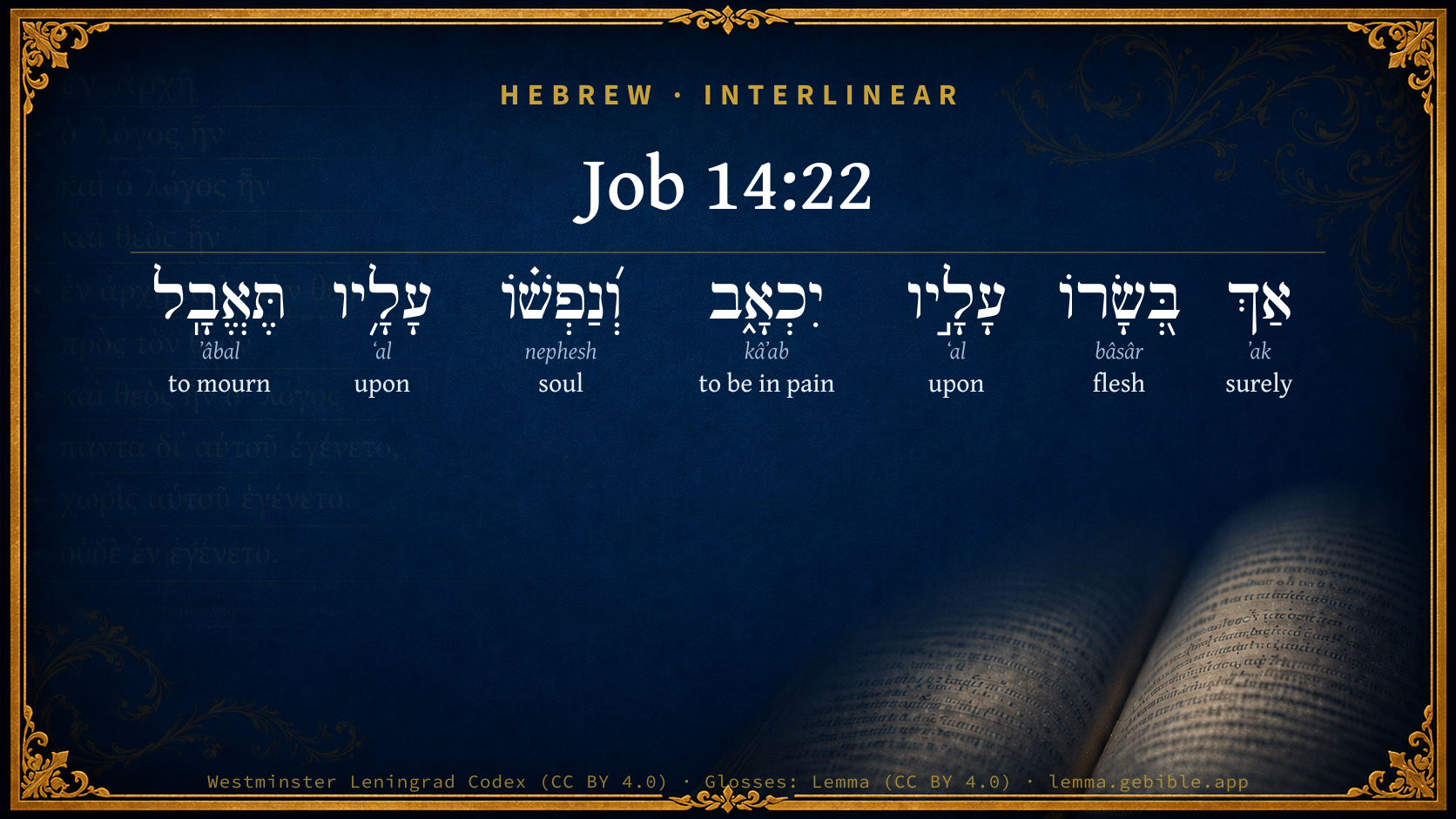
Job 14:22

Hebrew (Westminster Leningrad Codex) Job 14:22 appears in the Hebrew Old Testament. The text above is from the Westminster Leningrad Codex. Each word links to its Strong’s number, a concise gloss, and parsing drawn from the Open Scriptures Hebrew Bible morphology. Click any word for its full Brown-Driver-Briggs (BDB) entry.
Download image
Cite this verse

Job 14:22 (World English Bible). Public Domain. Lemma interlinear Bible study tool, https://lemma.gebible.app/v/job/14/22.

Show BibTeX & RIS
BibTeX
RIS
English Translation
But his flesh on him has pain; His soul within him mourns."
World English Bible · Public Domain
Download a study sheet

One document with this verse’s original text, its word-by-word gloss line, the meaning frame, cross-references with their text, attributed commentary, and full source and license credits — printable, and it pastes into notes with its structure intact.

This verse Autodidact and up

Study sheet (.html) Plain text (.txt)

A passage Seminary Student

Up to 50 verses in one chapter. A passage sheet keeps up to 6 commentary sources and 12 cross-references per verse, in the order this page ranks them, and says so on the sheet whenever that leaves anything out. Ask for a single verse and you get the Autodidact verse sheet above.

Everything on this page stays free to read, with no account — the sheet is a download of what is already on screen, not access to it.

Want to remove ads? Support Godless Engineer
Compare translations 3

The same verse in 3 English versions, stacked beneath the original-language interlinear above. Click any original word for its lexicon entry.

Each is an independent rendering of the whole verse — the interlinear is not word-aligned to these translations.

Highlighted words mark where these versions differ — a whole-verse word diff, not a word-by-word alignment.

  • World English Bible Public Domain
    But his flesh on him has pain; His soul within him mourns."
  • King James Version Public Domain
    But his flesh upon him shall have pain, and his soul within him shall mourn.
  • unfoldingWord Literal Text CC BY-SA 4.0
    Only his flesh grieves for him, and his soul mourns for him.”

unfoldingWord Literal Text — © unfoldingWord, licensed CC BY-SA 4.0. Word-aligned USFM3 via Door43 (git.door43.org/unfoldingWord/en_ult).

Versions to compare (up to 4)

3 of 4 selected

Show all 18 translations

Every available English version of this verse, each an independent rendering of the whole verse.

  • World English Bible Public Domain
    But his flesh on him has pain; His soul within him mourns."
  • Berean Standard Bible Public Domain
    He feels only the pain of his own body and mourns only for himself.”
  • Majority Standard Bible Public Domain
    He feels only the pain of his own body and mourns only for himself.”
  • King James Version Public Domain
    But his flesh upon him shall have pain, and his soul within him shall mourn.
  • American Standard Version (1901) Public Domain
    But his flesh upon him hath pain, And his soul within him mourneth.
  • Revised Version (1885) Public Domain
    But his flesh upon him hath pain, and his soul within him mourneth.
  • Geneva Bible (1599) Public Domain
    But while his flesh is vpon him, he shall be sorowfull, and while his soule is in him, it shall mourne.
  • Douay-Rheims (1899) Public Domain
    But yet his flesh, while he shall live, shall have pain, and his soul shall mourn over him.
  • Young's Literal Translation Public Domain
    Only -- his flesh for him is pained, And his soul for him doth mourn.'
  • Literal Standard Version CC BY-SA 4.0
    Only—his flesh is pained for him, || And his soul mourns for him.”
  • Unlocked Literal Bible CC BY-SA 4.0
    He feels only the pain of his own body, and he mourns for himself.
  • unfoldingWord Literal Text CC BY-SA 4.0
    Only his flesh grieves for him, and his soul mourns for him.”
  • Darby Bible Public Domain
    But his flesh hath pain for himself alone, and his soul mourneth for himself.
  • World Messianic Bible Public Domain
    But his flesh on him has pain, and his soul within him mourns.”
  • Webster's Bible Public Domain
    But his flesh upon him shall have pain, and his soul within him shall mourn.
  • Free Bible Version CC BY-SA 4.0
    As people die they only know their own pain and are sad for themselves.”
  • Bible in Basic English Public Domain
    Only his flesh still has pain, and his soul is sad.
  • JPS Tanakh (1917) Public Domain
    But his flesh grieveth for him, and his soul mourneth over him.

Literal Standard Version (2020), Covenant Press — licensed CC BY-SA 4.0. Text via the HelloAO Bible API (eBible.org). Unlocked Literal Bible (unfoldingWord) — licensed CC BY-SA 4.0. Text via the HelloAO Bible API (eBible.org). unfoldingWord Literal Text — © unfoldingWord, licensed CC BY-SA 4.0. Word-aligned USFM3 via Door43 (git.door43.org/unfoldingWord/en_ult). Free Bible Version, Dr. Jonathan Gallagher — licensed CC BY-SA 4.0. Text via the HelloAO Bible API (eBible.org).

Word by word

More ways to search: Search by grammar → Find every occurrence → Compare this word →

Practice this passage: Drill this verse → Learn its vocabulary →

About this verse

These counts appear in no published source. They are computed here, from the morphology-tagged text and Lemma’s own curated glosses. What Lemma adds →

7
words
6
distinct lemmas
Wisdom
section

Notable vocabulary

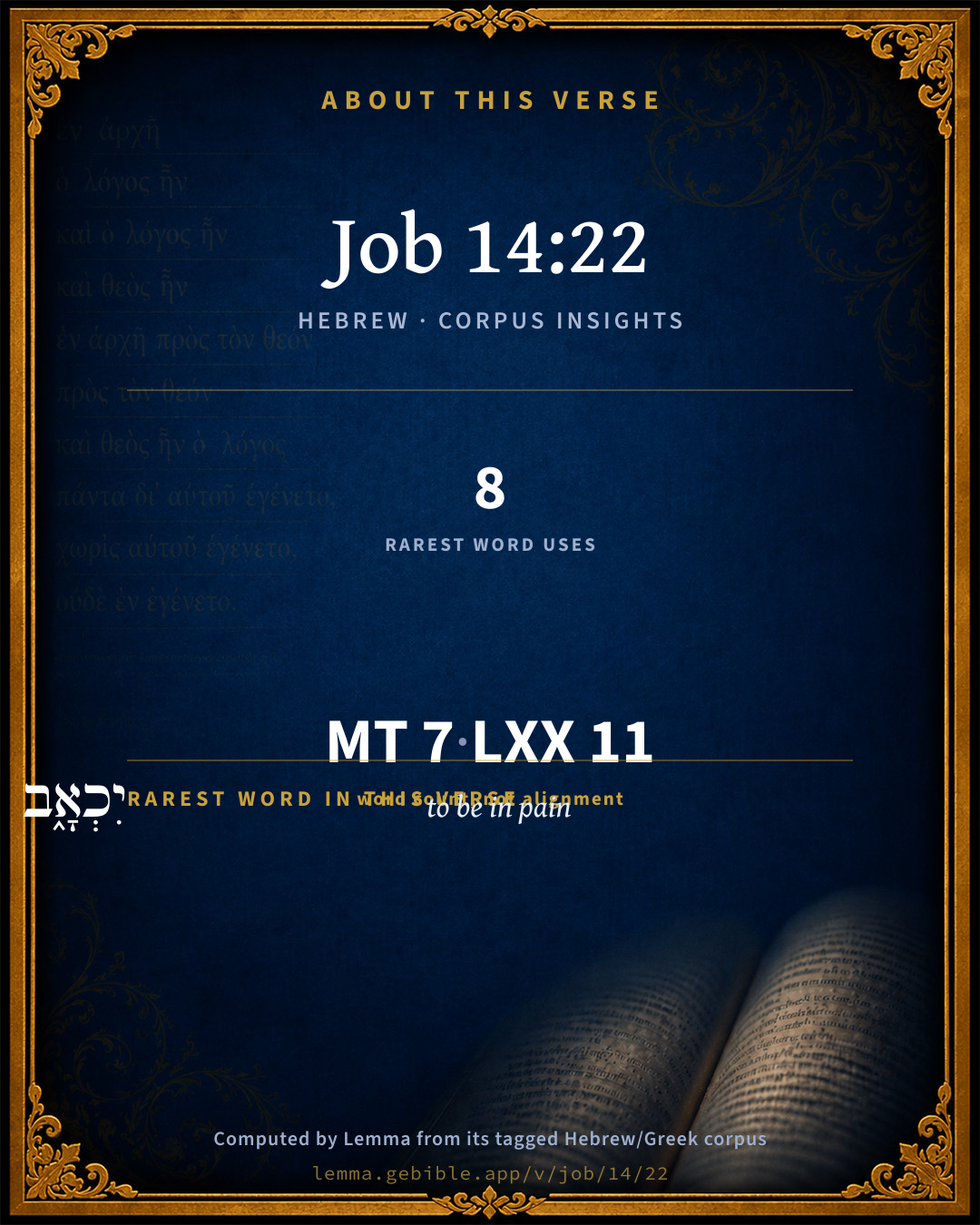
The rarest word here is יִכְאָ֑ב to be in pain H3510 — appearing just 8 times in the whole Hebrew Bible.

Shared distinctive vocabulary

יִכְאָ֑ב to be in pain H3510 occurs in 8 verses of the Hebrew Bible. Also found in:

Grammatical profile

  • 2 verbs
  • 2 nouns
  • 2 prepositions
  • 1 particle

Verb forms

  • יִכְאָ֑ב Qal · Imperfect
  • תֶּאֱבָֽל Qal · Imperfect

Repetition

A word recurs within this verse — often emphatic in Hebrew:

  • עָלָ֣יו upon H5921 ×2

Hebrew & Septuagint length

In English translation the verse runs 12 words from the Hebrew and 10 from the Septuagint (LXX English) — closely comparable.

A rough comparison of the two English renderings, which tokenize alike — not a word-level alignment.

Word counts can differ between the Hebrew and the Greek without any difference in meaning — e.g. the Hebrew direct-object marker אֵת has no separate Greek word, and Greek often adds the article ὁ.

In the original languages it is 7 Hebrew tokens and 11 Greek tokens — but the two are counted differently (Hebrew bundles its prefixes and suffixes into one token; the Greek is in lemma form), so that isn’t a like-for-like length.

Cross-references

6

Topical passages linked to Job 14:22 in the Treasury of Scripture Knowledge — connected by theme and wording, ordered by reader-vote popularity; previews shown in the World English Bible.

  • Job 19:26 After my skin is destroyed, Then in my flesh shall I see God,
  • Job 19:20 My bones stick to my skin and to my flesh. I have escaped by the skin of my teeth.
  • Job 19:22 Why do you persecute me as God, And are not satisfied with my flesh?
  • Job 33:19–21 He is chastened also with pain on his bed, With continual strife in his bones;
  • Proverbs 14:32 The wicked is brought down in his calamity, But in death, the righteous has a refuge.
  • Luke 16:23–24 In Hades, he lifted up his eyes, being in torment, and saw Abraham far off, and Lazarus at his bosom.

Cross-references courtesy of OpenBible.info (CC BY 4.0).

Hebrew and Greek witnesses Masoretic Hebrew ↔ Greek Septuagint

The same verse in the two great witnesses to the Old Testament, shown verse-for-verse.

These are two independent witnesses, not word-aligned to each other, and the Septuagint is shown in lemma (dictionary) form.

Hebrew Job 14:22 Masoretic · Westminster Leningrad Codex

אַךְ בְּ֭שָׂרוֹ עָלָ֣יו יִכְאָ֑ב וְ֝נַפְשׁ֗וֹ עָלָ֥יו תֶּאֱבָֽל

But his flesh on him has pain; His soul within him mourns."

World English Bible · Public Domain

Greek LXX Job 14:22 Septuagint · lemma form

ἀλλά ἤ ὁ σάρξ αὐτός ἀλγέω ὁ δέ ψυχή αὐτός πενθέω

But his flesh is in pain, and his soul mourns.

LXX2012 (modern English Septuagint) · Public Domain

Hebrew: Westminster Leningrad Codex (CC BY 4.0). Greek: Septuagint (public domain); English from LXX2012 (modern English Septuagint) (Public Domain). How the Septuagint differs from the Hebrew →

Commentary

Notes on Job 14:22 from classic Christian and Jewish commentators (each source and its license shown beneath its notes). The classic Christian expositions comment on the surrounding passage and are grouped to its opening verse, so a note may address several verses; the Jewish commentaries on the Tanakh (Rashi and others) are per-verse, so they appear only where the commentator wrote on this verse.

Lemma curates 59 commentaries, every one of them public domain or Creative Commons licensed, each selected and text-cleaned for this edition rather than reprinted as found. About our sources →

Trapp's Complete Commentary

John Trapp

Job 14:22 But his flesh upon him shall have pain, and his soul within him shall mourn.

Ver. 22. But his flesh upon him shall have pain] That is, say some, but as long as he is living his body is afflicted with a thousand evils; and though his soul, by the condition of her creation, be exempt from them, yet she bears a part in them, and becomes miserable with it. A dying man hath sorrow without and sorrow within; the whole man is in misery, as Job here felt himself. Others hold that this poetic representation hath no other meaning, but that the dead have no manner of communication with the living (Aben Ezra, Mercer, Diodati). Broughton rendereth it, His flesh is grieved for itself, and his soul will mourn for itself; q.d. he takes no thought or care for his children or nearest relations.

John Trapp, A Commentary or Exposition upon All the Books of the Old and New Testament (1647–1656) — public domain. Text from a community e-Sword module.

The Biblical Illustrator

Joseph S. Exell

Job_14:22

But his flesh upon him shall have pain, and his soul within him shall mourn.

Physical sensation after death

Was it not the opinion of the ancient Jews that the soul retained somewhat of the sensation of the flesh until the body had entirely dissolved? It would not be strange if such were the fact, considering the proximity of the Jews to the Egyptians; since the Egyptians held the notion that the continuance of the souls existence depended upon the preservation of the bodily organism, a notion which led to the embalming and secure burial of the corpse. Tacitus distinctly ascribes this notion to the Jews as its originators. There are also some Old Testament texts which at first glance seem to convey such a belief, e.g., verse 22, speaking of a man as dead, it adds, But his flesh upon him shall have pain, and his soul within him shall mourn; and Isa_66:24, They shall go forth, and look upon the carcasses of the men that have transgressed against. Me; for their worm shall not die, neither shall their fire be quenched. Dillman and others regard these texts as proving that the Jews held to the doctrine of physical consciousness in the grave. Delitzsch regards the pain of the soul as merely sentimental, The process of the corruption of the body casts painful reflections into the departed soul. Professor Davidson admits thus much to have been the Jewish notion. There are two ideas expressed--

(1) That the body in the grave, being that of a still existing person, feels the gnawing and the wasting of corruption, and that the soul in sheol leads a mournful and dreary existence; and

(2) That these elements of the person, though separated, still belong to the person. Professor Evans says, By poetic personification the mouldering flesh is here represented as sharing the aching discontent, the lingering misery of the imprisoned soul. Similarly Dr. Barnes, It is by the imagination that pain is here attributed to the dead body. Professor Lochler inclines to the opinion that the Jews believed that man carries with him to sheol a certain corporeality (a certain residue, kernel, or some reflex of the earthly body). These passages, taken in view of the after revelation through Christ, may serve as illustration of how He delivered those who all their lifetime were in bondage through fear of death, as well as of the growing dawn light of the historic Scriptures. (Homiletic Monthly.)

.

The Biblical Illustrator, edited by Joseph S. Exell (c. 1880s–1900s) — public domain. Text from a community e-Sword module.

Joseph Benson's Commentary

Job 14:22. But his flesh upon him shall have pain — Or, while his flesh is upon him; and his soul within him — While the soul is clothed with, or united to, the body, he feels sharp pains in his body, and bitter grief in his soul. Dying work is generally hard work; dying pangs sore pangs. It is folly, therefore, for men to defer their repentance to a deathbed, and to have that to do, which is the one thing needful, when they are really unfit to do any thing. But it is true wisdom, by making our peace with God in Christ, and keeping a good conscience, to treasure up comforts, which will support and relieve us against the pains and sorrows of a dying hour.

Joseph Benson's Commentary on the Old and New Testaments (1811–1818) — public domain. Text from a community e-Sword module.

Tyndale Open Study Notes

Tyndale Open Resources

14:22 Job no longer saw Sheol as a haven (3:17-19; 14:13-17). The Old Testament usually depicts the dead as being without feeling (Ps 88:12; Eccl 9:5; cp. Isa 50:11; 66:24); the doctrine that the dead suffer painfully is clearer in the New Testament (Luke 16:23, 28; Rev 14:11).

Tyndale Open Study Notes — © Tyndale Open Resources, licensed CC BY-SA 4.0. Text via the HelloAO Bible API.

Geneva Bible (1599)

Geneva Bible translators

Yet while he shall be in pain, and misery.

Geneva Bible (1599) marginal notes — public domain. Text via Bolls.life.

Jamieson, Fausset & Brown

Robert Jamieson, A. R. Fausset & David Brown

"Flesh" and "soul" describe the whole man. Scripture rests the hope of a future life, not on the inherent immortality of the soul, but on the restoration of the body with the soul. In the unseen world, Job in a gloomy frame anticipates, man shall be limited to the thought of his own misery. "Pain is by personification, from our feelings while alive, attributed to the flesh and soul, as if the man could feel in his body when dead. It is the dead in general, not the wicked, who are meant here."

Next: Job Chapter 15

Jamieson, Fausset & Brown — Commentary Critical and Explanatory on the Whole Bible (1871) — public domain (CC PDM 1.0). Text via the HelloAO Bible API.

Adam Clarke's Commentary

Verse 22. But his flesh upon him shall have pain] The sum of the life of man is this, pain of body and distress of soul; and he is seldom without the one or the other, and often oppressed by both. Thus ends Job's discourse on the miserable state and condition of man.

THE last verse of the preceding chapter has been differently translated and explained.

Mr. Good's version is the following, which he vindicates in a learned note: -

For his flesh shall drop away from him;

And his soul shall become a waste from him.

The Chaldee thus: "Nevertheless his flesh, on account of the worms, shall grieve over him; and his soul, in the house of judgment, shall wail over him." In another copy of this version it is thus: "Nevertheless his flesh, before the window is closed over him, shall grieve; and his soul, for seven days of mourning, shall bewail him in the house of his burial." I shall give the Hebrew: -

אך בשרו עליו יכאב

Ach besaro alaiv yichab,

ונפשו עליו תאבל

Venaphsho alaiv teebal.

Which Mr. Stock translates thus, both to the spirit and letter: -

But over him his flesh shall grieve;

And over him his breath shall mourn.

"In the daring spirit of oriental poetry," says he, "the flesh, or body, and the breath, are made conscious beings; the former lamenting its putrefaction in the grave, the latter mourning over the mouldering clay which it once enlivened."

This version is, in my opinion, the most natural yet offered. The Syriac and Arabic present nearly the same sense: "But his body shall grieve over him; and his soul be astonished over him."

Coverdale follows the Vulgate: Whyle he lyveth his flesh must have travayle; and whyle the soul is in him, he must be in sorowe.

On Job 14:2. I have referred to the following beautiful lines, which illustrate these finely figurative texts: -

He cometh forth as a FLOWER, and is CUT Down; he fleeth also as a shadow, and continueth not.

All flesh is GRASS, and all the goodliness thereof is as the FLOWER of the field.

The GRASS withereth, the FLOWER fadeth; but the word of our God shall stand for ever.

The morning flowers display their sweets,

And gay their silken leaves unfold;

As careless of the noonday heats,

As fearless of the evening cold.

Nipp'd by the wind's untimely blast,

Parch'd by the sun's directer ray,

The momentary glories waste,

The short-lived beauties die away.

So blooms the human face divine,

When youth its pride of beauty shows;

Fairer than spring the colours shine,

And sweeter than the virgin rose.

Or worn by slowly-rolling years,

Or broke by sickness in a day,

The fading glory disappears,

The short-lived beauties die away.

Yet these, new rising from the tomb,

With lustre brighter far shall shine;

Revive with ever-during bloom,

Safe from diseases and decline.

Let sickness blast, let death devour,

If heaven must recompense our pains:

Perish the grass and fade the flower,

If firm the word of God remains.

See a Collection of Poems on Sundry Occasions, by the Rev. Samuel Wesley, Master of Blundell's School, Tiverton.

Adam Clarke's Commentary on the Bible (1810–1826) — public domain. Text from a community e-Sword/MySword module.

The Cambridge Bible for Schools and Colleges

gen. ed. J. J. S. Perowne

22. But his flesh] Or, only. The prep. rendered here “upon him” is the same as that rendered “within him,” it means with him or in connexion with him, and the verse differs little from this, Only his flesh hath pain and his soul mourneth. The dead knoweth nothing of the upper world, only this can be said of him that his flesh hath pain and his soul mourneth; but the Hebrew expresses the idea more distinctly that his flesh and soul do these things in connexion with him. There are two ideas expressed: (1) that the body in the grave, being that of a still existing person, feels the gnawing and the wasting of corruption, cf. Isa_66:24, and that the soul in Sheol leads a mournful and dreary existence; and (2) that these elements of the person though separated still belong to the person.

The first circle of speeches, now completed, started from Job’s complaints in ch. 3. Job did not there name God nor make any open imputation against Him, but his bitter maledictions of the day of his birth and his impatient cry, Why gives He life to him that is in misery, (Job_3:20), shewed too well against whom it was that he “turned his spirit” (Job_15:12.)

Hence the three friends conceive that the first thing to aim at is to bring Job back to just and reverent thoughts of God. Therefore they dwell upon the attributes of God and contrast Him with man, hoping by this great thought of God to still the tumult in Job’s breast and bring him to take his right place before the Creator.

The friends all impress this thought of God upon Job, each, however, doing it in his own way. The oldest and most thoughtful of the three, Eliphaz, lays hold of the moral purity of God and His universal goodness. Bildad insists on the discriminating rectitude of God in His rule of the world. While Zophar magnifies the omniscience of the Divine insight, which guides God’s dealings with men. Each of these views is designed to meet some side of Job’s feeling as expressed in his complaints. Job answers these arguments for the most part indirectly. His own unmerited afflictions furnished the answer to them, and he mainly dwells on this. Only at last is he driven by the form in which Zophar puts the common argument of the friends directly to meet it. To their great argument of “God,” with which they thought to terrify and silence him, he replies that he does need to be taught regarding God. He is not inferior to them in knowledge of God; but it is just God that he desires to meet. He will go before Him to maintain his rectitude. He challenges God to make known the sins of which he has been guilty (Job_13:23).

However irreligious Job’s demeanour might seem to his friends (Job_15:4), it is obvious that he has struck from their hands the weapon they have hitherto been using against him. Their argument of “God” is exhausted. Job’s passionate proclamation that what he desires above all things is to meet God and maintain his ways to His face has convinced them that he is not to be vanquished with this weapon. Hence they are obliged to look about for others.

The Cambridge Bible for Schools and Colleges (gen. ed. J. J. S. Perowne; Cambridge University Press, 1878–1918) — public domain. Text from a community e-Sword module.

John Gill's Exposition

But his flesh upon him shall have pain,.... Either he shall be chastened with strong pains on his sick and dying bed; which is the reason why he neither rejoices at the happiness of his family, nor is distressed at their misfortunes; having so much pain in his flesh and bones to endure himself; or, as Gussetius (x) renders it, "for this" his flesh and soul shall have pain and grief while he lives, because he cannot know how it will be with his family when he is dead; but rather this is to be understood of a man when dead; and so it is a continuation of the description of death, or of the state of the dead; thus Aben Ezra interprets it of his flesh upon him, that is, his body shall melt away, rot and corrupt, meaning in the grave; so the word is used of marring and destroying, in Kg2 3:19, to which the Targum inclines,

"but his flesh, because of worms upon him, shall grieve;''

and so Jarchi, troublesome is the worm to a dead man as a needle in quick flesh; pain and grief are by a prosopopoeia or personification attributed to a dead body; signifying, that could it be sensible of its case, it would be painful and grievous to it:

and his soul within him shall mourn; either while he lives, because of his afflictions and terrors, the days being come in which he has no pleasure, and the time of death drawing nigh; or his dead body, as the word is used in Psa 16:10; said to mourn by the same figure; or his soul, because of his body being dead; or rather his breath, which at death fails and pines away (y).

(x) Ebr. Comment. p. 605. (y) "emarcida luget", Schultens.

Next: Job Chapter 15

John Gill's Exposition of the Whole Bible (1746–1763) — public domain (CC PDM 1.0). Text via the HelloAO Bible API.

Albert Barnes' Notes on the Bible

But his flesh upon him shall have pain - Dr. Good renders this, “his flesh shall drop away from him.” This is evidently a representation of the state of the man after he was dead. He would be taken away from hope and from his friends. His body would be committed to the grave, and his spirit would go to the world of shades. The image in the mind seems to have been, that his flesh would suffer. It would be cold and chill, and would be devoured by worms. There seems to have been an impression that the soul would be conscious of this in its distant and silent abode, and the description is given of the grave as if the body were conscious there, and the turning back to dust were attended with pain. This thought is that which makes the grave so gloomy now. We think of ourselves in its darkness and chilliness. We insensibly suppose that we shall be conscious there. And hence, we dread so much the lonely, sad, and gloomy residence in the tomb. The meaning of the word rendered “shall have pain” - כאב kâ'ab - is “to be sore, to be grieved, afflicted, sad.” It is by the imagination, that pain is here attributed to the dead body. But Job was not alone in this. We all feel the same thing when we think of death.

And his soul within him shall mourn - The soul that is within him shall be sad; that is, in the land of shades. So Virgil, speaking of the death of Lausus, says,

Tum vita per auras

Concessit moesta ad manes, corpusque reliquit.

Aeneid x. 819.

The idea of Job is, that it would leave all the comforts of this life; it would be separate from family and friends; it would go lonely and sad to the land of shades and of night. Job dreaded it. He loved life; and in the future world, as it was presented to his view, there was nothing to charm and attract. There he expected to wander in darkness and sadness; and from that gloomy world he expected to return no more forever. Eichhorn, however, has rendered this verse so as to give a different signification, which may perhaps be the true one.

Nur uber sich ist er betrubt;

Nur sich betrauert er.

“His troubles pertain only to himself; his grief relates to himself alone.” According to this, the idea is that he must bear all his sorrows alone, and for himself. He is cut off from the living, and is not permitted to share in the joys and sorrows of his posterity, nor they in his. He has no knowledge of anything that pertains to them, nor do they participate in his griefs. What a flood of light and joy would have been poured on his soul by the Christian hope, and by the revelation of the truth that there is a world of perfect light and joy for the righteous - in heaven! And what thanks do we owe to the Great Author of our religion - to him who is “the Resurrection and the Life “ - that we are permitted to look upon the grave with hearts full of peace and joy!

Albert Barnes' Notes on the Bible (1834–1885) — public domain. Text from a community e-Sword/MySword module.

Haydock's Catholic Bible Commentary

Over. Hebrew, "within him." (Haydock) --- During life man is full of cares, and presently he is consigned to the dreary tomb, ver. 19. (Calmet)

George Leo Haydock (1774–1849), Haydock's Catholic Family Bible and Commentary, 1859 edition — public domain. Excludes Psalms (Douay-Rheims chapter numbering differs from Protestant) and Deuterocanonical books (Catholic canon only).

Matthew Poole's English Annotations

This is man’s condition; he is miserable both when he dies, because he dies without hope of returning to life, as he had discoursed before; and (as he now adds) whilst he lives, whilst his flesh is upon him, and his soul within him; whilst the soul is clothed with or united to the body, he feels sharp

pain in his body, and bitter grief in his soul. Seeing therefore the state of man upon earth is so vain and unhappy every way, Lord, give me some comfort to sweeten my life, or take away my life from me.

Matthew Poole's English Annotations on the Holy Bible (1683–1685) — public domain. Text from a community e-Sword/MySword module.

Whedon's Commentary on the Bible

Daniel D. Whedon

22. Upon him and within him are the same, (עליו,) and signify either “on his own account,” or better, in him. “He no longer knows and perceives the things of the upper world, he is henceforth conscious only of his pain and sorrow.” — Dillmann. The repetition of in him is significant; as much as to say, flesh and soul are equally essential to the identity of the man. In the intimation that man’s condition in sheol is by no means one of abstract personality, we have the germ of the vastly expanded disclosure given Job_19:26-27, of a future substantial union of the two. Some weakly suppose that Job speaks of the infirmities of age; others, (Delitzsch, Umbreit. etc.,) that he means the literal grave. According to the latter, Job employs a figure which attributes life to things inanimate. The dead body is regarded as suffering pain on account of its disconsolate, isolated condition. Job elsewhere speaks in like figure of the clods of the valley, that they shall be sweet to him. Job_21:33,

Daniel D. Whedon (gen. ed.), Commentary on the Old and New Testaments (1874–1909) — public domain. Text from a community e-Sword module.

The Pulpit Commentary

But his flesh upon him shall have pain. The best rendering is probably that which is placed in the margin of the Revised Version, only for himself his flesh hath pain, and for himself his soul mourneth. Nothing more is intended than to negative the idea that the future condition of his children will seriously affect a man who is suffering under God"s afflicting hand, either in this life or afterwards. He cannot but be occupied solely with himself. His own sufferings, whether of body or mind, win absorb all his attention.

The Pulpit Commentary (1880–1919), ed. H.D.M. Spence-Jones & Joseph S. Exell — public domain. Text from a community e-Sword module.

Rashi

Rabbi Shlomo Yitzchaki (Rashi)

But his flesh causes him pain A worm is as painful to the dead as a needle in the flesh of the living.

Rashi on the Tanakh — English translations: “The Judaica Press complete Tanach with Rashi, translated by A. J. Rosenberg” (CC BY 4.0); “Pentateuch with Rashi's commentary by M. Rosenbaum and A.M. Silbermann, 1929-1934” (public domain); “The Metsudah Tanach series, Lakewood, N.J” (CC BY 4.0); and “The Book of Joshua, Metsudah Publications, 1997” (CC BY 4.0). Text via Sefaria.

Lesson kit

Teaching starters — assembled from the data on this page, not authored interpretation. Every prompt links to the verse data it draws on. Edit before teaching.

Job, in the Wisdom, opens this verse with 7 words (6 distinct Hebrew lemmas). Its most distinctive word is kâʼab (“to be in pain”). A historical commentator’s framing appears above. Read the whole chapter for the surrounding context.

Discussion questions

  1. What does “to be in pain” (kâʼab) contribute to the verse as a whole?
  2. Genesis 34:25 shares the word «to be in pain» with this verse. How do the two illuminate each other?
  3. “upon” occurs 2× in this one verse. What is the effect of the repetition?
  4. These translations render this verse differently; the difference is in the English rendering, not the original. What questions does that raise?
  5. The verb «יִכְאָ֑ב» is Qal Imperfect. How does its form color the action?
  6. Reading how Trapp's Complete Commentary and The Biblical Illustrator read this verse, where do the two commentators agree and where do they part?

Things to notice

Reading settings

Reading text

Shown beneath each verse's original-language words.

Old Testament
Old Testament edition

Read the OT as the Masoretic Hebrew (MT) or the Greek Septuagint (LXX).

English shown for the Greek Septuagint (in the Hebrew ↔ Greek comparison).

Comparing translations? Open the Compare panel on any verse page to stack up to four side by side.