
Proverbs 13:3

Hebrew (Westminster Leningrad Codex) Proverbs 13:3 appears in the Hebrew Old Testament. The text above is from the Westminster Leningrad Codex. Each word links to its Strong’s number, a concise gloss, and parsing drawn from the Open Scriptures Hebrew Bible morphology. Click any word for its full Brown-Driver-Briggs (BDB) entry.
Download image
Cite this verse

Proverbs 13:3 (World English Bible). Public Domain. Lemma interlinear Bible study tool, https://lemma.gebible.app/v/proverbs/13/3.

Show BibTeX & RIS
BibTeX
RIS
English Translation
He who guards his mouth guards his soul. One who opens wide his lips comes to ruin.
World English Bible · Public Domain
Highlights
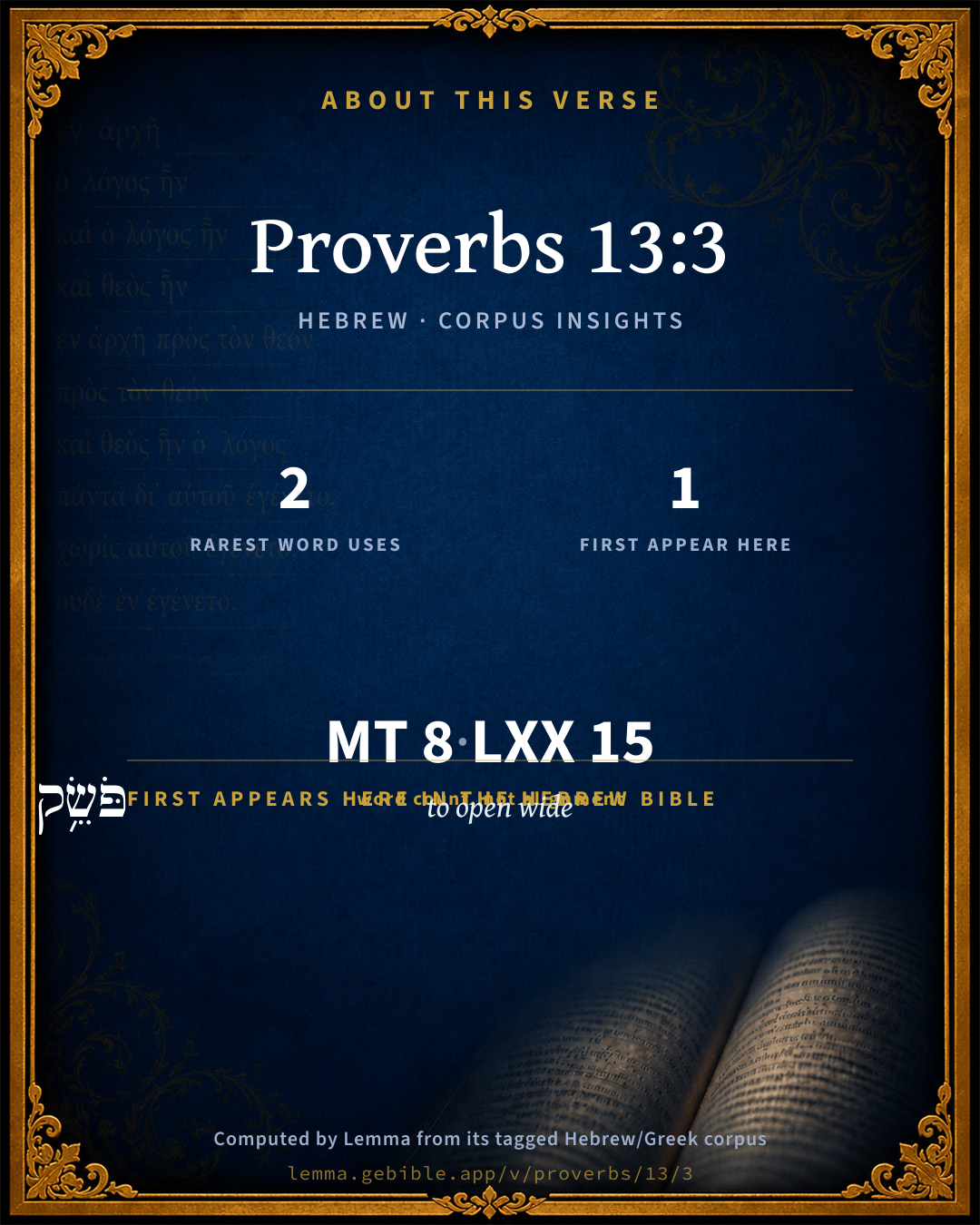
  • 1 first appearance in the Hebrew Bible
Full analysis ↓
Download a study sheet

One document with this verse’s original text, its word-by-word gloss line, the meaning frame, cross-references with their text, attributed commentary, and full source and license credits — printable, and it pastes into notes with its structure intact.

This verse Autodidact and up

Study sheet (.html) Plain text (.txt)

A passage Seminary Student

Up to 50 verses in one chapter. A passage sheet keeps up to 6 commentary sources and 12 cross-references per verse, in the order this page ranks them, and says so on the sheet whenever that leaves anything out. Ask for a single verse and you get the Autodidact verse sheet above.

Everything on this page stays free to read, with no account — the sheet is a download of what is already on screen, not access to it.

Want to remove ads? Support Godless Engineer
Compare translations 3

The same verse in 3 English versions, stacked beneath the original-language interlinear above. Click any original word for its lexicon entry.

Each is an independent rendering of the whole verse — the interlinear is not word-aligned to these translations.

Highlighted words mark where these versions differ — a whole-verse word diff, not a word-by-word alignment.

  • World English Bible Public Domain
    He who guards his mouth guards his soul. One who opens wide his lips comes to ruin.
  • King James Version Public Domain
    He that keepeth his mouth keepeth his life: but he that openeth wide his lips shall have destruction.
  • unfoldingWord Literal Text CC BY-SA 4.0
    One guarding his mouth keeps his life; one opening his lips, ruin for him.

unfoldingWord Literal Text — © unfoldingWord, licensed CC BY-SA 4.0. Word-aligned USFM3 via Door43 (git.door43.org/unfoldingWord/en_ult).

Versions to compare (up to 4)

3 of 4 selected

Show all 18 translations

Every available English version of this verse, each an independent rendering of the whole verse.

  • World English Bible Public Domain
    He who guards his mouth guards his soul. One who opens wide his lips comes to ruin.
  • Berean Standard Bible Public Domain
    He who guards his mouth protects his life, but the one who opens his lips invites his own ruin.
  • Majority Standard Bible Public Domain
    He who guards his mouth protects his life, but the one who opens his lips invites his own ruin.
  • King James Version Public Domain
    He that keepeth his mouth keepeth his life: but he that openeth wide his lips shall have destruction.
  • American Standard Version (1901) Public Domain
    He that guardeth his mouth keepeth his life; `But' he that openeth wide his lips shall have destruction.
  • Revised Version (1885) Public Domain
    He that guardeth his mouth keepeth his life: but he that openeth wide his lips shall have destruction.
  • Geneva Bible (1599) Public Domain
    Hee that keepeth his mouth, keepeth his life: but he that openeth his lips, destruction shall be to him.
  • Douay-Rheims (1899) Public Domain
    He that keepeth his mouth, keepeth his soul: but he that hath no guard on his speech shall meet with evils.
  • Young's Literal Translation Public Domain
    Whoso is keeping his mouth, is keeping his soul, Whoso is opening wide his lips -- ruin to him!
  • Literal Standard Version CC BY-SA 4.0
    Whoever is keeping his mouth, is keeping his soul, || Whoever is opening wide his lips—ruin to him!
  • Unlocked Literal Bible CC BY-SA 4.0
    The one who guards his mouth protects his life, but the one who opens wide his lips will ruin himself.
  • unfoldingWord Literal Text CC BY-SA 4.0
    One guarding his mouth keeps his life; one opening his lips, ruin for him.
  • Darby Bible Public Domain
    He that guardeth his mouth keepeth his soul; destruction shall be to him that openeth wide his lips.
  • World Messianic Bible Public Domain
    He who guards his mouth guards his soul. One who opens wide his lips comes to ruin.
  • Webster's Bible Public Domain
    He that keepeth his mouth keepeth his life: but he that openeth wide his lips shall have destruction.
  • Free Bible Version CC BY-SA 4.0
    Watch what you say and save your life—saying too much leads to disaster.
  • Bible in Basic English Public Domain
    He who keeps a watch on his mouth keeps his life; but he whose lips are open wide will have destruction.
  • JPS Tanakh (1917) Public Domain
    He that guardeth his mouth keepeth his life; but for him that openeth wide his lips there shall be ruin.

Literal Standard Version (2020), Covenant Press — licensed CC BY-SA 4.0. Text via the HelloAO Bible API (eBible.org). Unlocked Literal Bible (unfoldingWord) — licensed CC BY-SA 4.0. Text via the HelloAO Bible API (eBible.org). unfoldingWord Literal Text — © unfoldingWord, licensed CC BY-SA 4.0. Word-aligned USFM3 via Door43 (git.door43.org/unfoldingWord/en_ult). Free Bible Version, Dr. Jonathan Gallagher — licensed CC BY-SA 4.0. Text via the HelloAO Bible API (eBible.org).

Word by word

More ways to search: Search by grammar → Find every occurrence → Compare this word →

Practice this passage: Drill this verse → Learn its vocabulary →

פֹּשֵׂ֥ק
pâsaq
H6589
“opening wide”
Verb, Qal, Participle Active, Masculine, Singular, Absolute
Part of Speech
Verb
Stem
Qal
Form
Participle Active
Gender
Masculine
Number
Singular
State
Absolute
Full BDB Definition

Origin: a primitive root

TWOT: 1842

to part, open wide - (Qal) - to open wide - to be talkative (of the mouth) - (Piel) to open wide
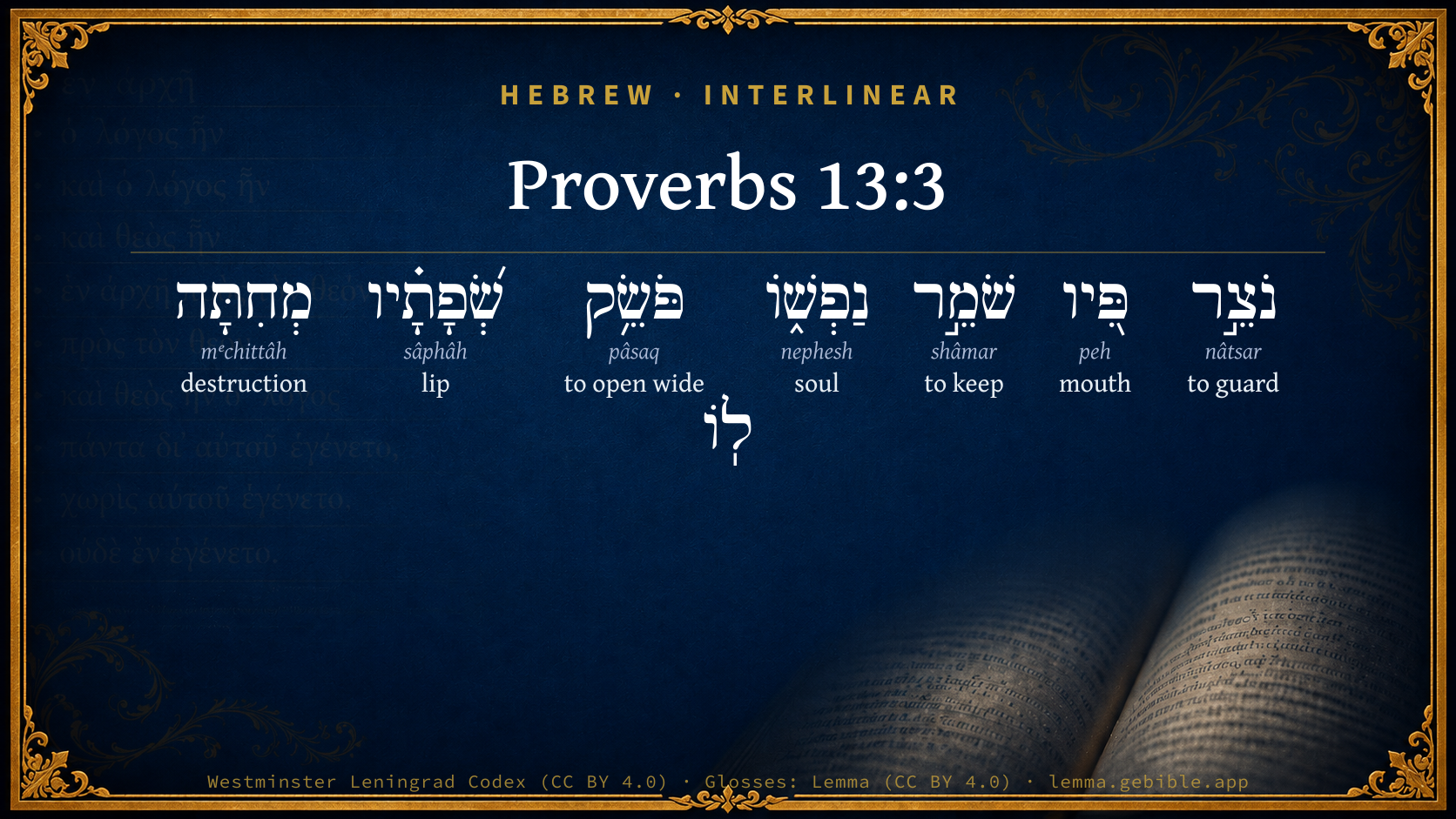
  1. נֹצֵ֣ר nâtsar H5341 “guarding” Verb, Qal, Participle Active, Masculine, Singular, Absolute
  2. פִּ֭יו peh H6310 “mouth · his” Noun, Common, Masculine, Singular, Construct + Suffix, Personal, 3rd Person, Masculine, Singular
  3. שֹׁמֵ֣ר shâmar H8104 “keeping” Verb, Qal, Participle Active, Masculine, Singular, Absolute
  4. נַפְשׁ֑וֹ nephesh H5315 “soul · his” Noun, Common, Both, Singular, Construct + Suffix, Personal, 3rd Person, Masculine, Singular
  5. שְׂ֝פָתָ֗יו sâphâh H8193 “lips · his” Noun, Common, Feminine, Dual, Construct + Suffix, Personal, 3rd Person, Masculine, Singular
  6. מְחִתָּה mᵉchittâh H4288 “destruction” Noun, Common, Feminine, Singular, Absolute

About this verse

These counts appear in no published source. They are computed here, from the morphology-tagged text and Lemma’s own curated glosses. What Lemma adds →

8
words
7
distinct lemmas
Wisdom
section

Notable vocabulary

The rarest word here is פֹּשֵׂ֥ק to open wide H6589 — appearing just 2 times in the whole Hebrew Bible.

First appearance in Scripture

This word makes its first canonical appearance in the Hebrew Bible here:

  • פֹּשֵׂ֥ק to open wide H6589

Shared distinctive vocabulary

פֹּשֵׂ֥ק to open wide H6589 occurs in 2 verses of the Hebrew Bible. Also found in:

Grammatical profile

  • 3 verbs
  • 4 nouns
  • 1 preposition

Verb forms

  • נֹצֵ֣ר Qal · Participle Active
  • שֹׁמֵ֣ר Qal · Participle Active
  • פֹּשֵׂ֥ק Qal · Participle Active

Hebrew & Septuagint length

In English translation the verse runs 17 words from the Hebrew and 23 from the Septuagint (LXX English) — closely comparable.

A rough comparison of the two English renderings, which tokenize alike — not a word-level alignment.

Word counts can differ between the Hebrew and the Greek without any difference in meaning — e.g. the Hebrew direct-object marker אֵת has no separate Greek word, and Greek often adds the article ὁ.

In the original languages it is 8 Hebrew tokens and 15 Greek tokens — but the two are counted differently (Hebrew bundles its prefixes and suffixes into one token; the Greek is in lemma form), so that isn’t a like-for-like length.

Cross-references

10

Topical passages linked to Proverbs 13:3 in the Treasury of Scripture Knowledge — connected by theme and wording, ordered by reader-vote popularity; previews shown in the World English Bible.

  • Proverbs 21:23 Whoever guards his mouth and his tongue Keeps his soul from troubles.
  • Proverbs 18:21 Death and life are in the power of the tongue; Those who love it will eat its fruit.
  • Proverbs 18:7 A fool's mouth is his destruction, And his lips are a snare to his soul.
  • James 3:2–12 For in many things we all stumble. If anyone doesn't stumble in word, the same is a perfect man, able to bridle the whole body also.
  • Psalms 39:1 I said, "I will watch my ways, so that I don't sin with my tongue. I will keep my mouth with a bridle while the wicked is before me."
  • Matthew 12:36–37 I tell you that every idle word that men speak, they will give account of it in the day of judgment.
  • Proverbs 10:19 In the multitude of words there is no lack of disobedience, But he who restrains his lips does wisely.
  • Proverbs 20:19 He who goes about as a tale-bearer reveals secrets; Therefore don't keep company with him who opens wide his lips.
  • James 1:26 If anyone among you thinks himself to be religious while he doesn't bridle his tongue, but deceives his heart, this man's religion is worthless.
  • Proverbs 12:13 An evil man is trapped by sinfulness of lips, But the righteous shall come out of trouble.

Cross-references courtesy of OpenBible.info (CC BY 4.0).

Hebrew and Greek witnesses Masoretic Hebrew ↔ Greek Septuagint

The same verse in the two great witnesses to the Old Testament, shown verse-for-verse.

These are two independent witnesses, not word-aligned to each other, and the Septuagint is shown in lemma (dictionary) form.

Hebrew Proverbs 13:3 Masoretic · Westminster Leningrad Codex

נֹצֵ֣ר פִּ֭יו שֹׁמֵ֣ר נַפְשׁ֑וֹ פֹּשֵׂ֥ק שְׂ֝פָתָ֗יו מְחִתָּה לֽוֹ

He who guards his mouth guards his soul. One who opens wide his lips comes to ruin.

World English Bible · Public Domain

Greek LXX Proverbs 13:3 Septuagint · lemma form

ὅς φυλάσσω ὁ ἑαυτοῦ στόμα τηρέω ὁ ἑαυτοῦ ψυχή ὁ δέ προπετής χεῖλος πτοέω ἑαυτοῦ

He that keeps his own mouth keeps his own life: but he that is hasty with his lips shall bring terror upon himself.

LXX2012 (modern English Septuagint) · Public Domain

On this verse, The Pulpit Commentary discusses the Septuagint’s reading. Read the note in Commentary ↓

Hebrew: Westminster Leningrad Codex (CC BY 4.0). Greek: Septuagint (public domain); English from LXX2012 (modern English Septuagint) (Public Domain). How the Septuagint differs from the Hebrew →

Commentary

Notes on Proverbs 13:3 from classic Christian and Jewish commentators (each source and its license shown beneath its notes). The classic Christian expositions comment on the surrounding passage and are grouped to its opening verse, so a note may address several verses; the Jewish commentaries on the Tanakh (Rashi and others) are per-verse, so they appear only where the commentator wrote on this verse.

Lemma curates 59 commentaries, every one of them public domain or Creative Commons licensed, each selected and text-cleaned for this edition rather than reprinted as found. About our sources →

Trapp's Complete Commentary

John Trapp

Pro 13:3 He that keepeth his mouth keepeth his life: [but] he that openeth wide his lips shall have destruction.

Ver. 3. He that keepeth his mouth.] As the guard keepeth the gates in a siege. God hath set a double guard of lips and teeth before this gate, and yet, unless he himself set the watch, and keep the door, all will be lost. {Psa 141:3}

But he that openeth wide his lips.] As she did her feet, to "multiply her whoredoms." {Eze 16:25} Kεχηνοτες, gaping mouthed men are noted for fools by Lucian and Aristophanes. An open mouth is a purgatory to the master, say we. And cave ne feriat lingua tua collum tuum, {a} say the Arabians in their proverb, Take heed that thy tongue cut not thy throat.

{a} Scalig. Arab. Prov., cent. 1. pro 75.

John Trapp, A Commentary or Exposition upon All the Books of the Old and New Testament (1647–1656) — public domain. Text from a community e-Sword module.

Tyndale Open Study Notes

Tyndale Open Resources

13:3 Having control of the tongue demonstrates wisdom (see Jas 3:1-12).

Tyndale Open Study Notes — © Tyndale Open Resources, licensed CC BY-SA 4.0. Text via the HelloAO Bible API.

Matthew Henry's Commentary

Note, 1. A guard upon the lips is a guard to the soul. He that is cautious, that thinks twice before he speaks once, that, if he have thought evil, lays his hand upon his mouth to suppress it, that keeps a strong bridle on his tongue and a strict hand on that bridle, he keeps his soul from a great deal both of guilt and grief and saves himself the trouble of many bitter reflections on himself and reflections of others upon him. 2. There is many a one ruined by an ungoverned tongue: He that opens widely his lips, to let our quod in buccam venerit - whatever comes uppermost, that loves to bawl, and bluster, and make a noise, and affects such a liberty of speech as bids defiance both to God and man, he shall have destruction. it will be the destruction of his reputation, his interest, his comfort, and his soul for ever, Jam 3:6.

Matthew Henry's Commentary on the Whole Bible (1708–1710) — public domain (CC PDM 1.0). Text via the HelloAO Bible API.

Jamieson, Fausset & Brown

Robert Jamieson, A. R. Fausset & David Brown

He . . . mouth . . . life--because evil speeches may provoke violence from others.

he that openeth wide his lips shall have destruction--On last clause, compare Pro 10:14.

Jamieson, Fausset & Brown — Commentary Critical and Explanatory on the Whole Bible (1871) — public domain (CC PDM 1.0). Text via the HelloAO Bible API.

Adam Clarke's Commentary

Verse 3. He that keepeth his mouth keepeth his life] How often have the foolish, headstrong, and wicked, forfeited their lives by the treasonable or blasphemous words they have spoken! The government of the tongue is a rare but useful talent.

But he that openeth wide his lips] He that puts no bounds to his loquacity, speaks on every subject, and gives his judgment and opinion on every matter. It has often been remarked that God has, given us two EYES, that we may SEE much; two EARS, that we may HEAR much; but has given us but ONE tongue, and that fenced in with teeth, to indicate that though we hear and see much, we should speak but little.

Adam Clarke's Commentary on the Bible (1810–1826) — public domain. Text from a community e-Sword/MySword module.

Ellicott's Commentary for English Readers

(3) He that keepeth his mouth keepeth his life.—Comp. above, on Pro_4:23; Pro_12:13.

A Bible Commentary for English Readers, edited by Charles John Ellicott (1878–1897) — public domain. Text from a community e-Sword module.

The Cambridge Bible for Schools and Colleges

gen. ed. J. J. S. Perowne

3. keepeth … keepeth] Rather, guardeth … keepeth, R.V., the Heb. words being different. For the sentiment comp. Pro_10:19.

The Cambridge Bible for Schools and Colleges (gen. ed. J. J. S. Perowne; Cambridge University Press, 1878–1918) — public domain. Text from a community e-Sword module.

John Gill's Exposition

He that keepeth his mouth keepeth his life,.... He that keeps his mouth shut keeps it as with a bridle; keeps it from speaking things of other persons, particularly of such as are in high places, of kings and princes, and civil magistrates: he keeps himself quiet and comfortable; keeps himself from many troubles, which otherwise he would come into; keeps his life from danger, to which it would be exposed, should he speak evil of dignities, or give himself the freedom, as some do, whereby they are brought to an untimely end; see Pro 18:21; besides, persons ought to be careful of their words, since by them a man will either be justified or condemned hereafter, Mat 12:37;

but he that openeth wide his lips shall have destruction; or "consternation" (x): he that is rash and inconsiderate, hasty with his lips, a talkative man; that speaks freely everything that comes into his mind, regardless of the characters of men, or consequences of things; is often brought into frights and fears, through the menaces and threatenings of men in power, whose characters he has made too free with, and oftentimes is brought to ruin and destruction: so he, whose throat is as an open sepulchre, belching out filthy words, horrid oaths, curses, and imprecations, destruction is near him, even in all his ways; and the man of sin, that opens his mouth in blasphemy against God, and his tabernacle, and his saints, shall go into perdition, Rev 13:5.

(x) "consternatio", Mercerus, Cocceius, Michaelis; "terrebitur", Tigurine version.

John Gill's Exposition of the Whole Bible (1746–1763) — public domain (CC PDM 1.0). Text via the HelloAO Bible API.

Haydock's Catholic Bible Commentary

Hath. Hebrew, "who openeth his lips inconsiderately, is lost, Judges xi. 35. (Haydock)

George Leo Haydock (1774–1849), Haydock's Catholic Family Bible and Commentary, 1859 edition — public domain. Excludes Psalms (Douay-Rheims chapter numbering differs from Protestant) and Deuterocanonical books (Catholic canon only).

Matthew Poole's English Annotations

He that keepeth his mouth, to wit, to the opening of it; who speaks sparingly, and with due care and caution;

keepeth his life; prevents many sins and mischiefs which others run into. He that openeth wide his lips, that takes liberty to speak every thing which pleaseth him, or cometh into his mind, shall have destruction, from God or men.

Matthew Poole's English Annotations on the Holy Bible (1683–1685) — public domain. Text from a community e-Sword/MySword module.

Whedon's Commentary on the Bible

Daniel D. Whedon

3. He that keepeth (or watcheth) his mouth — Meaning himself. Comp. Jas_3:2 : “If any man offend not in word, the same is a perfect man, and able also to bridle the whole body.” The latter clause of this proverb is very forcible:

He that openeth… destruction — To guard well against passionate or injurious words is often to preserve safety and life. Compare Pro_10:19; Pro_12:23; Psa_39:1.

Daniel D. Whedon (gen. ed.), Commentary on the Old and New Testaments (1874–1909) — public domain. Text from a community e-Sword module.

The Pulpit Commentary

He that keepeth (guardeth) his mouth keepeth his life (Pro_18:21 Pro_21:23; comp. Psa_39:1 Jam_1:26) Thus the gnome H glwssa pollou . "The tongue hath many to destruction led.

And Ecc 28:25, "Weigh thy words in a balance, and make a door and bar for thy mouth. Beware thou slide not by it, lest thou fall before him that lieth in wait." But he that openeth wide his lips shall have destruction. (Pro_10:14) The Vulgate paraphrases, "He who is inconsiderate in speech shall experience evils;" Septuagint, "will terrify himself will occasion to himself many terrible alarms and inflictions. Hence the psalmist prays, "Set a watch, O Lord, before my month; keep the door of my lips." So we have in the Danish, "A silent man"s words are not brought into court;" and in the Spanish, "Let not the tongue say what the head shall pay for;" while the Italians tell us, "The sheep that bleats is strangled by the wolf:" and "Silence was never written down" (Kelly). (See on Pro_18:6 Pro_20:19)

The Pulpit Commentary (1880–1919), ed. H.D.M. Spence-Jones & Joseph S. Exell — public domain. Text from a community e-Sword module.

Keil & Delitzsch

C. F. Keil & F. Delitzsch

3 He that guardeth his mouth keepeth his soul;

He that openeth his lips, to him it is destruction.

3a is extended in Pro 21:23 to a distich. Mouth and soul stand in closest interchangeable relation, for speech is the most immediate and continuous expression of the soul; thus whoever guards his mouth keeps his soul (the Venet., with excellent rendering of the synonym, ὁ τηρῶν τὸ στόμα ἑαυτοῦ φυλάσσει τὴν ψυχὴν ἑαυτοῦ), for he watches that no sinful vain thoughts rise up in his soul and come forth in words, and because he thus keeps his soul, i.e., himself, safe from the destructive consequences of the sins of the tongue. On the contrary, he who opens wide his lips, i.e., cannot hold his mouth (lxx ὁ δὲ προπετὴς χείλεσιν), but expresses unexamined and unconsidered whatever comes into his mind and gives delight, he is destruction to himself (supply הוּא), or to him it is destruction (supply זאת); both interpretations are possible, the parallelism brings nearer the former, and the parallel Pro 18:7 brings nearer the latter. פּשׂק means to spread (Schultens diducere cum ruptura vel ad rupturam usque), here the lips, Pih. Eze 16:25, the legs, Arab. fashkh, farshkh; vid., regarding the R. פש, to extend, to spread out, Fleischer in the supplements to the A. L. Z. 1843, col. 116. Regarding the Mishle word מחתּה, vid., under Pro 10:14.

Keil & Delitzsch — Biblical Commentary on the Old Testament (1861–1891) — public domain (CC PDM 1.0). Text via the HelloAO Bible API. (Old Testament only.)

Bridges on Proverbs

Charles Bridges

The last Proverb contrasted a fruitful and mischievous — this a cautious and ungoverned — tongue. "Keep thine heart." (Pro 4:23 .) This guards the citadel. Keep thy mouth. This sets a watch at the gates. If they be well guarded, the city is safe. Leave them unprotected — Thus was Babylon taken. ’He that looketh carefully to his tongue takes a safe course for preserving his life, which is oft in danger by much and wild talking.’†1 Think before we speak; ponder our words, their substance, manner, time, place, audience. The unruly member needs a strong bridle, and a strong hand to hold it. (Jas 3:2-3 .) Though it be necessary to open our lips; yet to open them wide; to let all come out; is a fearful hazard. (Pro 10:14 ; Pro 12:13 .) For if "in the multitude of words there wanteth not sin" (Pro 10:19 ), this evil must bring us within the jaws of destruction.

"Set a watch, O LORD, before my mouth; and keep the door of my lips" (Psa 141:3 ) — was the prayer of one, who knew the danger of an ungoverned tongue, and the only way to tame it. Shall we not call in God’s help, in the recollection, how often has our unguarded tongue "given place to the devil" (Eph 4:27 ), and "grieved the Holy Comforter"? (Eph 4:30 .) How much more matter do we make for repentance by our speaking than by our silence! Let the practical power of faith quicken watchfulness and prayer, self-abasement and self-discipline, godly fear and energy of conflict. Two things are clear. But for the blood of Christ, the mass of guilt from the sins of the tongue would have condemned us for ever; and in proportion as the "little member" is bridled, "the peace of God rules in the heart."

Footnotes:

†1 Bishop Hall, Pro 21:23 . Psa 34:12-13 .

Charles Bridges, An Exposition of the Book of Proverbs (1846) — public domain. Text from a community e-Sword module.

Kretzmann's Popular Commentary

Paul E. Kretzmann

v. 3. He that keepeth his mouth, that no evil, sinful speeches issue therefrom, keepeth his life; but he that openeth wide his lips, permitting the evil thoughts of his heart to issue in the form of malignant speeches, shall have destruction, bringing it upon himself as the inevitable consequence of his foolish or sinful indiscretion.

Paul E. Kretzmann, Popular Commentary of the Bible (1921–1924) — public domain. Text from a community e-Sword module.

unfoldingWord translationNotes

Door43 World Missions Community

his mouth

Here "mouth" represents what a person says. AT: "what he says" (See: Metonymy)

opens wide his lips

Opening the lips represents speaking, and opening them wide represents speaking too often or too much. AT: "speaks a lot" or "talks too much" (See: Metaphor)

The appetite ... the appetite

See how you translated this in Proverbs 13:2.

craves but gets nothing

"strongly desires but gets nothing"

the appetite of diligent people will be richly satisfied

Here "appetite" represents desire. AT: "diligent people will have a richly satisfied life" or "being diligent will make people richly satisfied" (See: Active or Passive)

diligent people

people who work with careful and continued effort

translationWords

life

ruin

unfoldingWord translationNotes — © Distant Shores Media and the Door43 World Missions Community, licensed CC BY-SA 4.0. Source: git.door43.org/Door43/en_tn.

Rashi

Rabbi Shlomo Yitzchaki (Rashi)

one who opens his lips wide Heb. פשק, opens his lips to speak constantly all his desire, from (Ezek. 16:25): “And you spread wide (ותפשקי) your legs,” an expression of wideness.

Rashi on the Tanakh — English translations: “The Judaica Press complete Tanach with Rashi, translated by A. J. Rosenberg” (CC BY 4.0); “Pentateuch with Rashi's commentary by M. Rosenbaum and A.M. Silbermann, 1929-1934” (public domain); “The Metsudah Tanach series, Lakewood, N.J” (CC BY 4.0); and “The Book of Joshua, Metsudah Publications, 1997” (CC BY 4.0). Text via Sefaria.

Lesson kit

Teaching starters — assembled from the data on this page, not authored interpretation. Every prompt links to the verse data it draws on. Edit before teaching.

Proverbs, in the Wisdom, opens this verse with 8 words (7 distinct Hebrew lemmas). Its most distinctive word is pâsaq (“to open wide”). A historical commentator’s framing appears above. Read the whole chapter for the surrounding context.

Discussion questions

  1. The word pâsaq carries the sense “to open wide.” How does it shape the verse?
  2. The word “to open wide” first appears here in Scripture. What is being introduced at this debut?
  3. Ezekiel 16:25 shares the word «to open wide» with this verse. How do the two illuminate each other?
  4. The translations on this page render this verse differently — a whole-verse word diff, not a word-by-word alignment. What might account for the different wordings?
  5. The verb «נֹצֵ֣ר» is Qal Participle Active. How does its form color the action?
  6. Reading how Trapp's Complete Commentary and Tyndale Open Study Notes read this verse, where do the two commentators agree and where do they part?

Things to notice

Reading settings

Reading text

Shown beneath each verse's original-language words.

Old Testament
Old Testament edition

Read the OT as the Masoretic Hebrew (MT) or the Greek Septuagint (LXX).

English shown for the Greek Septuagint (in the Hebrew ↔ Greek comparison).

Comparing translations? Open the Compare panel on any verse page to stack up to four side by side.