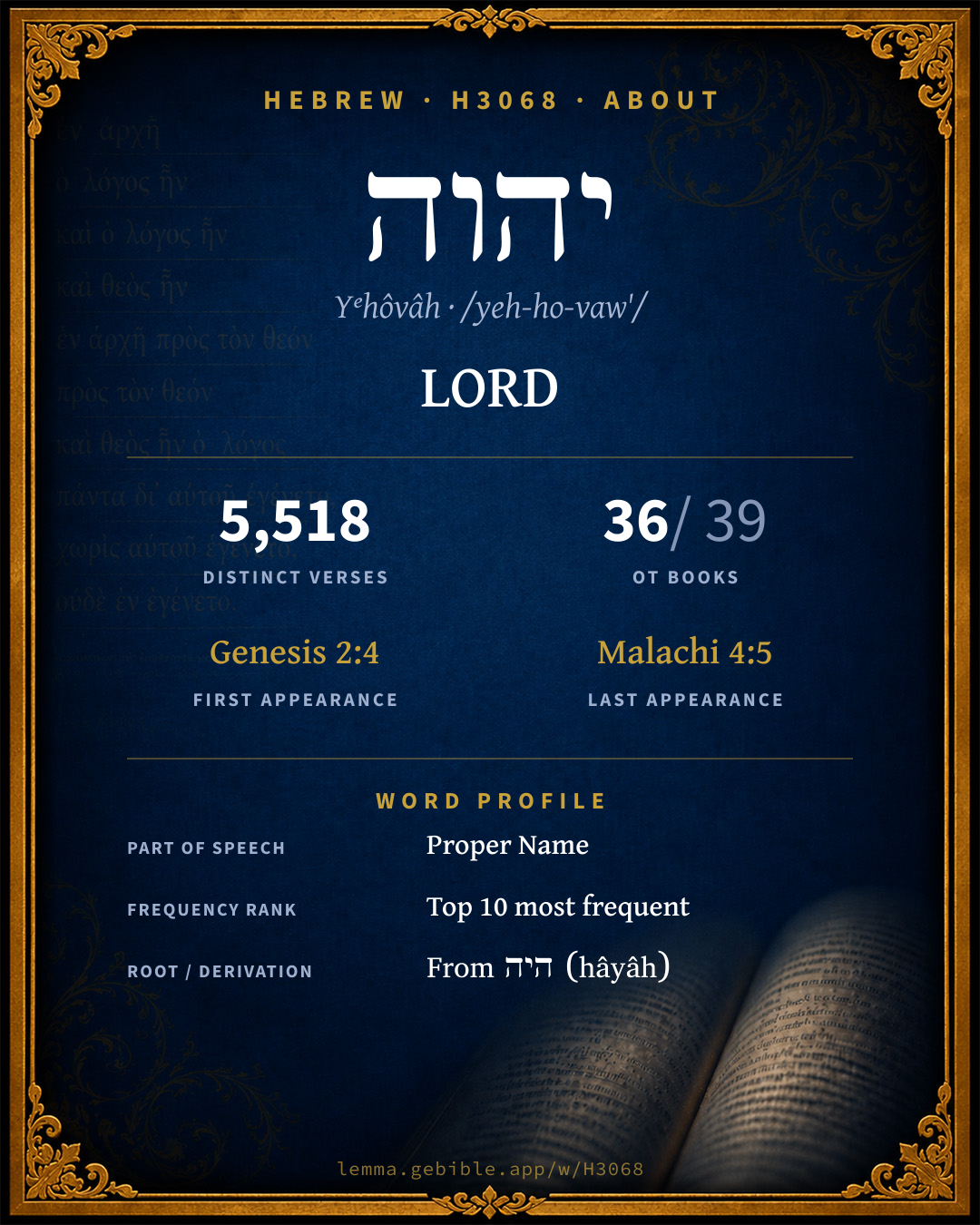
יהוה
LORD
‘LORD’ is one of 2 main senses fuller range ↓
Full lexicon entry — Brown-Driver-Briggs (BDB)
From Brown-Driver-Briggs (BDB)
Where this word appears
Grammar key — what these labels mean
Part of speech
- Noun
- A naming word — a person, place, thing, or idea.
Noun type
- Proper
- A name of a specific person, place, or people (e.g. Abraham, Zion, Israel).
Page 2 of 2 — showing verses 201–281 of 281 distinct verses where H3068 appears in the Book of Leviticus. Click any verse to open its interlinear word-by-word view. Verse text shown in the World English Bible for context — . Each verse’s Hebrew form is shown with its reference; the English is not keyword-highlighted, since the data carries no word-level English alignment. Use “Compare translations” on any verse to read it across multiple English versions. This concordance covers the Hebrew Bible; Septuagint (Greek Old Testament) occurrences are not indexed here.
Leviticus
- Leviticus 22:17 יְהוָ֖ה n Proper Yahweh spoke to Moses, saying,
- Leviticus 22:18 לַ/יהוָ֖ה prep + n Proper "Speak to Aaron, and to his sons, and to all the children of Israel, and say to them, 'Whoever is of the house of Israel, or of the foreigners in Israel, who offers his offering, whether it be any of their vows, or any of their freewill offerings, which they offer to Yahweh for a burnt offering;
- Leviticus 22:21 לַ/יהוָ֔ה prep + n Proper Whoever offers a sacrifice of peace offerings to Yahweh to accomplish a vow, or for a freewill offering, of the herd or of the flock, it shall be perfect to be accepted; there shall be no blemish therein.
- Leviticus 22:22 לַ/יהוָ֑ה לַ/יהוָֽה prep + n Proper prep + n Proper Blind, injured, maimed, having a wart, festering, or having a running sore, you shall not offer these to Yahweh, nor make an offering by fire of them on the altar to Yahweh.
- Leviticus 22:24 לַֽ/יהוָ֑ה prep + n Proper That which has its testicles bruised, crushed, broken, or cut, you shall not offer to Yahweh; neither shall you do thus in your land.
- Leviticus 22:26 יְהוָ֖ה n Proper Yahweh spoke to Moses, saying,
- Leviticus 22:27 לַ/יהוָֽה prep + n Proper "When a bull, or a sheep, or a goat, is born, then it shall remain seven days with its mother; and from the eighth day and thenceforth it shall be accepted for the offering of an offering made by fire to Yahweh.
- Leviticus 22:29 לַ/יהוָ֑ה prep + n Proper "When you sacrifice a sacrifice of thanksgiving to Yahweh, you shall sacrifice it so that you may be accepted.
- Leviticus 22:30 יְהוָֽה n Proper It shall be eaten on the same day; you shall leave none of it until the morning. I am Yahweh.
- Leviticus 22:31 יְהוָֽה n Proper "Therefore you shall keep my commandments, and do them. I am Yahweh.
- Leviticus 22:32 יְהוָ֖ה n Proper You shall not profane my holy name, but I will be made holy among the children of Israel. I am Yahweh who makes you holy,
- Leviticus 22:33 יְהוָֽה n Proper who brought you out of the land of Egypt, to be your God. I am Yahweh."
- Leviticus 23:1 יְהוָ֖ה n Proper Yahweh spoke to Moses, saying,
- Leviticus 23:2 יְהוָ֔ה n Proper "Speak to the children of Israel, and tell them, 'The set feasts of Yahweh, which you shall proclaim to be holy convocations, even these are my set feasts.
- Leviticus 23:3 לַֽ/יהוָ֔ה prep + n Proper "'Six days shall work be done: but on the seventh day is a Sabbath of solemn rest, a holy convocation; you shall do no manner of work. It is a Sabbath to Yahweh in all your dwellings.
- Leviticus 23:4 יְהוָ֔ה n Proper "'These are the set feasts of Yahweh, even holy convocations, which you shall proclaim in their appointed season.
- Leviticus 23:5 לַ/יהוָֽה prep + n Proper In the first month, on the fourteenth day of the month in the evening, is Yahweh's Passover.
- Leviticus 23:6 לַ/יהוָ֑ה prep + n Proper On the fifteenth day of the same month is the feast of unleavened bread to Yahweh. Seven days you shall eat unleavened bread.
- Leviticus 23:8 לַ/יהוָ֖ה prep + n Proper But you shall offer an offering made by fire to Yahweh seven days. In the seventh day is a holy convocation: you shall do no regular work.'"
- Leviticus 23:9 יְהוָ֖ה n Proper Yahweh spoke to Moses, saying,
- Leviticus 23:11 יְהוָ֖ה n Proper and he shall wave the sheaf before Yahweh, to be accepted for you. On the next day after the Sabbath the priest shall wave it.
- Leviticus 23:12 לַ/יהוָֽה prep + n Proper On the day when you wave the sheaf, you shall offer a male lamb without blemish a year old for a burnt offering to Yahweh.
- Leviticus 23:13 לַ/יהוָ֖ה prep + n Proper The meal offering with it shall be two tenth parts of an ephah of fine flour mingled with oil, an offering made by fire to Yahweh for a sweet savor; and the drink offering with it shall be of wine, the fourth part of a hin.
- Leviticus 23:16 לַ/יהוָֽה prep + n Proper even to the next day after the seventh Sabbath you shall number fifty days; and you shall offer a new meal offering to Yahweh.
- Leviticus 23:17 לַֽ/יהוָֽה prep + n Proper You shall bring out of your habitations two wave-loaves of two tenth parts of an ephah: they shall be of fine flour, they shall be baked with yeast, for first fruits to Yahweh.
- Leviticus 23:18 לַֽ/יהוָ֔ה לַ/יהוָֽה prep + n Proper prep + n Proper You shall present with the bread seven lambs without blemish a year old, one young bull, and two rams. Yhey shall be a burnt offering to Yahweh, with their meal offering, and their drink offerings, even an offering made by fire, of a sweet aroma to Yahweh.
- Leviticus 23:20 יְהוָ֔ה לַ/יהוָ֖ה n Proper prep + n Proper The priest shall wave them with the bread of the first fruits for a wave offering before Yahweh, with the two lambs. They shall be holy to Yahweh for the priest.
- Leviticus 23:22 יְהוָ֥ה n Proper "'When you reap the harvest of your land, you shall not wholly reap into the corners of your field, neither shall you gather the gleanings of your harvest: you shall leave them for the poor, and for the foreigner. I am Yahweh your God.'"
- Leviticus 23:23 יְהוָ֖ה n Proper Yahweh spoke to Moses, saying,
- Leviticus 23:25 לַ/יהוָֽה prep + n Proper You shall do no regular work; and you shall offer an offering made by fire to Yahweh.'"
- Leviticus 23:26 יְהוָ֖ה n Proper Yahweh spoke to Moses, saying,
- Leviticus 23:27 לַ/יהוָֽה prep + n Proper "However on the tenth day of this seventh month is the day of atonement: it shall be a holy convocation to you, and you shall afflict yourselves; and you shall offer an offering made by fire to Yahweh.
- Leviticus 23:28 יְהוָ֥ה n Proper You shall do no manner of work in that same day; for it is a day of atonement, to make atonement for you before Yahweh your God.
- Leviticus 23:33 יְהוָ֖ה n Proper Yahweh spoke to Moses, saying,
- Leviticus 23:34 לַ/יהֹוָֽה prep + n Proper "Speak to the children of Israel, and say, 'On the fifteenth day of this seventh month is the feast of tents for seven days to Yahweh.
- Leviticus 23:36 לַ/יהוָ֑ה לַֽ/יהוָה֙ prep + n Proper prep + n Proper Seven days you shall offer an offering made by fire to Yahweh. On the eighth day shall be a holy convocation to you; and you shall offer an offering made by fire to Yahweh. It is a solemn assembly; you shall do no regular work.
- Leviticus 23:37 יְהוָ֔ה לַ/יהוָ֗ה n Proper prep + n Proper "'These are the appointed feasts of Yahweh, which you shall proclaim to be holy convocations, to offer an offering made by fire to Yahweh, a burnt offering, and a meal offering, a sacrifice, and drink offerings, each on its own day;
- Leviticus 23:38 יְּהוָ֑ה לַ/יהוָֽה n Proper prep + n Proper besides the Sabbaths of Yahweh, and besides your gifts, and besides all your vows, and besides all your freewill offerings, which you give to Yahweh.
- Leviticus 23:39 יְהוָ֖ה n Proper "'So on the fifteenth day of the seventh month, when you have gathered in the fruits of the land, you shall keep the feast of Yahweh seven days: on the first day shall be a solemn rest, and on the eighth day shall be a solemn rest.
- Leviticus 23:40 יְהוָ֥ה n Proper You shall take on the first day the fruit of goodly trees, branches of palm trees, and boughs of thick trees, and willows of the brook; and you shall rejoice before Yahweh your God seven days.
- Leviticus 23:41 לַֽ/יהוָ֔ה prep + n Proper You shall keep it a feast to Yahweh seven days in the year: it is a statute forever throughout your generations; you shall keep it in the seventh month.
- Leviticus 23:43 יְהוָ֥ה n Proper that your generations may know that I made the children of Israel to dwell in booths, when I brought them out of the land of Egypt. I am Yahweh your God.'"
- Leviticus 23:44 יְהוָ֑ה n Proper Moses declared to the children of Israel the appointed feasts of Yahweh.
- Leviticus 24:1 יְהוָ֖ה n Proper Yahweh spoke to Moses, saying,
- Leviticus 24:3 יְהוָ֖ה n Proper Outside of the veil of the Testimony, in the Tent of Meeting, shall Aaron keep it in order from evening to morning before Yahweh continually: it shall be a statute forever throughout your generations.
- Leviticus 24:4 יְהוָ֖ה n Proper He shall keep in order the lamps on the pure gold lampstand before Yahweh continually.
- Leviticus 24:6 יְהוָֽה n Proper You shall set them in two rows, six on a row, on the pure gold table before Yahweh.
- Leviticus 24:7 לַֽ/יהוָֽה prep + n Proper You shall put pure frankincense on each row, that it may be to the bread for a memorial, even an offering made by fire to Yahweh.
- Leviticus 24:8 יְהוָ֖ה n Proper Every Sabbath day he shall set it in order before Yahweh continually. It is on the behalf of the children of Israel an everlasting covenant.
- Leviticus 24:9 יְהוָ֖ה n Proper It shall be for Aaron and his sons; and they shall eat it in a holy place: for it is most holy to him of the offerings of Yahweh made by fire by a perpetual statute."
- Leviticus 24:12 יְהוָֽה n Proper They put him in custody, until the will of Yahweh should be declared to them.
- Leviticus 24:13 יְהוָ֖ה n Proper Yahweh spoke to Moses, saying,
- Leviticus 24:16 יְהוָה֙ n Proper He who blasphemes the name of Yahweh, he shall surely be put to death; all the congregation shall certainly stone him: the foreigner as well as the native-born, when he blasphemes the Name, shall be put to death.
- Leviticus 24:22 יְהוָ֖ה n Proper You shall have one kind of law, for the foreigner as well as the native-born: for I am Yahweh your God.'"
- Leviticus 24:23 יְהוָ֖ה n Proper Moses spoke to the children of Israel; and they brought forth him who had cursed out of the camp, and stoned him with stones. The children of Israel did as Yahweh commanded Moses.
- Leviticus 25:1 יְהוָה֙ n Proper Yahweh said to Moses in Mount Sinai,
- Leviticus 25:2 לַ/יהוָֽה prep + n Proper "Speak to the children of Israel, and tell them, 'When you come into the land which I give you, then the land shall keep a Sabbath to Yahweh.
- Leviticus 25:4 לַ/יהוָ֑ה prep + n Proper but in the seventh year there shall be a Sabbath of solemn rest for the land, a Sabbath to Yahweh. You shall not sow your field or prune your vineyard.
- Leviticus 25:17 יְהֹוָ֖ה n Proper You shall not wrong one another; but you shall fear your God: for I am Yahweh your God.
- Leviticus 25:38 יְהוָה֙ n Proper I am Yahweh your God, who brought you forth out of the land of Egypt, to give you the land of Canaan, and to be your God.
- Leviticus 25:55 יְהוָ֥ה n Proper For to me the children of Israel are servants; they are my servants whom I brought forth out of the land of Egypt. I am Yahweh your God.
- Leviticus 26:1 יְהוָ֖ה n Proper "'You shall make for yourselves no idols, neither shall you raise up an engraved image or a pillar, neither shall you place any figured stone in your land, to bow down to it: for I am Yahweh your God.
- Leviticus 26:2 יְהוָֽה n Proper "'You shall keep my Sabbaths, and have reverence for my sanctuary. I am Yahweh.
- Leviticus 26:13 יְהוָ֣ה n Proper I am Yahweh your God, who brought you forth out of the land of Egypt, that you should not be their slaves; and I have broken the bars of your yoke, and made you go upright.
- Leviticus 26:44 יְהוָ֖ה n Proper Yet for all that, when they are in the land of their enemies, I will not reject them, neither will I abhor them, to destroy them utterly, and to break my covenant with them; for I am Yahweh their God;
- Leviticus 26:45 יְהוָֽה n Proper but I will for their sake remember the covenant of their ancestors, whom I brought forth out of the land of Egypt in the sight of the nations, that I might be their God. I am Yahweh.'"
- Leviticus 26:46 יְהוָ֔ה n Proper These are the statutes, ordinances and laws, which Yahweh made between him and the children of Israel in Mount Sinai by Moses.
- Leviticus 27:1 יְהוָ֖ה n Proper Yahweh spoke to Moses, saying,
- Leviticus 27:2 לַֽ/יהוָֽה prep + n Proper "Speak to the children of Israel, and say to them, 'When a man makes a vow, the persons shall be for Yahweh by your valuation.
- Leviticus 27:9 לַֽ/יהוָ֑ה לַ/יהוָ֖ה prep + n Proper prep + n Proper "'If it is an animal, of which men offer an offering to Yahweh, all that any man gives of such to Yahweh becomes holy.
- Leviticus 27:11 לַֽ/יהוָ֑ה prep + n Proper If it is any unclean animal, of which they do not offer as an offering to Yahweh, then he shall set the animal before the priest;
- Leviticus 27:14 לַֽ/יהוָ֔ה prep + n Proper "'When a man dedicates his house to be holy to Yahweh, then the priest shall evaluate it, whether it is good or bad: as the priest shall evaluate it, so shall it stand.
- Leviticus 27:16 לַֽ/יהוָ֔ה prep + n Proper "'If a man dedicates to Yahweh part of the field of his possession, then your valuation shall be according to the seed for it: the sowing of a homer of barley shall be valued at fifty shekels of silver.
- Leviticus 27:21 לַֽ/יהוָ֖ה prep + n Proper but the field, when it goes out in the Jubilee, shall be holy to Yahweh, as a field devoted; it shall be owned by the priests.
- Leviticus 27:22 לַֽ/יהוָֽה prep + n Proper "'If he dedicates to Yahweh a field which he has bought, which is not of the field of his possession,
- Leviticus 27:23 לַ/יהוָֽה prep + n Proper then the priest shall reckon to him the worth of your valuation up to the Year of Jubilee; and he shall give your valuation on that day, as a holy thing to Yahweh.
- Leviticus 27:26 לַֽ/יהוָה֙ לַֽ/יהוָ֖ה prep + n Proper prep + n Proper "'Only the firstborn among animals, which is made a firstborn to Yahweh, no man may dedicate it; whether an ox or sheep, it is Yahweh's.
- Leviticus 27:28 לַֽ/יהוָ֜ה לַ/יהוָֽה prep + n Proper prep + n Proper "'Notwithstanding, no devoted thing, that a man shall devote to Yahweh of all that he has, whether of man or animal, or of the field of his possession, shall be sold or redeemed: every devoted thing is most holy to Yahweh.
- Leviticus 27:30 לַ/יהוָ֖ה לַֽ/יהוָֽה prep + n Proper prep + n Proper "'All the tithe of the land, whether of the seed of the land or of the fruit of the trees, is Yahweh's. It is holy to Yahweh.
- Leviticus 27:32 לַֽ/יהוָֽה prep + n Proper All the tithe of the herds or the flocks, whatever passes under the rod, the tenth shall be holy to Yahweh.
- Leviticus 27:34 יְהוָ֛ה n Proper These are the commandments which Yahweh commanded Moses for the children of Israel on Mount Sinai.
About this entry
At a glance — auto-summarized from this page’s data, not written by a person. Every figure links to its source below. This summary describes the numbers; it doesn’t interpret them.
יהוה (Yᵉhôvâh) is a Hebrew name most often rendered “LORD.” Scripture first uses it in Genesis 2:4. Spanning 5,518 verses in 36 books, it ranks among the most common words of the Hebrew Bible. The sections below give every occurrence and version rendering.
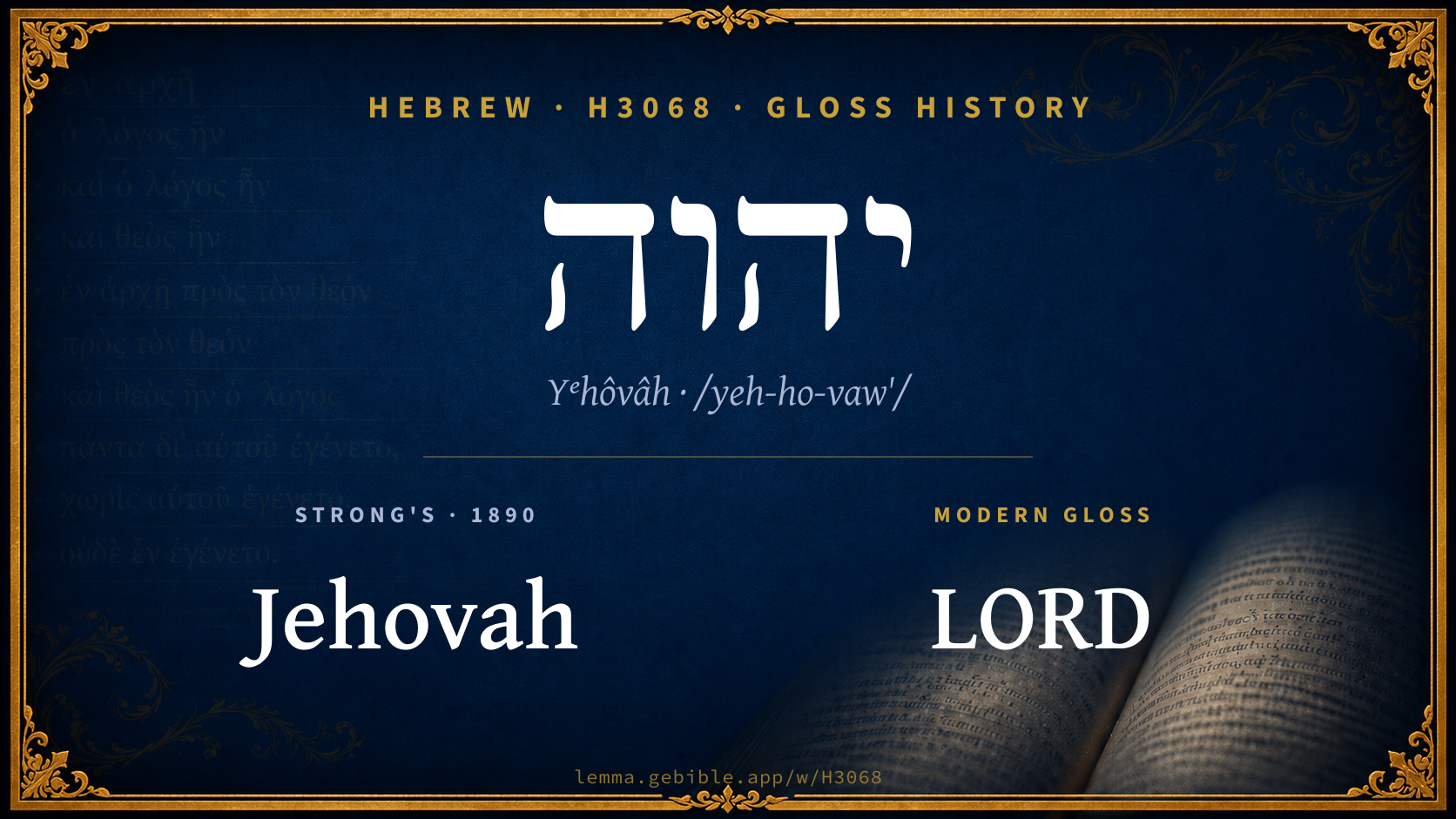
Gloss history
Strong's 1890 vs modern scholarship
About this word
Strong's H3068 catalogs a Hebrew word from the Hebrew Old Testament.
These counts are not copied from any lexicon or concordance. They are computed here, from the morphology-tagged Hebrew Old Testament. What Lemma adds →
- 5,518
- distinct verses
- The word appears in 5,518 distinct verses.
- 36 / 39
- OT books
- The word appears in 36 of 39 Old Testament books.
- #2
- by frequency
- Top 10 most frequent Hebrew words (rank 2 of 8,640 Hebrew words by occurrence).
View all 5,518 occurrences in the concordance →
Most concentrated in
- Psalms 624 verses 11%
- Jeremiah 614 verses 11%
- Deuteronomy 438 verses 8%
By section of the Old Testament
By traditional corpus
Conventional, traditional groupings — biblical authorship is debated, so this is a traditional corpus grouping, not an authorship claim. Each share is this word’s portion of its verses in that division of the Hebrew canon. Each figure is a share of the word’s 5,518 distinct verses.
- Prophets (Nevi'im) 2,686 verses · 49%
- Torah (Pentateuch) 1,550 verses · 28%
- Writings (Ketuvim) 1,282 verses · 23%
How translations render this word
Counts come from each version’s own published word-to-Strong’s tagging or interlinear alignment — an approximate guide to how each version renders this word, not a word-level alignment the data otherwise carries. Because each total is that version’s own tagged count, the per-version totals vary from one another and need not match the appearance or distinct-verse counts above. These counts may also differ from a printed concordance because Lemma counts each distinctly tagged rendering and does not collapse phrase taggings into a single head-word total. This is a fixed set of word-tagged versions (KJV, ASV, BSB, ULT) and does not change with the reading translation you choose elsewhere. Each version’s license is shown beside its name below (and on Sources).
BDB lists this Strong’s number as 2 distinct words (homographs). Each count above pools all of them and is not split by sense — see the Senses section below. A low-frequency rendering may belong to a different one of those words, not the primary meaning.
- King James Version†: Lord 5,517×, I am the lord 145×, Lord's 73×
- American Standard Version†: Jehovah 5,068×, Saith jehovah 131×, I am jehovah 115×
- Berean Standard Bible†: Lord 5,806×, Am the lord 156×, Lord’s 110×
- unfoldingWord Literal Text†: Yahweh 5,807×, Yahweh of 117×, Am yahweh 82×
King James Version Public Domain
Renders H3068 across 6,518† tagged occurrences — most commonly:
Plus other, less common renderings. Plus 231 renderings that appear only once — usually multi-word phrases or single function words the recovered tagging swept in, not distinct renderings. Not rendered by a distinct English word in 1 further occurrence.
American Standard Version Public Domain
Renders H3068 across 6,514† tagged occurrences — most commonly:
Plus other, less common renderings. Plus 398 renderings that appear only once — usually multi-word phrases or single function words the recovered tagging swept in, not distinct renderings.
Berean Standard Bible Public Domain
Renders H3068 across 6,460† tagged occurrences — most commonly:
Plus other, less common renderings. Plus 49 renderings that appear only once — usually multi-word phrases or single function words the recovered tagging swept in, not distinct renderings. Not rendered by a distinct English word in 62 further occurrences.
unfoldingWord Literal Text CC BY-SA 4.0
Renders H3068 across 6,226† tagged occurrences — most commonly:
Plus other, less common renderings. Plus 35 renderings that appear only once — usually multi-word phrases or single function words the recovered tagging swept in, not distinct renderings.
17 senses and sub-senses in the full BDB
What do BDB’s symbols mean?
BDB uses these scholarly abbreviations:
| Symbol | Meaning |
|---|---|
| 𝔊 | the Septuagint (the ancient Greek translation, LXX) |
| 𝔙 | the Vulgate (the Latin translation) |
| 𝔖 | the Syriac version (the Peshitta) |
| 𝔗 | the Targum (the Aramaic translation) |
| ψ | the Psalms |
| √ | root (the underlying root or stem) |
| ‖ | parallel passage (a synonymous or contrasted parallel) |
| † | the dagger: every passage where the word occurs is cited |
The 17 senses and sub-senses the full Brown-Driver-Briggs lexicon distinguishes for this word, in lexicon order (not ranked by frequency), with BDB’s own verbatim wording and sub-sense lettering. Shown in Hebrew script with BDB’s own scholarly abbreviations. The condensed entry is in the Lexicon Entry tab. See also the Forms in the corpus table below.
יהוה I 6823 i.e. יַהְוֶה n.pr.dei Yahweh, the proper name of the God of Israel
- I. יהוה is not used by E in Gn, but is given Ex 3:12–15 as the name of the God who revealed Himself to Moses at Horeb, and is explained thus: אֶהְיֶה עִמָּ֑ךְ I shall be with thee (v 12), which is then implied in אֶהְיֶה אֲשֶׁר אֶהְיֶה I shall be the one who will be it v 14a (i.e. with thee v 12) and then compressed into אֶהְיֶה v 14b (i.e. with thee v 12), which then is given in the nominal form יהוה He who will be it v 15 (i.e. with thee v 12). Cf. EwBTh ii. 337, 338 RSl. c., Proph. 385 ff. Other interpretations are: I am he who I am, i.e. it is no concern of yours (Le Clerc LagPsalt. Hieron. 156); I am, (this is my name), inasmuch as I am (אֲשֶׁר = כִּי; AE JDMich WeJD Th xxi, 540 = Comp. Hex. 72); Di al. I am who I am, he who is essentially unnameable, inexplicable.—E uses יהוה sparingly by the side of אלהים and האלהים in his subsequent narrative. The Ephraimitic writers in Ju S K use it in similar proportions. P abstains from the use of יהוה until he gives an account of its revelation to Moses Ex 6:3; but subsequently uses it freely. He gives no explanation of its meaning. He represents that אֵל שַׁדַּי was the God of the patriarchs. J uses יהוה from the beginning of his narrative, possibly explaining it, Gn 21:33 by אל עולם, the evergreen tamarisk being a symbol of the ever-living God; cf. De Gn 21:33. Elsewhere יהוה is the common divine name in pre-exilic writers, but in post-exilic writers gradually falls into disuse, and is supplanted by אלהים and אדני. In Job it is used 31 times in prose parts, and 12:9 (a proverb); not elsewhere in the poem. Chr apart from his sources prefers אלהים and האלהים. Dn uses יהוה only in chap. 9 (7 times); Ec not at all. In the Elohistic group of ψ 42–83 it is used 39 times (see אלהים). It occurs as the name of Israel’s God MI 18. It is doubtful whether it was used by other branches of the Shemitic family, cf. COT Gn 2:4b DlPa 158 ff. DrStud. Bib. i. 7 ff. e.g. Exodus 3:12
- II.
- 1. יהוה is used with אלהים with or without suffs., especially in D;
- a. with אֱלֹהֶיךָ in the Ten Words Ex 20:2–12 (5 times) = Dt 5:6–16; in the law of worship of JE, Ex 23:19; 34:24, 26; in D 234 times; Jos 1:9, 17; 9:9, 24 (D2); elsewhere Gn 27:20 Ex 15:26 (JE), Ju 6:26; S & K 20 times 1 Ch 11:2; 22:11, 12 2 Ch 9:8(×2); 16:7; Is 7:11; 37:4(×2); 41:13; 43:3; 51:15; 55:5; Je 40:2 + (3 times) Ho 12:10; 13:4; 14:2; Am 9:15; ψ 81:11. e.g. Exodus 20:12
- b. with אֱלֹהֵיכֶם in D 46 times; D2 28 times; H 15 times; P 15 times; elsewhere Ex 23:25 (E); 8:24; 10:8, 16, 17 (JE); Ju 6:10; 1 S 12:12, 14; 2 K 17:39; 23:21; 1 Ch 22:18 + (10 times Chr) ψ 76:12; Je 13:16; + (5 times) Ez 20:5, 7, 19, 20; Jo 2:13 + (6 times) Zc 6:15. e.g. Exodus 23:25
- c. with אֱלֹהֵינוּ in D 23 times; in D2 5 times; Ex 8:6 (JE) Ex 3:18; 5:3; 8:22, 23; 10:25, 26 (E) Ju 11:24; 1 S 7:8; 1 K 8:57, 59, 61, 65 2 K 18:22; 19:19 = Is 36:7; 37:20, 1 Ch 13:2 + (15 times Chr) Mi 4:5; 7:17; Is 26:13; Je 3:22 + (17 times) ψ 20:8; 90:17 (?; Baer אֲדֹנָי) 94:23; 99:5, 8, 9(×2); 105:7; 106:47; 113:5; 122:9; 123:2 Dn 9:10, 13, 14. e.g. Exodus 8:6
- d. c. אֱלֹהֵיהֶם Ex 10:7 (J) Ex 29:46(×2) Lv 26:44 (P) Ju 3:7; 8:34; 1 S 12:9; 1 K 9:9; 2 K 17:7, 9, 14, 16, 19; 18:12 2 Ch 31:6; 33:17; 34:33; Ne 9:3(×2), 4; Je 3:21; 22:9; 30:9; 43:1(×2) 50:4; Ez 28:26; 34:30; 39:22, 28 Ho 1:7; 3:5; 7:10; Zp 2:7; Hag 1:12(×2) Zc 9:16; 10:6. e.g. Exodus 10:7
- e. with אֱלֹהָיו Nu 23:21 (E) Ex 32:11 (J) Lv 4:22 (P) Dt 17:19; 18:7; 1 S 30:6; 1 K 5:17; 11:4; 15:3, 4; 2 K 5:11; 16:2; 2 Ch 1:1; + 13 times Chr; Mi 5:3; Je 7:28; ψ 33:12; 144:15; 146:5; Jon 2:2. e.g. Numbers 23:21
- f. with אֱלֹהַי Nu 22:18 (JE) Dt 4:5; 18:16; 26:14; Jos 14:8, 9; 2 S 24:24; 1 K 3:7; 5:18, 19; 8:28; 17:20, 21; 1 Ch 21:17; 22:7; 2 Ch 2:3; 6:19; Ezr 7:28; 9:5; ψ 7:2, 4; 13:4; 18:29; 30:3, 13; 35:24; 40:6; 104:1; 109:26; Is 25:1; Je 31:18; Dn 9:4, 20; Jon 2:7; Hab 1:12; Zc 11:4; 13:9; 14:5. e.g. Numbers 22:18
- g. with אֱלֹהַיִךְ Is 60:9 Je 2:17, 19; 3:13; Mi 7:10; Zp 3:17. e.g. Isaiah 60:9
- h. with אלהים, probably always due to later editors, or to a Qr which has crept into the text Gn 2:4b—3:23 (J, 20 times either אלהים inserted by RP as Di De; or יהוה inserted by J in an older source); Ex 9:30 (J, but not in 𝔊 Sam.; Sam. אדני יהוה; possibly MT from earlier Qr, & Sam. from later Qr); 2 S 7:22, 25 (𝔊 אדני יהוה and 1 Ch 17:20–23 only יהוה); 1 Ch 17:16, 17 (but 2 S 7:18, 19 אדני יהוה) 1 Ch 28:20; 29:1; 2 Ch 1:9; 6:41(×2), 42; 26:18 (but in the original ψ 132:8 stood יהוה (so ℌ), or else no divine name); ψ 72:18 (the late doxology) 84:12 (but it makes the line too long); Jon 4:6. For the combinations with other divine names see those names. e.g. Exodus 9:30
- 2. the phrase †אֲנִי יהוה is noteworthy:—
- a. after אמר either alone Ex 6:2, 29 (P) or before relative and other clauses: Gn 28:13 (J) 15:7 (R) Ex 6:6 (P) with אלהיכם Ju 6:10; Ez 20:5. e.g. Exodus 6:2
- b. after ידע כי (α) Ex 7:17; 8:18; 10:2 (J); Ex 7:5; 14:4, 18 (P); 1 K 20:13, 28; Je 24:7 Ez 6:7 + 4:8 times Ez; (β) with אלהיכם Ex 6:7; 16:12; Dt 29:5 (P) Ez 20:20; Jo 4:17; (γ) with אלהיהם Ex 29:46 (P) Ez 28:26; 34:30; 39:22, 28; (δ) before relative and other clauses Is 45:3; 49:23, 26; 60:16 Ez 7:9; 17:24; 21:10; 22:22; 35:12; 36:36; (ε) with various forms of קדשׁ Ex 31:13 (P) Ez 20:12; 37:28; 39:7; (ζ) with דברתי Ez 5:13; 17:21, cf. יֵדְעוּ אשׁר אני י׳ Ez 20:26. e.g. Exodus 7:17
- c. after כִּי in various combinations Lv 11:44, 45; Nu 35:34 (P), Lv 20:7, 26; 21:8, 15, 23; 22:16; 24:22; 25:17; 26:1, 44 (all H); Ex 15:26 (R) Is 41:13; 43:3; 61:8; Je 9:23; Ez 12:25; 21:4 Zc 10:6; Mal 3:6. e.g. Leviticus 11:44
- d. emphatic Ex 6:8; 12:12 Lv 26:2, 45; Nu 3:13, 41, 45 (all P); Lv 18:5, 6, 21; 19:12, 14, 16, 18, 28, 30, 32, 37; 21:12; 22:2, 3, 8, 30, 31, 33 (all H) Is 43:15; with אלהיהם Ex 29:46; with אלהיךָ Is 48:17; with אלהיכם Lv 23:43; 25:38, 55; Nu 10:10; 15:41(×2) (P) Lv 18:2, 4, 30; 19:2, 3, 4, 10, 25, 31, 34, 36; 20:24; 23:22; 26:13 (all H) Ez 20:7, 19 Jo 2:27; with מְקַדֵּשׁ Lv 20:8; 22:9, 32 (H), with דברתי Nu 14:35 (P) Ez 5:15 + (11 times Ez); with clauses Is 27:3; 41:4, 17; 42:6, 8; 45:5, 6, 7, 8, 18, 19, 21; 60:22 Je 17:10; 32:27; Ez 14:4, 7, 9; 34:24; †אָנֹכִי יהוה is used in the Ten Words Ex 20:2, 5 = Dt 5:6, 9 cited ψ 81:11 Ho 12:10; 13:4; elsewhere only Ex 4:11 (J) Is 43:11; 44:24; 51:15. e.g. Exodus 6:8
- 3. יהוה is also used with several predicates, to form sacred names of holy places of Yahweh יהוה יראה Gn 22:14 (J); יהוה נסי Ex 17:15 (E) יהוה שׁלום Ju 6:24 יהוה צדקנו Je 33:16 (cf. 23:6 where it is applied to the Messiah); יהוה שָׁ֑מָּה Ez 48:35.—On combinations such as הַר י׳, י׳ צְבָאוֹת etc., v. הַר, צָבָא, etc. e.g. Genesis 22:14
- 1. יהוה is used with אלהים with or without suffs., especially in D;
- —BonkZAW 1891, 126 ff. seems to shew that as prefix, in comp. n.pr., יְהוֹ is the oldest and the latest form and that יוֹ is intermediate, belonging to the earlier post-exilic period until the time of Chr; occasional copyists’ mistakes being taken into the account.
יהוה II dei, v. sub הוה p. 217 ff.
Senses from the full Brown-Driver-Briggs lexicon (Brown, Driver, Briggs; Oxford 1906 — public domain), digitized via Sefaria, supplemented by the OpenScriptures HebrewLexicon (CC BY 4.0). Full attribution on Sources.
Word origin
I. 6823 i.e. יַהְוֶה n.pr.dei Yahweh, the proper name of the God of Israel—(1. MT יְהוָֹה6518 (Qr אֲדֹנָי), or יֱהוִֹה305 (Qr אֱלֹהִים), in the combinations אדני יהוה & יהוה אדני (vid. אֲדֹנָי), and with prep. בַּיהוָֹה, לַיהוָֹה, מֵיהוָֹה (Qr בַּאדֹנָי, לַאדֹנָי, מֵאדֹנָי), do not give the original form. 𝔊 and other Vrss follow the Qr. On the basis of Ex 20:7; Lv 24:11 יהוה was regarded as a nomen ineffabile (vid. Philo de Vita Mosis iii, 519, 529), called by the Jews הַשֵּׁם and by the Samaritans שׁימא. The pronunciation Jehovah was unknown until 1520, when it was introduced by Galatinus; but it was contested by Le Mercier, J. Drusius, and L. Capellus, as against grammatical and historical propriety (cf. Bö§ 88). The traditional Ἰαβέ of Theodoret and Epiphanius, the ־יָהוּ, יְהוֹ־ of compound n.pr. and the contracted form יָהּ, all favour יַהְוֶה (cf. יַהֲלֹמ֑וּן ψ 74:6; תַּהֲרוּ Is 33:11), v. LagSym. i. 14 BaudissinStudien i. 179 ff.; DrStud. Bib. i. 1 ff. For Jeve v. StaZAW 1881, 346 De ib. 1882, 173 f. & Gn. Excurs. ii. 2. on liter. of interpret. v. NesEg 67 Drl.c..—Many recent scholars explain יַהְוֶה as Hiph. of הוה (= היה) the one bringing into being, life-giver (cf. הַוָּה Gn 3:20) Schr HSch; giver of existence, creator, Kue Tiele; he who brings to pass (so already Le Clerc), performer of his promises, Lag, Nes.Eg 88 (but NesEg. 91 inclines to Qal as RSBrit. & For. Ev. Rev. v. infr.); or from הוה he who causes to fall, rain or lightning RSOTJC ed. 1, 423; om. ed. 2, 245, cf. WeSkizzen iii. 175; ‘Fäller,’ destroying foes, StaG. i. 429 (dubiously). But most take it as Qal of היה (= היה); the one who is: i.e. the absolute and unchangeable one, Ri; the existing, ever-living, as self-consistent and unchangeable, Di; or the one ever coming into manifestation as the God of redemption, De Oehl; cf. also RSBrit. & For. Ev. Rev. 1876, he will be it, i.e. all that his servants look for (cf. Ewinfr.), he will approve himself (give evidence of being, assert his being Drl. c. 17)). theories of non-Heb. or non-Sem. origin. opposed (in their older forms) by BauRel i. 181 ff. (v. especially 230); DlPa 162 ff. claimed Bab. origin for יהו, against this KueNational religions, etc., Note iv (Eng. Trans. 329 ff.) JastrJBL xiii (1894), 103 f. cf. HptBAS i. 170 N; Dl Babel u. Bibel, 46 f., 73 f. makes same claim for יהוה, agst. this v. especially HirschZAW xxiii (1903), 355 ff. ZimKAT 3, 465 ff.; SpiegelbergZMG liii (1899), 633 ff. proposes (improb.) Egyptian etymol. for יהוה; further discussions see in KöEB Names, § 112 and n. 3. ‘Jehovah’ found in Jacob (? Johann.) Wessel († 1480), according to SchwallyThLZ, 1905, col. 612.
II. n.pr.dei, v. sub הוה p. 217 ff.
— Brown-Driver-Briggs (Oxford 1906, public domain), digitized via Sefaria, supplemented by the OpenScriptures HebrewLexicon (CC BY 4.0). See Sources.
Derived from היה (hâyâh) (H1961) — to be.
Forms in the corpus
The 179 distinct written forms H3068 takes in the Hebrew Bible, most frequent first — each parse links to that state’s occurrences in the concordance. Hebrew forms include their vowel points and cantillation, so a single lemma takes many written forms.
| Form | Parsing | Example | Uses |
|---|---|---|---|
| יְהוָ֖ה | Noun, Proper | Amos 5:4 | 870 |
| יְהוָ֔ה | Noun, Proper | Amos 1:3 | 731 |
| יְהוָֽה | Noun, Proper | Amos 1:5 | 598 |
| יְהוָה֙ | Noun, Proper | Amos 1:2 | 568 |
| יְהוָ֑ה | Noun, Proper | Amos 3:10 | 552 |
| יְהוָ֣ה | Noun, Proper | Daniel 9:10 | 484 |
| יְהוָ֥ה | Noun, Proper | Amos 4:13 | 358 |
| יְהוָ֗ה | Noun, Proper | Amos 2:4 | 289 |
| יְהוָ֛ה | Noun, Proper | Amos 3:1 | 252 |
| יְהוָ֤ה | Noun, Proper | Deuteronomy 1:30 | 180 |
| יְהוָ֜ה | Noun, Proper | Amos 5:16 | 172 |
| יְ֭הוָה | Noun, Proper | Proverbs 1:7 | 139 |
| יְהוָ֨ה | Noun, Proper | Deuteronomy 2:7 | 112 |
| לַ/יהוָֽה | Noun, Proper | Exodus 8:8 | 73 |
| יְהוָ֧ה | Noun, Proper | Amos 5:14 | 69 |
| יְ֝הוָ֗ה | Noun, Proper | Proverbs 3:7 | 67 |
| לַ/יהוָ֖ה | Noun, Proper | Deuteronomy 7:6 | 66 |
| לַֽ/יהוָ֔ה | Noun, Proper | Exodus 12:42 | 61 |
| לַ/יהוָ֑ה | Noun, Proper | Exodus 16:25 | 59 |
| יְהוָה֮ | Noun, Proper | Deuteronomy 9:26 | 50 |
| לַ/יהוָ֣ה | Noun, Proper | Deuteronomy 5:14 | 42 |
| לַֽ/יהוָה֙ | Noun, Proper | Exodus 15:21 | 39 |
| לַֽ/יהוָ֑ה | Noun, Proper | Exodus 12:14 | 32 |
| לַֽ/יהוָֽה | Noun, Proper | Deuteronomy 12:11 | 32 |
| יְֽהוָ֗ה | Noun, Proper | Proverbs 3:19 | 28 |
| לַֽ/יהוָ֖ה | Noun, Proper | Deuteronomy 14:1 | 27 |
| יְהוָ֞ה | Noun, Proper | Deuteronomy 1:11 | 25 |
| לַ/יהוָ֔ה | Noun, Proper | Ezra 8:28 | 24 |
| יְהוָה֒ | Noun, Proper | Amos 3:12 | 23 |
| יְהוָ֡ה | Noun, Proper | Deuteronomy 6:22 | 20 |
| בַּֽ/יהוָ֔ה | Noun, Proper | Deuteronomy 33:29 | 18 |
| לַ/יהוָ֥ה | Noun, Proper | Daniel 9:4 | 17 |
| יְ֠הוָה | Noun, Proper | Deuteronomy 1:8 | 14 |
| וַֽ/יהוָה֙ | Noun, Proper | Deuteronomy 17:16 | 13 |
| וַ/יהוָ֖ה | Noun, Proper | Amos 3:6 | 12 |
| וַֽ/יהוָ֖ה | Noun, Proper | Deuteronomy 32:30 | 12 |
| יְהוָ֕ה | Noun, Proper | 1 Chronicles 17:19 | 12 |
| יְהוָה֩ | Noun, Proper | Deuteronomy 9:4 | 12 |
| בַּ/יהוָ֑ה | Noun, Proper | 2 Chronicles 28:22 | 10 |
| יְהֹוָ֖ה | Noun, Proper | Deuteronomy 32:9 | 9 |
| לַ/יהוָה֙ | Noun, Proper | 1 Chronicles 16:34 | 9 |
| לַ֭/יהוָה | Noun, Proper | Psalms 9:11 | 9 |
| בַּ/יהוָ֣ה | Noun, Proper | Habakkuk 3:18 | 8 |
| בַּ/יהוָֽה | Noun, Proper | 2 Chronicles 12:2 | 8 |
| בַּֽ/יהוָ֖ה | Noun, Proper | 1 Chronicles 10:14 | 8 |
| וַ/יהוָ֣ה | Noun, Proper | 1 Samuel 9:17 | 8 |
| לַֽ/יהוָ֗ה | Noun, Proper | Exodus 12:27 | 8 |
| לַֽ֭/יהוָה | Noun, Proper | Psalms 16:2 | 8 |
| יְה֘וָ֤ה | Noun, Proper | Psalms 80:19 | 7 |
| לַ/יהוָ֗ה | Noun, Proper | 1 Chronicles 22:5 | 7 |
| בַּ/יהוָ֖ה | Noun, Proper | Deuteronomy 1:32 | 6 |
| בַּֽ/יהוָ֑ה | Noun, Proper | 1 Samuel 2:1 | 6 |
| יְה֫וָ֥ה | Noun, Proper | Proverbs 30:9 | 6 |
| יְהֹוָ֑ה | Noun, Proper | Jeremiah 5:9 | 6 |
| יְהֹוָ֗ה | Noun, Proper | Exodus 14:8 | 6 |
| לַ֝/יהוָ֗ה | Noun, Proper | Psalms 29:1 | 6 |
| וַֽ/יהוָ֔ה | Noun, Proper | 1 Chronicles 19:13 | 5 |
| וַֽ/יהוָ֗ה | Noun, Proper | Exodus 9:23 | 5 |
| יְ֝הוָה | Noun, Proper | Job 12:9 | 5 |
| לַֽ/יהוָ֥ה | Noun, Proper | Exodus 3:18 | 5 |
The 60 most common forms are shown; 119 rarer forms follow in the full concordance.
Same root — word family
Other BDB entries built from the same root as H3068, grouped by Strong’s listed origin. These share a root / origin per the lexicon — not necessarily a shared meaning. Each links to that word’s own entry.
Derives from
Proper names from this root
People and places named from this root — a name, not an additional meaning of the word.
- הושמע Hôwshâmâʻ H1953 Hoshama
- יה Yâhh H3050 Jah
- יהוא Yêhûwʼ H3058 Jehu
- יהואחז Yᵉhôwʼâchâz H3059 Jehoahaz
- יהואש Yᵉhôwʼâsh H3060 Jehoash
- יהוה Yᵉhôvih H3069 LORD
- יהוה יראה Yᵉhôvâh yirʼeh H3070 Jehovah-jireh
- יהוה נסי Yᵉhôvâh niççîy H3071 Jehovah-nissi
- יהוה צדקנו Yᵉhôvâh tsidqênûw H3072 a sacred name symbolically applied to
- יהוה שלום Yᵉhôvâh shâlôwm H3073 Jehovah-shalom
- יהוה שמה Yᵉhôvâh shâmmâh H3074 Jehovahshammah
- יהוזבד Yᵉhôwzâbâd H3075 Jehozabad
- יהוחנן Yᵉhôwchânân H3076 Jehohanan
- יהוידע Yᵉhôwyâdâʻ H3077 Jehoiada
- יהויכין Yᵉhôwyâkîyn H3078 Jehoiachin
- יהויקים Yᵉhôwyâqîym H3079 Jehoiakim
- יהויריב Yᵉhôwyârîyb H3080 Jehoiarib
- יהונדב Yᵉhôwnâdâb H3082 Jehonadab
- יהונתן Yᵉhôwnâthân H3083 Jonathan
- יהועדה Yᵉhôwʻaddâh H3085 Jehoadah
- יהועדין Yᵉhôwʻaddîyn H3086 Jehoaddan
- יהוצדק Yᵉhôwtsâdâq H3087 Jehozadak
- יהורם Yᵉhôwrâm H3088 Jehoram
- יהושבע Yᵉhôwshebaʻ H3089 Jehosheba
+12 more proper names from this root (not shown).
Compare all same-root words → Showing 4 of 38 — not the complete family. 36 of the same-root words are proper names (people or places). They share a root, not necessarily a meaning.
Bible dictionary
Public-domain dictionary articles matched to this entry by name (LORD). A biblical name can be shared by more than one person or place, so an article may treat several.
Easton's Bible Dictionary · M. G. Easton, 1897
There are various Hebrew and Greek words so rendered.
(1.) Heb. Jehovah, has been rendered in the English Bible LORD, printed in small capitals. This is the proper name of the God of the Hebrews. The form "Jehovah" is retained only in Ex. 6:3; Ps. 83:18; Isa. 12:2; 26:4, both in the Authorized and the Revised Version.
(2.) Heb. adon, means one possessed of absolute control. It denotes a master, as of slaves (Gen. 24:14, 27), or a ruler of his subjects (45:8), or a husband, as lord of his wife (18:12).
The old plural form of this Hebrew word is 'adonai. From a superstitious reverence for the name "Jehovah," the Jews, in reading their Scriptures, whenever that name occurred, always pronounced it 'Adonai.
(3.) Greek kurios, a supreme master, etc. In the LXX. this is invariably used for "Jehovah" and "Adonai."
(4.) Heb. ba'al, a master, as having domination. This word is applied to human relations, as that of husband, to persons skilled in some art or profession, and to heathen deities. "The men of Shechem," literally "the baals of Shechem" (Judg. 9:2, 3). These were the Israelite inhabitants who had reduced the Canaanites to a condition of vassalage (Josh. 16:10; 17:13).
(5.) Heb. seren, applied exclusively to the "lords of the Philistines" (Judg. 3:3). The LXX. render it by satrapies. At this period the Philistines were not, as at a later period (1 Sam. 21:10), under a kingly government. (See Josh. 13:3; 1 Sam. 6:18.) There were five such lordships, viz., Gath, Ashdod, Gaza, Ashkelon, and Ekron.
Smith's Bible Dictionary · William Smith, 1863
[God]
Classic public-domain reference works; full attribution on Sources.
Septuagint verse parallels
Most of the 5,518 Hebrew verses this word occurs in also exist in the Greek Old Testament (Septuagint), so the same passages can be read in Greek by switching the Old Testament edition to the Septuagint.
Read these verses in the Septuagint
- Genesis 2:4
- Exodus 3:2
- Leviticus 1:1
- Numbers 1:1
- Deuteronomy 1:3
- Joshua 1:1
- Judges 1:1
- Ruth 1:6
- 1 Samuel 1:3
- 2 Samuel 1:12
- 1 Kings 1:17
- 2 Kings 1:3
This is a verse-level parallel only — the same verses exist in both the Hebrew and Greek Old Testaments. No word-level Hebrew↔Greek correspondence is claimed: the data carries no such alignment, so no Greek word is shown as this Hebrew word’s translation. Coverage is not total — the Septuagint omits the deuterocanon and renumbers the Psalms, so some Hebrew verses have no direct Greek parallel.