
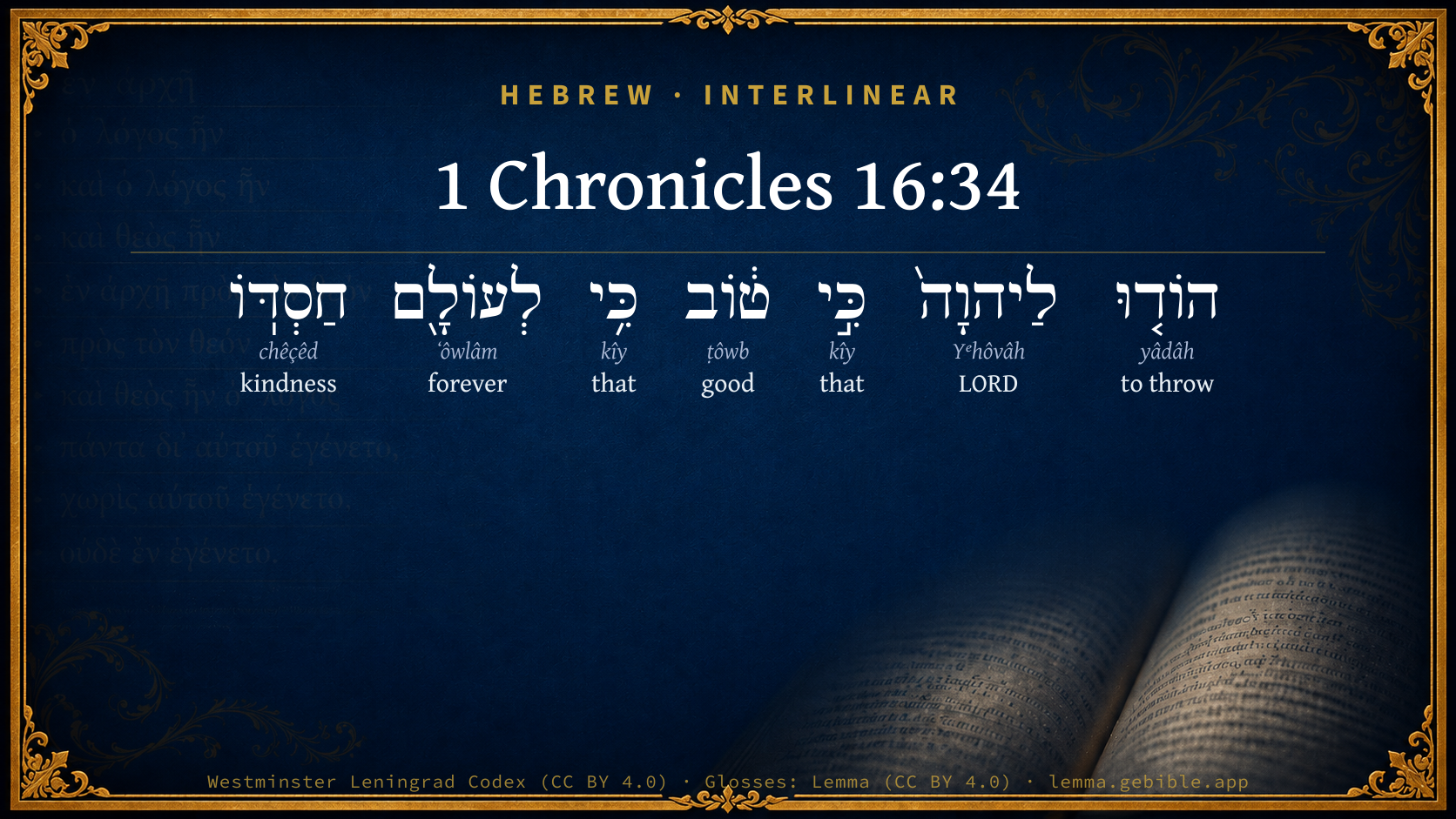
1 Chronicles 16:34

Hebrew (Westminster Leningrad Codex) 1 Chronicles 16:34 appears in the Hebrew Old Testament. The text above is from the Westminster Leningrad Codex. Each word links to its Strong’s number, a concise gloss, and parsing drawn from the Open Scriptures Hebrew Bible morphology. Click any word for its full Brown-Driver-Briggs (BDB) entry.
Download image
Cite this verse

1 Chronicles 16:34 (World English Bible). Public Domain. Lemma interlinear Bible study tool, https://lemma.gebible.app/v/1-chronicles/16/34.

Show BibTeX & RIS
BibTeX
RIS
English Translation
Oh give thanks to Yahweh; for he is good; For his loving kindness endures forever.
World English Bible · Public Domain
Download a study sheet

One document with this verse’s original text, its word-by-word gloss line, the meaning frame, cross-references with their text, attributed commentary, and full source and license credits — printable, and it pastes into notes with its structure intact.

This verse Autodidact and up

Study sheet (.html) Plain text (.txt)

A passage Seminary Student

Up to 50 verses in one chapter. A passage sheet keeps up to 6 commentary sources and 12 cross-references per verse, in the order this page ranks them, and says so on the sheet whenever that leaves anything out. Ask for a single verse and you get the Autodidact verse sheet above.

Everything on this page stays free to read, with no account — the sheet is a download of what is already on screen, not access to it.

Want to remove ads? Support Godless Engineer
Compare translations 3

The same verse in 3 English versions, stacked beneath the original-language interlinear above. Click any original word for its lexicon entry.

Each is an independent rendering of the whole verse — the interlinear is not word-aligned to these translations.

Highlighted words mark where these versions differ — a whole-verse word diff, not a word-by-word alignment.

  • World English Bible Public Domain
    Oh give thanks to Yahweh; for he is good; For his loving kindness endures forever.
  • King James Version Public Domain
    O give thanks unto the LORD; for he is good; for his mercy endureth for ever.
  • unfoldingWord Literal Text CC BY-SA 4.0
    Give thanks to Yahweh, for good, for his covenant faithfulness to forever.

unfoldingWord Literal Text — © unfoldingWord, licensed CC BY-SA 4.0. Word-aligned USFM3 via Door43 (git.door43.org/unfoldingWord/en_ult).

Versions to compare (up to 4)

3 of 4 selected

Show all 18 translations

Every available English version of this verse, each an independent rendering of the whole verse.

  • World English Bible Public Domain
    Oh give thanks to Yahweh; for he is good; For his loving kindness endures forever.
  • Berean Standard Bible Public Domain
    Give thanks to the LORD, for He is good; His loving devotion endures forever.
  • Majority Standard Bible Public Domain
    Give thanks to the LORD, for He is good; His loving devotion endures forever.
  • King James Version Public Domain
    O give thanks unto the LORD; for he is good; for his mercy endureth for ever.
  • American Standard Version (1901) Public Domain
    O give thanks unto Jehovah; for he is good; For his lovingkindness `endureth' for ever.
  • Revised Version (1885) Public Domain
    O give thanks unto the LORD; for he is good: for his mercy endureth for ever.
  • Geneva Bible (1599) Public Domain
    Prayse the Lord, for hee is good, for his mercie endureth for euer.
  • Douay-Rheims (1899) Public Domain
    Give ye glory to the Lord, for he is good: for his mercy endureth for ever.
  • Young's Literal Translation Public Domain
    Give thanks to Jehovah, for good, For to the age, `is' His kindness,
  • Literal Standard Version CC BY-SA 4.0
    Give thanks to YHWH, for [He is] good, || For His kindness [is] for all time,
  • Unlocked Literal Bible CC BY-SA 4.0
    Give thanks to Yahweh, for he is good, for his covenant faithfulness endures forever.
  • unfoldingWord Literal Text CC BY-SA 4.0
    Give thanks to Yahweh, for good, for his covenant faithfulness to forever.
  • Darby Bible Public Domain
    Give thanks unto Jehovah, for he is good; For his loving-kindness [endureth] for ever.
  • World Messianic Bible Public Domain
    Oh give thanks to the LORD, for he is good, for his loving kindness endures forever.
  • Webster's Bible Public Domain
    O give thanks to the LORD; for he is good; for his mercy endureth for ever.
  • Free Bible Version CC BY-SA 4.0
    Say thank you to the Lord, for he is good! His trustworthy love continues forever!
  • Bible in Basic English Public Domain
    O give praise to the Lord, for he is good: for his mercy is unchanging for ever.
  • JPS Tanakh (1917) Public Domain
    O give thanks unto the LORD; for He is good; for His mercy endureth for ever.

Literal Standard Version (2020), Covenant Press — licensed CC BY-SA 4.0. Text via the HelloAO Bible API (eBible.org). Unlocked Literal Bible (unfoldingWord) — licensed CC BY-SA 4.0. Text via the HelloAO Bible API (eBible.org). unfoldingWord Literal Text — © unfoldingWord, licensed CC BY-SA 4.0. Word-aligned USFM3 via Door43 (git.door43.org/unfoldingWord/en_ult). Free Bible Version, Dr. Jonathan Gallagher — licensed CC BY-SA 4.0. Text via the HelloAO Bible API (eBible.org).

Word by word

More ways to search: Search by grammar → Find every occurrence → Compare this word →

Practice this passage: Drill this verse → Learn its vocabulary →

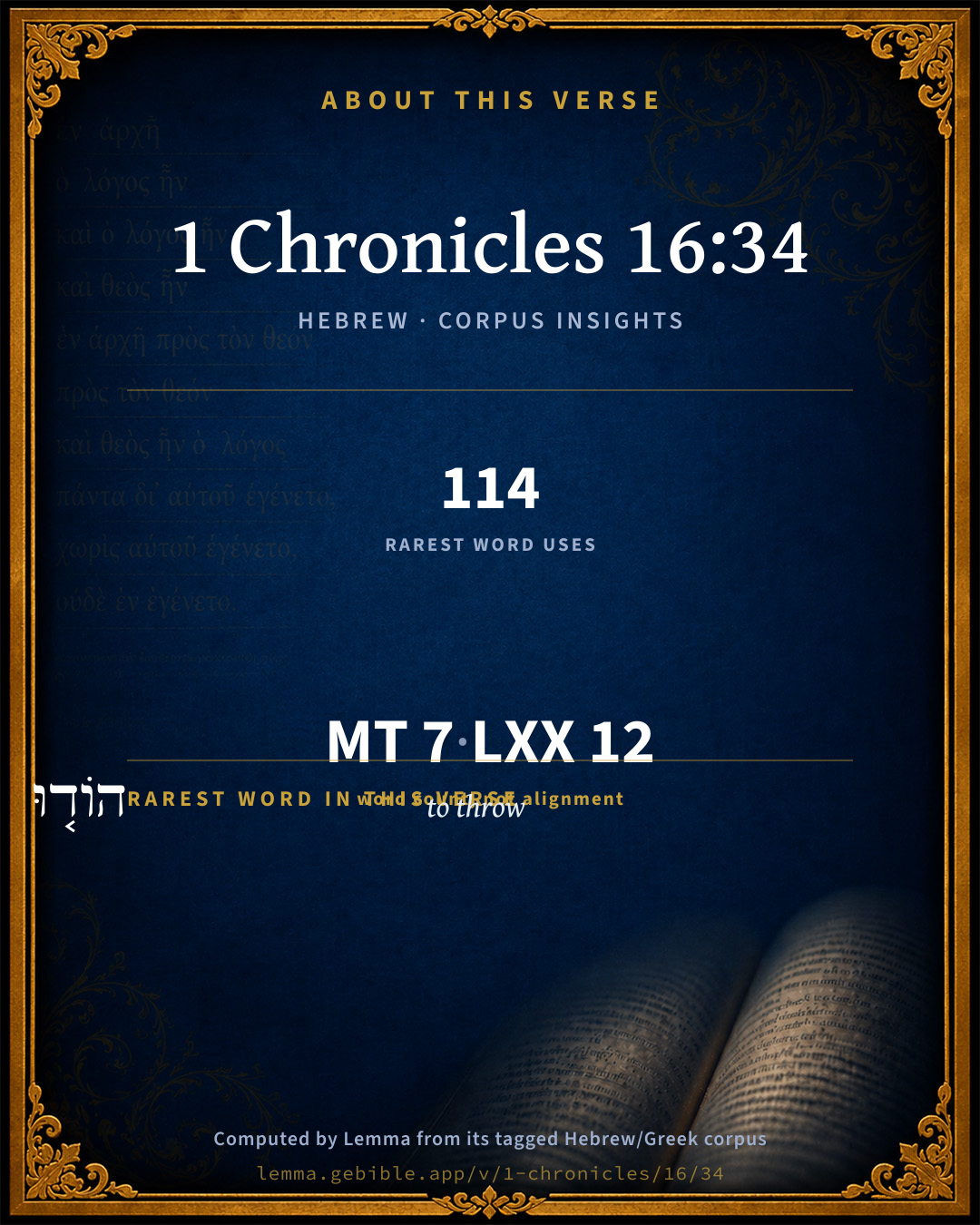
About this verse

These counts appear in no published source. They are computed here, from the morphology-tagged text and Lemma’s own curated glosses. What Lemma adds →

7
words
6
distinct lemmas
Historical
section

Grammatical profile

  • 1 verb
  • 3 nouns
  • 1 adjective
  • 2 conjunctions

Verb forms

  • הוֹד֤וּ Hiphil · Imperative

Repetition

A word recurs within this verse — often emphatic in Hebrew:

  • כִּ֣י that H3588 ×2

Hebrew & Septuagint length

In English translation the verse runs 15 words from the Hebrew and 15 from the Septuagint (LXX English) — the same length.

A rough comparison of the two English renderings, which tokenize alike — not a word-level alignment.

Word counts can differ between the Hebrew and the Greek without any difference in meaning — e.g. the Hebrew direct-object marker אֵת has no separate Greek word, and Greek often adds the article ὁ.

In the original languages it is 7 Hebrew tokens and 12 Greek tokens — but the two are counted differently (Hebrew bundles its prefixes and suffixes into one token; the Greek is in lemma form), so that isn’t a like-for-like length.

Cross-references

8

Topical passages linked to 1 Chronicles 16:34 in the Treasury of Scripture Knowledge — connected by theme and wording, ordered by reader-vote popularity; previews shown in the World English Bible.

  • Psalms 106:1 Praise Yahweh! Give thanks to Yahweh, for he is good, For his loving kindness endures forever.
  • 2 Chronicles 7:3 All the children of Israel looked on, when the fire came down, and the glory of Yahweh was on the house; and they bowed themselves with their faces to the ground on the pavement, and worshiped, and gave thanks to Yahweh, [saying], For he is good; for his loving kindness endures for ever.
  • Ezra 3:11 They sang one to another in praising and giving thanks to Yahweh, [saying], For he is good, for his loving kindness endures forever toward Israel. All the people shouted with a great shout, when they praised Yahweh, because the foundation of the house of Yahweh was laid.
  • Psalms 107:1 Give thanks to Yahweh, For he is good, For his loving kindness endures forever.
  • Psalms 136:1–26 Give thanks to Yahweh, for he is good; For his loving kindness endures forever.
  • 2 Chronicles 5:13 it happened, when the trumpeters and singers were as one, to make one sound to be heard in praising and thanking Yahweh; and when they lifted up their voice with the trumpets and cymbals and instruments of music, and praised Yahweh, [saying], For he is good; for his loving kindness endures forever; that then the house was filled with a cloud, even the house of Yahweh,
  • Jeremiah 33:11 the voice of joy and the voice of gladness, the voice of the bridegroom and the voice of the bride, the voice of those who say, Give thanks to Yahweh of Hosts, for Yahweh is good, for his loving kindness endures forever; [and of them] who bring [sacrifices of] thanksgiving into the house of Yahweh. For I will cause the captivity of the land to return as at the first, says Yahweh.
  • Psalms 118:1 Give thanks to Yahweh, for he is good, For his loving kindness endures forever.

Cross-references courtesy of OpenBible.info (CC BY 4.0).

Hebrew and Greek witnesses Masoretic Hebrew ↔ Greek Septuagint

The same verse in the two great witnesses to the Old Testament, shown verse-for-verse.

These are two independent witnesses, not word-aligned to each other, and the Septuagint is shown in lemma (dictionary) form.

Hebrew 1 Chronicles 16:34 Masoretic · Westminster Leningrad Codex

הוֹד֤וּ לַיהוָה֙ כִּ֣י ט֔וֹב כִּ֥י לְעוֹלָ֖ם חַסְדּֽוֹ

Oh give thanks to Yahweh; for he is good; For his loving kindness endures forever.

World English Bible · Public Domain

Greek LXX 1 Chronicles 16:34 Septuagint · lemma form

ἐκὁμολογέω ὁ κύριος ὅτι ἀγαθός ὅτι εἰς ὁ αἰών ὁ ἔλεος αὐτός

Give thanks to the Lord, for it is good, for his mercy is for ever.

LXX2012 (modern English Septuagint) · Public Domain

Hebrew: Westminster Leningrad Codex (CC BY 4.0). Greek: Septuagint (public domain); English from LXX2012 (modern English Septuagint) (Public Domain). How the Septuagint differs from the Hebrew →

Commentary

Notes on 1 Chronicles 16:34 from classic Christian and Jewish commentators (each source and its license shown beneath its notes). The classic Christian expositions comment on the surrounding passage and are grouped to its opening verse, so a note may address several verses; the Jewish commentaries on the Tanakh (Rashi and others) are per-verse, so they appear only where the commentator wrote on this verse.

Lemma curates 59 commentaries, every one of them public domain or Creative Commons licensed, each selected and text-cleaned for this edition rather than reprinted as found. About our sources →

Trapp's Complete Commentary

John Trapp

1Ch 16:34 O give thanks unto the LORD; for [he is] good; for his mercy [endureth] for ever.

Ver. 34. O give thanks to the Lord.] See on Psa 107:1.

John Trapp, A Commentary or Exposition upon All the Books of the Old and New Testament (1647–1656) — public domain. Text from a community e-Sword module.

The Biblical Illustrator

Joseph S. Exell

1Ch_16:34

O give thanks unto the Lord.

Thanksgiving due to God for His goodness

I. Instances of the loving-kindness and mercy of God.

1. The unfolding of a plan of salvation for sinners through His well-beloved Son.

2. The furnishing so fully of the means necessary to salvation.

(1) Birth in a Christian land.

(2) The Bible.

(3) Preaching of the gospel.

3. Temporal blessings.

II. The thanks-giving that is due.

III. This goodness ought to lead us to repentance. We ought to improve both the temporal and spiritual privileges we enjoy to the promotion of His glory. (Alex. Davidson.)

The Biblical Illustrator, edited by Joseph S. Exell (c. 1880s–1900s) — public domain. Text from a community e-Sword module.

Ellicott's Commentary for English Readers

(34) O give thanks unto the Lord . . .—Several of the later psalms begin with this beautiful liturgic formula. (See Psalms 106; Psalms 107, 118, 136.; and comp. Jer_33:11.) The ode thus concludes with the thought from which it started (1Ch_16:8).

A Bible Commentary for English Readers, edited by Charles John Ellicott (1878–1897) — public domain. Text from a community e-Sword module.

The Cambridge Bible for Schools and Colleges

gen. ed. J. J. S. Perowne

34–36 (= Psa_106:1; Psa_106:47-48)

34. his mercy endureth for ever] Cp. Exo_20:6, “shewing mercy unto a thousand generations of them that Jove me” (R.V. mg.).

The Cambridge Bible for Schools and Colleges (gen. ed. J. J. S. Perowne; Cambridge University Press, 1878–1918) — public domain. Text from a community e-Sword module.

The Pulpit Commentary

Vers. 34-36. These verses, from the first, forty-seventh, and forty-eighth of Psalm 106, must have suggested the sad intermediate contents of that psalm, the significant key-note of which is sounded in our thirty-fifth verse. The suggestion in the midst of the unbounded gladness of this day is affecting, and must have been intended for salutary lesson and timely warning. In the midst of the fulness of praise and joy, the people are led to prayer say ye and the prayer is a humble petition for salvation, union, and protection from every enemy. God"s treatment of his anointed people had been on his part one continued protection and one prolonged salvation. Yet they had often neither prayed for these nor acknowledged them. Now they are led again by the hand, as it were, to the footstool of the throne.

The Pulpit Commentary (1880–1919), ed. H.D.M. Spence-Jones & Joseph S. Exell — public domain. Text from a community e-Sword module.

unfoldingWord translationNotes

Door43 World Missions Community

for his covenant faithfulness endures forever

The abstract noun "faithfulness" can be stated as "faithfully" or "faithful." AT: "for he faithfully loves us forever" or "for he is faithful to his covenant forever" (See: Abstract Nouns)

from the other nations

Here "the other nations" represents the people in those nations. AT: "from the people of other nations" or "from the armies of other nations" (See: Metonymy)

give thanks to your holy name

Here Yahweh is referred to by his "holy name." AT: "give thanks to you" or "give thanks to Yahweh" (See: Metonymy)

translationWords

good

covenant faithfulness

endure

eternity

God

save

name

glory

praise

unfoldingWord translationNotes — © Distant Shores Media and the Door43 World Missions Community, licensed CC BY-SA 4.0. Source: git.door43.org/Door43/en_tn.

Rashi

Rabbi Shlomo Yitzchaki (Rashi)

Give thanks to the Lord for He is good, for His loving-kindness exists forever This verse (34) is not a conclusion of the Psalm (96) but [a continuation] of Psalm (105): “Give thanks to the Lord, call out in His Name.” The verse (35): “And say, save us, etc.” is from the Psalm (106). And this Psalm (106) commences with this verse (in Chron.). Now is it appropriate here, “And say, etc. and save us from the nations,” for when were they exiled in David’s time, that he should say, “and save us from among the nations”? And this is the arrangement in Psalms. Psalm (105) commences: “Give thanks to the Lord, call out in His name,” and it concludes only with “Blessed be the Lord God of Israel, etc.” until “Amen! Hallelujah,” for it is all one topic, but because it is a long psalm, it was divided, and it commences, “Give thanks to the Lord for He is good.” Similarly, Job, when he had to lengthen his reply, he shortened it and divided it in two, and it says, (Job 29:1): “And Job again took up his parable,” for in song, because of his ecstasies of joy, he could not speak at length; so he divided it in two. And so, in the matter of lamentation, because of his intense pain he could not speak at length, and he divided it in two, because both song and lamentation are uttered similarly. When Hannah came to pray in the forecourt, Eli thought her to be a drunken woman, because he thought that she acted in that manner because of wine, but she said, (I Sam. 1:15f.): “... and neither new wine nor old wine have I drunk, etc., for out of the abundance of my complaint and my vexation....” From here we learn that drunken people and those suffering from pain behave in the same manner.

Rashi on the Tanakh — English translations: “The Judaica Press complete Tanach with Rashi, translated by A. J. Rosenberg” (CC BY 4.0); “Pentateuch with Rashi's commentary by M. Rosenbaum and A.M. Silbermann, 1929-1934” (public domain); “The Metsudah Tanach series, Lakewood, N.J” (CC BY 4.0); and “The Book of Joshua, Metsudah Publications, 1997” (CC BY 4.0). Text via Sefaria.

Lesson kit

Teaching starters — assembled from the data on this page, not authored interpretation. Every prompt links to the verse data it draws on. Edit before teaching.

1 Chronicles, in the Historical, opens this verse with 7 words (6 distinct Hebrew lemmas). Its most distinctive word is yâdâh (“to throw”). A historical commentator’s framing appears above. Read the whole chapter for the surrounding context.

Discussion questions

  1. How does “to throw” (yâdâh) shape what this verse is saying?
  2. How does Psalms 106:1, which shares this passage’s theme, read alongside this verse?
  3. What does the repetition of “that” (2× in this one verse) do in this verse?
  4. These translations render this verse differently. What is at stake in choosing one wording over another?
  5. «הוֹד֤וּ» is a Hiphil Imperative verb. How does that grammatical form shape the action described?
  6. Compare how Trapp's Complete Commentary and The Biblical Illustrator read this verse. Where do they agree or differ?

Things to notice

Reading settings

Reading text

Shown beneath each verse's original-language words.

Old Testament
Old Testament edition

Read the OT as the Masoretic Hebrew (MT) or the Greek Septuagint (LXX).

English shown for the Greek Septuagint (in the Hebrew ↔ Greek comparison).

Comparing translations? Open the Compare panel on any verse page to stack up to four side by side.