
Leviticus 24:8

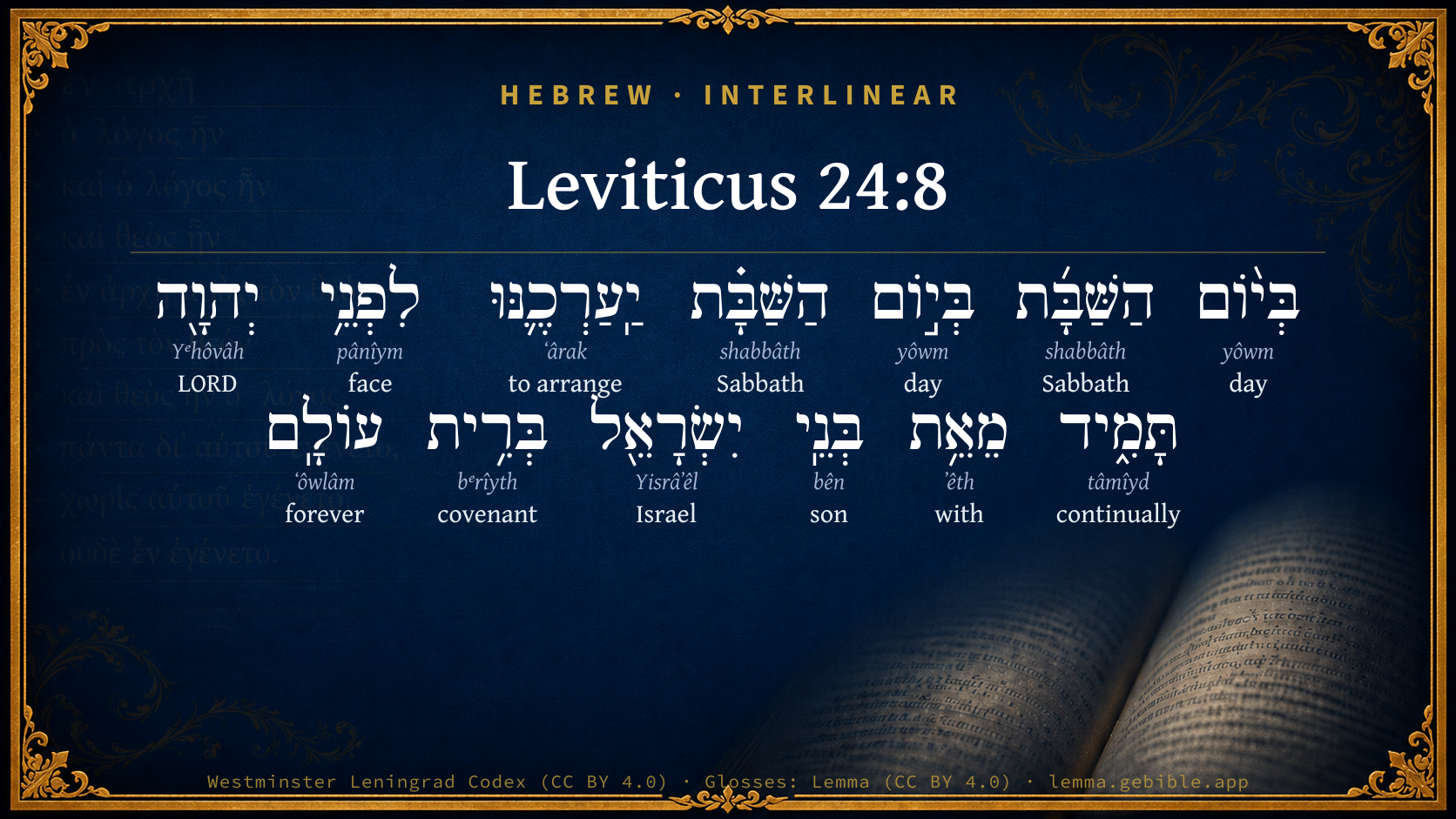
Hebrew (Westminster Leningrad Codex) Leviticus 24:8 appears in the Hebrew Old Testament. The text above is from the Westminster Leningrad Codex. Each word links to its Strong’s number, a concise gloss, and parsing drawn from the Open Scriptures Hebrew Bible morphology. Click any word for its full Brown-Driver-Briggs (BDB) entry.
Download image
Cite this verse

Leviticus 24:8 (World English Bible). Public Domain. Lemma interlinear Bible study tool, https://lemma.gebible.app/v/leviticus/24/8.

Show BibTeX & RIS
BibTeX
RIS
English Translation
Every Sabbath day he shall set it in order before Yahweh continually. It is on the behalf of the children of Israel an everlasting covenant.
World English Bible · Public Domain
Download a study sheet

One document with this verse’s original text, its word-by-word gloss line, the meaning frame, cross-references with their text, attributed commentary, and full source and license credits — printable, and it pastes into notes with its structure intact.

This verse Autodidact and up

Study sheet (.html) Plain text (.txt)

A passage Seminary Student

Up to 50 verses in one chapter. A passage sheet keeps up to 6 commentary sources and 12 cross-references per verse, in the order this page ranks them, and says so on the sheet whenever that leaves anything out. Ask for a single verse and you get the Autodidact verse sheet above.

Everything on this page stays free to read, with no account — the sheet is a download of what is already on screen, not access to it.

Want to remove ads? Support Godless Engineer
Compare translations 3

The same verse in 3 English versions, stacked beneath the original-language interlinear above. Click any original word for its lexicon entry.

Each is an independent rendering of the whole verse — the interlinear is not word-aligned to these translations.

Highlighted words mark where these versions differ — a whole-verse word diff, not a word-by-word alignment.

  • World English Bible Public Domain
    Every Sabbath day he shall set it in order before Yahweh continually. It is on the behalf of the children of Israel an everlasting covenant.
  • King James Version Public Domain
    Every sabbath he shall set it in order before the LORD continually, being taken from the children of Israel by an everlasting covenant.
  • unfoldingWord Literal Text CC BY-SA 4.0
    On the day of the sabbath, on the day of the sabbath, he shall arrange it to the face of Yahweh continually from the sons of Israel, a covenant of eternity.

unfoldingWord Literal Text — © unfoldingWord, licensed CC BY-SA 4.0. Word-aligned USFM3 via Door43 (git.door43.org/unfoldingWord/en_ult).

Versions to compare (up to 4)

3 of 4 selected

Show all 18 translations

Every available English version of this verse, each an independent rendering of the whole verse.

  • World English Bible Public Domain
    Every Sabbath day he shall set it in order before Yahweh continually. It is on the behalf of the children of Israel an everlasting covenant.
  • Berean Standard Bible Public Domain
    Every Sabbath day the bread is to be set out before the LORD on behalf of the Israelites as a permanent covenant.
  • Majority Standard Bible Public Domain
    Every Sabbath day the bread is to be set out before the LORD on behalf of the Israelites as a permanent covenant.
  • King James Version Public Domain
    Every sabbath he shall set it in order before the LORD continually, being taken from the children of Israel by an everlasting covenant.
  • American Standard Version (1901) Public Domain
    Every sabbath day he shall set it in order before Jehovah continually; it is on the behalf of the children of Israel, an everlasting covenant.
  • Revised Version (1885) Public Domain
    Every sabbath day he shall set it in order before the LORD continually; it is on the behalf of the children of Israel, an everlasting covenant.
  • Geneva Bible (1599) Public Domain
    Euery Sabbath hee shall put them in rowes before the Lord euermore, receiuing them of the children of Israel for an euerlasting couenant.
  • Douay-Rheims (1899) Public Domain
    Every sabbath they shall be changed before the Lord, being received of the children of Israel by an everlasting covenant:
  • Young's Literal Translation Public Domain
    `On each sabbath-day he arrangeth it before Jehovah continually, from the sons of Israel -- a covenant age-during;
  • Literal Standard Version CC BY-SA 4.0
    On each Sabbath day he arranges it before YHWH continually, from the sons of Israel—a perpetual covenant;
  • Unlocked Literal Bible CC BY-SA 4.0
    Every Sabbath day the high priest must regularly set out the bread before Yahweh on behalf of the people of Israel, as a sign of an everlasting covenant.
  • unfoldingWord Literal Text CC BY-SA 4.0
    On the day of the sabbath, on the day of the sabbath, he shall arrange it to the face of Yahweh continually from the sons of Israel, a covenant of eternity.
  • Darby Bible Public Domain
    Every sabbath day he shall arrange it before Jehovah continually, on the part of the children of Israel: [it is] an everlasting covenant.
  • World Messianic Bible Public Domain
    Every Sabbath day he shall set it in order before the LORD continually. It is an everlasting covenant on the behalf of the children of Israel.
  • Webster's Bible Public Domain
    Every sabbath he shall set it in order before the LORD continually, being taken from the children of Israel by an everlasting covenant.
  • Free Bible Version CC BY-SA 4.0
    Every Sabbath day the bread shall be placed before the Lord, given by the Israelites as an ongoing sign of the eternal agreement.
  • Bible in Basic English Public Domain
    Every Sabbath day regularly, the priest is to put it in order before the Lord: it is offered for the children of Israel, an agreement made for ever.
  • JPS Tanakh (1917) Public Domain
    Every sabbath day he shall set it in order before the LORD continually; it is from the children of Israel, an everlasting covenant.

Literal Standard Version (2020), Covenant Press — licensed CC BY-SA 4.0. Text via the HelloAO Bible API (eBible.org). Unlocked Literal Bible (unfoldingWord) — licensed CC BY-SA 4.0. Text via the HelloAO Bible API (eBible.org). unfoldingWord Literal Text — © unfoldingWord, licensed CC BY-SA 4.0. Word-aligned USFM3 via Door43 (git.door43.org/unfoldingWord/en_ult). Free Bible Version, Dr. Jonathan Gallagher — licensed CC BY-SA 4.0. Text via the HelloAO Bible API (eBible.org).

Word by word

More ways to search: Search by grammar → Find every occurrence → Compare this word →

Practice this passage: Drill this verse → Learn its vocabulary →

יַֽעַרְכֶ֛נּוּ
ʻârak
H6186
“to arrange · him”
Verb, Qal, Imperfect, 3rd Person, Masculine, Singular + Suffix, Personal, 3rd Person, Masculine, Singular
Part of Speech
Verb
Stem
Qal
Form
Imperfect
Person
3rd Person
Gender
Masculine
Number
Singular
Full BDB Definition

Origin: a primitive root

TWOT: 1694

to arrange, set or put or lay in order, set in array, prepare, order, ordain, handle, furnish, esteem, equal, direct, compare - (Qal) - to arrange or set or lay in order, arrange, state in order, set forth (a legal case), set in place - to compare, be comparable - (Hiphil) to value, tax
  1. בְּי֨וֹם yôwm H3117 “in/at · day of” Preposition + Noun, Common, Masculine, Singular, Construct
  2. הַשַּׁבָּ֜ת shabbâth H7676 “the · Sabbath” Particle, Definite Article + Noun, Common, Both, Singular, Absolute
  3. בְּי֣וֹם yôwm H3117 “in/at · day of” Preposition + Noun, Common, Masculine, Singular, Construct
  4. הַשַּׁבָּ֗ת shabbâth H7676 “the · Sabbath” Particle, Definite Article + Noun, Common, Both, Singular, Absolute
  5. לִפְנֵ֥י pânîym H6440 “to/for · face(s) of” Preposition + Noun, Common, Both, Plural, Construct
  6. יְהוָ֖ה Yᵉhôvâh H3068 “LORD” Noun, Proper
  7. תָּמִ֑יד tâmîyd H8548 “continually” Noun, Common, Masculine, Singular, Absolute
  8. מֵאֵ֥ת ʼêth H854 “from · with” Preposition + Preposition
  9. בְּנֵֽי bên H1121 “sons of” Noun, Common, Masculine, Plural, Construct
  10. יִשְׂרָאֵ֖ל Yisrâʼêl H3478 “Israel” Noun, Proper
  11. בְּרִ֥ית bᵉrîyth H1285 “covenant of” Noun, Common, Feminine, Singular, Construct
  12. עוֹלָֽם ʻôwlâm H5769 “forever” Noun, Common, Masculine, Singular, Absolute

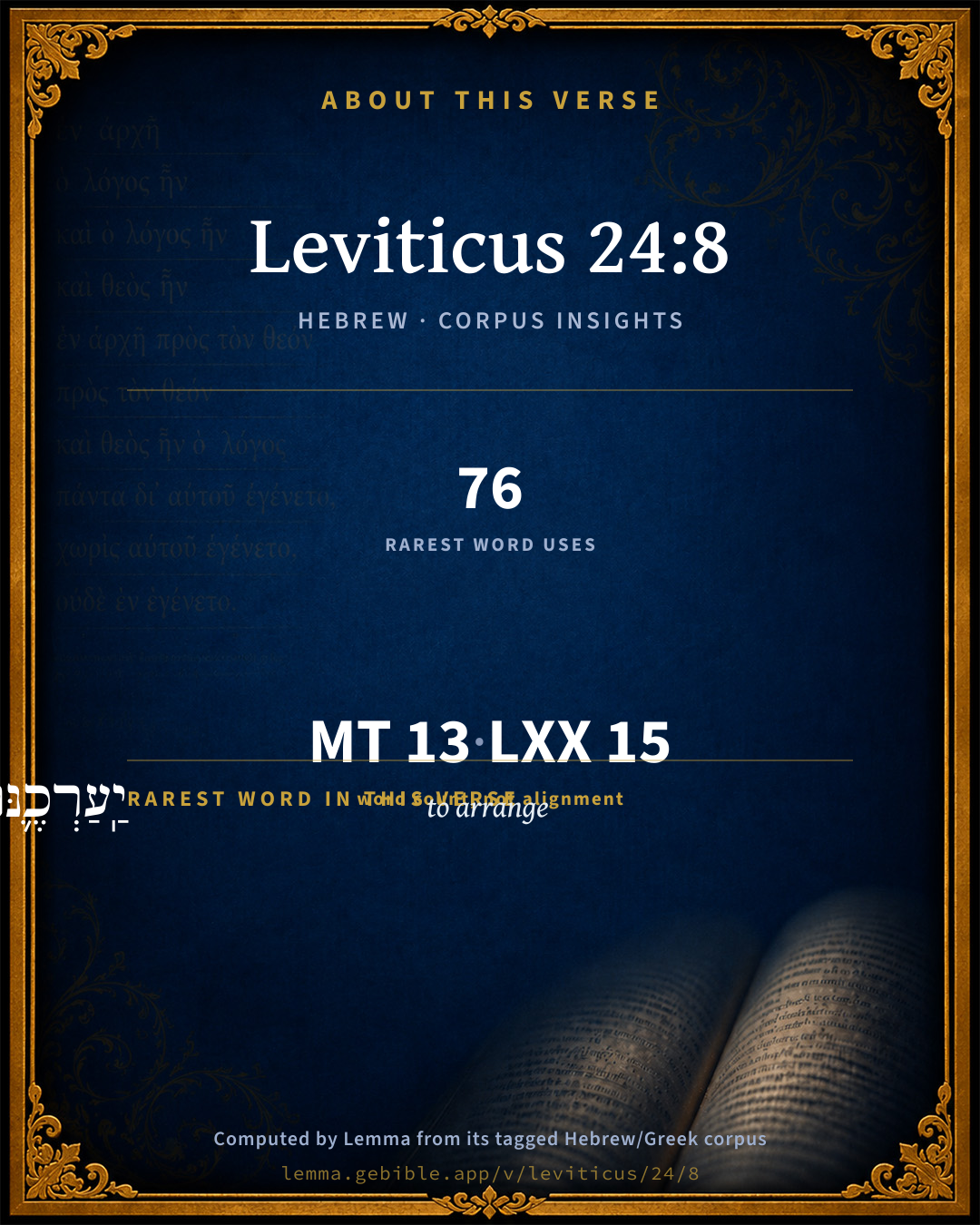
About this verse

These counts appear in no published source. They are computed here, from the morphology-tagged text and Lemma’s own curated glosses. What Lemma adds →

13
words
11
distinct lemmas
Pentateuch
section

Grammatical profile

  • 1 verb
  • 11 nouns
  • 1 preposition

Verb forms

  • יַֽעַרְכֶ֛נּוּ Qal · Imperfect

Repetition

Words recur within this verse — often emphatic in Hebrew:

  • בְּי֨וֹם day H3117 ×2
  • הַשַּׁבָּ֜ת Sabbath H7676 ×2

Hebrew & Septuagint length

In English translation the verse runs 25 words from the Hebrew and 21 from the Septuagint (LXX English) — closely comparable.

A rough comparison of the two English renderings, which tokenize alike — not a word-level alignment.

Word counts can differ between the Hebrew and the Greek without any difference in meaning — e.g. the Hebrew direct-object marker אֵת has no separate Greek word, and Greek often adds the article ὁ.

In the original languages it is 13 Hebrew tokens and 15 Greek tokens — but the two are counted differently (Hebrew bundles its prefixes and suffixes into one token; the Greek is in lemma form), so that isn’t a like-for-like length.

Cross-references

6

Topical passages linked to Leviticus 24:8 in the Treasury of Scripture Knowledge — connected by theme and wording, ordered by reader-vote popularity; previews shown in the World English Bible.

  • Numbers 4:7 On the table of show bread they shall spread a blue cloth, and put on it the dishes, the spoons, the bowls, and the cups with which to pour out; and the continual bread shall be on it.
  • 2 Chronicles 2:4 Behold, I am about to build a house for the name of Yahweh my God, to dedicate it to him, and to burn before him incense of sweet spices, and for the continual show bread, and for the burnt offerings morning and evening, on the Sabbaths, and on the new moons, and on the set feasts of Yahweh our God. This is [an ordinance] forever to Israel.
  • 1 Chronicles 9:32 Some of their brothers, of the sons of the Kohathites, were over the show bread, to prepare it every Sabbath.
  • 1 Chronicles 23:29 for the show bread also, and for the fine flour for a meal-offering, whether of unleavened wafers, or of that which is baked in the pan, or of that which is soaked, and for all manner of measure and size;
  • Nehemiah 10:33 for the show bread, and for the continual meal-offering, and for the continual burnt-offering, for the Sabbaths, for the new moons, for the set feasts, and for the holy things, and for the sin-offerings to make atonement for Israel, and for all the work of the house of our God.
  • Matthew 12:3–5 But he said to them, "Haven't you read what David did, when he was hungry, and those who were with him;

Cross-references courtesy of OpenBible.info (CC BY 4.0).

Hebrew and Greek witnesses Masoretic Hebrew ↔ Greek Septuagint

The same verse in the two great witnesses to the Old Testament, shown verse-for-verse.

These are two independent witnesses, not word-aligned to each other, and the Septuagint is shown in lemma (dictionary) form.

Hebrew Leviticus 24:8 Masoretic · Westminster Leningrad Codex

בְּי֨וֹם הַשַּׁבָּ֜ת בְּי֣וֹם הַשַּׁבָּ֗ת יַֽעַרְכֶ֛נּוּ לִפְנֵ֥י יְהוָ֖ה תָּמִ֑יד מֵאֵ֥ת בְּנֵֽי יִשְׂרָאֵ֖ל בְּרִ֥ית עוֹלָֽם

Every Sabbath day he shall set it in order before Yahweh continually. It is on the behalf of the children of Israel an everlasting covenant.

World English Bible · Public Domain

Greek LXX Leviticus 24:8 Septuagint · lemma form

ὁ ἡμέρα ὁ σάββατον προτίθημι ἔναντι κύριος διά πᾶς ἐνώπιον ὁ υἱός ἰσραήλ διαθήκη αἰώνιος

On the sabbath-day they shall be set forth before the Lord continually before the children of Israel, for an everlasting covenant.

LXX2012 (modern English Septuagint) · Public Domain

Hebrew: Westminster Leningrad Codex (CC BY 4.0). Greek: Septuagint (public domain); English from LXX2012 (modern English Septuagint) (Public Domain). How the Septuagint differs from the Hebrew →

Targum (Aramaic paraphrase)

2

The Targum is the ancient Jewish Aramaic paraphrase of the Hebrew Scriptures — an interpretive translation, not the Hebrew text itself. Onkelos (literal) and Pseudo-Jonathan (expansive) render the Torah, and Jonathan the Prophets. Coverage is partial: where no permissively-licensed English translation exists for a verse, only the Aramaic is shown. This is verse-level text, not a word-by-word alignment to the Hebrew.

  1. Targum Onkelos Torah (Genesis–Deuteronomy)
    בְּיוֹמָא דְשַׁבְּתָא בְּיוֹמָא דְשַׁבְּתָא יַסְדְרִנֵהּ קֳדָם יְיָ תְּדִירָא מִן קֳדָם בְּנֵי יִשְׂרָאֵל קְיַם עָלָם

    (no public-domain English translation for this verse)

    Targum Onkelos — Aramaic: “Onkelos Genesis” (public domain); “Onkelos Exodus” (public domain); “Onkelos Leviticus” (public domain); “Onkelos Numbers” (public domain); “Onkelos Deuteronomy” (public domain). English: “Sefaria Community Translation” (CC0 1.0 (public-domain dedication)); “J.W. Etheridge. The Targums of Onkelos and Jonathan Ben Uzziel on the Pentateuch. London: Longmans, Green, 1862” (public domain). Text via Sefaria.

  2. Targum Pseudo-Jonathan Torah (Genesis–Deuteronomy)
    בְּיוֹמָא דְשַׁבְּתָּא בְּיוֹמָא דְשַׁבְּתָּא יְסַדְרִינֵיהּ חֲדַת קֳדָם יְיָ תְּדִירָא מִן בְּנֵי יִשְרָאֵל קְיַים עֲלָם

    From Sabbath day to Sabbath day he shall order it anew before the Lord continually from the children of Israel. This shall be an everlasting statute.

    Targum Pseudo-Jonathan — Aramaic: “Targum Jonathan on Genesis” (public domain); “Targum Jonathan on Exodus” (public domain); “Targum Jonathan on Leviticus” (public domain); “Targum Jonathan on Numbers” (public domain); “Targum Jonathan on Deuteronomy” (public domain). English: “The Targum of Jonathan ben Uzziel, trans. J. W. Etheridge, London, 1862” (public domain). Text via Sefaria.

Commentary

Notes on Leviticus 24:8 from classic Christian and Jewish commentators (each source and its license shown beneath its notes). The classic Christian expositions comment on the surrounding passage and are grouped to its opening verse, so a note may address several verses; the Jewish commentaries on the Tanakh (Rashi and others) are per-verse, so they appear only where the commentator wrote on this verse.

Lemma curates 59 commentaries, every one of them public domain or Creative Commons licensed, each selected and text-cleaned for this edition rather than reprinted as found. About our sources →

Trapp's Complete Commentary

John Trapp

Lev 24:8 Every sabbath he shall set it in order before the LORD continually, [being taken] from the children of Israel by an everlasting covenant.

Ver. 8. Every Sabbath.] So must the bread of life be every Sabbath at least set before the saints.

John Trapp, A Commentary or Exposition upon All the Books of the Old and New Testament (1647–1656) — public domain. Text from a community e-Sword module.

Joseph Benson's Commentary

Lev 24:8. Being taken from the children of Israel — At whose charge they were provided, Neh 10:32; by an everlasting covenant — By a law which they had all agreed to observe, (Exo 24:3,) and which was to continue as long as that dispensation remained.

Joseph Benson's Commentary on the Old and New Testaments (1811–1818) — public domain. Text from a community e-Sword module.

Ellicott's Commentary for English Readers

(8) Every sabbath he shall set it in order.—That is, Aaron is to carry out these instructions in the first instance, as we are told in Lev_24:3, and after him, or together with him, the priests are sacredly to attend to this duty every sabbath throughout the year. Of the manner in which the shewbread, or the “bread of His Presence,” was renewed every Sabbath during the second Temple, we have a minute account. “Four priests entered the holy place, two of them carried in their hands the two piles of the cakes, and two carried in their hands the two incense cups, four priests having gone in before them, two to take off the two old piles, and two to take off the two incense cups. Those who brought in the new stood at the north side with their faces to the south, and those who took away the old stood at the south side with their faces to the north. As soon as the one party lifted up the old, the others put down the new, so that their hands were exactly over against each other, because it is written, before my Presence continually” (Exo_25:30). The authorities during the second Temple took the expression “continually” to denote that the cakes were not to be absent for one moment. Hence the simultaneous action of the two sets of priests, one lifting up the old, and the other at once putting down the new shewbread.

Being taken from the children of Israel.—Like the daily sacrifices, the offerings for the congregation, the salt for the sacrifices, the wood for the altar, the incense, the omer (see Lev_23:10-11), the two wave-loaves (Lev_23:17), the scapegoat (Lev_16:5, &c.), the red heifer (Num_19:1-22), &c., the shewbread, or the “bread of His Presence,” according to the canon that obtained during the second Temple, were purchased with the people’s half-shekels, which every Israelite had to contribute annually toward the maintenance of the service in the sanctuary. (See Exo_30:11-16.)

A Bible Commentary for English Readers, edited by Charles John Ellicott (1878–1897) — public domain. Text from a community e-Sword module.

John Gill's Exposition

Every sabbath he shall set it in order before the Lord continually,.... That is, the priest or priests then ministering, who should bring new cakes and place them in the above order, having removed the old ones, which was done in this manner; four priests went in, two had in their hands the two rows (of bread), and two had in their hands two cups (of frankincense); four went before these, two to take away the two rows (of the old bread), and two to take away the two cups (of frankincense); and they that carried in stood in the north, and their faces to the south and they that brought out stood in the south, and their faces to the north; these drew away (the old bread) and they put them (the new), and the hand of the one was over against the hand of the other, as it is said, "before me continually", Exo 25:30 (h); that is, at the same time the hands of the one were employed in taking away, the hands of the other were employed in setting on; so that there was always bread upon the table:

being taken from the children of Israel by an everlasting covenant; God requiring it of them, and they agreeing to give it, as they did, either in meal or in money; for this was at the expense of the community.

(h) Menachot, c. 11. sect. 7.

John Gill's Exposition of the Whole Bible (1746–1763) — public domain (CC PDM 1.0). Text via the HelloAO Bible API.

Haydock's Catholic Bible Commentary

Of the, &c. The Israelites gave a sufficient maintenance to the ministers of religion, out of which these provided the loaves; as St. Jerome testifies, Malachias i.

George Leo Haydock (1774–1849), Haydock's Catholic Family Bible and Commentary, 1859 edition — public domain. Excludes Psalms (Douay-Rheims chapter numbering differs from Protestant) and Deuterocanonical books (Catholic canon only).

Matthew Poole's English Annotations

Before the Lord, whence it was called the shew-bread, Heb. the bread of faces, or of presence, i.e. the bread which was put upon the table in the Lord’s presence.

Being taken; such supplements are not unusual. Thus in the floor, 1Ki 22:10, is put for sitting in the floor, 2Ch 18:9; and burdens, 2Ch 2:18, for carrying burdens, 1Ki 5:15. And these cakes are said to be received from or offered by

the children of Israel, because they were bought with the money which they contributed, as may be seen Neh 10:32,33; as Judas is said to purchase the field, Act 1:18, which was purchased by his money, Mat 27:7. By an everlasting covenant; by virtue of that compact made between me and them, by which they are obliged to keep this amongst other commands, and, they so doing, I am obliged to be their God, and to bless them. And this may be here called

an everlasting covenant, not only because it was to endure as long as the Jewish religion and polity stood, but also because this was to stand there everlastingly, or continually, as is here said, and therefore the new cakes were first brought before the old were taken away.

Matthew Poole's English Annotations on the Holy Bible (1683–1685) — public domain. Text from a community e-Sword/MySword module.

Whedon's Commentary on the Bible

Daniel D. Whedon

8. Every sabbath — The show-bread never waxed old; it was always fresh. Through eternity Jesus will be a theme ever new, and inspiring fresh interest — “a lamb as it had been slain.”

Daniel D. Whedon (gen. ed.), Commentary on the Old and New Testaments (1874–1909) — public domain. Text from a community e-Sword module.

John Wesley's Explanatory Notes

From the children of Israel - And these cakes are said to be received from or offered by the children of Israel, bought with the money which they contributed. By an everlasting covenant - By virtue of that compact made between me and them, by which they were obliged to keep this amongst other commands, and, they so doing, I am obliged to be their God and to bless them. And this may be here called an everlasting covenant, not only because it was to endure as long as the Jewish polity stood, but also because this was to stand everlastingly, or continually, and therefore the new cakes were first brought before the old were taken away.

John Wesley, Explanatory Notes Upon the Whole Bible (1754–1765) — public domain. Text via the GEBible commentary corpus.

Lesson kit

Teaching starters — assembled from the data on this page, not authored interpretation. Every prompt links to the verse data it draws on. Edit before teaching.

Leviticus, in the Pentateuch, opens this verse with 13 words (11 distinct Hebrew lemmas). Its most distinctive word is ʻârak (“to arrange”). A historical commentator’s framing appears above. Read the whole chapter for the surrounding context.

Discussion questions

  1. What does “to arrange” (ʻârak) contribute to the verse as a whole?
  2. Numbers 4:7 shares this passage’s theme. How do the two illuminate each other?
  3. “day” occurs 2× in this one verse. What is the effect of the repetition?
  4. The translations on this page render this verse differently — a whole-verse word diff, not a word-by-word alignment. What might account for the different wordings?
  5. The verb «יַֽעַרְכֶ֛נּוּ» is Qal Imperfect. How does its form color the action?
  6. Reading how Trapp's Complete Commentary and Joseph Benson's Commentary read this verse, where do the two commentators agree and where do they part?

Things to notice

Reading settings

Reading text

Shown beneath each verse's original-language words.

Old Testament
Old Testament edition

Read the OT as the Masoretic Hebrew (MT) or the Greek Septuagint (LXX).

English shown for the Greek Septuagint (in the Hebrew ↔ Greek comparison).

Comparing translations? Open the Compare panel on any verse page to stack up to four side by side.