
Deuteronomy 12:11

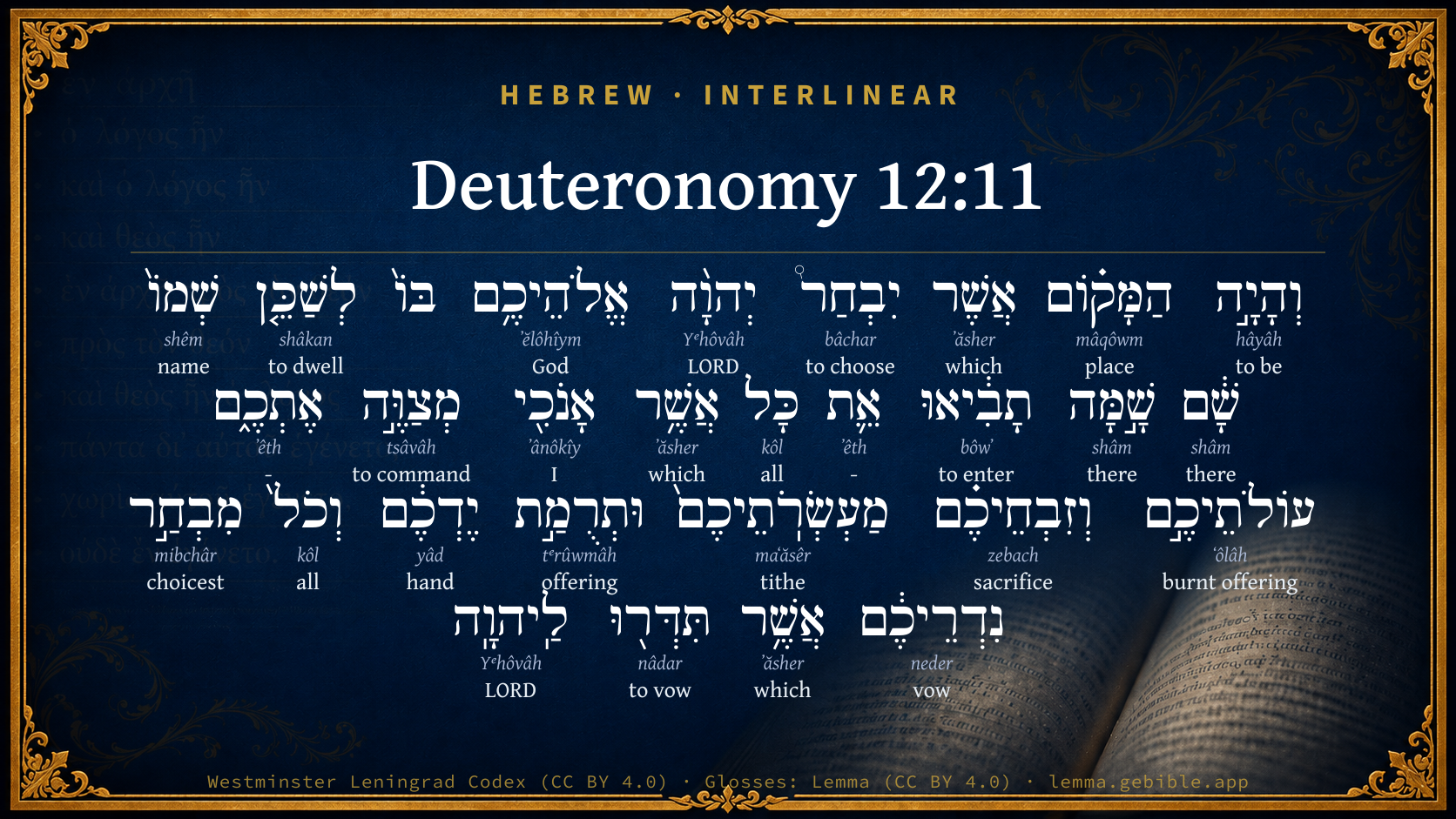
Hebrew (Westminster Leningrad Codex) Deuteronomy 12:11 appears in the Hebrew Old Testament. The text above is from the Westminster Leningrad Codex. Each word links to its Strong’s number, a concise gloss, and parsing drawn from the Open Scriptures Hebrew Bible morphology. Click any word for its full Brown-Driver-Briggs (BDB) entry.
Download image
Cite this verse

Deuteronomy 12:11 (World English Bible). Public Domain. Lemma interlinear Bible study tool, https://lemma.gebible.app/v/deuteronomy/12/11.

Show BibTeX & RIS
BibTeX
RIS
English Translation
then it shall happen that to the place which Yahweh your God shall choose, to cause his name to dwell there, there shall you bring all that I command you: your burnt offerings, and your sacrifices, your tithes, and the heave-offering of your hand, and all your choice vows which you vow to Yahweh.
World English Bible · Public Domain
Download a study sheet

One document with this verse’s original text, its word-by-word gloss line, the meaning frame, cross-references with their text, attributed commentary, and full source and license credits — printable, and it pastes into notes with its structure intact.

This verse Autodidact and up

Study sheet (.html) Plain text (.txt)

A passage Seminary Student

Up to 50 verses in one chapter. A passage sheet keeps up to 6 commentary sources and 12 cross-references per verse, in the order this page ranks them, and says so on the sheet whenever that leaves anything out. Ask for a single verse and you get the Autodidact verse sheet above.

Everything on this page stays free to read, with no account — the sheet is a download of what is already on screen, not access to it.

Want to remove ads? Support Godless Engineer
Compare translations 3

The same verse in 3 English versions, stacked beneath the original-language interlinear above. Click any original word for its lexicon entry.

Each is an independent rendering of the whole verse — the interlinear is not word-aligned to these translations.

Highlighted words mark where these versions differ — a whole-verse word diff, not a word-by-word alignment.

  • World English Bible Public Domain
    then it shall happen that to the place which Yahweh your God shall choose, to cause his name to dwell there, there shall you bring all that I command you: your burnt offerings, and your sacrifices, your tithes, and the heave-offering of your hand, and all your choice vows which you vow to Yahweh.
  • King James Version Public Domain
    Then there shall be a place which the LORD your God shall choose to cause his name to dwell there; thither shall ye bring all that I command you; your burnt offerings, and your sacrifices, your tithes, and the heave offering of your hand, and all your choice vows which ye vow unto the LORD:
  • unfoldingWord Literal Text CC BY-SA 4.0
    And it will be that the place that Yahweh your God will choose to make his name stay there, there you will bring all that I command you: your burnt offerings and your sacrifices, your tithes and the contribution of your hand and all your choice offerings for vows that you will vow to Yahweh.

unfoldingWord Literal Text — © unfoldingWord, licensed CC BY-SA 4.0. Word-aligned USFM3 via Door43 (git.door43.org/unfoldingWord/en_ult).

Versions to compare (up to 4)

3 of 4 selected

Show all 18 translations

Every available English version of this verse, each an independent rendering of the whole verse.

  • World English Bible Public Domain
    then it shall happen that to the place which Yahweh your God shall choose, to cause his name to dwell there, there shall you bring all that I command you: your burnt offerings, and your sacrifices, your tithes, and the heave-offering of your hand, and all your choice vows which you vow to Yahweh.
  • Berean Standard Bible Public Domain
    then the LORD your God will choose a dwelling for His Name. And there you are to bring everything I command you: your burnt offerings and sacrifices, your tithes and special gifts, and all the choice offerings you vow to the LORD.
  • Majority Standard Bible Public Domain
    then the LORD your God will choose a dwelling for His Name. And there you are to bring everything I command you: your burnt offerings and sacrifices, your tithes and special gifts, and all the choice offerings you vow to the LORD.
  • King James Version Public Domain
    Then there shall be a place which the LORD your God shall choose to cause his name to dwell there; thither shall ye bring all that I command you; your burnt offerings, and your sacrifices, your tithes, and the heave offering of your hand, and all your choice vows which ye vow unto the LORD:
  • American Standard Version (1901) Public Domain
    then it shall come to pass that to the place which Jehovah your God shall choose, to cause his name to dwell there, thither shall ye bring all that I command you: your burnt-offerings, and your sacrifices, your tithes, and the heave-offering of your hand, and all your choice vows which ye vow unto Jehovah.
  • Revised Version (1885) Public Domain
    then it shall come to pass that the place which the LORD your God shall choose to cause his name to dwell there, thither shall ye bring all that I command you; your burnt offerings, and your sacrifices, your tithes, and the heave offering of your hand, and all your choice vows which ye vow unto the LORD:
  • Geneva Bible (1599) Public Domain
    When there shalbe a place which the Lord your God shall chose, to cause his name to dwell there, thither shall yee bring all that I commaund you: your burnt offrings, and your sacrifices, your tithes, and the offring of your hands, and all your speciall vowes which ye vowe vnto the Lord:
  • Douay-Rheims (1899) Public Domain
    In the place, which the Lord your God shall choose, that his name may be therein. Thither shall you bring all the things that I command you, holocausts, and victims, and tithes, and the firstfruits of your hands: and whatsoever is the choicest in the gifts which you shall vow to the Lord.
  • Young's Literal Translation Public Domain
    `And it hath been, the place on which Jehovah your God doth fix to cause His name to tabernacle there, thither ye bring in all that which I am commanding you, your burnt-offerings, and your sacrifices, your tithes, and the heave-offering of your hand, and all the choice of your vows which ye vow to Jehovah;
  • Literal Standard Version CC BY-SA 4.0
    then it has been, the place on which your God YHWH fixes to cause His Name to dwell there, there you bring in all that which I am commanding you: your burnt-offerings, and your sacrifices, your tithes, and the raised-offering of your hand, and all the choice of your vows which you vow to YHWH.
  • Unlocked Literal Bible CC BY-SA 4.0
    Then to the place where Yahweh your God will choose to cause his name to live there—there you will bring everything I command you: your burnt offerings, your sacrifices, your tithes, and the offerings presented by your hand, and all your choice offerings for vows that you will vow to Yahweh.
  • unfoldingWord Literal Text CC BY-SA 4.0
    And it will be that the place that Yahweh your God will choose to make his name stay there, there you will bring all that I command you: your burnt offerings and your sacrifices, your tithes and the contribution of your hand and all your choice offerings for vows that you will vow to Yahweh.
  • Darby Bible Public Domain
    then there shall be a place which Jehovah your God will choose to cause his name to dwell there; thither shall ye bring all that I command you: your burnt-offerings, and your sacrifices, your tithes, and the heave-offering of your hand, and all your choice vows which ye shall vow to Jehovah.
  • World Messianic Bible Public Domain
    then it shall happen that to the place which the LORD your God shall choose, to cause his name to dwell there, there you shall bring all that I command you: your burnt offerings, your sacrifices, your tithes, the wave offering of your hand, and all your choice vows which you vow to the LORD.
  • Webster's Bible Public Domain
    Then there shall be a place which the LORD your God shall choose to cause his name to dwell there; thither shall ye bring all that I command you; your burnt-offerings, and your sacrifices, your tithes, and the heave-offering of your hand, and all your choice vows which ye vow to the LORD:
  • Free Bible Version CC BY-SA 4.0
    then the Lord your God will choose a place where he will live with you. That's where you are to bring all that I've ordered you—your burnt offerings and sacrifices, your tithes and freewill offerings, and all the special gifts that you promise to give to the Lord.
  • Bible in Basic English Public Domain
    Then there will be a place marked out by the Lord your God as the resting-place for his name, and there you will take all the things which I give you orders to take: your burned offerings and other offerings, and the tenth part of your goods, and the offerings to be lifted up, and the offerings of your oaths which you make to the Lord;
  • JPS Tanakh (1917) Public Domain
    then it shall come to pass that the place which the LORD your God shall choose to cause His name to dwell there, thither shall ye bring all that I command you: your burnt-offerings, and your sacrifices, your tithes, and the offering of your hand, and all your choice vows which ye vow unto the LORD.

Literal Standard Version (2020), Covenant Press — licensed CC BY-SA 4.0. Text via the HelloAO Bible API (eBible.org). Unlocked Literal Bible (unfoldingWord) — licensed CC BY-SA 4.0. Text via the HelloAO Bible API (eBible.org). unfoldingWord Literal Text — © unfoldingWord, licensed CC BY-SA 4.0. Word-aligned USFM3 via Door43 (git.door43.org/unfoldingWord/en_ult). Free Bible Version, Dr. Jonathan Gallagher — licensed CC BY-SA 4.0. Text via the HelloAO Bible API (eBible.org).

Word by word

More ways to search: Search by grammar → Find every occurrence → Compare this word →

Practice this passage: Drill this verse → Learn its vocabulary →

מִבְחַ֣ר
mibchâr
H4005
“choicest of”
Noun, Common, Masculine, Singular, Construct
Part of Speech
Noun
Type
Common
Gender
Masculine
Number
Singular
State
Construct
Full BDB Definition

Origin: from H977

TWOT: 231d

choicest, best
  1. וְהָיָ֣ה hâyâh H1961 “and · to be” Conjunction + Verb, Qal, Sequential Perfect, 3rd Person, Masculine, Singular
  2. הַמָּק֗וֹם mâqôwm H4725 “the · place” Particle, Definite Article + Noun, Common, Masculine, Singular, Absolute
  3. אֲשֶׁר ʼăsher H834 “which” Particle, Relative
  4. יִבְחַר֩ bâchar H977 “to choose” Verb, Qal, Imperfect, 3rd Person, Masculine, Singular
  5. יְהוָ֨ה Yᵉhôvâh H3068 “LORD” Noun, Proper
  6. אֱלֹהֵיכֶ֥ם ʼĕlôhîym H430 “God(s) · your” Noun, Common, Masculine, Plural, Construct + Suffix, Personal, 2nd Person, Masculine, Plural
  7. לְשַׁכֵּ֤ן shâkan H7931 “to dwell” Preposition + Verb, Piel, Infinitive Construct
  8. שְׁמוֹ֙ shêm H8034 “name · his” Noun, Common, Masculine, Singular, Construct + Suffix, Personal, 3rd Person, Masculine, Singular
  9. שָׁ֔ם shâm H8033 “there” Adverb
  10. שָׁ֣מָּה shâm H8033 “there · toward” Adverb + Suffix, Demonstrative
  11. תָבִ֔יאוּ bôwʼ H935 “to enter” Verb, Hiphil, Imperfect, 2nd Person, Masculine, Plural
  12. אֵ֛ת ʼêth H853 “-” Particle, Direct Object
  13. כָּל kôl H3605 “all of” Noun, Common, Masculine, Singular, Construct
  14. אֲשֶׁ֥ר ʼăsher H834 “which” Particle, Relative
  15. אָנֹכִ֖י ʼânôkîy H595 “I” Pronoun, Personal, 1st Person, Common, Singular
  16. מְצַוֶּ֣ה tsâvâh H6680 “commanding” Verb, Piel, Participle Active, Masculine, Singular, Absolute
  17. אֶתְכֶ֑ם ʼêth H853 “- · you” Particle, Direct Object + Suffix, Personal, 2nd Person, Masculine, Plural
  18. עוֹלֹתֵיכֶ֣ם ʻôlâh H5930 “burnt offerings · your” Noun, Common, Feminine, Plural, Construct + Suffix, Personal, 2nd Person, Masculine, Plural
  19. וְזִבְחֵיכֶ֗ם zebach H2077 “and · sacrifices · your” Conjunction + Noun, Common, Masculine, Plural, Construct + Suffix, Personal, 2nd Person, Masculine, Plural
  20. מַעְשְׂרֹֽתֵיכֶם֙ maʻăsêr H4643 “tithes · your” Noun, Common, Masculine, Plural, Construct + Suffix, Personal, 2nd Person, Masculine, Plural
  21. וּתְרֻמַ֣ת tᵉrûwmâh H8641 “and · offering of” Conjunction + Noun, Common, Feminine, Singular, Construct
  22. יֶדְכֶ֔ם yâd H3027 “hand · your” Noun, Common, Both, Singular, Construct + Suffix, Personal, 2nd Person, Masculine, Plural
  23. וְכֹל֙ kôl H3605 “and · all of” Conjunction + Noun, Common, Masculine, Singular, Construct
  24. נִדְרֵיכֶ֔ם neder H5088 “vows · your” Noun, Common, Masculine, Plural, Construct + Suffix, Personal, 2nd Person, Masculine, Plural
  25. אֲשֶׁ֥ר ʼăsher H834 “which” Particle, Relative
  26. תִּדְּר֖וּ nâdar H5087 “to vow” Verb, Qal, Imperfect, 2nd Person, Masculine, Plural
  27. לַֽיהוָֽה Yᵉhôvâh H3068 “to/for · LORD” Preposition + Noun, Proper

About this verse

These counts appear in no published source. They are computed here, from the morphology-tagged text and Lemma’s own curated glosses. What Lemma adds →

29
words
22
distinct lemmas
Pentateuch
section

Notable vocabulary

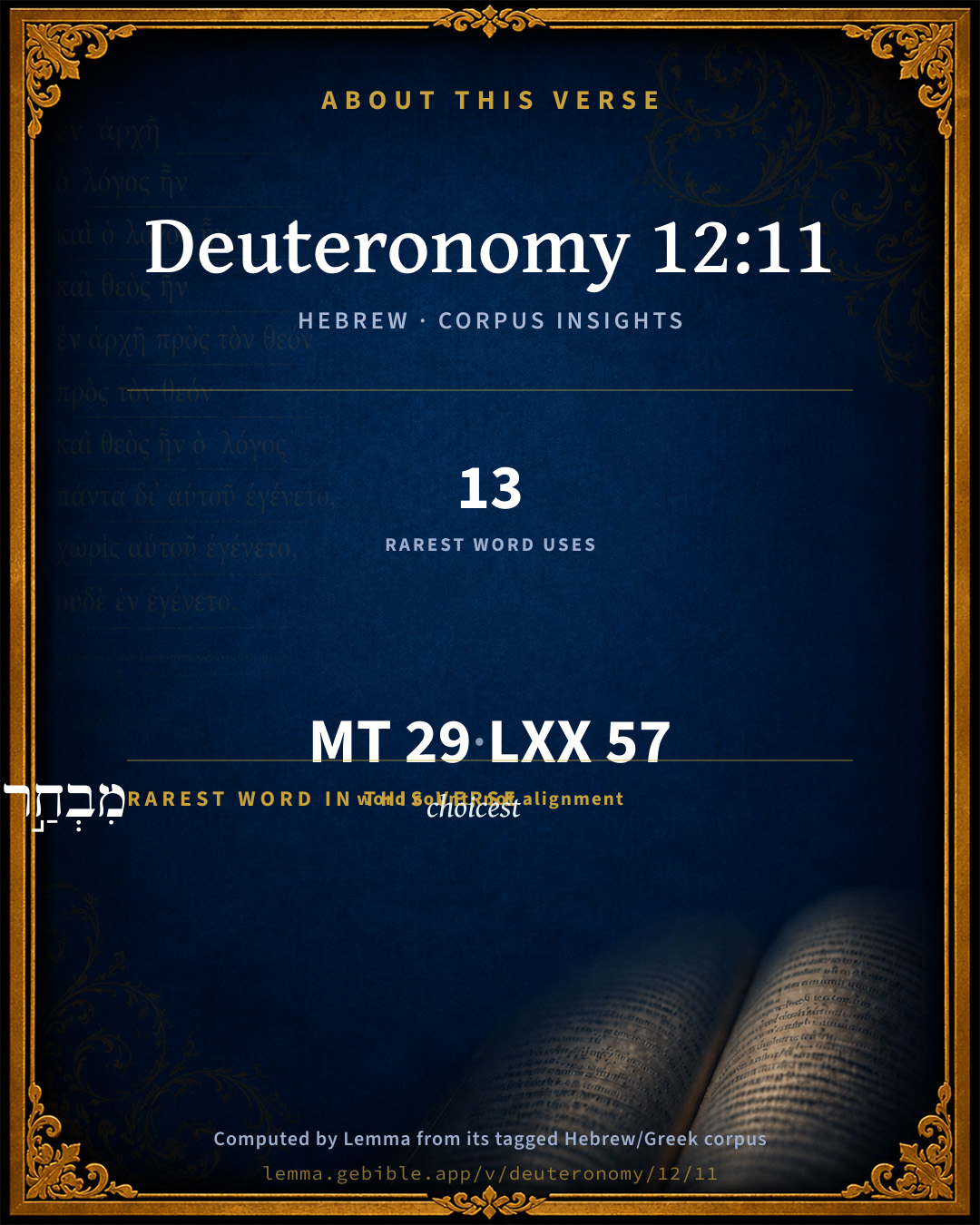
The rarest word here is מִבְחַ֣ר choicest H4005 — appearing just 13 times in the whole Hebrew Bible.

Shared distinctive vocabulary

מִבְחַ֣ר choicest H4005 occurs in 13 verses of the Hebrew Bible. Also found in:

Grammatical profile

  • 6 verbs
  • 14 nouns
  • 1 pronoun
  • 1 preposition
  • 2 adverbs
  • 5 particles

Verb forms

  • וְהָיָ֣ה Qal · Sequential Perfect
  • יִבְחַר֩ Qal · Imperfect
  • לְשַׁכֵּ֤ן Piel · Infinitive Construct
  • תָבִ֔יאוּ Hiphil · Imperfect
  • מְצַוֶּ֣ה Piel · Participle Active
  • תִּדְּר֖וּ Qal · Imperfect

Repetition

Words recur within this verse — often emphatic in Hebrew:

  • יְהוָ֨ה LORD H3068 ×2
  • שָׁ֔ם there H8033 ×2
  • כָּל all H3605 ×2
  • אֲשֶׁר which H834 ×3

Hebrew & Septuagint length

In English translation the verse runs 54 words from the Hebrew and 63 from the Septuagint (LXX English) — closely comparable.

A rough comparison of the two English renderings, which tokenize alike — not a word-level alignment.

Word counts can differ between the Hebrew and the Greek without any difference in meaning — e.g. the Hebrew direct-object marker אֵת has no separate Greek word, and Greek often adds the article ὁ.

In the original languages it is 29 Hebrew tokens and 57 Greek tokens — but the two are counted differently (Hebrew bundles its prefixes and suffixes into one token; the Greek is in lemma form), so that isn’t a like-for-like length.

Cross-references

19

Topical passages linked to Deuteronomy 12:11 in the Treasury of Scripture Knowledge — connected by theme and wording, ordered by reader-vote popularity; previews shown in the World English Bible.

  • Deuteronomy 12:5 But to the place which Yahweh your God shall choose out of all your tribes, to put his name there, even to his habitation shall you seek, and there you shall come;
  • Deuteronomy 15:20 You shall eat it before Yahweh your God year by year in the place which Yahweh shall choose, you and your household.
  • Deuteronomy 16:2–8 You shall sacrifice the Passover to Yahweh your God, of the flock and the herd, in the place which Yahweh shall choose, to cause his name to dwell there.
  • Deuteronomy 17:8 If there arise a matter too hard for you in judgment, between blood and blood, between plea and plea, and between stroke and stroke, being matters of controversy within your gates; then shall you arise, and go up to the place which Yahweh your God shall choose;
  • Deuteronomy 18:6 If a Levite comes from any of your gates out of all Israel, where he lives as a foreigner, and comes with all the desire of his soul to the place which Yahweh shall choose;
  • John 4:20–23 Our fathers worshiped in this mountain, and you Jews say that in Jerusalem is the place where people ought to worship."
  • Deuteronomy 12:14 but in the place which Yahweh shall choose in one of your tribes, there you shall offer your burnt offerings, and there you shall do all that I command you.
  • Deuteronomy 12:18 but you shall eat them before Yahweh your God in the place which Yahweh your God shall choose, you, and your son, and your daughter, and your man-servant, and your maid-servant, and the Levite who is within your gates: and you shall rejoice before Yahweh your God in all that you put your hand to.
  • Deuteronomy 12:21 If the place which Yahweh your God shall choose, to put his name there, be too far from you, then you shall kill of your herd and of your flock, which Yahweh has given you, as I have commanded you; and you may eat within your gates, after all the desire of your soul.
  • Deuteronomy 12:26 Only your holy things which you have, and your vows, you shall take, and go to the place which Yahweh shall choose:
  • Deuteronomy 14:23 You shall eat before Yahweh your God, in the place which he shall choose, to cause his name to dwell there, the tithe of your grain, of your new wine, and of your oil, and the firstborn of your herd and of your flock; that you may learn to fear Yahweh your God always.
  • Deuteronomy 23:16 he shall dwell with you, in the midst of you, in the place which he shall choose within one of your gates, where it pleases him best: you shall not oppress him.
  • Deuteronomy 26:2 that you shall take of the first of all the fruit of the ground, which you shall bring in from your land that Yahweh your God gives you; and you shall put it in a basket, and shall go to the place which Yahweh your God shall choose, to cause his name to dwell there.
  • Deuteronomy 31:11 when all Israel is come to appear before Yahweh your God in the place which he shall choose, you shall read this law before all Israel in their hearing.
  • Joshua 18:1 The whole congregation of the children of Israel assembled themselves together at Shiloh, and set up the tent of meeting there: and the land was subdued before them.
  • 1 Kings 8:13 I have surely built you a house of habitation, a place for you to dwell in forever.
  • 1 Kings 8:29 that your eyes may be open toward this house night and day, even toward the place of which you have said, My name shall be there; to listen to the prayer which your servant shall pray toward this place.
  • Psalms 78:68 But chose the tribe of Judah, Mount Zion which he loved.
  • Jeremiah 7:12 But go you now to my place which was in Shiloh, where I caused my name to dwell at the first, and see what I did to it for the wickedness of my people Israel.

Cross-references courtesy of OpenBible.info (CC BY 4.0).

Hebrew and Greek witnesses Masoretic Hebrew ↔ Greek Septuagint

The same verse in the two great witnesses to the Old Testament, shown verse-for-verse.

These are two independent witnesses, not word-aligned to each other, and the Septuagint is shown in lemma (dictionary) form.

Hebrew Deuteronomy 12:11 Masoretic · Westminster Leningrad Codex

וְהָיָ֣ה הַמָּק֗וֹם אֲשֶׁר יִבְחַר֩ יְהוָ֨ה אֱלֹהֵיכֶ֥ם בּוֹ֙ לְשַׁכֵּ֤ן שְׁמוֹ֙ שָׁ֔ם שָׁ֣מָּה תָבִ֔יאוּ אֵ֛ת כָּל אֲשֶׁ֥ר אָנֹכִ֖י מְצַוֶּ֣ה אֶתְכֶ֑ם עוֹלֹתֵיכֶ֣ם וְזִבְחֵיכֶ֗ם מַעְשְׂרֹֽתֵיכֶם֙ וּתְרֻמַ֣ת יֶדְכֶ֔ם וְכֹל֙ מִבְחַ֣ר נִדְרֵיכֶ֔ם אֲשֶׁ֥ר תִּדְּר֖וּ לַֽיהוָֽה

then it shall happen that to the place which Yahweh your God shall choose, to cause his name to dwell there, there shall you bring all that I command you: your burnt offerings, and your sacrifices, your tithes, and the heave-offering of your hand, and all your choice vows which you vow to Yahweh.

World English Bible · Public Domain

Greek LXX Deuteronomy 12:11 Septuagint · lemma form

καί εἰμί ὁ τόπος ὅς ἄν ἐκλέγω κύριος ὁ θεός σύ ἐπικαλέω ὁ ὄνομα αὐτός ἐκεῖ ἐκεῖ φέρω πᾶς ὅσος ἐγώ ἐντέλλομαι σύ σήμερον ὁ ὁλοκαύτωμα σύ καί ὁ θυσίασμα σύ καί ὁ ἐπιδέκατος σύ καί ὁ ἀπαρχή ὁ χείρ σύ καί ὁ δόμα σύ καί πᾶς ἐκλεκτός ὁ δῶρον σύ ὅσος ἐάν εὔχομαι ὁ θεός σύ

And there shall be a place which the Lord your God shall choose for his name to be called there, there shall you⌃ bring all things that I order you today; your whole burnt offerings, and your sacrifices, and your tithes, and the first fruits of your hands, and every choice gift of yours, whatever you⌃ shall vow to the Lord your God.

LXX2012 (modern English Septuagint) · Public Domain

On this verse, Haydock's Catholic Bible Commentary discusses the Septuagint’s reading. Read the note in Commentary ↓

Hebrew: Westminster Leningrad Codex (CC BY 4.0). Greek: Septuagint (public domain); English from LXX2012 (modern English Septuagint) (Public Domain). How the Septuagint differs from the Hebrew →

Targum (Aramaic paraphrase)

2

The Targum is the ancient Jewish Aramaic paraphrase of the Hebrew Scriptures — an interpretive translation, not the Hebrew text itself. Onkelos (literal) and Pseudo-Jonathan (expansive) render the Torah, and Jonathan the Prophets. Coverage is partial: where no permissively-licensed English translation exists for a verse, only the Aramaic is shown. This is verse-level text, not a word-by-word alignment to the Hebrew.

  1. Targum Onkelos Torah (Genesis–Deuteronomy)
    וִיהֵי אַתְרָא דִי יִתִּרְעֵי יְיָ אֱלָהֲכוֹן בֵּהּ לְאַשְׁרָאָה שְׁכִנְתֵּהּ תַּמָן לְתַמָן תַּיְתוּן יָת כָּל דִי אֲנָא מְפַקֵד יָתְכוֹן עֲלָוָתֵיכוֹן וְנִכְסַת קוּדְשֵׁיכוֹן מַעְשְׂרָתֵיכוֹן וְאַפְרָשׁוּת יֶדְכוֹן וְכֹל שְׁפַר נִדְרֵיכוֹן דִי תִדְרוּן קֳדָם יְיָ

    (no public-domain English translation for this verse)

    Targum Onkelos — Aramaic: “Onkelos Genesis” (public domain); “Onkelos Exodus” (public domain); “Onkelos Leviticus” (public domain); “Onkelos Numbers” (public domain); “Onkelos Deuteronomy” (public domain). English: “Sefaria Community Translation” (CC0 1.0 (public-domain dedication)); “J.W. Etheridge. The Targums of Onkelos and Jonathan Ben Uzziel on the Pentateuch. London: Longmans, Green, 1862” (public domain). Text via Sefaria.

  2. Targum Pseudo-Jonathan Torah (Genesis–Deuteronomy)
    וִיהֵי אַתְרָא דְיִתְרְעֵי בֵּיהּ מֵימְרָא דַיְיָ לְאַשְׁרָאָה שְׁכִינְתֵּיהּ תַּמָּן לְתַמָּן תַּיְיתוּן יַת כָּל קוּרְבָּנַיָא וּבִכּוּרַיָא וּמַעַשְרַיָא דַאֲנָא מְפַקֵּיד יַתְכוֹן תַּמָּן תִּקְרְבוּן עֲלָוַותְכוֹן וְנִכְסַת קוּדְשֵׁיכוֹן וְתַמָּן תֵּיכְלוּן מַעַשְרֵיכוֹן וְאַפְרָשׁוּת יְדֵיכוֹן וְכָל שְׁפַר נִדְרֵיכוֹן דְּתִידְרוּן קֳדָם יְיָ

    And to the place which the Word of the Lord will choose to make His Shekinah to dwell there, shall you bring all your oblations, firstlings, and tythes, which I command you; there shall you offer your sacrifices and hallowed victims, there eat your tythes and the separation of your hands, and all your goodly vows which you may have vowed before the Lord.

    Targum Pseudo-Jonathan — Aramaic: “Targum Jonathan on Genesis” (public domain); “Targum Jonathan on Exodus” (public domain); “Targum Jonathan on Leviticus” (public domain); “Targum Jonathan on Numbers” (public domain); “Targum Jonathan on Deuteronomy” (public domain). English: “The Targum of Jonathan ben Uzziel, trans. J. W. Etheridge, London, 1862” (public domain). Text via Sefaria.

Commentary

Notes on Deuteronomy 12:11 from classic Christian and Jewish commentators (each source and its license shown beneath its notes). The classic Christian expositions comment on the surrounding passage and are grouped to its opening verse, so a note may address several verses; the Jewish commentaries on the Tanakh (Rashi and others) are per-verse, so they appear only where the commentator wrote on this verse.

Lemma curates 59 commentaries, every one of them public domain or Creative Commons licensed, each selected and text-cleaned for this edition rather than reprinted as found. About our sources →

Trapp's Complete Commentary

John Trapp

Deu 12:11 Then there shall be a place which the LORD your God shall choose to cause his name to dwell there; thither shall ye bring all that I command you; your burnt offerings, and your sacrifices, your tithes, and the heave offering of your hand, and all your choice vows which ye vow unto the LORD:

Ver. 11. Your choice vows.] Your voluntary vows, and of your choicest commodities, the very best of the best.

John Trapp, A Commentary or Exposition upon All the Books of the Old and New Testament (1647–1656) — public domain. Text from a community e-Sword module.

Joseph Benson's Commentary

Deu 12:11. His name — His majesty and glory, his worship and service, his special and gracious presence. Your choice vows — Hebrew, the choice of your vows; that is, your select or chosen vows; so called, because things offered for vows were to be perfect, whereas defective creatures were accepted in free-will-offerings. Your daughters — Hence it appears, that though the males only were obliged to appear before God in their solemn feasts, yet the women also were permitted to come.

Joseph Benson's Commentary on the Old and New Testaments (1811–1818) — public domain. Text from a community e-Sword module.

Geneva Bible (1599)

Geneva Bible translators

Or, that which ye choose out for your vows.

Geneva Bible (1599) marginal notes — public domain. Text via Bolls.life.

Ellicott's Commentary for English Readers

(11) Then there shall be a place.—The building of Jerusalem and of the Temple brought with it in due time the accomplishment of the law which is appended to the prophecy.

A Bible Commentary for English Readers, edited by Charles John Ellicott (1878–1897) — public domain. Text from a community e-Sword module.

John Gill's Exposition

Then there shall be a place,.... Fixed and settled, and will be known to be the place:

which the Lord your God shall choose, to cause his name to dwell there: where he himself would dwell, and where his name would be called, and he would be worshipped:

thither shall ye bring all that I command you, your burnt offerings and your sacrifices, your tithes, and the heave offerings of your hands; of which See Gill on Deu 12:6.

and all your choice vows which ye vow unto the Lord; or, "the choice of your vows" (g); which, as Jarchi observes, was brought of their choicest things, as they ought to be; see Mal 1:14.

(g) , Sept. "optima votorum vestrorum", Fagius.

John Gill's Exposition of the Whole Bible (1746–1763) — public domain (CC PDM 1.0). Text via the HelloAO Bible API.

Haydock's Catholic Bible Commentary

Therein. While you are performing your duty to God, you need not fear the incursions of your enemies; or, according to the Hebrew, Septuagint, and Chaldean, "There shall be a place which....Thither," &c. (Menochius) --- Hands. Aquila, &c., have, "your voluntary oblations." --- Gifts. Hebrew, "your choice-vows." (Calmet)

George Leo Haydock (1774–1849), Haydock's Catholic Family Bible and Commentary, 1859 edition — public domain. Excludes Psalms (Douay-Rheims chapter numbering differs from Protestant) and Deuterocanonical books (Catholic canon only).

Matthew Poole's English Annotations

His name, i.e. his majesty and glory, his worship and service, his special and gracious presence, and the tokens of it.

All your choice vows, Heb. the choice of your vows. i.e. your select or chosen vows were to be perfect, whereas superfluous or deflective creatures were accepted in free-will offerings, as appears from Lev 22:21-23.

Matthew Poole's English Annotations on the Holy Bible (1683–1685) — public domain. Text from a community e-Sword/MySword module.

The Pulpit Commentary

All your choice vows; i.e. all the vows of your choice, all that ye choose to make; the vow was purely voluntary; it became obligatory only after it was made.

The Pulpit Commentary (1880–1919), ed. H.D.M. Spence-Jones & Joseph S. Exell — public domain. Text from a community e-Sword module.

John Wesley's Explanatory Notes

His name - His majesty and glory, his worship and service, his, special and gracious presence. Your choice vows - Hebrew. the choice of your vows, that is, your select or chosen vows; so called, because things offered for vows, were to be perfect, whereas defective creatures were accepted in free-will-offerings.

John Wesley, Explanatory Notes Upon the Whole Bible (1754–1765) — public domain. Text via the GEBible commentary corpus.

Rashi

Rabbi Shlomo Yitzchaki (Rashi)

והיה המקום וגו׳ IT SHALL BE [THAT YE SHALL BRING TO] THE PLACE [WHICH THE LORD YOUR GOD SHALL CHOOSE … EVEN THITHER YE SHALL BRING ALL THAT I COMMAND YOU] — then build the “Chosen House” for yourselves in Jerusalem. And so indeed it states of David, (II Samuel 7:1, 2): “And it came to pass when the king sat in his house, and the Lord had given him rest round about from all his enemies, that the king said unto Nathan the prophet, ‘See now, I dwell in the house of cedar, but the Ark of God dwelleth within curtains …'” (Sifrei Devarim 67:3; cf. Rashi on that verse).

שמה תביאו THITHER SHALL YE BRING [ALL THAT I COMMAND YOU] — Above (v. 6) it (the same expression) is said in reference to Shiloh, but here it is said in reference to Jerusalem. It is for the following reason that Scripture divides the matter into two paragraphs: to give permission to offer on a Bamah in the intermediate period between the existence of the one sanctuary and the other; viz., that after Shiloh was destroyed and they came to Nob and erected the Tabernacle there, and then again when Nob was destroyed and they came to Gibeon, sacrificing on the Bamah was allowed until they finally came to Jerusalem (Zevachim 119a and Mishnah Zevachim 14:1).

מבחר נדריכם YOUR CHOICE VOWS — This teaches that one should bring one’s offerings from the choicest (Sifrei Devarim 68:4).

Rashi on the Tanakh — English translations: “The Judaica Press complete Tanach with Rashi, translated by A. J. Rosenberg” (CC BY 4.0); “Pentateuch with Rashi's commentary by M. Rosenbaum and A.M. Silbermann, 1929-1934” (public domain); “The Metsudah Tanach series, Lakewood, N.J” (CC BY 4.0); and “The Book of Joshua, Metsudah Publications, 1997” (CC BY 4.0). Text via Sefaria.

Lesson kit

Teaching starters — assembled from the data on this page, not authored interpretation. Every prompt links to the verse data it draws on. Edit before teaching.

Deuteronomy, in the Pentateuch, opens this verse with 29 words (22 distinct Hebrew lemmas). Its most distinctive word is mibchâr (“choicest”). A historical commentator’s framing appears above. Read the whole chapter for the surrounding context.

Discussion questions

  1. What does “choicest” (mibchâr) contribute to the verse as a whole?
  2. Genesis 23:6 shares the word «choicest» with this verse. How do the two illuminate each other?
  3. “LORD” occurs 2× in this one verse. What is the effect of the repetition?
  4. These translations render this verse differently; the difference is in the English rendering, not the original. What questions does that raise?
  5. The verb «וְהָיָ֣ה» is Qal Sequential Perfect. How does its form color the action?
  6. Reading how Trapp's Complete Commentary and Joseph Benson's Commentary read this verse, where do the two commentators agree and where do they part?

Things to notice

Reading settings

Reading text

Shown beneath each verse's original-language words.

Old Testament
Old Testament edition

Read the OT as the Masoretic Hebrew (MT) or the Greek Septuagint (LXX).

English shown for the Greek Septuagint (in the Hebrew ↔ Greek comparison).

Comparing translations? Open the Compare panel on any verse page to stack up to four side by side.