1 Chronicles 17:19

Hebrew (Westminster Leningrad Codex) 1 Chronicles 17:19 appears in the Hebrew Old Testament. The text above is from the Westminster Leningrad Codex. Each word links to its Strong’s number, a concise gloss, and parsing drawn from the Open Scriptures Hebrew Bible morphology. Click any word for its full Brown-Driver-Briggs (BDB) entry.
Download image
Cite this verse

1 Chronicles 17:19 (World English Bible). Public Domain. Lemma interlinear Bible study tool, https://lemma.gebible.app/v/1-chronicles/17/19.

Show BibTeX & RIS
BibTeX
RIS
English Translation
Yahweh, for your servant's sake, and according to your own heart, have you worked all this greatness, to make known all [these] great things.
World English Bible · Public Domain
Download a study sheet

One document with this verse’s original text, its word-by-word gloss line, the meaning frame, cross-references with their text, attributed commentary, and full source and license credits — printable, and it pastes into notes with its structure intact.

This verse Autodidact and up

Study sheet (.html) Plain text (.txt)

A passage Seminary Student

Up to 50 verses in one chapter. A passage sheet keeps up to 6 commentary sources and 12 cross-references per verse, in the order this page ranks them, and says so on the sheet whenever that leaves anything out. Ask for a single verse and you get the Autodidact verse sheet above.

Everything on this page stays free to read, with no account — the sheet is a download of what is already on screen, not access to it.

Want to remove ads? Support Godless Engineer
Compare translations 3

The same verse in 3 English versions, stacked beneath the original-language interlinear above. Click any original word for its lexicon entry.

Each is an independent rendering of the whole verse — the interlinear is not word-aligned to these translations.

Highlighted words mark where these versions differ — a whole-verse word diff, not a word-by-word alignment.

  • World English Bible Public Domain
    Yahweh, for your servant's sake, and according to your own heart, have you worked all this greatness, to make known all [these] great things.
  • King James Version Public Domain
    O LORD, for thy servant's sake, and according to thine own heart, hast thou done all this greatness, in making known all these great things.
  • unfoldingWord Literal Text CC BY-SA 4.0
    Yahweh, for the sake of your servant and according to your heart, you have done all of this greatness, to make known all of the greatnesses.

unfoldingWord Literal Text — © unfoldingWord, licensed CC BY-SA 4.0. Word-aligned USFM3 via Door43 (git.door43.org/unfoldingWord/en_ult).

Versions to compare (up to 4)

3 of 4 selected

Show all 18 translations

Every available English version of this verse, each an independent rendering of the whole verse.

  • World English Bible Public Domain
    Yahweh, for your servant's sake, and according to your own heart, have you worked all this greatness, to make known all [these] great things.
  • Berean Standard Bible Public Domain
    O LORD. For the sake of Your servant and according to Your own heart, You have accomplished this great thing and revealed all Your greatness.
  • Majority Standard Bible Public Domain
    O LORD. For the sake of Your servant and according to Your own heart, You have accomplished this great thing and made known all these great promises.
  • King James Version Public Domain
    O LORD, for thy servant's sake, and according to thine own heart, hast thou done all this greatness, in making known all these great things.
  • American Standard Version (1901) Public Domain
    O Jehovah, for thy servant's sake, and according to thine own heart, hast thou wrought all this greatness, to make known all `these' great things.
  • Revised Version (1885) Public Domain
    O LORD, for thy servant’s sake, and according to thine own heart, hast thou wrought all this greatness, to make known all these great things.
  • Geneva Bible (1599) Public Domain
    O Lord, for thy seruantes sake, euen according to thine heart hast thou done all this great thing to declare all magnificence.
  • Douay-Rheims (1899) Public Domain
    O Lord, for thy servant's sake, according to thy own heart, thou hast shewn all this magnificence, and wouldst have all the great things to be known.
  • Young's Literal Translation Public Domain
    O Jehovah, for Thy servant's sake, and according to Thine own heart Thou hast done all this greatness, to make known all these great things.
  • Literal Standard Version CC BY-SA 4.0
    O YHWH, for Your servant’s sake, and according to Your own heart You have done all this greatness, to make known all these great things.
  • Unlocked Literal Bible CC BY-SA 4.0
    Yahweh, for your servant's sake, and to fulfill your own purpose, you have done this great thing to reveal all your great deeds.
  • unfoldingWord Literal Text CC BY-SA 4.0
    Yahweh, for the sake of your servant and according to your heart, you have done all of this greatness, to make known all of the greatnesses.
  • Darby Bible Public Domain
    Jehovah, for thy servant's sake, and according to thine own heart, hast thou done all this greatness, to make known all these great things.
  • World Messianic Bible Public Domain
    LORD, for your servant’s sake, and according to your own heart, you have done all this greatness, to make known all these great things.
  • Webster's Bible Public Domain
    O LORD, for thy servant's sake, and according to thy own heart, hast thou done all this greatness, in making known all these great things.
  • Free Bible Version CC BY-SA 4.0
    Lord, you're doing all this for me, your servant, and because it's what you want—doing all these amazing things and letting people know about them.
  • Bible in Basic English Public Domain
    O Lord, because of your servant, and from your heart, you have done all these great things and let them be seen.
  • JPS Tanakh (1917) Public Domain
    O LORD, for Thy servant's sake, and according to Thine own heart, hast Thou wrought all this greatness, to make known all these great things.

Literal Standard Version (2020), Covenant Press — licensed CC BY-SA 4.0. Text via the HelloAO Bible API (eBible.org). Unlocked Literal Bible (unfoldingWord) — licensed CC BY-SA 4.0. Text via the HelloAO Bible API (eBible.org). unfoldingWord Literal Text — © unfoldingWord, licensed CC BY-SA 4.0. Word-aligned USFM3 via Door43 (git.door43.org/unfoldingWord/en_ult). Free Bible Version, Dr. Jonathan Gallagher — licensed CC BY-SA 4.0. Text via the HelloAO Bible API (eBible.org).

Word by word

More ways to search: Search by grammar → Find every occurrence → Compare this word →

Practice this passage: Drill this verse → Learn its vocabulary →

הַגְּדוּלָּ֖ה
gᵉdûwlâh
H1420
“the · greatness”
Particle, Definite Article + Noun, Common, Feminine, Singular, Absolute
Part of Speech
Particle + Noun
Type
Common
Gender
Feminine
Number
Singular
State
Absolute
Full BDB Definition

Origin: from H1419

TWOT: 315e

greatness - of man - of God's greatness (as an attribute)
  1. יְהוָ֕ה Yᵉhôvâh H3068 “LORD” Noun, Proper
  2. בַּעֲב֤וּר ʻâbûwr H5668 “in/at · because of of” Preposition + Noun, Common, Masculine, Singular, Construct
  3. עַבְדְּךָ֙ ʻebed H5650 “servant · your” Noun, Common, Masculine, Singular, Construct + Suffix, Personal, 2nd Person, Masculine, Singular
  4. וּֽכְלִבְּךָ֔ lêb H3820 “and · like/as · heart · your” Conjunction + Preposition + Noun, Common, Masculine, Singular, Construct + Suffix, Personal, 2nd Person, Masculine, Singular
  5. עָשִׂ֕יתָ ʻâsâh H6213 “to do” Verb, Qal, Perfect, 2nd Person, Masculine, Singular
  6. אֵ֥ת ʼêth H853 “-” Particle, Direct Object
  7. כָּל kôl H3605 “all of” Noun, Common, Masculine, Singular, Construct
  8. הַזֹּ֑את zôʼth H2063 “the · this” Particle, Definite Article + Pronoun, Demonstrative, Feminine, Singular
  9. לְהֹדִ֖יעַ yâdaʻ H3045 “to know” Preposition + Verb, Hiphil, Infinitive Construct
  10. אֶת ʼêth H853 “-” Particle, Direct Object
  11. כָּל kôl H3605 “all of” Noun, Common, Masculine, Singular, Construct
  12. הַגְּדֻלּֽוֹת gᵉdûwlâh H1420 “the · greatness” Particle, Definite Article + Noun, Common, Feminine, Plural, Absolute

About this verse

These counts appear in no published source. They are computed here, from the morphology-tagged text and Lemma’s own curated glosses. What Lemma adds →

13
words
10
distinct lemmas
Historical
section

Notable vocabulary

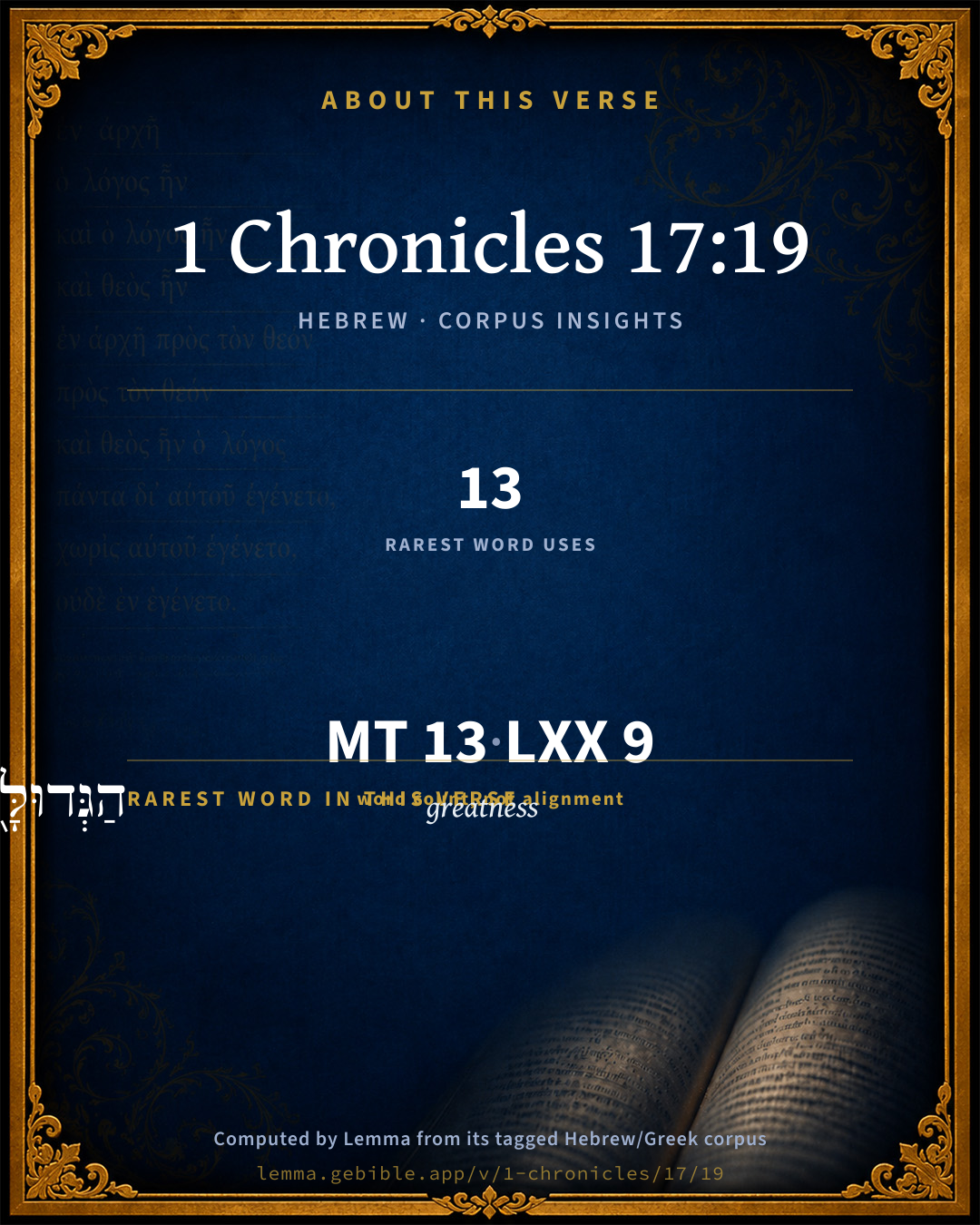
The rarest word here is הַגְּדוּלָּ֖ה greatness H1420 — appearing just 13 times in the whole Hebrew Bible.

Shared distinctive vocabulary

הַגְּדוּלָּ֖ה greatness H1420 occurs in 11 verses of the Hebrew Bible. Also found in:

Grammatical profile

  • 2 verbs
  • 8 nouns
  • 1 pronoun
  • 2 particles

Verb forms

  • עָשִׂ֕יתָ Qal · Perfect
  • לְהֹדִ֖יעַ Hiphil · Infinitive Construct

Repetition

Words recur within this verse — often emphatic in Hebrew:

  • כָּל all H3605 ×2
  • הַגְּדוּלָּ֖ה greatness H1420 ×2

Hebrew & Septuagint length

In English translation the verse runs 24 words from the Hebrew and 11 from the Septuagint (LXX English) — the Septuagint runs noticeably shorter here. See the side-by-side →

A rough comparison of the two English renderings, which tokenize alike — not a word-level alignment.

Word counts can differ between the Hebrew and the Greek without any difference in meaning — e.g. the Hebrew direct-object marker אֵת has no separate Greek word, and Greek often adds the article ὁ.

In the original languages it is 13 Hebrew tokens and 9 Greek tokens — but the two are counted differently (Hebrew bundles its prefixes and suffixes into one token; the Greek is in lemma form), so that isn’t a like-for-like length.

Cross-references

12

Topical passages linked to 1 Chronicles 17:19 in the Treasury of Scripture Knowledge — connected by theme and wording, ordered by reader-vote popularity; previews shown in the World English Bible.

  • Isaiah 37:35 For I will defend this city to save it, for my own sake, and for my servant David's sake.
  • Isaiah 49:5–6 Now says Yahweh who formed me from the womb to be his servant, to bring Jacob again to him, and that Israel be gathered to him (for I am honorable in the eyes of Yahweh, and my God is become my strength);
  • Ephesians 1:9–11 making known to us the mystery of his will, according to his good pleasure which he purposed in him
  • 2 Samuel 7:21 For your word's sake, and according to your own heart, have you worked all this greatness, to make your servant know it.
  • 1 Chronicles 29:11–12 Yours, Yahweh, is the greatness, the power, the glory, the victory, and the majesty: for all that is in the heavens and in the earth is yours. Yours is the kingdom, Yahweh, and you are exalted as head above all.
  • Psalms 111:3 His work is honor and majesty. His righteousness endures forever.
  • Psalms 111:6 He has shown his people the power of his works, In giving them the heritage of the nations.
  • Isaiah 42:1 Behold, my servant, whom I uphold; my chosen, in whom my soul delights: I have put my Spirit on him; he will bring forth justice to the Gentiles.
  • Isaiah 49:3 and he said to me, You are my servant; Israel, in whom I will be glorified.
  • Daniel 9:17 Now therefore, our God, listen to the prayer of your servant, and to his petitions, and cause your face to shine on your sanctuary that is desolate, for the Lord's sake.
  • Matthew 11:26 Yes, Father, for so it was well-pleasing in your sight.
  • Ephesians 3:11 according to the eternal purpose which he purposed in Christ Jesus our Lord;

Cross-references courtesy of OpenBible.info (CC BY 4.0).

Hebrew and Greek witnesses Masoretic Hebrew ↔ Greek Septuagint

The same verse in the two great witnesses to the Old Testament, shown verse-for-verse.

Here the Septuagint runs noticeably shorter than the Hebrew — LXX2012 (modern English Septuagint) 11 words vs World English Bible 24. A rough length comparison of the two English translations, not a word-level alignment — read both below.

These are two independent witnesses, not word-aligned to each other, and the Septuagint is shown in lemma (dictionary) form.

Hebrew 1 Chronicles 17:19 Masoretic · Westminster Leningrad Codex

יְהוָ֕ה בַּעֲב֤וּר עַבְדְּךָ֙ וּֽכְלִבְּךָ֔ עָשִׂ֕יתָ אֵ֥ת כָּל הַגְּדוּלָּ֖ה הַזֹּ֑את לְהֹדִ֖יעַ אֶת כָּל הַגְּדֻלּֽוֹת

Yahweh, for your servant's sake, and according to your own heart, have you worked all this greatness, to make known all [these] great things.

World English Bible · Public Domain

Greek LXX 1 Chronicles 17:19 Septuagint · lemma form

καί κατά ὁ καρδία σύ ποιέω ὁ πᾶς μεγαλωσύνη

And you have wrought all this greatness according to your heart.

LXX2012 (modern English Septuagint) · Public Domain

Hebrew: Westminster Leningrad Codex (CC BY 4.0). Greek: Septuagint (public domain); English from LXX2012 (modern English Septuagint) (Public Domain). How the Septuagint differs from the Hebrew →

Commentary

Notes on 1 Chronicles 17:19 from classic Christian and Jewish commentators (each source and its license shown beneath its notes). The classic Christian expositions comment on the surrounding passage and are grouped to its opening verse, so a note may address several verses; the Jewish commentaries on the Tanakh (Rashi and others) are per-verse, so they appear only where the commentator wrote on this verse.

Lemma curates 59 commentaries, every one of them public domain or Creative Commons licensed, each selected and text-cleaned for this edition rather than reprinted as found. About our sources →

Geneva Bible (1599)

Geneva Bible translators

Freely and according to the purpose of thy will, without any deserving.

Geneva Bible (1599) marginal notes — public domain. Text via Bolls.life.

Ellicott's Commentary for English Readers

(19) O Lord.—Not in Samuel. Probably belongs to end of last verse.

For thy servant’s sake.—Comp. Psa_132:10; 2Ch_6:42. Samuel has the more original “for thy word’s sake.” (Comp. 1Ch_17:23, and 1Ch_16:15.)

Heart—i.e., purpose, intent.

In making known all these great things. (greatnesses).—The repetition “greatness . . . greatnesses” is probably a scribe’s error. Samuel has the right text: “Thou hast done all this greatness” (work of power, δύναμις), viz., informing Thy servant of what shall be hereafter. Isaiah makes the miracle of prediction a special difference between the true God and idols (Isa_41:21-29; Isa_45:11; Isa_45:21).

A Bible Commentary for English Readers, edited by Charles John Ellicott (1878–1897) — public domain. Text from a community e-Sword module.

The Cambridge Bible for Schools and Colleges

gen. ed. J. J. S. Perowne

19. for thy servant’s sake] 2Sa_7:21, for thy word’s sake, a better reading.

The Cambridge Bible for Schools and Colleges (gen. ed. J. J. S. Perowne; Cambridge University Press, 1878–1918) — public domain. Text from a community e-Sword module.

Matthew Poole's English Annotations

For thy servant’s sake; in 2Sa 7:21, it is, for thy word’s sake, i.e. for the sake of thy word and promise made to thy servant; as that phrase, for David’s sake, is oft thus understood, for God’s covenant’s sake made with David.

Matthew Poole's English Annotations on the Holy Bible (1683–1685) — public domain. Text from a community e-Sword/MySword module.

The Pulpit Commentary

For thy servant"s sake. The parallel place reads, "For thy word"s sake." This reading is superior, and well suits the connection, suggesting also whether the first occurrence of the word "servant" in the previous verse might not be similarly explained. The similarity of the characters of the words in the Hebrew would render easy the exchange of the one word for the other.

Vers. 19-24.

Pleas in prayer.

David was pleading with God, and, in asking him to confirm and establish his word of promise, he made reference to four grounds of appeal. These we may substantially adopt, adding another "all-prevailing plea" which David could not introduce.

I GOD"S LOVE TO US AS INDIVIDUAL SOULS. "Thy servant"s sake" (ver. 19). At other times we read, "For thy servant David"s sake;" i.e. for the love which God bore to this servant and son of his. We may ask God to help us because we know he loves us; because he pities us who fear; (Psa_103:13) because he remembers us in our low estate, and counts our tears, and desires our happiness and well-being.

II HIS OWN DIVINE BENIGNITY AND HONOUR. (Vers. 19, 20, 24.) "According to thine own heart;" that he may act like himself, with the boundless grace and goodness which belong to his Divine nature. "That thy Name may be magnified for ever," etc. (ver. 24); that all nations may know that thou art a faithful God, continuing thy loving-kindnesses, and redeeming thy word to the land that is so peculiarly thine own. We may well plead the nature of God as a very strong reason why he should bless us. If he grant our request "according to his own heart," if he fill our treasury and satisfy our want in accordance with the tenderness of his heart, the strength and bounty of his hand, and to the glory of his Name, we shall be enriched indeed.

III HIS CARE FOR HIS CHURCH. (Vers. 21, 22.) As David prayed God to fulfil all the good pleasure of his will on account of Israel, whom he had redeemed and attached to himself by his special mercies, so may we ask for all great things to be done for us on account of that Church for which the Son of God suffered and died, which he "redeemed with his precious blood.

IV THE DIVINE PROMISE. "The thing that thou hast spoken concerning thy servant," etc. We have great promises to plead with God, based on his own inviolable word; and there can be no more solid ground on which to build our hope in prayer to God. There is one additional plea with which we are familiar, but which the King of Israel lived far too soon to urge. (see Luk_10:24) We plead with God

V THE NAME AND WORK OF THE LORD JESUS CHRIST. For the sake of him who loved us and gave himself for us, who lived and died on our behalf, we ask for all those blessings we need; for mercy, for acceptance and sonship, for Divine guidance and protection along the path of life, for the indwelling Spirit, for help and blessing in Christian work, for an abundant entrance into the kingdom of heaven. C.

The Pulpit Commentary (1880–1919), ed. H.D.M. Spence-Jones & Joseph S. Exell — public domain. Text from a community e-Sword module.

John Wesley's Explanatory Notes

Servant's sake - In 2 Sam. vii, 21, it is, for thy words sake, for the sake of thy promise made to thy servant.

John Wesley, Explanatory Notes Upon the Whole Bible (1754–1765) — public domain. Text via the GEBible commentary corpus.

unfoldingWord translationNotes

Door43 World Missions Community

Connecting Statement:

David continues to speak to Yahweh.

your servant's sake

Here David refers to himself as "your servant." This can be stated in first person. AT: "my sake" or "my benefit" (See: First, Second, or Third Person)

to fulfill your own purpose

"to accomplish what you planned to do"

there is none like you, and there is no God besides you

These phrases have similar meaning and are repeated for emphasis. (See: Parallelism)

as we have always heard

Here "we" refers to David and the nation of Israel. (See: Exclusive and Inclusive "We")

what nation on earth ... by great and awesome deeds?

This question expects a negative answer to make the point that there was no other nation like Israel. It can be translated as a statement. AT: "there is no nation on earth ... by great and awesome deeds." (See: Rhetorical Question)

you rescued from Egypt

The implied information is that they were rescued from slavery. AT: "you rescued from slavery in Egypt" (See: Assumed Knowledge and Implicit Information)

to make a name for yourself

Here "name" represents Yahweh's reputation. AT: "to make all people know who you are" (See: Metonymy)

You drove out nations

Here "nations" represents the people groups that were living in Canaan. (See: Metonymy)

translationWords

reveal

works

nation

earth

Israel

Egypt

name

awe

cast out

unfoldingWord translationNotes — © Distant Shores Media and the Door43 World Missions Community, licensed CC BY-SA 4.0. Source: git.door43.org/Door43/en_tn.

Rashi

Rabbi Shlomo Yitzchaki (Rashi)

O Lord, for the sake of Your servant This is connected to the preceding verse, as follows: And You did so much to let me know of all this greatness that You let me know, and all was from the desire of Your heart. Therefore...

Rashi on the Tanakh — English translations: “The Judaica Press complete Tanach with Rashi, translated by A. J. Rosenberg” (CC BY 4.0); “Pentateuch with Rashi's commentary by M. Rosenbaum and A.M. Silbermann, 1929-1934” (public domain); “The Metsudah Tanach series, Lakewood, N.J” (CC BY 4.0); and “The Book of Joshua, Metsudah Publications, 1997” (CC BY 4.0). Text via Sefaria.

Lesson kit

Teaching starters — assembled from the data on this page, not authored interpretation. Every prompt links to the verse data it draws on. Edit before teaching.

1 Chronicles, in the Historical, opens this verse with 13 words (10 distinct Hebrew lemmas). Its most distinctive word is gᵉdûwlâh (“greatness”). The Greek Septuagint runs shorter here. A historical commentator’s framing appears above. Read the whole chapter for the surrounding context.

Discussion questions

  1. The word gᵉdûwlâh carries the sense “greatness.” How does it shape the verse?
  2. How does 2 Samuel 7:21, which shares the word «greatness», read alongside this verse?
  3. What does the repetition of “all” (2× in this one verse) do in this verse?
  4. The Septuagint runs shorter here than the Hebrew. What might account for the difference?
  5. The translations on this page render this verse differently — a whole-verse word diff, not a word-by-word alignment. What might account for the different wordings?
  6. «עָשִׂ֕יתָ» is a Qal Perfect verb. How does that grammatical form shape the action described?
  7. Compare how Geneva Bible (1599) and Ellicott's Commentary for English Readers read this verse. Where do they agree or differ?

Things to notice

Reading settings

Reading text

Shown beneath each verse's original-language words.

Old Testament
Old Testament edition

Read the OT as the Masoretic Hebrew (MT) or the Greek Septuagint (LXX).

English shown for the Greek Septuagint (in the Hebrew ↔ Greek comparison).

Comparing translations? Open the Compare panel on any verse page to stack up to four side by side.