Exodus 12:14

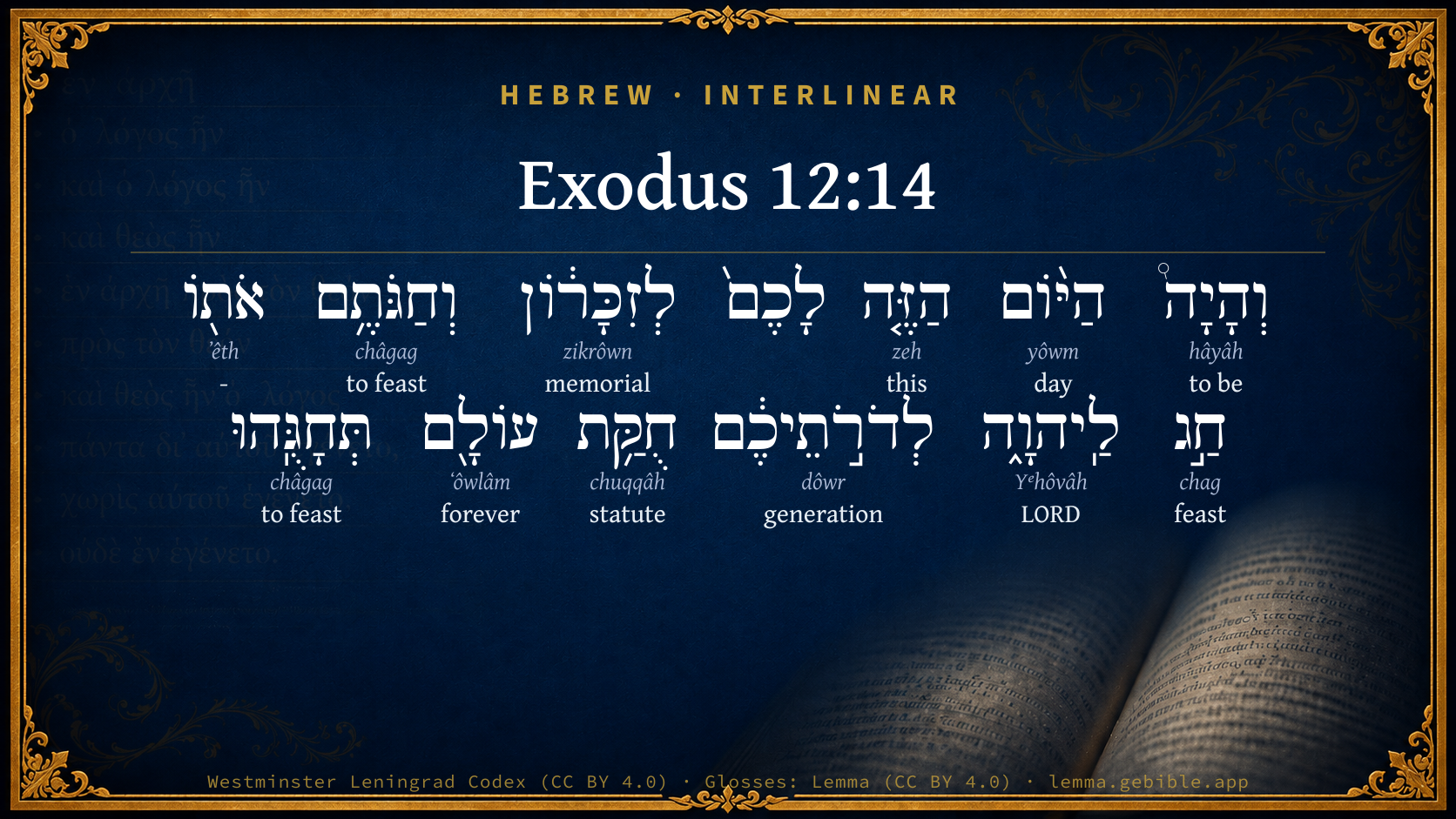
Hebrew (Westminster Leningrad Codex) Exodus 12:14 appears in the Hebrew Old Testament. The text above is from the Westminster Leningrad Codex. Each word links to its Strong’s number, a concise gloss, and parsing drawn from the Open Scriptures Hebrew Bible morphology. Click any word for its full Brown-Driver-Briggs (BDB) entry.
Download image
Cite this verse

Exodus 12:14 (World English Bible). Public Domain. Lemma interlinear Bible study tool, https://lemma.gebible.app/v/exodus/12/14.

Show BibTeX & RIS
BibTeX
RIS
English Translation
This day shall be to you for a memorial, and you shall keep it a feast to Yahweh: throughout your generations you shall keep it a feast by an ordinance forever.
World English Bible · Public Domain
Highlights
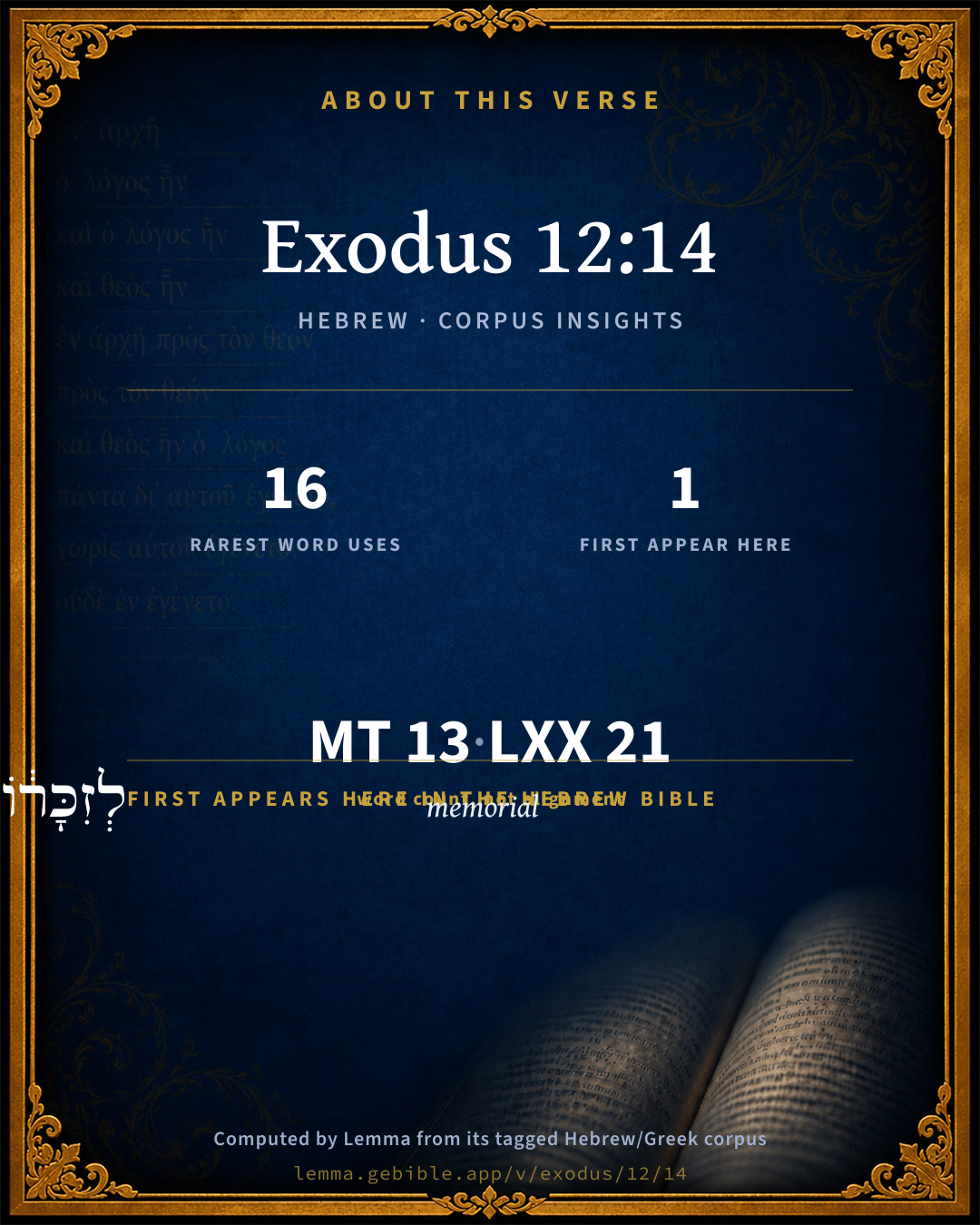
  • 1 first appearance in the Hebrew Bible
Full analysis ↓
Download a study sheet

One document with this verse’s original text, its word-by-word gloss line, the meaning frame, cross-references with their text, attributed commentary, and full source and license credits — printable, and it pastes into notes with its structure intact.

This verse Autodidact and up

Study sheet (.html) Plain text (.txt)

A passage Seminary Student

Up to 50 verses in one chapter. A passage sheet keeps up to 6 commentary sources and 12 cross-references per verse, in the order this page ranks them, and says so on the sheet whenever that leaves anything out. Ask for a single verse and you get the Autodidact verse sheet above.

Everything on this page stays free to read, with no account — the sheet is a download of what is already on screen, not access to it.

Want to remove ads? Support Godless Engineer
Compare translations 3

The same verse in 3 English versions, stacked beneath the original-language interlinear above. Click any original word for its lexicon entry.

Each is an independent rendering of the whole verse — the interlinear is not word-aligned to these translations.

Highlighted words mark where these versions differ — a whole-verse word diff, not a word-by-word alignment.

  • World English Bible Public Domain
    This day shall be to you for a memorial, and you shall keep it a feast to Yahweh: throughout your generations you shall keep it a feast by an ordinance forever.
  • King James Version Public Domain
    And this day shall be unto you for a memorial; and ye shall keep it a feast to the LORD throughout your generations; ye shall keep it a feast by an ordinance for ever.
  • unfoldingWord Literal Text CC BY-SA 4.0
    And this day shall become a memorial for you, and you shall celebrate it as a festival to Yahweh for your generations—a statute you shall celebrate forever.

unfoldingWord Literal Text — © unfoldingWord, licensed CC BY-SA 4.0. Word-aligned USFM3 via Door43 (git.door43.org/unfoldingWord/en_ult).

Versions to compare (up to 4)

3 of 4 selected

Show all 18 translations

Every available English version of this verse, each an independent rendering of the whole verse.

  • World English Bible Public Domain
    This day shall be to you for a memorial, and you shall keep it a feast to Yahweh: throughout your generations you shall keep it a feast by an ordinance forever.
  • Berean Standard Bible Public Domain
    And this day will be a memorial for you, and you are to celebrate it as a feast to the LORD, as a permanent statute for the generations to come.
  • Majority Standard Bible Public Domain
    And this day will be a memorial for you, and you are to celebrate it as a feast to the LORD, as a permanent statute for the generations to come.
  • King James Version Public Domain
    And this day shall be unto you for a memorial; and ye shall keep it a feast to the LORD throughout your generations; ye shall keep it a feast by an ordinance for ever.
  • American Standard Version (1901) Public Domain
    And this day shall be unto you for a memorial, and ye shall keep it a feast to Jehovah: throughout your generations ye shall keep it a feast by an ordinance for ever.
  • Revised Version (1885) Public Domain
    And this day shall be unto you for a memorial, and ye shall keep it a feast to the LORD: throughout your generations ye shall keep it a feast by an ordinance for ever.
  • Geneva Bible (1599) Public Domain
    And this day shalbe vnto you a remembrance: and ye shall keepe it an holie feast vnto the Lord, throughout your generations: yee shall keepe it holie by an ordinance for euer.
  • Douay-Rheims (1899) Public Domain
    And this day shall be for a memorial to you: and you shall keep it a feast to the Lord in your generations with an everlasting observance.
  • Young's Literal Translation Public Domain
    `And this day hath become to you a memorial, and ye have kept it a feast to Jehovah to your generations; -- a statute age-during; ye keep it a feast.
  • Literal Standard Version CC BY-SA 4.0
    And this day has become a memorial to you, and you have kept it [for] a celebration to YHWH throughout your generations—a continuous statute; you keep it [for] a celebration.
  • Unlocked Literal Bible CC BY-SA 4.0
    This day will become a memorial day for you, which you must observe as a festival for Yahweh. It will always be a law for you, throughout your people's generations, that you must observe this day.
  • unfoldingWord Literal Text CC BY-SA 4.0
    And this day shall become a memorial for you, and you shall celebrate it as a festival to Yahweh for your generations—a statute you shall celebrate forever.
  • Darby Bible Public Domain
    And this day shall be unto you for a memorial; and ye shall celebrate it [as] a feast to Jehovah; throughout your generations [as] an ordinance for ever shall ye celebrate it.
  • World Messianic Bible Public Domain
    This day shall be a memorial for you. You shall keep it as a feast to the LORD. You shall keep it as a feast throughout your generations by an ordinance forever.
  • Webster's Bible Public Domain
    And this day shall be to you for a memorial; and ye shall keep it a feast to the LORD throughout your generations: ye shall keep it a feast by an ordinance for ever.
  • Free Bible Version CC BY-SA 4.0
    This will be a day to remember for you. You are to celebrate it as a festival to the Lord for generations to come. You will observe this for all time to come.
  • Bible in Basic English Public Domain
    And this day is to be kept in your memories: you are to keep it as a feast to the Lord through all your generations, as an order for ever.
  • JPS Tanakh (1917) Public Domain
    And this day shall be unto you for a memorial, and ye shall keep it a feast to the LORD; throughout your generations ye shall keep it a feast by an ordinance for ever.

Literal Standard Version (2020), Covenant Press — licensed CC BY-SA 4.0. Text via the HelloAO Bible API (eBible.org). Unlocked Literal Bible (unfoldingWord) — licensed CC BY-SA 4.0. Text via the HelloAO Bible API (eBible.org). unfoldingWord Literal Text — © unfoldingWord, licensed CC BY-SA 4.0. Word-aligned USFM3 via Door43 (git.door43.org/unfoldingWord/en_ult). Free Bible Version, Dr. Jonathan Gallagher — licensed CC BY-SA 4.0. Text via the HelloAO Bible API (eBible.org).

Word by word

More ways to search: Search by grammar → Find every occurrence → Compare this word →

Practice this passage: Drill this verse → Learn its vocabulary →

וְחַגֹּתֶ֥ם
châgag
H2287
“and · to feast”
Conjunction + Verb, Qal, Sequential Perfect, 2nd Person, Masculine, Plural
Part of Speech
Conjunction + Verb
Stem
Qal
Form
Sequential Perfect
Person
2nd Person
Gender
Masculine
Number
Plural
Full BDB Definition

Origin: a primitive root [compare H2283 , H2328 ]

TWOT: 602

to hold a feast, hold a festival, make pilgrimage, keep a pilgrim-feast, celebrate, dance, stagger - (Qal) - to keep a pilgrim-feast - to reel
  1. וְהָיָה֩ hâyâh H1961 “and · to be” Conjunction + Verb, Qal, Sequential Perfect, 3rd Person, Masculine, Singular
  2. הַיּ֨וֹם yôwm H3117 “the · day” Particle, Definite Article + Noun, Common, Masculine, Singular, Absolute
  3. הַזֶּ֤ה zeh H2088 “the · this” Particle, Definite Article + Pronoun, Demonstrative, Masculine, Singular
  4. לְזִכָּר֔וֹן zikrôwn H2146 “to/for · memorial” Preposition + Noun, Common, Masculine, Singular, Absolute
  5. אֹת֖וֹ ʼêth H853 “- · him” Particle, Direct Object + Suffix, Personal, 3rd Person, Masculine, Singular
  6. חַ֣ג chag H2282 “feast” Noun, Common, Masculine, Singular, Absolute
  7. לַֽיהוָ֑ה Yᵉhôvâh H3068 “to/for · LORD” Preposition + Noun, Proper
  8. לְדֹרֹ֣תֵיכֶ֔ם dôwr H1755 “to/for · generations · your” Preposition + Noun, Common, Masculine, Plural, Construct + Suffix, Personal, 2nd Person, Masculine, Plural
  9. חֻקַּ֥ת chuqqâh H2708 “statute of” Noun, Common, Both, Singular, Construct
  10. עוֹלָ֖ם ʻôwlâm H5769 “forever” Noun, Common, Masculine, Singular, Absolute
  11. תְּחָגֻּֽהוּ châgag H2287 “to feast · him” Verb, Qal, Imperfect, 2nd Person, Masculine, Plural + Suffix, Personal, 3rd Person, Masculine, Singular

About this verse

These counts appear in no published source. They are computed here, from the morphology-tagged text and Lemma’s own curated glosses. What Lemma adds →

13
words
11
distinct lemmas
Pentateuch
section

Notable vocabulary

The rarest word here is וְחַגֹּתֶ֥ם to feast H2287 — appearing just 16 times in the whole Hebrew Bible.

First appearance in Scripture

This word makes its first canonical appearance in the Hebrew Bible here:

  • לְזִכָּר֔וֹן memorial H2146

Shared distinctive vocabulary

וְחַגֹּתֶ֥ם to feast H2287 occurs in 14 verses of the Hebrew Bible. Also found in:

Grammatical profile

  • 3 verbs
  • 7 nouns
  • 1 pronoun
  • 1 preposition
  • 1 particle

Verb forms

  • וְהָיָה֩ Qal · Sequential Perfect
  • וְחַגֹּתֶ֥ם Qal · Sequential Perfect
  • תְּחָגֻּֽהוּ Qal · Imperfect

Repetition

A word recurs within this verse — often emphatic in Hebrew:

  • וְחַגֹּתֶ֥ם to feast H2287 ×2

Hebrew & Septuagint length

In English translation the verse runs 31 words from the Hebrew and 33 from the Septuagint (LXX English) — closely comparable.

A rough comparison of the two English renderings, which tokenize alike — not a word-level alignment.

Word counts can differ between the Hebrew and the Greek without any difference in meaning — e.g. the Hebrew direct-object marker אֵת has no separate Greek word, and Greek often adds the article ὁ.

In the original languages it is 13 Hebrew tokens and 21 Greek tokens — but the two are counted differently (Hebrew bundles its prefixes and suffixes into one token; the Greek is in lemma form), so that isn’t a like-for-like length.

Cross-references

23

Topical passages linked to Exodus 12:14 in the Treasury of Scripture Knowledge — connected by theme and wording, ordered by reader-vote popularity; previews shown in the World English Bible.

  • 2 Kings 23:21 The king commanded all the people, saying, Keep the Passover to Yahweh your God, as it is written in this book of the covenant.
  • Exodus 12:17 You shall observe the feast of unleavened bread; for in this same day have I brought your hosts out of the land of Egypt: therefore shall you observe this day throughout your generations by an ordinance forever.
  • Exodus 12:24 You shall observe this thing for an ordinance to you and to your sons forever.
  • Exodus 13:9–10 It shall be for a sign to you on your hand, and for a memorial between your eyes, that the law of Yahweh may be in your mouth; for with a strong hand Yahweh has brought you out of Egypt.
  • 1 Corinthians 5:7–8 Purge out the old yeast, that you may be a new lump, even as you are unleavened. For indeed Christ, our Passover, has been sacrificed in our place.
  • Leviticus 23:4–5 "'These are the set feasts of Yahweh, even holy convocations, which you shall proclaim in their appointed season.
  • Exodus 12:43 Yahweh said to Moses and Aaron, "This is the ordinance of the Passover. There shall no foreigner eat of it,
  • Exodus 5:1 Afterward Moses and Aaron came, and said to Pharaoh, "This is what Yahweh, the God of Israel, says, 'Let my people go, that they may hold a feast to me in the wilderness.'"
  • Deuteronomy 16:1 Observe the month of Abib, and keep the Passover to Yahweh your God; for in the month of Abib Yahweh your God brought you forth out of Egypt by night.
  • Deuteronomy 16:11 and you shall rejoice before Yahweh your God, you, and your son, and your daughter, and your man-servant, and your maid-servant, and the Levite who is within your gates, and the foreigner, and the fatherless, and the widow, who are in the midst of you, in the place which Yahweh your God shall choose, to cause his name to dwell there.
  • Psalms 111:4 He has caused his wonderful works to be remembered. Yahweh is gracious and merciful.
  • Psalms 135:13 Your name, Yahweh, endures forever; Your renown, Yahweh, throughout all generations.
  • Matthew 26:13 Most assuredly I tell you, wherever this Gospel is preached in the whole world, what this woman has done will also be spoken of as a memorial of her."
  • Numbers 10:8 The sons of Aaron, the priests, shall blow the trumpets; and they shall be to you for a statute forever throughout your generations.
  • Numbers 16:40 to be a memorial to the children of Israel, to the end that no stranger, who isn't of the seed of Aaron, comes near to burn incense before Yahweh; that he not be as Korah, and as his company: as Yahweh spoke to him by Moses.
  • Numbers 18:8 Yahweh spoke to Aaron, I, behold, I have given you the charge of my heave-offerings, even all the holy things of the children of Israel; to you have I given them by reason of the anointing, and to your sons, as a portion forever.
  • Joshua 4:7 then you shall tell them, Because the waters of the Jordan were cut off before the ark of the covenant of Yahweh; when it passed over the Jordan, the waters of the Jordan were cut off: and these stones shall be for a memorial to the children of Israel forever.
  • 1 Samuel 30:25 It was so from that day forward, that he made it a statute and an ordinance for Israel to this day.
  • Nehemiah 8:9–12 Nehemiah, who was the governor, and Ezra the priest the scribe, and the Levites who taught the people, said to all the people, This day is holy to Yahweh your God; don't mourn, nor weep. For all the people wept, when they heard the words of the law.
  • Ezekiel 46:14 You shall prepare a meal-offering with it morning by morning, the sixth part of an ephah, and the third part of a hin of oil, to moisten the fine flour; a meal-offering to Yahweh continually by a perpetual ordinance.
  • Zechariah 6:14 The crowns shall be to Helem, and to Tobijah, and to Jedaiah, and to Hen the son of Zephaniah, for a memorial in the temple of Yahweh.
  • Luke 22:19 He took bread, and when he had given thanks, he broke it, and gave to them, saying, "This is my body which is given for you. Do this in memory of me."
  • 1 Corinthians 11:23–26 For I received from the Lord that which also I delivered to you, that the Lord Jesus on the night in which he was betrayed took bread.

Cross-references courtesy of OpenBible.info (CC BY 4.0).

Hebrew and Greek witnesses Masoretic Hebrew ↔ Greek Septuagint

The same verse in the two great witnesses to the Old Testament, shown verse-for-verse.

These are two independent witnesses, not word-aligned to each other, and the Septuagint is shown in lemma (dictionary) form.

Hebrew Exodus 12:14 Masoretic · Westminster Leningrad Codex

וְהָיָה֩ הַיּ֨וֹם הַזֶּ֤ה לָכֶם֙ לְזִכָּר֔וֹן וְחַגֹּתֶ֥ם אֹת֖וֹ חַ֣ג לַֽיהוָ֑ה לְדֹרֹ֣תֵיכֶ֔ם חֻקַּ֥ת עוֹלָ֖ם תְּחָגֻּֽהוּ

This day shall be to you for a memorial, and you shall keep it a feast to Yahweh: throughout your generations you shall keep it a feast by an ordinance forever.

World English Bible · Public Domain

Greek LXX Exodus 12:14 Septuagint · lemma form

καί εἰμί ὁ ἡμέρα σύ οὗτος μνημόσυνον καί ἑορτάζω αὐτός ἑορτή κύριος εἰς πᾶς ὁ γενεά σύ νόμιμος αἰώνιος ἑορτάζω αὐτός

And this day shall be to you a memorial, and you⌃ shall keep it a feast to the Lord through all your generations; you⌃ shall keep it a feast for a perpetual ordinance.

LXX2012 (modern English Septuagint) · Public Domain

Hebrew: Westminster Leningrad Codex (CC BY 4.0). Greek: Septuagint (public domain); English from LXX2012 (modern English Septuagint) (Public Domain). How the Septuagint differs from the Hebrew →

Targum (Aramaic paraphrase)

2

The Targum is the ancient Jewish Aramaic paraphrase of the Hebrew Scriptures — an interpretive translation, not the Hebrew text itself. Onkelos (literal) and Pseudo-Jonathan (expansive) render the Torah, and Jonathan the Prophets. Coverage is partial: where no permissively-licensed English translation exists for a verse, only the Aramaic is shown. This is verse-level text, not a word-by-word alignment to the Hebrew.

  1. Targum Onkelos Torah (Genesis–Deuteronomy)
    וִיהֵי יוֹמָא הָדֵין לְכוֹן לְדוּכְרָנָא וּתְחַגוּן יָתֵהּ חַגָא קָדָם יְיָ לְדָרֵיכוֹן קְיָם עָלָם תְּחַגֻנֵהּ:

    (no public-domain English translation for this verse)

    Targum Onkelos — Aramaic: “Onkelos Genesis” (public domain); “Onkelos Exodus” (public domain); “Onkelos Leviticus” (public domain); “Onkelos Numbers” (public domain); “Onkelos Deuteronomy” (public domain). English: “Sefaria Community Translation” (CC0 1.0 (public-domain dedication)); “J.W. Etheridge. The Targums of Onkelos and Jonathan Ben Uzziel on the Pentateuch. London: Longmans, Green, 1862” (public domain). Text via Sefaria.

  2. Targum Pseudo-Jonathan Torah (Genesis–Deuteronomy)
    וִיהֵי יוֹמָא הָדֵין לְכוֹן לְדוּכְרָנָא וּתְחַגּוּן יָתֵיהּ חַגָּא קֳדָם יְיָ לְדָרֵיכוֹן קְיַים עֲלָם תַּחֲגוּנֵיהּ

    And this day shall be to you for a memorial, and you shall celebrate it a festival before the Lord in your generations; by a perpetual statute shall you solemnize it.

    Targum Pseudo-Jonathan — Aramaic: “Targum Jonathan on Genesis” (public domain); “Targum Jonathan on Exodus” (public domain); “Targum Jonathan on Leviticus” (public domain); “Targum Jonathan on Numbers” (public domain); “Targum Jonathan on Deuteronomy” (public domain). English: “The Targum of Jonathan ben Uzziel, trans. J. W. Etheridge, London, 1862” (public domain). Text via Sefaria.

Commentary

Notes on Exodus 12:14 from classic Christian and Jewish commentators (each source and its license shown beneath its notes). The classic Christian expositions comment on the surrounding passage and are grouped to its opening verse, so a note may address several verses; the Jewish commentaries on the Tanakh (Rashi and others) are per-verse, so they appear only where the commentator wrote on this verse.

Lemma curates 59 commentaries, every one of them public domain or Creative Commons licensed, each selected and text-cleaned for this edition rather than reprinted as found. About our sources →

Trapp's Complete Commentary

John Trapp

Exo 12:14 And this day shall be unto you for a memorial; and ye shall keep it a feast to the LORD throughout your generations; ye shall keep it a feast by an ordinance for ever.

Ver 14. By an ordinance for ever.] Till "Christ our passover" should be "sacrificed for us"; {1Co 5:7} and then the Christian passover was to succeed.

John Trapp, A Commentary or Exposition upon All the Books of the Old and New Testament (1647–1656) — public domain. Text from a community e-Sword module.

The Biblical Illustrator

Joseph S. Exell

Exo_12:14

A feast to the Lord throughout your generations.

Analogy between the Jewish Passover and the Lords Supper

I. The Jewish institution was commemorative; so is the Lords Supper.

1. It was a memorial of a deliverance from the most cruel bondage.

2. It was a memorial of a deliverance from the most cruel bondage by the sacrifice of an innocent victim.

3. It was a memorial of a deliverance wrought by the sovereign compassion of God (Exo_3:7-8).

II. The Jewish institution was social; so is the Lords Supper.

1. Here all feel that they are in the same moral condition.

2. Here all feel that they are dependent on the same Redeemer for salvation.

3. Here all feel that they are members of the same family and destined for the same house.

III. The Jewish institution was binding; so is the Lords Supper.

1. It is binding on all.

2. It is binding on all perpetually. (Homilist.)

The Passover

I. The preparation for the Passover.

1. Divinely commanded.

2. The Passover a new era.

3. Details explicitly given.

(1) Indicating the importance of having a Thus saith the Lord for every ordinance religiously observed.

(2) Indicating the importance of observing every Divine ordinance as divinely ordained.

(3) In the ease of the Israelites, to deviate from the prescribed form would indicate insubordination.

(4) The lamb is Divinely declared a type of Christ.

(5) The lamb being kept up from the tenth to the fourteenth may be a type of the time when the promise of Christ was given in Eden, and of His crucifixion on Calvary.

II. The blood of the Passover.

1. The disposition to be made of it.

2. The purpose.

(1) A sign for the angel of death to exempt the house thus marked.

(2) This sign thus became the ground of peace and security to the Israelites.

(3) This was also a sign that this exemption, peace, and security, were not of works, but wholly of grace.

(4) The application to the believer, covered by the precious blood of Jesus (1Jn_1:7; 1Pe_1:18-20; 1Co_5:7-8; Rom_3:24-25).

III. Eating this Passover. Its typical significance. Lessons:

1. The Old Testament seems typical of the New Testament.

2. Doctrine and practice vividly portrayed. (D. C. Hughes, M. A.)

Eastertide memories

1. It is a day that reminds us of the deep sympathy of mind with nature. The springtime of the year has many meanings for us all. The face of the earth is renewed; and in imitation of it we renew our dress and the face of our homes. And for thoughtful and sensitive minds, doubtless the lesson goes very deep and very far; they feel the gentle hint that old dust and cobwebs should be swept out of the mind, and that they should seek for a fresh stock of impressions to carry the work of imagination cheerfully on.

2. We are reminded of our part in the lot of humanity. A long history seems to close; a new one opens on us Easter Day. We derive the name of Easter from an ancient heathen goddess, Ostera, worshipped by our ancestors. A thousand years ago, her priestesses on Easter eve washed their faces in clear springs: it was a kind of sacrament in her worship. Then, too, the Easter fires were kindled on many a height, as the name Osterberg, which often occurs in Germany, reminds us. The Easter water and the Easter fire had substantially one tendency and one efficacy--to cleanse from evil, to drive away evil spirits, to bring blessing to the hearth and home, to the fields and the toil of the husbandman. How far and wide the notion of a purgation, in the most comprehensive sense, of the doing away with the old and a new beginning, has extended through the world! We may begin our inquiries in the East of London, where the Jews make a thorough cleansing of the house and of the utensils against the Passover season. With the old leaven let malice and wickedness go out of the heart, and let it recover its unleavened state of sincerity and truth. Corresponding customs to those of the Jews are practised among peoples in all parts of the world, and there is not a tribe of black or brown men from whom we may not learn something edifying for ourselves. At a feast of first-fruits of a tribe of North American Indians, they provide themselves with new clothes, new pots and pans; they collect all their worn-out clothes and other despicable things, sweep and cleanse their houses, squares, and the whole town of their filth, which, with all the remaining grain and other old provisions, they cast together into one common heap, and consume it with fire. After having fasted for three days, all the fire in the town is extinguished. During the fast they abstain from the gratification of every passion and appetite whatever. A general amnesty is proclaimed; all malefactors may return to their towns. On the fourth morning the high priest, by rubbing dry wood together, produces new fire in the public square, whence every habitation in the town is supplied with the new and pure flame. Then there is feasting and rejoicing, and on the following days they receive visits from their friends of neighbouring towns, who have in like manner purified and prepared themselves. A man of genius, in describing these things, says, I have scarcely heard of a truer sacrament--i.e., an outward and visible sign of an inward and spiritual grace--than this, and I have no doubt that they were originally inspired from heaven to do thus, though they have no Biblical record of the revelation.

3. But this feast reminds us of deeper things--of things that never were, nor could be, learned from nature--of the hope of humanity, of triumph over death. If we look at the imagery and traditions of the nations, there is evidence of an overwhelming persuasion that the soul has a life distinct from the body, and that the soul will live again. One strong belief was, when the body was consumed on the funeral pyre, the human burden, as a Roman poet calls it, was cast away, mortality ceased, and higher life began. The phoenix bird, which arose from out of the ashes, was one of the symbolic images in which antiquity found this thought expressed. In another way we may see the same belief forming the very basis of worship. And at the great feasts of the year, such as Eastertide, the first thing was to bring offerings to the spirits of the departed, solemnly to commemorate them, and to unite with them in the social feast. What made those high days so peculiarly solemn, was the thought that the ancestral spirits had come back from the viewless regions to hold communion with their living posterity, and to impart to them a fresh blessing. And here, again, at the head of this belief, is something sweet and sound. If we let the hearts logic have its way with us, we shall hold that the life of humanity is continuous and unbroken, and that they who have gathered with us in the house of God in times gone by return from time to time to visit us in our lingering exile from bliss, and, it maybe, secretly to inspire us to follow their faith and to attain whither they have attained. (E. Johnson, M. A.)

The Passover

I. Obedience. Lamb to be killed, prepared, eaten, None to be left till morning. Eaten in a certain form and manner. Christ, the Lamb, slain for us, to be received as a whole. His yoke, His cross, as well as His crown. Example. Redeemer. Righteousness.

II. Faith. More reasonable that they should shed the blood of their enemies than of the lamb, and use the sword than the knife. Spreading fire and slaughter. More reasonable, apparently, to help and trust themselves than confide in a word spoken, and a few drops of blood on the door-post. Our faith, and Jesus the Lamb.

III. Humiliation. Eaten with bitter herbs. Penitential recollections. They prevented mere carnal delight in the feast. Our bitter herbs: remembrance of sin; of our condition; of our prospects, etc.

IV. Deliverance. Last night in Egypt. The blood sprinkled. The destroying angel. Door of every Israelites home opens, and the family comes out. The escape. Learn:

1. That God gives songs in the night. In darkest shades, if Thou appear.

2. That Christ our Passover was slain for us (1Co_5:7).

3. That we should receive Him with all humility, obedience, and faith.

4. That trusting in Him, we shall have a great deliverance. (J. C. Gray.)

A laudable custom

Rev. Joseph Sortain, the eloquent Brighton preacher, was of Huguenot extraction. He always observed the custom of his persecuted ancestors of reading the twenty-third Psalm at family worship on Saturday evening. When sometimes asked by guests why he had a special portion of Scripture for that evening, he would reply, It was the custom of my Huguenot forefathers, and I wish to gain inspiration for my Sundays duties by the associations it calls up. (J. Tinling.)

The Biblical Illustrator, edited by Joseph S. Exell (c. 1880s–1900s) — public domain. Text from a community e-Sword module.

Joseph Benson's Commentary

Exo 12:14-20. This shall be to you for a memorial — It was to be annually observed as a feast to the Lord in their generations, to which the feast of unleavened bread was annexed. A holy convocation — Such solemn festivals were called convocations, because the people were then assembled by sound of trumpet to attend the rites and ordinances of divine worship. The first day was to be a holy convocation, because of the feast of the passover; and the seventh, as being that day, after their exit out of Egypt, when Pharaoh and his host were drowned in the Red sea. A stranger — A proselyte, Heathen were not concerned in the passover.

It must be here observed, that the whole of this ordinance of the passover was typical.

(1,) The paschal lamb was typical. Christ is our passover, 1Co 5:7. 1st, It was to be a lamb, and Christ is the Lamb of God, Joh 1:29. 2d, It was to be a male of the first year; in its prime. Christ offered up himself in the midst of his days. It denotes the strength and sufficiency of the Lord Jesus, on whom our help was laid. 3d, It was to be without blemish, signifying the purity of the Lord Jesus, a lamb without spot, 1Pe 1:19. 4th, It was to be set apart four days before, denoting the designation of the Lord Jesus to be a Saviour, both in the purpose and promise of God. It is observable, that as Christ was crucified at the passover, so he solemnly entered into Jerusalem four days before, the very day that the paschal lamb was set apart. 5th, It was to be slain and roasted with fire, representing the exquisite sufferings of the Lord Jesus, even unto death, the death of the cross. 6th, It was to be killed by the whole congregation between the two evenings, that is, between three o’clock and six. Christ suffered in the latter end of the world, (Heb 9:26,) by the hand of the Jews, the whole multitude of them, Luke 23. 18. 7th, Not a bone of it must be broken, (Exo 12:46,) which is expressly said to be fulfilled in Christ, Joh 19:33; Joh 19:36.

(2,) The sprinkling of the blood was typical. 1st, It was not enough that the blood of the Lamb was shed, but it must be sprinkled, denoting the application of the merit of Christ’s death to our souls, by the Holy Ghost, through faith. 2d, It was to be sprinkled upon the door-posts, signifying the open profession we are to make of faith in Christ, and obedience to him. The mark of the beast may be received in the forehead, or in the right hand, but the seal of the Lamb is always in the forehead, Rev 7:3. 3d, The blood thus sprinkled was a means of the preservation of the Israelites from the destroying angel. If the blood of Christ be sprinkled upon our consciences, it will be our protection from the wrath of God, the curse of the law, and the damnation of hell.

(3,) The solemn eating of the lamb was typical of our gospel duty to Christ. 1st, The paschal lamb was killed not to be looked upon only, but to be fed upon; so we must by faith make Christ ours, as we do that which we eat, and we must receive spiritual strength and nourishment from him, as from our food, and have delight in him, as we have in eating and drinking when we are hungry or thirsty. 2d, It was to be all eaten: those that, by faith, feed upon Christ, must feed upon a whole Christ. They must take Christ and his yoke, Christ and his cross, as well as Christ and his crown. 3d, It was to be eaten with bitter herbs, in remembrance of the bitterness of their bondage in Egypt; we must feed upon Christ with brokenness of heart, in remembrance of sin. 4th, It was to be eaten in a departing posture, Exo 12:11; when we feed upon Christ by faith, we must sit loose to the world and all things in it.

(4,) The feast of unleavened bread was typical of the Christian life, 1

Corinthians Exo 5:7-8. Having received Christ Jesus the Lord, 1st, We must keep a feast, in holy joy, continually delighting ourselves in Christ Jesus; for if true believers have not a continual feast, it is their own fault. 2d, It must be a feast of unleavened bread, kept in charity, without the leaven of malice, and in sincerity, without the leaven of hypocrisy. All the old leaven must be put far from us, with the utmost caution, if we would keep the feast of a holy life to the honour of Christ. 3d, It was to be an ordinance for ever. As long as we live we must continue feeding upon Christ, and rejoicing in him always, with thankful mention of the great things he has done for us.

Joseph Benson's Commentary on the Old and New Testaments (1811–1818) — public domain. Text from a community e-Sword module.

The Preacher's Complete Homiletical Commentary

Joseph S. Exell (gen. ed.)

MAIN HOMILETICS OF THE PARAGRAPH.—Exo_12:14-20

THE SACRAMENT OF THE LORD’S SUPPER

I. It is the memorial of a glorious fact. The Passover was commemorative of the safety of the children of Israel when the destroying angel passed through the land, and also of their deliverance from the bondage of Egypt. And so the Sacrament of the Lord’s Supper is commemorative of important facts in the moral history of men. It is a memorial of the death of Christ upon the cross, and of the freedom then rendered possible to human souls. God will have the great facts of the Church’s history well remembered; hence He provides monuments of them to succeeding generations.

II. It is the token of abiding mercy. The Passover, whenever it was celebrated, reminded the Israelites of the abounding mercy of God to them, and in after-years this would be pre-eminently the case. And surely no true soul can draw near to the table of the Lord to partake of His Holy Sacrament, without being sensitive to the continued mercy of the Infinite. Hence the Sacrament is not merely a monument of bygone history, but of the continual compassion of God to the penitent sinner. His mercy endureth for ever.

III. It is the time of joyous festival. The Passover was not merely a sacrifice; it was also a feast. The sacrificial part of it found its counterpart in the death of Christ, but the eucharistic part still pertains to the Supper of the Lord. Hence it is only priestly arrogance and pretence that turns the table of the Lord into an altar of sacrifice; only superstition will be deceived by such artifice. The Supper of our Lord is a glorious festival, where men of varied customs, experiences, and temperaments are united in deepest sympathy. This feast is a bond of union. It celebrates the most jubilant memories of the soul.

IV. It is of perpetual obligation. The Passover was binding upon the Jew. The Sacrament of the Lord’s Supper is obligatory upon the Christian, and that to the end of time. Its obligation will never be removed by Christ, and no other authority is able to remove it. Let all Christian people realise not only their obligation, but the joy of coming to the table of the Lord; there they obtain the richest feast the soul can have. LESSONS:—

1. That the Sacrament of the Lord’s Supper is a Divine institution.

2. That it is commemorative of great facts and truths.

3. That it is to be observed by all Christly souls throughout the universe.

THE FEAST OF UNLEAVENED BREAD; OR, THE ORDINANCES OF GOD, AND THE MANNER IN WHICH THEY SHOULD BE OBSERVED

The feast of unleavened bread was a distinct ordinance from the Passover, though following immediately upon it. At this feast the Israelites were to eat unleavened bread; probably to commemorate the fact that they had left Egypt in such haste that they had no opportunity to leaven their dough, and were consequently obliged to eat unleavened cakes. It would also remind them of the power of God in bringing them out of Egypt when they were without provision for their journey, and it would teach them a lesson of trust in the Divine providence. This feast was an ordinance of God. We observe in reference to it—

I. That the ordinances of God are clearly made known and enjoined upon man. This feast of unleavened bread was clearly made Known and enjoined upon the Israelites. And so all the ordinances of God are plainly revealed in the Scriptures, and require the observance of man.

1. They are Divinely authorised. This feast of unleavened bread was authorised by God. It was not established by Moses; he was but the exponent of the Divine will in the matter. And so the ordinances of the Christian life have higher authority for their existence than the injunction or desire of man; they are ordained of Heaven. Hence their authority is unquestionable, and will only be set aside by open profanity.

2. They are morally beneficial. The feast of unleavened bread was morally beneficial. It carried back the thought of Israel to the old days of bondage, and also to the mercy of God as displayed in their freedom. It was associated with memories the very reproduction of which in the soul could not but have a beneficial tendency. And so all the ordinances of God are morally elevating and instructive. They remind us of great truths, of glorious experiences, and animate with brilliant hopes. The ordinances of God are the banqueting places of the soul. They remind of the past; they strengthen for the present; they prepare for the future.

3. They are wofully neglected. In this respect the Jew furnishes a great contrast to the Christian. Few Jews would neglect the feast of unleavened bread; many more professing Christians neglect the ordinances of God. This neglect is prevalent; it is fearful; it is inexcusable; it is morally injurious; it will ultimately meet with its due punishment.

II. That the ordinances of God are to be observed in a spirit and temper free from sin. The Israelites in observing this feast were to put away all leaven; none was to remain in the house. And all who wish faithfully to observe the ordinances of God must put away all moral leaven from the soul. All who partake of the Passover must put away leaven; all who have been sprinkled with the blood of Christ must put away sin (1Co_5:1-8).

1. The ordinances of God must be observed in a spirit free from hypocrisy. While observing the ordinances of God, the soul must be pure, free from all duplicity of motive, and perfectly in harmony with the solemn duty in which it is engaged. God seeth the heart, and knows whether the leaven of hypocrisy is expunged. lie cannot be deceived. Hence the need of sincerity.

2. The ordinances of God must be observed in a spirit free from malice and bitterness. Those who observe the ordinances of God must not be of cruel heart, of unrighteous character, infected with error, or filled with vexation. They must be compassionate; their dealings must be characterised by equity, their minds by true wisdom, and their souls by peacefulness.

3. The ordinances of God require that the home life be in sympathy with them. There must be no leaven in the house. A man who has leaven in his house cannot join in the feast of unleavened bread. What we are at home we shall be in the ordinances of God. The home life and the ordinary worship are inseparable; they are part of the same service, and must be pure.

III. That the ordinances of God are to be observed with solemnity and propriety of moral conduct and demeanour. “And in the first day there shall be an holy convocation, and in the seventh day there shall be an holy convocation to you; no manner of work shall be done in them, save that which every man must eat, that only may be done of you.” It may be asked why the Israelites were to eat unleavened bread for seven days. The number seven is not used here for an indefinite time, but probably to denote the length of time between Israel going out of Egypt and the overthrow of the Egyptians in the Red Sea. Seven days elapsed between these two events, and hence during this time they were to eat unleavened bread, as their freedom was not complete. The ordinances of God are solemn, and must be characterised by appropriate conduct. It was a holy convocation. This feast was set apart from all profane use, and consecrated unto God. Two days of it were not to be profaned by secular toil. On the first day of the seven, appropriate sacrifices were offered (Numbers 23.) During this time it was lawful to prepare food, which was not the case on the Sabbath (Exo_35:3). The first and last days were regarded with peculiar sanctity; the intervening days, work could be done. All the ordinances of God are holy, they should be observed with appropriate sacrifices of the heart; but they are not intended to interfere unduly with the time allowed for our secular duties.

IV. That those who profane the ordinances of God are unworthy of them, and should be denied the privilege of them. “That soul shall be cut off from Israel.” Some interpret this to mean capital punishment; more probably it signifies the excommunication of the offender from the society and privileges of the chosen people, either by the public act of the proper officers, or by the direct hand of God (Gen_17:14). And so men who neglect or abuse the ordinances of God are unworthy of them; they will derive no benefit from them; they will injure others in the use of them, and ought to be excluded from them until they return to a better state of mind. But such discipline was more rigorous in the Jewish Church than it is in the Christian. There ought, however, to be strict attention paid to the moral fitness of man for the ordinances of God. LESSONS:—

1. That there are in connection with the Church of God many ordinances to be observed by men.

2. That these ordinances should be observed with due solemnity and appropriate conduct.

3. That neglect of these ordinances is disobedience to the command of God.

SUGGESTIVE COMMENTS ON THE VERSES

Exo_12:14-20. Passover mercies and unleavened duties are joined together by the Lord.

God’s full time must be kept in unleavened duties toward Him.… Unleavened services are appointed as a feast to Jehovah.… Such festivals in type and truth are aimed by God to holiness.… Holy convocations are intended to sanctify the name of God and His people by holy duties.

None of man’s own works must come in to interrupt God at any time.

The strict service of God denies not daily food to His servants, but allows it.

Days of deliverance by God should be days of unleavened feasting to Him.

Memorials of such days are suitable to the generations of the Church.

God’s statutes alone must make such time to be observed by His people,

ILLUSTRATIONS

BY

REV. WM. ADAMSON

Memorial Feast! Exo_12:14. A lover on the west coast of Scotland, when about to leave his heath-clad hills and shaggy woods for India, led his betrothed to a rugged glen, through whose precipitous channel flowed a foaming stream. Clambering down its steep and rocky sides, amid the calls and tears of the maid, he reached the edge of the flood, where grew a lovely “forget-me-not” Obtained at the peril, though not the cost, of his life, he presented it to her, begging that she would preserve it as the memorial of his love. Far more wonderful is that “Crimson Passion-Flower,” which, in the form of the Lord’s Supper, seems to say, “Forget-Me-not;” this do as a memorial of Me. As Thomas Watson says, “If a friend give us a ring at death, we wear it to keep up the memory of our friend.” Much more, then, ought we to keep up the memorial of Christ’s death in the Sacrament

“Where flowers of heaven, divinely fair,

Unfold their happy bloom.”

—Bonar.

Supper-Songs! Exo_12:14. If ancient history is worthy of credence, Cleopatra once made a great feast or banquet of wine. Into the cup which she presented to her guest she placed a jewel worth a kingdom. Into the sacred cup which Jesus presents to His people, filled with His precious blood-shedding, He has put a pearl of great price—His Divine love. With such eucharistic joyfulness does this cup fill the believing recipient, that, like the Church in the Canticles, he exclaims: “Thy love is better than wine,”—

“That wine of love can be obtained of none

Save Him, who trod the wine-press all alone.”

—Trench.

Ordinances! Exo_12:14-20. Fuller says that as it was necessary for the patriarchs to fix their residence near a well, so is it for believers to fix their residence near ordinances. They are morally beneficial. They refresh and strengthen. Yet not in themselves. As M‘Cheyne puts it, when a man goes thirsty to a well, his thirst is not allayed merely by going there. An English sailor having escaped from his Moorish captors in Africa, found himself thirsty in the desert. Night came on, and his thirst increased. Amid the shadows he wandered on; then lay down under a tree with his thirst still unquenched. Had it been day, he would have perceived that he was lying beside a cooling spring. He had come to the well, but his thirst was not allayed by that act; on the contrary, his thirst was increased by every step he took. In the morning, it was by what he drew out of the well that he was refreshed and strengthened. Just so, it is not by the mere act or exercise of coming to ordinances that souls obtain life and joyfulness; but by the tasting of Jesus in the ordinances, Whose flesh is meat indeed, and His blood drink indeed—

“His fountains are deep, His waters are pure,

And sweet to the weary soul.”

Commemorations! Exo_12:14-20. During the reign of the Stuarts over the two kingdoms of England and Scotland, the youthful scion of a powerful Scotch house, whose family had once coerced their youthful monarch, was in revenge and fear confined in a dungeon. After upwards of twenty years’ solitary seclusion, where he beguiled his imprisonment with the education of a mouse, he was liberated. On the night previous to his liberation, he and the person through whose mediation his freedom had been secured, partook of a humble feast, which they always afterwards celebrated on the successive anniversaries of his liberty. With some such feelings of joyfulness and commemorative gratitude must Israel have feasted year by year. Year by year, it stirred the ashes of memory in the Jewish heart, and kindled them up into a flame of hope; while it taught them to look for a greater prophet than Moses, to long fur a grander sacrificial lamb than that of the passover, and to hope for a more glorious salvation than freedom from temporal oppression and bondage. So Christians commemorate with graceful praise the Feast of that great Paschal Lamb, looking in joyful anticipation to that full and final freedom in the Heavenly Canaan—

“Where peaceful hills and holy vales

Sleep in eternal day.”

The Preacher's Complete Homiletical Commentary (gen. ed. Joseph S. Exell; Funk & Wagnalls, c. 1892) — public domain (pre-1929). A full-Bible homiletical/sermon-outline anthology covering 65 of 66 books (2 John is absent from the source module). Text from a community e-Sword module.

Tyndale Open Study Notes

Tyndale Open Resources

12:14 The Jewish people still commemorate Passover, since it was instituted as a law for all time.

Tyndale Open Study Notes — © Tyndale Open Resources, licensed CC BY-SA 4.0. Text via the HelloAO Bible API.

Geneva Bible (1599)

Geneva Bible translators

That is, until Christ’s coming: for then ceremonies had an end.

Of the benefit received for your deliverance.

Geneva Bible (1599) marginal notes — public domain. Text via Bolls.life.

Jamieson, Fausset & Brown

Robert Jamieson, A. R. Fausset & David Brown

for a memorial, &c.--The close analogy traceable in all points between the Jewish and Christian passovers is seen also in the circumstance that both festivals were instituted before the events they were to commemorate had transpired.

Jamieson, Fausset & Brown — Commentary Critical and Explanatory on the Whole Bible (1871) — public domain (CC PDM 1.0). Text via the HelloAO Bible API.

Adam Clarke's Commentary

Verse 14. A memorial] To keep up a remembrance of the severity and goodness, or justice and mercy, of God. Ye shall keep it a feast - it shall be annually observed, and shall be celebrated with solemn religious joy, throughout your generations - as long as ye continue to be a distinct people; an ordinance - a Divine appointment, an institution of God himself, neither to be altered nor set aside by any human authority.

For ever] חקת עולם chukkath olam, an everlasting or endless statute, because representative of the Lamb of God who taketh away the sin of the world; whose mediation, in consequence of his sacrifice, shall endure while time itself lasts; and to whose merits and efficacy the salvation of the soul shall be ascribable throughout eternity. This, therefore, is a statute and ordinance that can have no end, either in this world or in the world to come. It is remarkable that though the Jews have ceased from the whole of their sacrificial system, so that sacrifices are no longer offered by them in any part of the world, yet they all, in all their generations and in all countries, keep up the remembrance of the passover, and observe the feast of unleavened bread. But no lamb is sacrificed. Their sacrifices have all totally ceased, ever since the destruction of Jerusalem by the Romans. Even the flesh that is used on this occasion is partly roasted and partly boiled, that it may not even resemble the primitive sacrifice; for they deem it unlawful to sacrifice out of Jerusalem. The truth is, the true Lamb of God that taketh away the sin of the world has been offered, and they have no power to restore the ancient type. See Clarke on Ex 12:27.

Adam Clarke's Commentary on the Bible (1810–1826) — public domain. Text from a community e-Sword/MySword module.

Ellicott's Commentary for English Readers

(14) Ye shall keep it a feast . . . by an ordinance for ever.—The Passover is continued in the Eucharist (1Co_5:7-8); and the Easter celebration, which the Church makes binding on all her members, exactly corresponds in time to the Paschal ceremony, and takes its place. In this way the Passover may be regarded as still continuing under Christianity, and as intended to continue, “even to the end of the world.”

A Bible Commentary for English Readers, edited by Charles John Ellicott (1878–1897) — public domain. Text from a community e-Sword module.

The Cambridge Bible for Schools and Colleges

gen. ed. J. J. S. Perowne

14. this day] not, as might seem at first sight, the 14th of the month, the day on which the Passover was observed, but the 15th, the first day of the feast of Maẓẓoth.

a memorial] viz. of the Exodus (v. 17): ‘memorial,’ as Num_16:40, Jos_4:7.

a feast] a pilgrimage (see on Exo_5:1): as Exo_23:15; Exo_23:17 shew, a pilgrimage to a sanctuary was an essential feature in the feast of Maẓẓoth.

throughout your generations … an ordinance for ever] both standing expressions of P. ‘Ordinance for ever’ (ḥoḳ ‘ôlâm, also rendered ‘statute for ever,’ ‘perpetual statute’) recurs v. 17, Exo_27:21, Exo_28:43, Exo_29:9; Exo_29:17 times in Lev., Nu. ‘Generations’ (dôrôth) means successive generations: cf. v. 42, Exo_27:21, Exo_30:10; Exo_30:21, Exo_31:13; Exo_31:16, Exo_40:15.

14–20. Regulations for the pilgrimage of Maẓẓoth (or Unleavened Cakes) according to P. Unless the writer has expressed himself loosely, vv. 14–20 can hardly be the original sequel of vv. 1–13: as Di. observes, not only is there nothing in vv. 1–13 to which ‘this day’ in vv. 14, 17 can refer, but a memorial day (v. 14) would not be appointed before the event which it was to commemorate had taken place, and v. 17 speaks of this as past: it is possible, therefore, that in the original text of P vv. 14–20 stood somewhere after v. 41, perhaps before v. 50. The feast of Maẓẓoth, though it followed immediately after the Passover, was quite distinct from it (Lev_23:5-6): it lasted (v. 15) seven days. Its original intention was in all probability to celebrate the beginning of harvest: cf. p. 241, and on Exo_23:15 a.

The Cambridge Bible for Schools and Colleges (gen. ed. J. J. S. Perowne; Cambridge University Press, 1878–1918) — public domain. Text from a community e-Sword module.

John Gill's Exposition

And this shall be unto you for a memorial,.... To be remembered, and that very deservedly, for the destruction of the firstborn of the Egyptians, and for the deliverance of the children of Israel out of Egypt, and as memorable a day it is, and much more so, for the redemption of the spiritual Israel by the Messiah; for it was on this selfsame day that he suffered for the redemption and salvation of his people: the Jews not only having a saying,"that in the month Nisan they were redeemed, and in the month Nisan they will be redeemed (g)''but they expressly say,"on the same day, the fifteenth of Nisan, Israel is to be redeemed, in the days of the Messiah, as they were redeemed on that day, as it is said, according to the days, &c. Mic 7:15 (h):"

and you shall keep it a feast to the Lord throughout your generations; as the fifteenth day was properly the Chagigah; or festival day, when they made a feast both of the flock and of the herd, of both sheep and oxen, Deu 16:2.

you shall keep it a feast by an ordinance for ever; unto the end of the Jewish economy and church state, until the Messiah come, the true passover, and be sacrificed for us.

(g) Roshhashanah, fol. 11. 1. 2. (h) Cabalistae apud Fagium in loc.

John Gill's Exposition of the Whole Bible (1746–1763) — public domain (CC PDM 1.0). Text via the HelloAO Bible API.

Albert Barnes' Notes on the Bible

A memorial - A commemorative and sacramental ordinance of perpetual obligation. As such, it has ever been observed by the Hebrews. By the Christian it is spiritually observed; its full significance is recognized, and all that it foreshadowed is realized, in the sacrament of holy communion.

Albert Barnes' Notes on the Bible (1834–1885) — public domain. Text from a community e-Sword/MySword module.

Haydock's Catholic Bible Commentary

This day. The Jews assert, that as their fathers were delivered out of Egypt on the 15th of Nisan, so Israel will be redeemed on that day by the Messias; which has been literally verified in Jesus Christ. --- Everlasting. This is what will be done with respect to our Christian passover, (Calmet) of which the Jewish was a figure, designed to subsist as long as their republic. (Menochius)

George Leo Haydock (1774–1849), Haydock's Catholic Family Bible and Commentary, 1859 edition — public domain. Excludes Psalms (Douay-Rheims chapter numbering differs from Protestant) and Deuterocanonical books (Catholic canon only).

Matthew Poole's English Annotations

For a memorial, or monument, both of this deliverance from Egypt, and moreover of your redemption by Christ, of which that is a type, as even the ancient Jews understood it, who also noted that Israel was to be redeemed in the days of the Messias upon the same day on which they were delivered from Egypt, to wit, upon the fifteenth day of the month of Nisan. Upon which day our blessed Lord was crucified for the redemption of his people. You shall observe it for a solemn feast or festival time.

For ever, i.e. so long as your state and church continues, or till the coming of the Messias. This word doth not always signify eternity, but any long time, as Pro 29:14; Dan 3:9, and oft elsewhere.

Matthew Poole's English Annotations on the Holy Bible (1683–1685) — public domain. Text from a community e-Sword/MySword module.

Whedon's Commentary on the Bible

Daniel D. Whedon

14. This day — The fourteenth of Abib, or Nisan, which was forever to be memorable as Israel’s birthday. The day of the full moon in the “ear-month” — the full moon of the spring equinox, when nature begins her round once more — was ever to be the great national festival of Israel.

Daniel D. Whedon (gen. ed.), Commentary on the Old and New Testaments (1874–1909) — public domain. Text from a community e-Sword module.

The Pulpit Commentary

Vers. 14-20. Hitherto the directions given have had reference, primarily and mainly, if not wholly, to the first celebration of the Passover on the night preceding the Exodus. Now, it is announced,

(1) That the observance is to be an annual one; and

(2) That it is to he accompanied with certain additional features in the future. These are

(a) the eating of unleavened bread for seven days after the killing of the Passover;

(b) the putting away of leaven out of the houses; (c)the holding of meetings for worship on the first day and the last; and

(d) the observance on these days of a sabbatical rest.

This day shall be to you for a memorial. Annual festivals, in commemoration of events believed to have happened, were common in the religion of Egypt, and probably not wholly strange to the religious ideas of the Hebrews. (See the "Introduction" to this chapter.) They were now required to make the 14th of Abib such a day, and to observe it continually year after year "throughout their generations." There is commendable faithfulness in the obedience still rendered to the command at the present day; and it must be confessed that the strong expressionthroughout your generations and as an ordinance for ever excuse to a great extent the reluctance of the Jews to accept Christianity. They have already, however, considerably varied from the terms of the original appointment. May they not one day see that the Passover will still be truly kept by participation in the Easter eucharist, wherein Christians feed upon "the Lamb slain from the foundation of the world the antitype, of which the Paschal lamb was the type the true sustenance of souls the centre and source of all real unity the one "perfect and sufficient sacrifice, and oblation, and satisfaction for the sins of the whole world"? The Church requires an Easter communion of all her members, proclaims that on that day, Christ our passover being slain, we are to keep the feast; and thus, so far as in her lies, maintains the festival as "an ordinance for ever," to be observed through all her generations.

The Passover continued in the Eucharist.

It was expressly declared that the Passover was instituted to be observed as a feast "by an ordinance for ever." Jews are justified in remaining Jews, if they cannot otherwise continue to celebrate it. But they can. The Passover is continued in the Eucharist. Hence St. Paul"s words at Easter time our Passover, is crucified for us; therefore let us keep the feast". (1Co_5:7, 1Co_5:8)

I THE EUCHARIST IS THE AFTER COMMEMORATION OF THE EVENT, WINCH THE PASSOVER PEFIGURED AND FORESHADOWED. The reality underlying both being the Lord"s death upon the cross as a propitiation for the sins of man, this death was set forth in anticipation by the Paschal sacrifice; it is now "shown forth" after the event, in the Eucharist, "until Christ come". (1Co_11:26) The bread and wine represent the humanity of Christ as truly as the Paschal lamb represented it. The Eucharistic ceremony is "a perpetual memory (ajnamnhsiv) of his precious death," and in some respects a more lively setting forth of that central event of history than ever was the Paschal ceremony.

II THE EUCHARIST SETS FORTH THE CHRISTIAN"S DELIVERANCE FROM BONDAGE, AS THE PASSOVER DID THE JEW"S. The true bondage is the bondage of sin. This is the "Egypt" from which man requires to be delivered. The death of Christ, which the Eucharist "shews forth," is the one and only remedy for sin, the one and only means Whereby it becomes possible for man to shake off the grievous yoke from his shoulders, and become free. By His meritorious sacrifice the guilt of sin is removed; by His assisting grace, given most abundantly through the Eucharist, the power of sin is destroyed, and its taint gradually purged out of our nature.

III THE EUCHARIST IS A FEAST OF THANKSGIVING TO THE CHRISTIAN, AS THE PASSOVER FESTIVAL WAS TO THE JEW. The very name of Eucharist, which became the usual name of the Holy Communion as early as the second century, indicates how essential a feature of it thanksgiving was felt to be. "We praise thee, we bless thee, we worship thee, we glorify thee, we give thee thanks for thy great glory, O Lord God this is the general key-note of Eucharistic services. And naturally. For, if the Jew had much to thank God for, the Christian has more. Redemption, justification, assisting grace, sanctification, union with Christ clear and distinct promise of everlasting life are his, and crowd upon his mind in connection with this sacrament.

IV THE EUCHARIST, LIKE THE PASSOVER, IS A FEAST UPON A SACRIFICE. In the Passover, as generally in sacrifices, the victim was first offered on behalf of the sacrificers in this case the household, and then the flesh of the victim furnished a solemn sacrificial meal to the members of the household. In the Eucharist, where the true victim is Christ himself, whose sacrifice upon the cross is alone propitiatory, a commemoration of the death of Christ is made, and then there follows a feast of the most sacred kind. Whatever benefits may have flowed from participation in the Paschal festival are far exceeded by those attached to the "Supper of the Lord." The Jew felt himself by participation in the Passover festival incorporated anew into the community of Israel; the Christian, by worthy participation in the Eucharist, is engrafted anew into Christ.

Vers. 14-20. The Passover feast the type of the Christian life.

I THE CHRISTIAN"S LIFE IS AN UNCEASING FESTIVAL.

1. It is unending, deepening joy. Other joys fade, this brightens.

2. It is a growing appropriation of the Lamb of God. Our union with himgrows ever closer, fuller. Is this our experience? A nominal Christianity will never save us. Are we feeding on Jesus? Are we in. him and be in us?

II IT IS THE KEEPING IN REMEMBRANCE OF A PAST DELIVERANCE, AND THE ANTICIPATION OF A GREATER.

1. There was present safety from the destroyer.

2. On the morrow there was to be the passing out from amidst the brokenbonds of Egypt to the promised inheritance. The feast pointed backward, the types onward. We have forgiveness through the blood of Jesus, and the expectation of his coming the second time without sin unto salvation. Faith, and love, and hope the threefold glory of Christ"s people.

III IT Is A LIFE OF HOLINESS. From the beginning to the end of the feast the old leaven was not to be found in the dwellings of Israel. The soul that turns back to sin is cut off (vers. 15, 18-20). What was a mere accompaniment in the type, is a fruit of life in Christ.

IV IT IS A FELLOWSHIP OF ALL BELIEVERS. It Was not only a family feast. It began and it closed with an assembly of the whole congregation. There are separate churches still, as there were families then. But the union of all believers must be recognised and rejoiced in. U.

The Pulpit Commentary (1880–1919), ed. H.D.M. Spence-Jones & Joseph S. Exell — public domain. Text from a community e-Sword module.

Rashi

Rabbi Shlomo Yitzchaki (Rashi)

לזכרון [AND THIS DAY SHALL BE UNTO YOU] FOR A MEMORIAL — in future generations (i. e. in the future).

וחגתם אתו AND YE SHALL CELEBRATE IT AS A FEAST— Scripture states: the day that is to serve you as a memorial, that day thou shalt celebrate as a feast, but we have not yet heard which is the day that is to be a memorial; therefore Scripture says (Exodus 13:3) “Remember (זכור) this day in which ye went out” and this teaches us that the day of the Exodus itself is the day which is to be the memorial (זכרון). Now, on which day did they go forth? Scripture states, (Numbers 33:3) “On the morrow after the Passover-sacrifice they went forth”. Thus you must say that the day of the fifteenth of Nisan is that of the Feast, for on the night of the fifteenth (i. e. what we would term the night following the day of the fourteenth) they ate the Passover-sacrifice, and consequently on the next morning they went forth (Mekhilta).

לדרתיכם וגו׳ [YE SHALL CELEBRATE IT] FOR YOUR GENERATIONS etc. — I might understand from this that it need be celebrated only for the minimum of a plurality of generations, viz., two; therefore Scripture goes on to state “an ordinance for ever shall ye celebrate it as feast” (Mekhilta).

Rashi on the Tanakh — English translations: “The Judaica Press complete Tanach with Rashi, translated by A. J. Rosenberg” (CC BY 4.0); “Pentateuch with Rashi's commentary by M. Rosenbaum and A.M. Silbermann, 1929-1934” (public domain); “The Metsudah Tanach series, Lakewood, N.J” (CC BY 4.0); and “The Book of Joshua, Metsudah Publications, 1997” (CC BY 4.0). Text via Sefaria.

Lesson kit

Teaching starters — assembled from the data on this page, not authored interpretation. Every prompt links to the verse data it draws on. Edit before teaching.

Exodus, in the Pentateuch, opens this verse with 13 words (11 distinct Hebrew lemmas). Its most distinctive word is châgag (“to feast”). A historical commentator’s framing appears above. Read the whole chapter for the surrounding context.

Discussion questions

  1. The word châgag carries the sense “to feast.” How does it shape the verse?
  2. The word “memorial” first appears here in Scripture. What is being introduced at this debut?
  3. Exodus 5:1 shares the word «to feast» with this verse. How do the two illuminate each other?
  4. “to feast” occurs 2× in this one verse. What is the effect of the repetition?
  5. These translations render this verse differently; the difference is in the English rendering, not the original. What questions does that raise?
  6. The verb «וְהָיָה֩» is Qal Sequential Perfect. How does its form color the action?
  7. Reading how Trapp's Complete Commentary and The Biblical Illustrator read this verse, where do the two commentators agree and where do they part?

Things to notice

Reading settings

Reading text

Shown beneath each verse's original-language words.

Old Testament
Old Testament edition

Read the OT as the Masoretic Hebrew (MT) or the Greek Septuagint (LXX).

English shown for the Greek Septuagint (in the Hebrew ↔ Greek comparison).

Comparing translations? Open the Compare panel on any verse page to stack up to four side by side.