Proverbs 30:9

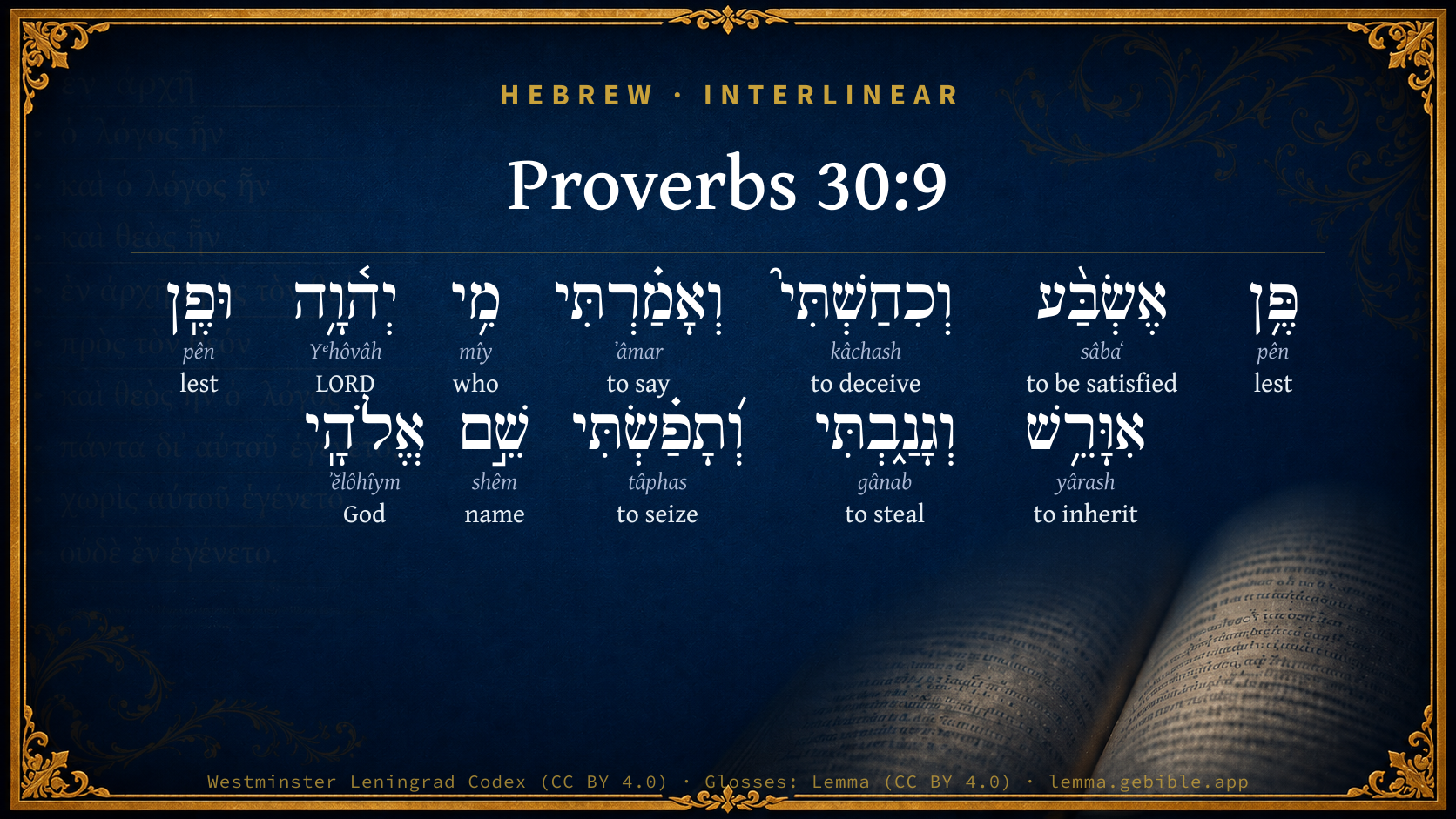
Hebrew (Westminster Leningrad Codex) Proverbs 30:9 appears in the Hebrew Old Testament. The text above is from the Westminster Leningrad Codex. Each word links to its Strong’s number, a concise gloss, and parsing drawn from the Open Scriptures Hebrew Bible morphology. Click any word for its full Brown-Driver-Briggs (BDB) entry.
Download image
Cite this verse

Proverbs 30:9 (World English Bible). Public Domain. Lemma interlinear Bible study tool, https://lemma.gebible.app/v/proverbs/30/9.

Show BibTeX & RIS
BibTeX
RIS
English Translation
Lest I be full, deny you, and say, 'Who is Yahweh?' Or lest I be poor, and steal, And so dishonor the name of my God.
World English Bible · Public Domain
Download a study sheet

One document with this verse’s original text, its word-by-word gloss line, the meaning frame, cross-references with their text, attributed commentary, and full source and license credits — printable, and it pastes into notes with its structure intact.

This verse Autodidact and up

Study sheet (.html) Plain text (.txt)

A passage Seminary Student

Up to 50 verses in one chapter. A passage sheet keeps up to 6 commentary sources and 12 cross-references per verse, in the order this page ranks them, and says so on the sheet whenever that leaves anything out. Ask for a single verse and you get the Autodidact verse sheet above.

Everything on this page stays free to read, with no account — the sheet is a download of what is already on screen, not access to it.

Want to remove ads? Support Godless Engineer
Compare translations 3

The same verse in 3 English versions, stacked beneath the original-language interlinear above. Click any original word for its lexicon entry.

Each is an independent rendering of the whole verse — the interlinear is not word-aligned to these translations.

Highlighted words mark where these versions differ — a whole-verse word diff, not a word-by-word alignment.

  • World English Bible Public Domain
    Lest I be full, deny you, and say, 'Who is Yahweh?' Or lest I be poor, and steal, And so dishonor the name of my God.
  • King James Version Public Domain
    Lest I be full, and deny thee, and say, Who is the LORD? or lest I be poor, and steal, and take the name of my God in vain.
  • unfoldingWord Literal Text CC BY-SA 4.0
    Lest I be satiated, and I deny and say, ‘Who Yahweh?’ And lest I become dispossessed and steal, and I seize the name of my God.

unfoldingWord Literal Text — © unfoldingWord, licensed CC BY-SA 4.0. Word-aligned USFM3 via Door43 (git.door43.org/unfoldingWord/en_ult).

Versions to compare (up to 4)

3 of 4 selected

Show all 18 translations

Every available English version of this verse, each an independent rendering of the whole verse.

  • World English Bible Public Domain
    Lest I be full, deny you, and say, 'Who is Yahweh?' Or lest I be poor, and steal, And so dishonor the name of my God.
  • Berean Standard Bible Public Domain
    Otherwise, I may have too much and deny You, saying, ‘Who is the LORD?’ Or I may become poor and steal, profaning the name of my God.
  • Majority Standard Bible Public Domain
    Otherwise, I may have too much and deny You, saying, ‘Who is the LORD?’ Or I may become poor and steal, profaning the name of my God.
  • King James Version Public Domain
    Lest I be full, and deny thee, and say, Who is the LORD? or lest I be poor, and steal, and take the name of my God in vain.
  • American Standard Version (1901) Public Domain
    Lest I be full, and deny `thee', and say, Who is Jehovah? Or lest I be poor, and steal, And use profanely the name of my God.
  • Revised Version (1885) Public Domain
    Lest I be full, and deny thee, and say, Who is the LORD? or lest I be poor, and steal, and use profanely the name of my God.
  • Geneva Bible (1599) Public Domain
    Least I be full, and denie thee, and say, Who is the Lord? or least I be poore and steale, and take the Name of my God in vaine.
  • Douay-Rheims (1899) Public Domain
    Lest perhaps being filled, I should be tempted to deny, and say: Who is the Lord? or being compelled by poverty, I should steal, and forswear the name of my God.
  • Young's Literal Translation Public Domain
    Lest I become satiated, and have denied, And have said, `Who `is' Jehovah?' And lest I be poor, and have stolen, And have laid hold of the name of my God.
  • Literal Standard Version CC BY-SA 4.0
    Lest I become satiated, and have denied, || And have said, “Who [is] YHWH?” And lest I am poor, and have stolen, || And have laid hold of the Name of my God.
  • Unlocked Literal Bible CC BY-SA 4.0
    For if I have too much, I might deny you and say, “Who is Yahweh?” Or if I become poor, I might steal and profane the name of my God.
  • unfoldingWord Literal Text CC BY-SA 4.0
    Lest I be satiated, and I deny and say, ‘Who Yahweh?’ And lest I become dispossessed and steal, and I seize the name of my God.
  • Darby Bible Public Domain
    lest I be full and deny [thee], and say, Who is Jehovah? or lest I be poor and steal, and outrage the name of my God.
  • World Messianic Bible Public Domain
    lest I be full, deny you, and say, ‘Who is the LORD?’ or lest I be poor, and steal, and so dishonor the name of my God.
  • Webster's Bible Public Domain
    Lest I be full, and deny thee, and say, Who is the LORD? or lest I be poor, and steal, and take the name of my God in vain.
  • Free Bible Version CC BY-SA 4.0
    Otherwise if I have plenty of money, I may give up on you, saying, “Who is the Lord?” while if I'm poor I may steal and bring the name of my God into disrepute.
  • Bible in Basic English Public Domain
    For fear that if I am full, I may be false to you and say, Who is the Lord? or if I am poor, I may become a thief, using the name of my God wrongly.
  • JPS Tanakh (1917) Public Domain
    Lest I be full, and deny, and say: 'Who is the LORD?' Or lest I be poor, and steal, and profane the name of my God.

Literal Standard Version (2020), Covenant Press — licensed CC BY-SA 4.0. Text via the HelloAO Bible API (eBible.org). Unlocked Literal Bible (unfoldingWord) — licensed CC BY-SA 4.0. Text via the HelloAO Bible API (eBible.org). unfoldingWord Literal Text — © unfoldingWord, licensed CC BY-SA 4.0. Word-aligned USFM3 via Door43 (git.door43.org/unfoldingWord/en_ult). Free Bible Version, Dr. Jonathan Gallagher — licensed CC BY-SA 4.0. Text via the HelloAO Bible API (eBible.org).

Word by word

More ways to search: Search by grammar → Find every occurrence → Compare this word →

Practice this passage: Drill this verse → Learn its vocabulary →

וְכִחַשְׁתִּי֮
kâchash
H3584
“and · to deceive”
Conjunction + Verb, Piel, Sequential Perfect, 1st Person, Common, Singular
Part of Speech
Conjunction + Verb
Stem
Piel
Form
Sequential Perfect
Person
1st Person
Gender
Common
Number
Singular
Full BDB Definition

Origin: a primitive root

TWOT: 975

to deceive, lie, fail, grow lean, be disappointing, be untrue, be insufficient, be found liars, belie, deny, dissemble, deal falsely - (Qal) to become lean - (Niphal) to cringe, feign obedience - (Piel) - to deceive, deny falsely - to act deceptively - to cringe - to disappoint, fail - (Hithpael) to cringe, feign obedience
  1. פֶּ֥ן pên H6435 “lest” Conjunction
  2. אֶשְׂבַּ֨ע sâbaʻ H7646 “to be satisfied” Verb, Qal, Imperfect, 1st Person, Common, Singular
  3. וְאָמַ֗רְתִּי ʼâmar H559 “and · to say” Conjunction + Verb, Qal, Sequential Perfect, 1st Person, Common, Singular
  4. מִ֥י mîy H4310 “who” Particle, Interrogative
  5. יְה֫וָ֥ה Yᵉhôvâh H3068 “LORD” Noun, Proper
  6. וּפֶֽן pên H6435 “and · lest” Conjunction + Conjunction
  7. אִוָּרֵ֥שׁ yârash H3423 “to inherit” Verb, Niphal, Imperfect, 1st Person, Common, Singular
  8. וְגָנַ֑בְתִּי gânab H1589 “and · to steal” Conjunction + Verb, Qal, Sequential Perfect, 1st Person, Common, Singular
  9. וְ֝תָפַ֗שְׂתִּי tâphas H8610 “and · to seize” Conjunction + Verb, Qal, Sequential Perfect, 1st Person, Common, Singular
  10. שֵׁ֣ם shêm H8034 “name of” Noun, Common, Masculine, Singular, Construct
  11. אֱלֹהָֽי ʼĕlôhîym H430 “God(s) · my” Noun, Common, Masculine, Plural, Construct + Suffix, Personal, 1st Person, Common, Singular

About this verse

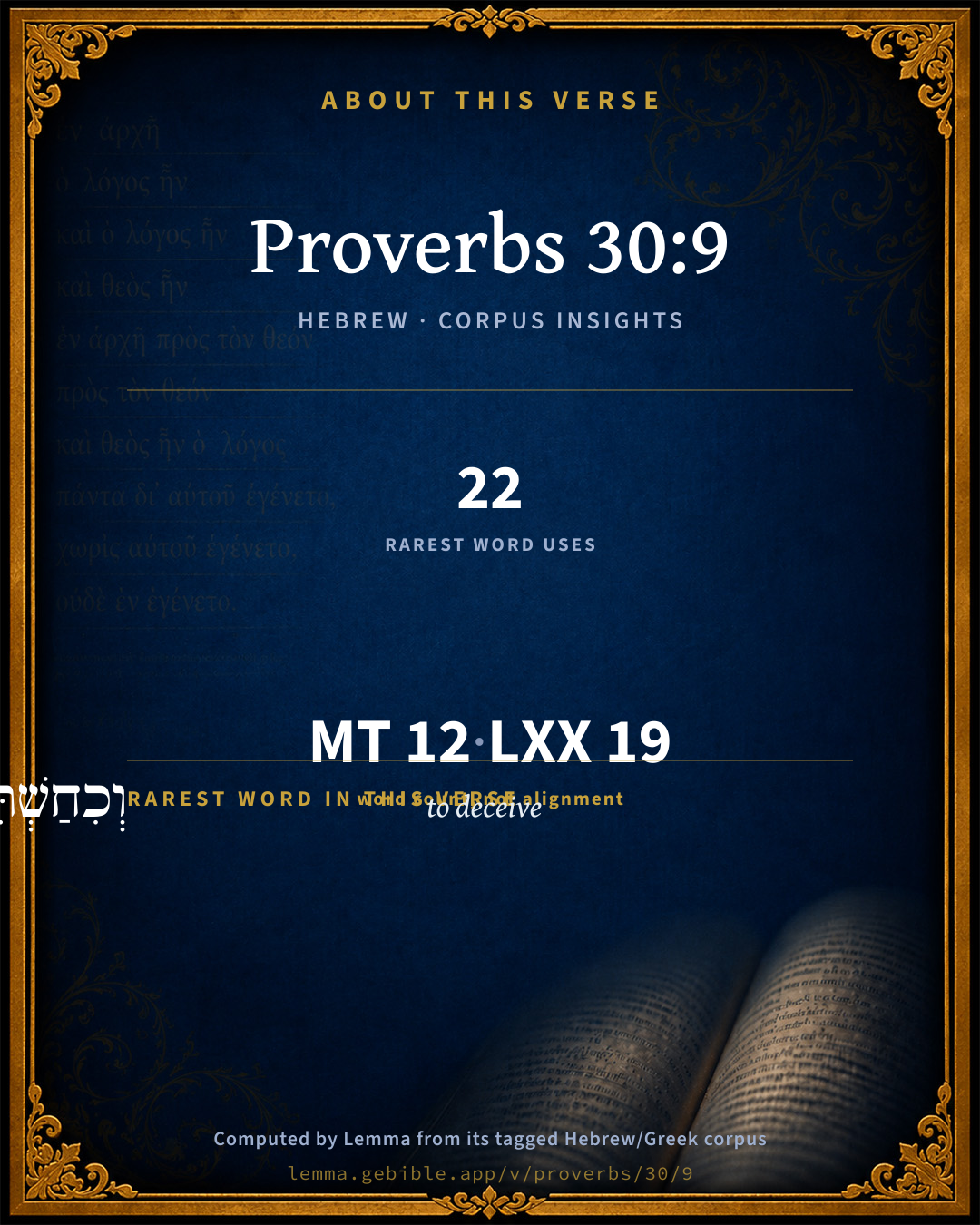
These counts appear in no published source. They are computed here, from the morphology-tagged text and Lemma’s own curated glosses. What Lemma adds →

12
words
11
distinct lemmas
Wisdom
section

Notable vocabulary

The rarest word here is וְכִחַשְׁתִּי֮ to deceive H3584 — appearing just 22 times in the whole Hebrew Bible.

Shared distinctive vocabulary

וְכִחַשְׁתִּי֮ to deceive H3584 occurs in 22 verses of the Hebrew Bible. Also found in:

Grammatical profile

  • 6 verbs
  • 3 nouns
  • 2 conjunctions
  • 1 particle

Verb forms

  • אֶשְׂבַּ֨ע Qal · Imperfect
  • וְכִחַשְׁתִּי֮ Piel · Sequential Perfect
  • וְאָמַ֗רְתִּי Qal · Sequential Perfect
  • אִוָּרֵ֥שׁ Niphal · Imperfect
  • וְגָנַ֑בְתִּי Qal · Sequential Perfect
  • וְ֝תָפַ֗שְׂתִּי Qal · Sequential Perfect

Repetition

A word recurs within this verse — often emphatic in Hebrew:

  • פֶּ֥ן lest H6435 ×2

Hebrew & Septuagint length

In English translation the verse runs 26 words from the Hebrew and 25 from the Septuagint (LXX English) — closely comparable.

A rough comparison of the two English renderings, which tokenize alike — not a word-level alignment.

Word counts can differ between the Hebrew and the Greek without any difference in meaning — e.g. the Hebrew direct-object marker אֵת has no separate Greek word, and Greek often adds the article ὁ.

In the original languages it is 12 Hebrew tokens and 19 Greek tokens — but the two are counted differently (Hebrew bundles its prefixes and suffixes into one token; the Greek is in lemma form), so that isn’t a like-for-like length.

Cross-references

23

Topical passages linked to Proverbs 30:9 in the Treasury of Scripture Knowledge — connected by theme and wording, ordered by reader-vote popularity; previews shown in the World English Bible.

  • Hosea 13:6 According to their pasture, so were they filled; They were filled, and their heart was exalted. Therefore they have forgotten me.
  • Deuteronomy 31:20 For when I shall have brought them into the land which I swore to their fathers, flowing with milk and honey, and they shall have eaten and filled themselves, and grown fat; then will they turn to other gods, and serve them, and despise me, and break my covenant.
  • Ezekiel 16:49–50 Behold, this was the iniquity of your sister Sodom: pride, fullness of bread, and prosperous ease was in her and in her daughters; neither did she strengthen the hand of the poor and needy.
  • Deuteronomy 8:10–14 You shall eat and be full, and you shall bless Yahweh your God for the good land which he has given you.
  • Deuteronomy 32:15 But Jeshurun grew fat, and kicked: You have grown fat, you are grown thick, you are become sleek; Then he forsook God who made him, Lightly esteemed the Rock of his salvation.
  • Nehemiah 9:25–26 They took fortified cities, and a fat land, and possessed houses full of all good things, cisterns hewn out, vineyards, and olive groves, and fruit trees in abundance: so they ate, and were filled, and became fat, and delighted themselves in your great goodness.
  • Job 31:24–28 "If I have made gold my hope, And have said to the fine gold, 'You are my confidence;'
  • Deuteronomy 6:10–12 It shall be, when Yahweh your God shall bring you into the land which he swore to your fathers, to Abraham, to Isaac, and to Jacob, to give you, great and goodly cities, which you didn't build,
  • Exodus 20:7 "You shall not take the name of Yahweh your God in vain, for Yahweh will not hold him guiltless who takes his name in vain.
  • Jeremiah 2:31 Generation, see the word of Yahweh. Have I been a wilderness to Israel? or a land of thick darkness? why say my people, We are broken loose; we will come no more to you?
  • Joshua 24:27 Joshua said to all the people, Behold, this stone shall be a witness against us; for it has heard all the words of Yahweh which he spoke to us: it shall be therefore a witness against you, lest you deny your God.
  • Ezekiel 16:14–15 Your renown went forth among the nations for your beauty; for it was perfect, through my majesty which I had put on you, says the Lord Yahweh.
  • Matthew 26:72 Again he denied it with an oath, "I don't know the man."
  • Matthew 26:74 Then he began to curse and to swear, "I don't know the man!" Immediately the rooster crowed.
  • Acts 12:22–23 The people shouted, "The voice of a god, and not of a man!"
  • Exodus 5:2 Pharaoh said, "Who is Yahweh, that I should listen to his voice to let Israel go? I don't know Yahweh, and moreover I will not let Israel go."
  • Leviticus 5:1 "'If anyone sins, in that he hears the voice of adjuration, he being a witness, whether he has seen or known, if he doesn't report it, then he shall bear his iniquity.
  • Proverbs 6:30–31 Men don't despise a thief, If he steals to satisfy himself when he is hungry:
  • Proverbs 29:24 Whoever is an accomplice of a thief is an enemy of his own soul. He takes an oath, but dares not testify.
  • 2 Chronicles 32:15–17 Now therefore don't let Hezekiah deceive you, nor persuade you after this manner, neither believe you him; for no god of any nation or kingdom was able to deliver his people out of my hand, and out of the hand of my fathers: how much less shall your God deliver you out of my hand?
  • Psalms 125:3 For the scepter of wickedness won't remain over the allotment of the righteous; So that the righteous won't use their hands to do evil.
  • Daniel 4:17 The sentence is by the decree of the watchers, and the demand by the word of the holy ones; to the intent that the living may know that the Most High rules in the kingdom of men, and gives it to whoever he will, and sets up over it the lowest of men.
  • Daniel 4:30 The king spoke and said, Is not this great Babylon, which I have built for the royal dwelling-place, by the might of my power and for the glory of my majesty?

Cross-references courtesy of OpenBible.info (CC BY 4.0).

Hebrew and Greek witnesses Masoretic Hebrew ↔ Greek Septuagint

The same verse in the two great witnesses to the Old Testament, shown verse-for-verse.

These are two independent witnesses, not word-aligned to each other, and the Septuagint is shown in lemma (dictionary) form.

Hebrew Proverbs 30:9 Masoretic · Westminster Leningrad Codex

פֶּ֥ן אֶשְׂבַּ֨ע וְכִחַשְׁתִּי֮ וְאָמַ֗רְתִּי מִ֥י יְה֫וָ֥ה וּפֶֽן אִוָּרֵ֥שׁ וְגָנַ֑בְתִּי וְ֝תָפַ֗שְׂתִּי שֵׁ֣ם אֱלֹהָֽי

Lest I be full, deny you, and say, 'Who is Yahweh?' Or lest I be poor, and steal, And so dishonor the name of my God.

World English Bible · Public Domain

Greek LXX Proverbs 30:9 Septuagint · lemma form

ἵνα μή πίμπλημι ψευδής γίγνομαι καί εἶπον τίς ἐγώ ὁράω ἤ πενέω κλέπτω καί ὄμνυμι ὁ ὄνομα ὁ θεός

lest I be filled and become false, and say, Who sees me? or be poor and steal, and swear vainly by the name of God.

LXX2012 (modern English Septuagint) · Public Domain

On this verse, The Pulpit Commentary discusses the Septuagint’s reading. Read the note in Commentary ↓

Hebrew: Westminster Leningrad Codex (CC BY 4.0). Greek: Septuagint (public domain); English from LXX2012 (modern English Septuagint) (Public Domain). How the Septuagint differs from the Hebrew →

Commentary

Notes on Proverbs 30:9 from classic Christian and Jewish commentators (each source and its license shown beneath its notes). The classic Christian expositions comment on the surrounding passage and are grouped to its opening verse, so a note may address several verses; the Jewish commentaries on the Tanakh (Rashi and others) are per-verse, so they appear only where the commentator wrote on this verse.

Lemma curates 59 commentaries, every one of them public domain or Creative Commons licensed, each selected and text-cleaned for this edition rather than reprinted as found. About our sources →

Trapp's Complete Commentary

John Trapp

Pro 30:9 Lest I be full, and deny [thee], and say, Who [is] the LORD? or lest I be poor, and steal, and take the name of my God [in vain].

Ver. 9. Lest I be full and deny thee, &c.] Fulness breeds forgetfulness, saturity security Deu 32:14; {See Trapp on "Deu 32:14"} 1Ti 6:17 {See Trapp on "1Ti 6:17"} every grain of riches hath a vermin of pride and ambition in it. A man may desire them, as one desires a ship to pass over the sea from one country to another; but to many they prove hindrances to heaven, remoras to religious practices. Many in their low estate could serve God, but now resemble the moon, which never suffers eclipse but at her full, and that is by the earth’s interposition between the sun and herself. Even an Agur full fed may grow wanton, and be dipping his fingers in the devil’s sauce; yea, so far may he forget himself, as to deny the Lord (or as the Hebrew hath it, belie him), disgrace his housekeeping, and cast a slur upon his work and wages by his shameful apostasy; yea (as Pharoah-like), to ask, Who is the Lord? as if such were petty gods within themselves, and could by the help of their mammon do well enough without him. Solomon’s wealth did him more harm than his wisdom did him good. {Ecc 2:1-26} It was his abundance that drew out his spirits, and dissolved him, and brought him to so low an ebb in grace.

Or, lest I be poor and steal.] Necessity is a hard weapon; we use to say, Hunger is an evil counsellor, and poverty is bold or daring, as Horace calls it. {a} The baser sort of people in Swethland do always break the Sabbath, saying, that it is only for gentlemen to keep that day. And the poorer sort among us (some of them I mean that have learned no better) hold theft in them, petty larceny at least, a peccadillo, an excusable evil; for either we must steal, say they, or starve; the belly hath no ears; our poor children must not pine and perish, &c. And truly "men do not despise," - i.e., not so much despise - "a thief if he steal to satisfy his soul when he is hungry," saith Solomon {Pro 6:30} in his argument that an adulterer is worse than a thief; though a thief be bad enough, shut out of heaven. {1Co 6:9} But if he steal for necessity - πεινωντι κλεπτειν εστ αναγκαιως εχον, saith the Greek proverb, there is no remedy but a harking stomach must be quieted - men do the more excuse him a tanto, though not a toto. But God saith flat and plain, "Thou shalt in no case steal." "Let him that stole steal no more," but let him labour with his hands, and depend upon God’s providence; let him prefer affliction before sin, and rather die than do wickedly. But want is a sore temptation, as Agur feared, and that good man felt, mentioned by Master Perkins, who being ready to starve, stole a lamb; and being about to eat of it with his poor children, and (as his manner was before meat) to crave a blessing, durst not do it, but fell into a great perplexity of conscience, acknowledged his fault to the owner, and promised restitution if ever able to make it.

And take the name of my God in vain.] He says not, Lest I, being poor, steal and be fined, burnt in the hand, whipped, &c. No; but "Lest I take thy name in vain"; that is, cause thy name to stink among the ungodly, open their mouths, break down the banks of blasphemy, by such a base sin, committed by such a forward professor. Good men take God’s name in vain no way so much as by confuting and shaming their profession by a scandalous conversation, such as becometh not the gospel of Christ; moreover, they count sin to be the greatest smart in sin, as being more sensible of the wound they therein give the glory of God, than of any personal punishment.

{a} Necessitas durum telum. Fames malesuada, audax paupertas.

John Trapp, A Commentary or Exposition upon All the Books of the Old and New Testament (1647–1656) — public domain. Text from a community e-Sword module.

Joseph Benson's Commentary

Pro 30:9. Lest I be full, and deny thee — By trusting to riches, which is a denial of God, and by un-thankfulness for, and the abuse of his mercies. And say, Who is the Lord — That I should obey or serve him? I do not need him: I can live without him. Lest by degrees, I should arrive at downright atheism or infidelity, which is most incident to rich and great men, as is manifest from experience. Or lest I be poor and steal — Lest, being in a state of poverty, I be under a strong temptation to dishonesty, and become injurious to others for my own relief; and take the name of my God in vain — Use false oaths, either to vindicate myself when I am suspected or accused of theft, and my oath is required according to the law, Exo 22:8-11; or to gratify others for filthy lucre, as poor men frequently do.

Joseph Benson's Commentary on the Old and New Testaments (1811–1818) — public domain. Text from a community e-Sword module.

Geneva Bible (1599)

Geneva Bible translators

Meaning, that they that put their trust in their riches, forget God, and that by too much wealth men have an occasion to the same.

Geneva Bible (1599) marginal notes — public domain. Text via Bolls.life.

Jamieson, Fausset & Brown

Robert Jamieson, A. R. Fausset & David Brown

be full . . . deny--that is, puffed up by the pride of prosperity.

take the name . . . vain--This is not (Hebrew) the form (compare Exo 20:7), but "take" rather denotes laying violent hold on any thing; that is, lest I assail God's name or attributes, as justice, mercy, &c., which the poor are tempted to do.

Jamieson, Fausset & Brown — Commentary Critical and Explanatory on the Whole Bible (1871) — public domain (CC PDM 1.0). Text via the HelloAO Bible API.

Ellicott's Commentary for English Readers

(9) Lest I be full, and deny thee.—For “pride and fulness of bread” were among the sins which brought destruction on Sodom (Eze_16:49). (Comp. Job_21:14-15.)

And take the name of my God in vain.—Literally, handle it roughly, irreverently; particularly in finding fault with His providence.

A Bible Commentary for English Readers, edited by Charles John Ellicott (1878–1897) — public domain. Text from a community e-Sword module.

The Cambridge Bible for Schools and Colleges

gen. ed. J. J. S. Perowne

9. take … in vain] use profanely, R.V. Lit. take hold of, or handle, sc. lightly or profanely. Lest I be moved in the bitterness of distress to blaspheme, or charge God foolishly. Comp. Job_1:22; Job_2:9; Isa_8:11.

The Cambridge Bible for Schools and Colleges (gen. ed. J. J. S. Perowne; Cambridge University Press, 1878–1918) — public domain. Text from a community e-Sword module.

John Gill's Exposition

Lest I be full, and deny thee,.... This is the dangerous consequence of riches, and the temptation they expose men unto; who, being full of the things of this world, are tempted to deny the Lord; not his being and perfections directly, but chiefly his providence; to deny that what they have, they have received of him, but attribute it to their own care, diligence, and industry; and now think they can live without him, without any dependence on his providence, having a large affluence of the things of life: yea, they may be said to deny him, when they forget the bounties of his providence; are not thankful to him for them; that flatter themselves with a continuance of them, without any regard to him, as if he had no concern in the affairs of life; see Deu 32:15;

and say, Who is the Lord? as Pharaoh did, Exo 5:2. I am not obliged to him; I can live without him, I have enough of my own;

or lest I be poor, and steal, and take the name of my God in vain; this is the snare that attends poverty; men, for want of food and raiment, are tempted to steal from their neighbours, which is a sin against the law of God, the eighth command; and then to cover the theft, when an oath is offered to purge them from the charge and suspicion of it, they take it, and so are guilty of false swearing, or taking the name of God not only in vain, but falsely, and so become guilty of the breach of the third command. Agur, a good man, is desirous he might not be exposed to temptations to such evils, and especially which so affected the honour and glory of God.

John Gill's Exposition of the Whole Bible (1746–1763) — public domain (CC PDM 1.0). Text via the HelloAO Bible API.

Albert Barnes' Notes on the Bible

The special dangers of the two extremes. Wealth tempts to pride, unbelief, and a scorn like that of Pharaoh Exo 5:2; poverty to, dishonesty, and then to perjury, or to the hypocritical profession of religion which is practically identical with it.

Albert Barnes' Notes on the Bible (1834–1885) — public domain. Text from a community e-Sword/MySword module.

Matthew Poole's English Annotations

Deny thee, by trusting to riches, which is a denial of God, Job 31:24-28, by unthankfulness for and abuse of his mercies, and by rebellion against him, and divers other courses and common practices of rich men, whereby God is denied in truth and in works, even when he is owned in words and in show.

Who is the Lord, that I should obey or serve him? I do not need him, I can live of my own without him. Lest by degrees I should arrive at downright atheism or infidelity, which is most incident to rich and great men, as is manifest from experience.

Take the name of my God in vain; use false oaths, either to vindictate myself when I am suspected or accused of theft, and my oath is required according to the law, Exo 22:8-11, or to gratify others for filthy lucre, as poor men frequently do.

Matthew Poole's English Annotations on the Holy Bible (1683–1685) — public domain. Text from a community e-Sword/MySword module.

Whedon's Commentary on the Bible

Daniel D. Whedon

9. Deny thee — Hebrew, simply deny; fail to render suitable acknowledgments. Abundance too commonly begets pride, sensuality, and forgetfulness of our obligation to the great Giver. “Jeshurun waxed fat, and kicked.” Deu_32:15. Poverty tempts to stealing and other illicit practices to supply our wants. Furthermore, the poor are apt to repine and murmur against Providence, and in their heart to accuse the divine Being of partiality. This is supposed to be the meaning of take the name of my God in vain — violate the name of God, by assailing or impugning the divine character. Some understand it of false swearing, or perjury, to which the thief is tempted in order to shield himself from punishment. See note on Pro_29:24.

Daniel D. Whedon (gen. ed.), Commentary on the Old and New Testaments (1874–1909) — public domain. Text from a community e-Sword module.

The Pulpit Commentary

The reason for the latter prayer follows, unless, as some consider, the prayer is one, as if Agur asked, "Take from me riches which lead to vanity, and poverty which leads to lying and deceit." In this case the ground of the request would embrace both parts of the petition. Lest I be full, and deny thee, and say, Who is the Lord (Jehovah)? Great wealth and temporal prosperity tempt to forgetfulness of God, to self-confidence and practical unbelief in Divine providence. Like Pharaoh, the haughty rich man asks with scorn, "Who is the Lord, that I should obey his voice?" (Exo_5:2; comp. Deu_8:12, etc.; Job_21:14, etc.; Psa_14:1) Septuagint, "Lest being filled I become false, and say, Who seeth me?" Or lest I be poor, and steal; lest my necessities lead to dishonesty. And take the name of my God in vain. The verb taphas means "to grasp at, seize violently, handle roughly," and the sin intended may be either false swearing in denial of his theft and to escape punishment, or the arraignment of God"s providence which has allowed him to fall into such distress. Titus Isa_8:21, "They shall pass through it, hardly bestead and hungry; and it shall come to pass that, when they shall be hungry, they shall fret themselves, and curse their king and their God." In view of the proverbs that follow, the clause seems to be best taken of the blasphemy attending on impatience and want of resignation to God"s will. (comp. Pro_19:3)

The Pulpit Commentary (1880–1919), ed. H.D.M. Spence-Jones & Joseph S. Exell — public domain. Text from a community e-Sword module.

John Wesley's Explanatory Notes

Deny thee - By trusting to riches, which is a denial of God, and by unthankfulness for, and abuse of his mercies. Who is the Lord - That I should serve him. Lest I take - Use false oaths either to vindicate myself when I am suspected, or to gratify others, as poor men frequently do.

John Wesley, Explanatory Notes Upon the Whole Bible (1754–1765) — public domain. Text via the GEBible commentary corpus.

Rashi

Rabbi Shlomo Yitzchaki (Rashi)

lest I become sated from wealth.

and deny the existence of the Holy One, blessed be He, out of my extreme haughtiness. Now what is the denial? And I say, “Who is the Lord?” Meaning, there is no God.

and take hold of the name of my God to become accustomed to swearing by it falsely.

Rashi on the Tanakh — English translations: “The Judaica Press complete Tanach with Rashi, translated by A. J. Rosenberg” (CC BY 4.0); “Pentateuch with Rashi's commentary by M. Rosenbaum and A.M. Silbermann, 1929-1934” (public domain); “The Metsudah Tanach series, Lakewood, N.J” (CC BY 4.0); and “The Book of Joshua, Metsudah Publications, 1997” (CC BY 4.0). Text via Sefaria.

Lesson kit

Teaching starters — assembled from the data on this page, not authored interpretation. Every prompt links to the verse data it draws on. Edit before teaching.

Proverbs, in the Wisdom, opens this verse with 12 words (11 distinct Hebrew lemmas). Its most distinctive word is kâchash (“to deceive”). A historical commentator’s framing appears above. Read the whole chapter for the surrounding context.

Discussion questions

  1. The word kâchash carries the sense “to deceive.” How does it shape the verse?
  2. How does Genesis 18:15, which shares the word «to deceive», read alongside this verse?
  3. What does the repetition of “lest” (2× in this one verse) do in this verse?
  4. The translations on this page render this verse differently — a whole-verse word diff, not a word-by-word alignment. What might account for the different wordings?
  5. «אֶשְׂבַּ֨ע» is a Qal Imperfect verb. How does that grammatical form shape the action described?
  6. Compare how Trapp's Complete Commentary and Joseph Benson's Commentary read this verse. Where do they agree or differ?

Things to notice

Reading settings

Reading text

Shown beneath each verse's original-language words.

Old Testament
Old Testament edition

Read the OT as the Masoretic Hebrew (MT) or the Greek Septuagint (LXX).

English shown for the Greek Septuagint (in the Hebrew ↔ Greek comparison).

Comparing translations? Open the Compare panel on any verse page to stack up to four side by side.