
Leviticus 23:9

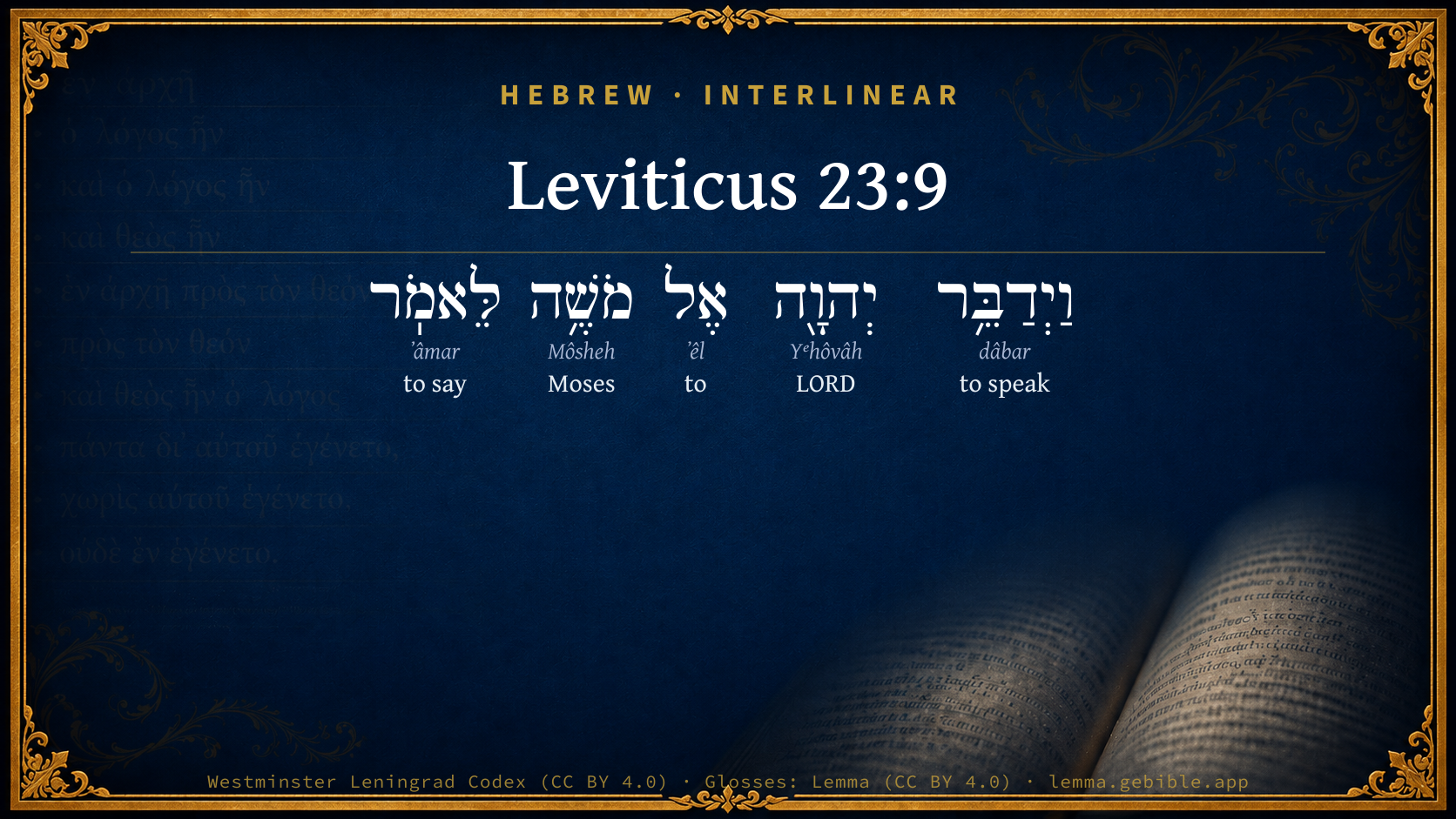
Hebrew (Westminster Leningrad Codex) Leviticus 23:9 appears in the Hebrew Old Testament. The text above is from the Westminster Leningrad Codex. Each word links to its Strong’s number, a concise gloss, and parsing drawn from the Open Scriptures Hebrew Bible morphology. Click any word for its full Brown-Driver-Briggs (BDB) entry.
Download image
Cite this verse

Leviticus 23:9 (World English Bible). Public Domain. Lemma interlinear Bible study tool, https://lemma.gebible.app/v/leviticus/23/9.

Show BibTeX & RIS
BibTeX
RIS
English Translation
Yahweh spoke to Moses, saying,
World English Bible · Public Domain
Download a study sheet

One document with this verse’s original text, its word-by-word gloss line, the meaning frame, cross-references with their text, attributed commentary, and full source and license credits — printable, and it pastes into notes with its structure intact.

This verse Autodidact and up

Study sheet (.html) Plain text (.txt)

A passage Seminary Student

Up to 50 verses in one chapter. A passage sheet keeps up to 6 commentary sources and 12 cross-references per verse, in the order this page ranks them, and says so on the sheet whenever that leaves anything out. Ask for a single verse and you get the Autodidact verse sheet above.

Everything on this page stays free to read, with no account — the sheet is a download of what is already on screen, not access to it.

Want to remove ads? Support Godless Engineer
Compare translations 3

The same verse in 3 English versions, stacked beneath the original-language interlinear above. Click any original word for its lexicon entry.

Each is an independent rendering of the whole verse — the interlinear is not word-aligned to these translations.

Highlighted words mark where these versions differ — a whole-verse word diff, not a word-by-word alignment.

  • World English Bible Public Domain
    Yahweh spoke to Moses, saying,
  • King James Version Public Domain
    And the LORD spake unto Moses, saying,
  • unfoldingWord Literal Text CC BY-SA 4.0
    And Yahweh spoke to Moses, saying,

unfoldingWord Literal Text — © unfoldingWord, licensed CC BY-SA 4.0. Word-aligned USFM3 via Door43 (git.door43.org/unfoldingWord/en_ult).

Versions to compare (up to 4)

3 of 4 selected

Show all 18 translations

Every available English version of this verse, each an independent rendering of the whole verse.

  • World English Bible Public Domain
    Yahweh spoke to Moses, saying,
  • Berean Standard Bible Public Domain
    And the LORD said to Moses,
  • Majority Standard Bible Public Domain
    And the LORD said to Moses,
  • King James Version Public Domain
    And the LORD spake unto Moses, saying,
  • American Standard Version (1901) Public Domain
    And Jehovah spake unto Moses, saying,
  • Revised Version (1885) Public Domain
    And the LORD spake unto Moses, saying,
  • Geneva Bible (1599) Public Domain
    And the Lord spake vnto Moses, saying,
  • Douay-Rheims (1899) Public Domain
    And the Lord spoke to Moses, saying:
  • Young's Literal Translation Public Domain
    And Jehovah speaketh unto Moses, saying,
  • Literal Standard Version CC BY-SA 4.0
    And YHWH speaks to Moses, saying,
  • Unlocked Literal Bible CC BY-SA 4.0
    Yahweh spoke to Moses, saying,
  • unfoldingWord Literal Text CC BY-SA 4.0
    And Yahweh spoke to Moses, saying,
  • Darby Bible Public Domain
    And Jehovah spoke to Moses, saying,
  • World Messianic Bible Public Domain
    The LORD spoke to Moses, saying,
  • Webster's Bible Public Domain
    And the LORD spoke to Moses, saying,
  • Free Bible Version CC BY-SA 4.0
    The Lord told Moses,
  • Bible in Basic English Public Domain
    And the Lord said to Moses,
  • JPS Tanakh (1917) Public Domain
    And the LORD spoke unto Moses saying:

Literal Standard Version (2020), Covenant Press — licensed CC BY-SA 4.0. Text via the HelloAO Bible API (eBible.org). Unlocked Literal Bible (unfoldingWord) — licensed CC BY-SA 4.0. Text via the HelloAO Bible API (eBible.org). unfoldingWord Literal Text — © unfoldingWord, licensed CC BY-SA 4.0. Word-aligned USFM3 via Door43 (git.door43.org/unfoldingWord/en_ult). Free Bible Version, Dr. Jonathan Gallagher — licensed CC BY-SA 4.0. Text via the HelloAO Bible API (eBible.org).

Word by word

More ways to search: Search by grammar → Find every occurrence → Compare this word →

Practice this passage: Drill this verse → Learn its vocabulary →

About this verse

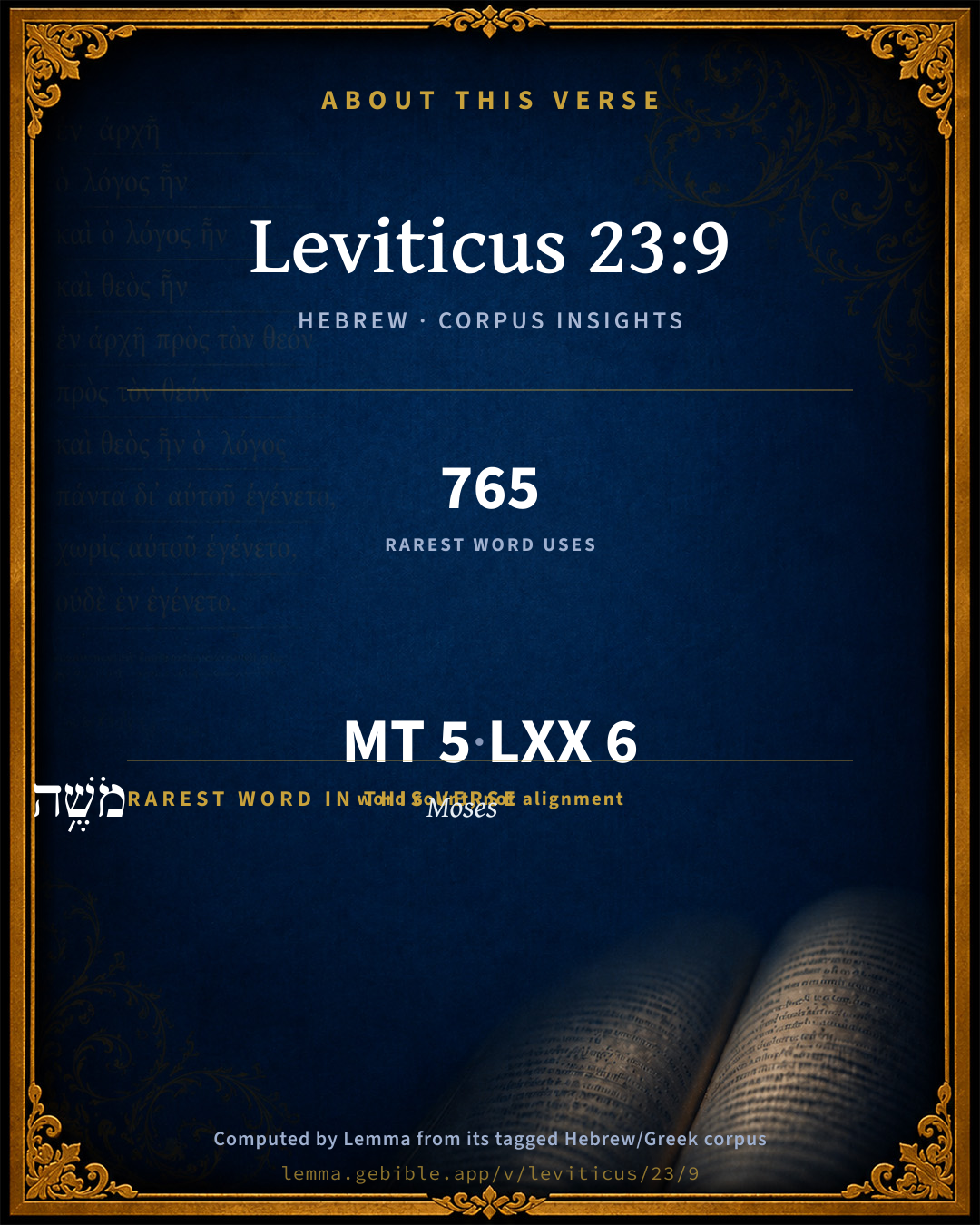
These counts appear in no published source. They are computed here, from the morphology-tagged text and Lemma’s own curated glosses. What Lemma adds →

5
words
5
distinct lemmas
Pentateuch
section

Grammatical profile

  • 2 verbs
  • 2 nouns
  • 1 preposition

Verb forms

  • וַיְדַבֵּ֥ר Piel · Sequential Imperfect
  • לֵּאמֹֽר Qal · Infinitive Construct

Hebrew & Septuagint length

In English translation the verse runs 5 words from the Hebrew and 7 from the Septuagint (LXX English) — closely comparable.

A rough comparison of the two English renderings, which tokenize alike — not a word-level alignment.

Word counts can differ between the Hebrew and the Greek without any difference in meaning — e.g. the Hebrew direct-object marker אֵת has no separate Greek word, and Greek often adds the article ὁ.

In the original languages it is 5 Hebrew tokens and 6 Greek tokens — but the two are counted differently (Hebrew bundles its prefixes and suffixes into one token; the Greek is in lemma form), so that isn’t a like-for-like length.

Hebrew and Greek witnesses Masoretic Hebrew ↔ Greek Septuagint

The same verse in the two great witnesses to the Old Testament, shown verse-for-verse.

These are two independent witnesses, not word-aligned to each other, and the Septuagint is shown in lemma (dictionary) form.

Hebrew Leviticus 23:9 Masoretic · Westminster Leningrad Codex

וַיְדַבֵּ֥ר יְהוָ֖ה אֶל מֹשֶׁ֥ה לֵּאמֹֽר

Yahweh spoke to Moses, saying,

World English Bible · Public Domain

Greek LXX Leviticus 23:9 Septuagint · lemma form

καί λαλέω κύριος πρός μωυσῆς λέγω

And the Lord spoke to Moses, saying,

LXX2012 (modern English Septuagint) · Public Domain

Hebrew: Westminster Leningrad Codex (CC BY 4.0). Greek: Septuagint (public domain); English from LXX2012 (modern English Septuagint) (Public Domain). How the Septuagint differs from the Hebrew →

Targum (Aramaic paraphrase)

2

The Targum is the ancient Jewish Aramaic paraphrase of the Hebrew Scriptures — an interpretive translation, not the Hebrew text itself. Onkelos (literal) and Pseudo-Jonathan (expansive) render the Torah, and Jonathan the Prophets. Coverage is partial: where no permissively-licensed English translation exists for a verse, only the Aramaic is shown. This is verse-level text, not a word-by-word alignment to the Hebrew.

  1. Targum Onkelos Torah (Genesis–Deuteronomy)
    וּמַלִיל יְיָ עִם מֹשֶׁה לְמֵימָר

    (no public-domain English translation for this verse)

    Targum Onkelos — Aramaic: “Onkelos Genesis” (public domain); “Onkelos Exodus” (public domain); “Onkelos Leviticus” (public domain); “Onkelos Numbers” (public domain); “Onkelos Deuteronomy” (public domain). English: “Sefaria Community Translation” (CC0 1.0 (public-domain dedication)); “J.W. Etheridge. The Targums of Onkelos and Jonathan Ben Uzziel on the Pentateuch. London: Longmans, Green, 1862” (public domain). Text via Sefaria.

  2. Targum Pseudo-Jonathan Torah (Genesis–Deuteronomy)
    וּמַלֵיל יְיָ עִם משֶׁה לְמֵימָר

    And the Lord spake with Mosheh, saying:

    Targum Pseudo-Jonathan — Aramaic: “Targum Jonathan on Genesis” (public domain); “Targum Jonathan on Exodus” (public domain); “Targum Jonathan on Leviticus” (public domain); “Targum Jonathan on Numbers” (public domain); “Targum Jonathan on Deuteronomy” (public domain). English: “The Targum of Jonathan ben Uzziel, trans. J. W. Etheridge, London, 1862” (public domain). Text via Sefaria.

Commentary

Notes on Leviticus 23:9 from classic Christian and Jewish commentators (each source and its license shown beneath its notes). The classic Christian expositions comment on the surrounding passage and are grouped to its opening verse, so a note may address several verses; the Jewish commentaries on the Tanakh (Rashi and others) are per-verse, so they appear only where the commentator wrote on this verse.

Lemma curates 59 commentaries, every one of them public domain or Creative Commons licensed, each selected and text-cleaned for this edition rather than reprinted as found. About our sources →

The Biblical Illustrator

Joseph S. Exell

Lev_23:9-15

When ye be come into the land.

The conditions of the spiritual land-tenure

I. Mans true relation to the land of promise.

1. In his original estate man realised his dependence upon God, and his responsibility before God for the true and righteous use of all Gods gifts. As long as man used Gods glorious gifts in obedience to Gods supreme law of love, his life was blessed with the fulness of weal: Of every tree of the garden thou mayest freely eat. But in the day when the sense of responsibility to God was lost, and the commandment which embraced in itself the significance of all the other commandments was broken, the disorders and the miseries of human society arose. The spirit of individual selfishness is the power which disorganises society, which brings a blight upon the garden of God, and drives human souls out from the glory and wealth into the thorny, desolate wilderness. There is no power that can enable man to dress the garden and to keep it, but the sense of responsibility to the one supreme Lord of Life, whose name is Love. This principle is the Divinely ordained power that suffices to check the deadly evils that arise from exaggerated notions of the rights of human property. In human society gifts are unequally distributed. The gifts of genius and the external gifts of property are alike unequal. In the ownership of the riches of mind we see men endowed with vast territories of knowledge and intellectual power. It is Gods order. Gifts are not equally divided. So the land is not, and never can be, possessed in absolutely equal portions by the citizens of state. There must be the large landowners and the multitude of the poor who have but little. Where is the check that is to restrain the abuses of property? In the perpetual remembrance of the truth that the proudest landowner is but a tenant who holds from God, upon Gods conditions, in order that the land may be dressed and kept so as to promote the greatest possible happiness of the greatest possible number.

2. Another truth closely related to our absolute dependence upon Gods love, and the realisation of which is equally necessary to our spiritual health, is declared in this passage, viz., that the occupiers of the land of promise can only enjoy the fruits which God gives upon Gods conditions. The king upon the throne who has not a kingly heart and soul occupies a land of promise, but does not eat of its fruits. In all the professions of human activity, from the highest to the humblest, the enjoyment of the noblest fruits of the position can only be realised by those who know how to perform the duties which belong to it.. The conditions of enjoyment are imposed upon the occupiers of every land of promise. The blessed land of rest, towards which human souls are travelling through the wilderness of earthly struggles, can only produce its harvest, and pour forth its stores of milk and honey to those who shall have been made meet to be partakers of the inheritance of the saints in light.

II. The conditions upon which the fruits of Canaan can be eaten.

1. The elevated use of the gifts of life. The man who uses Gods gifts to pamper his lusts, by feeding the low life of debased animalism, lowers the corn of the field below its original level by devoting it to the table of devils, as the food taken to create blood for the heart in which the basest, foulest feelings have their homes, and for the brain, out of which the thoughts that are set on fire of hell wing their flight. The drunkard, the glutton, and the unclean, degrade the fruits of the land by using them to feed the life of the tenants who dwell in the moral abyss. On the other hand, in the man who strives to live a life of high purpose, pure feeling, and noble thought, the corn is taken into the manhood and shares its elevation. It is that lofty use alone that gives man fulness of enjoyment. There is an unearthly delight in the enjoyment of Gods gifts when they are thus exalted. It is still true that God satisfies His people with the bread of heaven. It is still true that for those who are redeemed to the high life in Christ the Holy Spirit gives them of the corn of heaven. Man did eat angels food. Do we seek elevation in Christ Jesus? Are we pressing towards the mark for the prize of the high calling of God in Christ Jesus? Are we sanctifying the fields of our life by subjecting all our energies to the influence of noble aspirations and high purposes in Christ Jesus?

2. The second condition which regulates the enjoyment of the fruits of the land of promise is embodied in this command, Ye shall offer an he-lamb without, blemish of the first year for a burnt-offering unto the Lord. What are the moral and spiritual truths embodied in the form of this ordinance? It gives expression to that eternal truth that man cannot enjoy the fruits of Gods promised land without innocency of life, and entire surrender of self to God. The highest joys and richest pleasures of existence cannot be experienced by the man whose heart is full of malice and wickedness. Material prosperity, houses, and lands, and gold he may have. But the joy, peace, and satisfaction which feed the inner life of an enriched, ennobled soul are forbidden to all but those who have found truth and innocency of character. The mode of the offering is also expressive of another condition. The lamb was to be offered as a burnt-offering. This form of sacrifice expresses the principle of unreserved dedication of the life to God. The life of self-sacrifice is the happy life. The heart which has given itself unreservedly to the truth and love of God, is the heart that experiences the joys of the promised land.

3. The third condition imposed upon the Israelite was expressed in the command, The: meat-offering thereof shall be two-tenth deals of fine flour mingled with oil, an offering made by fire unto the Lord for a sweet savour; and the drink-offering thereof shall be of wine, the fourth part of an bin. What eternal principle is embodied in the form of this rite? It teaches us that we cannot enjoy the fruits of the promised land until we have learnt to seek the sustenance and gladness of the soul in communion with God. The flour of the meat-offering represents that spiritual bread of the soul which strengtheneth mans heart. The wine of the drink-offering represents the spiritual flow of joys that maketh glad the heart of man. The oil is the type of the influence of the Divine Spirit by the virtue of which life-giving efficacy comes to the forms of human service.

III. How are we to fulfil the conditions imposed upon souls in this passage? How can we practically qualify ourselves to eat the products of the spiritual harvest that grows in the land that, God has given to us? The three great principles here set before us are acknowledged in the life of the sincere, worthy communicants in the Church of Christ, the meet partakers of those holy mysteries. Whenever you approach the Lords table as the Church commands, you wave the energies of life on high before the Lord, and acknowledge the principle of Divine elevation by answering in obedience to her command, Lift up your hearts,--We lift them up unto the Lord. You acknowledge the eternal obligation of the Divine principle of self-devotion when, after confessing your sins and asking the absolution of Christ, you offer with fervent resolve the service of a life delivered from its blemishes by the redeeming power of the unblemished Lamb, who is the propitiation for our sins, and say, Here we offer and present unto Thee, O Lord, ourselves, our souls and bodies, to be a reasonable, holy, and lively sacrifice unto Thee. You acknowledge the need of Divine sustenance, the principle of the eternal meat-offering, when you hearken to the voice of the Church saying unto you, Feed on Him in thy heart by faith with thanksgiving. If we would be qualified to enjoy all the glorious wealth of Canaan we must live the hidden sacramental life in Christ. (H. T. Edwards, M. A.)

The Biblical Illustrator, edited by Joseph S. Exell (c. 1880s–1900s) — public domain. Text from a community e-Sword module.

Ellicott's Commentary for English Readers

(9) And the Lord spake unto Moses.—As the celebration of the sheaf of first-fruits formed no part of the original institution of the Passover (Exo_12:1-20), and as the omer ritual could not be observed in the wilderness, where there was no sowing of corn, it is here enacted as a prospective part of the feast of unleavened bread, and hence is introduced by a separate formula.

A Bible Commentary for English Readers, edited by Charles John Ellicott (1878–1897) — public domain. Text from a community e-Sword module.

The Cambridge Bible for Schools and Colleges

gen. ed. J. J. S. Perowne

9–14. An offering of firstfruits (H)

The Cambridge Bible for Schools and Colleges (gen. ed. J. J. S. Perowne; Cambridge University Press, 1878–1918) — public domain. Text from a community e-Sword module.

John Gill's Exposition

And the Lord spake unto Moses,.... At the same time, for what follow are the other feasts and holy convocations before spoken of:

saying; as follows.

John Gill's Exposition of the Whole Bible (1746–1763) — public domain (CC PDM 1.0). Text via the HelloAO Bible API.

Albert Barnes' Notes on the Bible

These verses contain a distinct command regarding the religious services immediately connected with the grain harvest, given by anticipation against the time when the people were to possess the promised land.

Lev 23:10

Sheaf - The original word, “omer”, means either a sheaf Deu 24:19; Rth 2:7, or a measure Exo 16:16. Our version is probably right in this place. The offering which was waved Lev 7:30 was most likely a small sheaf of barley, the grain which is first ripe. The first fruits of the wheat harvest were offered seven weeks later in the loaves of Pentecost. See Lev 23:15-17. The two offerings thus figure the very commencement and the completion of the grain harvest; compare Rth 1:22; Rth 2:23.

Lev 23:11

On the morrow after the sabbath - It is most probable that these words denote the 16th of Abib, the day after the first day of holy convocation (see Lev 23:5-8 note), and that this was called “the Sabbath of the Passover”, or, “the Sabbath of unleavened bread”.

Lev 23:13

Two tenth deals - Two omers, or tenth parts of an ephah, about a gallon and three quarters. See Lev 19:36 note. The double quantity (contrast Exo 29:40; Num 15:4; Num 28:19-21), implying greater liberality, was appropriate in a harvest feast.

Drink offering - This and Lev 23:18, Lev 23:37 are the only places in the book of Leviticus in which drink-offerings are mentioned. See the Exo 29:40 note.

Lev 23:14

Bread ... parched corn ... green ears - These are the three forms in which grain was commonly eaten. The old name, Abib, signified “the month of green ears.” See Jos 5:11.

Lev 23:15

The morrow after the sabbath - See Lev 23:11 note.

Seven sabbaths - More properly, seven weeks (compare Deu 16:9). The word Sabbath, in the language of the New Testament as well as the Old, is used for “week” (Lev 25:8; Mat 28:1; Luk 18:12, etc.).

Lev 23:16

The morrow after the seventh week was the 50th day after the conclusion of a week of weeks. The day is called in the Old Testament, “the feast of harvest” Exo 23:16, “the feast of weeks,” “the feast of the first fruits of wheat harvest” Exo 34:22; Deu 16:10, and “the day of the first fruits” Num 28:26. The word “Pentecost” used in the heading of this chapter in English Bibles is found only in the Apocrypha and the New Testament, Tobit 2:1; 2 Macc. 12:32; Act 2:1; Act 20:16; 1Co 16:8.

Lev 23:17

Habitations - Not strictly houses, but places of abode in a general sense. It seems here to denote the land in which the Israelites were to dwell so as to express that the flour was to be of home growth. The two loaves were to be merely waved before Yahweh and then to become the property of the priests. No bread containing leaven could be offered on the altar (see the Lev 2:11 note). The object of this offering seems to have been to present to the Lord the best produce of the earth in the actual condition in which it is most useful for the support of human life. It thus represented in the fittest manner the thanksgiving which was proper for the season. The loaves appear to be distinctively called “the first fruits for Yahweh,” and references to them are found in Rom 11:16; 1Co 15:20, 1Co 15:23; Jam 1:18; Rev 14:4, etc. As these loaves offered before Yahweh sanctified the harvest of the year, so has “Christ the firstfruits” sanctified the Church, which, in its union with Him as the firstfruits, becomes also the Sanctifier of the world. See the services for Whitsuntide.

Lev 23:18

More properly, seven sheep of a year old (to be distinguished from the lamb in Lev 23:12), and a young bull which might be from one to three years old. Compare Num 28:26-27.

Lev 23:19

Properly, a shaggy he-goat Lev 4:23 and two sheep of a year old.

Lev 23:20

When living creatures were “waved” Lev 7:30 before Yahweh, it is said that they were led to and fro before the tabernacle according to an established form.

Lev 23:21

The self-same day - The Feast of Weeks was distinguished from the two other great annual feasts by its consisting, according to the Law, of only a single day. But in later times it is said that during the following six days the Israelites used to bring their offerings to the temple, and to give the week something of a festal character in the suspension of mourning for the dead.

Lev 23:22

The repetition of the Law (see the margin reference) is appropriately connected with the thanksgiving for the completed grain harvest.

Albert Barnes' Notes on the Bible (1834–1885) — public domain. Text from a community e-Sword/MySword module.

The Pulpit Commentary

Vers. 9-14. A second command is given on the subject of the Feast of Unleavened Bread respecting those ceremonies which were only to be made use of when the Israelites had reached Canaan. It has reference to the second day of Unleavened Bread, which is called the morrow after the sabbath, the first day of the feast being meant by the sabbath, on whatever day of week it may have occurred. It was on this second day that the presentation of the first or wave sheaf of barley took place, according to the command, Ye shall bring a sheaf of the firstfruits of your harvest unto the priest: and he shall wave the sheaf before the Lord, to be accepted for you: on the morrow after the sabbath the priest shall wave it. Which command was fulfilled in the following manner. "Already, on the 14th of Nisan, the spot whence the first sheaf was to be reaped bad been marked out by delegates from the Sanhedrim, by tying together in bundles, while still standing, the barley that was to be cut down. Though for obvious reasons it was customary to choose for the purpose the sheltered Ashes valley across Kedron, there was no restriction on that point, provided the barley had grown in an ordinary field of course in Palestine itself and not in garden or orchard land, and that the soil had not been manured nor yet artificially watered. When the time for cutting the sheaf had arrived, that is, on the evening of the 15th of Nisan (even though it was a sabbath) just as the sun went down, three men, each with a sickle and basket, formally set to work. But in order clearly to bring out all that was distinctive in the ceremony, they first asked of the bystanders three times each of these questions: "Has the sun gone down?" "With this sickle?" "Into this basket?" " On this sabbath?" (or first Passover day); and lastly, "Shall I reap?" Having been each time answered in the affirmative, they cut down barley to the amount of one ephah, or ten omers, or three seahs, which is equal to about three pecks and three pints of our English measure. The ears were brought into the court of the temple" (Edersheim, "Temple Service"). The sheaf composed of these ears (for the Authorized Version is right in considering that it is the sheaf, and not the omer of flour made out of the ears of barley, that is meant by rmO, though Josephus and the Mishna take it the other way) was on the following day waved by the priests before the Lord, in token of its consecration, and through it, of the consecration of the whole barley crop to the Lord. With it was offered the burnt offering of a lamb, a meat offering double the usual quantity, and a drink offering. This passage and verses 18 and 37, are the only places in the Book of Leviticus where the drink offering is mentioned. Until the waving of the sheaf, neither bread nor parched corn, nor green ears, that is, no grain in any form, might be eaten. We may imagine how delicacies made of the new flour would at once appear in the streets as soon as the sheaf had been waved.

Vers. 9-21; 39-43. The harvest festivals

among ourselves receive a sanction from the divinely appointed harvest festivals of the Jews, which were three in number.

I THE PASSOVER HARVEST FESTIVAL.

1. On Nisan 14, the selection of the field and the ears of barley which were to be cut.

2. On Nisan 15, the progress of three appointed delegates to the spot, as the sun went down, with sickles and baskets; the reaping of the barley that had been marked to be cut, and its conveyance to the court of the temple.

3. On Nisan 16, the waving of one sheaf of the barley before the Lord, in token that the whole crop, of which it was the firstfruits, was offered to the Lord in gratitude for his having given it to man for his food. Not until the firstfruits had been presented to God might the new year"s barley be used. The firstfruits having been made holy, the whole lump was holy.

II THE PENTECOST HARVEST FESTIVAL.

1. At the beginning of the wheat harvest, the reservation of the field fromwhich the ears of wheat were to be cut.

2. On the forty-ninth day from Nisan 15, the progress, as before, of three appointed delegates to the spot, with sickles and baskets; the reaping of the wheat that had been marked; its conveyance to the court of the temple; its threshing, winnowing, and grinding, and the formation out of it of two loaves made with leaven.

3. On the fiftieth day from Nisan 15, the waving of the two loaves before the Lord, in token that the whole wheat crop, like the barley crop before, was sanctified for the use of man by a sample portion of it having been given to God. Not till after this might the meat offering be made of the new flour.

4. On the same day and subsequent days, the private offering of firstfruits, which might not be brought until the national offering of the firstfruits of the wheat harvest had been made, but kept up the harvest joyousness from that time to the end of the year. From each of the twenty-four districts into which Palestine was divided came a company. Each morning, while they were on the road to Jerusalem, their leader summoned them with the words, "Come ye, and let us go up to Zion, and unto Jehovah our God", (Jer_31:6) and they answered, "I was glad when they said unto me, Let us go into the house of the Lord". (Psa_122:1) "First went one who played the pipe; then followed a sacrificial bullock, destined for a peace offering, his horns gilt and garlanded with olive branches; next came the multitude, some carrying the baskets with firstfruits, others singing the psalms which many writers suppose to have been specially destined for that service, and hence to have been called "The Songs of Ascent," in our Authorized Version "The Psalms of Degrees." The poorer brought their gifts in wicker baskets, which afterwards belonged to the officiating priests; the richer theirs in baskets of silver or of gold, which were given to the temple treasury... And so they passed through the length and breadth of the land, everywhere waking the echoes of praise. As they entered the city, they sang Psa_122:2, "Our feet shall stand in thy gates, O Jerusalem."... As they reached the temple mount, each one, whatever his rank or condition, took one of the baskets on his shoulder, and they ascended singing that appropriate hymn, "Praise ye the Lord. Praise God in his sanctuary; praise him in the firmament of his power". (Ps 110) As they entered the temple itself, the Levites intoned Ps 30, "I will extol thee, O Lord; for thou hast lifted me up, and hast not made my foes to rejoice over me.... (Edersheim, "Temple Service"). The ceremonies of the actual presentation are detailed in De 26, "Thou shalt go unto the priest that shall he in those days, and say unto him, I profess this day unto the Lord thy God, that I am come unto the country which the Lord swam unto our fathers for to give us. And the priest shall take the basket out of thine hand, and set it down before the altar of the Lord thy God. And thou shalt speak and say before the Lord thy God, A Syrian ready to perish was my father, and he went down into Egypt, and sojourned there with a few, and became there a nation, great, mighty, and populous: and the Egyptians evil entreated us, and afflicted us, and laid upon us hard bondage: and when we cried unto the Lord God of our fathers, the Lord heard our voice, and looked on our affliction, and our labour, and our oppression: and the Lord brought us forth out of Egypt with a mighty hand, and with an outstretched arm, and with great terribleness, and with signs, and with wonders: and he hath brought us into this place, and hath given us this land, even a land which floweth with milk and honey. And now, behold, I have brought the firstfruits of the land, which thou, O Lord, hast given me. And thou shalt set it before the Lord thy God, and worship before the Lord thy God: and thou shalt rejoice in every good thing which the Lord thy God hath given unto thee, and unto thine house, thou, and the Levite, and the stranger that is among you". (Deu_26:3-11)

III THE INGATHERING HARVEST FESTIVAL.

1. The dwelling in booths for a week in memorial of the encampment at Succoth, when the Israelites for the first time felt themselves to be free men.

2. The rejoicing for the final ingathering of the olives and grapes and the other fruits of the earth. "Thou shalt keep the Feast of Ingathering, which is in the end of the year, when thou hast gathered in thy labours out of the field". (Exo_23:16) "Thou shalt observe the Feast of Tabernacles seven days, after that thou hast gathered in thy corn and thy wine: and thou shalt rejoice in thy feast, thou, and thy son, and thy daughter, and thy manservant, and thy maidservant, and the Levite, the stranger, and the fatherless, and the widow, that are within thy gates". (Deu_16:13, Deu_16:14)

3. The carrying of the oethrog, or citron, and of the lulav, or palm, together with a myrtle and willow branch.

4. On the last day of the feast, the drawing water from the pool of Siloam (a ceremony of a post-Mosaic date). "While the morning sacrifice was being prepared, a priest, accompanied by a joyous procession, with music, went down to the pool of Siloam, whence he drew water into a golden pitcher capable of holding three logs (rather more than two pints) The priest then went up the rise of the altar and turned to the left, where there were two silver basins with narrow holes the eastern a little wider for the wine, and the western somewhat narrower for the water. Into these the wine of the drink offering was poured, and at the same time the water from Siloam" (Edersheim, "Temple Service"). Our Lord shows the true symbolism of this ceremony to be the gift of the Spirit.

5. The further post-Mosaic ceremony of lighting four golden candelabra in the court of the women on the night of the first day of the feast, the wicks in the candelabra having been made of the robes of the priests worn out during the past year. This ceremony probably symbolized illumination by the Spirit.

IV MORAL LESSON. The duty of thankfulness. It is a rabbinical saying that the Holy Spirit dwells in man only through joy. This is an exaggeration, but it teaches a truth which is forgotten wherever asceticism comes to be a subject of admiration. The service of God is a joyous service. "Thou shalt rejoice before the Lord" (Deu_16:11) is the injunction of the Old Testament; "Rejoice in the Lord alway; and again I say, Rejoice", (Php_4:4) is that of the New Testament. It is right that there should be special occasions on which this joy may be exhibited and encouraged. Hence the reasonableness of festivals and holy days.

Vers. 9-14 The Feast of the Firstfruits.

Cf. Pro_3:9 1Co_15:20. The Feast of the Firstfruits began on the second day of the Feast of Unleavened Bread, as the fifteenth and sixteenth verses about Pentecost imply. And curiously enough, the sheaf of the firstfruits was to be waved "on the morrow after the sabbaths" that is, on what corresponds to our present "Lord"s day." Such a coincidence should not be overlooked, and was manifestly designed. If the Passover speaks of the death of Jesus, the firstfruits are surely intended to speak of his resurrection. The death of the Paschal lamb and the presentation of the firstfruits occupy the same temporal relation as the death of Jesus and his resurrection. Hence we find in this arrangement the following lessons:

I THE FIRSTFRUITS HALLOWED THE SUBSEQUENT HARVEST. They were a grateful acknowledgment of God"s hand in the harvest, and at the same time the condition of its being properly gathered. As one writer has very properly said, "It removed the impediment which stood opposed to its being gathered, the ceremonial impurity, if I may so say, which was attached to it previous to the waving of the sheaf before the Lord, until which time it was unlawful to make use of it. The prohibition on this head was express. "And ye shall eat neither bread, nor parched corn, nor green ears, until the selfsame day that ye have brought an offering unto your God: it shall be a statute for ever throughout your generations in all your dwellings" (verse 14). There was, then, you perceive, an imputed uncleanness attached to the harvest before the offering of the firstfruits, but which, when the sheaf was presented, was done away; and thus it is written, "he (the priest) shall wave the sheaf before the Lord to be accepted for you. Now, it is very plain from this that Christ, the Firstfruits, hallows the subsequent human harvest. The great ingathering of souls depends on the preceding Firstfruits for consecration and acceptance. Thus do we see in symbol that he was "raised for our justification". (Rom_4:25)

II THE FIRSTFRUITS WERE THE EARNEST OF THE COMING HARVEST, Here was a sample of what was coming and was at hand. It was first ripe, but the rest was on its way. In the very same way, the resurrection of the Saviour is the earnest and pledge of that of his people. Hence Paul says, "But now is Christ risen from the dead, and become the Firstfruits of them that slept. For since by man came death, by man came also the resurrection of the dead. For as in Adam all die, even so in Christ shall all be made alive. But every man in his own order: Christ the Firstfruits; afterward they that are Christ"s at his coming". (1Co_15:20-23) Hence we take the risen Saviour as at once the pledge of the resurrection of his people, and the sample of what our resurrection is to be. On the pledge implied by his resurrection we need not dwell. It is clear from 1Co 15 and from other Scriptures that his resurrection is the sure guarantee of ours.

The other thought involved is quite as precious. "Our citizenship is in heaven; from whence also we look for the Saviour, the Lord Jesus Christ: who shall change our body of humiliation, that it may be fashioned like unto his glorious body, according to the working whereby he is able even to subdue all things unto himself". (Php_3:20, 21) Just as Jesus in his post-resurrection life of forty days on earth showed marvelous superiority to the laws of nature by which these bodies of humiliation are bound, just as he was able on ministries of mercy to pass with the speed of thought from place to place, to enter through barred doors, and vanish like a vapour when he had dispensed his peace, so do we hope to be possessed of an organ more consonant to the aspirations of our spirits, and better adapted than our present bodies can be to fulfill the purposes of God. The forty days before the ascension of our Saviour afford the insight now needed into the conditions of our future life, when we too are gathered as sheafs that are ripe into the garner above. "We know that, when he shall appear, we shall be like him. R.M.E.

Vers. 9-14. Provision and piety.

We have here

I THE DIVINE FORETHOUGHT. Jehovah

(1) anticipated the religious wants of his people, and made due provision for them. "When ye be come into the land... and shall reap the harvest thereof, then ye shall bring," etc. (verse 10). God has anticipated our spiritual necessities with every provision in the gospel; there will never arise any necessity for which there is not, in Christ Jesus and his salvation, an adequate supply.

(2) Anticipated their bodily necessities. He was preparing for them corn and wine and oil in the land whither they went. So God is, through all the months between seed-sowing and harvest, "preparing us corn," providing for our nourishment, and also for our enjoyment. His hand of power is ever working (Joh_5:17) in anticipation of our wants and wishes.

II HUMAN PIETY IN RESPONSE. The goodness of God, shown to us through all generations, demands intelligent and devout response. We are reminded by the beautiful act of symbolism here enjoined the presentation of the first sheaf of the harvest unto the Lord (verses 10, 11) that our responsive piety should show itself in:

1. Conscious dependence on God, the Source of all life and strength; the waving of the firstfruits was a clear acknowledgment that the whole came from him and belonged to him.

2. Gratitude to God, the bountiful Benefactor. Undoubtedly this was to bea principal element in the institution; their hearts were to be filled with thankfulness for the harvest then about to be gathered in. There is not less gratitude due to our gracious God for giving us food as the result, in part, of our own labour, skill, intelligence, and patience; there is, in truth, immeasurably more, for it is the kindest way of doing the kindest thing; it is a way in which he has regard not only to our physical requirements, but also to our moral and spiritual well-being.

3. Fellowship with God. The meat and drink offerings (verse 13) spoke of the fellowship of the worshipper with Jehovah himself. We are, as reconciled children, to have communion with the God whom we love, to rejoice in his presence, to sit down at his table.

4. Consecration to God.

(1) The burnt offering (verse 12) pointed to the dedication of themselves to the Lord; and

(2) the strict injunction of verse 14 intimated that they were to bring to the service of Jehovah the first produce of the fertile land he had given them. This is the culmination of true piety, the

(1) presentation of ourselves to him as to the One whose we are, (Rom_12:1 1Co_6:19, 1Co_6:20) and

(2) bringing the first and the best we have to his holy service; (Pro_3:9) laying ourselves and our substance on the altar of our Lord. C.

Vers. 9-14. The first sheaf a wave offering of the harvest.

Festival of firstfruits. May be viewed

(1) naturally;

(2) typically.

I The consecration of human life and its results to God.

1. As an expression of thankfulness and praise.

2. As an act of faith and hope.

II TYPICAL view of the firstfruits.

1. Christ the Firstfruits. In the Resurrection. (1Co_15:20) Of humanity as renewed and restored to perfection.

2. The true doctrine of election, the firstfruits the pledge of the harvest. Israel separated from the world for the hope of the world.

3. Individually. Our present life consecrated is a pledge of future glory. We shall reap hereafter the full harvest of redemption. Profession and dedication. The wave offering, "before the Lord" and before his people, in the sanctuary; as a sacrifice; in the covenant. R.

The Pulpit Commentary (1880–1919), ed. H.D.M. Spence-Jones & Joseph S. Exell — public domain. Text from a community e-Sword module.

unfoldingWord translationNotes

Door43 World Missions Community

for it to be accepted

This can be stated in active form. AT: "for Yahweh to accept it" or "and I will accept it" (See: Active or Passive)

translationWords

Yahweh

Moses

people group

Israel

reap

harvest

firstfruits

priest

raise

unfoldingWord translationNotes — © Distant Shores Media and the Door43 World Missions Community, licensed CC BY-SA 4.0. Source: git.door43.org/Door43/en_tn.

Lesson kit

Teaching starters — assembled from the data on this page, not authored interpretation. Every prompt links to the verse data it draws on. Edit before teaching.

Leviticus, in the Pentateuch, opens this verse with 5 words (5 distinct Hebrew lemmas). Its most distinctive word is Môsheh (“Moses”). A historical commentator’s framing appears above. Read the whole chapter for the surrounding context.

Discussion questions

  1. How does “Moses” (Môsheh) shape what this verse is saying?
  2. These translations render this verse differently; the difference is in the English rendering, not the original. What questions does that raise?
  3. The verb «וַיְדַבֵּ֥ר» is Piel Sequential Imperfect. How does its form color the action?
  4. Reading how The Biblical Illustrator and Ellicott's Commentary for English Readers read this verse, where do the two commentators agree and where do they part?

Things to notice

Reading settings

Reading text

Shown beneath each verse's original-language words.

Old Testament
Old Testament edition

Read the OT as the Masoretic Hebrew (MT) or the Greek Septuagint (LXX).

English shown for the Greek Septuagint (in the Hebrew ↔ Greek comparison).

Comparing translations? Open the Compare panel on any verse page to stack up to four side by side.