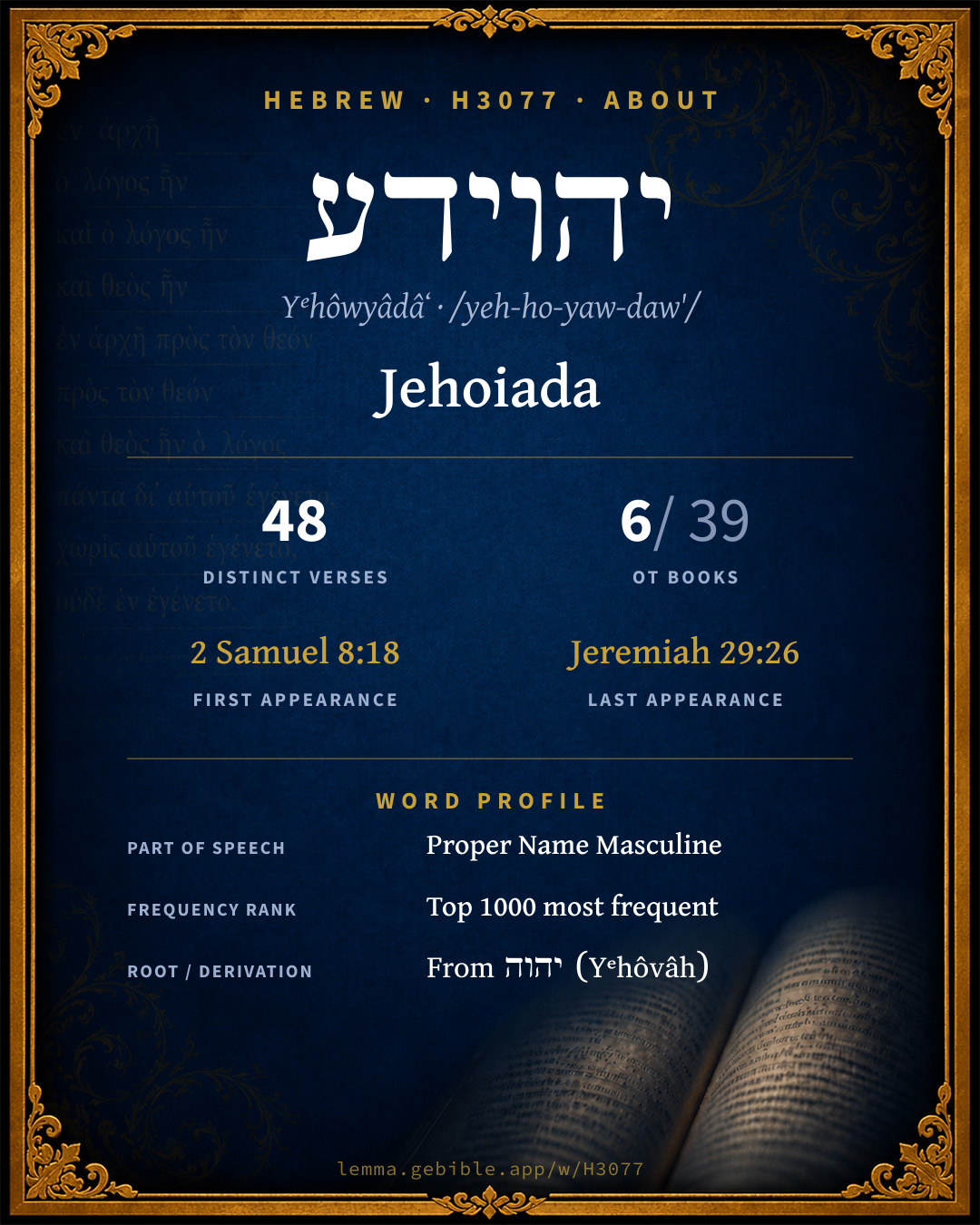
יְהוֹיָדָע
Jehoiada
BDB lists 5 entries for ‘Jehoiada’ fuller range ↓
Full lexicon entry — Brown-Driver-Briggs (BDB)
From Brown-Driver-Briggs (BDB)
Where this word appears
Grammar key — what these labels mean
Part of speech
- Noun
- A naming word — a person, place, thing, or idea.
Noun type
- Proper
- A name of a specific person, place, or people (e.g. Abraham, Zion, Israel).
Every verse where H3077 appears — 48 distinct verses across 6 books. Click any verse to open its interlinear word-by-word view. Verse text shown in the World English Bible for context — . Each verse’s Hebrew form is shown with its reference; the English is not keyword-highlighted, since the data carries no word-level English alignment. Use “Compare translations” on any verse to read it across multiple English versions. This concordance covers the Hebrew Bible; Septuagint (Greek Old Testament) occurrences are not indexed here.
2 Samuel 4 verses
- 2 Samuel 8:18 יְה֣וֹיָדָ֔ע n Proper and Benaiah the son of Jehoiada [was over] the Cherethites and the Pelethites; and David's sons were chief ministers.
- 2 Samuel 20:23 יְה֣וֹיָדָ֔ע n Proper Now Joab was over all the host of Israel; and Benaiah the son of Jehoiada was over the Cherethites and over the Pelethites;
- 2 Samuel 23:20 יְהוֹיָדָ֧ע n Proper Benaiah the son of Jehoiada, the son of a valiant man of Kabzeel, who had done mighty deeds, he killed the two [sons of] Ariel of Moab: he went down also and killed a lion in the midst of a pit in time of snow.
- 2 Samuel 23:22 יְהוֹיָדָ֑ע n Proper These things did Benaiah the son of Jehoiada, and had a name among the three mighty men.
1 Kings 12 verses
- 1 Kings 1:8 יְהוֹיָדָ֜ע n Proper But Zadok the priest, and Benaiah the son of Jehoiada, and Nathan the prophet, and Shimei, and Rei, and the mighty men who belonged to David, were not with Adonijah.
- 1 Kings 1:26 יְהוֹיָדָ֛ע n Proper But he hasn't called me, even me your servant, and Zadok the priest, and Benaiah the son of Jehoiada, and your servant Solomon.
- 1 Kings 1:32 יְהוֹיָדָ֑ע n Proper King David said, Call to me Zadok the priest, and Nathan the prophet, and Benaiah the son of Jehoiada. They came before the king.
- 1 Kings 1:36 יְהֽוֹיָדָ֛ע n Proper Benaiah the son of Jehoiada answered the king, and said, Amen: Yahweh, the God of my lord the king, say so [too].
- 1 Kings 1:38 יְהוֹיָדָ֗ע n Proper So Zadok the priest, and Nathan the prophet, and Benaiah the son of Jehoiada, and the Cherethites and the Pelethites, went down, and caused Solomon to ride on king David's mule, and brought him to Gihon.
- 1 Kings 1:44 יְה֣וֹיָדָ֔ע n Proper and the king has sent with him Zadok the priest, and Nathan the prophet, and Benaiah the son of Jehoiada, and the Cherethites and the Pelethites; and they have caused him to ride on the king's mule;
- 1 Kings 2:25 יְהוֹיָדָ֑ע n Proper King Solomon sent by Benaiah the son of Jehoiada; and he fell on him, so that he died.
- 1 Kings 2:29 יְהוֹיָדָ֛ע n Proper It was told king Solomon, Joab is fled to the Tent of Yahweh, and, behold, he is by the altar. Then Solomon sent Benaiah the son of Jehoiada, saying, Go, fall on him.
- 1 Kings 2:34 יְה֣וֹיָדָ֔ע n Proper Then Benaiah the son of Jehoiada went up, and fell on him, and killed him; and he was buried in his own house in the wilderness.
- 1 Kings 2:35 יְהוֹיָדָ֛ע n Proper The king put Benaiah the son of Jehoiada in his room over the host; and Zadok the priest did the king put in the room of Abiathar.
- 1 Kings 2:46 יְה֣וֹיָדָ֔ע n Proper So the king commanded Benaiah the son of Jehoiada; and he went out, and fell on him, so that he died. The kingdom was established in the hand of Solomon.
- 1 Kings 4:4 יְהוֹיָדָ֖ע n Proper and Benaiah the son of Jehoiada was over the host; and Zadok and Abiathar were priests;
2 Kings 7 verses
- 2 Kings 11:4 יְהוֹיָדָ֜ע n Proper In the seventh year Jehoiada sent and fetched the captains over hundreds of the Carites and of the guard, and brought them to him into the house of Yahweh; and he made a covenant with them, and took an oath of them in the house of Yahweh, and shown them the king's son.
- 2 Kings 11:9 יְהוֹיָדָ֣ע יְהוֹיָדָ֥ע n Proper n Proper The captains over hundreds did according to all that Jehoiada the priest commanded; and they took every man his men, those who were to come in on the Sabbath, with those who were to go out on the Sabbath, and came to Jehoiada the priest.
- 2 Kings 11:15 יְהוֹיָדָ֨ע n Proper Jehoiada the priest commanded the captains of hundreds who were set over the host, and said to them, Have her forth between the ranks; and him who follows her kill with the sword. For the priest said, Don't let her be slain in the house of Yahweh.
- 2 Kings 11:17 יְהוֹיָדָ֜ע n Proper Jehoiada made a covenant between Yahweh and the king and the people, that they should be Yahweh's people; between the king also and the people.
- 2 Kings 12:2 יְהוֹיָדָ֖ע n Proper Jehoash did that which was right in the eyes of Yahweh all his days in which Jehoiada the priest instructed him.
- 2 Kings 12:7 לִ/יהוֹיָדָ֤ע prep + n Proper Then king Jehoash called for Jehoiada the priest, and for the [other] priests, and said to them, Why don't you repair the breaches of the house? now therefore take no [more] money from your acquaintance, but deliver it for the breaches of the house.
- 2 Kings 12:9 יְהוֹיָדָ֤ע n Proper But Jehoiada the priest took a chest, and bored a hole in the lid of it, and set it beside the altar, on the right side as one comes into the house of Yahweh: and the priests who kept the threshold put therein all the money that was brought into the house of Yahweh.
1 Chronicles 6 verses
- 1 Chronicles 11:22 יְהוֹיָדָ֧ע n Proper Benaiah the son of Jehoiada, the son of a valiant man of Kabzeel, who had done mighty deeds, he killed the two [sons of] Ariel of Moab: he went down also and killed a lion in the midst of a pit in time of snow.
- 1 Chronicles 11:24 יְהוֹיָדָ֑ע n Proper These things did Benaiah the son of Jehoiada, and had a name among the three mighty men.
- 1 Chronicles 12:27 וִ/יהוֹיָדָ֖ע conj + n Proper Jehoiada was the leader of [the house of] Aaron; and with him were three thousand and seven hundred,
- 1 Chronicles 18:17 יְה֣וֹיָדָ֔ע n Proper and Benaiah the son of Jehoiada was over the Cherethites and the Pelethites; and the sons of David were chief about the king.
- 1 Chronicles 27:5 יְהוֹיָדָ֛ע n Proper The third captain of the host for the third month was Benaiah, the son of Jehoiada the priest, chief: and in his division were twenty-four thousand.
- 1 Chronicles 27:34 יְהוֹיָדָ֤ע n Proper and after Ahithophel was Jehoiada the son of Benaiah, and Abiathar: and the captain of the king's host was Joab.
2 Chronicles 18 verses
- 2 Chronicles 22:11 יְהוֹיָדָ֨ע n Proper But Jehoshabeath, the daughter of the king, took Joash the son of Ahaziah, and stole him away from among the king's sons who were slain, and put him and his nurse in the bedchamber. So Jehoshabeath, the daughter of king Jehoram, the wife of Jehoiada the priest (for she was the sister of Ahaziah), hid him from Athaliah, so that she didn't kill him.
- 2 Chronicles 23:1 יְהוֹיָדָ֗ע n Proper In the seventh year Jehoiada strengthened himself, and took the captains of hundreds, Azariah the son of Jeroham, and Ishmael the son of Jehohanan, and Azariah the son of Obed, and Maaseiah the son of Adaiah, and Elishaphat the son of Zichri, into covenant with him.
- 2 Chronicles 23:8 יְהוֹיָדָ֣ע יְהוֹיָדָ֥ע n Proper n Proper So the Levites and all Judah did according to all that Jehoiada the priest commanded: and they took every man his men, those who were to come in on the Sabbath; with those who were to go out on the Sabbath; for Jehoiada the priest didn't dismiss the shift.
- 2 Chronicles 23:9 יְהוֹיָדָ֨ע n Proper Jehoiada the priest delivered to the captains of hundreds the spears, and bucklers, and shields, that had been king David's, which were in the house of God.
- 2 Chronicles 23:11 יְהוֹיָדָ֣ע n Proper Then they brought out the king's son, and put the crown on him, and [gave him] the testimony, and made him king: and Jehoiada and his sons anointed him; and they said, [Long] live the king.
- 2 Chronicles 23:14 יְהוֹיָדָ֨ע n Proper Jehoiada the priest brought out the captains of hundreds who were set over the host, and said to them, Have her forth between the ranks; and whoever follows her, let him be slain with the sword: for the priest said, Don't kill her in the house of Yahweh.
- 2 Chronicles 23:16 יְהוֹיָדָע֙ n Proper Jehoiada made a covenant between himself, and all the people, and the king, that they should be Yahweh's people.
- 2 Chronicles 23:18 יְהוֹיָדָ֨ע n Proper Jehoiada appointed the officers of the house of Yahweh under the hand of the priests the Levites, whom David had distributed in the house of Yahweh, to offer the burnt offerings of Yahweh, as it is written in the law of Moses, with rejoicing and with singing, according to the order of David.
- 2 Chronicles 24:2 יְהוֹיָדָ֥ע n Proper Joash did that which was right in the eyes of Yahweh all the days of Jehoiada the priest.
- 2 Chronicles 24:3 יְהוֹיָדָ֖ע n Proper Jehoiada took for him two wives; and he became the father of sons and daughters.
- 2 Chronicles 24:6 לִֽ/יהוֹיָדָ֣ע prep + n Proper The king called for Jehoiada the chief, and said to him, Why haven't you required of the Levites to bring in out of Judah and out of Jerusalem the tax of Moses the servant of Yahweh, and of the assembly of Israel, for the tent of the testimony?
- 2 Chronicles 24:12 וִֽ/יהוֹיָדָ֗ע conj + n Proper The king and Jehoiada gave it to such as did the work of the service of the house of Yahweh; and they hired masons and carpenters to restore the house of Yahweh, and also such as worked iron and brass to repair the house of Yahweh.
- 2 Chronicles 24:14 וִֽ/יהוֹיָדָ֜ע יְהוֹיָדָֽע conj + n Proper n Proper When they had made an end, they brought the rest of the money before the king and Jehoiada, of which were made vessels for the house of Yahweh, even vessels with which to minister and to offer, and spoons, and vessels of gold and silver. They offered burnt offerings in the house of Yahweh continually all the days of Jehoiada.
- 2 Chronicles 24:15 יְהוֹיָדָ֛ע n Proper But Jehoiada grew old and was full of days, and he died; one hundred thirty years old was he when he died.
- 2 Chronicles 24:17 יְה֣וֹיָדָ֔ע n Proper Now after the death of Jehoiada came the princes of Judah, and made obeisance to the king. Then the king listened to them.
- 2 Chronicles 24:20 יְהוֹיָדָ֣ע n Proper The Spirit of God came on Zechariah the son of Jehoiada the priest; and he stood above the people, and said to them, Thus says God, Why disobey you the commandments of Yahweh, so that you can't prosper? because you have forsaken Yahweh, he has also forsaken you.
- 2 Chronicles 24:22 יְהוֹיָדָ֤ע n Proper Thus Joash the king didn't remember the kindness which Jehoiada his father had done to him, but killed his son. When he died, he said, Yahweh look on it, and require it.
- 2 Chronicles 24:25 יְהוֹיָדָ֣ע n Proper When they were departed for him (for they left him very sick), his own servants conspired against him for the blood of the sons of Jehoiada the priest, and killed him on his bed, and he died; and they buried him in the city of David, but they didn't bury him in the tombs of the kings.
Jeremiah 1 verse
About this entry
At a glance — auto-summarized from this page’s data, not written by a person. Every figure links to its source below. This summary describes the numbers; it doesn’t interpret them.
יהוידע (Yᵉhôwyâdâʻ) is a Hebrew name most often rendered “Jehoiada.” Scripture first uses it in 2 Samuel 8:18. Spanning 48 verses in 6 books, it ranks among the moderately common words of the Hebrew Bible. 2 Chronicles dominates its distribution — 18 of 48 verses. The sections below give every occurrence and version rendering.
Gloss history
Strong's 1890 vs modern scholarship
About this word
Strong's H3077 catalogs a Hebrew word from the Hebrew Old Testament.
These counts are not copied from any lexicon or concordance. They are computed here, from the morphology-tagged Hebrew Old Testament. What Lemma adds →
- 48
- distinct verses
- The word appears in 48 distinct verses.
- 6 / 39
- OT books
- The word appears in 6 of 39 Old Testament books.
- #723
- by frequency
- Top 1000 most frequent Hebrew words (rank 723 of 8,640 Hebrew words by occurrence).
View all 48 occurrences in the concordance →
Most concentrated in
- 2 Chronicles 18 verses 38%
- 1 Kings 12 verses 25%
- 2 Kings 7 verses 15%
By section of the Old Testament
By traditional corpus
Conventional, traditional groupings — biblical authorship is debated, so this is a traditional corpus grouping, not an authorship claim. Each share is this word’s portion of its verses in that division of the Hebrew canon. Each figure is a share of the word’s 48 distinct verses.
- Prophets (Nevi'im) 24 verses · 50%
- Writings (Ketuvim) 24 verses · 50%
How translations render this word
Counts come from each version’s own published word-to-Strong’s tagging or interlinear alignment — an approximate guide to how each version renders this word, not a word-level alignment the data otherwise carries. Because each total is that version’s own tagged count, the per-version totals vary from one another and need not match the appearance or distinct-verse counts above. These counts may also differ from a printed concordance because Lemma counts each distinctly tagged rendering and does not collapse phrase taggings into a single head-word total. This is a fixed set of word-tagged versions (KJV, ASV, BSB, ULT) and does not change with the reading translation you choose elsewhere. Each version’s license is shown beside its name below (and on Sources).
- King James Version: Jehoiada 45×, According to all things that jehoiada 2×
- American Standard Version: Jehoiada 46×, According to all that jehoiada 2×
- Berean Standard Bible: Jehoiada 46×
- unfoldingWord Literal Text: Jehoiada 48×
King James Version Public Domain
Renders H3077 across 51 tagged occurrences — most commonly:
Plus 4 renderings that appear only once — usually multi-word phrases or single function words the recovered tagging swept in, not distinct renderings.
American Standard Version Public Domain
Renders H3077 across 51 tagged occurrences — most commonly:
Plus 3 renderings that appear only once — usually multi-word phrases or single function words the recovered tagging swept in, not distinct renderings.
Berean Standard Bible Public Domain
Renders H3077 across 49 tagged occurrences — most commonly:
Plus 3 renderings that appear only once — usually multi-word phrases or single function words the recovered tagging swept in, not distinct renderings. Not rendered by a distinct English word in 2 further occurrences.
unfoldingWord Literal Text CC BY-SA 4.0
Renders H3077 across 50 tagged occurrences — most commonly:
Plus 2 renderings that appear only once — usually multi-word phrases or single function words the recovered tagging swept in, not distinct renderings.
Senses in the full BDB
What do BDB’s symbols mean?
BDB uses these scholarly abbreviations:
| Symbol | Meaning |
|---|---|
| 𝔊 | the Septuagint (the ancient Greek translation, LXX) |
| 𝔙 | the Vulgate (the Latin translation) |
| 𝔖 | the Syriac version (the Peshitta) |
| 𝔗 | the Targum (the Aramaic translation) |
| ψ | the Psalms |
| √ | root (the underlying root or stem) |
| ‖ | parallel passage (a synonymous or contrasted parallel) |
| † | the dagger: every passage where the word occurs is cited |
The 4 senses and sub-senses the full Brown-Driver-Briggs lexicon distinguishes for this word, in lexicon order (not ranked by frequency), with BDB’s own verbatim wording and sub-sense lettering. Shown in Hebrew script with BDB’s own scholarly abbreviations. The condensed entry is in the Lexicon Entry tab. See also the Forms in the corpus table below.
- 1. יְהוֹ׳; 𝔊 usually Ἰωδαε, A sometimes Ἰωιαδαε (2 S 23:30 +), 𝔊L Ἰωαδ (2 S 20:23 Ἰωαδδαι), father of Benaiah (David’s time), in combin. בְּנָיָהוּ בֶּן־יְהוֹ׳ 2 S 8:18; 20:23; 23:20, 22 1 K 1:8, 26, 32, 36, 38, 44; 2:25, 29, 34, 35, 46; 4:4; 1 Ch 1, 24; 18:17; 27:5; יְהוֹיָדָע בֶּן־בְּנָיָהוּ 1 Ch 27:34 is prob. erron. inversion of the usual order; יְהוֹ׳ alone only 1 Ch 12:28 (where called הַנָּגִיד לְאַחֲרֹן). e.g. 2 Samuel 23:30
- 2. יְהוֹ׳, 𝔊 usually Ἰωδαε A sometimes Ἰωιαδαε etc., (chief) priest at Jerus. in time of Joash 2 K 11:4, 9(×2), 15, 17; 12:3, 8, 10; 2 Ch 22:11; 23:1, 8(×2), 9, 11, 14, 16, 18; 24:2, 3, 6, 12, 14(×2), 15, 17, 20, 22, 25 Je 29:26. e.g. 2 Kings 11:4
- 3. יוֹיָדָע a builder at wall of Jerus., with Nehemiah, Ne 3:6 (𝔊 Ἰοειαα, Ἰοειδα, Ἰωδαε, etc.) e.g. Nehemiah 3:6
- 4. יוֹ׳ son of h. p. Eliashib Ne 12:10, 11, 22; 13:28 (𝔊 Ἰωδα, Ἰωδαε, Ἰωιαδα). e.g. Nehemiah 12:10
Senses from the full Brown-Driver-Briggs lexicon (Brown, Driver, Briggs; Oxford 1906 — public domain), digitized via Sefaria, supplemented by the OpenScriptures HebrewLexicon (CC BY 4.0). Full attribution on Sources.
Word origin
n.pr.m. (י׳ knoweth; cf. יְדַעְיָה, אֶלְיָדָע & reff., בְּעֶלְיָדָע)—
— Brown-Driver-Briggs (Oxford 1906, public domain), digitized via Sefaria, supplemented by the OpenScriptures HebrewLexicon (CC BY 4.0). See Sources.
Derived from יהוה (Yᵉhôvâh) (H3068) — LORD.
Jastrow Dictionary
A second Hebrew/Aramaic lexicon for comparison, covering Aramaic and post-biblical (Talmudic, Targumic, Midrashic) usage that the biblical-Hebrew BDB does not. Matched by lemma rather than by Strong’s number, so a lemma may carry more than one Jastrow headword (shown separately below), and the entries cover usage well beyond the Bible.
יְהוֹיָדָע
- (b. h.) pr. n. m. Jehoiada, the high-priest. Num. R. s. 23; a. e.
A Dictionary of the Targumim, the Talmud Babli and Yerushalmi, and the Midrashic Literature (Marcus Jastrow; London, Luzac, 1903) — Public Domain. Digitized via Sefaria. Digitized via Sefaria. Full attribution on Sources.
Forms in the corpus
The 19 distinct written forms H3077 takes in the Hebrew Bible, most frequent first — each parse links to that state’s occurrences in the concordance. Hebrew forms include their vowel points and cantillation, so a single lemma takes many written forms.
| Form | Parsing | Example | Uses |
|---|---|---|---|
| יְה֣וֹיָדָ֔ע | Noun, Proper | 1 Chronicles 18:17 | 7 |
| יְהוֹיָדָ֣ע | Noun, Proper | 2 Chronicles 23:8 | 6 |
| יְהוֹיָדָ֛ע | Noun, Proper | 1 Chronicles 27:5 | 5 |
| יְהוֹיָדָ֨ע | Noun, Proper | 2 Chronicles 22:11 | 5 |
| יְהוֹיָדָ֑ע | Noun, Proper | 1 Chronicles 11:24 | 4 |
| יְהוֹיָדָ֖ע | Noun, Proper | 1 Kings 4:4 | 3 |
| יְהוֹיָדָ֜ע | Noun, Proper | 1 Kings 1:8 | 3 |
| יְהוֹיָדָ֤ע | Noun, Proper | 1 Chronicles 27:34 | 3 |
| יְהוֹיָדָ֥ע | Noun, Proper | 2 Chronicles 23:8 | 3 |
| יְהוֹיָדָ֗ע | Noun, Proper | 1 Kings 1:38 | 2 |
| יְהוֹיָדָ֧ע | Noun, Proper | 1 Chronicles 11:22 | 2 |
| וִ/יהוֹיָדָ֖ע | Noun, Proper | 1 Chronicles 12:27 | 1 |
| וִֽ/יהוֹיָדָ֗ע | Noun, Proper | 2 Chronicles 24:12 | 1 |
| וִֽ/יהוֹיָדָ֜ע | Noun, Proper | 2 Chronicles 24:14 | 1 |
| יְהֽוֹיָדָ֛ע | Noun, Proper | 1 Kings 1:36 | 1 |
| יְהוֹיָדָֽע | Noun, Proper | 2 Chronicles 24:14 | 1 |
| יְהוֹיָדָע֙ | Noun, Proper | 2 Chronicles 23:16 | 1 |
| לִ/יהוֹיָדָ֤ע | Noun, Proper | 2 Kings 12:7 | 1 |
| לִֽ/יהוֹיָדָ֣ע | Noun, Proper | 2 Chronicles 24:6 | 1 |
Same root — word family
Other BDB entries built from the same root as H3077, grouped by Strong’s listed origin. These share a root / origin per the lexicon — not necessarily a shared meaning. Each links to that word’s own entry.
Derives from
Proper names from this root
People and places named from this root — a name, not an additional meaning of the word.
- הושמע Hôwshâmâʻ H1953 Hoshama
- יה Yâhh H3050 Jah
- יהוא Yêhûwʼ H3058 Jehu
- יהואחז Yᵉhôwʼâchâz H3059 Jehoahaz
- יהואש Yᵉhôwʼâsh H3060 Jehoash
- יהוה Yᵉhôvih H3069 LORD
- יהוה יראה Yᵉhôvâh yirʼeh H3070 Jehovah-jireh
- יהוה נסי Yᵉhôvâh niççîy H3071 Jehovah-nissi
- יהוה צדקנו Yᵉhôvâh tsidqênûw H3072 a sacred name symbolically applied to
- יהוה שלום Yᵉhôvâh shâlôwm H3073 Jehovah-shalom
- יהוה שמה Yᵉhôvâh shâmmâh H3074 Jehovahshammah
- יהוזבד Yᵉhôwzâbâd H3075 Jehozabad
- יהוחנן Yᵉhôwchânân H3076 Jehohanan
- יהויכין Yᵉhôwyâkîyn H3078 Jehoiachin
- יהויקים Yᵉhôwyâqîym H3079 Jehoiakim
- יהויריב Yᵉhôwyârîyb H3080 Jehoiarib
- יהונדב Yᵉhôwnâdâb H3082 Jehonadab
- יהונתן Yᵉhôwnâthân H3083 Jonathan
- יהועדה Yᵉhôwʻaddâh H3085 Jehoadah
- יהועדין Yᵉhôwʻaddîyn H3086 Jehoaddan
- יהוצדק Yᵉhôwtsâdâq H3087 Jehozadak
- יהורם Yᵉhôwrâm H3088 Jehoram
- יהושבע Yᵉhôwshebaʻ H3089 Jehosheba
- יהושוע Yᵉhôwshûwaʻ H3091 Joshua
- יוידע Yôwyâdâʻ H3111 Joiada
+11 more proper names from this root (not shown).
Compare all same-root words → Showing 4 of 38 — not the complete family. 37 of the same-root words are proper names (people or places). They share a root, not necessarily a meaning.
Bible dictionary
Public-domain dictionary articles matched to this entry by name (Jehoiada). A biblical name can be shared by more than one person or place, so an article may treat several.
Easton's Bible Dictionary · M. G. Easton, 1897
Jehovah-known. (1.) The father of Benaiah, who was one of David's chief warriors (2 Sam. 8:18; 20:23).
(2.) The high priest at the time of Athaliah's usurpation of the throne of Judah. He married Jehosheba, or Jehoshabeath, the daughter of king Jehoram (2 Chr. 22:11), and took an active part along with his wife in the preservation and training of Jehoash when Athaliah slew all the royal family of Judah.
The plans he adopted in replacing Jehoash on the throne of his ancestors are described in 2 Kings 11:2; 12:2; 2 Chr. 22:11; 23:24. He was among the foremost of the benefactors of the kingdom, and at his death was buried in the city of David among the kings of Judah (2 Chr. 24:15, 16). He is said to have been one hundred and thirty years old.
Smith's Bible Dictionary · William Smith, 1863
(Jehovah knows).
+ Father of Benaiah, David's well-known warrior. (2 Samuel 8:18) 1Kin 1 and 2 passim ; (1 Chronicles 18:17) etc. (B.C. before 1046.) + Leader of the Aaronites, i.e. the priests; who joined David at Hebron. (1 Chronicles 12:27) (B.C. 1053-46.) + According to (1 Chronicles 27:34) son of Benaiah; but in all probability Benaiah the sons of Jehoiada is meant. Probably an error in copying. (1 Chronicles 18:17; 2 Samuel 8:18) + High priest at the time of Athaliah's usurpation of the throne of Judah, B.C. 884-878, and during the greater portion of the forty-years reign of Joash. He married Jehosheba; and when Athaliah slew all the seed royal to Judah after Ahaziah had been put to death by Jehu, he and his wife stole Joash from among the king's sons and hid him for six years in the temple, and eventually replaced him on the throne of his ancestors. [Athaliah] The destruction of Baal-worship and the restoration of the temple were among the great works effected by Jehoiada. He died B.C. 834. + Second priest, or sagan, to Seraiah the high priest. (Jeremiah 29:25-29; 2 Kings 25:18) + Son of Paseach, who assisted to repair the old gate of Jerusalem. (Nehemiah 3:6)
Hitchcock's Bible Names Dictionary · Roswell D. Hitchcock, 1869
knowledge of the Lord
Classic public-domain reference works; full attribution on Sources.
Septuagint verse parallels
This word appears in 47 verses that also exist in the Greek Old Testament (Septuagint), out of the 48 Hebrew verses it occurs in. You can read those verses in Greek by switching the Old Testament edition to the Septuagint.
Read these verses in the Septuagint
This is a verse-level parallel only — the same verses exist in both the Hebrew and Greek Old Testaments. No word-level Hebrew↔Greek correspondence is claimed: the data carries no such alignment, so no Greek word is shown as this Hebrew word’s translation. Coverage is not total — the Septuagint omits the deuterocanon and renumbers the Psalms, so some Hebrew verses have no direct Greek parallel.