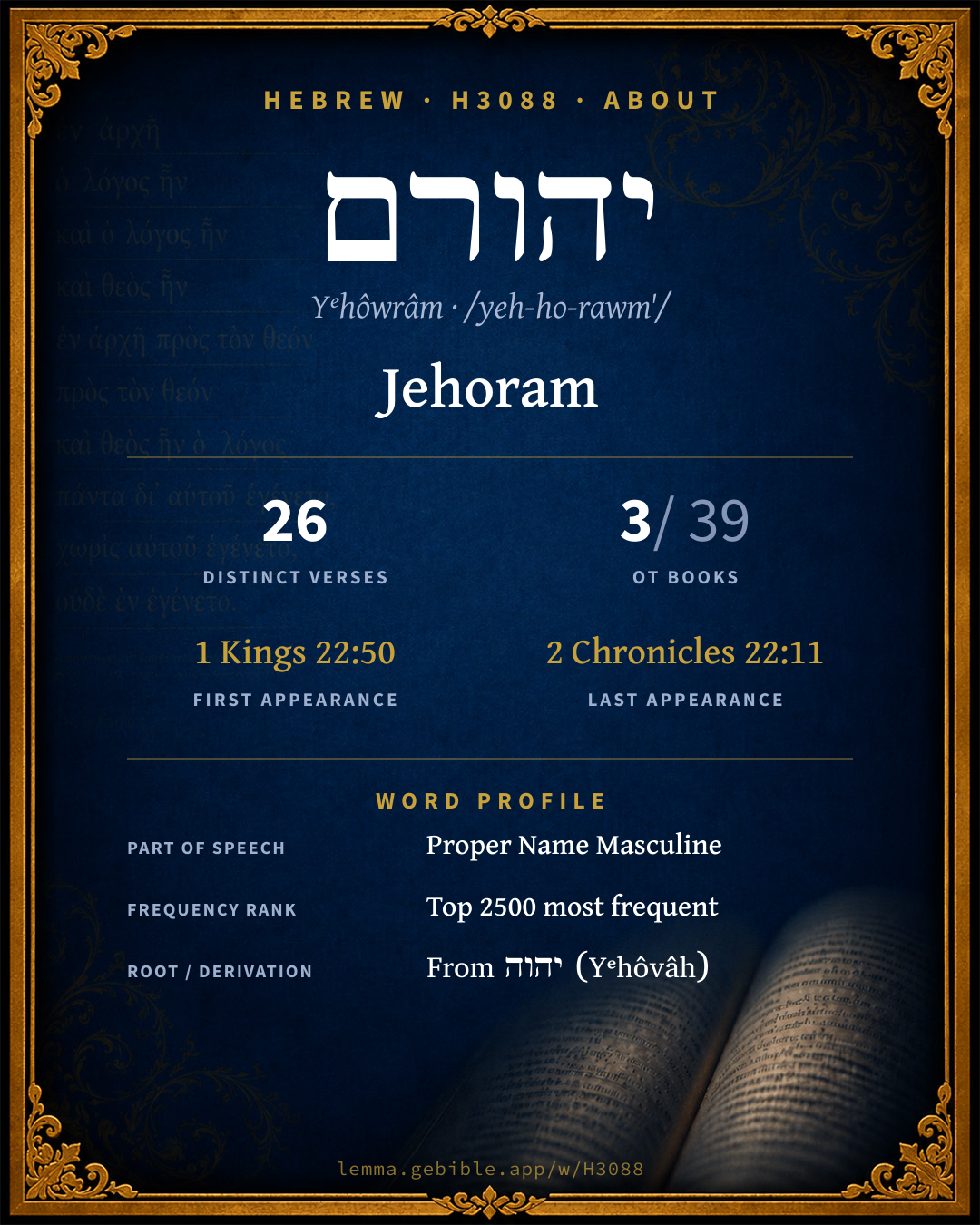
יְהוֹרָם
Jehoram
BDB lists 4 entries for ‘Jehoram’ fuller range ↓
Full lexicon entry — Brown-Driver-Briggs (BDB)
From Brown-Driver-Briggs (BDB)
Where this word appears
Grammar key — what these labels mean
Part of speech
- Noun
- A naming word — a person, place, thing, or idea.
Noun type
- Proper
- A name of a specific person, place, or people (e.g. Abraham, Zion, Israel).
Every verse where H3088 appears — 26 distinct verses across 3 books. Click any verse to open its interlinear word-by-word view. Verse text shown in the World English Bible for context — . Each verse’s Hebrew form is shown with its reference; the English is not keyword-highlighted, since the data carries no word-level English alignment. Use “Compare translations” on any verse to read it across multiple English versions. This concordance covers the Hebrew Bible; Septuagint (Greek Old Testament) occurrences are not indexed here.
1 Kings 1 verse
2 Kings 13 verses
- 2 Kings 1:17 יְהוֹרָם֙ לִ/יהוֹרָ֥ם n Proper prep + n Proper So he died according to the word of Yahweh which Elijah had spoken. Jehoram began to reign in his place in the second year of Jehoram the son of Jehoshaphat king of Judah; because he had no son.
- 2 Kings 3:1 וִ/יהוֹרָ֣ם conj + n Proper Now Jehoram the son of Ahab began to reign over Israel in Samaria in the eighteenth year of Jehoshaphat king of Judah, and reigned twelve years.
- 2 Kings 3:6 יְהוֹרָ֛ם n Proper King Jehoram went out of Samaria at that time, and mustered all Israel.
- 2 Kings 8:16 יְהוֹרָ֥ם n Proper In the fifth year of Joram the son of Ahab king of Israel, Jehoshaphat being then king of Judah, Jehoram the son of Jehoshaphat king of Judah began to reign.
- 2 Kings 8:25 יְהוֹרָ֖ם n Proper In the twelfth year of Joram the son of Ahab king of Israel did Ahaziah the son of Jehoram king of Judah begin to reign.
- 2 Kings 8:29 יְהוֹרָ֜ם n Proper King Joram returned to be healed in Jezreel of the wounds which the Syrians had given him at Ramah, when he fought against Hazael king of Syria. Ahaziah the son of Jehoram king of Judah went down to see Joram the son of Ahab in Jezreel, because he was sick.
- 2 Kings 9:15 יְהוֹרָ֨ם n Proper but king Joram was returned to be healed in Jezreel of the wounds which the Syrians had given him, when he fought with Hazael king of Syria.) Jehu said, If this be your mind, then let none escape and go forth out of the city, to go to tell it in Jezreel.
- 2 Kings 9:17 יְהוֹרָ֗ם n Proper Now the watchman was standing on the tower in Jezreel, and he spied the company of Jehu as he came, and said, I see a company. Joram said, Take a horseman, and send to meet them, and let him say, Is it peace?
- 2 Kings 9:21 יְהוֹרָם֙ יְהוֹרָ֣ם n Proper n Proper Joram said, Make ready. They made ready his chariot. Joram king of Israel and Ahaziah king of Judah went out, each in his chariot, and they went out to meet Jehu, and found him in the portion of Naboth the Jezreelite.
- 2 Kings 9:22 יְהוֹרָם֙ n Proper It happened, when Joram saw Jehu, that he said, Is it peace, Jehu? He answered, What peace, so long as the prostitution of your mother Jezebel and her witchcraft abound?
- 2 Kings 9:23 יְהוֹרָ֛ם n Proper Joram turned his hands, and fled, and said to Ahaziah, There is treachery, Ahaziah.
- 2 Kings 9:24 יְהוֹרָם֙ n Proper Jehu drew his bow with his full strength, and struck Joram between his arms; and the arrow went out at his heart, and he sunk down in his chariot.
- 2 Kings 12:18 וִ/יהוֹרָם֩ conj + n Proper Jehoash king of Judah took all the holy things that Jehoshaphat and Jehoram and Ahaziah, his fathers, kings of Judah, had dedicated, and his own holy things, and all the gold that was found in the treasures of the house of Yahweh, and of the king's house, and sent it to Hazael king of Syria: and he went away from Jerusalem.
2 Chronicles 12 verses
- 2 Chronicles 17:8 וִֽ/יהוֹרָ֖ם conj + n Proper and with them the Levites, even Shemaiah, and Nethaniah, and Zebadiah, and Asahel, and Shemiramoth, and Jehonathan, and Adonijah, and Tobijah, and Tob-adonijah, the Levites; and with them Elishama and Jehoram, the priests.
- 2 Chronicles 21:1 יְהוֹרָ֥ם n Proper Jehoshaphat slept with his fathers, and was buried with his fathers in the city of David: and Jehoram his son reigned in his place.
- 2 Chronicles 21:3 לִֽ/יהוֹרָ֖ם prep + n Proper Their father gave them great gifts, of silver, and of gold, and of precious things, with fortified cities in Judah: but the kingdom gave he to Jehoram, because he was the firstborn.
- 2 Chronicles 21:4 יְהוֹרָ֜ם n Proper Now when Jehoram was risen up over the kingdom of his father, and had strengthened himself, he killed all his brothers with the sword, and various also of the princes of Israel.
- 2 Chronicles 21:5 יְהוֹרָ֣ם n Proper Jehoram was thirty-two years old when he began to reign; and he reigned eight years in Jerusalem.
- 2 Chronicles 21:9 יְהוֹרָם֙ n Proper Then Jehoram passed over with his captains, and all his chariots with him: and he rose up by night, and struck the Edomites who surrounded him, along with the captains of the chariots.
- 2 Chronicles 21:16 יְהוֹרָ֗ם n Proper Yahweh stirred up against Jehoram the spirit of the Philistines, and of the Arabians who are beside the Ethiopians:
- 2 Chronicles 22:1 יְהוֹרָ֖ם n Proper The inhabitants of Jerusalem made Ahaziah his youngest son king in his place; for the band of men who came with the Arabians to the camp had slain all the eldest. So Ahaziah the son of Jehoram king of Judah reigned.
- 2 Chronicles 22:5 יְהוֹרָ֨ם n Proper He walked also after their counsel, and went with Jehoram the son of Ahab king of Israel to war against Hazael king of Syria at Ramoth-gilead: and the Syrians wounded Joram.
- 2 Chronicles 22:6 יְהוֹרָ֜ם יְהוֹרָ֧ם n Proper n Proper He returned to be healed in Jezreel of the wounds which they had given him at Ramah, when he fought against Hazael king of Syria. Azariah the son of Jehoram king of Judah went down to see Jehoram the son of Ahab in Jezreel, because he was sick.
- 2 Chronicles 22:7 יְהוֹרָם֙ n Proper Now the destruction of Ahaziah was of God, in that he went to Joram: for when he was come, he went out with Jehoram against Jehu the son of Nimshi, whom Yahweh had anointed to cut off the house of Ahab.
- 2 Chronicles 22:11 יְהוֹרָ֡ם n Proper But Jehoshabeath, the daughter of the king, took Joash the son of Ahaziah, and stole him away from among the king's sons who were slain, and put him and his nurse in the bedchamber. So Jehoshabeath, the daughter of king Jehoram, the wife of Jehoiada the priest (for she was the sister of Ahaziah), hid him from Athaliah, so that she didn't kill him.
About this entry
At a glance — auto-summarized from this page’s data, not written by a person. Every figure links to its source below. This summary describes the numbers; it doesn’t interpret them.
יהורם — transliterated Yᵉhôwrâm — is a Hebrew name carrying the sense “Jehoram.” Its uses cluster heavily in 2 Kings (50% of all occurrences). With 26 verses in 3 books, it is a moderately common word in the Hebrew Bible. It first appears in 1 Kings 22:50. See 26-verse concordance and the renderings breakdown below.
Gloss history
Strong's 1890 vs modern scholarship
About this word
Strong's H3088 catalogs a Hebrew word from the Hebrew Old Testament.
These counts are not copied from any lexicon or concordance. They are computed here, from the morphology-tagged Hebrew Old Testament. What Lemma adds →
- 26
- distinct verses
- The word appears in 26 distinct verses.
- 3 / 39
- OT books
- The word appears in 3 of 39 Old Testament books.
- #1,160
- by frequency
- Top 2500 most frequent Hebrew words (rank 1,160 of 8,640 Hebrew words by occurrence).
View all 26 occurrences in the concordance →
Most concentrated in
- 2 Kings 13 verses 50%
- 2 Chronicles 12 verses 46%
- 1 Kings 1 verse 4%
By section of the Old Testament
By traditional corpus
Conventional, traditional groupings — biblical authorship is debated, so this is a traditional corpus grouping, not an authorship claim. Each share is this word’s portion of its verses in that division of the Hebrew canon. Each figure is a share of the word’s 26 distinct verses.
- Prophets (Nevi'im) 14 verses · 54%
- Writings (Ketuvim) 12 verses · 46%
How translations render this word
Counts come from each version’s own published word-to-Strong’s tagging or interlinear alignment — an approximate guide to how each version renders this word, not a word-level alignment the data otherwise carries. Because each total is that version’s own tagged count, the per-version totals vary from one another and need not match the appearance or distinct-verse counts above. These counts may also differ from a printed concordance because Lemma counts each distinctly tagged rendering and does not collapse phrase taggings into a single head-word total. This is a fixed set of word-tagged versions (KJV, ASV, BSB, ULT) and does not change with the reading translation you choose elsewhere. Each version’s license is shown beside its name below (and on Sources).
BDB lists this Strong’s number as 3 distinct words (homographs). Each count above pools all of them and is not split by sense — see the Senses section below. A low-frequency rendering may belong to a different one of those words, not the primary meaning.
- King James Version†: Jehoram 19×, Joram 5×
- American Standard Version†: Jehoram 17×, Joram 6×
- Berean Standard Bible†: Jehoram 19×, Joram 10×
- unfoldingWord Literal Text†: Jehoram 25×, Joram 2×
King James Version Public Domain
Renders H3088 across 29† tagged occurrences — most commonly:
Plus 5 renderings that appear only once — usually multi-word phrases or single function words the recovered tagging swept in, not distinct renderings.
American Standard Version Public Domain
Renders H3088 across 28† tagged occurrences — most commonly:
Plus 5 renderings that appear only once — usually multi-word phrases or single function words the recovered tagging swept in, not distinct renderings.
Berean Standard Bible Public Domain
Renders H3088 across 29† tagged occurrences — most commonly:
unfoldingWord Literal Text CC BY-SA 4.0
Renders H3088 across 29† tagged occurrences — most commonly:
Plus 2 renderings that appear only once — usually multi-word phrases or single function words the recovered tagging swept in, not distinct renderings.
Senses in the full BDB
What do BDB’s symbols mean?
BDB uses these scholarly abbreviations:
| Symbol | Meaning |
|---|---|
| 𝔊 | the Septuagint (the ancient Greek translation, LXX) |
| 𝔙 | the Vulgate (the Latin translation) |
| 𝔖 | the Syriac version (the Peshitta) |
| 𝔗 | the Targum (the Aramaic translation) |
| ψ | the Psalms |
| √ | root (the underlying root or stem) |
| ‖ | parallel passage (a synonymous or contrasted parallel) |
| † | the dagger: every passage where the word occurs is cited |
The 5 senses and sub-senses the full Brown-Driver-Briggs lexicon distinguishes for this word, in lexicon order (not ranked by frequency), with BDB’s own verbatim wording and sub-sense lettering. Shown in Hebrew script with BDB’s own scholarly abbreviations. The condensed entry is in the Lexicon Entry tab. See also the Forms in the corpus table below.
יהורם I m. (י׳ is exalted
- 1. יְהוֹ׳ (𝔊 Ἰωραμ) king of Judah, son of Jehoshaphat 1 K 22:51 2 K 1:17; 8:16, 25, 29; 12:19 2 Ch 21:1, 3, 4, 5, 9, 16; 22:1, 6, 11; = יוֹ׳ 2 K 8:21, 23, 24; 11:2 1 Ch 3:11. e.g. 1 Kings 22:51
- 2. יְהוֹ׳ (𝔊 Ἰωραμ) king of Israel son of Ahab 2 K 1:17; 3:1, 6; 9:15, 17, 21, 22, 23 2 Ch 2, 6, 7; = יוֹ׳ 2 K 8:16, 25, 28(×2), 29(×2); 9:14(×2), 16(×2), 29 2 Ch 22:5, 7. e.g. 2 Kings 1:17
- 3. יְהוֹ׳ priest in time of Jehoshaphat 2 Ch 17:8 (𝔊 Ἰωραμ, Ἰωραν). e.g. 2 Chronicles 17:8
- 4. יוֹ׳ son of Tou, king of Hamath 2 S 8:10 (𝔊 Ἰεδδουραν) prob. error for הֲדוֹרָם ‖ 1 Ch 18:10. e.g. 2 Samuel 8:10
- 5. יֹרָם a Levite 1 Ch 26:25 (𝔊 Ἰωραμ). e.g. 1 Chronicles 26:25
יהורם II m. בְּנֵי י׳ one of the families of the restoration Ezr 2
Senses from the full Brown-Driver-Briggs lexicon (Brown, Driver, Briggs; Oxford 1906 — public domain), digitized via Sefaria, supplemented by the OpenScriptures HebrewLexicon (CC BY 4.0). Full attribution on Sources.
Word origin
I. n.pr.m. (י׳ is exalted; cf. מַלְכִּירָם; further, Ph. בעלרם, רמבעל; Sab. אלרם DHMZMG 1876, 686)—
II. n.pr.m. בְּנֵי י׳ one of the families of the restoration Ezr 2:18 (𝔊 Ουρα, Ιωρα) = חָרִיף Ne 7:24 (𝔊 Αρειφ).
— Brown-Driver-Briggs (Oxford 1906, public domain), digitized via Sefaria, supplemented by the OpenScriptures HebrewLexicon (CC BY 4.0). See Sources.
Derived from יהוה (Yᵉhôvâh) (H3068) — LORD.
Jastrow Dictionary
A second Hebrew/Aramaic lexicon for comparison, covering Aramaic and post-biblical (Talmudic, Targumic, Midrashic) usage that the biblical-Hebrew BDB does not. Matched by lemma rather than by Strong’s number, so a lemma may carry more than one Jastrow headword (shown separately below), and the entries cover usage well beyond the Bible.
יְהוֹרָם
- (b. h.) pr. n. m. Jehoram, Joram,
- 1. son of Ahab, king of Israel. Ber. 10ᵃ. Ex. R. s. 31; a. e.
- 2. son of Joshafat, king of Judah. Hor. 11ᵇ, v. יֵהוּא
A Dictionary of the Targumim, the Talmud Babli and Yerushalmi, and the Midrashic Literature (Marcus Jastrow; London, Luzac, 1903) — Public Domain. Digitized via Sefaria. Digitized via Sefaria. Full attribution on Sources.
Forms in the corpus
The 15 distinct written forms H3088 takes in the Hebrew Bible, most frequent first — each parse links to that state’s occurrences in the concordance. Hebrew forms include their vowel points and cantillation, so a single lemma takes many written forms.
| Form | Parsing | Example | Uses |
|---|---|---|---|
| יְהוֹרָם֙ | Noun, Proper | 2 Chronicles 21:9 | 6 |
| יְהוֹרָ֜ם | Noun, Proper | 2 Chronicles 21:4 | 3 |
| יְהוֹרָ֥ם | Noun, Proper | 1 Kings 22:50 | 3 |
| יְהוֹרָ֖ם | Noun, Proper | 2 Chronicles 22:1 | 2 |
| יְהוֹרָ֗ם | Noun, Proper | 2 Chronicles 21:16 | 2 |
| יְהוֹרָ֛ם | Noun, Proper | 2 Kings 3:6 | 2 |
| יְהוֹרָ֣ם | Noun, Proper | 2 Chronicles 21:5 | 2 |
| יְהוֹרָ֨ם | Noun, Proper | 2 Chronicles 22:5 | 2 |
| וִ/יהוֹרָ֣ם | Noun, Proper | 2 Kings 3:1 | 1 |
| וִ/יהוֹרָם֩ | Noun, Proper | 2 Kings 12:18 | 1 |
| וִֽ/יהוֹרָ֖ם | Noun, Proper | 2 Chronicles 17:8 | 1 |
| יְהוֹרָ֡ם | Noun, Proper | 2 Chronicles 22:11 | 1 |
| יְהוֹרָ֧ם | Noun, Proper | 2 Chronicles 22:6 | 1 |
| לִ/יהוֹרָ֥ם | Noun, Proper | 2 Kings 1:17 | 1 |
| לִֽ/יהוֹרָ֖ם | Noun, Proper | 2 Chronicles 21:3 | 1 |
Same root — word family
Other BDB entries built from the same root as H3088, grouped by Strong’s listed origin. These share a root / origin per the lexicon — not necessarily a shared meaning. Each links to that word’s own entry.
Derives from
Proper names from this root
People and places named from this root — a name, not an additional meaning of the word.
- הושמע Hôwshâmâʻ H1953 Hoshama
- יה Yâhh H3050 Jah
- יהוא Yêhûwʼ H3058 Jehu
- יהואחז Yᵉhôwʼâchâz H3059 Jehoahaz
- יהואש Yᵉhôwʼâsh H3060 Jehoash
- יהוה Yᵉhôvih H3069 LORD
- יהוה יראה Yᵉhôvâh yirʼeh H3070 Jehovah-jireh
- יהוה נסי Yᵉhôvâh niççîy H3071 Jehovah-nissi
- יהוה צדקנו Yᵉhôvâh tsidqênûw H3072 a sacred name symbolically applied to
- יהוה שלום Yᵉhôvâh shâlôwm H3073 Jehovah-shalom
- יהוה שמה Yᵉhôvâh shâmmâh H3074 Jehovahshammah
- יהוזבד Yᵉhôwzâbâd H3075 Jehozabad
- יהוחנן Yᵉhôwchânân H3076 Jehohanan
- יהוידע Yᵉhôwyâdâʻ H3077 Jehoiada
- יהויכין Yᵉhôwyâkîyn H3078 Jehoiachin
- יהויקים Yᵉhôwyâqîym H3079 Jehoiakim
- יהויריב Yᵉhôwyârîyb H3080 Jehoiarib
- יהונדב Yᵉhôwnâdâb H3082 Jehonadab
- יהונתן Yᵉhôwnâthân H3083 Jonathan
- יהועדה Yᵉhôwʻaddâh H3085 Jehoadah
- יהועדין Yᵉhôwʻaddîyn H3086 Jehoaddan
- יהוצדק Yᵉhôwtsâdâq H3087 Jehozadak
- יהושבע Yᵉhôwshebaʻ H3089 Jehosheba
- יהושוע Yᵉhôwshûwaʻ H3091 Joshua
- יורם Yôwrâm H3141 Joram
+11 more proper names from this root (not shown).
Compare all same-root words → Showing 4 of 38 — not the complete family. 37 of the same-root words are proper names (people or places). They share a root, not necessarily a meaning.
Bible dictionary
Public-domain dictionary articles matched to this entry by name (Jehoram). A biblical name can be shared by more than one person or place, so an article may treat several.
Easton's Bible Dictionary · M. G. Easton, 1897
Jehovah-exalted. (1.) Son of Toi, king of Hamath, sent by his father to congratulate David on the occasion of his victory over Hadadezer (2 Sam. 8:10).
(2.) A Levite of the family of Gershom (1 Chr. 26:25).
(3.) A priest sent by Jehoshaphat to instructruct the people in Judah (2 Chr. 17:8).
(4.) The son of Ahab and Jezebel, and successor to his brother Ahaziah on the throne of Israel. He reigned twelve years, B.C. 896-884 (2 Kings 1:17; 3:1). His first work was to reduce to subjection the Moabites, who had asserted their independence in the reign of his brother. Jehoshaphat, king of Judah, assisted Jehoram in this effort. He was further helped by his ally the king of Edom. Elisha went forth with the confederated army (2 Kings 3:1-19), and at the solicitation of Jehoshaphat encouraged the army with the assurance from the Lord of a speedy victory. The Moabites under Mesha their king were utterly routed and their cities destroyed. At Kir-haraseth Mesha made a final stand. The Israelites refrained from pressing their victory further, and returned to their own land.
Elisha afterwards again befriended Jehoram when a war broke out between the Syrians and Israel, and in a remarkable way brought that war to a bloodless close (2 Kings 6:23). But Jehoram, becoming confident in his own power, sank into idolatry, and brought upon himself and his land another Syrian invasion, which led to great suffering and distress in Samaria (2 Kings 6:24-33). By a remarkable providential interposition the city was saved from utter destruction, and the Syrians were put to flight (2 Kings 7:6-15).
Jehoram was wounded in a battle with the Syrians at Ramah, and obliged to return to Jezreel (2 Kings 8:29; 9:14, 15), and soon after the army proclaimed their leader Jehu king of Israel, and revolted from their allegiance to Jehoram (2 Kings 9). Jehoram was pierced by an arrow from Jehu's bow on the piece of ground at Jezreel which Ahab had taken from Naboth, and there he died (2 Kings 9:21-29).
(5.) The eldest son and successor of Jehoshaphat, king of Judah. He reigned eight years (B.C. 892-885) alone as king of Judah, having been previously for some years associated with his father (2 Chr. 21:5, 20; 2 Kings 8:16). His wife was Athaliah, the daughter of Ahab and Jezebel. His daughter Jehosheba was married to the high priest Jehoiada. He sank into gross idolatry, and brought upon himself and his kingdom the anger of Jehovah. The Edomites revolted from under his yoke, and the Philistines and the Arabians and Cushites invaded the land, and carried away great spoil, along with Jehoram's wives and all his children, except Ahaziah. He died a painful death from a fearful malady, and was refused a place in the sepulchre of the kings (2 Kings 8:16-24; 2 Chr. 21).
Smith's Bible Dictionary · William Smith, 1863
(whom Jehovah has exalted).
+ Son of Ahab king of Israel, who succeeded his brother Ahaziah B.C. 896, and died B.C. 884. The alliance between the kingdoms of Israel and Judah, commenced by his father and Jehoshaphat, was very close throughout his reign. We first find him associated with Jehoshaphat and the king of Edom in a war against the Moabites. The three armies were in the utmost danger of perishing for want of water. The piety of Jehoshaphat suggested an inquiry of Jehovah, thorough Elisha. After reproving Jehoram, Elisha, for Jehoshaphat's sake, inquired of Jehovah, and received the promise of an abundant supply of water, and of a great victory over the Moabites; a promise which was immediately fulfilled. The allies pursued them with great slaughter into their own land, which they utterly ravaged and destroyed most of its cities. Kirharaseth alone remained, the there the king of Moab made his last stand. An attempt to break through the besieging army having failed, he resorted to the desperate expedient of offering up his eldest son, as a burnt offering, upon the wall of the city, in the sight of the enemy. Upon this the Israelites retired and returned to their own land. (2 Kings 3:1) ... A little later, when war broke out between Syria and Israel, we find Elisha befriending Jehoram; but when the terrible famine in Samaria arose, the king immediately attributed the evil to Elisha, and determined to take away his life. The providential interposition by which both Elisha's life was saved the city delivered is narrated (2 Kings 7:1) ... and Jehoram appears to have returned to friendly feeling toward Elisha. (2 Kings 8:4) It was soon after these vents that the revolution in Syria predicted by Elisha took place, giving Jehoram a good opportunity of recovering Ramoth-gilead from the Syrians. he accordingly made an alliance with his nephew Ahaziah, who had just succeeded Joram on the throne of Judah, and the two kings proceeded to occupy Ramoth-gilead by force. The expedition was an unfortunate one. Jehoram was wounded in battle, and obliged to return to Jezreel to be healed of his wounds. (2 Kings 8:29; 9:14,15) jehu and the army under his command revolted from their allegiance to Jehoram, (2 Kings 9:1) ... and hastily marching to Jezreel, surprised Jehoram, wounded and defenseless as he was. Jehoram, going out to meet him, fell pierced by an arrow from Jehu's bow on the very plot of ground which Ahab had wrested from Naboth the Jezreelite; thus fulfilling to the letter the prophecy of Elijah. (1 Kings 21:29) With the life of Jehoram ended the dynasty of Omri. + Eldest son of Jehoshaphat, succeeded his father on the throne of Judah at the age of 32, and reigned eight years, from B.C. 893-2 to 885-4. As soon as he was fixed on the throne, he put his six brothers to death, with many of the chief nobles of the land. He then, probably at the instance of his wife Athaliah the daughter of Ahab, proceeded to establish the worship of Baal. A prophetic writing from the aged prophet Elijah, (2 Chronicles 21:12) failed to produce any good effect upon him. The remainder of his reign was a series of calamities. First the Edomites, who had been tributary to Jehoshaphat, revolted from his dominion and established their permanent independence. Next Libnah, (2 Kings 19:8) rebelled against him. Then followed invasion by armed bands of Philistines and of Arabians, who stormed the king's palace, put his wives and all his children, except his youngest son Ahaziah, to death, (2 Chronicles 22:1) or carried them into captivity, and plundered all his treasures. he died of a terrible disease. (2 Chronicles 21:19,20)
Hitchcock's Bible Names Dictionary · Roswell D. Hitchcock, 1869
exaltation of the Lord
Classic public-domain reference works; full attribution on Sources.
Septuagint verse parallels
This word appears in 25 verses that also exist in the Greek Old Testament (Septuagint), out of the 26 Hebrew verses it occurs in. You can read those verses in Greek by switching the Old Testament edition to the Septuagint.
Read these verses in the Septuagint
This is a verse-level parallel only — the same verses exist in both the Hebrew and Greek Old Testaments. No word-level Hebrew↔Greek correspondence is claimed: the data carries no such alignment, so no Greek word is shown as this Hebrew word’s translation. Coverage is not total — the Septuagint omits the deuterocanon and renumbers the Psalms, so some Hebrew verses have no direct Greek parallel.