
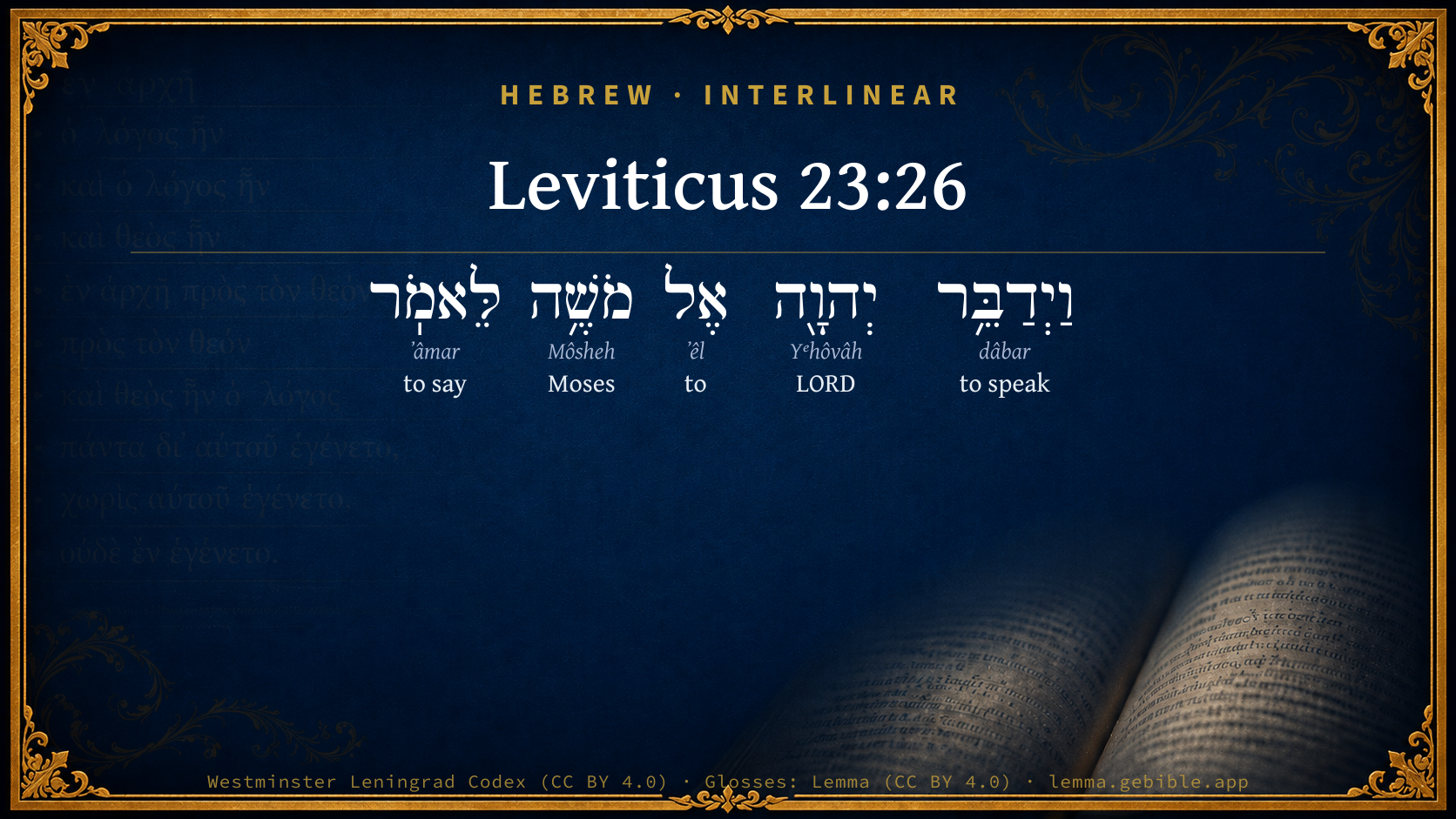
Leviticus 23:26

Hebrew (Westminster Leningrad Codex) Leviticus 23:26 appears in the Hebrew Old Testament. The text above is from the Westminster Leningrad Codex. Each word links to its Strong’s number, a concise gloss, and parsing drawn from the Open Scriptures Hebrew Bible morphology. Click any word for its full Brown-Driver-Briggs (BDB) entry.
Download image
Cite this verse

Leviticus 23:26 (World English Bible). Public Domain. Lemma interlinear Bible study tool, https://lemma.gebible.app/v/leviticus/23/26.

Show BibTeX & RIS
BibTeX
RIS
English Translation
Yahweh spoke to Moses, saying,
World English Bible · Public Domain
Download a study sheet

One document with this verse’s original text, its word-by-word gloss line, the meaning frame, cross-references with their text, attributed commentary, and full source and license credits — printable, and it pastes into notes with its structure intact.

This verse Autodidact and up

Study sheet (.html) Plain text (.txt)

A passage Seminary Student

Up to 50 verses in one chapter. A passage sheet keeps up to 6 commentary sources and 12 cross-references per verse, in the order this page ranks them, and says so on the sheet whenever that leaves anything out. Ask for a single verse and you get the Autodidact verse sheet above.

Everything on this page stays free to read, with no account — the sheet is a download of what is already on screen, not access to it.

Want to remove ads? Support Godless Engineer
Compare translations 3

The same verse in 3 English versions, stacked beneath the original-language interlinear above. Click any original word for its lexicon entry.

Each is an independent rendering of the whole verse — the interlinear is not word-aligned to these translations.

Highlighted words mark where these versions differ — a whole-verse word diff, not a word-by-word alignment.

  • World English Bible Public Domain
    Yahweh spoke to Moses, saying,
  • King James Version Public Domain
    And the LORD spake unto Moses, saying,
  • unfoldingWord Literal Text CC BY-SA 4.0
    And Yahweh spoke to Moses, saying,

unfoldingWord Literal Text — © unfoldingWord, licensed CC BY-SA 4.0. Word-aligned USFM3 via Door43 (git.door43.org/unfoldingWord/en_ult).

Versions to compare (up to 4)

3 of 4 selected

Show all 18 translations

Every available English version of this verse, each an independent rendering of the whole verse.

  • World English Bible Public Domain
    Yahweh spoke to Moses, saying,
  • Berean Standard Bible Public Domain
    Again the LORD said to Moses,
  • Majority Standard Bible Public Domain
    Again the LORD said to Moses,
  • King James Version Public Domain
    And the LORD spake unto Moses, saying,
  • American Standard Version (1901) Public Domain
    And Jehovah spake unto Moses, saying,
  • Revised Version (1885) Public Domain
    And the LORD spake unto Moses, saying,
  • Geneva Bible (1599) Public Domain
    And the Lord spake vnto Moses, saying,
  • Douay-Rheims (1899) Public Domain
    And the Lord spoke to Moses, saying:
  • Young's Literal Translation Public Domain
    And Jehovah speaketh unto Moses, saying,
  • Literal Standard Version CC BY-SA 4.0
    And YHWH speaks to Moses, saying,
  • Unlocked Literal Bible CC BY-SA 4.0
    Then Yahweh spoke to Moses, saying,
  • unfoldingWord Literal Text CC BY-SA 4.0
    And Yahweh spoke to Moses, saying,
  • Darby Bible Public Domain
    And Jehovah spoke to Moses, saying,
  • World Messianic Bible Public Domain
    The LORD spoke to Moses, saying,
  • Webster's Bible Public Domain
    And the LORD spoke to Moses, saying,
  • Free Bible Version CC BY-SA 4.0
    The Lord told Moses,
  • Bible in Basic English Public Domain
    And the Lord said to Moses,
  • JPS Tanakh (1917) Public Domain
    And the LORD spoke unto Moses, saying:

Literal Standard Version (2020), Covenant Press — licensed CC BY-SA 4.0. Text via the HelloAO Bible API (eBible.org). Unlocked Literal Bible (unfoldingWord) — licensed CC BY-SA 4.0. Text via the HelloAO Bible API (eBible.org). unfoldingWord Literal Text — © unfoldingWord, licensed CC BY-SA 4.0. Word-aligned USFM3 via Door43 (git.door43.org/unfoldingWord/en_ult). Free Bible Version, Dr. Jonathan Gallagher — licensed CC BY-SA 4.0. Text via the HelloAO Bible API (eBible.org).

Word by word

More ways to search: Search by grammar → Find every occurrence → Compare this word →

Practice this passage: Drill this verse → Learn its vocabulary →

About this verse

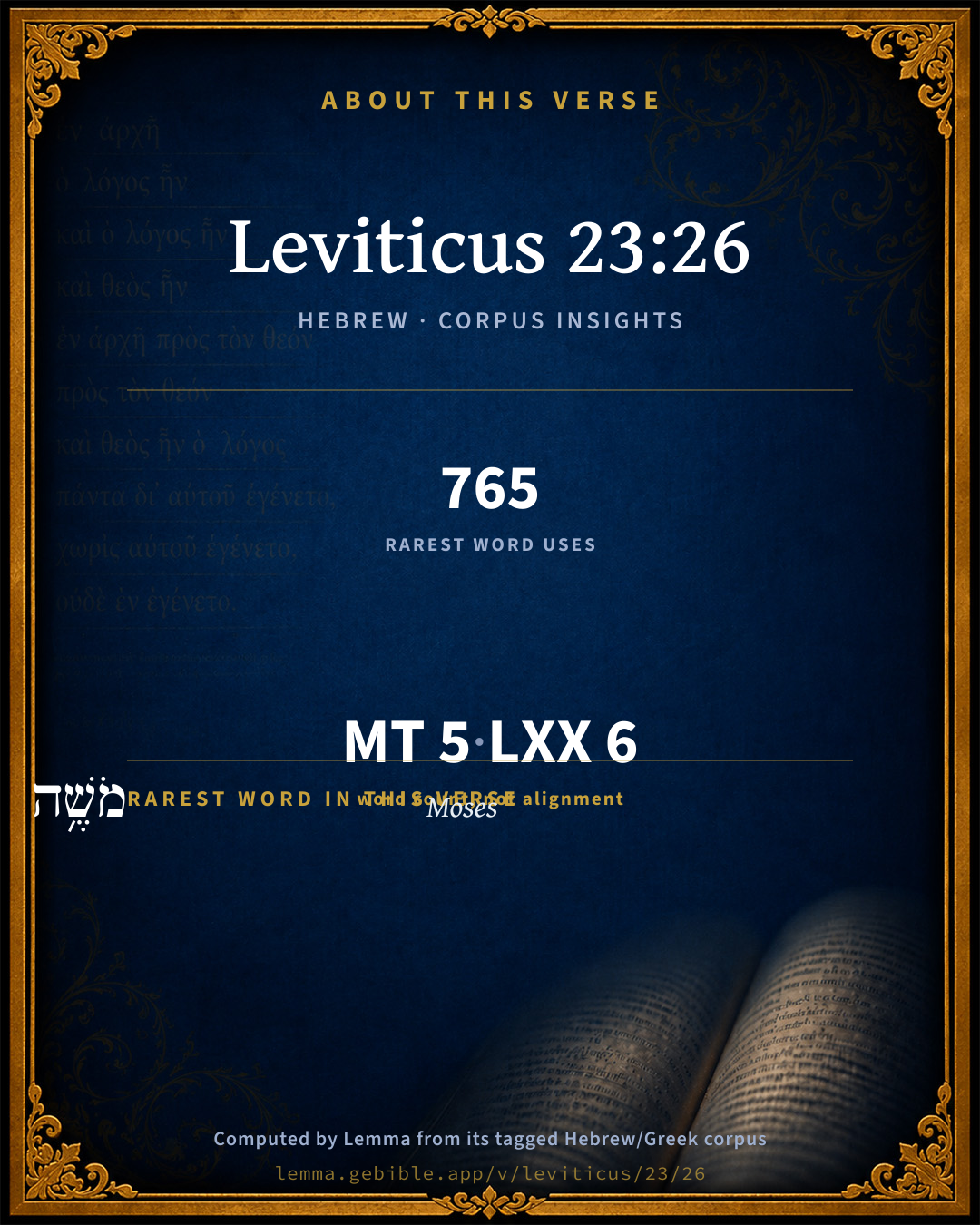
These counts appear in no published source. They are computed here, from the morphology-tagged text and Lemma’s own curated glosses. What Lemma adds →

5
words
5
distinct lemmas
Pentateuch
section

Grammatical profile

  • 2 verbs
  • 2 nouns
  • 1 preposition

Verb forms

  • וַיְדַבֵּ֥ר Piel · Sequential Imperfect
  • לֵּאמֹֽר Qal · Infinitive Construct

Hebrew & Septuagint length

In English translation the verse runs 5 words from the Hebrew and 7 from the Septuagint (LXX English) — closely comparable.

A rough comparison of the two English renderings, which tokenize alike — not a word-level alignment.

Word counts can differ between the Hebrew and the Greek without any difference in meaning — e.g. the Hebrew direct-object marker אֵת has no separate Greek word, and Greek often adds the article ὁ.

In the original languages it is 5 Hebrew tokens and 6 Greek tokens — but the two are counted differently (Hebrew bundles its prefixes and suffixes into one token; the Greek is in lemma form), so that isn’t a like-for-like length.

Hebrew and Greek witnesses Masoretic Hebrew ↔ Greek Septuagint

The same verse in the two great witnesses to the Old Testament, shown verse-for-verse.

These are two independent witnesses, not word-aligned to each other, and the Septuagint is shown in lemma (dictionary) form.

Hebrew Leviticus 23:26 Masoretic · Westminster Leningrad Codex

וַיְדַבֵּ֥ר יְהוָ֖ה אֶל מֹשֶׁ֥ה לֵּאמֹֽר

Yahweh spoke to Moses, saying,

World English Bible · Public Domain

Greek LXX Leviticus 23:26 Septuagint · lemma form

καί λαλέω κύριος πρός μωυσῆς λέγω

And the Lord spoke to Moses, saying,

LXX2012 (modern English Septuagint) · Public Domain

Hebrew: Westminster Leningrad Codex (CC BY 4.0). Greek: Septuagint (public domain); English from LXX2012 (modern English Septuagint) (Public Domain). How the Septuagint differs from the Hebrew →

Targum (Aramaic paraphrase)

2

The Targum is the ancient Jewish Aramaic paraphrase of the Hebrew Scriptures — an interpretive translation, not the Hebrew text itself. Onkelos (literal) and Pseudo-Jonathan (expansive) render the Torah, and Jonathan the Prophets. Coverage is partial: where no permissively-licensed English translation exists for a verse, only the Aramaic is shown. This is verse-level text, not a word-by-word alignment to the Hebrew.

  1. Targum Onkelos Torah (Genesis–Deuteronomy)
    וּמַלִיל יְיָ עִם מֹשֶׁה לְמֵימָר

    (no public-domain English translation for this verse)

    Targum Onkelos — Aramaic: “Onkelos Genesis” (public domain); “Onkelos Exodus” (public domain); “Onkelos Leviticus” (public domain); “Onkelos Numbers” (public domain); “Onkelos Deuteronomy” (public domain). English: “Sefaria Community Translation” (CC0 1.0 (public-domain dedication)); “J.W. Etheridge. The Targums of Onkelos and Jonathan Ben Uzziel on the Pentateuch. London: Longmans, Green, 1862” (public domain). Text via Sefaria.

  2. Targum Pseudo-Jonathan Torah (Genesis–Deuteronomy)
    וּמַלֵיל יְיָ עִם משֶׁה לְמֵימָר

    And the Lord spake with Mosheh saying:

    Targum Pseudo-Jonathan — Aramaic: “Targum Jonathan on Genesis” (public domain); “Targum Jonathan on Exodus” (public domain); “Targum Jonathan on Leviticus” (public domain); “Targum Jonathan on Numbers” (public domain); “Targum Jonathan on Deuteronomy” (public domain). English: “The Targum of Jonathan ben Uzziel, trans. J. W. Etheridge, London, 1862” (public domain). Text via Sefaria.

Commentary

Notes on Leviticus 23:26 from classic Christian and Jewish commentators (each source and its license shown beneath its notes). The classic Christian expositions comment on the surrounding passage and are grouped to its opening verse, so a note may address several verses; the Jewish commentaries on the Tanakh (Rashi and others) are per-verse, so they appear only where the commentator wrote on this verse.

Lemma curates 59 commentaries, every one of them public domain or Creative Commons licensed, each selected and text-cleaned for this edition rather than reprinted as found. About our sources →

Trapp's Complete Commentary

John Trapp

Lev 23:26 And the LORD spake unto Moses, saying,

Ver. 26. See on Lev 16:30, &c.

John Trapp, A Commentary or Exposition upon All the Books of the Old and New Testament (1647–1656) — public domain. Text from a community e-Sword module.

The Biblical Illustrator

Joseph S. Exell

Lev_23:26-32

For it is a day of atonement.

The Day of Atonement

The seventh month was one peculiarly distinguished in the Jewish year, no less than three of the annual festivals being assigned to it. On the first day was the Feast of Trumpets, on the fifteenth the Feast of Tabernacles, and on the tenth was the Day of Atonement. We propose to consider it under two heads: first, in its application to the Jews, and second, in its application to ourselves.

I. This ordinance differs from the rest in this respect--that it does not appear to have had any commemorative, or eucharistic import; it was, indeed, a fast rather than a festival or feast; it was a solemn day of humiliation before God, national humiliation, on which the people were called to an acknowledgment of their sins, and by the sprinkling of the blood of the slain sacrifice, were reminded at once of the judgment which their sins demanded, and of the only remedy which was provided for them. It was calculated to teach a most important lesson, and leave a deep moral impression upon the national mind. But I cannot but think that this ordinance had also a prophetic bearing upon the Jewish people; that, in common with the two other festivals of the seventh month, it was designed to shadow forth the future dealings of the Lord with them, and that it will have its accomplishment in that day when they shall, as a nation, be brought to repentance for their sins, and faith in the blood of the Lamb.

II. When we come to examine more minutely into the ceremonies observed on this day, we shall find that they were typical of the gospel scheme; and indeed, they present us with one of the most remarkable types contained in the Scriptures. These ceremonies are not mentioned in the chapter before us, but in the sixteenth chapter of this book they are detailed at length. Abstracting what was personal to the high priest himself, let us consider that part which concerned the people at large; and--

1. The offerings are to be considered, and in the first instance the sin-offering. This consisted of two goats, for although only one of them was to be slain, they are evidently to be considered as one offering, and indeed are spoken of as such--two kids of the goats for a sin-offering. These two combined, then, represent the Saviour in death and life. Both were necessary; Jesus saves us by His life as well as by His death. A similar type to this we have in the ceremony of the cleansing of the leper, where two birds were provided, one of which was to be slain over running water, and the other, after being dipped into the water and blood, and used to sprinkle the leper, was afterwards let loose into the open field (Lev_14:1-32). We do not sufficiently dwell upon the life of Jesus, and yet it is this life which saves us (Rom_5:10). But that which was peculiarly characteristic of this day was--

2. The entrance of the high priest within the veil. And what a beautiful illustration have we here of the office which our Redeemer now sustains--the part which He now acts for us. Beloved, we have a great High Priest, who has passed into the heavens, Jesus the Son of God. And for what purpose is He there? On whose behalf does He officiate? Let the reply be given in the language of the Holy Ghost--now to appear in the presence of God for us. Oh! let the words be treasured in our hearts for us. Unto them belonged the sons of Aaron; unto us belongs the Son of God. If Jesus has passed into the most Holy Place, He has entered there in a public character, as the representative of His people, and every part of the ministry which He sustains in all for them. When the high priest went within the veil he had a defined work to do; he undertook no vague, uncertain commission; the object for which he went, and the results of his meditation were clearly laid down and defined. It was for the chosen people that he ministered, for them he was ordained in things pertaining unto God--to make reconciliation for the sins of the people was the task assigned him. And accordingly he carried the names of the twelve tribes upon his shoulders, and upon his breast. And so with our great High Priest; there is no uncertainty in his work, it is all explicitly defined, ordered, and settled by covenant arrangement. But He bears them also in His breast; it; is not merely a matter of compact, of official duty, it is a matter of affection and friendship. He careth for us!

3. But when the high priest passed within the veil, he entered not without blood. He was commanded to carry with him the blood of the sin-offering, and to dip his finger in the blood, and sprinkle it before the mercy-seat (Lev_16:14-16). Just so, our great High Priest, not by the blood of bulls and of goats, but by His own blood, He has entered in once into the Holy Place, having obtained eternal redemption for us (Heb_9:12). The blood of the sin-offering was commanded to be sprinkled seven times before the mercy-seat, denoting the perfection and completeness of that atonement which it typified. Beloved, we are here reminded of a most important truth, the inherent efficacy of the blood of Jesus to atone for sin.

4. But there is something more which the high priest was commanded to do within the veil, which we must not forget to notice. He was to take a censer full of burning coals of fire from off the altar before the Lord, and he was to fill his hands full of sweet incense beaten small, and to bring it within the veil. And then, when there, he was to sprinkle the incense upon the coals of fire before the Lord, that the smoke of the incense might ascend and cover the mercy-seat (Lev_16:12-13). What a beautiful type have we here of the intercession of our glorious High Priest, ascending as sweet incense perpetually before God! The fire, too, with which this incense was kindled must not be common fire, it must be taken from off the altar of burnt-offering, reminding us of the ground of the Saviours intercession--His consecration of Himself to do His Fathers will; His self-sacrifice upon the Cross to be consumed by the fire of Jehovahs justice as the sinners Substitute. Oh! beloved, if we have not fellowship with our God in Christ, if we have not peace of mind and conscience, it is not that He has not opened unto us the bosom of His love; but it is because of our hardness of heart, and want of confidence in His mercy. We are not straitened in Him, but in ourselves.

5. But the whole of the duties of the high priest upon this solemn day were not conducted within the veil; he must come forth again to accomplish the service which awaited him outside. And the people, in the meantime, were expecting his return; they were waiting for him to reappear and complete the work allotted to the day. And here again we are reminded of the position which the Church of Christ should occupy in the present dispensation--waiting for the reappearing of her Lord--looking for that blessed hope, and the glorious appearing of the great God, and our Saviour Jesus Christ. For as the ceremonies of the Day of Atonement were not completed inside the veil, so is it with the work of our great High Priest; His ministry in heaven will not accomplish all--there is a work outside the veil which He must come forth to do; and those who are interested in the one are interested also in the other (Heb_9:27-28). When the high priest came forth from the sanctuary, and appeared again unto the people, he first dispatched the scapegoat bearing all their iniquities into the wilderness, and then united with them in offering the burnt-offering unto the Lord. And such shall be the results of the second advent of our Saviour. Then shall sin be completely put away, and every trace of it removed for ever. And then, too, shall Jesus and His people unite to offer the burnt-offering unto God. Then in the midst of His redeemed He shall sum up all their pure and holy service; and, blessed and consecrated by the presence of incarnate Godhead, the untiring energies of redeemed humanity shall be for ever consuming, yet unconsumed, upon the altar of eternal love. (J. B. Lowe, B. A.)

The Biblical Illustrator, edited by Joseph S. Exell (c. 1880s–1900s) — public domain. Text from a community e-Sword module.

Whedon's Commentary on the Bible

Daniel D. Whedon

DAY OF EXPIATIONS, Lev_23:26-32.

27. A day of atonement — The Yom Kopher, as it is called by Jews to day, is fully described in chap. 16. It is mentioned here in order to make an exhaustive enumeration of the annual religious ceremonies and assemblies. There is added in Lev_23:32 that the period during which they should afflict their souls, or fast, was twenty-four hours, from the evening of the ninth to the evening of the tenth day. The modern Jew, on the day of atonement, fasts from sunset to sunset.

Daniel D. Whedon (gen. ed.), Commentary on the Old and New Testaments (1874–1909) — public domain. Text from a community e-Sword module.

The Expositor's Bible

THE DAY OF ATONEMENT

Lev_23:26-32

"And the Lord spake unto Moses, saying, Howbeit on the tenth day of this seventh month is the day of atonement: it shall be a holy convocation unto you, and ye shall afflict your souls: and ye shall offer an offering made by fire unto the Lord. And ye shall do no manner of work in that same day: for it is a day of atonement, to make atonement for you before the Lord your God. For whatsoever soul it be that shall not be afflicted in that same day, he shall be cut off from his people. And whatsoever soul it be that doeth any manner of work in that same day, that soul will I destroy from among his people. Ye shall do no manner of work: it is a statute forever throughout your generations in all your dwellings. It shall be unto you a sabbath of solemn rest, and ye shall afflict your souls: in the ninth day of the month at even, from even unto even shall ye keep your sabbath."

After this festival of annunciation, followed, on the tenth day of the month, the great annual day of atonement. This has already come before us (chapter 13) in its relation to the sacrificial system, of which the sin offering of this day was the culmination. But this chapter brings it before us in another aspect, namely, in its relation to the annual septenary series of sacred seasons, the final festival of which it preceded and introduced.

Its significance, as thus coming in this final seventh and sabbatic month of the ecclesiastical year. lay not merely in the strictness of the rest which was commanded (Lev_23:28-30) from every manner of work, but, still more, in that it expressed in a far higher degree than any other festival the other sabbatic idea of complete restoration brought in through expiation for sin. This was indeed the central thought of the whole ceremonial of the day, -the complete removal of all those sins of the nation which stood between them and God, and hindered complete restoration to Gods favour. And while this restoration was symbolised by the sacrifice of the sin offering, and its presentation and acceptance before Jehovah in the Holy of Holies; yet, that none might hence argue from the fact of atonement to license to sin, it was ordained (Lev_23:27) that the people should "afflict their souls," namely, by fasting, in token of their penitence for the sins for which atonement was made; and the absolute necessity of this condition of repentance in order to any benefit from the high priestly sacrifice and intercession was further emphasised by the solemn threat (Lev_23:29): "Whatsoever soul it be that shall not be afflicted in that same day, he shall be cut off from his people."

These then were the lessons-lessons of transcendent moment for all people and all ages-which were set forth in the great atonement of the sabbatic month, -the complete removal of sin by an expiatory offering, conditioned on the part of the worshipper by the obedience of faith and sincere repentance for the sin, and issuing in rest and full establishment in Gods loving favour.

William Robertson Nicoll, ed., The Expositor's Bible (London: Hodder & Stoughton, 1887–1910) — public domain. 65 of 66 books (1 Corinthians is not separately keyed, as that volume carries no machine-parseable verse references); section-level commentary keyed to the opening verse. Introductory and overview sections not keyed to a specific passage are excluded.

Ellicott's Commentary for English Readers

(26) And the Lord spake unto Moses.—The same formula which introduced the regulations about the feast of trumpets (see Lev_23:23), now introduces the laws about the day of Atonement.

A Bible Commentary for English Readers, edited by Charles John Ellicott (1878–1897) — public domain. Text from a community e-Sword module.

The Cambridge Bible for Schools and Colleges

gen. ed. J. J. S. Perowne

26–32. The Day of Atonement (P). See on ch. 16.

The Cambridge Bible for Schools and Colleges (gen. ed. J. J. S. Perowne; Cambridge University Press, 1878–1918) — public domain. Text from a community e-Sword module.

John Gill's Exposition

And the Lord spake unto Moses,.... This phrase, which is a kind of preface to each precept, seems to be used to distinguish one from another, as the preceding one from the feast of Pentecost; and here, the day of atonement from that of the blowing of the trumpets; and afterwards, the feast of tabernacles from the day of atonement; the reason why it is not used before the feast of Pentecost seems to be, because, as Aben Ezra observes, that depended upon the wave sheaf, and was reckoned from it:

saying; as follows.

John Gill's Exposition of the Whole Bible (1746–1763) — public domain (CC PDM 1.0). Text via the HelloAO Bible API.

The Pulpit Commentary

Vers. 26-32. The ceremonies to be observed on the day of atonement have been already described in chapter 16, where it found its place as the great purification of the people and of the sanctuary. Here it is reintroduced as one of the holy days. It is the one Jewish fast; to be observed as a day of holy convocation, a day in which to afflict your souls and to offer an offering made by fire unto the Lord, and in which no manner of work was to be done; inasmuch as, like the weekly sabbath, it was a sabbath of rest from the ninth day of the month at even, from even unto even. The time of year at which it was appointed shows that one purpose of its institution was to make solemn preparation for the joyous festival of Tabernacles, which was to follow in five days" time, when the people ought to be in a state of reconciliation with God.

vers. 26-32The annual repentance the Day of Atonement.

cf. Le 16; Heb_9:12. Into the ritual of the Day of Atonement we need not here enter, after what has been said on the subject under Le 16. But the reference here is to the spirit of repentance which was to characterize the people on that day. It was, in fact, a call to the whole congregation to repent and be reconciled to God. As the Day of Atonement is in all respects the climax of the sacrificial worship, it may be useful here to notice the spirit which belonged to that worship and the corresponding spirit in man which it demanded.

I THE SPIRIT OF JUDAISM IS THAT OF EXCLUSION FROM THE DIVINE PRESENCE. Ever since man"s fall until the vail was rent at the death of Jesus, man was deservedly kept at a distance from God. Sin is a separating power; as long as it is harboured it prevents near access to him. And even when, in the Exodus, God delivered a chosen people to bring them to himself, (Exo_19:4) they were only permitted to come up to certain barriers round about the holy mount. When, moreover, the Lord transferred his dwelling-place from the top of Sinai to the tent or tabernacle provided by his pilgrim people, he insisted on having a private apartment, railed off from vulgar gaze, and only allowed one representative man, the high priest, to draw nigh unto him once a year. He certainly sent this honoured individual forth with his blessing, to encourage the people waiting without. But the whole arrangement of the Day of Atonement was on the principle of excluding the people until such times as they might profitably have closer access. "God sent his people," says an able writer, "his blessing, to show them that he had not forgotten them. But he would not see them. Even the high priest saw but a very little of him at this annual solemn time. The cloud of fragrant incense filled the most holy place, and barred the view.

II THERE IS NOTHING SO HUMILIATING AS THIS DENIAL OF ACCESS. On the Day of Atonement the people came to the tabernacle, and saw their select representative enjoy the privilege of drawing nigh to God all alone. Not a man of them dare venture beyond the vail. Nadab and Abihu, who seem to have done so, intoxicated by their elevation to the priesthood and perhaps also by wine, perished before the Lord. The Israelites felt at the tabernacle that they were an excluded people. This would lead to self-examination, and to repentance for the sin which excluded them. Doubtless the ritual of the great Day of Atonement would have a soothing effect upon their spirits. The blessing would fall upon their souls like balm. At the same time, they could not but feel that access to God was for them through a mediator, and that they were kept at a very humiliating distance.

III OUR GREAT HIGH PRIEST HAS GIVEN US THE REALITY OF ACCESS IN THAT HE HAS BECOME OUR FORERUNNER. This is the beautiful idea suggested by the apostle in the Hebrews. (Heb_6:20) Christ has not entered the holiest to enjoy a privilege in solitude. He has entered it as our Forerunner, to announce our approach. This applies, not only to the everlasting felicity of heaven, but also to present devotional access to God. Through him we are permitted to draw nigh. The vail is rent; therefore we draw near with holy boldness. We are no longer an excluded people, but in the enjoyment of close communion. When the vail was rent at the death of Jesus, the ordinary priests were thereby raised to the privilege of the high priest. All had alike access to God. Hence we are to live up to our privilege as believers; for we are priests unto God, and access is our right through the rending of the vail of our Redeemer"s flesh.

Thus do we see the secret of penitence on the Day of Atonement, and how it is the preliminary arranged by the All-wise to communion with himself close and eternal. R.M.E.

Vers. 26-32. The Feast of Expiation.

This great occasion, the ceremonies of which are more particularly described in chapter 16, was to be

I A HOLY CONVOCATION, IN WHICH THE PEOPLE WERE TO AFFLICT THEIR SOULS. Learn hence:

1. That sin must be mourned.

(1) It should be mourned in secret. There are matters which it may be proper to confess to God alone. The confession of these to others would serve no useful purpose. It might even be productive of harm.

(2) It should be publicly mourned. Where there are national sins they should be openly confessed. Sins against society should be publicly owned. The general public confession of sin is useful in calling individual sin to remembrance.

(3) Contrition for sin is indispensable. To neglect it is to incur excision (verse 29).

2. The mourning must be thorough.

(1) No secular work must be done on this day in which men were to afflict their souls. Not only were they on this day to rest from "servile work," as on the other annual feasts; the rest must be as strict as upon the weekly sabbaths. If we would have salvation, we must be in earnest. We must not suffer the claims of the world to divert us from this great business.

(2) The soul must be afflicted with fasting. The animal soul is here referred to. (see Lev_16:31 Num_29:7 Isa_58:5, Isa_58:6) The spirit of a religious fast is abstinence from all kinds of sin.

3. The soul is to be afflicted because of the atonement.

(1) They were to bring an "offering by fire unto the Lord" on this day. The sin and trespass offering had respect to particular sins, but the burnt offering was for sin in the abstract. The sacrifices of this day were of the greatest importance, and eminently typified the Great Atonement of the gospel.

(2) Penitence is never perfect till we get a view of Calvary. Because he is merciful we fear God with a gracious fear. With such a fear is holiness perfected. (2Co_7:1)

II THIS HOLY CONVOCATION WAS ON THE TENTH DAY OF THE SEVENTH MONTH.

1. This was to suggest the riches of redemption.

(1) For the mystery of the number ten is wealth. So the Hebrew word for ten (r is also the word for riches.

(2) Hence because of his riches of merit and wealth of blessings, viz. as the Depository of all the promises, Christ is called a Tenth. (see Isa_6:13)

(3) When Isaiah calls Christ the Tenth, he describes the Tenth as of the nature of bread. Bread is the "staff of life," and Christ is the "Tree of life the Bread of immortality. Hence all the holy bread, as prefiguring Christ, was composed of tenth-deals of flour. So the meat, or bread, offering; so the firstfruits; so the shewbread; even the manna was gathered in omers, or tenths. (see Exo_16:36; see also Mal_3:10)

2. The association of the tenth day with the seventh month also is suggestive.

(1) it suggests the perfection of riches to be associated with the mysteries of the day. This we find only in connection with the great atonement of Christ. Other wealth is poverty compared with the "riches of Christ.

(2) Note elsewhere the association of seven and ten in weeks of decades. Thus the term of human life is a week of decades, at the close of which the rich rewards of a faithful life are reaped. (Psa_90:10) But "the wicked do not live out half their days." They come short of the "durable riches." The week of decades was the term of the Babylonish captivity. (Jer_24:1 Jer_29:10) And towards the close of that period the week of weeks of decades was revealed to Daniel as destined to mark the crisis of the great atonement. (see Dan_9:24)

(3) Dr. Lightfoot computes that the Feast of Expiation was the anniversary of that on which Moses came the last time down kern the mount, bringing with him the unbroken tables and the assurance of God"s reconciliation to Israel, the very glory of the gospel beaming in his face. Moses in this was a similar type to the high priest on the Day of Atonement. (see 2Co_3:12-18)

(4) It is stilt more remarkable that Jesus, on the anniversary of these events, actually entered the cloud of the Shechinah, and passed within the vail into the heaven of heavens (see reasoning to this conclusion in the appendix of Guinness"s "Approaching End of the Age"). These coincidences are not accidental. They are "the Lord"s doing, and marvelous in our eyes." Such things as these, and in such the Holy Scriptures abound, prove them to be from God, and should encourage our faith and obedience. J.A.M.

Vers. 26-32. The great Day of Atonement

(see on Lev_16:29-34) R.

The Pulpit Commentary (1880–1919), ed. H.D.M. Spence-Jones & Joseph S. Exell — public domain. Text from a community e-Sword module.

Keil & Delitzsch

C. F. Keil & F. Delitzsch

On the tenth day of the seventh month the day of atonement was to be observed by a holy meeting, by fasting from the evening of the ninth till the evening of the tenth, by resting from all work on pain of death, and with sacrifices, of which the great expiatory sacrifice peculiar to this day had already been appointed in ch. 16, and the general festal sacrifices are described in Num 29:8-11. (For fuller particulars, see at ch. 16.) By the restrictive אך, the observance of the day of atonement is represented a priori as a peculiar one. The אך refers less to "the tenth day," than to the leading directions respecting this feast: "only on the tenth of this seventh month...there shall be a holy meeting to you, and ye shall afflict your souls," etc.

Keil & Delitzsch — Biblical Commentary on the Old Testament (1861–1891) — public domain (CC PDM 1.0). Text via the HelloAO Bible API. (Old Testament only.)

Kretzmann's Popular Commentary

Paul E. Kretzmann

The Day of Atonement

v. 26. And the Lord spake unto Moses, saying,

v. 27. Also on the tenth day of this seventh month, the seventh month of the church-year, known as Tishri, there shall be a day of atonement; it shall be an holy convocation unto you; and ye shall afflict your souls, show the grief and mourning which you feel on account of your sins by a complete fast, and offer an offering made by fire unto the Lord. Cf Leviticus 16. The offerings are specified in detail Num 29:8-11.

v. 28. And ye shall do no work in that same day; for it is a day of atonement, to make an atonement for you before the Lord, your God, the annual restoration of the relation between the covenant God and His people by the sprinkling of blood in the Most Holy Place.

v. 29. For whatsoever soul it be that shall not be afflicted in that same day, not join the rest of the people in the fasting which showed the intensity of their mourning, he shall be cut off from among his people.

v. 30. And whatsoever soul it be that doeth any work in that same day, the same soul will I destroy from among his people, for the strictest form of Sabbath rest was here demanded.

v. 31. Ye shall do no manner of work; it shall be a statute forever throughout your generations in all your dwellings.

v. 32. It shall be unto you a Sabbath of rest, and ye shall afflict your souls. In the ninth day of the month at even, from even unto even, shall ye celebrate your Sabbath. The exact length of the fast is specified, and the great rigor is to be noted with which the penalty of death was held forth for every transgression against the rest of the Sabbath and against the fast. The children of Israel mere to be made conscious, at least to some extent, of the heinousness and of the guilt of sin, that they might enter upon the celebration of the Day of Atonement with hearts full of genuine repentance.

Paul E. Kretzmann, Popular Commentary of the Bible (1921–1924) — public domain. Text from a community e-Sword module.

unfoldingWord translationNotes

Door43 World Missions Community

tenth day of this seventh month

This is the seventh month of the Hebrew calendar. The tenth day is near the end of September on Western calendars. (See: Hebrew Months and Ordinal Numbers)

the Day of Atonement

On this day each year the high priest made a sacrifice to Yahweh so that Yahweh would forgive all the sins of the people of Israel. AT: "the Day of Sacrifice for Forgiveness" (See: Translate Unknowns)

translationWords

Yahweh

Moses

day

atonement

assembly

holy

sacrifice

burnt offering

unfoldingWord translationNotes — © Distant Shores Media and the Door43 World Missions Community, licensed CC BY-SA 4.0. Source: git.door43.org/Door43/en_tn.

Lesson kit

Teaching starters — assembled from the data on this page, not authored interpretation. Every prompt links to the verse data it draws on. Edit before teaching.

Leviticus, in the Pentateuch, opens this verse with 5 words (5 distinct Hebrew lemmas). Its most distinctive word is Môsheh (“Moses”). A historical commentator’s framing appears above. Read the whole chapter for the surrounding context.

Discussion questions

  1. How does “Moses” (Môsheh) shape what this verse is saying?
  2. These translations render this verse differently. What is at stake in choosing one wording over another?
  3. «וַיְדַבֵּ֥ר» is a Piel Sequential Imperfect verb. How does that grammatical form shape the action described?
  4. Compare how Trapp's Complete Commentary and The Biblical Illustrator read this verse. Where do they agree or differ?

Things to notice

Reading settings

Reading text

Shown beneath each verse's original-language words.

Old Testament
Old Testament edition

Read the OT as the Masoretic Hebrew (MT) or the Greek Septuagint (LXX).

English shown for the Greek Septuagint (in the Hebrew ↔ Greek comparison).

Comparing translations? Open the Compare panel on any verse page to stack up to four side by side.