Leviticus 27:2

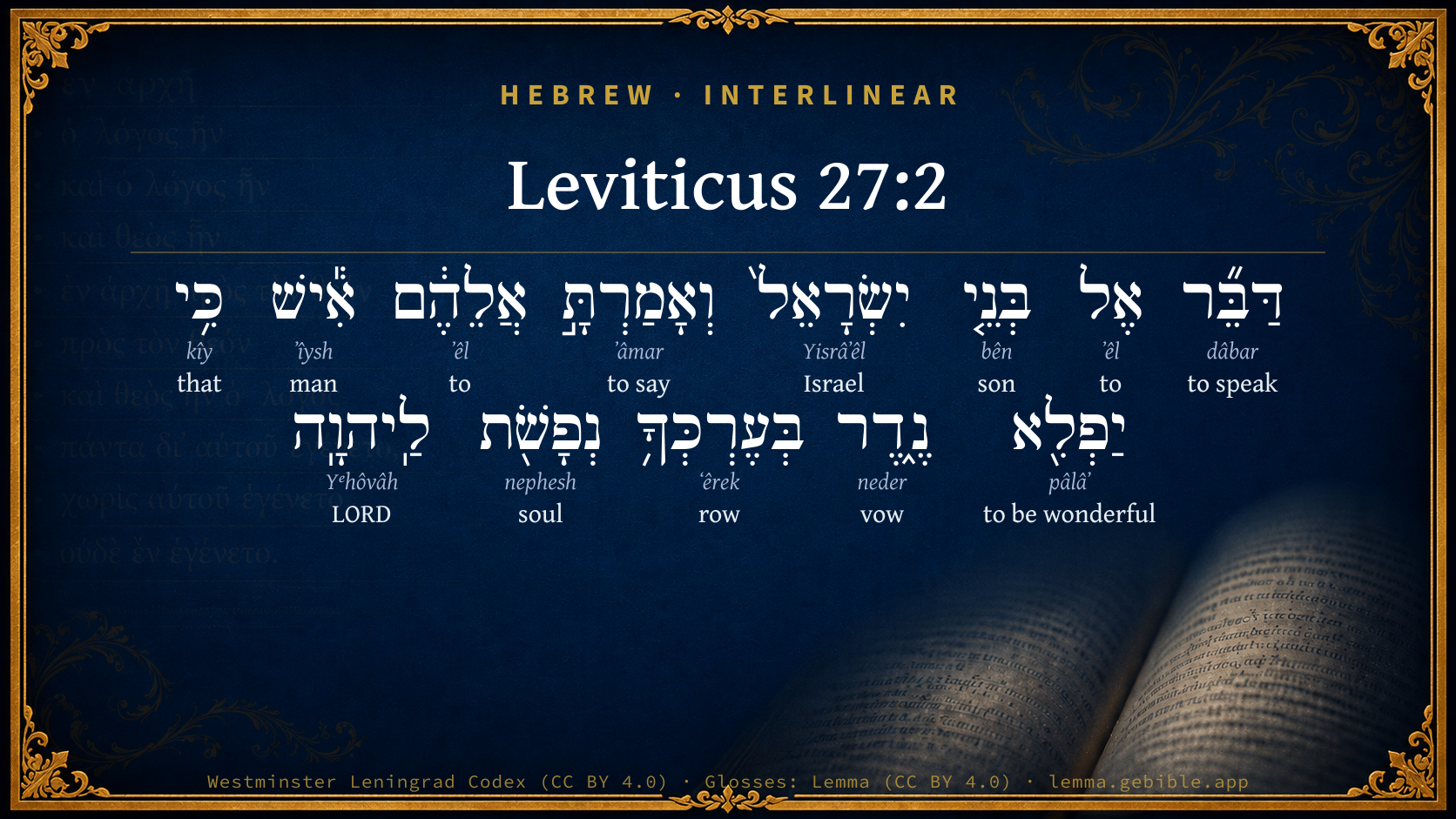
Hebrew (Westminster Leningrad Codex) Leviticus 27:2 appears in the Hebrew Old Testament. The text above is from the Westminster Leningrad Codex. Each word links to its Strong’s number, a concise gloss, and parsing drawn from the Open Scriptures Hebrew Bible morphology. Click any word for its full Brown-Driver-Briggs (BDB) entry.
Download image
Cite this verse

Leviticus 27:2 (World English Bible). Public Domain. Lemma interlinear Bible study tool, https://lemma.gebible.app/v/leviticus/27/2.

Show BibTeX & RIS
BibTeX
RIS
English Translation
"Speak to the children of Israel, and say to them, 'When a man makes a vow, the persons shall be for Yahweh by your valuation.
World English Bible · Public Domain
Download a study sheet

One document with this verse’s original text, its word-by-word gloss line, the meaning frame, cross-references with their text, attributed commentary, and full source and license credits — printable, and it pastes into notes with its structure intact.

This verse Autodidact and up

Study sheet (.html) Plain text (.txt)

A passage Seminary Student

Up to 50 verses in one chapter. A passage sheet keeps up to 6 commentary sources and 12 cross-references per verse, in the order this page ranks them, and says so on the sheet whenever that leaves anything out. Ask for a single verse and you get the Autodidact verse sheet above.

Everything on this page stays free to read, with no account — the sheet is a download of what is already on screen, not access to it.

Want to remove ads? Support Godless Engineer
Compare translations 3

The same verse in 3 English versions, stacked beneath the original-language interlinear above. Click any original word for its lexicon entry.

Each is an independent rendering of the whole verse — the interlinear is not word-aligned to these translations.

Highlighted words mark where these versions differ — a whole-verse word diff, not a word-by-word alignment.

  • World English Bible Public Domain
    "Speak to the children of Israel, and say to them, 'When a man makes a vow, the persons shall be for Yahweh by your valuation.
  • King James Version Public Domain
    Speak unto the children of Israel, and say unto them, When a man shall make a singular vow, the persons shall be for the LORD by thy estimation.
  • unfoldingWord Literal Text CC BY-SA 4.0
    “Speak to the sons of Israel and say to them, ‘A man when he makes extraordinary a vow, by your valuation of persons to Yahweh,

unfoldingWord Literal Text — © unfoldingWord, licensed CC BY-SA 4.0. Word-aligned USFM3 via Door43 (git.door43.org/unfoldingWord/en_ult).

Versions to compare (up to 4)

3 of 4 selected

Show all 18 translations

Every available English version of this verse, each an independent rendering of the whole verse.

  • World English Bible Public Domain
    "Speak to the children of Israel, and say to them, 'When a man makes a vow, the persons shall be for Yahweh by your valuation.
  • Berean Standard Bible Public Domain
    “Speak to the Israelites and say to them, ‘When someone makes a special vow to the LORD involving the value of persons,
  • Majority Standard Bible Public Domain
    “Speak to the Israelites and say to them, ‘When someone makes a special vow to the LORD involving the value of persons,
  • King James Version Public Domain
    Speak unto the children of Israel, and say unto them, When a man shall make a singular vow, the persons shall be for the LORD by thy estimation.
  • American Standard Version (1901) Public Domain
    Speak unto the children of Israel, and say unto them, When a man shall accomplish a vow, the persons shall be for Jehovah by thy estimation.
  • Revised Version (1885) Public Domain
    Speak unto the children of Israel, and say unto them, When a man shall accomplish a vow, the persons shall be for the LORD by thy estimation.
  • Geneva Bible (1599) Public Domain
    Speake vnto the children of Israel, and say vnto them, If any man shall make a vowe of a person vnto the Lord, by thy estimation,
  • Douay-Rheims (1899) Public Domain
    Speak to the children of Israel, and thou shalt say to them: The man that shall have made a vow, and promised his soul to God, shall give the price according to estimation.
  • Young's Literal Translation Public Domain
    `Speak unto the sons of Israel, and thou hast said unto them, When a man maketh a wonderful vow, by thy valuation the persons `are' Jehovah's.
  • Literal Standard Version CC BY-SA 4.0
    “Speak to the sons of Israel, and you have said to them: When a man makes a special vow in your valuation of persons to YHWH,
  • Unlocked Literal Bible CC BY-SA 4.0
    “Speak to the people of Israel and say to them, 'If anyone makes a special vow to Yahweh, use the following valuations.
  • unfoldingWord Literal Text CC BY-SA 4.0
    “Speak to the sons of Israel and say to them, ‘A man when he makes extraordinary a vow, by your valuation of persons to Yahweh,
  • Darby Bible Public Domain
    Speak unto the children of Israel and say unto them, When any one devoteth [anything] by a vow, the persons shall be for Jehovah according to thy valuation.
  • World Messianic Bible Public Domain
    “Speak to the children of Israel, and say to them, ‘When a man consecrates a person to the LORD in a vow, according to your valuation,
  • Webster's Bible Public Domain
    Speak to the children of Israel, and say to them, When a man shall make a singular vow, the persons shall be for the LORD, by thy estimation.
  • Free Bible Version CC BY-SA 4.0
    “Tell the Israelites: When you make a special promise to dedicate someone to the Lord, these are the values you are to use.
  • Bible in Basic English Public Domain
    Say to the children of Israel, If a man makes a special oath, you will give your decision as to the value of the persons for the Lord.
  • JPS Tanakh (1917) Public Domain
    Speak unto the children of Israel, and say unto them: When a man shall clearly utter a vow of persons unto the LORD, according to thy valuation,

Literal Standard Version (2020), Covenant Press — licensed CC BY-SA 4.0. Text via the HelloAO Bible API (eBible.org). Unlocked Literal Bible (unfoldingWord) — licensed CC BY-SA 4.0. Text via the HelloAO Bible API (eBible.org). unfoldingWord Literal Text — © unfoldingWord, licensed CC BY-SA 4.0. Word-aligned USFM3 via Door43 (git.door43.org/unfoldingWord/en_ult). Free Bible Version, Dr. Jonathan Gallagher — licensed CC BY-SA 4.0. Text via the HelloAO Bible API (eBible.org).

Word by word

More ways to search: Search by grammar → Find every occurrence → Compare this word →

Practice this passage: Drill this verse → Learn its vocabulary →

בְּעֶרְכְּךָ֥
ʻêrek
H6187
“in/at · row · your”
Preposition + Noun, Common, Masculine, Singular, Construct + Suffix, Personal, 2nd Person, Masculine, Singular
Part of Speech
Preposition + Noun
Type
Common
Gender
Masculine
Number
Singular
State
Construct
Full BDB Definition

Origin: from H6186

TWOT: 1694a

order, row, estimate, things that are set in order, layer, pile - order, row - estimate, valuation
  1. דַּבֵּ֞ר dâbar H1696 “speak” Verb, Piel, Imperative, 2nd Person, Masculine, Singular
  2. אֶל ʼêl H413 “to” Preposition
  3. בְּנֵ֤י bên H1121 “sons of” Noun, Common, Masculine, Plural, Construct
  4. יִשְׂרָאֵל֙ Yisrâʼêl H3478 “Israel” Noun, Proper
  5. וְאָמַרְתָּ֣ ʼâmar H559 “and · to say” Conjunction + Verb, Qal, Sequential Perfect, 2nd Person, Masculine, Singular
  6. אֲלֵהֶ֔ם ʼêl H413 “to · them” Preposition + Suffix, Personal, 3rd Person, Masculine, Plural
  7. אִ֕ישׁ ʼîysh H376 “man” Noun, Common, Masculine, Singular, Absolute
  8. כִּ֥י kîy H3588 “that” Conjunction
  9. יַפְלִ֖א pâlâʼ H6381 “to be wonderful” Verb, Hiphil, Imperfect, 3rd Person, Masculine, Singular
  10. נֶ֑דֶר neder H5088 “vow” Noun, Common, Masculine, Singular, Absolute
  11. נְפָשֹׁ֖ת nephesh H5315 “souls” Noun, Common, Both, Plural, Absolute
  12. לַֽיהוָֽה Yᵉhôvâh H3068 “to/for · LORD” Preposition + Noun, Proper

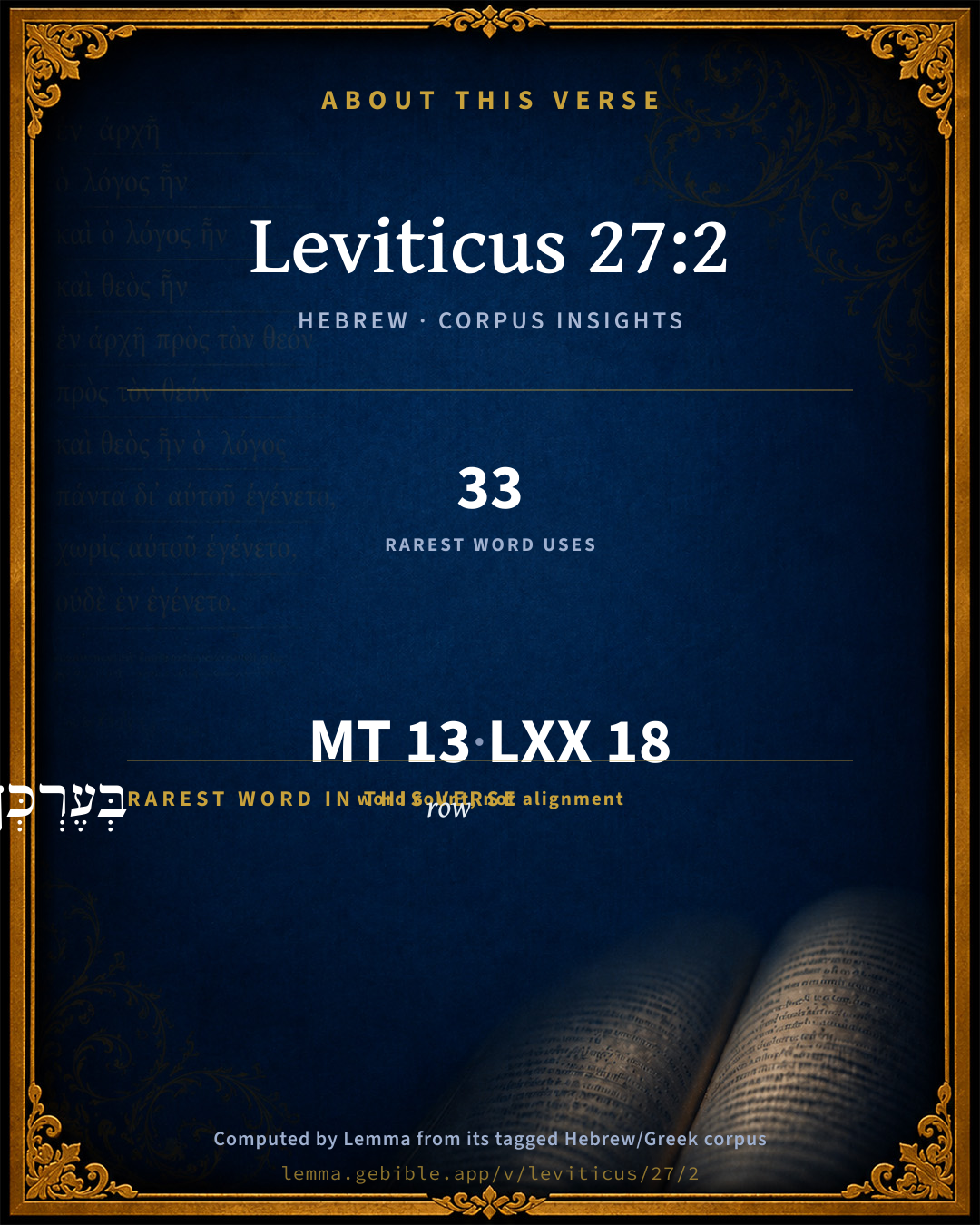
About this verse

These counts appear in no published source. They are computed here, from the morphology-tagged text and Lemma’s own curated glosses. What Lemma adds →

13
words
12
distinct lemmas
Pentateuch
section

Shared distinctive vocabulary

בְּעֶרְכְּךָ֥ row H6187 occurs in 29 verses of the Hebrew Bible. Also found in:

Grammatical profile

  • 3 verbs
  • 7 nouns
  • 2 prepositions
  • 1 conjunction

Verb forms

  • דַּבֵּ֞ר Piel · Imperative
  • וְאָמַרְתָּ֣ Qal · Sequential Perfect
  • יַפְלִ֖א Hiphil · Imperfect

Repetition

A word recurs within this verse — often emphatic in Hebrew:

  • אֶל to H413 ×2

Hebrew & Septuagint length

In English translation the verse runs 25 words from the Hebrew and 26 from the Septuagint (LXX English) — closely comparable.

A rough comparison of the two English renderings, which tokenize alike — not a word-level alignment.

Word counts can differ between the Hebrew and the Greek without any difference in meaning — e.g. the Hebrew direct-object marker אֵת has no separate Greek word, and Greek often adds the article ὁ.

In the original languages it is 13 Hebrew tokens and 18 Greek tokens — but the two are counted differently (Hebrew bundles its prefixes and suffixes into one token; the Greek is in lemma form), so that isn’t a like-for-like length.

Cross-references

10

Topical passages linked to Leviticus 27:2 in the Treasury of Scripture Knowledge — connected by theme and wording, ordered by reader-vote popularity; previews shown in the World English Bible.

  • Numbers 6:2 "Speak to the children of Israel, and tell them: When either man or woman shall make a special vow, the vow of a Nazirite, to separate himself to Yahweh,
  • Deuteronomy 23:21–23 When you shall vow a vow to Yahweh your God, you shall not be slack to pay it: for Yahweh your God will surely require it of you; and it would be sin in you.
  • Judges 11:30–31 Jephthah vowed a vow to Yahweh, and said, If you will indeed deliver the children of Ammon into my hand,
  • Judges 11:39 It happened at the end of two months, that she returned to her father, who did with her according to his vow which he had vowed: and she was a virgin. It was a custom in Israel,
  • 1 Samuel 1:11 She vowed a vow, and said, Yahweh of hosts, if you will indeed look on the affliction of your handmaid, and remember me, and not forget your handmaid, but will give to your handmaid a man-child, then I will give him to Yahweh all the days of his life, and there shall no razor come on his head.
  • 1 Samuel 1:28 therefore also I have granted him to Yahweh; as long as he lives he is granted to Yahweh. He worshiped Yahweh there.
  • Genesis 28:20–22 Jacob vowed a vow, saying, "If God will be with me, and will keep me in this way that I go, and will give me bread to eat, and clothing to put on,
  • Numbers 21:2 Israel vowed a vow to Yahweh, and said, If you will indeed deliver this people into my hand, then I will utterly destroy their cities.
  • Numbers 30:3 Also when a woman vows a vow to Yahweh, and binds herself by a bond, being in her father's house, in her youth,
  • Ecclesiastes 5:4–5 When you vow a vow to God, don't defer to pay it; for he has no pleasure in fools. Pay that which you vow.

Cross-references courtesy of OpenBible.info (CC BY 4.0).

Hebrew and Greek witnesses Masoretic Hebrew ↔ Greek Septuagint

The same verse in the two great witnesses to the Old Testament, shown verse-for-verse.

These are two independent witnesses, not word-aligned to each other, and the Septuagint is shown in lemma (dictionary) form.

Hebrew Leviticus 27:2 Masoretic · Westminster Leningrad Codex

דַּבֵּ֞ר אֶל בְּנֵ֤י יִשְׂרָאֵל֙ וְאָמַרְתָּ֣ אֲלֵהֶ֔ם אִ֕ישׁ כִּ֥י יַפְלִ֖א נֶ֑דֶר בְּעֶרְכְּךָ֥ נְפָשֹׁ֖ת לַֽיהוָֽה

"Speak to the children of Israel, and say to them, 'When a man makes a vow, the persons shall be for Yahweh by your valuation.

World English Bible · Public Domain

Greek LXX Leviticus 27:2 Septuagint · lemma form

λαλέω ὁ υἱός ἰσραήλ καί εἶπον αὐτός ὅς ἄν εὔχομαι εὐχή ὥστε τιμή ὁ ψυχή αὐτός ὁ κύριος

Speak to the children of Israel, and you shall say to them, Whosoever shall vow a vow as the valuation of his soul for the Lord,

LXX2012 (modern English Septuagint) · Public Domain

On this verse, Haydock's Catholic Bible Commentary discusses the Septuagint’s reading. Read the note in Commentary ↓

Hebrew: Westminster Leningrad Codex (CC BY 4.0). Greek: Septuagint (public domain); English from LXX2012 (modern English Septuagint) (Public Domain). How the Septuagint differs from the Hebrew →

Targum (Aramaic paraphrase)

2

The Targum is the ancient Jewish Aramaic paraphrase of the Hebrew Scriptures — an interpretive translation, not the Hebrew text itself. Onkelos (literal) and Pseudo-Jonathan (expansive) render the Torah, and Jonathan the Prophets. Coverage is partial: where no permissively-licensed English translation exists for a verse, only the Aramaic is shown. This is verse-level text, not a word-by-word alignment to the Hebrew.

  1. Targum Onkelos Torah (Genesis–Deuteronomy)
    מַלֵל עִם בְּנֵי יִשְׂרָאֵל וְתֵימַר לְהוֹן גְבַר אֲרֵי יַפְרֵשׁ נְדַר בְּפֻרְסַן נַפְשָׁתָא קֳדָם יְיָ

    (no public-domain English translation for this verse)

    Targum Onkelos — Aramaic: “Onkelos Genesis” (public domain); “Onkelos Exodus” (public domain); “Onkelos Leviticus” (public domain); “Onkelos Numbers” (public domain); “Onkelos Deuteronomy” (public domain). English: “Sefaria Community Translation” (CC0 1.0 (public-domain dedication)); “J.W. Etheridge. The Targums of Onkelos and Jonathan Ben Uzziel on the Pentateuch. London: Longmans, Green, 1862” (public domain). Text via Sefaria.

  2. Targum Pseudo-Jonathan Torah (Genesis–Deuteronomy)
    מַלֵיל עִם בְּנֵי יִשְרָאֵל וְתֵימַר לְהוֹן גְבַר אֲרוּם יַפְרִישׁ פֵּירוּשׁ דְנִדְרָא בְּעִילוֹי נַפְשָׁתָא לִשְׁמָא דַיְיָ

    Speak with the children of Israel, and say to them: When a man willeth to set apart the separation of a vow, in the valuing of the life unto the name of the Lord,

    Targum Pseudo-Jonathan — Aramaic: “Targum Jonathan on Genesis” (public domain); “Targum Jonathan on Exodus” (public domain); “Targum Jonathan on Leviticus” (public domain); “Targum Jonathan on Numbers” (public domain); “Targum Jonathan on Deuteronomy” (public domain). English: “The Targum of Jonathan ben Uzziel, trans. J. W. Etheridge, London, 1862” (public domain). Text via Sefaria.

Commentary

Notes on Leviticus 27:2 from classic Christian and Jewish commentators (each source and its license shown beneath its notes). The classic Christian expositions comment on the surrounding passage and are grouped to its opening verse, so a note may address several verses; the Jewish commentaries on the Tanakh (Rashi and others) are per-verse, so they appear only where the commentator wrote on this verse.

Lemma curates 59 commentaries, every one of them public domain or Creative Commons licensed, each selected and text-cleaned for this edition rather than reprinted as found. About our sources →

Trapp's Complete Commentary

John Trapp

Lev 27:2 Speak unto the children of Israel, and say unto them, When a man shall make a singular vow, the persons [shall be] for the LORD by thy estimation.

Ver. 2. When a man shall make a singular vow.] Votum eximium, as Vatablus renders it, a personal, particular, voluntary vow; which, drawn by some peculiar reason, a man promiseth to God of his own accord. It is a binding of one’s self to God by a holy and religious promise, to do or not to do something lawful, possible, useful for our increase in godliness. As here of persons, afterwards of things: all which might be redeemed, under such exception as the law provideth, by the estimation of the priest for certain shekels of silver, after the shekel of the sanctuary: this was double to the ordinary shekel. The aim and intent of these personal vows was, say some, that the price of their redemption might be employed either for the maintenance of the priests, {Num 18:14} or for the repair of the sanctuary. {2Ki 12:4-5} Neither by such vows do we cast any new snares upon ourselves, but rather a new tie to the payment of an old debt.

John Trapp, A Commentary or Exposition upon All the Books of the Old and New Testament (1647–1656) — public domain. Text from a community e-Sword module.

The Biblical Illustrator

Joseph S. Exell

Lev_27:2-13

When a man shall make a singular vow.

Laws concerning vows

I. That voluntary and special vows were permitted by the Lord. Vows should be made cautiously, deliberately, and, in most instances, conditionally; because further enlightenment, or changed conditions may render their fulfilment undesirable, unnecessary, or even impossible.

II. That vows were acceptable to the Lord according to the spirit which prompted them, and in which they were paid. When circumstances justified an Israelite repenting of his vow, it could be com-mutated or remitted, or some compensation offered in its stead. Jehovah would accept nothing that was recklessly or reluctantly presented. All adjustments and decisions were to be made according to the standards of the sanctuary, not according to human fallibility and caprice. Though a vow should not be literally performed, it must be perfectly fulfilled in respect to honourable intention and sacred fidelity. The state of heart, in the presentation of sacrifice, determined the value of the gift. This law has fever been repealed.

III. That freedom of choice given in the fulfilment of vows did not contravene the purposes of the lord concerning his work and worship. The compensation paid in lieu of the original vow went to sustain the sanctuary services, and the Lord reserved to Himself some unalienable rights. Some things when devoted could not be withheld or withdrawn under any circumstances. He demanded a tenth of the produce of the land, and enforced His claim with righteous and unrelaxing rigour. Thus the preservation and perpetuation of Jehovahs worship were secured, and not left contingent upon the fickleness and uncertainty of human devotedness. Righteousness lies at the foundation of the Levitical economy; is the basis of natural and revealed religion. Leviticus is a witness to Christ and His gospel. In Him we have combined all that the law embodied--Altar, Sacrifice, Priest. Simplicity, and purity of aims, loftiest motives, deepest meanings, and incomparable excellence, lift the law and the gospel infinitely above all other religions of the world. The superiority to Jewish narrowness and bigotry, to human sinfulness and shortsightedness, demonstrate their divinity of origin, mutual dependence, absolute authority, undying vigour, and inestimable worth. (F. W. Brown.)

The extraordinary in the service of God

This is part of the law concerning singular vows, extraordinary ones; which though God did not expressly insist on, yet if they were consistent and conformable to the general precepts, He would be well pleased with. Note--We should not only ask what must we do, but what may we do, for the glory and honour of God. As the liberal deviseth liberal things (Isa_32:8), so the pious deviseth pious things, and the enlarged heart would willingly de something extraordinary in the service of so good a Master as God is. When we receive or expect some singular mercy, it is good to honour God with some singular vow. (Matthew Henry, D. D.)

The singular vow

I. Speaking in modern phrase, we should describe this chapter as the act of the old law on the singular vow. This vow was distinguished from certain other vows common among the Hebrews by the circumstance that it was susceptible of redemption. We can all understand that a consecration of a mans self or of a mans estate might be so hurriedly or so thoughtlessly made (as in the case of Jephtha with his daughter) that the author of them would find out afterwards how rashly the promise had been given, and how unequal he was to the keeping it, and so be anxious to compound by a money equivalent for the more spiritual service he found himself incompetent to bring. This kind of engagement is called in the Hebrew the Neder, and is further marked by the character of singularity or wonderfulness; whereas towards the end of this very chapter we have another vow provided for, and called the Cherem, which, being accompanied with some sort of anathema or execration, allowed no redemption. But now, observe very carefully the method appointed for gaining release from the obligation. Moses was to arbitrate according to what he considered the ability of the applicant to render. Pay so much, would be the decision of the lawgiver, and thou mayest go free. Rut the remarkable and the beautiful thing is, that even that measure of relief to the vow-maker was not absolutely or invariably final. Moses might overestimate the resources of the devotee for the buying himself off from the personal service of the Tabernacle--Moses might adjudge too heavy a ransom--and therefore the law provided a yet further and more merciful escape. The man was at liberty to appeal from Moses to the priest. Aaron was the priest. His very name stands for a representative before God of the wants and the sorrows and the sins of the people; and hence to transfer the adjudication of a debtors affairs from Moses to his brother would, as you can all see, be the introduction of a perfectly new element into the ease to be tried. The appellant would be as poor in the presence of Aaron as he was in the presence of the former judge. He would also be as rich. And yet the very terms of the text are all but decisive on the fact that he would gain by carrying his cause before this new tribunal. Aaron would certainly--if we understand the law of the case--fix the money ransom at a lower figure. And the obvious reason is that Aaron, by virtue of his own calling, would make up for it--i.e., for the deficiency--in some other way, and in some way in which Moses could not make up for it. We must not pronounce with any authority on the exact method in which the priest would settle with the poverty of a debtor, and make it possible for him to go free whom his brother would have handed over to the full penalties of the vow, to do, perhaps, Gibeonites work as a hewer of wood or a drawer of water. But the probability is that the remedy in Aarons hands would be the appointment of some easy offering in which the priest would render him the aid of his sacred functions.

II. Now it will hardly require any one of us to be very deep in controversial divinity to understand that if we are going to Christianise this type and turn it to the account of a modern religious experience, we shall be treading on most critical, though it may turn out very lawful and very instructive, ground. In a word, then, let us say we are now having no business whatever with an unregenerate man, nor any business whatever with the sacrifice of Christ as the only channel of his justification. The solitary topic of the text is a topic for men already in the covenant. Regeneration, and even justification, must be understood as settled already; and the vow-making of Leviticus must be looked upon wholly and solely as the service of the Christian, at peace with the law, but struggling with subsequent duties. Is there no difference? There is all the difference in the world between the terms on which the great God will take a man to heaven and the terms on which He will treat him when already in the covenant. In the former transaction the man may vow as he likes; he can pay nothing, and he is never asked to pay. In the latter transaction, where the former is finished, the man is commanded to pay, and struggles to pay; but, nevertheless, our point with you is that times without number he is unable to pay. The universal and the sad fact is that entire duty is what none of us can render. Even in the Church the law is too much for us. And what we have to do a hundred times a day, and all our lives long, is to fall back on the solitary and sufficient and omnipotent righteousness of Christ. We do greatly err if we limit the sacerdotal functions of Immanuel to the gaining us forgiveness at our conversion or the taking us to heaven when we die. We want a priest every moment; some one that is to furnish the balance of service and duty demanded by our profession, but never forthcoming. Those two men, Moses and Aaron, may be said to travel with the Christian every inch of his journey: Moses standing for what I ought to do and to be; Aaron standing for what I take refuge in as often as I come short or fall below, If he be poorer than thy estimation. Which of us is not poorer than the Lawgivers estimation? Can we pay what is due from us? We acknowledged, when first we believed, that we could do nothing of the kind. But remember that there is a power and a merit in the righteousness of Christ that continues at the disposal of the saint till the day of his death. Immanuel is certain to judge me, or, according to the text, to value me on other grounds than those of justice and of law: and the reason is that He has something to give me, something of His own. He is my Priest, and has business with the altar and the sacrifice, and under the gospel Christ is Himself all three. You who tell me my duty are only my lawgivers fresh from Mount Sinai. So is the Sermon on the Mount; so is my conscience; so is everything and every one, but Christ. But do you not see that if a Mediator, who for ever is holding up His righteousness on my behalf--if He values me my value alters? I am now not the bankrupt debtor who had not enough to pay, I am that debtor and some one else besides. I am a part of Christ. I bring now my poor offerings of duty, for I must still bring them, but I bring them covered with blood, and made worth something by blood. And, therefore, though I was not rich enough to pay what I owed as bare law sat and measured my resources, I can pay the uttermost farthing as soon as Jesus the Saviour adds His own Cross to my inheritance. (H. Christopherson.)

The provisions of righteousness and grace

Now, in the case of a person devoting himself, or his beast, his house, or his field, unto the Lord, it was obviously a question of capacity or worth; and, hence, there was a certain scale of valuation, according to age. Moses, as the representative of the claims of God, was called upon to estimate, in each case, according to the standard of the sanctuary. If a man undertakes to make a vow he must be tried by the standard of righteousness; and, moreover, in all cases we are called upon to recognise the difference between capacity and title. Moses had a certain standard from which he could not possibly descend. He had a certain rule from which he could not possibly swerve. If any one could come up to that, well; if not, he had to take his place accordingly. What, then, was to be done in reference to the person who was unable to rise to the height of the claims set forth by the representative of Divine righteousness? Hear the consolatory answer (Lev_27:8). In other words, if it be a question of mans undertaking to meet the claims of righteousness, then he must meet them. But if, on the other hand, a man feels himself wholly unable to meet those claims, he has only to fall back upon grace, which will take him up, just as he is. Moses is the representative of the claims of Divine righteousness. The priest is the exponent of the provisions of Divine grace. The poor man who was unable to stand before Moses fell back into the arms of the priest. Thus it is ever. If we cannot dig we can beg; and directly we take the place of a beggar it is no longer a question of what we are able to earn, but of what God is pleased to give. Grace all the work shall crown, through everlasting days. How happy it is to be debtors to grace! How happy to take when God is glorified in giving! When man is in question it is infinitely better to dig than to beg; but when God is in question the case is the very reverse. I would just add, that I believe this entire chapter bears, in an especial manner, upon the nation of Israel. It is intimately connected with the two preceding chapters. Israel made a singular vow at the foot of Mount Horeb; but were quite unable to meet the claims of law--they were far poorer than Moses estimation. But, blessed be God, they will come in under the rich provisions of Divine grace. (C. H. Mackintosh.)

Influence of a singular vow

I made a solemn vow before God, that if General Lee were driven back from Pennsylvania, I would crown the result by the declaration of freedom to the slaves. (President Lincoln.)

A vow kept

I met some time ago a gentleman residing in a retired town in Kent, who told that he was recently confined to his house by indisposition and inclement weather on a wintry Sunday. When the rest of the family were at church he took up George Mullers book, in which he describes The Lords Dealings with him. He became so much interested in the authors life and labours that he promised his conscience, then and there, that if a certain business transaction he had in hand resulted in a certain amount of success, he would send the philanthropist £100 for his Orphans Home. The success was realised, and he was then just on the point of sending off a cheque for the promised amount. (Elihu Burritt.)

Brittle vows

It is said of Andreas, one of the kings of Hungary, that having engaged himself by promise to go to the holy wars (as they then called them), went with all his forces, and coming to Jerusalem, only bathed himself there, as one that had washed off his promise, and so returned back again without striking One blow. Such is the case with many men at present, their promises, covenants, and agreements with others, though sealed and subscribed, prove too, too often as brittle as the glasses they drink in; no bounds will hold them, they rob the Grecians of their proverb, and own it themselves. For let but the worst of men say they will do this or that, is as much as if they had sworn they would not do it, unless it be when they embark themselves in some unwarrantable actions, and the sun may sooner be thrust out of his sphere than they diverted from their adamantine resolutions. (J. Spencer.)

The redemption of a singular vow

Incidents in Oriental history often read like parables. Men are moved by strange motives to do strange things; and the student from the west wanders in a maze of fancies and facts that are bewildering indeed. Thus it is that the early portion of a missionarys life in an eastern land teems with things that are unreal, and he is surrounded by fellow-men who seem in no true sense his fellows. There is so much that is inexplicable to him in their motives and conduct, that, until he gets a clue to the maze, from a constant study of the religions that dominate their lives, his blunders are many, and sometimes even disastrous to his mission. The following is an instance of what I mean, and as it is recorded as an historical fact, will serve the purpose admirably: Abd-al-Muttalib once vowed that if he should be so greatly blessed as to have ten sons, one should certainly be devoted to Allah. In process of time, the number was fulfilled, and the reluctant father gathered his offspring in the Kaaba, and cast lots for the one to be sacrificed. The lot fell upon Abdalla, the beautiful son of his old age. The sacrifical knife was solemnly prepared; and, like Abraham, he stood ready for the awful deed. But the lads sisters came to the rescue. They knew that the Arabs offered camels in sacrifice, and in their abounding grief they entreated their father to cast lots between their brother and ten of these valuable creatures. He consented; but, to their sorrow, the lot fell a second time on the favourite boy. The number of beasts was then doubled, and the lot cast again; but still it fell upon the lad. Time after time trial was made, as the sorrowing sisters and the troubled father became more and more desperate in their anxiety to save the dear one. At last one hundred camels had been proffered, and then, to their great joy, the lot fell upon the beasts. Abdalla was saved. God had set his own value upon the devoted boy, and when an equivalent was provided he was free. Arabs value highly the ships of the desert; for they are so essential to their mode of life. But a human being is more precious than many of them. This was recognised when ten camels were proffered; but until an unprecedented number had been Divinely sanctioned, the true worth of the man was not fully believed in. Thus, all the world over, man has had to learn the value of his fellow by degrees. Many have not learnt the lesson yet, because only mans Maker and Redeemer can aright estimate the worth of man, and reveal it to us. This He hath done in the gift of His Only-begotten Son, who took mans place that the lot might fall upon Him as of more than equal value with the whole of our race. (Robert Spurgeon.)

Philip Henrys vow

A good man named Philip Henry resolved, when he was young, to give himself to God, and he did it in these words: I take God the Father to be my Chief End; I take God the Son to be my King and Saviour; I take God the Holy Ghost to be my Guide and Sanctifier; I take the Bible to be my rule of life; I take all Gods people to be my friends; and here I give my body and soul to be Gods--for God to use for ever. That was Philip Henrys resolve, which he wrote out for himself when he was young; and he put at the end of it--I make this vow of my own mind freely: God give me grace to keep it. (C. Bullock.)

A vow fulfilled

I remember that when we arrived at the hotel at White Mountains, the ladies sat down to a cup of tea, but I preferred to take a walk alone. It was a beautiful spot. The sun was just then reclining his head behind Mount Washington, with all that glorious drapery of an American sunset, of which we know nothing in this country. I felt that I should like to be walking with my God on this earth! I said, What shall I render to my Lord for all His benefits to me? I was led further to repeat that question which Paul asked under other circumstances, Lord, what wilt Thou have me to do? The answer came immediately. It was this: It is true thou canst not bring the many thousands thou hast left in thy native country to see this beautiful scenery; but thou canst create beautiful scenes for them. It is possible on a suitable spot so to arrange art and nature, that they shall be within the walk of every working man in Halifax; that he shall go and take his stroll there after he has done his hard days toil, and be able to get home again without being tired. He pondered the thought, prayed over it, and the next day resolved to carry it into execution. On his return to England he took immediate steps for the fulfilment of his purpose; the design of the proposed park was entrusted to the late Sir Joseph Paxton, and on the 14th of August, 1857, it was publicly opened. It covers twelve and a half acres of ground, and its entire cost was upwards of £30,000. (Memoir of Sir Francis Crossley.)

The Biblical Illustrator, edited by Joseph S. Exell (c. 1880s–1900s) — public domain. Text from a community e-Sword module.

Joseph Benson's Commentary

Lev 27:2. Shall make a singular vow — The Hebrew may be rendered, Shall separate, or set apart a vow; that is, shall, by solemn promise; separate any thing from a common to a sacred use. For vows were religious promises made to God, for obtaining some blessing or deliverance from some evil or danger, and were accompanied with prayer, and paid with thanksgiving. The words, however, יפלא נדר, japhli neder, may be properly translated, as here, Shall make a singular, or hard, or eminent vow. And this is to be understood, not of things, but of persons, which he devoted to the Lord. Although vows of this kind were not usual, yet there want not instances of persons who devoted either themselves or their children, and that either more strictly, as the Nazarites and the Levites, (1Sa 1:11,) and for these no redemption was admitted, but they were in person to perform the service to which they were devoted; or more largely, as some who were not Levites might yet, through zeal for God, or to obtain a blessing which they wanted, devote themselves or their children to the service of God and of the sanctuary, though not in such a way as the Levites, which was forbidden, yet in some kind of subserviency to them. And because there might be too great a number of persons thus dedicated, which might be burdensome to the sanctuary, an exchange is allowed, and the priests are directed to receive a tax for their redemption. A book of rates is, accordingly, provided here, by which the priests were to be guided in their valuation. 1st, The middle-aged, between twenty and sixty, were valued highest, the males at fifty shekels each, and the females at thirty, (Lev 27:3-4,) women being generally inferior to men in strength and serviceableness. 2d, The rate of the youth between five years old and twenty was less, because they were then less capable of doing service. 3d, Infants under five years old were capable of being vowed to God by their parents, as Samuel was, but were not to be presented and redeemed till they were a month old; that, as one sabbath passed over them before they were circumcised, so one new moon might pass over them before they were estimated; and their valuation was but small, Lev 27:6. Samuel, who was thus vowed to God, was not redeemed, because he was a Levite, and designed by his parents to be lent to the Lord as long as he lived, 1Sa 1:28. Therefore he was employed in his childhood in the service of the tabernacle. 4th, The aged are valued at a less rate than youth, but greater than children, Lev 27:7. And the Hebrews observe, that the rate of an aged woman is two parts of three to that of an aged man, so that in that age the female came nearest to the value of the male. 5th, The poor were to be valued according to their ability, Lev 27:8. Something they must pay, that they might not be rash in vowing to God; for he hath no pleasure in fools, Ecc 2:6; yet not more than their ability, that they might not ruin themselves and their families by their zeal.

Joseph Benson's Commentary on the Old and New Testaments (1811–1818) — public domain. Text from a community e-Sword module.

Whedon's Commentary on the Bible

Daniel D. Whedon

PERSONS THE OBJECTS OF VOWS, Lev_27:2-8.

2. A singular vow — That is, special and extraordinary; Hebrews, “if any man definitely announces (R.V., ‘accomplishes’) a vow, souls shall be to Jehovah according to thy estimation.” The same Hebrew verb expresses the separation of a Nazarite unto the Lord. See Num_6:2, note. Persons who were the objects of the vow were to be redeemed according to a scale of values fixed by Moses. “This implies, clearly enough, that whenever a person was vowed redemption was to follow according to the valuation. Otherwise what was the object of valuing them? ‘Estimation’ supposes either redemption or purchase. But in the case of men (Israelites) there could be no purchasing as slaves, and therefore the object of the valuing could only have been for the purpose of buying off the person vowed to the Lord, and the fulfilment of the vow could only have consisted in the payment into the sanctuary of the price fixed by the law.” — Keil and Delitzsch. The theory that an unredeemed Israelite became a slave of the sanctuary cannot be sustained by 1Sa_2:11; 1Sa_2:22; 1Sa_2:28, since Hannah did not consecrate Samuel by a simple vow, but as a Nazarite for the whole of his life. Still less pertinent to the support of this theory is 2Sa_15:8, adduced by Michaelis. The valuation of persons without any thought of the relations of servitude appears further in the redemption of the firstborn.

Daniel D. Whedon (gen. ed.), Commentary on the Old and New Testaments (1874–1909) — public domain. Text from a community e-Sword module.

Tyndale Open Study Notes

Tyndale Open Resources

27:2 The vow taken to become a Nazirite is also called a special vow (Num 6:2), but the vow mentioned here was probably a promise made to God when seeking a desired answer to prayer (see Gen 28:20-22). Pagan religions of the time sacrificed infants to their gods, but God outlawed such a practice (Lev 18:21; 20:2-5; cp. Gen 22:12-13). Consequently, the concept of being vowed to the Lord was measured in terms of service given, not in the sacrifice of a life. Whether the vow was made by the person or by another acting for him or her, payment was to be made to the sanctuary, apparently for the person’s expenses during the term of service. See also Num 6:1-21; Judg 13:5, 7; 1 Sam 1:11; Amos 2:11-12; Acts 18:18.

Tyndale Open Study Notes — © Tyndale Open Resources, licensed CC BY-SA 4.0. Text via the HelloAO Bible API.

Geneva Bible (1599)

Geneva Bible translators

Which art the Priest.

As of his son or his daughter.

Geneva Bible (1599) marginal notes — public domain. Text via Bolls.life.

Adam Clarke's Commentary

Verse 2. When a man shall make a singular vow] The verse is short and obscure, and may be translated thus: A man who shall have separated a vow, according to thy estimation, of souls unto the Lord; which may be paraphrased thus: He who shall have vowed or consecrated a soul, i. e., a living creature, whether man or beast, if he wish to redeem what he has thus vowed or consecrated, he shall ransom or redeem it according to the priest's estimation; for the priest shall judge of the properties, qualifications, and age of the person or beast, and the circumstances of the person who has vowed it, and shall regulate the value accordingly; and the money shall be put into his hands for the service of the sanctuary. A vow (says Mr. Ainsworth) is a religious promise made unto the Lord, and for the most part with prayer, and paid with thanksgiving, Nu 21:2-3; Ps 66:12; Ps 66:14. Vows were either of abstinence, such as are spoken of Nu 30:1-2, and the vow of the Nazarite, Nu 6:1-21; or they were to give something to the Lord, as sacrifices, Le 7:16, or the value of persons, beasts, houses, or lands, concerning which the law is here given. A man might vow or devote himself, his children, (Le 27:5-6), his domestics, his cattle, his goods, c. And in this chapter rules are laid down for the redemption of all these things. But if, after consecrating these things, he refused to redeem them, then they became the Lord's property for ever. The persons continued all their lives devoted to the service of the sanctuary the goods were sold for the profit of the temple or the priests; the animals, if clean, were offered in sacrifice; if not proper for sacrifice, were sold, and the price devoted to sacred uses. This is a general view of the different laws relative to vows, mentioned in this chapter.

Adam Clarke's Commentary on the Bible (1810–1826) — public domain. Text from a community e-Sword/MySword module.

Ellicott's Commentary for English Readers

(2) Shall make a singular vow.—Better, shall consecrate a vow. (See Lev_22:21.) According to the interpretation of this phrase which obtained during the second Temple it denotes shall pronounce a vow. Hence the ancient Chaldee Versions render it, “shall distinctly pronounce a vow.” Accordingly, no vow mentally made or conceived was deemed binding. It had to be distinctly pronounced in words. The form of the vow is nowhere given in the Bible. Like many other points of detail, the wording of it was left to the administrators of the law. They divided vows into two classes: (1) Positive vows, by which a man bound himself to consecrate for religious purposes his own person, those members of his family over whom he had control, or any portion of his property, and for this kind of vow the formula was “Behold I consecrate this to the Lord”; and (2) Negative vows, by which he promised to abstain from enjoying a certain thing, for which the formula was, “Such and such a thing be unlawful to me for so many days, weeks, or for ever.”

The persons shall be for the Lord by thy estimation.—Better, souls to the Lord according to thy estimation., that is, the vow consists of consecrating persons to the Lord with the intention of redeeming by money the persons thus consecrated, according to the valuation put upon them by Moses. This part of the verse explains the nature of the vow, and takes it for granted that by consecrating a human being to God by a vow is meant to substitute the money value for him. By the suffix, “thy estimation,” Moses is meant, to whom these regulations are here Divinely communicated, and upon whom it devolved in the first instance to carry out the law. (See Lev_5:15; Lev_5:18.) During the second Temple any Israelite could estimate the money value of a person thus vowed to the Lord.

A Bible Commentary for English Readers, edited by Charles John Ellicott (1878–1897) — public domain. Text from a community e-Sword module.

The Cambridge Bible for Schools and Colleges

gen. ed. J. J. S. Perowne

2. accomplish a vow] rather, as mg., make a special (lit. hard) vow. For the definition of a vow, as compared with other classes of offerings, see on Lev_7:11. It was the utterance, and not merely the intention, that constituted the binding character of a vow (Deu_23:22). In this first case, viz. that of persons being vowed, the redemption might be made by an offering of money, in accordance with an estimate adapted to the particular case. R.V. mg. is nearer the Heb. than the text, but in strict grammar its ‘of’ should be omitted, ‘persons’ being in apposition to the word ‘vow’ in the original. The pronoun ‘thy,’ if it stands, seems to refer to Moses, but see on Lev_27:13. The estimate evidently turned upon the comparative strength and capability of work to be fairly expected in the two sexes and at various periods of life, in fact, in modern phraseology, on their value in the labour market.

The Cambridge Bible for Schools and Colleges (gen. ed. J. J. S. Perowne; Cambridge University Press, 1878–1918) — public domain. Text from a community e-Sword module.

John Gill's Exposition

And thy estimation shall be,.... The estimation of the man himself that vowed, or of the priest for him, was not left to be made by either of them at their pleasure, but was to be made according to the following rules, in proportion to the age a person was of to be estimated:

of the male from twenty years old even unto sixty years old: the account begins with these, because men of an age from the one to the other are fittest for labour, and therefore to be set at the highest price, as they are in the next clause:

even that estimation shall be fifty shekels of silver, after the shekel of the sanctuary; a shekel was about half a crown of our money, or somewhat less, so that fifty of these amounted to about six pounds: these shekels were to be of the full weight, according to the standard that was kept in the sanctuary, and were the highest price that was set upon any; and this was paid equally by all of the same age, whether rich or poor: hence it is said,"in estimations there is nothing less than one shekel, nor more than fifty (n).''

(n) Misn. Eracin, c. 2. sect. 1.

John Gill's Exposition of the Whole Bible (1746–1763) — public domain (CC PDM 1.0). Text via the HelloAO Bible API.

Albert Barnes' Notes on the Bible

Rather, When a man makes a special vow which concerns thy valuation of persons to Yahweh, if thy estimation shall be of the male, etc. The expression “thy estimation” is addressed either to Moses or to the priest Lev 27:12 : it denoted a legal valuation. The vow of a person was perhaps most frequently made in cases of illness or danger, under the impulse of religions feeling, either in the way of thankfulness for blessings received, or of supplication for something desired. A man might dedicate himself, his wife, his child, or his bondservant. This might have been an old custom; but the Law ordained that he who had taken such a vow should pay a sum of money to the sanctuary, determined according to the age and sex of the person.

Albert Barnes' Notes on the Bible (1834–1885) — public domain. Text from a community e-Sword/MySword module.

Haydock's Catholic Bible Commentary

Estimation. Hebrew is obscure, "Whoever has separated, or made a singular vow; the souls to the Lord according to thy estimation." (Calmet) --- Septuagint, "shall vow as it were the price of a soul to the Lord." (Haydock) --- The person or the beast shall belong to the Lord; but if it be redeemed, the priests shall fix a price, according to the following regulations. Whatever was vowed must be subject to these rules, or it shall remain for the service of the altar. The priests may sell it, if it be an impure animal. Those which are fit for sacrifice, were to be immolated, ver. 9, &c. No change of them was allowed, lest a worse should ever be substituted for a better; (Calmet) and because God is better pleased with things that are offered to him by vow. (Worthington)

George Leo Haydock (1774–1849), Haydock's Catholic Family Bible and Commentary, 1859 edition — public domain. Excludes Psalms (Douay-Rheims chapter numbering differs from Protestant) and Deuterocanonical books (Catholic canon only).

Matthew Poole's English Annotations

A singular vow, or, an eminent or hard or wonderful vow; not concerning things, which was not strange, but customary; but concerning persons, as it here follows, which he vowed, or by vow devoted unto the Lord, which indeed was unusual and difficult: yet there want not instances of such vows, and of persons which devoted either themselves or their children to the service of God, and that either more strictly and particularly, as the Nazarites and the Levites, 1Sa 1:11, and for these there was no redemption admitted, but they were in person to perform the service to which they were devoted; or more largely and generally, as some who were not Levites, nor intended themselves or their children should be Nazarites, might yet, through zeal to God and his service, or to obtain God’s help in giving them some mercy which they wanted and desired, or in freeing them from some evil felt or feared, devoted themselves or their children to the service of God and of the sanctuary, though not in such a way as the Levites, which they were forbidden to do, yet in some kind of subserviency to them. And because there might be too great a number of persons thus dedicated, which might be burdensome and chargeable to the sanctuary, therefore an exchange is allowed, and the priests are directed to impose and require a tax for their redemption.

For the Lord, i.e. dedicated to the Lord, and consequently to the priest. By whose estimation?

Answ. Either, 1. Thine, O priest, to whom the valuation of things belonged, and here is ascribed, Lev 27:12. Or rather,

2. Thine, O man that vowest, as appears from Lev 27:8, where his estimation is opposed to the priest’s valuation. Nor was there any fear of his partiality in his own cause, for the price is particularly limited. But where the price is undetermined, there, to avoid that inconvenience, the priest is to value it, as Lev 27:8,12.

Matthew Poole's English Annotations on the Holy Bible (1683–1685) — public domain. Text from a community e-Sword/MySword module.

The Pulpit Commentary

When a man shall make a singular vow, literally, when a man shall separate a vow, that is, make a special vow (see Num_6:2) the persons shall be for the Lord by thy estimation; that is, when a man has vowed himself or another person to the Lord, the priest shall declare the amount at which the person vowed is to be redeemed.

The Pulpit Commentary (1880–1919), ed. H.D.M. Spence-Jones & Joseph S. Exell — public domain. Text from a community e-Sword module.

John Wesley's Explanatory Notes

A singular vow-Or, an eminent, or hard vow, not concerning things, which was customary, but concerning persons, which he devoted to the Lord, which was unusual and difficult: yet there want not instances of persons who devoted either themselves or their children, and that either more strictly, as the Nazarites, and the Levites, 1 Sam. i, 11, and for these there was no redemption admitted, but they were in person to perform the service to which they were devoted: or more largely, as some who were not Levites, might yet through zeal to God, or to obtain God's help, which they wanted or desired, devote themselves or their children to the service of God and of the sanctuary, tho' not in such a way as the Levites, which was forbidden, yet in some kind of subserviency to them. And because there might be too great a number of persons thus dedicated, which might be burdensome to the sanctuary, an exchange is allowed, and the priests are directed to receive a tax for their redemption. By thy estimation - Thine, O man that vowest, as appears from ver. 8, where his estimation is opposed to the priest's valuation. Nor was there any fear of his partiality in his own cause, for the price is particularly limited. But where the price is undetermined, there, to avoid that inconvenience, the priest is to value it, as ver. 8, 12.

John Wesley, Explanatory Notes Upon the Whole Bible (1754–1765) — public domain. Text via the GEBible commentary corpus.

Keil & Delitzsch

C. F. Keil & F. Delitzsch

The vowing of persons. - "If any one make a special vow, souls shall be to the Lord according to thy valuation." נדר הפליא does not mean to dedicate or set apart a vow, but to make a special vow (see at Lev 22:21). The words בּערכּך, "according to thy (Moses') valuation," it is more simple to regard as an apodosis, so as to supply to ליהוה the substantive verb תּהיינה, than as a fuller description of the protasis, in which case the apodosis would follow in Lev 27:3, and the verb יקדּישׁ would have to be supplied. But whatever may be the conclusion adopted, in any case this thought is expressed in the words, that souls, i.e., persons, were to be vowed to the Lord according to Moses' valuation, i.e., according to the price fixed by Moses. This implies clearly enough, that whenever a person was vowed, redemption was to follow according to the valuation. Otherwise what was the object of valuing them? Valuation supposes either redemption or purchase. But in the case of men (i.e., Israelites) there could be no purchasing as slaves, and therefore the object of the valuing could only have been for the purpose of redeeming, buying off the person vowed to the Lord, and the fulfilment of the vow could only have consisted in the payment into the sanctuary of the price fixed by the law.

(Note: Saalschtz adopts this explanation in common with the Mishnah. Oehler is wrong in citing Sa1 2:11, Sa1 2:22, Sa1 2:28 as a proof of the opposite. For the dedication of Samuel did not consist of a simple vow, but was a dedication as a Nazarite for the whole of his life, and Samuel was thereby vowed to service at the sanctuary, whereas the law says nothing about attachment to the sanctuary in the case of the simple vowing of persons. But because redemption in the case of persons was not left to the pleasure or free-will of the person making the vow as in the case of material property, no addition is made to the valuation price as though for a merely possible circumstance.)

Lev 27:1-3

This was to be, for persons between twenty and thirty years of age, 50 shekels for a man and 30 for a woman; for a boy between 5 and 20, 20 shekels, for a girl of the same age 10 shekels; for a male child from a month to five years 5 shekels, for a female of the same age 3 shekels; for an old man above sixty 15 shekels, for an old woman of that age 10; the whole to be in shekels of the sanctuary (see at Exo 30:15). The valuation price was regulated, therefore, according to capacity and vigour of life, and the female sex, as the weaker vessel (Pe1 3:7), was only appraised at half the amount of the male.

Lev 27:8

But if the person making the vow was "poor before thy valuation," i.e., too poor to be able to pay the valuation price fixed by the law, he was to be brought before the priest, who would value him according to the measure of what his hand could raise (see Lev 5:11), i.e., what he was able to pay. This regulation, which made it possible for the poor man to vow his own person to the Lord, presupposed that the person vowed would have to be redeemed. For otherwise a person of this kind would only need to dedicate himself to the sanctuary, with all his power for work, to fulfil his vow completely.

Keil & Delitzsch — Biblical Commentary on the Old Testament (1861–1891) — public domain (CC PDM 1.0). Text via the HelloAO Bible API. (Old Testament only.)

Rashi

Rabbi Shlomo Yitzchaki (Rashi)

כי יפלא means, if he expressly states by an utterance of his mouth (cf. Rashi on Leviticus 22:21).

בערכך נפשות — he expressly states that he will give to the Sanctuary the valuation attached to a life by saying, “the payment of the valuation of such and such a thing — that, however, being something upon which its life depends — is incumbent upon me” (Sifra, Bechukotai, Section 3 6; Arakhin 4a).

Rashi on the Tanakh — English translations: “The Judaica Press complete Tanach with Rashi, translated by A. J. Rosenberg” (CC BY 4.0); “Pentateuch with Rashi's commentary by M. Rosenbaum and A.M. Silbermann, 1929-1934” (public domain); “The Metsudah Tanach series, Lakewood, N.J” (CC BY 4.0); and “The Book of Joshua, Metsudah Publications, 1997” (CC BY 4.0). Text via Sefaria.

Ibn Ezra

Rabbi Abraham ibn Ezra

Expresses a vow. He will discharge and express clearly.

Pledging valuation of souls. This means one makes a vow, saying, “If Hashem will do such and such for me, I will redeem myself with my valuation, or my son’s valuation, or an animal’s valuation.

Ibn Ezra on the Tanakh — English translations: “Sefaria Community Translation” (CC0 1.0 (public-domain dedication)); “Yalkut, Sifsei Chachomim Chumash, Metsudah Publications, 2009” (CC BY 4.0); and “Commentary of Ibn Ezra on Isaiah - trans. by M. Friedlander, 1873” (public domain). Text via Sefaria.

Lesson kit

Teaching starters — assembled from the data on this page, not authored interpretation. Every prompt links to the verse data it draws on. Edit before teaching.

Leviticus, in the Pentateuch, opens this verse with 13 words (12 distinct Hebrew lemmas). Its most distinctive word is ʻêrek (“row”). A historical commentator’s framing appears above. Read the whole chapter for the surrounding context.

Discussion questions

  1. What does “row” (ʻêrek) contribute to the verse as a whole?
  2. How does Exodus 40:4, which shares the word «row», read alongside this verse?
  3. What does the repetition of “to” (2× in this one verse) do in this verse?
  4. These translations render this verse differently; the difference is in the English rendering, not the original. What questions does that raise?
  5. «דַּבֵּ֞ר» is a Piel Imperative verb. How does that grammatical form shape the action described?
  6. Compare how Trapp's Complete Commentary and The Biblical Illustrator read this verse. Where do they agree or differ?

Things to notice

Reading settings

Reading text

Shown beneath each verse's original-language words.

Old Testament
Old Testament edition

Read the OT as the Masoretic Hebrew (MT) or the Greek Septuagint (LXX).

English shown for the Greek Septuagint (in the Hebrew ↔ Greek comparison).

Comparing translations? Open the Compare panel on any verse page to stack up to four side by side.