
Job 12:9

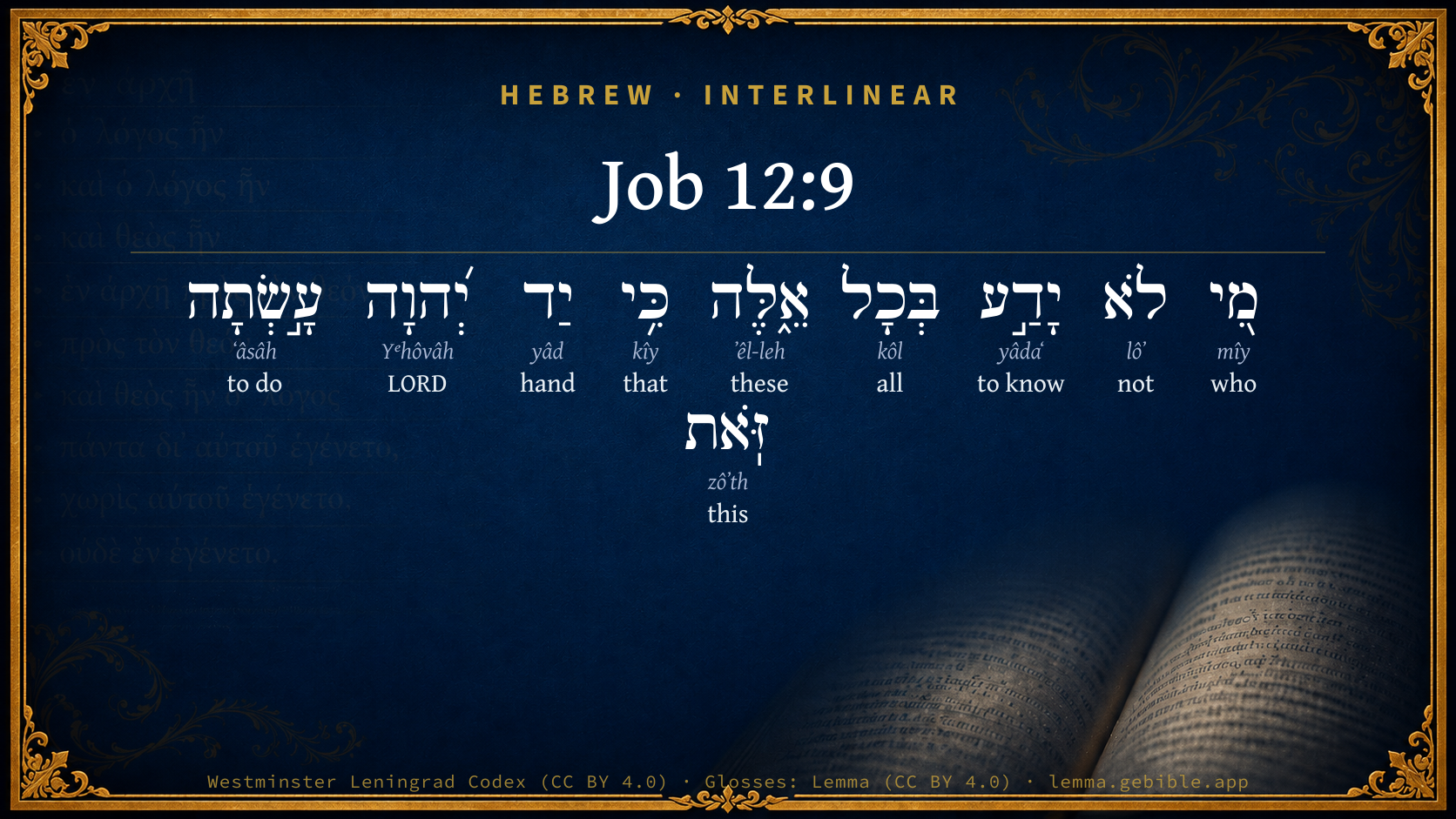
Hebrew (Westminster Leningrad Codex) Job 12:9 appears in the Hebrew Old Testament. The text above is from the Westminster Leningrad Codex. Each word links to its Strong’s number, a concise gloss, and parsing drawn from the Open Scriptures Hebrew Bible morphology. Click any word for its full Brown-Driver-Briggs (BDB) entry.
Download image
Cite this verse

Job 12:9 (World English Bible). Public Domain. Lemma interlinear Bible study tool, https://lemma.gebible.app/v/job/12/9.

Show BibTeX & RIS
BibTeX
RIS
English Translation
Who doesn't know that in all these, The hand of Yahweh has done this,
World English Bible · Public Domain
Download a study sheet

One document with this verse’s original text, its word-by-word gloss line, the meaning frame, cross-references with their text, attributed commentary, and full source and license credits — printable, and it pastes into notes with its structure intact.

This verse Autodidact and up

Study sheet (.html) Plain text (.txt)

A passage Seminary Student

Up to 50 verses in one chapter. A passage sheet keeps up to 6 commentary sources and 12 cross-references per verse, in the order this page ranks them, and says so on the sheet whenever that leaves anything out. Ask for a single verse and you get the Autodidact verse sheet above.

Everything on this page stays free to read, with no account — the sheet is a download of what is already on screen, not access to it.

Want to remove ads? Support Godless Engineer
Compare translations 3

The same verse in 3 English versions, stacked beneath the original-language interlinear above. Click any original word for its lexicon entry.

Each is an independent rendering of the whole verse — the interlinear is not word-aligned to these translations.

Highlighted words mark where these versions differ — a whole-verse word diff, not a word-by-word alignment.

  • World English Bible Public Domain
    Who doesn't know that in all these, The hand of Yahweh has done this,
  • King James Version Public Domain
    Who knoweth not in all these that the hand of the LORD hath wrought this?
  • unfoldingWord Literal Text CC BY-SA 4.0
    Which of all these does not know that the hand of Yahweh has done this?—

unfoldingWord Literal Text — © unfoldingWord, licensed CC BY-SA 4.0. Word-aligned USFM3 via Door43 (git.door43.org/unfoldingWord/en_ult).

Versions to compare (up to 4)

3 of 4 selected

Show all 18 translations

Every available English version of this verse, each an independent rendering of the whole verse.

  • World English Bible Public Domain
    Who doesn't know that in all these, The hand of Yahweh has done this,
  • Berean Standard Bible Public Domain
    Which of all these does not know that the hand of the LORD has done this?
  • Majority Standard Bible Public Domain
    Which of all these does not know that the hand of the LORD has done this?
  • King James Version Public Domain
    Who knoweth not in all these that the hand of the LORD hath wrought this?
  • American Standard Version (1901) Public Domain
    Who knoweth not in all these, That the hand of Jehovah hath wrought this,
  • Revised Version (1885) Public Domain
    Who knoweth not in all these, that the hand of LORD hath wrought this?
  • Geneva Bible (1599) Public Domain
    Who is ignorant of all these, but that the hande of the Lord hath made these?
  • Douay-Rheims (1899) Public Domain
    Who is ignorant that the hand of the Lord hath made all these things?
  • Young's Literal Translation Public Domain
    `Who hath not known in all these, That the hand of Jehovah hath done this?
  • Literal Standard Version CC BY-SA 4.0
    Who has not known in all these, || That the hand of YHWH has done this?
  • Unlocked Literal Bible CC BY-SA 4.0
    Which animal among all these does not know that the hand of Yahweh has done this?
  • unfoldingWord Literal Text CC BY-SA 4.0
    Which of all these does not know that the hand of Yahweh has done this?—
  • Darby Bible Public Domain
    Who knoweth not in all these, that the hand of Jehovah hath wrought this?
  • World Messianic Bible Public Domain
    Who doesn’t know that in all these, the LORD’s hand has done this,
  • Webster's Bible Public Domain
    Who knoweth not in all these that the hand of the LORD hath wrought this?
  • Free Bible Version CC BY-SA 4.0
    Which of all these doesn't know that the Lord has done this?
  • Bible in Basic English Public Domain
    Who does not see by all these that the hand of the Lord has done this?
  • JPS Tanakh (1917) Public Domain
    Who knoweth not among all these, that the hand of the LORD hath wrought this?

Literal Standard Version (2020), Covenant Press — licensed CC BY-SA 4.0. Text via the HelloAO Bible API (eBible.org). Unlocked Literal Bible (unfoldingWord) — licensed CC BY-SA 4.0. Text via the HelloAO Bible API (eBible.org). unfoldingWord Literal Text — © unfoldingWord, licensed CC BY-SA 4.0. Word-aligned USFM3 via Door43 (git.door43.org/unfoldingWord/en_ult). Free Bible Version, Dr. Jonathan Gallagher — licensed CC BY-SA 4.0. Text via the HelloAO Bible API (eBible.org).

Word by word

More ways to search: Search by grammar → Find every occurrence → Compare this word →

Practice this passage: Drill this verse → Learn its vocabulary →

About this verse

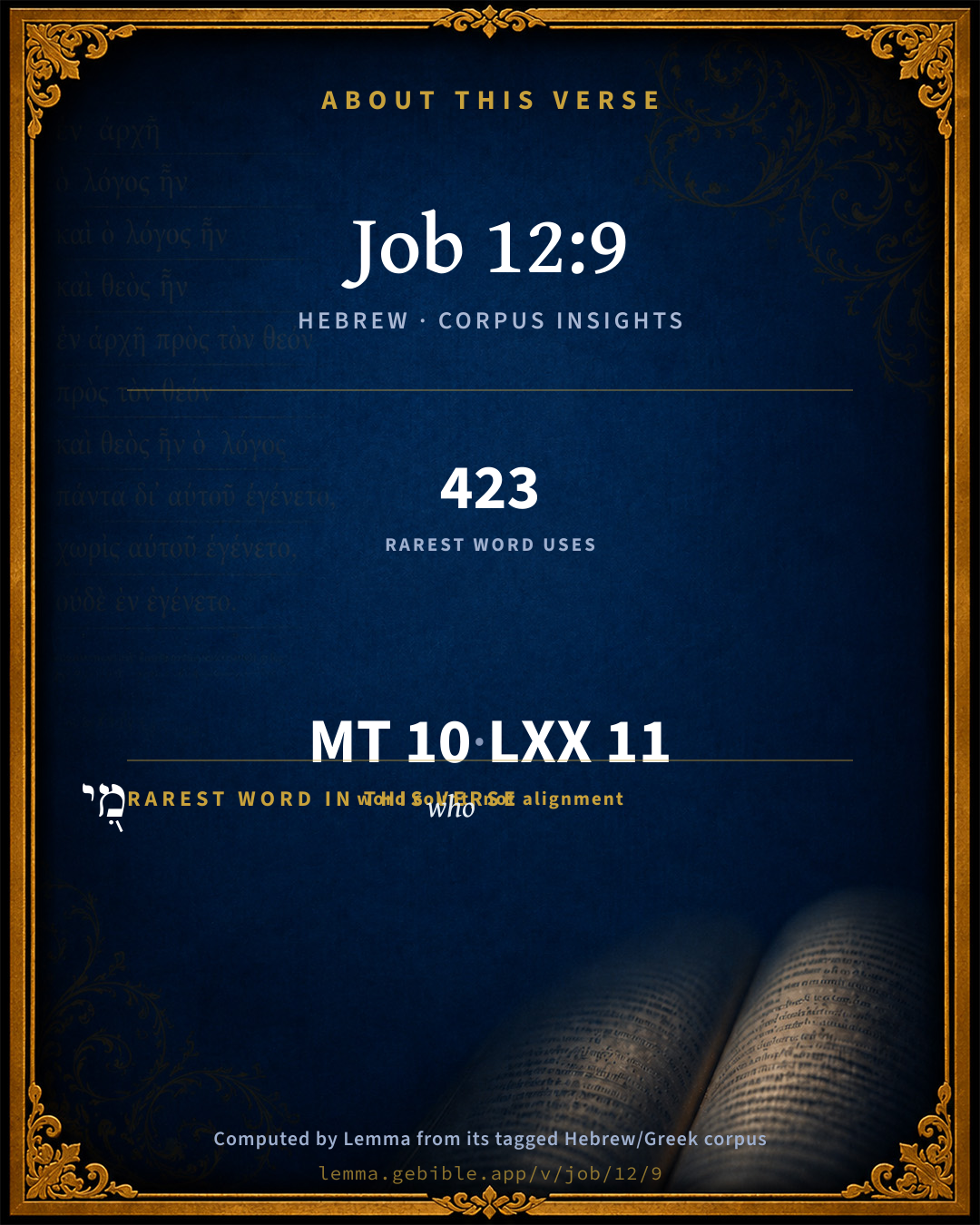
These counts appear in no published source. They are computed here, from the morphology-tagged text and Lemma’s own curated glosses. What Lemma adds →

10
words
10
distinct lemmas
Wisdom
section

Grammatical profile

  • 2 verbs
  • 3 nouns
  • 2 pronouns
  • 1 conjunction
  • 2 particles

Verb forms

  • יָדַ֣ע Qal · Perfect
  • עָ֣שְׂתָה Qal · Perfect

Hebrew & Septuagint length

In English translation the verse runs 14 words from the Hebrew and 18 from the Septuagint (LXX English) — closely comparable.

A rough comparison of the two English renderings, which tokenize alike — not a word-level alignment.

Word counts can differ between the Hebrew and the Greek without any difference in meaning — e.g. the Hebrew direct-object marker אֵת has no separate Greek word, and Greek often adds the article ὁ.

In the original languages it is 10 Hebrew tokens and 11 Greek tokens — but the two are counted differently (Hebrew bundles its prefixes and suffixes into one token; the Greek is in lemma form), so that isn’t a like-for-like length.

Cross-references

11

Topical passages linked to Job 12:9 in the Treasury of Scripture Knowledge — connected by theme and wording, ordered by reader-vote popularity; previews shown in the World English Bible.

  • Isaiah 41:20 that they may see, and know, and consider, and understand together, that the hand of Yahweh has done this, and the Holy One of Israel has created it.
  • Jeremiah 27:5–6 I have made the earth, the men and the animals that are on the surface of the earth, by my great power and by my outstretched arm; and I give it to whom it seems right to me.
  • Romans 11:36 For of him, and through him, and to him, are all things. To him be the glory for ever! Amen.
  • 1 Samuel 2:7 Yahweh makes poor, and makes rich: He brings low, he also lifts up.
  • Daniel 9:17 Now therefore, our God, listen to the prayer of your servant, and to his petitions, and cause your face to shine on your sanctuary that is desolate, for the Lord's sake.
  • Acts 19:35 When the town clerk had quieted the multitude, he said, "You men of Ephesus, what man is there who doesn't know that the city of the Ephesians is temple-keeper of the great goddess Artemis, and of the image which fell down from Zeus?
  • Deuteronomy 8:17–18 and [lest] you say in your heart, My power and the might of my hand has gotten me this wealth.
  • Daniel 5:18 You king, the Most High God gave Nebuchadnezzar your father the kingdom, and greatness, and glory, and majesty:
  • James 2:5–7 Listen, my beloved brothers. Didn't God choose those who are poor in this world to be rich in faith, and heirs of the Kingdom which he promised to those who love him?
  • Job 12:3 But I have understanding as well as you; I am not inferior to you: Yes, who doesn't know such things as these?
  • Job 22:18 Yet he filled their houses with good things, But the counsel of the wicked is far from me.

Cross-references courtesy of OpenBible.info (CC BY 4.0).

Hebrew and Greek witnesses Masoretic Hebrew ↔ Greek Septuagint

The same verse in the two great witnesses to the Old Testament, shown verse-for-verse.

These are two independent witnesses, not word-aligned to each other, and the Septuagint is shown in lemma (dictionary) form.

Hebrew Job 12:9 Masoretic · Westminster Leningrad Codex

מִ֭י לֹא יָדַ֣ע בְּכָל אֵ֑לֶּה כִּ֥י יַד יְ֝הוָה עָ֣שְׂתָה זֹּֽאת

Who doesn't know that in all these, The hand of Yahweh has done this,

World English Bible · Public Domain

Greek LXX Job 12:9 Septuagint · lemma form

τίς οὐ γιγνώσκω ἐν πᾶς οὗτος ὅτι χείρ κύριος ποιέω οὗτος

Who then has not known in all these things, that the hand of the Lord has made them?

LXX2012 (modern English Septuagint) · Public Domain

Hebrew: Westminster Leningrad Codex (CC BY 4.0). Greek: Septuagint (public domain); English from LXX2012 (modern English Septuagint) (Public Domain). How the Septuagint differs from the Hebrew →

Commentary

Notes on Job 12:9 from classic Christian and Jewish commentators (each source and its license shown beneath its notes). The classic Christian expositions comment on the surrounding passage and are grouped to its opening verse, so a note may address several verses; the Jewish commentaries on the Tanakh (Rashi and others) are per-verse, so they appear only where the commentator wrote on this verse.

Lemma curates 59 commentaries, every one of them public domain or Creative Commons licensed, each selected and text-cleaned for this edition rather than reprinted as found. About our sources →

Trapp's Complete Commentary

John Trapp

Job 12:9 Who knoweth not in all these that the hand of the LORD hath wrought this?

Ver. 9. Who knoweth not in all these, &c.] Or, by all these before mentioned creatures, &c., and therefore, Zophar, you have showen no more wisdom in your lofty discourse than the birds, beasts, and fishes have taught and told us. It is a silly vanity to pretend mysteriousness about vulgar truths; to dig deep for that which lieth above ground, Theologia cryptica; to talk of new truths, and never before heard of, when as the hearer may well say, as here, Who knows not such things as these? Of some in these days it is observed, that they call upon their hearers to mark, it may be they shall hear that which they have not heard before; when the thing is either false, or if true, no more than ordinarily is taught by others.

That the hand of the Lord hath wrought this?] That he alone made all without tool or toil, and that he alone manageth and ordereth all according to the good pleasure of his will; neither need he subscribe his name to his work; for the very things that he hath made proclaim that he made them. Meanwhile, hereby we may see how much we are beholden to Aristotle, Aelian, Gesner, and other learned men, who have written books concerning the nature of living creatures.

John Trapp, A Commentary or Exposition upon All the Books of the Old and New Testament (1647–1656) — public domain. Text from a community e-Sword module.

Albert Barnes' Notes on the Bible

Who knoweth not in all these - Who cannot see in all these the proofs of the same divine and sovereign agency? Who cannot see the hand of the same God and the same great principles of administration? The meaning of Job is, that the position which he defends is so plain, that it may be learned from the very earth and the lowest orders of animals which God has made.

That the hand of the Lord hath wrought this - In this place the original word is יהוה yehovâh. On the meaning of the word see the notes at Isa 1:2. The Chaldee also renders it here יה yâhh. It is remarkable that this is the only place where the name yahweh occurs in poetical parts of the book of Job, in the printed editions. In Job 28:28, yahweh is found in some manuscripts, though the word “Adonai” is in the printed copies. Eichhorn, Einleit. section 644, Note. In Job 12:9, the word yahweh, though found in the printed editions, is missing in nine ancient manuscripts. Dr. John P. Wilson on the “Hope of Immortality,” p. 57. The word yahweh constantly occurs in the historical parts of the book. On the argument derived from this, in regard to the antiquity of the Book of Job, see the introduction, Section 4.

Albert Barnes' Notes on the Bible (1834–1885) — public domain. Text from a community e-Sword/MySword module.

The Biblical Illustrator

Joseph S. Exell

Job_12:9-10

Who knoweth not in all these that the hand of the Lord hath wrought this?

God and nature

If one could possibly laugh the laugh of the scornful, surely there is temptation enough in the teachings of a modern science, and in the attempt to build up before us a self-created world without God. But we are not endowed with such a scornful spirit. Modern science is too wonderful, and its discoveries too fascinating for us to laugh at it. We never dream of suggesting that a vast edifice crammed with machinery and automatic looms, which can produce webs of finest texture and perfect design, could possibly have evolved itself from some primary simple structure. And why should we commit such an outrage on our common reason, as to suggest that this world, unaided by any outside hand, could have made itself? But if we add to this evolutionary theory, the teaching that God may have endowed the materials and life of the world with an inner spirit of development and adaptation, it would become, at least, reasonable. No one who is familiar with the types of life on the earth, and their remarkable history, can fail to perceive that there is in all forms, even in the lowly fungus and the blade of grass, a certain power of choice and adaptation. But whence came that power of choice and adaptation? No combination of chemical elements could make it. None other could impart it than the hand of a Person. We can observe, too, a wonderful linking together of all the forms of life from the lowly creature to the highest man, though there are more blanks in the chain than the links which have been discovered. Yet, how is it possible for one species to pass on to a higher stage without some external directing power?

I. The Christian sees nature as a scientist. As the Christian studies a flower he marks the secret intelligence which directs every part of it. The embryo in the seed knows which part of it must descend to the earth, and which part must be raised up to the heavens. The leaves place themselves at proper intervals, and follow out their cyclical order. The plant creeps or climbs or shoots upwards with an intelligent adaptation, and the flowers mix their colours and exhale their odours to allure the passing bee. A Christian watches all this intelligence in a flower, and with deeper reason than ever he can add, God is the maker of that flower. The Christian, as he delights in spelling out the arithmetical principles on which the chemical elements unite, asks who taught them the laws of their combinations. Or as he takes his stand on the great orbit, and marvels as he sees planet after planet come up in sublime order, and roll on majestically in its marked and bounded path, he repeats with deeper conception his belief in the greatness and power of the Almighty. He can read, too, the records of the rocks, the story of the fire and water, of the grinding and building up of the earths crust, of life that existed long before the advent of man. As a scientist he can do all this, but to him it is all the work of God, who is infinite in His power and duration, who works His great works by these methods, and in these marvellous ways which science discovers and unfolds.

II. The Christian sees nature as a poet. A flower is not a clever piece of machinery of subtle forces and delicate laws. Beautiful must have been the hands, and beautiful the thoughts of Him who could, out of gross earth, cause the primrose to make its petals or the wild briar its tinted flowers. The Christian looks at the flower, and to him it is a poem written by the hand of God. Even uncouth flowers and hideous creatures become transformed when looked at in this light, and suggest far-reaching thoughts of that wisdom which makes things useful as well as beautiful. It is delightful to have the poets eye, and thus to look on Gods nature. The spiked blade of grass, the curving stalk of corn, the uplifted bole of the pine, the waving autumn field, and the moving life of the spring, are the visible lines and measures of a great Divine poem. The crawling worm, the soaring bird, the chirp of the sparrow, and the melody of the lark, the cows in the field, and the snake in the grass, all repeat and increase the lines-Earths crammed with heaven, And every common bush afire with God.

III. The Christian sees nature as a pantheist. As scientific men, we open up our senses to impressions from the outer world. As they come in by this way, they spell out God, the Creator, the Architect, Infinite and Omnipotent. As we open other and deeper sensibilities, and the charm, the grace, the tenderness, the strength and life of nature flow in, they write out in measured form God the Ever Glorious and Wondrous. (J. D. Watters, M. A.)

The hand of the Lord

Nothing can be disposed of without the good pleasure and providence of God, who hath the life and breath of all creatures, men as well as others, in His hand. Learn--

1. A providence is not seen and adored in dispensations which do not please us. When we do not distinctly see and adore providence in ordinary, we meet with intricate and thorny questions about it.

2. Though men, in their sins, presume to debate and question the matter of Gods providence, yet they will not get it shifted nor denied.

3. When men turn atheists, and fall a questioning the providence of God, they ought to be sharply dealt with and refuted. It is the common interest of saints not to let the providence of God be denied in the faith whereof they are so often comforted in darkness. And zeal for God should cause them to abhor any thoughts prejudicial to His glory.

4. As God hath a dominion over all His creatures, particularly over living things, and man in special, so the study of this dominion will help to open our eyes to see Him and His providence, and to clear His providence in every particular.

5. As Gods dominion over every living thing, so, particularly, His dominion over man is to be studied and improved. Therefore it is particularly instanced here that the breath of all mankind is in His hand.

6. Gods dominion over man reacheth even to his life, and no less. The study of this invites us to stand in awe of God. To trust Him in difficulties. To look upon ourselves, not as made for ourselves, but to be subservient to His dominion. When we thus submit to and acknowledge His absolute dominion, we should be without anxiety, as knowing in whose hand we and our concernments are, and should leave it on Him to give a good account of everything He doeth, and believe that His actings will be like the worker, who is God, and our God, though we cannot discern it for the present. (George Hutcheson.)

Everywhere and yet forgotten

There is much temper here, but there is very much also of good common sense. Job wished to show that the fact of the presence of God in all things was so clearly discernible that men need not borrow the eagles wing to mount to heaven, nor need they enter into the bowels of Leviathan to find a chariot wherein to enter the depths of the sea.

I. The present hand of God upon everything.

1. This is one of the doctrines which men believe, but are constantly forgetting.

2. This is a fact of universal force.

3. A truth worthy of perpetual remembrance.

II. Our absolute dependence upon a present God at this very moment.

1. Our life is entirely dependent upon God.

2. So are our comforts.

3. So is the power to enjoy those comforts. If this be true concerning temporals, how doubly true is it with regard to spiritual things. There is no Christian grace which has in it a particle of self-existence.

III. Lessons from this subject. Child of God, see where thou art. Thou art completely in the hand of God. Thou art absolutely and entirely, and in every respect, placed at the will and disposal of Him who is thy God. Art thou grieved because of this? Does this doctrine trouble thee? Let your conversation be as becometh this doctrine. Speak of what thou wilt do, and of what will happen, always in respect to the fact that man proposes, but God disposes. To the sinner we say, Man, you are in the hand of God. (C. H. Spurgeon.)

Divine domination

I. A sense of our own extreme insignificance.

II. A consciousness of our absolute dependence. II we are in Gods hands, He can do with us as He will.

III. A mighty influence in life and behaviour. It impresses us with a feeling of--

1. Intense humility.

2. Great thankfulness.

3. Earnest effort. Effort to develop our moral nature.

IV. A readiness to acquiesce in all the dispensations of so great a being. (J. J. S. Bird.)

The Biblical Illustrator, edited by Joseph S. Exell (c. 1880s–1900s) — public domain. Text from a community e-Sword module.

Joseph Benson's Commentary

Job 12:9. Who knoweth not in all these — Or, by all these brute creatures; that the hand of the Lord hath wrought this — That God, by his power and wisdom, hath created and ordered all that is in them, or that is done by and among them. Job meant in these verses to express his firm opinion that all animate and inanimate nature clearly bore testimony to the creating power and overruling providence of God: see Neh 9:6. This is the only time that we meet with the name Jehovah in all the discourses between Job and his friends. For God in that age was more known by the name of Shaddai, the Almighty.

Joseph Benson's Commentary on the Old and New Testaments (1811–1818) — public domain. Text from a community e-Sword module.

Tyndale Open Study Notes

Tyndale Open Resources

12:9 from the hand of the Lord: This is the only place in the dialogues (chs 3–27; 29–37) that the Hebrew Yahweh (“the Lord”) is used. For Job, the dispute was not about who caused his misery but why it happened.

Tyndale Open Study Notes — © Tyndale Open Resources, licensed CC BY-SA 4.0. Text via the HelloAO Bible API.

Jamieson, Fausset & Brown

Robert Jamieson, A. R. Fausset & David Brown

In all these cases, says Job, the agency must be referred to Jehovah, though they may seem to man to imply imperfection (Job 12:6; Job 9:24). This is the only undisputed passage of the poetical part in which the name "Jehovah" occurs; in the historical parts it occurs frequently.

Jamieson, Fausset & Brown — Commentary Critical and Explanatory on the Whole Bible (1871) — public domain (CC PDM 1.0). Text via the HelloAO Bible API.

Ellicott's Commentary for English Readers

(9) Who knoweth not in all these that the hand of the Lord hath wrought this?—This is the only place in the dialogue parts of Job in which the sacred name of Jehovah is found, and Job’s very use of the word in such a context is the clearest evidence of the superior knowledge that he claims. No one of his friends makes use of the name; but Job uses it here, and shows thereby his knowledge of the covenant name.

A Bible Commentary for English Readers, edited by Charles John Ellicott (1878–1897) — public domain. Text from a community e-Sword module.

The Cambridge Bible for Schools and Colleges

gen. ed. J. J. S. Perowne

9. in all these] Or, by all these, Gen_15:8.

hath wrought this] Rather, doeth this, viz. as Zophar had taught and as Job_12:10 explains, rules with an absolute sway in all the world of life upon the earth, men and creatures. We should say in English here, acts thus (as Zophar had said), cf. Isa_41:20, though the point prominently referred to is the infliction of suffering.

The Cambridge Bible for Schools and Colleges (gen. ed. J. J. S. Perowne; Cambridge University Press, 1878–1918) — public domain. Text from a community e-Sword module.

John Gill's Exposition

In whose hand is the soul of every living thing,.... Of every animal, of every brute creature, as distinct from man, in the next clause: the life of everyone of them is from him, and it is continued by him as long as he pleases, nor can it be taken away without his leave; two sparrows, which are not worth more than a farthing, not one of them falls to the ground, or dies without the knowledge and will of God, Mat 10:29; of the soul or spirit of beasts, see Ecc 3:21;

and the breath of all mankind; the breath of man is originally from God, he at first breathed into man the breath of life; and though this is in his nostrils, which makes him of little account, yet it would not continue there long, was it not in the hand, and under the care and providence of God; the breath of a king, as well as the heart of a king, is in the hand of the Lord: the breath of that great monarch Belshazzar, king of Babylon, was in the hand of God, Dan 5:23; and so is the breath of every peasant; and as when he takes away the breath of other creatures, they die and return to the dust; such is the case of man when God takes away his breath; all our times are in his hand, to be born, to live and die, all is at his dispose: or "the spirit of all the flesh of men" (p), or of all men's flesh; his rational soul, as distinguished from his flesh or body, this is from God, supported in its being by him, and ever will be, being immortal, and will never die.

(p) "spiritus omnis carnis viri?" Pagninus, Montanus, Schmidt, Schultens, Michaelis.

John Gill's Exposition of the Whole Bible (1746–1763) — public domain (CC PDM 1.0). Text via the HelloAO Bible API.

Matthew Poole's English Annotations

In all these, or, by all these, brute creatures, that God by his power and wisdom hath created and ordered all this which is in them, or is done by and among them.

Matthew Poole's English Annotations on the Holy Bible (1683–1685) — public domain. Text from a community e-Sword/MySword module.

Whedon's Commentary on the Bible

Daniel D. Whedon

9. Lord — Jehovah. This is the only place in the poetical part of this book (if we except Job_28:28) where the name Jehovah appears. Jehovah, the Self-existent, is the source of life to all these — “the things seen.” Heb_11:3. Compare Isa_66:2.

This — The totality of creation, corresponding to, but more comprehensive than, “all these;” or better — “the administration of God among his creatures.”

Daniel D. Whedon (gen. ed.), Commentary on the Old and New Testaments (1874–1909) — public domain. Text from a community e-Sword module.

The Pulpit Commentary

Who knoweth not in all these; or, by all these; i.e. by all these instances. That the hand of the Lord hath wrought this? literally, the hand of Jehovah. The name "Jehovah does not occur elsewhere in the dialogue, though it is employed frequently in the historical sections. (Job_1:6-12, 21 2:1-7 38:1 40:1, 3, 6 42:1, 7-12) The writer probably regards the name as unfamiliar, if not unknown, to Job"s neighbours, and therefore as avoided by him in his discussions with them. But here, for once, he forgets to be consistent with himself. Outside Scripture, the name is first found on the Moabite Stone (about B.C. 890), where it designates the God worshipped by the Israelites (see "Records of the Past," vol. 11. p. 166, 1. 18).

The Pulpit Commentary (1880–1919), ed. H.D.M. Spence-Jones & Joseph S. Exell — public domain. Text from a community e-Sword module.

John Wesley's Explanatory Notes

Lord - This is the only time that we meet with the name Jehovah in all the discourses between Job and his friends. For God in that age was more known by the name of Shaddai, the Almighty.

John Wesley, Explanatory Notes Upon the Whole Bible (1754–1765) — public domain. Text via the GEBible commentary corpus.

unfoldingWord translationNotes

Door43 World Missions Community

Which animal among all these does not know ... this?

This question emphasizes the point that all the animals know that Yahweh has done this. This question can be worded as a statement. AT: "Every animal among all these knows ... this." (See: Rhetorical Question)

the hand of Yahweh has done this

Yahweh's hand represents his power. AT: "Yahweh has done this by his power" (See: Metonymy)

In his hand is the life ... and the breath of all mankind

Yahweh's hand represents his control or power. AT: "God controls the life of every living thing and gives breath to all mankind" (See: Metonymy)

the breath of all mankind

Here "breath" represents life or the ability to live. (See: Metonymy)

translationWords

know

hand

Yahweh

life

breath

unfoldingWord translationNotes — © Distant Shores Media and the Door43 World Missions Community, licensed CC BY-SA 4.0. Source: git.door43.org/Door43/en_tn.

Lesson kit

Teaching starters — assembled from the data on this page, not authored interpretation. Every prompt links to the verse data it draws on. Edit before teaching.

Job, in the Wisdom, opens this verse with 10 words (10 distinct Hebrew lemmas). Its most distinctive word is mîy (“who”). A historical commentator’s framing appears above. Read the whole chapter for the surrounding context.

Discussion questions

  1. What does “who” (mîy) contribute to the verse as a whole?
  2. How does Isaiah 41:20, which shares this passage’s theme, read alongside this verse?
  3. These translations render this verse differently; the difference is in the English rendering, not the original. What questions does that raise?
  4. «יָדַ֣ע» is a Qal Perfect verb. How does that grammatical form shape the action described?
  5. Compare how Trapp's Complete Commentary and Albert Barnes' Notes on the Bible read this verse. Where do they agree or differ?

Things to notice

Reading settings

Reading text

Shown beneath each verse's original-language words.

Old Testament
Old Testament edition

Read the OT as the Masoretic Hebrew (MT) or the Greek Septuagint (LXX).

English shown for the Greek Septuagint (in the Hebrew ↔ Greek comparison).

Comparing translations? Open the Compare panel on any verse page to stack up to four side by side.