
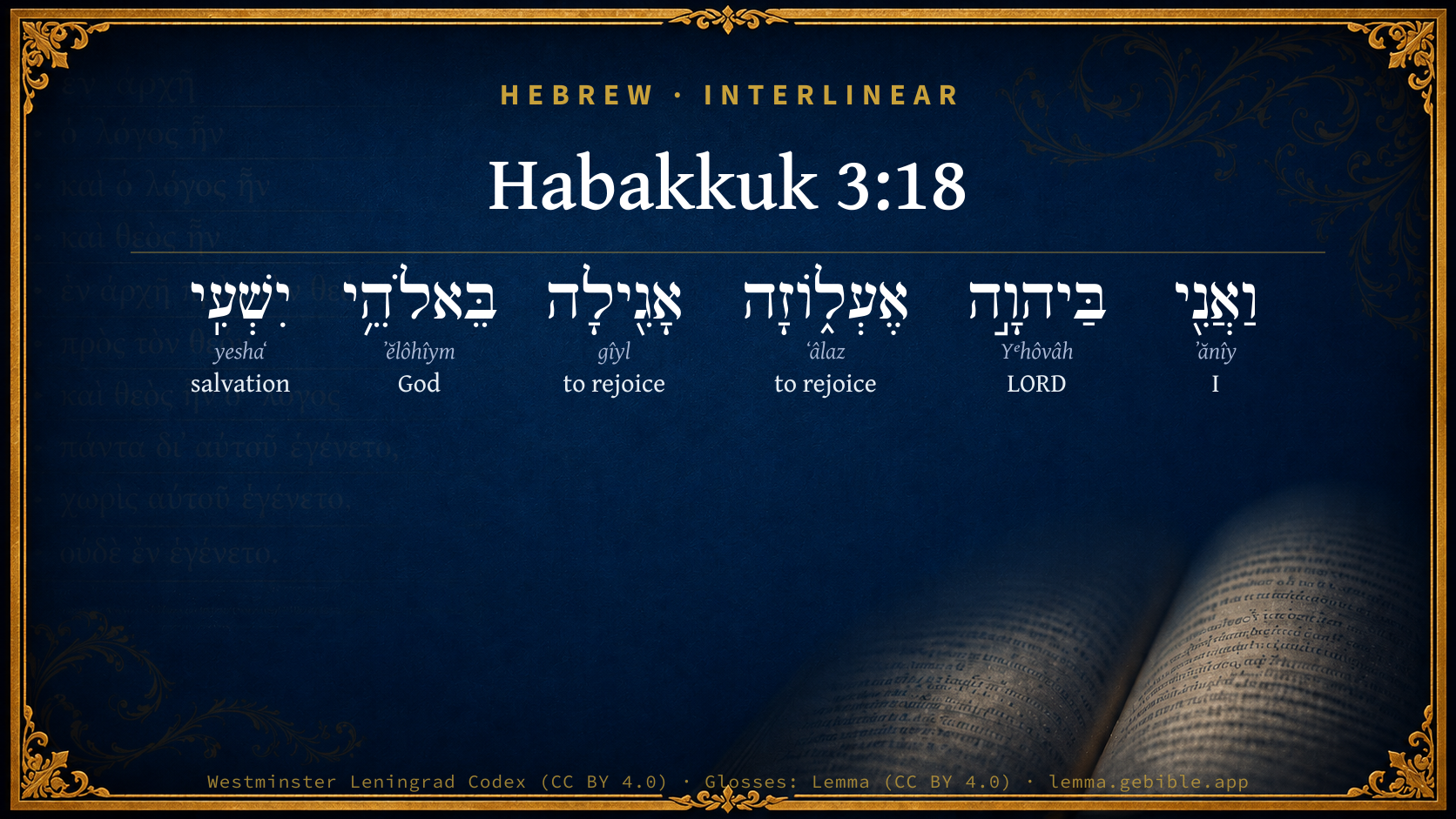
Habakkuk 3:18

Hebrew (Westminster Leningrad Codex) Habakkuk 3:18 appears in the Hebrew Old Testament. The text above is from the Westminster Leningrad Codex. Each word links to its Strong’s number, a concise gloss, and parsing drawn from the Open Scriptures Hebrew Bible morphology. Click any word for its full Brown-Driver-Briggs (BDB) entry.
Download image
Cite this verse

Habakkuk 3:18 (World English Bible). Public Domain. Lemma interlinear Bible study tool, https://lemma.gebible.app/v/habakkuk/3/18.

Show BibTeX & RIS
BibTeX
RIS
English Translation
Yet I will rejoice in Yahweh. I will be joyful in the God of my salvation!
World English Bible · Public Domain
Download a study sheet

One document with this verse’s original text, its word-by-word gloss line, the meaning frame, cross-references with their text, attributed commentary, and full source and license credits — printable, and it pastes into notes with its structure intact.

This verse Autodidact and up

Study sheet (.html) Plain text (.txt)

A passage Seminary Student

Up to 50 verses in one chapter. A passage sheet keeps up to 6 commentary sources and 12 cross-references per verse, in the order this page ranks them, and says so on the sheet whenever that leaves anything out. Ask for a single verse and you get the Autodidact verse sheet above.

Everything on this page stays free to read, with no account — the sheet is a download of what is already on screen, not access to it.

Want to remove ads? Support Godless Engineer
Compare translations 3

The same verse in 3 English versions, stacked beneath the original-language interlinear above. Click any original word for its lexicon entry.

Each is an independent rendering of the whole verse — the interlinear is not word-aligned to these translations.

Highlighted words mark where these versions differ — a whole-verse word diff, not a word-by-word alignment.

  • World English Bible Public Domain
    Yet I will rejoice in Yahweh. I will be joyful in the God of my salvation!
  • King James Version Public Domain
    Yet I will rejoice in the LORD, I will joy in the God of my salvation.
  • unfoldingWord Literal Text CC BY-SA 4.0
    yet I, I will exult in Yahweh; I will rejoice in the God of my salvation.

unfoldingWord Literal Text — © unfoldingWord, licensed CC BY-SA 4.0. Word-aligned USFM3 via Door43 (git.door43.org/unfoldingWord/en_ult).

Versions to compare (up to 4)

3 of 4 selected

Show all 18 translations

Every available English version of this verse, each an independent rendering of the whole verse.

  • World English Bible Public Domain
    Yet I will rejoice in Yahweh. I will be joyful in the God of my salvation!
  • Berean Standard Bible Public Domain
    yet I will exult in the LORD; I will rejoice in the God of my salvation!
  • Majority Standard Bible Public Domain
    yet I will exult in the LORD; I will rejoice in the God of my salvation!
  • King James Version Public Domain
    Yet I will rejoice in the LORD, I will joy in the God of my salvation.
  • American Standard Version (1901) Public Domain
    Yet I will rejoice in Jehovah, I will joy in the God of my salvation.
  • Revised Version (1885) Public Domain
    Yet I will rejoice in the LORD, I will joy in the God of my salvation.
  • Geneva Bible (1599) Public Domain
    But I will reioyce in the Lord: I will ioy in the God of my saluation.
  • Douay-Rheims (1899) Public Domain
    But I will rejoice in the Lord: and I will joy in God my Jesus.
  • Young's Literal Translation Public Domain
    Yet I, in Jehovah I exult, I do joy in the God of my salvation.
  • Literal Standard Version CC BY-SA 4.0
    Yet I, in YHWH I exult, || I am joyful in the God of my salvation.
  • Unlocked Literal Bible CC BY-SA 4.0
    Still, I will rejoice in Yahweh. I will be joyful because of the God of my salvation.
  • unfoldingWord Literal Text CC BY-SA 4.0
    yet I, I will exult in Yahweh; I will rejoice in the God of my salvation.
  • Darby Bible Public Domain
    Yet I will rejoice in Jehovah, I will joy in the God of my salvation.
  • World Messianic Bible Public Domain
    yet I will rejoice in the LORD. I will be joyful in the God of my salvation!
  • Webster's Bible Public Domain
    Yet I will rejoice in the LORD, I will joy in the God of my salvation.
  • Free Bible Version CC BY-SA 4.0
    still I will be happy in the Lord, joyful in the God of my salvation.
  • Bible in Basic English Public Domain
    Still, I will be glad in the Lord, my joy will be in the God of my salvation.
  • JPS Tanakh (1917) Public Domain
    Yet I will rejoice in the LORD, I will exult in the God of my salvation.

Literal Standard Version (2020), Covenant Press — licensed CC BY-SA 4.0. Text via the HelloAO Bible API (eBible.org). Unlocked Literal Bible (unfoldingWord) — licensed CC BY-SA 4.0. Text via the HelloAO Bible API (eBible.org). unfoldingWord Literal Text — © unfoldingWord, licensed CC BY-SA 4.0. Word-aligned USFM3 via Door43 (git.door43.org/unfoldingWord/en_ult). Free Bible Version, Dr. Jonathan Gallagher — licensed CC BY-SA 4.0. Text via the HelloAO Bible API (eBible.org).

Word by word

More ways to search: Search by grammar → Find every occurrence → Compare this word →

Practice this passage: Drill this verse → Learn its vocabulary →

About this verse

These counts appear in no published source. They are computed here, from the morphology-tagged text and Lemma’s own curated glosses. What Lemma adds →

6
words
6
distinct lemmas
Prophets
section

Notable vocabulary

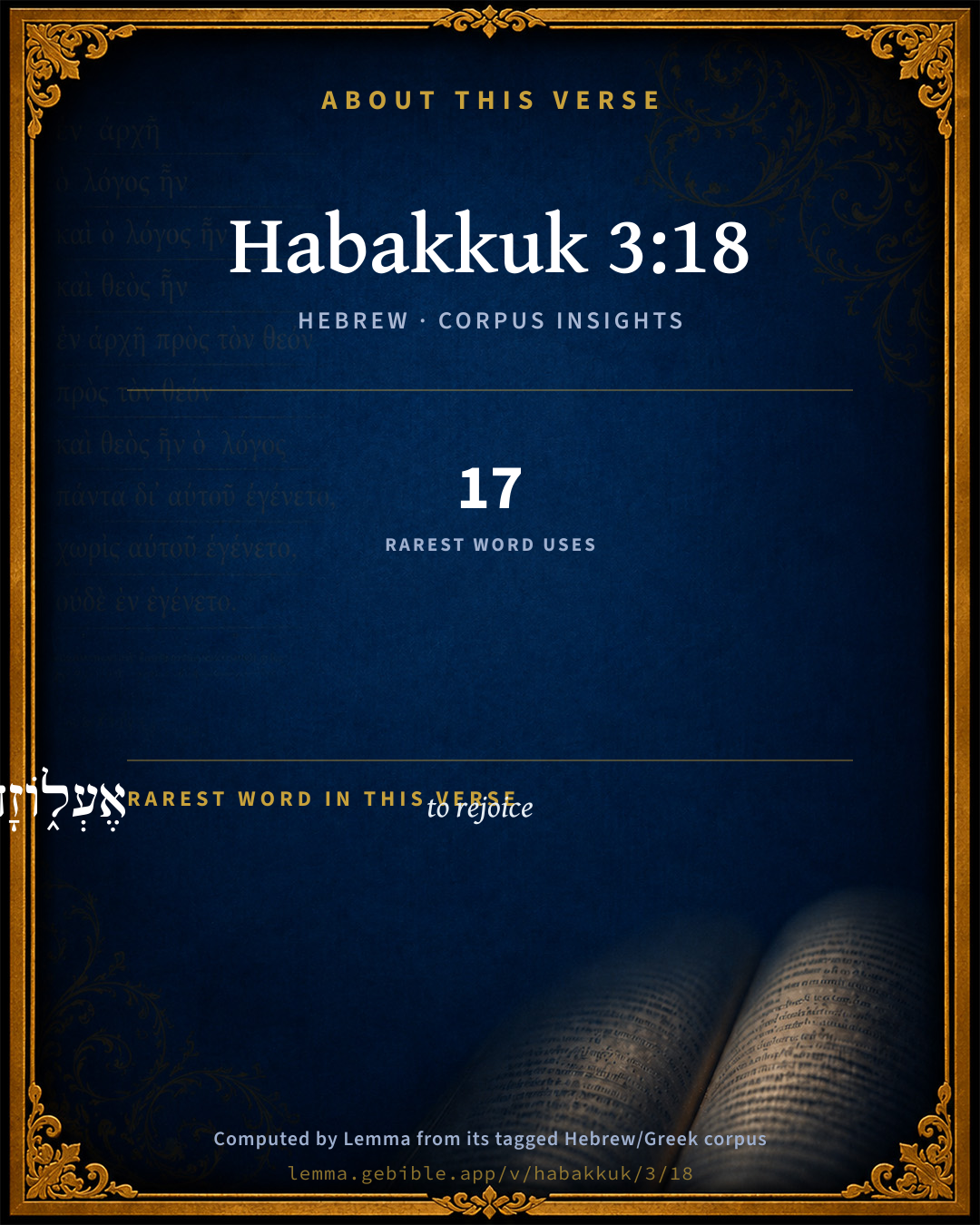
The rarest word here is אֶעְל֑וֹזָה to rejoice H5937 — appearing just 17 times in the whole Hebrew Bible.

Shared distinctive vocabulary

אֶעְל֑וֹזָה to rejoice H5937 occurs in 16 verses of the Hebrew Bible. Also found in:

Grammatical profile

  • 2 verbs
  • 3 nouns
  • 1 pronoun

Verb forms

  • אֶעְל֑וֹזָה Qal · Cohortative
  • אָגִ֖ילָה Qal · Cohortative

Hebrew & Septuagint length

In English translation the verse runs 16 words from the Hebrew and 14 from the Septuagint (LXX English) — closely comparable.

A rough comparison of the two English renderings, which tokenize alike — not a word-level alignment.

Word counts can differ between the Hebrew and the Greek without any difference in meaning — e.g. the Hebrew direct-object marker אֵת has no separate Greek word, and Greek often adds the article ὁ.

Cross-references

26

Topical passages linked to Habakkuk 3:18 in the Treasury of Scripture Knowledge — connected by theme and wording, ordered by reader-vote popularity; previews shown in the World English Bible.

  • Job 13:15 Behold, he will kill me; I have no hope. Nevertheless, I will maintain my ways before him.
  • Philippians 4:4 Rejoice in the Lord always! Again I will say, Rejoice!
  • Micah 7:7 But as for me, I will look to Yahweh. I will wait for the God of my salvation. My God will hear me.
  • Isaiah 61:10 I will greatly rejoice in Yahweh, my soul shall be joyful in my God; for he has clothed me with the garments of salvation, he has covered me with the robe of righteousness, as a bridegroom decks himself with a garland, and as a bride adorns herself with her jewels.
  • Isaiah 12:2 Behold, God is my salvation. I will trust, and will not be afraid; for Yah, Yahweh, is my strength and song; and he has become my salvation."
  • Romans 5:2–3 through whom we also have our access by faith into this grace in which we stand. We rejoice in hope of the glory of God.
  • Psalms 25:5 Guide me in your truth, and teach me, For you are the God of my salvation, I wait for you all day long.
  • Psalms 46:1–5 God is our refuge and strength, A very present help in trouble.
  • Psalms 118:14–15 Yah is my strength and song. He has become my salvation.
  • Luke 1:46–47 Mary said, "My soul magnifies the Lord.
  • 1 Peter 1:8 whom not having known you love; in whom, though now you don't see him, yet believing, you rejoice greatly with joy unspeakable and full of glory--
  • Exodus 15:2 Yah is my strength and song, He has become my salvation: This is my God, and I will praise him; My father's God, and I will exalt him.
  • 1 Samuel 2:1 Hannah prayed, and said: My heart exults in Yahweh; My horn is exalted in Yahweh; My mouth is enlarged over my enemies; Because I rejoice in your salvation.
  • Psalms 27:1 Yahweh is my light and my salvation. Whom shall I fear? Yahweh is the strength of my life. Of whom shall I be afraid?
  • Psalms 97:12 Be glad in Yahweh, you righteous people! Give thanks to his holy Name.
  • Luke 2:30 For my eyes have seen your salvation,
  • 1 Peter 4:12–13 Beloved, don't be astonished at the fiery trial which has come upon you, to test you, as though a strange thing happened to you.
  • Psalms 33:1 Rejoice in Yahweh, you righteous! Praise is fitting for the upright.
  • Psalms 85:6 Won't you revive us again, That your people may rejoice in you?
  • Isaiah 41:16 You shall winnow them, and the wind shall carry them away, and the whirlwind shall scatter them; and you shall rejoice in Yahweh, you shall glory in the Holy One of Israel.
  • James 1:2 Count it all joy, my brothers, when you fall into various temptations,
  • Psalms 104:34 Let your meditation be sweet to him. I will rejoice in Yahweh.
  • Psalms 149:2 Let Israel rejoice in him who made them. Let the children of Zion be joyful in their King.
  • James 1:9–10 But let the brother in humble circumstances glory in his high position;
  • Deuteronomy 12:18 but you shall eat them before Yahweh your God in the place which Yahweh your God shall choose, you, and your son, and your daughter, and your man-servant, and your maid-servant, and the Levite who is within your gates: and you shall rejoice before Yahweh your God in all that you put your hand to.
  • Zechariah 10:7 Ephraim will be like a mighty man, And their heart will rejoice as through wine; Yes, their children will see it, and rejoice. Their heart will be glad in Yahweh.

Cross-references courtesy of OpenBible.info (CC BY 4.0).

Hebrew and Greek witnesses Masoretic Hebrew ↔ Greek Septuagint

The same verse in the two great witnesses to the Old Testament, shown verse-for-verse.

These are two independent witnesses, not word-aligned to each other, and the Septuagint is shown in lemma (dictionary) form.

Hebrew Habakkuk 3:18 Masoretic · Westminster Leningrad Codex

וַאֲנִ֖י בַּיהוָ֣ה אֶעְל֑וֹזָה אָגִ֖ילָה בֵּאלֹהֵ֥י יִשְׁעִֽי

Yet I will rejoice in Yahweh. I will be joyful in the God of my salvation!

World English Bible · Public Domain

Greek LXX Habakkuk 3:18 Septuagint · lemma form

ἐγώ δέ ἐν ὁ κύριος ἀγαλλιάομαι χαίρω ἐπί ὁ θεός ὁ σωτήρ ἐγώ

yet I will exult in the Lord, I will joy in God my Saviour.

LXX2012 (modern English Septuagint) · Public Domain

On this verse, Haydock's Catholic Bible Commentary discusses the Septuagint’s reading. Read the note in Commentary ↓

Hebrew: Westminster Leningrad Codex (CC BY 4.0). Greek: Septuagint (public domain); English from LXX2012 (modern English Septuagint) (Public Domain). How the Septuagint differs from the Hebrew →

Targum (Aramaic paraphrase)

1

The Targum is the ancient Jewish Aramaic paraphrase of the Hebrew Scriptures — an interpretive translation, not the Hebrew text itself. Onkelos (literal) and Pseudo-Jonathan (expansive) render the Torah, and Jonathan the Prophets. Coverage is partial: where no permissively-licensed English translation exists for a verse, only the Aramaic is shown. This is verse-level text, not a word-by-word alignment to the Hebrew.

  1. Targum Jonathan Prophets (Joshua–Malachi)
    בְּכֵן עַל נִסָא וּפוּרְקָנָא דְתַעֲבֵּיד לִמְשִׁיחָךְ וְלִשְׁאָרָא דְעַמָךְ דִי יִשְׁתָּאֲרוּן יוֹדוּן לְמֵימָר אֲמַר נְבִיָא וַאֲנָא בְּמֵימְרָא דַייָ אֲבוּעַ אֲדוּץ לֶאֱלָהָא עָבֵיד פּוּרְקָנִי:

    (no public-domain English translation for this verse)

    Targum Jonathan — Aramaic: “Mikraot Gedolot” (public domain). English: “Sefaria Community Translation” (CC0 1.0 (public-domain dedication)); “London "Chaldee Paraphrase," 1871” (public domain). Text via Sefaria.

Commentary

Notes on Habakkuk 3:18 from classic Christian and Jewish commentators (each source and its license shown beneath its notes). The classic Christian expositions comment on the surrounding passage and are grouped to its opening verse, so a note may address several verses; the Jewish commentaries on the Tanakh (Rashi and others) are per-verse, so they appear only where the commentator wrote on this verse.

Lemma curates 59 commentaries, every one of them public domain or Creative Commons licensed, each selected and text-cleaned for this edition rather than reprinted as found. About our sources →

Trapp's Complete Commentary

John Trapp

Hab 3:18 Yet I will rejoice in the LORD, I will joy in the God of my salvation.

Ver. 18. Yet I will rejoice in the Lord, I will joy in the God of my salvation] This joy of the Lord was the prophet s strength, and kept his head above all waters of affliction, Neh 8:10. So it was David’s at the sack of Ziklag, 1Sa 30:6, when Saul at the same time for want of it ran first to the witch, and thence to the sword’s point. A good man hath God for his portion; and if any occasion of discontent or trouble befall him he retireth into his counting house, and there seeth himself so well stored with unlosable graces and invaluable privileges that he cannot be greatly moved, Psa 62:2. His soul in greatest straits can magnify the Lord, and his spirit rejoice in God his Saviour. Disquieted he may be sometimes for a season, till he hath recollected and better bethought himself. We are staggering, saith the apostle, but not wholly sticking, 2Co 4:8, for not the evenest weights but at their first putting into the balance do somewhat sway both parts thereof, not without some show of inequality, which yet after some little motion do settle themselves in a meet poise and posture.

John Trapp, A Commentary or Exposition upon All the Books of the Old and New Testament (1647–1656) — public domain. Text from a community e-Sword module.

Keil & Delitzsch

C. F. Keil & F. Delitzsch

Although trembling on account of the approaching trouble, the prophet will nevertheless exult in the prospect of the salvation that he foresees. Hab 3:18. "But I, in Jehovah will I rejoice, will shout in the God of my salvation. Hab 3:19. Jehovah the Lord is my strength, and makes my feet like the hinds, and causes me to walk along upon my high places." The turning-point is introduced with ואני ht, as is frequently the case in the Psalms. For this exaltation out of the sufferings of this life to believing joy in God, compare Psa 5:8; Psa 13:6; Psa 31:15, etc. עלז, a softened form of עלץ, to rejoice in God (cf. Psa 5:12), i.e., so that God is the inexhaustible source and infinite sphere of the joy, because He is the God of salvation, and rises up to judgment upon the nations, to procure the salvation of His people (Hab 3:13). Elōhē yish‛ı̄ (the God of my salvation), as in Psa 18:47; Psa 25:5 (see at Mic 7:7). The thoughts of the 19th verse are also formed from reminiscences of Psalm 18: the first clause, "the Lord is my strength," from Psa 18:33. "God, who girdeth me with strength," i.e., the Lord gives me strength to overcome all tribulation (cf. Psa 27:1 and Co2 12:9). The next two clauses are from Psa 18:34, "He maketh my feet like hinds'," according to the contracted simile common in Hebrew for "hinds' feet;" and the reference is to the swiftness of foot, which was one of the qualifications of a thorough man of war (Sa2 1:23; Ch1 12:8), so as to enable him to make a sudden attack upon the enemy, and pursue him vigorously. Here it is a figurative expression for the fresh and joyous strength acquired in God, which Isaiah calls rising up with eagles' wings (Isa 40:29-31). Causing to walk upon the high places of the land, was originally a figure denoting the victorious possession and government of a land. It is so in Deu 32:13 and Deu 33:29, from which David has taken the figure in Psalm 18, though he has altered the high places of the earth into "my high places" (bâmōthai). They were the high places upon which the Lord had placed him, by giving him the victory over his enemies. And Habakkuk uses the figurative expression in the same sense, with the simple change of יעמידני into ידרכני after Deu 33:29, to substitute for the bestowment of victory the maintenance of victory corresponding to the blessing of Moses. We have therefore to understand bâmōthai neither as signifying the high places of the enemy, nor the high places at home, nor high places generally. The figure must be taken as a whole; and according to this, it simply denotes the ultimate triumph of the people of God over all oppression on the part of the power of the world, altogether apart from the local standing which the kingdom of God will have upon the earth, either by the side of or in antagonism to the kingdom of the world. The prophet prays and speaks throughout the entire ode in the name of the believing congregation. His pain is their pain; his joy their joy. Accordingly he closes his ode by appropriating to himself and all believers the promise which the Lord has given to His people and to David His anointed servant, to express the confident assurance that the God of salvation will keep it, and fulfil it in the approaching attack on the part of the power of the world upon the nation which has been refined by the judgment.

The last words, למנצּח בּנגינותי, do not form part of the contents of the supplicatory ode, but are a subscription answering to the heading in Hab 3:1, and refer to the use of the ode in the worship of God, and simply differ from the headings למנצּח בּנגינות in Psa 4:1-8; Psa 6:1-10; 54:1-55:23; Psa 67:1-7, and Psa 76:1-12, through the use of the suffix in בּנגינותי. Through the words, "to the president (of the temple-music, or the conductor) in accompaniment of my stringed playing," the prophet appoints his psalm for use in the public worship of God accompanied by his stringed playing. Hitzig's rendering is grammatically false, "to the conductor of my pieces of music;" for ב cannot be used as a periphrasis for the genitive, but when connected with a musical expression, only means with or in the accompaniment of (ה instrumenti or concomitantiae). Moreover, נגינות does not mean pieces of music, but simply a song, and the playing upon stringed instruments, or the stringed instrument itself (see at Psa 4:1-8). The first of these renderings gives no suitable sense here, so that there only remains the second, viz., "playing upon stringed instruments." But if the prophet, by using this formula, stipulates that the ode is to be used in the temple, accompanied by stringed instruments, the expression bingı̄nōthai, with my stringed playing, affirms that he himself will accompany it with his own playing, from which it has been justly inferred that he was qualified, according to the arrangements of the Israelitish worship, to take part in the public performance of such pieces of music as were suited for public worship, and therefore belonged to the Levites who were entrusted with the conduct of the musical performance of the temple.

Keil & Delitzsch — Biblical Commentary on the Old Testament (1861–1891) — public domain (CC PDM 1.0). Text via the HelloAO Bible API. (Old Testament only.)

Geneva Bible (1599)

Geneva Bible translators

He declareth wherein standeth the comfort and joy of the faithful, though they see never so great afflictions prepared.

Geneva Bible (1599) marginal notes — public domain. Text via Bolls.life.

Jamieson, Fausset & Brown

Robert Jamieson, A. R. Fausset & David Brown

yet I will rejoice--The prophet speaks in the name of his people.

Jamieson, Fausset & Brown — Commentary Critical and Explanatory on the Whole Bible (1871) — public domain (CC PDM 1.0). Text via the HelloAO Bible API.

Ellicott's Commentary for English Readers

(18) Yet—i.e., in spite of all the afflictions predicted in Hab_3:17. We are reminded of St. Paul’s expression of confidence in Rom_8:37.

A Bible Commentary for English Readers, edited by Charles John Ellicott (1878–1897) — public domain. Text from a community e-Sword module.

The Cambridge Bible for Schools and Colleges

gen. ed. J. J. S. Perowne

18. Yet I will rejoice in the Lord] Comp. Psa_5:11; Psa_32:11; Psa_33:1; Isa_61:10. In spite of calamities the people will joy in God; though earthly blessings perish He remains their portion. The joy is partly a present one in the possession of God, as Psa_73:23, “Nevertheless I am continually with thee”; and partly one of hope in His salvation; Psa_18:46; Mic_7:7; Isa_17:12 ff.

The Cambridge Bible for Schools and Colleges (gen. ed. J. J. S. Perowne; Cambridge University Press, 1878–1918) — public domain. Text from a community e-Sword module.

John Gill's Exposition

Yet I will rejoice in the Lord,.... In the Word of the Lord, as the Targum; the essential Word of the Lord, the Lord Jesus Christ; in his person, the greatness and glory of it; in his offices, as Prophet, Priest, and King, the only Mediator and Saviour; in his relations, as head and husband, father, brother, friend; in his fulness, grace, and righteousness; in his spiritual presence, and comfortable communion with him, which may be expected in a remarkable manner after the above day of trouble is over; and in his personal appearance, which will shortly be, and when his tabernacle will be with men on earth:

I will joy in the God of my salvation; in Christ, who is God, and so able to save his people; to make everything he did and suffered in human nature effectual and available to them; to supply all their wants, and to keep what they commit unto him, and to preserve them safe to his kingdom and glory: and who also joy in the salvation of their God, or which he is the author of, both temporal and spiritual, especially the latter; which is so great and glorious in itself, so suitable to their case, so complete and perfect, and makes so much for the glory of all the divine perfections, and is all of free grace, and lasts for ever: this salvation is peculiar to the people of God; it is theirs, and theirs only; it is what they choose and prefer to all other ways of salvation; it is brought and applied to them by the Spirit, and which they appropriate to themselves under his witnessings; and then it is they can and do rejoice: particularly salvation and deliverance from antichristianism, in all the branches of it, may be chiefly pointed at as the matter and ground of joy; and the enjoyment of Gospel privileges in the full extent of them; the word and ordinances in their power and purity; and the presence of Christ in them.

John Gill's Exposition of the Whole Bible (1746–1763) — public domain (CC PDM 1.0). Text via the HelloAO Bible API.

Albert Barnes' Notes on the Bible

Yet I will rejoice in the Lord, I will joy in the God of my salvation. - The words are very impressive, as they stand in the Hebrew. “For,” he says, “the fig tree shall not blossom, and there is no fruit in the vines, the labor of the olive hath failed;” (the prophet does not look on, only to these things, but in his mind stands in the midst of them, they are done, and he amid them, feeling their effects) “and the field hath yielded no food; the flock hath been cut off from the fold, and there is no herd in the stall; and I.” He relates it as the result of all which had gone before; such and such was the state of fruit-trees, vintage, harvest, flocks and herds; such was the aspect of all nature, living or inanimate; all was barren, disappointing; all had failed and was gone; and then at last he comes to himself, and I; what is he doing, when all nature and every seeming hope is dead? thus and thus it is with them; and I will rejoice.

He almost uses the expression as to the exultation of the enemy, adopting the same word only in a softer form. “Their exulting joy was” concentrated in this, “as to devour the poor secretly;” he too had “exulting joy.” There is a joy against joy - a joy of theirs in the possession of all which their rapacity covets, in the possession of all things: a joy of his amid the privation of all things. He contrasts the two joys, as David had of old; Psa 17:13, Psa 17:15 : “the men of the world, whose portion is in this life, whose belly Thou fillest with Thy hid treasure; they are sated of children and leave their substance to their babes: I,” he adds, “I shall behold Thy Presenee in righteousness, I shall be sated, in the awakening, with Thine image.” So Habakkuk, “I will not rejoice only, but shout for joy;” and not so only, but “I will bound for joy;” and this not for a time only; both words express a drawing, yearning of the soul, and this yet more and more, “I will shout for joy and would shout on; I will bound for joy and would bound on.”

But whence the source of this measureless unutterable joy? In the Lord, the Unchangeable God, “who is and was and is to come,” I am (it is the incommunicable Name); in the God of my salvation: it is almost the Name of Jesus; for jesus is salvation, and the Name means “the Lord is Salvation;” whence the words are here rendered even by a Jew “in God the Author of my redemption,” and yet more sweetly by a father. Augustine, de Civ. D. xviii. 32: “To me what some manuscripts have; ‘I will rejoice in God my Jesus,’ seems better than what they have, who have not set the Name itself (but saving) which to us it is more loving and sweeter to name.”) “in God my Jesus.” In Him his joy begins, to Him and in Him it flows back and on; before he ventures, amid all the desolation, to speak of joy, he names the Name of God, and, as it were, stays himself in God, is enveloped and wrapped round in God; sad I (the words stand in this order) “and I in the Lord would shout for joy.”

He comes, as it were, and places himself quite close to God, so that nothing, not even his joy should be between himself and God; “and I in the Lord.” All creation, as it had failed, ceases to be; all out of God: he speaks of nothing but himself and God, or rather himself in God; and as He, God, comes before his joy, as its source, so in Him does he lose himself, with joy which cannot be contained, nor expressed, nor rest, but utters itself in the glad motions of untiring love. “I would bound for joy in my Saving God.” Truly all our joy is, to be in Him in whom is all Good, who is all Goodness and all Love.

Albert Barnes' Notes on the Bible (1834–1885) — public domain. Text from a community e-Sword/MySword module.

Haydock's Catholic Bible Commentary

Jesus. Hebrew yishi, "my (Haydock) salvation." (Calmet) --- Septuagint, "saviour." Chaldean, "redeemer." (Haydock) --- Jesus was the desire of all nations, and he imparts true joy to the faithful, John viii. 56. (Calmet) --- At the last day, plagues similar to those of Egypt will occur; but the elect shall rejoice. (St. Jerome)

George Leo Haydock (1774–1849), Haydock's Catholic Family Bible and Commentary, 1859 edition — public domain. Excludes Psalms (Douay-Rheims chapter numbering differs from Protestant) and Deuterocanonical books (Catholic canon only).

Matthew Poole's English Annotations

As for my part, I will, saith the prophet, rejoice; look for joy, expect matter of rejoicing

in the Lord, who will preserve a remnant and redeem them, who will rebuke Babylon, and will very strangely destroy it.

I will joy in the God of my salvation: the prophet renews his own faith, and confirms ours. All shall end in salvation to him and believers.

Matthew Poole's English Annotations on the Holy Bible (1683–1685) — public domain. Text from a community e-Sword/MySword module.

The Pulpit Commentary

Vers. 18, 195. In spite of the terror produced by these judgments, the true Israelite is blessed with hope of salvation and joy in the Lord.

Yet I will rejoice in the Lord. Unshaken in confidence, the prophet, representing the faithful Israelite, expresses his unbounded joy at the prospect of salvation which opens to him beyond the present affliction. The psalmist often thus shews his exulting faith. (see Psa_5:7 Psa_13:6 Psa_17:14, 15 31:19) I will joy. I will shout for joy; my joy shall express itself outwardly. The God of my salvation. (see note on Mic_7:7) The God who judges the nations to procure the final salvation of his people. Septuagint, Tw Qew tw swthri mou, "God my Saviour;" Vulgate, In Deo Jesu meo. From this gloss of St. Jerome some of the Fathers have argued for the existence in this passage of a revelation of the incarnation of Christ and the redemption wrought by him.

The Pulpit Commentary (1880–1919), ed. H.D.M. Spence-Jones & Joseph S. Exell — public domain. Text from a community e-Sword module.

unfoldingWord translationNotes

Door43 World Missions Community

General Information:

Habakkuk continues to describe his reaction to his vision of Yahweh and determines to praise him.

the God of my salvation

The word "salvation" can be translated with a verb. AT: "the God who saves me" (See: Abstract Nouns)

he makes my feet like the deer's. He makes me go forward on my high places

Habakkuk speaks of Yahweh keeping him safe and enabling him to survive during difficult times as if Yahweh were to make him as sure-footed as a deer that can climb easily on rugged and dangerous mountain sides. (See: Metaphor)

translationWords

joy

Yahweh

God

save

lord

high place

unfoldingWord translationNotes — © Distant Shores Media and the Door43 World Missions Community, licensed CC BY-SA 4.0. Source: git.door43.org/Door43/en_tn.

Rashi

Rabbi Shlomo Yitzchaki (Rashi)

Yet I the nation of Israel, will rejoice in the Lord.

Rashi on the Tanakh — English translations: “The Judaica Press complete Tanach with Rashi, translated by A. J. Rosenberg” (CC BY 4.0); “Pentateuch with Rashi's commentary by M. Rosenbaum and A.M. Silbermann, 1929-1934” (public domain); “The Metsudah Tanach series, Lakewood, N.J” (CC BY 4.0); and “The Book of Joshua, Metsudah Publications, 1997” (CC BY 4.0). Text via Sefaria.

Lesson kit

Teaching starters — assembled from the data on this page, not authored interpretation. Every prompt links to the verse data it draws on. Edit before teaching.

Habakkuk, in the Prophets, opens this verse with 6 words (6 distinct Hebrew lemmas). Its most distinctive word is ʻâlaz (“to rejoice”). A historical commentator’s framing appears above. Read the whole chapter for the surrounding context.

Discussion questions

  1. The word ʻâlaz carries the sense “to rejoice.” How does it shape the verse?
  2. 2 Samuel 1:20 shares the word «to rejoice» with this verse. How do the two illuminate each other?
  3. These translations render this verse differently. What is at stake in choosing one wording over another?
  4. The verb «אֶעְל֑וֹזָה» is Qal Cohortative. How does its form color the action?
  5. Reading how Trapp's Complete Commentary and Keil & Delitzsch read this verse, where do the two commentators agree and where do they part?

Things to notice

Reading settings

Reading text

Shown beneath each verse's original-language words.

Old Testament
Old Testament edition

Read the OT as the Masoretic Hebrew (MT) or the Greek Septuagint (LXX).

English shown for the Greek Septuagint (in the Hebrew ↔ Greek comparison).

Comparing translations? Open the Compare panel on any verse page to stack up to four side by side.