Leviticus 23:11

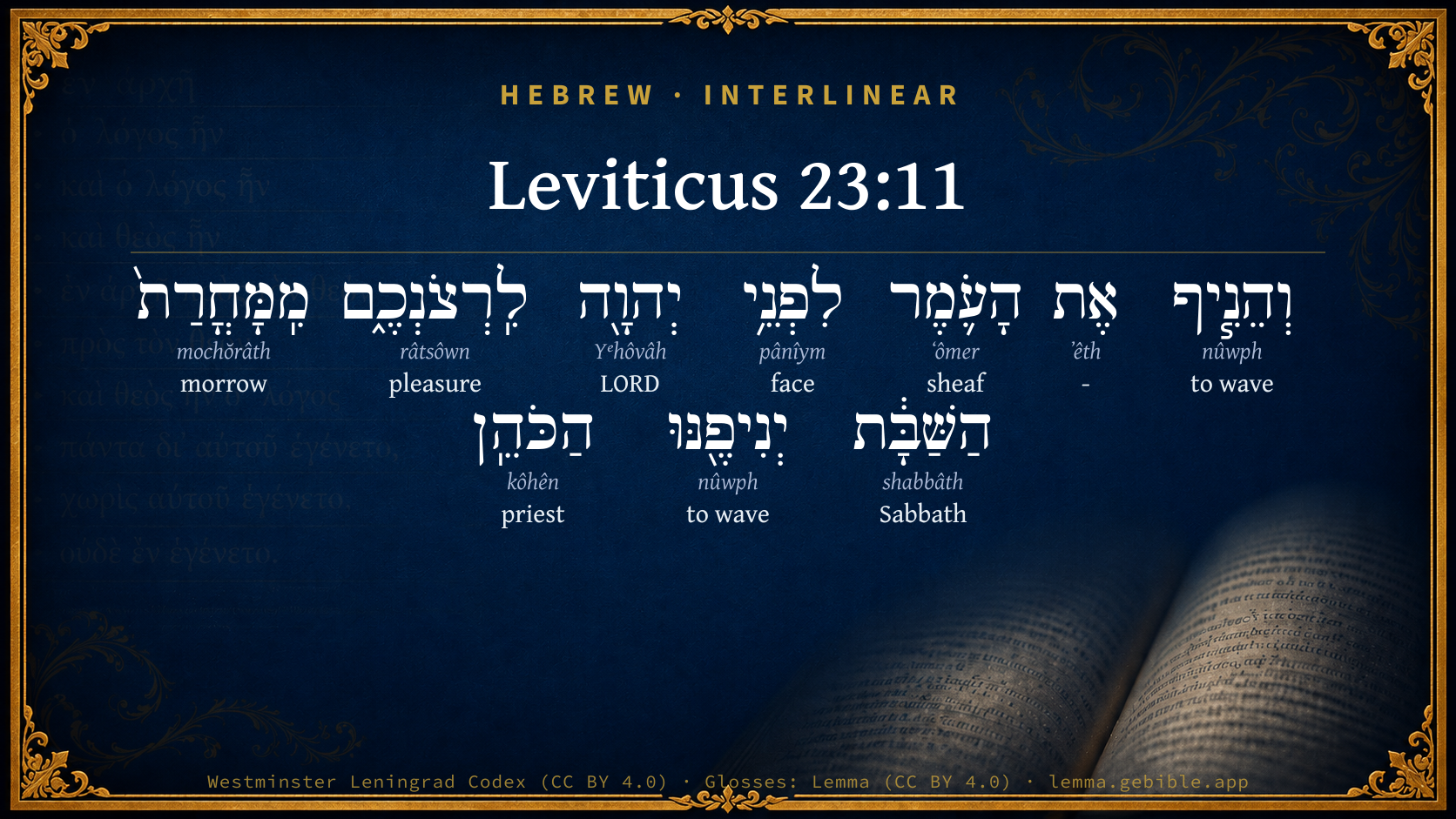
Hebrew (Westminster Leningrad Codex) Leviticus 23:11 appears in the Hebrew Old Testament. The text above is from the Westminster Leningrad Codex. Each word links to its Strong’s number, a concise gloss, and parsing drawn from the Open Scriptures Hebrew Bible morphology. Click any word for its full Brown-Driver-Briggs (BDB) entry.
Download image
Cite this verse

Leviticus 23:11 (World English Bible). Public Domain. Lemma interlinear Bible study tool, https://lemma.gebible.app/v/leviticus/23/11.

Show BibTeX & RIS
BibTeX
RIS
English Translation
and he shall wave the sheaf before Yahweh, to be accepted for you. On the next day after the Sabbath the priest shall wave it.
World English Bible · Public Domain
Download a study sheet

One document with this verse’s original text, its word-by-word gloss line, the meaning frame, cross-references with their text, attributed commentary, and full source and license credits — printable, and it pastes into notes with its structure intact.

This verse Autodidact and up

Study sheet (.html) Plain text (.txt)

A passage Seminary Student

Up to 50 verses in one chapter. A passage sheet keeps up to 6 commentary sources and 12 cross-references per verse, in the order this page ranks them, and says so on the sheet whenever that leaves anything out. Ask for a single verse and you get the Autodidact verse sheet above.

Everything on this page stays free to read, with no account — the sheet is a download of what is already on screen, not access to it.

Want to remove ads? Support Godless Engineer
Compare translations 3

The same verse in 3 English versions, stacked beneath the original-language interlinear above. Click any original word for its lexicon entry.

Each is an independent rendering of the whole verse — the interlinear is not word-aligned to these translations.

Highlighted words mark where these versions differ — a whole-verse word diff, not a word-by-word alignment.

  • World English Bible Public Domain
    and he shall wave the sheaf before Yahweh, to be accepted for you. On the next day after the Sabbath the priest shall wave it.
  • King James Version Public Domain
    And he shall wave the sheaf before the LORD, to be accepted for you: on the morrow after the sabbath the priest shall wave it.
  • unfoldingWord Literal Text CC BY-SA 4.0
    And he shall wave the sheaf to the face of Yahweh for your acceptance. On the day after the Sabbath the priest shall wave it.

unfoldingWord Literal Text — © unfoldingWord, licensed CC BY-SA 4.0. Word-aligned USFM3 via Door43 (git.door43.org/unfoldingWord/en_ult).

Versions to compare (up to 4)

3 of 4 selected

Show all 18 translations

Every available English version of this verse, each an independent rendering of the whole verse.

  • World English Bible Public Domain
    and he shall wave the sheaf before Yahweh, to be accepted for you. On the next day after the Sabbath the priest shall wave it.
  • Berean Standard Bible Public Domain
    And he shall wave the sheaf before the LORD so that it may be accepted on your behalf; the priest is to wave it on the day after the Sabbath.
  • Majority Standard Bible Public Domain
    And he shall wave the sheaf before the LORD so that it may be accepted on your behalf; the priest is to wave it on the day after the Sabbath.
  • King James Version Public Domain
    And he shall wave the sheaf before the LORD, to be accepted for you: on the morrow after the sabbath the priest shall wave it.
  • American Standard Version (1901) Public Domain
    and he shall wave the sheaf before Jehovah, to be accepted for you: on the morrow after the sabbath the priest shall wave it.
  • Revised Version (1885) Public Domain
    and he shall wave the sheaf before the LORD, to be accepted for you: on the morrow after the sabbath the priest shall wave it.
  • Geneva Bible (1599) Public Domain
    And hee shall shake the sheafe before the Lord, that it may be acceptable for you: the morowe after the Sabbath, the Priest shall shake it.
  • Douay-Rheims (1899) Public Domain
    Who shall lift up the shed before the Lord, the next day after the sabbath, that it may be acceptable for you, and shall sanctify it.
  • Young's Literal Translation Public Domain
    then he hath waved the sheaf before Jehovah for your acceptance; on the morrow of the sabbath doth the priest wave it.
  • Literal Standard Version CC BY-SA 4.0
    then he has waved the sheaf before YHWH for your acceptance; on the next day of the Sabbath the priest waves it.
  • Unlocked Literal Bible CC BY-SA 4.0
    He will raise the bundle of grain before Yahweh and present it to him, for it to be accepted on your behalf. It is on the day after the Sabbath that the priest will raise it and present it to me.
  • unfoldingWord Literal Text CC BY-SA 4.0
    And he shall wave the sheaf to the face of Yahweh for your acceptance. On the day after the Sabbath the priest shall wave it.
  • Darby Bible Public Domain
    And he shall wave the sheaf before Jehovah, to be accepted for you; on the next day after the sabbath the priest shall wave it.
  • World Messianic Bible Public Domain
    He shall wave the sheaf before the LORD, to be accepted for you. On the next day after the Sabbath the priest shall wave it.
  • Webster's Bible Public Domain
    And he shall wave the sheaf before the LORD, to be accepted for you: on the morrow after the sabbath the priest shall wave it.
  • Free Bible Version CC BY-SA 4.0
    He will wave the stack of grain before the Lord so that it may be accepted on your behalf. The priest is to do this the day following the Sabbath.
  • Bible in Basic English Public Domain
    And let the grain be waved before the Lord, so that you may be pleasing to him; on the day after the Sabbath let it be waved by the priest.
  • JPS Tanakh (1917) Public Domain
    And he shall wave the sheaf before the LORD, to be accepted for you; on the morrow after the sabbath the priest shall wave it.

Literal Standard Version (2020), Covenant Press — licensed CC BY-SA 4.0. Text via the HelloAO Bible API (eBible.org). Unlocked Literal Bible (unfoldingWord) — licensed CC BY-SA 4.0. Text via the HelloAO Bible API (eBible.org). unfoldingWord Literal Text — © unfoldingWord, licensed CC BY-SA 4.0. Word-aligned USFM3 via Door43 (git.door43.org/unfoldingWord/en_ult). Free Bible Version, Dr. Jonathan Gallagher — licensed CC BY-SA 4.0. Text via the HelloAO Bible API (eBible.org).

Word by word

More ways to search: Search by grammar → Find every occurrence → Compare this word →

Practice this passage: Drill this verse → Learn its vocabulary →

הָעֹ֛מֶר
ʻômer
H6016
“the · sheaf”
Particle, Definite Article + Noun, Common, Masculine, Singular, Absolute
Part of Speech
Particle + Noun
Type
Common
Gender
Masculine
Number
Singular
State
Absolute
Full BDB Definition

Origin: from H6014

TWOT: 1645b , 1645a

omer - a dry measure of 1/10 ephah (about 2 litres) - sheaf
  1. וְהֵנִ֧יף nûwph H5130 “and · to wave” Conjunction + Verb, Hiphil, Sequential Perfect, 3rd Person, Masculine, Singular
  2. אֶת ʼêth H853 “-” Particle, Direct Object
  3. לִפְנֵ֥י pânîym H6440 “to/for · face(s) of” Preposition + Noun, Common, Both, Plural, Construct
  4. יְהוָ֖ה Yᵉhôvâh H3068 “LORD” Noun, Proper
  5. לִֽרְצֹנְכֶ֑ם râtsôwn H7522 “to/for · pleasure · your” Preposition + Noun, Common, Masculine, Singular, Construct + Suffix, Personal, 2nd Person, Masculine, Plural
  6. מִֽמָּחֳרַת֙ mochŏrâth H4283 “from · morrow of” Preposition + Noun, Common, Feminine, Singular, Construct
  7. הַשַּׁבָּ֔ת shabbâth H7676 “the · Sabbath” Particle, Definite Article + Noun, Common, Both, Singular, Absolute
  8. יְנִיפֶ֖נּוּ nûwph H5130 “to wave · him” Verb, Hiphil, Imperfect, 3rd Person, Masculine, Singular + Suffix, Personal, 3rd Person, Masculine, Singular
  9. הַכֹּהֵֽן kôhên H3548 “the · priest” Particle, Definite Article + Noun, Common, Masculine, Singular, Absolute

About this verse

These counts appear in no published source. They are computed here, from the morphology-tagged text and Lemma’s own curated glosses. What Lemma adds →

10
words
9
distinct lemmas
Pentateuch
section

Notable vocabulary

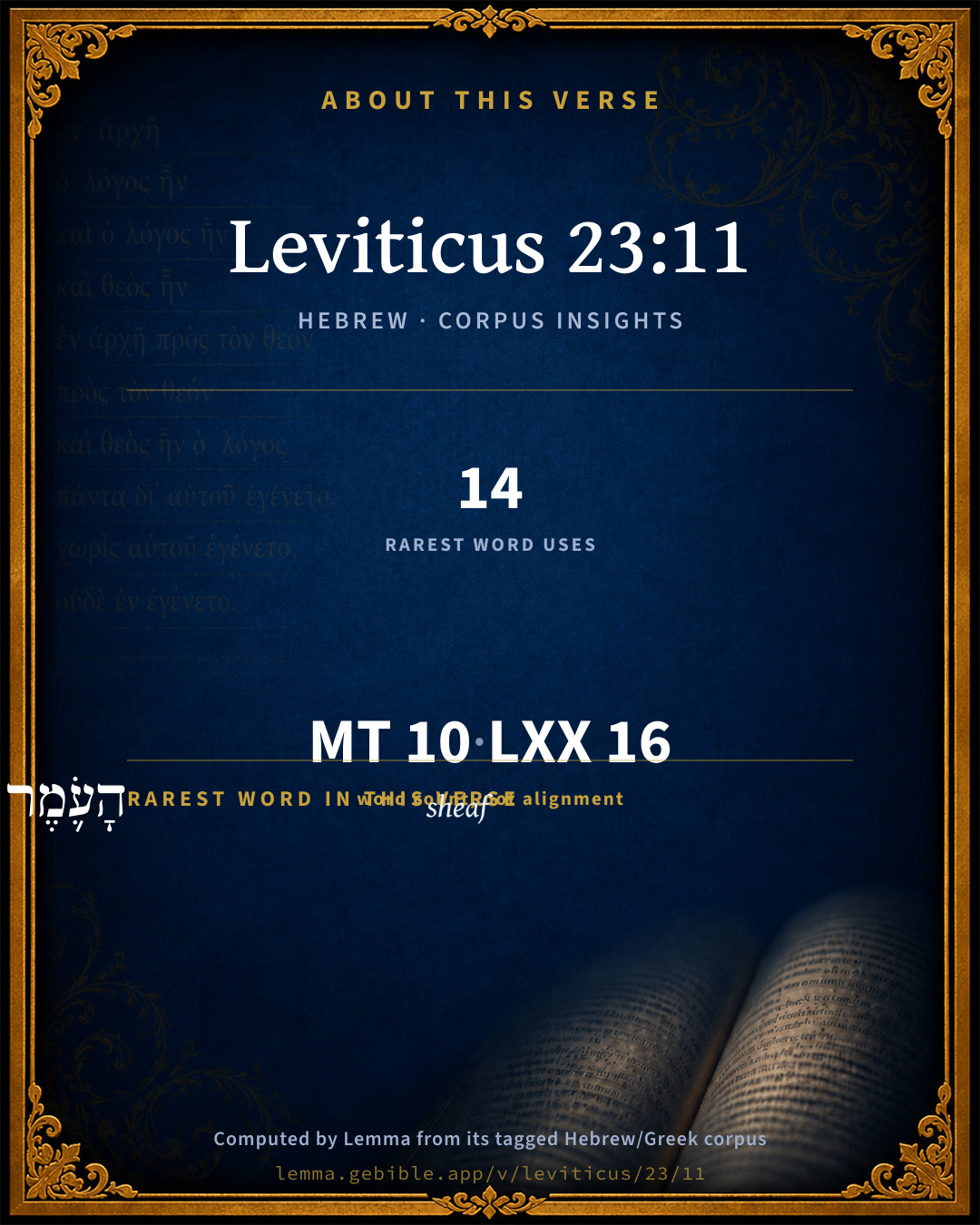
The rarest word here is הָעֹ֛מֶר sheaf H6016 — appearing just 14 times in the whole Hebrew Bible.

Shared distinctive vocabulary

הָעֹ֛מֶר sheaf H6016 occurs in 14 verses of the Hebrew Bible. Also found in:

Grammatical profile

  • 2 verbs
  • 7 nouns
  • 1 particle

Verb forms

  • וְהֵנִ֧יף Hiphil · Sequential Perfect
  • יְנִיפֶ֖נּוּ Hiphil · Imperfect

Repetition

A word recurs within this verse — often emphatic in Hebrew:

  • וְהֵנִ֧יף to wave H5130 ×2

Hebrew & Septuagint length

In English translation the verse runs 25 words from the Hebrew and 28 from the Septuagint (LXX English) — closely comparable.

A rough comparison of the two English renderings, which tokenize alike — not a word-level alignment.

Word counts can differ between the Hebrew and the Greek without any difference in meaning — e.g. the Hebrew direct-object marker אֵת has no separate Greek word, and Greek often adds the article ὁ.

In the original languages it is 10 Hebrew tokens and 16 Greek tokens — but the two are counted differently (Hebrew bundles its prefixes and suffixes into one token; the Greek is in lemma form), so that isn’t a like-for-like length.

Cross-references

3

Topical passages linked to Leviticus 23:11 in the Treasury of Scripture Knowledge — connected by theme and wording, ordered by reader-vote popularity; previews shown in the World English Bible.

  • Exodus 29:24 You shall put all of this in Aaron's hands, and in his sons' hands, and shall wave them for a wave-offering before Yahweh.
  • Leviticus 9:21 and the breasts and the right thigh Aaron waved for a wave offering before Yahweh, as Moses commanded.
  • Leviticus 10:14 The waved breast and the heaved thigh you shall eat in a clean place, you, and your sons, and your daughters with you: for they are given as your portion, and your sons' portion, out of the sacrifices of the peace offerings of the children of Israel.

Cross-references courtesy of OpenBible.info (CC BY 4.0).

Hebrew and Greek witnesses Masoretic Hebrew ↔ Greek Septuagint

The same verse in the two great witnesses to the Old Testament, shown verse-for-verse.

These are two independent witnesses, not word-aligned to each other, and the Septuagint is shown in lemma (dictionary) form.

Hebrew Leviticus 23:11 Masoretic · Westminster Leningrad Codex

וְהֵנִ֧יף אֶת הָעֹ֛מֶר לִפְנֵ֥י יְהוָ֖ה לִֽרְצֹנְכֶ֑ם מִֽמָּחֳרַת֙ הַשַּׁבָּ֔ת יְנִיפֶ֖נּוּ הַכֹּהֵֽן

and he shall wave the sheaf before Yahweh, to be accepted for you. On the next day after the Sabbath the priest shall wave it.

World English Bible · Public Domain

Greek LXX Leviticus 23:11 Septuagint · lemma form

καί ἀναφέρω ὁ δράγμα ἔναντι κύριος δεκτός σύ ὁ ἐπαύριον ὁ πρῶτος ἀναφέρω αὐτός ὁ ἱερεύς

and he shall lift up the sheaf before the Lord, to be accepted for you. On the morrow of the first day the priest shall lift it up.

LXX2012 (modern English Septuagint) · Public Domain

Hebrew: Westminster Leningrad Codex (CC BY 4.0). Greek: Septuagint (public domain); English from LXX2012 (modern English Septuagint) (Public Domain). How the Septuagint differs from the Hebrew →

Targum (Aramaic paraphrase)

2

The Targum is the ancient Jewish Aramaic paraphrase of the Hebrew Scriptures — an interpretive translation, not the Hebrew text itself. Onkelos (literal) and Pseudo-Jonathan (expansive) render the Torah, and Jonathan the Prophets. Coverage is partial: where no permissively-licensed English translation exists for a verse, only the Aramaic is shown. This is verse-level text, not a word-by-word alignment to the Hebrew.

  1. Targum Onkelos Torah (Genesis–Deuteronomy)
    וִירִים יָת עוּמְרָא קֳדָם יְיָ לְרַעֲוָא לְכוֹן מִבָּתַר יוֹמָא טָבָא יְרִימִנֵהּ כַּהֲנָא

    (no public-domain English translation for this verse)

    Targum Onkelos — Aramaic: “Onkelos Genesis” (public domain); “Onkelos Exodus” (public domain); “Onkelos Leviticus” (public domain); “Onkelos Numbers” (public domain); “Onkelos Deuteronomy” (public domain). English: “Sefaria Community Translation” (CC0 1.0 (public-domain dedication)); “J.W. Etheridge. The Targums of Onkelos and Jonathan Ben Uzziel on the Pentateuch. London: Longmans, Green, 1862” (public domain). Text via Sefaria.

  2. Targum Pseudo-Jonathan Torah (Genesis–Deuteronomy)
    וִירֵים יַת עוּמְרָא קֳדָם יְיָ לְרַעֲוָא לְכוֹן מִבָּתַר יוֹמָא טָבָא קַמָאָה דְפִסְחָא יְרִימְנֵיהּ כַּהֲנָא

    and he shall uplift the sheaf before the Lord to be accepted for you. After the first festal day of Pascha (or, the day after the feast-day of Pascha)

    Targum Pseudo-Jonathan — Aramaic: “Targum Jonathan on Genesis” (public domain); “Targum Jonathan on Exodus” (public domain); “Targum Jonathan on Leviticus” (public domain); “Targum Jonathan on Numbers” (public domain); “Targum Jonathan on Deuteronomy” (public domain). English: “The Targum of Jonathan ben Uzziel, trans. J. W. Etheridge, London, 1862” (public domain). Text via Sefaria.

Commentary

Notes on Leviticus 23:11 from classic Christian and Jewish commentators (each source and its license shown beneath its notes). The classic Christian expositions comment on the surrounding passage and are grouped to its opening verse, so a note may address several verses; the Jewish commentaries on the Tanakh (Rashi and others) are per-verse, so they appear only where the commentator wrote on this verse.

Lemma curates 59 commentaries, every one of them public domain or Creative Commons licensed, each selected and text-cleaned for this edition rather than reprinted as found. About our sources →

Trapp's Complete Commentary

John Trapp

Lev 23:11 And he shall wave the sheaf before the LORD, to be accepted for you: on the morrow after the sabbath the priest shall wave it.

Ver. 11. And he shall wave the sheaf.] This signified that they and theirs were accepted of God through Christ.

On the morrow after the Sabbath.] Here the Lord’s day was prefigured, saith one, therefore prescribed, and instituted of God. This shake day sheaf was a pregnant type of Christ’s rising again, the firstfruits from the dead. It was fulfilled in Christ’s resurrection, the day after the Sabbath. And because this Sabbath was chiefly meant of the Passover (which was a high Sabbath) it was a double Sabbath wherein Christ rested in the grave. The very next morning was Christ waved before the Lord, when, in the earthquake, he rose from the dead "the firstfruits of them that sleep," and there hence entered the everlasting gates as a King of glory, {Psa 24:7} which psalm is in the Greek called A psalm of David of the first day of the week.

John Trapp, A Commentary or Exposition upon All the Books of the Old and New Testament (1647–1656) — public domain. Text from a community e-Sword module.

Joseph Benson's Commentary

Lev 23:11. He shall wave the sheaf — Or omer, rather. In the name of the whole congregation, it was lifted up toward heaven, as an acknowledgment to God for his goodness, and with prayer for his blessing upon all their ensuing harvest, which it, as it were, sanctified to them, and of which it gave them a comfortable use. For then we may eat our bread with joy, when God hath accepted our works. And thus should we always begin with God; begin our lives with him, begin every day with him, begin every work and business with him: Seek ye first the kingdom of God — Reader, dost thou do this? The morrow after the sabbath — After the first day of the feast of unleavened bread, which was a sabbath, or day of rest, as appears from Lev 23:7; or upon the sixteenth day of the month. And this was the first of those fifty days, in the close whereof was the feast of pentecost.

Joseph Benson's Commentary on the Old and New Testaments (1811–1818) — public domain. Text from a community e-Sword module.

Tyndale Open Study Notes

Tyndale Open Resources

23:11 The phrase lift it up symbolizes presenting the grain to the Lord (see study note on 7:34).

Tyndale Open Study Notes — © Tyndale Open Resources, licensed CC BY-SA 4.0. Text via the HelloAO Bible API.

Geneva Bible (1599)

Geneva Bible translators

That is, the second Sabbath of the Passover.

Geneva Bible (1599) marginal notes — public domain. Text via Bolls.life.

Adam Clarke's Commentary

Verse 11. He shalt wave the sheaf] He shall move it to and fro before the people, and thereby call their attention to the work of Divine Providence, and excite their gratitude to God for preserving to them the kindly fruits of the earth. See Clarke on Ex 29:27, and "Le 7:38" at end.

Adam Clarke's Commentary on the Bible (1810–1826) — public domain. Text from a community e-Sword/MySword module.

Ellicott's Commentary for English Readers

(11) And he shall wave the sheaf.—Better, and he shall wave the omer. The priest mixed with the omer of meal a log of oil, put on a handful of frankincense (see Lev_2:15), as on other meat-offerings, waved it, took a handful of it and caused it to ascend in smoke (see Lev_2:16), and then consumed the residue in company with his fellow-priests. Immediately after this ceremony, bread, parched corn, green ears, &c, of the new crop were exposed for sale in the streets of Jerusalem, as, prior to the offering of the omer, no use whatever was allowed to be made of the new corn.

On the morrow after the sabbath.—The interpretation of this phrase also constituted one of the differences between the Pharisees and the Sadducees during the second Temple. According to the Pharisees, the term sabbath here, as elsewhere (see Lev_23:24; Lev_23:32; Lev_23:39), is not the weekly sabbath, but the next day, or the first day of the holy convocation, the first day of Passover, on which the Israelites had to abstain from all unnecessary work. It is the 16th of Nisan. The Sadducees, however, maintained that it is to be understood in its literal sense as denoting the weekly sab-bath in the Passover week, which might happen to fall within the seven days, and possibly the fifth or sixth day of the festival. But this is against the import of Lev_23:15. Here the feast of Pentecost is to be reckoned from this sabbath, and if this sabbath might either be on the second or sixth day of the Passover, not only would the feast of Pentecost have no definite day, but the Passover itself would, in the course of time, be displaced from the fundamental position which it occupies in the order of the annual festivals. Hence the Pharisees, rightly regarding the word sabbath here as an alternative term for the day of holy convocation, took the morrow after the sabbath to denote Nisan 16. On the afternoon of this day, therefore, the inhabitants of the neighbouring towns of Jerusalem assembled together “so that the reaping might take place amidst great tumult.” As soon as it became dark, each of the reapers asked, “Has the sun gone down?” To which the people replied, “Yes.” They asked twice again, “Has the sun gone down?” to which the people each time replied, “Yes.” Each reaper then asked three times, “Is this the scythe? “to which the people each time replied “Yes.” “Is this the box?” they next asked three times. “Yes,” was again thrice the reply of the people. “Is this the Sabbath?” the reaper asked three times; and three times the people replied, “Yes.” “Shall I cut?” he asked three times; and three times the people replied, “Yes.” When cut it was laid in boxes, brought into the court of the Temple, threshed with canes and sticks, that the grains might not be crushed, and laid in a roast with holes, so that the fire might touch each grain. Thereupon it was spread in the court of the sanctuary for the wind to pass over it, and ground in a barley mill which left the hulls unground. The flour thus obtained was sifted through thirteen different sieves, each one finer than its predecessor. In this manner was the prescribed omer or tenth part got from the seah.

A Bible Commentary for English Readers, edited by Charles John Ellicott (1878–1897) — public domain. Text from a community e-Sword module.

The Cambridge Bible for Schools and Colleges

gen. ed. J. J. S. Perowne

11. The ritual here set forth has no parallel elsewhere in the Pentateuch. Deu_26:2 prescribes that ‘the first of all the fruit of the ground’ shall be offered, but gives no direction as to any particular day. In Deu_16:9-10 the nature of the offering is left undetermined, and the date is seven weeks ‘from the time thou beginnest to put the sickle to the standing corn.’

shall wave] See Appendix IV, pp. 183 ff.

the morrow after the sabbath] For this vague expression see introd. note to ch. Driver (LO T.9 p. 55 note) says that it is understood traditionally of the 1st day of Maẓẓoth (unleavened bread); but this is an unusual sense of ‘sabbath.’ He considers it probable that in its original connexion the ‘sabbath’ meant here was the ordinary weekly sabbath which fell during the seven days of Maẓẓoth.

The Cambridge Bible for Schools and Colleges (gen. ed. J. J. S. Perowne; Cambridge University Press, 1878–1918) — public domain. Text from a community e-Sword module.

John Gill's Exposition

And he shall wave the sheaf before the Lord,.... Or the omer of barley; this was done by the priest in the tabernacle and temple, where was the presence of God, and that before the handful of it was put upon the altar; which agitation or waving was, as Gersom says, towards the cast; it was moved to and fro, backwards and forwards, upwards and downwards, to make an acknowledgment to the Lord of heaven and earth, that the fruits of the earth and the plentiful harvest were of him, and to give him the praise and glory of it:

to be accepted for you; of the Lord, as a thanksgiving to him, for the harvest now ripe, and the appointed time of it, and the plenty thereof; and that the remainder might be sanctified and blessed to them, and they have leave to gather it in, which they had not till this was done:

on the morrow after the sabbath the priest shall wave it; not after the seventh day, but after the first day of the feast of unleavened bread, which was a sabbath, in which no servile work was to be done, Lev 23:7; and so the Targum of Jonathan calls it the day after the first good day of the passover, which was the sixteenth of Nisan, as Josephus expressly says, in the place above referred to; and so it is generally understood by Jewish writers (m) the account given of this affair is this; the messengers of the sanhedrim went out (from Jerusalem over the brook Kidron to the fields near it) on the evening of the feast, (i.e. at the going out of the fifteenth) and at the beginning of the sixteenth of Nisan, and bound the standing corn in bundles, that so it might be the more easily reaped; and all the neighbouring cities gathered together there, that it might be reaped in great pomp; and when it was dark, one said to them, is the sun set? they said, yes. With this sickle (shall I reap?) they said, yes. In this basket (shall I put it?) they said, yes. If on a sabbath day, he said to them, On this sabbath day (shall I do it?) they said, yes (n). These questions were put and answered three times; then they reaped it and put it into the baskets, and brought it to the court, where they parched it before the fire, to fulfil the commandment of parched corn; then they put it in mills for grinding beans, and took out of it a tenth part (of an ephah), which was sifted with eighteen sieves; then oil and frankincense were poured upon it, being mixed; and it was waved, and brought, and a handful taken and burnt, and the rest was eaten by the priests; and when they had offered the omer, they went out and found the streets of Jerusalem full of meal and parched corn (o), there being now full liberty to reap what they would: now this sheaf of the firstfruits was typical of Christ; it being of barley, may denote the mean estate of Christ in his humiliation; and but one sheaf for all the people, may signify that Christ is the one Mediator, Saviour, and Redeemer: yet as a sheaf comprehends many stalks and grains, so Christ has a complication of blessings in him; yea, he had all his people representatively in him, when he was offered for the whole body of his mystical Israel, all the children of God scattered abroad; the manner of reaping it, by persons deputed by the sanhedrim on the eve of a festival of the passover, in the sight of much people, without Jerusalem, near Kidron, exactly agrees with the apprehending of Christ in the night near Kidron, by persons sent from the Jewish sanhedrim, and his suffering publicly without the gates of Jerusalem; it being brought to the priests in the court, and threshed, winnowed, dried, and parched by the fire, and ground in mills, may denote the various dolorous sufferings of Christ, by means of the priests and elders of the people; and oil and frankincense being put on it, may denote the acceptableness of his sacrifice to God; and the waving of it, his resurrection from the dead, which was on the very day this sheaf was waved; who is the firstfruits of them that sleep in him, and which sanctifies the whole body of them, and ensures their resurrection unto eternal life; see Co1 15:20.

(m) Jarchi & Ben Gersom in loc. Jarchi in Misn. Succah, c. 3. sect. 12. (n) Misn. Menachot, c. 10. sect. 3, 4. (o) Ib. sect. 4, 5.

John Gill's Exposition of the Whole Bible (1746–1763) — public domain (CC PDM 1.0). Text via the HelloAO Bible API.

Haydock's Catholic Bible Commentary

Sabbath. Onkelos has "the good day," from which the fifty days of Pentecost were counted. (Calmet)

George Leo Haydock (1774–1849), Haydock's Catholic Family Bible and Commentary, 1859 edition — public domain. Excludes Psalms (Douay-Rheims chapter numbering differs from Protestant) and Deuterocanonical books (Catholic canon only).

Matthew Poole's English Annotations

To be accepted for you; that God may accept of you, and bless you in the rest of your harvest.

On the morrow after the sabbath, i.e. after the first day of the feast of unleavened bread, which was a sabbath, or day of rest, as appears from Lev 23:7, or upon the sixteenth day of the month. And this was the first of those fifty days, in the close whereof was the feast of pentecost, or Whitsuntide.

Matthew Poole's English Annotations on the Holy Bible (1683–1685) — public domain. Text from a community e-Sword/MySword module.

Whedon's Commentary on the Bible

Daniel D. Whedon

11. The morrow after the sabbath — After the first day of holy convocation. Hence the waving of the sheaf, according to Josephus, was on the sixteenth of Nisan.

Daniel D. Whedon (gen. ed.), Commentary on the Old and New Testaments (1874–1909) — public domain. Text from a community e-Sword module.

John Wesley's Explanatory Notes

He shall wave the sheaf before the Lord - In the name of the whole congregation, which as it were sanctified to them the whole harvest, and gave them a comfortable use of all the rest. For then we may eat our bread with joy, when God hath accepted our works. And thus should we always begin with God; begin our lives with him, begin every day with him, begin every work and business with him: seek ye first the kingdom of God. The morrow after the sabbath - After the first day of the feast of unleavened bread, which was a sabbath or day of rest, as appears from ver. 7, or upon the sixteenth day of the month. And this was the first of those fifty days, in the close whereof was the feast of pentecost.

John Wesley, Explanatory Notes Upon the Whole Bible (1754–1765) — public domain. Text via the GEBible commentary corpus.

Rashi

Rabbi Shlomo Yitzchaki (Rashi)

והניף AND HE SHALL WAVE [THE OMER] — Every form of the root נוף used in connection with sacrifices signifies that one moves the latter about both horizontally (מוליך ומביא) and upwards and downwards (מעלה ומוריד); he moves it about horizontally to prevent (i. e. the act was symbolical of preventing) destructive winds, he moves it about upwards and downwards to keep away injurious dews (cf. Rashi on Exodus 29:24) (Menachot 62a).

לרצנכם TO BE ACCEPTED FOR YOU — If you offer it according to this precept it shall effect favourable acceptance for you.

ממחרת השבת ON THE MORROW AFTER THE DAY OF REST [THE PRIEST SHALL WAVE IT] — This must mean on the morrow of the first day of the Passover festival (on the 16th of Nisan); for if you say that it means on the morrow of the weekly Sabbath (i. e. on a Sunday) you do not know which particular Sabbath Scripture is referring to (Menachot 66a).

Rashi on the Tanakh — English translations: “The Judaica Press complete Tanach with Rashi, translated by A. J. Rosenberg” (CC BY 4.0); “Pentateuch with Rashi's commentary by M. Rosenbaum and A.M. Silbermann, 1929-1934” (public domain); “The Metsudah Tanach series, Lakewood, N.J” (CC BY 4.0); and “The Book of Joshua, Metsudah Publications, 1997” (CC BY 4.0). Text via Sefaria.

Ramban (Nachmanides)

Rabbi Moshe ben Nachman (Ramban / Nachmanides)

ON THE MORROW AFTER ‘HA’SHABBATH’ THE PRIEST SHALL WAVE IT. “That is, the morrow after the first day of the Festival of Passover. For if you are to say it means [on the morrow of] the Sabbath of Creation [i.e., the weekly Sabbath], you have no indication which Sabbath is meant.” This is Rashi’s language. And indeed, this is the greatest of the proofs mentioned in the Gemara [to show that ha’shabbath here is not to be interpreted literally as meaning the weekly Sabbath, but refers to the first day of Passover]; for what sense is there for Scripture to state that “when ye are to come into the Land … and shall reap the harvest thereof ye shall bring the sheaf on the morrow of the weekly Sabbath,” which would mean that at any time of the year when we come into the Land and reap its harvest, the priest shall wave the sheaf on the morrow of the first Sabbath after we have come into the Land! In that case the Festival of Weeks would have no [definite] starting point from which we are to count [the forty-nine days, so that on the fiftieth day we should celebrate that festival]! Moreover, according to this way we would not know even in the years following [our entrance into the Land] when we are to begin counting [the forty-nine days], but only from the day that we first put the sickle to the standing grain at our will. But these are meaningless words! If, however, the expression on the morrow after ‘ha’shabbath’ means “on the morrow after [the first day of] the festival,” in accordance with the tradition of our Rabbis, then the matter appears correctly. For at first Scripture commanded that we should observe in the first month the Festival of Unleavened Bread for seven days, and that on the first day there should be a solemn rest and on the seventh day a solemn rest, and we are not to do thereon any manner of servile work. Afterwards He stated that when we come into the Land we are to bring on the morrow of this rest-day [previously] mentioned, the sheaf of the waving, this being the first rest-day here mentioned. And He also taught that the [bringing of the] sheaf was not obligatory in the desert, nor outside the Land [since the section begins, When ye are come into the Land …]. However, the expressions, even unto the morrow after ‘ha’shabbath’ the seventh and seven ‘shabbathoth’ cannot possibly be interpreted as referring to a festival [as does the expression on the morrow after ‘ha’shabbath’ here in Verse 11 and also further in Verse 15.] Onkelos, however, rendered them as meaning “week”, but if so, there are two different usages of the same word in one verse!. According to Onkelos the first ha’shabbath means “the festival,” while the second shabbathoth means “weeks.” And the commentators have written that this is a literary expression [Scripture using one term in the same instance with two different meanings], such as: they rode on thirty ‘a’yarim’ (ass colts) and they had thirty ‘a’yarim’ (cities). And in another place Scripture clearly states, Seven weeks shalt thou number. Similarly, those that were to come in on ‘ha’shabbath,’ with those that were to go out on ‘ha’shabbath,’ [where both ha’shabbath mean] “week.” Likewise, Saying: ‘When will the New Moon be gone, that we may sell grain, ‘v’ha’shabbath,’ that we may set forth corn?’ [also means “and the week”], for since every seven days contain one Sabbath, and the enumeration of the days is with reference to it [the Sabbath], therefore one week is called “one shabbath”, this usage being well-known and common in the words of our Rabbis, such as: “for twice b’shabbath (in the week) the court sits in towns [on Mondays and on Thursdays].” It is possible that every shabbath mentioned [here] in the section means “week.” And the meaning of the expression on the morrow after ‘ha’shabbath’ is that on the day of the waving of the sheaf they should begin counting the week, and if so, that day will be “on the morrow after the week” which has passed, it being as if He had said: “The day of the waving of the sheaf shall be on the morrow after the week with relation to the days that have passed by, and the first with reference to the weeks which he is to count until he finishes seven weeks.” And since He mentioned the expression, and on the fifteenth day, He thus states that [the priest] should wave the sheaf on the morrow after the week mentioned, and count therefrom seven weeks. One cannot mistake the expression [ha’shabbath] as referring to the fourteenth day [of Nisan, thus making the offering of the omer, brought on the morrow, to be on the fifteenth day of Nisan, the first day of Passover], for of that fourteenth day He has said that only at dusk [is the Eternal’s Passover]. of the festival is the next day, i.e., the fifteenth. Hence on the morrow after ‘ha’shabbath’ must refer to the expression and on the fifteenth day etc. (in Verse 6), thus establishing that it is on the sixteenth day of Nisan that we are to begin a new week — the first of the seven complete weeks. And the meaning of they shall be complete is that a Sabbath together with its six days is called “a whole” Sabbath. And the meaning of the expression mimachorath ha’shabbath [literally: “from the morrow of the shabbath”] is like b’machorath ha’shabbath (“on the morrow of the shabbath”). Similarly, Even unto ‘mimachorath ha’shabbath’ the seventh, shall ye number [fifty days] the morrow after the seventh week …” This cannot be understood literally, for it would mean that the festival day of Shevuoth is to be observed on the day “from the morrow after the seventh week, i.e., on the following day after the morrow of the seven weeks.” Instead, it must mean: “Even unto on the morrow …” [is like b’machorath ha’shabbath (“on the morrow of the shabbath”)] So also: It shall be eaten the same day ye offer it u’mimachorath [literally: “and from the morrow,” means u’b'machorath — “and on the morrow]. Scholars have said that the letter beth cannot occur as a prefix in the word machar (tomorrow) or machorath (the morrow). [Therefore it states], And it came to pass ‘mimachorath’ [literally: “from the morrow”] that Moses sat to judge the people [which means “on the morrow”]. And the Eternal did that thing ‘mimachorath’, 9:6. [literally: “from the morrow,” which means “on the morrow”], and similarly all such expressions.

Ramban (Nachmanides) on the Tanakh — English translation: “Commentary on the Torah by Ramban (Nachmanides). Translated and annotated by Charles B. Chavel. New York, Shilo Pub. House, 1971-1976” (CC BY 4.0). Text via Sefaria.

Lesson kit

Teaching starters — assembled from the data on this page, not authored interpretation. Every prompt links to the verse data it draws on. Edit before teaching.

Leviticus, in the Pentateuch, opens this verse with 10 words (9 distinct Hebrew lemmas). Its most distinctive word is ʻômer (“sheaf”). A historical commentator’s framing appears above. Read the whole chapter for the surrounding context.

Discussion questions

  1. What does “sheaf” (ʻômer) contribute to the verse as a whole?
  2. How does Exodus 16:16, which shares the word «sheaf», read alongside this verse?
  3. What does the repetition of “to wave” (2× in this one verse) do in this verse?
  4. These translations render this verse differently. What is at stake in choosing one wording over another?
  5. «וְהֵנִ֧יף» is a Hiphil Sequential Perfect verb. How does that grammatical form shape the action described?
  6. Compare how Trapp's Complete Commentary and Joseph Benson's Commentary read this verse. Where do they agree or differ?

Things to notice

Reading settings

Reading text

Shown beneath each verse's original-language words.

Old Testament
Old Testament edition

Read the OT as the Masoretic Hebrew (MT) or the Greek Septuagint (LXX).

English shown for the Greek Septuagint (in the Hebrew ↔ Greek comparison).

Comparing translations? Open the Compare panel on any verse page to stack up to four side by side.