Galatians 3:9

Greek (Tischendorf 8th ed.) Galatians 3:9 appears in the Greek New Testament. The text above is from the Tischendorf 8th edition. Each word links to its Strong’s number and a concise gloss. Click any word for its full Thayer’s Greek Lexicon entry.
Download image
Cite this verse

Galatians 3:9 (World English Bible). Public Domain. Lemma interlinear Bible study tool, https://lemma.gebible.app/v/galatians/3/9.

Show BibTeX & RIS
BibTeX
RIS
English Translation
So then, those who are of faith are blessed with the faithful Abraham.
World English Bible · Public Domain
Download a study sheet

One document with this verse’s original text, its word-by-word gloss line, the meaning frame, cross-references with their text, attributed commentary, and full source and license credits — printable, and it pastes into notes with its structure intact.

This verse Autodidact and up

Study sheet (.html) Plain text (.txt)

A passage Seminary Student

Up to 50 verses in one chapter. A passage sheet keeps up to 6 commentary sources and 12 cross-references per verse, in the order this page ranks them, and says so on the sheet whenever that leaves anything out. Ask for a single verse and you get the Autodidact verse sheet above.

Everything on this page stays free to read, with no account — the sheet is a download of what is already on screen, not access to it.

Want to remove ads? Support Godless Engineer
Compare translations 3

The same verse in 3 English versions, stacked beneath the original-language interlinear above. Click any original word for its lexicon entry.

Each is an independent rendering of the whole verse — the interlinear is not word-aligned to these translations.

Highlighted words mark where these versions differ — a whole-verse word diff, not a word-by-word alignment.

  • World English Bible Public Domain
    So then, those who are of faith are blessed with the faithful Abraham.
  • King James Version Public Domain
    So then they which be of faith are blessed with faithful Abraham.
  • unfoldingWord Literal Text CC BY-SA 4.0
    So then, the ones by faith are blessed along with the believing Abraham.

unfoldingWord Literal Text — © unfoldingWord, licensed CC BY-SA 4.0. Word-aligned USFM3 via Door43 (git.door43.org/unfoldingWord/en_ult).

Versions to compare (up to 4)

3 of 4 selected

Show all 19 translations

Every available English version of this verse, each an independent rendering of the whole verse.

  • World English Bible Public Domain
    So then, those who are of faith are blessed with the faithful Abraham.
  • Berean Standard Bible Public Domain
    So those who have faith are blessed along with Abraham, the man of faith.
  • Majority Standard Bible Public Domain
    So those who have faith are blessed along with Abraham, the man of faith.
  • King James Version Public Domain
    So then they which be of faith are blessed with faithful Abraham.
  • American Standard Version (1901) Public Domain
    So then they that are of faith are blessed with the faithful Abraham.
  • Revised Version (1885) Public Domain
    So then they which be of faith are blessed with the faithful Abraham.
  • Geneva Bible (1599) Public Domain
    So then they which be of faith, are blessed with faithfull Abraham.
  • Douay-Rheims (1899) Public Domain
    Therefore they that are of faith, shall be blessed with faithful Abraham.
  • Young's Literal Translation Public Domain
    `Blessed in thee shall be all the nations;' so that those of faith are blessed with the faithful Abraham,
  • Literal Standard Version CC BY-SA 4.0
    “All the nations will be blessed in you”; so that those of faith are blessed with the believing Abraham,
  • Unlocked Literal Bible CC BY-SA 4.0
    So then, those of faith are blessed along with Abraham, the man of faith.
  • unfoldingWord Literal Text CC BY-SA 4.0
    So then, the ones by faith are blessed along with the believing Abraham.
  • Darby Bible Public Domain
    So that they who are on the principle of faith are blessed with believing Abraham.
  • World Messianic Bible Public Domain
    So then, those who are of faith are blessed with the faithful Abraham.
  • Webster's Bible Public Domain
    So then they who are of faith are blessed with faithful Abraham.
  • Free Bible Version CC BY-SA 4.0
    Consequently those who trust in God are blessed along with Abraham who trusted God.
  • Bible in Basic English Public Domain
    So then those who are of faith have a part in the blessing of Abraham who was full of faith.
  • Text-Critical English NT CC BY 4.0
    So then, those who have faith are blessed along with Abraham, the man of faith.
  • Tyndale New Testament (1534) Public Domain
    So then they which be of fayth are blessed with faythfull Abraham.

Literal Standard Version (2020), Covenant Press — licensed CC BY-SA 4.0. Text via the HelloAO Bible API (eBible.org). Unlocked Literal Bible (unfoldingWord) — licensed CC BY-SA 4.0. Text via the HelloAO Bible API (eBible.org). unfoldingWord Literal Text — © unfoldingWord, licensed CC BY-SA 4.0. Word-aligned USFM3 via Door43 (git.door43.org/unfoldingWord/en_ult). Free Bible Version, Dr. Jonathan Gallagher — licensed CC BY-SA 4.0. Text via the HelloAO Bible API (eBible.org).

Word by word

More ways to search: Search by grammar → Find every occurrence → Compare this word →

Practice this passage: Drill this verse → Learn its vocabulary →

εὐλογοῦνται
eulogéō
G2127
“to praise”
Verb, Present, Passive, Indicative, 3rd person, Plural
Part of Speech
Verb
Tense
Present
Voice
Passive
Mood
Indicative
Person
3rd person
Number
Plural
Full Thayer's Definition

Origin: from a compound of G2095 and G3056

TDNT: 14:34,3

1. to praise, celebrate with praises 2. to invoke blessings 3. to consecrate a thing with solemn prayers a. to ask God's blessing on a thing b. pray God to bless it to one's use c. pronounce a consecratory blessing on 4. of God a. to cause to prosper, to make happy, to bestow blessings on b. favoured of God, blessed
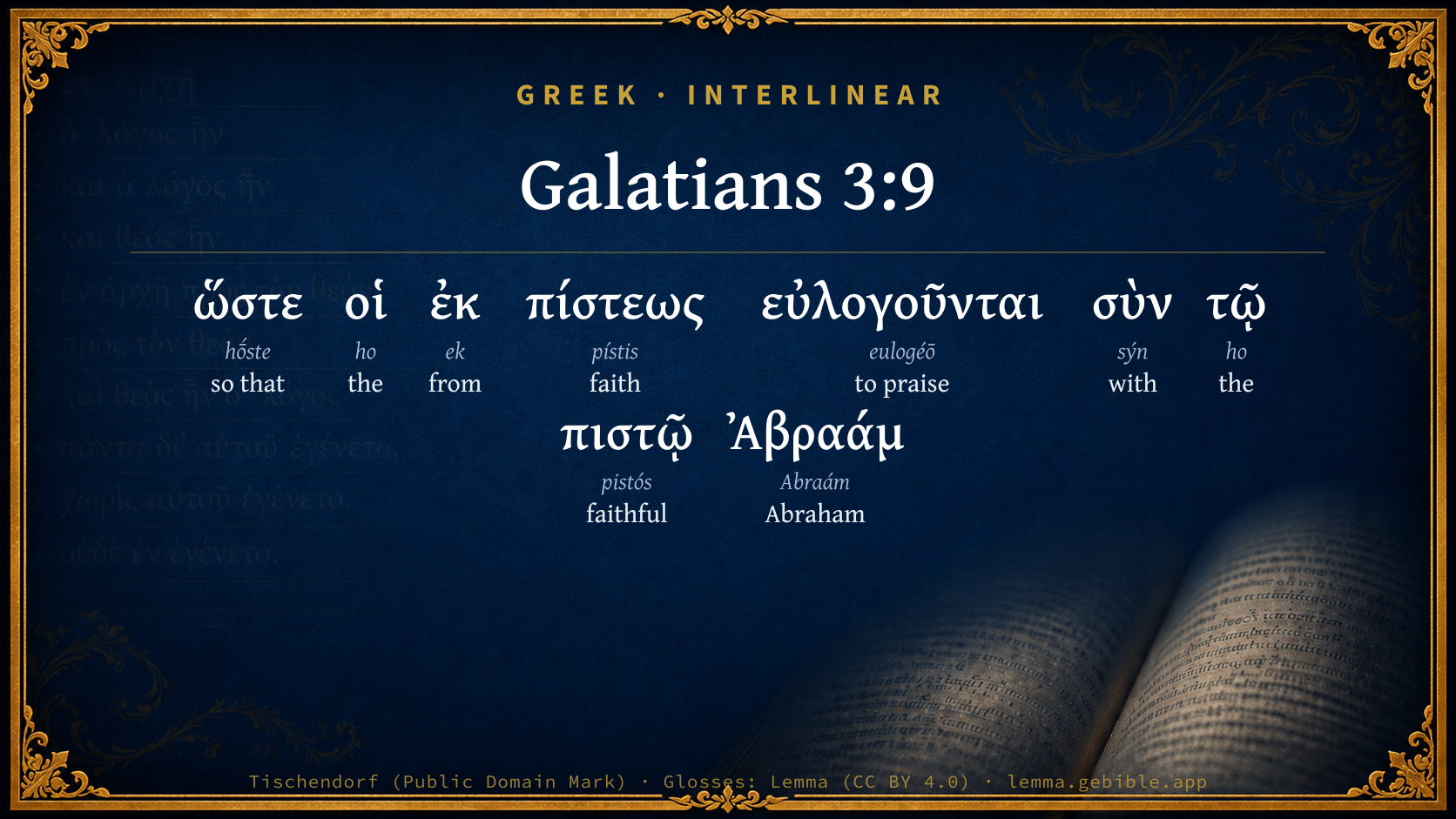
  1. ὥστε hṓste G5620 “so that” Conjunction
  2. οἱ ho G3588 “the” Article, Nominative, Plural, Masculine
  3. ἐκ ek G1537 “from” Preposition
  4. πίστεως pístis G4102 “faith” Noun, Genitive, Singular, Feminine
  5. σὺν sýn G4862 “with” Preposition
  6. τῷ ho G3588 “the” Article, Dative, Singular, Masculine
  7. πιστῷ pistós G4103 “faithful” Adjective, Dative, Singular, Masculine
  8. Ἀβραάμ Abraám G11 “Abraham” Noun, Proper, indeclinable

About this verse

These counts appear in no published source. They are computed here, from the morphology-tagged text and Lemma’s own curated glosses. What Lemma adds →

9
words
8
distinct lemmas
Pauline Epistles
section

Shared distinctive vocabulary

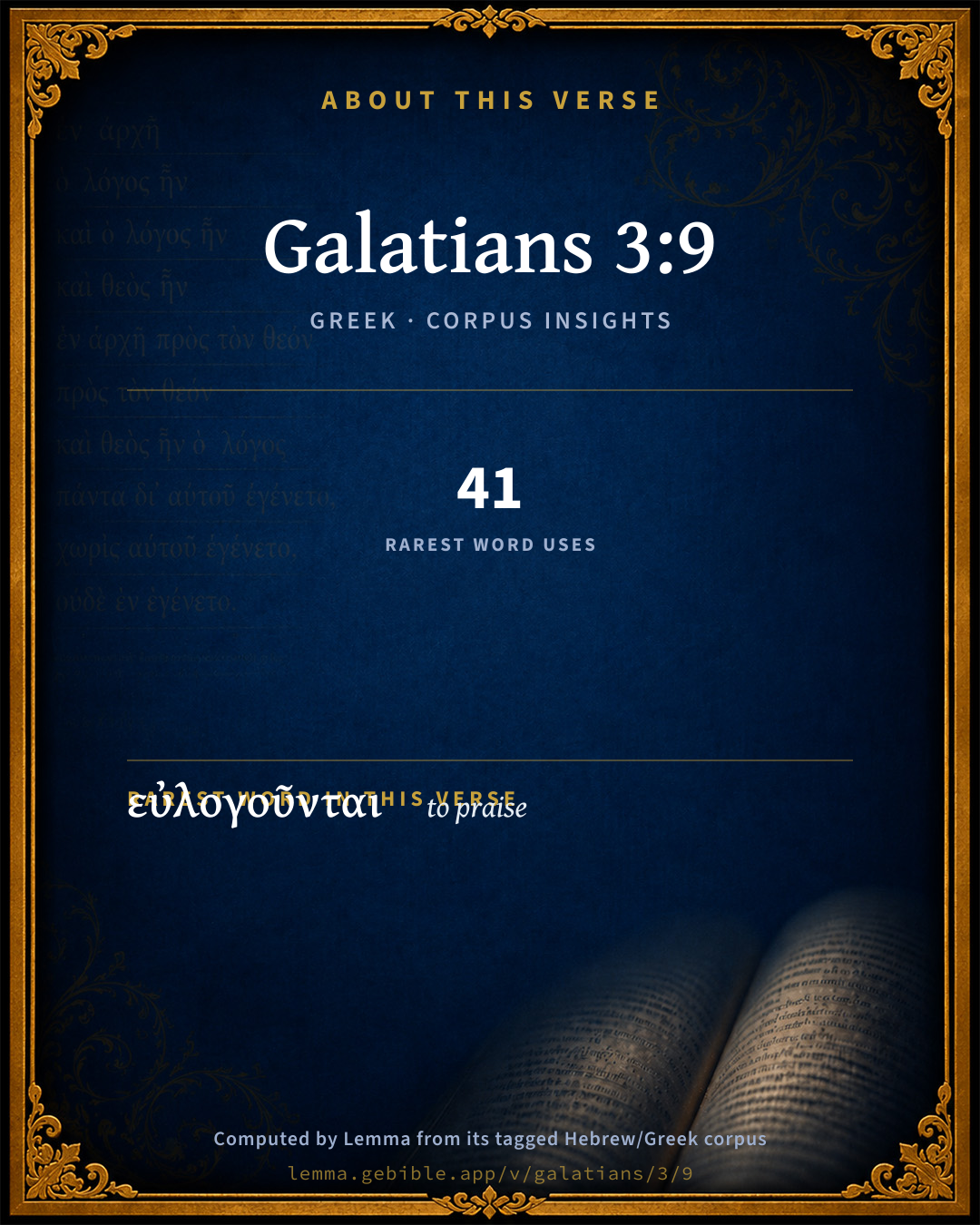
εὐλογοῦνται to praise G2127 occurs in 38 verses of the Greek New Testament. Also found in:

Repetition

A word recurs within this verse:

Cross-references

7

Topical passages linked to Galatians 3:9 in the Treasury of Scripture Knowledge — connected by theme and wording, ordered by reader-vote popularity; previews shown in the World English Bible.

  • Romans 4:16 For this cause it is of faith, that it may be according to grace, to the end that the promise may be sure to all the seed, not to that only which is of the law, but to that also which is of the faith of Abraham, who is the father of us all.
  • Galatians 3:29 If you are Christ's, then you are Abraham's seed and heirs according to promise.
  • Galatians 4:28 Now we, brothers, as Isaac was, are children of promise.
  • Romans 4:24 but for our sake also, to whom it will be accounted, who believe in him who raised Jesus, our Lord, from the dead,
  • Romans 4:11 He received the sign of circumcision, a seal of the righteousness of the faith which he had while he was in uncircumcision, that he might be the father of all those who believe, though they be in uncircumcision, that righteousness might also be accounted to them.
  • Galatians 3:14 that the blessing of Abraham might come on the Gentiles through Christ Jesus; that we might receive the promise of the Spirit through faith.
  • Galatians 3:7–8 Know therefore that those who are of faith, the same are children of Abraham.

Cross-references courtesy of OpenBible.info (CC BY 4.0).

Commentary

Notes on Galatians 3:9 from classic Christian and Jewish commentators (each source and its license shown beneath its notes). The classic Christian expositions comment on the surrounding passage and are grouped to its opening verse, so a note may address several verses; the Jewish commentaries on the Tanakh (Rashi and others) are per-verse, so they appear only where the commentator wrote on this verse.

Lemma curates 59 commentaries, every one of them public domain or Creative Commons licensed, each selected and text-cleaned for this edition rather than reprinted as found. About our sources →

The Biblical Illustrator

Joseph S. Exell

Gal_3:9

Are blessed with faithful Abraham.

Aspects of faith

I. Faith as a possessor--of faith.

1. Men are hardly believers in the fullest sense until they have been mastered and subjugated by their faith.

2. History, secular and sacred, is full of examples of men who have not only had faith, but have belonged to faith.

The true believer--

1. Acts on faiths impulse;

2. Follows faiths guidance as a good servant

(1) unquestionably;

(2) fully;

(3) cheerfully.

II. Faith as a possession--Faithful.

1. There is a partial faith

(1) of the intellect;

(2) of the affections;

(3) of the will;

(4) of the life.

Of these one may act without the other. We may believe in Christ

(1) historically;

(2) doctrinally;

(3)emotionally;

(4) ethically.

2. There is a fulness of faith which embraces all.

III. Faith as a bond of union, Blessed with Abraham.

1. This bond unites all classes, Jew and Gentile.

2. Unites all ages.

3. Unites all classes and ages in a common blessedness.

Believers are saved

I recollect the lesson which I learned from my Sunday school class, Though yet a youth, I was teaching the gospel to boys, and I said, He that believeth and is baptized shall be saved. One of them asked somewhat earnestly, Teacher, are you saved? I answered, I hope so. As if he had been sent to push the matter home to me the boy replied, Teacher, dont you know? and further inquired, Teacher, have you believed? I said, Yes. Have you been baptized? I said Yes. Well, then, he argued, Youre saved. I was happy to answer, Yes, I am, but I had hardly dared to say that before. (C. H. Spurgeon.)

Gods people blessed in faithful Abraham

I. Observe, then, in the first place--Abraham is declared to be faithful and blessed. Truly he may well be called faithful Abraham; for though there are some evident marks of want of faith in Abraham, yet this is saying no more of him than of any one of Gods people. In those the most excellent--standing forth the most prominently in Gods Word--it is remarkable, that in the very point in which the Holy Ghost made them peculiarly excellent--gave a peculiar beauty in their character--you will find in that very point are they distinguished, in some few stages of their journey, for that which is the direct opposite; and if that teaches us no more than this, than Abraham was not saved for his faiths sake--that Job was not saved for his patience sake--that David was not saved for his courage sake--it leads us to this, to say that by grace they were saved, and not by anything wrought in them or done by them. When we look at the character of this eminent servant of God, truly he was distinguished for this most excellent gift--the faith of Gods elect. But observe: the passage also asserts that faithful Abraham was blessed, Faithful Abraham had temporal blessings. Thats one proof, among many, why I cannot think that Abrahams covenant is the same with our gospel covenant. There was the act of circumcision that entitled him to a blessing; and there was the promised land--the temporal good. Surely this does not savour of the unearthly gospel. The gospel covenant gives no promise of any temporal blessing, except, indeed, in this waySeek first the kingdom of God and His righteousness, and all these shall be added unto you. All these things shall be thrown in. Ye shall find riches in your poverty, and health in your sickness. Ye shall find that God, who worketh by contraries, shall give you real good even out of evil. But His covenant gives no assurance of earthly blessings, though the covenant of Abraham did; and thats one reason, among ten thousand, why I never could consider it the same with the gospel covenant. But besides this, Abraham was especially blessed in spiritual things. He inherited the promise--the great promise. He inherited the promise of Isaac, and saw through him the Messiah that was to be cut off, but not for Himself.

II. But now observe, secondly, that they which be of faith are blessed with him. When it is said that they which be of faith, we are not to understand that they have the same measure of faith as Abraham. My dear friends, we are oftentimes accused of laying too great stress on faith. I never heard a believer think we laid too much stress upon faith. I hear of those who talk of faith as a blind man talks of colours, unable to describe or truly to understand that of which he speaks. I have heard them saying we lay too much stress upon faith; but the Apostle Paul wrote two whole Epistles especially on this subject; and you will find, throughout the whole of the Romans, and throughout the whole of the Galatians, how great and how continued a stress he lays on this most important point; and how is that? He knew well this grand subject of faith sinks everything else. As faith is strong, so every thing is strong. When our views of faith rise, so our views of God rise; and when such is the case, obedience to the law of God flows as a stream, pervades the heart, and worketh by love--subjecteth the will, and leadeth a man upwards to his salvation. All the blessings are received by faith. They are as much received by faith as I receive the bread I eat. That bread becomes mine as I eat it, it becomes mine by appropriation, as it were--it becomes my own, to nutrify and sustain me; and so, by faith, Christ becomes the support of my spiritual frame. I now come to that part of the subject which opens a great and glorious prospect: they are blessed. They who have Christ are blessed; they inherit the promise--the great promise--Christ--Jehovah--Jesus the Saviour. They have Him in the glory of His person, the perfection of His work, and all the fulness of His grace. Oh I what a blessing has that man who has Christ for his portion. Does any one doubt it? They are blessed because they are hastening to that world where they shall be superlatively blessed. (J. H. Evans.)

Abraham; or, the influence of faith

Let us consider:

I. The character of his faith. Few things are more talked about, and less understood, than this subject of faith. St. James teaches us in his second chapter and twenty-sixth verse, that there are two distinct kinds of faith--that, as the body without the spirit is dead, so faith without works is dead also. There are those who possess what we may call a living faith amongst the heathen--a faith which indeed does not come down from the living Spirit--but it inspires the soul of the Hindoo mother when she is constrained to cast her own child beneath the wheels of the ponderous machine which carries the god called Juggernaut. Is it not so, also, where the Jew really trusts on his god--who, however, is not the God of Abraham, of Isaac, and of Jacob, but one of his own creation? Is it not equally so with the Mahommedan, who will imbrue his hands in the blood of those who deny that Mahomet was Gods prophet? Is it not so with those Roman Catholics who believe the Virgin Mary to be more tender and compassionate than Christ, who came into the world and suffered death to save us? They exercise a living faith, but its object is such as to render it nevertheless short of salvation. You will observe that the right object of faith is as essential as the living principle of faith. Here then is the one true and only object by which faith is made instrumental in saving the soul. I need not say that faith itself never saves a man--it is the object of that faith. Faith is the instrument--it is not the life which is brought into the soul, but it merely opens the soul to receive that life--it leads the thirsty soul to the waters of life, where it may be refreshed. Still, it may be asked, how can this be true as regards the Old Testament Saints? The text teaches us to take Abraham as a type of the whole of the Old Testament Saints, and that Abraham did believe in Jesus Christ; for you will find in verse 16--Now to Abraham and his seed were the promises made. He saith not, and to seeds, as of many; but, as of one, and to thy seed--which is Christ. He did believe. As you read in the first lesson of this evenings service, you will remember that Abraham said unto his son--My son, God will provide himself a Lamb for a burnt-offering. Now this Lamb was no other than the Lord Jesus Christ, of whom it is said--He was the Lamb which was slain from the foundation of the world. He was regarded by all the Old Testament Saints as a Lamb slain for them. They looked forward to the sacrifice which was to be made, as we look back to it now it has been made. The promise made to Abraham is noticed in Gal_3:8. Now this does away with the notion that any faith in the abstract can possibly save. I know that there is a common notion amongst men in these latitudinarian days, by which they affirm and endeavour to maintain that it matters little what a mans faith is, provided it be sincere. Now you will observe from this that it does matter altogether what his faith is; for it may be sincerely placed on a wrong object. We come, therefore, to the inevitable conclusion, that unless the object of your faith be one with the object of Abrahams faith--i.e., the Lord Jesus Christ, His blessing cannot be yours.

II. The influence of his faith. They that be of faith are blessed with faithful Abraham by righteousness imputed to their souls. Another point is, that through faith Abraham walked with God. St. James tells us that Abraham was a friend of God. What an exalted honour and privilege is this. Can there be any term more endearing to the believing soul than to be called the friend of God? And yet Jesus says to His people, Ye are my friends! Now, dear friends, those who be of faith are blessed with faithful Abraham. They have the same blessing, and they, too, are the friends of God. How do they prove they are His friends? They follow the voice of the Lord Jesus Christ, who says, My sheep hear My voice, and they follow Me. Through faith Abraham was supported in all his trials, and protected in all his dangers; and was there ever a friend of God left in an un-befriended state by God? No! Gen_15:1 --Fear not, I am thy shield, and thy exceeding great reward. He is a shield to ward off and protect. But not only was Abraham blessed: he was made a blessing to others. He was made a blessing to all the families of the earth by being the father of the seed to whom the promises were made. He was also a blessing by his bright example of faith and holiness, and all who follow his example shall receive his blessing. He was made a blessing to others; and, dear friends, all who are of faith are blessed with faithful Abraham by being made a blessing to others. Suffer me, then, to ask you, brethren, whether you this night have the mark of the blessing of Abraham? Because, if you have not this mark, you have not his faith, and consequently are not blessed with him. There is, one thought more before we leave the subject, Abraham through faith realized the Lord as his portion. You will find in Gen_15:1 : I am thy shield and exceeding great reward. Dear friends, what a depth there is here! I am thy exceeding great reward! This is what we are all seeking for--a recompense for our labours, toils, and anxieties. But here--All them that be of faith are blessed with faithful Abraham--they have the Lord as their exceeding great reward. He is their portion, their everlasting inheritance--He is their all in all in this world! But here is a blessing which reaches not only to the end of time, but to all eternity. (G. A. Rogers, M. A.)

The blessing in Abraham is like a stream

I. Full--of comfort and refreshment for guilty man--of promise for the world.

II. Flowing--first enjoyed by Abraham--it flows on through time.

III. Expansive--it reaches to all nations.

IV. Free--for every one that believeth.

V. Inexhaustible--for its source is Christ. (J. Lyth.)

The Biblical Illustrator, edited by Joseph S. Exell (c. 1880s–1900s) — public domain. Text from a community e-Sword module.

Bengel's Gnomon

Johann Albrecht Bengel

Gal 3:9. Οἱ ἐκ πίστεως) they who are of faith, all, and they alone; as is evident from its opposite in the following verse.—σὺν τῷ πιστῷ, with the faithful) The blessing was conferred on Abraham himself by faith; with whom those, who believe, are blessed. Observe, he says now, σὺν, with, not ἐν, in. In thee was said before Christ was born of the seed of Abraham; subsequently to that event, with, nay even previously; compare the heirs with him, Heb 11:9.

Bengel's Gnomon of the New Testament — English translation (T&T Clark, Edinburgh, 1860) — public domain. Text from a community e-Sword module.

Meyer's Critical & Exegetical Commentary

Heinrich August Wilhelm Meyer

Gal_3:9. Ὥστε] The general result from Gal_3:7-8. If, namely, believers are sons of Abraham (Gal_3:7), and if the Scripture, in its promise of blessing to Abraham, has had in view faith as the source of divine justification for the Gentiles, believers accordingly are those who are blessed with believing Abraham, ὥστε is used in its common acceptation of the actual consequence, and is therefore not to be explained in the sense of οὕτως νῦν, to which Hofmanns view comes.

οἱ ἐκ πίστεως] has the whole emphasis, as in Gal_3:7.

σὺν τῷ πιστῷ Ἀβρ.] Paul does not repeat ἐν, but writes σύν, because he looks from the present time of εὐλογοῦνται into the past, in which Abraham stands forth as the blessed one, with whom those who become blessed are now placed on a like footing, σύν is not, however, equivalent to καθώς, a view on behalf of which appeal ought not to be made to Rom_8:32 (Koppe and others); but it expresses fellowship, for believers, inasmuch as they are blessed (justified), share with believing Abraham the same divine benefit which began in his person and is extended to believers as the υἱούς homogeneous with him. The predicate πιστῷ is added to Ἀβρ., in order to denote the similarity of the ethical character, which necessarily accompanies the similarity of the result.

Meyer — Critical and Exegetical Commentary on the New Testament — English translation by Peter Christie, edited by Frederick Crombie (T&T Clark, 1880) — public domain. Text from a community e-Sword module.

Expositor's Greek Testament

ed. W. Robertson Nicoll

Gal 3:9 . οἱ ἐκ πίστεως . See note on Gal 3:7 .

The Expositor's Greek Testament, edited by W. Robertson Nicoll (1897–1910) — public domain. Text from a community e-Sword module.

Geneva Bible (1599)

Geneva Bible translators

The conclusion of the fifth argument: Therefore as Abraham is blessed by faith, so are all his children (that is to say, all the Gentiles that believe) blessed, that is to say, freely justified.

With faithful Abraham, and not by faithful Abraham, to give us to understand that the blessing cometh not from Abraham, but from him, by whom Abraham and all his posterity is blessed.

Geneva Bible (1599) marginal notes — public domain. Text via Bolls.life.

Jamieson, Fausset & Brown

Robert Jamieson, A. R. Fausset & David Brown

they--and they alone.

of faith--(See on Gal 3:7, beginning).

with--together with.

faithful--implying what it is in which they are "blessed together with him," namely, faith, the prominent feature of his character, and of which the result to all who like him have it, is justification.

Jamieson, Fausset & Brown — Commentary Critical and Explanatory on the Whole Bible (1871) — public domain (CC PDM 1.0). Text via the HelloAO Bible API.

Adam Clarke's Commentary

Verse 9. They which be of faith] All who believe, as Abraham has believed, are made partakers of Abraham's blessings.

Adam Clarke's Commentary on the Bible (1810–1826) — public domain. Text from a community e-Sword/MySword module.

John Calvin's Commentaries

9. Faithful Abraham. This expression is very emphatic. They are blessed, not with Abraham as circumcised, nor as entitled to boast of the works of the law, nor as a Hebrew, nor as relying on his own excellence, but with Abraham, who by faith alone obtained the blessing; for no personal quality is here taken into the account, but faith alone. The word Blessing is variously employed in Scripture: but here it signifies Adoption into the inheritance of eternal life.

John Calvin's Commentaries (1540-1563) — public domain. Text from the Calvin Translation Society English edition (1840s-50s) via the Christian Classics Ethereal Library (ccel.org). Calvin's coverage is partial (roughly two-thirds of the Bible); uncommented books and verses are honest gaps, never fabricated. The 19th-century editor's footnotes and remarks are omitted so the notes are faithfully Calvin's own voice.

Ellicott's Commentary for English Readers

(9) They which be of faith.—The same phrase as in Gal_3:7 above.

With faithful Abraham—i.e., in company with Abraham. The same idea is presented in two different forms. Abraham’s spiritual descendants are blessed “in him;” they are also blessed “with him.” He is the head of a great company, in which they all are included.

A Bible Commentary for English Readers, edited by Charles John Ellicott (1878–1897) — public domain. Text from a community e-Sword module.

The Cambridge Bible for Schools and Colleges

gen. ed. J. J. S. Perowne

9. faithful] The original word, like its English equivalent, may mean either trustworthy or trusting, deserving confidence or exercising it. In the former sense it occurs 1Co_1:9; 1Co_4:2. In the latter (which is the sense here), Joh_20:27, where it is rendered ‘believing’. The context will determine which meaning is to be assigned to it. A similar ambiguity attaches to such English words as pitiful, mournful, hopeful.

The Cambridge Bible for Schools and Colleges (gen. ed. J. J. S. Perowne; Cambridge University Press, 1878–1918) — public domain. Text from a community e-Sword module.

John Gill's Exposition

So then they which be of faith,.... This is the apostle's conclusion upon the whole, from the instance of Abraham, and, the promise made to him; and is an explanation of the preceding clause, and shows that it must be taken in a limited sense, and understood not of every individual; only of those who are of the same faith with Abraham, are believers in Christ, and seek for justification by faith in him, and not by the works of the law:

these are blessed with faithful Abraham; in his seed Christ; they are blessed with a justifying righteousness in Christ as he was, and will be blessed with eternal life as he is; they shall sit with him, and with Isaac and Jacob in the kingdom of heaven. The character of "faithful" given to him, respects not his uprightness and integrity among men, but his faith in God; and does not suppose that he was blessed for his faith, but that it was through faith that he received the blessing of justification, and not by the works of the law; and that in the same way, all that believe enjoy the same favour, for to them it is limited and restrained: nor can the Jews of all men find fault with this interpretation of the apostle's, since they themselves interpret the above clause of some particular persons of the nations of the world, and say in so many words, that

"the meaning is, not that all the men of the world should be blessed, but that every family that is in the world, , "that comes to the obedience and faith of him" (God,) to it shall adhere the blessing and providence. (o)''

(o) Abarbinel in Pentateuch, fol. 54. 1, 2. Vid. R. Isaac Chizzuk Emuna, par. 1. c. 13. p. 135.

John Gill's Exposition of the Whole Bible (1746–1763) — public domain (CC PDM 1.0). Text via the HelloAO Bible API.

Trapp's Complete Commentary

John Trapp

9 So then they which be of faith are blessed with faithful Abraham.

Ver. 9. Are blessed, &c.] For they only are blessed whose sins are remitted, Psa 32:1. Oh, the blessedness of that man, saith the Psalmist.

John Trapp, A Commentary or Exposition upon All the Books of the Old and New Testament (1647–1656) — public domain. Text from a community e-Sword module.

Albert Barnes' Notes on the Bible

So then they which be of faith - They whose leading characteristic it is that they believe. This was the leading trait in the character of Abraham, and this is the leading thing required of those who embrace the gospel, and in the character of a true Christian.

Are blessed with faithful Abraham - In the same manner they are interested in the promises made to him, and they will be treated as he was. They are justified in the same manner, and admitted to the same privileges on earth and in heaven.

Albert Barnes' Notes on the Bible (1834–1885) — public domain. Text from a community e-Sword/MySword module.

Matthew Poole's English Annotations

Those that believe in Jesus Christ with such a faith as the gospel doth require, they, and they alone, are blessed with spiritual blessings, justified from the guilt of sin,

with Abraham; that is, in the same manner that Abraham, the father of the faithful, and who himself was a believer, was justified; which was not (as was before said) by his circumcision, or by any works that he did, but by imputation upon his believing in the Lord Jesus Christ, exhibited and held forth in the promise made to him.

Matthew Poole's English Annotations on the Holy Bible (1683–1685) — public domain. Text from a community e-Sword/MySword module.

Whedon's Commentary on the Bible

Daniel D. Whedon

9. Of faith—Out from (εκ) faith. Notes on Luk_20:35, and Act_8:38.

Daniel D. Whedon (gen. ed.), Commentary on the Old and New Testaments (1874–1909) — public domain. Text from a community e-Sword module.

The Pulpit Commentary

So then they which be of faith are blessed with faithful Abraham (wste oiJ ejk pistewv eujlogountai sum) "Are blessed;" are objects of benediction. The apostle gathers from the words cited in ver. 8 the two particulars, that there are who get to be blessed like Abraham and with him, and that it is by faith like Abraham"s, without works of the Law, that they do so. He seems to have an eye to the sense of Divine benediction which the Galatians had themselves experienced, when upon their simply believing in Christ the Spirit"s gifts had been poured forth upon them. The word "faithful" (pistw) is inserted, ex abundanti almost, to mark the more explicitly and emphatically, the condition on which both Abraham and therefore others in him gain the blessing. This being "in Abraham," which is here predicated of all who gain justification and God"s benediction, is analogous to the image of Gentiles, being by faith "grafted," and by faith abiding, in the "olive tree," which we have in Rom_11:17, Rom_11:20. The verbal pistov is generally passive, "one to be believed or trusted in," and so a man "of fidelity;" but it is also at times active, in the sense of "one who believes," as Joh_20:27; Act_10:45; 2Co_6:15; Eph_1:1; pistov,pistov, 1Ti_4:10 1Ti_5:16 1Ti_6:2 (so in a Joh_20:27; ojligo Mat_6:30) In consequence of this use of the term in Scripture, both fidelis in ecclesiastical Latin and "faithful" in English have often this signification.

The Pulpit Commentary (1880–1919), ed. H.D.M. Spence-Jones & Joseph S. Exell — public domain. Text from a community e-Sword module.

John Wesley's Explanatory Notes

So then all they, and they only, who are of faith - Who truly believe. Are blessed with faithful Abraham - Receive the blessing as he did, namely, by faith.

John Wesley, Explanatory Notes Upon the Whole Bible (1754–1765) — public domain. Text via the GEBible commentary corpus.

Luther on Galatians

Martin Luther

VERSE 9. So then they which be of faith are blessed with faithful Abraham.

The emphasis lies on the words "with faithful Abraham." Paul distinguishes between Abraham and Abraham. There is a working and there is a believing Abraham. With the working Abraham we have nothing to do. Let the Jews glory in the generating Abraham; we glory in the believing Abraham of whom the Scriptures say that he received the blessing of righteousness by faith, not only for himself but for all who believe as he did. The world was promised to Abraham because he believed. The whole world is blessed if it believes as Abraham believed.

The blessing is the promise of the Gospel. That all nations are to be blessed means that all nations are to hear the Gospel. All nations are to be declared righteous before God through faith in Christ Jesus. To bless simply means to spread abroad the knowledge of Christ’s salvation. This is the office of the New Testament Church which distributes the promised blessing by preaching the Gospel, by administering the sacraments, by comforting the broken- hearted, in short, by dispensing the benefits of Christ.

The Jews exhibited a working Abraham. The Pope exhibits a working Christ, or an exemplary Christ. The Pope quotes Christ’s saying recorded in Joh 13:15, "I have given you an example, that ye should do as I have done to you." We do not deny that Christians ought to imitate the example of Christ; but mere imitation will not satisfy God. And bear in mind that Paul is not now discussing the example of Christ, but the salvation of Christ.

That Abraham submitted to circumcision at the command of God, that he was endowed with excellent virtues, that he obeyed God in all things, was certainly admirable of him. To follow the example of Christ, to love one’s neighbor, to do good to them that persecute you, to pray for one’s enemies, patiently to bear the ingratitude of those who return evil for good, is certainly praiseworthy. But praiseworthy or not, such virtues do not acquit us before God. It takes more than that to make us righteous before God. We need Christ Himself, not His example, to save us. We need a redeeming, not an exemplary Christ, to save us. Paul is here speaking of the redeeming Christ and the believing Abraham, not of the model Christ or the sweating Abraham.

The believing Abraham is not to lie buried in the grave. He is to be dusted off and brought out before the world. He is to be praised to the sky for his faith. Heaven and earth ought to know about him and about his faith in Christ. The working Abraham ought to look pretty small next to the believing Abraham.

Paul’s words contain the implication of contrast. When he quotes Scripture to the effect that all nations that share the faith of faithful Abraham are to be blessed, Paul means to imply the contrast that all nations are accursed without faith in Christ.

Martin Luther — Commentary on the Epistle to the Galatians (1535), English translation by Theodore Graebner (Zondervan, 1939) — public domain (U.S. copyright not renewed). Text from a community e-Sword module.

McGarvey & Pendleton's Commentaries

J. W. McGarvey

So then they that are of faith are blessed with the faithful Abraham. [The word for "Gentiles" and "nations" is the same; so Paul says that the Scripture, foreseeing that the Gentiles would be justified by faith, just as Abraham was, foretold to him this gospel of justification by saying, "In thee shall all the Gentiles be blessed." That is, the blessing of justification which is imparted to you, the father, shall attach to all the spiritual children which are potentially in you, and are hereafter to be, as it were, born out of you; even the Gentiles. Those, therefore, that are of faith, and not those who are children of Abraham after the flesh (for the Gentiles can never be such), are blessed with Abraham.]

J. W. McGarvey (with Philip Y. Pendleton), Commentaries on the New Testament (The Fourfold Gospel, 1914; Acts; and the epistles) — public domain. Text from a community e-Sword/MySword module.

The People's New Testament

B. W. Johnson

9. So then. Then this promise embraces Gentile believers. They are blessed as believing Abraham was blessed. See verse 6.

B. W. Johnson's The People's New Testament with Notes (1889–1891) — public domain. Electronic text from the Christian Classics Ethereal Library (CCEL) ThML edition.

Cambridge Greek Testament for Schools and Colleges

9. ὤστε, “so that,” i.e. since Abraham was justified by faith (Gal 3:6), and those who are of faith are his sons (Gal 3:7), and the blessings promised to the Gentiles come to them in him (Gal 3:8). This thought is fully developed in Romans 4.

οἱ ἐκ πίστεως (Gal 3:7 note) εὐλογοῦνται. Not ἐνευλ. (Gal 3:8), for he is not here insisting on union with Abraham. The tense is timeless. Observe that “sons” and “blessing” are related as “seed” and “heirs” in Gal 3:29.

σὺν τῷ πιστῷ Ἀβραάμ, “with believing Abraham,” or “with Abraham the believer.” For a full investigation of the use of πιστός see Hort on 1Pe 1:21. In both the O.T. and Apocrypha it = “trustworthy” or “faithful,” but not “believing” or “trustful.” In the N.T. the latter meaning is still rare, but in our verse it is “a fresh application of an old epithet of Abraham.” See also in particular 2Co 6:15; 1Ti 4:3; Act 16:1. The article recalls the fact that his faith has already been mentioned (Gal 3:6), but it must be omitted in English. Similarly “faithful “no longer means “full of faith.” Thus the R.V., “the faithful Abraham,” is doubly unsatisfactory. St Paul changes ἐν to σύν when uttering his own words, probably because he was accustomed to think of blessing ἐν Χριστῷ.

Cambridge Greek Testament for Schools and Colleges (Cambridge University Press, 1896; 21 vols, various authors incl. Carr, Maclear, Plummer, Farrar, Lumby, Moule, M. R. James, Simcox) — public domain. Text from a community e-Sword module.

Alford’s Greek Testament

Henry Alford

9.] Consequence of ἐνευλογηθήσονται above, substantiated by ver. 10 below. A share in Abraham’s blessing must be the accompaniment of faith, not of works of the law πίστεως has the emphasis.

σύν, to shew their community with him in the blessing: τῷ πιστῷ, to shew wherein the community consists, viz. faith.

Henry Alford, The Greek Testament (1849–1861) — public domain. Text from a community e-Sword module.

International Critical Commentary

9. ὥστε οἱ ἐκ πίστεως εὐλογοῦνται σὺν τῷ Ἀβραάμ. “So that the men of faith are blessed with the faithful (believing) Abraham.” A definite statement of what Paul wishes to prove by his previous argument. The emphasis is on οἱ ἐκ πίστεως as against οἱ περιτετμημένοι, or οἱ ἐξ ἔργων νόμου, of whom the judaisers affirmed that they only could inherit the blessings of the promise made to Abraham. That he here says “blessed with … Abraham” instead of “justified” is doubtless due to the fact that he is still using the language of his opponents. Note the similarity of this verse to v. 7 and compare notes on that v. “Blessed with Abraham” is clearly equivalent to “sons of Abraham.” By the addition of the word πιστῷ (cf. Jub. 17:18, 19:8,9) the apostle reminds his readers that the important thing about Abraham is the fact of his faith. No undue stress must be laid on the use of σύν instead of the ἐν of the quotation. It may have been his opponents’ form of expression; but it was, in any case, congenial to his own thought. It is his constant contention that they who inherit the blessing promised to Abraham must do so on the same basis on which he was blessed, viz., faith, and in that sense “with” him. A reference to the fact that all who should afterwards exercise faith were in the blessing of Abraham proleptically blessed, εὐλογοῦνται being in that case a historical present, is less probable because εὐλογ seems obviously to refer to the same fact as ἐνευλογ. of the quotation, and because to express this thought unambiguously would have required an aorist.

The adjective πιστῷ is manifestly to be taken in its active sense, as is required by ἐπίστευσεν of v. 6. See Th. s. v. 2 and esp. Eph 1:1. The English word “believing” would more exactly express its meaning, but would obscure the relation between this word and ἐκ πίστεως. The translation, “Those that believe are blessed with believing Abraham,” is in some respects better but does not do full justice to οἱ ἐκ πίστεως. See note on v. 7.

International Critical Commentary — older volumes (1896–1929), various authors — public domain. Text from a community e-Sword module.

Vincent's Word Studies in the New Testament

Marvin R. Vincent

With [συν] . Not = like or as, but in fellowship with. Believers are regarded as homogeneous with Abraham, and as thus sharing the blessing which began in him.

Faithful [πιστω] . Or believing, as Act 16:1; 2Co 11:15; 1Ti 5:16. Those who are of the faith are one in blessing with him whose characteristic was faith.

Marvin R. Vincent, Word Studies in the New Testament (1887–1900) — public domain. Text from a community e-Sword/MySword module.

Lesson kit

Teaching starters — assembled from the data on this page, not authored interpretation. Every prompt links to the verse data it draws on. Edit before teaching.

Galatians, in the Pauline Epistles, opens this verse with 9 words (8 distinct Greek lemmas). Its most distinctive word is eulogéō (“to praise”). A historical commentator’s framing appears above. Read the whole chapter for the surrounding context.

Discussion questions

  1. What does “to praise” (eulogéō) contribute to the verse as a whole?
  2. Matthew 14:19 shares the word «to praise» with this verse. How do the two illuminate each other?
  3. “the” occurs 2× in this one verse. What is the effect of the repetition?
  4. The translations on this page render this verse differently — a whole-verse word diff, not a word-by-word alignment. What might account for the different wordings?
  5. Reading how The Biblical Illustrator and Bengel's Gnomon read this verse, where do the two commentators agree and where do they part?

Things to notice

  • These translations choose different wording for 6 words in this verse.
  • “the” occurs 2× in this single verse.
  • 8 distinct Greek lemmas span 9 words in this verse.

Reading settings

Reading text

Shown beneath each verse's original-language words.

Old Testament
Old Testament edition

Read the OT as the Masoretic Hebrew (MT) or the Greek Septuagint (LXX).

English shown for the Greek Septuagint (in the Hebrew ↔ Greek comparison).

Comparing translations? Open the Compare panel on any verse page to stack up to four side by side.