
Genesis 15:11

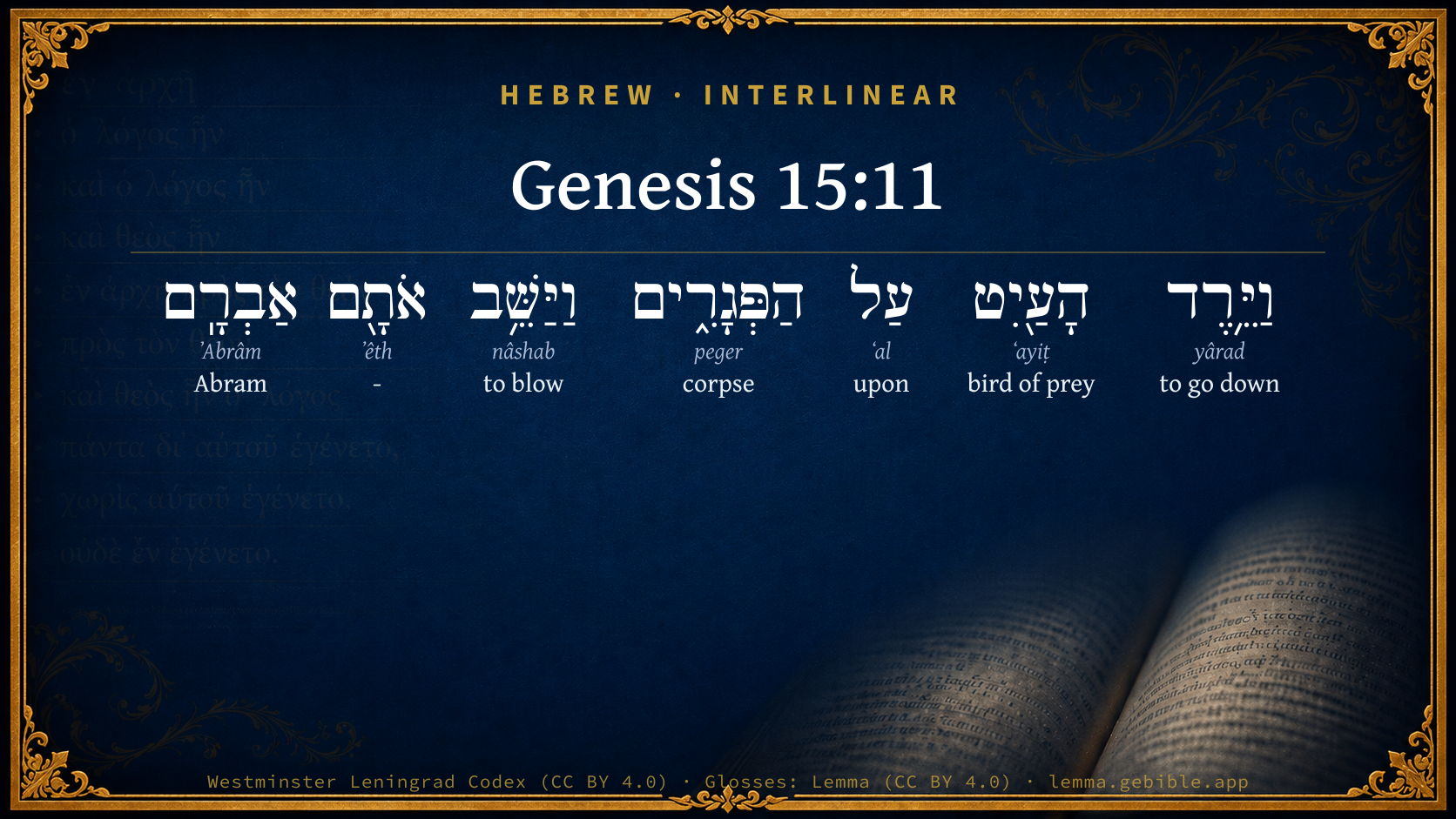
Hebrew (Westminster Leningrad Codex) Genesis 15:11 appears in the Hebrew Old Testament. The text above is from the Westminster Leningrad Codex. Each word links to its Strong’s number, a concise gloss, and parsing drawn from the Open Scriptures Hebrew Bible morphology. Click any word for its full Brown-Driver-Briggs (BDB) entry.
Download image
Cite this verse

Genesis 15:11 (World English Bible). Public Domain. Lemma interlinear Bible study tool, https://lemma.gebible.app/v/genesis/15/11.

Show BibTeX & RIS
BibTeX
RIS
English Translation
The birds of prey came down on the carcasses, and Abram drove them away.
World English Bible · Public Domain
Highlights Full analysis ↓
Download a study sheet

One document with this verse’s original text, its word-by-word gloss line, the meaning frame, cross-references with their text, attributed commentary, and full source and license credits — printable, and it pastes into notes with its structure intact.

This verse Autodidact and up

Study sheet (.html) Plain text (.txt)

A passage Seminary Student

Up to 50 verses in one chapter. A passage sheet keeps up to 6 commentary sources and 12 cross-references per verse, in the order this page ranks them, and says so on the sheet whenever that leaves anything out. Ask for a single verse and you get the Autodidact verse sheet above.

Everything on this page stays free to read, with no account — the sheet is a download of what is already on screen, not access to it.

Want to remove ads? Support Godless Engineer
Compare translations 3

The same verse in 3 English versions, stacked beneath the original-language interlinear above. Click any original word for its lexicon entry.

Each is an independent rendering of the whole verse — the interlinear is not word-aligned to these translations.

Highlighted words mark where these versions differ — a whole-verse word diff, not a word-by-word alignment.

  • World English Bible Public Domain
    The birds of prey came down on the carcasses, and Abram drove them away.
  • King James Version Public Domain
    And when the fowls came down upon the carcasses, Abram drove them away.
  • unfoldingWord Literal Text CC BY-SA 4.0
    Then birds of prey came down on the carcasses, and Abram drove them away.

unfoldingWord Literal Text — © unfoldingWord, licensed CC BY-SA 4.0. Word-aligned USFM3 via Door43 (git.door43.org/unfoldingWord/en_ult).

Versions to compare (up to 4)

3 of 4 selected

Show all 18 translations

Every available English version of this verse, each an independent rendering of the whole verse.

  • World English Bible Public Domain
    The birds of prey came down on the carcasses, and Abram drove them away.
  • Berean Standard Bible Public Domain
    And the birds of prey descended on the carcasses, but Abram drove them away.
  • Majority Standard Bible Public Domain
    And the birds of prey descended on the carcasses, but Abram drove them away.
  • King James Version Public Domain
    And when the fowls came down upon the carcasses, Abram drove them away.
  • American Standard Version (1901) Public Domain
    And the birds of prey came down upon the carcasses, and Abram drove them away.
  • Revised Version (1885) Public Domain
    And the birds of prey came down upon the carcases, and Abram drove them away.
  • Geneva Bible (1599) Public Domain
    Then foules fell on the carkases, and Abram droue them away.
  • Douay-Rheims (1899) Public Domain
    And the fowls came down upon carcasses, and Abram drove them away.
  • Young's Literal Translation Public Domain
    and the ravenous birds come down upon the carcases, and Abram causeth them to turn back.
  • Literal Standard Version CC BY-SA 4.0
    and the ravenous birds come down on the carcasses, and Abram causes them to turn back.
  • Unlocked Literal Bible CC BY-SA 4.0
    When the birds of prey came down upon the carcasses, Abram drove them away.
  • unfoldingWord Literal Text CC BY-SA 4.0
    Then birds of prey came down on the carcasses, and Abram drove them away.
  • Darby Bible Public Domain
    And the birds of prey came down on the carcases; and Abram scared them away.
  • World Messianic Bible Public Domain
    The birds of prey came down on the carcasses, and Abram drove them away.
  • Webster's Bible Public Domain
    And when the fowls came down upon the carcases, Abram drove them away.
  • Free Bible Version CC BY-SA 4.0
    When vultures flew down on the carcasses, Abram frightened them off.
  • Bible in Basic English Public Domain
    And evil birds came down on the bodies, but Abram sent them away.
  • JPS Tanakh (1917) Public Domain
    And the birds of prey came down upon the carcasses, and Abram drove them away.

Literal Standard Version (2020), Covenant Press — licensed CC BY-SA 4.0. Text via the HelloAO Bible API (eBible.org). Unlocked Literal Bible (unfoldingWord) — licensed CC BY-SA 4.0. Text via the HelloAO Bible API (eBible.org). unfoldingWord Literal Text — © unfoldingWord, licensed CC BY-SA 4.0. Word-aligned USFM3 via Door43 (git.door43.org/unfoldingWord/en_ult). Free Bible Version, Dr. Jonathan Gallagher — licensed CC BY-SA 4.0. Text via the HelloAO Bible API (eBible.org).

Word by word

More ways to search: Search by grammar → Find every occurrence → Compare this word →

Practice this passage: Drill this verse → Learn its vocabulary →

About this verse

These counts appear in no published source. They are computed here, from the morphology-tagged text and Lemma’s own curated glosses. What Lemma adds →

7
words
7
distinct lemmas
Pentateuch
section

Notable vocabulary

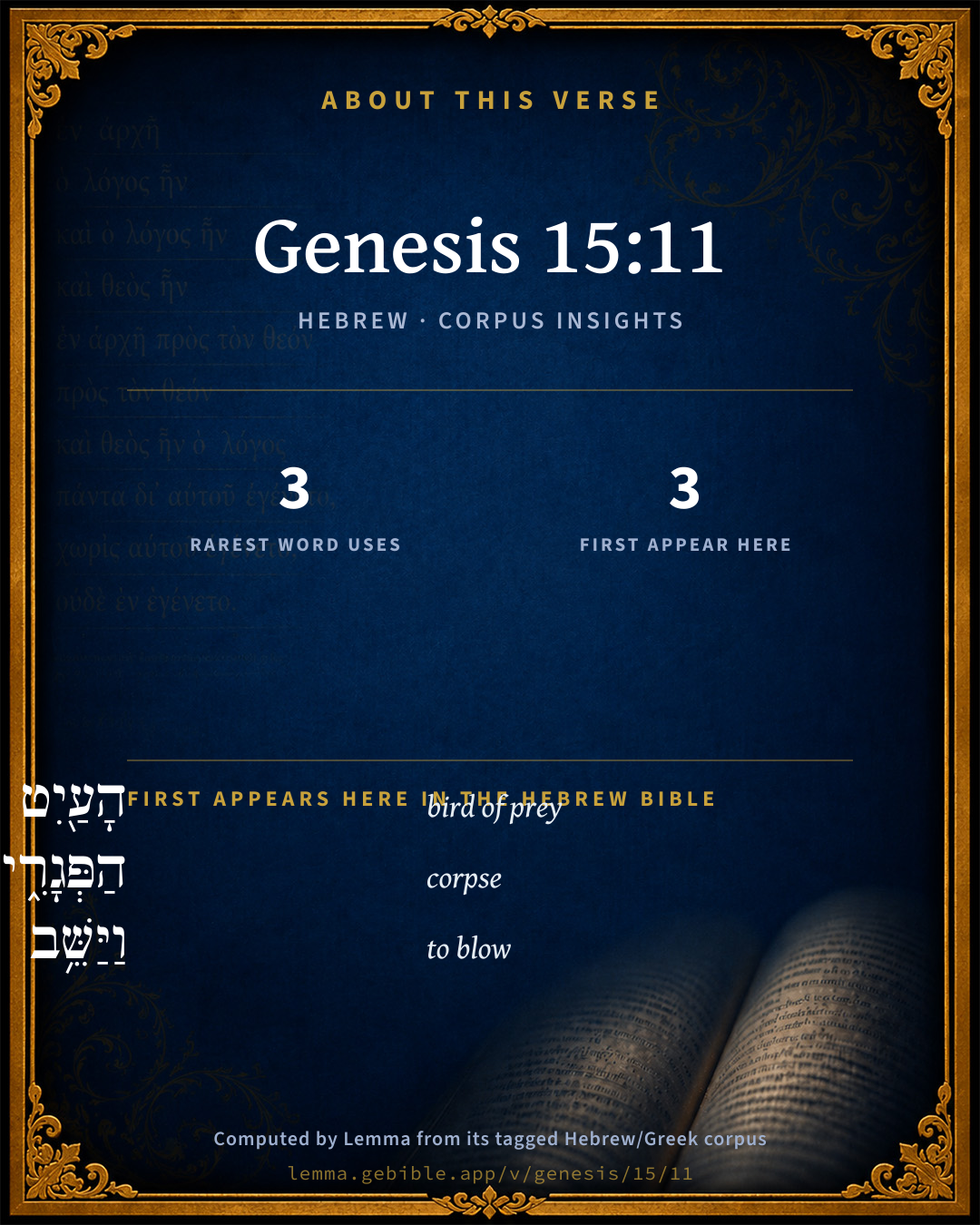
The rarest word here is וַיַּשֵּׁ֥ב to blow H5380 — appearing just 3 times in the whole Hebrew Bible.

First appearance in Scripture

These words make their first canonical appearance in the Hebrew Bible here:

  • הָעַ֖יִט bird of prey H5861
  • הַפְּגָרִ֑ים corpse H6297
  • וַיַּשֵּׁ֥ב to blow H5380

Shared distinctive vocabulary

וַיַּשֵּׁ֥ב to blow H5380 occurs in 3 verses of the Hebrew Bible. Also found in:

Grammatical profile

  • 2 verbs
  • 3 nouns
  • 1 preposition
  • 1 particle

Verb forms

  • וַיֵּ֥רֶד Qal · Sequential Imperfect
  • וַיַּשֵּׁ֥ב Hiphil · Sequential Imperfect

Hebrew & Septuagint length

In English translation the verse runs 14 words from the Hebrew and 20 from the Septuagint (LXX English) — the Septuagint runs noticeably longer here. See the side-by-side →

A rough comparison of the two English renderings, which tokenize alike — not a word-level alignment.

Word counts can differ between the Hebrew and the Greek without any difference in meaning — e.g. the Hebrew direct-object marker אֵת has no separate Greek word, and Greek often adds the article ὁ.

Cross-references

4

Topical passages linked to Genesis 15:11 in the Treasury of Scripture Knowledge — connected by theme and wording, ordered by reader-vote popularity; previews shown in the World English Bible.

  • Matthew 13:4 As he sowed, some seeds fell by the roadside, and the birds came and devoured them.
  • Psalms 119:13 With my lips, I have declared all the ordinances of your mouth.
  • Ezekiel 17:3 and say, Thus says the Lord Yahweh: A great eagle with great wings and long feathers, full of feathers, which had various colors, came to Lebanon, and took the top of the cedar:
  • Ezekiel 17:7 There was also another great eagle with great wings and many feathers: and, behold, this vine did bend its roots toward him, and shot forth its branches toward him, from the beds of its plantation, that he might water it.

Cross-references courtesy of OpenBible.info (CC BY 4.0).

Hebrew and Greek witnesses Masoretic Hebrew ↔ Greek Septuagint

The same verse in the two great witnesses to the Old Testament, shown verse-for-verse.

Here the Septuagint runs noticeably longer than the Hebrew — LXX2012 (modern English Septuagint) 20 words vs World English Bible 14. A rough length comparison of the two English translations, not a word-level alignment — read both below.

These are two independent witnesses, not word-aligned to each other, and the Septuagint is shown in lemma (dictionary) form.

Hebrew Genesis 15:11 Masoretic · Westminster Leningrad Codex

וַיֵּ֥רֶד הָעַ֖יִט עַל הַפְּגָרִ֑ים וַיַּשֵּׁ֥ב אֹתָ֖ם אַבְרָֽם

The birds of prey came down on the carcasses, and Abram drove them away.

World English Bible · Public Domain

Greek LXX Genesis 15:11 Septuagint · lemma form

καταβαίνω δέ ὄρνεον ἐπί ὁ σῶμα ὁ διχοτόμημα αὐτός καί συν καταἵζω αὐτός αβραμ

And birds came down upon the bodies, even upon the divided parts of them, and Abram sat down by them.

LXX2012 (modern English Septuagint) · Public Domain

On this verse, The Cambridge Bible for Schools and Colleges discusses the Septuagint’s reading. Read the note in Commentary ↓

Hebrew: Westminster Leningrad Codex (CC BY 4.0). Greek: Septuagint (public domain); English from LXX2012 (modern English Septuagint) (Public Domain). How the Septuagint differs from the Hebrew →

Targum (Aramaic paraphrase)

2

The Targum is the ancient Jewish Aramaic paraphrase of the Hebrew Scriptures — an interpretive translation, not the Hebrew text itself. Onkelos (literal) and Pseudo-Jonathan (expansive) render the Torah, and Jonathan the Prophets. Coverage is partial: where no permissively-licensed English translation exists for a verse, only the Aramaic is shown. This is verse-level text, not a word-by-word alignment to the Hebrew.

  1. Targum Onkelos Torah (Genesis–Deuteronomy)
    וּנְחַת עוֹפָא עַל פַּגְלַיָא וְאַפְרַח יָתְהוֹן אַבְרָם

    (no public-domain English translation for this verse)

    Targum Onkelos — Aramaic: “Onkelos Genesis” (public domain); “Onkelos Exodus” (public domain); “Onkelos Leviticus” (public domain); “Onkelos Numbers” (public domain); “Onkelos Deuteronomy” (public domain). English: “Sefaria Community Translation” (CC0 1.0 (public-domain dedication)); “J.W. Etheridge. The Targums of Onkelos and Jonathan Ben Uzziel on the Pentateuch. London: Longmans, Green, 1862” (public domain). Text via Sefaria.

  2. Targum Pseudo-Jonathan Torah (Genesis–Deuteronomy)
    וּנְחָתוּ אוּמַיָא ע"א הִינוּן מְדַמְיָין לְעוֹפָא מְסָאֲבָא לְמִיבְזַז נִכְסֵיהוֹן דְיִשְרָאֵל וַהֲוַת זְכוּתֵיהּ דְאַבְרָם מְגַנָא עֲלֵיהוֹן

    And there came down idolatrous peoples which are like to unclean birds, to steal away the sacrifices of Israel; but the righteousness of Abram was a shield over them.

    Targum Pseudo-Jonathan — Aramaic: “Targum Jonathan on Genesis” (public domain); “Targum Jonathan on Exodus” (public domain); “Targum Jonathan on Leviticus” (public domain); “Targum Jonathan on Numbers” (public domain); “Targum Jonathan on Deuteronomy” (public domain). English: “The Targum of Jonathan ben Uzziel, trans. J. W. Etheridge, London, 1862” (public domain). Text via Sefaria.

Commentary

Notes on Genesis 15:11 from classic Christian and Jewish commentators (each source and its license shown beneath its notes). The classic Christian expositions comment on the surrounding passage and are grouped to its opening verse, so a note may address several verses; the Jewish commentaries on the Tanakh (Rashi and others) are per-verse, so they appear only where the commentator wrote on this verse.

Lemma curates 59 commentaries, every one of them public domain or Creative Commons licensed, each selected and text-cleaned for this edition rather than reprinted as found. About our sources →

Trapp's Complete Commentary

John Trapp

Gen 15:11 And when the fowls came down upon the carcases, Abram drove them away.

Ver. 11. Abram drove them away.] So must we do evil motions and distractive thoughts in holy duties, which else will muster and swarm in our hearts like the flies of Egypt; pestering us worse than the fly in Albertus Magnus, that was ever hankering after the bald head; though he flapt it off again and again, he could not be rid of it.

John Trapp, A Commentary or Exposition upon All the Books of the Old and New Testament (1647–1656) — public domain. Text from a community e-Sword module.

The Biblical Illustrator

Joseph S. Exell

Gen_15:11

When the fowls came down upon the carcases, Abram drove them away

Abram and the ravenous birds

I.

MENTION SOME OF THOSE WELL-KNOWN INTRUDERS WHICH ARE PERPETUALLY MOLESTING OUR PEACE AND DISTURBING OUR SERVICE.

1. Wicked thoughts--the sons of Satan.

2. Worldly thoughts, which spring from the force of habit.

3. Anxious thoughts, the fruits of our unbelief.

4. Annoying thoughts, the offspring of our vanity.

5. Ecclesiastical anxieties. Church business, or Church differences.

II. DISTRACTING CARES MUST BE CHASED AWAY.

1. For your own sake. No human brain can bear the perpetual toil of business, except it knows how to pause and oil the machinery by turning the mind in some other direction.

2. You will find, if you are able to take a perfect rest, by driving away these evil thoughts when you are worshipping God, that you will do your work during the other days of the week far better. It was an old Popish folly to try and tell what kind of weather there would be by the weather on Sunday--If it rain before mess; rain all the week more or less. Now, we do not believe that literally; but we do believe it in a spiritual sense. If you have a bad Sabbath day, you will have a bad week; but if you have a good day of rest, you will find it good with your souls the whole week long; not that you will be without trouble all the week, that would not be good for you, but you shall never be without grace during the week; nor if you have peace on the Sunday shall you be without peace on the Monday.

3. And then let me remind you, in the next place, that the character of this day demands that you should get rid of these thoughts. Now, it is inconsistent with such a day--the day of light--for us to be in darkness. It is inconsistent with the day of resurrection for us to be raking in this grave of the world. It is inconsistent with this day of descent of the Spirit for us to be thinking of carnal things, and forgetting the things which are above.

4. The indulging of vain or anxious thoughts, when we are engaged in the worship of God, must be striven against, because it must be grievous to the Holy Spirit. How can we expect that we shall have His presence and His assistance if we give Him not our hearts?

5. These thoughts and cares must be driven away, for if you do not strive against them they will increase and multiply. This is a growing habit. The force of habit is like the velocity of a falling stone, it increases in ever multiplying proportions. If I have indulged one unbelieving thought, there has always been another to follow it; if I have allowed some little disturbance in the congregation to cast me down, and distract my thoughts, there has been another, and another, and another, till I have been in the pitiable condition of a minister who has been half afraid of his congregation.

III. I am now to show you HOW TO DO IT.

1. And we begin by saying, first of all, set your heart upon it; for when the soul is set upon a thing, then it is likely to accomplish it. Go up to Gods house, saying, I must give up my soul to eternal matters today, and I will.

2. But when you have this done, remember next--let the preparation of your heart before coming to the sacrifice assist you when you shall be there. We are told men ought not to preach without preparation. Granted. But, we add, men ought not to hear without preparation.

3. But, this done, above all, cry to the Spirit of God for help to make your spirit rest.

4. Then, when you have thus done, and you come up to the house of God, still seek to continue in the same frame of mind, remembering in whose immediate presence you are. A Spartan youth was holding the censer at a sacrifice, when Alexander was offering a victim. It chanced that while he held the censer a hot coal fell upon his hand. The youth stood still, and never flinched, lest by any utterance or cry the sacrifice should be disturbed; for he said he was in the presence of Alexander, and he would not have the sacrifice interrupted for him; and he bore the pain of the burning coal. Let us remember that Spartan youth, adding to what he said, We are in the presence of the Almighty God. Then, if there be something which annoys us, let us bear it unflinchingly, for we stand before Him for whom it is blessed to suffer, and who will surely reward them that seek Him in spirit and in truth.

5. Another means I will give you. Take care that your faith be in active exercise, or else you cannot chase away those thoughts. Rest in the Lord and wait patiently for Him. Be still, and know that He is God.

6. Take care also that thou attend a ministry which draws thee from earth, for there are some dead ministries which make the Sabbath day more intolerable than any of the other days of the week. (C. H. Spurgeon.)

Driving away the vultures from the sacrifice

I. First, with regard to THE GREAT SACRIFICE OF OUR LORD JESUS CHRIST. This has been, and always will be, the great object of attack by the enemies of God.

1. Note well that the sacrifice which Abram guarded was of Divine ordination. So with the sacrifice of Christ.

2. Next, we see a further reason for guarding the sacrifice in the fact that it is of most solemn import. A covenant. We cannot let the vultures tear this sacrifice, for it is to us the token of the covenant; and if there be no covenant of grace, then is our preaching vain, and your faith is also vain, and we are still under the curse of the broken law. If ye are still out of covenant with God, what hope, what safety, what peace, what joy is there for you?

3. And, next, we must guard this sacrifice, because there God most fully displays His grace.

4. We will do this all the more because this is the chief point of attack. Every doctrine of revelation has been assailed, but the order of battle passed by the black prince at this hour runs as follows: Fight neither with small nor great, save only with the crucified King of Israel. If they carry the bastion of substitution, if they can throw down the great truth of atonement, then all the rest will go as a matter of course. The cross taken away, indeed, there is nothing left worth defending. Therefore let us gather up our strength, that we may vigorously chase the vultures from the altar of the living God.

5. How are we to do it? says one. Well, we can all of us help in this struggle.

(1) First, by a constant, immovable faith in Jesus Christ our crucified Saviour for ourselves.

(2) Let your own confidence be strong, and then very frequently make an open declaration of your faith in the atoning Sacrifice.

II. But now let us apply this example of Abram to ourselves in the matter of THE GRATEFUL SACRIFICE OF OUR LIVES. It is our reasonable service, that we present ourselves a living sacrifice, holy, acceptable unto God by our Lord Jesus Christ, and we must guard our consecration against the temptations which will assail it. I am addressing many of you who feel that you have entered into covenant with God by Jesus Christ. What sort of vultures will there be? says one. Well, there will come doubts as to eternal things. There will be questions about your own wisdom in giving yourself up to God. I hope you have been strangers to such birds of prey, but some of us have not been: doubts as to whether there be a God to serve; doubts as to whether there be a heaven, an eternal future, a blessed reward; doubts as to whether it is well to give up this world for the next, or not, Drive them away! They may come in other forms, such as dreams of ambition, the cares of life, temptations to sin, idleness, etc. In whatever guise they come, drive them away.

III. GUARD ALL THE SACRIFICES OF YOUR DEVOTION. When the fowls come down upon your sacrifices of prayer, and praise, and meditation, drive them away. A little boy, who was accustomed to spend a time every day in prayer, went up into a hayloft, and when he climbed into the hayloft, he always pulled the ladder up after him. Someone asked him why he did so. He answered, As there is no door, I pull up the ladder. Oh, that we could always in some way cut the connection between our soul and the intruding things which lurk below! There is a story told of me and of some person, I never knew who it was, who desired to see me on a Saturday night, when I had shut myself up to make ready for the Sabbath. He was very great and important, and so the maid came to say that someone desired to see me. I bade her say that it was my rule to see no one at that time. Then he was more important and impressive still, and said, Tell Mr. Spurgeon that a servant of the Lord Jesus Christ desires to see him immediately. The frightened servant brought the message; but the sender gained little by it, for my answer was, Tell him I am busy with his Master, and cannot see servants now. Sometimes you must use strong measures. Did not our Lord tell His messengers, on one occasion, to salute no man by the way? Courtesy must give place to devotion. It is incumbent on you that you should be alone with your Lord, and if intruders force an entrance, they must be sent about their business. (C. H. Spurgeon.)

The disturbers of worship

I. THE OFFERING OF THE CHRISTIAN WORSHIPPER.

II. IT IS OFTEN DISTURBED AND INTERRUPTED.

1. Unbelieving thoughts.

2. Evil passions.

3. Worldly thoughts.

4. Satanic influence.

III. THE REMEDIES AGAINST THESE DIFFICULTIES AND INTERRUPTIONS.

1. A devotional preparation.

2. A firm hold on the truth.

3. Earnestness in the service.

4. Unshaken confidence in the aid of the Holy Spirit. (J. G. Hewlett, D. D.)

Wandering thoughts removed from the sacrifice by warm affections

If we would prevent wandering thoughts, we should seek warm affections. Flies will not so readily light on a boiling pot on the fire, as when it stands cold in the window, Nor will vain thoughts so easily light on thy sacrifice, when burning on the altar of a fervent heart, as when offered up with a cold, dull spirit. (W. Gurnall.)

The sacrifice hindered by vain thoughts

I have heard of some men who were called walking libraries, because they carried all that they read in their memories wherever they went. And have we not too many walking shops, barns, warehouses, etc., that is, persons who carry this lumber to bed and board, church and closet? How can such pray with a united heart, who have so many sharers in their thoughts? (W. Gurnall.)

The Biblical Illustrator, edited by Joseph S. Exell (c. 1880s–1900s) — public domain. Text from a community e-Sword module.

Tyndale Open Study Notes

Tyndale Open Resources

15:11 Vultures are unclean birds of prey that symbolize those who unjustly attack Abraham’s heirs (15:13-14).

Tyndale Open Study Notes — © Tyndale Open Resources, licensed CC BY-SA 4.0. Text via the HelloAO Bible API.

Adam Clarke's Commentary

Verse 11. And when the fowls] העיט haayit, birds of prey, came down upon the carcasses to devour them, Abram, who stood by his sacrifice waiting for the manifestation of GOD, who had ordered him to prepare for the ratification of the covenant, drove them away, that they might neither pollute nor devour what had been thus consecrated to God.

Adam Clarke's Commentary on the Bible (1810–1826) — public domain. Text from a community e-Sword/MySword module.

John Calvin's Commentaries

11. And when the fowls came down. Although the sacrifice was dedicated to God, yet it was not free from the attack and the violence of birds. So neither are the faithful, after they are received into the protection of God, so covered with his hand, as not to be assailed on every side; since Satan and the world cease not to cause them trouble. Therefore, in order that the sacrifice we have once offered to God may not be violated, but may remain pure and uninjured, contrary assaults must be repulsed, with whatever inconvenience and toil.

John Calvin's Commentaries (1540-1563) — public domain. Text from the Calvin Translation Society English edition (1840s-50s) via the Christian Classics Ethereal Library (ccel.org). Calvin's coverage is partial (roughly two-thirds of the Bible); uncommented books and verses are honest gaps, never fabricated. The 19th-century editor's footnotes and remarks are omitted so the notes are faithfully Calvin's own voice.

Ellicott's Commentary for English Readers

(11) And when the fowls . . . —Heb., And the birds of prey came down upon the carcases, and Abram scared them away. Had there been a sacrifice the fire would have kept the vultures from approaching; but the bodies lay exposed, and Abram therefore kept guard over them, lest the purpose of the ceremonial should be frustrated by any want of respect shown to the outward symbols.

A Bible Commentary for English Readers, edited by Charles John Ellicott (1878–1897) — public domain. Text from a community e-Sword module.

The Cambridge Bible for Schools and Colleges

gen. ed. J. J. S. Perowne

11. And the birds of prey, &c.] The birds of prey, regarded as unclean, swooping down threatened to carry off the pieces of flesh. This would have interrupted the ceremony with an evil omen, polluted the sacrifice, and impaired the covenant. Abram drives away the birds of ill omen. In the context, these birds evidently symbolized the Egyptians, who threatened, by enslaving Israel in Egypt, to frustrate the fulfilment of the Divine promise to the seed of Abram. The chasing away of the birds typified the surmounting of all obstacles.

The LXX συνεκάθισεν αὐτοῖς = “he sat with them” for “he drove them away” (reading vay-yêsheb ittâm for vay-yasshêb ôthâm) is a strange example of the mistakes arising from Hebrew writing without vowel points.

The Cambridge Bible for Schools and Colleges (gen. ed. J. J. S. Perowne; Cambridge University Press, 1878–1918) — public domain. Text from a community e-Sword module.

John Gill's Exposition

And when the sun was going down,.... Just setting, descending below the hemisphere; or "about to enter" (m) into his chamber, as Piscator observes, from whence he went forth in the morning, as a strong man to run his race; which at sunset is finished according to human appearance, and the common apprehensions of men, who have thought it goes under the earth, or drops into the ocean, see Psa 19:5,

a deep sleep fell upon Abram: through the great fatigue he had had the preceding day, in doing what is before related; or rather through a more than ordinary influence of God upon him, which bound up his senses, and cast him into an ecstasy or trance, when he had the following prophecy and vision, which more fully explained to him the emblem he had been conversant with; this was such a sleep as fell on Adam, Gen 2:21,

and, lo, an horror of great darkness fell upon him; or such darkness as was horrible and terrible, so it was represented to his mind in vision; which signified the great afflictions after expressed by darkness, that should come upon his children in Egypt and elsewhere: and so Jarchi says it refers to the distresses and darkness of their captivities in Egypt, and in other places. The Targumists observe, that Abram in this vision saw the four monarchies that should bring his children into bondage.

(m) "et fuit sol ad intrandum", Montanus, Piscator.

John Gill's Exposition of the Whole Bible (1746–1763) — public domain (CC PDM 1.0). Text via the HelloAO Bible API.

Matthew Poole's English Annotations

The fowls came to devour them; whereby is signified, either,

1. The disturbance and distraction which good men are exposed to in the service of God from evil spirits and men; or rather,

2. The great peril of Abram’s posterity, who were not only torn in pieces like these sacrifices, but even the remainder of them were likely to be devoured by the Egyptians, whose king is compared to an eagle, the chief of the birds of prey, Eze 17:1-24.

Abram drove them away by the blast of his mouth, as the Hebrew word signifies; representing Abram’s conquest over all his enemies by faith and prayer, whereby he engaged God to be the Preserver and Deliverer of his people.

Matthew Poole's English Annotations on the Holy Bible (1683–1685) — public domain. Text from a community e-Sword/MySword module.

Whedon's Commentary on the Bible

Daniel D. Whedon

11. Fowls came down — Birds of prey, seeking to devour the carcasses. These unclean birds may be regarded as types of the enemies of the chosen seed, and Abram’s driving them away until the darkness of evening came on, was a sign that the covenant people would be delivered from the destruction threatened by their foes. Some see in these birds of prey a type of the Egyptians.

Daniel D. Whedon (gen. ed.), Commentary on the Old and New Testaments (1874–1909) — public domain. Text from a community e-Sword module.

The Pulpit Commentary

And when the fowls literally, and the bird of prey, a collective singular with the article, as in Gen_14:13, symbolizing the Egyptians and other adversaries of Israel, as in Eze_17:3, Eze_17:7, 12 39:4, 17; Rev_19:17, 18 (Knobel, Rosenm Lunge, Keil, Kalisch) which may be regarded as probable if the divided victims represented Israel in affliction, which is doubtful (vide supra). It does not appear necessary to attach any special significance to the descent of the vultures, which are always attracted towards carrion, and the introduction of which here completes the naturalness of the scenecame down upon the caresses (the LXX interpolates, ejpi tamata), Abram drove them away. Literally, caused them to be blown away, i.e. by blowing. "Though Abram is here represented as the instrument, yet the effect is to be ascribed primarily to the tutelar agency of omnipotence" (Bush; cf. Exo_15:10; Eze_21:31) The act of scaring the voracious birds has been taken to represent the ease with which Abram or Israel would ward off his enemies (Jonathan, Targums, Rosenm Bush); the averting of destruction from the Israelites through Abram"s merit (Kalisch, Keil); Abram"s religious regard for and observance of God"s treaty (Wordsworth); the patriarch"s expectation that God was about to employ the sacrificial victims for some holy purpose (Alford); simply his anxiety to preserve the victims pure and un-mutilated for whatever end they might have to serve (Murphy).

The silent worshipper.

I THE NATURE OF ABRAM"S WORSHIP.

1. Divine in its appointment.

2. Simple in its ritual.

3. Sacrificial in its character.

4. Believing in its spirit.

5. Patient in its continuance.

6. Expectant in its attitude.

II THE INTERRUPTIONS OF ABRAM"S WORSHIP.

1. What they were. The descent of the fowls may be regarded as emblematic of those obstructions to communion with God which arise from

(1) The principalities and powers of the air.

(2) The persecutions and oppressions (or, where these are absent, the pleasures and engagements) of the world.

(3) The disturbances and distractions of vain thoughts and sinful motions in the heart.

2. How they were removed.

(1) By watchfulness.

(2) By opposition.

(3) By perseverance.

(4) By Divine help the breath of Abram"s mouth being probably accompanied by a wind from God.

III THE ACCEPTANCE OF ABRAM"S WORSHIP. This was proved

1. By the approach of God at night-fall towards the scene.

2. By the supernatural revelation accorded to the patriarch.

3. By the passage of the symbol of Jehovah"s presence between the divided victims.

4. By the announcement that God had taken him into covenant with himself.

5. By the vision of the land which was granted to him. Learn

1. The sinfulness and worthlessness of all forms of worship except that which God has appointed.

2. The need for self-examination and Divine assistance when engaged in serving God.

3. The certain acceptance and spiritual enrichment of those who worship God in spirit and in truth. W.

The Pulpit Commentary (1880–1919), ed. H.D.M. Spence-Jones & Joseph S. Exell — public domain. Text from a community e-Sword module.

Keil & Delitzsch

C. F. Keil & F. Delitzsch

"Then birds of prey (העיט with the article, as Gen 14:13) came down upon the carcases, and Abram frightened them away." The birds of prey represented the foes of Israel, who would seek to eat up, i.e., exterminate it. And the fact that Abram frightened them away was a sign, that Abram's faith and his relation to the Lord would preserve the whole of his posterity from destruction, that Israel would be saved for Abram's sake (Psa 105:42).

Keil & Delitzsch — Biblical Commentary on the Old Testament (1861–1891) — public domain (CC PDM 1.0). Text via the HelloAO Bible API. (Old Testament only.)

Rashi

Rabbi Shlomo Yitzchaki (Rashi)

העיט THE BIRD OF PREY— It is a bird so called because it swoops down (עט) greedily upon dead bodies, darting quickly upon its food. Similarly we have the verbal form (1 Samuel 15:19) “And thou didst pounce down (ותעט) upon the spoil”.

על הפגרים UPON THE CARCASSES i.e. the pieces of the carcasses. — The word הפגרים we should translate in the Targum by פגל) פגליא being the same as פגר); since, however, people were familiar with the Targum’s translation of the words איש בתרו (in Genesis 5:10) ‘‘each piece” by פלגיא (the halves), the word פגליא here was mistakenly changed by them into פלגיא and so they gave the Targum of פגרים (carcasses) by פלגיא (halves). But whoever renders it thus in the Targum is wrong for there is no comparison (similarity in meaning) between בתרים and פגרים; for the Targum of בתרים is פלגיא (“parts”, from פלג “to divide”,) whilst the Targum of פגרים is פגליא, which has the sense of פגול, something; abhorrent, as (Leviticus 7:18) פגול הוא “it shall be an abhorred thing”, similar in sense to פגר a carcass.

וישב [AND ABRAM] SCARED THEM AWAY — The word means “blowing upon a thing and making a thing fly away”, similar to (Psalms 147:18) יַשֵּׁב רוחו “He causeth His wind to blow”. It is a symbol that David, the son of Jesse, will wish to destroy them (the nations), but that he will not be permitted by God to do so until king Messiah comes (Pirkei D'Rabbi Eliezer 28).

Rashi on the Tanakh — English translations: “The Judaica Press complete Tanach with Rashi, translated by A. J. Rosenberg” (CC BY 4.0); “Pentateuch with Rashi's commentary by M. Rosenbaum and A.M. Silbermann, 1929-1934” (public domain); “The Metsudah Tanach series, Lakewood, N.J” (CC BY 4.0); and “The Book of Joshua, Metsudah Publications, 1997” (CC BY 4.0). Text via Sefaria.

Ramban (Nachmanides)

Rabbi Moshe ben Nachman (Ramban / Nachmanides)

AND THE BIRDS OF PREY CAME DOWN UPON THE CARCASSES. [They came down] to eat them, as is the nature of birds.

AND ABRAM DROVE THEM AWAY. It was thus alluded to Abraham that the nations would come to abolish the sacrifices, but the children of Abraham would drive them away.

Ramban (Nachmanides) on the Tanakh — English translation: “Commentary on the Torah by Ramban (Nachmanides). Translated and annotated by Charles B. Chavel. New York, Shilo Pub. House, 1971-1976” (CC BY 4.0). Text via Sefaria.

Radak

Rabbi David Kimhi (Radak)

וירד העיט, the word עיט is description of predatory birds generally.

על הפגרים, the carcasses which are whole. This term is not applied to the animals which had been cut in half as part of the sacrificial procedures, [presumably, the author does not feel comfortable in the Torah describing sacrifices which had been accepted by G’d winding up as the food for vultures. Ed.] The author quotes a number of examples where the word פגר occurs in the Bible, in all of which the reference is to a whole carcass, not to a section of it. (compare Isaiah 14,19; Chronicles I 10,12; Samuel I 31,12) The symbolism in all this is that there would hardly be a generation in which the gentile nations would not attempt to devour the Jewish people, and to annihilate them utterly. Nonetheless, in the final analysis, G’d has always saved us from becoming total victims. This confirms the prediction in Leviticus 26,44 that even during our darkest days when we are being punished collectively for our sins and the sins of our fathers, “I will not despise you and allow you to be wiped out completely.” In the verse following the one we just quoted, the Torah adds verbatim: וזכרתי להם ברית ראשונים, at such a time “I will remember for them the covenant I concluded with the forefathers.”

Radak on the Tanakh — English translations: “Sefaria Community Translation” (CC0 1.0 (public-domain dedication)); “Eliyahu Munk, HaChut Hameshulash” (CC BY 4.0); “Rabbi Mike Feuer, Jerusalem Anthology” (CC BY 4.0); and “R. David Kimhi on the first book of Psalms, Translated by R.G. Finch, London, 1919” (public domain). Text via Sefaria.

Lesson kit

Teaching starters — assembled from the data on this page, not authored interpretation. Every prompt links to the verse data it draws on. Edit before teaching.

Genesis, in the Pentateuch, opens this verse with 7 words (7 distinct Hebrew lemmas). Its most distinctive word is nâshab (“to blow”). The Greek Septuagint runs longer here. A historical commentator’s framing appears above. Read the whole chapter for the surrounding context.

Discussion questions

  1. The word nâshab carries the sense “to blow.” How does it shape the verse?
  2. 3 words here appear for the first time in Scripture. What is being introduced at this debut?
  3. Psalms 147:18 shares the word «to blow» with this verse. How do the two illuminate each other?
  4. Compared with the Hebrew, the Septuagint runs longer here. What questions does that raise?
  5. These translations render this verse differently; the difference is in the English rendering, not the original. What questions does that raise?
  6. The verb «וַיֵּ֥רֶד» is Qal Sequential Imperfect. How does its form color the action?
  7. Reading how Trapp's Complete Commentary and The Biblical Illustrator read this verse, where do the two commentators agree and where do they part?

Things to notice

  • 3 words make their first canonical appearance in Scripture here.
  • These translations choose different wording for 5 words in this verse.
  • 7 distinct Hebrew lemmas span 7 words in this verse.

Reading settings

Reading text

Shown beneath each verse's original-language words.

Old Testament
Old Testament edition

Read the OT as the Masoretic Hebrew (MT) or the Greek Septuagint (LXX).

English shown for the Greek Septuagint (in the Hebrew ↔ Greek comparison).

Comparing translations? Open the Compare panel on any verse page to stack up to four side by side.