Acts 27:2

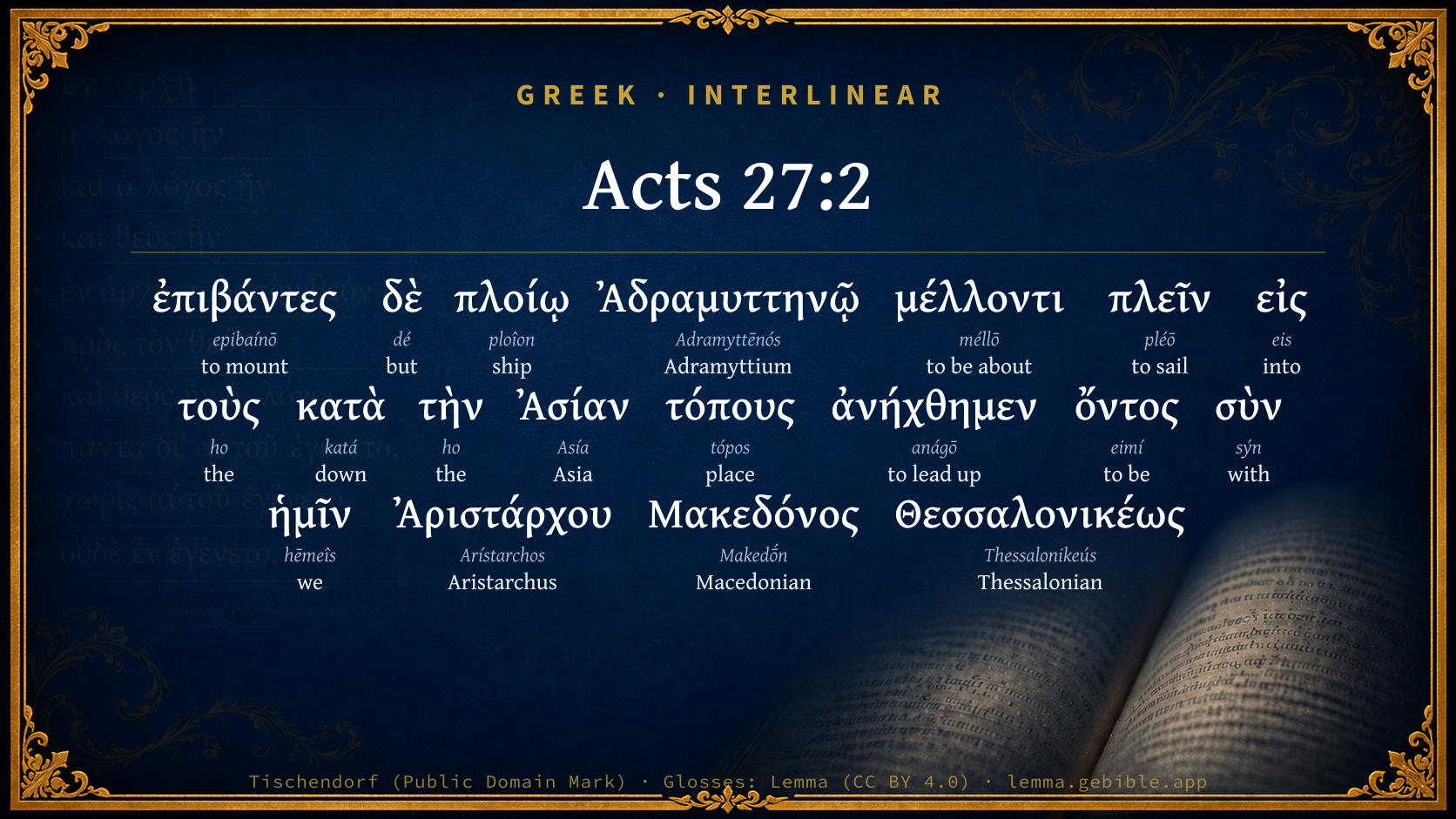
Greek (Tischendorf 8th ed.) Acts 27:2 appears in the Greek New Testament. The text above is from the Tischendorf 8th edition. Each word links to its Strong’s number and a concise gloss. Click any word for its full Thayer’s Greek Lexicon entry.
Download image
Cite this verse

Acts 27:2 (World English Bible). Public Domain. Lemma interlinear Bible study tool, https://lemma.gebible.app/v/acts/27/2.

Show BibTeX & RIS
BibTeX
RIS
English Translation
Embarking in a ship of Adramyttium, which was about to sail to places on the coast of Asia, we put to sea; Aristarchus, a Macedonian of Thessalonica, being with us.
World English Bible · Public Domain
Highlights
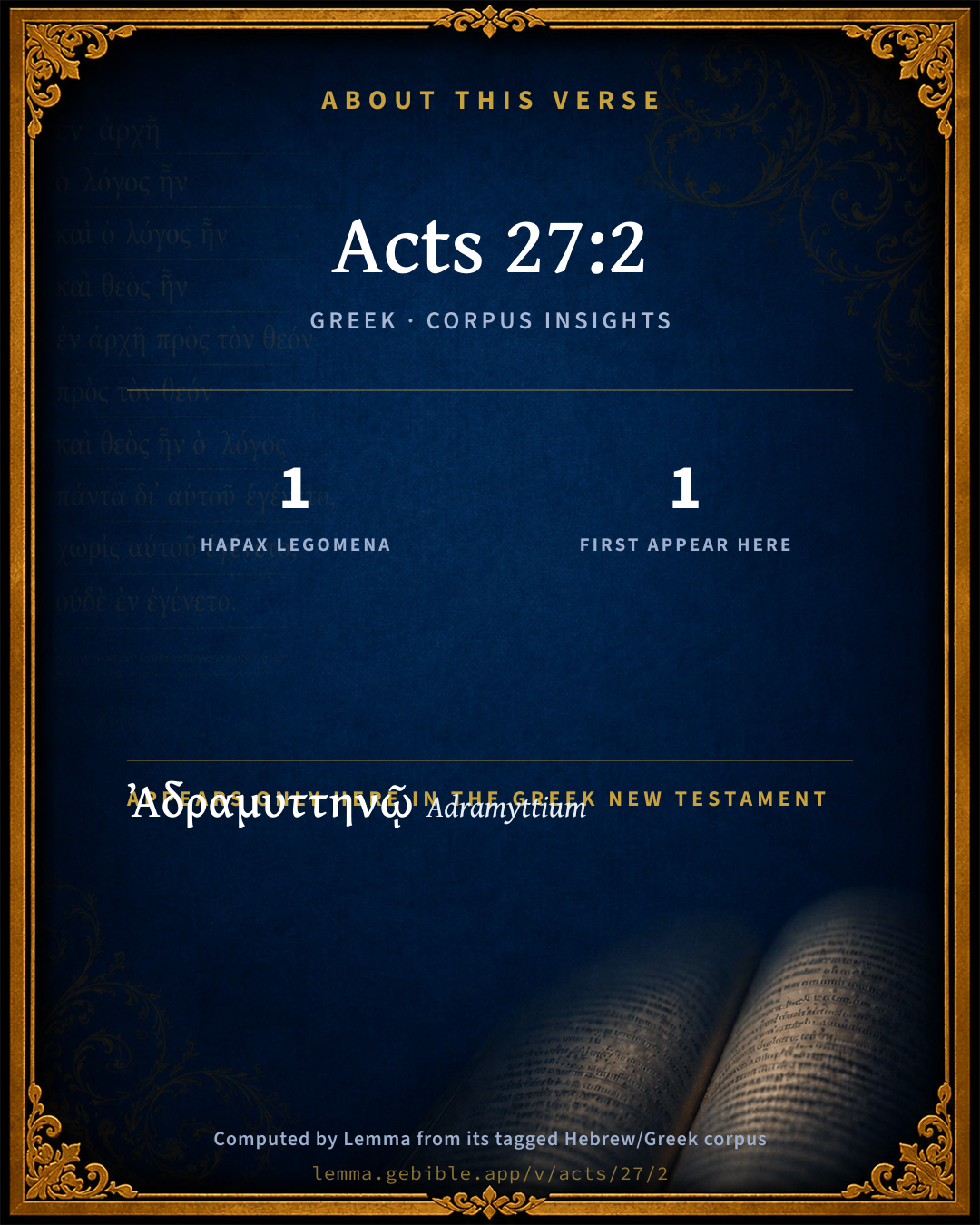
  • 1 hapax legomenon — only here in the Greek New Testament
  • 1 first appearance in the Greek New Testament
Full analysis ↓
Download a study sheet

One document with this verse’s original text, its word-by-word gloss line, the meaning frame, cross-references with their text, attributed commentary, and full source and license credits — printable, and it pastes into notes with its structure intact.

This verse Autodidact and up

Study sheet (.html) Plain text (.txt)

A passage Seminary Student

Up to 50 verses in one chapter. A passage sheet keeps up to 6 commentary sources and 12 cross-references per verse, in the order this page ranks them, and says so on the sheet whenever that leaves anything out. Ask for a single verse and you get the Autodidact verse sheet above.

Everything on this page stays free to read, with no account — the sheet is a download of what is already on screen, not access to it.

Want to remove ads? Support Godless Engineer
Compare translations 3

The same verse in 3 English versions, stacked beneath the original-language interlinear above. Click any original word for its lexicon entry.

Each is an independent rendering of the whole verse — the interlinear is not word-aligned to these translations.

Highlighted words mark where these versions differ — a whole-verse word diff, not a word-by-word alignment.

  • World English Bible Public Domain
    Embarking in a ship of Adramyttium, which was about to sail to places on the coast of Asia, we put to sea; Aristarchus, a Macedonian of Thessalonica, being with us.
  • King James Version Public Domain
    And entering into a ship of Adramyttium, we launched, meaning to sail by the coasts of Asia; one Aristarchus, a Macedonian of Thessalonica, being with us.
  • unfoldingWord Literal Text CC BY-SA 4.0
    And having boarded a ship from Adramyttium being about to sail to places along Asia, we put to sea, Aristarchus, a Macedonian, a Thessalonian, being with us.

unfoldingWord Literal Text — © unfoldingWord, licensed CC BY-SA 4.0. Word-aligned USFM3 via Door43 (git.door43.org/unfoldingWord/en_ult).

Versions to compare (up to 4)

3 of 4 selected

Show all 19 translations

Every available English version of this verse, each an independent rendering of the whole verse.

  • World English Bible Public Domain
    Embarking in a ship of Adramyttium, which was about to sail to places on the coast of Asia, we put to sea; Aristarchus, a Macedonian of Thessalonica, being with us.
  • Berean Standard Bible Public Domain
    We boarded an Adramyttian ship about to sail for ports along the coast of Asia, and we put out to sea. Aristarchus, a Macedonian from Thessalonica, was with us.
  • Majority Standard Bible Public Domain
    We boarded an Adramyttian ship about to sail for ports along the coast of Asia, and we put out to sea. Aristarchus, a Macedonian from Thessalonica, was with us.
  • King James Version Public Domain
    And entering into a ship of Adramyttium, we launched, meaning to sail by the coasts of Asia; one Aristarchus, a Macedonian of Thessalonica, being with us.
  • American Standard Version (1901) Public Domain
    And embarking in a ship of Adramyttium, which was about to sail unto the places on the coast of Asia, we put to sea, Aristarchus, a Macedonian of Thessalonica, being with us.
  • Revised Version (1885) Public Domain
    And embarking in a ship of Adramyttium, which was about to sail unto the places on the coast of Asia, we put to sea, Aristarchus, a Macedonian of Thessalonica, being with us.
  • Geneva Bible (1599) Public Domain
    And we entred into a ship of Adramyttium purposing to saile by the coastes of Asia, and launched foorth, and had Aristarchus of Macedonia, a Thessalonian, with vs.
  • Douay-Rheims (1899) Public Domain
    Going on board a ship of Adrumetum, we launched, meaning to sail by the coasts of Asia, Aristarchus, the Macedonian of Thessalonica, continuing with us.
  • Young's Literal Translation Public Domain
    and having embarked in a ship of Adramyttium, we, being about to sail by the coasts of Asia, did set sail, there being with us Aristarchus, a Macedonian of Thessalonica,
  • Literal Standard Version CC BY-SA 4.0
    and having embarked in a ship of Adramyttium, we, being about to sail by the coasts of Asia, set sail, there being with us Aristarchus, a Macedonian of Thessalonica,
  • Unlocked Literal Bible CC BY-SA 4.0
    We boarded a ship from Adramyttium, which was about to sail along the coast of Asia. So we went to sea. Aristarchus from Thessalonica in Macedonia went with us.
  • unfoldingWord Literal Text CC BY-SA 4.0
    And having boarded a ship from Adramyttium being about to sail to places along Asia, we put to sea, Aristarchus, a Macedonian, a Thessalonian, being with us.
  • Darby Bible Public Domain
    And going on board a ship of Adramyttium about to navigate by the places along Asia, we set sail, Aristarchus, a Macedonian of Thessalonica, being with us.
  • World Messianic Bible Public Domain
    Embarking in a ship of Adramyttium, which was about to sail to places on the coast of Asia, we put to sea, Aristarchus, a Macedonian of Thessalonica being with us.
  • Webster's Bible Public Domain
    And entering into a ship of Adramyttium, we lanched, meaning to sail by the coasts of Asia, one Aristarchus, a Macedonian of Thessalonica, being with us.
  • Free Bible Version CC BY-SA 4.0
    We boarded a ship based in Adramyttium that was headed to the coastal ports of the province of Asia, and we set sail. Aristarchus, a Macedonian from Thessalonica, went with us.
  • Bible in Basic English Public Domain
    And we went to sea in a ship of Adramyttium which was sailing to the sea towns of Asia, Aristarchus, a Macedonian of Thessalonica, being with us.
  • Text-Critical English NT CC BY 4.0
    We got on board a ship of Adramyttium and put out to sea, intending to sail by the ports along the coast of Asia. With us was Aristarchus, a Macedonian of Thessalonica.
  • Tyndale New Testament (1534) Public Domain
    And we entred into a ship of Adramicium and lowsed from lond apoynted to sayle by the costes of Asia one Aristarcus out of Macedonia of the contre of Thessalia beinge with vs.

Literal Standard Version (2020), Covenant Press — licensed CC BY-SA 4.0. Text via the HelloAO Bible API (eBible.org). Unlocked Literal Bible (unfoldingWord) — licensed CC BY-SA 4.0. Text via the HelloAO Bible API (eBible.org). unfoldingWord Literal Text — © unfoldingWord, licensed CC BY-SA 4.0. Word-aligned USFM3 via Door43 (git.door43.org/unfoldingWord/en_ult). Free Bible Version, Dr. Jonathan Gallagher — licensed CC BY-SA 4.0. Text via the HelloAO Bible API (eBible.org).

Word by word

More ways to search: Search by grammar → Find every occurrence → Compare this word →

Practice this passage: Drill this verse → Learn its vocabulary →

Ἀδραμυττηνῷ
Adramyttēnós
G98
“Adramyttium”
Adjective, Dative, Singular, Neuter
Part of Speech
Adjective
Case
Dative
Number
Singular
Gender
Neuter
Full Thayer's Definition

Origin: from Adramutteion (a place in Asia Minor)

TDNT: None

Adramyttium = "I shall abide in death" 1. Adramyttium, a seaport of Mysia
  1. ἐπιβάντες epibaínō G1910 “to mount” Verb, Aorist, Active, Participle, Nominative, Singular, Masculine
  2. δὲ dé G1161 “but” Conjunction
  3. πλοίῳ ploîon G4143 “ship” Noun, Dative, Singular, Neuter
  4. μέλλοντι méllō G3195 “to be about” Verb, Present, Active, Participle, Dative, Singular, Masculine
  5. πλεῖν pléō G4126 “to sail” Verb, Present, Active, Infinitive
  6. εἰς eis G1519 “into” Preposition
  7. τοὺς ho G3588 “the” Article, Accusative, Plural, Masculine
  8. κατὰ katá G2596 “down” Preposition
  9. τὴν ho G3588 “the” Article, Accusative, Singular, Feminine
  10. Ἀσίαν Asía G773 “Asia” Noun, Accusative, Singular, Feminine
  11. τόπους tópos G5117 “place” Noun, Accusative, Plural, Masculine
  12. ἀνήχθημεν anágō G321 “to lead up” Verb, Aorist, Passive, Indicative, 1st person, Plural
  13. ὄντος eimí G1510 “to be” Verb, Present, Active, Participle, Genitive, Singular, Masculine
  14. σὺν sýn G4862 “with” Preposition
  15. ἡμῖν hēmeîs G2249 “we” Personal pronoun, 1st person, Dative, Plural
  16. Ἀριστάρχου Arístarchos G708 “Aristarchus” Noun, Genitive, Singular, Masculine
  17. Μακεδόνος Makedṓn G3110 “Macedonian” Noun, Genitive, Singular, Masculine
  18. Θεσσαλονικέως Thessalonikeús G2331 “Thessalonian” Noun, Genitive, Singular, Masculine

About this verse

These counts appear in no published source. They are computed here, from the morphology-tagged text and Lemma’s own curated glosses. What Lemma adds →

19
words
18
distinct lemmas
Acts
section

Notable vocabulary

1 hapax legomenon — a word that appears only here in the entire Greek New Testament:

  • Ἀδραμυττηνῷ Adramyttium G98

First appearance in Scripture

This word makes its first canonical appearance in the Greek New Testament here:

  • Ἀδραμυττηνῷ Adramyttium G98

Shared distinctive vocabulary

Θεσσαλονικέως Thessalonian G2331 occurs in 4 verses of the Greek New Testament. Also found in:

Repetition

A word recurs within this verse:

  • τοὺς the G3588 ×2

Cross-references

17

Topical passages linked to Acts 27:2 in the Treasury of Scripture Knowledge — connected by theme and wording, ordered by reader-vote popularity; previews shown in the World English Bible.

  • Acts 19:29 The whole city was filled with confusion, and they rushed with one accord into the theater, having seized Gaius and Aristarchus, men of Macedonia, Paul's companions in travel.
  • Colossians 4:10 Aristarchus, my fellow prisoner greets you, and Mark, the cousin of Barnabas (concerning whom you received commandments, "if he comes to you, receive him"),
  • Philemon 1:24 as do Mark, Aristarchus, Demas, and Luke, my fellow workers.
  • Luke 8:22 Now it happened on one of those days, that he entered into a boat, himself and his disciples, and he said to them, "Let's go over to the other side of the lake." So they launched out.
  • Acts 2:9 Parthians, Medes, Elamites, and people from Mesopotamia, Judea, Cappadocia, Pontus, Asia,
  • Acts 16:9–13 A vision appeared to Paul in the night. There was a man of Macedonia standing, begging him, and saying, "Come over into Macedonia and help us."
  • Acts 16:17 Following Paul and us, she cried out, "These men are servants of the Most High God, who proclaim to us the way of salvation!"
  • Acts 17:1 Now when they had passed through Amphipolis and Apollonia, they came to Thessalonica, where there was a synagogue of the Jews.
  • Acts 19:19 Many of those who practiced magical arts brought their books together and burned them in the sight of all. They counted the price of them, and found it to be fifty thousand pieces of silver.
  • Acts 20:4–5 These accompanied him as far as Asia: Sopater of Beroea; Aristarchus and Secundus of the Thessalonians; Gaius of Derbe; Timothy; and Tychicus and Trophimus of Asia.
  • Acts 20:15–16 Sailing from there, we came the following day opposite Chios. The next day we touched at Samos and stayed at Trogyllium, and the day after we came to Miletus.
  • Acts 21:1–3 When it happened that we had parted from them and had set sail, we came with a straight course to Cos, and the next day to Rhodes, and from there to Patara.
  • Acts 21:5 When it happened that we had accomplished the days, we departed and went on our journey. They all, with wives and children, brought us on our way until we were out of the city. Kneeling down on the beach, we prayed.
  • Acts 28:2 The natives showed us uncommon kindness; for they kindled a fire, and received us all, because of the present rain, and because of the cold.
  • Acts 28:10 They also honored us with many honors, and when we sailed, they put on board the things that we needed.
  • Acts 28:12 Touching at Syracuse, we stayed there three days.
  • Acts 28:16 When we entered into Rome, the centurion delivered the prisoners to the captain of the guard, but Paul was allowed to stay by himself with the soldier who guarded him.

Cross-references courtesy of OpenBible.info (CC BY 4.0).

Commentary

Notes on Acts 27:2 from classic Christian and Jewish commentators (each source and its license shown beneath its notes). The classic Christian expositions comment on the surrounding passage and are grouped to its opening verse, so a note may address several verses; the Jewish commentaries on the Tanakh (Rashi and others) are per-verse, so they appear only where the commentator wrote on this verse.

Lemma curates 59 commentaries, every one of them public domain or Creative Commons licensed, each selected and text-cleaned for this edition rather than reprinted as found. About our sources →

Tyndale Open Study Notes

Tyndale Open Resources

27:2 Aristarchus was a native of Thessalonica and a co-worker with Paul in Asia (see 19:29; 20:4, 6; Phlm 1:24). • Adramyttium was a port on the west coast of Asia Minor southeast of Troas.

Tyndale Open Study Notes — © Tyndale Open Resources, licensed CC BY-SA 4.0. Text via the HelloAO Bible API.

Bengel's Gnomon

Johann Albrecht Bengel

Act 27:2. Πλοίῳ) They did not choose for the sake of prisoners to take such a ship [so large, and therefore charging dearly for passage], as that in it alone the whole voyage might be accomplished. see Act 27:6.—Ἀδραμυττηνῷ) Adramyttium, a town of Asia Minor, situated towards the north of Pergamos, as Raphelius observes from Xenophon, contrary to what the geographical maps represent.—μέλλοντι) So the language appertains to the ship; with which comp. Act 27:6. Μέλλοντες is the reading of others, flowing from the rhythm ἐτιβάντες.[147] ΤΟῪς—ΤΌΠΟΥς, the localities) As the sea is navigated, so the parts (τόποι) of the sea are navigated.—ἈΡΙΣΤΆΡΧΟΥ) Aristarchus was either returning to his native country, or was on his journey to Rome.

[147] Μέλλοντι is the reading of AB Vulg. (Amiat.) both Syr. Versions, Memph. Μέλλοντες of the Rec. Text is not supported by any very old authority.—E. and T.

Bengel's Gnomon of the New Testament — English translation (T&T Clark, Edinburgh, 1860) — public domain. Text from a community e-Sword module.

Meyer's Critical & Exegetical Commentary

Heinrich August Wilhelm Meyer

Act_27:2. Ἐπιβάντες] with dative, see on Act_25:1.

πλοίῳ Ἀδραμ.] a ship which belonged to Adramyttium, had its home there, the master of which resided there. Ἀδραμύττιον, or Ἀδραμύττειον (for several other modes of writing the name, see Steph. Byz. s.v.; Poppo, ad Thuc. I. 2, p. 441 f.), was a seaport of Mysia, and is not to be confounded with Adrumetum on the north coast of Africa (Grotius, Drusius, Richard Simon), because amidst all the variations in the codd. (Ἀδραμυντινῷ, Ἀδραμυντηνῷ, Ἀτραμυτηνῷ Ἀδραμμυτινῷ) the υ in the middle syllable is decidedly preponderant.

μέλλοντι πλεῖν κ.τ.λ.] The ship, certainly a merchant-ship, was thus about to start on its homeward voyage. The prisoners were by this opportunity to be brought to the Asiatic coast, and sent thence by the opportunity of another vessel (Act_27:6) to Italy.

τοὺς κατὰ τ. Ἀσίαν τόπους] to navigate the places situated along Asia (on the Asiatic coast). On the accusative, see Winer, p. 210 [E. T. 280]; Thuc. vi. 63. 2 : πλέοντες τά τε ἐπέκεινα τῆς Σικελίας. Pausan. i. 35.

Ἀριστάρχου] see Act_19:29, Act_20:4; Col_4:10; Phm_1:24. Thus he also had from Asia (Act_20:4) come again to Paul; Trophimus (see on Act_21:29) already joined him at Jerusalem. But whether Aristarchus accompanied Paul as a fellow-prisoner (Ewald) does not follow with certainty from Col_4:10. See in loc.

Meyer — Critical and Exegetical Commentary on the New Testament — English translation by Peter Christie, edited by Frederick Crombie (T&T Clark, 1880) — public domain. Text from a community e-Sword module.

Expositor's Greek Testament

ed. W. Robertson Nicoll

Act 27:2 . πλοίῳ Ἀδραμ .: a boat which belonged to Adramyttium in Mysia, in the Roman province Asia, situated at the top of the gulf Sinus Adramyttenus , to which it gives its name (Ramsay, Hastings’ B.D., sub v. ). It was of considerable importance as a seaport and commercial centre, and under Roman rule it was the metropolis of the north-west district of Asia. Not to be confounded as by Grotius and others with Adrumetum on the north coast of Africa. For the spelling see critical note. μέλλοντες the usual route to Rome would have been by way of Alexandria, cf. the route taken by Titus from Judæa to the capital, Suet., Tit. , 5. But apparently there was no ship sufficiently large at hand. From some of the great harbours of the Asian coast the centurion might have passed to Italy, or probably from Adramyttium (if the ship was going home) he intended to go to Neapolis, and take the great high road to Rome, if no ship could be found in the Asian harbours so late in the season. τοὺς κατὰ . τὴν Ἀ . τόπους : “to sail by the coasts of Asia,” A.V.; but with εἰς after πλεῖν see critical note, “to sail unto the places on the coast of Asia,” R.V., cf. for the phrase, Act 11:1 , Polyb., i., 3, 6. In Act 16:3 τόποι is similarly used. See J. Smith’s note, u.s. , p. 63. ἀνήχ ., see above on Act 13:13 ; in the preceding verse we have the corresponding nautical term κατάγεσθαι , to come to land. Ἀριστ ., cf. Act 19:39 , Act 21:4 . Perhaps the expression σὺν ἡμῖν may mean that he was with them, but only for a time, not being actually one of them, i.e. , of Paul’s company; he may have gone in the Adramyttian ship on his way to his native home, and left Paul at Myra. On the other hand, Col 4:10 , he is named as one of Paul’s companions in Rome, and as his “fellow-prisoner,” see Salmon, Introd. , p. 383. Whether he made the journey as an actual fellow-prisoner with Paul cannot be proved, although Col., u. s. (Phm 1:24 ), may point to it, see Lightfoot, Philippians , 35, 36, Lewin, St. Paul , ii. 183; “one Aristarchus,” A.V., as if otherwise unknown; R.V. gives simply his name. Jüngst refers Μακεδ . Θεσσ . to his Redactor.

The Expositor's Greek Testament, edited by W. Robertson Nicoll (1897–1910) — public domain. Text from a community e-Sword module.

Jamieson, Fausset & Brown

Robert Jamieson, A. R. Fausset & David Brown

a ship of--belonging to.

Adramyttium--a port on the northeast coast of the Ægean Sea. Doubtless the centurion expected to find another ship, bound for Italy, at some of the ports of Asia Minor, without having to go with this ship all the way to Adramyttium; and in this he was not disappointed. See on Act 27:6.

meaning to sail by the coasts--"places."

of Asia--a coasting vessel, which was to touch at the ports of proconsular Asia.

one Aristarchus, a Macedonian of Thessalonica, being with us--rather, "Aristarchus the Macedonian," &c. The word "one" should not have been introduced here by our translators, as if this name had not occurred before; for we find him seized by the Ephesian mob as a "man of Macedonia and Paul's companion in travel" (Act 19:29) and as a "Thessalonian" accompanying the apostle from Ephesus on his voyage back to Palestine (Act 20:4). Here both these places are mentioned in connection with his name. After this we find him at Rome with the apostle (Col 4:10; Plm 1:24).

Jamieson, Fausset & Brown — Commentary Critical and Explanatory on the Whole Bible (1871) — public domain (CC PDM 1.0). Text via the HelloAO Bible API.

Adam Clarke's Commentary

Verse 2. A ship of Adramyttium] There were several places of this name; and in different MSS. the name is variously written. The port in question appears to have been a place in Mysia, in Asia Minor. And the abbé Vertot, in his history of the Knights of Malta, says it is now called Mehedia. Others think it was a city and seaport of Africa, whence the ship mentioned above had been fitted out; but it is more probable that the city and seaport here meant is that on the coast of the AEgean Sea, opposite Mitylene, and not far from Pergamos. See its situation on the map.

Aristarchus, a Macedonian] We have seen this person with St. Paul at Ephesus, during the disturbances there, Ac 19:29, where he had been seized by the mob, and was in great personal danger. He afterwards attended Paul to Macedonia, and returned with him to Asia, Ac 20:4. Now, accompanying him to Rome, he was there a fellow prisoner with him, Col 4:10, and is mentioned in St. Paul's epistle to Philemon, Phm 1:24, who was probably their common friend.-Dodd. Luke and Aristarchus were certainly not prisoners at this time, and seem to have gone with St. Paul merely as his companions, through affection to him, and love for the cause of Christianity. How Aristarchus became his fellow prisoner, as is stated Col 4:10, we cannot tell, but it could not have been at this time.

Adam Clarke's Commentary on the Bible (1810–1826) — public domain. Text from a community e-Sword/MySword module.

John Calvin's Commentaries

2. And there continued with us. Luke seemeth so to commend one man’s constancy, that he nippeth the rest. For there were more which did accompany him to Jerusalem; whereof we see two only which remained with him. But because it may be that the rest were letted with some just causes, or that Paul refused to have them to minister unto him, I will say nothing either way. Neither is it an unmeet thing to say that Luke had some special reason for which he doth commend this man above the rest, albeit he was but one of many. Surely, it is likely that he was a rich man, seeing he was able to bear the charges whereat he was by the space of three years, having left his house. For we heard before (Acts 17:11) that many of the chief families in Thessalonica did receive Christ, and Luke saith, for honor’s sake, that Aristarchus and Secundus came with Paul into Asia (Acts 20:4). Therefore, let it suffice us to hold that which is certain and good to be known, that there is set before us an example of holy patience, because Aristarchus is not wearied with any trouble, but doth willingly take part with Paul in his trouble, and after that he had been in prison with him two years, he doth now cross the seas, that he may likewise minister to him at Rome, not without the reproachings of many, besides the loss of his goods at home, and so great charges.

John Calvin's Commentaries (1540-1563) — public domain. Text from the Calvin Translation Society English edition (1840s-50s) via the Christian Classics Ethereal Library (ccel.org). Calvin's coverage is partial (roughly two-thirds of the Bible); uncommented books and verses are honest gaps, never fabricated. The 19th-century editor's footnotes and remarks are omitted so the notes are faithfully Calvin's own voice.

Ellicott's Commentary for English Readers

(2) Entering into a ship of Adramyttium.—Better, embarking in. Adramyttium was a town on the coast of Mysia, opposite Lesbos. It lay on the Roman road from Assos and Troas to Pergamus, Ephesus, and Miletus. It was a port of considerable importance, and the Gulf of Adramyti still retains its name. There would seem to have been but little direct intercourse by sea between Cæsarea and Rome, and the voyage had therefore to be made, now in one ship, now in another. Changes of this kind occurred, it will be remembered, in St. Paul’s journey from Philippi to Cæsarea. Possibly it was at first intended that the prisoners should go to Adramyttium, cross to Greece, and then proceed by land. “Asia” is, of course, the proconsular province so called. Looking to the fact that the “fast,” i.e., the Day of Atonement (falling this year on Sept. 24th), was over when St. Paul reached Crete (Act_27:9), the date of embarkation may be fixed, with much probability, in the middle, or towards the end, of the previous August.

One Aristarchus, a Macedonian of Thessalonica.—It is reasonable to infer that Aristarchus, who had come with St. Paul to Jerusalem (Act_20:4), had remained in Palestine during the two years of the Apostle’s imprisonment, and was now intending to return to his native city. The subsequent alteration of plan (Act_27:6), however, led to his accompanying him to Rome, and we find him there with St. Paul in Col_4:10, sharing his imprisonment.

A Bible Commentary for English Readers, edited by Charles John Ellicott (1878–1897) — public domain. Text from a community e-Sword module.

The Cambridge Bible for Schools and Colleges

gen. ed. J. J. S. Perowne

2. And entering into (R. V. embarking in)] The verb is the technical term for “going on board.”

Adramyttium] a seaport on the coast of that district of Asia Minor called Mysia, and in early times Æolis. It appears to have been in St Paul’s time a place of considerable trade, and Pliny (Act_27:30) mentions it as an assize town. The reason why the Apostle and his companions embarked on board a vessel from this port was that it was probably the easiest way of getting into the line of vessels going from Asia to the West. The isle of Lesbos lay off the gulf on which Adramyttium was situated, and to which it gave name, and the town was in close connexion with Ephesus, Miletus, Pergamos and Troas, and so was a considerable centre of commerce.

we launched, meaning to sail] The best MSS. make the participle refer to the ship and not to the Apostle and his company. So read, with Rev. Ver. “a ship … which was about to sail unto the places on the coast of Asia, we put to sea.” For in a voyage of such a character they would be very likely to find, in some of the ports at which they touched, a vessel that would convey them to Italy.

Aristarchus] Mentioned before (Act_19:29) as one of those whom the mob in Ephesus seized in their fury against St Paul. He went, as it seems, with the Apostle into Europe, for he is enumerated amongst those who accompanied St Paul (Act_20:4) on his return. After the present notice of him, we learn nothing more of his history except that from Col_4:10 and Phm_1:24 we can gather that he remained with the Apostle during his first Roman imprisonment.

The Cambridge Bible for Schools and Colleges (gen. ed. J. J. S. Perowne; Cambridge University Press, 1878–1918) — public domain. Text from a community e-Sword module.

John Gill's Exposition

And entering into a ship of Adramyttium,.... Which was in the port of Caesarea; for from thence they set sail to the place where this ship was bound, which very likely was the place here mentioned; there was a city of this name in Africa, and which was built upon the sea shore, and is sometimes called Hadrumentum (g), as this is called Adramantos, in the Syriac version; and in the Alexandrian copy, and in another manuscript, "a ship of Adramyntum"; it is mentioned with Carthage, a city in Africa, by Pliny (h) and Solinus (i); the one calls it Adrumetum, and the other Adrymeto; and the latter says, that it, as well as Carthage, was built by the people of Tyre; and so Sallust (k) says, that the Phoenicians built Hippo, Adrumetum, Leptis, and other cities on the sea coast; and the name seems to be a Phoenician name, "Hadarmuth", which signifies "the court of death"; perhaps it might be so called, either from the badness of the air in which it was, or the dangerousness of its haven: Jerom calls it Hadrumetus, and says (l) it is a city in Byzacium, a country in Africa; he seems to design another place, the metropolis of the Byzacian country, the most fruitful of all the parts of Africa, and which in the Phoenician language was "Hadarmeoth"; which signifies "the court of a hundred"; that is, it was a place so fruitful that it brought forth an hundred fold; and agreeably to which is what Pliny says (m), they are called Libyphoenicians, who inhabit Byzacium, a country so named, in circuit two hundred and fifty miles, and of such great fruitfulness that the land returns to the husbandmen an hundred fold. The former of these is most likely to be the place here meant; and though we nowhere read of the apostle being here, nor of the Gospel being preached here in the early times of Christianity; yet in the "fourth" century there was a church in this place, and Philologus was bishop of it, who subscribed at a council held at Carthage in this century; and in the "fifth" century we read of several bishops of this place, as Aurelius, who was in the Chalcedon council, Flavianus in that at Ephesus, which was reckoned an infamous one, and Helladius, who was in the first Ephesine council, and Felix, who was banished by Gensericus (n). There was another city of the same name in Aeolia, or Mysia (o), and which was formerly called Pedasus, and since Landermiti, and was a seaport, and bids fair to be the place here intended; though since there was an island of Lycia called Adramitis (p), now Audromety, and it was at Myra, a city of Lycia, where this ship stopped, Act 27:5 and where the passengers changed their ship, this seems most likely to be designed:

we launched; in the said ship from Caesarea:

meaning to sail by the coast of Asia; the lesser Asia, along by Ephesus and Miletus, as they did; for in this last place, as before observed, Trophimus was left sick; the Alexandrian copy reads, "that was about to sail"; that is, the ship of Adramyttium was about to sail, or just ready to sail by the coast of Asia, wherefore the company entered, and set forth in it on their voyage:

one Aristarchus a Macedonian, of Thessalonica, being with us; the same person that was with the apostle at Ephesus, and accompanied him into Asia, Act 19:29 the same went through with him to Rome, and became his fellowlabourer, and fellow prisoner there, Plm 1:24 Col 4:10.

(g) Mela, l. 1. c. 7. (h) Nat. Hist. l. 6. c. 34. (i) Polyhistor. c. 40. (k) Bellum Jugurth. p. 52. (l) De locis Hebraicis, fol. 96. B. (m) Nat. Hist. l. 5. c. 4. (n) Magdeburg. Eccl. Hist. cent. 4. c. 9. p. 496, 497. cent. 5. c. 10. p. 648. (o) Plin. l. 5. c. 30. Ptolom. l. 5. c. 2. Mela. l. 1. c. 18. Pausan. Messenica sive l. 4. p. 268. Herodot. l. 7. c. 42. (p) Stephanus de urbibus.

John Gill's Exposition of the Whole Bible (1746–1763) — public domain (CC PDM 1.0). Text via the HelloAO Bible API.

Trapp's Complete Commentary

John Trapp

2 And entering into a ship of Adramyttium, we launched, meaning to sail by the coasts of Asia; one Aristarchus, a Macedonian of Thessalonica, being with us.

Ver. 2. One Aristarchus, &c.] St Paul’s fellow traveller first, and then fellow prisoner too, yea, fellow worker unto the kingdom of God, and a great comfort to him, Col 4:10-11 Act 19:29; Act 20:4, Optimum solatium, sodalitium. The best comfort was his co-workers. Therefore David so bewails the loss of Jonathan. St Paul counts it a singular mercy to him that Epaphroditus recovered, Php 2:27. And St John found himself furthered and quickened by the graces of the elect lady, 2Jn 1:12.

John Trapp, A Commentary or Exposition upon All the Books of the Old and New Testament (1647–1656) — public domain. Text from a community e-Sword module.

Albert Barnes' Notes on the Bible

A ship of Adramyttium - A maritime town of Mysia, in Asia Minor, opposite to the island of Lesbos. This was a ship which had been built there, or which sailed from that port, but which was then in the port of Caesarea. It is evident, from Act 27:6, that this ship was not expected to sail to Italy, but that the centurion expected to find some other vessel into which he could put the prisoners to take them to Rome.

We launched - We loosed from our anchorage, or we set sail. See Act 13:13.

By the coasts of Asia - Of Asia Minor. Probably the owners of the ship designed to make a coasting voyage along the southern part of Asia Minor, and to engage in traffic with the maritime towns and cities.

One Aristarchus, a Macedonian - This man is mentioned as Paul’s companion in travel in Act 19:29. He afterward attended him to Macedonia, and returned with him to Asia, Act 20:4. He now appears to have attended him, not as a prisoner, but as a voluntary companion, choosing to share with him his dangers, and to enjoy the benefit of his society and friendship. He went with him to Rome, and was a fellow-prisoner with him there Col 4:10, and is mentioned Phm 1:24 as Paul’s fellow-laborer. It was doubtless a great comfort to Paul to have with him two such valuable friends as Luke and Aristarchus; and it was an instance of great affection for him that they were not ashamed of his bonds, but were willing to share his dangers, and to expose themselves to peril for the sake of accompanying him to Rome.

Albert Barnes' Notes on the Bible (1834–1885) — public domain. Text from a community e-Sword/MySword module.

Haydock's Catholic Bible Commentary

Adrumetum. In the Greek, Adrametum, which seems to be the best reading: the former was in Africa, the latter in Asia; and the ship was to make for the coasts of Asia and not those of Africa. --- Being about to sail [1] by the coast of Asia. Literally, beginning to sail; the sense can only be designing to sail that way, as appears also by the Greek. (Witham)

===============================

[BIBLIOGRAPHY]

Incipientes navigare, Greek: mellontes plein, navigaturi.

George Leo Haydock (1774–1849), Haydock's Catholic Family Bible and Commentary, 1859 edition — public domain. Excludes Psalms (Douay-Rheims chapter numbering differs from Protestant) and Deuterocanonical books (Catholic canon only).

Matthew Poole's English Annotations

Adramyttium; a city in Mysia, a province in the Lesser Asia, almost over against Mitylene, of a pestilent air.

Meaning to sail by the coasts of Asia; the ship did belong to Adramyttium, and designed a trading voyage along the coasts of Asia.

Aristarchus; this Aristarthus seems to have been a man of some note, who accompanied St. Paul (together with Luke, the holy penman of this book, and of the Gospel so called) throughout his journey, and none else that we read of. This Aristarchus was one of them that was laid hold on in the uproar at Ephesus, Act 19:29; and having partook of Paul’s afflictions in all his travels, was at last his fellow prisoner at Rome, Col 4:10.

Thessalonica; of this city mention is made, Act 17:1.

Matthew Poole's English Annotations on the Holy Bible (1683–1685) — public domain. Text from a community e-Sword/MySword module.

Whedon's Commentary on the Bible

Daniel D. Whedon

2. Adramyttium—A trading town of some note in Mysia, near the Isle of Lesbos. The ship was, doubtless, merely engaged in the coasting trade.

We launched—According to Mr. Lewin’s reckoning it was on the twenty-first of August, in the year of our Lord 60, when Paul’s ship departed from Cesarea. The winds at that date are generally from the west, but not violent, and the trip to Sidon was doubtless prosperous.

The first intention probably was that Paul and his party should land at Adramyttium, and take the overland route across Northern Greece, by the Egnatian way, through Neapolis, Philippi, and the other Macedonian towns, and thence crossing the Adriatic to Brandusium, the regular route to Rome. (See note on Act_17:14-34.) The meeting an Alexandrian ship at Myra changed this plan disastrously.

One Aristarchus—See note on Act_19:29.

Daniel D. Whedon (gen. ed.), Commentary on the Old and New Testaments (1874–1909) — public domain. Text from a community e-Sword module.

The Pulpit Commentary

Embarking in for entering into, A.V.; which was about to sail unto the places on the coasts of Asia, we put to sea for we launched, meaning to sail by the coast of Asia, A.V. and T.R.; Aristarchus for one Aristarchus, A.V.. Adramyttium (now Adra-myti, where ships are still built), on the north-western coast of Asia Minor, south of Troas, on the gulf opposite which lies the island of Lesbos, was a place of considerable trade, situated on the great Roman road which connected the Hellespont with Ephesus and Miletus. Which was about to sail; mellonti (not mellontev, as in the T.R.), describing the ship as a coasting-vessel, trading between Adramyttium and other ports on the coast of Asia. She was now on her homeward voyage. Aristarchus. He is first mentioned in Act_19:29, as a Macedonian, and one of Paul"s companions at Ephesus, pro-badly, therefore, the fruit of his first visit to Thessalonica. We find him again with St. Paul on his last journey from Corinth to Asia, (Act_20:4) and we gather from the present notice of him that he kept with him till he arrived at Jerusalem, and followed him to Caesarea. It would appear at first sight, from lwtov Col_4:10, that he not only stayed with St. Paul during his two years" imprisonment at Rome, but was his "fellow-prisoner," if at least the word sunaicma) mou is to be taken literally. This, however, is very doubtful, because in the Epistle to the Romans (Rom_16:7) St. Paul calls Andronicus and Junius his "fellow-prisoners," though he was not then in prison himself; and also because, in the Epistle to Philemon, (Phm_1:23, 24) he gives this epithet to Epaphras, with the addition ejn Cristw jIhsou ("my fellow-prisoner in Christ Jesus"), and does not give it to Aristarchus, who is named in the same sentence as his sunergov. (see Bishop Lightfoot, on Col_4:10, and Bishop Ellicott, on ibid.) If sunaicmalwtov is to be taken of a bodily captivity, nothing is known of the occasion which gave rise to it in the case of any of the persons to whom it is applied.

The Pulpit Commentary (1880–1919), ed. H.D.M. Spence-Jones & Joseph S. Exell — public domain. Text from a community e-Sword module.

John Wesley's Explanatory Notes

Adramyttium - was a sea port of Mysia. Aristarchus and Luke went with Paul by choice, not being ashamed of his bonds.

John Wesley, Explanatory Notes Upon the Whole Bible (1754–1765) — public domain. Text via the GEBible commentary corpus.

Godbey's Commentary on the New Testament

William B. Godbey

2. Adramyttium is a Mysian port on the Mediterranean, one of whose ships enjoys the first honor of carrying the Rome-bound trio, Paul, Aristarchus and Luke.

William B. Godbey, Commentary on the New Testament (1896–1900) — public domain. Text from a community e-Sword module.

McGarvey & Pendleton's Commentaries

J. W. McGarvey

See notes on verse 1

J. W. McGarvey (with Philip Y. Pendleton), Commentaries on the New Testament (The Fourfold Gospel, 1914; Acts; and the epistles) — public domain. Text from a community e-Sword/MySword module.

The People's New Testament

B. W. Johnson

2. A ship of Adramyttium. This city was on the Asiatic coast of the Ægean Sea. In those days there were no regular lines of passenger ships, and in making a voyage from Judea to Rome several ships might be necessary to complete the voyage. Paul took three before he reached Rome. Aristarchus, a Macedonian. He is named in 19:29 and in 20:4. Luke and Aristarchus are the only fellow-Christians who attended Paul on the journey, as far as we know. In Col. 4:10, written while a prisoner at Rome, Paul calls Aristarchus his fellow-prisoner.

B. W. Johnson's The People's New Testament with Notes (1889–1891) — public domain. Electronic text from the Christian Classics Ethereal Library (CCEL) ThML edition.

Cambridge Greek Testament for Schools and Colleges

2. μέλλοντι for μέλλοντες with אAB. Vulg. ‘incipientes.’

2. ἐπιβάντες δέ, and embarking in. This verb is the technical term for ‘going on board ship.’

Ἀδραμυττηνῷ, of Adramyttium. This was a seaport on the coast of that district of Asia Minor called Mysia, and in early times Aeolis. It appears to have been in St Paul’s time a place of considerable trade, and Pliny (Act 27:30) mentions it as an assize town. The reason why the Apostle and his companions embarked on board a vessel from this port was that it was probably the easiest way of getting into the line of vessels going from Asia to the West. The isle of Lesbos lay off the gulf on which Adramyttium was situated, and to which it gave name, and the town was in close connexion with Ephesus, Miletus, Pergamos and Troas, and so was a considerable centre of commerce.

μέλλοντι πλεῖν κ.τ.λ., which was about to sail unto the places on the coast of Asia. The centurion and his party when they had reached the Asiatic coast would be very likely to find in some of the ports there a vessel which would carry them across to Italy.

Ἀριστάρχου, Aristarchus. Mentioned before (Act 19:29) as one of those whom the mob in Ephesus seized in their fury against St Paul. He went, as it seems, with the Apostle into Europe, for he is enumerated amongst those who accompanied St Paul (Act 20:4) on his return. After the present notice of him, we learn nothing more of his history except that from Col 4:10 and Phm 1:24 we can gather that he remained with the Apostle during his first Roman imprisonment.

Cambridge Greek Testament for Schools and Colleges (Cambridge University Press, 1896; 21 vols, various authors incl. Carr, Maclear, Plummer, Farrar, Lumby, Moule, M. R. James, Simcox) — public domain. Text from a community e-Sword module.

Alford’s Greek Testament

Henry Alford

2. Ἀδραμυττηνῷ] Adramyttium (Ἀδραμύττιον, -ειον, or Ἀτραμύττιον, and in Plin. v. 32, Adramytteos) was a seaport with a harbour in Mysia, an Athenian colony. It is now a village called Eudramit. Grotius, Drusius, and others erroneously suppose Adrumetum to be meant, on the north coast of Africa (Winer, Realw.).

πλεῖν [εἰς] τοὺς.…] The bracketed εἰς is in all probability an insertion to help off the harshness of the construction. But the accusative is indicative of the direction. We have ἦλθε Πολυνείκης χθόνα, Eur. Phœniss. 110. See Winer, edn. 6, § 32. 1, on the accus. after neuter verbs, and Bernhardy, Syntax, pp. 114 ff., and other instances in Wetstein.

Ἀριστάρχ.] See ch. 19:29; 20:4; Col 4:10; Phm 1:24. In Col 4:10, Paul calls him his συναιχμάλωτος, but perhaps only figuratively: the same term is applied to Epaphras, Phm 1:23, where follows Ἀρίσταρχος, Δημᾶς, Λουκᾶς, οἱ σύνεργοί μου.

Henry Alford, The Greek Testament (1849–1861) — public domain. Text from a community e-Sword module.

Vincent's Word Studies in the New Testament

Marvin R. Vincent

Meaning to sail [μελλοντες πλειν] . This refers the intention to the voyagers; but the best texts read mellonti, agreeing with ploiw, ship; so that the correct rendering is, as Rev., a ship - which was about to sail.

Marvin R. Vincent, Word Studies in the New Testament (1887–1900) — public domain. Text from a community e-Sword/MySword module.

Lesson kit

Teaching starters — assembled from the data on this page, not authored interpretation. Every prompt links to the verse data it draws on. Edit before teaching.

Acts, in the Acts, opens this verse with 19 words (18 distinct Greek lemmas). Its most distinctive word is Adramyttēnós (“Adramyttium”). A historical commentator’s framing appears above. Read the whole chapter for the surrounding context.

Discussion questions

  1. The word Adramyttēnós carries the sense “Adramyttium.” How does it shape the verse?
  2. This verse holds 1 word here found nowhere else in the Greek New Testament. What might the rare word draw attention to?
  3. The word “Adramyttium” first appears here in Scripture. What is being introduced at this debut?
  4. Acts 20:4 shares the word «Thessalonian» with this verse. How do the two illuminate each other?
  5. “the” occurs 2× in this one verse. What is the effect of the repetition?
  6. These translations render this verse differently. What is at stake in choosing one wording over another?
  7. Reading how Tyndale Open Study Notes and Bengel's Gnomon read this verse, where do the two commentators agree and where do they part?

Things to notice

  • 1 word in this verse appears nowhere else in the Greek New Testament.
  • 1 word makes its first canonical appearance in Scripture here.
  • These translations choose different wording for 18 words in this verse.
  • “the” occurs 2× in this single verse.
  • 18 distinct Greek lemmas span 19 words in this verse.

Reading settings

Reading text

Shown beneath each verse's original-language words.

Old Testament
Old Testament edition

Read the OT as the Masoretic Hebrew (MT) or the Greek Septuagint (LXX).

English shown for the Greek Septuagint (in the Hebrew ↔ Greek comparison).

Comparing translations? Open the Compare panel on any verse page to stack up to four side by side.