Exodus 21:3

Hebrew (Westminster Leningrad Codex) Exodus 21:3 appears in the Hebrew Old Testament. The text above is from the Westminster Leningrad Codex. Each word links to its Strong’s number, a concise gloss, and parsing drawn from the Open Scriptures Hebrew Bible morphology. Click any word for its full Brown-Driver-Briggs (BDB) entry.
Download image
Cite this verse

Exodus 21:3 (World English Bible). Public Domain. Lemma interlinear Bible study tool, https://lemma.gebible.app/v/exodus/21/3.

Show BibTeX & RIS
BibTeX
RIS
English Translation
If he comes in by himself, he shall go out by himself. If he is married, then his wife shall go out with him.
World English Bible · Public Domain
Highlights
  • 1 first appearance in the Hebrew Bible
Full analysis ↓
Download a study sheet

One document with this verse’s original text, its word-by-word gloss line, the meaning frame, cross-references with their text, attributed commentary, and full source and license credits — printable, and it pastes into notes with its structure intact.

This verse Autodidact and up

Study sheet (.html) Plain text (.txt)

A passage Seminary Student

Up to 50 verses in one chapter. A passage sheet keeps up to 6 commentary sources and 12 cross-references per verse, in the order this page ranks them, and says so on the sheet whenever that leaves anything out. Ask for a single verse and you get the Autodidact verse sheet above.

Everything on this page stays free to read, with no account — the sheet is a download of what is already on screen, not access to it.

Want to remove ads? Support Godless Engineer
Compare translations 3

The same verse in 3 English versions, stacked beneath the original-language interlinear above. Click any original word for its lexicon entry.

Each is an independent rendering of the whole verse — the interlinear is not word-aligned to these translations.

Highlighted words mark where these versions differ — a whole-verse word diff, not a word-by-word alignment.

  • World English Bible Public Domain
    If he comes in by himself, he shall go out by himself. If he is married, then his wife shall go out with him.
  • King James Version Public Domain
    If he came in by himself, he shall go out by himself: if he were married, then his wife shall go out with him.
  • unfoldingWord Literal Text CC BY-SA 4.0
    If he came by himself, he shall go free by himself; if he is the husband of a wife, then his wife shall go free with him.

unfoldingWord Literal Text — © unfoldingWord, licensed CC BY-SA 4.0. Word-aligned USFM3 via Door43 (git.door43.org/unfoldingWord/en_ult).

Versions to compare (up to 4)

3 of 4 selected

Show all 18 translations

Every available English version of this verse, each an independent rendering of the whole verse.

  • World English Bible Public Domain
    If he comes in by himself, he shall go out by himself. If he is married, then his wife shall go out with him.
  • Berean Standard Bible Public Domain
    If he arrived alone, he is to leave alone; if he arrived with a wife, she is to leave with him.
  • Majority Standard Bible Public Domain
    If he arrived alone, he is to leave alone; if he arrived with a wife, she is to leave with him.
  • King James Version Public Domain
    If he came in by himself, he shall go out by himself: if he were married, then his wife shall go out with him.
  • American Standard Version (1901) Public Domain
    If he come in by himself, he shall go out by himself: if he be married, then his wife shall go out with him.
  • Revised Version (1885) Public Domain
    If he come in by himself, he shall go out by himself: if he be married, then his wife shall go out with him.
  • Geneva Bible (1599) Public Domain
    If he came himselfe alone, he shall goe out himselfe alone: if hee were married, then his wife shall go out with him.
  • Douay-Rheims (1899) Public Domain
    With what raiment he came in, with the like let him go out: if having a wife, his wife also shall go out with him.
  • Young's Literal Translation Public Domain
    if by himself he cometh in, by himself he goeth out; if he `is' owner of a wife, then his wife hath gone out with him;
  • Literal Standard Version CC BY-SA 4.0
    if he comes in by himself, he goes out by himself; if he [is] owner of a wife, then his wife has gone out with him;
  • Unlocked Literal Bible CC BY-SA 4.0
    If he came by himself, he must go free by himself; if he is married, then his wife must go free with him.
  • unfoldingWord Literal Text CC BY-SA 4.0
    If he came by himself, he shall go free by himself; if he is the husband of a wife, then his wife shall go free with him.
  • Darby Bible Public Domain
    If he came in alone, he shall go out alone: if he had a wife, then his wife shall go out with him.
  • World Messianic Bible Public Domain
    If he comes in by himself, he shall go out by himself. If he is married, then his wife shall go out with him.
  • Webster's Bible Public Domain
    If he came in by himself, he shall depart by himself: if he was married, then his wife shall depart with him.
  • Free Bible Version CC BY-SA 4.0
    If he was single when he came, he is to leave single. If he had a wife when he came, she is to leave with him.
  • Bible in Basic English Public Domain
    If he comes to you by himself, let him go away by himself: if he is married, let his wife go away with him.
  • JPS Tanakh (1917) Public Domain
    If he come in by himself, he shall go out by himself; if he be married, then his wife shall go out with him.

Literal Standard Version (2020), Covenant Press — licensed CC BY-SA 4.0. Text via the HelloAO Bible API (eBible.org). Unlocked Literal Bible (unfoldingWord) — licensed CC BY-SA 4.0. Text via the HelloAO Bible API (eBible.org). unfoldingWord Literal Text — © unfoldingWord, licensed CC BY-SA 4.0. Word-aligned USFM3 via Door43 (git.door43.org/unfoldingWord/en_ult). Free Bible Version, Dr. Jonathan Gallagher — licensed CC BY-SA 4.0. Text via the HelloAO Bible API (eBible.org).

Word by word

More ways to search: Search by grammar → Find every occurrence → Compare this word →

Practice this passage: Drill this verse → Learn its vocabulary →

בְּגַפּ֥וֹ
gaph
H1610
“in/at · body · his”
Preposition + Noun, Common, Masculine, Singular, Construct + Suffix, Personal, 3rd Person, Masculine, Singular
Part of Speech
Preposition + Noun
Type
Common
Gender
Masculine
Number
Singular
State
Construct
Full BDB Definition

Origin: from an unused root meaning to arch

TWOT: 373a

body, self (only in phrase, eg by himself) - height, elevation
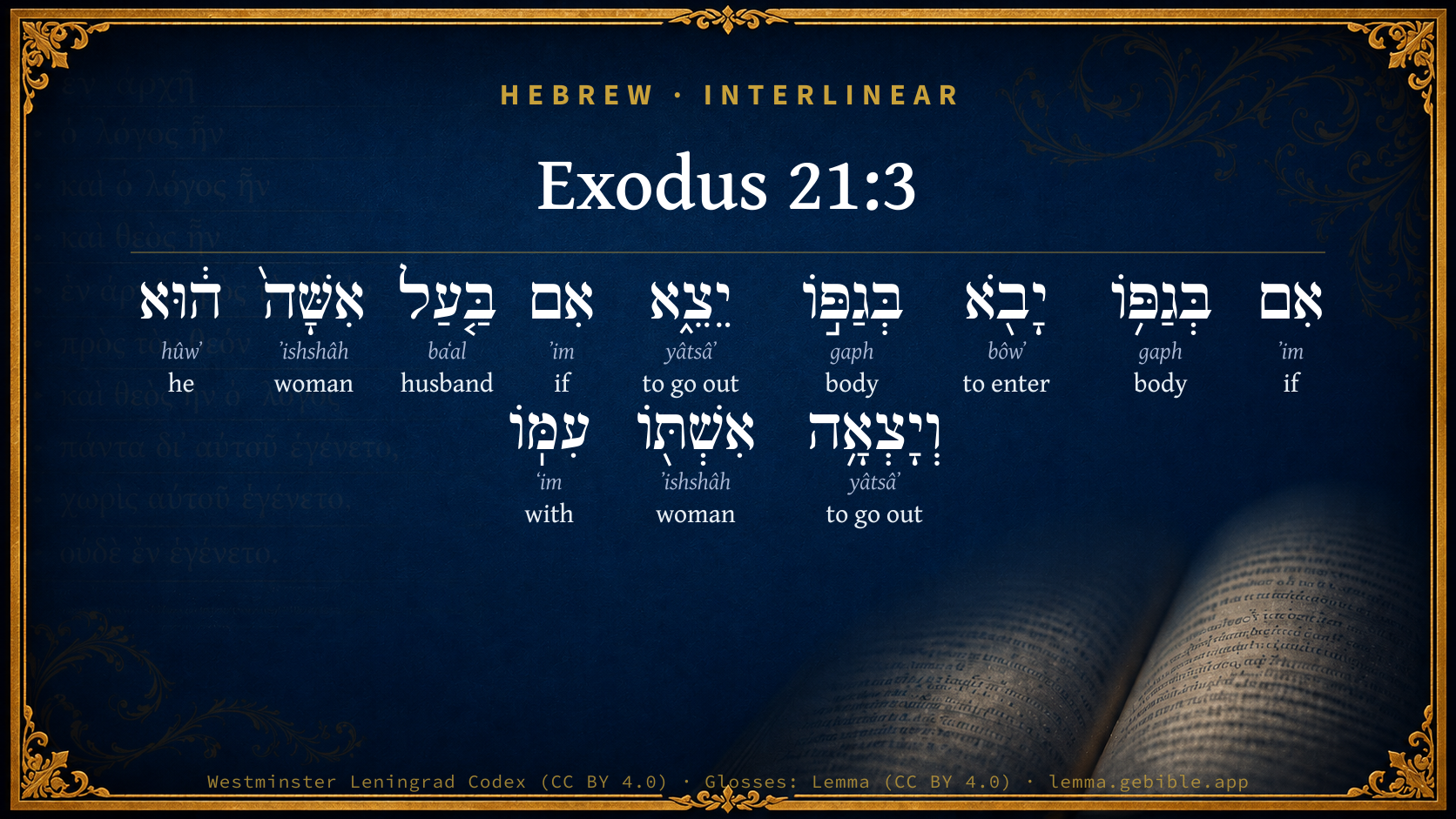
  1. אִם ʼim H518 “if” Conjunction
  2. יָבֹ֖א bôwʼ H935 “to enter” Verb, Qal, Imperfect, 3rd Person, Masculine, Singular
  3. בְּגַפּ֣וֹ gaph H1610 “in/at · body · his” Preposition + Noun, Common, Masculine, Singular, Construct + Suffix, Personal, 3rd Person, Masculine, Singular
  4. יֵצֵ֑א yâtsâʼ H3318 “to go out” Verb, Qal, Imperfect, 3rd Person, Masculine, Singular
  5. אִם ʼim H518 “if” Conjunction
  6. בַּ֤עַל baʻal H1167 “husband of” Noun, Common, Masculine, Singular, Construct
  7. אִשָּׁה֙ ʼishshâh H802 “woman” Noun, Common, Feminine, Singular, Absolute
  8. ה֔וּא hûwʼ H1931 “he” Pronoun, Personal, 3rd Person, Masculine, Singular
  9. וְיָצְאָ֥ה yâtsâʼ H3318 “and · to go out” Conjunction + Verb, Qal, Sequential Perfect, 3rd Person, Feminine, Singular
  10. אִשְׁתּ֖וֹ ʼishshâh H802 “woman · his” Noun, Common, Feminine, Singular, Construct + Suffix, Personal, 3rd Person, Masculine, Singular
  11. עִמּֽוֹ ʻim H5973 “with · him” Preposition + Suffix, Personal, 3rd Person, Masculine, Singular

About this verse

These counts appear in no published source. They are computed here, from the morphology-tagged text and Lemma’s own curated glosses. What Lemma adds →

12
words
8
distinct lemmas
Pentateuch
section

Notable vocabulary

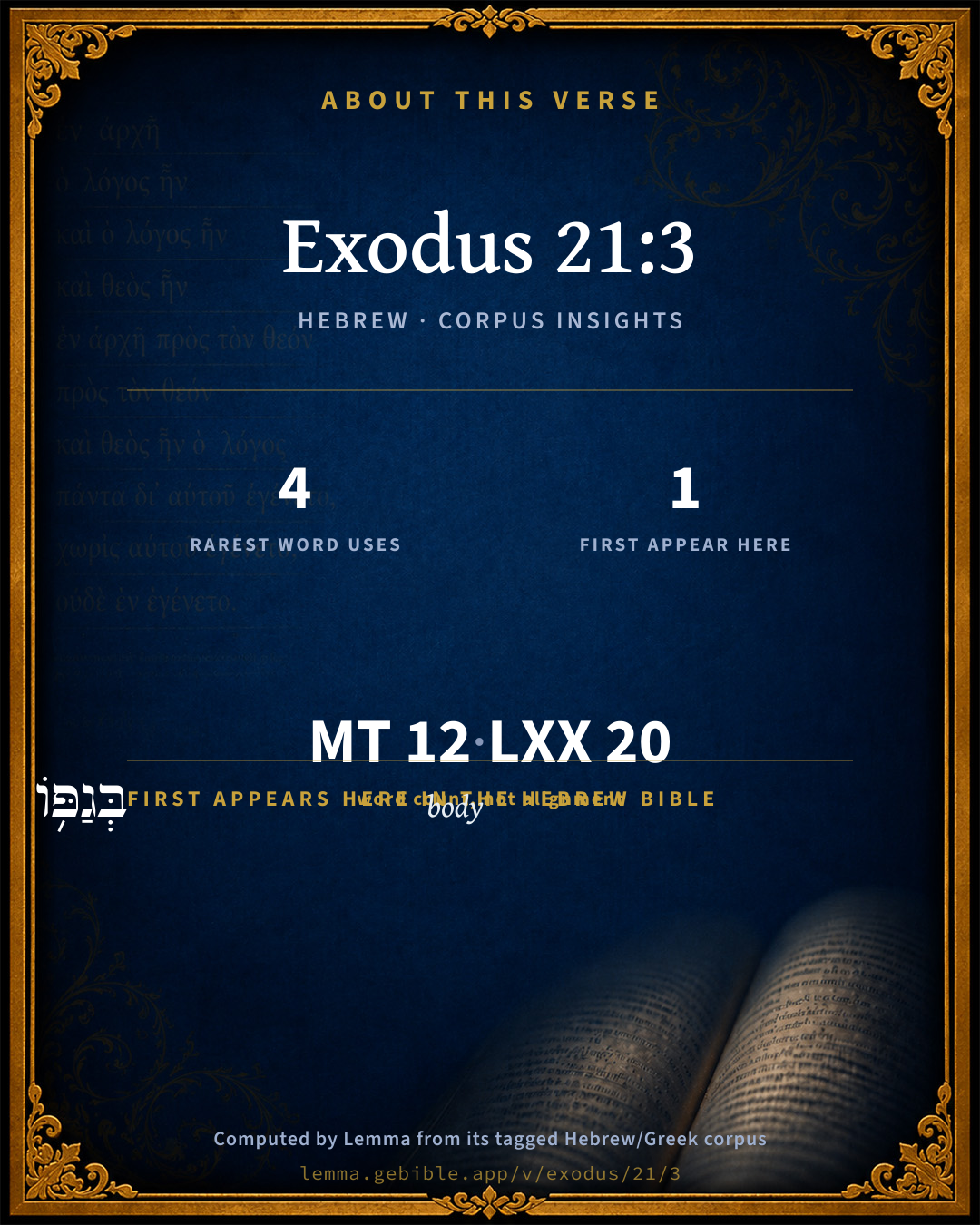
The rarest word here is בְּגַפּ֥וֹ body H1610 — appearing just 4 times in the whole Hebrew Bible.

First appearance in Scripture

This word makes its first canonical appearance in the Hebrew Bible here:

  • בְּגַפּ֥וֹ body H1610

Shared distinctive vocabulary

בְּגַפּ֥וֹ body H1610 occurs in 3 verses of the Hebrew Bible. Also found in:

Grammatical profile

  • 3 verbs
  • 5 nouns
  • 1 pronoun
  • 1 preposition
  • 2 conjunctions

Verb forms

  • יָבֹ֖א Qal · Imperfect
  • יֵצֵ֑א Qal · Imperfect
  • וְיָצְאָ֥ה Qal · Sequential Perfect

Repetition

Words recur within this verse — often emphatic in Hebrew:

  • בְּגַפּ֥וֹ body H1610 ×2
  • יֵצֵ֑א to go out H3318 ×2
  • אִשָּׁה֙ woman H802 ×2
  • אִם if H518 ×2

Hebrew & Septuagint length

In English translation the verse runs 24 words from the Hebrew and 30 from the Septuagint (LXX English) — closely comparable.

A rough comparison of the two English renderings, which tokenize alike — not a word-level alignment.

Word counts can differ between the Hebrew and the Greek without any difference in meaning — e.g. the Hebrew direct-object marker אֵת has no separate Greek word, and Greek often adds the article ὁ.

In the original languages it is 12 Hebrew tokens and 20 Greek tokens — but the two are counted differently (Hebrew bundles its prefixes and suffixes into one token; the Greek is in lemma form), so that isn’t a like-for-like length.

Cross-references

1

Topical passages linked to Exodus 21:3 in the Treasury of Scripture Knowledge — connected by theme and wording, ordered by reader-vote popularity; previews shown in the World English Bible.

  • Deuteronomy 15:12–14 If your brother, a Hebrew man, or a Hebrew woman, be sold to you, and serve you six years; then in the seventh year you shall let him go free from you.

Cross-references courtesy of OpenBible.info (CC BY 4.0).

Hebrew and Greek witnesses Masoretic Hebrew ↔ Greek Septuagint

The same verse in the two great witnesses to the Old Testament, shown verse-for-verse.

These are two independent witnesses, not word-aligned to each other, and the Septuagint is shown in lemma (dictionary) form.

Hebrew Exodus 21:3 Masoretic · Westminster Leningrad Codex

אִם בְּגַפּ֥וֹ יָבֹ֖א בְּגַפּ֣וֹ יֵצֵ֑א אִם בַּ֤עַל אִשָּׁה֙ ה֔וּא וְיָצְאָ֥ה אִשְׁתּ֖וֹ עִמּֽוֹ

If he comes in by himself, he shall go out by himself. If he is married, then his wife shall go out with him.

World English Bible · Public Domain

Greek LXX Exodus 21:3 Septuagint · lemma form

ἐάν αὐτός μόνος εἰςἔρχομαι καί μόνος ἐκἔρχομαι ἐάν δέ γυνή συν εἰςἔρχομαι μετά αὐτός ἐκἔρχομαι καί ὁ γυνή μετά αὐτός

If he should have come in alone, he shall also go forth alone; and if his wife should have gone in together with him, his wife also shall go out.

LXX2012 (modern English Septuagint) · Public Domain

On this verse, John Gill's Exposition discusses the Septuagint’s reading. Read the note in Commentary ↓

Hebrew: Westminster Leningrad Codex (CC BY 4.0). Greek: Septuagint (public domain); English from LXX2012 (modern English Septuagint) (Public Domain). How the Septuagint differs from the Hebrew →

Targum (Aramaic paraphrase)

2

The Targum is the ancient Jewish Aramaic paraphrase of the Hebrew Scriptures — an interpretive translation, not the Hebrew text itself. Onkelos (literal) and Pseudo-Jonathan (expansive) render the Torah, and Jonathan the Prophets. Coverage is partial: where no permissively-licensed English translation exists for a verse, only the Aramaic is shown. This is verse-level text, not a word-by-word alignment to the Hebrew.

  1. Targum Onkelos Torah (Genesis–Deuteronomy)
    אִם בִּלְחוֹדוֹהִי יֵיעוֹל בִּלְחוֹדוֹהִי יִפּוֹק אִם בְּעֵל אִתְּתָא הוּא וְתִפּוֹק אִתְּתֵהּ עִמֵהּ:

    (no public-domain English translation for this verse)

    Targum Onkelos — Aramaic: “Onkelos Genesis” (public domain); “Onkelos Exodus” (public domain); “Onkelos Leviticus” (public domain); “Onkelos Numbers” (public domain); “Onkelos Deuteronomy” (public domain). English: “Sefaria Community Translation” (CC0 1.0 (public-domain dedication)); “J.W. Etheridge. The Targums of Onkelos and Jonathan Ben Uzziel on the Pentateuch. London: Longmans, Green, 1862” (public domain). Text via Sefaria.

  2. Targum Pseudo-Jonathan Torah (Genesis–Deuteronomy)
    אִין בִּלְחוֹדוֹי יֵיעוֹל בִּלְחוֹדוֹי יִפּוֹק וְאִין מָרֵי אִינְתְּתָא בַּת יִשְרָאֵל הוּא וְתִיפּוֹק אִינְתְּתֵיהּ עִמֵּיהּ

    If he came in alone, he shall go out alone: but if (he be) the husband of a wife, a daughter of Israel, his wife shall go out with him.

    Targum Pseudo-Jonathan — Aramaic: “Targum Jonathan on Genesis” (public domain); “Targum Jonathan on Exodus” (public domain); “Targum Jonathan on Leviticus” (public domain); “Targum Jonathan on Numbers” (public domain); “Targum Jonathan on Deuteronomy” (public domain). English: “The Targum of Jonathan ben Uzziel, trans. J. W. Etheridge, London, 1862” (public domain). Text via Sefaria.

Commentary

Notes on Exodus 21:3 from classic Christian and Jewish commentators (each source and its license shown beneath its notes). The classic Christian expositions comment on the surrounding passage and are grouped to its opening verse, so a note may address several verses; the Jewish commentaries on the Tanakh (Rashi and others) are per-verse, so they appear only where the commentator wrote on this verse.

Lemma curates 59 commentaries, every one of them public domain or Creative Commons licensed, each selected and text-cleaned for this edition rather than reprinted as found. About our sources →

Trapp's Complete Commentary

John Trapp

Exo 21:3 If he came in by himself, he shall go out by himself: if he were married, then his wife shall go out with him.

Ver. 3. If he came in by himself,] Without a second-self, a yoke fellow, standing on even ground with himself, though drawing on the left side.

John Trapp, A Commentary or Exposition upon All the Books of the Old and New Testament (1647–1656) — public domain. Text from a community e-Sword module.

Joseph Benson's Commentary

Exo 21:3. If he came in by himself — That is, single, he shall so depart: if married, his wife was to depart with him.

Joseph Benson's Commentary on the Old and New Testaments (1811–1818) — public domain. Text from a community e-Sword module.

Tyndale Open Study Notes

Tyndale Open Resources

21:3 If a man and a wife went into slavery together, they were also to go free together.

Tyndale Open Study Notes — © Tyndale Open Resources, licensed CC BY-SA 4.0. Text via the HelloAO Bible API.

Geneva Bible (1599)

Geneva Bible translators

Not having wife nor children.

Geneva Bible (1599) marginal notes — public domain. Text via Bolls.life.

Adam Clarke's Commentary

Verse 3. If he came in by himself] If he and his wife came in together, they were to go out together: in all respects as he entered, so should he go out. This consideration seems to have induced St. Jerome to translate the passage thus: Cum quali veste intraverat, cum tali exeat. "He shall have the same coat in going out, as he had when he came in," i.e., if he came in with a new one, he shall go out with a new one, which was perfectly just, as the former coat must have been worn out in his master's service, and not his own.

Adam Clarke's Commentary on the Bible (1810–1826) — public domain. Text from a community e-Sword/MySword module.

Ellicott's Commentary for English Readers

(3) His wife shall go out with him.—The privilege of the married Hebrew slave was to attach also to his wife, if he was married when he became a slave. It further, no doubt, attached to his children.

A Bible Commentary for English Readers, edited by Charles John Ellicott (1878–1897) — public domain. Text from a community e-Sword module.

The Cambridge Bible for Schools and Colleges

gen. ed. J. J. S. Perowne

3. First and second of the special cases, viz. the cases (1) of an unmarried slave, and (2) of one married before he became a slave. There is no counterpart to this and the following verse in Dt.

by himself (twice)] lit. with his back or body, and with nothing else, i.e. alone, without wife or child. A peculiar expression, found only here and v. 4.

married] Heb. the possessor of a woman (or wife); so v. 22; ba‘al, ‘possessor,’ also, in the sense of ‘husband,’ Gen_20:3, Deu_24:4 al. The woman, being the possession of her husband, naturally shared his fortunes, and both entered into servitude, and left it, with him.

The Cambridge Bible for Schools and Colleges (gen. ed. J. J. S. Perowne; Cambridge University Press, 1878–1918) — public domain. Text from a community e-Sword module.

John Gill's Exposition

If he came in by himself, he shall go out by himself,.... That is, if he came into his servitude "alone", as the Septuagint version has it, he should go out of it in like manner; the word for "by himself", some interpret with "his garment" (f), or the skirt of one; and then the sense seems to be, that as he was clothed when he was sold, so he should be when made free: but rather the phrase literally is "with his body" (g); not his naked body, or as destitute of raiment, and the necessaries of life; for, as before observed, his master was to furnish him liberally with good things: but the plain meaning is, that if he was a single or unmarried man when he entered his master's service, he should go out, so; or as a Jewish writer (h) expresses it, as if he should say, with his body, without another body with him, who is his wife, as appears by what follows; unless his master should give him a wife while in his service, which is supposed in the next verse, and even then he was to go out alone, if he chose to go out at all; though Jarchi says, if he was not married at first, his master might not give him a Canaanitish woman to beget slaves of her:

if he were married, then his wife shall go with him; that is, if he had a wife, a daughter of Israel, as the Targum of Jonathan; or an Israelitish woman, as Jarchi, and had her at his coming; for otherwise, if it was one his master after gave him, she might not go out, as appears by the following verse; but being his wife before his servitude, and an Israelitish woman, was not the master's bondmaid, nor bought with his money, and therefore might go out free with her husband.

(f) "cum quali veste", V. L. "cum veste sua"; some in Vatablus & Drusius. (g) "Cum corpore suo", Munster, Pagninus, Vatablus, Drusius; "solus corpore suo", Junius & Tremellius; "cum solo corpore suo", Piscator. (h) R. Sol. Urbin. Ohel Moed, fol. 15. 1.

John Gill's Exposition of the Whole Bible (1746–1763) — public domain (CC PDM 1.0). Text via the HelloAO Bible API.

Albert Barnes' Notes on the Bible

If a married man became a bondman, his rights in regard to his wife were respected: but if a single bondman accepted at the hand of his master a bondwoman as his wife, the master did not lose his claim to the woman or her children, at the expiration of the husband’s term of service. Such wives, it may be presumed, were always foreign slaves.

Albert Barnes' Notes on the Bible (1834–1885) — public domain. Text from a community e-Sword/MySword module.

Haydock's Catholic Bible Commentary

Raiment. Hebrew Gaph may signify also the body. "If he come (with his body) alone, let him so depart," Septuagint. (Calmet)

George Leo Haydock (1774–1849), Haydock's Catholic Family Bible and Commentary, 1859 edition — public domain. Excludes Psalms (Douay-Rheims chapter numbering differs from Protestant) and Deuterocanonical books (Catholic canon only).

Matthew Poole's English Annotations

By himself, i.e. with his own person only, not with a wife, as the opposite branch showeth.

Matthew Poole's English Annotations on the Holy Bible (1683–1685) — public domain. Text from a community e-Sword/MySword module.

The Pulpit Commentary

If he came in by himself, etc.. The first clause of this verse is further explained in the next; the second secured to the wife who went into slavery with her husband a participation in his privilege of release at the end of the sixth year.

The Pulpit Commentary (1880–1919), ed. H.D.M. Spence-Jones & Joseph S. Exell — public domain. Text from a community e-Sword module.

Keil & Delitzsch

C. F. Keil & F. Delitzsch

There were three different circumstances possible, under which emancipation might take place. The servant might have been unmarried and continued so (בּגפּו: with his body, i.e., alone, single): in that case, of course, there was no one else to set at liberty. Or he might have brought a wife with him; and in that case his wife was to be set at liberty as well. Or his master might have given him a wife in his bondage, and she might have borne him children: in that case the wife and children were to continue the property of the master. This may appear oppressive, but it was an equitable consequence of the possession of property in slaves at all. At the same time, in order to modify the harshness of such a separation of husband and wife, the option was given to the servant to remain in his master's service, provided he was willing to renounce his liberty for ever (Exo 21:5, Exo 21:6). This would very likely be the case as a general rule; for there were various legal arrangements, which are mentioned in other places, by which the lot of Hebrew slaves was greatly softened and placed almost on an equality with that of hired labourers (cf. Exo 23:12; Lev 25:6, Lev 25:39, Lev 25:43, Lev 25:53; Deu 12:18; Deu 16:11). In this case the master was to take his servant האלהים אל, lit., to God, i.e., according to the correct rendering of the lxx, πρὸς τὸ κριτήριον, to the place where judgment was given in the name of God (Deu 1:17; cf. Exo 22:7-8, and Deu 19:17), in order that he might make a declaration there that he gave up his liberty. His ear was then to be bored with an awl against the door or lintel of the house, and by this sign, which was customary in many of the nations of antiquity, to be fastened as it were to the house for ever. That this was the meaning of the piercing of the ear against the door of the house, is evident from the unusual expression in Deu 15:17, "and put (the awl) into his ear and into the door, that he may be thy servant for ever," where the ear and the door are co-ordinates. "For ever," i.e., as long as he lives. Josephus and the Rabbins would restrict the service to the time ending with the year of jubilee, but without sufficient reason, and contrary to the usage of the language, as לעלם is used in Lev 25:46 to denote service which did not terminate with the year of jubilee. (See the remarks on Lev 25:10; also my Archologie.)

Keil & Delitzsch — Biblical Commentary on the Old Testament (1861–1891) — public domain (CC PDM 1.0). Text via the HelloAO Bible API. (Old Testament only.)

Rashi

Rabbi Shlomo Yitzchaki (Rashi)

אם בגפו יבא IF HE CAME IN BY HIMSELF — This means that he was unmarried — as the Targum renders it אם בלחודוהי, if he came in “alone”. The term בגפו is the same as גף) בכנפו being synonymous with כנף wing, skirt) i. e. he came in only just as he was, alone, merely wrapped in his garment: so that בגפו, “in his skirt”, means “in the skirt of his garment”.

בגפו יצא HE SHALL GO OUT BY HIMSELF — This intimates that if he was unmarried originally (when he came in), his master is not allowed to give him against his will a Canaanitish handmaid with the object of raising slaves (Kiddushin 20a).

אם בעל אשה הוא IF HE BE MARRIED to an Israelite woman (Mekhilta),

ויצאה אשתו עמו then HIS WIFE SHALL GO OUT WITH HIM — But who brought her in (into the state of service) that the text has to state she shall go out? But by saying this Scripture intimates that he who acquires a Hebrew servant is bound to provide his wife and children also with food (Mekhilta; Kiddushin 22a).

Rashi on the Tanakh — English translations: “The Judaica Press complete Tanach with Rashi, translated by A. J. Rosenberg” (CC BY 4.0); “Pentateuch with Rashi's commentary by M. Rosenbaum and A.M. Silbermann, 1929-1934” (public domain); “The Metsudah Tanach series, Lakewood, N.J” (CC BY 4.0); and “The Book of Joshua, Metsudah Publications, 1997” (CC BY 4.0). Text via Sefaria.

Ramban (Nachmanides)

Rabbi Moshe ben Nachman (Ramban / Nachmanides)

THEN HIS WIFE SHALL GO OUT WITH HIM. Rashi commented: “But who brought her in, that Scripture need say that she shall go out with him? But [by saying this], Scripture tells us that he who acquires a Hebrew servant is obliged to provide for the food of his wife and children.” This is a Midrash of the Sages. Now [even though the children are not mentioned in this verse, but only his wife,] the Rabbis have included the children together with the wife in this duty of the master, on the basis of what is written further on, Then he shall go out from thee, he and his children with him. I am not clear on this law as to whether the earnings of the woman and children belong to the master during the time he is supporting them. It appears to me that the master takes the place of the husband [in this respect]. For the Torah had compassion on the wife and children, whose lives are hanging in suspense, and who expect [to be supported from] the husband’s earnings, since now that he is sold as a servant, they are in danger of being lost in their misery. Therefore the Torah commanded the master who is now entitled to the servant’s labor, to act towards them as he [the servant] would. If so, the master only has to assume the responsibilities of the husband, [and no more]; thus he is entitled to their labor as is the husband, and in return he must feed and support them. This is the meaning of the expression, then his wife shall go out with him, since the servant’s wife was together with him as a handmaid to his master, for the labor of both of them belongs to him, in return for which he is obliged to give them food. Thus the only difference between husband and wife is that the wife has a right to go away as she pleases, [and is not bound to work for her husband’s master if she does not want to be supported by him, whilst the husband, who is the servant, is bound to the master]. Similarly, the master’s obligation to support the children is limited to the time that the father is responsible for them, namely when they are minors, or as long as is customary to feed them, as Rashi explained in Tractate Kiddushin. All this is out of G-d’s compassion for them [the wife and children], and for the servant as well so that he should not die in his anguish, in the knowledge that whilst he is toiling in a strange house, his children and wife are neglected. Now even though he is not obliged by law of the Torah to support them, as has been explained in the Talmud, Tractate Kethuboth, but since it is the normal way of life for a man to support his wife and small children, G-d in His mercies commanded the buyer [of the servant] to act to them as a merciful father. The meaning of the Sages in speaking of banav [literally: “his sons”] is both sons and daughters.I have seen written in the Mechilta: “I might think that the master is obliged to support the betrothed [of the servant] and the childless widow of his brother who is waiting for him to marry or reject her? Scripture therefore says, his wife, thus excluding the brother’s childless widow who is waiting for him, since she is not yet his wife. With him, this excludes the betrothed who, [even though she is his wife], is not yet with him.” This Mechilta is a proof to the law which I have stated, for since it is not customary for the betrothed and the childless brother’s widow to be supported by the man [in this case the servant], therefore the Torah did not impose their support upon the master either. And even if the brother-in-law or the bridegroom became liable by law at a certain time known in the Talmud (the heave-offering) as if she was already his wife. A later Mishnah though, ruled that a woman may not eat heave-offering until she has entered the bride-chamber (Kethuboth 57 b). to support them, that obligation was in the nature of other debts they may have, and therefore the master did not become liable to support them.Again I have found in another Mechilta of Rabbi Shimon: “If he be married then his wife shall go out with him. Just as the master is obliged to feed the servant, so he is obliged to feed his wife and children. Still I might say: if the servant had a wife and children before he was bought, then his master is obliged to feed them, because he bought him on that condition, but if he had a wife and children only after he was bought I might think that his master is not obliged to feed them. Scripture therefore says, if he be married, then his wife shall go out with him.” The word “wife” is thus mentioned twice, once to indicate etc. (see text). etc. There are thus two wives mentioned here, one referring to a wife that he had before his master bought him, and the other referring to a wife he had after he was bought. I might think that even if he had just a betrothed wife, or a childless brother’s widow who is waiting for him, whom the servant himself is not obliged to feed, that nonetheless his master is obliged to support them, and proof for that argument I might find in the fact that the husband himself is not obliged [by law of the Torah, as explained above] to feed his own wife and children, and yet, the master of the servant is obliged to feed the wife and children of his servant; Scripture therefore says, then his wife shall go out with him — that wife who is with him, the master is obliged to feed, but he is not bound to feed a wife who is not with him. I might think that even if the servant’s wife was one with whom it is not correct for him to continue living — such as a widow married to a High Priest, or a divorcee or profaned woman married to a common priest — [that the master is bound to feed her]; Scripture therefore says, then his wife shall go out with him — one that is fit to live with him, but not this one etc. I might think that even if he married without the master’s knowledge [the master is obliged to feed her]; Scripture therefore says, if ‘he’ be married — just as ‘he’ was acquired with the master’s knowledge, so his wife [whom the master must support] means one taken with the master’s knowledge. I might think that the earnings of his sons and daughters belong to the master, and it is logical that it be so: for if we see in the case of a Canaanite bondman, whose master is not bound to feed him, that nonetheless the earnings of his sons and daughters belong to the master, then surely it is logical that in the case of a Hebrew servant, whose master is obliged to feed him, that the earnings of his sons and daughters should belong to his master! Scripture therefore says: he (if ‘he’ be married) — it is he whose earnings belong to his master, but not those of his sons and daughters. Then his wife shall go out with him — do not separate him from his wife; do not separate him from his children.” Thus far the language of this Beraitha., Note 209.Yet I continue to say as I have written above, that if the servant’s wife and children want to be supported by the master, that he may take their earnings, and this Beraitha quoted above intends only to tell us that they are not his by absolute right, as is the law of the Canaanite bondman, or as is the law of the Hebrew servant himself, [who must of necessity work for their master], but they [the wife and children of the Hebrew servant] can say to him: “We will not be fed by you, and we will not work for you.” What is new in this Beraitha is that if the servant married without the consent of his master, he is not bound to feed the wife or her children, for since it is within the power of his master to give him a Canaanite bondmaid, he is not obliged to feed this Israelite woman. The Rabbis further interpreted the word imo (with him) to teach us that you are not to separate him from his wife and children, which means to say that the master cannot tell him: “Be together with the handmaid I gave you and sleep with her at night, and not with the Israelite wife,” but the servant has the right to choose for himself.

Ramban (Nachmanides) on the Tanakh — English translation: “Commentary on the Torah by Ramban (Nachmanides). Translated and annotated by Charles B. Chavel. New York, Shilo Pub. House, 1971-1976” (CC BY 4.0). Text via Sefaria.

Lesson kit

Teaching starters — assembled from the data on this page, not authored interpretation. Every prompt links to the verse data it draws on. Edit before teaching.

Exodus, in the Pentateuch, opens this verse with 12 words (8 distinct Hebrew lemmas). Its most distinctive word is gaph (“body”). A historical commentator’s framing appears above. Read the whole chapter for the surrounding context.

Discussion questions

  1. How does “body” (gaph) shape what this verse is saying?
  2. The word “body” first appears here in Scripture. What is being introduced at this debut?
  3. Exodus 21:4 shares the word «body» with this verse. How do the two illuminate each other?
  4. “body” occurs 2× in this one verse. What is the effect of the repetition?
  5. The translations on this page render this verse differently — a whole-verse word diff, not a word-by-word alignment. What might account for the different wordings?
  6. The verb «יָבֹ֖א» is Qal Imperfect. How does its form color the action?
  7. Reading how Trapp's Complete Commentary and Joseph Benson's Commentary read this verse, where do the two commentators agree and where do they part?

Things to notice

Reading settings

Reading text

Shown beneath each verse's original-language words.

Old Testament
Old Testament edition

Read the OT as the Masoretic Hebrew (MT) or the Greek Septuagint (LXX).

English shown for the Greek Septuagint (in the Hebrew ↔ Greek comparison).

Comparing translations? Open the Compare panel on any verse page to stack up to four side by side.