
Acts 3:8

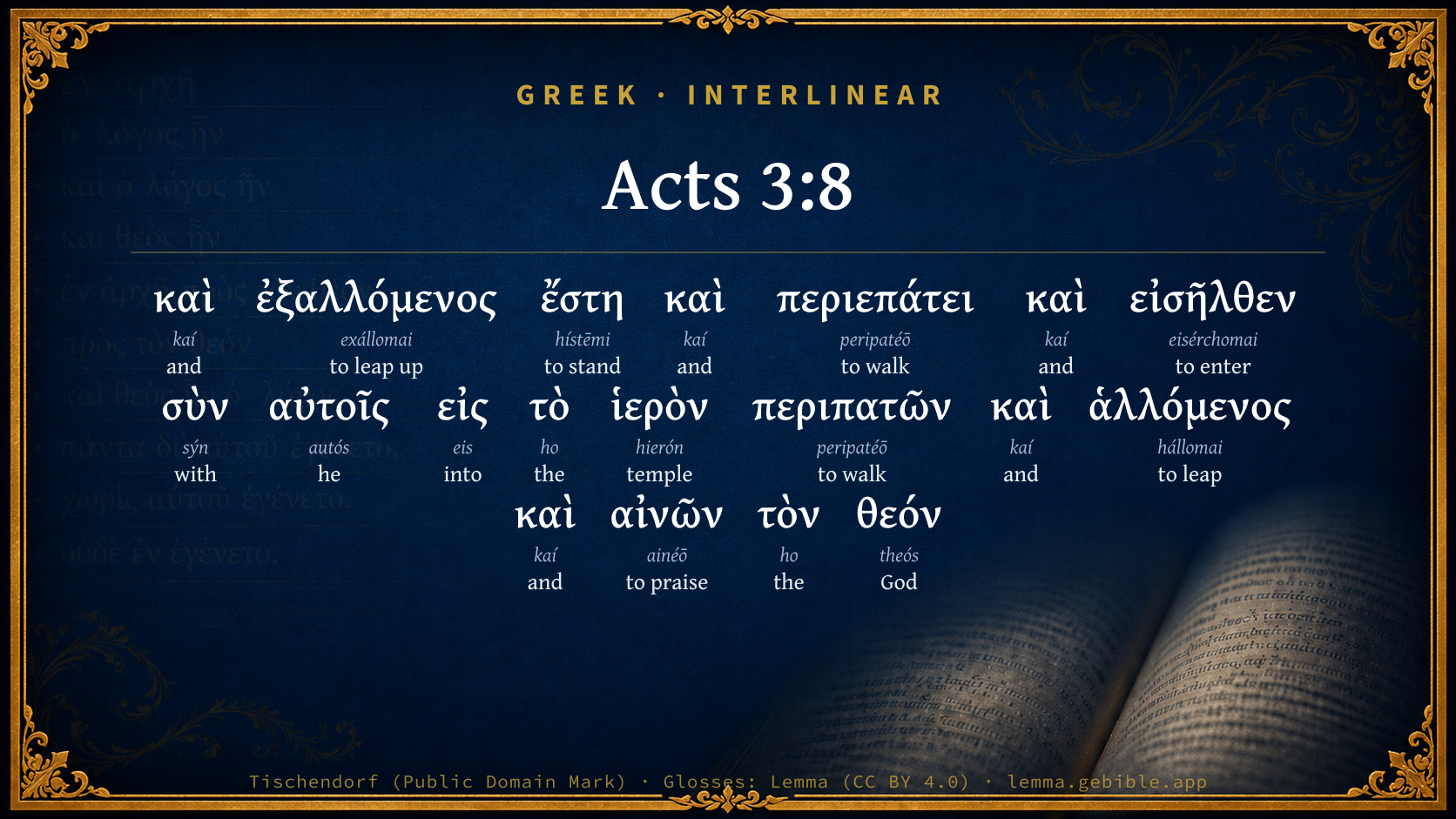
Greek (Tischendorf 8th ed.) Acts 3:8 appears in the Greek New Testament. The text above is from the Tischendorf 8th edition. Each word links to its Strong’s number and a concise gloss. Click any word for its full Thayer’s Greek Lexicon entry.
Download image
Cite this verse

Acts 3:8 (World English Bible). Public Domain. Lemma interlinear Bible study tool, https://lemma.gebible.app/v/acts/3/8.

Show BibTeX & RIS
BibTeX
RIS
English Translation
Leaping up, he stood, and began to walk. He entered with them into the temple, walking, leaping, and praising God.
World English Bible · Public Domain
Highlights
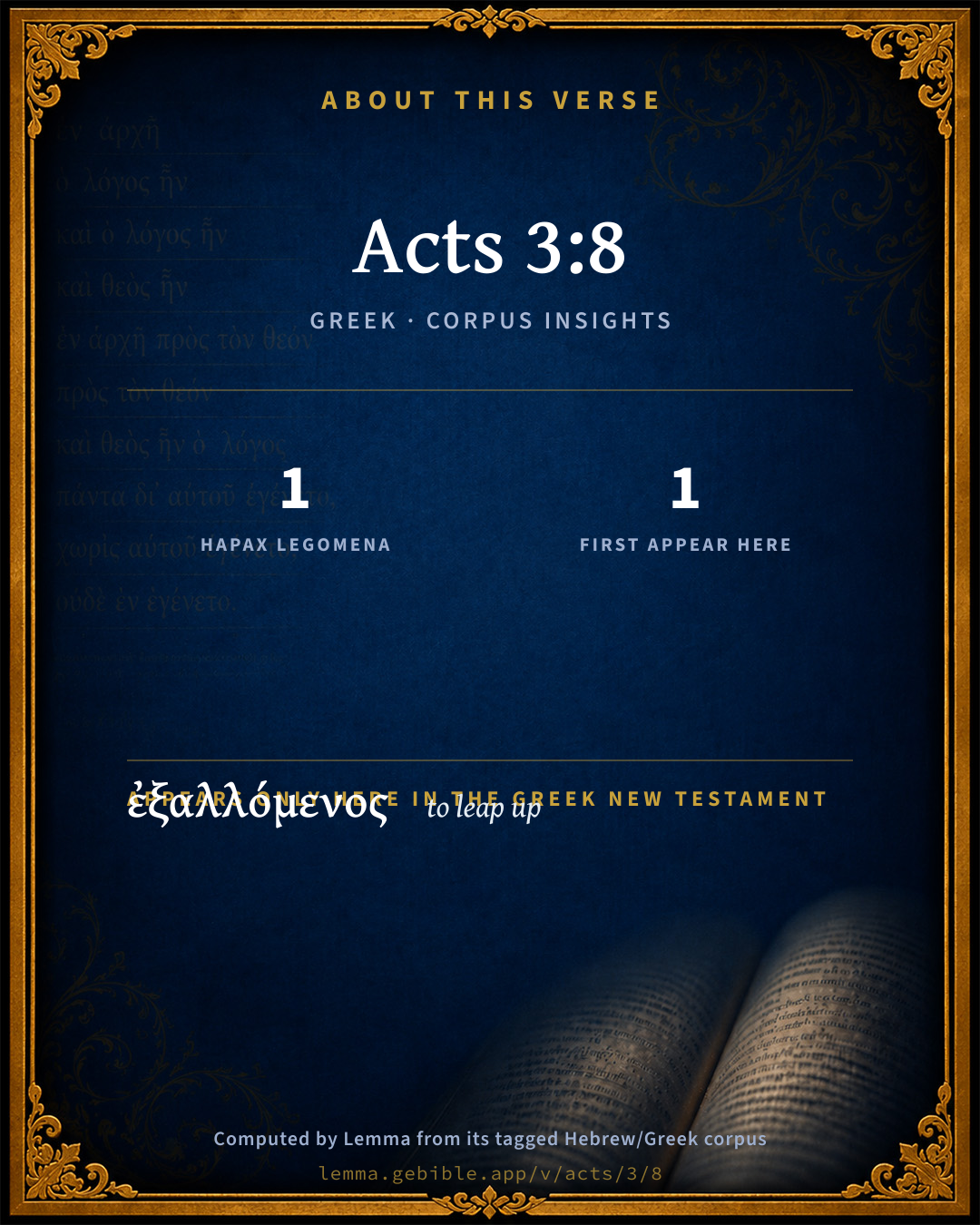
  • 1 hapax legomenon — only here in the Greek New Testament
  • 1 first appearance in the Greek New Testament
Full analysis ↓
Download a study sheet

One document with this verse’s original text, its word-by-word gloss line, the meaning frame, cross-references with their text, attributed commentary, and full source and license credits — printable, and it pastes into notes with its structure intact.

This verse Autodidact and up

Study sheet (.html) Plain text (.txt)

A passage Seminary Student

Up to 50 verses in one chapter. A passage sheet keeps up to 6 commentary sources and 12 cross-references per verse, in the order this page ranks them, and says so on the sheet whenever that leaves anything out. Ask for a single verse and you get the Autodidact verse sheet above.

Everything on this page stays free to read, with no account — the sheet is a download of what is already on screen, not access to it.

Want to remove ads? Support Godless Engineer
Compare translations 3

The same verse in 3 English versions, stacked beneath the original-language interlinear above. Click any original word for its lexicon entry.

Each is an independent rendering of the whole verse — the interlinear is not word-aligned to these translations.

Highlighted words mark where these versions differ — a whole-verse word diff, not a word-by-word alignment.

  • World English Bible Public Domain
    Leaping up, he stood, and began to walk. He entered with them into the temple, walking, leaping, and praising God.
  • King James Version Public Domain
    And he leaping up stood, and walked, and entered with them into the temple, walking, and leaping, and praising God.
  • unfoldingWord Literal Text CC BY-SA 4.0
    And leaping up, he stood and began to walk, and he entered with them into the temple, walking and leaping and praising God.

unfoldingWord Literal Text — © unfoldingWord, licensed CC BY-SA 4.0. Word-aligned USFM3 via Door43 (git.door43.org/unfoldingWord/en_ult).

Versions to compare (up to 4)

3 of 4 selected

Show all 19 translations

Every available English version of this verse, each an independent rendering of the whole verse.

  • World English Bible Public Domain
    Leaping up, he stood, and began to walk. He entered with them into the temple, walking, leaping, and praising God.
  • Berean Standard Bible Public Domain
    He sprang to his feet and began to walk. Then he went with them into the temple courts, walking and leaping and praising God.
  • Majority Standard Bible Public Domain
    He sprang to his feet and began to walk. Then he went with them into the temple courts, walking and leaping and praising God.
  • King James Version Public Domain
    And he leaping up stood, and walked, and entered with them into the temple, walking, and leaping, and praising God.
  • American Standard Version (1901) Public Domain
    And leaping up, he stood, and began to walk; and he entered with them into the temple, walking, and leaping, and praising God.
  • Revised Version (1885) Public Domain
    And leaping up, he stood, and began to walk; and he entered with them into the temple, walking, and leaping, and praising God.
  • Geneva Bible (1599) Public Domain
    And he leaped vp, stoode, and walked, and entred with them into the Temple, walking and leaping, and praysing God.
  • Douay-Rheims (1899) Public Domain
    And he leaping up, stood, and walked, and went in with them into the temple, walking, and leaping, and praising God.
  • Young's Literal Translation Public Domain
    and springing up, he stood, and was walking, and did enter with them into the temple, walking and springing, and praising God;
  • Literal Standard Version CC BY-SA 4.0
    and springing up, he stood, and was walking, and entered with them into the temple, walking and springing, and praising God;
  • Unlocked Literal Bible CC BY-SA 4.0
    Leaping up, the lame man stood and began to walk; and he entered with Peter and John into the temple, walking, leaping, and praising God.
  • unfoldingWord Literal Text CC BY-SA 4.0
    And leaping up, he stood and began to walk, and he entered with them into the temple, walking and leaping and praising God.
  • Darby Bible Public Domain
    And leaping up he stood and walked, and entered with them into the temple, walking, and leaping, and praising God.
  • World Messianic Bible Public Domain
    Leaping up, he stood and began to walk. He entered with them into the temple, walking, leaping, and praising God.
  • Webster's Bible Public Domain
    And he leaping up stood, and walked, and entered with them into the temple, walking, and leaping, and praising God.
  • Free Bible Version CC BY-SA 4.0
    He jumped to his feet, and then began to walk. He went with them into the Temple, walking and jumping and praising God.
  • Bible in Basic English Public Domain
    And, jumping up, he got on to his feet and went into the Temple with them, walking and jumping and giving praise to God.
  • Text-Critical English NT CC BY 4.0
    Leaping up, he stood and began walking. Then he entered the temple courts with them, walking and leaping and praising God.
  • Tyndale New Testament (1534) Public Domain
    And he sprage stode and also walked and entred with them into the temple walkinge and leapinge and laudynge God.

Literal Standard Version (2020), Covenant Press — licensed CC BY-SA 4.0. Text via the HelloAO Bible API (eBible.org). Unlocked Literal Bible (unfoldingWord) — licensed CC BY-SA 4.0. Text via the HelloAO Bible API (eBible.org). unfoldingWord Literal Text — © unfoldingWord, licensed CC BY-SA 4.0. Word-aligned USFM3 via Door43 (git.door43.org/unfoldingWord/en_ult). Free Bible Version, Dr. Jonathan Gallagher — licensed CC BY-SA 4.0. Text via the HelloAO Bible API (eBible.org).

Word by word

More ways to search: Search by grammar → Find every occurrence → Compare this word →

Practice this passage: Drill this verse → Learn its vocabulary →

ἐξαλλόμενος
exállomai
G1814
“to leap up”
Verb, Present, Middle or Passive deponent, Participle, Nominative, Singular, Masculine
Part of Speech
Verb
Tense
Present
Voice
Middle or Passive deponent
Mood
Participle
Case
Nominative
Number
Singular
Gender
Masculine
Full Thayer's Definition

Origin: from G1537 and G242

TDNT: None

1. to leap up
  1. καὶ kaí G2532 “and” Conjunction
  2. ἔστη hístēmi G2476 “to stand” Verb, Aorist, Active, Indicative, 3rd person, Singular
  3. καὶ kaí G2532 “and” Conjunction
  4. περιεπάτει peripatéō G4043 “to walk” Verb, Imperfect, Active, Indicative, 3rd person, Singular
  5. καὶ kaí G2532 “and” Conjunction
  6. εἰσῆλθεν eisérchomai G1525 “to enter” Verb, Aorist, Active, Indicative, 3rd person, Singular
  7. σὺν sýn G4862 “with” Preposition
  8. αὐτοῖς autós G846 “he” Personal pronoun, Dative, Plural, Masculine
  9. εἰς eis G1519 “into” Preposition
  10. τὸ ho G3588 “the” Article, Accusative, Singular, Neuter
  11. ἱερὸν hierón G2411 “temple” Noun, Accusative, Singular, Neuter
  12. περιπατῶν peripatéō G4043 “to walk” Verb, Present, Active, Participle, Nominative, Singular, Masculine
  13. καὶ kaí G2532 “and” Conjunction
  14. ἁλλόμενος hállomai G242 “to leap” Verb, Present, Middle or Passive deponent, Participle, Nominative, Singular, Masculine
  15. καὶ kaí G2532 “and” Conjunction
  16. αἰνῶν ainéō G134 “to praise” Verb, Present, Active, Participle, Nominative, Singular, Masculine
  17. τὸν ho G3588 “the” Article, Accusative, Singular, Masculine
  18. θεόν theós G2316 “God” Noun, Accusative, Singular, Masculine

About this verse

These counts appear in no published source. They are computed here, from the morphology-tagged text and Lemma’s own curated glosses. What Lemma adds →

19
words
13
distinct lemmas
Acts
section

Notable vocabulary

1 hapax legomenon — a word that appears only here in the entire Greek New Testament:

  • ἐξαλλόμενος to leap up G1814

First appearance in Scripture

This word makes its first canonical appearance in the Greek New Testament here:

  • ἐξαλλόμενος to leap up G1814

Shared distinctive vocabulary

ἁλλόμενος to leap G242 occurs in 3 verses of the Greek New Testament. Also found in:
Repetition

Words recur within this verse:

  • περιεπάτει to walk G4043 ×2
  • καὶ and G2532 ×5
  • τὸ the G3588 ×2

Cross-references

9

Topical passages linked to Acts 3:8 in the Treasury of Scripture Knowledge — connected by theme and wording, ordered by reader-vote popularity; previews shown in the World English Bible.

  • Isaiah 35:6 Then shall the lame man leap as a hart, and the tongue of the mute shall sing; for in the wilderness shall waters break out, and streams in the desert.
  • Acts 14:10 said with a loud voice, "Stand upright on your feet!" He leaped up and walked.
  • Psalms 107:20–22 He sends his word, and heals them, And delivers them from their graves.
  • Psalms 103:1–2 Praise Yahweh, my soul! All that is within me, praise his holy name!
  • Luke 6:23 Rejoice in that day, and leap for joy, for behold, your reward is great in heaven, for their fathers did the same thing to the prophets.
  • Luke 17:15–18 One of them, when he saw that he was healed, turned back, glorifying God with a loud voice.
  • John 5:14 Afterward Jesus found him in the temple, and said to him, "Behold, you are made well. Sin no more, so that nothing worse happens to you."
  • Luke 18:43 Immediately he received his sight, and followed him, glorifying God. All the people, when they saw it, praised God.
  • John 5:8–9 Jesus said to him, "Arise, take up your mat, and walk."

Cross-references courtesy of OpenBible.info (CC BY 4.0).

Commentary

Notes on Acts 3:8 from classic Christian and Jewish commentators (each source and its license shown beneath its notes). The classic Christian expositions comment on the surrounding passage and are grouped to its opening verse, so a note may address several verses; the Jewish commentaries on the Tanakh (Rashi and others) are per-verse, so they appear only where the commentator wrote on this verse.

Lemma curates 59 commentaries, every one of them public domain or Creative Commons licensed, each selected and text-cleaned for this edition rather than reprinted as found. About our sources →

The Biblical Illustrator

Joseph S. Exell

Act_3:8

And he leaping up stood.

The healed mans activity and gratitude

The evangelist describes minutely the actions of the lame man as soon as he began to believe that he was healed. First he leaped forth, releasing himself from the hold of Peter, or leaped up, as if trying the strength of his muscle; then he stood on his feet for the first time in his life, and walked around, to see whether the same power of walking belonged to him which all that were about had. But the pen of the writer, not content with this, adds graphically, And he entered with them, unwilling to be separated from the instruments of his cure, into the temple, practising his newly acquired powers without the ability to restrain himself, now walking, now leaping, and all the while praising God. Then did the lame man leap as an hart. He was of another kind from the nine lepers, who never looked back to give thanks to the Lord Jesus. (Pres. Woolsey.)

Practical gratitude

They who have witnessed our frailties should also attest our conversion and gratitude. Our gratitude is false and of no avail unless accompanied with newness of life; and this cannot endure long if our thankful sense of the grace to which we owe our deliverance declines. (Quesnel.)

The responsibilities of the saved

Sin has reduced the ,soul to a state of impotence. It has not destroyed the souls powers, but only disabled them. When a man is saved, therefore, his crippled powers are straightened and strengthened, and his new vocation is to use them.

I. What faculties are crippled by sin and restored by Christ?

1. Faith. This exists in every soul, but is dormant or perverted. Christ straightens it out and empowers it as an eye to see, a hand to grasp Him and heavenly things.

2. Love. No man is destitute of this: but it is wrenched away from its highest Object, who is its true life, and rests upon unworthy objects often, on secondary objects at best whom it cannot love fully, because unrecruited by the love of God. We love (R.V.) because He first loved us. Salvation largely consists in the conversion of the heart, the turning of all the affections to Christ, by whom they are invigorated and sanctified, and made to flow in worthy channels.

3. The will. Paul has given us a graphic picture of what that is in the natural man (Rom_7:1-25.) and what Christ makes it (Rom_8:1-39. and his own life).

4. The active powers. These again are paralysed for all spiritual purposes, but energetic enough in the cause of evil--the tongue: how silent for God, how glib for self or for folly or sin! the hands, how idle for God, how active in other causes! Christ restores these to their true uses, and consecrates them to the service of God.

II. The restored faculties must be employed. Otherwise they will fall into their old decrepitude. Had the lame man returned to his haunt, and neglected to use his limbs, those limbs would soon have become helpless once more. To neglect faith, love, resolution and work for God is to forfeit them. The action of the healed man may illustrate the manner in which our restored faculties are to be employed.

1. With alacrity, leaping up.

2. Progressively, walked.

3. In union with the Church, entered with them into the temple.

4. Thankfully, praising God. (J. W. Burn.)

Praise breaking forth

Wherever Gods grace is discerned, and His love is welcomed, there praise breaks forth, as surely as streams pour from the cave of the glacier when the sun of summer melts it, or earth answers the touch of spring with flowers. (A. Maclaren.)

The gate Beautiful

I. The close proximity of physical deformity to natural beauty.

II. The strange association of spiritual riches with temporal poverty.

III. The scribes transformation of popular indifference into abounding amazement. The gospel had been applied, put to the test, and had succeeded in a superhuman manner.

1. It had come into positive contact with poverty and suffering.

2. It had exalted the whole nature of the man.

3. It had set the man on a new course of life. (F. W. Brown.)

Praise

A Christian man ought to be like a horse that has bells on his head, so that he cannot go anywhere without ringing them and making a noise. His whole life should be a psalm, every step should be in harmony, every thought should constitute a note, every word he utters should be a component part of the joyful psalm. It is a blessed thing to see a Christian going about his business like the high-priest of old, who wherever he went made music with the golden bells. (C. H. Spurgeon.)

Thankfulness exceptional

It is said of a lately deceased benefactor of a Western college in the United States that, on a recent commencement day, a lady stepped up to him and said, Governor Hardin, I wish to thank you for this splendid college, and to say that my daughters, who graduate to-day, owe you a debt of gratitude they can never repay. The white-haired old man broke down, and, while the tears filled his eyes, he faltered out, Madam, you are the first person to express such a sentiment to me. How many men who secure scholarships and fellowships, or receive other benefactions, ever think of or thank the generous givers?

Thanksgiving expressed

When a boy, said a prominent member of a church, I was much helped by Bishop Hamline, who visited at a house where I was. Taking me aside, the Bishop said, When in trouble, my boy, kneel down and ask Gods help; but never climb over the fence into the devils ground and then kneel down and ask help. Pray from Gods side of the fence. Of that, said he, I have thought every day of my life since. Continuing, he remarked, Sanford Cobb, the missionary to Persia, helped me in another way. Said he, Do you ever feel thankful when God blesses you? Always. Did you ever tell Him so? Well, I dont know that I have. Well, try it, my young friend, try it, try it. Tell Him so; tell Him aloud; tell Him so that you are sure you will hear it yourself. That was a new revelation. I found that I had been only glad, not grateful. I have been telling Him with grateful feelings ever since, to my souls help and comfort.

The Biblical Illustrator, edited by Joseph S. Exell (c. 1880s–1900s) — public domain. Text from a community e-Sword module.

Bengel's Gnomon

Johann Albrecht Bengel

Act 3:8. Καὶ περιεπάτει, and he walked about) although he had never learned to walk. A new part of (feature in) the miracle.—ἀλλόμενος, leaping) Praiseworthy alacrity [put forth in honour of GOD.—V. g.]: Isa 35:6, “Then shall the lame man leap as an hart.”

Bengel's Gnomon of the New Testament — English translation (T&T Clark, Edinburgh, 1860) — public domain. Text from a community e-Sword module.

Expositor's Greek Testament

ed. W. Robertson Nicoll

Act 3:8 . ἐξαλλόμενος : not leaping out of his couch (as has sometimes been supposed), of which there is no mention, but leaping up for joy ( cf. Isa 55:12 , Joe 2:5 ) (on the spelling with one λ see Blass, p. 51); cf. also Isa 35:6 . This seems more natural than to suppose that he leaped because he was incredulous, or because he did not know how to walk , or to avoid the suspicion of hypocrisy (Chrys., Hom. , viii., so too Oecumenius). St. Chrysostom remarks that it was no less than if they saw Christ risen from the dead to hear Peter saying: “In the name,” etc., and if Christ is not raised, how account for it, he asks, that those who fled whilst He was alive, now dared a thousand perils for Him when dead? ἔστη καὶ περιεπάτει : “he stood and began to walk” R.V., thus marking the difference between the aorist and the imperfect. Such vivid details may have been derived from St. Peter himself, and they are given here with a vividness characteristic of St. Mark’s Gospel, of which St. Peter may reasonably be regarded as the main source. If St. Luke did not derive the narrative directly from St. Peter, he may easily have done so from the same Evangelist, John Mark, see on chap. 12, and Scharfe, Die petrinische Strömung der N. T. Literatur , pp. 59, 60 (1893). αἰνῶν τὸν θεόν : commentators from the days of St. Chrysostom have noted that by no act or in no place could the man have shown his gratitude more appropriately; characteristic of St. Luke, to note not only fear, but the ascription of praise to God as the result of miraculous deeds; cf., e.g. , Luk 19:37 ; Luk 24:53 , Act 3:9 ; Act 4:21 ; Act 11:18 , and other instances in Friedrich ( Das Lucasevangelium , pp. 77, 78). On the word see further, p. 97. Spitta regards Act 3:8 as modelled after Act 14:10 , a passage attributed by him to his inferior source B. But on the other hand both Feine and Jüngst regard the first part of Act 3:8 as belonging to the original source.

The Expositor's Greek Testament, edited by W. Robertson Nicoll (1897–1910) — public domain. Text from a community e-Sword module.

Jamieson, Fausset & Brown

Robert Jamieson, A. R. Fausset & David Brown

leaping up, stood . . . walked . . . entered the temple walking, leaping, and praising God--Every word here is emphatic, expressing the perfection of the cure, as Act 3:7 its immediateness.

Jamieson, Fausset & Brown — Commentary Critical and Explanatory on the Whole Bible (1871) — public domain (CC PDM 1.0). Text via the HelloAO Bible API.

Adam Clarke's Commentary

Verse 8. Walking and leaping, and praising God.] These actions are very naturally described. He walked, in obedience to the command of the apostle, rise up and walk: he leaped, to try the strength of his limbs and to be convinced of the reality of the cure: he praised God, as a testimony of the gratitude he felt for the cure he had received. Now was fulfilled, in the most literal manner, the words of the Prophet Isaiah, Isa 35:6: The lame man shall leap as a hart.

Adam Clarke's Commentary on the Bible (1810–1826) — public domain. Text from a community e-Sword/MySword module.

Ellicott's Commentary for English Readers

(8) And he leaping up stood.—The verb is a compound form of that in the LXX. version of Isa_35:6—“The lame shall leap as a hart.” First there was the upward leap in the new consciousness of power; then the successful effort to stand for the first time in his life; then he “began to walk,” and went on step by step; then the two-fold mode of motion, what to others was the normal act of walking, alternating with the leaps of an exuberant joy. And so “he entered with them into the Temple,” i.e., into the Court of Women, upon which the Beautiful Gate opened. At this hour, the hour of the evening sacrifice, it would be naturally filled with worshippers.

A Bible Commentary for English Readers, edited by Charles John Ellicott (1878–1897) — public domain. Text from a community e-Sword module.

The Cambridge Bible for Schools and Colleges

gen. ed. J. J. S. Perowne

8. and he leaping up stood] There is no hesitation in the man’s manner; he does not question the power, but obeys at once.

entered with them into the temple] He doubtless felt that this was the best visit he could make with his new powers, and he would be the more anxious to go there as Peter and John were going too.

leaping] For delight at his new strength he cannot put it too much in exercise. This exultant use of the gift was a part of his “praising God.”

We can hardly fail to see, if we compare the narrative of this miracle with that of the similar one wrought at Lystra by St Paul (14), to which we have already referred, that St Luke has used faithfully the materials with which he was furnished by “eye-witnesses,” and has given the accounts as he received them without any colouring of his own. In this chapter we have a description such as a painter would desire; the scene is brought vividly before us, and all the characters are in lively action. It is just such an account as we find in St Mark’s Gospel of the cure of the demoniac child (Mar_9:14-27), and both are quite in accord with all that we know of St Peter’s mode of speaking, and from St Peter it is most probable that the narrative in this chapter is derived. On the contrary, the story of the cure wrought at Lystra by St Paul is told in the fewest possible words and with no touch of the graphic power of which this description is so full. The difference bespeaks the faithfulness of the writer of the Acts, and shews us that he has left the narratives as they came to his hand, without any attempt to stamp on them an individuality of his own.

The Cambridge Bible for Schools and Colleges (gen. ed. J. J. S. Perowne; Cambridge University Press, 1878–1918) — public domain. Text from a community e-Sword module.

John Gill's Exposition

And he leaping up,.... From off the bed or couch, or ground on which he lay:

stood and walked; stood firm and strong upon his feet, and walked about; by which it was abundantly manifest to himself and others, that he had a perfect cure. The Ethiopic version is a very ridiculous one, "and he went with them catching fishes"; as if upon this, before they went into the temple, he and the apostles went a fishing together, which has not the least foundation in the text:

and entered with them into the temple; to join with them in divine worship, to acknowledge the goodness of God to him, and to show respect to the instruments he made use of in his cure:

and leaping; for joy of the mercy, and that it might appear to all that he was thoroughly cured of his lameness: and thus the prophecy in Isa 35:6 "then shall the lame man leap as an hart", was literally fulfilled:

and praising God; and not the apostles; for he knew that this was owing to the power of God, and could never have been done by man; though he might not be ungrateful to the instruments.

John Gill's Exposition of the Whole Bible (1746–1763) — public domain (CC PDM 1.0). Text via the HelloAO Bible API.

Trapp's Complete Commentary

John Trapp

8 And he leaping up stood, and walked, and entered with them into the temple, walking, and leaping, and praising God.

Ver. 8. Into the temple] There to hang up his crutches, as it were.

Walking and leaping] Weak Christians are commonly most affectionate, as this cripple when first cured leaped for joy.

John Trapp, A Commentary or Exposition upon All the Books of the Old and New Testament (1647–1656) — public domain. Text from a community e-Sword module.

Albert Barnes' Notes on the Bible

And he, leaping up - This was a natural expression of joy, and it was a striking fulfillment of the prophecy in Isa 35:6; “Then shall the lame man leap as an hart.” The account here given is one that is perfectly natural. The man would be filled with joy, and would express it in this manner. He had been lame from a child; he had never walked; and there was more in the miracle than merely giving strength. The art of “walking” is one that is acquired by long practice. Children learn slowly. Caspar Hauser, discovered in one of the cities of Germany, who had been confined in prison from a child, was unable to walk in an easy way when released, but stumbled in a very awkward manner (see his Life). When, therefore, this man was able at once to walk, it was clear proof of a miracle.

Praising God - This was the natural and appropriate expression of his feelings on this occasion. His heart would be full; and he could have no doubt that this blessing had come from God alone. It is remarkable that he did not even express his gratitude to Peter and John. They had not pretended to restore him in their own name, and he would feel that man could not do it. It is remarkable that he praised God without being taught or entreated to do it. It was instinctive - the natural feeling of the heart. So a sinner. His first feelings, when he is converted, will be to ascribe the praise to God. While he may and will feel regard for the ministry by whose instrumentality he has received the blessing, yet his main expression of gratitude will be to God. And this he will do instinctively. He needs no prompter; he knows that no power of man is equal to the work of converting the soul, and will rejoice, and give all the praise to the God of grace.

Albert Barnes' Notes on the Bible (1834–1885) — public domain. Text from a community e-Sword/MySword module.

Matthew Poole's English Annotations

Thus was fulfilled the prophecy of Isaiah, Isa 35:6,

Then shall the lame man leap as an hart; and thus the lame man manifested that he was perfectly cured, though in an instant,

walking, and leaping, and praising God, to whom alone he attributed that sudden and perfect (and therefore miraculous) cure; nay, he attributes nothing unto the means; the apostle’s words he knew did little or nothing, but God is all in all unto him: and he leaped, to evidence the truth of the miracle that was wrought upon him, and that his soul rejoiced in God his Saviour.

Matthew Poole's English Annotations on the Holy Bible (1683–1685) — public domain. Text from a community e-Sword/MySword module.

Whedon's Commentary on the Bible

Daniel D. Whedon

8. Leaping up—His first spring as the apostle lifted him, before he stood; as if the conscious strength to rise came into his feet and ankles like a quick throb.

Stood—A moment, as if to be sure of himself.

Walked—Or rather, in the present tense, walks in a regular style, like any body else.

Into the temple—Through the gate Beautiful into the women’s court of worship.

Leaping—Springs of involuntary joy united with rapturous shouts of praise, not to the apostles but to God. He goes in the right direction, he has the right spirit, and his happy disorderly action is quite pardonable even in the solemn place of prayer.

Daniel D. Whedon (gen. ed.), Commentary on the Old and New Testaments (1874–1909) — public domain. Text from a community e-Sword module.

The Pulpit Commentary

And leaping up, he stood, and began to walk, for and he, leaping up, stood and walked, A.V.; he entered for entered, A.V. Into the temple (ton). He passed through the gate, and mounted the fifteen steps which led into the agion (see note to ver. 2).

The Pulpit Commentary (1880–1919), ed. H.D.M. Spence-Jones & Joseph S. Exell — public domain. Text from a community e-Sword module.

Godbey's Commentary on the New Testament

William B. Godbey

8. The Greek describes the man leaping out of his place like a frog, and continuing to run round and round, following Peter and John into the temple, attracting the attention of everybody, because in forty years he had become better known than the king.

William B. Godbey, Commentary on the New Testament (1896–1900) — public domain. Text from a community e-Sword module.

McGarvey & Pendleton's Commentaries

J. W. McGarvey

See notes on verse 1

J. W. McGarvey (with Philip Y. Pendleton), Commentaries on the New Testament (The Fourfold Gospel, 1914; Acts; and the epistles) — public domain. Text from a community e-Sword/MySword module.

The People's New Testament

B. W. Johnson

8. Leaping up, stood. His alacrity and eagerness are shown in the language used.

B. W. Johnson's The People's New Testament with Notes (1889–1891) — public domain. Electronic text from the Christian Classics Ethereal Library (CCEL) ThML edition.

Cambridge Greek Testament for Schools and Colleges

8. ἐξαλλόμενος, leaping up. Thus manifesting his faith by his instant obedience, though his limbs must have shrivelled with forty years’ want of use.

περιεπάτει. Every word seems to express the man’s joy. He kept walking is the sense of this imperfect.

εἰσῆλθεν, he went in. As we see afterwards, he did not want to leave his benefactors. Beside this, it was the best use he could make of his new powers, to go to the Temple with the other worshippers. Of this conduct Chrysostom says, διὰ τοῦ μετὰ τὸ ἅλλεσθαι αἰνεῖς τὸν θεόν, οὐκ ἐκείνους θαυμάζων ἀλλὰ τὸν θεὸν τὸν δι’ ἐκείνων ἐνεργήσαντα οὕτως εὐχάριστος ἦν ὁ ἀνήρ.

ἁλλόμενος. He cannot put his strength sufficiently to exercise by the calm pace of those who have been walking all their lives. His exultant ‘leaping’ was a part of his ‘praising God.’

We can hardly fail to see, if we compare the narrative of this miracle with that of the similar one wrought at Lystra by St Paul (14), to which we have already referred, that St Luke has used faithfully the materials with which he was furnished by ‘eye-witnesses,’ and has given the accounts as he received them without any colouring of his own. In this chapter we have a description such as a painter would desire; the scene is brought vividly before us, and all the characters are in lively action. It is just such an account as we find in St Mark’s Gospel of the cure of the demoniac child (Mar 9:14-27), and both are quite in accord with all that we know of St Peter’s mode of speaking, and from St Peter it is most probable that the narrative in this chapter (like the substance of the Second Gospel) is derived. On the contrary, the story of the cure wrought at Lystra by St Paul is told in the fewest possible words and with no touch of the graphic power of which this description is so full. The difference bespeaks the faithfulness of the writer of the Acts, and shews us that he has left the narratives as they came to his hand, without any attempt to stamp on them an individuality of his own.

Cambridge Greek Testament for Schools and Colleges (Cambridge University Press, 1896; 21 vols, various authors incl. Carr, Maclear, Plummer, Farrar, Lumby, Moule, M. R. James, Simcox) — public domain. Text from a community e-Sword module.

Alford’s Greek Testament

Henry Alford

8.] ἐξαλλ. describes his first joyous liberation from his weakness: as soon as he felt himself strengthened, he leapt up, for joy. No suppositions need be made, such as πειράζων ἴσως ἑαυτόν (Chrys.): or that it was from ignorance how to walk (Bloomf.). His joy is quite sufficient to explain the gesture, and it is better to leave the narrative in its simplicity. If καί before αἰνῶν is omitted (see digest), the present participle has its ratiocinative force, alleging the cause of the walking and leaping: and would best be rendered in English, in his praising of God.

Henry Alford, The Greek Testament (1849–1861) — public domain. Text from a community e-Sword module.

Vincent's Word Studies in the New Testament

Marvin R. Vincent

Leaping up [εξαλλομενος] . Strictly, leaping forth. Only here in New Testament. Used in medical language of the sudden starting of a bone from the socket, of starting from sleep, or of the sudden bound of the pulse. Walked [περιεπατει] . The imperfect. Correctly, as Rev., began to walk; or, perhaps, continued walking about, testing his newly acquired power. The medical notes of the case are, that the disease was congenital, had lasted over forty years (ch. 4 22), and the progressive steps of the recovery - leaped up, stood, walked.

Marvin R. Vincent, Word Studies in the New Testament (1887–1900) — public domain. Text from a community e-Sword/MySword module.

Lesson kit

Teaching starters — assembled from the data on this page, not authored interpretation. Every prompt links to the verse data it draws on. Edit before teaching.

Acts, in the Acts, opens this verse with 19 words (13 distinct Greek lemmas). Its most distinctive word is exállomai (“to leap up”). A historical commentator’s framing appears above. Read the whole chapter for the surrounding context.

Discussion questions

  1. What does “to leap up” (exállomai) contribute to the verse as a whole?
  2. This verse holds 1 word here found nowhere else in the Greek New Testament. What might the rare word draw attention to?
  3. The word “to leap up” first appears here in Scripture. What is being introduced at this debut?
  4. John 4:14 shares the word «to leap» with this verse. How do the two illuminate each other?
  5. “to walk” occurs 2× in this one verse. What is the effect of the repetition?
  6. The translations on this page render this verse differently — a whole-verse word diff, not a word-by-word alignment. What might account for the different wordings?
  7. Reading how The Biblical Illustrator and Bengel's Gnomon read this verse, where do the two commentators agree and where do they part?

Things to notice

  • 1 word in this verse appears nowhere else in the Greek New Testament.
  • 1 word makes its first canonical appearance in Scripture here.
  • These translations choose different wording for 3 words in this verse.
  • “to walk” occurs 2× in this single verse.
  • 13 distinct Greek lemmas span 19 words in this verse.

Reading settings

Reading text

Shown beneath each verse's original-language words.

Old Testament
Old Testament edition

Read the OT as the Masoretic Hebrew (MT) or the Greek Septuagint (LXX).

English shown for the Greek Septuagint (in the Hebrew ↔ Greek comparison).

Comparing translations? Open the Compare panel on any verse page to stack up to four side by side.