
Colossians 4:9

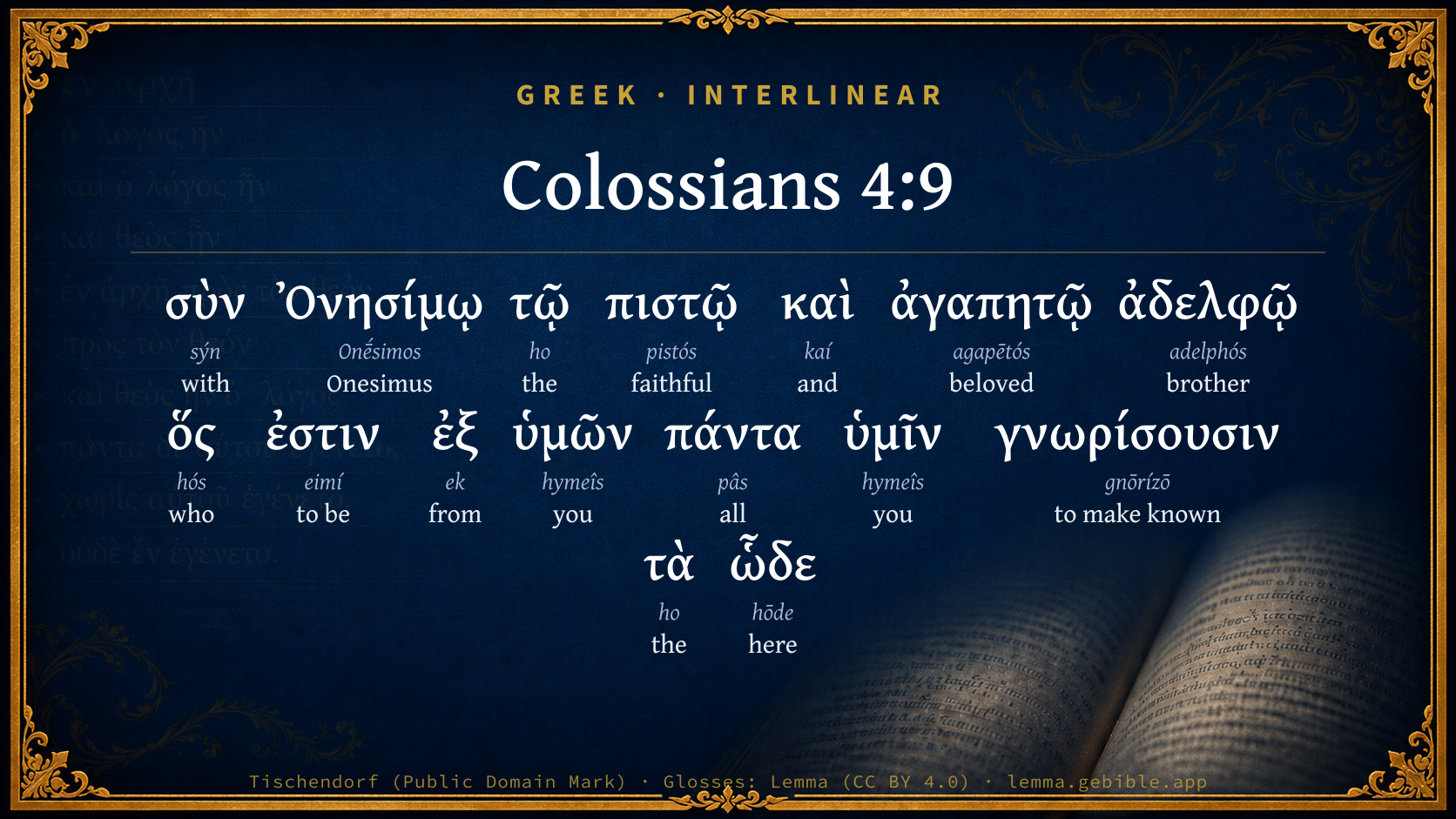
Greek (Tischendorf 8th ed.) Colossians 4:9 appears in the Greek New Testament. The text above is from the Tischendorf 8th edition. Each word links to its Strong’s number and a concise gloss. Click any word for its full Thayer’s Greek Lexicon entry.
Download image
Cite this verse

Colossians 4:9 (World English Bible). Public Domain. Lemma interlinear Bible study tool, https://lemma.gebible.app/v/colossians/4/9.

Show BibTeX & RIS
BibTeX
RIS
English Translation
together with Onesimus, the faithful and beloved brother, who is one of you. They will make known to you everything that is going on here.
World English Bible · Public Domain
Highlights
  • 1 first appearance in the Greek New Testament
Full analysis ↓
Download a study sheet

One document with this verse’s original text, its word-by-word gloss line, the meaning frame, cross-references with their text, attributed commentary, and full source and license credits — printable, and it pastes into notes with its structure intact.

This verse Autodidact and up

Study sheet (.html) Plain text (.txt)

A passage Seminary Student

Up to 50 verses in one chapter. A passage sheet keeps up to 6 commentary sources and 12 cross-references per verse, in the order this page ranks them, and says so on the sheet whenever that leaves anything out. Ask for a single verse and you get the Autodidact verse sheet above.

Everything on this page stays free to read, with no account — the sheet is a download of what is already on screen, not access to it.

Want to remove ads? Support Godless Engineer
Compare translations 3

The same verse in 3 English versions, stacked beneath the original-language interlinear above. Click any original word for its lexicon entry.

Each is an independent rendering of the whole verse — the interlinear is not word-aligned to these translations.

Highlighted words mark where these versions differ — a whole-verse word diff, not a word-by-word alignment.

  • World English Bible Public Domain
    together with Onesimus, the faithful and beloved brother, who is one of you. They will make known to you everything that is going on here.
  • King James Version Public Domain
    With Onesimus, a faithful and beloved brother, who is one of you. They shall make known unto you all things which are done here.
  • unfoldingWord Literal Text CC BY-SA 4.0
    Together with Onesimus, the faithful and beloved brother who is from among you, they will make known to you all the things here.

unfoldingWord Literal Text — © unfoldingWord, licensed CC BY-SA 4.0. Word-aligned USFM3 via Door43 (git.door43.org/unfoldingWord/en_ult).

Versions to compare (up to 4)

3 of 4 selected

Show all 19 translations

Every available English version of this verse, each an independent rendering of the whole verse.

  • World English Bible Public Domain
    together with Onesimus, the faithful and beloved brother, who is one of you. They will make known to you everything that is going on here.
  • Berean Standard Bible Public Domain
    With him I am sending Onesimus, our faithful and beloved brother, who is one of you. They will tell you about everything here.
  • Majority Standard Bible Public Domain
    With him I am sending Onesimus, our faithful and beloved brother, who is one of you. They will tell you about everything here.
  • King James Version Public Domain
    With Onesimus, a faithful and beloved brother, who is one of you. They shall make known unto you all things which are done here.
  • American Standard Version (1901) Public Domain
    together with Onesimus, the faithful and beloved brother, who is one of you. They shall make known unto you all things that `are done' here.
  • Revised Version (1885) Public Domain
    together with Onesimus, the faithful and beloved brother, who is one of you. They shall make known unto you all things that are done here.
  • Geneva Bible (1599) Public Domain
    With Onesimus a faithfull and a beloued brother, who is one of you. They shall shew you of all things here.
  • Douay-Rheims (1899) Public Domain
    With Onesimus, a most beloved and faithful brother, who is one of you. All things that are done here, they shall make known to you.
  • Young's Literal Translation Public Domain
    with Onesimus the faithful and beloved brother, who is of you; all things to you shall they make known that `are' here.
  • Literal Standard Version CC BY-SA 4.0
    with Onesimus the faithful and beloved brother, who is of you; they will make known to you all things that [are] here.
  • Unlocked Literal Bible CC BY-SA 4.0
    I sent him together with Onesimus, the faithful and beloved brother, who is one of you. They will tell you everything that has happened here.
  • unfoldingWord Literal Text CC BY-SA 4.0
    Together with Onesimus, the faithful and beloved brother who is from among you, they will make known to you all the things here.
  • Darby Bible Public Domain
    with Onesimus, the faithful and beloved brother, who is [one] of you. They shall make known to you everything here.
  • World Messianic Bible Public Domain
    together with Onesimus, the faithful and beloved brother, who is one of you. They will make known to you everything that is going on here.
  • Webster's Bible Public Domain
    With Onesimus, a faithful and beloved brother, who is one of you. They will make known to you all things which are done here.
  • Free Bible Version CC BY-SA 4.0
    Onesimus is going with him too, a trusted and dear brother, who's one of you. They'll explain to you everything that's going on here.
  • Bible in Basic English Public Domain
    And with him I have sent Onesimus, the true and well-loved brother, who is one of you. They will give you word of everything which is taking place here.
  • Text-Critical English NT CC BY 4.0
    With him I have sent Onesimus, our faithful and beloved brother, who is one of you. They will tell you everything that is happening here.
  • Tyndale New Testament (1534) Public Domain
    with one Onesimus a faythfull and a beloved brother which is one of you. They shall shewe you of all thinges which are adoynge here.

Literal Standard Version (2020), Covenant Press — licensed CC BY-SA 4.0. Text via the HelloAO Bible API (eBible.org). Unlocked Literal Bible (unfoldingWord) — licensed CC BY-SA 4.0. Text via the HelloAO Bible API (eBible.org). unfoldingWord Literal Text — © unfoldingWord, licensed CC BY-SA 4.0. Word-aligned USFM3 via Door43 (git.door43.org/unfoldingWord/en_ult). Free Bible Version, Dr. Jonathan Gallagher — licensed CC BY-SA 4.0. Text via the HelloAO Bible API (eBible.org).

Word by word

More ways to search: Search by grammar → Find every occurrence → Compare this word →

Practice this passage: Drill this verse → Learn its vocabulary →

Ὀνησίμῳ
Onḗsimos
G3682
“Onesimus”
Noun, Dative, Singular, Masculine
Part of Speech
Noun
Case
Dative
Number
Singular
Gender
Masculine
Full Thayer's Definition

Origin: from G3685

TDNT: None

Onesimus = "profitable or useful" 1. a Christian slave of Philemon
  1. σὺν sýn G4862 “with” Preposition
  2. τῷ ho G3588 “the” Article, Dative, Singular, Masculine
  3. πιστῷ pistós G4103 “faithful” Adjective, Dative, Singular, Masculine
  4. καὶ kaí G2532 “and” Conjunction
  5. ἀγαπητῷ agapētós G27 “beloved” Adjective, Dative, Singular, Masculine
  6. ἀδελφῷ adelphós G80 “brother” Noun, Dative, Singular, Masculine
  7. ὅς hós G3739 “who” Relative pronoun, Nominative, Singular, Masculine
  8. ἐστιν eimí G1510 “to be” Verb, Present, Active, Indicative, 3rd person, Singular
  9. ἐξ ek G1537 “from” Preposition
  10. ὑμῶν hymeîs G5210 “you” Personal pronoun, 2nd person, Genitive, Plural
  11. πάντα pâs G3956 “all” Adjective, Accusative, Plural, Neuter
  12. ὑμῖν hymeîs G5210 “you” Personal pronoun, 2nd person, Dative, Plural
  13. γνωρίσουσιν gnōrízō G1107 “to make known” Verb, Future, Active, Indicative, 3rd person, Plural
  14. τὰ ho G3588 “the” Article, Accusative, Plural, Neuter
  15. ὧδε hōde G5602 “here” Adverb

About this verse

These counts appear in no published source. They are computed here, from the morphology-tagged text and Lemma’s own curated glosses. What Lemma adds →

16
words
14
distinct lemmas
Pauline Epistles
section

Notable vocabulary

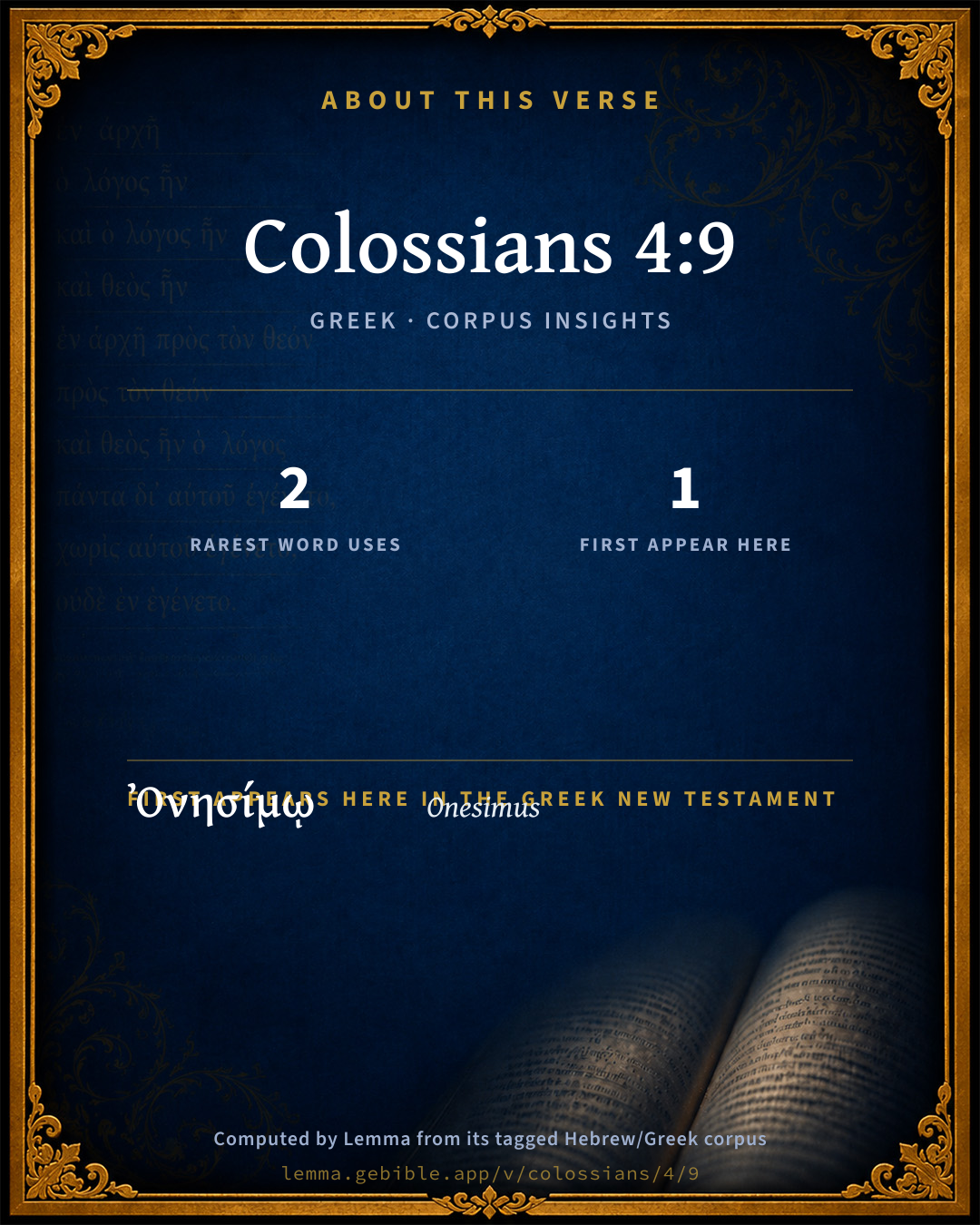
The rarest word here is Ὀνησίμῳ Onesimus G3682 — appearing just 2 times in the whole Greek New Testament.

First appearance in Scripture

This word makes its first canonical appearance in the Greek New Testament here:

  • Ὀνησίμῳ Onesimus G3682

Shared distinctive vocabulary

Ὀνησίμῳ Onesimus G3682 occurs in 2 verses of the Greek New Testament. Also found in:
Repetition

Words recur within this verse:

Cross-references

2

Topical passages linked to Colossians 4:9 in the Treasury of Scripture Knowledge — connected by theme and wording, ordered by reader-vote popularity; previews shown in the World English Bible.

  • Philemon 1:10–19 I beg you for my child, whom I have become the father of in my chains, Onesimus,
  • Colossians 4:7 All my affairs will be made known to you by Tychicus, the beloved brother, faithful servant, and fellow bondservant in the Lord.

Cross-references courtesy of OpenBible.info (CC BY 4.0).

Commentary

Notes on Colossians 4:9 from classic Christian and Jewish commentators (each source and its license shown beneath its notes). The classic Christian expositions comment on the surrounding passage and are grouped to its opening verse, so a note may address several verses; the Jewish commentaries on the Tanakh (Rashi and others) are per-verse, so they appear only where the commentator wrote on this verse.

Lemma curates 59 commentaries, every one of them public domain or Creative Commons licensed, each selected and text-cleaned for this edition rather than reprinted as found. About our sources →

The Biblical Illustrator

Joseph S. Exell

Col_4:9

With Onesimus a faithful and beloved brother who is one of you.

I. The person. Onesimus teaches us--

1. To despise no one for his former misdeeds after he has come to his right mind. This Onesimus was once contemptible, useless, and a runaway slave, but after his conversion he was thought worthy by the chiefest apostle of a mission of great honour. They therefore sin grievously who reproach the truly converted for their former evils, than to congratulate them on their new nature. God estimates men not by what they have put off, but by what they have put on (Eze_18:22).

II. His commendation.

1. He is a faithful brother, i.e., not only a Christian, but a genuine one; for many who have assumed the name have denied the thing (Gal_2:4; 2Ti_3:2-4). Hence we may observe--

(1) We should endeavour to answer to our name and profession; for to be called a Christian, faithful, etc., and not be so, is to be loaded with false titles and dishonourable (Rev_3:1).

(2) They are to be loved by all the pious, and to be embraced with both arms who are faithful in their Christian profession and special vocation.

(3) Nothing is more dangerous than those perfidious brethren who feign religion while they despise it (2Co_11:26).

2. He was loved warmly by Paul, who was not accustomed to receive any into intimate friendship except they were worthy, Therefore the apostle wished them to infer that Onesimus deserved to be beloved by them.

(1) It is a sign of a good Christian to be dear to his pastor.

(2) It becomes a prudent minister to embrace the most pious with peculiar affection (Php_4:1).

(3) It ought to be the care of all believers to be beloved by their pastors.

3. He was one of themselves. Although this was not much in his praise, it made him acceptable, for what is our own is wont to be prized more than what is not.

(1) It is proper to treat, then, with peculiar affection those who are of the same blood, country, society, as ourselves.

(2) It is contemptible to neglect our own, and to extol the distant at the expense of the near (Mar_13:57).

III. His mission. To make known what was going on with the apostle and at Rome. Tychicus was also entrusted with the same, but in adding Onesimus he provided two witnesses that the thing might be established. (Bishop Davenant.)

Onesimus

was a native, or certainly an inhabitant, of Colossi, since Paul refers to him as one of you. This confirms the presumption which his name affords that he was a Gentile. Slaves were numerous in Phrygia, and the very name Phrygian was almost synonymous with that of slave. Hence it happened that in writing to the Colossians (Col_3:22-25; Col_4:1)

Paul had to instruct them concerning the duties of servants and masters towards each other. Onesimus was one of this unfortunate class of persons, who escaped from his master and fled to Rome, where in the midst of its vast population he could hope to be concealed, and to baffle the efforts which were so often made in such cases for retaking the fugitive. Whether he had any other motive for the flight than the natural love of liberty we have not the means of deciding. It has been generally supposed that he had committed some offence, as theft or embezzlement, and feared the punishment of his guilt (Phm_1:18). Though it may be doubted whether Onesimus heard the gospel for the first time in Rome, it is beyond question that he was led to embrace the gospel there through the apostles instrumentality (Phm_1:10). As there were believers in Phrygia when the apostle passed through the region on his third missionary journey (Act_18:23), and as Onesimus belonged to a Christian household (Phm_1:2), it is not improbable that he knew something of Christian doctrine before he went to Rome. How long a time elapsed between his escape and his conversion we cannot decide. After the latter event, however, the most happy and friendly relations sprang up between the teacher and the disciple. The situation of the apostle must have made him keenly alive to the sympathies of Christian friendship, and dependent upon others for various services. Onesimus appears to have supplied this want in an eminent degree. He won entirely the apostles heart, and made himself so useful that Paul wished to keep him, and yielded him up only in obedience to that sensitive regard for the feelings and rights of others of which his conduct on this occasion was a conspicuous example. The traditional notices of Onesimus are not of great value. Some of the later fathers assert that Onesimus was set free and became Bishop of Beroea, and that he made his way to Rome again and died a martyr under Nero. (H. B. Hackett, D. D.)

The excellence of faithfulness

A year ago last summer I visited Yellowstone Park. I had read a great deal of the geysers, and seen pictures of them, but now it was my privilege to see them rise grandly and proudly in dizzy heights, then fall in graceful spray. They had great names given them. Some were called The Wonderful, The Monarch, others The Lion and The Lioness, but you never can depend on their regularity of action. A traveller may visit them and wait around four or five days without witnessing a performance, getting only labour for his pains, though you cannot tell when they will play. When they do they are very beautiful. But there is one geyser, named the Old Faithful, that is not so large, and doesnt make such a grand display, but you can always depend on it. It plays at certain times, and never fails. If you are there at 1 oclock, or five minutes before, you will see the water shoot up at a height of 60 or 70 feet. At 1:55 it will play again, not rising at such height as the other geysers, nor making such a roaring noise, but you can depend on it. It always comes to time, and never fails in a performance. I at once respected that geyser. It was faithful in its performance and sure. That is the key to a successful life. (A. Little.)

The Biblical Illustrator, edited by Joseph S. Exell (c. 1880s–1900s) — public domain. Text from a community e-Sword module.

Tyndale Open Study Notes

Tyndale Open Resources

4:9 Onesimus was the runaway slave whom Paul was sending back to his master Philemon (see the book of Philemon).

Tyndale Open Study Notes — © Tyndale Open Resources, licensed CC BY-SA 4.0. Text via the HelloAO Bible API.

Expositor's Greek Testament

ed. W. Robertson Nicoll

Col 4:9 . Ὀνησίμῳ . Philemon’s runaway slave, who was rescued by Paul and converted to Christianity. Paul sent him back to his master, with the exquisite Epistle to Philemon despatched at the same time as this letter. He speaks of him in the most affectionate terms, to secure a welcome for him at Colossæ. He seems from this passage to have belonged to Colossæ, and we may infer that this was the home of Philemon. If the author of Colossians learnt his name from the Epistle to Philemon, it is strange that he should have contented himself with this bald reference, and made no allusion to his desertion, conversion and return to his master. Such omission here is characteristic of Paul’s delicacy. τὰ ὧδε is wider than τὰ κατʼ ἐμὲ (Col 4:7 ). It means all that is happening to the Church in Rome.

The Expositor's Greek Testament, edited by W. Robertson Nicoll (1897–1910) — public domain. Text from a community e-Sword module.

Jamieson, Fausset & Brown

Robert Jamieson, A. R. Fausset & David Brown

Onesimus--the slave mentioned in the Epistle to Philemon (Plm 1:10, Plm 1:16), "a brother beloved."

a faithful . . . brother--rather, "the faithful brother," he being known to the Colossians as the slave of Philemon, their fellow townsman and fellow Christian.

one of you--belonging to your city.

They shall make known unto you all things--Greek, "all the things here." This substantial repetition of "all my state shall Tychicus declare unto you," strongly favors the reading of English Version in Col 4:8, "that he might (may) know your state," as it is unlikely the same thing should be stated thrice.

Jamieson, Fausset & Brown — Commentary Critical and Explanatory on the Whole Bible (1871) — public domain (CC PDM 1.0). Text via the HelloAO Bible API.

Adam Clarke's Commentary

Verse 9. With Onesimus - who is one of you.] Onesimus was a native of some part of Phrygia, if not of Colosse itself; and being lately converted to the Christian faith by the instrumentality of the apostle, he would be able, on this account, to give them satisfactory information concerning the apostle's state, which would be doubly acceptable to them as he was their countryman. See the Epistle to Philemon.

All things which are done here.] FG, the Vulgate, Itala, Jerome, and Bede, add here πραττομενα, what is done, which we have supplied in Italics in our translation. These brethren could give an account of the transactions at Rome, relative to the apostle and Christianity, which it might not be prudent for him to commit to writing. See Clarke on Col 4:7. The reign of Nero was not only cruel, but suspicious, jealous, and dangerous.

Adam Clarke's Commentary on the Bible (1810–1826) — public domain. Text from a community e-Sword/MySword module.

John Calvin's Commentaries

He adds, Onesimus, that the embassy may have the more weight. It is, however, uncertain who this Onesimus was. For it can scarcely be believed that this is the slave of Philemon, inasmuch as the name of a thief and a fugitive would have been liable to reproach. He distinguishes both of them by honorable titles, that they may do the more good, and especially Tychicus, who was to exercise the office of an instructor.

John Calvin's Commentaries (1540-1563) — public domain. Text from the Calvin Translation Society English edition (1840s-50s) via the Christian Classics Ethereal Library (ccel.org). Calvin's coverage is partial (roughly two-thirds of the Bible); uncommented books and verses are honest gaps, never fabricated. The 19th-century editor's footnotes and remarks are omitted so the notes are faithfully Calvin's own voice.

Ellicott's Commentary for English Readers

(9) Onesimus.—See Phm_1:10-17. The emphatic reference to him as being “faithful and beloved” like Tychicus, and “one of you” like Epaphras, is a remarkable commentary on St. Paul’s exhortation as to slaves and masters in the preceding chapter.

A Bible Commentary for English Readers, edited by Charles John Ellicott (1878–1897) — public domain. Text from a community e-Sword module.

The Cambridge Bible for Schools and Colleges

gen. ed. J. J. S. Perowne

9. Onesimus] On his name and story see below, on Phm_1:10, and Introd. to the Ep. to Philemon, ch. 3.

a faithful and beloved brother] Lit., and better, the, &c. See above on Col_4:7. This rescued slave is raised, in Christ, to a brother’s place beside Tychicus, the Colossians, and Paul himself, and is at once welcomed into the family of God.—St Paul implicitly assumes Philemon’s pardon and welcome for Onesimus.

is one of you] Or, belongs to you, a fellow-Colossian. A beautiful euphemism for Onesimus’ legal connexion with Colossæ; and it was, for Christians, as true as it was beautiful.

all things which are done here] Lit., more generally, all the things here; circumstances and proceedings alike.

The Cambridge Bible for Schools and Colleges (gen. ed. J. J. S. Perowne; Cambridge University Press, 1878–1918) — public domain. Text from a community e-Sword module.

John Gill's Exposition

With Onesimus,.... Who had been Philemon's servant, ran away from him, and was met with and converted by the Apostle Paul, of whom he says many things in his epistle to his master. According to the Apostolic Constitutions, he was afterwards bishop of Beyrhoea; and some say he suffered martyrdom under Domitian; a servant of this name is mentioned by Suetonius (i), Ignatius (k) speaks of one Onesimus as bishop of Ephesus, but not the same with this,

a faithful and beloved brother, who is one of you; either one of their ministers, as Epaphras was, Col 3:12 or one of their city, who was originally a native of that place; and which the apostle mentions, the more to recommend him; though this is the least part of his commendation; he calls him a "brother", being both a converted man, and in the ministry; and being faithful in his work to Christ, and greatly beloved, by the saints; and particularly highly in the esteem and affections of the apostle:

they shall make known unto you all things which are done here; at Rome, either to him in prison, or in the church; and being two of them, were a proper number to bear a testimony, and which ought to be received.

(i) ln Vit. Galbae, c. 13. (k) Ep. ad Ephes. p. 17. & ad Antioch. ascript. p. 89.

John Gill's Exposition of the Whole Bible (1746–1763) — public domain (CC PDM 1.0). Text via the HelloAO Bible API.

Trapp's Complete Commentary

John Trapp

9 With Onesimus, a faithful and beloved brother, who is one of you. They shall make known unto you all things which are done here.

Ver. 9. With Onesimus a faithful] Once unprofitable, but now profitable, faithful, and beloved. Plato went thrice to Sicily to convert Dionysius, and lost his labour. Polemo of a drunkard, by hearing Xenocrates, became a philosopher. But Ambrose saith well of him, si resipuit a vino, fuit semper tamen temulentus sacrilegio, if he repented of his drunkenness, yet he continued drunk with superstition. Philosophia non abscindit vitia, sed abscondit. Paul’s convert proved better, a faithful preacher and a beloved brother.

John Trapp, A Commentary or Exposition upon All the Books of the Old and New Testament (1647–1656) — public domain. Text from a community e-Sword module.

Albert Barnes' Notes on the Bible

With Onesimus - Who had been formerly a servant of Philemon, an inhabitant of Colossae; see the notes at Phm 1:10. Onesimus had probably been recently converted; and Paul felt toward him the warm attachment of a brother; Phm 1:16. In what way he became acquainted with him is unknown. A more full account of him will be found in the notes at the Epistle to Philemon.

Who is one of you - That is, either who is from your city, or one of your own people and nation. It is clear from this, that Onesimus was from Phrygia, and probably from the city of Colossae itself. It would seem also that he was of a higher rank than is designated by the word “slave” now. He was, indeed, a “servant” δοῦλος doulos - of Philemon, but would the apostle have addressed the Colossians, and said that he was “one of them,” if he had occupied precisely the condition which is now denoted by the word “slave”? Would a minister of the gospel now in the Northern States, who should send a letter by a run-away slave to a community of masters at the South, say of him that he was “one of them?” Would it be kindly received, or produce a good impression, if he did? There is reason, therefore, to think that Onesimus was not a slave in the proper sense, but that he might have been a respectable youth, who had bound himself to service for a term of years; compare Phm 1:18.

They shall make known to you all things which are done here - Relating to Paul himself and the state of the church in Rome. As the Epistle which Paul sent was designed not only for them, but to be a part of the volume of revealed truth, he wrote only those things which would be of permanent interest. Other matters he left for those who carried the Epistle to communicate. It would also serve to give Tychicus and Onesimus more respectability in view of the church at Colossae, if he referred the church to them for information on important points.

Albert Barnes' Notes on the Bible (1834–1885) — public domain. Text from a community e-Sword/MySword module.

Matthew Poole's English Annotations

With Onesimus, whom he adjoins to Tychicus. Some, because of his following commendation, think him to be another person different from the fugitive servant of Philemon; but the most, comparing the description here with the circumstances in the Epistle to Philemon, Col 4:10,16, &c., conclude him to be the very same, taking Philemon for a Colossian.

A faithful and beloved brother, who is one of you; there, as here, being expressly called a beloved brother, yea, and, which may answer to faithful, Paul’s spiritual son, who (whatever he had been) would be profitable and a benefit to Philemon, whom Paul would have to receive him as his own bowels. And that which might commend him to the Colossians was, that he was one of that city, or the same birth with themselves.

They shall make known unto you all things which are done here; these two persons of credit (upon the apostle’s testimony) in their different circumstances, might, as joint witnesses, give them a full and certain account how things went with the church, and particularly with Paul, now a prisoner at Rome.

Matthew Poole's English Annotations on the Holy Bible (1683–1685) — public domain. Text from a community e-Sword/MySword module.

Whedon's Commentary on the Bible

Daniel D. Whedon

9. Onesimus—A native of Colosse, and runaway slave of Philemon, converted at Rome through the labours of the apostle, and now returning in company with Tychicus to his master. He is legally a slave, but nevertheless a “beloved brother” in the Church of Christ, and joint-bearer of the present epistle.

All things… here—Many things respecting matters transacted at Rome could now be properly narrated which might not, in the times of Nero, be safely committed to writing.

Daniel D. Whedon (gen. ed.), Commentary on the Old and New Testaments (1874–1909) — public domain. Text from a community e-Sword module.

The Pulpit Commentary

With Onesimus, the faithful and beloved brother, who is (one) of you (ver. 7; Phm_1:10, Phm_1:16; Col_1:2; 1Pe_5:12) "In Christ there is no slave". (Col_3:11) Onesimus, like Epaphras and Tychicus, is a brother, to be trusted and loved. (comp. Phm_1:10-17) This language strongly supports the appeal of ver. 1, and would further the purpose of the apostle"s intercession to Onesimus" master. And Onesimus even shares with the honoured Tychicus in the privilege of being the apostle"s messenger! All things that are happening here they will make known to you. (ver. 7; Eph_6:21) There is, therefore, no need for any detailed account of the writer"s circumstances. The solicitude which he assumes that these stranger Colossians (Col_1:8 Col_2:1) feel on his behalf shows how commanding his ascendancy over the Gentile Churches had become.

The Pulpit Commentary (1880–1919), ed. H.D.M. Spence-Jones & Joseph S. Exell — public domain. Text from a community e-Sword module.

The People's New Testament

B. W. Johnson

9. With Onesimus. A peculiar interest is connected with Onesimus because he is the subject of the Epistle to Philemon. He belonged to Colosse, was probably a slave of Philemon, and had fled to Rome, and now returns as “a faithful and beloved brother.” Tychicus bore also at this time the letter to Philemon.

B. W. Johnson's The People's New Testament with Notes (1889–1891) — public domain. Electronic text from the Christian Classics Ethereal Library (CCEL) ThML edition.

Cambridge Greek Testament for Schools and Colleges

9. τὰ ὧδε. G vulg. Jer. Ambrst. add πραττόμενα, “a gloss which looks as if it had originated in the Latin, which could not literally render τὰ ὧδε” (Abbott).

9. σὺν Ὀνησίμῳ. See Phm 1:10†.

τῷ πιστῷ. Probably not intended to suggest a contrast to his character before his conversion, though it does so in fact. For πιστός with ἀγαπητός cf. (besides Col 4:7) 1Co 4:17; 1Ti 6:2.

ὅς ἐστιν ἐξ ὑμῶν, i.e. belonging to Colossae. Some have strangely thought it meant a member of the Christian community there. But this was just what, at present, he was not.

τὰ ὦδε. See notes on Textual Criticism. The phrase seems to occur here only in the Greek Bible. Added almost as an after-thought to further define πάντα.

Col 4:10-17. Greetings from (Col 4:10-14) and to (Col 4:15-17) individual believers

(Col 4:10) I send greetings to you from Aristarchus my present fellow captive, and from Mark Barnabas’ cousin (you have already received advices about him, if he come unto you receive him), (Col 4:11) and from Jesus who is called Justus—these three were originally circumcised and are the only Hebrew Christians here who have been fellow workers for the Kingdom of God, men, I mean, who became a help and solace to me. (Col 4:12) I send greetings to you from Epaphras who belongs to your own city, a slave of Christ Jesus, always wrestling on behalf of you in his prayers, in order that you may stand up mature and fully convinced in every known part of the will of God; (Col 4:13) for (whatever may have been said) I bear him witness that he has much toil on behalf of you and of those in Laodicea and of those in Hierapolis. (Col 4:14) I send greetings to you from Luke the physician, my beloved friend, and Demas.

Cambridge Greek Testament for Schools and Colleges (Cambridge University Press, 1896; 21 vols, various authors incl. Carr, Maclear, Plummer, Farrar, Lumby, Moule, M. R. James, Simcox) — public domain. Text from a community e-Sword module.

Alford’s Greek Testament

Henry Alford

9. σὺν Ὀνησ.] There can hardly be a doubt (compare ver. 17 with Phm 1:2, Phm 1:10 ff.) that this is the Onesimus of the Epistle to Philemon. When Calv. wrote “vix est credibile hunc esse servum illum Philemonis, quia furis et fugitivi nomen dedecori subjectum fuisset,” he forgot that this very term, ἀδελφὸς ἀγαπητός, is applied to him, Phm 1:16.

ἐξ ὑμῶν] most probably, a native of your town.

πάντ. ὑμ. γν. τὰ ὧδε] A formal restatement of τὰ κατʼ ἐμὲ π. γν. above. Is it likely, with this restatement, that the same should be again stated in the middle of the sentence, as would be the case with the reading ἵνα γνῶτε τὰ περὶ ἡμῶν?

Henry Alford, The Greek Testament (1849–1861) — public domain. Text from a community e-Sword module.

Vincent's Word Studies in the New Testament

Marvin R. Vincent

Onesimus. See on Phl 1:10.

The faithful and beloved brother. Whom the Colossians had known only as the worthless, runaway slave. See Phl 1:11, 16.

Marvin R. Vincent, Word Studies in the New Testament (1887–1900) — public domain. Text from a community e-Sword/MySword module.

Lightfoot's Colossians and Philemon

J. B. Lightfoot

γνῶτε τὰ περὶ ἡμῶν] This must be preferred to the received reading, γνῷ τὰ περὶ ὑμῶν, for two independent reasons. (1) The preponderance of ancient authority is decidedly in its favour. (2) The emphatic εἰς αὐτὸ τοῦτο ἵνα seems imperatively to demand it. St Paul in the context twice states the object of Tychicus’ visit to be that the Colossians might be informed about the Apostle’s own doings, τὰ κατ’ ἐμὲ πάντα γνωρίσει ὑμῖν (ver. 7), and πάντα ὑμῖν γνωρίσουσιν τὰ ὧδε. He could hardly therefore have described ‘the very purpose’ of his mission in the same breath as something quite different.

It is urged indeed, that this is a scribe’s alteration to bring the passage into accordance with Ephes. vi. 21. But against this it may fairly be argued that, on any hypothesis as regards the authorship and relation of the two letters, this strange variation from γνῶτε τὰ περὶ ἡμῶν to γνῷ τὰ περὶ ὑμῶν in the author himself is improbable. On the other hand a transcriber was under a great temptation to substitute γνῷ for γνῶτε owing to the following παρακαλέση, and this temptation would become almost irresistible, if by any chance περὶ ὑμῶν had been written for περὶ ἡμῶν in the copy before him, as we find to be the case in some MSS. See the detached note on various readings.

παρακαλέσῃ κ.τ.λ.] i.e. ‘encourage you to persevere by his tidings and exhortations’. The phrase occurs again, Ephes. vi. 22, 2 Thess, ii. 17: see above ii. 2. The prominent idea in all these passages is not comfort or consolation but perseverance in the right way.

9. σὺν Ὀνησίμῳ] See above, p. 33, and the introduction to the Epistle to Philemon.

τῷ πιστῷ κ.τ.λ.] The man whom the Colossians had only known hitherto, if they knew him at all, as a worthless runaway slave, is thus commended to them as no more a slave but a brother, no more dishonest and faithless but trustworthy, no more an object of contempt but of love; comp. Philem. 11, 16.

γνωρίσουσιν] This form has rather better support from the MSS than γνωριοῦσιν: see also above, iii. 25. On the Attic future from verbs in -ιζω in the Greek Testament generally see Winer § xiii. p. 88, A. Buttmann p. 32 sq. Is there any decisive instance of these Attic forms in St Paul, except in quotations from the LXX (e.g. Rom. x. 19, xv. 12)?

J. B. Lightfoot, St Paul's Epistles to the Colossians and Philemon: a revised text with introductions, notes and dissertations (London: Macmillan, 1875) — public domain. Electronic text from Project Gutenberg (ebook #50857). Covers Colossians and Philemon only (the verse-by-verse notes; introductions and dissertations are omitted); Lightfoot's companion Galatians and Philippians volumes are not included, as the available public-domain scans carry garbled Greek that cannot be faithfully reproduced.

Lesson kit

Teaching starters — assembled from the data on this page, not authored interpretation. Every prompt links to the verse data it draws on. Edit before teaching.

Colossians, in the Pauline Epistles, opens this verse with 16 words (14 distinct Greek lemmas). Its most distinctive word is Onḗsimos (“Onesimus”). A historical commentator’s framing appears above. Read the whole chapter for the surrounding context.

Discussion questions

  1. What does “Onesimus” (Onḗsimos) contribute to the verse as a whole?
  2. This is the first place “Onesimus” appears in Scripture (first appears here). What does its debut here establish?
  3. How does Philemon 1:10, which shares the word «Onesimus», read alongside this verse?
  4. What does the repetition of “the” (2× in this one verse) do in this verse?
  5. The translations on this page render this verse differently — a whole-verse word diff, not a word-by-word alignment. What might account for the different wordings?
  6. Compare how The Biblical Illustrator and Tyndale Open Study Notes read this verse. Where do they agree or differ?

Things to notice

  • 1 word makes its first canonical appearance in Scripture here.
  • These translations choose different wording for 11 words in this verse.
  • “the” occurs 2× in this single verse.
  • 14 distinct Greek lemmas span 16 words in this verse.

Reading settings

Reading text

Shown beneath each verse's original-language words.

Old Testament
Old Testament edition

Read the OT as the Masoretic Hebrew (MT) or the Greek Septuagint (LXX).

English shown for the Greek Septuagint (in the Hebrew ↔ Greek comparison).

Comparing translations? Open the Compare panel on any verse page to stack up to four side by side.