Acts 14:20

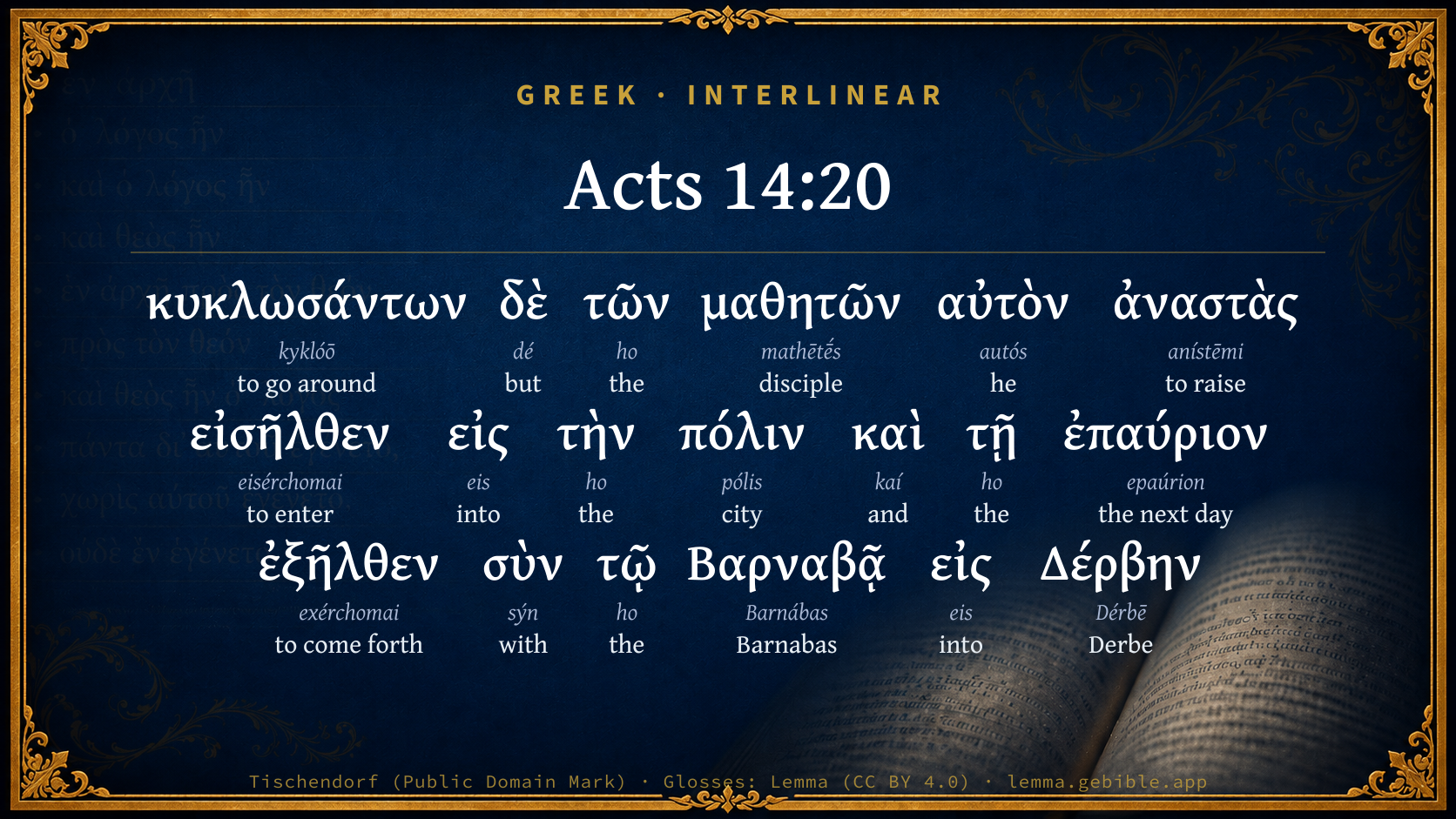
Greek (Tischendorf 8th ed.) Acts 14:20 appears in the Greek New Testament. The text above is from the Tischendorf 8th edition. Each word links to its Strong’s number and a concise gloss. Click any word for its full Thayer’s Greek Lexicon entry.
Download image
Cite this verse

Acts 14:20 (World English Bible). Public Domain. Lemma interlinear Bible study tool, https://lemma.gebible.app/v/acts/14/20.

Show BibTeX & RIS
BibTeX
RIS
English Translation
But as the disciples stood around him, he rose up, and entered into the city. On the next day he went out with Barnabas to Derbe.
World English Bible · Public Domain
Download a study sheet

One document with this verse’s original text, its word-by-word gloss line, the meaning frame, cross-references with their text, attributed commentary, and full source and license credits — printable, and it pastes into notes with its structure intact.

This verse Autodidact and up

Study sheet (.html) Plain text (.txt)

A passage Seminary Student

Up to 50 verses in one chapter. A passage sheet keeps up to 6 commentary sources and 12 cross-references per verse, in the order this page ranks them, and says so on the sheet whenever that leaves anything out. Ask for a single verse and you get the Autodidact verse sheet above.

Everything on this page stays free to read, with no account — the sheet is a download of what is already on screen, not access to it.

Want to remove ads? Support Godless Engineer
Compare translations 3

The same verse in 3 English versions, stacked beneath the original-language interlinear above. Click any original word for its lexicon entry.

Each is an independent rendering of the whole verse — the interlinear is not word-aligned to these translations.

Highlighted words mark where these versions differ — a whole-verse word diff, not a word-by-word alignment.

  • World English Bible Public Domain
    But as the disciples stood around him, he rose up, and entered into the city. On the next day he went out with Barnabas to Derbe.
  • King James Version Public Domain
    Howbeit, as the disciples stood round about him, he rose up, and came into the city: and the next day he departed with Barnabas to Derbe.
  • unfoldingWord Literal Text CC BY-SA 4.0
    But as the disciples surrounded him, arising, he entered into the city, and the next day he went with Barnabas to Derbe.

unfoldingWord Literal Text — © unfoldingWord, licensed CC BY-SA 4.0. Word-aligned USFM3 via Door43 (git.door43.org/unfoldingWord/en_ult).

Versions to compare (up to 4)

3 of 4 selected

Show all 19 translations

Every available English version of this verse, each an independent rendering of the whole verse.

  • World English Bible Public Domain
    But as the disciples stood around him, he rose up, and entered into the city. On the next day he went out with Barnabas to Derbe.
  • Berean Standard Bible Public Domain
    But after the disciples had gathered around him, he got up and went back into the city. And the next day he left with Barnabas for Derbe.
  • Majority Standard Bible Public Domain
    But after the disciples had gathered around him, he got up and went back into the city. And the next day he left with Barnabas for Derbe.
  • King James Version Public Domain
    Howbeit, as the disciples stood round about him, he rose up, and came into the city: and the next day he departed with Barnabas to Derbe.
  • American Standard Version (1901) Public Domain
    But as the disciples stood round about him, he rose up, and entered into the city: and on the morrow he went forth with Barnabas to Derbe.
  • Revised Version (1885) Public Domain
    But as the disciples stood round about him, he rose up, and entered into the city: and on the morrow he went forth with Barnabas to Derbe.
  • Geneva Bible (1599) Public Domain
    Howbeit, as the disciples stoode rounde about him, hee arose vp, and came into the citie, and the next day hee departed with Barnabas to Derbe.
  • Douay-Rheims (1899) Public Domain
    And when they had preached the gospel to that city, and had taught many, they returned again to Lystra, and to Iconium, and to Antioch:
  • Young's Literal Translation Public Domain
    and the disciples having surrounded him, having risen he entered into the city, and on the morrow he went forth with Barnabas to Derbe.
  • Literal Standard Version CC BY-SA 4.0
    and the disciples having surrounded him, having risen he entered into the city, and on the next day he went forth with Barnabas to Derbe.
  • Unlocked Literal Bible CC BY-SA 4.0
    Yet as the disciples were standing around him, he got up and entered the city. The next day, he went to Derbe with Barnabas.
  • unfoldingWord Literal Text CC BY-SA 4.0
    But as the disciples surrounded him, arising, he entered into the city, and the next day he went with Barnabas to Derbe.
  • Darby Bible Public Domain
    But while the disciples encircled him, he rose up and entered into the city. And on the morrow he went away with Barnabas to Derbe.
  • World Messianic Bible Public Domain
    But as the disciples stood around him, he rose up, and entered into the city. On the next day he went out with Barnabas to Derbe.
  • Webster's Bible Public Domain
    But as the disciples stood around him, he rose, and came into the city: and the next day he departed with Barnabas to Derbe.
  • Free Bible Version CC BY-SA 4.0
    But when the believers gathered around him, he got up, and went back into the city. The next day he and Barnabas left for Derbe.
  • Bible in Basic English Public Domain
    But when the disciples came round him, he got up and went into the town: and the day after he went away with Barnabas to Derbe.
  • Text-Critical English NT CC BY 4.0
    But when the disciples gathered around him, he rose and entered the city. The next day he went on with Barnabas to Derbe.
  • Tyndale New Testament (1534) Public Domain
    How be it as the disciples stode rounde about him he arose vp and cam into the cyte. And the nexte daye he departed with Barnabas to Derba.

Literal Standard Version (2020), Covenant Press — licensed CC BY-SA 4.0. Text via the HelloAO Bible API (eBible.org). Unlocked Literal Bible (unfoldingWord) — licensed CC BY-SA 4.0. Text via the HelloAO Bible API (eBible.org). unfoldingWord Literal Text — © unfoldingWord, licensed CC BY-SA 4.0. Word-aligned USFM3 via Door43 (git.door43.org/unfoldingWord/en_ult). Free Bible Version, Dr. Jonathan Gallagher — licensed CC BY-SA 4.0. Text via the HelloAO Bible API (eBible.org).

Word by word

More ways to search: Search by grammar → Find every occurrence → Compare this word →

Practice this passage: Drill this verse → Learn its vocabulary →

Δέρβην
Dérbē
G1191
“Derbe”
Noun, Accusative, Singular, Feminine
Part of Speech
Noun
Case
Accusative
Number
Singular
Gender
Feminine
Full Thayer's Definition

Origin: of foreign origin

TDNT: None

Derbe = "tanner: tanner of skin: coverer with skin" 1. a city of Lycaonia, on the confines of Isauria
  1. κυκλωσάντων kyklóō G2944 “to go around” Verb, Aorist, Active, Participle, Genitive, Plural, Masculine
  2. δὲ dé G1161 “but” Conjunction
  3. τῶν ho G3588 “the” Article, Genitive, Plural, Masculine
  4. μαθητῶν mathētḗs G3101 “disciple” Noun, Genitive, Plural, Masculine
  5. αὐτὸν autós G846 “he” Personal pronoun, Accusative, Singular, Masculine
  6. ἀναστὰς anístēmi G450 “to raise” Verb, Aorist, Active, Participle, Nominative, Singular, Masculine
  7. εἰσῆλθεν eisérchomai G1525 “to enter” Verb, Aorist, Active, Indicative, 3rd person, Singular
  8. εἰς eis G1519 “into” Preposition
  9. τὴν ho G3588 “the” Article, Accusative, Singular, Feminine
  10. πόλιν pólis G4172 “city” Noun, Accusative, Singular, Feminine
  11. καὶ kaí G2532 “and” Conjunction
  12. τῇ ho G3588 “the” Article, Dative, Singular, Feminine
  13. ἐπαύριον epaúrion G1887 “the next day” Adverb
  14. ἐξῆλθεν exérchomai G1831 “to come forth” Verb, Aorist, Active, Indicative, 3rd person, Singular
  15. σὺν sýn G4862 “with” Preposition
  16. τῷ ho G3588 “the” Article, Dative, Singular, Masculine
  17. Βαρναβᾷ Barnábas G921 “Barnabas” Noun, Dative, Singular, Masculine
  18. εἰς eis G1519 “into” Preposition

About this verse

These counts appear in no published source. They are computed here, from the morphology-tagged text and Lemma’s own curated glosses. What Lemma adds →

19
words
15
distinct lemmas
Acts
section

Notable vocabulary

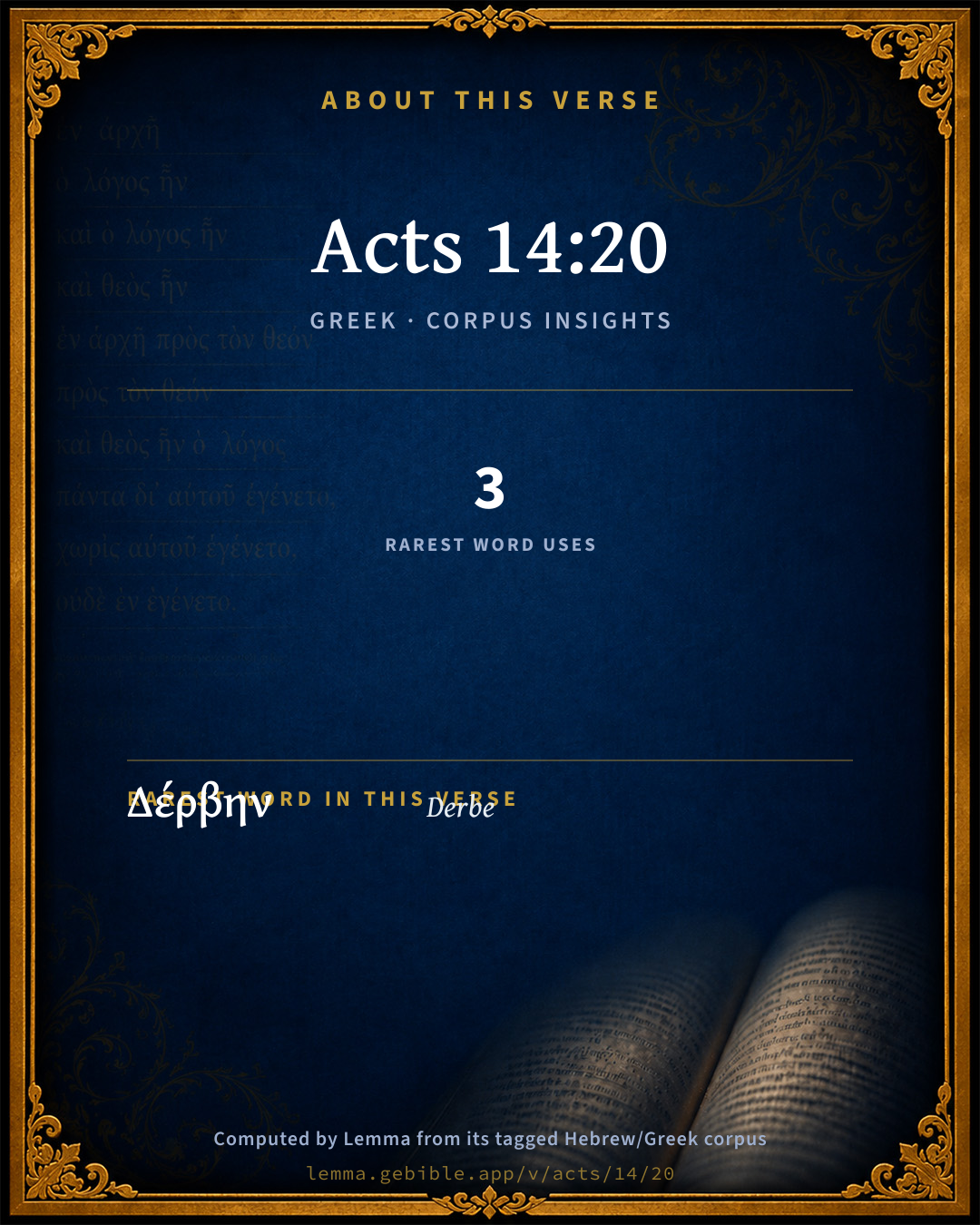
The rarest word here is Δέρβην Derbe G1191 — appearing just 3 times in the whole Greek New Testament.

Shared distinctive vocabulary

Δέρβην Derbe G1191 occurs in 3 verses of the Greek New Testament. Also found in:

Repetition

Words recur within this verse:

Cross-references

12

Topical passages linked to Acts 14:20 in the Treasury of Scripture Knowledge — connected by theme and wording, ordered by reader-vote popularity; previews shown in the World English Bible.

  • 2 Corinthians 1:9–10 Yes, we ourselves have had the sentence of death within ourselves, that we should not trust in ourselves, but in God who raises the dead,
  • 2 Corinthians 6:9 as unknown, and yet well known; as dying, and behold, we live; as punished, and not killed;
  • Acts 14:6 they became aware of it, and fled to the cities of Lycaonia, Lystra, Derbe, and the surrounding region.
  • Acts 16:40 They went out of the prison, and entered into Lydia's house. When they had seen the brothers, they encouraged them, and departed.
  • Acts 20:1 After the uproar had ceased, Paul sent for the disciples, took leave of them, and departed to go into Macedonia.
  • Acts 12:17 But he, beckoning to them with his hand to be silent, declared to them how the Lord had brought him out of the prison. He said, "Tell these things to James, and to the brothers." Then he departed, and went to another place.
  • Acts 14:28 They stayed there with the disciples for a long time.
  • Acts 16:1 He came to Derbe and Lystra: and behold, a certain disciple was there, named Timothy, the son of a Jewess who believed; but his father was a Greek.
  • Acts 20:9–12 A certain young man named Eutychus sat in the window, weighed down with deep sleep. As Paul spoke still longer, being weighed down by his sleep, he fell down from the third story, and was taken up dead.
  • Revelation 11:7–12 When they have finished their testimony, the beast that comes up out of the abyss will make war with them, and overcome them, and kill them.
  • Acts 11:26 When he had found him, he brought him to Antioch. It happened, that for a whole year they were gathered together with the assembly, and taught many people. The disciples were first called Christians in Antioch.
  • Acts 14:22 confirming the souls of the disciples, exhorting them to continue in the faith, and that through many afflictions we must enter into the Kingdom of God.

Cross-references courtesy of OpenBible.info (CC BY 4.0).

Commentary

Notes on Acts 14:20 from classic Christian and Jewish commentators (each source and its license shown beneath its notes). The classic Christian expositions comment on the surrounding passage and are grouped to its opening verse, so a note may address several verses; the Jewish commentaries on the Tanakh (Rashi and others) are per-verse, so they appear only where the commentator wrote on this verse.

Lemma curates 59 commentaries, every one of them public domain or Creative Commons licensed, each selected and text-cleaned for this edition rather than reprinted as found. About our sources →

Joseph Benson's Commentary

Act 14:20. Howbeit, as the disciples stood round — For there were some here at Lystra that became disciples, having found the mean between deifying the apostles and rejecting them. And though Paul’s enemies left him for dead, yet these would not leave him, but stood round about his body, having courage to own him when he was thus cruelly treated, though they had reason enough to fear, that the same persons that stoned him might stone them for manifesting such regard for him. Probably they stood considering how they should perform the last office of affection to him, in bearing him to his funeral with proper respect. Unexpectedly, however, while they were considering of this, to their unspeakable surprise, he rose up — As in perfect health; and went into the city — That just after he had been stoned, dragged about the streets and left for dead, he should be able to rise and walk back into the city, must certainly be the effect of a miraculous cure, approaching as near as one can conceive to a resurrection from the dead. This was the more illustrated by his going the next day to Derbe; whereas, in the course of nature, he would then have felt his bruises much more than at first; and probably, after the best care that could have been taken of him, would hardly have been able to move. Probably by going into the city, and showing himself to the new converts, at least, if not to others, he hoped, as he reasonably might, to confirm their faith in, and their courageous attachment to, the gospel.

Joseph Benson's Commentary on the Old and New Testaments (1811–1818) — public domain. Text from a community e-Sword module.

The Preacher's Complete Homiletical Commentary

Joseph S. Exell (gen. ed.)

HOMILETICAL ANALYSIS.—Act_14:20-28

The Homeward Journey of Paul and Barnabas; or, Back to Antioch in Syria

I. The turning point.—Derbe (see on Act_14:6).

1. The character of the apostles’ work in Derbe. Preaching the gospel. Thus early were Paul’s mottoes, “This one thing I do” (Php_3:13); “whom we preach” (Col_1:28); “Jesus Christ and Him crucified (1Co_2:2).

2. The acceptance of the apostles’ work in Derbe. No persecutions encountered here (see 2Ti_3:11). The omission of Derbe from the list of places in which persecution was experienced strikingly confirms the narrative of Luke (Paley, Horæ Paulinœ, Act_4:9).

3. The success of the apostles’ work in Derbe. They made many disciples, amongst them probably Gaius of Derbe (Act_20:4).

4. The duration of the apostles’ work at Derbe. Not stated, but may be inferred to have been some weeks.

II. The way back.

1. The route indicated. First to Lystra, twenty miles; next to Iconium, forty miles; after that to Antioch in Pisidia, sixty miles; then to Perga in Pamphylia; then across the plain for sixteen miles to Attalia (the modern Satalia), founded by Attalus Philadelphus, king of Pergamus, a seaport on the Pamphylian Gulf and near the mouth of the Catarrhactes; and finally thence to Antioch in Syria.

2. The work done.

(1) Confirming the souls of the disciples. Not by outward rites, but by instruction and encouragement, “exhorting them to continue in the faith,” and reminding them “that through many tribulations we must enter into the kingdom of God.”

(2) Appointing elders in every Church. These elders or presbyters were not modern diocesan bishops, but presiding overseers of different Churches. The mode of their election is not sufficiently clear. Whether by the stretching forth of the hands of the congregation or of the apostles is disputed. If the method adopted in the election of deacons (Act_6:5-6) was followed here, then the congregation would elect and the apostles ordain, the service being accompanied with fasting and prayer, in which the chosen office-bearers were commended to God for their work.

(3) Preaching the gospel. This, doubtless, would not be neglected in any of the towns visited on the homeward route, but it is specially mentioned that they spoke the word in Perga, because they had not done so on the outward journey (Act_13:13; which see for the reason of this omission).

III. Home reached.—

1. Their arrival in the city. From Attalia they sailed to Seleucia, “saw once more the steep cone of Mount Casius, climbed the slopes of Coryphæus, and made their way under the pleasant shade of ilex and myrtles and arbutus, on the banks of the Orontes, until they crossed the well-known bridge, and saw the grim head of Charon, stating over the street Singôn, in which neighbourhood the little Christian community were prepared to welcome them with keen interest and unbounded love (Farrar, The Life and Work of St. Paul, i. 390).

2. Their meeting with the Church.

(1) This was proper, seeing they had been by the Church recommended (or committed) to the grace of God for the work they had fulfilled (Act_13:3). Nothing could have been more becoming than that they should report to the Church how the work had fared.

(2) Interesting, since they rehearsed all that God had done with them—i.e., their experiences, and in particular how God had opened a door of faith unto the Gentiles—i.e., the success which had attended their labours.

(3) Encouraging, as showing the wisdom of the step which had been taken in despatching a mission to the heathen.

3. Their stay with the disciples. “A long” or “no little time.” The exact duration of the first missionary journey can only be approximately calculated. If it began in March A.D. 45, we are hardly at liberty to suppose that it occupied much more than a year (Farrar), in which case the return of Paul and Barnabas to Antioch would fall in all probability about the spring of A.D 46. Professor Ramsay gives April 45–July 47 (or 46–48) as the period over which the first journey extended. From the close of the journey they remained in Antioch till the outbreak of controversy concerning the terms on which the Gentiles should be admitted to the Church required their presence in Jerusalem (Act_15:2).

Learn.—

1. The duty of persevering in the work of the Lord.

2. The necessity of abiding in the faith.

3. The only way of entering the kingdom.

4. The Scripturalness of Church order.

5. The interest Christians should take in foreign missions.

HINTS AND SUGGESTIONS

Act_14:21-22. The Pastoral Office—its True Function.

I. To preach the gospel.

II. To make disciples.

III. To confirm believers.

IV. To comfort the suffering.

Act_14:22. Scriptural Confirmation.

I. Not an external (bodily) rite, but an internal (spiritual) grace.

II. Not performed by the laying on of hands, but by the utterance of exhortations and consolations.

III. Not doing a work of establishment, for others, but instructing others to do this for themselves.

Act_14:22. The Way into the Kingdom.

I. Painful—Through much tribulation or many tribulations.

II. Necessary.—We must. Un avoidable by any, indispensable for all.

III. Certain.—It leads into the kingdom. No question about whither it conducts.

IV. Blessed.—The terminus to which it tends is the kingdom of God.

Entering the Kingdom.

I. Heaven a kingdom.—

1. Its sovereign, God. The great king who built it, the architect of the universe, the Lord of Hosts.

2. Its subjects.

(1) In nature diversified, angels and redeemed men.

(2) In character, holy and without blemish,

(3) In condition, free from every defect and possessed of every felicity.

(4) In number, a multitude which no man can number and constantly increasing.

3. Its permanence. It will never be destroyed and never pass away.

II. The believer’s entrance into the kingdom.—Effected—

1. In time through regeneration, a work of gracious renewal upon his heart, which ipso facto at once constitutes him a subject of the kingdom.

2. At death, when the soul, having been purified and perfected through much tribulation, taking its departure from the body, passes through the vale and joins the company of the spirits of just men made perfect. This entrance certainly follows on the first after an interval, longer or shorter, of preparation.

Continuing in the Faith.

I. The danger of declining from the faith.—Arising from—

1. Indwelling sin.

2. The fascinations and temptations of the world.

3. The ills and tribulations of life.

4. False teachers and erroneous teaching.

5. The self-righteousness and spiritual pride of even converted hearts.

II. The necessity of abiding in the faith.—

1. Christ’s express command.

2. Continuance in the faith the best evidence of having ever been in the faith.

3. Without this the prize of eternal life cannot be won.

Act_14:23. The Office of the Eldership.

I. Its authority.—Derived from the Head of the Church (Eph_4:11).

II. Its function.—To superintend the membership of the Church (Act_20:28).

III. Its selection.—By the members of the Church. Christ an people should elect their own office bearers.

IV. Its ordination.—By the apostles in the first instance (2Ti_1:6), afterwards by the laying on of the hands of the presbyters (1Ti_4:14)

V. Its efficiency.—Derived from the Lord, on whom the elder has believed.

VI. Its sphere.—Within the Church. Purely a spiritual office.

VII. Its qualification.—The elder must himself be a believer. Other qualifications are set forth in the pastoral epistles.

Act_14:26-27. The First Recorded Missionary Meeting.

I. The place where it was held.—In Antioch of Syria, which had sent forth the first pair of evangelists to proclaim the gospel to the heathen. An unperishable renown which never can be taken from Antioch.

II. The congregation which assembled.—The company of believers in the city, or the Church. That all the Christians who could be were present, that all were interested in the proceedings, and that all were eager to see the men who had hazarded their lives for the name of Jesus Christ (Act_15:26), can hardly be doubted.

III. The story told by the missionaries.—Paul and Barnabas related all that God had done with them, and how He had opened a door of faith unto the Gentiles.

Act_14:27. The (or a) Door of Faith.

I. Divinely constructed.—Salvation by faith a scheme, not of man’s ininventing, but of God’s appointing.

II. Widely opened.—By the publication of the gospel, inviting all who will to enter.

III. Easily reached.—Requiring no distant or difficult pilgrimage to get near it: “The word is nigh thee,” etc. (Rom_10:8).

IV. Freely entered.—By all who come in the exercise of simple faith, trusting in the mercy of God for Jesus’ sake.

The Preacher's Complete Homiletical Commentary (gen. ed. Joseph S. Exell; Funk & Wagnalls, c. 1892) — public domain (pre-1929). A full-Bible homiletical/sermon-outline anthology covering 65 of 66 books (2 John is absent from the source module). Text from a community e-Sword module.

Tyndale Open Study Notes

Tyndale Open Resources

14:20 The next day he left: Paul later returned to Lystra on his second missionary journey (16:1).

Tyndale Open Study Notes — © Tyndale Open Resources, licensed CC BY-SA 4.0. Text via the HelloAO Bible API.

Bengel's Gnomon

Johann Albrecht Bengel

Act 14:20. Κυκλωσάντων, as the disciples stood round about him) as one who was to be buried.—εἰσῆλθεν, came into) Implying great confidence: being thereby about to confirm believers. [Barnabas was even still in the city.—V. g.]

Bengel's Gnomon of the New Testament — English translation (T&T Clark, Edinburgh, 1860) — public domain. Text from a community e-Sword module.

Expositor's Greek Testament

ed. W. Robertson Nicoll

Act 14:20 . κυκλ .: Bengel says “tanquam sepeliendum,” and others have held the same view, but the word need not imply more than that the disciples surrounded him, to help if human aid could profit, and to lament for him in his sufferings. Amongst the mourners the youthful Timothy may well have found a place. On Timothy’s means of knowing of the Apostle’s sufferings here narrated see Paley, Horæ Paulinæ, u. s . μαθητῶν : the Apostles’ work had not therefore been unsuccessful: there were converts willing to brave persecution, and to avow themselves as disciples. τῇ ἐπαύριον : the journey to Derbe was one of some hours, not free from risk, and the mention of Paul’s undertaking and finishing it on the morrow indicates how wonderfully he had been strengthened in his recovery. The word is found ten times in Acts, and not at all in Luke’s Gospel, but cf. αὔριον Luk 10:35 , Act 4:5 only; Hawkins’ Horœ Syn. , p. 144. It occurs three times in chap. 10, no less than in the second half of the book. σὺν τῷ Β .: apparently he had been free from attack, since Paul was the chief speaker, and consequently provoked hostility.

The Expositor's Greek Testament, edited by W. Robertson Nicoll (1897–1910) — public domain. Text from a community e-Sword module.

Jamieson, Fausset & Brown

Robert Jamieson, A. R. Fausset & David Brown

as the disciples stood round about him--sorrowing. So his labors here had not been in vain: "Disciples" had been gathered, who now rallied around the bleeding body. And one appears to have been gained on this occasion, of far more importance than all the rest--TIMOTHEUS. See on Act 16:1-3. (It could scarcely have been at the subsequent visit, Act 14:21, for the reason given in Ti2 3:10-11; while at the third visit, Act 16:1-3, he was already a Christian).

he rose up--It is possible that this recovery was natural; the insensibility occasioned by such treatment as he had received sometimes passing away of itself, and leaving the patient less hurt than appeared. But certainly the impression naturally left on the mind by the words is that the restoration was miraculous; and so the best interpreters understand the words. This is confirmed by what follows.

came into the city--Noble intrepidity!

next day he departed with Barnabas to Derbe--a journey for which he could hardly be fit if his recovery had been natural. (As to Derbe, see on Act 14:6).

Jamieson, Fausset & Brown — Commentary Critical and Explanatory on the Whole Bible (1871) — public domain (CC PDM 1.0). Text via the HelloAO Bible API.

Adam Clarke's Commentary

Verse 20. The disciples stood round about him] No doubt in earnest prayer, entreating the Author of life that his soul might again return to its battered tenement.

He rose up] Miraculously restored, not only to life, but to perfect soundness so that he was able to walk into the city, that his persecutors might see the mighty power of God in his restoration, and the faith of the young converts be confirmed in the truth and goodness of God. It is strange that neither the young converts at Lystra, nor Barnabas, were involved in this persecution! It seems to have had Paul alone for its object; and, when they thought they had despatched him, they did not think of injuring the rest.

Adam Clarke's Commentary on the Bible (1810–1826) — public domain. Text from a community e-Sword/MySword module.

John Calvin's Commentaries

20. As the disciples. Though no man defended Paul, yet Luke showeth that the godly were desirous of his life; yet they did so moderate themselves, lest they should attempt anything with great danger to no end, seeing they could not help him unless it were done privily. And surely we must always mark what the Lord hath brought to our hand. If I, standing upon the bank, shall see a man in the midst of the water, and cannot reach him my hand when he is like to be drowned, what is remaining for me to do but to commend him to the Lord? And [but] if there be any hope to help him, then must I endanger myself. Therefore, we will not say that Saint Paul was left alone by the disciples through sloth, seeing they could not help him; and they declare their love and care when they stand about him after he is cast out.

They went to Derbe It appeareth plainly by this that Paul was miraculously saved, seeing that, on the morrow, after he was cast out for dead, he taketh his journey, being fresh and sound; whence it is also gathered what an invincible heart he bare against all evils and afflictions. For he creepeth not into a corner, where, like an overworn soldier, he may live idly; but he goeth to the same places where he was uncourteously and cruelly handled but a little before. Notwithstanding Luke showeth that the church was first planted among the men of Derbe, he addeth afterward, that Paul and Barnabas returned unto the churches which they had ordained, that they might confirm the disciples; whereby by he giveth us to understand that the use of the Word consisteth not in instruction only, whereby the hearer is only taught, but that it is also available for confirmation of faith, in admonishing, exhorting, and reproving. And Christ doth not only command his ministers to teach, but also to exhort; and Paul saith that the Scripture is profitable not only to teach, but also to exhort, (2 Timothy 3:16.) Wherefore, let not pastors think that they have done their duty as they ought, when they have well trained up their people in true knowledge, unless they employ themselves to this part also. Again, let not the faithful neglect the Word of God, as if the reading and preaching thereof were unnecessary; because there is no man who hath not need of continual confirmation.

John Calvin's Commentaries (1540-1563) — public domain. Text from the Calvin Translation Society English edition (1840s-50s) via the Christian Classics Ethereal Library (ccel.org). Calvin's coverage is partial (roughly two-thirds of the Bible); uncommented books and verses are honest gaps, never fabricated. The 19th-century editor's footnotes and remarks are omitted so the notes are faithfully Calvin's own voice.

Ellicott's Commentary for English Readers

(20) Howbeit, as the disciples stood round about him.—They, it is obvious, had been powerless to prevent the attack; but they stole out, when all was over, it may be, with the purpose of giving at least a decent interment. We may fairly think of Lois, and Eunice, and Timotheus, as present in that crowd, weeping first for sorrow, and then for exceeding joy, to find that the teacher whom they loved was stunned only, and not dead.

He departed with Barnabas to Derbe.—The journey was one that must have occupied several hours, and we do well to remember that after the suffering of the previous day, it must have been one of peculiar hardship and fatigue. The city of Derbe was, as has been said, twenty miles to the east of Lystra. It was just within the Cappadocian boundary of Isauria. The exact site has not been identified, but the ruins of an Acropolis have been found not far from the lake Ak-Ghieul, which have been supposed to be the remains of Derbe. The whole region was infamous for its brigandage, and there may be a reference to this in the “perils of robbers” of 2Co_11:26.

A Bible Commentary for English Readers, edited by Charles John Ellicott (1878–1897) — public domain. Text from a community e-Sword module.

The Cambridge Bible for Schools and Colleges

gen. ed. J. J. S. Perowne

20. as the disciples stood round about him] Among these we may well believe that the young Timothy was included. Braving all danger that might attend on their act, the believers at Lystra gathered about what they deemed the corpse of their teacher, and their sorrowing thoughts were perhaps concerned how they might procure it reverent burial.

he rose up] The Greek conveys the impression that this was as a resurrection from the dead, and that the restoration of the Apostle, and his immediate exhibition of vigour, and boldness to enter again into the city, was the effect of a miracle. That one stoned and left for dead by a savage mob should revive and go about as if nothing had befallen him must have been a still more striking evidence of the mighty power of God present with these teachers than what the people had seen before in the restoration of the cripple.

and the next day he departed] Having been sheltered for the night in the house of some disciple, perhaps in that of Eunice and Lois, the mother and grandmother of Timothy, of whose faith the Apostle speaks (2Ti_1:5) as one who has been witness of its fruits in their lives.

with Barnabas to Derbe] Barnabas had not been an object of jealousy of the Jews. His power, though great as the “son of exhortation or consolation,” was not so demonstrative as that of his fellow-Apostle. Derbe, the town to which the Apostles next went, was to the east of Lystra. We have no mention of any other places in Lycaonia than these two as visited by Paul and Barnabas, but from Act_14:6 we gather that their preaching was extended to other parts of the surrounding country.

The Cambridge Bible for Schools and Colleges (gen. ed. J. J. S. Perowne; Cambridge University Press, 1878–1918) — public domain. Text from a community e-Sword module.

John Gill's Exposition

Howbeit as the disciples stood round about him,.... Weeping over him, and lamenting for him, and it may be praying to God, that he would restore him to life: however, they got about him, in order to take care of him, and provide for his interment: these were the young converts at Lystra, who, under the ministry of the apostles, were now brought to the faith of Christ; unless it can be thought, that they were such who followed them from other places, and attended them in their travels; but the former seems most probable, and which shows their affection to their spiritual Father, and their constancy in the faith of Christ, notwithstanding this ill treatment of his servant:

he rose up and came into the city; which was no less than a miracle, and was no doubt the effect of the mighty power of God, put forth upon him; for though he was not really dead, yet he was left as such, and thought to be so by both friends and foes: and when it is considered what wounds and bruises he must receive by stoning, and his being dragged through the streets of the city, and left in such a miserable condition without it, that he should at once rise up in the midst of the disciples, and walk into the city as one in perfect health and strength, has something extraordinary and miraculous in it; and it shows great resolution, courage, and strength of mind, to go into the same city again, where he had been so ill used; though he did not choose to continue there, nor were the inhabitants worthy of such a favour:

and the next day he departed with Barnabas to Derbe; where they had been before, and had preached the Gospel, and whither they fled from Iconium, when in great danger, Act 14:6.

John Gill's Exposition of the Whole Bible (1746–1763) — public domain (CC PDM 1.0). Text via the HelloAO Bible API.

Trapp's Complete Commentary

John Trapp

20 Howbeit, as the disciples stood round about him, he rose up, and came into the city: and the next day he departed with Barnabas to Derbe.

Ver. 20. He rose up] He starts up when stoned with a sic, sic oportet intrare; so heaven is gotten by pains, by patience, by violence, persecution being our inseparable companion. Sic petitur caelum.

John Trapp, A Commentary or Exposition upon All the Books of the Old and New Testament (1647–1656) — public domain. Text from a community e-Sword module.

Albert Barnes' Notes on the Bible

Howbeit - Notwithstanding the supposition that he was dead.

As the disciples stood round about him - It would seem that they did not suppose I that he was dead; but might be expecting that he would revive.

He rose up ... - Most commentators have supposed that this was the effect of a miracle. They have maintained that he could not have risen so soon, and entered into the city, without the interposition of miraculous power (Calvin, Doddridge, Clarke, etc.). But the commentators have asserted what is not intimated by the sacred penman. The probability is that he was stunned by a blow - perhaps a single blow and after a short time recovered from it. Nothing is more common than thus by a violent blow on the head to be rendered apparently lifeless, the effect of which soon is over, and the person restored to strength. Pricaeus and Wetstein suppose that Paul feigned himself to be dead, and when out of danger rose and returned to the city. But this is wholly improbable.

And came into the city - It is remarkable that he should have returned again into the same city. But probably it was only among the new converts that he showed himself. The Jews supposed that he was dead; and it does not appear that he again exposed himself to their rage.

And the next day ... - The opposition here was such that it was vain to attempt to preach there any longer. Having been seen by the disciples after his supposed death, their faith was confirmed, and he departed to preach in another place.

To Derbe - Act 14:6.

Albert Barnes' Notes on the Bible (1834–1885) — public domain. Text from a community e-Sword/MySword module.

Matthew Poole's English Annotations

Stood round about him; either in order to bury him, thinking him to be dead, as well as his persecutors did; or else to defend him, as much as possibly they could, from the rage of his enemies in that popular fury. Their spite was most against Paul, because he spake most, and preached unto them the way of life.

He rose up; being by the power of God suddenly restored to his strength again.

Derbe; a city near to Lycaonia, some say in it.

Matthew Poole's English Annotations on the Holy Bible (1683–1685) — public domain. Text from a community e-Sword/MySword module.

Whedon's Commentary on the Bible

Daniel D. Whedon

20. Disciples stood round—The murdered man is not deserted by his faithful converts; surrounding him, doubtless consulting with what obsequies to honour him. But before they had decided the murdered man rose up, relieving them from their tasks, and came into the city. We have called him the murdered man, assuming that the Lystrans, who dragged his body out of their town, had full opportunity for a correct judgment, and we have their authority for it that there was violence enough to kill him, and symptoms sufficient to prove him killed. But mark the calm boldness of Paul, rising and firmly walking, equally independent of Barnabas and the surrounding disciples, into the city from whose streets he had just been dragged as dead. Yet prudence dictated that he should leave the ensuing day, and he obeyed.

Among the disciples here made there was a young man who became to Paul a minister more true than John Mark, a fellow apostle more persevering than Barnabas. This was TIMOTHY of Lystra. By his mother Eunice, and his grandmother Lois, Timothy was taught the Scriptures from his childhood. Two of St. Paul’s epistles were to him addressed, (Act_16:1.)

To Derbe—Which lies eastward from Lystra, distant a few hours’ journey.

Daniel D. Whedon (gen. ed.), Commentary on the Old and New Testaments (1874–1909) — public domain. Text from a community e-Sword module.

The Pulpit Commentary

But for howbeit, A.V.; entered for came, A.V.; on the morrow for the next day, A.V.; went forth for departed, A.V. It is pleasing to observe the fidelity of the converts, who, in the face of violence and death, clave to the apostle, even when they thought he was dead. It does not appear how Barnabas escaped.

The Pulpit Commentary (1880–1919), ed. H.D.M. Spence-Jones & Joseph S. Exell — public domain. Text from a community e-Sword module.

John Wesley's Explanatory Notes

But as the disciples stood round - Probably after sunset. The enraged multitude would scarce have suffered it in the day time: he rose and went into the city - That he should be able to do this, just after he had been left for dead, was a miracle little less than a resurrection from the dead. Especially considering the manner wherein the Jewish malefactors were stoned. The witnesses first threw as large a stone as they could lift, with all possible violence upon his head, which alone was sufficient to dash the skull in pieces. All the people then joined, as long as any motion or token of life remained.

John Wesley, Explanatory Notes Upon the Whole Bible (1754–1765) — public domain. Text via the GEBible commentary corpus.

Godbey's Commentary on the New Testament

William B. Godbey

20, 21. Now the sorrowing Nazarenes gather around their murdered brother to bury him. To their joyful surprise, he jumps out of the rock-pile with a big shout, and walks with Barnabas to his next appointment at Derbe. Cheered with God’s blessing on their labors, and witnessing many conversions, they come right back to Lystra, where they had killed Paul. Do you think you could have come back and give them a chance to kill you again?

William B. Godbey, Commentary on the New Testament (1896–1900) — public domain. Text from a community e-Sword module.

McGarvey & Pendleton's Commentaries

J. W. McGarvey

20. Although Paul's physical constitution was feeble, he had, as is often the case with such constitutions, great tenacity of life. The mob left him, thinking he was dead. (20) " But while the disciples were standing around him, he rose up, and entered into the city, and the next day he went out with Barnabas into Derbe. "

J. W. McGarvey (with Philip Y. Pendleton), Commentaries on the New Testament (The Fourfold Gospel, 1914; Acts; and the epistles) — public domain. Text from a community e-Sword/MySword module.

Cambridge Greek Testament for Schools and Colleges

20. κυκλωσάντων δὲ τῶν μαθητῶν αὐτόν, but as the disciples stood round about him. Among this ring of disciples we may well believe that the young Timothy was included. Braving all danger that might attend on their act, the believers at Lystra gathered about what they, as well as his assailants, deemed the corpse of their teacher, and their sorrowing thoughts were perhaps concerned how they might procure for it reverent burial.

ἀναστὰς εἰσῆλθεν εἰς τὴν πόλιν, he rose up and came into the city. The word ἀναστάς conveys the impression that this was a resurrection from the dead, and that the restoration of the Apostle, and his immediate exhibition of vigour, and boldness to enter again into the city, was the effect of a miracle. That one stoned and left for dead by a savage mob should revive and go about as if nothing had befallen him must have been a still more striking evidence of the mighty power of God present with these teachers than what the people had seen before in the restoration of the cripple.

On the zeal of the Apostle and his readiness to return to the scene of his danger, Chrysostom remarks οὐδαμοῦ δὲ λέγει ὅτι ὑπέστρεψαν χαίροντες ὅτι σημεῖα ἐποίησαν, ἀλλ’ ὅτι κατηξιώθησαν ὑπὲρ τοῦ ὀνόματος αὐτοῦ ἀτιμασθῆναι.

καὶ τῇ ἐπαύριον ἐξῆλθεν, and the next day he departed. Having been sheltered for the night in the house of some disciple, perhaps in that of Eunice and Lois, the mother and grandmother of Timothy, of whose faith the Apostle speaks (2Ti 1:5) as though he had been witness of its fruits in their lives.

σὺν τῷ Βαρνάβᾳ εἰς Δερβήν, with Barnabas to Derbe. Barnabas, it seems, had not been an object of jealousy to the Jews. His power, though great as the ‘son of exhortation or consolation,’ was not so demonstrative as that of his fellow Apostle. Derbe, the town to which the Apostles next went, was to the east of Lystra. We have no mention of any other places in Lycaonia than these two as visited by Paul and Barnabas, but from Act 14:6 we gather that their preaching was extended to other parts of the surrounding country.

Cambridge Greek Testament for Schools and Colleges (Cambridge University Press, 1896; 21 vols, various authors incl. Carr, Maclear, Plummer, Farrar, Lumby, Moule, M. R. James, Simcox) — public domain. Text from a community e-Sword module.

Alford’s Greek Testament

Henry Alford

20.] κυκλ., not to bury him, but, as would naturally be the case, in mournful anxiety and regret.

ἀναστάς] The prima facie, and I think the right impression is, that this recovery was supernatural. It is not indeed so strongly implied, as to leave no doubt: especially as a blow from a stone would be likely to stun and occasion the appearance of death.

Δέρβην] See above, on ver. 6. Strabo, xii. 6, says of it, τῆς δʼ Ἰσαυρικῆς ἐστιν ἐν πλευραῖς ἡ Δέρβη, μάλιστα τῇ Καππαδοκίᾳ ἐπιπεφυκός, τὸ τοῦ Ἀντιπάτρου τυραννεῖον τοῦ Δερβήτου (cf. Cicero, Epp. xiii. 73, ‘Cum Antipatro Derbete mihi non solum hospitium verum etiam summa familiaritas intercedit’) … ἐφʼ ἡμῶν δὲ καὶ τὰ Ἴσαυρα κ. τὴν Δέρβην Ἀμύντας εἶχεν, ἐπιθέμενος τῷ Δερβήτῃ, κ. ἀνελὼν αὐτόν. And Stephanus Byzantinus, Δέρβη φρούριον Ἰσαυρίας καὶ λιμήν (for this, evidently an error, the French translators of Strabo propose to read λίμνη. There is a large lake, now called Ak Göl, near the presumed site of Derbe, see C. and H. i. 239).… τινὲς δὲ Δέλβειαν, ὅ ἐστι τῇ τῶν Λυκαόνων φωνῇ ἄρκευθος. (Wetst.) From this variety of the name, Δέλβεια, Mr. Hamilton thought the modern Divlé might be Derbe. Mr. Lewin (i. 167) objects, that there is no lake near Divlé: but this objection only affects the conjectural emendation mentioned above. From Derbe not being enumerated, 2Ti 3:11, with Antioch, Iconium, and Lystra, as the scene of any of Paul’s sufferings, we may perhaps infer that none befell him there.

They may have fled to Derbe, as being in a different jurisdiction from Lystra; the latter being comprised in the Roman province of Galatia, whereas Derbe seems to have belonged at this time to Antiochus, king of Commagene. See Lewin, i. p. 168; Strabo, xiv. 5; Dio, lix. 8; lx. 8; Jos. Antt. xix. 5. 1.

Henry Alford, The Greek Testament (1849–1861) — public domain. Text from a community e-Sword module.

Vincent's Word Studies in the New Testament

Marvin R. Vincent

To Derbe. A journey of only a few hours.

Marvin R. Vincent, Word Studies in the New Testament (1887–1900) — public domain. Text from a community e-Sword/MySword module.

Lesson kit

Teaching starters — assembled from the data on this page, not authored interpretation. Every prompt links to the verse data it draws on. Edit before teaching.

Acts, in the Acts, opens this verse with 19 words (15 distinct Greek lemmas). Its most distinctive word is Dérbē (“Derbe”). A historical commentator’s framing appears above. Read the whole chapter for the surrounding context.

Discussion questions

  1. What does “Derbe” (Dérbē) contribute to the verse as a whole?
  2. Acts 14:6 shares the word «Derbe» with this verse. How do the two illuminate each other?
  3. “into” occurs 2× in this one verse. What is the effect of the repetition?
  4. These translations render this verse differently; the difference is in the English rendering, not the original. What questions does that raise?
  5. Reading how Joseph Benson's Commentary and The Preacher's Complete Homiletical Commentary read this verse, where do the two commentators agree and where do they part?

Things to notice

Reading settings

Reading text

Shown beneath each verse's original-language words.

Old Testament
Old Testament edition

Read the OT as the Masoretic Hebrew (MT) or the Greek Septuagint (LXX).

English shown for the Greek Septuagint (in the Hebrew ↔ Greek comparison).

Comparing translations? Open the Compare panel on any verse page to stack up to four side by side.