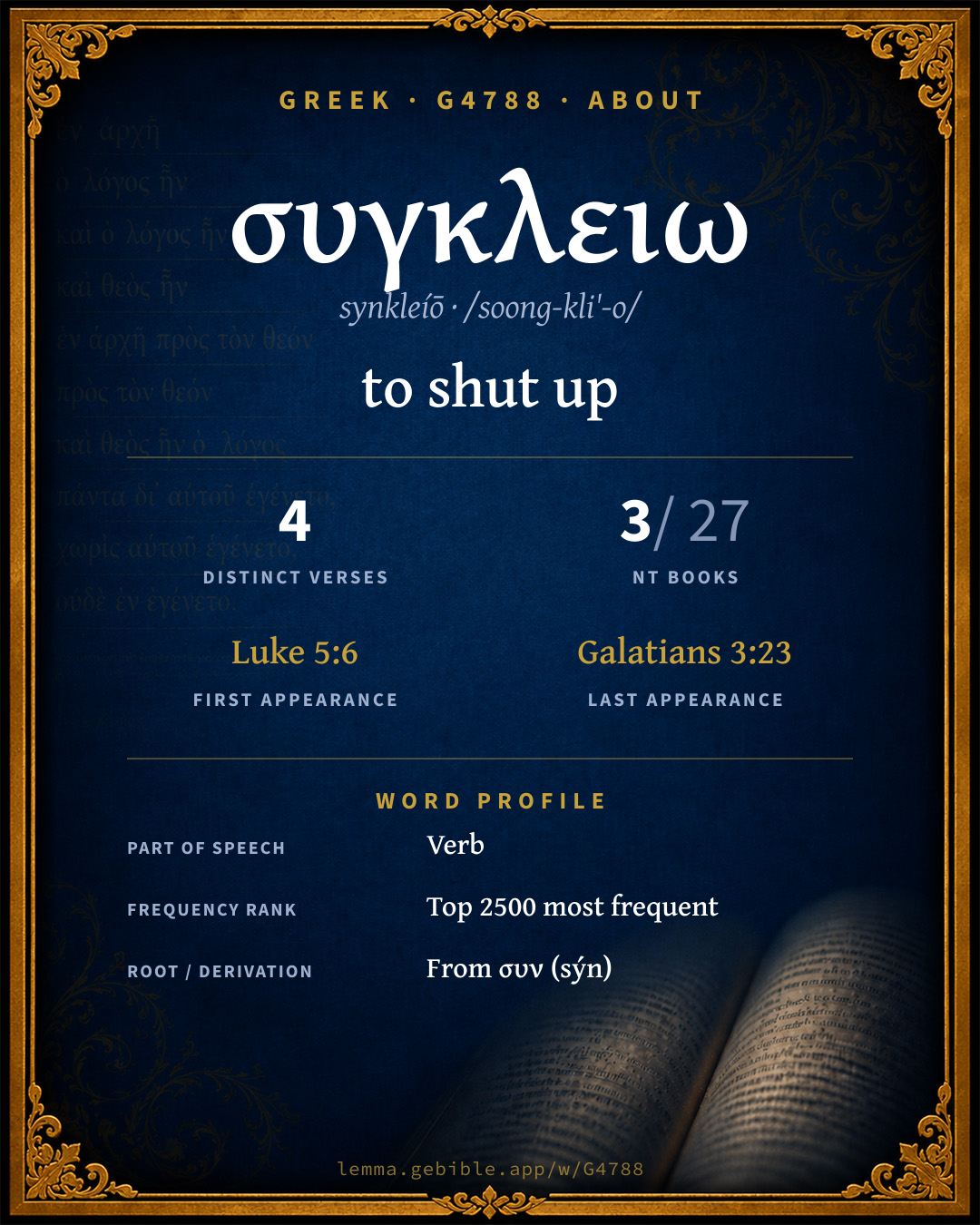
συγκλείω
to shut up
‘to shut up’ is one of 2 main senses fuller range ↓
Full lexicon entry — Thayer's Greek Lexicon
From Thayer's Greek Lexicon
Where this word appears
See every Aorist-tense verb in the Greek New Testament →
Grammar key — what these labels mean
Part of speech
- Verb
- An action or state-of-being word.
Tense
- Aorist
- Action viewed as a simple whole, without regard to duration — often past (perfective aspect).
- Present
- Ongoing or general action in present time (imperfective aspect).
Voice
- Active
- The subject performs the action.
- Passive
- The subject receives the action.
Mood
- Indicative
- States a fact or asks a factual question (the mood of reality).
- Participle
- A verbal adjective (“writing,” “having written”).
Case
- Nominative
- The case of the subject (and the predicate nominative).
Person
- 3rd person
- The one spoken about (“he / she / it / they”).
Gender
- Masculine
- Grammatically masculine.
Number
- Singular
- One.
- Plural
- More than one.
Grammatical forms
- Verb, Aorist, Active, Indicative, 3rd person, Singular 2 times (50%)
- Verb, Aorist, Active, Indicative, 3rd person, Plural 1 time (25%)
- Verb, Present, Passive, Participle, Nominative, Plural, Masculine 1 time (25%)
Parsed forms decoded from the imported morphology (Robinson–Tischendorf, public domain), counted across 4 parsed occurrences — not distinct verses.
Every verse where G4788 appears — 4 distinct verses across 3 books. Click any verse to open its interlinear word-by-word view. Verse text shown in the World English Bible for context — . Each verse’s Greek form is shown with its reference; the English is not keyword-highlighted, since the data carries no word-level English alignment. Use “Compare translations” on any verse to read it across multiple English versions. This concordance covers the Greek New Testament; Septuagint (Greek Old Testament) occurrences of this word are not indexed here.
Luke 1 verse
Romans 1 verse
Galatians 2 verses
- Galatians 3:22 συνέκλεισεν aor act ind 3sg But the Scriptures shut up all things under sin, that the promise by faith in Jesus Christ might be given to those who believe.
- Galatians 3:23 συνκλειόμενοι pres pass ptcp nom pl masc But before faith came, we were kept in custody under the law, shut up to the faith which should afterwards be revealed.
About this entry
At a glance — auto-summarized from this page’s data, not written by a person. Every figure links to its source below. This summary describes the numbers; it doesn’t interpret them.
συγκλειω (synkleíō) is a Greek verb most often rendered “to shut up.” It occurs a mere 4 verses across Scripture. It clusters heavily in Galatians, which alone accounts for 50% of its uses. It first appears in Luke 5:6. Ranging over 2 senses, it is not a single-sense word. The sections below give every sense, occurrence, and version rendering.
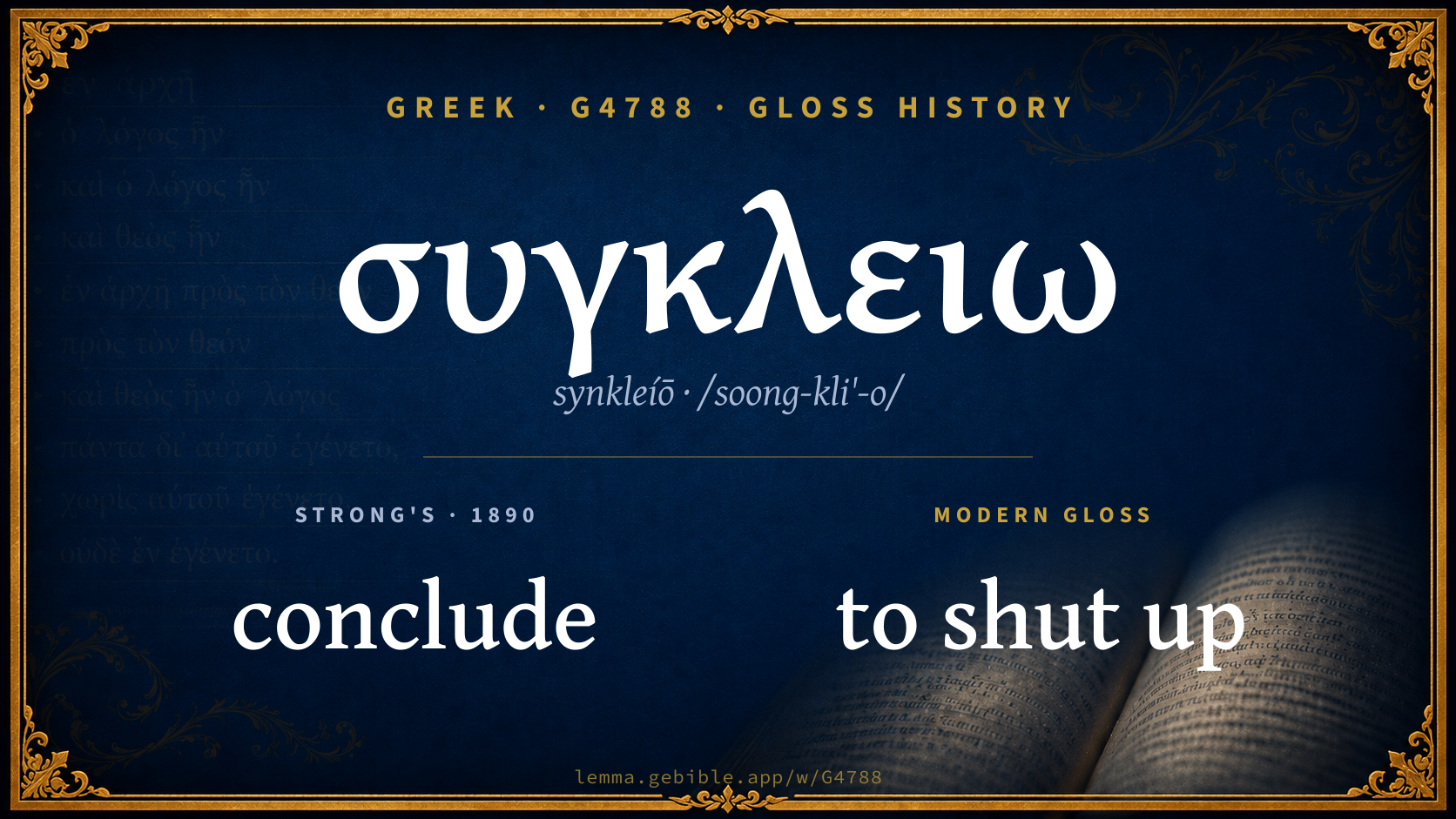
Gloss history
Strong's 1890 vs modern scholarship
About this word
Strong's G4788 catalogs a Greek word from the Greek New Testament.
These counts are not copied from any lexicon or concordance. They are computed here, from the morphology-tagged Greek New Testament. What Lemma adds →
- 4
- distinct verses
- The word appears in 4 distinct verses.
- 3 / 27
- NT books
- The word appears in 3 of 27 New Testament books.
- #1,877
- by frequency
- Top 2500 most frequent Greek words (rank 1,877 of 5,347 Greek words by occurrence).
View all 4 occurrences in the concordance →
By section of the New Testament
By traditional corpus
Conventional, traditional groupings — biblical authorship is debated, so this is a traditional corpus grouping, not an authorship claim. Some books belong to more than one corpus (Luke is in both the Gospels and the Lukan corpus, and so on), so these shares overlap and need not total 100%. Each figure is a share of the word’s 4 distinct verses.
- Pauline corpus 3 verses · 75%
- Gospels 1 verse · 25%
- Lukan (Luke–Acts) 1 verse · 25%
How translations render this word
Counts come from each version’s own published word-to-Strong’s tagging or interlinear alignment — an approximate guide to how each version renders this word, not a word-level alignment the data otherwise carries. Because each total is that version’s own tagged count, the per-version totals vary from one another and need not match the appearance or distinct-verse counts above. These counts may also differ from a printed concordance because Lemma counts each distinctly tagged rendering and does not collapse phrase taggings into a single head-word total. This is a fixed set of word-tagged versions (KJV, ASV, BSB, ULT) and does not change with the reading translation you choose elsewhere. Each version’s license is shown beside its name below (and on Sources).
- King James Version: Hath concluded 2×
- American Standard Version: Shut up 2×
- Berean Standard Bible: Confined 1×, Has consigned 1×, Locked up 1×
- unfoldingWord Literal Text: Imprisoned 2×
King James Version Public Domain
Renders G4788 across 4 tagged occurrences — most commonly:
Plus 2 renderings that appear only once — usually multi-word phrases or single function words the recovered tagging swept in, not distinct renderings.
American Standard Version Public Domain
Renders G4788 across 4 tagged occurrences — most commonly:
Plus 2 renderings that appear only once — usually multi-word phrases or single function words the recovered tagging swept in, not distinct renderings.
Berean Standard Bible Public Domain
Renders G4788 across 4 tagged occurrences — most commonly:
unfoldingWord Literal Text CC BY-SA 4.0
Renders G4788 across 4 tagged occurrences — most commonly:
Plus 2 renderings that appear only once — usually multi-word phrases or single function words the recovered tagging swept in, not distinct renderings.
Senses in Thayer's
The 2 senses Thayer's distinguishes for this word, in lexicon order (not ranked by frequency or importance). The full entry — with sub-senses — is in the Lexicon Entry tab.
- to shut up together, enclose
- to shut up on all sides, shut up completely
Word origin
Derived from συν (sýn) (G4862) — with.
Forms in the corpus
The 3 distinct written forms G4788 takes in the Greek New Testament, most frequent first — each parse links to that tense’s occurrences in the concordance.
| Form | Parsing | Example | Uses |
|---|---|---|---|
| συνέκλεισεν synékleisen | Verb, Aorist, Active, Indicative, 3rd person, Singular | Romans 11:32 | 2 |
| συνέκλεισαν synékleisan | Verb, Aorist, Active, Indicative, 3rd person, Plural | Luke 5:6 | 1 |
| συνκλειόμενοι synkleiómenoi | Verb, Present, Passive, Participle, Nominative, Plural, Masculine | Galatians 3:23 | 1 |
Same root — word family
Other Thayer's entries built from the same root as G4788, grouped by Strong’s listed origin. These share a root / origin per the lexicon — not necessarily a shared meaning. Each links to that word’s own entry.
Derives from
Shares the same root
- κοινος koinós G2839 common
- συγγενης syngenḗs G4773 related by blood
- συγγνωμη syngnṓmē G4774 pardon
- συγκαθημαι synkáthēmai G4775 to sit together
- συγκαθιζω synkathízō G4776 to sit together
- συγκακοπαθεω synkakopathéō G4777 to suffer together
- συγκακουχεω synkakouchéō G4778 to be ill-treated together
- συγκαλεω synkaléō G4779 to call together
- συγκαλυπτω synkalýptō G4780 to cover completely
- συγκαμπτω synkámptō G4781 to bend together
- συγκαταβαινω synkatabaínō G4782 to go down with
- συγκατατιθεμαι synkatatíthemai G4784 to deposit together
- συγκαταψηφιζω synkatapsēphízō G4785 to vote against
- συγκεραννυμι synkeránnymi G4786 to mix together
- συγκληρονομος synklēronómos G4789 joint heir
- συγκοινωνεω synkoinōnéō G4790 to share together
- συγκοινωνος synkoinōnós G4791 joint partner
- συγκομιζω synkomízō G4792 to collect together
- συγκρινω synkrínō G4793 to join together
- συγκυπτω synkýptō G4794 to bend together
- συγκυρια synkyría G4795 by chance
- συγχαιρω synchaírō G4796 to rejoice with
- συγχεω synchéō G4797 to disturb
- συγχραομαι synchráomai G4798 to associate with
+125 more words share this root (not shown).
Compare all same-root words → Showing 4 of 151 — not the complete family. They share a root, not necessarily a meaning.
Septuagint usage
The same Greek word συγκλειω appears 30 times in the Greek Old Testament (Septuagint), across 29 verses in 15 books.
- 30
- LXX occurrences
- Tagged occurrences of this Greek word in the Septuagint.
- 29
- verses
- Distinct Septuagint verses containing this word.
- 15 / 39
- OT books
- The word appears in 15 of the 39 Old Testament books.
Sample Septuagint occurrences
- Genesis 16:2 συνκλείω
- Exodus 14:3 συνκλείω
- Joshua 6:1 συνκλείω
- 1 Samuel 1:6 συνκλείω
- 1 Kings 6:20 συνκλείω
- 2 Kings 24:14 συνκλείω
- Job 3:10 συνκλείω
- Psalms 16:10 συνκλείω
- Proverbs 4:12 συνκλείω
- Isaiah 45:1 συνκλείω
- Jeremiah 13:19 συνκλείω
- Ezekiel 4:3 συνκλείω
Septuagint occurrences (same lexeme)
Every verse where the same Strong’s number (G4788) appears in the Greek Septuagint. Verse text shown in the World English Bible for context; the Greek form is the matched word — the English is not keyword-highlighted.
- Genesis 16:2 συνκλείω Sarai said to Abram," See now, Yahweh has restrained me from bearing. Please go in to my handmaid. It may be that I will obtain children by her." Abram listened to the voice of Sarai.
- Genesis 20:18 συνκλείω For Yahweh had closed up tight all the wombs of the house of Abimelech, because of Sarah, Abraham's wife.
- Exodus 14:3 συνκλείω Pharaoh will say of the children of Israel, 'They are entangled in the land. The wilderness has shut them in.'
- Joshua 6:1 συνκλείω Now Jericho was tightly shut up because of the children of Israel: none went out, and none came in.
- 1 Samuel 1:6 συνκλείω Her rival provoked her sore, to make her fret, because Yahweh had shut up her womb.
- 1 Kings 6:20 συνκλείω Within the oracle was [a space of] twenty cubits in length, and twenty cubits in breadth, and twenty cubits in the height of it; and he overlaid it with pure gold: and he covered the altar with cedar.
- 1 Kings 7:35 συνκλείω In the top of the base was there a round compass half a cubit high; and on the top of the base the stays of it and the panels of it were of the same.
- 1 Kings 10:21 συνκλείω All king Solomon's drinking vessels were of gold, and all the vessels of the house of the forest of Lebanon were of pure gold: none were of silver; it was nothing accounted of in the days of Solomon.
- 1 Kings 11:27 συνκλείω This was the reason why he lifted up his hand against the king: Solomon built Millo, and repaired the breach of the city of David his father.
- 1 Kings 12:24 συνκλείω Thus says Yahweh, You shall not go up, nor fight against your brothers the children of Israel: return every man to his house; for this thing is of me. So they listened to the word of Yahweh, and returned and went their way, according to the word of Yahweh.
- 2 Kings 24:14 συνκλείω He carried away all Jerusalem, and all the princes, and all the mighty men of valor, even ten thousand captives, and all the craftsmen and the smiths; none remained, save the poorest sort of the people of the land.
- 2 Kings 24:16 συνκλείω All the men of might, even seven thousand, and the craftsmen and the smiths one thousand, all of them strong and apt for war, even them the king of Babylon brought captive to Babylon.
- Job 3:10 συνκλείω Because it didn't shut up the doors of my mother's womb, Nor did it hide trouble from my eyes.
- Job 3:23 συνκλείω Why is light given to a man whose way is hid, Whom God has hedged in?
- Psalms 16:10 συνκλείω For you will not leave my soul in Sheol, Neither will you allow your holy one to see corruption.
- Psalms 30:9 συνκλείω "What profit is there in my destruction, if I go down to the pit? Shall the dust praise you? Shall it declare your truth?
- Psalms 34:3 συνκλείω Oh magnify Yahweh with me. Let us exalt his name together.
- Psalms 77:50 συνκλείω
- Psalms 77:62 συνκλείω
- Proverbs 4:12 συνκλείω When you go, your steps will not be hampered. When you run, you will not stumble.
- Isaiah 45:1 συνκλείω Thus says Yahweh to his anointed, to Cyrus, whose right hand I have held, to subdue nations before him, and I will loose the loins of kings; to open the doors before him, and the gates shall not be shut:
- Jeremiah 13:19 συνκλείω The cities of the South are shut up, and there is none to open them: Judah is carried away captive, all of it; it is wholly carried away captive.
- Jeremiah 21:4 συνκλείω Thus says Yahweh, the God of Israel, Behold, I will turn back the weapons of war that are in your hands, with which you fight against the king of Babylon, and against the Chaldeans who besiege you, without the walls; and I will gather them into the midst of this city.
- Jeremiah 21:9 συνκλείω He who remains in this city shall die by the sword, and by the famine, and by the pestilence; but he who goes out, and passes over to the Chaldeans who besiege you, he shall live, and his life shall be to him for a prey.
- Ezekiel 4:3 συνκλείω Take for yourself an iron pan, and set it for a wall of iron between you and the city: and set your face toward it, and it shall be besieged, and you shall lay siege against it. This shall be a sign to the house of Israel.
- Amos 1:6 συνκλείω Thus says Yahweh: "For three transgressions of Gaza, yes, for four, I will not turn away its punishment; Because they carried away captive the whole community, To deliver them up to Edom;
- Amos 1:9 συνκλείω Thus says Yahweh: "For three transgressions of Tyre, yes, for four, I will not turn away its punishment; Because they delivered up the whole community to Edom, And didn't remember the brotherly covenant;
- Obadiah 1:14 συνκλείω Don't stand in the crossroads to cut off those of his who escape. Don't deliver up those of his who remain in the day of distress.
- Malachi 1:10 συνκλείω "Oh that there were one among you who would shut the doors, that you might not kindle fire on my altar in vain! I have no pleasure in you," says Yahweh of hosts, "neither will I accept an offering at your hand.
These are occurrences of the same Greek lexeme (G4788) in the Septuagint — not a translation of any one Hebrew word. The store carries no word-level Hebrew↔Greek alignment, so no Hebrew original is asserted here. Counts come from the recovered LXX Strong's tagging — high-frequency vocabulary is well covered, while rare or late forms may be untagged — so they reflect tagged occurrences and may slightly undercount.