Acts 14:28

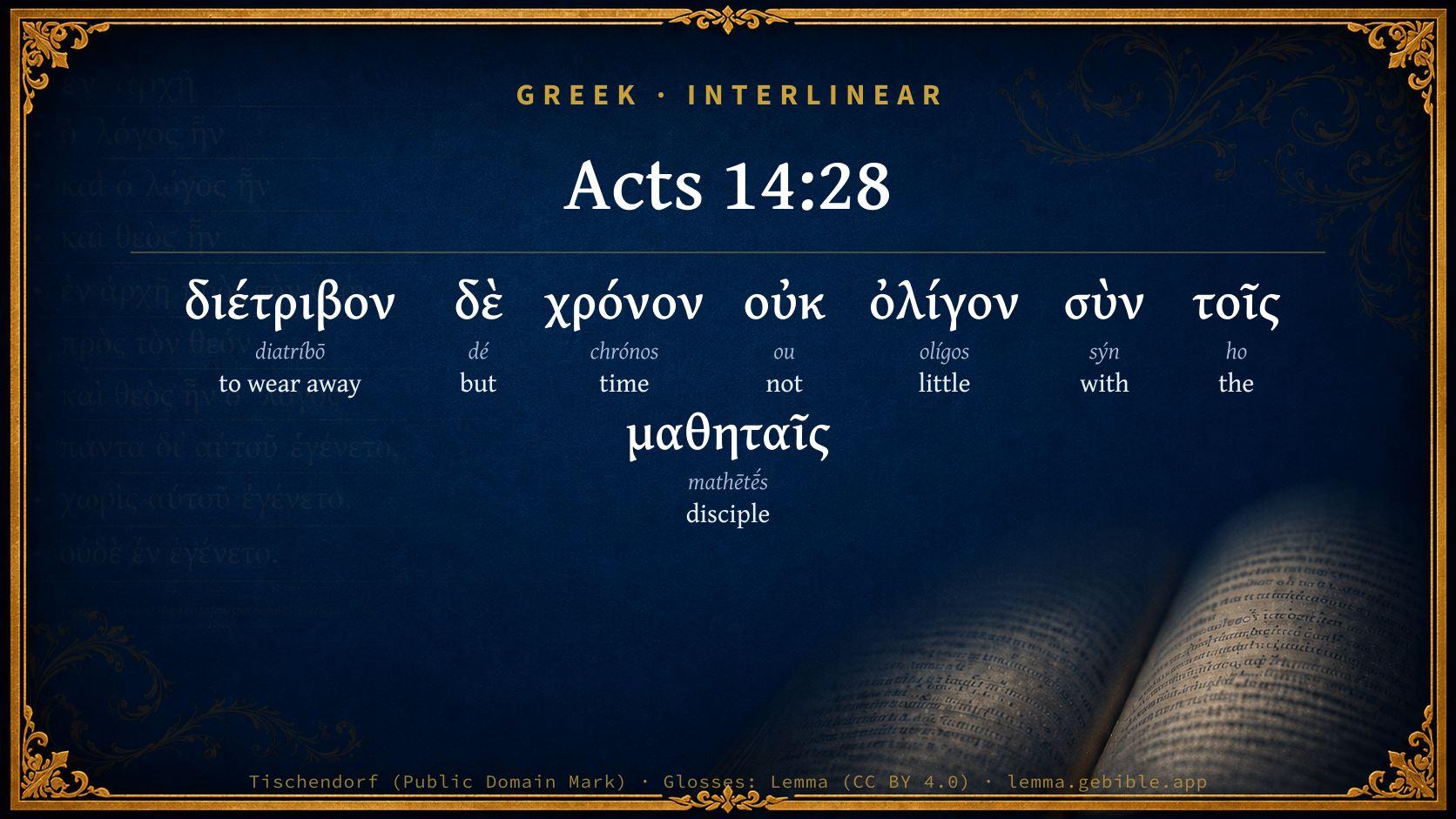
Greek (Tischendorf 8th ed.) Acts 14:28 appears in the Greek New Testament. The text above is from the Tischendorf 8th edition. Each word links to its Strong’s number and a concise gloss. Click any word for its full Thayer’s Greek Lexicon entry.
Download image
Cite this verse

Acts 14:28 (World English Bible). Public Domain. Lemma interlinear Bible study tool, https://lemma.gebible.app/v/acts/14/28.

Show BibTeX & RIS
BibTeX
RIS
English Translation
They stayed there with the disciples for a long time.
World English Bible · Public Domain
Download a study sheet

One document with this verse’s original text, its word-by-word gloss line, the meaning frame, cross-references with their text, attributed commentary, and full source and license credits — printable, and it pastes into notes with its structure intact.

This verse Autodidact and up

Study sheet (.html) Plain text (.txt)

A passage Seminary Student

Up to 50 verses in one chapter. A passage sheet keeps up to 6 commentary sources and 12 cross-references per verse, in the order this page ranks them, and says so on the sheet whenever that leaves anything out. Ask for a single verse and you get the Autodidact verse sheet above.

Everything on this page stays free to read, with no account — the sheet is a download of what is already on screen, not access to it.

Want to remove ads? Support Godless Engineer
Compare translations 3

The same verse in 3 English versions, stacked beneath the original-language interlinear above. Click any original word for its lexicon entry.

Each is an independent rendering of the whole verse — the interlinear is not word-aligned to these translations.

Highlighted words mark where these versions differ — a whole-verse word diff, not a word-by-word alignment.

  • World English Bible Public Domain
    They stayed there with the disciples for a long time.
  • King James Version Public Domain
    And there they abode long time with the disciples.
  • unfoldingWord Literal Text CC BY-SA 4.0
    And they were staying for not a little time with the disciples.

unfoldingWord Literal Text — © unfoldingWord, licensed CC BY-SA 4.0. Word-aligned USFM3 via Door43 (git.door43.org/unfoldingWord/en_ult).

Versions to compare (up to 4)

3 of 4 selected

Show all 18 translations

Every available English version of this verse, each an independent rendering of the whole verse.

  • World English Bible Public Domain
    They stayed there with the disciples for a long time.
  • Berean Standard Bible Public Domain
    And they spent a long time there with the disciples.
  • Majority Standard Bible Public Domain
    And they spent a long time there with the disciples.
  • King James Version Public Domain
    And there they abode long time with the disciples.
  • American Standard Version (1901) Public Domain
    And they tarried no little time with the disciples.
  • Revised Version (1885) Public Domain
    And they tarried no little time with the disciples.
  • Geneva Bible (1599) Public Domain
    So there they abode a long time with the disciples.
  • Young's Literal Translation Public Domain
    and they abode there not a little time with the disciples.
  • Literal Standard Version CC BY-SA 4.0
    and they abided there with the disciples [for] not a short time.
  • Unlocked Literal Bible CC BY-SA 4.0
    They stayed for a long time with the disciples.
  • unfoldingWord Literal Text CC BY-SA 4.0
    And they were staying for not a little time with the disciples.
  • Darby Bible Public Domain
    And they stayed no little time with the disciples.
  • World Messianic Bible Public Domain
    They stayed there with the disciples for a long time.
  • Webster's Bible Public Domain
    And there they abode a long time with the disciples.
  • Free Bible Version CC BY-SA 4.0
    They stayed there with the believers for a long time.
  • Bible in Basic English Public Domain
    And they were with the disciples there for a long time.
  • Text-Critical English NT CC BY 4.0
    And they stayed there with the disciples for some time.
  • Tyndale New Testament (1534) Public Domain
    And ther they abode longe tyme with the disciples.

Literal Standard Version (2020), Covenant Press — licensed CC BY-SA 4.0. Text via the HelloAO Bible API (eBible.org). Unlocked Literal Bible (unfoldingWord) — licensed CC BY-SA 4.0. Text via the HelloAO Bible API (eBible.org). unfoldingWord Literal Text — © unfoldingWord, licensed CC BY-SA 4.0. Word-aligned USFM3 via Door43 (git.door43.org/unfoldingWord/en_ult). Free Bible Version, Dr. Jonathan Gallagher — licensed CC BY-SA 4.0. Text via the HelloAO Bible API (eBible.org).

Word by word

More ways to search: Search by grammar → Find every occurrence → Compare this word →

Practice this passage: Drill this verse → Learn its vocabulary →

About this verse

These counts appear in no published source. They are computed here, from the morphology-tagged text and Lemma’s own curated glosses. What Lemma adds →

8
words
8
distinct lemmas
Acts
section

Notable vocabulary

The rarest word here is διέτριβον to wear away G1304 — appearing just 10 times in the whole Greek New Testament.

Shared distinctive vocabulary

διέτριβον to wear away G1304 occurs in 10 verses of the Greek New Testament. Also found in:

Cross-references

2

Topical passages linked to Acts 14:28 in the Treasury of Scripture Knowledge — connected by theme and wording, ordered by reader-vote popularity; previews shown in the World English Bible.

  • Acts 11:26 When he had found him, he brought him to Antioch. It happened, that for a whole year they were gathered together with the assembly, and taught many people. The disciples were first called Christians in Antioch.
  • Acts 15:35 But Paul and Barnabas stayed in Antioch, teaching and preaching the word of the Lord, with many others also.

Cross-references courtesy of OpenBible.info (CC BY 4.0).

Commentary

Notes on Acts 14:28 from classic Christian and Jewish commentators (each source and its license shown beneath its notes). The classic Christian expositions comment on the surrounding passage and are grouped to its opening verse, so a note may address several verses; the Jewish commentaries on the Tanakh (Rashi and others) are per-verse, so they appear only where the commentator wrote on this verse.

Lemma curates 59 commentaries, every one of them public domain or Creative Commons licensed, each selected and text-cleaned for this edition rather than reprinted as found. About our sources →

Expositor's Greek Testament

ed. W. Robertson Nicoll

Act 14:28 . χρόνον οὐκ ὀλίγον : only in Acts , where it occurs eight times, cf. Act 12:18 , etc.; on the length of time thus spent see “Chronology of the N.T.,” Hastings’ B.D., and also Ramsay, Church in the Roman Empire , p. 74, with which cf. Lewin, Fasti Sacri , p. 288.

Additional Note . In chapters 13 and 14 many critics find the commencement of a new source, a belief based to a great extent upon the view that Barnabas and Saul are here introduced as if they had not been previously mentioned. But whilst some description is given of each of the remaining persons in the list (Act 13:1 ), nothing is added to the name of Barnabas or of Saul, so that it seems quite permissible to argue that these two are thus simply mentioned by name because they were already known. It is therefore not surprising to find that some writers, e.g. , Hilgenfeld, regard these chapters as part of a previous source, so too Wendt, Spitta, Jüngst. Others see in these chapters a separate document, possibly not used again by the author of Acts; a document composed by a different hand from that to which we owe the “We” sections, and incorporated by the author of the whole book into his work (McGiffert). Others again see in these same chapters the commencement of a Travel-Document, containing not only these two chapters, but also the later journeys of St. Paul, coming to us from the same hand as the “We” sections, and from the same hand as the rest of the book (Ramsay). It is disappointing to find how Clemen, while referring 13, 14 to his good source, Historia Pauli , goes even further than Spitta in breaking up the different parts of the narrative: e.g. , Act 14:8-11 , we owe to the Redactor Judaicus, and Act 14:19-20 ; Act 14:22 b , Act 14:23 in the same chapter to the Redactor Anti-Judaicus. (See on the whole question Hilgenfeld, Zeitschrift für wissenschaft. Theol. , 1 e Heft, 1896; Wendt (1899), p. 225, note; Zöckler, Apostelgeschichte , pp. 243, 244 (second edition).) It is no wonder in face of the unsatisfactory attempts to break up these chapters, or to separate their authorship from that of the rest of the book, that Zahn should maintain that a man like Luke needed for the composition of chapters 13 28 no other source than his recollections of the narratives recited by St. Paul himself, or of the events in which he, as St. Paul’s companion, had participated, Didache 1 N. T. , ii., 412 (1899), cf. Nösgen, Apostelgeschichte , pp. 25, 26. Certainly the unity of authorship between the two chapters under consideration and the rest of the book seems most clearly marked in language and style: e.g. , κατασείειν , Act 13:6 , only found elsewhere in N.T., Act 12:17 ; Act 19:33 ; Act 21:40 ; ἐπαίρειν τὴν φωνήν , Act 14:11 , only elsewhere in N.T., Luk 11:27 , Act 2:14 ; Act 22:22 ; παραχρῆμα , Act 13:11 , elsewhere in N.T., ten times in Luke’s Gospel (only twice in St. Matthew, and not at all in the other Evangelists), Act 3:7 ; Act 5:10 ; Act 12:23 ; Act 12:16 :(26), 33; ἧ , with participle, Act 13:48 , Act 14:7 ; Act 14:12 ; Act 14:26 ; δή Act 13:2 ; ἄχρι , Act 13:6 ; Act 13:11 ; ἱκανός with χρόνος , Act 14:3 , elsewhere in N.T. in Luke only, and eight times in Acts in all parts; ἀτενίζειν in Act 13:9 and Act 14:9 and the frequent recurrence of τέ in both chapters. It is also perhaps worthy of observation that out of some twenty-one words and phrases found only in the “We” sections, and in the rest of Acts (Hawkins, Horæ Synopticæ , p. 151), six occur in these two chapters, and two of them twice: ἀποπλέω , Act 13:4 , Act 14:26 ; διατρίβω with accusative of time, Act 14:3 ; ἔξειμι , Act 13:42 ; ἡμέραι πλείους , Act 13:31 ; προσκέ κλημαι with accusative, Act 13:2 ; Act 13:7 ; ὑπονοέω , Act 13:25 . On the position of these two chapters relatively to chap. 15 see below.

Additional note on Act 14:23 . On the rapid spread of Christianity in Asia Minor see Ramsay, Cities and Bishoprics of Phrygia , i., pp. 87, 94, 95, 135 137, and Church in the Roman Empire , pp. 161, 397. The old nature religion with its negation of moral distinctions and family ties was doomed, a religion which on the one hand made woman the head of the family, and on the other hand compelled her to a so-called sacred service which involved the surrender of all which in a civilised community womanhood held most dear. The strength of the old ritual, however, was so great that it seems to have been maintained in Phrygia even after a higher type of society became known in the Roman period. But with the growth of Roman organisation and educational influences the minds of men were at least prepared for new ideas, and at this juncture St. Paul came preaching a gospel of home life, of Christian purity; and wherever higher social ideas had already penetrated he found converts disposed to follow his teaching as “a more excellent way”. In connection with the wide spread of Christianity in Asia Minor see also Orr, Some Neglected Factors in the Study of the Early Progress of Christianity , p. 48 ff. (1899).

The Expositor's Greek Testament, edited by W. Robertson Nicoll (1897–1910) — public domain. Text from a community e-Sword module.

Jamieson, Fausset & Brown

Robert Jamieson, A. R. Fausset & David Brown

there they abode long time--"no little time." From the commencement of the mission till they left Antioch to go up to attend the council at Jerusalem, some four or five years elapsed; and as the missionary journey would probably occupy less than two years, the rest of the time would be the period of their stay at Antioch. (But see Chronological Table.)

Next: Acts Chapter 15

Jamieson, Fausset & Brown — Commentary Critical and Explanatory on the Whole Bible (1871) — public domain (CC PDM 1.0). Text via the HelloAO Bible API.

Adam Clarke's Commentary

Verse 28. And there they abode long time] How long the apostles tarried here we cannot tell; but we hear no more of them till the council of Jerusalem, mentioned in the following chapter, which is generally supposed to have been held in the year 51 of our Lord; and, if the transactions of this chapter took place in A.D. 46, as chronologers think, then there are five whole years of St. Paul's ministry, and that of other apostles, which St. Luke passes by in perfect silence. It is very likely that all this time Paul and Barnabas were employed in extending the work of God through the different provinces contiguous to Antioch; for St. Paul himself tells us that he preached the Gospel so far as Illyria, Ro 15:19, on the side of the Adriatic Gulf: see its situation on the map. Many of the tribulations and perils through which the Apostle Paul passed are not mentioned by St, Luke, particularly those of which he himself speaks, 2Co 11:23-27. He had been five times scourged by the Jews; thrice beaten by the Romans; thrice shipwrecked; a whole night and day in the deep, probably saving his life upon a plank; besides frequent journeyings, and perils from his countrymen, from the heathen, from robbers, in the city, in the wilderness, in the sea, among false brethren, c., c. Of none of these have we any circumstantial account. Probably most of these happened in the five years which elapsed between the apostles' return to Antioch, and the council of Jerusalem.

IN reading the Acts of the Apostles we may have often occasion to remark that in preaching the Gospel they carefully considered the different circumstances of the Jews and the Gentiles, and suited their address accordingly. When speaking to the former, of the necessity of crediting the Gospel, because without it they could not be saved, they took care to support all their assertions by passages drawn from the LAW and the PROPHETS, as every Jew considered those books to be of Divine authority, and from their decision there was no appeal. But, in addressing the Gentiles, who had no revelation, they drew the proof of their doctrine from the visible creation and demonstrated, by plain reasoning, the absurdity of their idolatrous worship, and called them off from those vanities to the worship of the living and true God, who made and governs all things, and who gave them such proofs of his being, wisdom, and goodness, in the provision made for their comfort and support, that they had only to reflect on the subject in order to be convinced of its truth. And while, in consequence, they saw the absurdity of their own system, they would at once discover the reasonableness of that religion which was now offered to them, in the name and on the authority of that God who had fed and preserved them all their life long, and girded them when they knew him not. The Gentiles felt the force of these reasonings, yielded to the truth, and became steady followers of Christ crucified while the Jews, with all their light and advantages, hardened their hearts against it, though they had no other arguments than what contradiction and blasphemy could provide! Publicans and harlots enter into the kingdom of heaven before them. Do not many, even in the present day, copy their example, revile the truth, take up with the shadow instead of the substance, and rest just as much in the letter of Christianity, as ever the Jews did in the letter of the law? This is a deplorable fact which cannot be successfully controverted.

2. We have already had occasion to note five years of a chasm in the apostolic history. God himself does not choose to have all the labours and sufferings of his servants recorded. Their recompense is in heaven; and it is enough that God knows their work, who alone can reward it. And yet every faithful servant of God will feel that the reward is all of grace, and not of debt; for the amount of their good is just the sum of what God has condescended to do by them. How studious are men to record the smallest transactions of their lives, while much of the life and labours of Jesus Christ and his apostles are written in the sand, and no longer legible to man; or written before the throne, where they are seen only by God and his angels. In many cases, the silence of Scripture is not less instructive than its most pointed communications.

3. We cannot consider the effect produced on the minds of the people of Lystra, without being surprised that a single miracle, wrought instrumentally by men, should excite so much attention and reverence, and that we should be unmoved by the myriads wrought by the immediate hand of GOD.

4. How difficult it is to get men brought to worship God, though they have the highest reasons and most powerful motives for it; and yet how ready are they to offer an incense to man that is due only to God himself! We applaud the apostles for rejecting with horror the sacrifices offered to them: common sense must have taught them this lesson, even independently of their piety. Let us beware that we take not that praise to ourselves which belongs to our Maker. Gross flattery is generally rejected, because a man cannot receive it without being rendered ridiculous; but who rejects even inordinate praise, if it be delicately and artfully prepared!

Adam Clarke's Commentary on the Bible (1810–1826) — public domain. Text from a community e-Sword/MySword module.

Ellicott's Commentary for English Readers

(28) There they abode long time.—The words probably cover an interval of more than a year, during which it is reasonable to suppose that the preaching of the two Apostles drew together a large number of Gentile converts.

A Bible Commentary for English Readers, edited by Charles John Ellicott (1878–1897) — public domain. Text from a community e-Sword module.

The Cambridge Bible for Schools and Colleges

gen. ed. J. J. S. Perowne

28. And there they abode long time with the disciples] The oldest MSS. omit “there.” Render literally, “And they abode no little time with the disciples.” St Paul was naturally more attached to Antioch than to Jerusalem, for here was the centre where Gentiles had first formed a Church, and where consequently he found most sympathy with his special labours.

The termination of St Paul’s first missionary journey seems no unfitting place for a notice of the character of the Apostle’s labours. We must assign a space of three or four years to this first mission, and as the district traversed was but small, a considerable time must have been spent at each place chosen for a centre of labour. The narrative of St Luke indicates this very clearly. He tells us (Act_13:49) how from Antioch “the word of the Lord was published throughout all the religion.” Again he speaks (Act_13:52, Act_14:22) of “the disciples” as though converts had been made in no small numbers. Then at Iconium he mentions (Act_14:1) that “a great multitude both of Jews and Greeks believed,” and (Act_14:3) that “long time” was spent there in striving to overcome the opposition of the “unbelieving Jews,” and at last the whole city appears to have been divided into two great factions. Such a result was not produced by two unknown Jewish missionaries, except after the lapse of a long time. So too at Lystra they abode long enough to gain many adherents, and form a congregation of earnest disciples. And the abundant fruit of the labours of the missionaries is clearly seen in the need for the ordination of elders, and in the provisions made for orderly church government. The language of St Paul too (Act_15:36) when he speaks of revisiting “the brethren in every city where they had before preached the word of the Lord” indicates that he felt that a good foundation had been laid in the different places where they had ministered. It seems from this that the course adopted by the Apostle was to tarry in some centre of population, and continue his preaching till a sufficient number of converts had been gained to carry on the work after he left them, and till some of these were so far instructed as to be able to take oversight of the infant churches.

But it is when we read of the Christian congregations that the narrative of St Luke becomes most full of interest. St Paul had been by a revelation (Act_22:21) sent to be the Apostle of the Gentiles, and he testifies himself to this statement of St Luke in his Epistle to the Galatians (Gal_2:7). Yet the history shews him to us quite in harmony with the feelings expressed in his letter to the Romans (Act_10:1) as one whose heart’s desire for Israel is that they may be saved; and in full accord with that language in which in the same epistle (Act_11:1) he identifies himself with the children of Israel. Throughout all this missionary journey St Paul never neglects to publish the message of salvation first to his own people. No, not even after repeated rejections of his teaching. In Cyprus he and Barnabas are mentioned as going first to the synagogue at Salamis. To the Gentiles they preached with much effect, but the Jews had heard their doctrine first. At Antioch they began their mission work in the synagogue, where they took their places as members of the Jewish congregation, and were invited by the rulers to address the assembly as being brethren and of the same faith. This address, which St Luke has preserved for us in substance, echoes more than once the language of the Epistle to the Romans. If in the epistle (Act_3:18) St Paul says “We conclude that a man is justified by faith without the deeds of the Law,” St Luke relates (Act_13:39) how he said to the Jews of Antioch in precisely similar terms, “By Him all that believe are justified from all things from which ye could not be justified by the Law of Moses.” So too just as the Apostle explains to the Romans (Act_10:19) that the purpose of God had been to rouse His ancient people to jealousy by them that are no people, so to the Antiochene Jews (Act_13:46) is he represented as saying, “It was necessary that the word of God should have been first spoken to you, but seeing ye judge yourselves unworthy of everlasting life, lo, we turn to the Gentiles.” And the action is just in the same spirit as the language which is used in Rom_1:16. There the Gospel is proclaimed to be the power of God unto salvation to every one that believeth, but the order in which it is offered is “to the Jew first and afterwards to the Gentiles.”

To compare in this way the language of St Paul’s chief epistle with the abstracts of his speeches in the Acts is of much importance. For some have been found to maintain that the St Paul of the Epistles is a very different teacher from the Apostle whose history is recorded in the Acts. Those passages in the letters where St Paul speaks so severely of the opposition which he experienced from the Jews have been unduly dwelt on, and the theory of two sections in the early Church (a Pauline and a Petrine party) has been widely accepted, and the Acts described as a work of late date written with a view to bring about harmony between them. We cannot therefore dwell too often on all those points in the narrative of St Luke which find a counterpart in the letters of St Paul. And the farther such a comparison be carried on the more will it be apparent that the agreement between the Apostle and the historian exists because the latter is faithful to what he saw and heard, and so his record cannot but harmonize with the spirit and words of the chief actor in the history.

The Cambridge Bible for Schools and Colleges (gen. ed. J. J. S. Perowne; Cambridge University Press, 1878–1918) — public domain. Text from a community e-Sword module.

Trapp's Complete Commentary

John Trapp

28 And there they abode long time with the disciples.

Ver. 28. There they abode] As in a receptacle of rest, a place of free profession; such as Geneva hath been for many years to the persecuted Protestants, which makes the wicked Papists give out, that it is a professed sanctuary of all manner of roguery; that the people there are blasphemers of God and all his saints, yea, that they are grown barbarous, and eat young children, &c. And this the common people are taught to believe as gospel.

John Trapp, A Commentary or Exposition upon All the Books of the Old and New Testament (1647–1656) — public domain. Text from a community e-Sword module.

Albert Barnes' Notes on the Bible

And there they abode - At Antioch.

Long time - How long is not intimated; but we hear no more of them until the council at Jerusalem, mentioned in the next chapter. If the transactions recorded in this chapter occurred, as is supposed, about 45 a.d. or 46 a.d., and the council at Jerusalem assembled 51 a.d. or 53 a.d., as is supposed, then here is an interval of from five to eight years in which we have no account of them. Where they were, or what was their employment in this interval, the sacred historian has not informed us. It is certain, however, that Paul made several journeys of which we have no particular record in the New Testament, and it is possible that some of those journeys occurred during this interval. Thus, he preached the gospel as far as Illyricum, Rom 15:19. And in 2Co 11:23-27, there is an account of trials and persecutions, of many of which we have no distinct record, and which might have occurred during this interval. We may be certain that these holy men were not idle. From the example of Paul and Barnabas as recorded in this chapter, we may learn to bear all persecutions and trials without a complaint, and to acknowledge the good hand of God in our preservation in our travels; in our defense when we are persecuted; in all the opportunities which may be open before us to do good; and in all the success which may attend our efforts. Christians should remember that it is God who opens doors of usefulness; and they should regard it as a matter of thanksgiving that such doors are opened, and that they are permitted to spread the gospel, whatever toil it may cost, whatever persecution they may endure, whatever perils they may encounter.

Albert Barnes' Notes on the Bible (1834–1885) — public domain. Text from a community e-Sword/MySword module.

Matthew Poole's English Annotations

To confirm them, as Act 14:22; and also, as our Saviour withdrew himself from the multitudes, they chose there to refresh themselves a while, out of the heat of contention and persecution.

Matthew Poole's English Annotations on the Holy Bible (1683–1685) — public domain. Text from a community e-Sword/MySword module.

The Pulpit Commentary

They tarried for there they abode, A.V.; no little for long, A.V. Bishop Pearson reckons it a little more than a year; Lewin, "about a year;" Renan, "several months." No accurate statement can be gathered from St. Luke; s indefinite expression. With this chapter closes the account of St. Paul"s first missionary tour. Cony-beare and Howson (pp. 177, 213) assign to it a duration of about nine months, from early spring, March, to November, when the sea would be closed; bringing him to Perga in May, and thence for the next five or six months into the mountains of Pisidia, where it was the custom for the inhabitants of the lowlands to congregate during the hot months. Others, however, as Lewin (pp. 156, 157), think the circuit must have occupied "about two years;" Wieseler (p. 224), "more than one year;" but Renan assigns to it five years" ("Saint Paul," p. 55). "Conjectural estimates vary between two and eight years" ("Speaker"s Commentary"). Lewin"s estimate is, perhaps, the most probable. Whatever the exact period may have been, it was a time fruitful in consequences to the immortal interests of mankind.

The Pulpit Commentary (1880–1919), ed. H.D.M. Spence-Jones & Joseph S. Exell — public domain. Text from a community e-Sword module.

McGarvey & Pendleton's Commentaries

J. W. McGarvey

See notes on verse 27

J. W. McGarvey (with Philip Y. Pendleton), Commentaries on the New Testament (The Fourfold Gospel, 1914; Acts; and the epistles) — public domain. Text from a community e-Sword/MySword module.

Cambridge Greek Testament for Schools and Colleges

28. ἐκεῖ omitted with אABCD. Not represented in Vulg.

28. διέτριβον δὲ χρόνον … μαθηταῖς, and they abode no little time with the disciples. St Paul was naturally more attached to Antioch than to Jerusalem, for here was the centre where Gentiles had first formed a Church, and where consequently he found most sympathy with his special labours.

The termination of St Paul’s first missionary journey seems a fitting place to notice the general character of the Apostle’s labours as they are set forth for us by the historian. A space of three or four years at least must be assigned for the duration of this first mission, and as the district traversed was comparatively small, a considerable time must have been spent at each place which was chosen for a centre of labour. This is very clear from St Luke’s narrative. He tells us (Act 13:49) how ‘the word of God was published throughout all the region.’ He speaks also (Act 13:52, Act 14:22) of ‘the disciples’ as though converts had been made in no small numbers. Again at Iconium he mentions (Act 14:1) that (a great multitude both of Jews and Greeks believed,’ and (Act 14:3) that ‘long time’ was spent there in striving to overcome the opposition of the ‘unbelieving Jews,’ and at last the whole city seems to have been divided through the influence of the missionaries into two great and warmly opposing factions. Such results were not produced by a couple of unknown Jewish preachers except after long-extended labour. At Lystra they abode long enough to attract crowds to their discourses and to form a congregation of earnest disciples, who did not allow the work to die out. Another proof of the abundant fruit of their labours is the necessity for ordaining elders in the various centres and providing for orderly Church government. It took too no short time, we may feel sure, to secure converts of such a character as to be fit for the presidential offices in every Church. And the subsequent language of St Paul (Act 15:36) where he speaks of revisiting their brethren in every city where they ‘had before preached the word of the Lord,’ shews that he believed a good foundation had been laid in the various places where they had ministered. We judge from this that the plan of the mission was that Barnabas and Paul made a stay in some centre of population, and there continued their preaching till converts enough and of such a character had been gained to continue the work when the Apostles departed, and some of them so far instructed as to be fit to become teachers to the rest.

It is however when we read of the Christian congregations that the narrative of St Luke becomes most replete with interest. The vision by which St Paul was called (Act 22:21) declared him expressly chosen to be the Apostle of the Gentiles. In his letter to the Galatians he confirms (Gal 2:7) what St Luke tells us on this point in the history. Yet the history exhibits him to us as quite acting up to the feelings which he himself has expressed (Rom 10:1), where he declares that his heart’s desire for Israel is that they may be saved, and it shews us how his whole life was in accord with the language of that same Epistle (Rom 11:1) when he completely identifies himself with the children of Israel. Throughout all this missionary tour the Apostle in no instance neglects to publish the glad tidings of salvation first to his own people. The Jews reject him in one place, yet he still goes to their brethren first at the next station to which he comes. In Cyprus both he and Barnabas went first to the synagogue in Salamis. It is true that they preached mightily unto the Gentiles, but the Jews had heard their message first. At Antioch it was in the synagogue that their mission was commenced. They took their places there as ordinary Jewish worshippers, and were asked by the rulers to address the congregation as being brethren and of the same faith. The address which St Paul made on that occasion, the summary of which St Luke has preserved for us, echoes in more than one place the language of the Epistle to the Romans. While in the latter St Paul says (Rom 3:28) ‘we conclude that a man is justified by faith without the deeds of the Law,’ the historian relates (Act 13:39) that he said to the Antiochene congregation in similar terms, ‘By Him all that believed are justified from all things from which ye could not be justified by the law of Moses.’ In the same way we find in the Epistle St Paul explains to the Romans (Rom 10:19) that God’s purpose had been to rouse His ancient people to jealousy by them that are no people, so at Antioch the history tells us how he said, ‘It was necessary that the word of God should be first spoken to you, but seeing ye adjudge yourselves unworthy of everlasting life, lo, we turn to the Gentiles.’ This is quite in harmony too with Rom 1:16. There the Gospel is proclaimed to be ‘the power of God unto salvation to every one that believeth,’ but the order in which it is offered is ‘to the Jew first, and afterward to the Gentiles.’

To notice the unanimity of the language of St Paul’s chief Epistle with that of such abstracts of his speeches as are furnished by St Luke has much interest and is of much importance. For there are those who maintain that the St Paul of the Acts is a very different person in character and teaching from the St Paul of the Epistles. To establish such an opinion, those passages in the letters have been singled out and unduly dwelt on, wherein the Apostle speaks severely of the opposition which he met with from the Jews. A theory has been started that in the early Church there were two opposing parties, one named from Peter, the other from Paul, and that the Acts of the Apostles is a work of a late date written with the view of bringing about harmony between them. It cannot therefore be too prominently set forward, that in the narrative of St Luke there is a great deal for which we find an exact counterpart in St Paul’s Epistles. And if the comparison of the history with the letters be extended as far as the materials at our command permit, at every step it will become more and more apparent, that the agreement between the Apostle and the historian exists, because the latter is faithful to what he saw and heard, and his record therefore cannot but harmonize with the spirit and words of him who was the chief actor in the history.

Cambridge Greek Testament for Schools and Colleges (Cambridge University Press, 1896; 21 vols, various authors incl. Carr, Maclear, Plummer, Farrar, Lumby, Moule, M. R. James, Simcox) — public domain. Text from a community e-Sword module.

Lesson kit

Teaching starters — assembled from the data on this page, not authored interpretation. Every prompt links to the verse data it draws on. Edit before teaching.

Acts, in the Acts, opens this verse with 8 words (8 distinct Greek lemmas). Its most distinctive word is diatríbō (“to wear away”). A historical commentator’s framing appears above. Read the whole chapter for the surrounding context.

Discussion questions

  1. How does “to wear away” (diatríbō) shape what this verse is saying?
  2. John 3:22 shares the word «to wear away» with this verse. How do the two illuminate each other?
  3. These translations render this verse differently; the difference is in the English rendering, not the original. What questions does that raise?
  4. Reading how Expositor's Greek Testament and Jamieson, Fausset & Brown read this verse, where do the two commentators agree and where do they part?

Things to notice

Reading settings

Reading text

Shown beneath each verse's original-language words.

Old Testament
Old Testament edition

Read the OT as the Masoretic Hebrew (MT) or the Greek Septuagint (LXX).

English shown for the Greek Septuagint (in the Hebrew ↔ Greek comparison).

Comparing translations? Open the Compare panel on any verse page to stack up to four side by side.