Philippians 1:23

Greek (Tischendorf 8th ed.) Philippians 1:23 appears in the Greek New Testament. The text above is from the Tischendorf 8th edition. Each word links to its Strong’s number and a concise gloss. Click any word for its full Thayer’s Greek Lexicon entry.
Download image
Cite this verse

Philippians 1:23 (World English Bible). Public Domain. Lemma interlinear Bible study tool, https://lemma.gebible.app/v/philippians/1/23.

Show BibTeX & RIS
BibTeX
RIS
English Translation
But I am in a dilemma between the two, having the desire to depart and be with Christ, which is far better.
World English Bible · Public Domain
Download a study sheet

One document with this verse’s original text, its word-by-word gloss line, the meaning frame, cross-references with their text, attributed commentary, and full source and license credits — printable, and it pastes into notes with its structure intact.

This verse Autodidact and up

Study sheet (.html) Plain text (.txt)

A passage Seminary Student

Up to 50 verses in one chapter. A passage sheet keeps up to 6 commentary sources and 12 cross-references per verse, in the order this page ranks them, and says so on the sheet whenever that leaves anything out. Ask for a single verse and you get the Autodidact verse sheet above.

Everything on this page stays free to read, with no account — the sheet is a download of what is already on screen, not access to it.

Want to remove ads? Support Godless Engineer
Compare translations 3

The same verse in 3 English versions, stacked beneath the original-language interlinear above. Click any original word for its lexicon entry.

Each is an independent rendering of the whole verse — the interlinear is not word-aligned to these translations.

Highlighted words mark where these versions differ — a whole-verse word diff, not a word-by-word alignment.

  • World English Bible Public Domain
    But I am in a dilemma between the two, having the desire to depart and be with Christ, which is far better.
  • King James Version Public Domain
    For I am in a strait betwixt two, having a desire to depart, and to be with Christ; which is far better:
  • unfoldingWord Literal Text CC BY-SA 4.0
    But I am hard pressed between the two, having the desire to depart and to be with Christ, for very much better,

unfoldingWord Literal Text — © unfoldingWord, licensed CC BY-SA 4.0. Word-aligned USFM3 via Door43 (git.door43.org/unfoldingWord/en_ult).

Versions to compare (up to 4)

3 of 4 selected

Show all 19 translations

Every available English version of this verse, each an independent rendering of the whole verse.

  • World English Bible Public Domain
    But I am in a dilemma between the two, having the desire to depart and be with Christ, which is far better.
  • Berean Standard Bible Public Domain
    I am torn between the two. I desire to depart and be with Christ, which is far better indeed.
  • Majority Standard Bible Public Domain
    I am torn between the two. I desire to depart and be with Christ, which is far better.
  • King James Version Public Domain
    For I am in a strait betwixt two, having a desire to depart, and to be with Christ; which is far better:
  • American Standard Version (1901) Public Domain
    But I am in a strait betwixt the two, having the desire to depart and be with Christ; for it is very far better:
  • Revised Version (1885) Public Domain
    But I am in a strait betwixt the two, having the desire to depart and be with Christ; for it is very far better:
  • Geneva Bible (1599) Public Domain
    For I am distressed betweene both, desiring to be loosed and to be with Christ, which is best of all.
  • Douay-Rheims (1899) Public Domain
    But I am straitened between two: having a desire to be dissolved and to be with Christ, a thing by far the better.
  • Young's Literal Translation Public Domain
    for I am pressed by the two, having the desire to depart, and to be with Christ, for it is far better,
  • Literal Standard Version CC BY-SA 4.0
    for I am pressed by the two, having the desire to depart, and to be with Christ, for it is far better,
  • Unlocked Literal Bible CC BY-SA 4.0
    For I am hard pressed between the two. My desire is to depart and be with Christ, which is far better,
  • unfoldingWord Literal Text CC BY-SA 4.0
    But I am hard pressed between the two, having the desire to depart and to be with Christ, for very much better,
  • Darby Bible Public Domain
    But I am pressed by both, having the desire for departure and being with Christ, [for] [it is] very much better,
  • World Messianic Bible Public Domain
    But I am hard pressed between the two, having the desire to depart and be with Messiah, which is far better.
  • Webster's Bible Public Domain
    For I am in a strait betwixt two, having a desire to depart, and to be with Christ; which is far better:
  • Free Bible Version CC BY-SA 4.0
    For I'm in a dilemma—I really want to leave and be with Christ, which would be far better,
  • Bible in Basic English Public Domain
    I am in a hard position between the two, having a desire to go away and be with Christ, which is very much better:
  • Text-Critical English NT CC BY 4.0
    I am hard pressed between the two. I long to depart and be with Christ, which is far better.
  • Tyndale New Testament (1534) Public Domain
    I am constrayned of two thinges: I desyre to be lowsed and to be with Christ which thinge is best of all.

Literal Standard Version (2020), Covenant Press — licensed CC BY-SA 4.0. Text via the HelloAO Bible API (eBible.org). Unlocked Literal Bible (unfoldingWord) — licensed CC BY-SA 4.0. Text via the HelloAO Bible API (eBible.org). unfoldingWord Literal Text — © unfoldingWord, licensed CC BY-SA 4.0. Word-aligned USFM3 via Door43 (git.door43.org/unfoldingWord/en_ult). Free Bible Version, Dr. Jonathan Gallagher — licensed CC BY-SA 4.0. Text via the HelloAO Bible API (eBible.org).

Word by word

More ways to search: Search by grammar → Find every occurrence → Compare this word →

Practice this passage: Drill this verse → Learn its vocabulary →

ἀναλῦσαι
analýō
G360
“to depart”
Verb, Aorist, Active, Infinitive
Part of Speech
Verb
Tense
Aorist
Voice
Active
Mood
Infinitive
Full Thayer's Definition

Origin: from G303 and G3089

TDNT: 09:37,5

1. to unloose, undo again 2. to depart, break up, to depart from life, to return
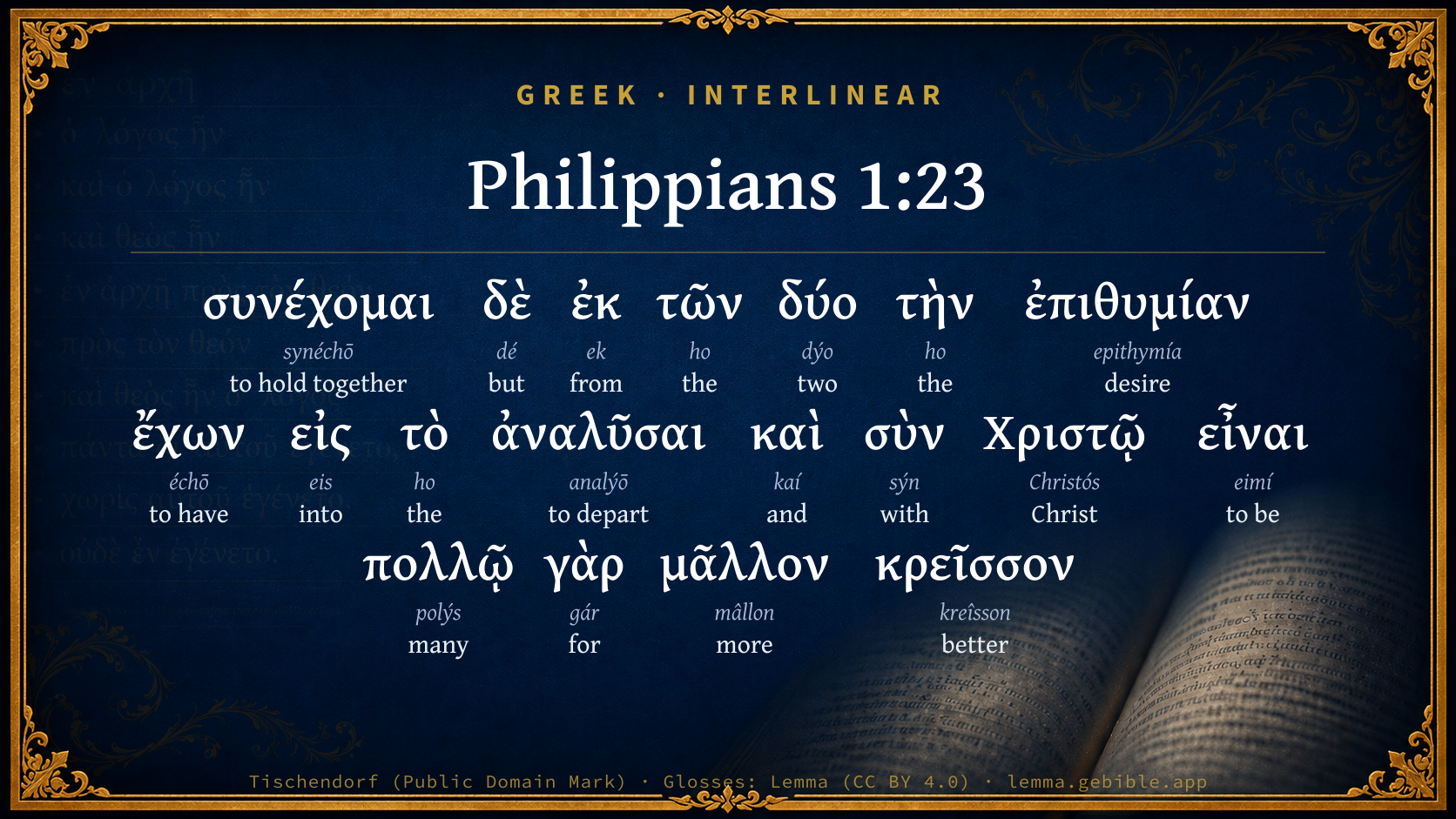
  1. συνέχομαι synéchō G4912 “to hold together” Verb, Present, Passive, Indicative, 1st person, Singular
  2. δὲ dé G1161 “but” Conjunction
  3. ἐκ ek G1537 “from” Preposition
  4. τῶν ho G3588 “the” Article, Genitive, Plural, Neuter
  5. δύο dýo G1417 “two” Adjective, Numeral (indeclinable)
  6. τὴν ho G3588 “the” Article, Accusative, Singular, Feminine
  7. ἐπιθυμίαν epithymía G1939 “desire” Noun, Accusative, Singular, Feminine
  8. ἔχων échō G2192 “to have” Verb, Present, Active, Participle, Nominative, Singular, Masculine
  9. εἰς eis G1519 “into” Preposition
  10. τὸ ho G3588 “the” Article, Accusative, Singular, Neuter
  11. καὶ kaí G2532 “and” Conjunction
  12. σὺν sýn G4862 “with” Preposition
  13. Χριστῷ Christós G5547 “Christ” Noun, Dative, Singular, Masculine
  14. εἶναι eimí G1510 “to be” Verb, Present, Active, Infinitive
  15. πολλῷ polýs G4183 “many” Adjective, Dative, Singular, Neuter
  16. γὰρ gár G1063 “for” Conjunction
  17. μᾶλλον mâllon G3123 “more” Adverb
  18. κρεῖσσον kreîsson G2908 “better” Adjective, Nominative, Singular, Neuter

About this verse

These counts appear in no published source. They are computed here, from the morphology-tagged text and Lemma’s own curated glosses. What Lemma adds →

19
words
17
distinct lemmas
Pauline Epistles
section

Notable vocabulary

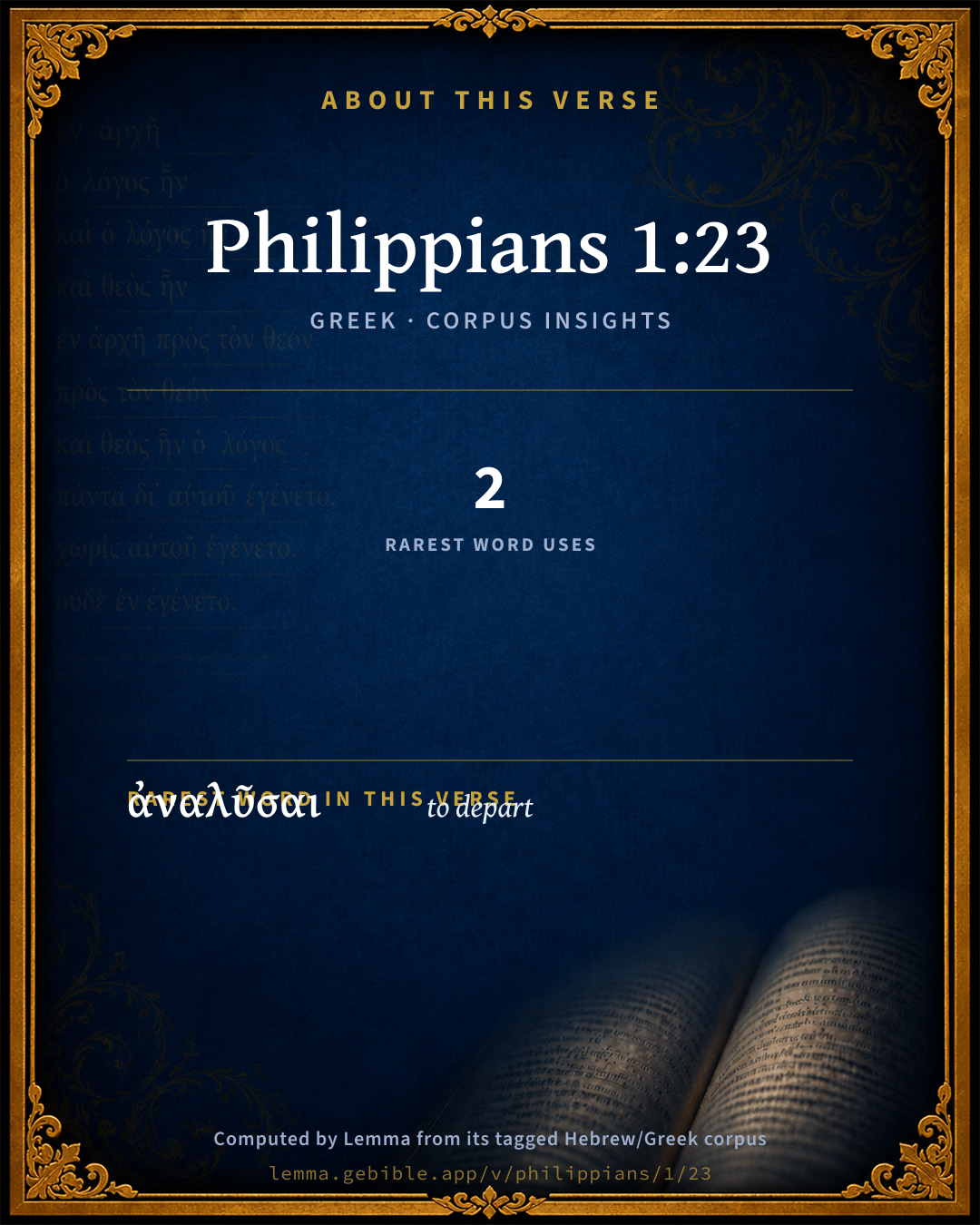
The rarest word here is ἀναλῦσαι to depart G360 — appearing just 2 times in the whole Greek New Testament.

Shared distinctive vocabulary

ἀναλῦσαι to depart G360 occurs in 2 verses of the Greek New Testament. Also found in:

Repetition

A word recurs within this verse:

Cross-references

23

Topical passages linked to Philippians 1:23 in the Treasury of Scripture Knowledge — connected by theme and wording, ordered by reader-vote popularity; previews shown in the World English Bible.

  • 2 Corinthians 5:8 We are of good courage, I say, and are willing rather to be absent from the body, and to be at home with the Lord.
  • Psalms 17:15 As for me, I shall see your face in righteousness; I shall be satisfied, when I awake, with seeing your form.
  • Revelation 14:13 I heard the voice from heaven saying, "Write, 'Blessed are the dead who die in the Lord from now on.'" "Yes," says the Spirit, "that they may rest from their labors; for their works follow with them."
  • Luke 23:43 Jesus said to him, "Assuredly I tell you, today you will be with me in Paradise."
  • John 17:24 Father, I desire that they also whom you have given me be with me where I am, that they may see my glory, which you have given me, for you loved me before the foundation of the world.
  • Acts 7:59 They stoned Stephen as he called out, saying, "Lord Jesus, receive my Spirit!"
  • 2 Timothy 4:6 For I am already being offered, and the time of my departure has come.
  • Revelation 7:14–17 I told him, "My lord, you know." He said to me, "These are those who came out of the great tribulation. They washed their robes, and made them white in the Lamb's blood.
  • Psalms 49:15 But God will redeem my soul from the power of Sheol, For he will receive me. Selah.
  • John 12:26 If anyone serves me, let him follow me. Where I am, there will my servant also be. If anyone serves me, the Father will honor him.
  • Job 19:26–27 After my skin is destroyed, Then in my flesh shall I see God,
  • Psalms 16:10–11 For you will not leave my soul in Sheol, Neither will you allow your holy one to see corruption.
  • John 14:3 If I go and prepare a place for you, I will come again, and will receive you to myself; that where I am, you may be there also.
  • 1 Thessalonians 4:17 then we who are alive, who are left, will be caught up together with them in the clouds, to meet the Lord in the air. So we will be with the Lord forever.
  • Luke 2:29–30 "Now you are releasing your servant, Master, According to your word, in peace;
  • Luke 12:50 But I have a baptism to be baptized with, and how distressed I am until it is accomplished!
  • Psalms 73:24–26 You will guide me with your counsel, And afterward receive me to glory.
  • Luke 8:38 But the man from whom the demons had gone out begged him that he might go with him, but Jesus sent him away, saying,
  • John 13:1 Now before the feast of the Passover, Jesus knowing that his time had come that he would depart from this world to the Father, having loved his own who were in the world, he loved them to the end.
  • 2 Corinthians 6:12 You are not restricted by us, but you are restricted by your own affections.
  • 1 Thessalonians 2:13 For this cause we also thank God without ceasing, that, when you received from us the word of the message of God, you accepted it not as the word of men, but, as it is in truth, the word of God, which also works in you who believe.
  • 2 Samuel 24:14 David said to Gad, I am in a great strait: let us fall now into the hand of Yahweh; for his mercies are great; and let me not fall into the hand of man.
  • 1 Thessalonians 2:1 For you yourselves know, brothers, our visit to you wasn't in vain,

Cross-references courtesy of OpenBible.info (CC BY 4.0).

Commentary

Notes on Philippians 1:23 from classic Christian and Jewish commentators (each source and its license shown beneath its notes). The classic Christian expositions comment on the surrounding passage and are grouped to its opening verse, so a note may address several verses; the Jewish commentaries on the Tanakh (Rashi and others) are per-verse, so they appear only where the commentator wrote on this verse.

Lemma curates 59 commentaries, every one of them public domain or Creative Commons licensed, each selected and text-cleaned for this edition rather than reprinted as found. About our sources →

The Biblical Illustrator

Joseph S. Exell

Php_1:23-24

I am in a strait betwixt two

Christ is best: or, St.

Pauls strait

I. St. Pauls strait. His soul was as a ship between two winds, tossed up and down; as iron between two loadstones, drawn first one way and then another. The people of God are often in great straits. Some things are so exceedingly bad that without deliberation we ought to abominate them; some things so good that we should immediately cling to them; others again are of a doubtful nature, requiring our best consideration, as Pauls here.

II. One ground of this strait was his present desire.

1. I have a desire. When there is anything set before the soul having a magnetical force to draw out the motives thereof we call that a desire, even though for the present the soul desires it not. This desire was--

(1) Spiritual.

(2) It came from a taste of sweetness in communion with Christ.

(3) Constant. I have, I carry it about with me.

(4) Efficacious, not the will of a sluggard, but one which carried him through death itself.

2. I desire to depart.

(1) There must be a parting from the enjoyment of the creature, from the body, from friends.

(2) There was to be a departing also. Here we cannot stay long; away we must; we are for another place (Psa_90:2). Paul labours to sweeten so harsh a thing by comfortable expressions of it--sleep, going home, etc.

3. I desire to be with Christ.

(1) Why doth he not say heaven? Because heaven is not heaven without Christ, but He is the heaven of heaven. Every creature is best in its own element; Christ is the element of the Christian. If, therefore, death is a passage to Him, what is there in it to be feared? (1Co_3:22).

(2) There is none but a Christian who can desire death, for to be with Christ is perfect holiness.

4. The consummation of this desire would be far better than anything or everything else. God reserves the best for the last. The Christian is happy in life, happier in death, happiest in heaven.

5. How shall we attain this desire? Let us carry ourselves as Paul did (chap. 3:20).

(1) He had his conversation in heaven.

(2) He loosed his affection from all earthly things (Gal_6:14).

(3) He laboured to keep a good conscience in all things (Act_24:16; Heb_10:22).

(4) He had the assurance that he was in Christ by his union with Him (Gal_2:19).

(5) He had an art of sweetening the thoughts of death, by regarding it as the passage to Christ and life.

III. The other ground of his strait was his present conviction that to stay was better for them.

1. The lives of worthy men are very needful for the Church of God, because Gods method is to bless man by man.

(1) By their counsel and direction (Pro_7:21).

(2) By their reformation of abuses.

(3) By their good example (Php_2:15).

(4) By their prayers.

2. Holy men can deny themselves and their own best good for the Churchs benefit. Because--

(1) They have the spirit of love, and love seeketh not her own.

(2) The Spirit of Christ who minded not His own things (1Co_10:24).

3. Use.

(1) Oh that we may have this Spirit to set us a work to do good while we are here.

(2) Set loving hearts full of inventions how to glorify God and do good to man.

(3) Labour to have sufficiency that you may have ability to do good. (R. Sibbes, D. D.)

Willing to wait, but ready to go

I. The two desires.

1. To depart and be with Christ. This desire is composed of two parts--a vestibule somewhat dark and forbidding, through which the pilgrim must pass, and a temple unspeakably glorious, which is to be his home.

(1) The exodus from this life by dissolution of the body. The band that knits body to soul is broken at death, and the soul escapes.

(2) The company to which the exodus more directly leads is Christ. Paul knew of no place of purgation. Wherever and whatever the place of saved spirits, one thing is certain--Christ is there. Christians need not care for more. Christs presence is needed for human happiness. Heaven would not be heaven, however otherwise glorious, without a human Christ to fasten the affections upon.

2. To abide in the flesh.

(1) It is a natural and lawful desire. God has placed and visited us here, and given us something to do. This is a point of great importance. Some rebelliously cling to life without respect to Gods will; others are troubled because in illness they discover a desire for longer days. Let the love of life remain, only get it so sanctified that at the appointed time it may cease.

II. The Christian balanced evenly between the two desires.

1. To depart was far better.

2. To stay was more needful.

3. The desire to be with Christ does not make life unhappy, because it is balanced by the pleasure of working for Christ; the desire to work for Christ does not make the approach of dissolution painful, because it is balanced by the expectation of being soon ever with the Lord.

4. These two constitute the spiritual man. They are the right and left sides of the new creature in Christ Jesus. Where both grow equally, there is no halting; where both have grown well, the step is steady and the progress great.

III. Practical lessons.

1. This text is sufficient to destroy the whole fabric of Romish prayer to departed saints.

2. The chief use of a Christian in the world is to do good.

3. You cannot be effectively useful to those who are in need on earth unless you hold by faith and hope to Christ on high.

4. Living hope of going to be with Christ is the only anodyne which can neutralize the pain of parting with those who are dear to us in the body. (W. Arnot, D. D.)

The attractions of heaven checked by the claims of earth

I. Having a desire to depart. A disciple of Christ may have a desire to depart.

1. For the sake of having the departing over. This is more terrible in prospect than in realization or in retrospect. We shrink from the strangeness of a new habitation however glorious; from the dark valley, however bright the yonder light.

2. For the sake of heavens attractions as--

(1) A place. It is Paradise regained. Beauty smiles there, life reigns there, the blessing of God is enshrined there. There is no night, no withering cold or scorching heat.

(2) A state, sorrowless, deathless, curseless, sinless.

3. For the sake of the objects of our holiest affections--our Father, our glorified Saviour, unfallen spirits, redeemed souls.

4. For the sake of the realization of our highest hopes. The weary look for rest, the hindered worker for unfettered action, the sad for gladness, the solitary for congenial society, the fearful for safety, the doubtful for certainty.

II. There were claims which held Paul to earth.

1. Had Paul been a husband and a father he could have turned to his household and said, for you. But his only tie to earth was Gods Church. There is a peculiar connection between the man who has been the means of anothers conversion or spiritual progress which can never be dissolved and which no other can take up. Paul, therefore, desired to live to instruct and comfort his converts, guide the whole Church, and win souls for Christ.

2. This double attraction perplexed, him and it was a good sign, a sign of life and high sensibility. Those whose religious life is monotonous have not much life in them.

(1) A man of the world is in no such strait. He is drawn but in one direction; by many things it may be, gold, honour, treasures, but only earthward.

(2) The hypocrite is in no such strait. His straits are connected with keeping on his mask and his cloak.

(3) The lukewarm and declining Christian has no such straits.

3. This perplexity only existed until the will of God was expressed to him. As soon as he knew that he said, I am ready; the time of my departure is at hand. Conclusion: The right state is to be attracted by Christ, wherever Christ is, in His Church on earth or His Church in heaven; and to the place in which we can most glorify Him. (S. Martin.)

The desire of the apostle; yet his perplexity

Nothing is more unpleasant than uncertainty and indecision. Shall I take a journey or not? Sometimes the ease is very important; marriage, e.g. What a strait was Jacob in between starvation and letting Benjamin go to Egypt, and David with his three things to choose. Paul was now in a strait not between two evil but between two good things. It was the strait of a man in a garden between a peach and a nectarine; a rose and a lily. He was between living and dying; but Christ was connected with both; whether he should enjoy Christ in heaven or serve Him on earth.

I. His representation of death. Consider--

1. Its nature--departure.

(1) The idea may be exemplified by the travellers departure from the inn, a prisoners from his dungeon.

(2) By so calling it Paul showed that man is a compound being. Cowper does not inscribe on the tomb of his dog, Here lies the body, but Here lies poor Dansy. There is a spirit in man.

(3) This departure was the inlet to future blessedness. To be with Christ. So heaven will be a social state. If Socrates could feel pleasure at the thought of being with Musaeus, and other worthies who had lived before him, what must be the attraction of the believer in Jesus.

2. The preference he gives it. Far better than what?

(1) Than to be stoned in the streets of Corinth; to fight with the beasts of Ephesus, etc.? That would he saying very little.

(2) It would also be saying very little if far better than his temporal mercies. There are things now that the believer deems far better.

(3) It would be far better than the enjoyment of the best and most spiritual things below.

II. His desire after it.

1. The desire of death can never be natural.

2. The fear of death is as natural as hunger and sleep; and there is no evil in it. If anything can raise us above it it must be supernatural.

3. There may be more who feel this desire than you are aware of.

4. Christians have more of this readiness to die as they approach death.

III. The counter balance by which he was willing to remain. The apostle shows the sense he had of his own importance, and the self-denial he was willing to exercise in order to be useful. Humility does not consist in ignorance. (W. Jay.)

Life more our business than death

At a private meeting of friends George Whitefield, after adverting to the difficulties attending the gospel ministry, said that he was weary with the burdens of the day, and declared it to be his great consolation that in a short time his work would be done, and he should depart and be with Christ. He then appealed to the ministers present, and asked if they had not entirely similar feelings. They generally assented, with the exception of Mr. Tennent. On seeing this, Mr. Whitefield, tapping him on the knee, said: Well, Brother Tennent, you are the oldest man among us; do you not rejoice to think that your time is so near at hand when you will be called home? Mr. Tennent bluntly answered that he had no wish about it. Being pressed for some opinion more definite and decided; he then added: I have nothing to do with death. My business is to live as long as I can, and as well as I can, and serve my Master as faithfully as I can until He shall think proper to call me home. It proved a word in season to the great evangelist, helping him more calmly and patiently to hold on his way. (J. L. Nye.)

I. The saints are sometimes in straits (2Sa_24:14).

II. They mind not their own but the glory of God and good of others (chap. 2:21).

III. The truly pious desire to depart and be with Christ.

1. What is it to depart? (2Pe_1:14; 2Co_5:1). To go into the other world.

2. What to be with Christ?

(1) To enjoy His presence (Joh_12:26; Joh_17:24).

(2) To behold His glory (Joh_17:24; 1Co_13:12).

(3) To have communion with Him.

3. Why do they desire to be with Christ? Because--

(1) They believe His promises (Joh_14:1-2).

(2) Are convinced of the creatures vanity and Christs excellency.

(3) Love Christ above all things (Php_3:8-9; Psa_42:1-2).

(4) Long to be eased of their sins (Rom_7:24).

(5) To be out of the devils reach (1Pe_5:8).

(6) They have foretastes of heaven already (1Pe_1:8).

(7) This is the end of all their labours (1Pe_1:9).

4. It is better to be with Christ than here (Mat_17:4). We shall have better--

(1) Souls (Heb_12:23).

(2) Bodies (Php_3:21).

(3) Company (Heb_12:22-23; Joh_17:24).

(4) Employments (Rev_7:11-12).

(5) Honours (Joh_12:26).

(6) Riches (Mat_6:19-20).

(7) Pleasures. (Bishop Beveridge.)

St. Pauls doubt and desire

I. Paul is his strait. He would be with Christ and yet with the Philippians; he would be dissolved and yet live. He resolved, however, at last against himself.

1. For the glory of God; the prime motive of our Christian obedience. We must neither live nor die but to Gods glory.

2. For the good of the brethren, wherein Gods glory is greatly manifested (2Co_12:15).

3. This was only possible to a man already in Christ, and imbued by His Spirit.

4. If the same mind be in us which was in Paul we should look upon our calling as Christians as the most delightful yet most troublesome calling.

II. Pauls desire.

1. The desire carries nothing in it that hath any opposition to the will of God. It is not wrought in us by impatience or sense of injuries as is the case of Stoics.

2. This desire is from heaven, heavenly (Heb_4:9; 2Ti_4:8). We love Christ and would be where His honour dwelleth.

3. This desire--

(1) is but for a dissolving of the whole into its parts, that the better part may have the better portion at once and the whole by and by.

(2) Brings us to Christ, and is therefore

(3) the fittest object for our desire to fasten upon. (A. Farindon, B. D.)

Pauls desire to depart

I. The apostles description of death.

1. Negatively. He does not call it--

(1) An arrest. In the death of the wicked the sheriffs officer of justice lays his clay-cold hand upon the mans shoulder and he is a prisoner forever: but who shall lay anything to the charge of Gods elect?

(2) A plunge. The wicked stand upon the precipice of a yawning and bottomless gulf and their unwilling spirits must take a desperate leap. The believer climbs upwards.

2. Positively. He calls it--

(1) A departure, like a vessel homeward bound.

(2) Departure to Christ.

(a) We shall see Him as He is.

(b) We shall commune with Him.

(c) We shall enjoy full fruition of Him.

II. The apostles desire.

1. Some men are seared by it.

2. Others with a seared conscience meet it with an idiot resignation.

3. The apostle panted to be gone: as the captain with his rich freight longs for the harbour, as the conqueror longs for his crown.

III. The apostles reasons.

1. Others besides he have longed to die.

(1) The suicide mad from lifes misery leaps from one evil to a myriad.

(2) The so called philosopher, sick of mankind. Not so Paul, he was neither coward nor man hater.

(3) Those who think that by getting out of the world they will escape their disappointments and suffering.

2. Paul felt this desire because he knew that being with Christ--

(1) He would be clean rid of sin.

(2) That he would meet his brethren in the faith who had gone before;

(3) That he would be with Christ, and these words have all heaven condensed in them. (C. H. Spurgeon.)

Forever with the Lord

I. The apostles certainty respecting the disembodied state.

1. Paul was an eminently conscientious man who would not say what he did not believe to be true, and a man of well-balanced reason, logic preponderating among his faculties.

2. Now this Paul was convinced of a future state. He did not believe in purgatory, much less that the soul sleeps until the resurrection.

3. What made this conscientious and collected man come to this conclusion? I suppose he would have replied first that he had been converted by a sight of the Lord Jesus. He was sure he had seen Him, and that He had come from somewhere and gone somewhere; and recollecting the prayer, I will that they be with me where I am, he was quite certain that as soon as saints died they were with Christ.

4. Remember this judicious and truthful witness had other distinct evidence of the disembodied state. He had been caught up into Paradise. It was, therefore, not merely matter of belief but of observation.

5. Paul had no doubt then, nor need you. If you believe in Him there is no condemnation, and if so, no separation (Rom_8:1-39) either in this life or that which is to come.

II. The apostles idea of that state.

1. It is a one-sided idea and almost a one-worded description: an inclusive idea, for it takes in all the heaven which the largest mind can conceive.

2. Being with Christ is so great a thing that he mentioned it alone.

(1) Because his love was so concentrated on Christ that he could think of nothing else in this connection.

(2) He was persuaded that heaven could not be heaven if Christ was not there. It would be day without the sun, existence without life, seeing without light, the heavens without their stars. Christ is heaven and heaven is Christ.

3. What is it to be with Christ?

(1) It is to be with Him--heaven is not merely what comes out of being with Him, His company itself is heaven.

(2) It is to have a clearer vision of Him than is possible now, and this vision will be ravishing.

(3) Brighter knowledge. Here we only know in part.

(4) More intimate intercourse.

(5) Unbroken fellowship.

(6) A share of His glory.

III. The apostles estimate of this disembodied state. Very far better.

1. St. Paul does not claim for this state that it is the believers highest condition, because one half of him is left behind. The fulness of our glory is the resurrection. Yet for one half of his manhood to be with Christ is far better than for the whole of his being to be here under the best possible conditions, not merely of worldly wealth, etc.

he had got above all that--but of spiritual excellence and blessing.

2. Concerning our departed friends, then, how can we sorrow?

3. With regard to ourselves what is there to fear?

4. All this points to the fountain of bliss while we are here. The nearer we get to Christ the more we shall participate in what makes the joy of heaven. (C. H. Spurgeon.)

Better to be with Christ than here

I. What is it to be with Christ? It implies--

1. Our being where He is (Joh_14:2-4).

2. Our enjoying what He enjoys.

(1) Clear knowledge of God (Joh_17:3; 1Co_13:12).

(2) Perfect love.

(3) Eternal joy (Php_4:1).

II. How is it better?

1. In its immunities.

(1) From sin (1Co_15:30).

(a) Errors in judgment (1Co_13:12).

(b) Disorder in affections.

(c) Infirmity in actions.

(2) From misery (Rev_21:4).

2. In its enjoyments, which are better; because--

(1) More real (Pro_23:5).

(2) More spiritual (Mat_11:28-29).

(3) More satisfying (Psa_16:11; Psa_17:15).

(4) More certain (Isa_55:3).

(5) More lasting (2Co_5:1).

III. Uses. Labour to get to Christ.

1. Means.

(1) Repent (Luk_13:3).

(2) Believe on Christ (Act_16:31).

(3) Labour after true grace, without which you shall not (Heb_12:14), and you cannot enjoy God.

(4) Use the means appointed (Rom_10:17).

2. Motives.

(1) Labour after it. Consider--

(a) It is possible.

(b) It is desired by God (Eze_33:11).

(c) You will repent ere long unless you do.

(2) Seek it first.

(a) It is a thing of the greatest concern (Luk_10:42).

(b) It is the only thing needful (Luk_10:42).

(3) Labour after it now (Psa_95:8-9). Consider--

(a) Your time is short.

(b) The work is great.

(c) You know not when you will be called to account. (Bishop Beveridge.)

Paul and Voltaire

I was lately looking over Voltaires correspondence with one of his literary female acquaintances, and no less than three times in his letters does he say, I dread death and hate life. Was it so with the Apostle Paul? Did he dread death? What is his language--I have a desire to depart and to be with Christ, which is far better. Did he hate life? Nevertheless to abide in the flesh is more needful for you, and, having this confidence, etc. (W. Jay.)

Strait

From the word strait employed in our translation we are apt to take up the notion of pain and difficulty. This is not the idea which the apostle intended to express. Literally the word signifies to be between two, and held by both at the same time. In ordinary circumstances, and in the present case especially, this is pleasanter and safer than to be held by only one. This strait is the happiest condition in which a living man can be. It is not a position of distraction from which he would fain escape, but a position of solid repose. To be grasped and drawn by either of these emotions alone would bend and break a man; to be attracted equally by both produces a delicious equilibrium. The spiritual fact may be explained by a material example. Suppose a man is standing aloft upon a pedestal where he finds room to plant his feet and no more. Suppose that one neighbour stands near him on the right hand, and another near him on the left. If one of these grasp and draw him, his posture immediately becomes uneasy and dangerous. Under the strain he does not keep his footing easily, and will not keep it long. But if both should grasp him, either seizing a hand, and draw with equal force in opposite directions, the result would be an erect attitude and an easy position. Such precisely in the spiritual department is the equilibrium of a believer who is held and drawn by both these desires at once. It is the strait betwixt two that makes him easy. Either of these desires wanting the other would distress him in proportion to its strength. On the one hand, a desire to abide in the flesh without a balancing desire to depart and to be with Christ, is a painful condition. The weight hanging on one side racks the person all over. Most men are crushed in this manner all their days. The Redeemer knows this sorrow and provides relief. One specific design of His coming was to deliver them who through fear of death were all their lifetime subject to bondage. As soon as one of these tremblers is begotten again into a living hope, by the resurrection of Jesus Christ from the dead, the balance is restored and deliverance effected. On the other hand, the converse is equally true, although not equally common. To experience a desire to depart, unbalanced by a desire to abide in the flesh, is also a painful experience. Many Christians pass through at least a short period of this unevenness and uneasiness before they are set free. Whatever may be the immediate causes which have made life wearisome to a Christian, whenever the desire to abide dies out, the desire to depart distracts him. It may be that most of us at present would gladly bargain for such a state of mind at the close of life, as being the safest; but it is, notwithstanding, and not the less a painful state of mind. (W. Arnot, D. D.)

Death, a departure

I shall never forget the cry of the late Rev. Dr. De Witt, of New York, as he stood at the grave of his wife. After the body had been lowered to its resting place, that venerable man of God leaned over the open space and said: Farewell, my honoured, faithful, beloved wife. The bond that bound us is severed, thou art in glory, I am still on earth, but we shall meet again. Farewell, farewell! (T. De Witt Talmage.)

Heaven our home

As a home the believer delights to think of it. Thus when, lately bending over a dying saint, and expressing our sorrow to see him laid so low, with the radiant countenance rather of one who had just left heaven, than of one about to enter it, he raised and clasped his hands, and exclaimed in ecstasy, I am going home. Happy the family of which God is the Father, Jesus the elder Brother, and all the saints in light are brethren. (T. Guthrie.)

Longing for home

I have heard a story of the celebrated Mr. William Dawson, who used to call himself Billy Dawson, much to the point. On one occasion, when he and some other Methodist friends were spending the evening together, a dear friend of mine happened to be present, and heard what passed. They were praying that Mr. Dawsons life might be spared for many years to come, that such an earnest man might be kept in the Church for the next twenty or thirty years. At last, as they were just in the middle of prayer, William Dawson said, Lord, dont hear em: I want to get my work done, and go home; I dont want to be here any longer than there is needs be; and the brethren stopped their prayers, thunderstruck as they witnessed his emotion. Now I believe that feeling will often pass over the earnest working Christian. Oh, saith he, I am not lazy; I am not idle; but still, I would like to get my work done. (C. H. Spurgeon.)

Death a gain

The most you can do to a good man is to persecute him; and the worst that persecution can do is to kill him. And killing a good man is as bad as it would be to spite a ship by launching it. The soul is built for heaven, and the ship for the ocean, and blessed be the hour that gives both to the true element. (H. W. Beecher.)

The desire to depart

As birds in the hour of transmigration feel the impulse of southern lands, and gladly spread their wings for the realm of light and bloom, so may we, in the death hour, feel the sweet solicitations of the life beyond, and joyfully soar from the chill and shadow of earth to fold our wings and sing in the summer of an eternal heaven! (H. W. Beecher.)

To depart is to be with Christ

The Rev. Alexander Fisher, of Dunfermline, an excellent young minister, in the afternoon of the day on which he died, inquired what the hour was, and on being informed, said, What would you think if I were in heaven tonight? It was answered, Then you will be with your Saviour, and see Him face to face. His pale emaciated countenance seemed to beam with delight, and his faltering lips uttered, Glory, glory, glory!

Ready for heaven

A little child was playing with her mother, and they were talking about heaven. The mother had been telling of the joy and glories of that happy world. The matchless beauty of the angels, the golden streets and pearly gates, and the exultant song of redemption. There is no sickness in those bright realms, no pain, no death, no sorrow, nor sighing, nor tears, no sin; for all will be pure and holy. Oh, dear mother! exclaimed the little child, in her amazement and delight, let us all go now! We must wait a little, said the mother, wait until God shall send for us. Well, dear mother, responded the child, in a tone of disappointment, if we cant start now, as any rate, let us pack up and be ready! There is a whole sermon in that one sentence: Let us pack up and be ready! Oh, what a world of difference between being ready and unready! (J. N. Norton, D. D.)

Christ, heavens supreme attraction

Being with Christ is so great a thing that he mentioned it alone, because his love was so concentrated upon Christ that he could think of nothing else in connection with heaven. There is a wife here, perhaps, and her husband is in India. He has been long away, and the years of his forced absence have been weary to her. She has had loving messages from him and kind letters, but often has she sighed, and her heart has looked out of the windows towards the east, yearning for his return; but now she has received a letter entreating her to go out to her husband, and without hesitation she has resolved to go. Now, if you ask her what she is going to India for, the reply will be, I am going to my husband. But she has a brother there, she has many old friends there, her husband has a handsome estate there. Yes, there may be other inducements to make the voyage, but to be with her beloved is the master object of her journey. She is going to the man she loves with all her soul, and she is longing for the country, whatever that country may be, because he is there. It is so with the Christian, only enhanced in a tenfold degree. (C. H. Spurgeon.)

Depart

The word depart means strictly to take to pieces. The living man is contemplated as a complex machine, and it is intimated that at death its joints are loosed, and the whole is broken up into its constituent elements. This life in the body is like a watch. By food, and drink, and air, it is wound up daily, and so kept going. At last the machinery, by gradual wear and tear, or by some sudden accident, is brought to a stand. Then it is taken down--taken to pieces--in order that it may be purified and perfected, and set agoing again, not to measure then the changing seasons of time, but to move on, without waste or weariness, in a limitless eternity. More immediately, the dissolution or untying probably refers to the separation of soul and body. The band that knit them together is broken at death. The soul escapes, and the body, meantime, returns to dust. In this view the works of the watch never stand still. When life from God was first breathed into that immortal being, it was wound up, once for all, to go for ever. At the shock of death it is severed from its case of flesh. Outer casement, and figured dial, and pointed hands, all remain with us, and all stand still. But these never were the moving springs. These were shells to protect the tender from injury where the road was rough, and indices to make the movements palpable to bodily sense; but the vital motion of the departed spirit continues uninterrupted, unimpeded, in a region where no violence is dreaded, and no sign to the senses is required. (W. Arnot, D. D.)

The Biblical Illustrator, edited by Joseph S. Exell (c. 1880s–1900s) — public domain. Text from a community e-Sword module.

Tyndale Open Study Notes

Tyndale Open Resources

1:23 I long to go and be with Christ: Death leads believers immediately into the Lord’s presence (cp. 3:20-21; 1 Cor 15:20-23, 51-52; 2 Cor 5:1-8; 1 Thes 4:13-17).

Tyndale Open Study Notes — © Tyndale Open Resources, licensed CC BY-SA 4.0. Text via the HelloAO Bible API.

Bengel's Gnomon

Johann Albrecht Bengel

Php 1:23. Συνέχομαι, I am in a strait [I am perplexed]) He suitably expresses this hesitation, when he dwells upon this deliberation.—δὲ, but [for]) He hereby declares the cause of his doubt.—ἔχων, having) The participle, expressive of the feelings of the mind, for the indicative.—εἰς τὸ ἀναλῦσαι) to depart from bonds, from the flesh, and from the world. There is no need to seek for metaphor. The use of this word is of wide extent [application], Luk 12:36; 2Ti 4:6—σὺν Χριστῷ, with Christ) there, whither Christ has gone before him. Paul takes it for granted as a certainty, that, after his martyrdom, he will be immediately with Christ, and that his condition will be greatly superior to what it was in the flesh. [How delightful it is to rejoice in this hope! Reader, dost thou love Christ? Think then what will be the feeling of thy mind, if, after an interval of some months or days, thou shalt be with Christ. If that were indeed sure in thy case, what wouldst thou think should be done? See then that thou art doing this very thing at the present time.—V. g.]—πολλῷ μᾶλλον κρεῖσσον, far the more preferable [far better]) This short clause is to be referred to the verb to be, not to depart, whether we take it as a predicate, or rather understand it absolutely, by supplying ὂν, in this sense, since that is much better. For the comparative is cumulative; comp. 2Co 7:13, note. To depart is better than to remain in the flesh; to be with Christ is far far better. The Vulgate alone, so far as I know, has rightly, multo magis melius, much more better [preferable]. To depart was always a thing wished for by the saints, but to be with Christ is in accordance with the New Testament [a privilege peculiar to the New Testament]; comp. Heb 12:24.

Bengel's Gnomon of the New Testament — English translation (T&T Clark, Edinburgh, 1860) — public domain. Text from a community e-Sword module.

Meyer's Critical & Exegetical Commentary

Heinrich August Wilhelm Meyer

Php_1:23. Respecting the τί αἱρήσομαι οὐ γνωρίζω, Paul expresses himself more fully in Php_1:23-24, proceeding with the explicative δέ; for δέ is not antithetical (Hofmann: on the contrary), but, in fact, the reading γάρ is a correct gloss, since the situation now follows, which necessitates that relinquishment of a choice. But I am held in a strait (comp. Luk_12:50; Act_18:5; 2Co_5:14; Wis_17:11; Dem. 396. 22, 1484. 23; Plat. Legg. vii. p. 791 E, Theaet. p. 165 B; Heind. ad Plat. Soph. 46) of the two points, namely the ἀποθανεῖν and the ζῆν,[75] of which he has just said, τί αἱρ. οὐ γνωρ. These δύο are not conceived in an instrumental sense, which is expressed with συνέχ., by the dative (Mat_4:24; Luk_8:37; Act_18:5; Plat. Soph. p. 250 D; Eur. Heracl. 634), but as that from which the συνεχέσθαι proceeds and originates (Bernhardy, p. 227 f.; Schoem. ad Is. p. 348; Mätzner, ad Antiph. p. 167).

τὴν ἐπιθυμ. ἔχων κ.τ.λ.] since my longing is to die. The article denotes, not votum jam commemoratum (Hoelemann), for Paul has not indeed as yet expressed an ἐπιθυμεῖν, but doubtless the desire, which Paul has. He says that his desire tends towards dying, etc.,[76] but that life is more necessary; and therefore he knows that not that for which he longs, but that which is the more necessary, will come to pass, and that he will remain alive (Php_1:25). Augustine aptly observes: Non patienter moritur, sed patienter vivit et delectabiliter moritur.

ἀναλῦσαι] comp. 2Ti_4:6; Isa_38:12. Dying is conceived as a breaking up (a figure taken from the camp) for the departure, namely, from this temporal life to Christ (comp. ὑπάγειν, Mat_26:24; ἘΚΔΗΜΕῖΝ, 2Co_5:8 f.; and similar passages); hence the ΚΑῚ ΣῪΝ ΧΡΙΣΤῷ ΕἾΝΑΙ immediately added.[77]

πολλῷ γ. μᾶλλ. κρεῖσσον] by much in a higher degree better; a cumulative expression in the strength and vividness of feeling. As to μᾶλλον with the comparative, see on Mar_7:36; 2Co_7:13; and Kühner, II. 2, p. 24 f., and ad Xen. Mem. iii. 13. 5; Bornemann, ad Cyrop. p. 137, Goth. If here interpreted as potius (Php_1:12), it would glance at the preference usually given to life; but nothing in the context leads to this. The predicate κρεῖσσον (a much better, i.e. happier lot) refers to the apostle himself; comp. below, διʼ ὑμᾶς. Eur. Hec. 214: θανεῖν μου ξυντυχία κρείσσων ἑκύρησεν.

[75] It is therefore more in harmony with the context to refer ἐκ τῶν δύο to what precedes than to what follows (Luther, Rheinwald, Corn. Müller, and others). Note that the emphasis is laid on συνέχομαι, which is the new climactic point in the continuation of the discourse. The word συνεχ. itself is rightly rendered by the Vulgate: coarctor. The mere teneor (Weiss and earlier expositors) is not sufficient according to the context. Paul feels himself in a dilemma between two opposite alternatives.

[76] It is thus explained why Paul did not write τοῦ ἀναλῦσαι (as Origen reads). εἰς is not dependent τὴν ἐπιθ. (ἐπιθ. is never so construed; comp. Corn. Müller); but τὴν ἐπιθ. is absolute, and εἰς τὸ ἀναλ. expresses the direction of τὴν ἑπιθ. ἔχων: having my longing towards dying. Comp. Thuc. vi. 15. 2.

[77] Bengel: Decedere sanctis nunquam non optabile fuit, sed cum Christo esse ex novo testamento est. This Christian longing, therefore, has in view anything rather than a having emerged from the limitation of personality (Schleiermacher).The translation dissolvi (Vulgate, Hilary) is to be referred to another reading (ἀναλυθῆναι).

Meyer — Critical and Exegetical Commentary on the New Testament — English translation by Peter Christie, edited by Frederick Crombie (T&T Clark, 1880) — public domain. Text from a community e-Sword module.

Expositor's Greek Testament

ed. W. Robertson Nicoll

Phi 1:23 . συνέχομαι δέ (with most authorr.). δέ = “rather”. Cf. Rom 4:20 . συνέχ . ἐκ . Apparently the idea is that of a strong pressure bearing upon him from ( ἐκ the source) two sides and keeping him motionless. ἐπιθυμ . εἰς . Cf. Thuc., iv., 81, ἐπιθυμίαν ἐνεποίει τοῖς Ἀθην . συμμάχοις ἐς τοὺς Λακεδ . ἀναλῦσαι . Aor. of momentary action (see Burton, MT [56] , p. 50). Only here in N.T. in this sense. Cf. 2Ti 4:6 , ἀνάλυσιν ; Philo, Flacc. ad fin. , τὴν ἐκ τοῦ βίου τελευταίαν ἀνάλυσιν . Frequent in LXX and late Greek = depart. In Polyb. it usually means castra movere . σὺν Χ . εἶναι . From this passage and 2Co 5:8 (but see also 1Th 5:10 ) as compared with others, e.g. , 1Th 4:15 , 1Co 15:51 , Beyschl. ( N.T. Theol. , ii., 269 ff.), Teichmann ( op. cit. pp. 57 59), Grafe ( Abhandl. C. v. Weizsäcker gewidm. , p. 276) and others conclude that the Apostle changed his views on eschatology in his later years, and esp [57] when death stared him in the face. Instead of supposing a sleep ( κοιμᾶσθαι ) until the Parousia, or else the direct experience of that event, he now believes that after death the soul is immediately united to Christ. It is, however, hazardous to build up eschatological theories on these isolated utterances of the Apostle. He has, apparently, no fixed scheme of thought on the subject. The Resurrection is not before his mind at all in this passage. His eschatology, as Dsm [58] ( Th. LZ [59] , 1898, col. 14) well observes, must rather be conceived as ἐλπίς . Death cannot interrupt the life ἐν Χριστῷ . This is the preparation for being σὺν Χ . Even contemporary Jewish thought was familiar with a similar idea. So, e.g., Tanchuma, Wajjikra , 8: “When the righteous leave the world they ascend at once and stand on high” (Weber, Lehren d. Talmud , p. 323). See also Charles, Eschatology , p. 399 ff. πολλῷ κ . τ . λ . It seems necessary for the sense to insert γάρ with the best authorities. The double comparat. is fairly common.

[56] Moods and Tenses (Burton, Goodwin).

[57] especially.

[58] Deissmann ( BS. = Bibelstudien, NBS. = Neue Bibelstudien ).

[59] Theologische Literaturzeitung .

The Expositor's Greek Testament, edited by W. Robertson Nicoll (1897–1910) — public domain. Text from a community e-Sword module.

Jamieson, Fausset & Brown

Robert Jamieson, A. R. Fausset & David Brown

For--The oldest manuscripts read, "But." "I know not (Phi 1:22), BUT am in a strait (am perplexed) betwixt the two (namely, 'to live' and 'to die'), having the desire for departing (literally, 'to loose anchor,' Ti2 4:6) and being with Christ; FOR (so the oldest manuscripts) it is by far better"; or as the Greek, more forcibly, "by far the more preferable"; a double comparative. This refutes the notion of the soul being dormant during its separation from the body. It also shows that, while he regarded the Lord's advent as at all times near, yet that his death before it was a very possible contingency. The partial life eternal is in the interval between death and Christ's second advent; the perfectional, at that advent [BISHOP PEARSON]. To depart is better than to remain in the flesh; to be with Christ is far, far better; a New Testament hope (Heb 12:24), [BENGEL].

Jamieson, Fausset & Brown — Commentary Critical and Explanatory on the Whole Bible (1871) — public domain (CC PDM 1.0). Text via the HelloAO Bible API.

Adam Clarke's Commentary

Verse 23. For I am in a strait betwixt two] Viz. the dying now, and being immediately with God; or living longer to preach and spread the Gospel, and thus glorify Christ among men.

Having a desire to depart, and to be with Christ] Την επιθυμιαν εχων εις το αναλυσαι. It appears to be a metaphor taken from the commander of a vessel, in a foreign port, who feels a strong desire αναλυσαι, to set sail, and get to his own country and family; but this desire is counterbalanced by a conviction that the general interests of the voyage may be best answered by his longer stay in the port where his vessel now rides; for he is not in dock, he is not aground, but rides at anchor in the port, and may any hour weigh and be gone. Such was the condition of the apostle: he was not at home, but although he was abroad it was on his employer's business; he wishes to return, and is cleared out and ready to set sail, but he has not received his last orders from his owner, and whatever desire he may feel to be at home he will faithfully wait till his final orders arrive.

Which is far better] Πολλῳ - μαλλον κρεισσον· Multo magis melior, VULGATE; much more better. The reader will at once see that the words are very emphatic.

Adam Clarke's Commentary on the Bible (1810–1826) — public domain. Text from a community e-Sword/MySword module.

John Calvin's Commentaries

23 For I am in a strait Paul did not desire to live with any other object in view than that of promoting the glory of Christ, and doing good to the brethren. Hence he does not reckon that he has any other advantage from living than the welfare of the brethren. But so far as concerns himself personally, it were, he acknowledges, better for him to die soon, because he would be with Christ. By his choice, however, he shews what ardent love glowed in his breast. There is nothing said here as to earthly advantages, but as to spiritual benefit, which is on good grounds supremely desirable in the view of the pious. Paul, however, as if forgetful of himself, does not merely hold himself undetermined, lest he should be swayed by a regard to his own benefit rather than that of the Philippians, but at length concludes that a regard to them preponderates in his mind. And assuredly this is in reality to live and die to Christ, when, with indifference as to ourselves, we allow ourselves to be carried and borne away withersoever Christ calls us.

Having a desire to be set free and to be with Christ These two things must be read in connection. For death of itself will never be desired, because such a desire is at variance with natural feeling, but is desired for some particular reason, or with a view to some other end. Persons in despair have recourse to it from having become weary of life; believers, on the other hand, willingly hasten forward to it, because it is a deliverance from the bondage of sin, and an introduction into the kingdom of heaven. What Paul now says is this; “I desire to die, because I will, by this means, come into immediate connection with Christ.” In the mean time, believers do not cease to regard death with horror, but when they turn their eyes to that life which follows death, they easily overcome all dread by means of that consolation. Unquestionably, every one that believes in Christ ought to be so courageous as to lift up his head on mention being made of death, delighted to have intimation of his redemption. (Luke 21:28.) From this we see how many are Christians only in name, since the greater part, on hearing mention made of death, are not merely alarmed, but are rendered almost lifeless through fear, as though they had never heard a single word respecting Christ. O the worth and value of a good conscience! Now faith is the foundation of a good conscience; nay more, it is itself goodness of conscience.

To be set free This form of expression is to be observed. Profane persons speak of death as the destruction of man, as if he altogether perished. Paul here reminds us, that death is the separation of the soul from the body. And this he expresses more fully immediately afterwards, explaining as to what condition awaits believers after death — that of dwelling with Christ We are with Christ even in this life, inasmuch as the kingdom of God is within us, (Luke 17:21,) and Christ dwells in us by faith, (Ephesians 3:17,) and has promised that he will be with us even unto the end of the world, (Matthew 28:20,) but that presence we enjoy only in hope. Hence as to our feeling, we are said to be at present at a distance from him. See 2 Corinthians 5:6. This passage is of use for setting aside the mad fancy of those who dream that souls sleep when separated from the body, for Paul openly declares that we enjoy Christ’s presence on being set free from the body.

John Calvin's Commentaries (1540-1563) — public domain. Text from the Calvin Translation Society English edition (1840s-50s) via the Christian Classics Ethereal Library (ccel.org). Calvin's coverage is partial (roughly two-thirds of the Bible); uncommented books and verses are honest gaps, never fabricated. The 19th-century editor's footnotes and remarks are omitted so the notes are faithfully Calvin's own voice.

Ellicott's Commentary for English Readers

(23) Having a desire . . .—Properly, having my own desire for departure. The verb “depart” corresponds exactly to the substantive used in 2Ti_4:6, “The time of my departure is at hand.” It is itself used only here and in Luk_12:36, “When he shall return (break up) from the wedding.” The metaphor is drawn either from “loosing” from the shore of life, or (perhaps better) from striking tents and breaking up a camp. The body (as in 2Co_5:1) is looked upon as a mere tabernacle. Each day is a march nearer home, and death is the last striking of the tent on arrival.

To be with Christ.—This is contemplated by St. Paul as the immediate consequence of death, even while still “out of the body,” and before the great day. The state of the faithful departed is usually spoken of as one of “rest” (1Co_15:51-52; 1Th_4:14-16; Rev_14:13), although not without expectation and longing for the consummation of all things (Rev_6:10-11). Such a condition of rest, and suspension of conscious exercise of spiritual energy, is, indeed, that which human reason and analogy would suggest, so far as they can suggest anything on this mysterious subject. But such passages as this seem certainly to imply that this rest is emphatically a “rest in the Lord,” having an inner consciousness of communion with Christ. His “descent unto Hades,” not only brings out the reality of the unseen world of souls, but also claims it as His. As on earth and in heaven, so also in the intermediate state, we are “ever with the Lord;” and that state, though not yet made perfect, is spiritually far higher than this earthly life. The original here is an emphatic double comparative, “far, far better.”

A Bible Commentary for English Readers, edited by Charles John Ellicott (1878–1897) — public domain. Text from a community e-Sword module.

The Cambridge Bible for Schools and Colleges

gen. ed. J. J. S. Perowne

23. For] Read But, with conclusive evidence. The word here marks addition rather than distinction. An English writer would have dispensed with a transitional particle, probably.

in a strait betwixt two] More precisely, with R.V., the two; the two alternatives just spoken of, life and death.—The imagery is of a man hemmed in right and left, so as to be stationary. Quite literally the words are, “I am confined from the two (sides)”; the position is one of dilemma, viewed from whichever side.

Wonderful is the phenomenon of this dilemma, peculiar to the living Christian as such. “The Apostle asks which is most worth his while, to live or to die. The same question is often presented to ourselves, and perhaps our reply has been that of the Apostle. But may we not have made it with a far different purport?… Life and death have seemed to us like two evils, and we knew not which was the less. To the Apostle they seem like two immense blessings, and he knows not which is the better.” (Ad. Monod, Adieux, No. ii.)

To the question, “Is life worth living?” this is the Christian answer.

having a desire] Lit., the desire. That is, the whole element of personal preference lies that way, not merely one desire among many.—We may paraphrase, “my longing being towards departure &c.”

to depart] The verb (analuein) occurs only here and Luk_12:36, where A.V. and R.V. render “when he shall return from the wedding,” but where we may equally well render, “when he shall depart, set out homewards, from the wedding.” The cognate noun analusis, whence our word analysis is transliterated, occurs 2Ti_4:6, in a connexion exactly akin to this; “the time of my departure is at hand.” The root meaning of the verb has to do with loosing, undoing; and by usage it can refer to either (a) the dissolution of a compound (so the Vulgate here, cupio dissolvi), or (b) the unmooring of a ship, or striking of a tent or camp. It does not occur in the LXX., but is not infrequent in the Apocrypha, and there usually means to go away, or, as another side of the same act, to return (cp. Tob_2:8; Jdt_13:1). Such a meaning is doubtless to be traced to the imagery of (b) above, but appears to have dropped all conscious reference to it. This apocryphal usage, and the comments here of the Greek expositors (St Chrysostom paraphrases our text by “migration from hence to heaven”), are decisively in favour of our Versions as against the Vulgate. St Paul desires to leave for home; to break up his camp, to weigh his anchor, for that better country. See the same thought under other phraseology 2Co_5:1-8; where we see a “tent taken down,” and a wanderer “going to be at home with the Lord.”

Suicer (Thesaurus, under ἀναλύω), says that Melanchthon on his death-bed called the attention of his learned friend Camerarius to this word, dwelling with delight on the passage, correcting the “dissolution” of the Vulgate, and rendering rather, “to prepare for departure,” “to migrate,” or “to return home.”—Luther renders here abzuscheiden, “to depart.”

and to be with Christ] The other side of the fact of departure, and that which makes its blessedness. From this passage and 2 Corinthians 5 quoted above we gather that as it were not a space, but a mathematical line, divides the state of faith this side death from the state of sight that side; see esp. 2Co_5:7, in its immediate context.—“Those who blame as … presumptuous the fervours and speciality of devout affection, such as eminent Christians have expressed in their dying moments, know probably nothing of Christianity beyond the bare story they read in the Gospels, and nothing of human nature … as affected by religion, beyond what belongs to the servile sentiments of a Pelagian faith, better called distrust … Christianity meets us where most of all we need its aid, and it meets us with the very aid we need. It does not tell us of the splendours of the invisible world; but it does far better when, in three words, it informs us that (ἀναλῦσαι) to loosen from the shore of mortality is (σὺν Χριστῶ̣ εἶναι) to be with Christ.” (Isaac Taylor, Saturday Evening, ch. xxvi.)

It is divinely true that the Christian, here below, is “with Christ,” and Christ with him. But such is the developed manifestation of that Presence after death, and such its conditions, that it is there as if it had not been before.—Cp. Act_7:59; words which St Paul had heard.

which is far better] Probably read, for it is &c. And the Greek, quite precisely, is “much rather better”; a bold accumulation, to convey intense meaning. R.V., for it is very far better.

Observe that it is thus “better” in comparison not with the shadows of this life, but with its most happy light. The man who views the prospect thus has just said that to him “to live is Christ.” Death is “gain” for him, therefore, not as mere escape or release, but as a glorious augmentation; it is “Christ” still, only very far more of Christ.

The Cambridge Bible for Schools and Colleges (gen. ed. J. J. S. Perowne; Cambridge University Press, 1878–1918) — public domain. Text from a community e-Sword module.

John Gill's Exposition

For I am in a strait betwixt two,.... Life and death; or between these "two counsels", as the Arabic version reads; two thoughts and desires of the mind, a desire to live for the reasons above, and a desire to die for a reason following. The apostle was pressed with a difficulty in his mind about this, as David was when he was bid to choose which he would, either seven years' famine, or three months' flight before his enemies, or three days' pestilence; upon which he said, I am in a great strait, Sa2 24:14; to which passage it is thought the apostle alludes; the same word as here is used by Christ, Luk 12:50,

having a desire to depart; to die, a way of speaking much in use with the Jews, as expressive of death; thus Abraham is represented by them speaking after this manner on account of his two sons Isaac and Ishmael, the one being righteous and the other wicked (c),

"says he, if I bless Isaac, lo, Ishmael will seek to be blessed, and he is wicked; but a servant am I, flesh and blood am I, and tomorrow , "I shall depart out of the world", or "die"; and what pleases the holy blessed God himself in his own world, let him do: "when Abraham was dismissed" or "departed", the holy blessed God appeared to Isaac and blessed him:

and again it is said (d),

"iniquities are not atoned for, until , "a man is dismissed", or "departs out of the world";

and once more (e),

"when a man , "departs out of this world"; according to his merit he ascends above;

See Gill on Joh 13:1; the same word is used in the Syriac version here; death is departing out of this life, a going out of the body, a removal out of this world; it is like moving from one place to another, from the world below to the world above; with the saints it is no other than a removing from one house to another, from the earthly house of their tabernacle, the body, to their Father's house, and the mansions of glory in it, preparing for them. Death is not an annihilation of men, neither of soul nor body; it is a separation of them, but not a destruction of either; it is a dissolution of the union between them for a while, when both remain in a separate state till the resurrection: now this the apostle had a desire unto, which was not a new and sudden motion of mind; it was a thought that had long dwelt with him, and still continued; and this desire after death was not for the sake of death, for death in itself is a king of terrors, very formidable and terrible, and not desirable; it is an enemy, the last enemy that shall be destroyed; it is contrary to nature, and to desire it is contrary to a first principle in nature, self-preservation; but death is desired for some other end; wicked men desire it, and desire others to put an end to their lives, or do it themselves to free them from some trouble they are in; or because they are not able to support under a disappointment of what their ambition or lust have prompted them to: good men desire death, though always when right, with a submission to the will of God, that they may be rid of sin, which so much dishonours God as well as distresses themselves; and that they may be clothed upon with the shining robes of immortality and glory; and as the apostle here,

to be with Christ: for the former clause is to be strictly connected with this; he did not desire merely to depart this life, but chiefly to be with Christ, and the former only in order to the latter; the saints are in Christ now, chosen in him, set upon his heart, and put into his hands, are created in him, and brought to believe in him, and are in him as branches in the vine; and he is in them, formed in their hearts, lives and dwells in them by faith, and they have sometimes communion with him in private duties and public worship; he comes into them and sups with them, and they with him: but this is only at times, he is as a wayfaring man that continues but for a night; hence the present state of the saints is a state of absence from Christ; while they are at home in the body, they are absent from the Lord, especially as to his bodily presence; but after death they are immediately with him, where he is in his human nature; and their souls in their separate state continue with him till the resurrection morn, when their bodies will be raised and reunited to their souls, and be both for ever with him, beholding his glory, and enjoying uninterrupted communion with him; which will be the completion and full end of Christ's preparations and prayers: hence it appears that there is a future being and state after death: the apostle desires to depart this life, and "be", exist, be somewhere, "with Christ"; for the only happy being after death is with him; if souls are not with him, they are with devils and damned spirits, in the lake which burns with fire and brimstone: and it is also manifest that souls do not sleep with the body in the grave until the resurrection; the souls of the saints are immediately with Christ, in the enjoyment of his presence, in happiness and glory, hoping, believing, and waiting for the resurrection of their bodies; had the apostle known that he must have remained after death in a state of inactivity and uselessness, deprived of the communion of Christ and of his church, it would have been no difficulty with him to determine which was most eligible, to live or die; and it would have been much better for him, and more to the advantage of the churches, if he had continued upon earth to this day, than to be sleeping in his grave, senseless and inactive; whereas he adds,

which is far better: to depart and be with Christ is better than to live in the flesh in this sinful world, in the midst of a variety of sorrows and troubles, and in which communion with Christ is but now and then enjoyed, though such a life is better than sleeping in the grave; but upon a soul's departure and being with Christ, it is free from sin and sorrow, and in the utmost pleasure, enjoying communion with him without interruption; and this is better than labouring in the ministry: for though no man took more pleasure in the work of the ministry than the apostle did, and no man's ministry was more profitable and useful; yet it was toilsome, laborious, and wearisome to the flesh; wherefore dying and being with Jesus could not but be desirable, since he should then rest from his labours, and his works would follow him; at least it was better for him, and so the Syriac version adds, "to me", far better for me; and so the Arabic: to live longer might be better and more to the advantage of Christ, the glory of his name, the good of his churches, it might be better for others; but leaving the world and being with Christ were better for him; and this was an argument swaying on the side of death, and inclining him to desire that, and made it so difficult with him what to choose,

(c) Bemidbar Rabba, sect. 11. fol. 202. 3. (d) Zohar in Numb. fol. 51. 3. (e) Tzeror Hammor, fol. 2. 1.

John Gill's Exposition of the Whole Bible (1746–1763) — public domain (CC PDM 1.0). Text via the HelloAO Bible API.

Trapp's Complete Commentary

John Trapp

23 For I am in a strait betwixt two, having a desire to depart, and to be with Christ; which is far better:

Ver. 23. For I am in a strait] Plato in the eighth of his laws hath a like speech, The communion of the soul with the body, κοινωνια ψυχη και σωματι διαλυσεως ουκ εστι κρειττων, is not better than the dissolution, as I would say if I were to speak in earnest. But whether Plato believed himself so saying, I have reason to make question, when I consider that his master Socrates, when he came to die, doubted whether it were better with the dead or with the living, as both Plato and Cicero testify.

Having a desire to depart] αναλυσαι, to loose from the shore of life, and launch out into the main of immortality. Or it may be rendered, to return home, or to change rooms. A believer when he dieth, doth but repatriasse (as Bernard phraseth it), return home; he doth but change his place, and not his company, as dying Dr Preston said. He is ready to chide out his soul with Quid hic facto? as Monica, Austin’s mother, did, What make I here so far from mine own country? or with an Egredere, o anima mea, as Hilarion did, Go forth, O my soul, to Jesus thy bridegroom; haste, haste, haste to thine happy home. Euge, Deo sit laus et gloria, quod iam mea instet liberatio, et horula gratissima, said Graserus, when death was upon him: Oh, blessed be God for this blessed hour. Oh, what a happy change shall I now make from night to day, from darkness to light, from death to life, from sorrow to solace, from a factious world to a happy being! as Mr John Holland, a Lancashire minister, said, when he was even ready to depart. Oh, wish heartily to die the death of these righteous; and let that be the unfeigned sense of thy soul, which Camerarius left in his will, should be written on his tombstone (Melch. Ad.):

" Vita mihi mors est, mors mihi vita nova est.

Life is to me a death, death’s a new life."

Or that emortual of George Fabritius (Bucholcer Index Chronol.),

"Σοι χαριν οιδα θεω ευσπλαγχνω ος μ εδιδαξας

Εν βιοτη τε θανειν, εν θανατω δε Βιουν."

"Thanks to my gracious God, who doth me give,

In life to die, and in death’s hand to live."

And to be with Christ] This was all his song ever since he had been in the third heaven. So Mr Bolton, lying on his death bed, said, I am by the wonderful mercies of God as full of comfort as my heart can hold, and feel nothing fit my soul but Christ, with whom I heartily desire to be. (His Life by Mr Bagshaw.)

Which is far better] πολλω μαλλον κρεισσον, Far, far the better. A transcendent expression, such as is that 2Co 4:17. {See Trapp on "2Co 4:17"}

John Trapp, A Commentary or Exposition upon All the Books of the Old and New Testament (1647–1656) — public domain. Text from a community e-Sword module.

Albert Barnes' Notes on the Bible

For I am in a strait betwixt two - Two things, each of which I desire. I earnestly long to be with Christ; and I desire to remain to be useful to the world. The word rendered “I am in a strait” - συνέχομαι sunechomai - means to be pressed on or constrained, as in a crowd; to feel oneself pressed or pent up so as not to know what to do; and it here means that he was in perplexity and doubt, and did not know what to choose. “The words of the original are very emphatic. They appear to be derived from a ship when lying at anchor, and when violent winds blow upon it that would drive it out to sea. The apostle represents himself as in a similar condition. His strong affection for them bound his heart to them - as an anchor holds a ship to its moorings and yet there was a heavenly influence bearing upon him - like the gale upon the vessel - which would bear him away to heaven.” Burder, in Ros. Alt. u. neu. Morgenland, in loc.

Having a desire to depart - To die - to leave this world for a better. People, as they are by nature, usually dread to die. Few are even made willing to die. Almost none desire to die - and even then they wish it only as the least of two evils. Pressed down by pain and sorrow; or sick and weary of the world, the mind may be worked up into a desire to be away. But this with the world is, in all cases, the result of misanthropy, or morbid feeling, or disappointed ambition, or an accumulation of many sorrows. Wetstein has adduced on this verse several most beautiful passages from the classic writers, in which people expressed a desire to depart - but all of them probably could be traced to disappointed ambition, or to mental or bodily sorrows, or to dissatisfaction with the world. It was from no such wish that Paul desired to die. It was not because he hated man - for he ardently loved him. It was not because he had been disappointed about wealth and honor - for he had sought neither. It was not because he had not been successful - for no man had been more so. It was not because he had been subjected to pains and imprisonments - for he was willing to bear them. It was not because he was old, and infirm, and a burden to the world - for, from anything that appears, he was in the vigor of life, and in the fullness of his strength. It was from a purer, higher motive than any of these - the strength of attachment which bound him to the Saviour, and which made him long to be with him.

And to be with Christ - We may remark on this expression:

(1) That this was the true reason why he wished to be away. It was his strong love to Christ; his anxious wish to be with him; his firm belief that in his presence was “fulness of joy.”

(2) Paul believed that the soul of the Christian would be immediately with the Saviour at death. It was evidently his expectation that he would at once pass to his presence, and not that he would remain in an intermediate state to some far distant period.

(3) The soul does not sleep at death. Paul expected to be with Christ, and to be conscious of the fact - to see him, and to partake of his glory.

(4) The soul of the believer is made happy at death. To be with Christ is synonymous with being in heaven - for Christ is in heaven, and is its glory. We may add:

(a) that this wish to be with Christ constitutes a marked difference between a Christian and other people. Other people may be willing to die; perhaps be desirous to die, because their sorrows are so great that they feel that they cannot be borne. But the Christian desires to depart from a different motive altogether. It is to be with Christ - and this constitutes a broad line of distinction between him and other people.

(b) A mere willingness to die, or even a desire to die, is no certain evidence of preparation for death. If this willingness or desire is caused by mere intensity of suffering; if it is produced by disgust at the world or by disappointment; if it arises from some view of fancied Elysian fields beyond the grave, it constitutes no evidence whatever of a preparation for death. I have seen not a few persons who were not professed Christians on a bed of death, and not a few willing to die, nay, not a few who wished to depart. But in the vast majority of instances it was because they were sick of life, or because their pain made them sigh for relief, or because they were so wretched that they did not care what happened - and this they and their friends construed into an evidence that they were prepared to die! In most instances this is a miserable delusion; in no case is a mere willingness to die an evidence of preparation for death.

Which is far better - Would be attended with more happiness; and would be a higher, holier state than to remain on earth. This proves also that the soul of the Christian at death is made at once happy - for a state of insensibility can in no way be said to be a better condition than to remain in this present world. The Greek phrase here - πολλῷ μᾶλλον κρεῖσσον pollō mallon kreisson - is very emphatic, and the apostle seems to labor for language which will fully convey his idea. It means, “by much more, or rather better,” and the sense is, “better beyond all expression.” Doddridge. See numerous examples illustrating the phrase in Wetstein. Paul did not mean to say that he was merely willing to die, or that he acquiesced in its necessity, but that the fact of being with Christ was a condition greatly to be preferred to remaining on earth. This is the true feeling of Christian piety; and having this feeling, death to us will have no terrors.

Albert Barnes' Notes on the Bible (1834–1885) — public domain. Text from a community e-Sword/MySword module.

Matthew Poole's English Annotations

For I am in a strait between two; because he knew not what to choose for the best, he was held in suspense, Luk 12:50; Act 18:5, as one drawn both ways with weighty reasons, which he amplifies with respect to himself and the church, that Christ might be honoured in both: his love to the enjoyment of Christ and the edification of his members constraining him on each hand; the former was more delightful to him, and the latter more profitable for them.

Having a desire to depart; being held not only with a bare inclination, but an ardent and perpetually active desire, to loose from this clayey tabernacle, Psa 42:1,2; Ec 12:7; Luk 2:29; 12:36; 2Co 5:1,4; 2Ti 4:6; so to depart as to abide in a better place.

And to be with Christ; which is far better; upon being absent from the body to be present with Christ, 2Co 5:8, in paradise, Luk 23:43; 1Th 4:17; so to leave the body as to live with and enjoy him in heaven, is by far much better for me.

Matthew Poole's English Annotations on the Holy Bible (1683–1685) — public domain. Text from a community e-Sword/MySword module.

Whedon's Commentary on the Bible

Daniel D. Whedon

23. In a strait—I am held fast by the two: namely, to live or to die. With their powerful motives, they are as if two mighty opposite forces were crowding upon him. His personal desire leans toward departing. The word for depart means to loose, as a ship lets go its fastenings to the shore.

Such is the Christian idea of dying.

With Christ—The apostle certainly believed that in death his soul would leave his body, and immediately be with Christ, for only so could death be gain. The soul is not, then, annihilated in the death of the body. See note on 1Co_15:14. It does not go with it into the grave, or lie in unconsciousness awaiting the resurrection, or float around in the air, but, like the dying thief, departs to paradise to be with Christ. See notes on Luk_23:43; 2Co_12:4. It was in the disembodied state of both that the thief was in paradise with Christ. That the imparadised soul is now with Christ, though he be in the highest heaven, see note on 2Co_5:6; 2Co_12:4.

Far better— He who has faithfully finished his earthly course and safely reached heaven, has won all. No wonder that the holy apostle felt the drawing away from the service here to the fellowship and the glory there.

Daniel D. Whedon (gen. ed.), Commentary on the Old and New Testaments (1874–1909) — public domain. Text from a community e-Sword module.

The Pulpit Commentary

For I am in a strait betwixt two; rather, but (so the best manuscripts) I am straitened, hemmed in (Bishop Lightfoot) betwixt the two alternatives, life and death, pressing upon me, constraining me on either side. Having a desire to depart; having my desire set towards departing (eiv to analusai). The word occurs again in 2Ti_4:6, O kairosewv It is used of a ship, to loose from its moorings; or a camp, to break up; comp. 2Co_5:1, "If our earthly house of this tabernacle were dissolved (kataluyh)." Probably here the metaphor is taken from tent life; to loosen, to remove the tent, the temporary abode, in the journey to the heavenly city. And to be with Christ. The holy dead are with Christ, they rest from their labors; they live unto God; (Luk_20:38) they do not sleep idly without consciousness, for they are described in Holy Scripture as witnesses (Heb_12:1) of the race set before living Christians. (comp. also 2Co_5:6, 8 Act_7:59) Yet they are elsewhere described as sleeping; (1Co_15:51, 52 1Th_4:14, 1Th_4:15) for the rest of the spirits of just men in Paradise is as a sleep compared with the perfect consummation and bliss of God"s elect, both in body and soul, in his everlasting glory. Which is far better; read and translate, for it is by much very far better. He piles up comparatives, as if unable to find words capable of expressing the glory of his hope.

Vers. 23, 24. A strait.

St. Paul is in a strait between his personal desire to depart and be with Christ, and his unselfish willingness to remain on earth for the good of the Church.

I THE PERSONAL DESIRE TO DEPART AND BE WITH CHRIST. This is no mere sentimental yearning for death, such as very young people sometimes dream about. St. Paul is an old man, and old men commonly cling to life. He is in bonds, however; he has fought a good fight; he feels the weariness of a life of extraordinary hardship and toil; soberly, earnestly, reverently, he longs to be with Christ.

1. St. Paul had a gram! faith in the future life. He was not; simply resigned, he longed for the great change. His was not Hamlet"s wish

"To die, to sleep,-No mere; and, by a sleep, to say we end The heart-ache, and the thousand natural shocks That flesh is heir to.

Many have devoutly wished for this consummation, longing only to be at peace, "where the wicked cease from troubling and the weary are at rest." St. Paul"s great desire was positive life with Christ.

2. The essential Christian blessedness is to be with Christ. We know exceedingly little about the future life. When we pass from rhetorical images to distinct facts, the chief, almost the only, thing we know is that Christians will be with Christ. (Joh_14:3)

"My knowledge of that life is small, The eye of faith is dim; But "tis enough that Christ knows all, And I shall be with him.

Note:

(1) Only they who have followed Christ on earth can dwell with Christ in heaven.

(2) Only they who have loved Christ on earth can rejoice to depart and be with Christ in heaven. It is far better to depart, just because, and only because, Christ is far dearer than all earthly things; for where our treasure is, there will our heart be also.

II THE UNSELFISH WILLINGNESS TO REMAIN ON EARTH TO SERVE THE CHURCH. St. Paul was resigned to life. His conception of Christianity was unselfish service. Men sometimes ask Why are not Christians taken straight to heaven out of the troubles and temptations of this world? One reason for remaining here is their own discipline. Another is the work they have to do. As Christ came into the world to bless mankind, Christians are retained in the world that they may be the salt of the earth. But they should remember that they are pilgrims and strangers; in the world, but not of it; serving the world, but looking for their greatest joy above it. Let every man ask him-self Is it for the good of my fellow-men that I should be continued in life? How many useful lives are cut down! How many cumberers of the ground are spared by the long-suffering mercy of God, in the hope that they may yet bear fruit, though at the eleventh hour! W.F.A.

The Pulpit Commentary (1880–1919), ed. H.D.M. Spence-Jones & Joseph S. Exell — public domain. Text from a community e-Sword module.

John Wesley's Explanatory Notes

To depart - Out of bonds, flesh, the world. And to be with Christ - In a nearer and fuller union. It is better to depart; it is far better to be with Christ.

John Wesley, Explanatory Notes Upon the Whole Bible (1754–1765) — public domain. Text via the GEBible commentary corpus.

The People's New Testament

B. W. Johnson

23. Having a desire to depart. His feelings would lead him to choose to depart from the flesh (see verse 24), and to be with Christ. Note that with Paul to depart from the flesh, the body, is followed by going immediately to Christ.

B. W. Johnson's The People's New Testament with Notes (1889–1891) — public domain. Electronic text from the Christian Classics Ethereal Library (CCEL) ThML edition.

Cambridge Greek Testament for Schools and Colleges

23. συνέχομαι δὲ. On the reading, see critical note.—Δὲ takes up the last clause, with a slightly differencing addition; “What to choose I do not see, but stand in suspense.”

ἐκ τῶν δύο. With συνέχομαι, the imagery is of a man “compressed” by forces acting “from both (ἐκ τῶν δύο) sides” upon him, so as to keep him fixed in the midst.

It is a wonderful and entirely Christian dilemma. “The Apostle asks which is most worth his while, to live or to die. The same question is often presented to ourselves, and perhaps our reply has been the same. But may we not have made it with a far different purport?… Life and death have seemed … like two evils, and we knew not which was the less. To the Apostle they seem like two immense blessings, and he knows not which is the better” (Ad. Monod, Adieux, No. II.).

τὴν ἐπιθυμίαν. Almost, “my desire.” He distinguishes the ἐπιθυμία, the preference by pleasure, from the preference by principle, the προαίρεσις (if we may use the word) simply to do the will of God for others. “Where his Treasure is, there is his heart.”

εἰς τὸ ἀναλῦσαι. The verb occurs elsewhere in N. T. only in Luk 12:36, πότε ἀναλύσει κτλ., “when he shall return” (but we may well explain the word there of “setting out” homeward). Ἀνάλυσις occurs 2Ti 4:6, obviously in the sense it bears here. Verb and noun alike can refer, by usage, to either (a) the solution of a compound (so here the Vulgate, cupio dissolvi), or (b) the undoing of a cable, to set sail, or the striking of a tent, to travel. Verb and noun are both absent from LXX., but the verb is not infrequent in the Apocrypha, and there usually means to go away, or, as the other side of that act, to return (Tob 2:8; Jdg 13:1). This points to (b) as the probable thought of the verb here; and this is supported by the comments of the Greek expositors; Chrysostom e.g. paraphrases our text by ἐντεῦθεν πρὸς τὸν οὐρανὸν μεθίστασθαι, καὶ σὺν Χριστῷ εἶναι. St Paul “desires” to leave for home; to strike his camp, to weigh his anchor, for the better country. See the same thought under other phraseology 2Co 5:1-8; the wanderer’s “tent is taken down,” καταλύεται, that he may “go home to the Lord,” ἐνδημῆσαι πρὸς τὸν κύριον.

In Suicer’s Thesaurus (of the language of the Greek Fathers) ἀναλύω and its noun are treated at length, and the words are shewn to have glided in post-apostolic Greek into an almost synonym for dying (Lucian, Philops. c. 14, has ὀκτωκαιδεκάτης ὢν ἀνέλυεν). He tells how Melanchthon, dying (1560), talked to his friend Camerarius, “prince of Greek scholars in his day,” about ἀναλύω, dwelling with delight on this passage, criticizing the Vulgate rendering, and vindicating that of departure, migration. Luther here has abzuscheiden, “to depart.”

καὶ σὺν Χριστῷ εἶναι. Such is the blissful “other side” of the Christian’s death. Cp. carefully 2Co 5:7, with its profound intimation that to step at death out of the “walk by faith” is, ipso facto, to begin to “walk by Object Seen” (διὰ εἴδους), in the disclosed presence of the Lord. “Christianity … does not [in the presence of death] tell us of the splendours of the invisible world, but it does far better when, in three words, it informs us that (ἀναλῦσαι) to loosen from the shore of mortality is (σὺν Χριστῷ εἶναι) to be with Christ” (Isa. Taylor, Saturday Evening, ch. XXVI.).

The Christian, in this life, is “with Christ,” and Christ with him. But so is the Presence manifested in that life that it is as if it had not been known before. Cp. Act 7:39; words which St Paul had heard spoken.

πολλῷ γὰρ μᾶλλον κρεῖσσον. On the reading, see critical note.—With μᾶλλον κρεῖσσον cp. ἐλαχιστότερος, Eph 3:8. The phrase may well be characteristic of St Paul’s vivid feeling. But classical Greek gives parallel examples: e.g. æsch. S. c. T. 673, τίς ἄλλος μᾶλλον ἐνδικώτερος; Soph. Ant. 1210, ἕρποντι μᾶλλον ἆσσον. In popular Latin there is a distinct tendency to such double comparatives, e.g. Plaut. Capt. 3. 4. 112, nihil invenies magis hoc certo certius; Stich. 5. 4. 22, magis dulcius. “Much rather better” is a bold accumulation.—Observe that he finds this “betterness,” in the unseen bliss, in comparison not with this life’s darkest but with its brightest; he has just said that “to live (on earth) is CHRIST.”

Cambridge Greek Testament for Schools and Colleges (Cambridge University Press, 1896; 21 vols, various authors incl. Carr, Maclear, Plummer, Farrar, Lumby, Moule, M. R. James, Simcox) — public domain. Text from a community e-Sword module.

Alford’s Greek Testament

Henry Alford

23.] But (the contrast is to the decision involved in γνωρίζω) I am perplexed (reff. and Act 18:5 note: held in, kept back from decision, which would be a setting at liberty) by (from the direction of,—kept in on both sides) the two (which have been mentioned, viz. τὸ ζῇν and τὸ ἀποθανεῖν not, which follow: this is evident by the insignificant position of ἐκ τῶν δύο behind the emphatic verb συνέχομαι, whereas, had the two been the new particulars about to be mentioned, τὸ ἀναλῦσαι and τὸ ἐπιμένειν it would have been in ἐκ δὲ τῶν δύο συνέχομαι), having my desire towards (εἰς belongs to ἔχων, not to ἐπιθυμίαν. The E. V., ‘having a desire to,’ would be ἐπιθυμίαν ἔχων τοῦ, and entirely misses the delicate sense) departing (from this world—used on account of σὺν χρ. εἶναι following. The intransitive sense of ἀναλύω is not properly such, but as in the Latin solvere, elliptical, to loose (anchor or the like: see reff.) for departure, for return, &c.) and being with Christ (“valet hic locus ad refellendum eorum deliramentum, qui animas a corporibus divisas dormire somniant: nam Paulus aperte testatur, nos frui Christi præsentia quum dissolvimur.” Calv.; and similarly Est. Thus much is true: but not perhaps that which some have inferred from our verse, that it shews a change of view respecting the nearness of the Lord’s advent—for it is only said in case of his death: he immediately takes it up (ver. 25) by an assurance that he should continue with them: and cf. ver. 6; ch. 3:20, 21, which shew that the advent was still regarded as imminent), for it is by far better (ref. Mark, and examples in Wetst, Plato, Hip. Maj. § 56, οἴει σοι κρεῖττον εἶναι ζῇν μᾶλλον ἢ τεθνάναι: Isocr. Helen. 213 c, οὕτως ἠγανάκτησεν ὥσθʼ ἡγήσατο κρεῖττον εἶναι τεθνάναι μᾶλλον: ib. Archidam. 134 c, πολὺ γὰρ κρεῖττον ἐν ταῖς δόξαις αἷς ἔχομεν τελευτῆσαι τὸν βίον μᾶλλον ἢ ζῇν ἐν ταῖς ἀτιμίαις: but to continue (the preposition gives the sense of still, cf. Rom 6:1) in my flesh (the article makes a slight distinction from ἐν σαρκί, abstract, ver. 22) is more needful (this comparison contains in itself a mixed construction, between ἀναγκαῖον and αἱρετώτερον or the like) on account of you (and others—but the expressions of his love are now directed solely to them. Meyer quotes from Seneca, Epist. 98:—‘vitæ suæ adjici nihil desiderat sua causa, sed eorum, quibus utilis est.’ Cf. also a remarkable passage from id. Epist. 104 in Wetst.).

Henry Alford, The Greek Testament (1849–1861) — public domain. Text from a community e-Sword module.

International Critical Commentary

23. συνέχομαι δε ἐκ τῶν δύο:

The TR γαρ for δε is very slenderly supported.

Δὲ introduces an explanation, and at the same time separates it from that which is to be explained. (See Joh 3:19, Joh 3:6:39; 1Co 1:12.) It may be rendered ‘now.’ I do not declare my preference. Now the reason is that I am in a strait, etc. Συνέχομαι is used by Paul only here and 2Co 5:14. (See Luk 12:50; Act 18:5; LXX; Job 3:24, Job 7:11, Job 10:1, Job 31:23.) The figure is that of one who is in a narrow road between two walls. I am held together, so that I cannot move to the one or the other side. (Comp. Ign. Rom. vi.) The pressure comes from (ἐκ) both sides, from ‘the two’ (τῶν δύο) considerations just mentioned, departing and abiding in the flesh.

τὴν ἐπιθυμίαν ἔχων: ‘having the desire.’ Τὴν has the force of a possessive pronoun, ‘my’ desire. Ἐπιθυμία is used in N.T. in both a good and a bad sense. (Comp. Luk 22:15 and Mar 4:19; Rom 1:24, Rom 1:7:7; Gal 5:16; 1Jn 2:16.)

εἰς τὸ ἀναλῦσαι: Lit. ‘to break up’; ‘unloose’; ‘undo.’ It is used of loosing a ship from its moorings, of breaking camp, and of death. Paul uses ἀνάλυσις of his own death (2Ti 4:6). If he employs the verb here with any consciousness of its figurative meaning, the figure is probably that of breaking camp. Paul’s circumstances would more naturally suggest the military than the nautical metaphor; and, singularly enough, nautical expressions and metaphors are very rare in his writings. The idea of striking the tent and breaking camp falls in with 2Co 5:1. For the construction with εἰς, comp. Rom 1:11, Rom 1:3:26, Rom 1:12:2; 1Th 3:10; Heb 11:3.

σὺν Χριστῷ εἶναι: Beng. says: “To depart was sometimes desired by the saints (of the O.T.), but to be with Christ is peculiar to the New Testament.” Paul assumes that, on departing this life, he will immediately be with the Lord. (Comp. 2Co 5:6-8; Act 7:59.) On the other hand, Paul elsewhere treats death as a sleep from which believers will awake at the appearing of the Lord (1Co 15:51, 1Co 15:52; 1Th 4:14, 1Th 4:16).

The passage does not lend itself to controversies on the condition of the dead in Christ. It is not probable that the dogmatic consciousness enters at all into this utterance of the apostle. Discussions like those of Weiss and Klöpper as to the agreement or disagreement of the words here with those of Cor. and Thess. are beside the mark, as is the assumption that Paul’s views on this subject had undergone a change which is indicated in this passage. Lightf. is quite safe in the remark that the one mode of representation must be qualified by the other. Weiss (Bibl. Theol. § 101) justly says that “if the more particular dealing with eschatological proceedings is reserved in the four principal epistles, to a yet greater extent is this the case in the epistles of the captivity, without its being possible to show any essential change in the position on these points.” In this familiar epistle, in this passage, written under strong emotion, Paul throws out, almost incidentally, the thought that death implies, for him, immediate presence with Christ. If it be asserted that death introduces believers into a condition of preparation for perfect glorification, that supposition is not excluded by either these words or those in Cor. and Thess. In 2Co 5:8 the intimation is the same as in this passage. In any case we are warranted in the belief that the essential element of future bliss, whether in an intermediate or in a fully glorified state, will be the presence of Christ. These words do not exclude the idea of an intermediate state, nor do the words in 1 Cor. exclude the idea of being with Christ.

πολλῷ γὰρ μᾶλλον κρεῖσσον: ‘for it is very far better.’

DFgr G read ποσω for πολλω.

γαρ with אa ABC 17, 31, 47, 67, WH. Tisch. Omitted by א* DFGKLP, Vulg., Goth., Syr.utr, Basm., Arm., Æth.

Notice the heaping up of comparatives according to Paul’s habit. (Comp. Rom 8:37; 2Co 7:13, 2Co 7:4:17; Eph 3:20.) Render, ‘very far better.’

International Critical Commentary — older volumes (1896–1929), various authors — public domain. Text from a community e-Sword module.

Vincent's Word Studies in the New Testament

Marvin R. Vincent

I am in a strait betwixt two [συνεχομαι εκ των δυο] . See on 2Co 5:14. The picture is that of a man pressed on both sides. Lit. I am held together, so that I cannot incline either way. Betwixt two, lit., from the two. The pressure comes from both sides. Note the article, the two, the two considerations just mentioned, departing or abiding in the flesh. Having a desire. Lit., the desire : my desire, as expressed in ver. 21, for death with its gain.

To depart [αναλυσαι] . The verb means originally to unloose, undo again. So of Penelope's web : "During the night she undid it" (Homer, "Odyssey," 2, 105). Of loosing a ship from her moorings : of breaking up a camp. So 2 Macc. 9 1. Antiochus, having entered Persepolis, and having attempted to rob the temple and to hold the city, was put to flight by the inhabitants, and broke up [αναλελυκως] and came away with dishonor. We have the same figure in popular usage of one who changes his residence : "He broke up at Chicago and removed to New York." Paul 's metaphor here is the military one, to break camp. Compare 2Co 5:1, where the metaphor is the striking of a tent. Some prefer the nautical image, casting off from shore; but Paul 's circumstances naturally suggested military figures; and, what is somewhat strange in the case of one so familiar with the sea, nautical metaphors are rare in his writings. There is one at 1Ti 1:19, of those "who concerning the faith have made shipwreck;" at Eph 4:14, "tossed as by waves, and borne about by every wind." Kubernhseiv governments, 1Co 12:28 (see note), is from kubernaw to steer.

To be with Christ. Compare 2Co 5:6, 8; Act 7:59; 1Th 4:14, 17.

Which is far better [πολλω μαλλον κρεισσον] . Lit., much more better. For similar cumulative expressions, see on 2Co 4:17. The best texts insert gar for. So Rev., for it is very far better.

Marvin R. Vincent, Word Studies in the New Testament (1887–1900) — public domain. Text from a community e-Sword/MySword module.

Lesson kit

Teaching starters — assembled from the data on this page, not authored interpretation. Every prompt links to the verse data it draws on. Edit before teaching.

Philippians, in the Pauline Epistles, opens this verse with 19 words (17 distinct Greek lemmas). Its most distinctive word is analýō (“to depart”). A historical commentator’s framing appears above. Read the whole chapter for the surrounding context.

Discussion questions

  1. The word analýō carries the sense “to depart.” How does it shape the verse?
  2. How does Luke 12:36, which shares the word «to depart», read alongside this verse?
  3. What does the repetition of “the” (3× in this one verse) do in this verse?
  4. These translations render this verse differently. What is at stake in choosing one wording over another?
  5. Compare how The Biblical Illustrator and Tyndale Open Study Notes read this verse. Where do they agree or differ?

Things to notice

Reading settings

Reading text

Shown beneath each verse's original-language words.

Old Testament
Old Testament edition

Read the OT as the Masoretic Hebrew (MT) or the Greek Septuagint (LXX).

English shown for the Greek Septuagint (in the Hebrew ↔ Greek comparison).

Comparing translations? Open the Compare panel on any verse page to stack up to four side by side.