
1 Samuel 7:9

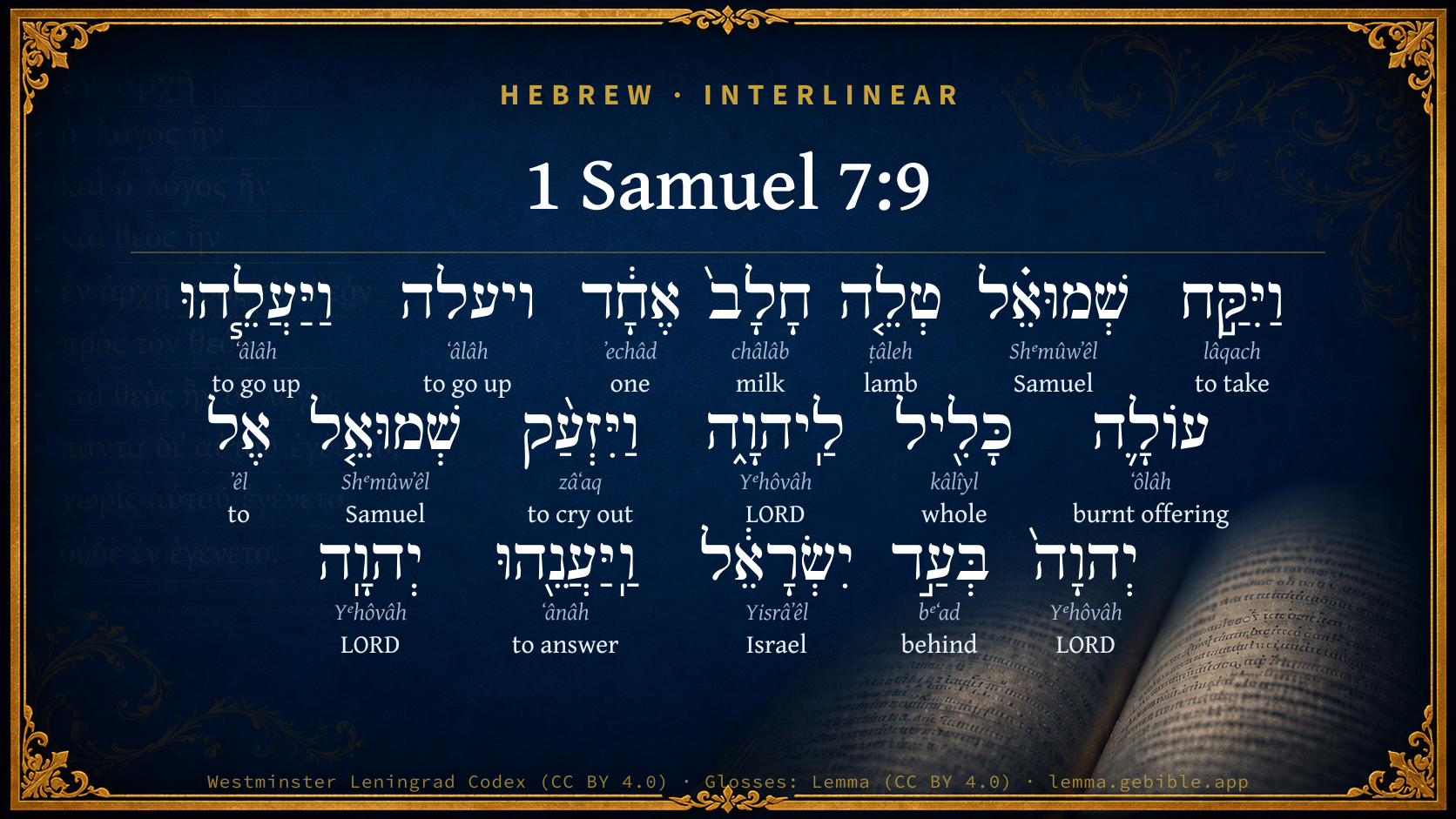
Hebrew (Westminster Leningrad Codex) 1 Samuel 7:9 appears in the Hebrew Old Testament. The text above is from the Westminster Leningrad Codex. Each word links to its Strong’s number, a concise gloss, and parsing drawn from the Open Scriptures Hebrew Bible morphology. Click any word for its full Brown-Driver-Briggs (BDB) entry.
Download image
Cite this verse

1 Samuel 7:9 (World English Bible). Public Domain. Lemma interlinear Bible study tool, https://lemma.gebible.app/v/1-samuel/7/9.

Show BibTeX & RIS
BibTeX
RIS
English Translation
Samuel took a sucking lamb, and offered it for a whole burnt-offering to Yahweh: and Samuel cried to Yahweh for Israel; and Yahweh answered him.
World English Bible · Public Domain
Highlights Full analysis ↓
Download a study sheet

One document with this verse’s original text, its word-by-word gloss line, the meaning frame, cross-references with their text, attributed commentary, and full source and license credits — printable, and it pastes into notes with its structure intact.

This verse Autodidact and up

Study sheet (.html) Plain text (.txt)

A passage Seminary Student

Up to 50 verses in one chapter. A passage sheet keeps up to 6 commentary sources and 12 cross-references per verse, in the order this page ranks them, and says so on the sheet whenever that leaves anything out. Ask for a single verse and you get the Autodidact verse sheet above.

Everything on this page stays free to read, with no account — the sheet is a download of what is already on screen, not access to it.

Want to remove ads? Support Godless Engineer
Compare translations 3

The same verse in 3 English versions, stacked beneath the original-language interlinear above. Click any original word for its lexicon entry.

Each is an independent rendering of the whole verse — the interlinear is not word-aligned to these translations.

Highlighted words mark where these versions differ — a whole-verse word diff, not a word-by-word alignment.

  • World English Bible Public Domain
    Samuel took a sucking lamb, and offered it for a whole burnt-offering to Yahweh: and Samuel cried to Yahweh for Israel; and Yahweh answered him.
  • King James Version Public Domain
    And Samuel took a sucking lamb, and offered it for a burnt offering wholly unto the LORD: and Samuel cried unto the LORD for Israel; and the LORD heard him.
  • unfoldingWord Literal Text CC BY-SA 4.0
    And Samuel took a lamb of milk, and he offered it, a whole burnt offering to Yahweh. And Samuel cried out to Yahweh for Israel, and Yahweh answered him.

unfoldingWord Literal Text — © unfoldingWord, licensed CC BY-SA 4.0. Word-aligned USFM3 via Door43 (git.door43.org/unfoldingWord/en_ult).

Versions to compare (up to 4)

3 of 4 selected

Show all 18 translations

Every available English version of this verse, each an independent rendering of the whole verse.

  • World English Bible Public Domain
    Samuel took a sucking lamb, and offered it for a whole burnt-offering to Yahweh: and Samuel cried to Yahweh for Israel; and Yahweh answered him.
  • Berean Standard Bible Public Domain
    Then Samuel took a suckling lamb and offered it as a whole burnt offering to the LORD. He cried out to the LORD on behalf of Israel, and the LORD answered him.
  • Majority Standard Bible Public Domain
    Then Samuel took a suckling lamb and offered it as a whole burnt offering to the LORD. He cried out to the LORD on behalf of Israel, and the LORD answered him.
  • King James Version Public Domain
    And Samuel took a sucking lamb, and offered it for a burnt offering wholly unto the LORD: and Samuel cried unto the LORD for Israel; and the LORD heard him.
  • American Standard Version (1901) Public Domain
    And Samuel took a sucking lamb, and offered it for a whole burnt-offering unto Jehovah: and Samuel cried unto Jehovah for Israel; and Jehovah answered him.
  • Revised Version (1885) Public Domain
    And Samuel took a sucking lamb, and offered it for a whole burnt offering unto the LORD: and Samuel cried unto the LORD for Israel; and the LORD answered him.
  • Geneva Bible (1599) Public Domain
    Then Samuel tooke a sucking lambe, and offered it all together for a burnt offering vnto the Lord, and Samuel cryed vnto the Lord for Israel, and the Lord heard him.
  • Douay-Rheims (1899) Public Domain
    And Samuel took a sucking lamb, and offered it whole for a holocaust to the Lord: and Samuel cried to the Lord for Israel, and the Lord heard him.
  • Young's Literal Translation Public Domain
    And Samuel taketh a fat lamb, and causeth it to go up -- a burnt-offering whole to Jehovah; and Samuel crieth unto Jehovah for Israel, and Jehovah answereth him;
  • Literal Standard Version CC BY-SA 4.0
    And Samuel takes a fat lamb, and causes it to go up—a whole burnt-offering to YHWH; and Samuel cries to YHWH for Israel, and YHWH answers him;
  • Unlocked Literal Bible CC BY-SA 4.0
    Samuel took a nursing lamb and offered it as a whole burnt offering to Yahweh. Then Samuel cried out to Yahweh for Israel, and Yahweh answered him.
  • unfoldingWord Literal Text CC BY-SA 4.0
    And Samuel took a lamb of milk, and he offered it, a whole burnt offering to Yahweh. And Samuel cried out to Yahweh for Israel, and Yahweh answered him.
  • Darby Bible Public Domain
    And Samuel took a sucking-lamb, and offered it as a whole burnt-offering to Jehovah; and Samuel cried to Jehovah for Israel, and Jehovah answered him.
  • World Messianic Bible Public Domain
    Samuel took a suckling lamb, and offered it for a whole burnt offering to the LORD. Samuel cried to the LORD for Israel, and the LORD answered him.
  • Webster's Bible Public Domain
    And Samuel took a sucking lamb, and offered it for a burnt-offering wholly to the LORD: and Samuel cried to the LORD for Israel; and the LORD heard him.
  • Free Bible Version CC BY-SA 4.0
    Samuel took a young lamb and presented it as a whole burnt offering to the Lord. He cried out for help to the Lord for Israel, and the Lord responded.
  • Bible in Basic English Public Domain
    And Samuel took a young lamb, offering all of it as a burned offering to the Lord; and Samuel made prayers to the Lord for Israel and the Lord gave him an answer.
  • JPS Tanakh (1917) Public Domain
    And Samuel took a sucking lamb, and offered it for a whole burnt-offering unto the LORD; and Samuel cried unto the LORD for Israel; and the LORD answered him.

Literal Standard Version (2020), Covenant Press — licensed CC BY-SA 4.0. Text via the HelloAO Bible API (eBible.org). Unlocked Literal Bible (unfoldingWord) — licensed CC BY-SA 4.0. Text via the HelloAO Bible API (eBible.org). unfoldingWord Literal Text — © unfoldingWord, licensed CC BY-SA 4.0. Word-aligned USFM3 via Door43 (git.door43.org/unfoldingWord/en_ult). Free Bible Version, Dr. Jonathan Gallagher — licensed CC BY-SA 4.0. Text via the HelloAO Bible API (eBible.org).

Word by word

More ways to search: Search by grammar → Find every occurrence → Compare this word →

Practice this passage: Drill this verse → Learn its vocabulary →

טְלֵ֤ה
ṭâleh
H2924
“lamb of”
Noun, Common, Masculine, Singular, Construct
Part of Speech
Noun
Type
Common
Gender
Masculine
Number
Singular
State
Construct
Full BDB Definition

Origin: by variation for H2922

TWOT: 806a

lamb
  1. וַיִּקַּ֣ח lâqach H3947 “and · to take” Conjunction + Verb, Qal, Sequential Imperfect, 3rd Person, Masculine, Singular
  2. שְׁמוּאֵ֗ל Shᵉmûwʼêl H8050 “Samuel” Noun, Proper
  3. חָלָב֙ châlâb H2461 “milk” Noun, Common, Masculine, Singular, Absolute
  4. אֶחָ֔ד ʼechâd H259 “one” Adjective, Cardinal number, Masculine, Singular, Absolute
  5. ויעלה ʻâlâh H5927 “and · to go up” Conjunction + Verb, Hiphil, Sequential Imperfect, 3rd Person, Masculine, Singular
  6. וַיַּעֲלֵ֧הוּ ʻâlâh H5927 “and · to go up · him” Conjunction + Verb, Hiphil, Sequential Imperfect, 3rd Person, Masculine, Singular + Suffix, Personal, 3rd Person, Masculine, Singular
  7. עוֹלָ֛ה ʻôlâh H5930 “burnt offering” Noun, Common, Feminine, Singular, Absolute
  8. כָּלִ֖יל kâlîyl H3632 “whole” Adjective, Adjective, Masculine, Singular, Absolute
  9. לַֽיהוָ֑ה Yᵉhôvâh H3068 “to/for · LORD” Preposition + Noun, Proper
  10. וַיִּזְעַ֨ק zâʻaq H2199 “and · to cry out” Conjunction + Verb, Qal, Sequential Imperfect, 3rd Person, Masculine, Singular
  11. שְׁמוּאֵ֤ל Shᵉmûwʼêl H8050 “Samuel” Noun, Proper
  12. אֶל ʼêl H413 “to” Preposition
  13. יְהוָה֙ Yᵉhôvâh H3068 “LORD” Noun, Proper
  14. בְּעַ֣ד bᵉʻad H1157 “behind” Preposition
  15. יִשְׂרָאֵ֔ל Yisrâʼêl H3478 “Israel” Noun, Proper
  16. וַֽיַּעֲנֵ֖הוּ ʻânâh H6030 “and · to answer · him” Conjunction + Verb, Qal, Sequential Imperfect, 3rd Person, Masculine, Singular + Suffix, Personal, 3rd Person, Masculine, Singular
  17. יְהוָֽה Yᵉhôvâh H3068 “LORD” Noun, Proper

About this verse

These counts appear in no published source. They are computed here, from the morphology-tagged text and Lemma’s own curated glosses. What Lemma adds →

18
words
14
distinct lemmas
Historical
section

Notable vocabulary

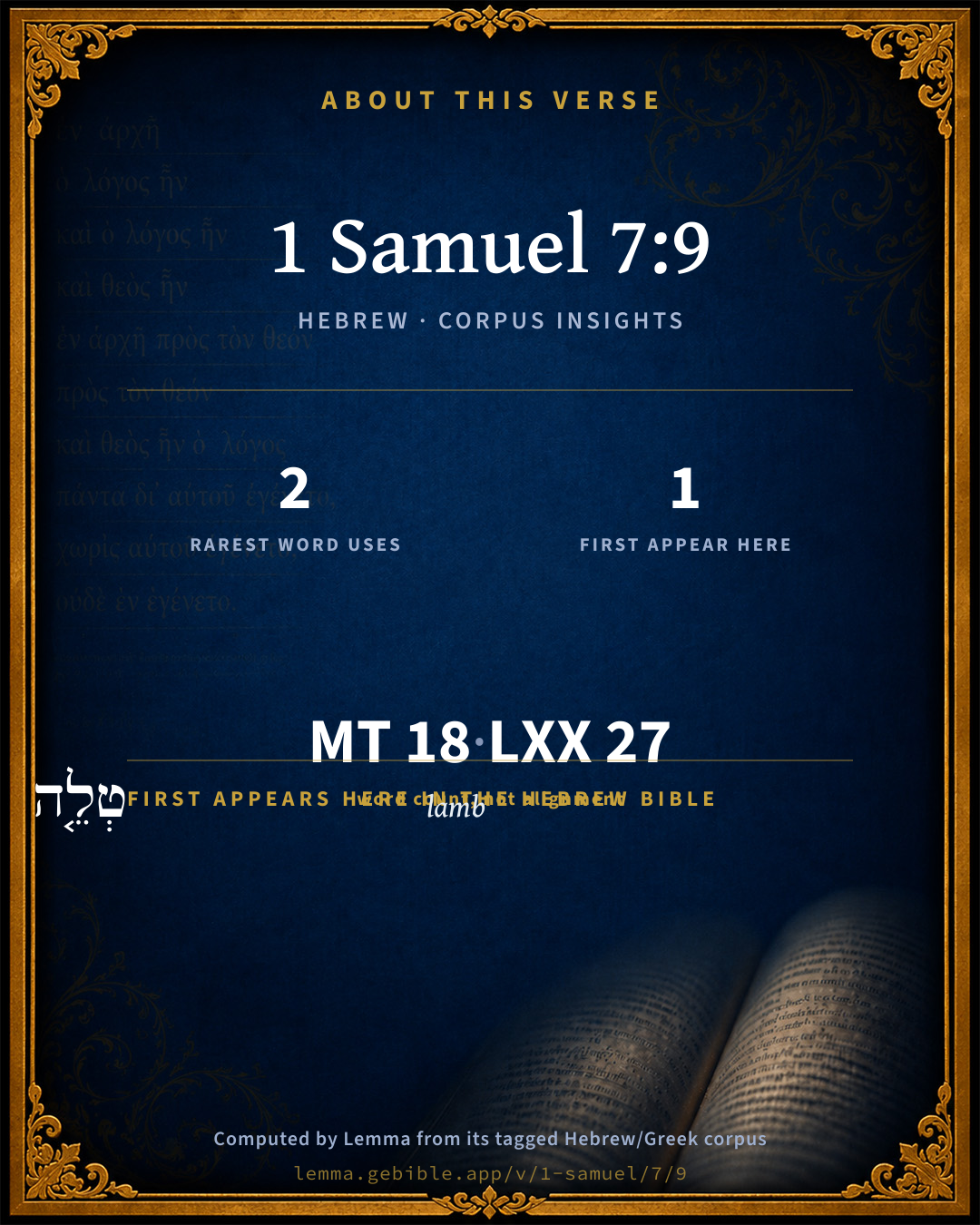
The rarest word here is טְלֵ֤ה lamb H2924 — appearing just 2 times in the whole Hebrew Bible.

First appearance in Scripture

This word makes its first canonical appearance in the Hebrew Bible here:

  • טְלֵ֤ה lamb H2924

Shared distinctive vocabulary

טְלֵ֤ה lamb H2924 occurs in 2 verses of the Hebrew Bible. Also found in:

Grammatical profile

  • 5 verbs
  • 9 nouns
  • 2 adjectives
  • 2 prepositions

Verb forms

  • וַיִּקַּ֣ח Qal · Sequential Imperfect
  • ויעלה Hiphil · Sequential Imperfect
  • וַיַּעֲלֵ֧הוּ Hiphil · Sequential Imperfect
  • וַיִּזְעַ֨ק Qal · Sequential Imperfect
  • וַֽיַּעֲנֵ֖הוּ Qal · Sequential Imperfect

Repetition

Words recur within this verse — often emphatic in Hebrew:

  • לַֽיהוָ֑ה LORD H3068 ×3
  • שְׁמוּאֵ֗ל Samuel H8050 ×2
  • ויעלה to go up H5927 ×2

Hebrew & Septuagint length

In English translation the verse runs 25 words from the Hebrew and 35 from the Septuagint (LXX English) — the Septuagint runs noticeably longer here. See the side-by-side →

A rough comparison of the two English renderings, which tokenize alike — not a word-level alignment.

Word counts can differ between the Hebrew and the Greek without any difference in meaning — e.g. the Hebrew direct-object marker אֵת has no separate Greek word, and Greek often adds the article ὁ.

In the original languages it is 18 Hebrew tokens and 27 Greek tokens — but the two are counted differently (Hebrew bundles its prefixes and suffixes into one token; the Greek is in lemma form), so that isn’t a like-for-like length.

Cross-references

12

Topical passages linked to 1 Samuel 7:9 in the Treasury of Scripture Knowledge — connected by theme and wording, ordered by reader-vote popularity; previews shown in the World English Bible.

  • Jeremiah 15:1 Then said Yahweh to me, Though Moses and Samuel stood before me, yet my mind would not be toward this people: cast them out of my sight, and let them go forth.
  • Psalms 99:6 Moses and Aaron were among his priests, Samuel among those who call on his name; They called on Yahweh, and he answered them.
  • 1 Samuel 7:17 His return was to Ramah, for there was his house; and there he judged Israel: and he built there an altar to Yahweh.
  • Psalms 50:15 Call on me in the day of trouble. I will deliver you, and you will honor me."
  • 1 Samuel 16:2 Samuel said, How can I go? if Saul hear it, he will kill me. Yahweh said, Take a heifer with you, and say, I am come to sacrifice to Yahweh.
  • James 5:16 Confess your offenses to one another, and pray one for another, that you may be healed. The effective, earnest prayer of a righteous man is powerfully effective.
  • Judges 6:28 When the men of the city arose early in the morning, behold, the altar of Baal was broken down, and the Asherah was cut down that was by it, and the second bull was offered on the altar that was built.
  • 1 Samuel 6:14–15 The cart came into the field of Joshua the Beth-shemite, and stood there, where there was a great stone: and they split the wood of the cart, and offered up the cattle for a burnt offering to Yahweh.
  • 1 Samuel 9:12 They answered them, and said, He is; behold, [he is] before you: make haste now, for he is come today into the city; for the people have a sacrifice today in the high place:
  • 1 Samuel 10:8 You shall go down before me to Gilgal; and, behold, I will come down to you, to offer burnt offerings, and to sacrifice sacrifices of peace-offerings: seven days shall you wait, until I come to you, and show you what you shall do.
  • 1 Kings 18:30–38 Elijah said to all the people, Come near to me; and all the people came near to him. He repaired the altar of Yahweh that was thrown down.
  • Judges 6:26 and build an altar to Yahweh your God on the top of this stronghold, in the orderly manner, and take the second bull, and offer a burnt offering with the wood of the Asherah which you shall cut down.

Cross-references courtesy of OpenBible.info (CC BY 4.0).

Hebrew and Greek witnesses Masoretic Hebrew ↔ Greek Septuagint

The same verse in the two great witnesses to the Old Testament, shown verse-for-verse.

Here the Septuagint runs noticeably longer than the Hebrew — LXX2012 (modern English Septuagint) 35 words vs World English Bible 25. A rough length comparison of the two English translations, not a word-level alignment — read both below.

These are two independent witnesses, not word-aligned to each other, and the Septuagint is shown in lemma (dictionary) form.

Hebrew 1 Samuel 7:9 Masoretic · Westminster Leningrad Codex

וַיִּקַּ֣ח שְׁמוּאֵ֗ל טְלֵ֤ה חָלָב֙ אֶחָ֔ד ויעלה וַיַּעֲלֵ֧הוּ עוֹלָ֛ה כָּלִ֖יל לַֽיהוָ֑ה וַיִּזְעַ֨ק שְׁמוּאֵ֤ל אֶל יְהוָה֙ בְּעַ֣ד יִשְׂרָאֵ֔ל וַֽיַּעֲנֵ֖הוּ יְהוָֽה

Samuel took a sucking lamb, and offered it for a whole burnt-offering to Yahweh: and Samuel cried to Yahweh for Israel; and Yahweh answered him.

World English Bible · Public Domain

Greek LXX 1 Samuel 7:9 Septuagint · lemma form

καί λαμβάνω σαμουηλ ἀρνός γαλαθηνός εἷς καί ἀναφέρω αὐτός ὁλοκαύτωσις σύν πᾶς ὁ λαός ὁ κύριος καί βοάω σαμουηλ πρός κύριος περί ἰσραήλ καί ἐπιἀκούω αὐτός κύριος

And Samuel took a sucking lamb, and offered it up as a whole burnt offering with all the people to the Lord: and Samuel cried to the Lord for Israel, and the Lord heard him.

LXX2012 (modern English Septuagint) · Public Domain

On this verse, Haydock's Catholic Bible Commentary discusses the Septuagint’s reading. Read the note in Commentary ↓

Hebrew: Westminster Leningrad Codex (CC BY 4.0). Greek: Septuagint (public domain); English from LXX2012 (modern English Septuagint) (Public Domain). How the Septuagint differs from the Hebrew →

Targum (Aramaic paraphrase)

1

The Targum is the ancient Jewish Aramaic paraphrase of the Hebrew Scriptures — an interpretive translation, not the Hebrew text itself. Onkelos (literal) and Pseudo-Jonathan (expansive) render the Torah, and Jonathan the Prophets. Coverage is partial: where no permissively-licensed English translation exists for a verse, only the Aramaic is shown. This is verse-level text, not a word-by-word alignment to the Hebrew.

  1. Targum Jonathan Prophets (Joshua–Malachi)
    וּנְסִיב שְׁמוּאֵל אִמְרָא דַחֲלָבָא חַד וְאַסְקֵיהּ עֲלָתָא קֳדָם יְיָ וְצַלִי שְׁמוּאֵל קֳדָם יְיָ עַל יִשְׂרָאֵל וְקַבֵּיל צְלוֹתֵיהּ יְיָ:

    (no public-domain English translation for this verse)

    Targum Jonathan — Aramaic: “Mikraot Gedolot” (public domain). English: “Sefaria Community Translation” (CC0 1.0 (public-domain dedication)); “London "Chaldee Paraphrase," 1871” (public domain). Text via Sefaria.

Commentary

Notes on 1 Samuel 7:9 from classic Christian and Jewish commentators (each source and its license shown beneath its notes). The classic Christian expositions comment on the surrounding passage and are grouped to its opening verse, so a note may address several verses; the Jewish commentaries on the Tanakh (Rashi and others) are per-verse, so they appear only where the commentator wrote on this verse.

Lemma curates 59 commentaries, every one of them public domain or Creative Commons licensed, each selected and text-cleaned for this edition rather than reprinted as found. About our sources →

Trapp's Complete Commentary

John Trapp

1Sa 7:9 And Samuel took a sucking lamb, and offered [it for] a burnt offering wholly unto the LORD: and Samuel cried unto the LORD for Israel; and the LORD heard him.

Ver. 9. And Samuel took a sucking lamb.] A figure of that Lamb undefiled and without spot, Jesus Christ, by whom we prevail over all our spiritual enemies, as here Israel did over the Philistines. It was a sucking lamb, to show, haply, that the people purposed to be renewed in piety and holiness {a} - a lamb of no great price, to show that God looketh not to the greatness of the gift, but to the heart of the offerer. {b}

And offered it for a burnt offering.] This he might do as a prophet, though no priest, saith Kimchi. See 1Ki 18:30-31.

And Samuel cried unto the Lord.] He was famous for calling upon God’s name with singular success. {Psa 99:6 Jer 15:1}

And the Lord heard him.] So he doth all such as bring unto him honest hearts and lawful petitions: these are sure of not miscarrying returns of their prayers.

{a} Diod.

{b} Pet. Martyr.

John Trapp, A Commentary or Exposition upon All the Books of the Old and New Testament (1647–1656) — public domain. Text from a community e-Sword module.

Joseph Benson's Commentary

1Sa 7:9. Samuel took a sucking lamb — For after a lamb was eight days old, it was fit to be sacrificed to God, Exo 22:30; Leviticus 17:27. And offered it for a burnt-offering — For though he was not a priest, nor this place appointed for sacrifice, yet as a prophet he had authority from God to build an altar anywhere and offer sacrifices. Thus other holy men, Gideon and Manoah, were warranted to offer extraordinary sacrifices, in places which God had not before appointed. And thus we read of an altar he built in another place, 1Sa 7:17, as Elijah did in following times. And Samuel cried unto the Lord — He made intercession with the sacrifice. So Christ intercedes in virtue of his satisfaction. And in all our prayers we must have an eye to his great oblation, depending on him for audience and acceptance. And the Lord heard him — Probably God answered Samuel as he did Manoah, by sending fire from heaven to consume the sacrifice, in testimony of his acceptance of it.

Joseph Benson's Commentary on the Old and New Testaments (1811–1818) — public domain. Text from a community e-Sword module.

Tyndale Open Study Notes

Tyndale Open Resources

7:9 The whole burnt offering was probably for forgiveness of sin (see Lev 1:1-4). • The Lord answered with a forceful thunderclap (1 Sam 7:10).

Tyndale Open Study Notes — © Tyndale Open Resources, licensed CC BY-SA 4.0. Text via the HelloAO Bible API.

Adam Clarke's Commentary

Verse 9. Samuel took a sucking lamb] This sucking lamb must have been eight days under its mother before it could be offered, as the law says, Le 22:27.

Though Samuel was not a priest, yet he offered this sacrifice; or he might have ordered Eleazar to offer it, and still be said to have done it himself: Qui facit per alterum, facit per se; "He who procures a thing to be done, may be said to do it himself."

His not sacrificing at the tabernacle was justified by the necessity of the case; neither tabernacle nor ark was at hand.

Adam Clarke's Commentary on the Bible (1810–1826) — public domain. Text from a community e-Sword/MySword module.

The Cambridge Bible for Schools and Colleges

gen. ed. J. J. S. Perowne

9. a sucking lamb] Which might not be less than seven days old, according to Lev_22:17.

for a burnt offering wholly unto the Lord] The whole animal was burnt upon the altar to denote the entire consecration to Jehovah of those who were pleading for deliverance.

and the Lord heard him] Better, answered him. Cp. Psa_99:6, and note on 1Sa_7:5.

The Cambridge Bible for Schools and Colleges (gen. ed. J. J. S. Perowne; Cambridge University Press, 1878–1918) — public domain. Text from a community e-Sword module.

John Gill's Exposition

And Samuel took a sucking lamb,.... Which it might be, and yet more than eight days old, for under that it might not be sacrificed, Exo 22:30.

and offered it for a burnt offering wholly unto the Lord; the whole of it was burnt, skin and all, whereas the skin was the priest's in other burnt offerings; and this is remarked (m) as one of the three things in which it differed from other offerings; the word being feminine, the Jews gather from hence, as Jarchi notes, that females might be offered at a private altar:

and Samuel cried unto the Lord for Israel; not only offered a sacrifice for them, but prayed for them:

and the Lord heard him; and answered him, either by causing fire to come down on the sacrifice, by which it was consumed, or by the voice of thunder, which frightened and discomfited the Philistines; and the event of things manifestly showed it.

(m) Midrash Schemuel apud Abarbinel in loc.

John Gill's Exposition of the Whole Bible (1746–1763) — public domain (CC PDM 1.0). Text via the HelloAO Bible API.

Albert Barnes' Notes on the Bible

Samuel’s preparation for intercessory prayer, namely, the offering up an atoning sacrifice, is most significant (compare Luk 1:9-10). The term here used for a “lamb” does not occur in the Pentateuch; indeed it is only found besides this place in Isa 65:25. The offering is in accordance with Lev 22:27.

The Lord heard him - Better as in margin. The “answer” was not simply the granting the asked-for deliverance, but the great thunder 1Sa 7:10, which was “the voice of the Lord,” the same voice with which the Lord answered Moses Exo 19:19; Psa 99:6.

Albert Barnes' Notes on the Bible (1834–1885) — public domain. Text from a community e-Sword/MySword module.

Haydock's Catholic Bible Commentary

Suckling lamb. Any might be used, when eight days old, except for the paschal lamb, which must be older; a yearling, Exodus xxiii. 9., and Leviticus xxii. 27. --- Offered it, either by the hands of the priests, or by dispensation, which authorized him to sacrifice out of the tabernacle. --- Whole, without blemish; (Ecclesiasticus xlvi. 19.) or, not having time to divide it, according to the ritual, Leviticus i. 12. He consumed even the skin. (Salien) --- Septuagint, "with all the people."

George Leo Haydock (1774–1849), Haydock's Catholic Family Bible and Commentary, 1859 edition — public domain. Excludes Psalms (Douay-Rheims chapter numbering differs from Protestant) and Deuterocanonical books (Catholic canon only).

Matthew Poole's English Annotations

It might be a sucking lamb, though it was more than eight days old, and so that law, Exo 23:19, was not violated.

Offered it; either himself by Divine instinct, which was a sufficient warrant; or rather by a priest, as Saul is afterwards said to have offered, 1Sa 13:9.

A burnt-offering wholly; burning all the parts of it, according to the law of the burnt-offerings; whereas in other offerings some parts were reserved.

The Lord heard him, as appears by the effects, the following thunder, and the overthrow of the Philistines’ host.

Matthew Poole's English Annotations on the Holy Bible (1683–1685) — public domain. Text from a community e-Sword/MySword module.

Whedon's Commentary on the Bible

Daniel D. Whedon

9. A sucking lamb — שׂלה חלב, a lamb of milk, that is, young and tender, only seven or eight days old, (Lev_22:27,) such “being the most suitable to represent the nation that had wakened up to new life through its conversion to the Lord, and was, as it were, newborn.” — Keil.

A burnt offering wholly — Not cut up and divided, as sacrificial victims often were, but offered entire. We need not suppose that Samuel offered this burnt-offering with his own hand, and thus assumed a function of the priesthood. The co-operation of the priests on such occasions being generally understood, no particular reference to that fact was here necessary. Samuel stood by and blessed the sacrifice. Compare 1Sa_9:13, and note.

Daniel D. Whedon (gen. ed.), Commentary on the Old and New Testaments (1874–1909) — public domain. Text from a community e-Sword module.

The Pulpit Commentary

And Samuel took a sucking lamb. Samuel now appears as priest, and makes intercession and atonement for them. The lamb was at least seven days old, for so the law required, (Lev_22:27) but probably not much older; for the word, a rare one, occurring elsewhere only in Isa_65:25, means something small and tender: this then he offered for a burnt offering wholly unto Jehovah. The A.V translates in this way because chalil, "whole," is masculine, while "olah, "a burnt offering," is feminine; but chalil had in course of time come to be used as a substantive (Lev_6:23; Deu_13:16 Deu_33:10) and is really here in opposition to "olah, and so the two together signify "a whole burnt offering," and clearly indicate that the lamb was entirely consumed by fire. "Olah means that which ascends, and symbolised devotion and consecration to God. Chalil intensified this signification, and showed that all was God"s, and no part whatsoever reserved for the priest or the offerer. And thus then Samuel"s burnt offering implied that the people gave themselves unreservedly to Jehovah. And Jehovah heard him . Really, "Jehovah answered him," by the thunder mentioned in ver. 10. For thunder was regarded as God"s voice, (1Sa_2:10) and in Ps 29. we have a poetic description of its majesty and power. Express mention is also made in Psa_99:6 of Jehovah having thus answered the prayers of, (Exo_19:19) and of Samuel.

The Pulpit Commentary (1880–1919), ed. H.D.M. Spence-Jones & Joseph S. Exell — public domain. Text from a community e-Sword module.

John Wesley's Explanatory Notes

Cried - And he cried unto the Lord. He made intercession with the sacrifice. So Christ intercedes in virtue of his satisfaction. And in all our prayers we must have an eye to his great oblation, depending on him for audience and acceptance.

John Wesley, Explanatory Notes Upon the Whole Bible (1754–1765) — public domain. Text via the GEBible commentary corpus.

Kretzmann's Popular Commentary

Paul E. Kretzmann

The Philistines Overthrown

v. 9. And Samuel took a sucking lamb, one having been about seven days with its mother, Lev 22:27, and offered it for a burnt offering wholly unto the Lord, without having divided it according to the usual form of burnt offerings. And Samuel cried unto the Lord for Israel; and the Lord heard him, gave him an answer in the defeat of their enemies, as now related.

v. 10. And as Samuel was offering up the burnt offering, while this act of worship was still going on, the Philistines drew near to battle against Israel; but the Lord thundered with a great thunder, with terrific peals, which followed one after another, on that day upon the Philistines and discomfited them, so that they were terrified, confused, and confounded; and they were smitten before Israel, literally, "before the face of Israel," while the Israelites were looking on in wonder.

v. 11. And the men of Israel, while the enemies turned away in confusion, went out of Mizpeh, and pursued the Philistines, and smote them until they came under Bethcar, below a city at some distance from the field of battle.

v. 12. Then Samuel took a stone, and set it between Mizpeh and Shen, at the place where the two former battles with the Philistines had also been fought, and called the name of it Ebenezer (stone of help), saying, Hitherto hath the Lord helped us. Although the victory did not complete the deliverance from the oppression of the Philistines, yet it pointed to the fact that Jehovah was once more with the army of Israel, and therefore this token of thanksgiving in the name of the whole people properly expressed the sentiments which were stirring their hearts.

v. 13. So the Philistines were subdued, in consequence of this victory, and they came no more into the coast of Israel, all attempts made by them with this object in view were promptly frustrated; and the hand of the Lord was against the Philistines all the days of Samuel; while he lived, they did not regain the supremacy over Israel which they once held.

v. 14. And the cities which the Philistines had taken from Israel were restored to Israel, from Ekron even unto Gath, these cities being on the Philistine frontier. These cities themselves were clearly not included in the territory which they yielded, the text merely stating that Israel recovered the land on the Philistine borders between Ekron and Gath, which had originally been subdued by the armies of Judah and Simeon, Jdg 1:18. And the coasts thereof did Israel deliver out of the hands of the Philistines. And there was peace between Israel and the Amorites; the other Canaanitish nations, among whom the Amorites were the strongest, thought it the best policy not to undertake any campaigns against the children of Israel.

v. 15. And Samuel judged Israel all the days of his life, rendering decisions in difficult matters and proposing measures for the benefit of the people even when Saul had been made king.

v. 16. And he went from year to year in circuit to Bethel, toward the north, and Gilgal, in the valley of Jordan near Jericho, and Mizpeh, toward the southwest, and judged Israel in all those places.

v. 17. And his return was to Ramah, to this city he always came back; for there was his house; and there he judged Israel, when not absent on one of his circuit-court trips; and there he built an altar unto the Lord. Although the Tabernacle remained at Shiloh for the time being, public worship was, for a number of years, carried on in other places as well. Thus Samuel, as judge, prophet, and priest, performed the work of his office and taught Israel the ways of the Lord. Herein he is a type of the Messiah, Jesus Christ, who is Priest, Prophet, and King in one person, who sacrificed Himself for the sins of all men, gives knowledge of the salvation gained by Him through the Gospel, and lives and reigns throughout eternity.

Paul E. Kretzmann, Popular Commentary of the Bible (1921–1924) — public domain. Text from a community e-Sword module.

unfoldingWord translationNotes

Door43 World Missions Community

nursing lamb

a lamb that is still drinking its mother's milk

cried out

"cried out for help"

Yahweh answered him

"Yahweh did what Samuel asked him to do"

translationWords

Samuel

lamb

burnt offering

Yahweh

cry

unfoldingWord translationNotes — © Distant Shores Media and the Door43 World Missions Community, licensed CC BY-SA 4.0. Source: git.door43.org/Door43/en_tn.

Rashi

Rabbi Shlomo Yitzchaki (Rashi)

And offered it all as a burnt offering. The כְּתִיב is 'וַיַעֲלֶהָ' because it was a female. From here our Rabbis deduced that a female animal is acceptable as a burnt offering on a private altar.

Rashi on the Tanakh — English translations: “The Judaica Press complete Tanach with Rashi, translated by A. J. Rosenberg” (CC BY 4.0); “Pentateuch with Rashi's commentary by M. Rosenbaum and A.M. Silbermann, 1929-1934” (public domain); “The Metsudah Tanach series, Lakewood, N.J” (CC BY 4.0); and “The Book of Joshua, Metsudah Publications, 1997” (CC BY 4.0). Text via Sefaria.

Lesson kit

Teaching starters — assembled from the data on this page, not authored interpretation. Every prompt links to the verse data it draws on. Edit before teaching.

1 Samuel, in the Historical, opens this verse with 18 words (14 distinct Hebrew lemmas). Its most distinctive word is ṭâleh (“lamb”). The Greek Septuagint runs longer here. A historical commentator’s framing appears above. Read the whole chapter for the surrounding context.

Discussion questions

  1. What does “lamb” (ṭâleh) contribute to the verse as a whole?
  2. The word “lamb” first appears here in Scripture. What is being introduced at this debut?
  3. Isaiah 65:25 shares the word «lamb» with this verse. How do the two illuminate each other?
  4. “LORD” occurs 3× in this one verse. What is the effect of the repetition?
  5. Compared with the Hebrew, the Septuagint runs longer here. What questions does that raise?
  6. These translations render this verse differently. What is at stake in choosing one wording over another?
  7. The verb «וַיִּקַּ֣ח» is Qal Sequential Imperfect. How does its form color the action?
  8. Reading how Trapp's Complete Commentary and Joseph Benson's Commentary read this verse, where do the two commentators agree and where do they part?

Things to notice

Reading settings

Reading text

Shown beneath each verse's original-language words.

Old Testament
Old Testament edition

Read the OT as the Masoretic Hebrew (MT) or the Greek Septuagint (LXX).

English shown for the Greek Septuagint (in the Hebrew ↔ Greek comparison).

Comparing translations? Open the Compare panel on any verse page to stack up to four side by side.