Galatians 1:2

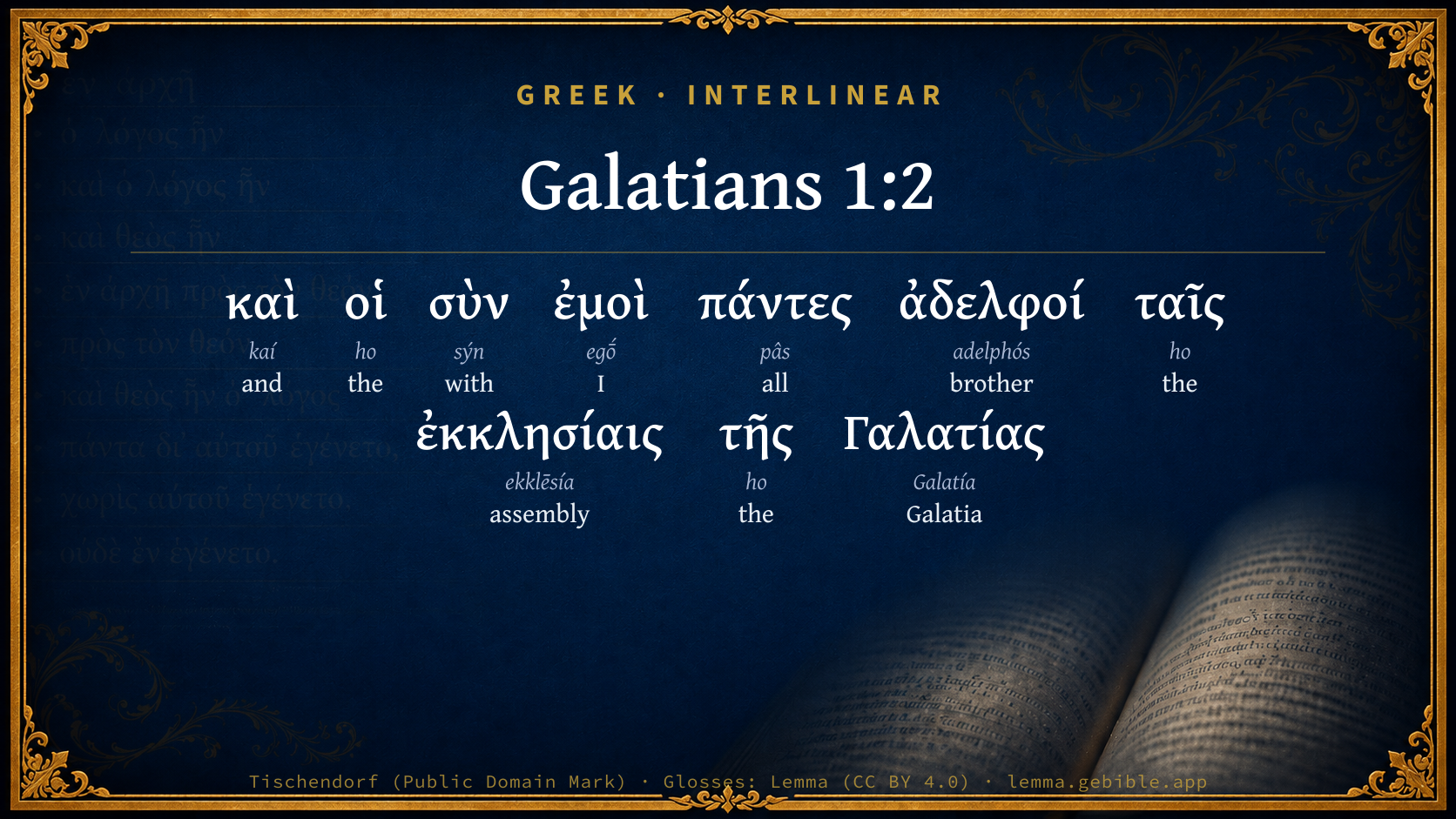
Greek (Tischendorf 8th ed.) Galatians 1:2 appears in the Greek New Testament. The text above is from the Tischendorf 8th edition. Each word links to its Strong’s number and a concise gloss. Click any word for its full Thayer’s Greek Lexicon entry.
Download image
Cite this verse

Galatians 1:2 (World English Bible). Public Domain. Lemma interlinear Bible study tool, https://lemma.gebible.app/v/galatians/1/2.

Show BibTeX & RIS
BibTeX
RIS
English Translation
and all the brothers who are with me, to the assemblies of Galatia:
World English Bible · Public Domain
Download a study sheet

One document with this verse’s original text, its word-by-word gloss line, the meaning frame, cross-references with their text, attributed commentary, and full source and license credits — printable, and it pastes into notes with its structure intact.

This verse Autodidact and up

Study sheet (.html) Plain text (.txt)

A passage Seminary Student

Up to 50 verses in one chapter. A passage sheet keeps up to 6 commentary sources and 12 cross-references per verse, in the order this page ranks them, and says so on the sheet whenever that leaves anything out. Ask for a single verse and you get the Autodidact verse sheet above.

Everything on this page stays free to read, with no account — the sheet is a download of what is already on screen, not access to it.

Want to remove ads? Support Godless Engineer
Compare translations 3

The same verse in 3 English versions, stacked beneath the original-language interlinear above. Click any original word for its lexicon entry.

Each is an independent rendering of the whole verse — the interlinear is not word-aligned to these translations.

Highlighted words mark where these versions differ — a whole-verse word diff, not a word-by-word alignment.

  • World English Bible Public Domain
    and all the brothers who are with me, to the assemblies of Galatia:
  • King James Version Public Domain
    And all the brethren which are with me, unto the churches of Galatia:
  • unfoldingWord Literal Text CC BY-SA 4.0
    and all the brothers with me, to the churches of Galatia:

unfoldingWord Literal Text — © unfoldingWord, licensed CC BY-SA 4.0. Word-aligned USFM3 via Door43 (git.door43.org/unfoldingWord/en_ult).

Versions to compare (up to 4)

3 of 4 selected

Show all 19 translations

Every available English version of this verse, each an independent rendering of the whole verse.

  • World English Bible Public Domain
    and all the brothers who are with me, to the assemblies of Galatia:
  • Berean Standard Bible Public Domain
    and all the brothers with me, To the churches of Galatia:
  • Majority Standard Bible Public Domain
    and all the brothers with me, To the churches of Galatia:
  • King James Version Public Domain
    And all the brethren which are with me, unto the churches of Galatia:
  • American Standard Version (1901) Public Domain
    and all the brethren that are with me, unto the churches of Galatia:
  • Revised Version (1885) Public Domain
    and all the brethren which are with me, unto the churches of Galatia:
  • Geneva Bible (1599) Public Domain
    And all the brethren which are with me, vnto the Churches of Galatia:
  • Douay-Rheims (1899) Public Domain
    And all the brethren who are with me, to the churches of Galatia.
  • Young's Literal Translation Public Domain
    and all the brethren with me, to the assemblies of Galatia:
  • Literal Standard Version CC BY-SA 4.0
    and all the brothers with me, to the assemblies of Galatia:
  • Unlocked Literal Bible CC BY-SA 4.0
    and all the brothers with me, to the churches of Galatia:
  • unfoldingWord Literal Text CC BY-SA 4.0
    and all the brothers with me, to the churches of Galatia:
  • Darby Bible Public Domain
    and all the brethren with me, to the assemblies of Galatia.
  • World Messianic Bible Public Domain
    and all the brothers who are with me, to the assemblies of Galatia:
  • Webster's Bible Public Domain
    And all the brethren who are with me, to the churches of Galatia:
  • Free Bible Version CC BY-SA 4.0
    All the brothers and sisters here with me join in sending this letter to the churches in Galatia.
  • Bible in Basic English Public Domain
    And all the brothers who are with me, to the churches of Galatia:
  • Text-Critical English NT CC BY 4.0
    and all the brothers with me, to the churches of Galatia:
  • Tyndale New Testament (1534) Public Domain
    and all the brethren which are with me. Vnto the congregacions of Galacia.

Literal Standard Version (2020), Covenant Press — licensed CC BY-SA 4.0. Text via the HelloAO Bible API (eBible.org). Unlocked Literal Bible (unfoldingWord) — licensed CC BY-SA 4.0. Text via the HelloAO Bible API (eBible.org). unfoldingWord Literal Text — © unfoldingWord, licensed CC BY-SA 4.0. Word-aligned USFM3 via Door43 (git.door43.org/unfoldingWord/en_ult). Free Bible Version, Dr. Jonathan Gallagher — licensed CC BY-SA 4.0. Text via the HelloAO Bible API (eBible.org).

Word by word

More ways to search: Search by grammar → Find every occurrence → Compare this word →

Practice this passage: Drill this verse → Learn its vocabulary →

About this verse

These counts appear in no published source. They are computed here, from the morphology-tagged text and Lemma’s own curated glosses. What Lemma adds →

10
words
8
distinct lemmas
Pauline Epistles
section

Notable vocabulary

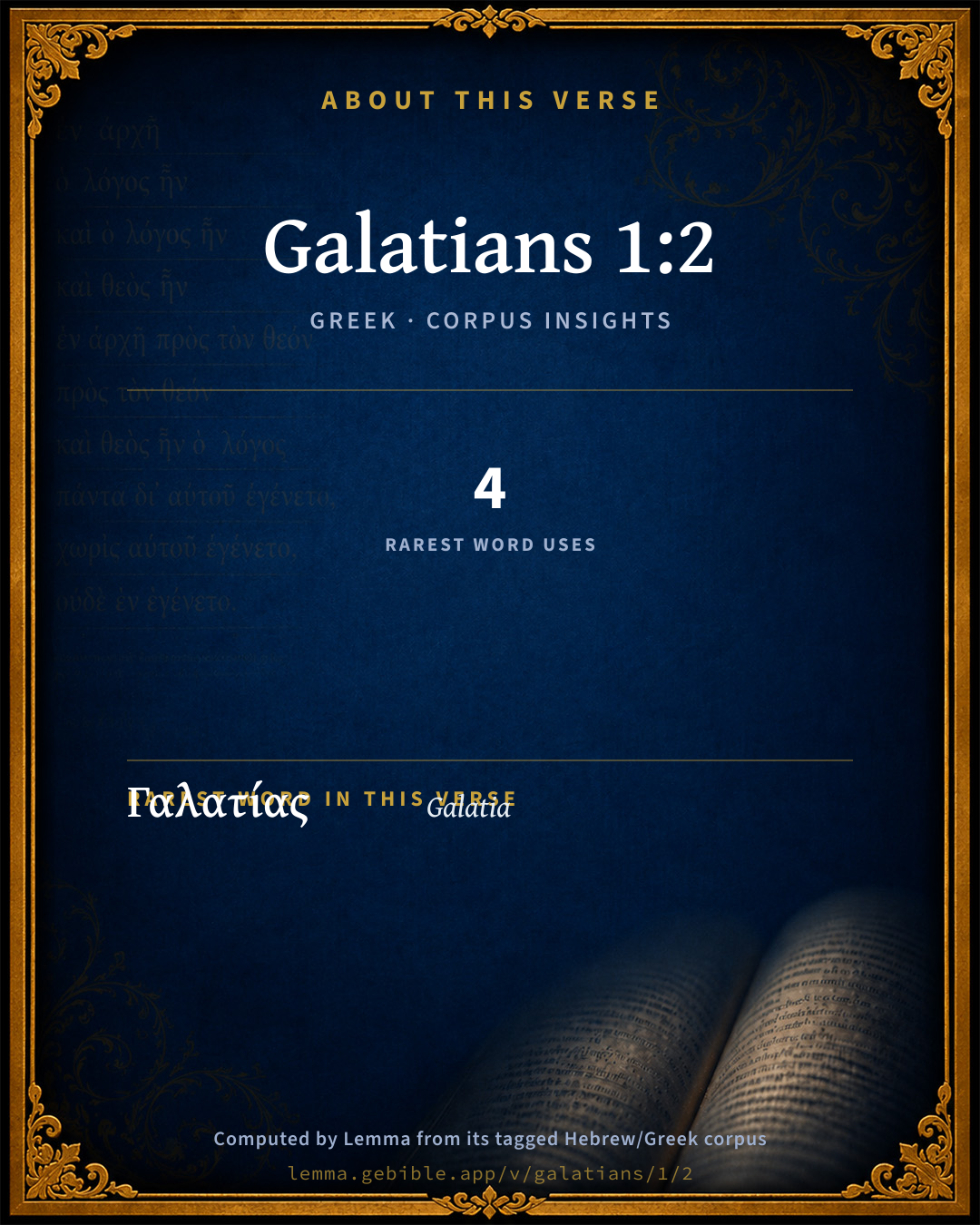
The rarest word here is Γαλατίας Galatia G1053 — appearing just 4 times in the whole Greek New Testament.

Shared distinctive vocabulary

Γαλατίας Galatia G1053 occurs in 4 verses of the Greek New Testament. Also found in:

Repetition

A word recurs within this verse:

Cross-references

7

Topical passages linked to Galatians 1:2 in the Treasury of Scripture Knowledge — connected by theme and wording, ordered by reader-vote popularity; previews shown in the World English Bible.

  • 1 Corinthians 16:1 Now concerning the collection for the saints, as I commanded the assemblies of Galatia, you do likewise.
  • Philippians 4:21 Greet every saint in Christ Jesus. The brothers who are with me greet you.
  • Acts 16:5–6 So the assemblies were strengthened in the faith, and increased in number daily.
  • Acts 18:23 Having spent some time there, he departed, and went through the region of Galatia, and Phrygia, in order, establishing all the disciples.
  • Philippians 2:22 But you know the proof of him, that, as a child serves a father, so he served with me in furtherance of the Gospel.
  • Acts 9:31 So the assemblies throughout all Judea and Galilee and Samaria had peace, and were built up. They were multiplied, walking in the fear of the Lord and in the comfort of the Holy Spirit.
  • Acts 15:41 He went through Syria and Cilicia, strengthening the assemblies.

Cross-references courtesy of OpenBible.info (CC BY 4.0).

Commentary

Notes on Galatians 1:2 from classic Christian and Jewish commentators (each source and its license shown beneath its notes). The classic Christian expositions comment on the surrounding passage and are grouped to its opening verse, so a note may address several verses; the Jewish commentaries on the Tanakh (Rashi and others) are per-verse, so they appear only where the commentator wrote on this verse.

Lemma curates 59 commentaries, every one of them public domain or Creative Commons licensed, each selected and text-cleaned for this edition rather than reprinted as found. About our sources →

Ellicott's Commentary for English Readers

(2) All the brethren which are with me—i.e., all his travelling companions. We are unable to say exactly who these were, the more so as we do not know with any certainty the place from which St. Paul was writing. He may have had in his company most of those who are mentioned in Act_20:4 as accompanying him back into Asia: Sopater, son of Pyrrhus (according to an amended reading); Aristarchus and Secundus, of Thessalonica; Gaius, of Derbe; Tychicus and Trophimus, of Asia; in any case, probably Timothy, and perhaps Titus.

It was usual with St. Paul to join with his own name that of one or other of his companions in the address of his Epistles. Thus, in the First Epistle to the Corinthians he associates with himself Sosthenes; in the Second Epistle to Corinth, and in those to the Philippians and Colossians, Timothy and Silvanus. In writing to the Galatians, St. Paul includes all his companions in his greeting, hardly with the view of fortifying himself with their authority, for he is ready enough to take the whole defence of his own cause upon himself, but, perhaps, not altogether without the idea that he is possessed of their sympathy.

The churches of Galatia.—See the Introduction to this Epistle.

This opening salutation is intentionally abrupt and bare. Usually it was the Apostle’s custom to begin with words of commendation. He praises all that he can find to praise even in a Church that had offended so seriously as the Corinthians. (See 1Co_1:2; 1Co_1:4-7.) But the errors of the Galatians, he feels, go more to the root of things. The Corinthians had failed in the practical application of Christian principles; the Galatians (so far as they listened to their Judaising teachers) could hardly be said to have Christian principles at all. The Apostle is angry with them with a righteous indignation, and his anger is seen in the naked severity of this address.

A Bible Commentary for English Readers, edited by Charles John Ellicott (1878–1897) — public domain. Text from a community e-Sword module.

The Cambridge Bible for Schools and Colleges

gen. ed. J. J. S. Perowne

2. all the brethren which are with me] It is impossible to say with certainty who these brethren were. The expression, ‘all the brethren’ and the omission of any names, render it improbable that reference is intended only to Timothy and Titus. The words are intentionally vague, and certainly do not lend support to the view that St Paul “sought safety in numbers”. He knew that truth is generally with the minority. But he never forgot that he was a member of the Church, and not an isolated individual. The truth for which he contended was the birthright of his brethren, dear to them as to himself.

unto the churches of Galatia] The abruptness of the address is remarkable. No word of praise, no mention of privilege. Comp. the opening words of the Epistles to the Thessalonians, Ephesians, &c. Even the Corinthians receive a more kindly salutation. They had not “erred concerning the faith” as had these Galatians.

The word ‘Church’ in the N. T. is used either (1) of the whole body of believers, “the whole congregation of Christian people dispersed throughout the whole world” (Canon lv.), (Mat_16:18; Col_1:24), or (2) of a particular congregation, under the same ministry of the word and sacraments. Thus we read of the Church in Cenchreæ (1Co_16:1), of the Churches of Asia (1Co_16:19; Rev_1:4, &c.), of the Church in a particular house (Col_4:15; Phm_1:2). (3) It is also used of an assembly of believers gathered together for worship, as 1Co_14:28. The Churches of the Thessalonians and Laodiceans are exceptions to the usual form, in which the precise locality is designated. We may assume that the Churches of Galatia were bodies of converts living in the principal cities, Ancyra, Pessinus, &c. See Introduction, p. ix.

The Cambridge Bible for Schools and Colleges (gen. ed. J. J. S. Perowne; Cambridge University Press, 1878–1918) — public domain. Text from a community e-Sword module.

The Biblical Illustrator

Joseph S. Exell

Gal_1:2

And all the brethren which are with me, unto the churches of Galatia.

Church unity

Our religion is not designed to terminate upon ourselves, but to benefit those with whom we associate. As the touched needle has the power to impart something of its own magnetic virtue to kindred substances brought into contact with it, so true grace is always communicative, and delights to diffuse the moral impressions which it has received. The early Churches set a noble pattern, in this respect, to the men of succeeding times.

I. Their unity of sentiment in the fundamental doctrines of Christian faith. Paul blends the testimony of his brethren in the ministry with his own (all the brethren) to show that he stood not alone in his views of Christian doctrine; and they delight to bear their concurrent attestation in favour of the truths he proclaimed, and against the errors he condemned.

II. Their unity of affection. All the brethren that are with me, to the Churches of Galatia. Amidst some discrepancy of opinion, there was much love at heart, which yet did not prevent their bearing a faithful and energetic protest against the dangerous views newly entertained by their Galatian friends, upon the subject of the incorporation of the Jewish rites with the Christian faith. The truth of grace in others should be the most powerful loadstone to attract our regards towards them. For one man to love another, chiefly because he is of his own opinion and party, is little better than a refined species of selfishness, as he does but embrace his own shadow which he sees falling upon his brothers breast.

III. Mark also their unity in prayer, for spiritual blessings to descend upon those to whom they wrote--Grace be to you and peace, from God the Father and our Lord Jesus Christ. (The Evangelist.)

A word to pastors and people

I. To pastors.

1. Dont lord it over your people: they are brethren.

2. Take them into your confidence: not to confirm your authority, but because they have an interest in your work.

3. Secure their sympathy: it will be your solace when you are dealing with crafty Judaizers.

4. Carry them with you. You will need them

(1) in bodily affliction;

(2) in exceptional difficulties.

II. To people,

1. Your pastor is not your slave but your brother: love and esteem him.

2. He is the servant of Christ and the Church, and you are his fellowservants: give him sympathy and co-operation.

3. He is your leader: follow him; let him speak not only in his own name but yours, because

(1) you have common interests,

(2) these interests can only be preserved by unanimity (Php_1:27).

There is no relationship like that founded on the sanctity of religion. Between you and me that sanctity exists. I stood by your side when you awoke in the dark valley of conviction and owned yourselves lost. I led you by the hand out of the darkness. By your side I have prayed, and my tears have mingled with yours. I have bathed you in the crystal waters of a holy baptism; and when you sang the song of the ransomed captive it filled my heart with a joy as great as your own. Love beginning in such scenes and drawn from so sacred a fountain is not commercial, is not fluctuating. Amid severe toils and not a few anxieties it is a crown of rejoicing to a pastor. (H. W. Beecher.)

The Churches of Galatia

I. Their locality. Probably the seats of the most ancient bishoprics.

1. Ancyra, the capital.

2. Pessinus, the great emporium.

3. Tavium, the junction of many roads.

4. Juliopolis, in the centre of the land. Note Pauls sagacity in choosing such serviceable centres.

II. Their members.

1. The native Gaulo-Phrygians--an impulsive, inquisitive, imaginative, and superstitious race; worshippers of Cybele, whose cult involved wild ceremonial and horrible mutilations.

2. Jews and proselytes.

3. Roman colonists.

III. Their planting.

1. During second missionary tour (Act_16:6).

2. Under afflictive circumstances (Gal_4:13).

3. With warm enthusiasm (Gal_4:15). Rapid growth, rapid decadence.

IV. Their character.

1. Their natural imaginativeness and impulsiveness moulded by grace.

2. Many churches, but one Church.

3. True churches, though in error.

V. Their early history.

1. Confirmed during third missionary tour (Act_18:23).

2. Corrupted by Judaizers.

3. Rebuked and perhaps reclaimed by Paul (2Ti_4:10).

4. Strongholds of heresy during second and third centuries.

5. Purged by the Diocletian persecution.

6. Triumphant over Julian.

What is a church?

A band of faithful men

Met for Gods worship in some humble room,

Or screened from foes by midnights starlit gloom,

On hillside or lone glen

To hear the counsels of Gods Holy Word

Pledged to each other and their common Lord.

These, few as they may be,

Compose a Church, such as in pristine ages

Defied the tyrants steel, the bigots rage.

For, when but two or three,

Whateer the place, in faiths communion meet,

There, with Christ present, is a Church complete.

The Galatian people

When the vast tide of Aryan migration began to set to the westward the Celtic family was among the earliest to stream away. They gradually occupied a great part of the centre and west of Europe, and their various tribes were swept hither and thither by various currents. One of their Brennuses, four centuries b.c., inflicted on Rome its deepest humiliation. Another, 111 years later, ravaged Northern Greece, and when its hordes were driven back at Delphi they found another body under Leonnorius and Lutarius, and established themselves in the northern regions of Asia Minor. But their exactions soon roused an opposition which led to their confinement to the central region. Here we find them in three tribes: the Tolistobogii, with their capital Pessinus; the Tectosages, with their capital Ancyra; the Trocmi, with their capital Tavium. These tribes were, in b.c. 65, united under Deiotarus, tetrarch of the Tolistobogii. The Romans had conquered them in b.c. 189, but had left them nominally independent; and in b.c. 36 Mark Antony made Amyntas king. On his death, b.c. 25, Galatia was joined to Lycaonia and part of Pisidia, and made a Roman province. This was its political condition when Paul entered Pessinus. (F. W. Farrar.)

Note--

I. The brotherhood of Christians;

II. Their united action;

III. Their interest in distant churches. (J. Lyth.)

The Biblical Illustrator, edited by Joseph S. Exell (c. 1880s–1900s) — public domain. Text from a community e-Sword module.

Tyndale Open Study Notes

Tyndale Open Resources

1:2 the brothers and sisters here join me: Paul probably wrote from Antioch of Syria. Antioch was the hub of Paul’s ministry and the earliest center of Gentile Christianity (see Acts 11:20-26). Paul did not stand alone (as his opponents in Galatia might have suggested), but in fellowship with a significant New Testament church. • The churches of Galatia were probably founded by Paul during his first missionary journey (Acts 13:4–14:26; see Galatians Book Introduction, “Recipients”).

Tyndale Open Study Notes — © Tyndale Open Resources, licensed CC BY-SA 4.0. Text via the HelloAO Bible API.

Bengel's Gnomon

Johann Albrecht Bengel

Gal 1:2. Πάντες, all) This short verse adds to this epistle the form of a creed.—ἐκκλησίαις, to the churches) He uses the plural on account of the multitude of churches and towns in Galatia. Nor does he add the epithets, which he applies to the Romans, Corinthians, etc.—Γαλατίας, of Galatia) 1Pe 1:1.

Bengel's Gnomon of the New Testament — English translation (T&T Clark, Edinburgh, 1860) — public domain. Text from a community e-Sword module.

Meyer's Critical & Exegetical Commentary

Heinrich August Wilhelm Meyer

Gal_1:2. Καὶ οἱ σὺν ἐμοὶ πάντες ἀδελφοί] ἀδελφοί denotes nothing more than fellow-Christians; but the words σὺν ἐμοί place the persons here intended in special connection with the person of the apostle (comp. Gal_2:3; Php_4:21): the fellow-Christians who are in my company. This is rightly understood as referring to his travelling companions, who were respectively his official assistants, at the time (comp. Pareus, Hammond, Semler, Michaelis, Morus, Koppe, Rosenmüller, Winer, Paulus, Rückert, Usteri, Wieseler, Reithmayr), just as Paul, in many other epistles, has conjoined the name of official associates with his own (1Co_1:1; 2Co_1:1; Php_1:1; Col_1:1; 1Th_1:1; 2Th_1:1). Instead of mentioning their names,[15] which were perhaps known to the Galatians at least in partpossibly from his last visit to them (Act_18:23) or in some other wayhe uses the emphatic πάντες (which, however, by no means implies any very large number, as Erasmus and others, including Olshausen, have supposed), indicating that these brethren collectively desired to address the very same instructions, warnings, exhortations, etc., to the Galatians, whereby the impressive effect of the epistle, especially as regards the apostles opponents, could not but be strengthened, and therefore was certainly intended to be so strengthened (comp. Chrysostom, Theodoret, Jerome, Erasmus, Calvin, and others). At the same time, there is no need to assume that his opponents had spread abroad the suggestion that some one in the personal circle of the apostle did not agree with him in his teaching (Wieseler); actual indications of this must have been found in the epistle. Others have thought of all the Christians in the place where he was then sojourning (Erasmus, Estius, Grotius, Calovius, and others; also Schott). This is quite opposed to the analogy of all the other epistles of the N.T., not one of which is composed in the name of a church along with that of the writer. It would, in that case, have been more suitable that Paul should have either omitted σὺν ἐμοί (comp. 1Co_16:20), or expressed himself in such a way as to intimate, not that the church was σὺν αὐτῷ, but that he was σὺν αὐτοῖς. To refer it (with Beza) to the office-bearers of the church, is quite arbitrary; for the readers could not recognise this in σὺν ἐμοί without further explanation.

ταῖς ἐκκλησίαις τῆς Γαλατ.] consequently a circular epistle to the several independent churches. The relations of the churches were different in Achaia: see on 1Co_1:2; 2Co_1:1. The fact that Paul adds no epithet of honour (as κλητοῖς ἁγίοις, or the like) is considered by Chrysostom, Theophylact, Oecumenius, and by Winer, Credner, Olshausen (comp. Rückert), Hilgenfeld, Wieseler, a sign of indignation. Comp. Grotius, quia coeperant ab evangelio declinare. And justly so; because it is in keeping with the displeasure and chagrin which induce him afterwards to refrain from all such favourable testimony as he elsewhere usually bears to the Christian behaviour of his readers, and, on the contrary, to begin at once with blame (Gal_1:6). In no other epistle, not even in the two earliest, 1 and 2 Thess., has he put the address so barely, and so unaccompanied by any complimentary recognition, as in this; it is not sufficient, therefore, to appeal to the earlier and later usage of the apostle (Hofmann).

[15] Which indeed he might have done, even if the epistle had been, as an exception, written by his own hand (but see on Gal_6:11); so that Hofmanns view is erroneous.

Meyer — Critical and Exegetical Commentary on the New Testament — English translation by Peter Christie, edited by Frederick Crombie (T&T Clark, 1880) — public domain. Text from a community e-Sword module.

Expositor's Greek Testament

ed. W. Robertson Nicoll

Gal 1:2 . οἱ σὺν ἐμοὶ . No name is mentioned: neither Timothy nor Silas, nor any other companion of Paul known to the Galatians can have been with him when he wrote, nor is the name mentioned of any Christian congregation; probably he was residing in some Greek city in which no Church had yet been formed. The phrase οἱ σὺν ἐμοὶ seems, from its use in Phi 4:21 , to describe a small group of brethren immediately surrounding the Apostle; for the salutation from them is there followed by a separate salutation from the Roman Church in general. The position of the Apostle during his first few weeks at Corinth, before Silas and Timothy rejoined him, corresponds closely to the circumstances indicated by this phrase (see Introd., pp. 146 147). ἐκκλησίαις . There were four Churches in Southern Galatia, but they formed a single group, being all bound together by the great imperial highway that ran through them, and gave facility for constant intercourse. All would, therefore, respond speedily to any religious impulse, like the wave of Pharisaic reaction which the Apostle is combating in this Epistle.

The Expositor's Greek Testament, edited by W. Robertson Nicoll (1897–1910) — public domain. Text from a community e-Sword module.

Cambridge Greek Testament for Schools and Colleges

2. καὶ οἱ σὺν ἐμοὶ πάντες ἀδελφοί, “and the whole of the brethren with me.” For οἱ … πάντες see Gal 5:14 note. Contrasted with πάντες οἱ ἄγιοι which = all the believers in the place whence a letter was written (Php 4:21), and meaning probably his special friends and workers with him at the time. His usual custom was to name some one person (1Co 1:1; 2Co 1:1; Col 1:1; Phm 1:1). On this occasion he may have purposely avoided any name either lest his own position should seem less independent, or lest the one named should be challenged with him. This would be the more likely if he had with him at the time representatives from Galatia (cf. Sosthenes from Corinth, 1Co 1:1). Further the absence of names in this salutation may be connected with a similar absence of names at the close of the Epistle, which was due, no doubt, to the fact that the Epistle was a kind of circular letter intended for more than one place; see Gal 6:18 note.

ἀδελφοί. “Brother” as a term signifying religious relationship is of course far from peculiar to Christianity, though its significance was immensely developed by it. ἀδελφοί was used of members of religious associations and guilds at least as early as the 2nd century B.C. (see Deissmann, Bible Studies, 1901, pp. 87, 142; see also Ramsay, Cities and Bishoprics, pp. 96 sqq., 630, Moulton and Milligan in Expositor, VII. 5, 1908, p. 58). Even in the O.T. we may see the privileges of “brother” extended to all Israelites, and even to foreigners who claimed the protection of Jehovah (Gêrim), cf. Lev 19:17-18; Lev 19:34. In the N.T. ἀδελφοί is used (a) of Jews as such, Act 2:29; Act 2:37; Act 3:17 (cf. 2Ma 1:1), (b) of Christians as such, see (besides in the Epistles) especially Joh 21:23; Act 11:1; Act 15:23 b. Cf. ἀδελφότης, 1Pe 2:17; 1Pe 5:9[41], and φιλαδελφία 1Pe 1:22 (where see Hort); cf. φιλάδελφος, 2Ma 15:14. [From the note on Col 1:2 in this series.]

[41] Is affixed to a word it means that all the passages are mentioned where that word occurs in the New Testament.

ταῖς ἐκκλησίαις. ἐκκλησία is originally “an assembly called out” not from other men (see Hort, The Christian Ecclesia, p. 5), but from their houses or their ordinary occupations. So in a non-religious sense Act 19:32; Act 19:39; Act 19:41[42]. So of Jewish religious assemblies and the Jewish congregation as a whole (Septuagint often from Deut. onwards, e.g. Deu 31:30; Mic 2:5; Ezr 10:8; see also Act 7:38). Christians used it (a) of an assembly gathered for worship (1Co 14:28; 1Co 14:34); (b) of the body of believers that usually met in one house (Col 4:15; Phm 1:2); (c) or that belonged to one town (1Co 1:2), or district (Act 9:31, and in the plural, 1Co 16:1; 1Co 16:19, and our verse); (d) of the whole body of believers (Col 1:18; Col 1:24; Mat 16:18, and in the plural, Rev 22:16). The plural in our verse shows that the letter was sent to many places, doubtless because the errors were not solely, or chiefly, in one town (contrast the errors combated in Col.), but spread over many centres, οὐ γὰρ μιᾷ πόλει, ἀλλὰ παντὶ γράφει τῷ ἔθνει. πανταχοῦ γὰρ εἴρψεν ἡ νόσος (Theodoret).

[42] So a bilingual inscription of 103/4 A.D. found in the theatre at Ephesus speaks of the gift of a silver statue of Artemis and other statues ἴνα τίθηνται κατʼ ἐκκλησίαν ἐν τῶ θεάτρῳ ἐπὶ τῶν βάσεων ita ut [om]n[i e]cclesia supra bases ponerentur (Deissmann, Licht vom Osten, 1908, p. 77).

τῆς Γαλατίας. North Galatia. See Introduction.

Cambridge Greek Testament for Schools and Colleges (Cambridge University Press, 1896; 21 vols, various authors incl. Carr, Maclear, Plummer, Farrar, Lumby, Moule, M. R. James, Simcox) — public domain. Text from a community e-Sword module.

International Critical Commentary

2. καὶ οἱ σὺν ἐμοὶ πάντες ἀδελφοί, “and all the brethren that are with me.” The term “brethren” is one which according to Paul’s usage and that of the early Christians generally (1Th 1:4, 1Th 1:2:1, 1Co 5:11, 1Co 6:5-8, 1Co 8:12, et freq. in Paul; Jas 1:2, 1Pe 5:12, 1Jn 3:13, Rev 12:10; Clem. Rom 1:1; Ign. Philad. 5:1—much less frequent in the early fathers than in N. T.) usually meant “fellow-Christians.” See below on v. 11. The fact that it is Paul’s usual habit to join with himself in the address of a letter one or two of his closest companions and fellow-labourers (see esp. 1Co 1:1 and cf. 16:20; 2Co 1:1 and cf. 13:11, 12; Php 1:1, and cf. 4:21, 22; Col 1:1 and cf. 4:10, 12, 14), the distinction which he apparently makes in Php 4:21, Php 4:22 between “the brethren with him” and the resident Christians, and the fact that a temporary sojourner in a place would more naturally refer to the residents of the place as “those with whom I am staying” or more generally as “the brethren of such a place,” than “the brethren that are with me,” makes it probable that the phrase here designates not the Christians of the place in general (as Wies., Zahn, and Bous. maintain), but his fellow-missionaries (so Hilg., Ltft., Ell., Sief., Beet).

The purpose of this association of his companions with himself in the writing of the letter does not clearly appear. If the persons thus named took any part in the composition of the letter, we are unable now to detect their part, or even that they had any such. Even in 1 Thes. where Paul uses the first person plural in the first two chapters and part of the third (cf. Frame on 1. 1) it is probable that while the pronoun at first includes the companions named at the beginning, they took no actual part in the composition of the letter, being only in the background of his thought, as 2:18 itself shows. But in Gal. the almost uniform use of the first person singular for the author, not only in narrative passages (such as 1:12-19,21, 22, 2:1-14, 4:13-15) and in those in which the pronoun might be supposed to be rhetorically used for the Christian believer as such (2:18-21), but in those in which the writer speaks of himself as such, referring to what he is at the moment saying (1:6, 10, 11, 20, 3:2, 15, 17, 4:1,12, 16-21, 5:2, 3, 10-12, 16, 6:17), practically excludes the possibility of any partnership in the writing of the letter. The first person plural is usually “we Jews,” or “we Christians.” Only in 1:3, 9 can it be taken as an epistolary plural referring to Paul himself (see Dick, Der schriftstellerische Plural bei Paulus, 1900), and even here more probably (see on those vv.) as a designation of the apostle and his companions. But in 1:9, at least, these are apparently referred to, not as with him at the moment of writing, but when he was preaching in Galatia; and that “the brethren with me” here referred to were his companions in Galatia is rather improbable, since had those who shared with him in the preaching of the gospel in Galatia been with the apostle at the moment of writing it is likely that, instead of there being no other reference to them in the letter than this obscure one, they would have received at least as much recognition as in 1 Thes. Paul gives to Timothy and Silas. Nor does it seem likely that the brethren here referred to are intended to be understood as indorsing the apostle’s statements. The mention of them seems rather, as in Paul’s salutations generally, mainly at least, an act of courtesy, though doubtless carrying with it the implication that the brethren were aware of his writing the letter, and were not averse to being mentioned in it.

The question who these brethren were is, of course, inseparably connected with the question where and when the letter was written. If it was written to the churches of southern Galatia from Corinth on the second missionary journey (see Introd., pp. xlvii ff.) we can name none who were more probably included than Silas and Timothy, who were with Paul in Macedonia and Achaia on this journey, his first into that region (1Th 1:1, 1Th 1:3:1, 1Th 1:2, 1Th 1:5, 2Th 1:1, 2Co 1:19, Act 17:10, Act 17:14, Act 17:18:5). If it was written from Antioch between the second and third journeys, Timothy or Titus was very likely among those referred to. Both were with Paul on the latter journey (2Co 1:1, 2Co 2:13). Titus had been with Paul in Antioch before the writing of this letter (Gal 2:1), perhaps about three years before, and was sent by him to Corinth in connection with the trouble in the Corinthian church (2Co 2:12, 2Co 2:13, 2Co 2:7:6, 2Co 2:12:18), probably about three years after the writing of the letter to the Galatians, if it was written at Antioch; but his movements in the interval we can not trace. If it was sent from Ephesus or Macedonia, there is a still wider range of possibilities (1Co 1:1, 1Co 1:11, 16:1Co 1:10-12, 1Co 1:17, 2Co 1:1, 2Co 2:13, 2Co 8:16-24. That the Galatians knew who were referred to, or would be informed by those who bore the letter, is rendered probable by the very omission of the names. On the use of the term ἀδελφός, see on 1:11.

ταῖς ἐκκλησίαις τῆς Γαλατίας· “to the churches of Galatia.” On the location of these churches see Introd., p. xxi. On the use of the word ἐκκλησία in N. T. see detached note, p. 417. The most notable characteristic of this salutation is the total lack of such commendatory words as are found in the address of all other Pauline letters (see below). This is commonly and doubtless rightly explained as reflecting the apostle’s perturbation of mind mingled with indignation against the fickle Galatians. Cf. on θαυμάζω, v. 6.

1 and 2 Thes. are addressed τῆ ἐκκλησίᾳ Θεσσαλονικέων ἐν θεῷ πατρὶ καὶ κυρίῳ Ἰησοῦ Χριστῶ, with ἡμῶν after πατρί in 2 Thes. In 1 and 2 Cor. the address is τῇ ἐκκλησίᾳ τοῦ θεοῦ τῇ οὔση ἐν Κορίνθῳ, the first letter adding ἡγιασμένοις ἐν Χριστῷ Ἰησοῦ, κλητοῖς ἁγίοις etc., the second adding σὺν τοῖς ἁγίοις πᾶσιν, etc. None of the later Pauline letters, from Rom. on, have the term ἐκκλησία in the address, but all those addressed to communities have a phrase designating the members of the community and always including the word ἅγιος.

2. Expression of indignant surprise at the threatened abandonment of his teaching by the Galatians, in which is disclosed the occasion of the letter (1:6-10)

In place of the expression of thanksgiving or of praise to God with which in all the letters that bear Paul’s name, except 1 Tim. and Titus, the paragraph immediately following the address and salutation opens, there stands in this letter an expression of surprise and indignation; surprise that the Galatians are so quickly abandoning the gospel as they had received it from the apostle, and are on the point of accepting from others a perversion of it; indignation at those who are troubling them and seeking to pervert the gospel of the Christ. In this expression there is disclosed, as usually in the second paragraph of the apostle’s letters, the occasion of the epistle.

6I marvel that ye are so quickly turning away from him who called you in the grace of Christ unto a different gospel, 7which is not another except in the sense that there are some who are troubling you and desire to pervert the gospel of the Christ. 8But even if we or an angel from heaven shall preach unto you a gospel not in accordance with that which we preached to you, let him be accursed. 9As we said before, so now I say again, if any one is preaching to you a gospel not in accordance with that which ye received, let him be accursed. 10For am I now seeking the favour of men, or of God? Or am I now seeking to please men? If I were still pleasing men I should not be a servant of Christ.

2. Aside from, except, lacking, used with a numeral, 2Co 11:24, and in Greek writers with other expressions suggesting number or quantity.

2. Evidence substantiating the preceding assertion of his independence of human authority (vv. 11, 12) drawn from various periods of his life (1:13-2:21)

(a) Evidence drawn from his life before his conversion (1:13, 14)

To substantiate the statement of vv. 11, 12 the apostle appeals to the facts of his life, some of them at least already known to his readers; he begins with his life before his conversion to faith in Jesus. The evidence in the nature of the case is directed towards the negative part of the proposition. That which sustained the positive assertion he could affirm, but could not appeal to as known to others.

13For ye have heard of my manner of life formerly in the religion of the Jews, that beyond measure I persecuted the church of God and ravaged it. 14And I was advancing in the religion of the Jews beyond many who were of equal age with me in my nation, being more exceedingly zealous than they of the traditions of my fathers.

International Critical Commentary — older volumes (1896–1929), various authors — public domain. Text from a community e-Sword module.

Jamieson, Fausset & Brown

Robert Jamieson, A. R. Fausset & David Brown

all the brethren--I am not alone in my doctrine; all my colleagues in the Gospel work, travelling with me (Act 19:29, Gaius and Aristarchus at Ephesus: Act 20:4, Sopater, Secundus, Timotheus, Tychicus, Trophimus, some, or all of these), join with me. Not that these were joint authors with Paul of the Epistle: but joined him in the sentiments and salutations. The phrase, "all the brethren," accords with a date when he had many travelling companions, he and they having to bear jointly the collection to Jerusalem [CONYBEARE and HOWSON].

the churches--Pessinus and Ancyra were the principal cities; but doubtless there were many other churches in Galatia (Act 18:23; Co1 16:1). He does not attach any honorable title to the churches here, as elsewhere, being displeased at their Judaizing. See First Corinthians; First Thessalonians, &c. The first Epistle of Peter is addressed to Jewish Christians sojourning in Galatia (Pe1 1:1), among other places mentioned. It is interesting thus to find the apostle of the circumcision, as well as the apostle of the uncircumcision, once at issue (Gal 2:7-15), co-operating to build up the same churches.

Jamieson, Fausset & Brown — Commentary Critical and Explanatory on the Whole Bible (1871) — public domain (CC PDM 1.0). Text via the HelloAO Bible API.

Adam Clarke's Commentary

Verse 2. And all the brethren which are with me] It is very likely that this refers to those who were his assistants in preaching the Gospel, and not to any private members of the Church.

Churches of Galatia] Galatia was a region or province of Asia Minor; there was neither city nor town of this name. See the preface. But as, in this province, St. Paul had planted several Churches, he directs the epistle to the whole of them; for it seems they were all pretty nearly in the same state, and needed the same instructions.

Adam Clarke's Commentary on the Bible (1810–1826) — public domain. Text from a community e-Sword/MySword module.

John Calvin's Commentaries

2. And all the brethren who are with me. — He appears to have usually written in the name of many persons, judging that, if those to whom he wrote should attach less weight to a solitary individual, they might listen to a greater number, and would not despise a whole congregation. His general practice is, to insert the salutations from brethren at the conclusion, instead of introducing them at the commencement as joint authors of the epistle: at least, he never mentions more than two names, and those very well known. But here he includes all the brethren; and thus adopts, though not without good reason, an opposite method. The concurrence of so many godly persons must have had some degree of influence in softening the minds of the Galatians, and preparing them to receive instruction.

To the churches of Galatia. It was an extensive country, and therefore contained many churches scattered through it. But is it not wonderful that the term “Church”, which always implies unity of faith, should have been applied to the Galatians, who had almost entirely revolted from Christ? I reply, so long as they professed Christianity, worshipped one God, observed the sacraments, and enjoyed some kind of Gospel ministry, they retained the external marks of a church. We do not always find in churches such a measure of purity as might be desired. The purest have their blemishes; and some are marked, not by a few spots, but by general deformity. Though the doctrines and practices of any society may not, in all respects, meet our wishes, we must not instantly pronounce its defects to be a sufficient reason for withholding from it the appellation of a Church. Paul manifests here a gentleness of disposition utterly at variance with such a course. Yet our acknowledgment of societies to be churches of Christ must be accompanied by an explicit condemnation of everything in them that is improper or defective; for we must not imagine, that, wherever there is some kind of church, everything in it that ought to be desired in a church is perfect.

I make this observation, because the Papists, seizing on the single word Church, think that whatever they choose to force upon us is sanctioned; though the condition and aspect of the Church of Rome are widely different from what existed in Galatia. If Paul were alive at the present day, he would perceive the miserable and dreadfully shattered remains of a church; but he would perceive no building. In short, the word Church is often applied by a figure of speech in which a part is taken for the whole, to any portion of the church, even though it may not fully answer to the name.

John Calvin's Commentaries (1540-1563) — public domain. Text from the Calvin Translation Society English edition (1840s-50s) via the Christian Classics Ethereal Library (ccel.org). Calvin's coverage is partial (roughly two-thirds of the Bible); uncommented books and verses are honest gaps, never fabricated. The 19th-century editor's footnotes and remarks are omitted so the notes are faithfully Calvin's own voice.

John Gill's Exposition

And all the brethren which are with me,.... Meaning either the brethren of the church where he was when he wrote this epistle, who were children of the same Father, regenerated by the same grace, belonged to the same family and household of God, and were heirs together of the grace of life; or else his fellow ministers, who were assisting to him in his work, and were companions with him in his travels, and whom he sometimes mentions by name and joins with him in his epistles, as Sosthenes, Silvanus, and Timothy; and the rather he takes notice of the brethren here, whoever are meant, to show that they agreed with him in the doctrines of grace he defends, and in the charges he brought against this church, and in the reproofs and advice he gave them; which he might suppose, and hope, would have the greater weight and influence upon them;

unto the churches of Galatia; Galatia was a country in the lesser Asia, inhabited by the Gauls, who coming thither out of Europe, mixed with the Grecians; whence it was first called Gallo Graecia, and afterwards Galatia; See Gill on Act 16:6. The metropolis of it, as Pliny (b) says, was formerly Gordium, and the chief towns or cities, according to him, were Ancyra, Tavium, and Pessinus; and in some, or all of these places, it is very probable, were the churches here mentioned; See Gill on Act 18:23. It seems there were more than one in this country; for the primitive churches were not national nor provincial, but congregational, consisting of persons called out of the world, and joined together in holy fellowship and who walked in the commandments and ordinances of the Lord: and though these churches had many among them that were disorderly, and were swerving from the faith of the Gospel, yet were not unchurched, but honoured still with the name of churches, there being no perfection to be expected in this state of things; as not in particular persons, so not in congregated bodies and societies; though it is observed by some, that they are barely called churches, without any additional epithets, as churches of God, beloved of God, called to be saints, faithful and sanctified in Christ, which are bestowed on other churches; whereby the apostle is thought to show his indignation and resentment at their principles and practices. For quickly after the Gospel was preached unto them, false teachers crept in among them, endeavouring to subvert it, by mixing it with the law, and joining Moses and Christ; and in which they very much succeeded; and is the reason of the apostle's writing this epistle.

(b) Nat. Hist. l. 5. c. 32.

John Gill's Exposition of the Whole Bible (1746–1763) — public domain (CC PDM 1.0). Text via the HelloAO Bible API.

Trapp's Complete Commentary

John Trapp

2 And all the brethren which are with me, unto the churches of Galatia:

Ver. 2. The Churches of Galatia] They are not unchurched though much corrupted. Uzziah ceased not to be a king when he began to be a leper; the disease of his forehead did not remove his crown.

John Trapp, A Commentary or Exposition upon All the Books of the Old and New Testament (1647–1656) — public domain. Text from a community e-Sword module.

Albert Barnes' Notes on the Bible

And all the brethren which are with me - It was usual for Paul to associate with him the ministers of the gospel, or other Christians who were with him, in expressing friendly salutations to the churches to which he wrote, or as uniting with him, and concurring in the sentiments which he expressed. Though Paul claimed to be inspired, yet it would do much to conciliate favor for what he advanced, if others also concurred with what he said, and especially if they were known to the churches to which the epistles were written. Sometimes the names of others were associated with his in the Epistle; see the 1Co 1:1 note; Phi 1:1 note; Col 1:1 note; 1Th 1:1 note. Since we do not know where this epistle was written, of course we are ignorant who the “brethren” were, who are here referred to. They may have been ministers with Paul, or they may have been the private members of the churches. Commentators have been much divided in opinion on the subject; but all is conjecture. It is obviously impossible to determine.

Unto the churches - How many churches there were in Galatia is unknown. There were several cities in Galatia, as Ancyria, Tavia, Pessinus, etc. It is not improbable that a church had been established in each of the cities, and, since they were not far distant from each other, and the people had the same general character and habits, it is not improbable that they had fallen into the same errors. Hence, the Epistle is directed to them in common.

Albert Barnes' Notes on the Bible (1834–1885) — public domain. Text from a community e-Sword/MySword module.

Matthew Poole's English Annotations

He writeth not only in his own name, but in the name of all those other Christians that were with him in the place where he now was (whether Rome or Corinth, or some other place, is uncertain); with whose consent and privity probably he wrote, possibly at their instigation, and whose common consent in that doctrine of faith which he handleth, (as well as in other things about which he writeth), he here declareth. Some think that the apostle forbears the term saints, or sanctified in Christ Jesus, & c., commonly used in his other Epistles, because of that apostacy for which he designed to reprove them; but it is implied in the term churches. Galatia was a large country, and had in it many famous cities; it was neither wholly Christian, nor yet such as to the major part; but there were in it several particular congregations of Christians, which he calleth churches; every congregation of Christians using to meet together to worship God, being a church, a particular church, though all such congregations make up but one universal visible church. Nor, being guilty of no idolatry, though corrupted in some particular points of doctrine, and those of moment, doth the apostle deny them the name of churches, though he sharply rebuketh them for their errors.

Matthew Poole's English Annotations on the Holy Bible (1683–1685) — public domain. Text from a community e-Sword/MySword module.

Whedon's Commentary on the Bible

Daniel D. Whedon

2. Brethren… with me—His retinue of friends, fellow-preachers, and supporters. To allude to them is brotherly courtesy to them, and confirmation to himself. See notes, Act_20:4; Act_21:16.

Churches—This is, therefore, a circular letter, to be read in the Christian congregations of Ancyra, Pessinus, and Tavium, and the other Churches of the province. Such letters were carried by messengers, charged often with special verbal messages, and directed to whom to be delivered. Very probably different copies were thus distributed, each to the proper Church.

No affectionate epithet or clause is added to the word churches, and no commendations or congratulations, such as open the other epistles, enliven this. The omission is a silent rebuke, preparatory to the rebukes soon to be uttered.

Daniel D. Whedon (gen. ed.), Commentary on the Old and New Testaments (1874–1909) — public domain. Text from a community e-Sword module.

The Pulpit Commentary

and all the brethren which are with me (kai oiJ aun ejmointev ajdelfoi); and the brethren which are with me, one and all. The ordinary unaccentuated collocation of pantev would be, pantev oiJ sun ejmoi. Its position here, where, perhaps, it was thrust in by a kind of after-thought, marks it as emphatic; there is not one of those about him who does not feel the like grief and indignation as himself in reference to the news just now received. We have a similar collocation in Rom_16:15. Pantev would be marked as emphatic also if placed last, as in 1Co_7:17 1Co_13:2 1Co_15:7; Tit_3:15. Our attention is arrested by the absence of any name. A number of persons are named by St. Luke in the Acts, (Act 18:18-20:5) and by the apostle himself in his Epistles to the Corinthians and to the Romans, as about his person at different times during the latter part of his third journey; and it does not seem very likely that not one was now with him of those who had accompanied him, either in the first or in the second of his two visits in Galatia. The most probable way of explaining the entire suppression of names is by reference to the present mood of the writer; he is too indignant at the behaviour of the Galatian Churchmen to weave into his greeting any such thread of mutual personal interest. It is enough to intimate that all about him felt as he did. Unto the Churches of Galatia (taiv ejkklhsiav thv Galatiav). The dry coldness of tone with which this is written will be best understood by the reader upon his comparing the apostle"s manner in his other letters, in all of which he is found adding some words marking the high dignity which attached to the communities he is addressing. He is too much displeased to do this now. The plurality of the Galatian Churches, each of them apparently forming a distinct organization, is expressed again in 1Co_16:1, "As I gave order to the Churches of Galatia;" and agrees very well with what we read in Act_18:23, "Went through tile region of Galatia and Phrygia in order (kaqexhv) stablishing all the disciples." The leaven of Judaizing, whether imported by visitants from other regions or originating within these Churches themselves, appears to have been working very extensively among these communities, and not in one or two of them only. If the latter had been the case, the apostle would not have involved the collective Churches in the like censure, but, as in the case of Colossae, compared with the Ephesians," have singled out for warning those actually peccant. This fact, of the general diffusion among them of one particular taint, warrants the belief that certain persons had been at the pains of going about among these Churches to propagate it. Who these persons were, or where they came from, there is nothing to show. It has, indeed, been assumed by many that, like those disturbers of the Antiochian Church mentioned in Act_15:1 and Gal_2:12, they had come from Judaea, or rather Jerusalem. But the Epistle gives no hint of this in respect to the Galatian Churches. What the apostle writes in Gal_6:12, 13 points rather to the surmise that this particular distraction was caused by some Churchmen of their own, who had given themselves to this heretical proselytizing in order to truckle to non-Christian Jews living in their neighbourhood. Compare tile apostle"s foreboding respecting the future of the Ephesian Church, in Act_20:30. (See note on Gal_6:12, Gal_6:13)

The apostle"s companions in the gospel.

all the brethren which are with me." It was after his manner to associate brethren with him in the inscriptions of his Epistles.

I WHO WERE THESE BRETHREN?

1. They were not the Christian people among whom he resided; for it was his habit to distinguish between "the brethren which are with me" and "the saints". (Php_4:21, 22) Besides, in that case he would rather have spoken of the brethren as the persons with whom he was.

2. They were his colleagues in gospel work and gospel travel, including probably Timothy and Titus, who had accompanied him in his first visit to Galatia, and who had rejoined him there, (Act_18:5) and perhaps Erastus, Trophimus, and others.

3. They were very numerous. If the Epistle was written during the apostle"s three months" visit to Corinth, toward the close of A.D. 57, he was now accompanied by a larger number of brethren than at almost any other time.

II WHY DOES HE IDENTIFY THESE BRETHREN WITH HIMSELF IN THE EPISTLE?

1. The concurrence of such brethren as Timothy and Silas, with whom the Galatians were personally acquainted, might have the effect of conciliating their affection and abating the bitterness of their opposition.

2. His emphatic reference to "all the brethren" seems to show that there was no singularity in his views; that he was supported by the best and the wisest of the Church"s leaders, and that the Galatians, by repudiating Pauline teaching, were really severing themselves from the recognized guides of visible Christianity.

The Churches of Galatia.

Probably in the towns of Ancyra, Pessinus, and Tavium. It is interesting to mark that we have not in the New Testament a single name of a place or person, scarcely a single incident of any kind, connected with the apostle"s preaching in Galatia. He had paid two visits to Galatia before this time.

I THE MEMBERSHIP OF THE GALATIAN CHURCHES. The members belonged, as their name signifies, to the Celtic race, and differed in character and habits from all the other nations to whom Epistles were addressed. "It is the Celtic blood which gives a distinctive colour to the Galatian character." We hardly needed the authority of Caesar to know that instability of character was the chief difficulty in dealing with the Galatians, and that they were prone to all sorts of ritualistic observances. Thus they received the apostle with true Celtic heartiness at his first visit; they "received him as an angel of God, even as Christ." The Church was mainly Gentile, but gathered round a nucleus of Jewish converts. The fact that this Epistle was addressed to Churches over so extensive a tract of country would imply the wide prevalence of the Judaistic heresy. Yet the apostasy was as yet only in its incipient stage. It is a characteristic fact that false teachers never appear except in Churches already established. They seldom attempt the conversion of either Jew or Gentile, thus carefully avoiding persecution; but wherever they scent a work of grace from afar, they gather in eager haste to pervert the gospel of Christ.

II THOUGH THE GALATIAN CHURCHES WERE IN ERROR, THEY WERE STILL TRUE CHURCHES OF CHRIST. They were not guilty of idolatry or of total apostasy, but they were stained by serious doctrinal corruptions and grave moral disorders. Yet the apostle owns them as true Churches of Christ. The lesson is a rebuke to the unchurching spirit so often manifest in Christian history.

III THE APOSTLE"S ADDRESS TO THEM WAS CHARACTERISTIC. He addresses them simply as "Churches of Galatia," without one word of commendation or familiar greeting or kindly remembrance, such as we find in his addresses to other Churches. He does not address them as "faithful brethren," as "the saints in Christ Jesus." There is something suggestive in this method of prefacing the Epistle. He ends it with a perceptible softening of tone, his last word being "brethren."

The Pulpit Commentary (1880–1919), ed. H.D.M. Spence-Jones & Joseph S. Exell — public domain. Text from a community e-Sword module.

John Wesley's Explanatory Notes

And all the brethren -- who agree with me in what I now write.

John Wesley, Explanatory Notes Upon the Whole Bible (1754–1765) — public domain. Text via the GEBible commentary corpus.

Luther on Galatians

Martin Luther

VERSE 2. And all the brethren which are with me.

This should go far in shutting the mouths of the false apostles. Paul’s intention is to exalt his own ministry while discrediting theirs. He adds for good measure the argument that he does not stand alone, but that all the brethren with him attest to the fact that his doctrine is divinely true. "Although the brethren with me are not apostles like myself, yet they are all of one mind with me, think, write, and teach as I do."

VERSE 2. Unto the churches of Galatia.

Paul had preached the Gospel throughout Galatia, founding many churches which after his departure were invaded by the false apostles. The Anabaptists in our time imitate the false apostles. They do not go where the enemies of the Gospel predominate. They go where the Christians are. Why do they not invade the Catholic provinces and preach their doctrine to godless princes, bishops, and doctors, as we have done by the help of God? These soft martyrs take no chances. They go where the Gospel has a hold, so that they may not endanger their lives. The false apostles would not go to Jerusalem of Caiaphas, or to the Rome of the Emperor, or to any other place where no man had preached before as Paul and the other apostles did. But they came to the churches of Galatia, knowing that where men profess the name of Christ they may feel secure.

It is the lot of God’s ministers not only to suffer opposition at the hand of a wicked world, but also to see the patient indoctrination of many years quickly undone by such religious fanatics. This hurts more than the persecution of tyrants. We are treated shabbily on the outside by tyrants, on the inside by those whom we have restored to the liberty of the Gospel, and also by false brethren. But this is our comfort and our glory, that being called of God we have the promise of everlasting life. We look for that reward which "eye hath not seen, nor ear heard, neither hath entered into the heart of man."

Jerome raises the question why Paul called them churches that were no churches, inasmuch as the Galatians had forsaken the grace of Christ for the law of Moses. The proper answer is: Although the Galatians had fallen away from the doctrine of Paul, baptism, the Gospel, and the name of Christ continued among them. Not all the Galatians had become perverted. There were some who clung to the right view of the Word and the Sacraments. These means cannot be contaminated. They remain divine regardless of men’s opinion. Wherever the means of grace are found, there is the Holy Church, even though Antichrist reigns there. So much for the title of the epistle. Now follows the greeting of the apostle.

Martin Luther — Commentary on the Epistle to the Galatians (1535), English translation by Theodore Graebner (Zondervan, 1939) — public domain (U.S. copyright not renewed). Text from a community e-Sword module.

Burkitt's Expository Notes on the New Testament

William Burkitt

That is, "All the brethren which are here with me, and own the doctrine which I preach, send greeting unto the churches of Galatia."

Here note, 1. How St. Paul’s doctrine is justified from the charge of singularity, which the Judaizing false teachers objected against it. What he wrote and taught, he tells the Galatians, was owned by all the brethren. This shews the consent he had of the church with him, in that holy doctrine which was delivered by him.

Note, 2. The generality of the persons to whom this epistle is directed; not to a single person, nor to a particular church, but unto all the churches in the province of Galatia. There were several Christian congregations, called churches, in that country, and all of them being leavened, or in danger of being soured with Judaism, that is, of superadding the ceremonial law of Moses to the gospel of Christ: the apostle and the brethren with him, direct this epistle, not to any single church in that province, but to them all in general, being equally concerned: All the brethren with me, unto the churches of Galatia.

Note, 3. How the apostle doth not say here, as elsewhere, To the saints of God which are in Galatia; or, To them that are sanctified by God the Father; but barely says, To the churches of Galatia; thereby declaring his holy indignation against the Galatians, as unworthy of those gracious appellations, because they had sadly corrupted the doctrine of the gospel begun in the Spirit, and ended in the flesh; first owning Christ and the liberty of the gospel, and afterwards pleading for the bondage of the ceremonial law.

Yet, note, lastly, as corrupt as these churches of Galatia were, our apostle owns and acknowledges them to be true churches; they retained the essentials of Christianity, and were not guilty either of idolatry, or a total apostasy; therefore though stained with divers corruptions both in doctrine and manners, which he sharply rebukes and reproves them for, yet he doth not deny them the name of churches: All the brethren which are with me, unto the churches of Galatia.

William Burkitt's Expository Notes on the New Testament (1700–1703) — public domain. Text from a community e-Sword module.

McGarvey & Pendleton's Commentaries

J. W. McGarvey

and all the brethren that are with me, unto the churches of Galatia [These two verses form not only the text of this first section, but also the keynote of the entire epistle. Without a moment's introduction, Paul passes at once to that which caused him to write, viz.: the challenge of his apostleship. If it was urged against him that he was but the faithless messenger of the other apostles, he replies by asserting, in the clearest, most forceful way, the nature of his apostleship. Both as to source and agency it was divine. The call to it came from God and not from men, and the call came through the agency of Jesus Christ, and not through the agency of any man. The election of Matthias throws light upon these words ( Act_1:23-26 ), for if he was not called of the apostles, he was at least called through their agency. Paul's call, on the contrary, was from the lips of Jesus himself, and had in it no human mixture whatever. Why Paul speaks of the resurrection of Jesus is not clear. It has been thought that Paul could claim a call from God the Father, because the Father, by the resurrection of the Son, gave official countenance to the acts of the Son. Again it is thought that Paul has in mind the fact that Jesus rose from the dead for our justification ( Rom_4:25 ), and since justification by faith in Christ is the main theme of the epistle, he mentions the resurrection to pave the way for the introduction of that theme. But it seems more likely, from the context, that he has in mind the fact that his own call came after the resurrection of Jesus, and so the resurrection of Jesus was an essential element in the proof of his apostleship. Paul mentions the brethren who were with him. For a probable list of them see Act_20:4 ; Act_21:16 . Paul does not mention them by name, as he does in the epistles to the Thessalonians and Corinthians, because the letter is of a more personal nature than any of these others. But he does mention them to let the Galatians know that others sympathized with him in all that he wrote. The address implies that there were many churches in Galatia, yet to none of them does he attach any honorable title, for none of them does he offer the usual expression of thanksgiving, and to none of them does he speak the customary words of commendation and praise. This ominous silence on the part of the apostle constitutes a most telling rebuke]

J. W. McGarvey (with Philip Y. Pendleton), Commentaries on the New Testament (The Fourfold Gospel, 1914; Acts; and the epistles) — public domain. Text from a community e-Sword/MySword module.

The People's New Testament

B. W. Johnson

2. And all the brethren which are with me. His fellow-laborers, such as Timothy, Titus, Silas, Luke, etc., some of whom at least were with him at this time. The word “all” implies that a number were with him. Unto the churches of Galatia. The inference from the language is that there were a considerable number scattered through the province.

B. W. Johnson's The People's New Testament with Notes (1889–1891) — public domain. Electronic text from the Christian Classics Ethereal Library (CCEL) ThML edition.

Alford’s Greek Testament

Henry Alford

2. ἀδελφοί] Who these were, may best be inferred by the Apostle’s usage in the addresses of other Epistles, where we have Σωσθένης ὁ ἀδελφός (1Co 1:1), Τιμόθεος ὁ ἀδ. (1Ch 1:11Ch_1:11Ch 1:1.Phm 1:1Phm 1:1). They were his colleagues in the work of the Gospel, his companions in travel, and the like (not all the members of the church where he was, as Erasm., Grot., Jowett, al., who would hardly be specified as being σὺν αὐτῷ,—besides that such an address would be unprecedented): and their unanimity (παντες) is here stated, as Chrys., Luther, al., to shew that he was not alone in his doctrine, but joined by all the brethren who were present. At the same time πάντες would seem to imply that just now he had many of these ἀδελφοί with him. But we cannot draw any inference from this as to the date of our Epistle: for we do not know who were his companions on many occasions. At Ephesus, where probably it was written, we hear only of Gaius and Aristarchus (Act 19:29), but we cannot say that there were not others: in all likelihood, several more of those mentioned Act 20:4, were with him.

ταῖς ἐκκλ.] πανταχοῦ γὰρ εἷρψεν ἡ νόσος. Thdrt. The principal cities of Galatia were Pessinus and Ancyra: but this plural seems to imply more than two such churches. See 1Co 16:1, and Act 16:6; Act 18:23. That we have here barely ταῖς ἐκκλ., without any honourable adjunct (as in 1 Cor., 2 Cor., 1 Thess., 2 Thess., &c.), must he explained as Chrys. al.: θέα δέ μοι καὶ ἐνταῦθα τ. πολλὴν ἀγανάκτησιν. οὐ γὰρ εἶπε Τοῖς ἀγαπητοῖς οὐδὲ Τοῖς ἡγιασμένοις, ἀλλὰ Τ. ἐκκλ. τ. Γαλ. Meyer denies this, alleging (carelessly, which is not usual with him) 1 Thess. and 2 Thess. as addressed barely τῇ ἐκκλησίᾳ, whereas in both we have added ἐν θεῷ πατρὶ κ. κυρίῳ Ἰησ. χρ.

Henry Alford, The Greek Testament (1849–1861) — public domain. Text from a community e-Sword module.

Vincent's Word Studies in the New Testament

Marvin R. Vincent

Brethren - with me. The circle of Paul 's colleagues or more intimate friends. Comp. Phi 4:21, 22, where the brethren with me are distinguished from all the saints - the church members generally.

Unto the churches of Galatia. See Introduction. This is a circular letter to several congregations. Note the omission of the commendatory words added to the addresses in the two Thessalonian and first Corinthian letters.

Marvin R. Vincent, Word Studies in the New Testament (1887–1900) — public domain. Text from a community e-Sword/MySword module.

Lesson kit

Teaching starters — assembled from the data on this page, not authored interpretation. Every prompt links to the verse data it draws on. Edit before teaching.

Galatians, in the Pauline Epistles, opens this verse with 10 words (8 distinct Greek lemmas). Its most distinctive word is Galatía (“Galatia”). A historical commentator’s framing appears above. Read the whole chapter for the surrounding context.

Discussion questions

  1. What does “Galatia” (Galatía) contribute to the verse as a whole?
  2. How does 1 Corinthians 16:1, which shares the word «Galatia», read alongside this verse?
  3. What does the repetition of “the” (3× in this one verse) do in this verse?
  4. The translations on this page render this verse differently — a whole-verse word diff, not a word-by-word alignment. What might account for the different wordings?
  5. Compare how Ellicott's Commentary for English Readers and The Cambridge Bible for Schools and Colleges read this verse. Where do they agree or differ?

Things to notice

  • These translations choose different wording for 6 words in this verse.
  • “the” occurs 3× in this single verse.
  • 8 distinct Greek lemmas span 10 words in this verse.

Reading settings

Reading text

Shown beneath each verse's original-language words.

Old Testament
Old Testament edition

Read the OT as the Masoretic Hebrew (MT) or the Greek Septuagint (LXX).

English shown for the Greek Septuagint (in the Hebrew ↔ Greek comparison).

Comparing translations? Open the Compare panel on any verse page to stack up to four side by side.